

Adults face various types of stress in daily life. Some clash with their partners over value differences, and others may experience difficulty interacting with workplace colleagues. Although stressors associated with an intimate partner are inevitable (Gordon & Chen, Reference Gordon and Chen2013), they are a major source of stress (e.g., Geiss & O'Leary, Reference Geiss and O'Leary1981). Indeed, stressors within marital relationships have been associated with depression and depressive symptoms (Whisman, Reference Whisman2001). Stressors that originate from outside of the couple are also important (Randall & Bodenmann, Reference Randall and Bodenmann2017), because intimate relationships cannot be understood without reference to the contexts in which couples live (Neff & Karney, Reference Neff and Karney2004).
Several studies have examined the stressors that originate within and outside couples (Falconier, Nussbeck, Bodenmann, Schneider, & Bradbury, Reference Falconier, Nussbeck, Bodenmann, Schneider and Bradbury2015; Merz, Meuwly, Randall, & Bodenmann, Reference Merz, Meuwly, Randall and Bodenmann2014). Previous studies conducted in Europe and the United States have defined these stressors as internal stressors and external stressors, and assessed their effects on intimate relationships (Bodenmann, Ledermann, & Bradbury, Reference Bodenmann, Ledermann and Bradbury2007; Merz et al., Reference Merz, Meuwly, Randall and Bodenmann2014; Totenhagen, Randall, Cooper, Tao, & Walsh, Reference Totenhagen, Randall, Cooper, Tao and Walsh2016).
Stress Within a Relational Framework
The relational framework (Randall & Bodenmann, Reference Randall and Bodenmann2017) comprises three aspects of stress: the locus of control, the intensity of stress, and the duration of stress. The locus of stress refers to the source of stress. Stressors that arise within a relationship are called internal stressors. Marital conflict with a partner is considered to be an internal stressor. Conversely, stressors that originate outside the relationship (e.g., from work) are considered external stressors.
Stressors That Originate Within and Outside a Couple
Previous studies indicate that internal stressors that originate within a couple are related to higher neuroticism, lower marital satisfaction, and lower sexual satisfaction (Bodenmann et al., Reference Bodenmann, Ledermann and Bradbury2007; Merz et al., Reference Merz, Meuwly, Randall and Bodenmann2014). In addition, internal stressors are associated with sexual problems (Bodenmann, Ledermann, Blattner, & Galluzzo, Reference Bodenmann, Ledermann, Blattner and Galluzzo2006). Overall, these empirical findings suggest that there is a negative association between stress and relationship satisfaction (Randall & Bodenmann, Reference Randall and Bodenmann2017).
Research shows that external stressors are related to higher levels of neuroticism (Merz et al., Reference Merz, Meuwly, Randall and Bodenmann2014). External stressors affect males and females differently. Merz et al. (Reference Merz, Meuwly, Randall and Bodenmann2014) found that external stressors were significantly correlated with lower relationship satisfaction for husbands, but not for wives.
Relational Framework
The relational framework categorises stressors in two additional ways (Randall & Bodenmann, Reference Randall and Bodenmann2017). Specifically, major stressors are considered to be critical life events, such as severe illness or the death of a close friend. Conversely, a minor stressor is daily stress. Theoretically, the duration of stress is also important. In the framework, stress that lasts only a few days is considered acute, and stress that lasts several months or more is considered chronic.
The experience of stress in one domain of life can spill over into another domain. Merz et al. (Reference Merz, Meuwly, Randall and Bodenmann2014) reported that external stressors have spillover effects on internal stressors and relationship satisfaction. External stressors also directly affect intimate relationships. For example, money problems reported by husbands and wives were linked with more disagreements within the relationship (Jackson et al., Reference Jackson, Trail, Kennedy, Williamson, Bradbury and Karney2016).
Characteristics of the Multidimensional Stress Questionnaire (MSQ)
According to the relational framework, simultaneous measurement of internal and external, major and minor, and acute and chronic stressors is essential, as these aspects have different effects on adult psychological states (Randall & Bodenmann, Reference Randall and Bodenmann2017). The Multidimensional Stress Questionnaire for Couples (MSQ) was developed to measure multidimensional aspects of stress (Bodenmann, Reference Bodenmann2007). The MSQ can measure the locus of control, the intensity of stress and the duration of stress simultaneously. Studies using the MSQ have shown that internal stressors are positively correlated with neuroticism and negatively correlated with marital satisfaction, wellbeing and physical wellbeing in intimate relationships (Falconier et al., Reference Falconier, Nussbeck, Bodenmann, Schneider and Bradbury2015; Merz et al., Reference Merz, Meuwly, Randall and Bodenmann2014).
The MSQ has several advantages for the measurement of stressors that affect individuals in intimate relationships. First, the MSQ can be used to assess stress not only in married heterosexual couples, but also in individuals in other types of close relationships (e.g., homosexual couples). Second, the MSQ can clarify the presence or absence of significant life events and the extent to which these life events affect the psychological state of individuals in an intimate relationship.
Limitations of Previous Studies
Despite the utility of the MSQ, previous studies using this questionnaire have been limited in several ways. First, there has been little focus on life stages. One such study sampled newly wed couples (Merz et al., Reference Merz, Meuwly, Randall and Bodenmann2014) and another used a community sample (Falconier et al., Reference Falconier, Nussbeck, Bodenmann, Schneider and Bradbury2015). Couples have various backgrounds and may be at different stages of life. For instance, some couples have children and others do not. MSQ research would benefit from assessing couples from various backgrounds and at different stages of life.
The second limitation is that previous studies have used paired data from couples (e.g., Falconier et al., Reference Falconier, Nussbeck, Bodenmann, Schneider and Bradbury2015; Merz et al., Reference Merz, Meuwly, Randall and Bodenmann2014). It is possible that such data are biased towards couples with higher marital satisfaction, as both members of the couple must agree to complete the questionnaire. For example, couple-based research is sometimes hindered by a relatively low response rate (e.g., 38%, reported by Hinnen, Hagedoorn, Ranchor, & Sanderman, Reference Hinnen, Hagedoorn, Ranchor and Sanderman2008). Furthermore, if one partner decides to withdraw participation, data from both participants are lost (Dagan & Hagedoorn, Reference Dagan and Hagedoorn2014).
Third, although some studies have reported a gender difference, the effect of gender on the MSQ score has not been fully clarified. For example, one study found that chronic external stressors were related to higher relationship satisfaction in women, but not in men (Merz et al., Reference Merz, Meuwly, Randall and Bodenmann2014). To clarify the similarities and differences between the MSQ and other psychological measures, validation of the MSQ by gender is required.
Fourth, most research regarding the MSQ sampled the couples in Europe and the United States (Merz et al., Reference Merz, Meuwly, Randall and Bodenmann2014; Totenhagen et al., Reference Totenhagen, Randall, Cooper, Tao and Walsh2016). Validation of the MSQ in an Eastern culture such as Japan is required. The marriage rate in Japan is currently 5.1 (per 1,000) and the divorce rate is 1.75 (per 1,000) (National Institute of Population and Social Security Research, 2018). This indicates that Japan has an average marriage rate and relatively low divorce rate compared with other major countries. Validation of the MSQ in Japan is important for future international comparative research. Furthermore, in a comparison of British and Japanese families, and based on their clinical practice in family therapy, Tamura and Lau (Reference Tamura and Lau1992) found that Japanese people prefer connectedness, whereas British people prefer separateness and clear boundaries in relationships. The MSQ focuses on the stressors inside and outside intimate relationships. Therefore, it is useful to validate the MSQ-C for the Japanese culture, which is characterised by a preference for connectedness.
Aims of the Present Study
We sought to determine whether a Japanese version of the MSQ (MSQ-J) has a factor structure similar to that reported in previous research (Merz et al., Reference Merz, Meuwly, Randall and Bodenmann2014), and to assess the validity and reliability of the MSQ-J. First, we created a Japanese version of the MSQ. Second, to validate the MSQ-J, we conducted confirmatory factor analysis and assessed the correlations between neuroticism, marital satisfaction, psychological wellbeing, and physical wellbeing in Japanese couples across gender.
To investigate the construct validity of the MSQ-J, we generated the following hypotheses: (1) MSQ-J data generated by a sample of Japanese participants will fit a two-factor structure with internal and external stressors as factors; (2) neuroticism will be positively correlated with both MSQ-J factors (internal and external stressors); (3) marital satisfaction will be negatively correlated with both MSQ-J factors and will be strongly associated with lower internal stressors; (4) psychological wellbeing and physical wellbeing will be negatively correlated with both MSQ-J factors; (5) MSQ-J scores will be stable one month after the original assessment.
Statistical Approach
Measurement invariance of latent constructs (including the pattern and magnitude of the factor loadings) is important when researchers hope to establish whether participants across groups interpret questionnaire items and underlying latent factors in the same way (Xu & Tracey, Reference Xu and Tracey2017). Therefore, we also conducted multiple group analysis.
First, we used confirmatory factor analysis to validate the MSQ-J with respect to other psychological constructs based on previous findings (Merz et al., Reference Merz, Meuwly, Randall and Bodenmann2014). Then we compared the results of the model with findings from previous studies (Falconier et al., Reference Falconier, Nussbeck, Bodenmann, Schneider and Bradbury2015; Merz et al., Reference Merz, Meuwly, Randall and Bodenmann2014) and with an exploratory factor analysis (EFA) model from a previous study (Kurosawa, Reference Kurosawa2018a). We then conducted multiple group analysis (Xu & Tracey, Reference Xu and Tracey2017) for the MSQ-J across gender with respect to life stage and socioeconomic status.
For the purposes of this study, we considered acute stressors to be stressors that occurred within the last 7 days, and chronic stressors to be stressors that occurred within the last year. We chose to include acute stressors and minor stressors in the factor analysis for two reasons. First, it is easier to remember events that took place within the last 7 days (acute perspective) compared with those that took place within the last year (chronic perspective). Second, some participants may not have experienced a major life event. Thus, we felt that focusing on minor (daily) stressors was sufficient.
Goodness-of fit-indices, including model chi-squared (χ2), goodness-of-fit index (GFI), adjusted goodness-of-fit index (AGFI), comparative fit index (CFI), root mean square of approximation (RMSEA) and the standardised root mean square of approximation (SRMSA) were examined to determine how well the model fit the data. Following previous recommendations (Hooper, Coughlan, & Mullen, Reference Hooper, Coughlan and Mullen2008), we considered higher GFI and AGFI, CFI >.90 (CFI >.95 is regarded as a good fit) and SRMSA <0.08 to indicate good model fit. In addition, Brown and Cudeck (Reference Browne, Cudeck, Bollen and Long1993) have suggested that an RMSEA value of about 0.05 or less indicates a close fit of the model in relation to the degrees of freedom. However, they also stated that a value of about 0.08 or less for the RMSEA indicates a reasonable error of approximation; a RMSEA greater than 0.1 indicates a poor fit. Based on the recommendations of Brown and Cudeck (Reference Browne, Cudeck, Bollen and Long1993), we interpreted the RMSEA as follows: good: RMSEA <0.05, reasonable: RMSEA 0.05–0.08, acceptable: RMSEA 0.08–0.1, not acceptable: RMSEA >0.1. These values of goodness of fit were used to compare the models.
Method
Ethics Statement
This study was conducted after receiving approval from the ethical review board at the university with which the first author is affiliated (approval number: 2017-001). Participation in the research was voluntary and participants had the option to withdraw their participation at any time.
Statistical Analysis
As we planned to conduct a longitudinal study with two measurement points (Time 1 and Time 2), we expected a certain percentage of participants to drop out prior to study completion. Thus, we decided to recruit 300 husbands and 300 wives for the Time 1 Survey. All data were analysed using SPSS version 23 (SPSS Inc., Tokyo), R (R version 3.4.4), lavaan (0.6-2), semTools (0.5-0), semPlot (1.1) and HAD version 16_012 (Shimizu, Reference Shimizu2016).
Participants
The participants were recruited in 2017 using a research company based in Japan. Participants were married individuals living in Japan who were registered with the research company. As per a previous study (Merz et al., Reference Merz, Meuwly, Randall and Bodenmann2014), we set the conditions for inclusion as follows: (1) individuals aged from 20 to 45 years old; and (2) individuals in a heterosexual couple relationship who had been together for at least one year (Merz et al., Reference Merz, Meuwly, Randall and Bodenmann2014). The participants received an explanation of the research and provided informed consent by clicking ‘I agree’.
The research company distributed the online questionnaire to the participants in June (Time 1) and July (Time 2). The company stored participants’ personally identifiable information (e.g., name, mailing address) and assigned identification numbers to enable the researchers to match the data from Time 1 to that of Time 2. Thus, only identification numbers and data with no personal identifiable information were available to the researchers. In addition, the first author and the research company agreed on a personal information protection policy.
The participants received a shopping credit (about 100 yen) for their participation in the present study. Eight participants gave single answers (e.g., a rating of 1 for all questions) and completed the questionnaire too quickly to have reasonably considered their responses. Therefore, we used data from 592 participants for analysis.
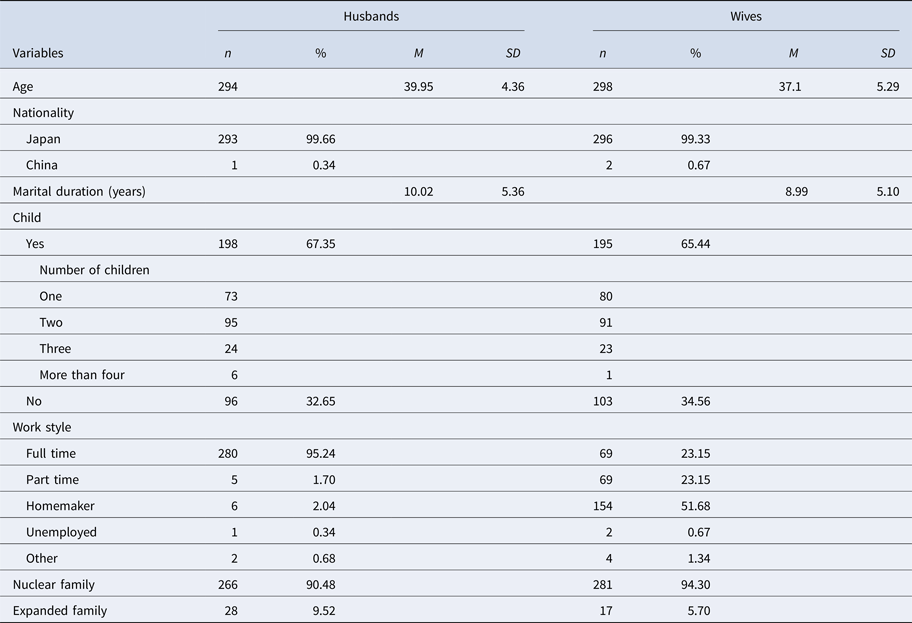
The following demographic data were collected: age, gender, work style, type of work, number of children, family structure type, marital status, and marital duration. The final sample consisted of 592 individuals (294 husbands and 298 wives). The mean age of the husbands was 39.95 years (SD = 4.36) and the mean age of the wives was 37.10 years (SD = 5.29). The average marital duration was 9.5 years (SD = 5.25). Approximately 66.4% of the participants had at least one child. Five hundred and eighty-nine participants stated that their nationality was Japanese and three stated that their nationality was Chinese (see Table 1).
Demographic Data of the Participants

The participants provided information about their family income. Eleven participants (1.9%) had a family income of 2 million yen (about USD20,000) or less, 22 participants (3.7%) had 2–3 million yen, 43 participants had 3–4 million yen, 89 participants had 4–5 million yen, 91 participants had 5–6 million yen, 127 participants had 6–8 million yen, 72 participants had 8–10 million yen, and 52 participants had above 10 million yen as their family income. In addition, 43 participants answered ‘I don't want to answer’ and 42 participants answered ‘I don't know’ to the items.
Measures
MSQ
The MSQ is the English version of the original German version of the Multidimensionaler Stressfragebogen für Paare (MSF-P) scale (Bodenmann, Reference Bodenmann, Ledermann and Bradbury2007). In this study, we used a Japanese version of the MSQ (MSQ-J) that we translated from the English version of the MSQ. Translation of the MSQ into Japanese was permitted by the first author of the original MSF-P (Bodenmann et al., Reference Bodenmann, Ledermann, Blattner and Galluzzo2006). We conducted translation and back-translation to confirm the equivalence of the English version and the Japanese translated version.
The translation procedure was as follows. First, a Japanese clinical psychologist (researcher A), who had published an article in an English language journal, translated the MSQ into Japanese. Second, another Japanese psychologist fluent in both Japanese and English checked the translation. The outcome was the first version of the MSQ-J. Third, a native English speaker translated our version of the MSQ-J from Japanese into English. Fourth, the author of the MSF-P checked the back-translation and commented on the meaning and quality of our translation. Fifth, on the basis of the comments of the author of the MSF-P, researcher A modified our translation of the MSQ-J. Sixth, the translator again translated our modified MSQ-J into English. Seventh, the modified MSQ-J was sent to the author of the MSF-P. After receiving comments from the author, we developed a provisional version of the MSQ-J. Consequently, we concluded that the translation accuracy of the MSQ-J was acceptable for use in the present study.
The following points were considered in the translation of the MSQ-J. First, it was important that the translated scale was appropriate for use in a Japanese cultural context. For example, in the original version of the MSQ, item 5 refers to ‘difficult behaviour of the partner (e.g., smoking, consumption of drugs or alcohol, excessive TV watching or eating, etc.’. As use of drugs is illegal in Japan, the inclusion of the word ‘drugs’ might have affected response variance, and therefore the word was removed. Second, we did not limit the wording of the MSQ-J such that it could be used only with married heterosexual couples. The MSQ is meant to assess intimate relationships, regardless of partner gender and type of relationship. Therefore, we used the Japanese word for ‘partner’ instead of ‘spouse’.
To examine internal stressors, participants were asked: ‘How stressful are the following issues in the relationship between the two of you? The following types of stress are involved with your partner or in the relationship with your partner.’ The items included ‘Differences in opinions from your partner (conflicts, arguments, etc.)’. The participants rated their responses from 1 (not at all) to 4 (very often).
To examine external stressors, participants were asked: ‘How stressful are the following issues outside the relationship between the two of you? The following types of stress and not being involved with your partner or in the relationship with your partner.’ The items included ‘Social relationships (conflicts with neighbours, colleagues, and acquaintances, trouble in participating in activities and gossips)’. The participants rated their responses from 1 (not at all) to 4 (very often).
Neuroticism
Neuroticism scores are positively correlated with the MSQ scores (Merz et al., Reference Merz, Meuwly, Randall and Bodenmann2014). In this study, we used the Neuroticism component of the Japanese version of the Big-Five Scale (Namikawa et al., Reference Namikawa, Tani, Wakita, Kumagai, Nakane and Noguchi2012). This short-form scale was constructed according to item response theory and shows sufficient reliability and validity when compared with the original version of the NEO Five Factor Inventory (FFI). The neuroticism scale consists of five items (e.g., Be discouraged). These items were scored using a scale rating from 1 (very untrue of me) to 6 (very true of me). Higher scores indicate higher levels of neuroticism.
The participants were asked to complete the neuroticism scale at Time 1 only (husbands M = 3.43, SD = 1.55; wives M = 4.19, SD = 1.54). Cronbach's alpha was .96 for husbands and .94 for wives.
Marital satisfaction
Participants completed the Japanese version of the Kansas Marital Satisfaction Scale (KMSS; Schumm et al., Reference Schumm, Paff-Bergen, Hatch, Obiorah, Copeland, Meens and Bugaighis1986; Sugawara & Takuma, Reference Sugawara and Takuma1997). The KMSS comprises three items (e.g., ‘How satisfied are you with your relationship with your wife/husband?’). The KMSS has been found to be highly reliable in studies in the United States, Europe and Asia (Sorokowski et al., Reference Sorokowski, Randall, Groyecka, Frackowiak, Cantarero, Hilpert and Sorokowska2017).
The original KMSS scale consists of a fully anchored 7-point Likert scale. However, the mid-point of the original KMSS scale is ‘mixed’, whereas the mid-point of the Japanese version of the KMSS is ‘neither agree nor disagree’. Because of this difference between the two versions of the scale, we removed the mid-point in the present study. The item scores were averaged to produce a score on a scale ranging from 1 (extremely dissatisfied) to 6 (extremely satisfied). A higher score indicated greater marital satisfaction.
The participants were asked to complete the KMSS at both Time 1 (husbands M = 4.22, SD = 1.24; wives M = 4.12, SD = 1.23) and Time 2 (husbands M = 4.32, SD = 1.24; wives M = 4.18, SD = 1.20). Cronbach's alpha at Time 1 was .97 for husbands and .96 for wives.
Psychological wellbeing
We used the five-item World Health Organisation Well-Being Index (WHO-5) to measure psychological wellbeing. The WHO-5 contains items that are phrased in a positive way and is considered a measure of general wellbeing (Bech, Reference Bech1999; Topp, Ostergaard, Sondergaard, & Bech, Reference Topp, Ostergaard, Sondergaard and Bech2015). The scale has been used for both elderly adults (Awata et al., Reference Awata, Bech, Koizumi, Seki, Kuriyama, Hozawa and Tsuji2007) and married couples (Kurosawa, Kato, & Kamiya, Reference Kurosawa, Kato and Kamiya2015).
The WHO-5 has five items, including ‘I have felt calm and relaxed’. The participants rated how often they experienced each feeling on a scale from 0 (at no time) to 5 (all of the time). A higher score indicates a higher level of wellbeing.
We asked the participants to complete the WHO-5 at both Time 1 (husbands M = 13.33, SD = 6.04; wives M = 12.80, SD = 5.44) and Time 2 (husbands M = 14.14, SD = 5.64; wives M = 12.67, SD = 5.74). Cronbach's alphas were .95 for husbands and .91 for wives.
Physical wellbeing
We used the Public Health Research Foundation Stress Check List (PHPR-SCL) to measure physical wellbeing (Imazu et al., Reference Imazu, Murakami, Kobayashi, Matsuno, Shiihara, Ishihara and Kodama2006). This stress checklist has been validated previously using data from approximately 3,000 adults. The PHPR-SCL has shown high internal consistency and sufficient construct validity. We used the PHPR-SCL subscale for tiredness/physical (body) responses to assess physical wellbeing. The participants rated their responses from 0 (never) to 2 (very often). Higher scores indicate higher levels of tiredness (lower physical wellbeing).
We asked the participants to complete the six items at Time 1 only (husbands M = 5.02, SD = 3.40; wives M = 6.50, SD = 3.11). We found that wives had higher tiredness scores than husbands (t = −5.51, df = 590, p < .001, d = 0.46). Cronbach's alphas were .89 for husbands and .83 for wives.
Results
Two-Factor Structure of the MSQ-J
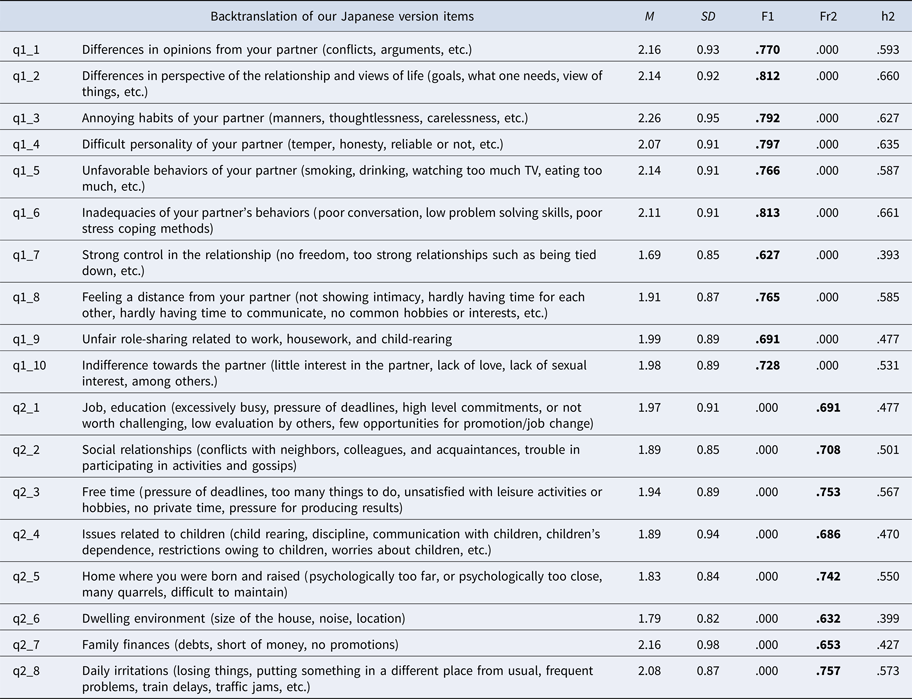
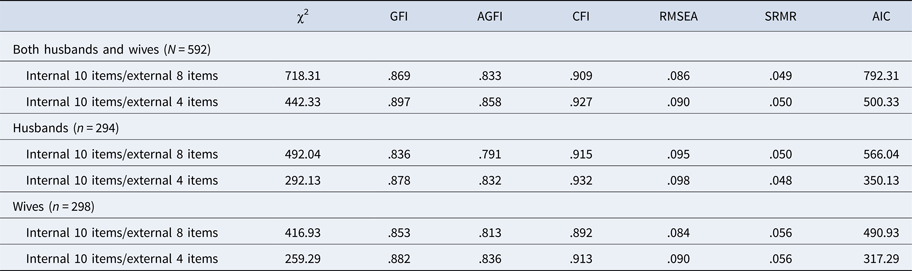
To confirm the two-factor structure of the MSQ-J, we conducted a confirmatory factor analysis using maximum likelihood estimation for all data (data for both husbands and wives). As shown in Table 2, the confirmatory analysis revealed that a two-factor model (10 internal items/8 external items) was statistically acceptable (GFI = .87, AGFI = .83, CFI = .91, RMSEA = .086, SRMSA = .05). A two-factor model (10 internal items/8 external items) was statistically acceptable for husbands (GFI = .84, AGFI = .79, CFI = .92, RMSEA = .095, SRMSA = .05) and for wives (GFI = .85, AGFI = .81, CFI = .89, RMSEA = .084, SRMSA = .06).
Confirmatory Factor Analysis for the MSQ-J (N = 592)

The confirmatory factor analysis confirmed the following factor structure. Factor 1 was constructed from items such as ‘Inadequacies of your partner's behaviours (poor conversation, low problem-solving skills, poor stress-coping methods)’ and ‘Difficult personality of your partner (temper, honesty, reliable or not, etc.)’. As these items were similar to those found for the original version of the MSQ in a previous study (Merz et al., Reference Merz, Meuwly, Randall and Bodenmann2014), we named this factor ‘internal stressors’.
Factor 2 was constructed from items such as ‘Social relationships (conflicts with neighbours, colleagues, and acquaintances, trouble in participating in activities and gossips)’ and ‘Dwelling environment (size of the house, noise, location)’. As these items were similar to those found for the original version of the MSQ in a previous study (Merz et al., Reference Merz, Meuwly, Randall and Bodenmann2014), we named this factor ‘external stressors’.
A previous study found that the eight external stressor items did not have a simple factor structure for wives (Kurosawa, Reference Kurosawa2018a). In the EFA, items 7, 6, 5, and 8 were excluded because the factor loadings for these items were under .40.
We again conducted a confirmatory factor analysis based on the EFA of a previous study (Kurosawa, Reference Kurosawa2018a). A two-factor model based on the EFA results (10 internal items/4 external items) showed better goodness of fit (for husbands: GFI = .88, AGFI = .83, CFI = .93, RMSEA = .098, SRMSA = .05; for wives: GFI = .88, AGFI = .84, CFI = .91, RMSEA = .09, SRMSA = .06) compared with the two-factor model (10 internal items, 8 external items) used by Merz et al. (Reference Merz, Meuwly, Randall and Bodenmann2014). See Table 3.
Summary of Model Fit Indices for the MSQ-J

Note: GFI = goodness-of-fit index, AGFI = adjusted goodness of fit index, CFI = comparative fit index, RMSEA = root mean square error of approximation, SRMR = standardised root mean residual, AIC = Akaike's information criterion
Multiple Group Analysis
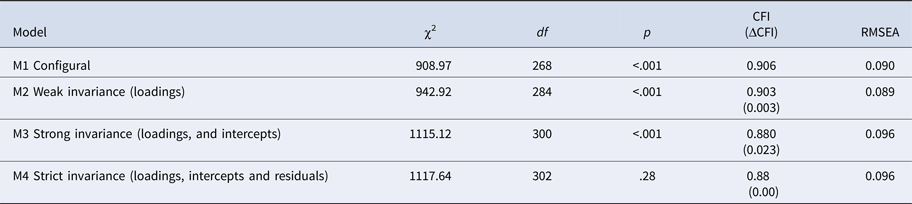
A multiple group analysis was conducted to examine group invariance across the parameters in the measurement structure of the MSQ-J. We followed the guidelines of a previous study (Hirschfeld & von Brachel, Reference Hirschfeld and von Brachel2014) for testing invariance using lavaan. The starting point was an unconstrained (configural) model that was identical across gender; in the constrained model, three conditions (weak, strong, strict) were prepared. Weak invariance indicates that the magnitude of the item loadings are similar across the groups; strong invariance indicates that both the item loadings and the item intercepts are similar across the groups; strict invariance indicates that in addition to the loadings and intercepts, the residual variances are similar across groups (Hirschfeld & von Brachel, Reference Hirschfeld and von Brachel2014).
These four models were compared using analysis of variance (see Table 4). The difference between the configural model (χ2 = 908.97) and the weak model (χ2 = 942.92) was significant, indicating that the measurement structure of the MSQ-J varies as a function of gender.
Series of Model Comparisons

Note: CFI = comparative fit index, RMSEA = root mean square error of approximation.
Associations Between the MSQ-J Scores and Neuroticism, Marital Satisfaction, and Psychological/Physical Wellbeing
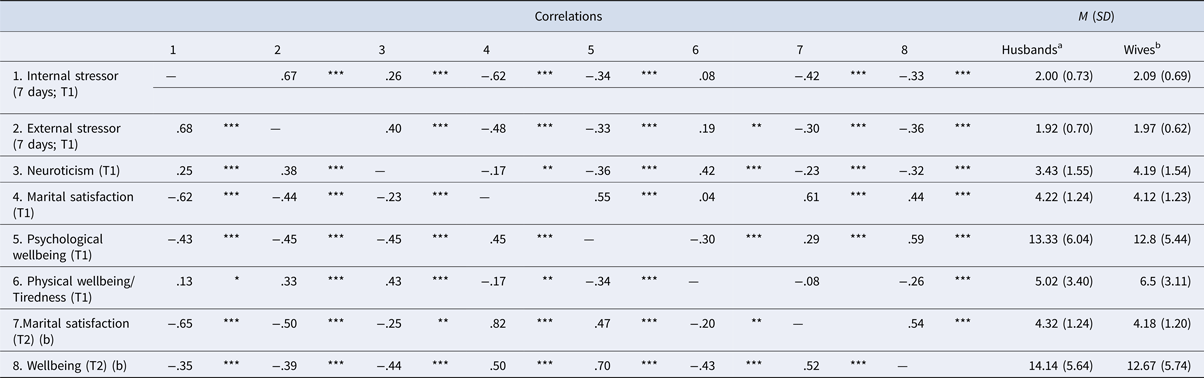
Falconier et al. (Reference Falconier, Nussbeck, Bodenmann, Schneider and Bradbury2015) has proposed that external stressors cannot be considered a psychometric scale, as the measure covers various life domains. Therefore, we mainly focused on internal stressors. Table 5 shows the correlations among the MSQ-J, neuroticism, marital satisfaction, and psychological/physical wellbeing scores. For husbands, acute internal minor stressors were significantly correlated with higher levels of neuroticism (r = .26, p < .001), lower marital satisfaction (r = -.62, p < .001) and lower psychological wellbeing (r = −.34, p < .001). In addition, acute internal minor stressors were correlated with marital satisfaction (r = -.42, p < .001, n = 225) and psychological wellbeing (r = -.33, p < .001, n = 225) one month later. Furthermore, acute external minor stressors were significantly correlated with higher levels of neuroticism (r = .40, p < .001), lower marital satisfaction (r = -.48, p < .001) and lower psychological wellbeing (r = -.33, p < .001).
Zero-Order Correlations of MSQ-J and Other Psychological Constructs

Note: Correlations of variables measured in husbands appear above the diagonal. Correlations of variables measured in wives appear below the diagonal. a225 husbands completed the questionnaires at both Time 1 and Time 2. b206 wives completed the questionnaires at both Time 1 and Time 2.
*p < .05, **p < .01, ***p < .001.
For wives, acute internal minor stressors were significantly correlated with higher levels of neuroticism (r = .25, p < .001), lower marital satisfaction (r = -.62, p < .001), lower psychological wellbeing (r = -.43, p < .001) and higher tiredness levels (r = .13, p = .026). In addition, acute internal minor stressors were correlated with lower marital satisfaction (r = -.65, p < .001, n = 206) and lower psychological wellbeing (r = -.35, p < .001, n = 206) one month later. Furthermore, acute external minor stressors were significantly correlated with higher neuroticism (r = .38, p < .001), lower marital satisfaction (r = -.44, p < .001), lower psychological wellbeing (r = -.45, p < .001) and higher tiredness levels (r = .33, p < .01).
We found that acute internal stressors (those that occurred in the last 7 days) were strongly positively correlated with chronic internal stressors (those that occurred in the last year; for husbands, r = .93, p < .001; for wives, r = .89, p < .001). We found a similar tendency for acute external stressors and chronic external stressors (for husbands, r = .96, p < .001; for wives, r = .89, p < .001).
Reliability
For husbands, Cronbach's alpha for internal stressors (10 items) was .949 and that for external stressors (eight items) was .922. To examine the test–retest reliability, we calculated the correlation between data collected at Time 1 and Time 2. There were strong positive correlations for scores at the two time points for acute internal stressors (r = .64, p < .001, n = 225), chronic internal stressors (r = .67, p < .001, n = 225), acute external stressors (r = .58, p < .001, n = 225) and chronic external stressors (r = .59, p < .001, n = 225).
For wives, Cronbach's alpha for internal stressors (10 items) was .913. Cronbach's alpha for external stressors was .844 when there were eight items and .790 when there were four items. There were strong positive correlations for scores at the two time points on acute internal stressors (r = .63, p < .001, n = 206), chronic internal stressors (r = .72, p < .001, n = 206), acute external stressors (r = 60, p < .001, n = 206) and chronic external stressors (r = 62, p < .001, n = 206).
Comparison of the MSQ-J Scores By Socioeconomic Situation and Family Structure
We found no significant differences in acute internal stressors for participants from different socioeconomic backgrounds. For example, there was no significant difference in internal stressors (t = 0.13, df = 585, p = .90, Cohen's d = 0.01) between working participants (M = 2.05, SD = 0.72, n = 423) and non-working participants (M = 2.04, SD = 0.69, n = 164).
In contrast, whether the participants had children or not had a significant effect on scores for acute internal stressors. The participants with one child or more (M = 2.11, SD = 0.72, n = 393) experienced stronger internal stressors (t = 3.54, df = 590, p < .001, d = 0.31) than participants without children (M = 1.90, SD = 0.65, n = 199).
Discussion
This study aimed to validate the Japanese version of the MSQ for couples. To validate the MSQ-J, we specified two factors from a previous study (Merz et al., Reference Merz, Meuwly, Randall and Bodenmann2014) and evaluated the construct validity and reliability of these factors. We found two subscales that we identified as internal stressors and external stressors. However, the model fit improved when we removed the external stressor items, on the basis of the factor structure from an EFA in a previous study (Kurosawa, Reference Kurosawa2018a).
The multiple group analysis indicated that the MSQ-J showed configural invariance and did not show measurement invariance across gender. That is, although the two-factor structure was common to both husbands and wives, the item loadings differed significantly by gender.
Internal Stressors
Our findings indicated that higher internal stressor scores were correlated with higher neuroticism and lower marital satisfaction scores. These findings are similar to the findings of previous studies (Falconier et al., Reference Falconier, Nussbeck, Bodenmann, Schneider and Bradbury2015; Merz et al., Reference Merz, Meuwly, Randall and Bodenmann2014). Thus, the internal stressor factor in the MSQ-J for Japanese participants is similar to that found in previous European studies.
Our data demonstrate the important role of internal stressors in intimate relationships. Stressors in intimate relationships influence negative psychological outcomes such as depression (Whisman, Reference Whisman2001). The 10 items that we identified may be helpful as components of psychological assessment for practitioners and researchers investigating stressors in intimate relationships. Family therapists may benefit from paying special attention to internal stressors, because these are associated with lower marital satisfaction and decreased psychological wellbeing.
We found that individuals with one or more children experienced more internal stressors. Research on coparenting has shown that two or more adults work together to raise a child for whom they share responsibility (e.g., Talbot & McHale, Reference Talbot and McHale2004). Childrearing is a shared task in intimate relationships and so can highlight conflicts between partners as they work together. Therefore, having a child or children is likely to increase internal stressors.
External Stressors
External stressors were also associated with higher neuroticism and lower marital satisfaction, and these findings were consistent with previous research (e.g., Merz et al., Reference Merz, Meuwly, Randall and Bodenmann2014). Our confirmatory factor analysis indicated that eight items loaded on one factor. We also found that the external stressors factor showed acceptable construct validity.
However, a previous MSQ study (Merz et al., Reference Merz, Meuwly, Randall and Bodenmann2014) reported a relatively low Cronbach's alpha for external stressors (α = .66). In addition, there was a strong positive factor correlation between external stressors and internal stressors in our study (r = .73, N = 592). A recent study by Falconier et al. (Reference Falconier, Nussbeck, Bodenmann, Schneider and Bradbury2015) did not calculate Cronbach's alpha for external stressors. The researchers proposed that external stressors could not be considered a psychometric scale because the measure covers various life domains (Falconier et al., Reference Falconier, Nussbeck, Bodenmann, Schneider and Bradbury2015). Although our findings suggest that the external stressors factor had acceptable validity, we cannot conclude that the construct validity is good.
Our findings regarding external stressors might reflect differences in life stage and social situation of the participants. That is, external stressors might be considered part of their life ‘context’. In summary, the external stressors may vary according to differences in participant characteristics.
Contribution
The first contribution of this study is an assessment of similarities and differences between these findings and those of previous studies (e.g., Falconier et al., Reference Falconier, Nussbeck, Bodenmann, Schneider and Bradbury2015; Merz et al., Reference Merz, Meuwly, Randall and Bodenmann2014). For example, although the duration of stress (acute vs. chronic) is theoretically important, we found quite high correlations between acute and chronic stress. Our findings indicate that these two aspects were not independent. Our second contribution relates to international comparative research. We confirmed the two-factor structure of the MSQ-J using multiple group confirmatory factor analysis. In addition, through the translation and back-translation process, we established equivalence between the English and the Japanese translated versions of the MSQ. As the original MSQ was written in German, our findings increase the possibilities for international comparative research on stressors in intimate relationships; comparisons can now be made between data from Japan, the United States, and Europe. Third, a comparison of MSQ-J scores by socioeconomic situation showed that having children affected the level of internal stressors.
Implications for Future Research
First, the MSQ was constructed to measure stressors within and outside intimate relationships. Although the MSQ has generally been used to assess stressors in heterosexual relationships, a recent MSQ study focused on the daily stress and relationship satisfaction of individuals in same-sex relationships (Totenhagen et al., Reference Totenhagen, Randall, Cooper, Tao and Walsh2016). Therefore, the MSQ-J could also be used in future research on other intimate relationships.
The second implication of our validation of the MSQ-J is that this scale may be able to predict maladaptive marital life events. A recent MSQ study examined the effect of minor stressors on major stressors using logistic regression analysis (Kurosawa, Reference Kurosawa2018b). The analysis revealed that lower marital satisfaction and higher internal stressors (e.g., inadequacies of partner's behaviours) in a couple predicted unfaithfulness in that couple. It may be possible to predict other types of maladaptive marital life events (e.g., domestic violence) using the MSQ-J.
Limitations
Our study has several limitations. First, the data were not paired. We used individual data to examine the validity of the MSQ-J and found an association between marital satisfaction and psychological wellbeing. A previous study using paired data showed a positive correlation between husbands and their wives on internal stressors, but not on external stressors (Bodenmann et al., Reference Bodenmann, Ledermann and Bradbury2007). The collection and analysis of paired data would be useful to further examine the validity of the MSQ-J, although such paired data has some disadvantages, as discussed in the introduction. Second, we focused on heterosexual couples who were legally married. Future research should include other intimate relationships, such as homosexual couples and common-law marriages. Third, we did not examine coping behaviour. Coping and stress management may be useful targets for intervention programs designed to prevent and treat relationship distress (Bodenmann et al., Reference Bodenmann, Ledermann and Bradbury2007). Future studies should examine coping factors, such as individual coping (Kramer, Ceschi, Van der Linden, & Bodenmann, Reference Kramer, Ceschi, Van der Linden and Bodenmann2005), relationship-focused coping (Coyne & Smith, Reference Coyne and Smith1991), and dyadic coping (Bodenmann, Meuwly, & Kayser, Reference Bodenmann, Meuwly and Kayser2011). Fourth, we did not find ideal model fit values. For example, the AGFI scores were not over 0.95, and the RMSEA scores were near to 0.10 in some analyses. However, we could not determine whether these were because of the characteristics of the MSQ-J, the characteristics of our sample, or cultural characteristics. Further research on this issue is required.
Conclusion
Based on the relational framework, we confirmed the two-factor structure of the Japanese version of the MSQ across gender. The two main factors were internal stressors and external stressors. The internal stressors factor showed sufficient validity and reliability and demonstrated its suitability for measuring marital stressors in both husbands and wives. However, we suggest that the external stressors factor should be split to reflect scoring differences in couples from various backgrounds and at different stages of life.
Ethical Standards
The authors assert that all procedures contributing to this work comply with the ethical standards of relevant national and institutional committees on human experimentation and with the Helsinki Declaration of 1975, as revised in 2008. This study was conducted after receiving approval from the ethical review board at the university with which the first author is affiliated (approval number: 2017-001).
Supplementary material
To view supplementary material for this article, please visit https://doi.org/10.1017/jrr.2018.15.
Acknowledgments
We are grateful to Dr Guy Bodenmann for his permission to translate the MSQ and his insightful comments. We also thank Dr Kentaro Komura and Dr Keiko Ejiri for their advice regarding statistical analysis, and Sydney Koke, MFA, and Diane Williams from Edanz Group (www.edanzediting.com/ac) for editing a draft of this manuscript.
Financial Support
This work was supported by JSPS KAKENHI Grant Numbers 16K17315 and 17K04338.
Conflict of Interest
None.