Introduction
When Staiger (Reference Staiger2002) liberated the genera of the lichen family Graphidaceae Dumort from the traditional, artificial concepts of Zahlbruckner, she placed the genus Graphina Müll. Arg. into synonymy with Thalloloma Trevis., because at that time the type species of Graphina was considered to be G. anguina (Mont.) Müll. Arg. (= Thalloloma anguinum (Mont.) Trevis.). Subsequently, Lücking et al. (Reference Lücking, Kalb, Staiger and McNeill2007) discovered that due to a previously overlooked bibliographic error, G. anguina was not actually included in the protologue of Graphina. Therefore, Lücking et al. (Reference Lücking, Kalb, Staiger and McNeill2007) selected another name, G. puiggarii Müll. Arg., to represent the type of the genus. This change in typification rendered Graphina a synonym of Graphis Ach. rather than of Thalloloma.
While the status of Graphina as a synonym of Graphis could be resolved by careful bibliographic analysis, the impact at the species level of this and other recent changes in generic nomenclature and circumscription have been considerably more problematic. This is largely because genera in the Graphidaceae were historically defined by phylogenetically homoplasious characters such as ascospore colour and septation. Such genera often included disparate groups of unrelated taxa that have subsequently been moved into other genera on the basis of more informative characters such as apothecial anatomy. Indeed, in the case of Graphina, while many species can simply be returned or transferred to Graphis, a large number of others require more thorough evaluation to establish their correct placement in the current generic framework of Graphidaceae (sensu Staiger Reference Staiger2002).
Following the publication of Staiger (Reference Staiger2002), lichenologists throughout the world began the process of reorganizing the taxa present in their geographical regions to fit Staiger's new generic system (e.g., Nakanishi et al. Reference Nakanishi, Kashiwadani and Moon2003; Archer Reference Archer2006, Reference Archer2007). The second author (JCL) has begun this task in North America (Lendemer & Yahr Reference Lendemer and Yahr2004; Lendemer Reference Lendemer2007; Lendemer & Knudsen Reference Lendemer and Knudsen2008) by evaluating taxa that had been treated in Graphina in the past (Harris Reference Harris1990, Reference Harris1995). As part of our continuing studies of North American lichens including Graphidaceae, we have attempted to resolve the status of all species of Graphina that have been reported from North America excluding Mexico (hereafter referred to as North America for consistency with standard usage in North American lichenology; see Esslinger Reference Esslinger2008). Despite the fact that Graphina was placed into synonymy seven years ago, the genus persists on the North American Lichen Checklist (Esslinger Reference Esslinger2008). This is in part because the status of some species has yet to be revisited. In the process of revising these species, we developed treatments for North American members of some of the genera to which they properly belong under current generic concepts. The results of our study are presented here in the form of an updated ‘checklist’ of North American Graphina and corresponding treatments of Acanthothecis Clem., Carbacanthographis Staiger & Kalb, and Diorygma Eschw. Species of Graphina that have already been placed in (or returned to) Graphis are not treated in detail here in order to prevent duplication of the efforts of others (e.g., Lücking et al. Reference Lücking, Chaves, Sipman, Umaña and Aptroot2008). Comparatively few of the North American species previously assigned to Graphina require placement in Fissurina Fée. Those that do belong in Fissurina will be treated in a future publication on this genus in eastern North America.
Materials and Methods
All herbarium materials for this study are housed at NY (except some types and additional specimens that were loaned to NY or seen elsewhere). Because many of the names discussed here have already been treated by Kalb et al. (Reference Kalb, Staiger and Elix2004), Staiger (Reference Staiger2002), and Staiger & Kalb (Reference Staiger and Kalb1999), we do not provide full synonymies and type specimen citations unless the name has not previously been treated or the type specimen is particularly relevant to the discussion. Specimens were studied using a Bausch & Lomb StereoZoom 7 dissecting microscope. Sections of apothecia and thalli were cut by hand, mounted in water, and examined with an Olympus BH-2 compound microscope prior to the application of reagents (I, KOH, C, PD). Images were captured using a Nikon CoolPix990 digital camera. Illustrations were prepared using Adobe Photoshop (v. 7.0). In addition to spot tests, specimens were subjected to thin-layer chromatography (TLC) using solvents A and/or C following the methods of Culberson & Kristinsson (Reference Culberson and Kristinsson1970). Terminology follows Lücking & Rivas Plata (Reference Lücking and RivasPlata2008), Kalb et al. (Reference Kalb, Staiger and Elix2004), Staiger & Kalb (Reference Staiger and Kalb1999) and Staiger (Reference Staiger2002). Newly proposed taxonomic names and combinations have been deposited into MycoBank.
Taxonomy
Disposal of the remaining North American species of Graphina Müll. Arg
Below, we provide a list of the species of Graphina that are still included in the current North American Lichen Checklist (Esslinger Reference Esslinger2008). We recommend or note placement in other genera following the modern concepts of the Graphidaceae employed by Staiger (Reference Staiger2002).
1. Graphina acharii (Fée) Müll. Arg.
Harris (Reference Harris1990) questioned the occurrence of Graphina acharii in North America because material that he examined named as such actually represented G. xylophaga (= Graphis xylophaga (R. C. Harris) Lendemer). During the 2009 Tuckerman Workshop in southern Florida, the second author (JCL) and several other participants collected material that may be referable to G. acharii, however the identity remains uncertain because the collections lack ascospores. If Graphina acharii is indeed present in North America, it should be treated under the name Graphis acharii Fée.
2. Graphina anguina (Mont.) Müll. Arg.
Following Staiger (Reference Staiger2002), this taxon is treated in Thalloloma Trevis. as T. anguinum (Mont.) Trevis.
3. Graphina antillarum (Vain.) Zahlbr.
Following Staiger (Reference Staiger2002), this taxon is treated in Graphis as G. antillarum Vain.
4. Graphina babingtonii (Mont.) Zahlbr.
According to Staiger (Reference Staiger2002), Graphina babingtonii is a synonym of Fissurina insculpta Mont. We suspect, however, that North American reports of this species represent misidentifications.
5. Graphina colliculosa (Mont.) Hale
Following Staiger (Reference Staiger2002), this taxon is treated in Platythecium Staiger as P. collicuosum (Mont.) Staiger.
6. Graphina floridana (Tuck.) R. C. Harris
Following Lendemer & Knudsen (Reference Lendemer and Knudsen2008), this taxon is treated in Platythecium as P. floridanum (Tuck.) Lendemer.
7. Graphina leuconephela (Nyl.) Zahlbr.
Following Staiger (Reference Staiger2002), this taxon is treated in Fissurina as F. leuconephala Nyl.
8. Graphina parilis (Kremp.) Müll. Arg.
Following Lücking et al. (Reference Lücking and RivasPlata2008), this taxon is treated in Graphis as G. parilis Kremp.
9. Graphina peplophora M. Wirth & Hale
The thick greenish corticate thallus and large elongate lirellae with white crumbling margins make this species fairly conspicuous in the field. However, although Graphina peplophora itself is easily recognized, its generic affinities are somewhat harder to determine. While it possesses several characters that suggest placement in Acanthothecis (e.g., large ascospores and a striate exciple), it differs from other species currently placed in that genus in only occasionally having ornamented paraphyses (versus widespread ornamentation on paraphyses and generally also periphysoids in Acanthothecis). Although the species was included in a phylogenetic analysis of Graphidaceae (Staiger et al. Reference Staiger, Kalb and Grube2006), its exact position in relation to Acanthothecis (represented only by A. aurantiaca) was unresolved. However, data presented by Staiger et al. (Reference Staiger, Kalb and Grube2006) did show that G. peplophora is unrelated to the strongly supported clade containing Fissurina. We have not examined the voucher ourselves and thus cannot confirm its identification. While we are not fully confident that this taxon belongs in Acanthothecis, it cannot remain in Graphina and probably does not belong in Fissurina. Thus, at present, it seems best treated in Acanthothecis, and we make the combination in the following section. Clearly, this and other problematic species should be included in future molecular studies to help to determine the generic limits of Acanthothecis.
10. Graphina platyleuca (Nyl.) Zahlbr.
Following Kalb et al. (Reference Kalb, Staiger and Elix2004), this taxon is treated as a synonym of Diorygma pruinosum (Ehrh.) Kalb, Staiger & Elix. For notes on the occurrence of this taxon in North America, refer to the Diorygma section of this paper.
11. Graphina sophisticascens (Nyl.) Zahlbr.
This taxon should be treated in Graphis as G. sophisticascens Nyl.
12. Graphina subnitida (Nyl.) Zahlbr.
It is likely that reports of this taxon from North America are based on misidentifications. If this species is indeed present in North America, it should be treated under the name Fissurina subnitida (Nyl.) Nyl. following Staiger (Reference Staiger2002).
13. Graphina substriatula (Nyl.) Zahlbr.
We have not seen any material of this species during our studies of NY specimens. Following Staiger (Reference Staiger2002), this taxon is treated in the genus Glyphis Ach. as G. substriatula (Nyl.) Staiger.
14. Graphina subvirginalis (Nyl.) Müll. Arg.
We treat Graphina subvirginalis as a species of Acanthothecis under the name A. mosquitensis (Tuck.) E. Tripp & Lendemer (see the Acanthothecis section of this paper).
15. Graphina xylophaga R. C. Harris
Following Lendemer & Knudsen (Reference Lendemer and Knudsen2008), this taxon is treated in Graphis under the name G. xylophaga (R.C. Harris) Lendemer.
The genus Acanthothecis in North America
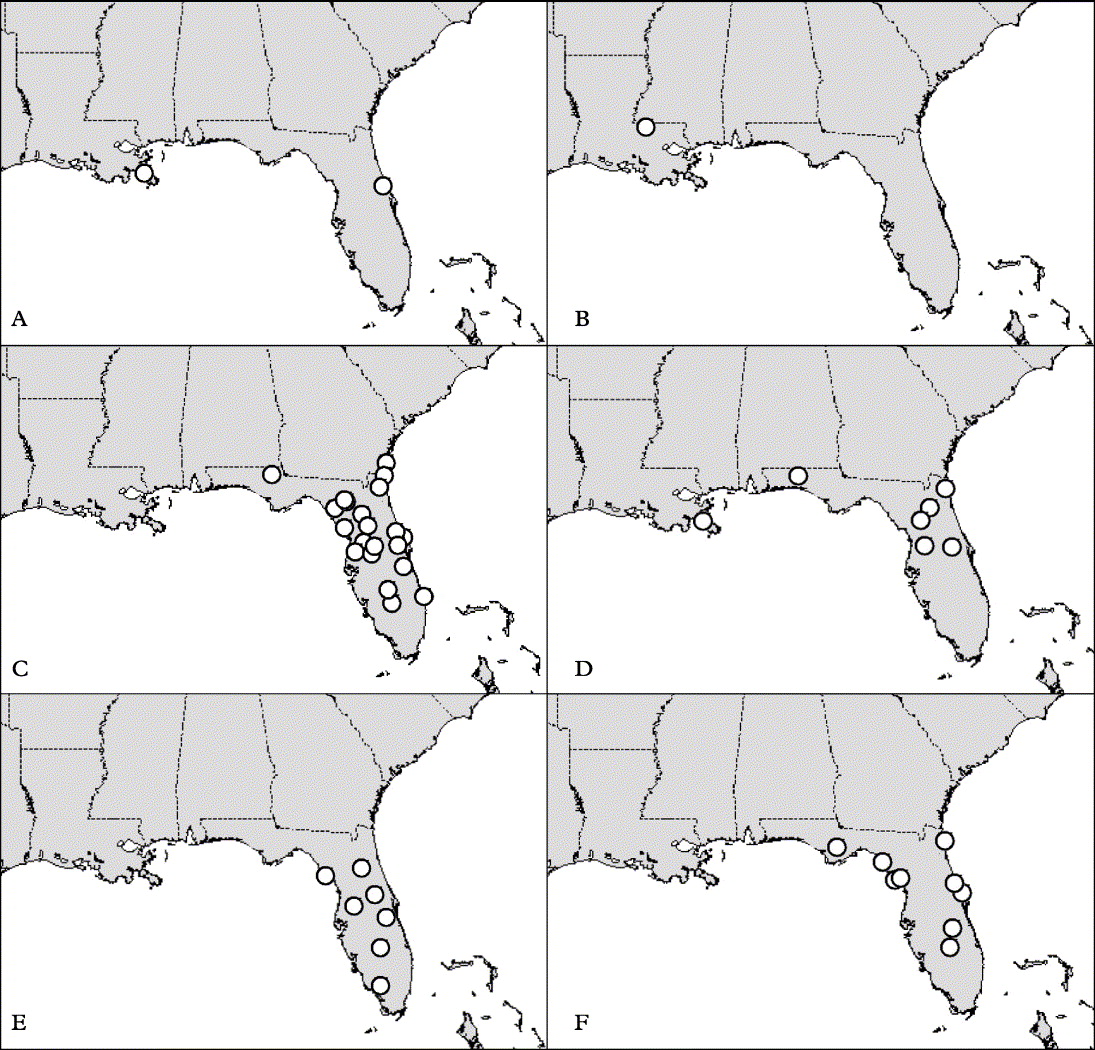
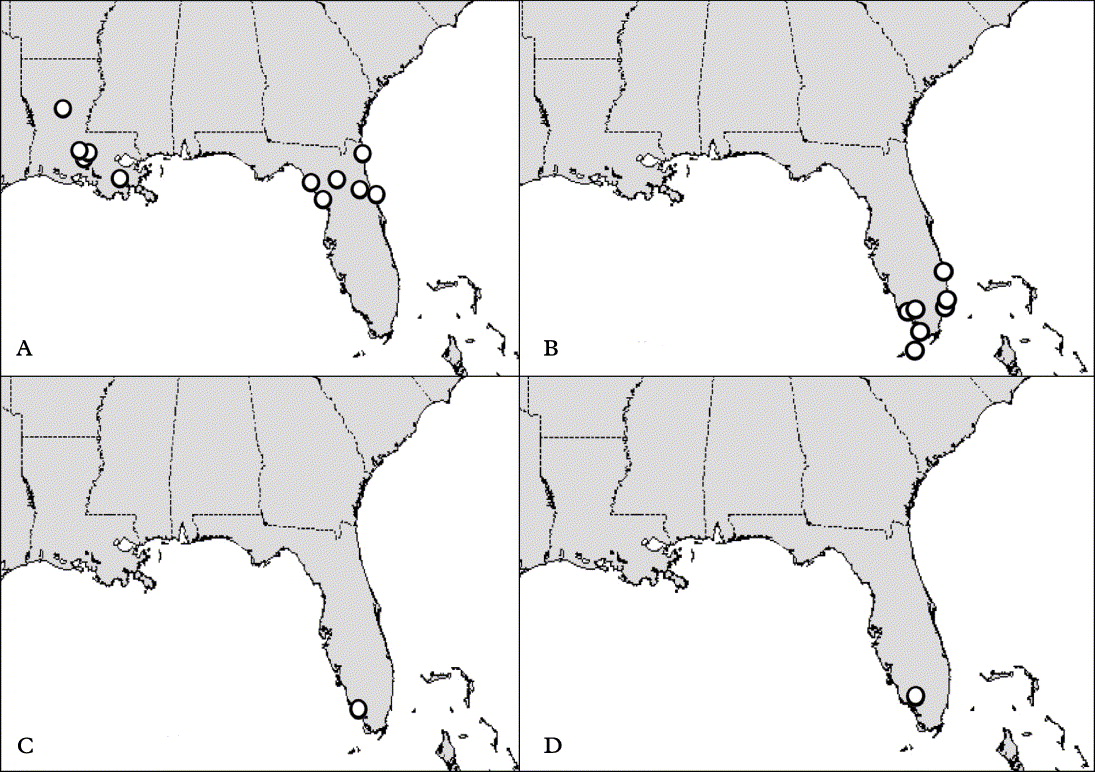
Most species of Acanthothecis are uncommon in North America. The genus can be recognized by the presence of minute spines on apical portions of the paraphyses (and generally also on periphysoids) and by having lirellae that lack excipular cabonization. Here, we recognize six species as occurring in North America (see Fig. 2 for distributions): Acanthothecis aurantiaca, A. gracilis, A. leucopepla, A. mosquitensis, A. peplophora and A. poitaeoides. We make several necessary combinations below. All taxa treated here produce norstictic acid except A. abaphoides that produces protocetraric acid, and A. peplophora that can (but does not always) produce constictic or salazinic acids.
Key to North American Acanthothecis
1 Lirellae with crumbling white margins; few paraphyses with apical ornamentation; ascospores often absent; constictic acid (K+ yellowish) or salazinic acid (K+ red) often present ... A. peplophora
Lirellae not as above; paraphyses richly ornamented; ascospores present or absent; norstictic acid (K+ yellow turning red) or protocetraric acid (K+ yellow-brown) present ... 2
2(1) Ascospores transversely septate ... 3
Ascospores submuriform or muriform ... 4
3(2) Spores 45–87 × 6·6–11 μm ... A. poitaeoides
Spores 30–45(–50) × 5–7·5 μm ... A. aurantiaca
4(2) Spores < 40 μm long (20–32 × 6–8 μm) ... A. gracilis
Spores ≥ 40 μm long ... 5
5(4) Spores < 86 μm (46–85 × 9–17 μm); exciple not striate; norstictic acid present (K+ yellow turning red, producing red crystals) ... A. mosquitensis
Spores ≥ 86 μm (88–171 × 13–30 μm); exciple striate; protocetraric acid present (K+ yellow-brown) ... A. leucopepla
Acanthothecis aurantiaca (Müll. Arg.) Staiger & Kalb
Biblioth. Lichenol. 85: 77. 2002.—Phaeographis aurantiaca Müll. Arg., Mém. Soc. Phys. Genève 29: 28 (1887); type: Jamaica, sine col. and date, (G—holotype, n.v.).
Acanthothecis intertexta (Müll. Arg.) Staiger & Kalb, Mycotaxon 73: 103 (1999).—Graphina intertexta (Müll. Arg.) R. C. Harris, Some Florida Lichens, 14 (1990).— Graphis intertexta Müll. Arg., Bull. Herb. Boissier 3: 45 (1895); type: USA, Louisiana, [Plaquemines Parish], Point à la Hache, Langlois [not Eckfeldt] 231 (G—holotype, n.v.; PH—isotype!).
Prior to this study, the only confirmed record of Acanthothecis aurantiaca in North America was that of the type collection of Graphis intertexta from Louisiana. While revising the original material of Graphis mosquitensis Tuck., we discovered that two specimens (cited below) Tuckerman had identified as G. mosquitensis instead represent A. aurantiaca. As discussed below, the lectotype of G. mosquitensis represents a separate taxon with muriform ascospores. Our spore measurements in the key are taken from Staiger & Kalb (Reference Staiger and Kalb1999). More collections of this species should be sought in Louisiana and the coastal plain of surrounding states. A potential isotype of G. intertexta at NY proved to represent A. subvirginalis. See Staiger & Kalb (Reference Staiger and Kalb1999) for illustrations of A. aurantiaca.
Additional specimens examined. USA: Florida: sine loc., sine date, Mead s. n. (NY-HIGGINSON #1264); Volusia Co., New Smyrna, sine date, Hawks s. n. (FH-TUCK #3396 [HUH-barcode 0029867]).
Acanthothecis gracilis Staiger & Kalb
Mycotaxon, 73: 99 (1999); type: USA, Louisiana, Baton Rouge, Baird Drive, Tucker 29368 (hb. Kalb—holotype, n.v.).
The only confirmed record of A. gracilis in North America is that of the type collection, which we have not seen. As such, our spore measurements are taken from Staiger & Kalb (Reference Staiger and Kalb1999). More collections of this species as well as of A. aurantiaca should be sought in the south-eastern coastal plain of the United States.
Acanthothecis leucopepla (Tuck.) E. Tripp & Lendemer, comb. nov
MycoBank No. 514006
Graphis leucopepla Tuck. N. Amer. Lich., 2: 126 (1888); type: USA, Florida, Wilson 56. (FH-TUCK #3396 [HUH barcode 259843]—holotype!); epitype: USA, Florida, without date, Calkins 102 (NY [barcode 1046992]- selected here!).
Acanthothecis abaphoides (Nyl.) Staiger & Kalb, Mycotaxon 73: 93 (1999).—Graphina abaphoides (Nyl.) Müll. Arg., Bull. Herb. Boissier 3: 46 (1895).—Graphis abaphoides Nyl. in Eckfeldt, Bull. Torrey Bot. Club 16: 105 (1889); type: USA, Florida, Jacksonville, on Persea, Eckfeldt & Calkins 107 (H-NYL—holotype!).
Kalb et al. (Reference Kalb, Staiger and Elix2004) discussed the problematic nature of Graphis leucopepla Tuck. Because of the presence of apically ornamented paraphyses, it is clear that this taxon should be transferred to Acanthothecis. As was noted by Staiger & Kalb (Reference Staiger and Kalb1999), the type material of Graphis leucopepla lacks mature ascospores but is otherwise chemically and morphologically identical to the taxon that has been recognized as Acanthothecis abaphoides. We have reviewed all of the available, pertinent material at NY and found no North American taxon other than A. abaphoides that shares the combination of characters possessed by the type of G. leucopepela (i.e., protocetraric acid, striate exciple, and large spores). Thus, there is strong evidence that the type of G. leucopepla is conspecific with A. abaphoides. In the interest of providing nomenclatural stability, we have chosen to epitypify the name that has priority with a fertile specimen possessing mature ascospores from the type locality, and to transfer it to Acanthothecis.
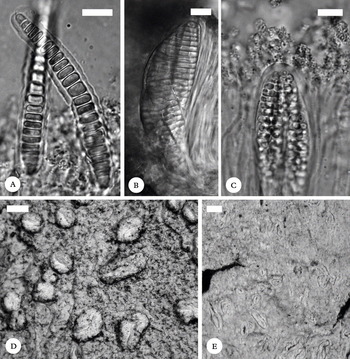
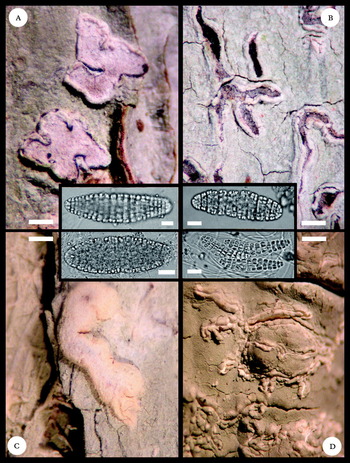
Acanthothecis leucopepla is easily distinguished from other North American members of the genus by its striate exciple, production of protocetraric acid, and, when fertile, by having the largest spores of all six species. Unfortunately, most material from south-eastern North America lacks mature ascospores and as such, we have relied upon the unique combination (among North American taxa) of chemistry and non-carbonized striate exciples for routine identification. A similar species known from Mexico (but not yet from the United States) with protocetraric acid, A. hololeucoides (Nyl.) Staiger & Kalb, is distinguished from A. leucopepla by its smaller ascospores [67–96 × 12–19 μm fide Staiger & Kalb (Reference Staiger and Kalb1999)]. The thallus and lirellae of A. leucopepla are shown in Fig. 1D.
Characteristics of North American species of Acanthothecis. A, transversely septate ascospore of A. poitaeoides (Tripp & Deregibus 268); B, muriform ascospores of A. mosquitensis (Harris 29267); C, ornamented paraphyses tips in A. mosquitensis (Harris 29267); D, thallus and lirellae of A. leucopepla (Harris 29087); E, thallus and lirellae of A. poitaeoides (Harris 37038). Scales: A – C = 10 μm, D & E = 0·5 mm.

Geographical distributions of species of North American Acanthothecis (USA localities only). A, A. aurantica; B, A. gracilis; C, A. leucopepla; D, A. mosquitensis; E, A. peplophora; F, A. poitaeoides.
Additional specimens examined. USA: Florida: sine loc., 1887, Calkins 43; Clay Co., Gold Head Branch State Park, 1992, Harris 29058, 29072, 29087; Duval Co., Big Talbot Island State Park, 1987, Harris 21218, 21232; Lake Co., Ocala National Forest, 1988, Harris 23558; Marion Co., Ocala National Forest, 1989, Harris 23825.
Acanthothecis mosquitensis (Tuck.) E. Tripp & Lendemer, comb nov
MycoBank No. 514007
Graphis mosquitensis Tuck., N. Amer. Lich. 2: 126 (1888); type: USA, Florida, St. Augustine, Sprague s. n. (FH-TUCK #3396 [HUH barcode 259844]—lectotype! [designated in Kalb et al. Reference Kalb, Staiger and Elix2004]); epitype: USA., Florida, Duval Co., Big Talbot Island State Park, c. 0·7 mile S of northern boundary of park, coastal oak scrub, on branch of Lyonia ferruginea, 1987, W. R. Buck 15511 (NY—selected here!).
Graphina subvirginalis (Nyl.) Müll. Arg., Bull. Herb. Boissier 3: 47 (1895).—Graphis subvirginalis Nyl. in Eckfeldt, Bull. Torrey Bot. Club 16: 106 (1889); type: USA, Florida, Duval Co., Jacksonville, Calkins 217 (H-NYL 6851—holotype!).
Like Graphis leucopepla, Kalb et al. (Reference Kalb, Staiger and Elix2004) discussed the problematic nature of Graphis mosquitensis Tuck. Because of the presence of apically ornamented paraphyses, it is clear that Graphis mosquitensis should be transferred to Acanthothecis. However, ascribing the type specimen to a particular species has been difficult owing to the presence of only immature ascospores in the lectotype (Harris Reference Harris1990; Kalb et al. Reference Kalb, Staiger and Elix2004). We re-examined the lectotype and, like other authors, found only immature spores. These ascospores were identical in size and shape to those of mature spores illustrated here (Fig. 1B) but had transverse septa developed only in the central portions and non-septate regions at either end. The ascospores found in the lectotype of G. mosquitensis are typical of those in the early stages of development of a muriform ascospore (see Kirk et al. Reference Kirk, Cannon, David and Stalpers2001, fig. 33). While the transverse septation of the immature spores in the G. mosquitensis lectotype would at first seem to align the taxon with A. aurantiaca or A. poitaeoides, the width of its spores lies outside the range of both of the latter taxa. Thus, we concluded that the type of G. mosquitensis would have had muriform spores (cf. Fig. 1B) if the spores had reached maturity, as would have Nylander (Reference Nylander1862Footnote 1), the first to discuss how to determine when ascospores are mature.
We examined numerous other North American collections of Acanthothecis and have determined that the lectotype of Graphis mosquitensis is almost certainly conspecific with the holotype of Graphina subvirginalis. While it is true that only immature ascospores are present in the lectotype of Graphis mosquitensis, these ascospores are not easily confused with those of other Acanthothecis species whose ascospores are transverselyseptate at maturity; instead, they are identical to the immature, transversely septate ascospores we have observed in freshly collectedspecimens of Graphina subvirginalis, whose mature ascospores are muriform. No other species of Acanthothecis with muriform asco spores, a non-striate exciple, and norstictic acid is known from North America. Therefore, in an attempt to prevent any future taxonomic ambiguity, we select an epitype for Graphis mosquitensis that has muriform spores at maturity. Based on the presence of ornamented paraphyses tips (Fig. 1C), Graphis mosquitensis should be transferred to Acanthothecis, and we provide the new combination above.
This taxon was only recently recognized as distinct, mainly because the name Graphina subvirginalis has a somewhat complex history of usage in North America. Originally, Harris (Reference Harris1990) treated Graphis intertexta Müll. Arg. (under the name Graphina intertexta (Müll. Arg.) R. C. Harris) and Graphina subvirginalis as distinct taxa with muriform ascospores that differed in ascospore size and number per ascus. Subsequent study by Harris (Reference Harris1995) led to the recognition that Graphina subvirginalis sensu Harris (Reference Harris1990) was not actually conspecific with the type of that name and that Graphina intertexta sensu Harris (Reference Harris1990) was conspecific with the type of Graphina subvirginalis. Harris (Reference Harris1995) did not re-examine the holotype of Graphis intertexta but assumed it to be conspecific with Graphina subvirginalis based on the presence of muriform ascospores in a probable isotype of Graphis intertexta at NY. In conjunction with their revision of Acanthothecis, Staiger & Kalb (Reference Staiger and Kalb1999) revised the holotype of Graphis intertexta and discovered that it in fact had short, transversely septate ascospores and was thus synonymous with A. aurantiaca. We subsequently revised the potential isotype at NY and found that it is not actually part of the type collection of Graphis intertexta (it is Langlois 1052 not Langlois 231), but represents A. mosquitensis with muriform ascospores.
Additional specimens examined. USA: Florida: Citrus Co., Withlacoochee State Forest, Citrus Wildlife Management Area, 1993, Buck 24506; Clay Co., Gold Head Branch State Park, 1992, Harris 29267; Santa Rosa Co., Blackwater River State Forest, 1993, Buck 24661. Louisiana: St. Martin Parish, near St. Martinville, 1894, Langlois 1052.
Acanthothecis peplophora (M. Wirth & Hale) E. Tripp & Lendemer, comb. nov
MycoBank No. 514008
Graphina peplophora M. Wirth & Hale, Contr. U.S. Natl. Herb., 36(3): 86 (1963); type: Mexico, Tamaulipas, Tampico, July 1896, C. G. Pringle 408 (US—holotype!; MICH—isotype, n. v.).
As originally conceived this was a chemically diverse species that encompassed at least two chemotypes (one containing constictic acid and the other lacking lichen substances). Harris (Reference Harris1990, Reference Harris1995) broadened its concept to include morphologically identical material containing salazinic acid. All three chemotypes occur in North America. See the discussion in the preceding Graphina section for notes on the generic placement of this taxon.
Specimens examined. USA: Florida: Collier Co., Fakahatchee Strand State Preserve, 1992, Harris 29895 (NY, constictic), Harris 29920 (NY, salazinic); Highlands Co., Archbold Biological Station, 1998, Harris 41826 (NY, salazinic); Levy Co., Black Point Swamp, 1992, Harris 29372 (NY, salazinic), Harris 29400 (NY, no substances), Harris 29403 (NY, constictic); Marion Co., Florida Greenways along Oklawaha River at Eureka East Boat Ramp, 1996, Harris 37191 (NY, constictic); Osceola Co., Bull Creek Wildlife Management Area, 1996, Harris 37614 (NY, salazinic); Polk Co., Green Swamp Wildlife Management Area, 1998, Harris 41587 (NY); Seminole Co., along Econlockhatchee River at Little-Big Econlockhatchee Canoe Launch, 1996, Harris 37712 (NY, constictic), Harris 37719 (NY, salazinic); Seminole Co., Sanford, 1919, Rapp 202 (NY, constictic); Sumter Co., Withlacoochee State Forest, 1996, Harris 39830 (NY, salazinic).
Acanthothecis poitaeoides (Nyl. ex Tuck.) E. Tripp & Lendemer, comb. nov
MycoBank No. 514009
Graphis poitaeoides Nyl. ex Tuck., N. Amer. Lich., 2: 126. 1888; type: Cuba, Wright s.n. (H-NYL 7720—lectotype, designated here!).
While reviewing undetermined material at NY, we came across several collections of a taxon that neither keyed out in the recent revision of the genus by Staiger & Kalb (Reference Staiger and Kalb1999) nor in Staiger's updated family treatment (2002). Examination of the third author's (RCH) notes on types of Graphidaceae revealed the name Graphis poitaeoides Nyl. ex Tuck. that, following combination into Acanthothecis, is suitable for the aforementioned collections. This species represents a new record for North America. It is apparently common in Florida.
For some time, we have been puzzled by a specimen of Acanthothecis collected by the first author (EAT) in Franklin County, Florida. It has c. 24-celled, transversely septate ascospores (Fig. 1A) and norstictic acid in the thallus (Fig. 1E). This specimen would seem to fit best into A. poitaeoides in the key above, but its ascospores (78–99 μm long) are noticeably longer than those of other additional specimens examined (45–87 μm long) as well as those of the lectotype. We tentatively identify this specimen as A. poitaeoides, with the caveat that more collections are needed to fully understand the variability of ascospore size in this taxon.
Additional specimens examined. USA: Florida: Brevard Co., corner of Fox Lake Rd. and South Carpenter Rd., 1996, Harris 37445; Franklin Co., Apalachicola National Forest near Wright Lake Recreation Area, 2007, Tripp & Deregibus 268; Levy Co., near Cedar Key Scrub State Preserve, 1992, Harris 29318; Highlands Co., Hickory Hammock, along US 98, 1998, Harris 41951a; St. Johns Co., Guana Rivers State Park, 1995, Harris 37038; Taylor Co., Big Bend Wildlife Management Area, 1996, Harris 39491.
The genus Carbacanthographis in North America
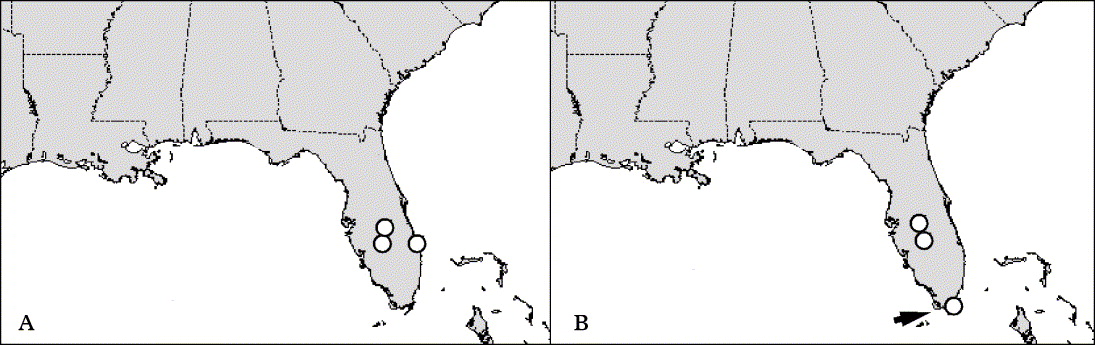
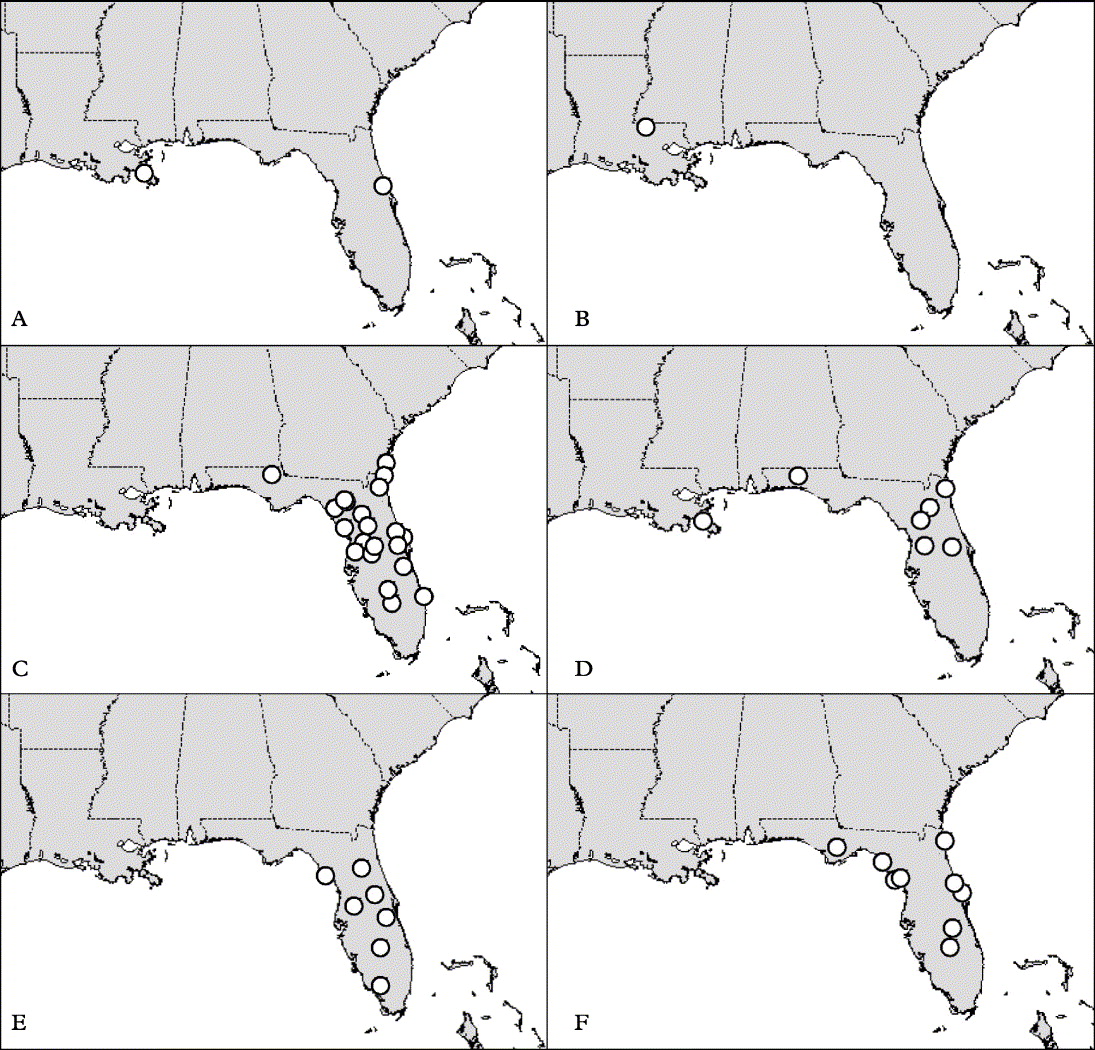
The genus Carbacanthographis is morphologically similar to Acanthothecis in having ornamented periphysoids, but differs in having non-ornamented paraphyses tips and a laterally to fully carbonized exciple. Hitherto, the genus contained two species known from North America: C. candidata and C. marcescens (see Fig. 4 for distributions). These are easily distinguishable because the former has medium-sized, transversely septate ascospores (43–100 × 6–9 μm) and a fully carbonized exciple while the latter has small, submuriform spores (12–17 × 5–9 μm) and a basally non-carbonized exciple. During our study of undetermined material collected by the third author (RCH) in Florida, we encountered two collections of a species of Carbacanthographis with long, muriform ascospores (114–162 × 12 μm) for which we were unable to find a suitable name in Staiger & Kalb (Reference Staiger and Kalb1999) or in Staiger (Reference Staiger2002). We describe it below as a new species, Carbacanthographis muriformis.
Key to North American Carbacanthographis species
1 Ascospores transversely septate, 43–100 μm long; exciple fully carbonized; lichexanthone (UV+ yellow) and protocetraric acid (K+ yellow-brown) present ... ... C. candidata
Ascospores submuriform or muriform; exciple laterally carbonized or fully carbonized; lichexanthone absent (UV–), protocetraric acid present or absent ... 2
2(1) Ascospores submuriform, 12–17 μm long; exciple not carbonized below hymenium; salazinic acid present (K+ red) ... C. marcescens
Ascospores muriform, 114–162 μm long; exciple fully carbonized; protocetraric acid present (K+ yellow-brown) ... C. muriformis
Carbacanthographis candidata (Nyl.) Staiger & Kalb
Biblioth. Lichenol., 85: 104 (2002).—Graphis candidata Nyl., Flora, 52: 72 (1874); type: Brazil, Paricatuba, ad fl. Amazon, Spruce s.n. = Lich. Amaz. et And. 292 (H-NYL 7538—holotype, n.v.)
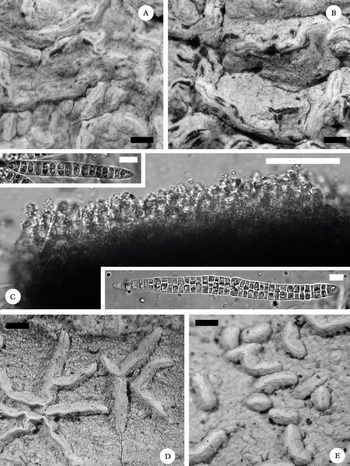
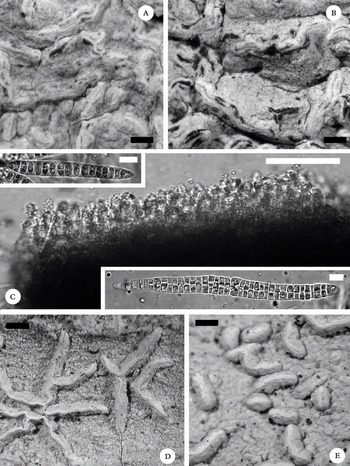
Carbacanthographis candidata is distinctive among all other known North American species in the genus by its transversely septate ascospores (Fig. 3C, upper left inset). A macroscopic photo of this species is shown in Fig. 3E.
Characteristics of North American species of Carbacanthographis. A & B, thallus and lirellae of C. marcescens (Plitt s.n., isotype of Graphina plittii); C, ornamented periphysoids of C. muriformis (Harris 42110), ascospores of C. candidata (upper left inset, Harris 42120), and ascospores of C. muriformis (lower right inset, Harris 41759); D. thallus and lirellae of C. muriformis (Harris 42110); E, thallus and lirellae of C. candidata (Harris 42120). Scales: A, B, D & E = 0·5 mm; C = 20 μm; C (insets) = 10 μm.
Specimens examined. USA: Florida: Glades Co., Ortona Cemetery, 1998, Harris 42120; Highlands Co., Archbold Biological Station, Tract 31, 1998, Yahr 694; Martin Co., Jonathan Dickinson State Park, 1998, Harris 41670.
Carbacanthographis marcescens (Fée) Staiger & Kalb
Biblioth. Lichenol. 85: 109 (2002).—Graphina marcescens (Fée) Müll. Arg., Mém. Soc. Phys. Genève, 29: 42 1887.—Graphis marcescens Fée, Essai Cryptog. Écorc: 38, Tab. XV, Fig. 2 (1825); type: America meridionali, ad corticem Bonplandiae trifoliatae, Humbolt & Bonpland s.n. (G—lectotype, n.v.).
Graphina plittii Zahlbr., Ann. Naturhist. Mus. Wien, 42: 60 (1928); type: USA, Florida, Miami-Dade Co., “prope Miami” (fide protologue), without date, Plitt s.n. = Krypt. Exs. Vind. 3051 (W—lectotype, n.v.; NY—isolectotype!).
Carbacanthographis marcescens is differentiated from the other known congeners in North America by its small (< 30 μm), submuriform ascospores. Macroscopic photos of this species are shown in Figs 3A & B. See Staiger (Reference Staiger2002) for an image of the ascospores of C. marcescens.
Carbacanthographis muriformis E. Tripp & Lendemer, sp. nov
MycoBank No. 514010
Sicut Carbacanthographis candidata sed ascosporis muriformibus differt.
Type: USA, Florida, Glades Co., Ortona Cemetery, along SR 78, 1 mi W of CR 78A, 26°49′N, 81°18′W, oak-palmetto scrub directly N of cemetery, on oak, 30 March 1998, Harris 42110 (NY—holotypus!).
(Fig. 3C & D)
Thallus corticate, semi-glossy, white to light grey, with irregular bumps across surface, c. 30–90 μm thick in cross-section.
Apothecia lirelliform, sessile (completely raised above thallus surface), partially to wholly covered by thalline margin (concolorous with thallus), all white in appearance when wholly covered, black slits visible at apex when partially covered, 0·25–0·5 ×< 1–c. 5 mm, unbranched to sub-asteriform, flexuose, flask-shaped to triangular in cross-section; excipulum not striate, fully carbonized, 45–66 μm wide; hypothecium hyaline to brown, 24–36 μm high; hymenium hyaline, not inspersed, 120–135 μm high; ascospores 4-per ascus, hyaline, I−, muriform, elongate (clavate), 114–162 × 9–15 μm, c. 26–38 celled, lumina square; paraphyses tips not ornamented, periphysoids forming a pad that lines the inside of exciple and extends around apical portions of exciple, ornamented at tips.
Etymology. The specific epithet “muriformis” refers to the septation of the ascospores that distinguish this taxon from other species of the genus known from North America.
Chemistry. Protocetraric acid; K+ yellowish brown, C−, KC−, P+ orange/red, UV−.
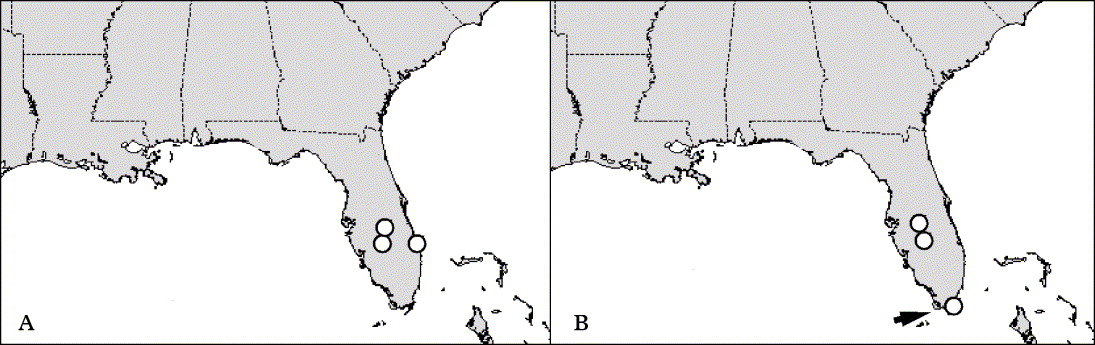
Distribution. Carbacanthographis muriformis is currently known from Highlands and Glades Counties in Florida (Fig. 4).
Geographical distributions of species of North American Carbacanthographis (USA localities only). A, C. candidata; B, C. muriformis and C. marcescens (arrow indicates sole collection of C. marcescens).
Ecology. Corticolous on Quercus in scrub forests.
Discussion. Carbacanthographis muriformis is easily distinguished from the other two species of Carbacanthographis known from North America by its long (> 100 μm), distinctly muriform ascospores (vs. small, submuriform in C. marcescens and medium-sized, transversely-septate in C. candidata). Of the two larger-spored species, C. candidata has clavate ascospores (with one end acute); those of C. murifomis are not clavate but are rounded at both ends. The new species also differs from C. candidata by the absence of lichexanthone in the cortex (UV−). Interestingly, the paratype of C. muriformis cited below is a mixed collection with C. candidata. In this collection, the two are growing adjacent on a short length of branch, and a sterile thallus of C. candidata can be observed overgrowing that of C. muriformis. Even superficially, the two can bedistinguished by the colour of the thallus, which is light yellow in C. candidata due to the presence of lichexanthone.
Additional specimen examined. USA: Florida: Highlands Co., Archibold Biological Station, on Old SR 8, SE Tract, Carya floridana scrub on yellow sand along fire lane, on oak, 1998, Harris 41759.
The genus Diorygma in North America
The genus Diorygma was described by Eschweiler (Reference Eschweiler1824) to accommodate the Neotropical species of Graphidaceae that have large, muriform ascospores. After a long history of the name Diorygma being largely neglected, it was resurrected and its circumscription refined by Staiger (Reference Staiger2002) as well as Kalb et al. (Reference Kalb, Staiger and Elix2004). As defined by Kalb et al. (Reference Kalb, Staiger and Elix2004), Diorygma is typified by D. hieroglyphicum (Pers.) Staiger & Kalb and distinguished from other genera in Graphidaceae by having an inconspicuous, dull white to blue-grey thalline pseudocortex (or no cortex at all), lirellate ascomata with exposed discs that are often densely pruinose, a non- to weakly carbonized exciple (also present in a few other genera, for example, Acanthothecis and Fissurina), a non-inspersed (and usually amyloid) hymenium and anastomosing paraphyses that branch reticulately and interweave at their tips. The genus is easy to recognize, even in the field, by its distinctive lirellae with exposed, pruinose discs and the obscure thalline pseudocortex that gives the majority of species their dull white to blue-grey ± granular appearance. Recent molecular studies suggest the genus is monophyletic (Staiger et al. Reference Staiger, Kalb and Grube2006; Mangold et al. Reference Mangold, Martîn, Lücking and Lumbsch2008).
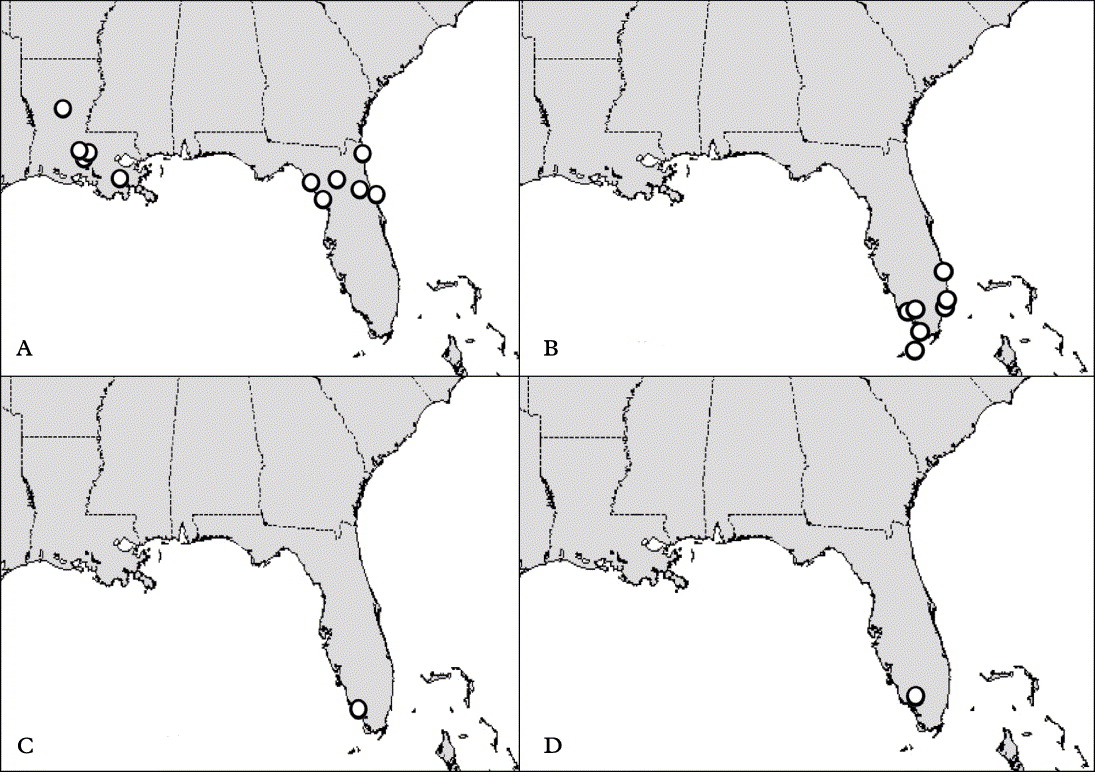
The present edition of the North American Lichen Checklist (Esslinger Reference Esslinger2008) registers only two species of Diorygma as occurring in North America: D. poitaei (Fée) Kalb, Staiger, & Elix and D. pruinosum (Eschw.) Kalb, Staiger & Elix [the latter name is listed under the synonym Graphina platyleuca (Nyl.) Zahlbr]. Prompted by the disposal of Graphina and similarly inspired by the recent monograph of Diorygma (Kalb et al. Reference Kalb, Staiger and Elix2004), we examined undetermined specimens of Graphidaceae at NY for North American material. Our efforts resulted in the discovery of several additional records of D. poitaei as well as material of two species previously unreported from North America: D. junghuhnii and D. reniforme. All four of the species reported here are widely distributed in the Neotropics and as such, their occurrence in sub-tropical North America is not particularly surprising (Fig. 6). Below, we present a preliminary treatment of Diorygma in North America excluding Mexico with the hope that it will motivate collectors to search for these species, particularly in areas where they have not been reported such as Alabama, Georgia and Mississippi. For collections that do not correspond to those treated here, the monograph of Kalb et al. (Reference Kalb, Staiger and Elix2004) should be consulted.
Key to North American Diorygma species
1 Exciple not carbonized; protocetraric acid absent; lirellae immersed to erumpent, not prominent and distinctly raised above thallus ... 2
Exciple carbonized; protocetraric acid present; lirellae prominent and distinctly raised above thallus ... 3
2(1) Norstictic acid present (especially in epihymenium; K+ yellow turning red and forming crystals); ascospores 1–2 per ascus, ≥ 20 μm wide; thallus white to grey ... ... D. junghuhnii
Norstictic acid absent, K+ dull to strong yellow (hypostictic acid and accessories); ascospores 2-8 per ascus, < 20 μm wide; thallus blue-grey ... D. poitaei
3(1) Norstictic acid present, K+ yellow turning red forming crystals; ascospores ≥ 40 μm wide ... D. reniforme
Norstictic acid absent, K+ yellowish (protocetraric acid); ascospores < 40 μm wide ... D. pruinosum
Diorygma junghuhnii (Mont. & Bosch) Kalb, Staiger & Elix
Symb. Bot. Upsal. 34: 157 (2004).—Phaeographis junghuhnii (Mont. & Bosch) Zahlbr., Ann. Cryptog. Exot. 1: 148 (1928).—Graphina junghuhnii (Mont. & Bosch) Müll. Arg. Flora 65: 385 (1882).—Ustalia junghuhnii Mont. & Bosch in Junghuhn, Pl. Jungh. Fasc. IV: 447 (1855); type: Java, Junghuhn s. n. (L—holotype n. v.; G—isotype, n. v.).
Diorygma junghuhnii is a pantropical species previously known from both the Old World (Fiji, Australia, Philippines, Togo and Tanzania) and New World (Brazil, Costa Rica, Guatemala and Guyana) tropics (Kalb et al. Reference Kalb, Staiger and Elix2004). The collections cited below represent the first reports of this species in North America by extending the New World distribution of D. junghuhnii into the coastal plain of Louisiana and Florida. We expect that further collecting will reveal additional populations in Alabama, Georgia and Mississippi, especially on the bark of Carya, Celtis, Fraxinus, Liquidambar, Nyssa and Quercus, upon which it has been collected in North America. Diorygma junghuhnii (Fig. 5B) can be recognized by its long and narrow, ± immersed, branching lirellae, uncarbonized exciple, medium-sized, muriform ascospores (80–115 × 24–38 μm, 1–2 per ascus), white to grey thallus, and chemistry (norstictic acid). In one of our specimens (Langlois s.n.), the hymenium contains conspicuous red streaks that dissolve in KOH. These have previously been reported in this species (Kalb et al. Reference Kalb, Staiger and Elix2004); their function, if any, remains unknown. In the field, D. junghuhnii can be distinguished from D. poitaei by its white to grey thallus (conspicuously blue-grey in the latter). Diorygma junghuhnii also resembles Fissurina cypressi (Müll. Arg.) Lendemer, but the latter differs by lacking norstictic acid (K−), by having paraphyses that are not apically branched and reticulate, and by its I− hymenium and I− ascospores. Finally, D. junghuhnii also superficially resembles some species of Acanthothecis Staiger & Kalb; however, members of the latter genus have ornamented paraphyses tips (see Fig. 1C).
Characteristics of North American species of Diorygma, thallus, lirellae, and ascospores. A, D. pruinosum (Harris 30065); B, D. junghuhnii (Harris 29455); C, D. reniforme (Harris 41872); D, D. poitaei (Harris 30057). Scales: A–D (macroscopic images) = 0·5 mm; A & C (insets) = 20 μm; B & D (insets) = 10 μm.

Geographical distributions of species of North American Diorygma (USA localities only). A, D. junghuhnii; B, D. poitaei; C, D. pruinosum; D, D. reniforme.
Specimens examined. USA: Florida: Alachua Co., Paynes Prairie State Preserve, 1992, Harris 29423, 29435, Harris 29455; Duval Co., Jacksonville Beach, 1976, Harris 11269; Levy Co., Cedar Key Scrub State Reserve, 1987, Harris 21042; Levy Co., Black Point Swamp, 1992, Buck 22474, Buck 22495, Harris 29391; ibid., Black Point Swamp, 1995, Buck 28739, Buck 28721; Putnam Co., Crescent City, 1880, Martin 35; Taylor Co., Big Bend Wildlife Management Area, 1996, Harris 39525; Harris 22374. Louisiana: St. Martin Parish, Bayou Tortue, 15 iv 1895, Langlois s.n.; Lafayette Parish, Bayou Tortue, 15 iv 1895, Langlois bg; Lafourche Parish, Grand Bois, 1894, Langlois 1012; Natchitoches Parish, Bayou Millieu [Milieu], 27 viii 1894, Langlois bx; St. Martin Parish, Duchamps [Duchamp], 17 x 1894, Langlois bt; ibid., Bois Lobbé, 28 xi 1893, Langlois bs; ibid., St. Martinsville, 1892, Langlois x 68; ibid., St. Martinsville, 1894, Langlois 1020; ibid., St. Martinsville, 1895, Eckfeldt [Langlois] s.n.
Comparative material. Australia: Queensland: Thursday Island, without date, Knight s. n.
Diorygma poitaei (Fée) Kalb, Staiger & Elix
Symb. Bot. Upsal. 34: 164 (2004).—Graphina poitaei (Fée) Müll. Arg., Mém. Soc. Phys. Genève 29: 45 (1887).—Ustalia poitaei (Fée) Stizenb., Ber. Thätigk. St. Gallischen Naturwiss. Ges.: 155 (1862).—Ectographis poitaei (Fée) Trevis., Spighe E Paglie 12 (1853).—Opegrapha poitaei (Fée) Bél., Voy. Indes Or. 136 (1846).—Graphia poitaei Fée, Essai Cryptog. Écorc.: 46 (1825); type: America meridionali, in Sancto-Domingo, ad arbores, voucher no. 4 (G—lectotype n.v.).
Graphina virginea (Eschw.) Müll. Arg., Bull. Herb. Boissier 3: 47 (1885).—Leiogramma virgineum Eschw. in Martius, Fl. Bras. Enum. Pl. 1: 98 (1833); type: Brazil, Martius (M—holotype n. v.).
Kalb et al. (Reference Kalb, Staiger and Elix2004) reported Diorygma poitaei as a widespread New World taxon known from North America (USA and Mexico), the West Indies (Cuba, Jamaica and Puerto Rico) and South America (Colombia, Ecuador, Surinam and Brazil). The most distinctive features of D. poitaei are its thick, blue-grey thallus and ± narrow, immersed white lirellae with pruinose discs (Fig. 5D). The blue-grey thallus readily distinguishes D. poitaei from D. junghuhnii in the field. Under a microscope, D. poitaei is distinguishable from D. junghuhnii and the other two species of Diorygma known from North America by its ascospores that are consistently < 20 μm wide (Fig. 5D; > 20 in the others) and generally shorter spores (note that the upper limit of the spore length of D. poitaei (40–60 × 10–18 μm) overlaps with the lower length limit of that of D. junghuhnii ((60–)80–125 × 21–42 μm). Following the keys to Graphidaceae in Harris (Reference Harris1995), Diorygma poitaei could be confused with Acanthothecis peplophora (M. Wirth & Hale) E. Tripp & Lendemer because of similar ascospore size, but D. poitaei does not have the striate exciple of A. peplophora. Furthermore, the two species are not likely to be confused in the field owing to the distinctly corticate thallus of Acanthothecis peplophora.
Selected specimens examined. USA: Florida: Collier Co., Hammer Key, SW of Royal Palm Hammock, 1918, Small 8610; ibid., Collier-Seminole State Park, 1992, Buck 22857, Harris 30057; Miami-Dade Co., Coral Gables, Mattheson Hammock, ii 1977, Stein s.n.; ibid., Royal Palm State Park, 1919, Britton & Britton 752, 773, 779A, 780; ibid., Cutler, Deering Hammock, 1918, Small 8540, 8554, 8562; Monroe Co., E end of Long Key, 1917, Small 8403, 8406, 8413; ibid., S part of Big Pine Key, 1919, Small et al. 9130; ibid., between Flamingo and Coot Bay, 1921, Small et al. 10315; Palm Beach Co., near Jupiter, 1919, Britton & Britton 783.
Comparative material. Puerto Rico: Bosque Estatal de Guajataca, Vereda Salomé, 1992, Buck 21221. Distr. Aguadilloa: Montañas Aymamon, Bosque Estatal de Guajataa, 1989, Harris 24415. Distr. Arecibo: along Hwy 590 NE of Lago de Matrullas, 1989, Harris 24246.
Diorygma pruinosum (Eschw.) Kalb, Staiger & Elix
Symb. Bot. Upsal. 34: 166 (2004).—Cyclographina pruinosa (Eschw.) D. D. Awasthi in Awasthi & Joshi, Norweg. J. Bot. 26: 174 (1979).—Leiogramma pruinosum Eschw. in Martius, Icones Pl. Crypt., Fasc. 1: 12, tab. 7, fig. 3 (1828); type: Brazil, crescit ad aborum corticem prope Bahiam, Martius (M—holotype n.v.).
Graphina platyleuca (Nyl.) Zahlbr. Ann. Mycol. 19: 231 (1921).—Helminthocarpon platyleucum (Nyl.) Müll. Arg. Flora 70: 423 (1887).—Graphis platyleuca Nyl., Bull. Soc. Linn. Normandie, Sér. 2, 2: 114 (1868); type: Brazil, crescit ad arboreum corticem prope Bahiam, Martius (M—holotype, n.v.).
Harris (Reference Harris1995) reported Diorygma pruinosum from Florida under the name Graphina platyleuca, but Kalb et al. (Reference Kalb, Staiger and Elix2004) did not mention its occurrence in North America. Rather, they noted that D. pruinosum is a widespread, tropical species and cited specimens from Africa, Asia, Australia and Brazil. The North American Lichen Checklist (Esslinger Reference Esslinger2008) currently lists this species as Graphina platyleuca on the basis of Harris' original report. We have reviewed the relevant voucher (cited below) and confirm the occurrence of this species in the United States. Surprisingly, we have found no additional material from the USA among the undetermined specimens at NY, although material from Puerto Rico exists.
Diorygma pruinosum (Fig. 5A) is one of only a few species of Diorygma that have a carbonized exciple. In this regard, it is similar to D. reniforme (also known from North America). However, the latter species has wider spores (> 40 μm vs. < 40 μm in D. pruinosum) and differs chemically by producing norstictic acid (lacking in D. pruinosum) in addition to protocetraric acid. Because both species are rare in North America based on extant herbarium material at NY, with D. pruinosum represented only by a single collection, both species should be sought in the coastal plain of the south-eastern USA.
Specimen examined. USA: Florida: Collier Co., Collier-Seminole State Park, 1992, Harris 30065.
Comparative material. Puerto Rico: Between Aibonito and Cayey, 1899, Heller 560.
Diorygma reniforme (Fée) Kalb, Staiger & Elix
Symb. Bot. Upsal. 43: 167 (2004).—Graphina reniformis (Fée) Müll. Arg., Mém. Soc. Phys. Genève 29: 43 (1887).—Graphis reniformis Fée, Essai Cryptog. Écorc.: 46 (1825); type: Peru, sine col. (G—lectotype, n.v.).
Diorygma reniforme is an attractive species that can be recognized in the field by its large and generally compound, short lirellae with a thick, convex layer of pruina covering the discs (Fig. 5C). The species is comparable to D. pruinosum because both have a carbonized exciple. However, D. pruinosum has narrower spores (< 40 μm vs. > 40 μm in D. reniforme) and differs chemically in lacking norstictic acid. In the field, the two may be differentiated by the less compound nature of lirellae in D. pruinosum, although we caution that this observation is based on a sole collection of the latter. Kalb et al. (Reference Kalb, Staiger and Elix2004) cited “southern USA” when discussing the distribution of D. reniforme but did not cite a voucher. As such, the collections cited here appear to represent the first documented occurrence of the species in North America.
Specimens examined. USA: Florida: Collier Co., Corkscrew Swamp Sanctuary, 1998, Buck 33779, Harris 41859, 41872.
Comparative material. Hispaniola: Haiti: Dept. de la Grand'anse, Massif de la Hotte, 1982, Buck 9125.—Jamaica: Clarendon Parish: Peckham Woods, 1974, Proctor 34376.
We gratefully acknowledge The Society of Systematic Biologists for a mini-PEET award that enabled this research and training. Revisions suggested by Rick Seavey and Robert Lücking significantly improved the manuscript. We also thank Klaus Kalb and Robert Lücking for additional, helpful discussions.