Introduction
Dual diagnosis (DD) is the term used when people experience co-occurring substance use disorder (SUD) and mental health (MH) disorders (Kessler Reference Kessler2004; National Working Group for Dual Diagnosis 2023; Torrens et al. Reference Torrens, Mestre-Pintó and Domingo-Salvany2015). DD is complex, and a SUD may precede, follow, or coincide with a MH disorder, and in some instances can induce a MH disorder (Torrens et al. Reference Torrens, Mestre-Pintó and Domingo-Salvany2015).
Estimating the true prevalence of DD among people who use drugs is complicated, and research is hampered by differing definitions, settings, study design, and study quality (National Working Group for Dual Diagnosis 2023). It is estimated that between 30% and 50% of people experiencing a severe mental illness also have a SUD (National Working Group for Dual Diagnosis 2023). In Ireland, only one study has examined the prevalence of DD; it found 46% of patients with first-episode psychosis had a co-occurring SUD (Kamali et al. Reference Kamali, McTigue, Whitty, Gervin, Clarke, Browne, Larkin and O’Callaghan2009). In the literature, several MH disorders have been highlighted as more common in DD, including depression, anxiety, psychosis, personality disorders, eating disorders, and more recently, attention-deficit disorders (Lähteenvuo et al. Reference Lähteenvuo, Batalla, Luykx, Mittendorfer-Rutz, Tanskanen, Tiihonen and Taipale2021; Torrens et al. Reference Torrens, Mestre-Pintó and Domingo-Salvany2015).
Globally, MH disorders are associated with higher mortality rates (Alotaibi et al. Reference Alotaibi, Halbesma, Wild and Jackson2024; Harris and Barraclough Reference Harris and Barraclough1998; Plana-Ripoll et al. Reference Plana-Ripoll, CBøcker, Agerbo, Holtz, Erlangsen, Canudas-Romo, Andersen, Charlson, Christensen, Erskine, Ferrari, Moesgaard Iburg, Momen, Mortensen, Nordentoft, Santomauro, Scott, Whiteford, Weye, McGrath and Laursen2019; Walker et al. Reference Walker, McGee and Druss2015). However, people who use drugs are also at an increased risk of premature mortality (Degenhardt et al. Reference Degenhardt, Bucello, Mathers, Briegleb, Ali, Hickman and McLaren2011; Giraudon et al. Reference Giraudon, Buster, Espelt, Matias and Vicente2015). DD is associated with a greater risk of poorer outcomes for the individual, including a higher risk of mortality (Fridell et al. Reference Fridell, Bäckström, Hesse, Krantz, Perrin and Nyhlén2019; National Working Group for Dual Diagnosis 2023; Ojansuu et al. Reference Ojansuu, Putkonen, Lähteenvuo and Tiihonen2019; Torrens et al. Reference Torrens, Mestre-Pintó and Domingo-Salvany2015). Significantly, some research points to higher mortality among those with a DD compared to those experiencing MH disorders alone (Heiberg et al. Reference Heiberg, Jacobsen, Nesvåg, Bramness, Reichborn-Kjennerud, Næss, Ystrom, Hultman and Høye2018; Hjorthoj et al. Reference Hjorthoj, Ostergaard, Benros, Toftdahl, Erlangsen, Andersen and Nordentoft2015; Keen et al. Reference Keen, Kinner, Young, Jang, Gan, Samji, Zhao, Krausz and Slaunwhite2022; Lynskey et al. Reference Lynskey, Kimber and Strang2015).
One of the reasons for the higher mortality rate among people with a DD may be their increased risk of suicide (Athey et al. Reference Athey, Shaff, Kahn, Brodie, Ryan, Sawyer, DeVinney, Nestadt and Wilcox2025; Devin et al. Reference Devin, Lyons, Murphy, O’Sullivan and Lynn2023; Flórez et al. Reference Flórez, Espandian, Seoane-Pillado, Llorens, Gerpe and Saiz2024; Hesse et al. Reference Hesse, Thylstrup, Seid and Skogen2020). Among people with SUD, the potential factors associated with increased risk of suicide are: being male, homelessness, imprisonment, MH conditions, and a lack of DD service provision (Devin et al. Reference Devin, Lyons, Murphy, O’Sullivan and Lynn2023).
The complexity of DD presents considerable treatment challenges. Traditionally, SUD and MH services lacked integration, and specialised care to address complex needs was lacking, leading to poorer outcomes for people with a DD. An exploration of the perspectives of people with lived experience of DD in Ireland indicated that they felt services could not cater for their specific needs, with long waiting times, and other barriers including stigma, resulting in poorer clinical and personal outcomes (National Working Group for Dual Diagnosis 2023). Evidence shows that integrated care has better outcomes for people with DD (Minyard et al. Reference Minyard, Manteuffel, Smith, Attell, Landers, Schlanger and Dore2019). In 2023 in Ireland, the Health Service Executive (HSE) established a Dual Diagnosis Clinical Programme to develop a model of care for people with severe DD. This noted that data on the prevalence of DD in Ireland was limited and that additional research in this area was required (National Working Group for Dual Diagnosis 2023).
Aims and objectives
To increase the understanding of DD, this study aims to describe the characteristics of deaths among people who both used drugs and had a MH condition to better understand DD and to help improve the provision of DD services for people in Ireland.
Methods
Data source
The data for this study comes from the National Drug-Related Deaths Index (NDRDI), the national epidemiological database on drug-related deaths and deaths among people who were alcohol dependent, set up in 2005 in response to the then-current National Drugs Strategy (Department of Tourism, Sport and Recreation 2001). NDRDI uses four sources of information:
-
1. Closed coronial files.
-
2. HSE Hospital Inpatient Enquiry (HIPE) data.
-
3. Central Treatment List (CTL) that records all people in receipt of opioid agonist treatment (OAT).
-
4. General Mortality Register (GMR) via the Central Statistics Office.
It must be noted that coronial files are compiled for the purposes of investigating the cause of death and therefore include information pertinent to that investigation rather than for wider research purposes.
NDRDI classifies two types of deaths: poisonings and non-poisonings (deaths due to medical (e.g. cardiovascular) or traumatic (e.g. hanging)). Since 2010, MH conditions have been recorded on the NDRDI, and for deaths from 2019 onwards, the source of the diagnosis (medical professional, other, or unknown) is also recorded. Lifetime history of a MH condition is primarily ascertained from depositions in the coroner files. These files are searched by trained NDRDI medical researchers, with any MH condition recorded and coded to ICD 10 (World Health Organisation 2016). Depositions come primarily from family, friends, or police. In this circumstance, the source of the MH diagnosis is recorded as ‘other’. Where relevant to the coronial investigation, depositions are available from medical staff, for example, general practitioner or psychiatrist. For these, the source of the MH diagnosis is recorded as ‘medical professional’. If information on a MH condition comes from the ICD 10 diagnoses provided by HIPE, the source is always medical professional. A main MH diagnosis is not recorded on the NDRDI, as information can be taken from different sources. Up to 10 separate conditions can be recorded.
For the purposes of this study, MH conditions do not include drug or alcohol misuse or dependence ICD codes. The deceased’s history of substance use is recorded and reported separately in the NDRDI. However, to record a history of substance misuse or dependence, the source does not have to be a medical professional. The variable is recorded as ‘ever used’ or ‘current use’ (i.e. in 30 days prior to death). This data can also be taken from the other sources: HIPE and GMR (based on relevant ICD codes); and the CTL, where the deceased is recorded as opioid dependent by virtue of their registration on that system. Alcohol is only included in the NDRDI if there is evidence to support dependency.
Inclusion criteria
Deaths recorded between 2019 and 2021 were included if the deceased had:
-
1. A history of substance misuse or dependence of at least one drug (alcohol excluded unless part of polysubstance use).
-
2. A history of at least one MH condition diagnosed by a medical professional.
Analysis
Data were analysed using SPSS Version 26 (IBM 2023). Data were analysed descriptively to provide the number and proportion of deaths by sociodemographic characteristics, risk factors, medical contact; substance use history; MH conditions; and type (poisoning or non-poisoning), drugs implicated, and cause of death (traumatic or medical). These analyses were stratified by sex (as stated on the death certificate). Variance by MH condition was examined for key characteristics (drugs used, type and cause of death, and verdict) using cross tabulation. The unit of analysis was deaths, except where data are presented for instances (i.e. the number of times) of drugs implicated in poisoning deaths.
Results
Between 2019 and 2021, the NDRDI recorded 2,137 deaths among people who used drugs, regardless of the cause of death. Of these, 926 (43.3%) individuals had a history of MH, and of those, 567 (61.2%) had at least one MH condition diagnosed by a medical professional. The following analyses pertain to these 567 deaths.
Sociodemographic characteristics, risk factors and medical contact
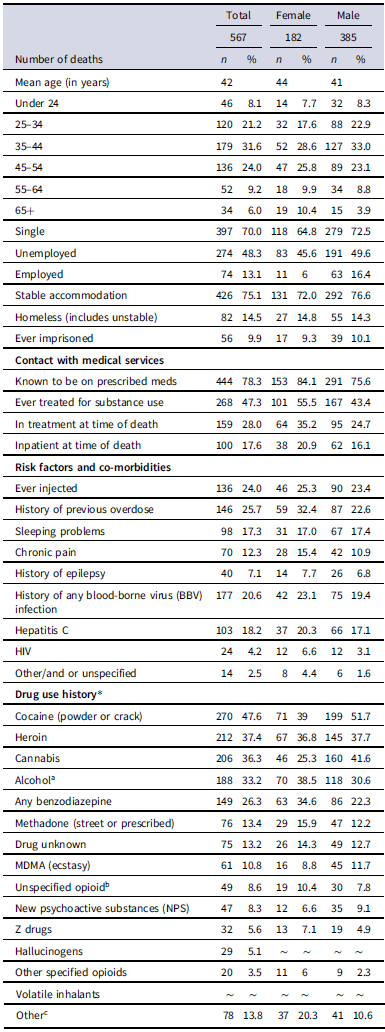
Table 1 outlines the main sociodemographic characteristics of the DD group, by sex. The majority (385, 67.9%) were men. The mean age was 42 years (women 44 years; men 41 years); most were aged between 25 and 54 years (79.0%). There were more deaths among women aged 65 years or over (19, 10.4%) than among men of that age group (15, 3.9%).
Sociodemographic characteristics, risk factors, medical contact, and substance use among people with a dual diagnosis, by sex (2019–2021), NDRDI

Table 1. Long description
A table comparing sociodemographic characteristics, risk factors, medical contact, and substance use among people with a dual diagnosis by sex. The table has 23 rows and 6 columns. The columns are labeled Total, Female, and Male, each with sub-columns for number (n) and percentage (%). The rows are labeled with various characteristics and factors. Row 1: Number of deaths, 567 total (182 female, 385 male). Row 2: Mean age (in years), 42 total (44 female, 41 male). Row 3: Under 24, 46 total (14 female, 32 male), 8.1 percent total (7.7 percent female, 8.3 percent male). Row 4: 25-34, 120 total (32 female, 88 male), 21.2 percent total (17.6 percent female, 22.9 percent male). Row 5: 35-44, 179 total (52 female, 127 male), 31.6 percent total (28.6 percent female, 33.0 percent male). Row 6: 45-54, 136 total (47 female, 89 male), 24.0 percent total (25.8 percent female, 23.1 percent male). Row 7: 55-64, 52 total (18 female, 34 male), 9.2 percent total (9.9 percent female, 8.8 percent male). Row 8: 65+, 34 total (19 female, 15 male), 6.0 percent total (10.4 percent female, 3.9 percent male). Row 9: Single, 397 total (118 female, 279 male), 70.0 percent total (64.8 percent female, 72.5 percent male). Row 10: Unemployed, 274 total (83 female, 191 male), 48.3 percent total (45.6 percent female, 49.6 percent male). Row 11: Employed, 74 total (11 female, 63 male), 13.1 percent total (6.1 percent female, 16.4 percent male). Row 12: Stable accommodation, 426 total (131 female, 292 male), 75.1 percent total (72.0 percent female, 76.6 percent male). Row 13: Homeless (includes unstable), 82 total (27 female, 55 male), 14.5 percent total (14.8 percent female, 14.3 percent male). Row 14: Ever imprisoned, 56 total (17 female, 39 male), 9.9 percent total (9.3 percent female, 10.1 percent male). Row 15: Known to be on prescribed meds, 444 total (153 female, 291 male), 78.3 percent total (84.1 percent female, 75.6 percent male). Row 16: Ever treated for substance use, 268 total (101 female, 167 male), 47.3 percent total (55.5 percent female, 43.4 percent male). Row 17: In treatment at time of death, 159 total (64 female, 95 male), 28.0 percent total (35.2 percent female, 24.7 percent male). Row 18: Inpatient at time of death, 100 total (38 female, 62 male), 17.6 percent total (20.9 percent female, 16.1 percent male). Row 19: Ever injected, 136 total (46 female, 90 male), 24.0 percent total (25.3 percent female, 23.4 percent male). Row 20: History of previous overdose, 146 total (59 female, 87 male), 25.7 percent total (32.4 percent female, 22.6 percent male). Row 21: Sleeping problems, 98 total (31 female, 67 male), 17.3 percent total (17.0 percent female, 17.4 percent male). Row 22: Chronic pain, 70 total (28 female, 42 male), 12.3 percent total (15.4 percent female, 10.9 percent male). Row 23: History of epilepsy, 40 total (14 female, 26 male), 7.1 percent total (7.7 percent female, 6.8 percent male).
* This is a multi-response table taking account of up to 10 drugs used. Therefore, numbers in columns will not add up to the total number of deaths, as individual deaths may have more than one drug recorded.
a Alcohol dependency as part of polysubstance use.
b Coded if the deceased was on methadone but there was no mention of the original problem drug.
c Includes amphetamines, other medications, antidepressants etc.
∼Numbers 5 or less.
The majority of the deceased were known to be single (397, 70.0%), with almost half unemployed (274, 48.3%). Risk factors included: 9.9% (56) history of imprisonment; 14.5% (82) experienced homelessness; 24.0% (136) lifetime history of injecting; 25.7% (146) history of a previous drug overdose; 18.2% (103) history of a hepatitis C infection (includes treated and cleared) (Table 1).
Many of the deceased had contact with medical services, as most (444, 78.3%) were known to be on prescribed medication at the time of death (includes OAT) and 28.0% (159) were known to be in SUD treatment at the time of death (Table 1).
The most common drug used was cocaine (powder and/or crack) (270, 47.6%), followed by heroin (212, 37.4%) and cannabis (206, 36.3%) (Table 1). Alcohol (dependency as part of polysubstance use) was recorded in 188 (33.2%) individuals. For women, cocaine was the most common drug used, followed closely by alcohol, then heroin. For men, cocaine was also the most common drug used, followed by cannabis, and heroin.
Most of the deceased (439, 77.4%) had a reported history of problem use of more than one drug (which could include alcohol). Over half (332, 58.6%) were reported to have used two to four problem substances. Most of the deceased (398, 70.2%) had a recorded history of using at least one substance in the 30 days prior to their death.
MH conditions
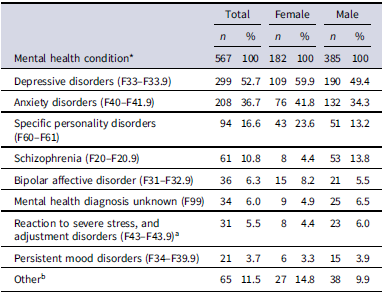
MH conditions were grouped by most appropriate ICD code; some categories were combined to allow for small numbers (Table 2). Forty percent (226, 39.9%) of the deceased had one condition recorded. The most common MH conditions were depressive disorders (299, 52.7%), followed by anxiety disorders (208, 36.7%) and specific personality disorders (94, 16.6%). The proportions varied by sex, with women having higher proportions of most reported diagnoses with the exception of schizophrenia (4.4% versus 13.8%). Eating disorders were only reported for women (n = 7). Most of the deceased (444, 78.3%) were known to be on prescribed medications at the time of death.
Mental health conditions among people with a dual diagnosis, by sex (2019–2021), NDRDI

Table 2. Long description
A table showing mental health conditions among people with a dual diagnosis, by sex, with data for total, female, and male categories. The table has 567 total entries, with 182 females and 385 males. The conditions listed include depressive disorders, anxiety disorders, specific personality disorders, schizophrenia, bipolar affective disorder, mental health diagnosis unknown, reaction to severe stress and adjustment disorders, persistent mood disorders, and other. Depressive disorders have 299 total cases (109 female, 190 male), anxiety disorders have 208 total cases (76 female, 132 male), and specific personality disorders have 94 total cases (43 female, 51 male). Schizophrenia has 61 total cases (8 female, 53 male), bipolar affective disorder has 36 total cases (15 female, 21 male), and mental health diagnosis unknown has 34 total cases (9 female, 25 male). Reaction to severe stress and adjustment disorders have 31 total cases (8 female, 23 male), persistent mood disorders have 21 total cases (6 female, 15 male), and other conditions have 65 total cases (27 female, 38 male).
* This is a multi-response table taking account of up to 10 MH conditions. Therefore, numbers in columns will not add up to the total number of deaths, as individual deaths may have more than one MH condition recorded.
a Includes post-traumatic stress disorder (F43.1).
b Other includes eating disorders, hyperkinetic disorder, conduct disorders, other personality and behavioural disorders.
Type of death
Overall, 48.9% of deaths were poisonings and 51.1% were non-poisonings, with no difference between the sexes (Tables 3 and 4). The most common verdict recorded was misadventure (264, 46.6%), followed by suicide (154, 27.2%). Deaths classified as probable suicides were not categorised by the NDRDI during the full time period covered by the study and hence are not included (for further information see Cox et al. Reference Cox, Munnelly, Rochford and Kavalidou2022). There was a difference in the proportion of deaths due to suicide for women (39, 21.4%) compared to men (115, 29.9%). Most of the deaths occurred at the deceased’s home address (376, 66.3%), with some differences between women (131, 72.0%) and men (245, 63.6%).
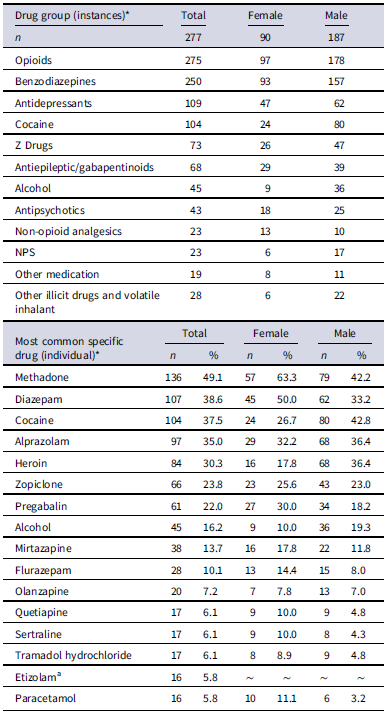
Drugs implicated in poisoning deaths among people with a dual diagnosis, by sex (2019–2021), NDRDI

Table 3. Long description
A table showing drugs implicated in poisoning deaths among people with a dual diagnosis, by sex, from 2019 to 2021. The table is divided into two main sections: Drug group (instances) and Most common specific drug (individual). The first section lists various drug groups and the number of instances for each, broken down by total, female, and male. The drug groups include Opioids, Benzodiazepines, Antidepressants, Cocaine, Z Drugs, Antiepileptic/gabapentinoids, Alcohol, Antipsychotics, Non-opioid analgesics, NPS, Other medication, and Other illicit drugs and volatile inhalant. The second section lists the most common specific drugs and the number and percentage of instances for each, also broken down by total, female, and male. The specific drugs include Methadone, Diazepam, Cocaine, Alprazolam, Heroin, Zopiclone, Pregabalin, Alcohol, Mirtazapine, Flurazepam, Olanzapine, Quetiapine, Sertraline, Tramadol hydrochloride, Etizolam, and Paracetamol.
* This is a multi-response table taking account of up to twenty drugs implicated. Therefore, numbers in columns will not add up to the total number of deaths, as individual deaths may have more than one drug implicated. For example, if an individual has methadone and heroin implicated in their death, each drug will be included in the opioid category.
a Etizolam was mainly implicated in deaths among men.
∼Numbers 5 or less.
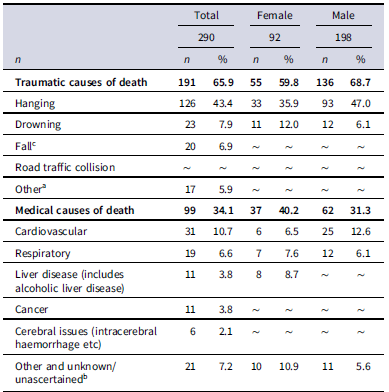
Causes of non-poisoning deaths, by sex, among people with a dual diagnosis, (2019–2021), NDRDI

Table 4. Long description
A table comparing causes of non-poisoning deaths by sex among people with a dual diagnosis. The table has 11 rows and 6 columns. The columns are labeled Total, Female, and Male, each with sub-columns for count (n) and percentage (%). The rows are categorized into Traumatic causes of death and Medical causes of death, with specific causes listed under each category. Row 1: Total, 290, 92, 198. Row 2: Traumatic causes of death, 191, 65.9, 55, 59.8, 136, 68.7. Row 3: Hanging, 126, 43.4, 33, 35.9, 93, 47.0. Row 4: Drowning, 23, 7.9, 11, 12.0, 12, 6.1. Row 5: Fall, 20, 6.9, ~, ~, 15, 7.6. Row 6: Road traffic collision, ~, ~, ~, ~, ~, ~. Row 7: Other, 17, 5.9, ~, 4.3, 13, 6.6. Row 8: Medical causes of death, 99, 34.1, 37, 40.2, 62, 31.3. Row 9: Cardiovascular, 31, 10.7, 6, 6.5, 25, 12.6. Row 10: Respiratory, 19, 6.6, 7, 7.6, 12, 6.1. Row 11: Liver disease (includes alcoholic liver disease), 11, 3.8, 8, 8.7, ~, ~. Row 12: Cancer, 11, 3.8, ~, ~, ~, ~. Row 13: Cerebral issues (intracerebral haemorrhage etc), 6, 2.1, ~, ~, ~, ~. Row 14: Other and unknown/unascertained, 21, 7.2, 10, 10.9, 11, 5.6. The table shows the distribution of different causes of death among males and females, with traumatic causes being more prevalent than medical causes in both sexes.
a Other includes assault, gunshot wounds, fire, suffocation, other.
b Other includes epilepsy, haemorrhage, other infections.
c Majority of these deaths were among males.
∼Numbers 5 or less.
Poisoning
Most of the 277 poisoning deaths involved more than one substance (polysubstance) (232, 83.8%), and proportions were similar among women (77, 85.6%) and men (155, 82.9%). Most poisoning deaths involved an opioid-type drug, either alone or with another drug (219, 79.1%).
Table 3 outlines the most common drug groups and specific drugs implicated in poisoning deaths. The most common specific drugs implicated were methadone (136, 49.1%), of which 60% was prescribed, followed by diazepam (107, 38.6%) and cocaine (104, 37.5%). Along with benzodiazepines (mainly diazepam and alprazolam), psychiatric medications implicated in the poisoning deaths included antidepressants (mainly mirtazapine and sertraline), and antipsychotics (mainly olanzapine and quetiapine). There were some differences in drugs by sex: women had higher proportions of methadone, diazepam, pregabalin, and mirtazapine, for example, while men had higher proportions of cocaine, alprazolam, heroin, and alcohol. In total, 81 different drugs were implicated 1,060 times in the 277 deaths, which makes understanding trends in polysubstance combinations difficult.
Non-poisoning
The majority of the 290 non-poisoning deaths were due to traumatic causes (191, 65.9%) (Table 4). The most common cause of non-poisoning death was hanging (126, 43.4%), followed by cardiovascular issues (31, 10.7%) and then drowning (23, 6.9%).
Hanging was the most common cause of death for both women (33, 35.9%) and men (93, 47.0%), but with a higher proportion among men.
Variance in key factors by MH conditions
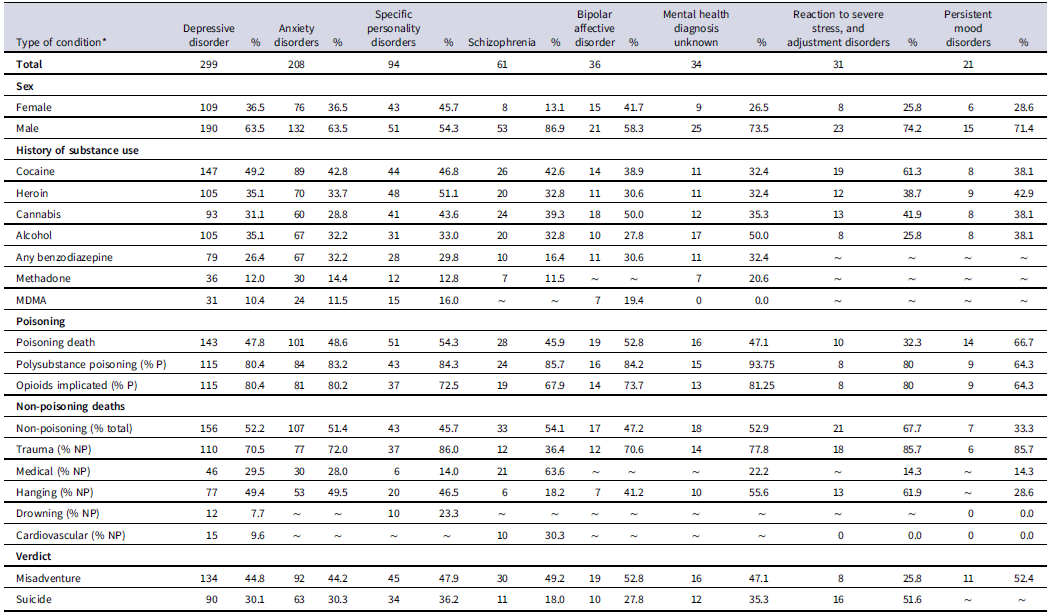
Table 5 presents drugs used, type of death, and verdict for the most common MH conditions recorded in the study. As the majority of the deceased had more than one condition, an individual can appear in more than one MH category.
MH conditions by drugs used, type of death, and verdict for people with a dual diagnosis (2019–2021), NDRDI

Table 5. Long description
The table presents data on mental health conditions by drugs used, type of death, and verdict for people with a dual diagnosis from 2019 to 2021. It includes various mental health conditions such as depressive disorder, anxiety disorders, specific personality disorders, schizophrenia, bipolar affective disorder, unknown mental health diagnosis, reaction to severe stress and adjustment disorders, and persistent mood disorders. The table is divided into several sections: Total, Sex, History of substance use, Poisoning, Non-poisoning deaths, and Verdict. Each section provides percentages for different conditions and categories. For example, under the Sex section, it shows the percentage of females and males for each condition. The History of substance use section lists various substances like cocaine, heroin, cannabis, alcohol, and others, along with their respective percentages. The Poisoning section includes categories like poisoning death, polysubstance poisoning, and opioids implicated, with their percentages. The Non-poisoning deaths section covers trauma, medical issues, hanging, drowning, cardiovascular issues, and others. The Verdict section includes misadventure and suicide. Each row provides detailed percentages for each condition and category, offering a comprehensive view of the data.
* This is a multi-response table taking account of up to 10 MH conditions and 10 drugs used. Therefore, numbers in columns will not add up to the total number of deaths.
∼Numbers 5 or less.
The rate of cocaine use was high among all conditions but highest in the group experiencing ‘reaction to severe stress, and adjustment disorders’ (61.3%). The highest proportion of heroin use was in the group ‘specific personality disorders’ (51.1%) and lowest in the ‘bipolar affective disorder group’ (30.6%). The proportion of deaths due to poisoning were highest among the group with ‘persistent mood disorders’ (66.7%), while non-poisoning deaths were highest among the ‘reaction to severe stress, and adjustment disorders’ group (67.7%). For most MH conditions, non-poisoning deaths mostly had traumatic causes, the exception being schizophrenia, where 63.6% of deaths had medical causes.
The group ‘reaction to severe stress, and adjustment disorders’ had the highest proportion of deaths due to hanging (61.9%). The highest proportion of drownings was in the group ‘specific personality disorders’ (23.3%). The highest proportion of suicide verdicts was in the ‘reaction to severe stress, and adjustment disorders’ group (51.6%), a category that includes post-traumatic stress disorder.
Discussion
This is the first study in Ireland to examine in detail the characteristics of deaths among people with a DD. The findings indicate that at least one in four drug-related deaths in Ireland are among people with a DD. The data reveal a complex clinical picture, with multiple physical and MH co-morbidities common, as well as indicators of social vulnerability and known risks for suicide, including homelessness and imprisonment. Depressive and anxiety disorders were highly prevalent among the group, coinciding with high rates of cocaine, heroin, cannabis, alcohol, and benzodiazepine use. Most had died suddenly and unexpectedly through misadventure or suicide, due to poisoning, or due to hanging. They were more likely to be men (seven in ten), to be single, and not in employment, and their average age was 42 years. The study demonstrates a significant overlap between substance use and MH problems among those who die due to drug-related causes. Most of the deceased were in contact with medical services before they died.
Sociodemographic characteristics
The analysis shows the significant premature mortality in this group, with the average age in the forties. Similarly, in a Swedish cohort study examining predictors of premature mortality in people with DD, the mean age at death (all causes) was 42 years for women and 40 years for men (Nyhlén et al. Reference Nyhlén, Fridell, Bäckström, Hesse and Krantz2011).
Of note, this study found more deaths among women aged 65 years or over compared to men in that age group. Among a cohort of people in OAT, Durand et al. found an elevated risk of drug-related poisoning mortality among women and with increasing age (Durand et al. Reference Durand, O’Driscoll, Boland, Keenan, Ryan, Barry, Bennett, Fahey and Cousins2020). Further analysis is warranted to better understand potential risk factors among older women with DD.
Physical co-morbidities
This study identified a relatively high prevalence of physical comorbidities, which potentially contribute to a risk of premature mortality among this group. Durand et al. (Reference Durand, O’Driscoll, Boland, Keenan, Ryan, Barry, Bennett, Fahey and Cousins2020) found that 78% of deaths among people on OAT had multiple physical co-morbidities including cardiovascular, respiratory, and gastric diagnoses, which correspond to the medical causes of death in this study. Given that almost one in four had ever injected goes some way to explain the high prevalence of BBV, in particular hepatitis C. In Ireland, the rate of hepatitis C notification is 10.4 per 100,000 (Health Protection Surveillance Centre 2024).
Type of problem drug use
The dominance of cocaine in drug use histories is notable. This also reflects contemporaneous Irish drug treatment figures, which show a notable increase in cases with cocaine as a main problem seeking addiction treatment (Kelleher et al. Reference Kelleher, Condron and Lyons2022).
One of the most significant physical harms of cocaine, after overdose, are cardiovascular problems, including an increased risk of stroke (Darke et al. Reference Darke, Duflou, Peacock, Chrzanowska, Farrell and Lappin2022). An Australian study of deaths among people who use cocaine reported that 26% presented with a MH problem, and the proportion was higher for women (36%) than men (28%). The most common MH condition identified were affective disorders (Darke et al. Reference Darke, Duflou, Peacock, Chrzanowska, Farrell and Lappin2022), similar to the current study.
Heroin was the second most common drug used; heroin use, even when intermittent, has been shown to be a predictor of premature mortality (Lopez-Quintero et al. Reference Lopez-Quintero, Roth, Eaton, Wu, Cottler, Bruce and Anthony2015; Marel et al. Reference Marel, Wilson, Darke, Ross, Slade, Haber, Haasnoot, Visontay, Keaveny, Tremonti, Mills and Teesson2024) and in this study, heroin was implicated in 30% of poisoning deaths. Deaths due to suicide among people who use opioids and have DD have been shown to have a higher risk of deliberate overdose, as well as higher rates of depressive disorders (Athey et al. Reference Athey, Beale, Overholser, Stockmeier and Bagge2020).
After cocaine and heroin, the most common drug used was cannabis (36.3%). Cannabis has been linked with a number of specific MH diagnoses including schizophrenia, psychosis, and bipolar disorder (Torrens et al. Reference Torrens, Mestre-Pintó and Domingo-Salvany2015).
As so many of those who died had problem use of more than one drug, determining potential linkages between specific MH conditions and an individual drug was not possible in the current study.
Even though alcohol dependence was only included as part of polysubstance use in this study, it featured prominently: one third of those who died were alcohol dependent, greater for women (39%) than men (31%).
MH conditions
The most common MH conditions found in this study were depressive disorders, anxiety disorders, schizophrenia, and other personality disorders, similar to current DD literature (Lähteenvuo et al. Reference Lähteenvuo, Batalla, Luykx, Mittendorfer-Rutz, Tanskanen, Tiihonen and Taipale2021; Torrens et al. Reference Torrens, Mestre-Pintó and Domingo-Salvany2015). Inclusion in the study required having at least one MH condition diagnosed by a health professional. The number of individuals included is likely to be an underestimation of the true number, as 359 people with a history of MH issues were excluded based on this criterion.
Irish inpatient psychiatric hospital data show that depressive disorders have the highest rate of admission, followed by schizophrenia and then anxiety/fear/OCD/stress related disorders (Daly et al. Reference Daly, Lovett and Lynn2024). Therefore, the MH conditions found in this study may reflect the distribution in the wider population.
The majority in this study had more than one MH condition. A Danish study investigating the link between SUDs and mortality in people with schizophrenia, bipolar disorder, and depression, found many participants had a lifetime diagnosis of more than one of these disorders, most frequently depression (Hjorthoj et al. Reference Hjorthoj, Ostergaard, Benros, Toftdahl, Erlangsen, Andersen and Nordentoft2015).
Over half (51%) of those with a recorded specific personality disorder had a history of heroin use, which was the highest proportion in all MH groups. A recent Australia study among a group of people with heroin dependence found major depression and borderline personality disorder were consistently linked to poorer outcomes (Marel et al. Reference Marel, Wilson, Darke, Ross, Slade, Haber, Haasnoot, Visontay, Keaveny, Tremonti, Mills and Teesson2024). Personality disorders have also been associated with an increased risk of mortality among people on OAT (Bogdanowicz et al. Reference Bogdanowicz, Stewart, Broadbent, Hatch, Hotopf, Strang and Hayes2015).
In this study over three quarters (77%) had a reported history of problem use of more than one drug, and hence, it is difficult to ascertain trends or clear profiles for those who used a single specific drug.
Other risk factors and contact with medical services
One in four individuals had ever injected; injecting drug use, particularly opioids, is a strong predictor of mortality among people who use drugs (Holmén et al. Reference Holmén, Hammarberg and Kåberg2026; Mathers et al. Reference Mathers, Degenhardt, Bucello, Lemon, Wiessing and Hickman2013).
A previous case control study among opioid dependent patients in Ireland showed that most of the deceased were in contact with medical services before they died (Truszkowska et al. Reference Truszkowska, McCarron, Konovalov, Galander, Lyons, Keenan and Smyth2015). Other research also shows recent contact with medical services prior to the deaths among people with SUD (Fleury et al. Reference Fleury, Cao, Grenier and Huỳnh2023; Johnson et al. Reference Johnson, Andersson, Jacobsson and Khoshnood2024). This may represent a window for intervention where services may more readily identify individuals at higher risk of mortality based on key characteristics such as a history of imprisonment. In this current study, 10% had a history of imprisonment.
A higher proportion of women than men were in substance use treatment (but not necessarily OAT) at the time of their death. An American study among a cohort treated for opioid use disorder showed that that those with DD were more likely to be female (Zhu et al. Reference Zhu, Mooney, Yoo, Evans, Kelleghan, Saxon, Curtis and Hser2021). Based on this study, certain cohorts, such as those on OAT or alcohol dependent, merit further, more in-depth research on risk factors in relation to DD.
Type of death: poisonings
Almost half of deaths were due to poisoning. Opioids, mainly methadone, were the most common drugs implicated, followed by benzodiazepines and then cocaine. These trends were broadly similar to national data published by the NDRDI on poisoning deaths for 2022 (Kelleher et al. Reference Kelleher, Riordan and Gopalakrishnan2025).
Comparatively, a Swedish longitudinal study among people who used drugs reported that 59% of deaths were poisonings, the majority of which involved opioids (Nyhlén et al. Reference Nyhlén, Fridell, Bäckström, Hesse and Krantz2011). A history of a previous non-fatal overdose is significantly associated with the subsequent risk of fatal overdose, particularly among people who inject drugs (Caudarella et al. Reference Caudarella, Dong, Milloy, Kerr, Wood and Hayashi2016). In the current study, 26% had experienced a previous overdose, which was higher among women (32%) than men (23%). In Sweden, poisoning deaths were predicted by opioid use, being male and co-comorbid mood disorders (Fridell et al. Reference Fridell, Bäckström, Hesse, Krantz, Perrin and Nyhlén2019), while in the current study, a higher rate of poisoning deaths was observed among those with persistent mood disorders (66.7%) and bipolar affected disorder (52.8%).
Many of those who died used multiple drugs. A study examining all causes of death among people with SUDs and poly drug use in Norway found poisoning was the most common cause of death (33%), closely followed by other medical causes (Hjemsæter et al. Reference Hjemsæter, Bramness, Drake, Skeie, Monsbakken, Benth and Landheim2019).
Importantly, the study period overlapped with the COVID-19 pandemic; while the number of poisoning deaths recorded nationally peaked in 2020, with a reduction in 2021, COVID-19 may have impacted on deaths in this cohort (Kelleher et al. Reference Kelleher, Riordan and Gopalakrishnan2025). While understanding the true impact of COVID-19 on this group is beyond the scope of this current study, NDRDI data will be used for upcoming research specifically into the effect of COVID-19 on OAT (Cousins et al. Reference Cousins, Durand, Bennett, O’Hara, Crowley, Lyons and Keenan2025).
Prescribed medication
Most of those who died were recorded as being on prescribed medication, even though the source of the prescription medication could not be ascertained. Mirtazapine and sertraline were the most commonly found antidepressant drugs. Between 2019 and 2021, prescribing data from the HSE’s Primary Care Reimbursement Service (PCRS) shows that after escitalopram, sertraline was the second most commonly prescribed psychiatric medication, closely followed by mirtazapine (in General Medical Services (GMS) scheme). Therefore, their involvement in DD poisonings deaths in this study may be a reflection of prescribing practices (noting that data on private prescriptions is not available). However, with data from PCRS, in the future the NDRDI will be able to report on the source of prescribable drugs, thereby enabling important insights into the role of prescribable drugs in drug-related deaths (Multiagency Working Group on Overprescribing 2025).
Type of death: non-poisoning
Hanging (126, 43%) was by far the most common non-poisoning cause of death. Just over a third (34.1%) of non-poisoning deaths were from medical causes (cardiovascular, respiratory, liver disease etc), with a higher proportion among women than men. A Swedish mortality study found cardiovascular disease was the most common medical non-poisoning cause of death (Nyhlén et al. Reference Nyhlén, Fridell, Bäckström, Hesse and Krantz2011). A more recent Swedish study found that being male was a predictor of non-poisoning deaths among people with SUD (Fridell et al. Reference Fridell, Bäckström, Hesse, Krantz, Perrin and Nyhlén2019). A study of predictors of death from physical illness among people with SUD in Canada found a higher a proportion with a serious DD died from a physical illness than those with no DD (Fleury et al. Reference Fleury, Cao, Grenier and Huỳnh2023). Further analysis of non-poisoning deaths by age and gender would provide greater insights into differences in cause of death.
Type of death: verdict
In this study, suicide was the second most common verdict given (154, 27%). However, it is possible that other deaths included in this study were probable suicides, as almost one third (31%) of deaths included in the Irish Probable Suicide Deaths Study (2015–2018) did not have a suicide or equivalent verdict (Gemma Cox et al. 2022). An Irish study of suicide and probable suicide deaths in Ireland (2015 to 2018) using the NDRDI methodology found that 26% of those who died by suicide had a lifetime history of drug use (Gemma Cox et al. 2022). The most common illicit drugs reported were cocaine (21%), cannabis (14%), and heroin (7%). These are lower rates than those reported in the current study, which included all verdicts and did not identify probable suicides in the group. Other research has clearly shown the link between SUD and suicide (Athey et al. Reference Athey, Shaff, Kahn, Brodie, Ryan, Sawyer, DeVinney, Nestadt and Wilcox2025; Devin et al. Reference Devin, Lyons, Murphy, O’Sullivan and Lynn2023). In Spain, a recent study showed that use of any substance was linked to a higher risk of suicide but use of cocaine or cannabis was significantly associated with a suicide death (Sosa et al. Reference Sosa, de-la-Vega-Sánchez, Sanz– Gómez, Melvin, Sánchez– Gómez, Guija, Oquendo and Giner2025).
Cannabis use has been identified as a risk factor for suicide, particularly for men, and is often found among suicides using violent methods (Athey et al. Reference Athey, Shaff, Kahn, Brodie, Ryan, Sawyer, DeVinney, Nestadt and Wilcox2025; Devin et al. Reference Devin, Lyons, Murphy, O’Sullivan and Lynn2023). An analysis of English coronial data showed that in deaths with a positive toxicology for cannabis alone, a significant proportion were due to suicide or undetermined intent (Rock et al. Reference Rock, Englund, Morley, Rice and Copeland2022). Analysis of Australian coronial data found that 25% of cannabis-related deaths were due to suicide, which increased to 37% where cannabis was the only drug involved (Zahra et al. Reference Zahra, Darke, Degenhardt and Campbell2020).
Recent meta-analysis and systematic reviews show that women with SUD were at a higher risk of suicide (Athey et al. Reference Athey, Shaff, Kahn, Brodie, Ryan, Sawyer, DeVinney, Nestadt and Wilcox2025; Mohana Rao et al. Reference Mohana Rao, Jalil and Leong Bin Abdullah2026). In this study, women had a lower proportion of suicide verdicts (21%) compared to men (30%) but had a slightly higher proportion of undetermined (open) verdicts (8% compared to 5%).
Limitations
It should be noted that information in coronial files was not originally generated for research purposes and so the data are not complete for some variables. For some variables, it is more likely that that positive instances are indicated in files (e.g. the deceased ever injected or was ever in prison), while the opposite is less likely to be stated (i.e. the deceased never injected or was never imprisoned). Therefore, it is likely that some variables are underestimated.
The study did not examine whether SUD preceded or induced the MH issue, but only that the person had received a diagnosis of a MH condition and also had a substance use problem. Moreover, the study did not examine the combination of MH conditions that may be present in the deceased and their association with key factors of drug use history and type of death. It is possible that some deaths among people who used drugs may not be included in the NDRDI. However, as the NDRDI identifies deaths using four sources of information, that number is likely to be very small.
Conclusion
As the HSE Dual Diagnosis Programme becomes more established, it is important to better understand factors that impact mortality in among people with a DD. The NDRDI data enables in-depth description of those who died with DD in Ireland, while it does not provide comparisons with those who survived, given the limited amount of research in this area in Ireland, the data contributes valuable insights into the issue.
A mortality cohort study, linked to the NDRDI data, would enable a better characterisation of the DD population at risk, and further improve our understanding of those at highest risk of mortality, which will benefit service planning and targeting of resources.
Funding statement
This research paper did not receive any funding.
Competing interests
The authors declare that they have no competing interests.
Ethical standards
The authors declare that this editorial adheres to ethical standards and guidelines for research and publication.