The worldwide type 1 diabetes mellitus (T1DM) prevalence rate is expected to increase by approximately 50 percent in 20 years to 55 million by 2030 (Reference Diabetes1). Type 1 diabetes usually appears before the age of 40, accounting for around 10 percent of all people with diabetes (Reference Diabetes1). In the United Kingdom, recent estimates of T1DM prevalence is one per 700–1,000 children (2), where less than 15 percent of them meet the recommended glycemic target (Reference Price, Wales and Eiser3). Self-management education programs for adults with T1DM improve clinical outcomes and are cost-effective (4;Reference Kruger, Brennan and Thokala5). However, literature searches have revealed none of the programs have been evaluated in the pediatric population, who would have different individual characteristics and lifetime trajectory regarding the progression of their condition.
Kids in Control OF Food (KICk-OFF) is a 5-day group-based structured education program for 11- to 16-year-olds with T1DM who are using multiple daily insulin injections. The program is based on the principles of the Dose Adjustment for Normal Eating (DAFNE) education program for adults and aims to provide young people with self-management skills to help overcome some of the barriers to effective self-management associated with an intensive insulin regimen (Reference Price, Wales and Eiser3). The key modules of the program include: what is diabetes?; food and diabetes; insulin management; management of hypoglycemia; sick day rules; diabetes in school and social situations. KICk-OFF course uses interactive and practical learning activities focusing on carbohydrate counting and insulin adjustment in everyday life. The management of hypoglycemia, ketosis, and long-term complications of diabetes are considered with scenario-based teaching. Written material and quizzes support and assess learning. Each course, attended by up to eight participants, was taught by three KICk-OFF research educators (Reference Price, Knowles and Fox6). Parents received a 1-day course.
The KICk-OFF trial was a cluster-randomized controlled trial which recruited 480 patients across 31 pediatric diabetes centers in the United Kingdom with a 2-year postintervention follow-up period (Reference Price, Wales and Eiser3). Centers were randomized to either KiCK-OFF(intervention) or usual care. Usual care is center-specific education delivered without a clear structure (Reference Price, Wales and Eiser3).
This study evaluates the cost-effectiveness of the KICk-OFF education program compared with usual care. We undertake two analyses. First, the within-trial analysis examines the cost-effectiveness of the intervention over the trial period only (24 months). This provides limited insights, as the potential effects of better blood glucose control and other effects accrue to participants over the long-term. The second analysis estimates the longer-term (lifetime) diabetes-related complications in both arms and thus estimates of the long-term cost-effectiveness using an adapted version of the previously published Sheffield Type 1 Diabetes Policy Model (Reference Thokala, Kruger and Brennan7).
METHODS
Thirty-one KICk-OFF courses were delivered between October 2009 and August 2010. Data on the primary health outcome of the trial, the patients’ glycated hemoglobin (HbA1c), were collected at both the 12- and 24-month follow-up intervals. Incidence of severe hypoglycemia and incidence of diabetic ketoacidosis (DKA) were also collected. As many centers routinely teach carbohydrate counting, albeit by means of less intensive methods than KICk-OFF, the randomization was stratified by the education level being low, medium, and high (corresponding to 0–4.5 hr, 5–6.5 hr, and over 7 hr of education per participant per annum) before KICk-OFF education. Sub-group analyses have been defined on the basis of baseline HbA1c being below 7.5 percent (58.5 mmol/mol) (low group), between 7.5 percent and 9.5 percent (80.3 mmol/mol) (medium group), and over 9.5 percent (high group). The outcomes of the model were lifetime costs and quality-adjusted life-years (QALYs) discounted at 3.5 percent in line with the recommendations by NICE (8). The economic analyses were evaluated from the perspective of the UK National Health Service (NHS).
Within-Trial Analyses
The mean KICk-OFF intervention cost itself was reported based on professional diaries of the educators and expenses reported by all the participating centers (Supplementary Table 1). The costing of the intervention was undertaken based on the costs associated with educator time, venue, educator accommodation, parent day expenses, educator travel, participant travel to venue, Web site, course food, equipment and materials, educator food, activity/exercise sessions, and the education of the educators. Over 80 percent of the intervention cost was attributable to the educator time (Supplementary Table 1). The average increase in the unstructured education time before (2010) and after (2012) KICk-OFF education was very similar in both arms (0.2 and 0.5-hr increase per center per annum, on average). Therefore, the cost of the KICk-OFF intervention is considered as an additional cost to the existing education cost (i.e., the cost of usual care is considered as zero).
Relevant patient costs for the within-trial analyses were based on individual-level data collected during the 2-year follow-up after the completion of the trial. The within-trial resource use was collected from participants using designated questionnaires and covered insulin use, hospital admissions, and NHS contacts. Unit costs reported in Supplementary Table 1 were multiplied with the resource use data collected in the trial to calculate the total costs.
A health utility is a continuum where values of zero and one are assigned to health conditions judged equivalent to death and optimal health, respectively (Reference Brazier, Roberts and Deverill9). The Health Utilities Index Mark 2 (HUI-2) (Reference McCabe, Stevens, Roberts and Brazier10) and The Child Health Utility 9D (CHU9D) (Reference Stevens11) were used as the measures of health outcome within the KICk-OFF trial. There are currently three generic pediatric preference based measures available (HUI-2, AQoL-6D, CHU9D) and one in development (EQ-5D-Y) (Reference van Reenen, Janssen, Oppe, Kreimeier and Greiner12). HUI-2 is a Canadian measure that is extensively validated with UK preference weights available and used as the primary outcome measure in this study. The AQoL-6D was developed in Australia with no UK preference weights and has a relatively limited number of applications (Reference Richardson, Peacock and Hawthorne13). The CHU9D was developed in Sheffield and is currently in use in over 30 studies nationally and internationally. Currently, EQ-5D-Y does not have preference weights and given that the EuroQol Group do not recommend the use of the adult weights (Reference van Reenen, Janssen, Oppe, Kreimeier and Greiner12), a QALY value cannot be calculated based on this measure. A recent study trialed the use of the EQ-5D-Y and CHU9D, although for a younger cohort, and favored the use of the CHU9D (Reference Canaway and Frew14). Therefore, HUI-2 is listed as the primary and CHU9D is listed as the secondary outcome measures for the KICk-OFF trial.
Statistical Analysis
The statistical analysis needs to accounts for dependence between individuals and their clusters to avoid any potential bias in the results (Reference Wears15). In addition, the within-trial utility and cost values observed at the end of the follow-up period should be adjusted for the baseline utility and cost values (Reference Manca, Hawkins and Sculpher16;Reference van Asselt, van Mastrigt, Dirksen, Arntz, Severens and Kessels17). Consequently, two linear models where baseline utility and baseline cost were used as covariates were fitted, using generalized estimating equations to control for clustering.
Preliminary analysis showed the utility and cost data had considerable number of missing observations: 23 percent (91/396) of the individuals had complete utility and 36 percent (144/396) had complete cost data at baseline and all follow-up time points, which is reduced further to 10 percent (40/396) when considering individuals who have complete data on both utilities and costs. A multiple imputation was used to address this problem (Reference Rubin18). This exercise not only avoids information loss, but also reduces any potential bias due to missing data on the initial randomization.
Imputed values were estimated by using the chained predictive mean matching method, as this method is suitable for predicting variables that are bounded, continuous and have a nonnormal distribution, such as the left-skewed EQ-5D data (Reference Rubin18). Using the multiple imputation method, the sample size increased to 389, of which 322 individuals had both cost and utility data. The linear model with baseline utility as a covariate, using generalized estimating equations to control for clustering, was applied to this dataset. All analyses are performed using STATA release 12.0 (19).
Long-Term Modeling
An incremental model-based analysis was performed to evaluate the long-term cost-effectiveness of the KICk-OFF arm in comparison to the usual care arm over a lifetime horizon. A detailed description of The Sheffield Type 1 Diabetes Policy Model (henceforth, the Model) is provided elsewhere (Reference Thokala, Kruger and Brennan7). In summary, the Model is a patient-level simulation, where each diabetes-related complication is represented using Markov sub-models. The incidence of adverse diabetic events and long-term diabetes-related complications were predicted using individual characteristics and biomedical information, with HbA1c being the principal predictor of future events. Microvascular complications (nephropathy, neuropathy, retinopathy, macular edema), cardiovascular complications (myocardial infarction, stroke, heart failure, angina) and adverse events (severe hypoglycemia and DKA) were modeled. As there is no information on existing complications and given the young age group, it is assumed that patients do not have any existing complications at the baseline. The use of individual level Monte Carlo simulation technique for patient progression to a more severe health state allows the development of multiple complications for a single individual in each annual cycle.
The initial effects of KICk-OFF on HbA1c levels, and hypoglycemia and DKA event numbers are taken from the within trial statistical analyses and applied to 5,000 simulated patients within the model. For the base case, the effect of the structured education program on individual HbA1c was assumed to last for 4 years, in line with evidence published on the sustained effects of previous structured education programs in T1DM adults (Reference Speight, Amiel and Bradley20). The same assumption was made for the effect of the program on the hypoglycemia and DKA risks. After this time, we have assumed that the HbA1c, hypoglycemia, and DKA progression reverts back to the baseline levels. For each of the long-term complications and adverse events, simulated a utility decrement is used in the Model as shown in Supplementary Table 3. We also incorporate the annual cost (Table 5 of reference 7) of each particular complication, which includes hospital admission and NHS contact costs, together with the insulin use observed within-trial (base year 2011).
The model outcomes were evaluated using the incremental cost-effectiveness ratio (ICER), which divides the cost difference of the intervention arm versus the control arm by the corresponding QALY difference, and can be thought of as the cost per QALY gained by due to the KICk-OFF program. Results are also presented using net monetary benefit, which is the difference between the expected QALYs multiplied by the willingness-to-pay threshold and expected costs (8).
Sensitivity Analysis for the Long-term Modelling
A total of 500 probabilistic sensitivity analysis (PSA) runs were undertaken in line with the internal capacity of the Simul8 software program. The uncertainty around both the within-trial analysis and the long-term modeling analysis were represented by cost-effectiveness planes (CEPs) and the resulting cost-effectiveness acceptability curves (CEACs), which illustrate the probability that a particular intervention is cost-effective over a range of possible values for the maximum willingness-to-pay for a unit improvement in QALYs (Reference van Hout, Al, Gordon and Rutten21).
The maintenance period for the HbA1c, as well as hypoglycemia and DKA benefits, were modelled for 4 years based on the literature on the T1DM education program designed for an adult population (Reference Speight, Amiel and Bradley20). Given the lack of relevant literature on the maintenance period of these benefits for a pediatric cohort, sensitivity analyses have been undertaken based on the two extremes: 1-year effect, going back to the baseline level at year 2, in line with the postintervention follow-up period; and lifetime maintenance period.
RESULTS
Patient Characteristics
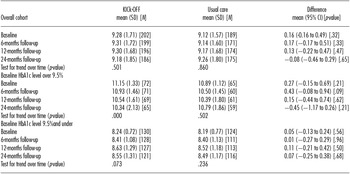
The mean age for the cohort was 13.1 years with an average time since diagnosis of 5 years. 45 percent of the participants were male (Supplementary Table 1). For the KICk-OFF arm, the mean HbA1c was 9.28 percent (77.9 mmol/mol) at baseline, 9.30 percent (78.1 mmol/mol) at 12 months and 9.18 percent (76.8 mmol/mol) at 24 months. For the usual care arm, the mean HbA1c value was 9.12 percent (76.2 mmol/mol) at baseline, 9.17 percent (76.7 mmol/mol) at 12 months and 9.26 percent (77.7mmol/mol) at 24 months (Table 1). Nonparametric test on identifying HbA1c levels over time (baseline and ordered data collection points) indicated that the only statistically significant trend observed in HbA1c levels is by the group whose HbA1c levels were higher than 9.5 percent at baseline (nptrend command in STATA) (19). Patient characteristics, such as systolic blood pressure(116.2 mm Hg), low density lipoprotein cholesterol (2.7 mmol/L), high density lipoprotein cholesterol (1.5 mmol/L), total cholesterol (4.4 mmol/L), and triglyceride (1.2 mmol/L) were not collected, and, therefore, were based on the characteristics of the under 20-year-old population in the DAFNE trial.
Blood Glucose (HbA1c Level %) Outcomes of the KICk-OFF Trial

Within-Trial Cost-Effectiveness Results
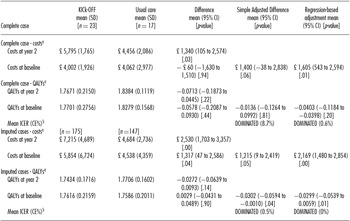
Table 2 reports the within-trial cost-effectiveness analysis undertaken by using both the complete case data only and with imputed data on HUI2 patient-reported outcome measures completed by children. Two other measures (HUI2 completed by parents and CHU9D) are reported in Supplementary Tables 4 and 5, respectively. The costing analysis based on the within-trial data showed that the mean cluster-adjusted cost per individual during the 24-month trial period was £7,165 for the KICk-OFF arm and £4,787 for usual care arm (Table 2). When the cost data were analyzed for individuals with complete utility data only, the cost of each arm reduced, suggesting that the cost per individual for those individuals with a missing utility data was higher on average than the overall mean. Once the missing utility data had been imputed, the mean cost value for each arm approached back to the level of “complete cost cases.”
Within-Trial per Patient Cost and QALYs (Based on HUI2 Children Measure) over the 2-Year Trial Period

a Base year for costs and QALYs is 2009.
b (CE%) stands for cost-effectiveness probability.
A regression-based adjustment, which controls for the baseline value and the treatment arm, applied on the cost values (Reference van Asselt, van Mastrigt, Dirksen, Arntz, Severens and Kessels17). This approach resulted in cost differences that were similar to the simple adjusted differences when complete case data were used, whereas they were significantly different when imputed data were used (Table 2). One explanation is the higher cost values observed using the imputed data compared with the complete case data, combined with the fact that, unlike the simple-adjusted difference where baseline values are subtracted from the 2-year values, the regression-based approach accounts for the “regression to the mean” problem (Reference Manca, Hawkins and Sculpher16;Reference Vickers and Altman22).
Based on the complete case data on HUI2 Children, the mean per patient 2-year QALY value at baseline was considerably higher (0.0578) for the usual care arm (Table 2), which supports the importance of adjusting utility values for baseline value (Reference Manca, Hawkins and Sculpher16). Using the simple adjustment and regression-based approach to adjust for baseline values, the utility differences between the two arms were favoring the usual care arm. The differences between the simple-adjusted and regression-based adjusted incremental QALY values was smaller when the imputed data were used, due to higher sample size reducing the uncertainty around the mean estimates, together with the inherent reduction of variability in imputed data.
Of the twelve sets of analyses presented in Table 2, Supplementary Table 4, and Supplementary Table 5, nine resulted in the KICk-OFF arm being “dominated” by the usual care arm, and two analyses resulted in a mean ICER that would not be evaluated as cost-effective at the £20,000/QALY threshold in the United Kingdom. The only ICER that might potentially be cost-effective was based on complete case CHU9D data with simple adjustment (£23,688) (Supplementary Table 5), which had a cost-effectiveness probability of 41.3 percent at £20,000 per QALY.
Long-term Modeling Results
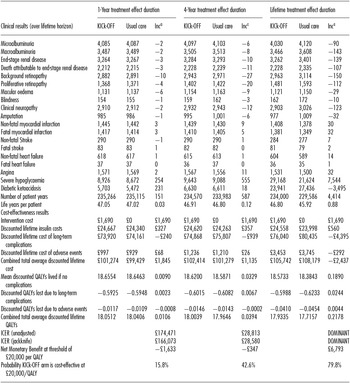
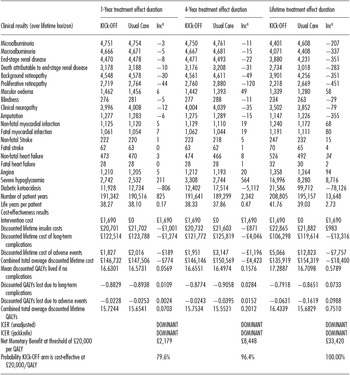
The descriptive statistics for the parameters used in the long-term model and the utility decrements are reported in Supplementary Tables 1–3. The mean number of estimated lifetime events for the full trial cohort and high baseline HbA1c trial cohort (>9.5 percent or 80.3 mmol/mol) are reported in Table 3 and Table 4, respectively. The “treatment effect duration” refers to the sustained impact of the changes observed in the HbA1c level, and hypoglycemia and DKA event numbers after the KICk-OFF course. In addition to the base case of “4-year treatment effect” (Reference Speight, Amiel and Bradley20), 1-year and lifetime treatment effect durations are also reported.
Full Cohort Long-term Model Outcomes and Economic Evaluation of KICk-OFF vs. Usual Care Treatment Arms (for 5,000 Simulated Individuals over Their Lifetime)

a “Inc” refers to “incremental”.
QALY, quality-adjusted life-year; ICER, incremental cost-effectiveness ratio.
High Baseline Hba1c Cohort Long-term Model Outcomes and Economic Evaluation of KICk-OFF vs. Usual Care Treatment Arms (for 5,000 Simulated Individuals over Their Lifetime)

Note. High Baseline HbA1c is defined as an HbA1c over 9.5% (80.3mmol/mol).
a “Inc” refers to “incremental”.
QALY, quality-adjusted life-year; ICER, incremental cost-effectiveness ratio.
The base case discounted lifetime costs per patient for the usual care arm and KICk-OFF arms were £101,279 and £102,404, respectively, giving a difference of £1,135 (95 percent confidence interval [CI], £-2,734–£3,970) (Table 3). These represent the sum of discounted lifetime costs for insulin, interventions, long-term complications, and adverse events. The total cost for both arms reduced when treatment duration assumed to be 1-year only, increasing the incremental cost to £1,845 (95 percent CI, -£984–£4,185). The total cost for both arms increased when treatment duration assumed to be lifetime, resulting in an incremental cost of -£2,437 (95 percent CI, -£14,546–£6,152). For the high baseline HbA1c group, which is expected to experience a higher number of complication-related events in the long-term, the costs per patient for both arms were higher. The lifetime costs per high baseline HbA1c patient for the usual care and KICk-OFF arms were £150,569 and £146,146, respectively, giving a difference of -£4,423 (95 percent CI, £-13,321–£238) in the base case. The incremental cost value increased to -£774 (95 percent CI, £-5,422–£2,157) in the 1-year treatment effect duration scenario, and reduced to -£18,400 (95 percent CI, £-46,818–-£4,829) in the lifetime treatment effect scenario (Table 4).
The discounted long-term QALYs for the usual care and KICk-OFF arms are estimated at 17.9646 and 18.0039, respectively, leading to a difference of 0.0394 (95 percent CI, -0.0845–0.2013), which corresponds to 14.39 days per person in perfect health. 1-year treatment duration assumption led to an incremental QALY difference of 0.0106 (95 percent CI, -0.0843–0.1115). The total QALYs for both arms reduced when treatment duration assumed to be lifetime, resulting in an incremental QALY of 0.2178 (95 percent CI, -0.2012–0.7029). For the high baseline HbA1c group, which are expected to experience a higher number of complication-related events in the long-term, the QALYs per patient for both arms were lower. The incremental QALY value for the base case was 0.2012 (95 percent CI, -0.0238–0.4716), which reduced to 0.0703 (95 percent CI, -0.0652–0.2151) with 1-year treatment effect duration and increased to 0.7510 (95 percent CI, 0.1967–1.6083) with lifetime treatment effect duration assumptions.
In the base case, assuming a 4-year treatment effect duration, the incremental cost-effectiveness ratio (ICER) is £28,813 with a cost-effectiveness probability of 42.6 percent using a £20,000/QALY threshold, 1-year assumption resulted in a cost-ineffective ICER of £174,471 (15.8 percent) and a lifetime assumption led to an outcome where KICk-OFF arm was dominant with a cost-effectiveness probability of 79.8 percent. For the high baseline HbA1c group, however, the KICk-OFF arm was dominant in all three scenarios, with cost-effectiveness probabilities of 79.6 percent, 96.4 percent, and 100 percent for 1-year, 4-year, and lifetime treatment effect durations, respectively.
The CEPs and the CEACs are provided in Supplementary Figures 1 and 2, respectively. These figures highlight the parameter uncertainty in the ICER estimates.
DISCUSSION
This study evaluates the cost-effectiveness of KICk-OFF T1DM structured education program over the usual care arm, which is center-specific education delivered without a clear structure. After adjusting for baseline, at each time point the mean HbA1c level for the whole intervention group was not significantly different from that of controls. The within-trial analysis, which is limited due to the short follow-up period it covers and the limited number of complication-related events a cohort of this age group would experience, has showed more favorable results for the usual care arm. The most favorable within-trial scenario for the KICk-OFF arm was observed when the CHU9D instrument was used to capture the QALYs.
The results changed considerably when two extremes were considered for the treatment effect duration, with 1-year duration leading to a cost-ineffective outcome and a lifetime duration resulting in a cost-saving outcome for the KICk-OFF arm. This demonstrates that the short-term QALY gains identified within the trial, which were favoring the usual care arm, are overturned by the longer-term health effects generated by the greater HbA1c improvement observed for the KICk-OFF arm compare with usual care arm. The uncertainty of the results has been illustrated with the CEPs, which indicated that uncertainty increases in parallel with the length of the treatment duration assumption. Although the base case results for the overall group show that the KICk-OFF program may be considered as “not cost-effective” at £20,000/QALY threshold and “cost-effective” at £30,000/QALY threshold, there is considerable evidence that the program would lead to cost-effective outcomes for the high baseline HbA1c group irrespective of the treatment effect duration assumed.
In addition to patient-level modelling and fully accounting for parameter uncertainty, which allowed to capture individual heterogeneity and illustrated the robustness of the results, the strengths of the study include using data from a UK-based, multi-center, randomized controlled trial of a structured education program. However, the study also has several limitations. First, the effectiveness of the KICk-OFF education program was only represented by the change in HbA1c levels, hypoglycemia and DKA risks. The effect of baseline HbA1c level, and the duration of the changes in HbA1c levels were explored in sensitivity analyses, but there is also the potential to incorporate KICk-OFF's effect directly on other indicators such as weight or physical activity (Reference Kruger, Brennan and Thokala5). In addition, although it is the best evidence available, the Model used published data from non-UK settings to define risk of long-term complications, some of which are from studies published several years ago (Reference Kruger, Brennan and Thokala5).
Finally, the issue of missing observations, especially in the utilities data used for the within-trial analyses, is addressed by a recognized imputation method selected as part of the sensitivity analysis. Further research should investigate the impact of alternative imputation methods on the cost-effectiveness analyses. Alternative data sources that have been used to populate the disutility parameters for comorbidities in long-term cost-effectiveness model introduces heterogeneity into the analyses; however, there is not a single source that reports all disutility parameters of interest.
The generalizability of the results of this study is limited to cohorts with similar characteristics, such as having a cohort of children (aged 11–16 years) and using the UK-based costs to analyze the resource use. However, with small refinements, the Sheffield Type 1 Diabetes Policy Model could be used to analyze the effects of additional interventions. For example, the Model will be used to analyze trials for adolescents (aged 16–21 years) called Working with Insulin, Carbs, Ketones, and Exercise to manage Diabetes (WICKED) (Reference Eiser, Johnson and Brierley23).
CONCLUSION
In conclusion, the results of this study suggest that, for the whole study population, the cost-effectiveness of the KICk-OFF structured education programs depends on the assumption on the treatment effect duration, which had mean baseline HbA1c of 9.20 percent (77.0 mmol/mol) and mean 24-month follow-up HbA1c of 9.22 percent (77.3 mmol/mol). For the high baseline HbA1c sub-group, which was defined as having an HbA1clevel over 9.5 percent (80.3 mmol/mol) at the baseline, resulting in a mean baseline HbA1c value of 11.04 percent and a 24-month follow-up value of 10.55 percent, KICk-OFF arm was estimated to be cost-effective (in fact dominant i.e. providing better health gains at lower costs than usual care) regardless of the assumption on the treatment effect duration.
SUPPLEMENTARY MATERIAL
Supplementary Table 1: www.journals.cambridge.org/10.1017/S0266462316000507
Supplementary Table 2: www.journals.cambridge.org/10.1017/S0266462316000507
Supplementary Table 3: www.journals.cambridge.org/10.1017/S0266462316000507
Supplementary Table 4: www.journals.cambridge.org/10.1017/S0266462316000507
Supplementary Table 5: www.journals.cambridge.org/10.1017/S0266462316000507
Supplementary Figure 1: www.journals.cambridge.org/10.1017/S0266462316000507
Supplementary Figure 2: www.journals.cambridge.org/10.1017/S0266462316000507
CONFLICTS OF INTEREST
This study presents independent research commissioned by the Diabetes UK, grant number 07/0003555. None of the authors have any further financial arrangement to disclose.