
Introduction
Leishmaniasis is an anthropozoonosis considered a public health problem, with a broad clinical spectrum and epidemiological variety. It is caused by parasites of the genus Leishmania, transmitted to mammals during the blood meal of female sand flies of the genus Phlebotomus or Lutzomyia (Kevric et al., Reference Kevric, Cappel and Keeling2015). More than 50 species of Leishmania have been described, 20 of which cause human disease, most of them grouped into Leishmania (L.) and Viania (V.) subgenera (Cupolillo et al., Reference Cupolillo, Medina-Acosta, Noyes, Momen and Grimaldi2000; Akhoundi et al., Reference Akhoundi, Kuhls, Cannet, Votypka, Marty, Delaunay and Sereno2016). The 2 main clinical forms in humans are the cutaneous (CL) and visceral (VL) leishmaniasis. The clinical manifestations and disease severity are mainly determined by the host immune response and by the Leishmania species and strains (Podinovskaia and Descoteaux, Reference Podinovskaia and Descoteaux2015; Velasquez et al., Reference Velasquez, Galuppo, de Rezende, Brandao, Peron, Uliana, Duarte and Stolf2016; de Rezende et al., Reference de Rezende, Kawahara, Pena, Palmisano and Stolf2017). According to the World Health Organization (WHO), in 2018, 92 and 83 countries were considered endemic for CL and VL, respectively, and approximately 30 000 new cases of VL and 1 million new cases of CL occurred annually (WHO, 2018). In Brazil, Leishmania (L.) amazonensis is one of the species frequently associated with CL (Silveira et al., Reference Silveira, Lainson, De Castro Gomes, Laurenti and Corbett2009).
Leishmania promastigotes develop in the vector and are transmitted to mammals. In the vertebrate host they are phagocytosed by phagocytes, mainly macrophages, and convert into amastigotes (Dostalova and Volf, Reference Dostalova and Volf2012; Podinovskaia and Descoteaux, Reference Podinovskaia and Descoteaux2015). Adaptation to the hostile environment of macrophages relies on parasite virulence factors (Podinovskaia and Descoteaux, Reference Podinovskaia and Descoteaux2015). Lipophosphoglycan (LPG) and glycoprotein 63 (GP63) are well-known virulence factors in Leishmania, which contribute to the survival of the parasite in the vertebrate host by affecting several processes (Brittingham et al., Reference Brittingham, Morrison, McMaster, McGwire, Chang and Mosser1995; Sacks et al., Reference Sacks, Modi, Rowton, Spath, Epstein, Turco and Beverley2000; Chang et al., Reference Chang, Reed, McGwire and Soong2003; Spath et al., Reference Spath, Garraway, Turco and Beverley2003; Yao et al., Reference Yao, Donelson and Wilson2003; Svarovska et al., Reference Svarovska, Ant, Seblova, Jecna, Beverley and Volf2010). Many proteases have also been described as virulence factors, degrading proteins and peptides that participate in a range of biological processes involved in the infection (Silva-Almeida et al., Reference Silva-Almeida, Pereira, Ribeiro-Guimaraes and Alves2012). A well-studied example is cysteine protease B (CPB), which induces a Th2 response in mice infected by L. (L.) mexicana, increasing parasite survival (Weinheber et al., Reference Weinheber, Wolfram, Harbecke and Aebischer1998; Bennett et al., Reference Bennett, Misslitz, Colledge, Aebischer and Blackburn2001; Buxbaum et al., Reference Buxbaum, Denise, Coombs, Alexander, Mottram and Scott2003; Pollock et al., Reference Pollock, McNeil, Mottram, Lyons, Brewer, Scott, Coombs and Alexander2003; Cameron et al., Reference Cameron, McGachy, Anderson, Paul, Coombs, Mottram, Alexander and Plevin2004; Mottram et al., Reference Mottram, Coombs and Alexander2004; Saravia et al., Reference Saravia, Escorcia, Osorio, Valderrama, Brooks, Arteaga, Coombs, Mottram and Travi2006; Abu-Dayyeh et al., Reference Abu-Dayyeh, Shio, Sato, Akira, Cousineau and Olivier2008). Oligopeptidase B (OPB) is another protease that may be considered a virulence factor in Leishmania.
OPB (MEROPS code S09.010) was first described in Escherichia coli as a protease II and was later characterized in Trypanosoma cruzi and T. brucei as an alkaline protease (Pacaud and Richaud, Reference Pacaud and Richaud1975; Ashall, Reference Ashall1990; Kornblatt et al., Reference Kornblatt, Mpimbaza and Lonsdale-Eccles1992). It is classified as a serine peptidase from the prolyl oligopeptidase family (POP) (SC clan, family S9, subfamily A) (Rawlings et al., Reference Rawlings, Barrett and Bateman2010; Munday et al., Reference Munday, McLuskey, Brown, Coombs and Mottram2011), present in prokaryotes, in unicellular eukaryotes such as trypanosomatids, in plants and fungi. OPB has never been described in any mammalian genome (Motta et al., Reference Motta, Azevedo, Neves, Araujo, Grellier, Santana and Bastos2019). It is considered an important virulence factor in T. cruzi. Indeed, it is believed that an unknown OPB product secreted by the parasite binds to host cell receptors, triggering the release of Ca2+. The mobilization of Ca2+ induces lysosomal exocytosis and disruption of actin filaments that facilitate cell invasion by the parasite (Burleigh and Andrews, Reference Burleigh and Andrews1995; Rodriguez et al., Reference Rodriguez, Rioult, Ora and Andrews1995; Burleigh et al., Reference Burleigh, Caler, Webster and Andrews1997; Caler et al., Reference Caler, Vaena de Avalos, Haynes, Andrews and Burleigh1998; Motta et al., Reference Motta, Azevedo, Neves, Araujo, Grellier, Santana and Bastos2019).
OPB was annotated in the first Leishmania genome reported (Ivens et al., Reference Ivens, Peacock, Worthey, Murphy, Aggarwal, Berriman, Sisk, Rajandream, Adlem, Aert, Anupama, Apostolou, Attipoe, Bason, Bauser, Beck, Beverley, Bianchettin, Borzym, Bothe, Bruschi, Collins, Cadag, Ciarloni, Clayton, Coulson, Cronin, Cruz, Davies, De Gaudenzi, Dobson, Duesterhoeft, Fazelina, Fosker, Frasch, Fraser, Fuchs, Gabel, Goble, Goffeau, Harris, Hertz-Fowler, Hilbert, Horn, Huang, Klages, Knights, Kube, Larke, Litvin, Lord, Louie, Marra, Masuy, Matthews, Michaeli, Mottram, Muller-Auer, Munden, Nelson, Norbertczak, Oliver, O'Neil, Pentony, Pohl, Price, Purnelle, Quail, Rabbinowitsch, Reinhardt, Rieger, Rinta, Robben, Robertson, Ruiz, Rutter, Saunders, Schafer, Schein, Schwartz, Seeger, Seyler, Sharp, Shin, Sivam, Squares, Squares, Tosato, Vogt, Volckaert, Wambutt, Warren, Wedler, Woodward, Zhou, Zimmermann, Smith, Blackwell, Stuart, Barrell and Myler2005), but was only studied in the genus in 2007 (de Matos Guedes et al., Reference de Matos Guedes, Duarte Carneiro, de Oliveira Gomes, Rossi-Bergmann and Giovanni De-Simone2007). This study showed that L. (L.) amazonensis OPB was a single copy gene with 2.196 base pairs (bp), encoding a 731 amino acid protein with predicted mass and isoelectric point of 83.52 kDa and 5.61, respectively. The protein lacks a signal peptide at the N-terminal extension, indicating that it is probably synthesized as an active protease (de Matos Guedes et al., Reference de Matos Guedes, Duarte Carneiro, de Oliveira Gomes, Rossi-Bergmann and Giovanni De-Simone2007). The structure of L. (L.) amazonensis enzyme is composed of 2 distinct domains, an α/β hydrolase fold and 7 blades with β helix domains. OPB amino acid sequences of L. (L.) amazonensis, L. (L.) major, L. (L.) chagasi and L. (V.) braziliensis are conserved, mainly in the catalytic region (de Matos Guedes et al., Reference de Matos Guedes, Duarte Carneiro, de Oliveira Gomes, Rossi-Bergmann and Giovanni De-Simone2007). Another gene from the OPB group, later named OPB-2, was annotated in the L. (L.) major genome (Ivens et al., Reference Ivens, Peacock, Worthey, Murphy, Aggarwal, Berriman, Sisk, Rajandream, Adlem, Aert, Anupama, Apostolou, Attipoe, Bason, Bauser, Beck, Beverley, Bianchettin, Borzym, Bothe, Bruschi, Collins, Cadag, Ciarloni, Clayton, Coulson, Cronin, Cruz, Davies, De Gaudenzi, Dobson, Duesterhoeft, Fazelina, Fosker, Frasch, Fraser, Fuchs, Gabel, Goble, Goffeau, Harris, Hertz-Fowler, Hilbert, Horn, Huang, Klages, Knights, Kube, Larke, Litvin, Lord, Louie, Marra, Masuy, Matthews, Michaeli, Mottram, Muller-Auer, Munden, Nelson, Norbertczak, Oliver, O'Neil, Pentony, Pohl, Price, Purnelle, Quail, Rabbinowitsch, Reinhardt, Rieger, Rinta, Robben, Robertson, Ruiz, Rutter, Saunders, Schafer, Schein, Schwartz, Seeger, Seyler, Sharp, Shin, Sivam, Squares, Squares, Tosato, Vogt, Volckaert, Wambutt, Warren, Wedler, Woodward, Zhou, Zimmermann, Smith, Blackwell, Stuart, Barrell and Myler2005) and sequenced in L. (L.) amazonensis (de Matos Guedes et al., Reference de Matos Guedes, de Carvalho, de Oliveira Gomes, Rossi-Bergmann and De Simone2008). OPB-2 amino acid sequences are conserved among Leishmania but display several insertions and deletions and a C-terminal extension domain when compared to OPBs (de Matos Guedes et al., Reference de Matos Guedes, de Carvalho, de Oliveira Gomes, Rossi-Bergmann and De Simone2008). No enzymatic or functional studies for OBP-2 were reported to date, but comparative modelling indicates that L. (L.) amazonensis OPB and OPB2 have many similarities and may be sensitive to dual inhibitors (Sodero et al., Reference Sodero, Dos Santos, Mello, de Jesus, de Souza, Rodrigues, de Simone, Rodrigues and de Matos Guedes2017). OPB is secreted by Leishmania, as it was found in exosomes shed by L. (L.) donovani and L. (L.) major promastigotes (Silverman et al., Reference Silverman, Chan, Robinson, Dwyer, Nandan, Foster and Reiner2008, Reference Silverman, Clos, de'Oliveira, Shirvani, Fang, Wang, Foster and Reiner2010). The protein is present in the soluble fraction of L. (L.) major procyclics, metacyclics and amastigotes (Munday et al., Reference Munday, McLuskey, Brown, Coombs and Mottram2011), and higher activity was observed in L. (L.) donovani and L. (L.) mexicana axenic amastigotes compared to promastigotes (Swenerton et al., Reference Swenerton, Zhang, Sajid, Medzihradszky, Craik, Kelly and McKerrow2011).
OPB hydrolyses peptide bonds preferentially after a pair of dibasic residues, preferentially with an arginine at the P1 position (Kanatani et al., Reference Kanatani, Masuda, Shimoda, Misoka, Lin, Yoshimoto and Tsuru1991; Polgar, Reference Polgar2002; Motta et al., Reference Motta, Azevedo, Neves, Araujo, Grellier, Santana and Bastos2019). Enzymatic profiles of Leishmania OPBs were analysed using recombinant proteins. L. (L.) donovani and L. (L.) major OPBs were produced in Pichia pastoris and Escherichia coli, respectively. The 2 enzymes showed preference to an Arg at position P1 and similar inhibition profiles employing commercial inhibitors (McLuskey et al., Reference McLuskey, Paterson, Bland, Isaacs and Mottram2010; Swenerton et al., Reference Swenerton, Zhang, Sajid, Medzihradszky, Craik, Kelly and McKerrow2011).
Only 2 functional studies on Leishmania OPBs have been published, and they are restricted to 2 parasite species. L. (L.) major parasites deficient in OPB showed impaired differentiation into metacyclic promastigotes, decreased infectivity in macrophages in vitro (Munday et al., Reference Munday, McLuskey, Brown, Coombs and Mottram2011) and generated smaller footpad lesions in mice compared to wild-type (wt) parasites (Munday et al., Reference Munday, McLuskey, Brown, Coombs and Mottram2011; Swenerton et al., Reference Swenerton, Zhang, Sajid, Medzihradszky, Craik, Kelly and McKerrow2011). L. (L.) donovani promastigotes knockout (ko) for OPB expressed more enolase isoforms and higher abundance of the enzyme on the parasite surface (Swenerton et al., Reference Swenerton, Zhang, Sajid, Medzihradszky, Craik, Kelly and McKerrow2011). Since enolase activity was similar between ko and wt parasites, the authors suggested an accumulation of inactive enolase on the surface of ko parasites. They also hypothesized that during differentiation into amastigotes OPB is responsible for removing enolase and plasminogen from the parasite surface (Swenerton et al., Reference Swenerton, Zhang, Sajid, Medzihradszky, Craik, Kelly and McKerrow2011).
A study carried out by our group compared the proteome of L. (L.) amazonensis amastigotes derived from BALB/c and BALB/c nude mice lesions and showed that 4 OPB isoforms were more abundant in parasites from BALB/c nude mice (Teixeira et al., Reference Teixeira, Velasquez, Lepique, de Rezende, Bonatto, Barcinski, Cunha-Neto and Stolf2015). This suggests that T cells or their mediators may be responsible for controlling OPB post-translational modifications (Teixeira et al., Reference Teixeira, Velasquez, Lepique, de Rezende, Bonatto, Barcinski, Cunha-Neto and Stolf2015).
No study has analysed the profile and the role of OPB from Leishmania species from the New World. In the present study, we produced L. (L.) amazonensis recombinant OPB and characterized its enzymatic profile. Both pH preference, V max, K m and inhibition pattern were characterized. Since OPB was shown to be secreted by Leishmania promastigotes, we analysed the effect of the recombinant protein in macrophage infection by this parasite stage. Our data indicate that active soluble OPB plays a role in in vitro infection by L. (L.) amazonensis, suggesting that OPB is relevant to L. (L.) amazonensis infection.
Materials and methods
L. (L.) amazonensis promastigotes and axenic amastigotes
Cultures of promastigotes were periodically obtained from BALB/c mice infected with 2 × 10⁶ L. (L.) amazonensis strain LV79 (MPRO/BR/72/M1841) stationary phase promastigotes in the plantar pad of the left hind paw. Promastigotes were maintained in complete medium 199 (see below) at 24°C. Cultures were subcultured weekly to an initial density of 2 × 10⁶ parasites mL−1 until the 8th passage.
Axenic amastigotes were obtained as previously described (Miguel et al., Reference Miguel, Flannery, Mittra and Andrews2013). Briefly, 5-day promastigote cultures (2–3 × 10⁶ mL−1) were mixed with the same volume of M199 medium supplemented with 0.25% glucose, 0.5% trypticase and 40 mm Na succinate, adjusted to pH 5.5. Cultures were maintained at 24°C for 16 h and at 34°C for 3 days, diluted at a 1:5 ratio and maintained for up to 5 days at 32°C.
Production of recombinant OPB
The OPB gene was amplified from L. (L.) amazonensis genomic DNA using Platinum™ Superfi™ DNA polymerase (Invitrogen) and primers derived from the 5′ and 3′ ends of the L. (L.) amazonensis ORF deposited in TriTryp (LAMA_000147800) (forward: 5′- ATA GAA TTC ATG TCG TCG GGC AAC – 3′ and reverse: 5′- AAT CTC GAG TTA CCT GCG AAC CAG – 3′). The resultant 2.196 kb PCR product was cloned into pJET 1.2/blunt (Life Technologies) and then into the pET28a expression vector. Competent Escherichia coli BL21 pGro7 was transformed with pET-28aOPB and 2 clones were confirmed by sequencing. One of them was grown and expression of OPB was induced with 0.1 mm IPTG at 37°C for 4 h.
The culture was centrifuged and the pellet was resuspended in binding buffer (20 mm NaH2PO4, 0.5 M NaCl, 5 mm imidazol) plus 0.4 mg mL−1 lysozyme and 1 mm PMSF and kept at −20°C for 16 h. Bacteria were disrupted by sonication at 25% amplitude, centrifuged and the soluble fraction was loaded on a 1 mL Histrap™ HP (GE HealthCare) nickel column previously washed with 10 volumes of H2O and equilibrated with 50 volumes of binding buffer. Protein was eluted with 20 mm NaH2PO4, 0.5 M NaCl containing imidazole from 25 to 500 mm. Imidazole was removed using the Amicon® Ultra 4–30 K filter (Millipore), the protein was reconstituted with 1 mL of phosphate-buffered saline (PBS) + 15% glycerol and quantified by Bradford assay. The purified protein showed undetectable amounts of LPS according to the Pierce™ Chromogenic Endotoxin Quant Kit (Thermo Scientific).
Recombinant OPB activity assays at different pHs
Enzyme assays to determine the pH preference were adapted from Swenerton et al. (Reference Swenerton, Zhang, Sajid, Medzihradszky, Craik, Kelly and McKerrow2011). Assays were performed at 25°C in a Corning Costar 3603 plate (Corning®) with 0.5 ng (1 μL) of OPB, 5 μ m (1 μL) of Z-Arg-Arg-AMC substrate (Sigma-Aldrich) and a gradient of buffers (98 μL) from pH of 3–10 with 0.5 intervals. The buffers used were 0.2 M citrate phosphate (pH 3–7) and 50 mm Tris-HCl (pH 7–10). The fluorescence readings, which result from the product AMC released, were taken every minute for 45 min in POLARstar Omega reader (BMG Labtech) with 390 nm excitation and 480 nm emission. The slope of fluorescence vs time lines corresponds to the enzyme activity. The mean activity at each pH was calculated based on 3 linear plots and expressed as relative activity taking the highest mean activity as reference. This triplicate assay was repeated 3 times. Control tests without OPB were carried out to check the substrate spontaneous hydrolysis in different pHs.
Recombinant OPB inhibition assay with commercial inhibitors
The choice of inhibitors was based on the work of Swenerton et al. (Reference Swenerton, Zhang, Sajid, Medzihradszky, Craik, Kelly and McKerrow2011). Recombinant OPB inhibition assays were performed at 25°C in a Corning Costar 3603 plate (Corning®) with 0.5 ng (1 μL) of OPB enzyme, and 5 μ m (1 μL) of Z-Arg-Arg-AMC substrate in 50 mm Tris-buffer HCl, pH 8.0 with the following commercial inhibitors: 100 μ m Antipain, 100 μ m leupeptin, 5 mm EDTA, 1 μ m pepstatin A, 10 mm Ca2+ and 10 mm Mg2+. The enzyme was pre-incubated with each inhibitor for 10 min in the absence of substrate. After addition of the substrate, fluorescence readings were taken every minute for 45 min in POLARstar Omega reader (BMG Labtech) with 390 nm for excitation and 480 nm for emission. The slope of fluorescence vs time lines corresponds to the enzyme activity. The mean activity in the presence of the putative inhibitors was calculated based on 3 linear plots. Then it was expressed as a relative activity taking the activity in the absence of any inhibitor as a reference. This triplicate assay was repeated 2 times.
Calculation of K m and V max
Enzyme assays were performed with substrate concentrations ranging from 0.8 to 8 μ m (in triplicates). Reactions were performed at 25°C in a Corning Costar 3603 plate (Corning®) with OPB enzyme and Z-Arg-Arg-AMC substrate in 50 mm Tris-buffer HCl, pH 8.0. Fluorescence readings were taken every minute for 45 min in POLARstar Omega reader (BMG Labtech) with 390 nm for excitation and 480 nm for emission. The slope of the fluorescence vs time lines corresponds to the reaction initial rate (afu min−1; afu, arbitrary fluorescence units). The Michaelis–Menten equation was fitted to [S] x rate data resulting in the K m and V max. Such fitting process was done using the Origin 2019 software.
Anti-OPB serum and Western blot
To obtain anti-OPB serum, BALB/c mice were immunized by the intraperitoneal route with 15 μg of recombinant OPB in 100 μL, emulsified 1:1 with incomplete Freund's adjuvant. A control mouse was inoculated with PBS emulsified with incomplete Freund. Immunization was carried out in 2 steps with an interval of 30 days and serum collection was carried out 60 days after the first immunization. The reactivity of anti-OPB serum was confirmed by enzyme-linked immunosorbent assay (ELISA).
Parasites were lysed by 8 cycles of freeze–thaw at the density of 2 × 10⁹ promastigotes mL−1 in PBS with protease inhibitors (800 nm aprotinin, 50 nm bestatin, 1 mm AEBSF-HCl, 15 nm E64, 2 nm leupeptin and 1 nm pepstatin A; Fermentas). Proteins were separated by sodium dodecyl-polyacrylamide gel electrophoresis (SDS-PAGE) and transferred onto nitrocellulose membrane (GE Healthcare) in 25 mm Tris buffer, 192 mm glycine, 20% methanol, 0.1% SDS, pH 8.2, for 1 h at 5 V using the TE77 equipment (GE Healthcare). The membrane was blocked in PBS 5% skim milk and 0.1% Tween 20 for 1 h and incubated with anti-OPB serum diluted 1:500 in PBS 2.5% skim milk 0.1% Tween 20 for 16 h at 4°C. Then, the membrane was washed 3 times for 10 min with PBS 0.05% Tween 20 and incubated for 1 h with secondary antibodies anti-mouse HRP (from KPL) diluted 1:5000 in PBS 2.5% skim milk and 0.05% Tween 20. Three washes were performed as described and the membrane was incubated with ECL substrate (Amersham™ ECL™ detection systems, GE Healthcare) for 5 min and developed in a ChemiDoc™ XRS (Bio-Rad).
Infection assay
Resident macrophages of the peritoneal cavity were obtained from BALB/c mice. The animals were euthanized and washed with 70% ethanol. The peritoneal cavity was exposed and 5 mL of sterile PBS at 4°C was injected into the cavity, which was massaged for 30 s before recovering the aspirate with a syringe and 21 G needle. The aspirate was centrifuged at 3000 g for 10 min at 4°C, the supernatant was discarded, and cells resuspended in RPMI. Cells were counted in a Neubauer® chamber and transferred to 48-well plates containing circular glass coverslips. After 2 h at 37°C 5% CO2, the medium was changed to RPMI supplemented with 10% fetal bovine serum (FBS), 20 μg mL−1 gentamicin (from now on called supplemented RPMI) and OPB in different conditions. Plates were incubated overnight at 37°C and 5% CO2. Alternatively, medullary macrophages were obtained as previously described (Galuppo et al., Reference Galuppo, de Rezende, Forti, Cortez, Cruz, Teixeira, Giordano and Stolf2018) and employed in infection assays using the same conditions.
To assess the importance of peptidase activity on infection, we inhibited OPB with 4 mm Pefabloc® (Sigma) for 2 h at 37°C and then used the Amicon® Ultra 4–30 K filter (Millipore) to remove the free inhibitor. To assess the importance of OPB structure and of eventual LPS, aliquots of OPB were incubated at 95°C for 5 min. Recombinant OPB and these 2 controls were incubated at the time of macrophage plating and maintained until the end of the experiment.
Infection was performed with promastigotes at day 4 of culture at a multiplicity of infection (MOI) of 10:1, in supplemented RPMI at 34°C, 5% CO2 with OPB and controls described above. After 4 h, the medium was changed and the plates incubated for another 20 h at 34°C and 5% CO2. Cells were fixed with methanol and stained with the Instant Prov Kit dye set (Newprov). Assays were performed in technical triplicates and 100 cells were counted from each cover slip. The percentage of infected macrophages and the number of amastigotes per macrophage were calculated.
Statistical analysis
Statistical analyses were performed by ANOVA test followed by Tukey post-test (n ⩾ 3), Sidak's post-test or by Student's t test (n ⩽ 2). Differences were considered significant for P value ⩽ 0.05.
Results
Sequencing and production of recombinant OPB
OPB from L. (L.) amazonensis PH8 strain has already been sequenced and studied in silico years ago (de Matos Guedes et al., Reference de Matos Guedes, Duarte Carneiro, de Oliveira Gomes, Rossi-Bergmann and Giovanni De-Simone2007). In this work we cloned and sequenced OPB gene from L. (L.) amazonensis LV79 strain, which is shown in Fig Sup 1 along with its translation. LV79 OPB is similar to the sequence reported for PH8 strain, except for a change in 1 nucleotide, generating a valine instead of an isoleucine at the 558 position, as depicted in Fig Sup 1. This substitution occurs outside of relevant sites for enzyme activity, such as the catalytic triad and S1 and S2 subsites, as indicated in Fig Sup 2.
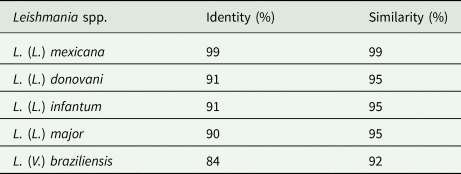
The alignment of L. (L.) amazonensis LV79 OPB with sequences from other Leishmania species indicated high identity and similarity, as shown in Table 1. Structures of L. (L.) amazonensis and L. (L.) major OPBs (published by de Matos Guedes et al., Reference de Matos Guedes, Duarte Carneiro, de Oliveira Gomes, Rossi-Bergmann and Giovanni De-Simone2007 and McLuskey et al., Reference McLuskey, Paterson, Bland, Isaacs and Mottram2010) after in silico and crystal studies, respectively, were very similar. Besides, L. (L.) amazonensis and L. (L.) major sequences display the same residues in the catalytic triad and S1 and S2 subsites (Fig Sup 2), suggesting that the 2 enzymes probably have similar enzymatic activities. Apart from these residues, we also observe conservation in residues involved in interactions between the catalytic and the propeller domain, which also determine enzyme activity and specificity. These residues, already cited by McLuskey et al. (Reference McLuskey, Paterson, Bland, Isaacs and Mottram2010), are E179-R664, which form a salt-bridge that affects substrate binding pocket; E621 and Y499, important for the preference for RR residues; E623, which connects the 2 domains in the active enzyme; D504-R366 and H404-Q506, which connect the 2 domains and probably influence substrate specificity; E538-R302, forming a salt-bridge that is broken when OPB changes conformation and replaced by a bridge between S271 and R534.
Identity and similarity between amino acid sequences of L. (L.) amazonensis LV79 strain OPB and those from L. (L.) mexicana, L. (L.) donovani, L. (L.) infantum, L. (L.) major and L. (V.) braziliensis OPBs

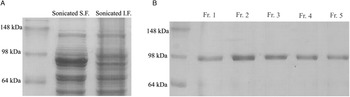
Since active recombinant L. (L.) major OPB had been previously produced in a bacterial system (McLuskey et al., Reference McLuskey, Paterson, Bland, Isaacs and Mottram2010), we attempted to produce L. (L.) amazonensis OPB in Escherichia coli. The analysis of the samples from the recombinant OPB expression and purification steps is shown in Fig. 1. As can be noted, a his-tagged protein was present mainly in the soluble fraction (Fig. 1A) and was efficiently recovered using nickel columns (Fig. 1B). The size of the protein seems a little larger than expected even considering the addition of his and T7 tags at the N-terminal end, as sometimes happens in SDS-PAGE migration.
Recombinant L. (L.) amazonensis OPB expression and purification. (A) 10% SDS-PAGE showing soluble (S.F.) and insoluble (I.F.) fractions of bacterial extracts after sonication. Protein marker: SeeBlue Plus2, Invitrogen. (B) 10% SDS-PAGE showing fractions (Fr.) 1–5 of the soluble fraction of the bacterial lysate eluted from the nickel column. Protein marker: SeeBlue Plus2, Invitrogen.

Recombinant OPB activity at different pHs and in the presence of inhibitors
The recombinant enzyme was analysed in terms of activity in different pHs and in the presence of commercial inhibitors, following procedures previously employed to study L. (L.) major and L. (L.) donovani OPBs (McLuskey et al., Reference McLuskey, Paterson, Bland, Isaacs and Mottram2010; Swenerton et al., Reference Swenerton, Zhang, Sajid, Medzihradszky, Craik, Kelly and McKerrow2011).
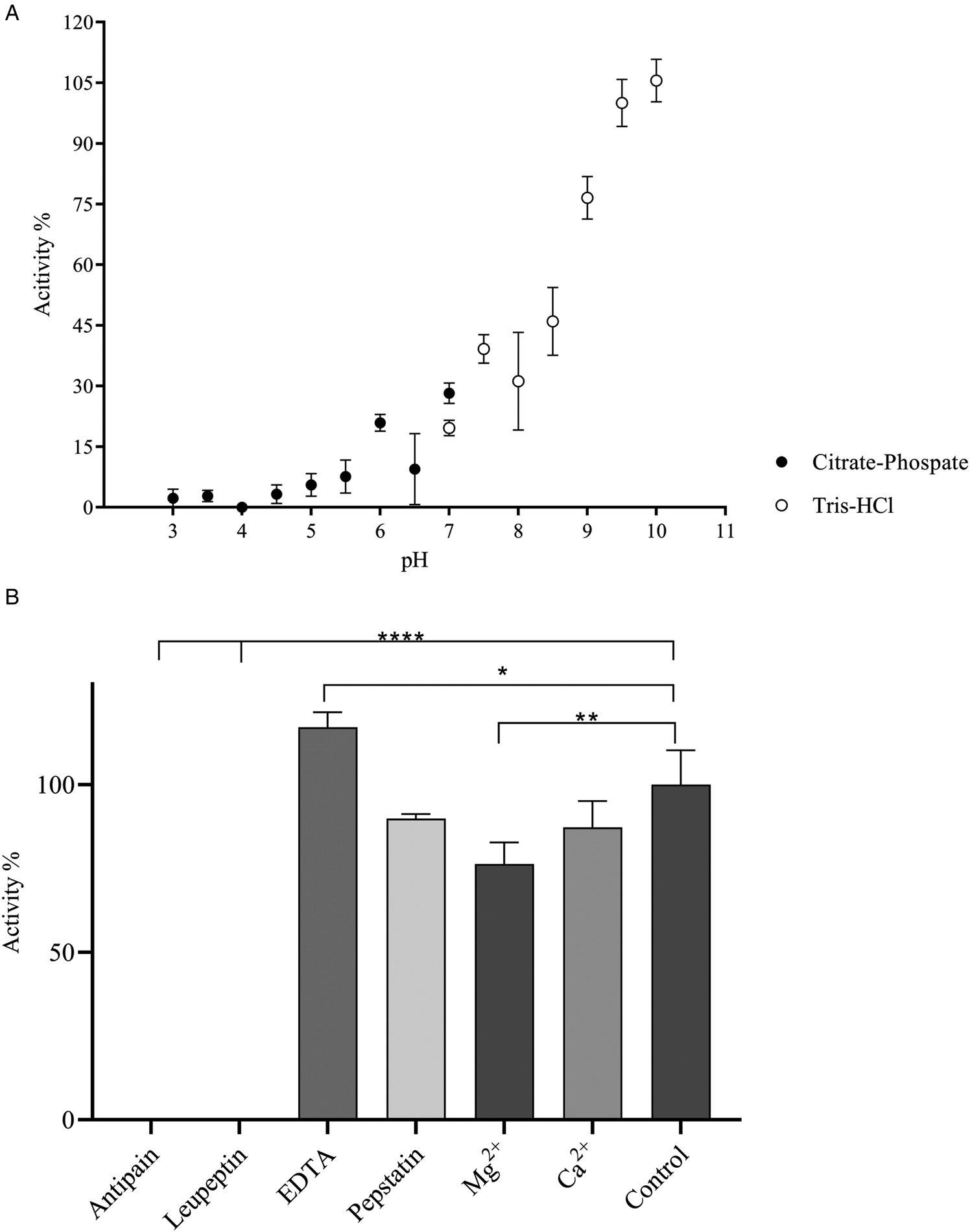
Figure 2A shows that activity of L. (L.) amazonensis OPB is highest at pH 9.5 and 10 and very low at pH around 5, like OPBs from other Leishmania species. OPB activity was completely inhibited by antipain and leupeptin and diminished with Mg2+ (Fig. 2B). Conversely, pepstatin had no effect, while EDTA increased OPB activity.
Characterization of the enzymatic activity of the recombinant OPB from L. (L.) amazonensis. (A) Activity in different pHs. The substrate Z-Arg-Arg-AMC was prepared in 0.2 M citrate-phosphate and 50 mm Tris-HCl buffers. Mean relative activities and standard deviations were calculated based on 3 enzyme assays. For more details see Materials and Methods. Negative relative activities were considered as 0. (B) Activity in the presence of commercial inhibitors and bivalent cations. Inhibitors were pre-incubated with the enzyme for 10 min and the activity was measured by hydrolysis of the substrate Z-Arg-Arg-AMC in a 50 mm Tris-HCl buffer, pH 8.0. Negative relative activities were considered as 0. Mean relative activities and standard deviations were calculated based on 3 enzyme assays. For more details see Materials and Methods. Statistical analysis for one-way ANOVA and Sidak's multiple comparison (*P < 0.05; **P < 0.005; ****P < 0.0001).

K m and V max were determined employing different substrate (Z-Arg-Arg-AMC) concentrations and the same conditions used for assays in the presence of inhibitors. The Michaelis–Menten equation showed a precise fit to the curve obtained with the complete set of data points (correlation coefficient (R) = 0.99), leading to values of K m = 2.1 ± 0.4 μ m and V max = 1.7 ± 0.1 afu min−1.
Presence of OPB in promastigotes and amastigotes of L. (L.) amazonensis
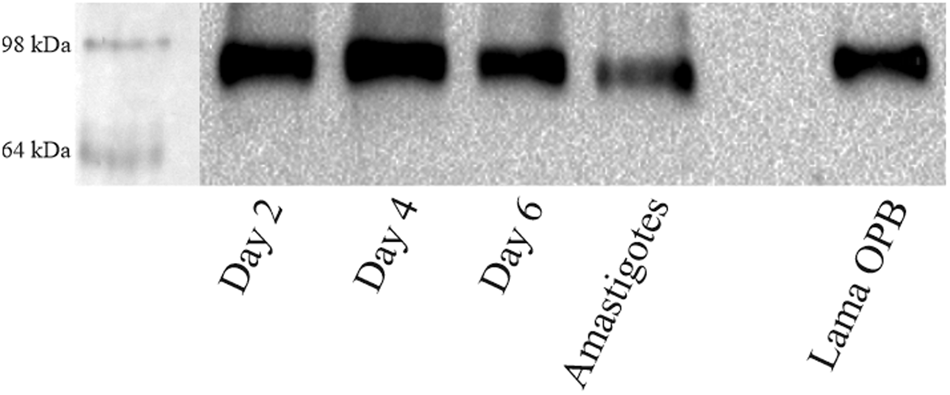
The recombinant protein was used to immunize mice and obtain anti-OPB sera. Sera from 4 mice were tested in ELISA (data not shown), and 1 was selected for use in Western blot of total promastigote and amastigote extracts. Day 2 represents the beginning of the logarithmic phase, day 4 the initial stationary phase and day 6 the late stationary phase. The results shown in Fig. 3 indicate that L. (L.) amazonensis promastigotes from all stages and amastigotes express OPB, and that the endogenous enzyme displays a mass below 98 kDa in SDS-PAGE gels, a little lower than the recombinant OPB but above the expected 85 kDa predicted from OPB amino acid sequence.
Western blot to assess the presence of OPB in L. (L.) amazonensis promastigotes from days 2, 4 and 6 and amastigotes, in parallel with recombinant (Lama OPB). 20 μg of each total protein extract and 0.5 μg of recombinant protein were probed with the primary anti-OPB serum at a dilution of 1:500 and secondary anti-mouse HRP at a dilution of 1:5000. Protein marker: SeeBlue Plus2, Invitrogen

Infection of peritoneal macrophages by L. (L.) amazonensis in the presence of soluble OPB
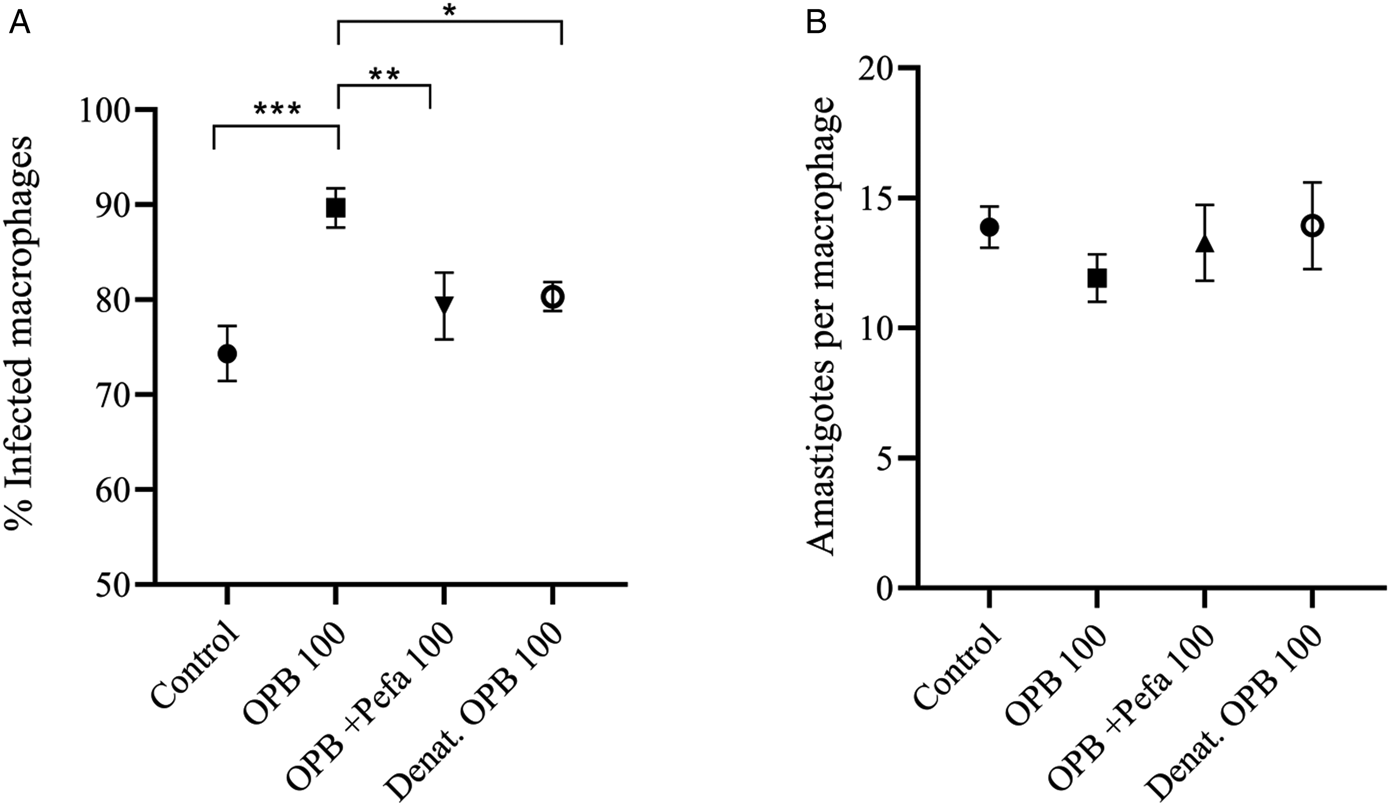
The presence of OPB in L. (L.) amazonensis promastigotes (Fig. 3) and the secretion of OPB by promastigotes previously reported (Silverman et al., Reference Silverman, Chan, Robinson, Dwyer, Nandan, Foster and Reiner2008, Reference Silverman, Clos, de'Oliveira, Shirvani, Fang, Wang, Foster and Reiner2010) prompted us to analyse whether soluble OPB could affect macrophage infection in vitro. Peritoneal macrophages were plated and kept in the presence of recombinant OPB throughout the experiment. Figure 4 shows numbers of infected cells after 24 h. As controls we used Pefabloc® (Sigma)-inhibited OPB and OPB inactivated by boiling at 95°C for 5 min. Pefabloc serves as a control for inactive OPB, while boiled OPB serves as a control for eventual residual LPS, since this procedure denatures proteins but does not destroy LPS. As can be noted in Fig. 4A, the presence of OPB before and during infection increased the percentage of infected macrophages compared to control, Pefabloc and boiled conditions. Results with Pefabloc-inhibited OPB and boiled OPB did not differ from the control without OPB, indicating that the active enzyme is necessary for modulation of infection. We observed no differences in the number of intracellular parasites among the 4 conditions (Fig. 4B).
Infection of peritoneal macrophages with L. (L.) amazonensis in the presence of recombinant OPB (100 ng mL−1), OPB inhibited with Pefabloc® (Sigma) (OPB + Pefa, 100 ng mL−1) and denatured OPB (Denat. OPB, 100 ng mL−1) throughout the experiment. (A) Percentage of infected macrophages. (B) Number of amastigotes per macrophage. Results represented as mean ± standard deviation of 3 technical replicates from a representative experiment of 3 with similar profiles. Statistical analysis by one-way ANOVA and Tukey's multiple comparisons (*P ⩽ 0.01; **P ⩽ 0.005; ***P ⩽ 0.0005).

When peritoneal macrophages were exposed to soluble OPB only in the 4 h of contact between Leishmania promastigotes and macrophage, no changes in the percentage of infected cells were observed (Fig Sup 3). These results indicate that active OPB increased infection of peritoneal macrophages by L. (L.) amazonensis when present before and during infection.
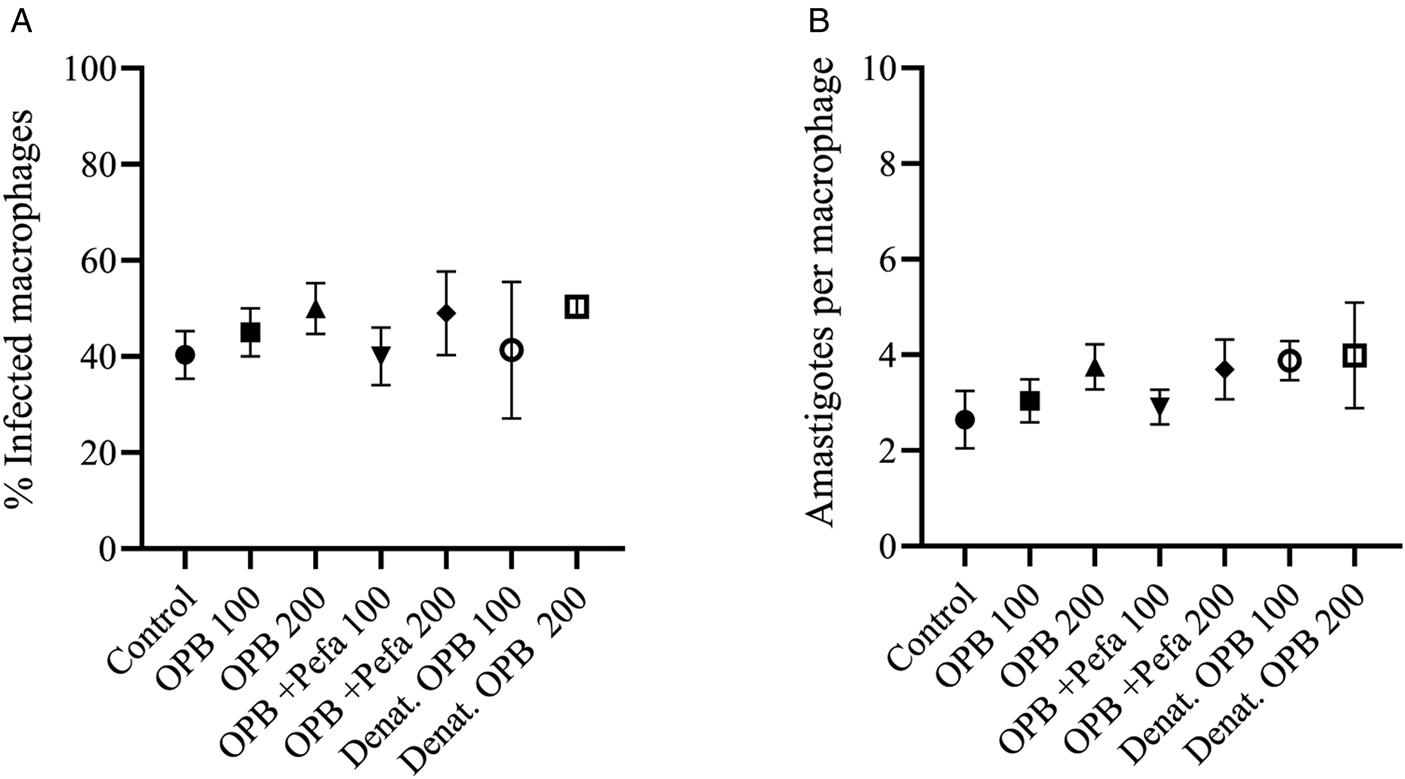
To explore whether the effect of recombinant OPB was observed for other macrophage types, we employed bone marrow-derived macrophages. Soluble OPB was added during plating and throughout the experiment, using a design similar to the one showed in Fig. 4. Interestingly, no increase in infection was observed in the presence of OPB, even at 200 ng mL−1 (Fig. 5A). Similarly to what was observed for peritoneal macrophages, OPB did not affect the number of intracellular parasites (Fig. 5B). These results indicate that OPB did not modulate the infection of medullary macrophages by L. (L.) amazonensis, demonstrating that macrophage types responded differently to OPB.
Infection of MDMOs with L. (L.) amazonensis in the presence of recombinant OPB (100 and 200 ng mL−1), OPB inhibited with Pefabloc® (Sigma) (OPB + Pefa 100 and 200 ng mL−1) and denatured OPB (Denat. OPB, 100 and 200 ng mL−1) throughout the experiment. (A) Percentage of infected macrophages. (B) Number of amastigotes per macrophage. Results of a single experiment, represented as mean ± standard deviation of 3 technical replicates. Statistical analysis by one-way ANOVA and Tukey's multiple comparisons.

Discussion
In this paper we described the production of L. (L.) amazonensis recombinant OPB. The sequence obtained for the LV79 strain (Sup Fig 1) was very similar to the sequence reported for PH8 strain, except for a change in 1 nucleotide.
This recombinant protein showed larger size than the expected, but the similarity in kinetic parameters with other OPBs and purity of the band reinforce its identity as L. (L.) amazonensis OPB. Anti-sera obtained from immunized mice recognized a band of similar size in promastigotes and amastigotes, slightly smaller than the band of the recombinant protein (Fig. 3). Western blots of promastigote lysates obtained from cultures at days 2, 4 and 6 cultures and axenic amastigotes indicated that promastigotes from different stages and amastigotes expressed OPB. This analysis is merely qualitative and OPB levels may vary during differentiation since the protein may be secreted at different levels and we only analysed whole cell lysates. Our findings agree with a previous report showing OPB transcripts in L. (L.) amazonensis procyclic and metacyclic promastigotes (de Matos Guedes et al., Reference de Matos Guedes, Duarte Carneiro, de Oliveira Gomes, Rossi-Bergmann and Giovanni De-Simone2007).
L. (L.) amazonensis OPB activity was analysed at different pHs and in the presence of protease inhibitors (Fig. 2). The pH effects on L. (L.) amazonensis OPB activity were similar to those reported for L. (L.) major and L. (L.) donovani OPBs (McLuskey et al., Reference McLuskey, Paterson, Bland, Isaacs and Mottram2010; Swenerton et al., Reference Swenerton, Zhang, Sajid, Medzihradszky, Craik, Kelly and McKerrow2011). Interestingly, OPBs optimal pHs are higher than the most neutral milieus where OPB is found – inside promastigotes, secreted in the phlebotomine fly or in the vertebrate host dermis. It is possible that neutral physiological pH keeps the enzyme activity levels low enough not to cause harm to parasite proteins.
Effective inhibitors for L. amazonensis OPB were also the same observed for the 2 other species, and K m values for the substrate Z-Arg-Arg-AMC were similar for L. (L.) amazonensis and L. (L.) major OPBs (2.1 and 0.93 μ m, respectively). These findings were expected, since OPB sequence conservation was observed among Leishmania species. The lack of OPB in mammals has prompted some groups to search for potential OPB or OPB/OPB2 inhibitors as eventual drugs for leishmaniasis (Goyal et al., Reference Goyal, Grover, Dhanjal, Goyal, Tyagi, Chacko and Grover2014; Sodero et al., Reference Sodero, Dos Santos, Mello, de Jesus, de Souza, Rodrigues, de Simone, Rodrigues and de Matos Guedes2017). The conservation in OPB activity among the 3 species analysed (L. (L.) major and L. (L.) donovani and L. (L.) amazonensis, in this work) suggests that drugs designed for 1 species would probably be effective for others.
Since OPB is present in promastigotes from day 4 cultures (Fig. 3) used in our infection experiments and considering that data from literature showed OPB secretion in L. (L.) donovani and L. (L.) major promastigotes (Silverman et al., Reference Silverman, Chan, Robinson, Dwyer, Nandan, Foster and Reiner2008, Reference Silverman, Clos, de'Oliveira, Shirvani, Fang, Wang, Foster and Reiner2010), we evaluated the effect of soluble recombinant OPB in L. (L.) amazonensis macrophage infections. In the first assay we used peritoneal macrophages and included OPB in the medium during the whole experiment. We observed that OPB increased the number of infected macrophages and that this effect was dependent on enzyme structure and activity. A similar experiment including OPB only during parasite–macrophage contact (Fig Sup 3) showed no difference between OPB and control or boiled conditions, indicating that OPB increase in infection depends on its presence throughout infection. Since macrophages are very heterogeneous and exhibit high plasticity (Taylor et al., Reference Taylor, Martinez-Pomares, Stacey, Lin, Brown and Gordon2005; Ghosn et al., Reference Ghosn, Cassado, Govoni, Fukuhara, Yang, Monack, Bortoluci, Almeida, Herzenberg and Herzenberg2010; Gordon, Reference Gordon2012; Mills, Reference Mills2015), we also analysed the effect of OPB on the infection of medullary macrophages. Interestingly, no difference in infection was observed in the presence of OPB throughout the experiment (Fig 5). This was not completely unexpected since peritoneal and medullary macrophages display different receptors or in different abundances (Taylor et al., Reference Taylor, Martinez-Pomares, Stacey, Lin, Brown and Gordon2005), and these (and other) phenotypic peculiarities may affect their responses to OPB.
We believe this work contributes to a better knowledge of OPB from a New World Leishmania species. Our enzymatic analysis suggested that similar inhibitors or drugs may be used to target the enzyme on several Leishmania species. The demonstration that recombinant OPB increased macrophage infection by L. (L.) amazonensis in vitro agrees with reports of lower infection for L. (L.) major parasites deficient for OPB, suggesting that the protein affects infection of many and maybe all Leishmania species. Future studies will be done to evaluate the effect of OPB deletion in L. (L.) amazonensis infectivity and to decipher the mechanism by which soluble OPB increases macrophage infection.
Supplementary material
The supplementary material for this article can be found at https://doi.org/10.1017/S0031182022000816.
Acknowledgements
We would like to thank Adriana Lopes and Silvia Uliana for several suggestions throughout this work. We also thank Silvia Boscardin and Marcio Yamamoto for help in OPB purification.
Author contributions
GRB and BSS conceived and designed the study, SRM helped designing activity assays. GRB performed experiments. GRB, BSS and SRM performed statistical analyses. GRB and BSS wrote the article.
Financial support
This work was supported by FAPESP (grant 2018/14972-8 for BSS and scholarship 2019/02391-3 for GRB) and by CAPES.
Conflict of interest
The authors declare there are no conflicts of interest.
Ethical standards
All animals were used according to the Brazilian College of Animal Experimentation (CONEP) guidelines, and the protocols were approved by the Institutional Animal Care and Use Committee (CEUA) of the University of São Paulo (protocol number 9829290419/2019). Euthanasia was performed in CO2 camera.