Introduction
Addressing the challenges posed by population ageing has become an increasingly global concern in the 21st century. Older adults’ need for support is widely recognized as a central issue in this context. Across countries, the provision of elder care typically relies on three sources: families, the state and the market. National policy makers must balance these providers to deliver quality services at the lowest possible social cost (Liu and Kou Reference Liu and Kou2015). In practice, family- and community-based care are generally regarded as preferable to institutional care, despite mixed empirical evidence (Hajek et al. Reference Hajek, Lehnert, Wegener, Riedel-Heller and König2017). Building on this perspective, many governments – including China – have positioned family and community care as a central focus of ageing policy (Hajek et al. Reference Hajek, Lehnert, Wegener, Riedel-Heller and König2017).
In China, the government has explicitly promoted a policy orientation of family-based elder care through the ‘9073’ framework. This model envisions that 90 per cent of older adults will rely primarily on family care, 7 per cent on community services and only 3 per cent on institutional provision (Zhang et al. Reference Zhang, Shen, Zhang and Fang2024; Wang and Liu Reference Wang and Liu2025). First introduced in Shanghai’s Eleventh Five-Year Plan for Civil Affairs (2007), it has since been adopted nationwide as a guiding principle for developing elder-care systems. Importantly, the viability of this framework rests on the continued adaptation of traditional filial piety, which emphasizes adult children’s responsibility for supporting and caring for ageing parents (Wang and Liu Reference Wang and Liu2025). Within this cultural and policy context, intergenerational co-residence remains a crucial arrangement for meeting older adults’ needs and sustaining family-based care (Johar and Maruyama Reference Johar and Maruyama2011; Liu Reference Liu2023; Yang et al. Reference Yang, Jin and Shao2023).
The cultural foundation of China’s family-based care system lies in the enduring tradition of filial piety, which assigns adult children – especially sons and their spouses – the primary responsibility for supporting ageing parents through daily care, financial provision and emotional comfort (Shi Reference Shi2017; Zhang et al. Reference Zhang, Shen, Zhang and Fang2024). Within this framework, intergenerational co-residence has historically been regarded not only as a practical means of meeting parents’ needs but also as a moral expression of filial duty (Chu et al. Reference Chu, Xie and Yu2011; Johar and Maruyama Reference Johar and Maruyama2011; Liu Reference Liu2023). However, rapid industrialization, urbanization and large-scale migration have eroded traditional patterns of family life, raising doubts about whether filial norms can continue to sustain co-residence in practice (Aboderin Reference Aboderin2004; Liu Reference Liu2023). Against this backdrop, it becomes essential to examine how family dynamics – particularly the distribution of power within households and the quality of intergenerational relationships – shape older adults’ living arrangements in contemporary China.
Despite their importance, these family dynamics have not been systematically incorporated into the broader literature on intergenerational co-residence. Existing studies primarily emphasize a wide range of demographic and socio-economic determinants – such as financial resources, health conditions, marital status, education and family size (Smits et al. Reference Smits, van Gaalen and Mulder2010; Johar and Maruyama Reference Johar and Maruyama2011; Isengard and Szydlik Reference Isengard and Szydlik2012). In East Asian societies, cultural expectations of filial piety and kinship obligations often reinforce the norm of living with adult children (Chu et al. Reference Chu, Xie and Yu2011; Yasuda et al. Reference Yasuda, Iwai, Chin-Chun and Guihua2011; Zhang et al. Reference Zhang, Gu and Luo2014; Shi Reference Shi2017). Policy contexts also shape co-residence decisions, as welfare arrangements, housing conditions and state support interact with family choices in determining whether and how older adults live with their children. (Darton and Knapp Reference Darton and Knapp1984; Rein Reference Rein1999; Keene and Batson Reference Keene and Batson2010; Zhao Reference Zhao2023). Although existing research underscores the multi-dimensionality of co-residence decisions, it remains fragmented: much of the literature isolates single determinants, privileges stated preferences over actual arrangements and relies on cross-sectional evidence that cannot capture dynamic processes (Hanum et al. Reference Hanum, Newcombe and Scott2024). While aspects of household resources and intergenerational ties have been considered, they have seldom been theorized systematically as mechanisms. To address this limitation, our study applies two complementary perspectives – family power theory and intergenerational solidarity theory – to analyse the structural and relational pathways through which support needs shape co-residence.
Family power theory, rooted in the power–bargaining model, highlights the structural dimension of household decision-making. It posits that older adults’ control over economic or material resources enhances their bargaining position and thereby increases their influence on intergenerational co-residence (Goode Reference Goode1963; Thomas Reference Thomas1990; Ruggles Reference Ruggles2007). In traditional settings, such power was often derived from land, income or other assets, enabling what has been described as a ‘resource exchange for care’, through which older parents leveraged resource control to secure attention and support from adult children (Lillard and Willis Reference Lillard and Willis1997; Chen and Silverstein Reference Chen and Silverstein2000). Over time, however, structural changes have eroded this advantage. As adult children gained economic independence, older adults’ authority weakened, and co-residence gave way to residential separation, with support increasingly expressed through financial or emotional transfers, outside the household when parental support needs are low (Ruggles Reference Ruggles2007; Hanum et al. Reference Hanum, Newcombe and Scott2024).
Importantly, parental authority is not uniformly beneficial. When older adults have strong needs for co-residence but exercise excessive authority, intergenerational tensions or resistance from children may arise, reducing the likelihood of shared living (Bai et al. Reference Bai, Chen, He and Xu2023; Hanum et al. Reference Hanum, Newcombe and Scott2024). Conversely, when rising support needs diminish older adults’ bargaining power, increased dependence may make co-residence a more feasible and practical arrangement (Zhang et al. Reference Zhang, Gu and Luo2014; Pezzin et al. Reference Pezzin, Pollak and Schone2015). Empirical evidence supports this interpretation: Pezzin et al. (Reference Pezzin, Pollak and Schone2015) found that once co-residence begins, children’s care-giving hours to parents tend to decline, possibly reflecting resistance to excessive dependence or control. From this perspective, support needs – such as functional decline – may weaken older adults’ family power and thereby indirectly increase the probability of co-residing with adult children, a mechanism examined in this study.
Empirical and theoretical research has increasingly shown that as older adults’ structural power within the family weakens, intergenerational living arrangements are no longer determined solely by economic control or bargaining advantage but also depend on the quality of relational bonds (Silverstein and Bengtson Reference Silverstein and Bengtson1997; Johar et al. Reference Johar, Maruyama and Nakamura2015; Pezzin et al. Reference Pezzin, Pollak and Schone2015). In contexts where parental authority or resource control has declined, these relational forces often become the primary basis sustaining intergenerational support and co-residence.
Building on this perspective, intergenerational solidarity theory provides a relational framework that explains how affective and normative cohesion – rather than material exchange – underpins the persistence of intergenerational support and shared living (Bengtson and Roberts Reference Bengtson and Roberts1991; Silverstein and Bengtson Reference Silverstein and Bengtson1997). The theory conceptualizes intergenerational ties as multi-dimensional, encompassing affectual, normative, structural and functional solidarity (Bengtson and Roberts Reference Bengtson and Roberts1991). Among these, affectual solidarity – emotional closeness and trust – is often the most salient predictor of co-residence. Strong emotional bonds increase the frequency of interaction, reciprocal exchanges and mutual care-giving, thereby making co-residence more likely (Cooney Reference Cooney1991; Liu and Zhang Reference Liu and Zhang2012). Normative solidarity, reflected in shared obligations and filial expectations, further reinforces co-residential arrangements, particularly in East Asian societies where filial piety remains a central cultural norm (Chu et al. Reference Chu, Xie and Yu2011; Zhang et al. Reference Zhang, Gu and Luo2014). Structural and functional dimensions also matter: geographic proximity facilitates regular exchanges, while practical help and financial transfers sustain ongoing interdependence (Jahangir et al. Reference Jahangir, Patil, Gangopadhyay and Vogt2025; Liu Reference Liu2023).
Comparative evidence indicates that intergenerational solidarity can buffer the negative consequences of limited resources or health decline, thereby mediating the relationship between support needs and co-residence (Smits et al. Reference Smits, van Gaalen and Mulder2010; Yasuda et al. Reference Yasuda, Iwai, Chin-Chun and Guihua2011). As older adults’ needs increase, family interaction, reciprocal exchanges and care-giving often intensify, strengthening affectual and normative solidarity and raising the likelihood of co-residence (Cooney Reference Cooney1991; Liu and Zhang Reference Liu and Zhang2012). Yet solidarity is not always effectively mobilized: when intergenerational ties are strained or distant, heightened needs may fail to generate co-residential support, leaving older adults exposed to unmet needs (Isengard and Szydlik Reference Isengard and Szydlik2012; Jahangir et al. Reference Jahangir, Patil, Gangopadhyay and Vogt2025). In China, this mechanism is particularly salient. While filial piety reinforces children’s sense of obligation to support ageing parents, rapid urbanization and migration reduce opportunities for daily interaction, making the translation of support needs into solidarity – and ultimately into co-residence – less consistent. Against this backdrop, the present study conceptualizes intergenerational solidarity as a relational mechanism through which support needs shape living arrangements in contemporary China.
Although both frameworks provide valuable insights, previous studies have often examined them in isolation. Research grounded in the power–bargaining model emphasizes material resources and decision-making authority, whereas studies adopting the intergenerational solidarity framework focus on emotional cohesion and normative obligations. Such analytical separation limits our understanding of how structural constraints and relational processes jointly shape family support and living arrangements.
The present study brings together the two perspectives within a unified mechanism-based framework. By linking the structural dimension of family power with the relational dimension of intergenerational solidarity, it analyses how older adults’ support needs are translated into co-residence through both pathways. This integrated approach clarifies the dual importance of household authority and relational cohesion in shaping living arrangements and provides a balanced lens for understanding family adaptation amid demographic ageing and social transformation in China. Specifically, the study aims to (1) examine how support needs influence actual co-residence behaviour, (2) test the mediating roles of family power and intergenerational solidarity, and (3) assess the contextual relevance of these theoretical models in contemporary China.
This study makes three marginal contributions. First, it advances theoretical understanding by integrating family power and intergenerational solidarity into a unified mechanism-based framework. By demonstrating how support needs shape co-residence through both structural (power) and relational (solidarity) pathways, the study moves beyond static, factor-based explanations towards a dynamic understanding of intergenerational living arrangements. Second, it advances methodological practice by applying structural equation modelling and cross-lagged panel analysis to test both mediation and longitudinal dynamics, thereby capturing how support needs, family power and solidarity evolve and interact over time to shape intergenerational co-residence. Third, it enriches cross-cultural gerontological research by testing the applicability of the family power and intergenerational solidarity frameworks in China. By situating the analysis within a rapidly transforming society marked by urbanization, migration and evolving filial norms, the study not only evaluates their cultural relevance but also contributes to the localization and refinement of intergenerational support theory.
Methods
Data source sample and procedures
The Chinese Longitudinal Healthy Longevity Survey (CLHLS) is a nationally representative longitudinal study jointly conducted by Peking University and Duke University. Using a stratified, multi-stage probability design, it covers about half of all counties and cities across 22 provinces, representing approximately 85 per cent of China’s older population. Analytical weights correct for mortality and attrition across waves. The CLHLS is archived by the US National Institute on Aging and has been widely used in international ageing research (e.g. in The Lancet, Demography and Ageing & Society), underscoring its methodological robustness and global credibility (Zeng and Vaupel Reference Zeng and Vaupel2002; Gu Reference Gu, Yi, Poston, Vlosky and Gu2008; Zeng et al. Reference Zeng, Feng, Hesketh, Christensen and Vaupel2020).
For this study, we used the 2005, 2008, 2011 and 2014 waves, which provide complete measures of family power and intergenerational living arrangements. Earlier waves (1998, 2000, 2002) and the 2018 wave were excluded because their questionnaires lacked proxy indicators of family power, a key construct in our analysis. The CLHLS is an unbalanced panel that re-interviews survivors while adding new respondents in each wave, with attrition mainly owing to mortality and failure to follow up. To minimize attrition bias, we applied the official panel weights, which adjust for differential probabilities of survival and re-interview. Detailed statistics on attrition and sample replenishment are presented in Appendix Table A1.
After merging the four selected waves, the raw dataset contained 49,549 respondents. Missing values were generally low (<5 per cent), except for the proxy indicators of family power, which had about 10 per cent missing. We used a Heckman selection model to impute these missing values, as detailed in Appendix Table A2. Finally, restricting the sample to respondents aged 65 and older with at least one surviving child yielded 43,282 individuals for regression analyses. This restriction is conceptually necessa as the analytic focus of this study is intergenerational co-residence, which presupposes the existence of living children as potential co-residential partners.
Ethical approval
This study used a publicly available dataset approved by the Biomedical Ethics Committee of Peking University (IRB00001052-13,074). Written informed consent was obtained from all participants, who took part voluntarily and anonymously.
Analysis strategies
To evaluate how support needs shape intergenerational co-residence through family power and intergenerational solidarity, we adopted a stepwise analytical strategy designed to ensure both measurement validity and causal plausibility.
Preliminary and measurement analyses
Preliminary analyses were conducted in Stata/MP 17.0 to assess data quality and establish the empirical foundation for model estimation. Descriptive statistics, reliability tests and Spearman’s rank correlations were used to examine the distributional properties and associations among key variables (Spearman’s rank correlations in Appendix Table A3). Subsequently, confirmatory factor analysis (CFA) was performed to validate the measurement of the three latent constructs – support needs, family power and intergenerational solidarity. The CFA confirmed adequate reliability, convergent validity and discriminant validity, ensuring that the measurement model was robust for subsequent structural estimation.
Structural equation modelling
We then employed structural equation modelling (SEM) in Mplus 8.3 to test the hypothesized mediation framework. As a theory-driven approach, SEM allows for simultaneous estimation of measurement and structural components, capturing both correlational structure and hypothesized causal pathways. To assess robustness, four model specifications were estimated: (1) baseline models without survey weights or controls, (2) models with survey weights only, (3) models with control covariates only and (4) fully adjusted models incorporating both weights and controls. Bootstrapped indirect effects (2,000 replications, bias-corrected CIs) were used to test whether family power and intergenerational solidarity mediated the influence of support needs on co-residence.
Dynamic modelling
To move beyond cross-sectional associations, four-wave cross-lagged panel models (CLPMs) were further estimated in Mplus 8.3. The CLPMs examined whether changes in support needs predicted subsequent shifts in family power, intergenerational solidarity and co-residence while accounting for prior levels of each construct, thereby testing the directionality and stability of mediation pathways over time.
Robustness checks
Multiple sensitivity analyses were conducted to ensure the stability of results. Panel weights provided by the CLHLS were applied to correct for mortality and attrition bias. Alternative imputations for missing data and model specifications produced consistent results, confirming the robustness of the findings. Detailed diagnostics and supplementary analyses are reported in the Appendix Table A1–A6.
Measures
Intergenerational co-residence
Older adults typically live alone, with adult children or in institutions (Hanum et al. Reference Hanum, Newcombe and Scott2024). However, co-residence with adult children remains a preferred option globally, including in some high-income countries (Ruggles Reference Ruggles2007). In Asian societies, it is especially prevalent owing to enduring norms of filial piety, where adult children are expected to provide care and housing for their ageing parents (Zhang et al. Reference Zhang, Gu and Luo2014; Chen and Jordan Reference Chen and Jordan2019; Liu Reference Liu2023). In this study, intergenerational co-residence (CORESI) was defined as older adults residing in the same household with at least one adult child. In the CLHLS, respondents were asked ‘Who is currently living with you?’. Based on responses, we constructed a binary variable: 1 = living with adult children; 0 = other arrangements.
Support needs of older adults
Older adults with declining health often rely on support from family members, particularly adult children (Reher and Requena Reference Reher and Requena2018). A consistent body of evidence from the Americas, Europe and Asia shows that lower functioning in activities of daily living (ADLs) and instrumental activities of daily living (IADLs) increases the likelihood of co-residing with adult children (Isengard and Szydlik Reference Isengard and Szydlik2012; Johar M et al. Reference Johar, Maruyama and Nakamura2015; Chen and Jordan Reference Chen and Jordan2019). Given this strong link between health status and co-residence, support needs (NEEDS) were measured using the functional limitations scale, based on a comprehensive set of ADL and IADL items. The ADLs included bathing, dressing, toileting, indoor transferring, urinary control and eating, while the IADLs covered activities such as visiting neighbours, shopping, meal preparation, doing laundry, walking > 1 km, lifting 5 kg, squatting and using public transport independently. Respondents were asked whether they required assistance for each task (1 = no assistance, 2 = partial assistance, 3 = full assistance), with higher scores indicating greater support needs. The overall scale demonstrated excellent internal consistency (Cronbach’s α = 0.944). Based on functional similarity and the factorial parcelling approach, the 14 ADL and IADL items were grouped into three parcels – mobility and transportation (MOB), basic self-care and manual skills (BCARE) and personal hygiene and domestic tasks (DOM) (Little et al. Reference Little, Cunningham, Shahar and Widaman2002; Rogers and Schmitt Reference Rogers and Schmitt2004; Wen and Ye Reference Wen and Ye2014). Prior to parcelling, principal component analysis (PCA) and Cronbach’s alpha were used to assess unidimensionality and internal consistency. The ratio of the first to the second eigenvalue was 3.976, exceeding the recommended threshold of 3. Cronbach’s alpha values for MOB, BCARE and DOM were 0.845, 0.841 and 0.841, respectively, indicating good internal reliability.
Intergenerational relationships
Older adults are more likely to co-reside with children with whom they have close and comfortable relationships, while strained or negative parent–child ties may reduce the likelihood of intergenerational co-residence (Bromberg Reference Bromberg1983; Yamada and Teerawichitchainan Reference Yamada and Teerawichitchainan2015; Liu Reference Liu2023). Drawing on intergenerational solidarity theory (Bengtson and Roberts Reference Bengtson and Roberts1991), this study conceptualized the intergenerational relationship (RELATION) as a multi-dimensional construct encompassing affectual (emotional closeness) and functional (practical support) dimensions. Four observed indicators were used to represent this construct: CHAT, SHARE, HELP and SICKCARE. Affectual solidarity was measured by asking respondents to name the top two individuals they most frequently (1) talked with in daily life (CHAT) and (2) turned to when needing to share personal thoughts (SHARE). Functional solidarity was captured through (3) help-seeking during difficult situations (HELP) and (4) care-giving during illness (SICKCARE). For CHAT, SHARE and HELP, a weighted score of 2 was assigned if an adult child was listed first, and 1 if second. SICKCARE was coded as 1 if care was provided by a child or child-in-law, and 0 otherwise.
Family power of older adults
According to the power and bargaining model, decision-making within families – including living arrangements – is shaped by the distribution of power and control over resources (Lillard and Willis Reference Lillard and Willis1997; Chen and Silverstein Reference Chen and Silverstein2000; Chen and Chen Reference Chen and Chen2016). Within this framework, older adults with greater autonomy or financial control are more likely to influence co-residence decisions. Guided by this perspective, family power (POWER) was measured using two indicators: (1) OWNP, capturing older adults’ autonomy in managing their own affairs, and (2) FAMP, indicating their control over household financial resources. The corresponding survey items were: ‘Do you have the power to decide your own affairs?’ (1 = never to 5 = always) and ‘Do you have the power to control any family resources?’ (1 = cannot make decisions on any spending to 5 = can make decisions on almost all spending). These indicators reflect two complementary dimensions of intrafamilial power, namely behavioural autonomy (OWNP) and structural power (FAMP).
Control variables
We included several control variables across three domains. Demographic variables were age (AGE), gender and spouse status. Gender was coded as 0 (female) and 1 (male); spouse status as 1 (married and live together) and 0 (otherwise). Socio-economic variables included urban residence (URBAN), years of schooling (EDU) and annual household income (INCOME), adjusted to 2005 price levels using the Consumer Price Index. Family structure was captured by the number of living children (CHILD), based on reported child survival status.
Notes: Latent variables (support needs, family power and intergenerational relationships) are constructed from observed indicators based on theoretical frameworks including the power and bargaining theory and intergenerational solidarity theory.
Results
Participant characteristics
Table 1, which presents the conceptual framework and operationalization of all variables, including definitions and measurement details. Table 2 summarizes sample characteristics by intergenerational co-residence status. Overall, 60.5 per cent of older adults lived with at least one adult child. Those in co-residential arrangements were older (M = 88.2 vs 82.4), less likely to be married and more likely to be female. We also reported significantly greater support needs across mobility, care and domestic domains, as well as stronger intergenerational relationship indicators (e.g. CHAT, SHARE, HELP and SICKCARE; all p < 0.01). In contrast, they exhibited lower family power scores (FAMP and OWNP). No significant difference was observed in the number of living children.
Conceptual framework and operationalization of variables

Characteristics of the study population
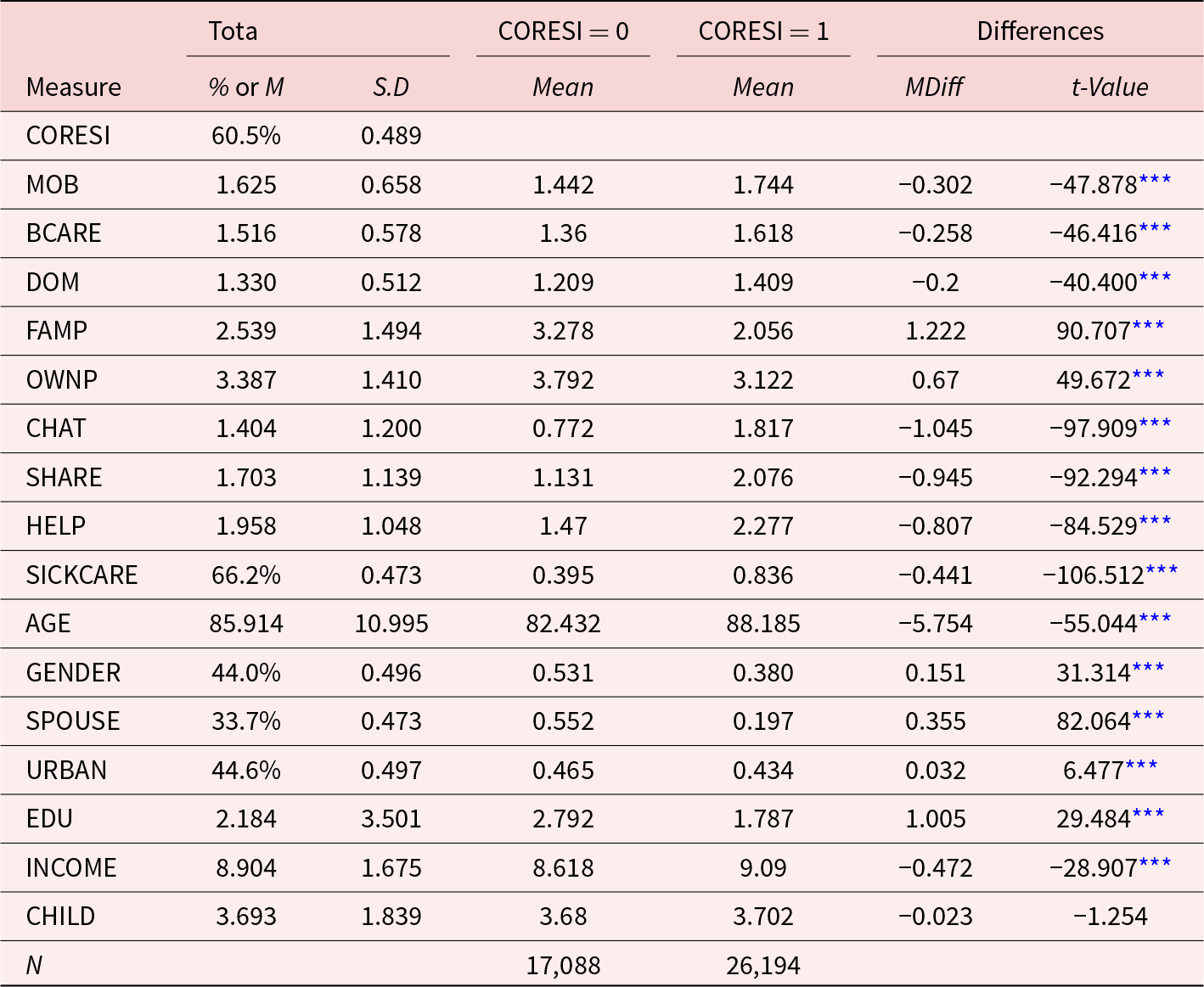
*** Notes: *** p < 0.01.
Confirmatory factor analysis
Before conducting the SEM, we performed CFA to assess the measurement validity of the three latent constructs: support needs, family power and intergenerational relationships. Model estimation was conducted using maximum likelihood (ML) (Gao et al. Reference Gao, Mokhtarian and Johnston2008; Stevens Reference Stevens and Stevens2009).
The CFA indicated good to excellent model fit. Although the chi-square statistic was significant (χ2(21) = 5262.73, p < 0.001), this is expected with large samples. All incremental fit indices exceeded the recommended threshold of 0.95 (CFI = 0.981, TLI = 0.967, GFI = 0.973) and absolute indices were acceptable (RMSEA = 0.076, SRMR = 0.034), indicating satisfactory fit (Hu and Bentler Reference Hu and Bentler1999). To address the sensitivity of χ2 in large samples, we applied the Bollen–Stine bootstrap (2,000 re-samples), which yielded a non-significant adjusted chi-square (χ2/df = 1.06), with all fit indices reaching ideal levels (CFI, TLI, GFI = 1.000; RMSEA = 0.000), confirming excellent model performance (Bollen and Stine Reference Bollen and Stine1992).
As shown in Table 3, all standardized factor loadings were statistically significant and exceeded 0.60, supporting adequate item reliability (Fornell and Larcker Reference Fornell and Larcker1981; Hair et al. Reference Hair, Black, Babin, Anderson, Hair, Black, Babin and Anderson2014). The constructs of support needs (CR = 0.955, AVE = 0.877) and intergenerational relationship (CR = 0.868, AVE = 0.627) showed excellent reliability and convergent validity. Family power had slightly lower values (CR = 0.660, AVE = 0.496), which is modest but acceptable given the theoretical distinctiveness and limited number of items.
Factor loading and combined validity in confirmatory factor analysis

Discriminant validity was confirmed in two ways. First, all inter-construct correlations were below the 0.70 threshold (Grewal et al. Reference Grewal, Cote and Baumgartner2004). Second, the square root of the AVE for each construct exceeded its correlations with other constructs, satisfying the Fornell–Larcker criterion (Fornell and Larcker Reference Fornell and Larcker1981).
Structural equation model testing
Baseline SEM results
We used SEM to examine the hypothesized mechanisms linking support needs, family power, intergenerational relationships and co-residence. To ensure robustness, the model was estimated under four specifications consistent with the analytical strategy. Standardized path estimates are reported in Table 4, and graphical representations are shown in Appendix Figures A1–A4.
SEM path estimates across model adjustments

Notes: Model specifications are defined as follows: unweighted & uncontrolled = baseline model without survey weights or covariates; weighted & uncontrolled = model including survey weights only; unweighted & controlled = model including control covariates only; weighted & controlled = fully adjusted model including both survey weights and covariates.
*** p < 0.01, ** p < 0.05, * p < 0.1.
As standard model fit indices (e.g. χ2, CFI, RMSEA) are not available under the weighted estimation in Mplus, model fit was evaluated using unweighted specifications in AMOS. Both unweighted models showed acceptable to excellent fit, with full fit statistics reported in Appendix Table A4. Structural path patterns remained consistent across all models, underscoring the robustness of the hypothesized mediation framework.
Across all model specifications, all factor loadings were statistically significant (p < 0.001), indicating strong measurement validity. Structurally, support needs consistently showed a negative association with family power (β = –0.657 to –0.410) and a positive association with intergenerational relationship (β = 0.117 to 0.209), suggesting that greater dependency is linked to reduced decision-making authority and increased emotional closeness. Support needs also had a modest but statistically significant negative direct effect on intergenerational co-residence (β = –0.143 to –0.063). Family power was strongly and negatively associated with co-residence (β = –0.443 to –0.351), whereas intergenerational relationships showed a consistent positive effect (β = 0.275 to 0.412), reinforcing the hypothesized mediation mechanism. While the inclusion of survey weights and covariates slightly attenuated the effect sizes, the direction and statistical significance of all key paths remained robust, supporting the stability of the structural model across estimation strategies.
Testing mediation hypotheses
We tested the hypothesized mediation using bootstrapped SEM (2,000 re-samples, bias-corrected CIs). Results from the fully adjusted model are shown in Table 5. The standardized total effect of support needs on intergenerational co-residence was positive and statistically significant (β = 0.120, 95% CI [0.104, 0.136]). In contrast, the direct effect was negative and significant (β = –0.064, 95% CI [–0.086, –0.042]), suggesting a suppression pattern. The total indirect effect was estimated at 0.184 (95% CI [0.167, 0.201]), exceeding the total effect and indicating a fully mediated association.
Mediation effects testing from fully adjusted model

Notes: All effects are standardized. CI: confidence interval. Bootstrap based on 2,000 draws.
Among the two mediators, the indirect effect via family power accounted for the majority of the mediation (β = 0.152, 95% CI [0.135, 0.167]), while the path via intergenerational relationships also contributed a smaller but significant proportion (β = 0.032, 95% CI [0.027, 0.038]). The significance of both indirect paths was further confirmed using the PRODCLIN method (MacKinnon et al. Reference MacKinnon, Fritz, Williams and Lockwood2007), with non-overlapping 95 per cent confidence intervals for each mediator (family power: [0.138, 0.166]; intergenerational relationship: [0.027, 0.038]). Taken together, the results suggest that support needs influence co-residence primarily through indirect mechanisms – family power and intergenerational relationship – rather than via a direct pathway (MacKinnon et al. Reference MacKinnon, Krull and Lockwood2000).
Cross-lagged panel model
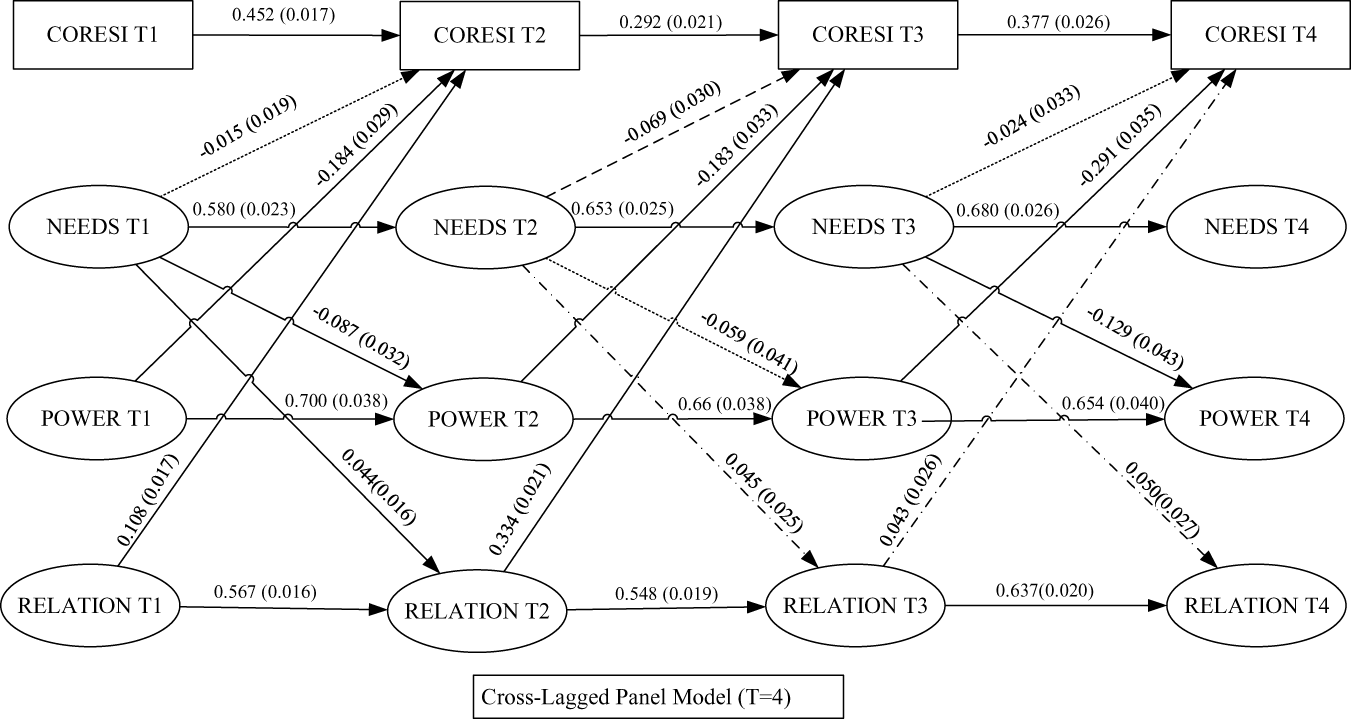
To further assess the temporal stability of the mediation mechanisms identified in the SEM, we estimated CLPMs under the same four specifications. The fully adjusted model is presented in Figure 1, while alternative model specifications are shown in Appendix Figures A5–A7. Corresponding indirect effects across all model variants are summarized in Table 6.
Four-wave CLPM testing dynamic pathways to intergenerational co-residence.

Specific Indirect Effects from CLPM Across Model Adjustments

Notes: Model specifications are as follows: unweighted & uncontrolled = baseline model without survey weights or covariates; weighted & uncontrolled = model including survey weights only; unweighted & controlled = model including control covariates only; weighted & controlled = fully adjusted model including both survey weights and covariates. Standardized path coefficients (β) are reported, with standard errors in parentheses.
*** p < 0.01, **p < 0.05, *p < 0.10. All estimates are derived from the CLPMs illustrated in Figure 1 and Appendix Figures A5–A7. Total indirect effects represent the sum of specific pathways at each time point.
Temporal dynamics and path estimation
Based on the CLPMs estimated with both survey weights and control covariates (see Figure 1), the results revealed high autoregressive stability across support needs, family power, intergenerational relationships and co-residence, indicating strong temporal consistency over time. Cross-lagged paths showed that increases in support needs predicted subsequent declines in family power (β = –0.087 between Wave 1 and Wave 2; β = –0.129 between Wave 3 and Wave 4) and modest increases in intergenerational relationships (β = 0.044 between Wave 1 and Wave 2). These findings suggest that rising care needs tend to weaken older adults’ authority while modestly strengthening emotional ties with children.
In turn, family power significantly and negatively predicted later co-residence (β = –0.295 between Wave 3 and Wave 4), whereas intergenerational relationships exerted a consistent positive effect (β = 0.336 between Wave 2 and Wave 3), supporting their mediating roles. Direct effects of support needs on subsequent co-residence were small and non-significant, indicating that living arrangements are shaped primarily through changes in household authority and relational closeness. These temporal and structural patterns were replicated across the three alternative model specifications (Appendix Figures A5–A7), underscoring the robustness of the dynamic pathways identified in the fully adjusted model.
Indirect effects in CLPM
In addition to direct temporal effects, we examined the indirect influence of support needs on intergenerational co-residence via family power and intergenerational relationships across survey waves, as summarized in Table 6.
From Wave 1 to Wave 3, significant indirect effects were consistently observed through both mediators across all model specifications. Specifically, higher support needs at the initial wave were associated with a greater likelihood of co-residence two waves later, operating through reduced family power (β = 0.016–0.032, p < 0.01) and enhanced intergenerational ties (β = 0.015–0.032, p < 0.01). These associations remained statistically significant across specifications, though slightly attenuated in the fully adjusted model.
In contrast, for the later observation period – from the second to the fourth wave – the indirect pathway via family power remained significant in unweighted and partially adjusted models (β = 0.026–0.035, p < 0.05) but became non-significant in the fully adjusted specification (β = 0.017, p > 0.05). The indirect effects through intergenerational relationships were weaker and reached significance only in unweighted models (β = 0.007–0.008, p < 0.05).
Taken together, these results indicate that the mediation effects were stronger and more stable in the earlier observation period, whereas those observed in later waves were more sensitive to model adjustments. The pathway through family power proved more consistent and substantial than that through intergenerational relationships, underscoring the central role of older adults’ family power in shaping co-residence outcomes.Notably, we performed a series of robustness checks under alternative imputation scenarios, including sensitivity analyses of SEM path estimates and CLPM specifications as well as indirect effects (Appendix Table A5–A6; Appendix Figures A8–A11), and the results were substantively consistent with the main findings.
Discussion
Drawing on power–bargaining and intergenerational solidarity theory, this study examined how support needs shape intergenerational co-residence through structural and relational pathways. The SEM and CLPM results show that support needs increase the overall probability of co-residence primarily through indirect pathways, while their direct effect remains negative. This pattern reflects a suppressor mediation, whereby needs influence living arrangements mainly through family power and intergenerational solidarity. Through the family-power pathway, increasing support needs weaken older adults’ control over resources and everyday decision-making, reducing their bargaining position and making co-residence a more feasible arrangement. Through the intergenerational-solidarity pathway, rising needs foster more frequent interaction, care-giving and emotional exchange, thereby strengthening relational closeness and normative obligations. This relational mechanism promotes co-residence but with a smaller and more context-sensitive effect compared with the structural pathway of family power. Longitudinal analysis further shows that these mediation effects are more stable in earlier periods but more sensitive to contextual adjustments in later waves, with the family-power pathway remaining consistently stronger. Taken together, the findings indicate that co-residence is not directly driven by support needs but emerges through the reconfiguration of household authority and intergenerational ties – where structural feasibility precedes and conditions relational adaptation.
Regarding the family-power pathway, increases in functional limitations tend to weaken older adults’ control over household resources and their autonomy in daily life. Consequently, their bargaining position declines, and dependence on adult children and daily care-giving rises (Silverstein and Bengtson Reference Silverstein and Bengtson1997; Zhang et al. Reference Zhang, Gu and Luo2014; Pezzin et al. Reference Pezzin, Pollak and Schone2015). As decision-making power and resource control diminish, the capacity to sustain independent living or to access market-based care services also declines (Dostie and Léger Reference Dostie and Léger2005; Johar and Maruyama Reference Johar and Maruyama2011; Chen Reference Chen2019). Under such circumstances, co-residence with adult children is more likely where feasible alternatives have narrowed. This mechanism suggests that declining family power may not directly lead to co-residence through authority, but may allow it to occur under reduced autonomy – when independent options are no longer viable, shared living tends to become the default arrangement (Smits et al. Reference Smits, van Gaalen and Mulder2010). This interpretation aligns with empirical studies in China showing that housing inadequacy, economic pressure and other structural constraints are associated with a higher likelihood of intergenerational co-residence (Lee et al. Reference Lee, Lin and Chang1995). Overall, these findings suggest that higher support needs may not directly strengthen the desire for co-residence but instead narrow the range of feasible options, making shared living a pragmatic response to structural limitation.
At the theoretical level, this mechanism refines and contextualizes the classical power–bargaining model. Earlier formulations proposed that parents’ control of resources could be exchanged for care, thereby enhancing their leverage and increasing the likelihood of co-residence (Goode Reference Goode1963; Lillard and Willis Reference Lillard and Willis1997; Chen and Silverstein Reference Chen and Silverstein2000). In contemporary China, however, this positive association appears to have weakened and, in some cases, reversed. As adult children have gained economic independence and alternative care options have expanded, stronger parental power no longer promotes co-residence, whereas reduced authority and greater dependence make it more feasible (Chen Reference Chen2019). Hence, co-residence can be viewed as reflecting a shift from resource-based negotiation to feasibility-based adaptation – a contextual revision of the classical ‘exchange-for-support’ logic within the power–bargaining framework.
While structural mechanisms explain why declining authority and constrained feasibility make co-residence more likely, they do not fully capture how families sustain such arrangements in daily practice. Living together requires not only structural necessity but also relational willingness – the capacity to cooperate, communicate and maintain emotional balance in everyday life. In this sense, the structural pathway defines what is feasible, whereas the relational pathway determines what is sustainable.
From the intergenerational-solidarity perspective, support needs showed a stable positive association with intergenerational relationships, and stronger relational ties are associated with a higher likelihood of co-residence. This finding is consistent with intergenerational solidarity theory, which posits that affective closeness and normative obligations promote intergenerational support and shared living (Bengtson and Roberts Reference Bengtson and Roberts1991; Silverstein and Bengtson Reference Silverstein and Bengtson1997). In line with prior studies, greater needs may stimulate more frequent contact, help-seeking and care-giving within families, thereby enhancing emotional cohesion and willingness to co-reside (Cooney Reference Cooney1991; Liu and Zhang Reference Liu and Zhang2012).
However, our findings also indicate that the strength of this relational mechanism is smaller than that of family power, suggesting that solidarity plays a secondary yet complementary role. This attenuation may reflect China’s broader structural transformations: with increasing geographic mobility and the institutionalization of support, emotional solidarity can no longer fully compensate for declining structural feasibility. Moreover, while solidarity theory assumes that emotional cohesion naturally facilitates cooperation, recent evidence suggests that intensive care-giving demands may also strain family relationships and reduce the appeal of co-residence (Silverstein and Bengtson Reference Silverstein and Bengtson1994). These nuances suggest that affective closeness is a facilitating condition – it enhances co-residence only when sustained interaction and moderate care intensity are present. These findings refine the intergenerational solidarity perspective by underscoring its conditional effectiveness. Solidarity remains a key relational mechanism linking needs to co-residence, but its influence depends on relational quality, proximity and care-giving context (Merz et al. Reference Merz, Schuengel and Schulze2007; Lin and Chen Reference Lin and Chen2018). In contemporary China, where filial piety persists alongside increasing mobility and smaller family size, solidarity functions as a selective rather than universal facilitator of co-residence (Chu et al. Reference Chu, Xie and Yu2011; Zhang et al. Reference Zhang, Gu and Luo2014; Chen and Jordan Reference Chen and Jordan2019).
Viewed jointly, the two mediation pathways reveal a coherent process of structural and relational adaptation through which support needs shape intergenerational co-residence. Rising dependency first alters the feasibility of living arrangements: as functional limitations weaken older adults’ authority and control over household resources, independent living becomes less attainable, making co-residence a more practical alternative. Once co-residence becomes structurally feasible, increased interaction, help-seeking and care-giving further strengthen affective and normative solidarity, improving coordination and willingness to live together. In this sense, family power operates as a structural gatekeeper defining what arrangements are possible, while intergenerational solidarity serves as a relational harmonizer facilitating their realization. Because feasibility is a stronger constraint than coordination, the mediating role of family power appears to outweigh that of solidarity. In sum, intergenerational co-residence among older adults in China reflects a two-stage adaptive process – first expanding feasibility through declining authority and then consolidating co-residence through strengthened relational cohesion. Conceptually, this integrated interpretation shows how structural and relational mechanisms interact in shaping family adaptation under demographic ageing and social transformation.
On this basis, and to enable different families in differing contexts to make informed and sustainable choices, we propose the following recommendations. First, expand the feasible choice set and reduce structural constraints. Our findings show that the direct effect of support needs on co-residence is negative, suggesting that structural barriers often outweigh preference for shared living. To address this, policy should broaden feasible living options by providing subsidies for proximate residence and small-scale age-friendly home adaptations (e.g. barrier-free access, lift installation and small-space optimization), complemented by vouchers for home-based or day care and cross-regional reimbursement. At the same time, offset carers’ opportunity costs through paid care leave and flexible working arrangements, thereby mitigating the inhibitory effects of overcrowding, privacy conflict and commuting constraints on co-residence decisions.
Second, safeguard agency and family power. Because family power is identified as the dominant mediating mechanism linking needs to co-residence, it is essential to strengthen older adults’ decision-making capacity while preventing power imbalances within families. A supported decision-making framework – comprising joint financial authorization, third-party witnessing, annual review and alerts for unusual transactions – should be established. Subsidies should be paid directly into older adults’ accounts, and contracts should list the older person or their legal proxy as the contracting party. In addition, legal and financial counselling should be made available to prevent ‘functional limitation = loss of decision-making power’, thereby reducing the likelihood that weakened authority leads to involuntary co-residence.
Third, enhance collaborative quality and strengthen intergenerational solidarity. The study also finds that intergenerational relationships play a positive, albeit smaller, mediating role in shaping co-residence. To reinforce this relational dimension, policy should institutionalize family care conferences and personalized care plans with embedded conflict-resolution mechanisms and promote regular, high-frequency communication between generations. Through care allowances or tax relief, respite services, skills training and care coordinators, care-giving burdens can be made explicit and fairly compensated. Such measures would enhance intergenerational coordination efficiency and affective sustainability while maintaining older adults’ dignity and autonomy.
Limitations
This study has several limitations. First, although the CLHLS data enhance the robustness of the findings, the scope and representativeness of the sample limit the generalizability of the conclusions. The analytical sample included only adults aged 65 and above with at least one surviving child, focusing on realistic intergenerational co-residence but excluding childless or institutionalized older adults. This restriction is conceptually necessary, as intergenerational co-residence presupposes the existence of potential child partners. Hence, the results are most applicable to family-oriented living contexts, and caution is warranted when extrapolating beyond this population.
Second, the data were collected between 2005 and 2014. While these waves allow for dynamic analysis, subsequent demographic and policy shifts – such as urbanization, welfare expansion and the diversification of elder-care services – may have altered the feasibility and meaning of co-residence. Nevertheless, the identified mechanisms, whereby support needs weaken family power and modestly strengthen intergenerational solidarity, reflect structural and relational dynamics that are likely to persist amid population ageing. Future studies using newer longitudinal data should test whether these relationships remain stable under evolving social conditions.
Third, the measurement of latent constructs was limited. Family power was proxied through indicators of economic and decision-making control (OWNP and FAMP), which do not capture other dimensions such as discursive authority or household power structure. Likewise, intergenerational relationships were measured mainly through connection-based indicators, omitting structural, normative and consensual aspects of solidarity. Although conceptually coherent, these proxies cannot fully represent the multi-dimensional nature of the constructs; future research could incorporate richer indicators or mixed-method approaches to capture these mechanisms more comprehensively.
Finally, despite extensive robustness checks, potential reciprocal influences between support needs and co-residence cannot be entirely ruled out. Causal direction remains difficult to establish, as living arrangements may themselves affect older adults’ health and support needs. Nonetheless, the use of longitudinal CLPMs provides partial leverage on temporal sequencing. Future research could further clarify these dynamic feedback processes using extended time horizons and complementary methods.
Supplementary material
The supplementary material for this article can be found at https://doi.org/10.1017/S0144686X26100749.
Financial support
This work was supported by the Hebei Provincial Social Science Foundation (grant no. HB23GL027). The financial sponsor was not involved in the design or execution of the study.
Competing interests
The authors declare none.
Ethical standards
This study used a publicly available dataset approved by the Biomedical Ethics Committee of Peking University (IRB00001052-13,074). Written informed consent was obtained from all participants, who took part voluntarily and anonymously.