Introduction
Research shows that psychotic symptoms are relatively common in both the general adult community (Kessler et al. Reference Kessler, McGonagle, Zhao, Nelson, Hughes, Eshleman, Wittchen and Kendler1994; Kendler et al. Reference Kendler, Gallagher, Abelson and Kessler1996; Bijl et al. Reference Bijl, Ravelli and van Zessen1998; Johns et al. Reference Johns, Cannon, Singleton, Murray, Farrell, Brugha, Bebbington, Jenkins and Meltzer2004) and child and adolescent populations (Poulton et al. Reference Poulton, Caspi, Moffit, Cannon, Murray and Harrington2000; Laurens et al. Reference Laurens, Hodgins, Maughan, Murray, Rutter and Taylor2007). These symptoms, in the absence of psychotic disorder, are also termed psychotic-like experiences (PLEs; see Kelleher & Cannon, Reference Kelleher and Cannon2011, for an overview of PLEs). A meta-analysis by van Os et al. (Reference van Os, Linscott, Myin-Germeys, Delespaul and Krabbendam2009) reported a median prevalence of 5–8% for PLEs in the general population. Prevalence rates of PLEs in younger populations vary from 9% of schoolchildren aged 7 and 8 years (Bartels-Velthuis et al. Reference Bartels-Velthuis, Jenner, van de Willigie, van Os and Wiersma2010) to up to half of 9–12-year-olds reporting ‘certain experience’ of one or more PLEs (Laurens et al. Reference Laurens, Hodgins, Maughan, Murray, Rutter and Taylor2007). Alemany et al. (Reference Alemany, Arias, Aguilera, Villa, Moya, Ibanez, Vossen, Gasto, Ortet and Fananas2011) reported that, in a sample of 533 young people (mean age=22.9 years), more than 40% ‘often’ or ‘almost always’ experienced a PLE. The importance of PLEs is highlighted by the possibility that they might serve as markers for an increased risk of psychotic disorder later in adult life. Data from the Dunedin birth cohort study showed that children aged 11 years who reported psychotic symptoms were found to be at a 5- to 16-fold increased risk of schizophreniform disorder later in life (Poulton et al. Reference Poulton, Caspi, Moffit, Cannon, Murray and Harrington2000). In an Australian cohort study, Welham et al. (Reference Welham, Scott, Williams, Najman, Bor, O'Callaghan and McGrath2009) showed that self-reported auditory hallucinations at 14 years were associated with increased risk for non-affective psychotic disorder at 21 years. Hanssen et al. (Reference Hanssen, Bak, Bijl, Vollebergh and van Os2005) found that, in a Dutch sample, 8% of those who experienced PLEs were clinically psychotic 2 years later. It is thought that these symptoms represent the less severe end of a continuum of psychosis (van Os et al. Reference van Os, Hanssen, Bijl and Ravelli2000). Indeed, several studies have demonstrated a continuum between the non-pathological subclinical phenotype and clinical psychosis, including shared risk factors such as childhood trauma (Kelleher et al. Reference Kelleher, Harley, Lynch, Arseneault, Fitzpatrick and Cannon2008), ethnicity (Laurens et al. Reference Laurens, West, Murray and Hodgins2008) and reduced performance on intelligence tests (Horwood et al. Reference Horwood, Salvi, Thomas, Duffy, Gunnell, Hollis, Lewis, Menezes, Thompson, Wolke, Zammit and Harrison2008) (for review see Kelleher & Cannon, Reference Kelleher and Cannon2011).
Social cognition deficits have been widely documented in individuals with schizophrenia (Penn et al. Reference Penn, Corrigan, Bentall, Racenstein and Newman1997; Couture et al. Reference Couture, Penn and Roberts2006). One important component of social cognition that has been extensively studied in schizophrenia patients is the ability to recognize emotions in the faces of others (Mandal et al. Reference Mandal, Pandey and Prasad1998; Whittaker et al. Reference Whittaker, Deakin and Tomenson2001; Edwards et al. Reference Edwards, Jackson and Pattison2002; Hooker & Park, Reference Hooker and Park2002; Bolte & Poustka, Reference Bolte and Poustka2003; Kohler et al. Reference Kohler, Turner, Bilker, Bresinger, Siegel, Kanes, Gur and Gur2003; Schneider et al. Reference Schneider, Gur, Koch, Backes, Amunts, Shah, Bilker, Gur and Habel2006; Pinkham et al. Reference Pinkham, Penn, Perkins, Graham and Siegel2007; Pomarol-Clotet et al. Reference Pomarol-Clotet, Hynes, Ashwin, Bullmore, McKenna and Laws2010). There are consistent findings of an impairment in facial emotion recognition (FER) in schizophrenia (for review see Kohler et al. Reference Kohler, Walker, Martin, Healey and Moberg2010), and these deficits have been shown to be associated with abnormal neural activity (Li et al. Reference Li, Chan, McAlonan and Gong2010). Given the established findings for FER deficits in schizophrenia, and in an attempt to gain insights into the earliest cognitive deficits in the developmental trajectory to psychosis, research has recently begun to investigate FER deficits in individuals who are at risk for this disorder.
Deficits in FER have been documented in those at genetic high risk (based on family history) (McCown et al. Reference McCown, Johnson, Austin and Shefsky1988; Kee et al. Reference Kee, Horan, Mintz and Green2004; Eack et al. Reference Eack, Mermon, Montrose, Miewald, Gur, Gur, Sweeney and Keshavan2010) and in individuals who are at clinical or ultra-high risk (UHR) for schizophrenia, based on criteria for an At-Risk Mental State (ARMS) or prodrome (Addington et al. Reference Addington, Penn, Woods, Addington and Perkins2008). Research has also examined the relationship between FER deficits and schizotypal personality disorder (SPD). In one of the first such investigations, Poreh et al. (Reference Poreh, Whitman, Weber and Ross1994) examined FER among hypothetically schizotypic college men (defined by high scores on the perceptual aberration, magical ideation and schizotypy scales) and found that, relative to control participants, high-scoring participants made more errors in FER. This association was initially not replicated by Toomey & Schuldberg (Reference Toomey and Schuldberg1995), who reported no significant association between FER and psychosis-proneness (as indexed by measures of schizotypy) among a sample of university students. However, all subsequent studies reported deficits in FER that were associated with schizotypy or SPD (Mikhailova et al. Reference Mikhailova, Vladimirova, Iznak, Tsusulkovskaya and Sushko1996; Waldeck & Miller, Reference Waldeck and Miller2000; van 't Wout et al. Reference van 't Wout, Aleman, Kessels, Laroi and Kahn2004).
Recently, Germine & Hooker (Reference Germine and Hooker2011) found that FER was related to individual differences in psychosis-like characteristics in the normal population. In addition, Dickey et al. (Reference Dickey, Panych, Voglmaier, Niznikiewicz, Terry, Murphy, Zacks, Shenton and McCarley2011) reported that participants with clinically diagnosed SPD (SCID-II) were slower and less accurate than healthy controls in identifying facial expressions. However, in the only previous study to directly examine FER in relation to PLEs, Thompson et al. (Reference Thompson, Sullivan, Heron, Thomas, Zammit, Horwood, Gunnell, Hollis, Lewis, Wolke and Harrison2011) reported that FER in 8-year-olds was not related to the reporting of PLEs 3 years later. Thus, the relationship between subclinical PLEs and FER is obscure. Differences in participant age are particularly important in the context of FER. For example, although it has been established that recognition of facial emotions emerges early (Barrera & Maurer, Reference Barrera and Maurer1981; Walker-Andrews, Reference Walker-Andrews1997), it is thought that full proficiency is not acquired before 10 years of age. Facial emotion processing abilities increase with age (Durand et al. Reference Durand, Gallay, Seigneuric, Robichon and Baudouin2007), thus the 8-year-olds in Thompson et al.'s study would have been substantially less accurate than the adult participants in some of the other studies. The current study aimed to further understanding of the association between FER and PLEs and involved a community sample of adolescents who reported PLEs.
Method
Recruitment
Ethical approval for this study was given by Beaumont Hospital Medical Research Ethics Committee. Thirteen large single- and mixed-sex state primary schools in North and West Dublin, Kildare and Meath were recruited for participation, with a total of 793 individuals taking part. The majority of participants were Irish (89.2%), with small numbers from the UK (2.4%) and other countries (8.4%). Participants were recruited from the 5th (n=328) and 6th classes (n=465), the two most senior classes in the primary education system, and were aged 10–13 years (mean=11.5, s.d.=0.66): 10-year-olds (n=37), 11-year-olds (n=382), 12-year-olds (n=338) and 13-year-olds (n=36). There were approximately equal numbers of each gender (female: n=401; male: n=392). The study team visited participating schools and presented a brief information session about adolescent brain development to students, who were then given consent forms to take home to their parents. On this form, parents were asked to tick a box to indicate consent for their children to complete questionnaires in their classrooms. Parents and children were informed that the study was about adolescent brain development. To ensure and maximize confidentiality, children were asked to complete the questionnaire without allowing other children to see their answers. A study researcher was present at all times and children were instructed to ask the researcher for clarification if there was anything that they did not understand.
Questionnaires
The Adolescent Psychotic-Like Symptom Screener (APSS; Kelleher et al. Reference Kelleher, Harley, Murtagh and Cannon2011) was used to assess a variety of psychotic symptoms in a brief period of time. This is a seven-item measure consisting of four questions from the Diagnostic Interview Schedule for Children (Poulton et al. Reference Poulton, Caspi, Moffit, Cannon, Murray and Harrington2000) and three additional questions, one each on visual hallucinations, delusions of control, and grandiosity. For each question, participants selected one of three possible responses: ‘Yes, definitely’ (scored 1), ‘Maybe’ (scored 0.5) or ‘No, never’ (scored 0). Total scores were summated for each participant, with higher scores indicating greater experience of psychotic symptoms. Kelleher et al. (Reference Kelleher, Harley, Murtagh and Cannon2011) reported that, in a sample of 334 adolescents aged 11–13 years, this brief screening tool had good sensitivity and specificity in identifying young people who had psychotic symptoms that were subsequently identified by clinical interview.
The Penn Emotion Recognition-40 Test (Penn ER-40; Gur et al. Reference Gur, Ragland, Moberg, Turner, Bilker, Kohler, Siegel and Gur2001) comprises 40 coloured photographs of adult faces (depicting individuals who differ in race and gender) expressing one of four basic emotions (sad, happy, angry, and scared) and also the ‘no feeling’ emotional expression (i.e. eight faces depicting each of these five expressions). Penn ER-40 is typically used as a computerized task; however, given that testing took place in a group setting (school classrooms), participants were administered a pencil-and-paper version of the test. A forced-choice format was used, where participants had to choose, by circling the correct option, among the labels ‘happy’, ‘sad’, ‘angry’, ‘scared’ or ‘no feeling’ for the presented face. Correct responses were scored as 1 and incorrect responses were scored as 0, thus the highest total score possible was 40; higher scores indicated better facial emotion recognition. Additionally, individual subscale totals were calculated for each of the five emotional expressions, with a highest score possible of eight. The Penn ER-40 has demonstrated good test–retest reliability (Weiss et al. Reference Weiss, Stadelmann, Kohler, Brensinger, Nolan, Oberacher, Parson, Pitterl, Niederstatter, Kemmler, Hinterhuber and Marksteiner2007).
The Hinting Task (Corcoran et al. Reference Corcoran, Mercer and Frith1995) is a simple theory of mind test where the participant is required to infer the intention behind veiled speech acts. Ten short vignettes describing an interaction between two characters along with an extract of their dialogue, which ends with one character dropping a hint to the other, are presented. Participants read through the vignettes and are asked what the character really meant by what he/she said. Participants were instructed to write their inferences down. An appropriate inference was scored 2 points. If a participant had difficulty, they were instructed to raise their hand and one of the study team provided them with further information about the story in the form of an even more obvious hint. A correct response at this stage was scored 1 point. Scores on this task range from 0 to 20, with higher scores indicating greater ability to derive the true meaning behind a character's speech. The task has good face validity (Corcoran & Frith, Reference Corcoran and Frith2003) and has been found to be sensitive to theory of mind deficits in several studies (Corcoran et al. Reference Corcoran, Mercer and Frith1995).
Data analysis
Analyses were conducted using Stata version 11.0 (Stata Corporation, 2011). Total scores on the Penn ER-40 and individual subscale scores for the five emotional expressions of the Penn ER-40 along with total scores on the APSS and the Hinting Task were used in analyses. Mean scores and standard deviations on the APSS, Penn ER-40 and Hinting Task were first reported. Independent-sample t tests were used to determine whether there were age and gender differences in scores on the APSS, Penn ER-40 and Hinting Task. The Bonferroni correction was used to control for multiple comparisons with the Penn ER-40. Correlational analyses were used to examine the relationship between the Hinting Task and the Penn ER-40 and the APSS. Linear regression was used to investigate the relationship between the overall and subscale scores on the Penn ER-40, and the APSS total score (dependent variable). These analyses were repeated, controlling for potential confounders (age, gender and scores on the Hinting Task).
Results
Participation rates
In total, 1550 consent forms were distributed: 793 children completed the APSS (51.20% consent rate), 748 children completed the Penn ER-40 and 409 completed the Hinting Task. Because of time constraints, slightly fewer participants completed the latter two measures and participants with missing data were not included in analyses. We have no information on the pupils who did not agree to take part in the study.
The APSS
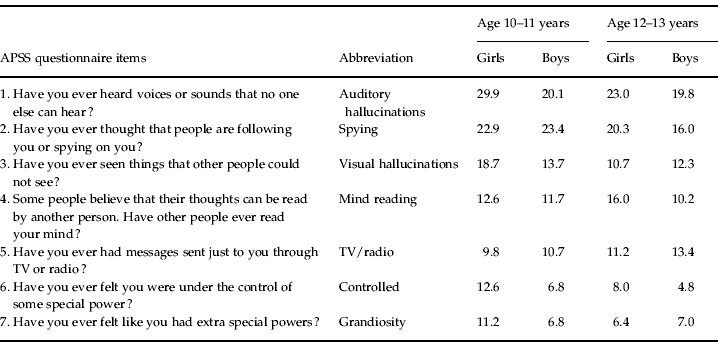
The mean total score on the APSS was 1.71 (s.d.=1.53). Overall, 46.8% of the total sample answered ‘Yes, definitely’ to at least one item, 24.8% answered ‘Yes, definitely’ to two or more items, and 14.1% answered ‘Yes, definitely’ to three or more items. Table 1 displays the percentage of participants endorsing individual items on the APSS. The most common symptom reported by participants was auditory hallucinations.
The percentages of girls and boys in the 10–11 and 12–13 years age groups who responded ‘Yes, definitely’ to items on the APSS

APSS, Adolescent Psychotic-Like Symptom Screener.
Significant age differences emerged in participants' total scores (t 791=2.27, p=0.023), with children in the 10–11 age group (mean=1.82, s.d.=1.53) scoring significantly higher than children in the 12–13 age group (mean=1.58, s.d.=1.53). Significant gender differences also emerged (t 791=−2.68, p=0.0075), with girls (mean=1.86, s.d.=1.58) scoring significantly higher than boys (mean=1.57, s.d.=1.47).
Penn ER-40
Overall, the mean number of faces correctly identified by the sample was 30.38 (s.d.=3.95). In the total sample, participants were best at identifying happy (mean=7.60, s.d.=0.91) and no feeling faces (mean=6.56, s.d.=1.57) and worst at identifying sad (mean=4.91, s.d.=1.46) and angry faces (mean=5.07, s.d.=1.50), with average scores for scared faces (mean=6.21, s.d.=1.58) falling between this range. Significant age and gender effects were observed with younger participants (10–11-year-olds) scoring higher on happy, sad and angry faces (p's<0.014) and boys scoring better than girls at identifying angry expressions (p=0.016).
The Hinting Task
The average score on the Hinting Task was 15.2 (s.d.=3.62). Significant gender and age differences were observed with girls scoring higher than boys (p=0.001) and older participants scoring higher than younger participants (p<0.01). There was no significant relationship between the Hinting Task and the APSS (p=0.231). In terms of the Penn ER-40, the Hinting Task was significantly correlated with scores for sad faces (p=0.031) only (p's>0.138).
Associations between the Penn ER-40 and PLEs
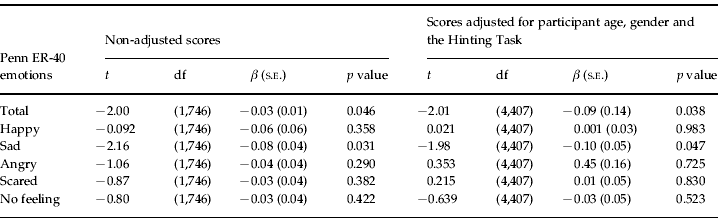
Table 2 shows results of the linear regression analyses for the Penn ER-40 and total scores on the APSS. Inverse associations were found between these scores, with two of these associations being statistically significant. Specifically, with regard to the relationship for (i) the total score on the Penn ER-40 (β=−0.03, t 748=−2.00, p=0.046) and (ii) the score for sad faces (β=−0.08, t 748=−2.16, p=0.031), higher scores on the APSS were associated with lower scores on the Penn ER-40. There were no significant associations between children's APSS scores and scores on the Penn ER-40 for angry, fearful or happy faces (p's >0.186).
Non-adjusted and adjusted standardized coefficients for the relationship between scores on the Penn ER-40 and the APPS

Penn ER-40, the Penn Emotion Recognition-40 Test; APPS, Adolescent Psychotic-Like Symptom Screener; df, degrees of freedom; s.e., standard error.
Associations between the Penn ER-40 and PLEs when adjusting for age, gender and the Hinting Task
Given that age and gender differences were found for scores on both the Penn ER-40 and the APSS, and that the Hinting Task was significantly correlated with scores on sad faces, a further series of linear regression analyses was conducted to control for the influence of these variables on the results reported previously. These data are also presented in Table 2. First, for the overall sample, the results show that gender and age did not account for the significant relationships between the APSS and (i) the total score on the Penn ER-40 (β=−0.03, t 748=−2.11, p=0.035) and (ii) the score for sad faces (β=−0.08, t 748=−2.14, s.e.=0.04, p=0.032). Second, with the subsample of participants (n=409) who completed the Hinting Task along with the other measures, the addition of this measure to these analyses also did not account for the significant relationships between the APSS and (i) the total sore on the Penn ER-40 (β=−0.09, t 407=−2.01, p=0.038) and (ii) the score for sad faces (β=−0.10, t 407=−1.98, s.e.=0.04, p=0.047). As is evident in Table 2, controlling for these variables did not significantly affect the relationship between APSS scores and happy, scared or no feeling emotional expressions on the Penn ER-40.
Discussion
In the current study we found that adolescents who report PLEs had poorer ability to correctly identify facial emotional expressions. These findings were independent of the participants' age and gender. Analyses with a subsample of participants who had completed a theory of mind test also showed that the association between PLEs and FER was robust. These findings seem to be driven by a particular difficulty in the recognition of sad faces. Consistent findings have also been reported for the recognition of negative emotions in patients with schizophrenia, specifically fear (Gaebel & Wolwer, Reference Gaebel and Wolwer1992), sadness (Gaebel & Wolwer, Reference Gaebel and Wolwer1992; Kohler et al. Reference Kohler, Turner, Bilker, Bresinger, Siegel, Kanes, Gur and Gur2003) and anger (Pinkham et al. Reference Pinkham, Penn, Perkins and Lieberman2003). It is important to note that the current findings were observed with a sample of adolescents with an average age of 11.5 years. Of interest, Amminger et al. (Reference Amminger, Schafer, Papageorgiou, Klier, Schlogelhofer, Mossaheb, Werneck-Rohrer, Nelson and McGorry2011) recently reported that a sample of youngsters (aged 13–25 years) at UHR (on the basis of family history and/or an ARMS) of psychosis were significantly worse than a group of healthy controls at recognizing both ‘sad’ and ‘fear’ emotional expressions. Thus, in combination, the findings of the latter study and the current investigation suggest that specific difficulties in FER may be apparent at a young age and before the full expression of psychotic illness. Detecting these deficits at such an early age in individuals who have not yet entered the period of risk for psychotic disorder has implications in terms of early detection and intervention. Importantly, these findings suggest that emotion recognition is related to vulnerability to psychosis in addition to psychotic disorder (Penn et al. Reference Penn, Corrigan, Bentall, Racenstein and Newman1997; Edwards et al. Reference Edwards, Pattison, Jackson and Wales2001; Philips & Seidman, Reference Philips and Seidman2008).
There are several different ways that our findings may be related to the aetiology of vulnerability to psychosis. First, problems in FER may be on the causal pathway to psychosis; in other words, these difficulties themselves are a risk factor for the development of psychosis, consistent with the neurodevelopmental model of schizophrenia (Marenco & Weinberger, Reference Marenco and Weinberger2000). Second, poor FER may be a consequence of experiencing PLEs. Third, both poor FER and PLEs may be outcomes of a common aberrant developmental trajectory that, in some individuals, will eventually lead to psychotic disorder. It is important to note that performance on the Penn ER-40 has been shown to be heritable in families with schizophrenia (Greenwood et al. Reference Greenwood, Braff, Light, Cadenhead, Calkins, Dobie, Freedman, Green, Gur, Gur, Mintz, Nuechterlein, Olincy, Radant, Seidman, Siever, Silverman, Stone, Swerdlow, Tsaung, Tsaung, Turetsky and Schork2007; Gur et al. Reference Gur, Nimgaonkar, Almasy, Calkins, Ragland, Pogue-Geile, Kanes, Blangero and Gur2007; Calkins et al. Reference Calkins, Tepper, Gur, Ragland, Klei, Wiener, Richard, Savage, Allen, O'Jile, Devlin, Kwentus, Ailyu, Bradford, Edwards, Lyons, Nimgaonkar, Santos, Go and Gur2010). We cannot distinguish between these three hypotheses because we do not have temporal information about the association seen here. However, the fact that a recent prospective analysis found no association between emotion deficits at age 8 and PLEs at age 13 (Thompson et al. Reference Thompson, Sullivan, Heron, Thomas, Zammit, Horwood, Gunnell, Hollis, Lewis, Wolke and Harrison2011) whereas we found a relationship between PLEs and FER at age 11.5 years (on average) suggests that poor FER may be a consequence of developing PLEs. Thus, further research will need to address this issue to determine whether problems in FER serve as an index of subsequent psychotic disorder or even as an indicator of a vulnerability to psychosis and to inform the design of future intervention. At the same time it is important to note that the number of individuals who reported PLEs was much greater than the number that would be expected to eventually develop psychosis (Poulton et al. Reference Poulton, Caspi, Moffit, Cannon, Murray and Harrington2000). Follow-up work with this sample at further stages along the developmental trajectory would help to refine the precise nature of the association between PLEs and FER and the predictive validity, of one or both of these variables, as markers of subsequent psychotic disorder.
In keeping with our findings, research with older samples has shown poor FER in individuals with SPD (e.g. Poreh et al. Reference Poreh, Whitman, Weber and Ross1994; Mikhailova et al. Reference Mikhailova, Vladimirova, Iznak, Tsusulkovskaya and Sushko1996; Waldeck & Miller, Reference Waldeck and Miller2000) and in those at increased risk of schizophrenia (McCown et al. Reference McCown, Johnson, Austin and Shefsky1988; Kee et al. Reference Kee, Horan, Mintz and Green2004; Addington et al. Reference Addington, Penn, Woods, Addington and Perkins2008; Eack et al. Reference Eack, Mermon, Montrose, Miewald, Gur, Gur, Sweeney and Keshavan2010) in addition to individuals with schizophrenia (Gaebel & Wolwer, Reference Gaebel and Wolwer1992; Mandal et al. Reference Mandal, Pandey and Prasad1998; Hooker & Park, Reference Hooker and Park2002; Kohler et al. Reference Kohler, Turner, Bilker, Bresinger, Siegel, Kanes, Gur and Gur2003, Reference Kohler, Walker, Martin, Healey and Moberg2010).
The discrepancy in findings between the current work and that of Thompson et al. (Reference Thompson, Sullivan, Heron, Thomas, Zammit, Horwood, Gunnell, Hollis, Lewis, Wolke and Harrison2011) could also be due to several other factors. The current study used the Penn ER-40 whereas Thompson et al. used the Diagnostic Analysis of Non-Verbal Accuracy (DANVA). Despite their established psychometrics (e.g. Nowicki & Duke, Reference Nowicki and Duke1994; Kohler et al. Reference Kohler, Turner, Stolar, Bilker, Brensinger, Gur and Gur2004), these measures differ significantly. For example, the Penn ER-40 was administered as a pencil-and-paper test in a group setting whereas the DANVA is a computerized task completed individually. Another factor is that the Penn ER-40 presented images of adult faces whereas the DANVA presented photographs of children. The presentation of expressions on adult versus child faces is particularly important in light of recent research by Hoehl et al. (Reference Hoehl, Brauer, Brasse, Striano and Friederici2010), who showed that although children (mean age=6.2 years) displayed stronger amygdala activation in response to angry expressions on adult versus child faces, the converse was true for happy facial expressions. Thus, the presentation of expressions on child versus adult faces is an important variable to consider and one that research suggests interacts with the expression being presented to influence how the emotions are processed.
Another important issue, independent of the measures used across these studies, is that Thompson et al. (Reference Thompson, Sullivan, Heron, Thomas, Zammit, Horwood, Gunnell, Hollis, Lewis, Wolke and Harrison2001) measured FER prospectively at age 8 years and psychotic symptoms 3 years later, whereas in the current study both of these variables were assessed at the same time point when children were, on average, 11.5 years of age. As referred to in the introduction, processing of facial emotions emerges early (e.g. Barrera & Maurer, Reference Barrera and Maurer1981; Walker-Andrews, Reference Walker-Andrews1997), but full competency emerges much later at around 10 years of age (Simonian et al. Reference Simonian, Beidel, Turner, Berkes and Long2001), with more specific skills, such as the recognition of negative emotions, not fully established until later in adolescence (Camras & Allison, Reference Camras and Allison1985). The inclusion of younger participants by Thompson et al. might account for their finding of no association between emotion recognition and psychotic symptoms.
Strengths and limitations
The current work has several strengths. For example, it involved a large sample of adolescents from the general population; as such, it represents one of very few studies to examine the relationship between PLEs and FER in early adolescence. It also used a valid measure of PLEs, which has been shown to provide good sensitivity and specificity in identifying young adolescents in the general population with psychotic symptoms identified at clinical interview (Kelleher et al. Reference Kelleher, Harley, Murtagh and Cannon2011). At the same time, a limitation of the current work, as described previously, was that it involved a pencil-and paper version of the Penn ER-40 when past research has used a computerized version of this measure (Kohler et al. Reference Kohler, Turner, Bilker, Bresinger, Siegel, Kanes, Gur and Gur2003; Pinkham et al. Reference Pinkham, Sasson, Calkins, Richard, Hughett, Gur and Gur2008). However, the pencil-and paper version seemed to be sensitive in picking up poor FER and allowed us to access a larger sample than would have been possible with a computerized version. Future research is needed to establish the validity of this pencil-and paper version of the Penn ER-40 and to examine its relationship with performances on the computerized protocol.
A second limitation of this study is that there was a consent rate of 51.20%. However, this is comparable to that reported in previous investigations of the mental health of a community sample of Irish adolescents aged 12–15 years (Lynch et al. Reference Lynch, Mills, Daly and Fitzpatrick2004, Reference Lynch, Mills, Daly and Fitzpatrick2006). At the same time, this rate is significantly better than those reported in some previous community-based studies involving samples of adolescents from other countries. For example, Yung et al. (Reference Yung, Nelson, Baker, Buckby, Baksheev and Cosgrave2009) reported a 19.7% consent rate with a community sample of Australian adolescents (mean age=15.64 years). Third, this study did not consider the misattribution of facial expressions. Recent research by van Rijn et al. (Reference van Rijn, Aleman, de Sonneville, Sprong, Ziermens, Schothorst, van Engeland and Swaab2011) suggests that the misattribution of facial expressions might be the potential cognitive mechanism contributing to social impairments that have been observed in adolescents at UHR for psychosis. Thus, future work with adolescents who report PLEs might benefit from investigating emotion misattribution scores; for example, comparing the misattribution scores of individuals who scored high and low on the APSS. It is also possible that ceiling effects were observed for some emotional expressions on the Penn ER-40. The mean number of happy (7.60), no feeling (6.56) and scared (6.21) faces correctly recognized (out of a possible 8) was fairly high. Thus, this task might have been relatively easy for young adolescents to complete. More difficult computerized tasks that vary the intensity of the emotional expression (e.g. the DANVA; Thompson et al. Reference Thompson, Sullivan, Heron, Thomas, Zammit, Horwood, Gunnell, Hollis, Lewis, Wolke and Harrison2011) or tasks that morph neutral faces to emotional faces (e.g. Norton et al. Reference Norton, McBain, Holt, Ongur and Chen2009) could be used in future research.
The fact that no information about the temporality of the relationship between PLEs and FER was provided represents a necessary limitation of the current work. It remains to be seen whether children's experience of PLEs resulted in the observed poorer performance in FER or whether this poorer ability preceded PLEs. However, determining the temporality of the association is not straightforward, given that we do not know how early PLEs emerge in development and the possibility that both poor FER and PLEs are outcomes of a common underlying process. Further research will need to address this issue to determine whether poor FER can serve as an index of vulnerability to psychosis. Finally, although attempts were made to control for possible confounding variables, including participant age and gender and performance on a theory of mind task, it is possible that other factors, such as intelligence, social class, parental education and previous childhood psychiatric disorders, may have influenced the observed results. Future research could explore the effects of these variables on the relationship between PLEs and facial emotion processing.
Acknowledgements
This work was supported by a Clinician Scientist Award from the Health Research Board (Ireland) and a 2009 National Alliance for Research on Schizophrenia and Depression (NARSAD) Essel Foundation Independent Investigator Award to M. Cannon. L. Tiedt was supported by a Health Research Board (Ireland) Summer Studentship. The research leading to these results has received funding from the European Community's Seventh Framework Programme under grant agreement no. HEALTH-F2-2010-241909: project European network of National Schizophrenia Networks Studying Gene–Environment Interactions (EU-GEI). We thank L. Power for her help in scoring the questionnaires. We thank the children and their parents for participating in the study and the teachers, principals and school secretaries for their help with this project.
Declaration of Interest
None.