

Jean Cocteau: ‘I'm quite as interested in the use of sound as in the use of images.’Footnote 1
In addition to directing six films over a thirty-year period, Jean Cocteau's (1889–1963) career included explorations in a variety of media including literature, poetry, and the plastic arts. He viewed his films as a form of poetry, classifying them as poésie cinématographique and using them to explore his artistic preoccupations. In the French studios where Cocteau shaped his own films, he did not shy away from getting personally involved with any aspect of a film, declaring:
I am an artisan, a worker. It is for this reason that I get on so well with my workers on the cinematograph. I must work with my hands.Footnote 2
He was as much a poet in his work on his film soundscapes as he was on other aspects of his art. In contrast to the highly systematized Hollywood studios of the mid-twentieth century, he carefully controlled almost every parameter of his films. He ensured that Georges Auric was the composer of the music for all the films he directed, and from his first feature he gave direction or personally developed and edited the individual sound components of his soundscapes. He even concerned himself with the sonic dimension of the exhibition of his films in cinema theatres, and was also usually keen to discuss his more unusual sonic experiments in interviews and film publicity. I would argue that his film soundscapes occupy a unique position in the history of French film sound, providing a key link between experimentation in art music and the sonic experimentation of the New Wave filmmakers. This argument is best exemplified by Le Testament d'Orphée (1960), which represents the apotheosis of his career. Cocteau's confidence in handling a wide range of sonic materials is very clear in his final film, which includes a wide variety of approaches to the combination of images with sounds.
Research into interconnections between film sound and innovations in electroacoustic music in the mid-twentieth century has generated several recent publications. In relation to early experimentation in Hollywood, Neil Lerner has examined Rouben Mamoulian's ‘sound stew’ to accompany Dr Jekyll's first transformation in Dr Jekyll and Mr Hyde (1931), which was reported to combine candelight photographed to the soundtrack, a gong without its initial attack played backwards, and the sound of a heartbeat.Footnote 3 Lerner identifies this sound montage as a forerunner of experimentation later in the century by John Cage and musique concrète artists.Footnote 4 The electronic music studios of continental Europe are perhaps the most widely studied and the relationship between their compositional approaches and those found in Britain provides the starting point for Louis Niebur's study of the BBC Radiophonic Workshop. Niebur contrasts reservations held by artists at the French and German studios concerning the suitability of electronic music for film, television, and radio (as it would be reduced to a supporting role) with that of the BBC's Radiophonic Workshop where experimentation was first carried out within the context of creating sounds for radio and then television.Footnote 5 While musique concrète composers may have felt that the provision of music for film and radio was a supplement to their research into electronic music, this did not prevent many of them from actively involving themselves in these activities. Philippe Langlois's study of the history of relationships between electroacoustic music and cinema over the course of the twentieth century explores the mutual influence they have had on each other. He highlights forays by musique concrète composers into cinema and the extent to which this new development in art music impacted on a range of artists, including filmmakers.Footnote 6 Certainly, the pioneers of musique concrète, Pierre Schaeffer and Pierre Henry, recognized its potential for film and television, and opened up their studio to directors who were interested in audiovisual experimentation. Cocteau's film soundscapes, reflections on the role of music and sound in film and other writings, suggest an awareness of such contemporary developments. As a filmmaker who stood outside the mainstream, Cocteau was well regarded by the audacious young filmmakers of the New Wave.Footnote 7 Focusing on his soundscape for Testament as the poet's cinematic summation of his career and a conscious exercise in self-reflection, where music and sound play a crucial role in presenting Cocteau audiovisually as he wished to be remembered, I suggest that he can usefully be understood as a sound auteur in his work on this film. By establishing connections between musique concrète, New Wave film, and Cocteau's approach to film sound, I shall then examine the musical selections for Testament, discussing Cocteau's employment of pre-existing music as both a means of canonizing himself and as a precursor to Godard's later editing of classical music in film. Indeed, the extent of Cocteau's creativity with music and sound in this film suggests points of contact with later New Wave film and musique concrète practices while his very personal efforts in designing the complete sonic environment of this self-reflexive soundscape reflect those of a poet sonically situating himself in the canon.
Cocteau engages with musique concrète and the New Wave
The character of Orpheus was an important presence in Cocteau's poetics, and Le Testament d'Orphée represents a very personal engagement with classical myth. The choice of the Orpheus theme for this film demonstrates a continued interest in subjects that were present from his very first film, Le Sang d'un poète (1930). Indeed, François Truffaut recognized Testament as another remake of that film, saying that it was ‘the very same essay on poetic creation looked at afresh and revised’.Footnote 8Le Sang d'un poète and Le Testament d'Orphée are frequently grouped with Cocteau's 1950 film Orphée to form the ‘Orphic Trilogy’. Orphée is the most explicitly connected to the Greek myth since it is a modern-day version in which the poet falls in love with an agent of death, the Princess. All three films centre on the theme of the poet who must die and be reborn to achieve artistic glory. Cocteau's approach to the music and sound in his final film can be contextualized more broadly as part of a long history of collaboration in film with Auric. The composer contributed music to six films directed by Cocteau; in addition to the Orphic trilogy, the list includes La Belle et la bête (1946), L'Aigle à deux têtes (1948), and Les Parents terribles (1948). Indeed, before their first excursion into film, Cocteau had supported Auric's work as a member of Les Six (Auric, Louis Durey, Arthur Honegger, Darius Milhaud, Francis Poulenc, and Germaine Tailleferre).Footnote 9
Cocteau's professional relationship with Auric had a basis in a friendship that can be traced through personal correspondence.Footnote 10 Their collaboration in film was not always smooth and at times the director seems to have annoyed the composer with his treatment of his music. Indeed, Auric credits his work with René Clair on A Nous, la Liberté! (1931) as the starting point for his film career even though he had already worked with Cocteau on Le Sang d'un poète.Footnote 11 Colin Roust outlines some of the challenges faced by Auric on that film, including Cocteau's use of accidental synchronization, which would trouble the composer long after the completion of this film.Footnote 12 Accidental synchronization was a response to the dull illustrative synchronization that was to be found in many early sound films. Cocteau avoided aligning the image and the music in the way one might expect, deliberately placing music composed for certain images with completely different ones. He stated that his re-shuffling, shifting, and reversing of the order of the music in every single sequence heightened the relief of the images.Footnote 13 James Deaville and Simon Wood have explored the extent to which his accidental synchronization was as random as he claimed, finding that several cues appear to have been edited very carefully to enhance certain images.Footnote 14 They find similar results in La Belle et la bête and Orphée, where Cocteau appears to have exercised more conventional control rather than leaving image and music combinations to chance.
Despite his fame, Cocteau found it difficult to obtain financial support for Testament and the low budget necessitated precise planning in advance of the filming. Shooting was rapid and took place between September and October 1959 at the Studios de la Victorine in Nice and Franstudio in Paris; the exterior shots were filmed at Francine Weisweiller's Villa Santo-Sospir, Villefranche and Baux-de-Provence.Footnote 15 Cocteau described Testament as unfolding in the manner of a dream and as lacking a story: ‘There is none. I exploit the realism of settings, people, gestures, words and music to obtain a mould for abstraction of thought.’Footnote 16 In Testament the poet (played by Cocteau as himself) is trapped in space-time and trying to break free. His fate is intertwined with a professor (Henri Crémieux) who discovers the means by which he can escape from this limbo through use of a special powder that will return the poet to his own time. The experiment is not wholly successful and the poet continues to wander through space-time, encountering his friends, characters, and works of art: his tapestry of Judith and Holofernes, his friend Francine Weisweiller, and the horseman from the play Orphée, for instance. The character Cégeste from Orphée, played by Edouard Dermit, reappears early in Testament to guide Cocteau to the goddess Minerva, and he is identified as the poet's adopted son in real life. The characters of the Princess (Maria Casarès) and Heurtebise (François Périer) from Orphée also reappear in the film to judge the poet in a mock trial. They question Cocteau about what it means to be a poet and about the nature of cinema. Following a journey through the garden of a fin-de-siècle lady and a trip across the sea to the port of Villefranche, Cocteau and Cégeste encounter the poet's double who functions as his public face and who refuses to acknowledge the original Cocteau. They also stumble on a young couple, ‘intellectual lovers’, writing in notebooks over each other's shoulders. The couple are approached by two children demanding autographs to feed into the mouth of a mysterious idol who can create artworks out of the offerings. Cégeste disappears and Cocteau continues his journey alone, finally reaching Minerva and presenting her with a hibiscus flower. She rejects it and launches her spear at him as he walks away. The mortally wounded poet is mourned by gypsies and several famous friends, including Picasso and Charles Aznavour. Their distress is shortlived as, with a burst of fanfare, he is resurrected and the voiceover explains that ‘poets only pretend to die’.Footnote 17 Cocteau walks away to encounter the Sphinx, Antigone, and blind Oedipus (Jean Marais), only to be stopped by two policemen on motorcycles who demand his identity papers. As they examine them, Cégeste reappears and, declaring that the poet is not of this world, they disappear together. The policemen realize that Cocteau has vanished but are soon distracted by the appearance of young people in a speeding Cadillac blaring out jazz.Footnote 18 The final moments of Testament comprise a line drawing of Orpheus accompanied by Cocteau's voiceover announcing that a joyous wave has washed over his final film and that he and his team put their best efforts into this work.Footnote 19Testament is a highly self-reflexive film and since it begins with the closing shots of Cocteau's previous film Orphée in a silent film style, the entire film might be viewed as a bridge between cinema at the start of Cocteau's career and the new directions that were being developed during his later years.
Cocteau's involvement in cinema spanned a period of great change in the development of French film culture and its technologies; from the early years of sound cinema until the start of New Wave cinema, the industry and its sound practices underwent many transformations. For Mervyn Cooke, Cocteau's films ‘logically bridge the gap between the French cinema of the 1930s and the nouvelle vague of the 1960s’, and anticipated techniques later exploited by New Wave filmmakers.Footnote 20 Through shared access to emerging technologies, there are further connections to be made between the creative practices of the musique concrète musicians, who recorded and manipulated real-world sounds as part of their compositions, and the manipulations of sound as creative cinematic material characteristic of New Wave cinema. Musique concrète developed during the late 1940s and 1950s, contemporaneous with Cocteau's direction of Orphée (1950) and Le Testament d'Orphée (1960). The impetus for such innovations in art music composition can be traced to the Second World War, the aftermath of which was a watershed period, with young composers struggling to reassert their identities and many attempting to continue pre-war modernist trends in composition.Footnote 21 Pierre Schaeffer, Jacques Copeau, and his pupils founded the Studio d'Essai de la Radiodiffusion Nationale in 1942, which became a centre of French Resistance and delivered the first broadcasts in liberated Paris in August 1944.Footnote 22 The studio was renamed as the Club d'Essai de la Radiodiffusion-Télévision Française in 1946 and, in 1948, became the place for musique concrète experimentation; the group collaborated under the name Groupe de Recherche de Musique Concrète.Footnote 23 Cocteau was aware of the work of the Club d'Essai, even publishing an essay for the first edition of the Cahiers du Club d'Essai de la Radiodiffusion française in 1947. Several of his works were adapted for radio and broadcast at the Club, including Antigone in November 1946, Les Enfants terribles in March 1947, and Opium in November 1955.Footnote 24 He was initially cautious about the radio as a medium and his concerns were partially due to the impact of the microphone and resulting quality of the sound for listeners.
Regardless of the skill of the specialists who direct the waves, all the sounds reach us in one single mass. They [the waves] present us with the portrait of the orchestra or the crowd and our ear instinctively corrects its flatness, as happens with the cinematograph and in photography.Footnote 25
In addition, the challenges of recording for the radio, including the microphone's ability to pick up unwanted sounds, seems to have added to his reservations and he suggested using several microphones to ensure that everyone's part should be recorded adequately without some sounds obscuring others.Footnote 26 The work of the Club d'Essai alleviated some of his concerns about radio, which suggests an interest in and approval of their experimentation with sound.
It is the poverty of this acoustic pipe [microphone], of this hole in the wall behind which one conceals oneself, which prevented me, until now, from devoting myself to the rigorous work of radio. The Club d'Essai alleviated some of my reservations. In addition to the work which is done there out of love and without the shadow of comfort, there is constant research. One doesn't say: ‘What good is it to struggle?’ when obstacles present themselves. And all kinds of obstacles present themselves. One struggles. One struggles and tries desperately to conquer this machine which hates us and which makes fun of us.Footnote 27
He reflected on the radio again within the context of the broader universe of sound in a 1953 essay ‘Sound Civilisation’. Again, he states that radio is important when it brings culture to people who might not otherwise experience it.
It is certainly true that individuals have been influenced by the world of sound, but sometimes for ill, because the radio is so widespread and extensive that it tends to obey: to obey its listeners, when it would be better if the listeners were to obey it. In other words, if one could manage to reach a high level of creation through sound apparatus, this would be an excellent achievement.Footnote 28
He goes on to suggest that both sound reproduction and cinematography could be useful resources in schools. Both essays demonstrate that his concerns for innovation in sound reproduction and cinematography were closely linked and that he was making comparisons between sonic technologies across media.
Initially Schaeffer and his group used shellac discs but in 1949, following advances in technology during the war, they started to use magnetic tape, which allowed a direct or ‘concrete’ engagement with sounds themselves and a new means of manipulating sound. Live and recorded music could be juxtaposed for the first time in performance. Schaeffer began his experimentation by recording pure sounds and used them to create compositions, freed from their original context. For him, the key moment in the birth of musique concrète was the moment when he first separated a sound from its attack to create an entirely new sound.Footnote 29 He insisted that the sounds be appreciated for their individual qualities rather than through associations with their causes. Schaeffer's principal transformations included: isolating elements of a sound; playing a recording backwards to reverse a sound; changing the velocity of the playback to alter the pitch; altering speed and timbre; and superimposing sounds on top of one another.Footnote 30 Early compositions that include such experimentations with different raw materials and treatment of sounds include the collection of Études in 1948 (Étude aux chemins de fer, Étude pour orchestre, Étude aux tourniquets, Études pour piano, and the Étude aux casseroles).
The première of the Étude aux chemins de fer, as part of a ‘concert of noises’ on French radio on 5 October 1948, inspired interest in the possibilities offered by the studio among young composers and the wider public. Schaeffer received letters suggesting future uses for the new music; among these were proposals that they might be used in the cinema.Footnote 31 He went on to collaborate with Pierre Henry on the Symphonie pour un homme seul in 1950, for which Schaeffer manipulated the bodily sounds of a man, including his cries, tapping feet, breathing, and the sounds of back slapping.Footnote 32 The Symphonie was premiered at the first big public concert of electronic music, at the École Normale de Musique on 18 March 1950.Footnote 33 The potential importance of these early concert performances was recognized in the contemporary press and Schaeffer recalled Clarendon's review of 4 April 1950 in Le Figaro in particular. The journalist described:
We are, if not at the conception of a true art, at least at the birth of a process of which it remains impossible to predict the future and its applications.Footnote 34
There was a hiatus in the collaboration of the Groupe from 1953 to 1958, when Schaeffer branched out by himself, although he returned and the group was reformed with François Bernard Mâche and Luc FerrariFootnote 35 as the Groupe de Recherches Musicales.Footnote 36 Schaeffer produced his manifesto of experimental music, ‘Vers la musique expérimentale’ in 1957. Musique concrète took on a more comprehensive meaning and came to refer less restrictedly to a specific technical procedure.Footnote 37
Schaeffer commented on the attraction of musique concrète for film and television directors: ‘Neither sound effects nor symphony, musique concrète easily demonstrated its dramatic effectiveness, its broadcasting potential.’Footnote 38 In a practical endeavour, Schaeffer and Henry's interest in sound for film led them to open up their studio to film directors and even to develop a library of sounds to keep up with demand.Footnote 39 The musique concrète artists soon came to compose for film themselves. Henry composed numerous musique concrète pieces for ballet, theatre, and cinema. Schaeffer recorded:
Musique concrète became known in the ballets of Béjart: alongside Orphée and the Symphonie, the Concerto des ambiguïties in its turn was danced, under the name of Voyage au coeur d'un enfant; the theatre (L'Amour des quatres colonels) and especially the cinema (Aube, Astrologie, then Fulchignoni's remarkable documentaries on Mexican art and Vinci) called on Pierre Henry's musique concrète.Footnote 40
The potential of explorations into the applications of real-world sound for cinema was acknowledged in the wider film industry. Schaeffer published an article in early 1954 in the magazine Courier, which looked ahead to a UNESCO-sponsored ‘Music and Film’ exhibition at the Cannes International Film Festival in April that would include a section devoted to musique concrète. Cocteau was president of the jury at the 1954 festival, so it is likely that he was aware that such an event was programmed, although it is unclear whether he was in attendance at this session. Schaeffer's article, which displays the extent to which technological experimentation in art music was related to the development of film sound, was later published in a longer version in Cahiers du cinéma (a publication that provided a rich forum for New Wave directors during the 1950s and 1960s).Footnote 41 He notes the connection between musique concrète, electronic music, and musique dessinée via their reliance on film tape (bande), which in turn places them on common ground with the cinema. As he puts it:
concrete music [. . .] uses magnetic tape, which is similar to the sound track of a film, for recording and recomposing its sounds. Its bars are traced by the scissors of the cutter who splices the different sections of tape. The sound itself is modified by phonogenic apparatus which by running the tape at greater or lesser speed can raise or lower the pitch of the original sound and greatly alter its tone quality.Footnote 42
Schaeffer recognized the parallel between these new art music genres and cinema which all handle sound directly as material: ‘sound ceases to be a fleeting thing; it is printed permanently on magnetic tape, and like movement itself, miraculously fixed on film’.Footnote 43
One of the aspects that aligned musique concrète composers more strongly with their film sound colleagues than with their concert music colleagues was the nature of their professional training. The composer of musique concrète does not have to be able to read and write traditional musical notation nor to have performers play orchestral instruments. Many skills traditionally used by composers, to imagine sound and shapes and then notate them for performance, are no longer relevant.Footnote 44 In À la recherche, Schaeffer contrasted the working methods of the traditional composer with those of the concrete one. While the traditional composer works from the abstract to the concrete, conceiving a piece, notating it, and then arranging a performance, the concrete composer produces the material (usually from real-world sound), experiments with it, and then puts it together. His/her material is not usually notatable and the performer is often rendered superfluous.Footnote 45 Schaeffer described such working methods in his 1953 article ‘Vers une musique expérimentale’:
The classical relationships between composition and performance, between authors and instrumentalists are also fundamentally changed. In the new musics, the composer is often his own performer, and the score is simply a shooting script. The creation is achieved once for all, by means of a different division of responsibilities, which resembles that of the production crews in cinema.Footnote 46
Musique concrète’s facilitation of musical creativity by those not trained in traditional composition is the key link with Cocteau's work. Empowered and inspired by emerging technologies and developments in art music, Cocteau was confident in editing the sonic materials in Orphée (1950) and Le Testament d'Orphée (1960). His engagement with contemporary culture and emerging technologies is highlighted by the frequent focus on the radio in Orphée: in a car, communicating poetry to Orphée; and in the Princess's bedroom when she tunes the radio in and out to pick up musical excerpts from Gluck's opera Orphée et Eurydice. Cocteau heavily edited the music in Orphée in an approach that seems almost Godardian, and later recalled:
I took the most irreverent liberties with the composer. I recorded Auric's music without the images (to a chronometer) and for example put the scherzo he had composed for the comic home-coming scene into the chase through the deserted house. Or, even better, I recorded Eurydice's lament, by Gluck, meaning to use it only for the wireless in the cottage. But when I cut into Auric's music at the first shot of Heurtebise's entrance, I noticed that the first and last note of Gluck's music fitted exactly with the first and last images of the scene, and I shamelessly took advantage of that little miracle.Footnote 47
He also involved himself in technically demanding preparation in handling sound for Orphée. He used a drumming solo by Gene Krupa for scenes with the Bacchantes but switched to the drums from Katherine Dunham's dance troupe for the scenes after Orpheus has been killed. Cocteau made a record of Dunham's ensemble and superimposed it on the final orchestral music of Orphée, occasionally cutting the orchestra to leave percussion alone.Footnote 48
His experimentation with the techniques of musique concrète is most obvious in the manipulation of real-world sound. For instance, he removed the opening ‘attack’ of a sound to create an entirely different sound unrecognizable from its source, applying this approach to a tuning fork in Orphée, noting:
In Orphée, for the coming and going through the mirror we used the entire range of the actual sound, but without the initial shock. I kept only the prolongation of the waves (to be in fashion, I should say the undulatory prolongation).Footnote 49
The phrase ‘to be in fashion’ immediately acknowledges that he is about to appropriate a new term then being applied in art music composition, further emphasizing his awareness and understanding of developments in that area. Cocteau also drew attention to his inclusion of real-world sounds from the Saint Cyr railway in the Zone in Orphée, perhaps aware of the interest this might generate in those enthusiastic about innovations in film sound.
There were about one hundred and fifty trains passing there every night. The sous-préfet, Amade, stood watch in hand announcing the times of the trains and the intervals in the din. But it was very rare, alas, that a shot could be made to coincide with the railway timetable. This is why in Orphée you occasionally hear distant whistles and a kind of hollow factory noise. We tried to dub these passages. But in the projection room I realized that the whistles and factory noises gave a background of mystery to the dialogue, and that they should on no account be cut.Footnote 50
These passages are reminiscent of Schaeffer's first Études, dating from less than two years before, which included manipulations of recorded sounds from railways. Most famously, Cocteau employed the real-world sound of an aeroplane with the shot of Minerva killing the poet, a combination Truffaut cited as a ‘stroke of genius’:
the great moment of joy for the director took place, I'd think, in the editing room, when Cocteau was able to see the flying spear accompanied by the screech of the jet. The quality of this joining of sound and image should have set to rest any doubts he had about the emotional power of the scene.Footnote 51
In an interview with Jean de Baroncelli for Le Monde, Cocteau described the fortuitous development of this segment as follows:
I was filming my death scene. On the screenplay I had written: ‘Aeroplane noises’. I counted on adding these noises in the mixing. But while we were filming, at the same instant that Minerva pierced me with her spear, an aeroplane appeared in the sky allowing the sound technicians to record the drone of its motors.Footnote 52
Cocteau was similarly not averse to manipulating the dialogue to achieve a desired effect. In Orphée, he filmed the scene where the dead Cégeste stands up in front of the Princess in reverse and slow motion, once with a close-up on Casarès and then again with one on Dermit. He preferred Dermit's voice in the Casarès shots and so put the dialogue of these with the close-up of his face, making them synchronize with his lip movements. In Testament, he recorded Cégeste's speech backwards for the scene where Cégeste tries to force Cocteau to visit the goddess Minerva, for which the images had also been recorded backwards. The result is that all significance is removed from the words: we hear Cégeste's voice as pure sound. Cocteau's use of recorded sound and his frequent recourse to playing sequences backwards to achieve special effects are reminiscent of the sorts of sound manipulations attempted by Schaeffer, such as altering timbre and pitch by changing the playback speed, and playing sounds in reverse, demonstrating the close connections between Cocteau's approach and the techniques of musique concrète.
In addition to his interest in manipulating real-world sounds, Cocteau approached and hired the well-known Baschet brothers who formed the duo ‘Les Structures Sonores’ to tape a part of the musical background for Testament.Footnote 53 The Baschet brothers were not musique concrète artists (they are most commonly described as sound sculptors), but they engaged with the generation of new sounds through the building of special instruments. In his Répertoire Internationale des Musiques Electroacoustiques, Hugh Davies describes their structures sonores (sculptural instruments) as ‘designed for musical performance, and [they] generally do not include any electronic devices, such as amplification’.Footnote 54 Most famous among these was the use of ‘radiators’, ‘each of which imposes a selected frequency response on the sounds which are mostly produced by lengths of metal rods (often threaded) that are struck or are bowed by means of attached glass rods rubbed by wettened fingers’.Footnote 55 The Baschet brothers worked with the composer Jacques Lasry and Yvonne Lasry, popular performers of the newly invented instrument the ‘cristal Baschet’, which utilized these glass rods.Footnote 56 Despite their acoustic format, Bernard Baschet recognized the similarity of character between the sounds they could create with the sounds emanating from electronic music studios, saying ‘We can make sounds with these bars which “musique concrete” [sic] or electronic music can make only with enormous equipment.’Footnote 57 Cocteau was aware of the innovative nature of their work and it pleased him; he even sought to advise them on their place in the history of instrument makers and how to be in fashion.Footnote 58 François Baschet recalled that Cocteau marvelled at the richness of their sounds and the possibilities of modifying them by changing elements. Indeed, he records in his memoirs that the director participated in creating some of the music himself.Footnote 59 In a photograph in Baschet's memoirs, Cocteau is pictured among the Baschet instruments and the famous glass rods are visible (Jacques Lasry is also present in the picture playing the ‘cristal Baschet’). Based on aural analysis, the sound of the glass rods seems to be used for the ‘Tristan's Horn’ motif after its rendition on the cor anglais and in the three note figure (f1–D♭2–B♭1) heard when the camera focuses on the hibiscus flower in close-up shots. As is clear, Cocteau's interest in contemporary art music encompassed both musique concrète techniques and the work of artists building new acoustic instruments,Footnote 60 and his involvement in the creation of new sounds seems to have been as attractive to him as the resulting soundscapes.
The developments in technology that made musique concrète possible also suggested new sonic possibilities to emerging film directors, especially those who would become known as the New Wave filmmakers. Françoise Giroud coined the term ‘nouvelle vague’ in a 1957 article for L'Express. It came to refer to a group of directors (Claude Chabrol, Jean-Luc Godard, Jacques Rivette, Eric Rohmer, and François Truffaut) who had met at the Paris Cinémathèque in the 1950s and were critics for Cahiers du cinéma before they began directing their own films. Drawing on Naomi Greene's synthesis of the range of definitions of New Wave cinema in current scholarship, while these young revolutionaries formed a core group, a wider understanding of New Wave artists could also include the Left Bank and politically engaged filmmakers (Chris Marker, Alain Resnais, Agnès Varda); the directors (Jacques Demy, Louis Malle, Jean-Daniel Pollet, Jacques Rozier); the documentary makers (Jean Rouch, Pierre Schendoerffer); and more commercial filmmakers such as Roger Vadim and Claude Sautet.Footnote 61 These filmmakers reacted against their immediate predecessors in mainstream cinema and attacked the 1940s and 1950s qualité films, which were formulaic historical or literary dramas filmed in a classic style. Instead, New Wave directors looked up to the work of filmmakers such as Orson Welles and Alfred Hitchcock, as well as Howard Hawks and Samuel Fuller who directed ‘gangster’ films. Royal S. Brown has shown how, to varying degrees, New Wave filmmakers ‘redefined the relationship of the cinema's component parts, including music, both to each other and to the narrative’. They undertook innovations in the editing of sound and image that undermined the subordination of editing to narrative in classical cinema.Footnote 62
By the 1950s, Cocteau was in his sixties, but from the very first rumblings of this new group of filmmakers in Cahiers du cinéma, he was very supportive of their endeavours.Footnote 63 In turn, they frequently mentioned him in Cahiers during the 1950s and 1960s as a respected influence, a filmmaker set apart from mainstream commercial cinema. In Cahiers’ 1965 retrospective ‘Twenty Years of French Cinema: The Best French Films Since the Liberation’, Cocteau's Testament was placed fourth.Footnote 64 Cocteau socialized with many of the emerging filmmakers and was honorary president of the ciné-club Objectif49, which championed cinema outside the mainstream, organizing ‘Le Festival du Film Maudit’ at Biarritz.Footnote 65 This club, also led by Robert Bresson, Roger Leenhardt, René Clément, Alexandre Astruc, Pierre Kast, and Raymond Queneau, among others, included critics, filmmakers, and aspiring filmmakers who conceived of a cinéma d'auteurs.Footnote 66 Truffaut praised Cocteau as an auteur, arguing that he and Jacques Tati, Jacques Becker, and Bresson were capable of writing and directing characters quite different from those in the psychological realist films.Footnote 67 This article shaped Cahiers immeasurably and Jacques Doniol-Valcroze recalled its impact:
A leap had been made, a trial begun with which we were all in solidarity, something bound us together. From then on, it was known that we were for Renoir, Rossellini, Hitchcock, Cocteau, Bresson . . . and against X, Y and Z. From then on there was a doctrine, the politique des auteurs, even if it lacked flexibility. [. . .] an ‘idea’ had got under way which was going to make its obstinate way to its most logical conclusion: the passage of almost all those involved in it to directing films themselves.Footnote 68
Godard too stated that he, Truffaut, Rivette, and Rohmer looked to the other ‘gang of four’, Marcel Pagnol, Marguerite Duras, Sacha Guitry, and Cocteau, as models since they were literary-minded men and women who also made cinema, often better than the filmmakers themselves, as they were willing to take risks and be daring. Godard compared Cocteau to a skater dancing freestyle in the section of a competition that requires one to follow a routine, saying that it confused the judges. He felt that Cocteau faced the same obstacles as the New Wave directors in trying to make a film outside of the closed shop that was the film industry, and frequently paid homage to him on screen.Footnote 69 When shooting Hiroshima mon amour (1959), Resnais used Orphée as a point of reference for himself and his Japanese crew, since both films are concerned with a journey through time.Footnote 70 Rivette even credited his passion for cinema as stemming from reading Cocteau's notes on shooting La Belle et la bête; he claimed he knew them by heart.Footnote 71
The interconnections between Cocteau and the young filmmakers can be seen to proliferate when it becomes clear that he anticipated New Wave aesthetic principles and techniques, most prominently the concept of the cinematograph as a means of writing. Astruc developed this notion in ‘The Birth of a New Avant-Garde: La Caméra-Stylo’ (1948),Footnote 72 and Agnès Varda would also draw on the concept of writing to describe her collective and handmade approach to filmmaking, which she called ‘cinécriture’.Footnote 73 Cocteau's artisan working style set him apart from the methods of the wider industry and foreshadowed the approach of many New Wave filmmakers. Cocteau himself said:
The severity of trade-union regulation in Hollywood and London makes it impossible to work without the intermediary of an army of specialists. But in France, filmmaking is a family affair, and no one rebels if his prerogatives are encroached upon – lighting, sets, costumes, make-up, music and so forth. All this rests in my hands and I work in close collaboration with my assistants. Consequently, as my unit itself admits, the film becomes a thing of my very own to which they have contributed by their advice and skill.Footnote 74
As early as the release of L’Éternel Retour (dir. Jean Delannoy, 1943), Cocteau advocated the use of 16mm film, ‘a perfect weapon with which the poet can hunt for beauty, alone, free and with his “shot-gun” camera on his shoulder’,Footnote 75 and this style of filmmaking became the hallmark of the New Wave. Filming on location, using natural light and sounds, hiring unknown actors, and using loose or improvised dialogue and real-time narratives all reflected this desire. Their low-budget approaches had a dramatic impact on the way in which sound was treated in their inexpensive and quickly produced films.
Major sonic changes brought about by New Wave cinema included the use of direct recorded sound on location, and fewer symphonic scores and monothematicism which had dominated mainstream French cinema.Footnote 76 As Michel Chion describes, there was something unpredictable about New Wave film, which frequently undertook bold editing and experimentation such as the manipulation of everyday speech.Footnote 77 Orlene Denice McMahon highlights a distinction between the ways in which the core New Wave filmmakers and the Left Bank group approached film music. She engages with Chion's idea that Godard stands out as music editor while the Left Bank directors are noteworthy in their search for ‘a new style and use of film music’.Footnote 78 Through close study of selected directors, McMahon argues that, excepting Rivette and Chabrol to a lesser extent, the Right Bank group did not engage with contemporary developments in music in the same way as the Left Bank group.Footnote 79 Points of contact with musique concrète were particularly clear in the films of Alain Robbe-Grillet who worked with Michael Fano to produce musique concrète style soundscapes.Footnote 80 Also, Resnais employed Guy Bernard to score Guernica (1950), for which he used electronically manipulated instrumental sounds and some real-world sounds of war.Footnote 81
The New Wave directors’ manipulations of sound are more extreme than anything to be found in Cocteau's oeuvre but the foundations for some of their experimental and rather free creative practices can be found in the design for his soundscapes, notably the techniques of using real-world sound, recording sounds backwards and playing with volume, rooted in musique concrète. Cocteau's manipulation of music and sound in Orphée and to a greater extent in Testament can therefore be understood both as a link to musique concrète, its employment in the films of several Left Bank filmmakers, and as a precursor to Godard's much more audacious editing of sonic materials.Footnote 82 A further connection between Cocteau's Testament and Godard's films can be found in their shared interest in the use of classical music.Footnote 83 In Cocteau's case, Testament includes more classical music than any of his previous films and I suggest that this was as a result of the desire to meet a particular need in this film, one that was bound up with the choice of subject matter and its deeply personal significance.
Sonic self-reflection: Cocteau selects music for Le Testament d'Orphée
Thematically, the cycle of death and rebirth as a prerequisite for poetic glory was central to Cocteau's aesthetics, making the Orpheus myth an ideal vehicle for his concerns; the ability of the poetic voice to continue after death is a strong motif in Testament. Furthermore, Cocteau made no secret of his theory that an artist will always produce a work of art reflective of himself or herself. This is made explicit in Testament when the poet is challenged to paint a portrait and he reproduces a picture of himself. As described by James S. Williams, Testament is ‘a portrait of the artist as Orpheus’.Footnote 84 Cocteau's attribution of great importance to the Orpheus myth in representing his poetic ideals is reflected in his concern for the music and sound of his Orphic films.
By 1959, Cocteau was very confident in his ability to manipulate sounds, music, and silence in the creation of his soundscapes. He incorporated silent montage, voice-over, diegetic music, non-diegetic music, classical borrowings, popular music borrowings, self-borrowings of music from his previous films, and music composed especially for the film. He described Testament as ‘a farce, in the style of Goldoni, on the confusions of space-time and sound’.Footnote 85 The ‘confusions of space-time and sound’ must have encouraged a soundscape that looked to the future through experimental editing while balancing this with a broad range of pre-existing classical music and new music composed by Auric. Cocteau developed ideas about how music might be used before he contacted Auric, and seems to have been unsure whether the composer would even want to be involved given the fixity of his ideas and his initial decision not to credit his collaborators. Such a desire to be seen as the sole author of the work resonates with New Wave auteurism and brings to mind Godard's tendency to edit music for his films himself. On 21 September 1959, Cocteau wrote to Auric:
I must tell you why I have not, as I usually do, called on your friendly genius. The film, although it resembles Sang, is of a totally different type. It demands silence, sound effects, famous allusions (for example to Yseult) ‘Tristan's horn’ etc. . . . The opening titles will be without doubt on the final images of Orphée. There, it would be agreed perhaps, instead of using the music from the end of the film, to replace it with an overture of trumpets and drums. But the film will be produced without the names of actors and collaborators, and I do not dare to offer you an uncredited participation (of the sort taken by Yul, Jeannot, Picasso etc. . . .) Each one appears for a minute. Tell me what you think. In case you accept, it would be necessary to compose a sort of overture theme which would remain in the ears like the work's sign.Footnote 86
Auric did agree to collaborate but his decision did not cause Cocteau to cease his reflections on the choice and arrangement of musical excerpts in the soundscape. He wrote again in December 1959, saying:
My Georges
I have finished the placement of the music. As this film does what it pleases, I was lucky with an obligatory cut of Orphée’s soundtrack, to stumble exactly upon the two great phrases of Le Sang d'un poète.Footnote 87 [. . .] I found the trumpets too beautiful not to use in the body of the film. I put them on Minerva and on the tapestry. I believe that all in all it is beautiful and you will be satisfied.Footnote 88
The correspondence elucidates the degree to which Cocteau respected Auric's contribution to the film but also the fact that he himself was ultimately responsible for the placement of the music in the soundscape. Given his desire for total control over the film's soundscape, the relative marginalization of Auric in comparison to his previous films, and his heavy use of pre-existing music, in the context of Testament, Cocteau can be viewed as a sound auteur.Footnote 89
Cahiers supported the idea of the auteur as transforming the elements of cinema into artwork of personal expression,Footnote 90 and auteurism was the subject of much debate during the late 1950s and the 1960s, with scholars such as Andrew Sarris developing more extreme positions and an auteur theory from an underlying attitude in Cahiers.Footnote 91 Cocteau is widely accepted as an auteur across his film output but Testament stands out from the previous films, released a decade after Orphée, by a director who was more hands on with the music and sound than in any of his previous work. I would not wish to invoke auteurism as either a formula or theory,Footnote 92 but would suggest that the concept of the sound auteur provides a useful lens through which to examine Cocteau's work on this final film. In John Caughie's discussion of commonalities across auteurism as found in Cahiers, in the publication Movie in Britain, and in the writings of Sarris in the United States, he identifies the shared assumption that, while a film is a collective effort, the personality of the auteur director is likely to be expressed in the resulting film.Footnote 93 It is this common belief, which Truffaut initiated for Cahiers,Footnote 94 that provides the foundation for a reading of Cocteau as a sound auteur in Testament. Indeed, Cocteau seems to present himself implicitly as an auteur in his published screenplay of the film which includes a collection of photographs taken during the filmmaking process. Following a picture of the hibiscus flower, the second photograph is of himself and it is captioned: ‘A poet who gets involved in the making of a film must do menial tasks.’Footnote 95 Forty of the sixty-one photos feature Cocteau, either as actor or behind the camera, setting up shots, directing his technicians, among the actors and gypsy musicians. There is also a picture of Cocteau and Truffaut on set together, again supporting a connection with one of the leading filmmakers of the New Wave and the author of ‘la politique des auteurs’ (1954). Interpreting Cocteau as a sound auteur permits the possibility of collective endeavour but suggests that his personality is the guiding force behind the sonic choices in Testament.
His desire to have such a high degree of control over sonic matters was, I would suggest, closely connected with the extent to which Testament was a chance for him to present himself as he would like to be remembered. Cocteau was no stranger to the classical canon, but in Testament one of the striking aspects of the soundscape is that, amidst its highly creative exploration of all possible sonic techniques available, he relies significantly on classical music borrowings. Indeed, this sets Testament apart from the rest of his output and I would argue that this reliance was due to two factors. First, Cocteau could work with relative autonomy on pre-existing music, without requiring a composer to prepare a special score, reinforcing his position as an auteur in designing and arranging his film soundscapes, and second, he may have wished to situate his last work, his testament, as part of the canon of art, making Western art music the obvious choice for the picture. There is some biographical evidence to support the second hypothesis. In the decade between Orphée (1950) and Le Testament d'Orphée (1960), Cocteau received numerous official honours, including acceptance into the Académie Française in 1954, a significant mark of reception into the French literary canon, and the Chair of French language and literature at the Belgian Royal Academy in 1955.Footnote 96 The following year he also accepted an Honorary Doctorate of Letters from Oxford University. Cocteau seems to have been pleased to be received into the literary establishmentFootnote 97 and it is possible that this impetus shaped his sonic choices in his films of this period. The personal desire to be situated in the canon of art can be nuanced further with Testament’s plot in mind. The poet is lost in space-time, just as the canon of great artists and works are suspended in cultural and artistic history. Cocteau's choices of classical music, mostly canonical music, and his attempt to situate himself among the greats, who are also suspended in space and time, prove apt parallels with the narrative theme of this semi-autobiographical, overtly ‘testament’ film.
Canons are socially constructed and exert great cultural power, as Marcia Citron argues. She observes that the concept of canon is characterized by ideas of quality, timelessness, and exclusivity;Footnote 98 canons also create ‘a narrative of the past and a template for the future’.Footnote 99 Cocteau reflected on the role of music in the film from the early planning stages, as is evident in a spiral notebook, dated 31 January 1958, in which he noted his ideas on the developing film.Footnote 100 On the last page he compiled the following list of music, including several references to canonical composers:
Musiques du film:
Rossini: Ouverture du Cendrillon
Le Boutique Fantastique
Tarantelle
Boccherini: Quintet in C majeur: for strings
et
Pastorale opus 37
Beethoven: Concerto No. 1 en ut majeur
J.S. Bach: Menuet et Badinerie
Suite No. 2 en B mineur
To one side of the list he wrote ‘Mozart?, et jazz tambour’, and ‘Flamenco des Gitanes’. The musical choices documented in the sketchbook appear again in the 1958–59 shooting script (découpage technique), with directions about sound effects and percussion (‘ordre de bruitage et des tambours’) and Signor Bruscino (‘Génerique’) at the top of the list. Notes were added to suggest Handel and jazz, although these seemed to be points of consideration, as Handel is followed with a question mark and the annotation ‘Bora Bora?’ appears after the note about jazz.Footnote 101 Despite this apparent uncertainty, the first movement of Handel's Concerto Grosso in A Minor, Op. 6, no. 4, recurs throughout the film, whereas the Rossini and Beethoven works were not used in the final cut of the picture. Studying a 1959 shooting script signed by Cocteau, and comparing it to the final cut indicates that he initially intended to place Beethoven's first concerto in C in the early scenes of the poet leaving the professor and walking along the coast roadFootnote 102 and that he considered ‘musique nouvelle’ or Boccherini's Pastorale, Op. 37, for the scene where Cégeste first appears to Cocteau.Footnote 103 In the end, he chose the former for this sequence, and the sound effect of a wordless choir (‘ah’) is followed by the aforementioned three-note motif associated with the hibiscus flower.Footnote 104 Cocteau also considered playing pre-existing music backwards, the shooting script indicating that the whole sequence in which the poet meets with his double should be accompanied by a Chopin Nocturne played backwards, and if the expected effect was disappointing, a small orchestra playing Mozart could be chosen instead or a passage from Beethoven's Seventh Symphony.Footnote 105 In the final cut, Cocteau instead decided to reprise the cor anglais solo from Act III of Tristan und Isolde, creating a greater sense of continuity within the journey to the goddess sequences. In the same signed shooting script, at the moment the poet pretends to be dead there is an indication for chants et musiques du flamenco to be followed by Bach's Suite no. 2 in B Minor for the poet's resurrection;Footnote 106 this triumphant scene would eventually be spotted with Auric's trumpet fanfare. Comparing these different production papers, Cocteau appears to have decided on the repertoire for the film quite early on and later made alterations to it and to its intended placement, suggesting that his reflection on the film's music was an ongoing process as the film developed.
Analysing the final cut of the film for where Cocteau finally placed his chosen classical music excerpts (see Table 1), it is apparent that most of the scenes are spotted according to narrative thematic matching. Thus, scenes of the poet walking alone are accompanied by the first movement of Handel's Concerto Grosso in A minor, Op. 6, no. 4, the steady pace of the continuo bass line in conjunction with the rising sequences of the first violin melody, rendering it apt accompaniment for these walking sequences. Bach's Minuet and Badinerie, musique savante of the most elevated kind, accompanies the poet, dressed in his Oxford gown, attempting to painstakingly reconstruct the decimated hibiscus. Boccherini accompanies two men pretending to be a dog, racing through the garden of Weisweiller, who plays the fin-de-siècle woman ‘out of time’. The accompaniment of this comic scene by playful music disconnected from the 1960s further reinforces the idea that the Countess, and indeed the poet and Cégeste, are all wandering lost in space-time throughout the film. The cor anglais solo from Tristan und Isolde is used for the scene where the poet and Cégeste encounter Isolde. Similarly, following the trial by the Princess and Heurtebise, the ‘Complainte d'Eurydice’ is heard, in an explicit reference to the opera and, in this case, also to Cocteau's earlier film. This sonic connection with Orphée emphasizes the narrative connection between the characters who appear in both films and the association between these characters and classical music. Cocteau also employs Gluck's ‘Dance of the Blessed Spirits’ for one of the key moments of the film, where he outlines his aims over a line drawing of Orpheus. The simplicity of the images in these opening moments places all the focus on Cocteau's voice and Gluck's music. As Orpheus has been the subject of so many compositions throughout history, one might ask what attracted Cocteau to Gluck specifically. Three reasons seem plausible. First, because Gluck attempted to reform French opera and his work is entrenched in the French classical canon, an association with him might have seemed very suitable to Cocteau if he was attempting to situate himself in the canon; both Auric and Cocteau always advocated embracing French art. Second, perhaps in the wake of the Second World War, a return to such an established classic opera within the fabric of Cocteau's most personal films seemed an attractive idea and a good way to put some of the war's political difficulties behind him. Finally, Gluck had used Greek myths in his tragédies en musique and Cocteau may have felt an affiliation between that and his own attempt to contemporize Greek myths, making them relevant to the mid-twentieth century. The association of the poet with Gluck, Bach, and Handel situates him in relation to these canonical greats, also sonically suspended in space-time, just as he is in the narrative.
Placement of pre-existing classical music in the final cut
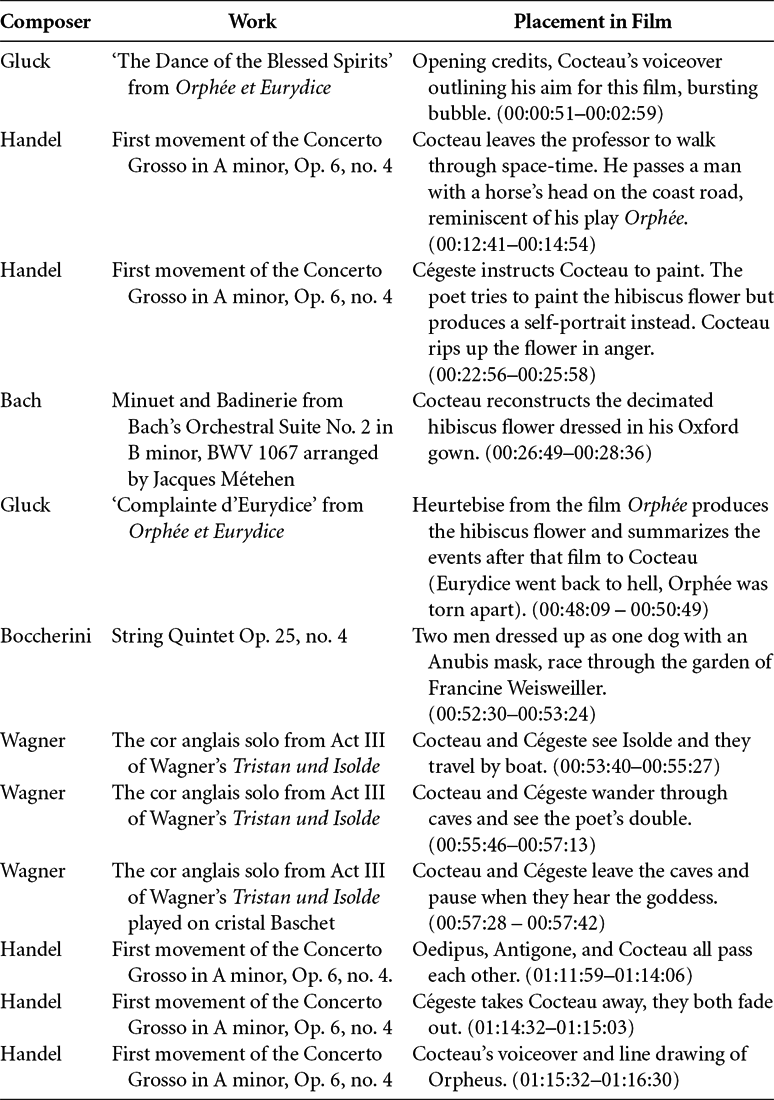
Note: Timings refer to Jean Cocteau, Le Testament d'Orphée (1960) (London: Optimum Releasing, 2007, DVD).
The classical borrowings also carry further layers of meaning within the universe of Cocteau's own film canon, due to multiple sonic cross-references to his earlier films.Footnote 107 Both ‘The Dance of the Blessed Spirits’ and Auric's arrangement of the ‘Complainte d'Eurydice’ had appeared in Orphée. Bach's Concerto for Four Harpsichords in A Minor, BWV 1065 (an arrangement of Vivaldi's Concerto for Four Violins in B Minor, Op. 3, no. 10, RV580) had been used in Les Enfants terribles (1950), Jean-Pierre Melville's cinematic reworking of Cocteau's novel of the same name. In addition to connecting the character of Isolde to Wagner's opera, the use of the cor anglais solo from Tristan recalls the subject of L’Éternel Retour (1943). The high proportion of musical selections from the Western musical canon imbues Cocteau's final artistic testament with a layer of gravitas usually associated with the classical repertoire. Choosing repertoire from the canon was appropriate for his film testament for all time, and enabled Cocteau to present himself sonically as he would like to be perceived by posterity: an enduring poet and modern-day Orpheus.
In contrast, the use of popular music in Testament is associated with twentieth-century youth culture. The intellectual lovers and the joy riders are accompanied by bursts of piano jazz by Martial Solal,Footnote 108 a style of music that would come to be associated with juvenile delinquency in both Hollywood and European cinema by the late 1950s, in films such as Godard's À bout de souffle (1959).Footnote 109 Within French culture, young engaged writers certainly aligned themselves with jazz and blues. The gypsies in Testament are characterized by their folk music, and Roger Pillaudin's memoir of the filming process noted that in spite of the changing numbers of gypsies on set, a man who could play the guitar was always part of the personnel arrangements.Footnote 110 Cocteau's inclusion of musicians as part of the filming experience as well as in the diegesis presents another instance of the blurred boundaries between fantasy and reality in Testament.
Studying the relationship between Testament’s sonic elements, it becomes apparent that pre-existing music, Auric's original music, musique concrète-style editing, and contributions by Les Structures sonores undertake quite different functions within the film. The pre-existing classical music and the few popular music borrowings function wholly as underscore; Auric's trumpet fanfare is used at key narrative moments, such as to announce the display of the tapestry of Judith and Holofernes, the arrival at Minerva's podium, and the poet's resurrection; musique concrète-style editing generates creative sound effects such as the sound of the choir when Dermit emerges out of the sea, the transformation of Dermit's dialogue into pure sound effect by reversing his speech, and the aeroplane engine accompanying Minerva's spear; and Les Structures sonores seem to provide percussive accompaniment for the idol who eats autographs, and the sonic motif for the hibiscus flower. As discussed, it was not unusual for musique concrète musicians to provide sound effects for films and television. In this respect, Cocteau's placement of his innovative sound edits is not unusual; it is, rather, handling the editing himself and attempting to record and manipulate real-world sounds that reinforces his position as a sound auteur. There is also one instance where classical borrowing and contemporary music appear to merge. As Cocteau and Cégeste wander through the caves of Baux-de-Provence and encounter the poet's double, the cor anglais solo from Tristan plays, and when they step outside the melody is immediately reprised on the ‘cristal Baschet’, stopping when the goddess's voiceover commences (00:57:28–00:57:42). Cocteau described the moment of meeting the double as the ‘spine’ of the film,Footnote 111 which perhaps explains why this is the only moment where classical material and contemporary instrumentation merge.
Conclusion
Cocteau's work in film spanned three decades of the mid-twentieth century and during this period there were significant chronological overlaps both with the experimental compositions of musique concrète composers and with the innovative filmmaking of New Wave directors. On close examination of Cocteau's approach to film sound, it becomes clear that he was always eager to engage creatively with the technology and resources available to him and he appears to have been aware of new ways to employ sound in film, and even utilized musique concrète techniques in the development of some of his soundscapes. New Wave film directors also embraced developments in technology for creative purposes, and directors such as Resnais and Godard engaged in highly experimental practices with film sound. As this analysis of the music and sound in Testament demonstrates, it is Cocteau's creative conceptualization and handling of sonic materials in film that secures his place as a significant link between musique concrète and New Wave film sound. Although the New Wave only truly started as Cocteau's career was drawing to a close in the late 1950s and early 1960s, he was repeatedly referred to as an important precursor to their aesthetics of filmmaking, and his work on film sound can be viewed as an influence on some of their sonic practices. Testament represents the apotheosis of Cocteau's artistic career as well as the stage at which he was most confident in handling almost every aspect of the soundscape design. He was comfortable with the selection and arrangement of the sonic elements to the extent that his regular collaborator Auric became almost dispensable. Nevertheless, their enduring friendship and Auric's willing support further enriched the final film and Cocteau created a highly self-reflexive film through the arrangement of the composer's music with musical borrowings. Testament can be read on multiple levels due to cross-filmic sonic connections and links to the musical canon, which render it a sonic testament to Cocteau's rich appreciation and employment of film sound.



