INTRODUCTION
Caring for patients at the end of life is demanding for nurses, as they are constantly exposed to life-and-death situations. Serious existential questions that challenge their identities as human beings can arise in these situations. Additional research about these questions is needed. Nurses are confronted with issues related to suffering, dying, and death whether they work in hospital or community care.
Patients who are facing the end of life are exposed to profound loss of family, of friends, and of beliefs. There is a risk that human life can fall to pieces in the absence of a humane atmosphere (Qvarnström, Reference Qvarnström1993). Rasmussen and Edvardsson (Reference Rasmussen and Edvardsson2007) and Bergdahl et al. (Reference Bergdahl, Benzein and Ternestedt2013) describe the importance of a humane atmosphere when caring for patients at the end of life. Nurses can provide such an atmosphere and support, which can preserve the identity and integrity of the patient/other. Nurses meet patients and their families in vulnerable circumstances, and issues can arise that are troublesome, issues that affect the nature of the caring atmosphere. Such challenges include questions about withdrawing treatment when they understand that a patient is too ill to undergo treatment and questions about how they can alleviate patients’ suffering or troublesome relations with others (e.g., relatives and other personnel) (Karlsson et al., Reference Karlsson, Roxberg and Barbosa da Silva2010; Reference Karlsson, Karlsson and Barbosa da Silva2012). Morita and colleagues (Reference Morita, Miyashita and Kimura2004) found that nurses who care for patients with cancer at the end of life feel an emotional burden with respect to sedation therapy.
Georges et al. (Reference Georges, Grypdonk and Dierrckx de Casterle2002) showed how nurses in end-of-life care strive to adopt a well-organized and purposeful strategy in their work and simultaneously strive to enhance patients’ well-being. They also demonstrated that when nurses develop more personalized patient relationships, it is easier to explain a patient's needs to other healthcare professionals. Tønnessen et al. (Reference Tønnessen, Nortvedt and Førde2011) revealed the significance of good organization for nurses when caring for patients in home care. The care is predetermined and handed down by an administrative system, and the central focus is on practical procedures. Due to a lack of time, nurses prioritize medical and physical needs. According to Ranheim (Reference Ranheim2009), nurses receive demands from the organization related to effective and productive work and attentive caring, which can be seen as nonproductive. It could be an ethical dilemma for nurses to resolve formal obligations with the inner obligations they feel about creating better conditions for patients, which would allow for the possibility of finding meaningfulness in illness and suffering (Ranheim, Reference Ranheim2009).
Karlsson et al. (Reference Karlsson, Roxberg and Barbosa da Silva2010; Reference Karlsson, Karlsson and Barbosa da Silva2012) showed that community nurses in difficult situations take responsibility when caring for patients at the end of life. However, the nurses experience powerlessness, frustration, and have concerns when faced with ethical dilemmas related to end-of-life care at home (Karlsson et al., Reference Karlsson, Roxberg and Barbosa da Silva2010). Vanderspank-Wright et al. (Reference Vanderspank-Wright, Fothergill-Bourbonnais and Brajtman2011) indicated that it is challenging for nurses as they attempt to do what is right for an individual patient, and that nurses often take on the role of mediator between physicians and relatives.
Wlodarczyk and Lazarewitz (Reference Wlodarczyk and Lazarewitz2011) reported that the most critical ethical conflict for nurses is low-quality nurse/patient relationships due to high workloads. They cited other examples of burdening conflicts, including witnessing other colleagues’ unfair and ungrounded critiques of colleagues and witnessing the breaking of patients’ rights to intimacy and dignity. In end-of-life long-term home care, nurses navigate complex issues when they care for both patients and relatives. They attempt to create a positive experience for everyone (Kaasalainen et al., Reference Kaasalainen, Ploeg and McAiney2013). It is thus understandable that end-of-life care can exact a substantial toll on nurses when they give too much of themselves, as both fellow human beings and professional nurses. In return, however, nurses do receive strength and meaning in caring for patients at the end of life (Johansson & Lindahl, Reference Johansson and Lindahl2010). Sasahara et al. (Reference Sasahara, Miyashita and Kawa2005) showed that the presence of a mentor is correlated with fewer difficulties in the hospital when caring for terminally ill patients.
Karlsson and coworkers (Reference Karlsson, Berggren and Kasén2015) indicated that nurses in end-of-life care are deeply involved with dying patients. They worry about causing unnecessary suffering and about violating their human dignity. They are attentive and struggle to defend patient dignity. However, they are sometimes unsure about how to respond to dying patients, even while they struggle to be truthful and provide what is beautiful and good for patients (Karlsson et al., Reference Karlsson, Berggren and Kasén2015). Johansson and Lindahl (Reference Johansson and Lindahl2010) showed that nurses’ thoughts about their own life and death are intensified when they care for patients at the end of life. Their vulnerability as human beings is revealed, and this affects their own identity issues. Bergdahl et al. (Reference Bergdahl, Benzein and Ternestedt2013) demonstrated the need for further research since patients are increasingly being cared for in their homes.
According to the studies outlined above, nurses caring for patients at the end of life are confronted with demands from healthcare organizations related to effective and productive work, as attentive caring can sometimes be seen as unproductive. They are also confronted with challenges to encounter and support patients at the end of life and to help them reconcile themselves with their past and future. This may give rise to existential questions for nurses. The aim of our study was to describe and gain a deeper understanding of nurses’ existential questions when caring for patients at the end of life.
METHODS
Data Collection
Interviews in focus groups were employed for data collection due to the complex and sensitive nature of the subject (cf. Kitzinger, Reference Kitzinger1994; Krueger, Reference Krueger1994; Barbour, Reference Barbour2008). Group discussions are suited to the subject of end-of-life care, as the topic can “open up” the dialogue if participants have similar experiences and backgrounds (cf. Barbour, Reference Barbour2008). The members in a focus group can contribute to a deeper understanding of nurses’ perspectives about such a sensitive subject.
Focus-group interviews with registered nurses (RNs) were performed at one community care center, one hospice care center, and one regional palliative care unit at a regional hospital, with a consulting team visiting dying patients in different community services in western Sweden. Both the hospice care and palliative care units treat patients with a life-threatening illness and aim to provide specialized palliative care. At the hospice in our study, a patient is the guest and must apply to be accepted. The responsible physician can also write a referral for help with symptom relief. On the palliative care unit, specialized palliative care is given to patients with complex symptoms or whose life situation imposes special needs. A referral from the responsible physician is required for a patient to be accepted at the palliative care unit. The palliative team is the base of the palliative care unit and acts as a link between the hospital and home care or other accommodations. The first author, familiar with the context of end-of-life-care, contacted the chief manager of each of the various settings and asked for permission to do focus-group interviews (with four to seven registered nurses in each group). The inclusion criterion was at least one year experience with patients in end-of-life care. The manager at each setting invited nurses, who then voluntarily participated.
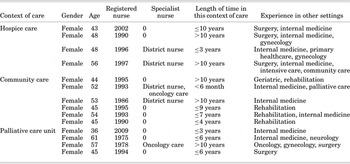
Data collection was carried out during one month in the spring of 2014, consisted of one group at each workplace, and ceased when saturation was achieved. There were four participants in two of the groups and six in the remaining group, with a total of 14 female RNs between the ages of 36 and 61 years. No male nurses volunteered to participate. The participants in hospice care were educated between 1977 and 2002, those in community care between 1986 and 1995, and those in the palliative care unit between 1975 and 2009. Participants had worked in hospice care from 3 to >10 years, in community care from less than 6 months to more than 10 years, and on the palliative care unit from 3 to >10 years (Table 1). The participant who had worked less than 6 months in community care was included in the study due to her long-term experience on a palliative care unit. Each focus-group interview lasted between 60 and 90 minutes. The first author led the interviews. A moderator helped to ensure that participants talked with each other and that they stayed on topic. They also assisted in noting the order of speech. The first author recorded all the interviews using a dictaphone, and discussions were transcribed verbatim.
Participant demographic data

Participants
Participation was voluntary, and nurses were informed that they could interrupt the interview at any time—without justification. As it turns out, no participant chose to suspend participation during or after an interview. Participants were independent of the authors and had no workplace connection. The focus of our study was not on individual nurses’ experiences, so that the authors did not identify any of the group participants in the transcription and interpretation of interviews.
End-of-life care strongly engaged all group participants, and all wanted to share their experiences. They talked with each other, commenting on each other's statements, and put questions to each other based on their own experiences.
Data
Each focus-group interview began with an exposition of participants’ age, education, and length of time working in this end-of-life care context and their earlier experiences of care (Table 1). They were also asked to describe their relationships with each other. The nurses in each group knew each other, had worked together, and felt comfortable with each other. Participants were asked to describe situations and experiences in end-of-life care. They described situations where they had been affected emotionally, as well as how they acted and reacted when caring for patients in end-of-life care. The content of the discussions in the three focus-group interviews have common themes, including difficulties in alleviating patients’ pain, terminal sedation, and reconciliation.
Interpretation of the Data
We employed a qualitative research design. According to Grove and Burns (Reference Grove and Burns2013), qualitative research is used to explore, describe, and understand human experience. The methodological approach chosen for interpreting our material is a hermeneutic one inspired by Gadamer's (Reference Gadamer2013) philosophy of gaining a deeper understanding about nurses’ existential questions when caring for patients at the end of life. We focused on the nurses’ general existential questions in order to gain a deeper understanding of the phenomenon and not on their unique experiences.
In Gadamer's (Reference Gadamer2008) hermeneutical philosophy, the researcher comes to a dialogue with full transparency and examines the text, and preunderstanding is important for understanding. The question is what happens behind what we do, not what we do or what we should do. The methodology is subordinate in interpretation of the material and can only show the truth on which it is based. It cannot reveal a new truth. Interpretation involves a continuous dialectic between the parts and the whole, and the resulting interpretation is that which appears the most reasonable to the interpreter (Gadamer, Reference Gadamer2013). However, there should be a logical connection between the material and the researcher's interpretation. We therefore utilized Ödman's (Reference Ödman1997; Reference Ödman2007) model in performing the interpretations. Söderlund (Reference Söderlund1998; Reference Söderlund2004), Söderlund and Eriksson (Reference Söderlund and Eriksson2006), and Rydenlund (Reference Rydenlund2012) developed Ödman's model further for interpretation. The different levels of interpretation described in the model (Ödman, Reference Ödman1997; Reference Ödman2007) can also make interpretation more transparent for the reader. These levels illustrate how the interpretation has gradually processed in order to finally reach an understanding of nurses’ existential questions.
On all levels of interpretation, the first and second authors worked side by side. The process began by reading the material carefully several times to gain an understanding of the whole. Subsequently, expressions obviously related to the aim of the study were marked and coded. Interpretation then continued on three levels. In the first level, according to Ödman (Reference Ödman1997), the focus is on the intention of the object, which is a rational interpretation, a description of what it is that leads to a rational understanding. This level is close to the empirical material and describes nurses’ intentions in the care of patients at the end of life. The second level is aimed at clarifying structures or patterns in specific events or situations where the shape of the interpretation is a structural one. An understanding form in our study is a structural understanding of nurses’ actions in end-of-life care. In the third level, construed interpretation of the object world of the interpretation form is an existential interpretation. The understanding form is a hermeneutic understanding, based on a previous understanding and abstraction of nurses’ existential questions. On this level, a hermeneutic understanding is gained about being a human being caring for another at the end of life.
Ethical Considerations
The ethics committee at University West approved the study (no. 2014/232 B 22) and deemed it to be in accordance with the World Medical Association's Declaration of Helsinki (2014). Permission to conduct interviews was received from each of the three heads of the nursing units, who informed and distributed letters to nurses about the study. The nurses who were willing to participate submitted an informed written consent. In accordance with the Declaration of Helsinki, participation was voluntary and could be discontinued at any time without justification. In addition, all information was and will be kept confidential.
The interviews were conducted in small focus groups, which is probably preferable in view of the research question. In a narrative-focused interview, memories of events that have occurred during end-of-life care or a participant's own personal experiences are likely to come up. The authors promised the participants professional support after the interviews if they were in need of follow-up, but none of the nurses requested such support.
RESULTS
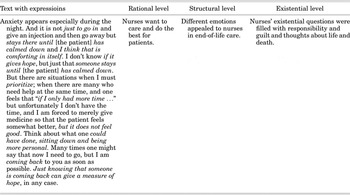
The findings are presented following Ödman's (Reference Ödman1997) three levels of interpretation: rational, structural, and existential interpretation (Table 2).
Example from interpretation of material

Rational Interpretation
A focus on rational interpretation reveals nurses’ intentions toward patients in end-of-life care. The nurses wanted to be aware of and understand the suffering of their patients in order to create a sense of communion that allowed patients to feel comparatively secure. There were situations in all three focus groups where nurses felt that they had insufficient time for communion with their patients. They understood that it was not enough to only give medications and leave patients alone with their suffering. The following report of one nurse in the hospice care focus group illustrates their intentions toward patients in end-of-life care:
We had a patient from another country far away that had so many intravenous [ports] for pain medications … She only had one wish: to get back home to her family, and we all knew that was not going to happen. We couldn't dwell on that, but we could give her the best time we could right here.
Nurses wanted to care and take responsibility for patients at the end of life, even when events and situations conspired against this intention. All the nurses in the different contexts faced this difficult reality. Intention and willpower were not enough to overcome the externalities that prevented them from doing their best for their patients.
Structural Interpretation
On this level of interpretation, the focus is to clarify structures and patterns in actions and situations. A structural interpretation is about what nurses do when they witness, assume responsibility, and become deeply involved when caring for patients at the end of life. The patterns that were revealed in the interpretation consisted of different emotions, which describe various events that occurred when caring for patients. The following patterns were revealed during interpretation of our material:
-
1. Physical emotions that fostered recognizing and taking responsibility
-
2. Spatial emotions that fostered perceiving and witnessing
-
3. Temporal emotions that fostered insight and understanding
These different emotions elicited nurses’ compassion, which in turn led them to witness, assume responsibility, and become deeply involved in the care of their patients.
Physical Emotions that Fostered Recognizing and Taking Responsibility
The emotions related to patients’ physical problems motivated nurses to want to do something, to take responsibility. Patients’ physical suffering was clearly and concretely visible for all nurses. In some instances, that visibility could be difficult when patients did not want to receive pain relief, or when certain patients’ bodily pain could not be alleviated no matter what was done. One nurse in the community care focus group recounted how physical emotions can cause nurses to recognize and take responsibility:
… sudden pain, she becomes very scared. It was something that she had never felt in her body. She had a pain-relief pump, and I pressed and pressed, and then I gave intravenous morphine. And I thought that one can't give this much, and then she stopped and breathed and sat there, and she was very sad … She became calm, said farewell to her husband, and she was very sad about her grandchildren. She didn't dare to fall asleep because she was afraid that she would not wake up again.
In home care, nurses were often alone when making decisions regarding providing pain relief. They were strongly prepared for the contingencies of home care, where an unforeseen event in a patient's condition can be a severe challenge, especially when the availability of a physician is limited. Whether patients were in hospice, at home, or in a palliative care unit, it was usually the nurses who had the responsibility to make initial assessments and decisions regarding patient treatment and care. If a nurse's feeling of responsibility was engendered by a patient's suffering, they saw how the patients did not have the strength to struggle or had lost the ability to find meaning in life. The nurses were also often faced with doubts about the right or wrong course of action (e.g., whether intravenous treatment should continue or be withdrawn). They wondered if the chosen course would worsen the patient's condition. Patients’ vulnerability and unbearable suffering became very apparent for the nurses. They knew that they had to be prepared for unforeseen events, especially if patients were being cared for at home, where a physician would probably not be readily available. Patients’ bodily emotions elicited nurses’ responsibilities as they acted on what felt right, in the present, right then and there.
Spatial Emotions that Fostered Perceiving and Witnessing
Nurses in the different contexts perceived and witnessed spatial emotions that appeared when patients were in the final stages of life. In a patient's home, spatial emotions emerged as nurses provided care in the patient's own environment. Nurses could perceive and testify about fear, worry, anxiety, tenseness, and relaxed emotions in the room. As told by one nurse from the palliative care unit focus group:
One often notices during those last days when one can see quite clearly what they have had for relationships … There is much we do not know. We do not know what they had for the relationship before … and I can feel that there is a desperation to be reconciled somehow before [the patient dies] … For the other's sake awful also … It really feels like a very sad way for it to be. I don't understand how they can endure it.
When nurses were in a patient's room, they understood and witnessed their vulnerability and sensed their imminent death. Whether patients were in a hospice, a palliative care unit, or at home, nurses could witness that patients had difficulty in reconciling with their life. Patients with a sense of incomplete reconciliation gave nurses a feeling of helplessness and sadness. Sometimes patients and families were unable to reconcile because they had been out of contact for many years. However, the nurses could only stand mute in the face of a lack of reconciliation between patients and families. The emotions in the room were manifestations of life's vulnerability.
Temporal Emotions that Fostered Insight and Understanding
Both patients’ and nurses’ limited time in which to alleviate patients’ suffering were emergent emotions. Nurses were faced with questions about what was right and wrong for treatment of suffering at the end of life. Temporal emotions meant both hope and uncertainty for nurses, as they always had to have an inner readiness to act and react. They also required a readiness to witness and be present for patients’ good days or hours, which could quickly change into bad ones. They journeyed with their patients along the path of hope and suffering.
Nurses also cared for patients who wished to reduce their level of consciousness in order to alleviate unbearable suffering. Questions about terminal sedation were more common in the hospice and on the palliative care unit. However, all nurses understood patients’ decisions and knew that patients were well aware of their own situations. The following narrative from a nurse in the palliative care unit focus group illustrates how temporal emotions can engender insight and understanding:
I knew the patient already, and the doctor had not yet met the patient at all. I was ready to do anything so that he could get his midazolam … I felt it was the right time.
It is a very specific situation when terminal sedation is suggested to relieve a patient's intractable pain or existential suffering, and the nurses understood what a difficult decision it was for everyone. However, they were present with patients when they bid farewell to relatives as their level of consciousness sank under sedation. When temporal emotions affected a nurse, they understood that they were struggling against time to allow patients to bid farewell to life and their loved ones.
Existential Level
This level of interpretation focuses on nurses’ existential questions when caring for patients at the end of life. Our interpretation revealed an expression of nurses’ existential questions: (1) balancing between responsibility and guilt in relation to patients; (2) balancing between fear and courage in relation to being a professional caregiver and a fellow human being; and (3) balancing between hope and despair in relation to the other's and their own death. Nurses in community care seemed to be more balanced between fear and courage and between hope and despair when caring for patients in home care.
Balancing Between Responsibility and Guilt in Relation to Patients
Nurses’ existential questions in end-of-life care can be understood as balancing between responsibility and guilt in relation to patients. With their responsibility came feelings of guilt for not doing enough for the patients to alleviate suffering, as well as feelings of guilt and remorse when young people did not survive. In communion with patients, nurses saw their pain and felt responsible to do everything they could to alleviate it. Failure to alleviate suffering can cause feelings of fear and guilt in nurses, who feel responsible for patients and are dedicated to alleviating suffering. Nurses also suffer when they dwell on patients’ suffering or about what they should have done but could not do. A nurse from the hospice care focus group illustrated the balance between responsibility and guilt in relation to patients:
[The nurse] can see that she has extreme pain, and [the nurse] really tries, but she does not want to take pain relievers … then goes home with a lump in her stomach that “Why didn't I do more?” or “What more could I have done?”
All the nurses had inner doubts and uncertainties about not being good enough. Insecurity can cause confidence to waver and affects nurses’ ability to provide effective care. Nurses caring for patients at the end of life take responsibility and want to preserve patients’ integrity and dignity and often feel a deep sense of communion. However, they realize that their own beliefs about death and dying influence their interactions with patients and families.
Balancing Between Fear and Courage in Relation to Being Professional Caregivers and Fellow Human Beings
The nurses also identified with patients when the process of leaving life was a prolonged one, as patients found it difficult to “let go.” They imagined how difficult it was to say farewell forever to loved ones. They feared for their own existence and thought about the fragility of life, as well as how quickly one's life can change from a state of health to illness, suffering, and death. Their existential questions balanced between being fellow human beings and being professional caregivers. They sometimes did not know how their own values, fears, and anxieties about death influenced the quality of their caring. One nurse in the community care focus group illustrated the balance between fear and courage in relation to being a professional caregiver and a fellow human being:
I [as a nurse] have also been worried about how these doubts reflect when I meet patients that I have been afraid to meet. I am pretty sure that it isn't so, but I don't know how it is in situations with patients if my own fears of death have been reflected in my meetings with patients. I don't believe it but— but I have many thoughts around my own fear of death.
Thoughts and reflections about suffering and the meaning of suffering and death were ever present and caused nurses’ views on life and death to undergo constant reevaluation. They hold back tears, anger, and fear when caring for patients, especially in home care. At times their emotions cannot be held back, and they need to find another way to express their feelings. They need to find the courage as both professional caregivers and fellow human beings when balancing their emotions in end-of-life care.
Balancing Between Hope and Despair in Relation to the Other's Death and Their Own Death
Through the caring communion with patients at the end of life, nurses in the different contexts became aware of their existence as fellow human beings. It was a transformational event in their own emotional life and often evoked their despair about existence itself: to be or not to be.
Nurses had existential questions about how to relate to the death of others or to their own death. This involved balancing between hope and despair about life and death, as well as the hope of reconciliation with life when death approaches. Death was ever present in their existential questions, and it became a part of everyday life to reflect on the meaning of suffering, life, and death. One nurse in the community care focus group illustrated the balance between feelings of hope and despair in relation to the other's and their own death thus:
I think that everyone who works with this reflects on their own death or that something could happen. It would be terrible if we, as staff, were not that way.
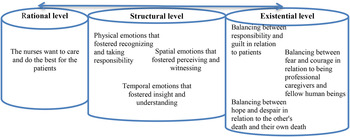
It was inevitable that nurses consider their own life and death and be aware of their own vulnerability. They raised concerns and questions about responsibility and guilt, fear and courage, and hope and despair in the context of being professional caregivers and fellow human beings and in communion with their patients. Being nurses and fellow human beings meant that they took responsibility for their own sense of being while caring for patients. In addition, entering into a deep caring communion with patients gave them strength and meaning, allowed them to provide better care, and helped them to better deal with the issues in their own lives (see Figure 1).
An understanding of the different levels of interpretation.

DISCUSSION
The results of our study reveal that nurses in the different contexts are affected by various emotions from patients in end-of-life care that are by nature physical, spatial, and temporal. Thoughts about their own life and death can also arise, as reported by Johansson and Lindahl (Reference Johansson and Lindahl2010).
The temporal emotions fostered insight and understanding and raised questions about what is right and wrong, which meant both hope and uncertainty for nurses. The question of sedation therapy was also difficult for nurses and can be understood to constitute an emotional burden, as described by Morita et al. (Reference Morita, Miyashita and Kimura2004), according to whom such burden is associated with insufficient time, patient and family wishes, nurses’ skills and beliefs about sedation, and nurses’ ability to cope with a patient's death. Some nurses believed that sedation would hasten death, which is ethically indistinguishable from euthanasia. Sedation therapy is not generally considered the equivalent of euthanasia. It can be defined as “the use of sedative medications to relieve intolerable and refractory distress by reduction of patient consciousness” (Morita et al., Reference Morita, Tsuneto and Shima2002, p. 452). This issue seemed to be more common in hospice care and on the palliative care unit. It is supposedly easier to administer sedation therapy, monitor patient comfort, and control symptoms in these two settings, as opposed to community care.
However, regardless of context, nurses who take responsibility for the care of a human being at the end of life can feel guilty that they are not doing enough while at the same time struggling to preserve the patient's integrity and dignity. This new understanding is in accordance with Kaasalainen et al. (Reference Kaasalainen, Ploeg and McAiney2013), who described how nurses struggle to create as positive an experience as possible for everyone.
All the nurses in our focus groups were affected by patients’ suffering, emotions that evoked their inner motives for caring. According to Eriksson (Reference Eriksson1997), only a human being who is whole can meet another human being completely—to see the other as a unit of body, mind, and spirit and create a genuine relationship. If the nurse has truly seen the other, then the willingness arises to do something good for that other (Eriksson, Reference Eriksson1997).
In terms of interpretation on the existential level, Buber (Reference Buber2011), Levinas (Reference Levinas1969), and Gadamer (Reference Gadamer2013) can shed new light on nurses’ existential questions. Nurses are continuously growing as human beings due to their communion with patients who are suffering and struggling with the issues of life and death. They become aware of their own existential issues. Daring to understand another's reality means that the human being is present, and that there is a sense of wholeness, unity, and uniqueness, which is only possible in a shared situation (Buber, Reference Buber2011). However, when the face of the other appeals to another, responsibility begins, and a relationship occurs when the face of the other speak to another (Levinas, Reference Levinas1969). The emotions of patients appeal to the nurses and awaken their inner ethos, which makes make them willing to care for and help patients. To better understand nurses’ engagement in their care of patients at the end of life, we can compare it to what Gadamer (Reference Gadamer2013) called “play”—that they are transported into a game and are being immersed in the atmosphere of the game. In a game, there must be someone who plays with and responds to an opponent's moves. The nurses put themselves into the game to allow patients at the end of life to embrace their own wholeness as human beings. This only occurs if a nurse is open to the patient, is fully present, and allows the patient to come forward. Gadamer (Reference Gadamer2013) argues that the game has its own rhythm and may oppose a player's intentions, that anyone who plays needs to be prepared for unpredictable changes, and that they need to be able to act based on how the game is portrayed. It is impossible to predict what will happen in end-of-life care. Nurses are entering the game and want to be prepared for unpredictable changes, but no one can be fully prepared for the unpredictable. Unpredictability can contribute to balancing between responsibility and guilt in relation to their patients, between fear and courage in relation to being professional caregivers and fellow human beings, and between hope and despair in relation to the other's and their own death.
Nurses balance between hope and despair in relation to a patient's and their own death and can actualize thoughts and questions about their own existence. This actualization can mean a change in their perception of life and death as a human being, whether patient, relative, or nurse.
Through the use of rational, structural, and existential levels of interpretation, an understanding of nurses’ existential questions when caring for patients at the end of life has been revealed (Figure 1). Applying Ödman's (Reference Ödman1997) model was helpful in structuring and formulating the study in terms of a better understanding of the existential questions that face human beings. This model explains the logical constructions between the material and researchers’ interpretations.
If we had done individual interviews instead of conducting focus groups, we may not have gathered such rich data, due to the nature of the topic of our research. A further interview with individual RNs could have complemented the study, but this was not considered necessary due to the richness of the obtained data. On the other hand, separate interviews might have yielded deeper data. One limitation of our study is the small sample size (N = 14), and another is the lack of male participants. Perhaps male nurses would have had an impact on the focus-group interviews, which might have led to gathering more varied results. Nonetheless, we deliberately decided to have a small study sample because of the exploratory nature of the research.
On an existential level, the nurses in community care seemed to be more engaged in balancing between fear and courage and between hope and despair when working with patients in home care. Their vulnerability as human beings seemed to be more visible, and they comprised our most dynamic group. Perhaps nurses in community care are more alone in their work with patients in their homes and have more of a need to talk with someone. However, the structures of end-of-life care in community care are not quite so clearly expressed, as they are on a palliative care unit or in hospice care.
CONCLUSIONS
End-of-life care is challenging for nurses, as they have to balance between different feelings in relation to patients, relatives, and colleagues, as both professional caregivers and as fellow human beings. Their own existential questions are brought to the table and can contribute to personal growth, as both nurses and human beings. Such a result could help nurses express and reflect upon their inner feelings, in accordance with such theoretical aspects as physical, spatial, and temporal emotions, and in the context of caring for patients at the end of life. This could help them deal with their own human emotions and perhaps help them share their existential questions with others in the workplace. An enhanced understanding of nurses’ existential questions and the ethics of caring can provide a basis for clinical supervision. Sharing and talking about thoughts and feelings with others in a well-ordered environment can help nurses continue to serve human beings and engage in a caring communion, to be absolutely present, and to provide a better quality of life for their dying patients.
AUTHOR CONTRIBUTIONS
MK and AK were responsible for study design. MK was responsible for data collection. Analysis was performed by MK and AK. The manuscript was prepared by MK, AK, and CW-F.
ACKNOWLEDGMENTS
We are grateful to the nurses who participated in our study. We acknowledge Steven Rowland for reviewing the English grammar in the paper. We would also like to acknowledge Maria Rönnerhag, Department of Nursing, Health and Culture, University West, for valuable support as moderator during the data gathering process. In addition, we are grateful for the financial support offered by the Department of Nursing, Health, and Culture at University West.