INTRODUCTION
We perceive the visual world as hierarchically organized. Visual scenes for example consist of global structures (e.g., an office building) composed of local features (e.g., windows). Attentional mechanisms allow us to selectively process the global structure of a percept or the local details, depending on task demands. The ability to process and integrate information at both local and global levels allows us to build up context, discover structure, and form generalizations across different settings.
A paradigm, originally developed by Navon (Reference Navon1977) has been used to investigate the way visual attention is allocated under differing task demands; specifically, whether people process a visual scene in a piecemeal manner, constructing a percept from the bottom–up (i.e., local-to-global processing), or whether a scene is broken down in a top–down manner from the global form to a more detailed analysis (global-to-local processing). In the classic Navon task, participants are presented with a larger letter (global form) composed of smaller letters (local form). The relationship between the two hierarchical levels is manipulated so the same letter can appear at both local and global levels (congruent) or different letters can appear at each level (incongruent). Participants name the letter at a particular level of the stimulus (global or local), thereby engaging selective attention to filter out the unattended level. Processing of these stimuli by neurotypical individuals classically results in two effects: (1) global advantage where global stimuli are responded to quicker than local stimuli regardless of stimulus congruency and (2) global interference where responses to local stimuli are slower due to interference from incongruent global stimuli (Navon, Reference Navon1977).
While studies using Navon stimuli demonstrate global processing biases in typically developing children as young as 6 years of age (Mondloch, Geldart, Maurer, & de Schonen, Reference Mondloch, Geldart, Maurer and de Schonen2003), atypical hierarchical processing has been reported across several neurodevelopmental disorders. Individuals with autism spectrum disorder (ASD) and attention deficit hyperactivity disorder (ADHD), for example, exhibit reduced global interference, suggesting an abnormal bias toward local processing (Brosnan, Scott, Fox, & Pye, Reference Brosnan, Scott, Fox and Pye2004; Song & Hakoda, Reference Song and Hakoda2015). In contrast, individuals with Down syndrome favor the global percept at the expense of local processing (Bihrle, Bellugi, Delis, & Marks, Reference Bihrle, Bellugi, Delis and Marks1989). No study has investigated hierarchical processing in neurofibromatosis type 1 (NF1), a single-gene disorder associated with a wide variety of clinical features ranging from café-au-lait spots through to optic gliomas, benign cutaneous neurofibromas, and malignant peripheral nerve sheath tumors (Jett & Friedman, Reference Jett and Friedman2010).
From a neuropsychological perspective, while intelligence is only mildly affected, specific impairments in attention, executive function and language are common (see Lehtonen, Howie, Trump, & Huson, Reference Lehtonen, Howie, Trump and Huson2012 for review). In addition, visuospatial processing deficits are a hallmark feature and scores of studies have demonstrated impaired visuospatial judgement and construction (Schrimsher, Billingsley, Slopis, & Moore, Reference Schrimsher, Billingsley, Slopis and Moore2003). There have been many reports of poor performance on the Rey Complex Figure Test, with disjointed and piecemeal copies that appear to focus on local details while neglecting the global “gestalt.” Attention impairment is common, with reports indicating a heightened vulnerability to distraction, an elevated impact of irrelevant stimuli on the processing of meaningful targets, and reduced disengaging and shifting of attention (Payne, Hyman, Shores, & North, Reference Payne, Hyman, Shores and North2011).
Prompted by these observations, combined with the high comorbidity in NF1 of several neurodevelopmental conditions that tend toward local processing, including ADHD (approximately 40%; Hyman, Shores, & North, Reference Hyman, Shores and North2005) and ASD (up to 25%; Garg et al., Reference Garg, Green, Leadbitter, Emsley, Lehtonen, Evans and Huson2013), we sought to determine whether children with NF1 demonstrate atypical hierarchical processing. Our research aimed to provide the first direct test of local-global processing in children with NF1. Based on evidence of reduced attentional function and poor visuospatial abilities that anecdotally suggest difficulties processing the gestalt, we predicted increased local interference in children with NF1.
METHOD
Participants
Thirty-one children with NF1 aged 7–15 years were recruited from the neurogenetics clinic at The Children’s Hospital at Westmead on a sequential basis. Participants with NF1 were diagnosed by a neurologist/clinical geneticist at the clinic using criteria specified by the National Institutes of Health Conference Statement (1988). Participants were excluded if demonstrating: (a) diagnosed intracranial pathology (including optic glioma), (b) inadequate English, (c) abnormally low intelligence (IQ<70), (d) significant hearing/visual problems. One participant with NF1 was excluded due to identification of a pituitary gland tumor 1 month after participation, resulting in a total of 30 NF1 participants. All children with NF1 underwent a comprehensive interview with a clinical psychologist. Review of medical files revealed a diagnosis of ADHD in 11/30 patients (4 inattentive, 7 combined). A clinical diagnosis of ASD had been given to 2/30 patients (both also had ADHD).
In addition, 24 typically developing participants aged between 7 and 15 years were recruited as a comparison group through Neuronauts, a science club for children at Macquarie University. Parents/guardians of comparison participants underwent a structured interview screening for medical/genetic conditions, developmental delay and psychological diagnoses. No control participant had a positive history of neurological/psychological disorders, intellectual impairment or learning difficulties. Written informed consent was obtained from a parent/guardian of each participant and the study was approved by The Children’s Hospital at Westmead Ethics Committee.
Stimuli and Procedure
Stimuli were 17 hierarchical figures consisting of a global shape composed of local shapes: diamond, star, arch, pentagon, triangle, heart, circle, square, arrow, tick, rectangle, asterisk, cross, crucifix, oval, drop, and swirl. Shapes were black with a white background. Each comprised a congruent and incongruent version (Supplementary Material). Shapes at the local level were the same orientation as the global shape. There were a total of 34 designs. Stimuli were approximately 12×12 cm in size and centered on a computer screen. The local shape subtended a 1-degree visual angle, which is larger than typically used in the literature, but selected to reduce our chance of obtaining the global advantage that arises when the local stimulus is less than half a visual degree (Song & Hakoda, Reference Song and Hakoda2015). Per Porter and Coltheart (Reference Porter and Coltheart2006), we wanted to maintain the possibility of obtaining global or local advantage within our NF1 sample.
Stimuli were presented on a Dell laptop. Participants were seated approximately 50 cm in front of the screen, centered on their midline. The task was run using DMDX 1.3.01 software (Forster & Forster, Reference Forster and Forster2003). Before commencing the task, participants were shown all shapes in a randomized order and asked to name them. Each shape remained on the screen until the voice key was triggered. Feedback was provided if participants were unable to name the shape, or incorrectly activated the voice key. This procedure was repeated until all shapes were named automatically.
NF1 participants were individually assessed on the Wechsler Intelligence Scale for Children, 4th Edition (Wechsler, 2003) to screen for abnormally low intelligence.
There were two experimental conditions: local and global. In the local condition, participants named the small shape and in the global condition, they named the large shape. Participants were instructed to respond quickly and accurately. In both conditions, half the stimuli were congruent and half incongruent. Stimuli were intermingled throughout a block in a pseudorandom order. There were two local and two global blocks. Each commenced with two practice trials. Block order was counterbalanced between participants. The participant fixated on a central location and the experimenter pressed the space bar to show the first design. As soon as the voice key was activated the shape disappeared from the screen. The experimenter initiated the next trial when the participant was ready. Errors in voice key activation and shape naming were manually scored by the examiner. Response times were automatically logged by a Beyer Dynamic voice key.
RESULTS
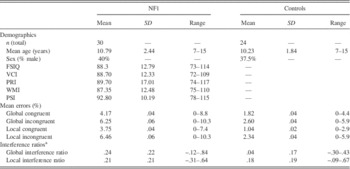
Demographic data are shown in Table 1. There were no group differences in age or sex ratios. Voice key activation errors occurred in approximately 5% of trials for both groups and were removed from subsequent analysis.
Participant demographics, mean percent errors, and interference ratios

Note. FSIQ=Full-Scale IQ, VCI=Verbal Comprehension Index; PRI=Perceptual Reasoning Index; WMI=Working Memory Index; PSI=Processing Speed Index.
a The larger the ratio, the greater the interference from the unattended level.
For error data (Table 1), a three-way analysis of variance (ANOVA) was conducted with the between-subjects factor of group (NF1 and control) and the within-subjects factors of spatial scale (global and local) and congruency (congruent and incongruent). Overall, NF1 participants (M=5.16%) made significantly more errors than controls (M=1.94%), F(1,52)=21.30, p<.001. There was also a significant main effect of congruency, with more errors made in the incongruent condition, F(1,52)=6.13, p=.017. No other main effects or interactions were significant (all, p>.34).
Next we analyzed the effects of spatial scale and congruency on reaction time data for the two groups (Figure 1). Three-way ANOVA revealed a significant main effect of congruency, F(1,52)=45.38, p<.001, partial η 2=.45, and group, F(1,52)=4.24, p=.04, partial η 2 =.08, but no significant main effect of spatial scale, F(1,52)=2.51, p=.11, partial η 2=.04. The congruency-by-group interaction was significant, F(1,52)=9.80, p=.003, partial η 2=.146, as was the crucial three-way interaction of congruency-by-spatial scale-by-group, F(1,52)=4.57, p=.04, partial η 2=.08.
Mean reaction time data for patients with NF1 and typically developing controls. Error bars represent standard error of measurement.

Data were then analyzed separately for each group to determine the source of the three-way interaction. Two-way ANOVA on control data demonstrated no effect of spatial scale, F(1,23)=1.20, p=.28, partial η 2=.05, but a significant effect of congruency, F(1,23)=9.00, p=.006, partial η 2=.26, and a significant interaction, F(1,23)=8.32, p=.008, partial η 2=.23, indicating controls were slower on incongruent than congruent trials for the local condition (i.e., global interference), but demonstrated no differences in congruency when naming the global shape (i.e., no local interference).
In contrast, NF1 data revealed a significant effect of congruency, F(1,29)=50.59, p<.001, partial η 2=.63, but no effect of spatial scale, F(1,29)=1.30, p=.26, partial η 2=.03, and no interaction between these factors, F(1,29)=.57, p=.46, partial η 2=.01, indicating similar naming times for local and global stimuli in both congruent and incongruent conditions (i.e., both local and global interference).
We then calculated interference ratios (IR) to examine the impact of incongruence on perceptual processing for global and local conditions (Table 1). For the global condition, IR was calculated with the following formula [(mean incongruent RT - mean congruent RT)/ mean congruent RT] for each participant on global-directed responses. The same formula was used on local-directed responses to calculate IR for the local condition. The larger the ratio, the greater the interference to visual processing of the unattended condition. Independent t tests revealed that children with NF1 demonstrated a significantly larger IR in the global condition than controls (p<.01; d=.94), indicating interference from local incongruent features in participants with NF1. There were no group differences in local IR (p=.54; d=.15).
Exploratory analyses using independent t tests revealed no effect of sex for ether group (all, p>.32) or ADHD diagnosis for NF1 participants (both, p>.29) on global or local IR. Pearson correlations revealed no relationships between global or local IR and age for both groups (all, p>.29) or FSIQ for NF1 participants (both, p>.43).
DISCUSSION
We assessed local-global processing in children with NF1 and typically developing controls using a modified Navon paradigm. As expected, the task did not result in faster naming of global stimuli for control participants, making a local or global bias equally likely for NF1 participants (Porter & Coltheart, Reference Porter and Coltheart2006). Controls experienced a significant cost of congruence when naming local stimuli, suggesting interference from the global level. There was no cost of congruence naming global shapes, indicating controls effectively ignored incongruent local stimuli. This finding demonstrates the expected global processing bias in our control group.
Participants with NF1, however, experienced significant congruency costs when attending to both local and global levels. Unlike controls, who were able to filter out local distractors when attending globally, children with NF1 were slower naming incongruent global shapes, experiencing interference from local distractors. These findings suggest children with NF1 do not demonstrate the typical human bias of processing visual information from a global perspective, supporting our hypothesis of increased local interference. Exploratory analyses suggests this effect may not be related to age, sex, intelligence, or comorbid ADHD.
The results of the present study raise interesting questions about the locus of the observed interference effects in NF1. One possible account is that children with NF1 experience weak central coherence; the central control processes responsible for assembling component features into a coherent whole. Weak central coherence is hypothesized to contribute to perceptual anomalies in children with ASD, which include a tendency to focus on local properties of objects and difficulties integrating local information into meaningful representations (Frith, Reference Frith1989).
It could be proposed that children with NF1 were slower at naming incongruent global stimuli due to a failure in forming a gestalt/global perception of the Navon stimuli. However, NF1 participants also suffered interference from the global shape, suggesting they were able to form robust-enough representations of global stimuli to significantly interfere with local processing, arguing against the weak central coherence theory.
An alternate explanation is that NF1 patients were unable to selectively focus on a particular spatial scale due to a selective attention impairment. This could potentially explain the significant cost of congruence at both local and global levels. The time-costly process of attempting to ignore irrelevant distractors and resolve the response conflict inherent in incongruent stimuli is not new to the NF1 literature, with impairments inhibiting the irrelevant stimulus dimension in Stroop tasks well-documented (Ferner, Hughes, & Weinman, Reference Ferner, Hughes and Weinman1996).
A third possibility is that our results reflect a perceptual-based abnormality. Navon (Reference Navon1977) argued that local details become superfluous once the global stimulus has been processed and that semantic and physical processing of an object stops once it has been interpreted globally. Perhaps children with NF1 display local interference because they continue to process the stimulus after the global object has been identified. As such, our findings may reflect a perceptual deficiency in inhibiting further processing of the stimuli. The idea that atypical hierarchical processing in NF1 is underpinned by a more fundamental inhibitory deficit is supported by literature describing executive control impairments in the condition (Payne, Arnold, Pride, & North, Reference Payne, Arnold, Pride and North2012).
It is also important to consider our findings within a neurobiological context. Unilateral lesion (Robertson & Lamb, Reference Robertson and Lamb1991) and functional neuroimaging (Fink et al., Reference Fink, Halligan, Marshall, Frith, Frackowiak and Dolan1996) studies using Navon stimuli report a right hemisphere bias toward global processing and a left hemisphere specialization for local analysis. It is possible that the inability to inhibit local interference when responding globally occurs because of a right-hemisphere deficit in NF1, and is thus characterized by impaired global processing. Linking right-hemisphere dysfunction to the global anomalies demonstrated in our NF1 sample is consistent with a previous functional neuroimaging study attributing the hallmark visuospatial deficits on the judgement of line orientation task to inefficient right hemisphere networks (Clements-Stephens, Rimrodt, Gaur, & Cutting, Reference Clements-Stephens, Rimrodt, Gaur and Cutting2008).
Our study is not without limitation. A larger sample size would increase confidence in our findings and enable us to examine relationships between local-global processing and the neurodevelopmental comorbidities commonly associated with NF1. Comparing the mechanisms that give rise to abnormal local-global processing in NF1, whether visuoperceptual deficits, executive dysfunction, attention impairments, or a combination of these, to idiopathic ASD and ADHD samples, may prove an important step in understanding the underpinnings of these comorbidities in NF1.
ACKNOWLEDGMENTS
We thank all study participants for their contribution to this research. This work has been supported by a Murdoch Childrens Research Institute fellowship awarded to J.M.P. The authors declare no conflicts of interest.
Supplementary material
To view supplementary material for this article, please visit https://doi.org/10.1017/S1355617717000224