
Introduction
The plasma polymerization technique is a commonly used method to achieve tailor-made and ångström (Å) scale thin films. Plasma polymerization offers easily controllable, environmentally friendly, and inexpensive processing of various materials when compared with the wet chemical methods. It is known that the plasma-polymerized thin films (PPTFs) have a random network and highly cross-linked film density.[Reference Cho, Park, Kim and Boo1, Reference Alp, Mutlu and Mutlu2] These advantageous properties make this technique a distinguished candidate for biotechnologic applications.[Reference Mutlu, Mutlu, Rosenberg, Kane, Jones and Vadgama3]
Ideally, thin films must possess some properties such as high stability, slow aging process, and uniformity.[Reference Kylián, Choukourov and Biederman4–Reference Shi6] So far, to achieve these features, precursors such as ethylenediamine,[Reference Choukourov, Biederman, Slavinska, Trchova and Hollander5, Reference Mutlu, Çökeliler, Shard, Goktas, Ozansoy and Mutlu7, Reference Akdoǧan, Çökeliler, Marcinauskas, Valatkevicius, Valincius and Mutlu8] amylamine,[Reference Alp, Mutlu and Mutlu2, Reference Mutlu, Mutlu, Rosenberg, Kane, Jones and Vadgama3] heptylamine,[Reference Losic, Cole, Dollmann, Vasilev and Griesser9] cyclopropylamine,[Reference Manakhov, Skládal, Nečas, Čechal, Polčák, Eliáš and Zajíčková10] trans-1,2-diaminocyclohexane[Reference Martin, Boutin and Vermette11–Reference Zhao, Michalski, Williams, Li, Xu, Lamb, Jones, Zhou and Dai13] were studied by employing plasma polymerization and amine-based PPTFs (NH2-PPTFs) have been produced for biotechnologic applications because of providing covalent bonding with biomolecules such as proteins, enzymes, or living cells.[Reference Kylián, Choukourov and Biederman4, Reference Michelmore, Steele, Whittle, Bradley and Short14] In order to achieve an active surface for biomolecule immobilization, amine-rich coatings are crucial, especially in biosensing studies.[Reference Betancor, López-Gallego, Hidalgo, Alonso-Morales, Dellamora-Ortiz, Mateo, Fernández-Lafuente and Guisán15]
Among biosensing technologies, mass sensitive devices are highly preferred due to their high precision and sensitivity. Although piezoelectric-based quartz crystal (QC) transducers are highly used for the preparation of mass sensitive biosensor infrastructures, quartz tuning forks (QTFs) are more advantageous due to their high-frequency stability, sharp frequency response, low response time, high-quality factor (Q F) (at vacuum ~103–105),[Reference Su, Dai, Zhang and O'Shea16, Reference Zhang and O'Shea17] and cost-effectiveness compared with QC microbalances. However, the main challenge with QTFs is their inability to work in liquids with high dielectric permeability due to short circuit. Any insulation or passivation layer can overcome this problem, and then QTFs can be used in any liquid medium. So far, no reports have been published about the insulation and functionalization of QTFs by plasma polymerization technique.
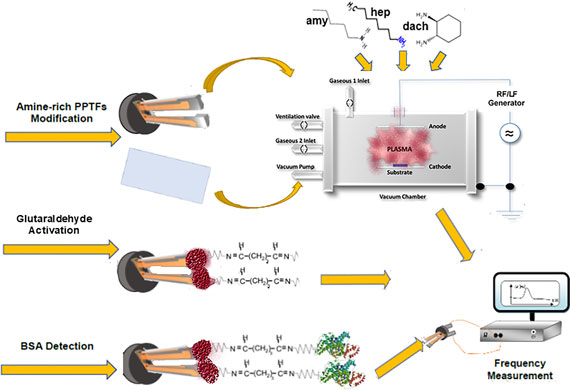
With this motivation, for the first time in the literature, the effect of plasma-polymerized amine-rich thin films over QTF surfaces were investigated. Precursors, amylamine (amy), n-heptylamine (hep), or diaminocyclohexane (dach), were selected for simultaneous electrical insulation and surface functionalization. Experiments were performed in radio frequency-generated low-pressure plasma (RF/LP) and low-frequency-generated low-pressure plasma (LF/LP) systems, respectively. Processing parameters were modulated with respect to characterization studies and frequency shifts.
Experimental
QTF modification and insulation via plasma polymerization
Substrates were selected as QTF prongs and third-class soda lime glass microscope slides for plasma modification. All contact angle (CA) measurements were conducted on glass microscope slides because the geometry of QTF is not proper for CA measurement. QTFs with 32768 Hz resonance frequency were purchased from Shoulder Crystal (China). Third-class soda lime glass microscope slides were acquired from InterLab (Turkey). Precursors of 99% amylamine and 99% n-heptylamine and sodium chloride (NaCl) were purchased from Sigma-Aldrich (St. Louis, NJ, USA) and diaminocyclohexane 90% technical mixture of isomers were acquired from Acros Organics (Morris Plains, NJ, USA).
Two different plasma generators were used to investigate the effect of different energetically loaded constituents in the plasma chamber and their effect on the stability of PPTFs. Plasma polymerization performed by both using RF/LP (13.56 MHz) plasma equipment (Pico, Diener Electronic GmbH, Germany) with a stainless-steel plasma chamber of 150 mm radius/320 mm length and LF/LP (40 kHz) plasma equipment (Femto, Diener Electronic GmbH, Germany) with a chamber of stainless-steel 100 mm radius/600 mm length.
Before plasma polymerization process, hermetic casing of the QTFs were removed. Then both QTFs and glass slides were cleaned with ethanol solution. After that, they were placed in the middle of the plasma chamber. Evacuation of the plasma chambers were provided by the vacuum pump (Trivac 2.5E, Leybold Vacuum GmbH, Germany). Precursors were fed into the plasma chamber for 15 min, for each plasma process, separately. Substrates were exposed to discharge power varying from 30 to 90 W for 1–10 min of exposure times at a constant pressure of 0.15 mbar. Before finalizing the plasma process, samples were exposed to the vacuum medium for 15 min and then argon was swept through for 15 min to neutralize the reactive radicals in the plasma chamber.
Glutaraldehyde activation
For surface activation, the selected samples based on characterization results were immersed in a 25% (v/v) glutaraldehyde solution and placed in a magnetic stirrer (250 rpm) at room temperature for 2 h. Then, all samples were washed three times with phosphate buffer (pH 7.4) and double-distilled water. Unmodified QTFs were also activated with glutaraldehyde as a negative control.
Bovine serum albumin (BSA) detection by using plasma-modified QTF sensor
The detection ability of plasma-polymerized QTFs were examined by using a model protein, BSA. Two different detection processes were applied to find the proper procedure.
In the dip-and-dry process, the QTFs produced by optimum plasma parameters were treated with a 100 µg/mL (w/v) BSA [0.1% v/v in phosphate-buffered saline (PBS), pH 7.4] solution for 2 h. Then, QTFs were washed three times with PBS and distilled water to remove unbounded BSA and then, air-dried.
In the batch process, the QTFs were immersed in 100 µg/mL (w/v) BSA (0.1% v/v in PBS, pH 7.4) solution for 2 h, again. After incubation period, stirrer was stopped, and the frequency measurement was achieved in liquid medium.
Characterization
CA measurements were used to reach optimum plasma processing parameters and type of the plasma generator to achieve highly cross-linked and hydrophilic PPTFs. Measurements were taken from unmodified glass slides (g-base), amy-coated glass slides (g-amy), hep-coated glass slides (g-hep), dach-coated glass slides (g-dach). The investigation was conducted in both air and aqueous media for 30 days to observe the “restructuring” behavior of PPTFs produced by different plasma parameters. A CA analyzer (KSV Instruments Ltd., Finland) was used for the examination of ~12 µL sessile water drop placed over each glass substrates. To calculate the average and standard deviation (±SD), CA measurements of each group were replicated for five times.
Electrical resistivity measurements of the QTFs were carried out for selected samples to observe the effect of plasma modification. To perform this measurement, NaCl solution (5% w/v) was prepared, QTF prongs were then dipped into the solution. Resistivity of the QTF samples was measured with a digital multimeter (UNI-T, UT139C, Uni-Trend Technology China Ltd., Guangdong, China) and repeated for three times per sample.
The resonance frequency of QTFs was examined before and after plasma modification under optimized plasma parameters, after glutaraldehyde activation and model protein (BSA) detection. To measure frequency shifts, both unmodified QTF (q-base) and plasma-modified QTF samples were measured with Asensis Q Master (Asensis, Ankara, Turkey).
The topographies of the PPTFs were analyzed by atomic force microscopy (ez-AFM, NanoMagnetics Instruments, Oxford, UK). PPP-type cantilever (Nanoworld AG, Matterhorn, Switzerland) working in a tapping mode was utilized for AFM measurements of the amy- and dach-modified PPTFs, respectively. Unmodified glass slides were taken as a reference and measurements were replicated three times. Root mean square roughness (R q) of the amy and dach coatings were evaluated.
X-ray photoelectron spectroscopy (XPS) was used to characterize the chemical composition of the PPTFs. Thermo K-Alpha (Thermo Fisher Sci., Waltham, MA, USA) instrument and Thermo K-Alpha monochromatic high-performance XPS spectrometer (Thermo Fisher Sci.) at a pressure of 1 × 10⁻⁹ Torr were used for XPS characterization. A 400 µm spot size was used per sample. OriginLab v.6 (Wellesley Hills, MA, USA) was used for fitting the XPS spectra.
Statistical analysis
Five independent control experiments were performed for each group of samples. The results were reported as mean ± SD. SPSS 22.0 software for Windows was used to conduct the statistical analyses. Using a one-way analysis of variance and Tukey's honest significant difference test (P < 0.05), the significance was tested.
Results and discussion
Wettability and time-dependent variations in surface wettability give information about the concentration of polar groups on the surface and storage time of the thin films, respectively. Both are important during the selection of optimum plasma parameters for QTF modification via plasma polymerization. In our case, the increment of amino-group concentration after plasma polymerization modification with amine-rich precursors can be monitored by the change of wettability. In other words, a sample, which was found highly hydrophilic, held a surface which was greatly functionalized by amino groups. Additionally, rigidity is also crucial since highly cross-linked structure interrupts restructuring and thus enables to create stable thin films and increases storage time. Migration of energetically unfavorable groups from surface through the polymer leads energetically favorable groups to remain at the interface and minimize the interfacial free energy between the thin film and air. Amino groups that functionalized the surface could have a great tendency to be buried inside the PPTF in air because of thermodynamic equilibrium. Due to this fact, migration of amino groups should immediately be stopped for preserving their location.
To investigate wettability properties and aging behavior of PPTFs, CA measurements were performed. The CA of an unmodified glass slide was measured to compare with plasma-modified samples and found as 33° ± 6° (n = 15).
Firstly, the effect of two different plasma generators (RF/LP and LF/LP) on hydrophilicity and aging behavior of PPTFs were examined. Energy of the species is related with excitation frequency of plasma generator. This relation can be explained by Planck's Eq. (1). In this equation, h indicates the Planck's constant, c is the velocity of the light, λ is the wavelength of the incident particle, and v is the frequency of the plasma generator.[Reference Fricke, Girard-Lauriault, Weltmann and Wertheimer18–Reference Bittencourt22]
 $$E = \displaystyle{{hc} \over \lambda} = h\nu. $$
According to this equation, low-frequency species has lower energy when compared with high-frequency ones (such as x-ray) thus lower momentum. In our case, LF/LP plasma constituents had lower energy and momentum when compared with RF/LP. Theoretically, this energetic relationship causes LF/LP-generated PPTFs to have lower cross-linking density and thus lower stability. Since our characterization results of LF/LP-generated PPTFs confirmed this theory, which is given in Supplementary material, RF/LP-generated PPTFs were selected for further investigation.
Selection of processing parameters such as discharge power, exposure time, flow rate, pressure, and precursor type is crucial for the chemical and physical properties of the PPTFs. In our case, the discharge power was adjusted to 30, 60, 75, and 90 W, whereas exposure times were selected as 1, 3, 5, and 10 min. The pressure was kept constant at 0.15 mbar.
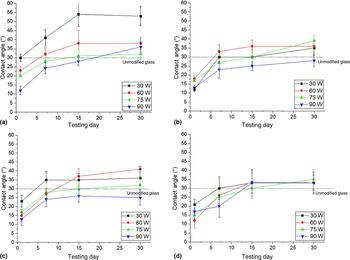
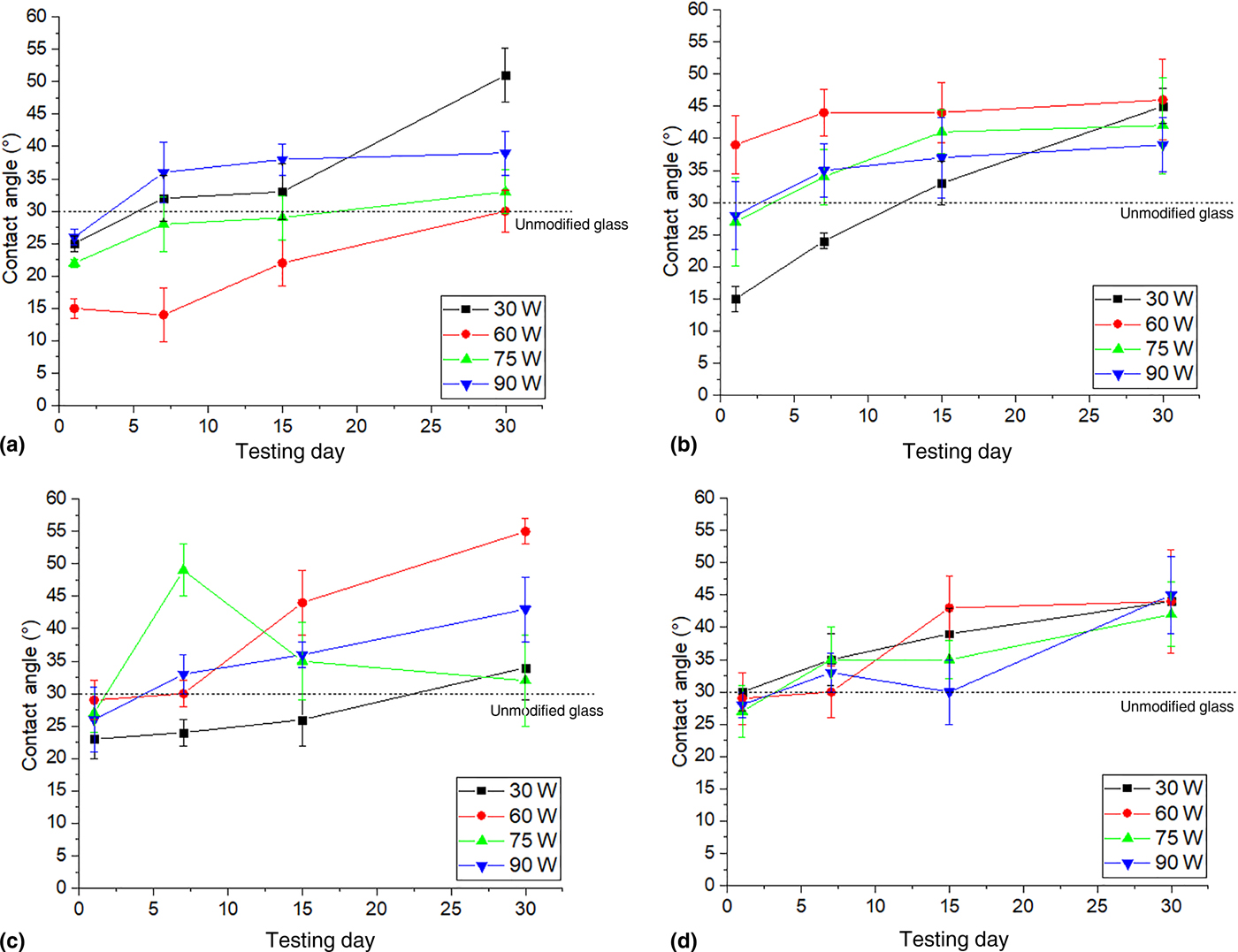
CA results of amy-coated PPTFs (g-amy) between 1 and 30 days were given in Fig. 1. On their first day, CA results have shown that the surface hydrophilicity was changed by all parameters, except 30 W plasma power and 1 min exposure time. Application of higher plasma power resulted in the reduction of the CA down to approximately 20°. Also, the increment of the exposure time from 1 to 3 min at 30, 60, and 75 W plasma power also decreased the CA. However, proceeding exposure time up to 5 and 10 min did not significantly affect the hydrophilicity of the surface. Interestingly, 90 W plasma power changed the surface hydrophilicity to 12°, and exposure time at that plasma power did not affect the surface hydrophilicity.
PPTFs produced by amylamine precursor (g-amy) with exposure time of (a) 1 min, (b) 3 min, (c) 5 min, and (d) 10 min. Plasma powers were selected as 30, 60, 75, and 90 W for all samples.

The aging process of the thin film in ambient air can be followed by the change of the CA as a result of restructuring. The aging process occurred at 30, 60, and 75 W plasma power in 7 days storage in ambient air, except 90 W plasma power. The g-amy samples produced by 90 W-5 min plasma parameters were found stable for more than 7 days. Consequently, samples produced with all plasma parameters except 30 W-1 min were selected for further experiments.
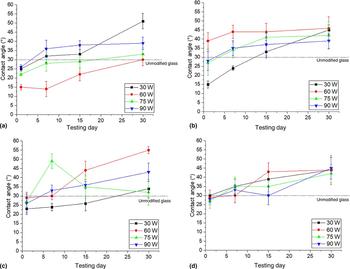
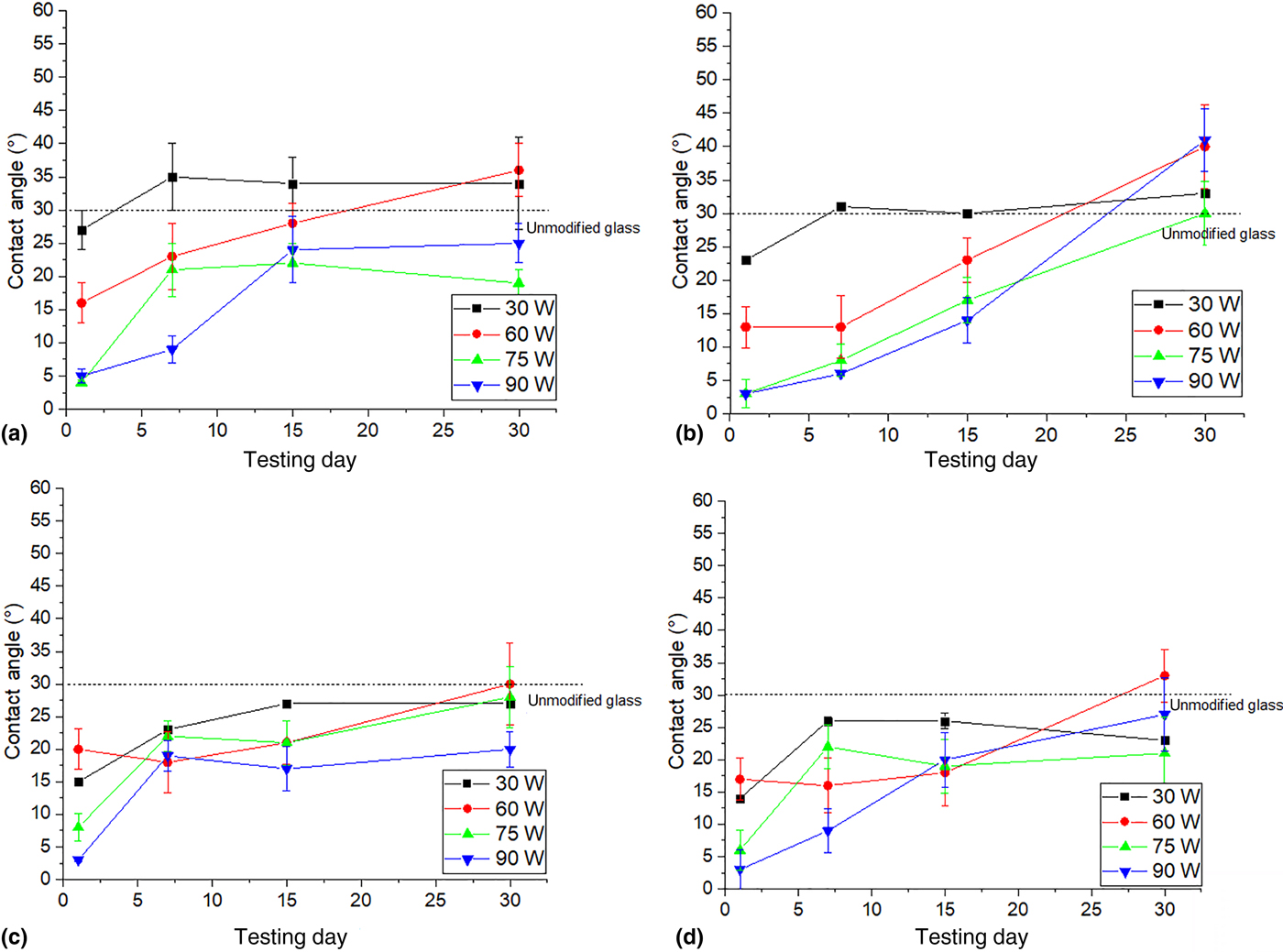
Secondly, hep-modified PPTFs obtained from RF/LP-generated plasma systems were monitored and given in Fig. 2. It seems that CAs of PTTFs were mostly found around 30°, which is close to unmodified glass slide. The change on plasma power and exposure time did not affect the CA of g-hep significantly. So, PPTFs that are produced by hep were not proper for QTFs’ functionalization. Therefore, hep was eliminated among the precursors.
PPTFs produced by heptylamine precursor (g-hep) with exposure time of (a) 1 min, (b) 3 min, (c) 5 min, and (d) 10 min. Plasma powers were selected as 30, 60, 75, and 90 W for all samples.
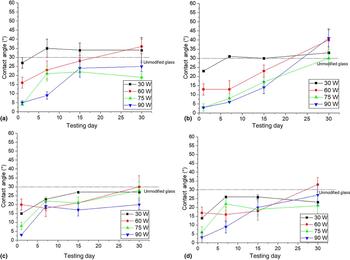
In the last step of CA studies, PPTFs produced by dach (g-dach) were examined. According to Fig. 3, g-dach produced at higher plasma power has shown super-hydrophilicity, while the change of the exposure time did not significantly affect the CA. All in all, PPTFs produced by dach at higher plasma power (75 and 90 W) were found to be more hydrophilic when compared with g-amy and g-hep. Since, dach has higher amino-group concentration per molecule compared with amy and hep, more hydrophilic characteristic was expected to be observed. As a result, samples that were produced at 75 W-1, 3, 5, and 10 min and 90 W-1, 3, 5, and 10 min were selected.
PPTFs produced by diaminocyclohexane precursor (g-dach) with exposure time of (a) 1 min, (b) 3 min, (c) 5 min, and (d) 10 min. Plasma powers were selected as 30, 60, 75, and 90 W for all samples.
According to the aging studies performed for 30 days, the smallest change in CA was observed in the PPTFs that are produced by higher plasma power and lower exposure time. Besides aging behavior in ambient air, CA in the liquid medium of selected samples (g-amy and g-dach) was also examined and given in Supplementary material.
After CA measurement, the optimum plasma parameters were selected to modify QTF substrates. Then, resistivity of the selected samples was measured to observe the effect of plasma polymerization on QTFs’ electrical insulation.
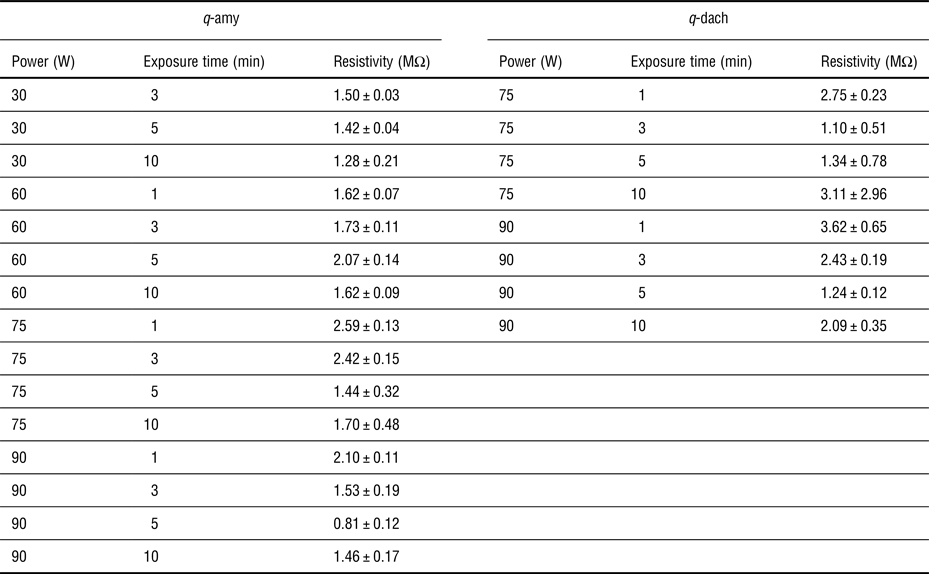
The electrical resistivity of unmodified QTF was measured as 015 MΩ. As seen in Table 1, there was no significant correlation between plasma parameters and resistivity of the QTFs. According to the results, 75 W-1 min for q-amy and 90 W-1 min for q-dach had highest resistivity among all, and thus those plasma parameters were chosen for simultaneous insulation and functionalization of QTFs. The resistivity change with increasing exposure time and/or plasma power possibly affected from the chemical composition of the PPTF on the surface. The studies to clarify the compositional change are still under investigation.
The electrical resistivity of q-amy and q-dach samples.

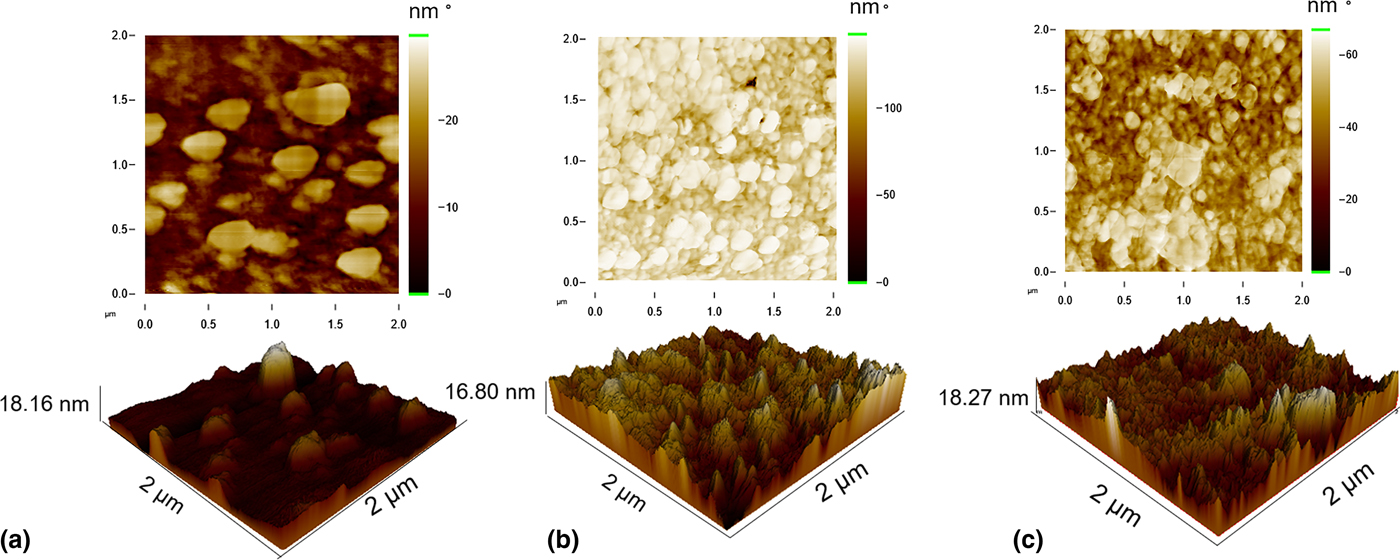
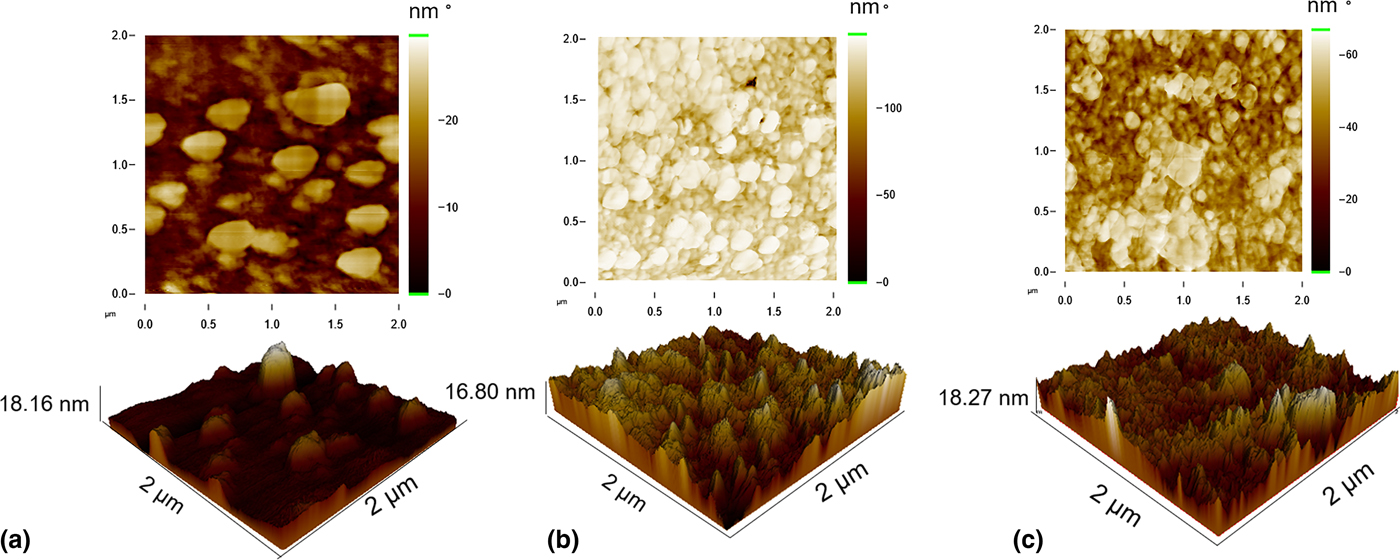
An overview of the results obtained from Fig. 4 reveals a growth of plasma-deposited amy and dach thin films on the surface of glass substrates. All high-contrast two dimensional (2D) (upside) and 3D images have an area of 2 µm × 2 µm. The R q of the glass slides was found to be 2.27 nm, which indicates imperfections on the glass material as shown in Fig. 4(a). After amy-generated plasma deposition for 75 W-1 min, the R q of the PPTFs’ decreased to 2.18 nm [Fig. 4(b)]. Similarly, 90 W-1 min dach-modified PPTFs have also showed smooth surface with the R q of 2.06 nm. Deposition rates for amy and dach plasma modification were found as 12 and 19 nm/min, respectively. As a result, both types of PPTFs were resulted in a smoother topography compared with unmodified glass slides. Although, roughness of the thin films was very similar, mass accumulation in some parts of the dach-modified PPTF surface was observed.
Two-dimensional (2D) and 3D AFM micrographs of the (a) unmodified glass slide, (b) amy-coated PPTF, and (c) dach-coated PPTF.
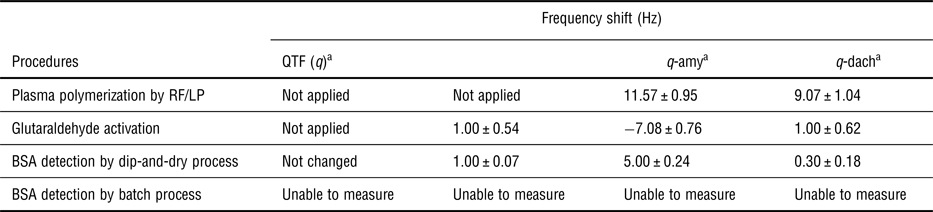
The effect of plasma polymerization, glutaraldehyde activation, and BSA detection by dip-and-dry and dipping process onto frequency shift were monitored by Asensis Q Master and given in Table 2. The resonance frequencies of commercial QTFs are calibrated to 32768 Hz in the vacuum. After decapsulation, resonance frequency of QTFs decreased to about 9.00 ± 0.57 Hz (n = 50), due to air damping. After plasma polymerization, the resonance frequencies of q-amy decreased to about 11.57 ± 0.95 Hz (n = 5). However, the frequency shift of q-dach was found to be 9.07 ± 1.04 Hz (n = 5). Until now, Su et al. have successfully modified QTFs’ prongs to produce QTF biosensor. They were dip-coated tuning fork surface with polystyrene solution. But uniformity and reproducibility problem of coating technique was caused due to resonance frequency differences between QTFs.[Reference Su, Dai, Zhang and O'Shea16, Reference Zhang and O'Shea17] In this research, those problems were solved due to uniformity, reproducibility, and ultra-thin film producibility properties of plasma polymerization technique.
The effect of different procedures on frequency shift of q-amy and q-dach.

a Average ± SD of five replicate experiments.
As given in Table 2, unmodified QTFs were activated with glutaraldehyde at first and the slight decrement in frequency, about 1 Hz, was observed. The resonance frequencies of q-amy after glutaraldehyde activation increased, whereas those of q-dach decreased. It indicated that PPTFs produced by amy were partially detached from the QTF prongs. After the functionalization and activation step, QTFs’ prongs were used to detect the model protein (BSA) by dip-and-dry and batch processes. In this part, unmodified QTFs, whether glutaraldehyde activated and non-activated, were used as blank. The frequency measurements of blank samples were not established in batch process. At the end of dip-and-dry process, the resonance frequency of non-activated unmodified QTFs was not changed. These results indicated that there was no interaction between QTF's prong and BSA. Then, glutaraldehyde-activated blank samples were tested with dip-and-dry process, and the resonance frequency decreased to about 1 Hz that corresponds to BSA attachment. After blank samples, functionalized QTFs were tested with BSA by dip-and-dry and batch processes. The former process decreased the resonance frequencies of q-amy to about 5 Hz. However, there was a slight change in the resonance frequency of q-dach (<0.3 Hz). These decrements were found close to systematic errors (±0.57 Hz), which could be caused by the decapsulation of QTF and frequency measuring device. Although QTFs were successfully insulated, the latter process was not efficient because of the liquid damping. So, dip-and-dry process was found to be proper for BSA detection.
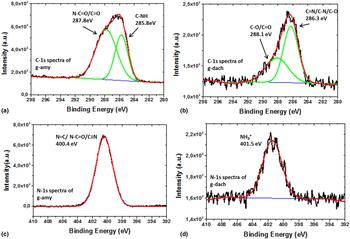
XPS is used in order to investigate the surface chemistry of the samples. XPS spectra of carbon and nitrogen content for both g-amy and g-dach samples in high resolution are shown in Fig. 5. The C-1s signal of amy was fitted with two components at 285.8 and 287.8 eV. The absorption peak at about 285.8 eV corresponds to C–NH bond. The C-1s peak at 287.8 eV was attributed to C–C=O/C=O–.[Reference Sandstrom, Jasieniak, Griesser, Grøndahl and Cooper-White12, Reference Ma, Ming, Huang, Liu and Kang23–Reference Zhang, Ma, Zhuang, Zhang, Chen, Hong, Yan, Yu and Huang25] The high-resolution C-1s spectra in dach were fitted by two components at 286.3 and 288.1 eV, which correspond to C=N/C–N/C–O and C–O/C=O, respectively.[Reference Sandstrom, Jasieniak, Griesser, Grøndahl and Cooper-White12]
(a) Deconvolution graph of C-content for RF/LP amy, (b) C-content for RF/LP dach samples, (c) N-content graph for RF/LP amy, (d) N-content graph for RF/LP dach.
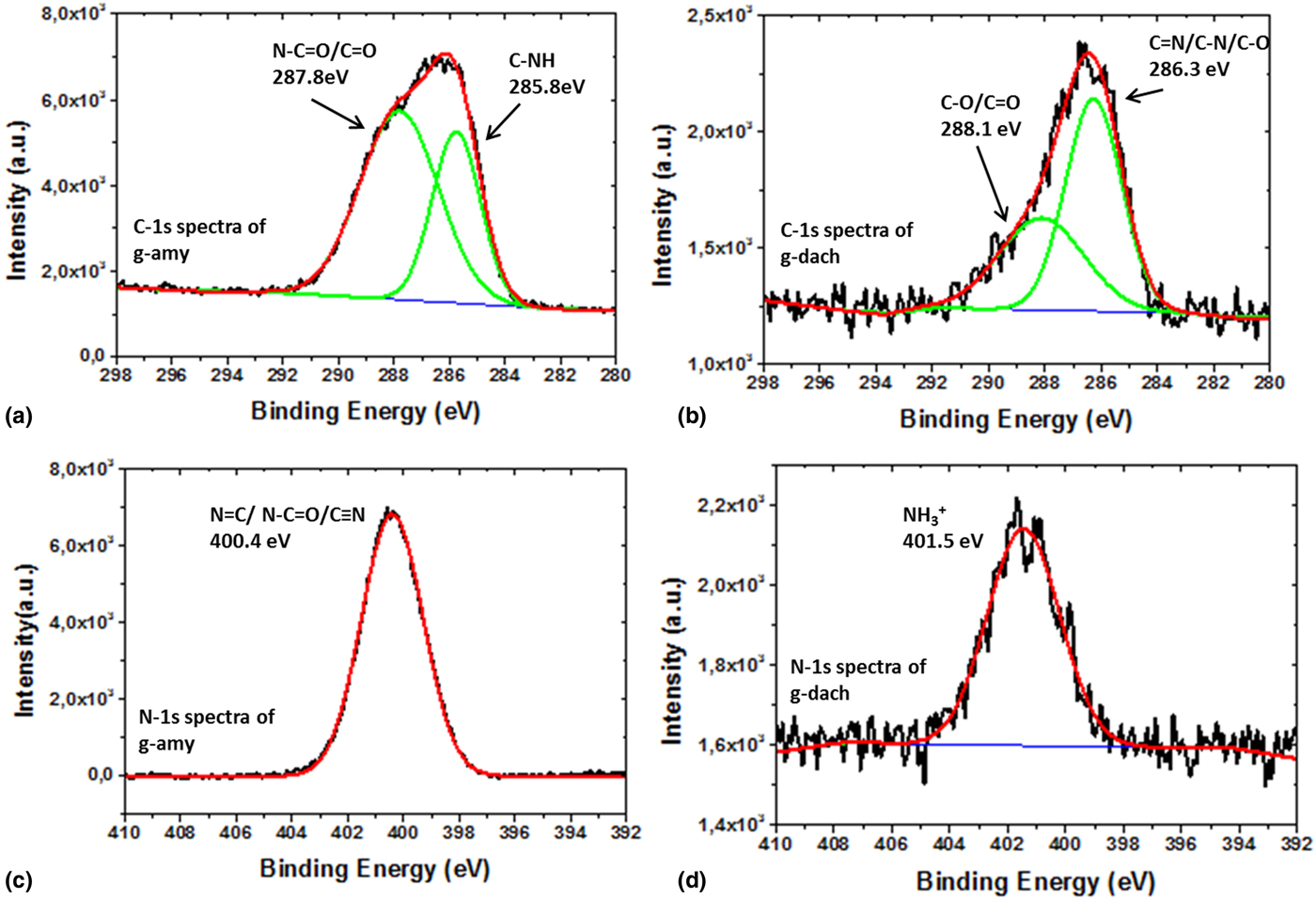
One peak was identified from N-1s spectra for each sample (g-amy and g-dach), corresponding to N=C/N–C=O/C≡N (~400.4 eV)[Reference Wilson, Rhodes and Williams26–Reference Zajíčková, Manakhov, Skládal, Eliáš, Nečas and Čechal30] and NH3+ (protonated amine ~401.5 eV),[Reference Graf, Lippitz, Gross, Pippig, Holländer and Unger31] respectively. In this research, the surface concentrations expressed as atomic percent were not given since atoms (Si, K, Na) from glass slides were also seen in spectra due to the thickness of the g-amy and g-dach.
Conclusion
In this work, QTFs were functionalized and electrically insulated via plasma polymerization method with amine-rich precursors, simultaneously. On the basis of CA and resistivity results, the q-amy produced by 75 W-1 min and q-dach produced by 90 W-1 min plasma conditions were selected to be used further in mass-sensitive biosensor studies. After surface activation, q-dach were successfully activated, on the other hand q-amy were partially detached during glutaraldehyde activation step. Despite partial detachment behavior in glutaraldehyde activation step, in the model protein step, BSA was detected in only q-amy samples. The results of this study showed that plasma polymerization is a proper coating technique for QTF modification due to uniformity, reproducibility, producibility of ultra-thin polymer films and q-amy can be an infrastructure for future biosensor application.
Supplementary material
The supplementary material for this article can be found at https://doi.org/10.1557/mrc.2018.79
Acknowledgment
The authors thank Assoc. Prof. Dr. Fatih Büyükserin and Merve Çelik for help with AFM studies.