I. Introduction
“Does the election of more and more women mean that women will be better represented?” (Reingold, 2000: 2). A wide body of literature on women and representation in the United States, well reviewed and well cited, indicates that the number of women in politics has a positive impact in terms of symbolic implications, policy ramifications and mobilization consequences (Dodson, 2006; Reingold, 2000; Thomas and Wilcox, 1998; Kathlene, 1998; Darcy, Welch and Clark, 1994). “[D]escriptive representation by gender improves substantive representation for women in every polity for which we have a measure” (Mansbridge, 2005: 622). As the numbers of women in elective office in the United States have increased slowly and incrementally,1
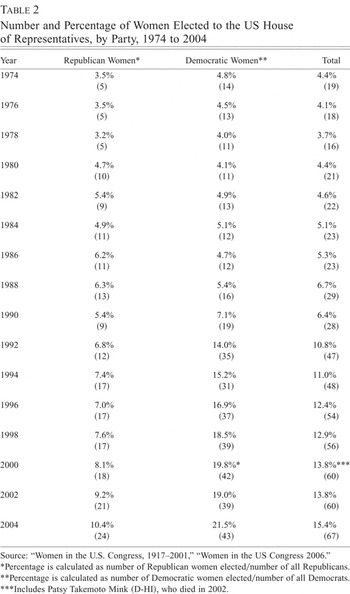
The number and percentage of women elected to the US House of Representatives has increased in every Congress since 1978.
This attention to numbers is reflected politically and theoretically in scholarship on the gender gap, where the large number of voting women and the increasing proportion that voting women constitute in the overall electorate have potential election-outcome determining consequences.
This article examines the theoretical underpinnings of two number-based theories employed by women and politics scholars to explain and to predict elected women's policy impacts: “critical mass” theory and sex-ratio (or proportions) theory. Each of these theories concerns the relationship between the numerical, descriptive presence of women and public policy outcomes. In discussing these theories, I examine their utility for understanding the impact of an increasing number of elected women, identify hypotheses for testing, and discuss the importance of a focus on “newness” as well as “numbers” in studying links between women's descriptive and substantive representation.
II. Critical Mass and Women's Substantive Representation
Women's descriptive representation and the literature that addresses the means by which more women might be elected to national office involve, at face value, number-based models. The most prevalent number-based scholarship linking women's descriptive and substantive political representation focuses on the concept of “critical mass” (Childs and Krook, 2005; Dahlerup, 1988, 2006). “Critical mass” links women's descriptive representation to policy change through the linchpin of a threshold number which, once surpassed, has a transformative impact upon legislatures and serves to produce policy change. Whether deriving from nuclear physics (Norris and Lovenduski, 2001) or from organizational behaviour research (Studlar and McAllister, 2002: 234), critical mass models posit a relationship between numbers and outcome. Norris and Lovenduski summarize critical mass theory thus:
[T]he nature of group interactions depend upon size. When a group remains a distinct minority within a larger society, its members will seek to adapt to their surroundings, conforming to the predominant rules of the game…. But once the group reaches a certain size, critical mass theory suggests that there will be a qualitative change in the nature of group interactions, as the minority starts to assert itself and thereby transform the institutional culture, norms and values. (2001:2–3)3
Childs and Krook identify critical mass as “the magic number where female legislators are said to be able to make a difference” (2006: 522).
Similarly, when the number of women elected to parliaments increases beyond a certain point, the result should be “a transformation in the institutional culture, political discourse, and policy agenda” (Norris and Lovenduski, 2001: 3). Donley Studlar and Ian McAllister summarize critical mass theory in much the same way, but focus on the impact of a critical mass of elected women upon additional women's candidacies. They consider the claim that a critical mass of elected women, once reached, “would encourage and legitimize the presence of women in legislatures, leading to even more women being chosen” (Studlar and McAllister, 2002: 234). More recent research also suggests that increases in women's parliamentary presence are related to women's electoral mobilization at the mass level, heightened interest in electoral politics among women, and increases in women's voting turnout (for the US, see Dolan, 2006). Critical mass, as a concept indicating women's descriptive representation, should arguably have its most powerful impact on policy outcomes, or upon women's substantive representation (Dodson, 2006; Grey, 2002; Reingold, 2006).
Despite differences in focus on the potential and actual outcomes of increases in the number of women elected to national legislatures, and the variety of dependent variables identified in this body of scholarship, critical mass models of women's representation share several components. First, the number of elected women constitutes the independent variable, operationalized by a measure of women's presence in national (or state) legislatures. Second, the number of women in a legislature relative to the size of the legislature, or the percentage of women, establishes a critical mass. Third, most scholars posit critical mass numbers that can be encompassed by a critical representation threshold, ranging between 15 and 30 per cent (Beckwith and Cowell-Meyers, 2003; see Studlar and McAllister, 2002: 235–238; Bystydzienski, 1992: 15). There appears to be general agreement that where women constitute less than 15 percent of a legislative body, women's influence will be constrained at best.4
See, however, Beckwith and Cowell-Meyers, 2003; Childs and Krook, 2005; Childs and Withey, 2006; Cowell-Meyers, 2001; and Crowley, 2004, among others, whose research challenges this general agreement.
Problems with Critical Mass
While critical mass models share common components, they also share similar shortcomings. These include: 1) the under-theorized nature of critical mass; 2) the problematics of conceptualizing critical mass; and 3) research design challenges (for further critiques of critical mass, see Childs and Krook, 2006).
Critical mass theory is severely underdeveloped in the research on women's descriptive and substantive representation, evidenced in the first instance by its treatment both as a concept for testing and as a larger theory (or at least model), neither of which is clearly delineated. In theoretical terms, it is unclear what specific number or percentage might ignite the transformations, in terms of, for example, policy initiatives or institutional culture. Because critical mass ultimately requires quantification, this necessitates a theoretical specification of a threshold and its justification. What critical representation threshold marks the beginning of important policy or preference changes, and why that threshold?
In physics, critical mass is linked to a process of change, but in political science, insofar as critical mass is posed as a dichotomous variable, it has little explanatory value. A dichotomous functioning of critical mass as a variable suggests that once critical mass is achieved, automatic changes then ensue or, in a more modest representation, processes already under way accelerate. In the absence of a well-developed theory, it is unclear what factors tie critical mass to anticipated qualitative changes (explanatory) and what number or percentage constitutes the critical mass that sets these processes in motion (predictive).5
The lack of conceptual clarity is not easily resolved by treating critical mass as a relative concept, deriving from organizational behaviour models, with research hypotheses worded: “As the percentage of women elected to a legislature increases, then ….” This rewording is not strictly a “critical mass” hypothesis, however, but one that tests the effects of increasing numbers of female legislators. In addition, the problem of conceptual clarity remains unsolved. How is an increase in the percentage of women in parliament specifically linked to changes in a hypothesized dependent variable? What process is put in motion by the increase that then causes change? See discussion in section III of this article.
The theoretical underdevelopment of critical mass is also evidenced by the range of factors and behaviours it has been employed to explain (see particularly the review of the literature by Studlar and McAllister, 2002). Its utility is variously presented as explaining access to nominations and (eventually) election to parliament; an increased ability of female legislators to enact policy; changes in legislative behavioural norms; the source of increased feminization of public policy; and increasingly feminist public policy. The range of potential dependent variables reflects, in part, the richness and the vagueness of women's substantive representation. Given the numbers of potential dependent variables, critical mass models must theorize explicit and, presumably, different impacts of critical mass upon each set of dependent variables. A critical mass of women, however quantified, in a national legislature could be expected to have positive and negative impacts, consistent with specific outcomes, such as institutional cultural transformation, coalition building and policy enactment, each of which would require detailed, distinctive theorizing.
The under-theorized nature of critical mass is also evident in the fact that, generally, positive implications of critical mass are presented among the potential outcomes. Conceivably, however, critical mass could also explain negative outcomes (see Beckwith and Cowell-Meyers, 2003; Childs and Krook, 2005; Dodson, 2006; Studlar and McAllister, 2002). These include an increasing hostility toward female legislators or increasing resistance to the nomination of women. Beyond negative implications involving potential provocations to and hostilities of male legislators and legislative gate-keepers, more general negative consequences could include, for example, an increasing fragmentation of party coalitions, as female representatives of several parties form alliances along gender lines, or an increasing polarization of female legislators, into left and right camps, as ideological differences become highlighted with the higher number of women, representing multiple parties, elected to parliament.
In terms of concept development, critical mass is ultimately presented as a dichotomous independent variable, indicating a critical representation threshold, where a critical mass of women is present (i.e., above the threshold) or absent (i.e., below the threshold). In operationalizing critical mass, a critical cutoff or threshold for critical mass has been difficult to specify. First, the early literature generally identified women elected to a national legislature as the “mass base” for a critical mass, implicitly advantaging gender relative to other factors, most particularly political party. The increase in women's representation in parliaments in West Europe, North America and Latin America has been fuelled primarily by an increase in women's election from left-wing (rather than right-wing) parties,6
conflating the number of women with the number of left-wing women. Particularly in regard to claims about the policy impacts of the increasing number of women in parliaments, the block-booking of gender (female) and party (left-wing) may have led to more optimistic conclusions about the impact of the number of women than is warranted. The mass base for critical mass would provide more utility for the concept if it were operationalized within specific parties (see, e.g., Dodson, 2006: 36–37; Sanbonmatsu, 2002a, 2002b),7In the United States, Democratic women have constituted the majority of elected House women in the past 25 years. By 2000, there were nearly three times as many Democratic as Republican women elected to the House. Kathleen Dolan reports that “there are more Democratic women than Republican women seeking office, Democratic women are more successful than Republican women in primaries and general elections, and Democratic women make up a greater proportion of the Democratic members of Congress than Republican women make up of their party's total” (2006: 30).
Beyond this partisan disproportion, the extent to which selection of the “mass base” of women might skew policy results emerges when one considers the presence of Democratic women from California, a powerful subset of House women. In the 107th Congress (2001–2003), 17 members were Democratic women from California, almost 4 per cent of the entire House membership and 29.3 per cent of all women elected to the House in 2000. Given the numerical presence and policy distinctiveness of the California delegation, calculations of a mass base of “all women” in the 107th Congress need to account for this subset and its potential policy influence.
Dodson (2002: 16) addresses this when she writes: “Although the dominance of liberals is no assurance of feminist success in historically masculine institutions, to the extent that men's support for feminist policy objectives is greater among liberals than conservatives, a shift to the right has the potential to make feminist policy goals a more difficult sell and to reduce the level of influence feminist activists have in raising participant awareness of conditions, problems, and solutions.”
Research Design Challenges
Third, critical mass models face specific research design challenges. These include case selection, context, time frame and small numbers problems. Moreover, any research design attempting to assess the impact of a critical mass of elected women will necessarily require longitudinal analysis.
To test hypotheses based on critical mass, case selection will have to take into account, first, the time-bound nature of previous findings of women's parliamentary presence and its effects. Research on women's substantive policy representation generally (if not exclusively) employs a post-1970 time frame. A larger time frame, including periods and parliaments when few or no women held national legislative office, may implicate factors other than women's parliamentary presence in the promulgation of women's policy issues. For example, legislation securing liberalized divorce in Italy in 1968 preceded increases in women's descriptive representation (Beckwith, 1987). Similarly, in 1971, with only 10 women in the House and a lone woman in the Senate, the US Congress nonetheless passed the Comprehensive Child Development Act, “which would have provided federally regulated and funded child-care centers open to parents of all incomes on a sliding fee basis. Although the bill passed Congress with bipartisan support, [President] Nixon vetoed the bill in December 1971” (Banaszak, Beckwith and Rucht, 2003: 1).
Critical mass models will have to be tested in conditions of few women in parliament, as well as in cases where women's numbers have declined across time (these cases may be difficult to find; see, however, Bratton, 2005). The application of models of substantive representation to periods when women were absent from parliaments will help to elucidate the process by which increases in descriptive representation lead to substantive policy progress for women.
Second, critical mass models will benefit from testing across a wide range of national parliaments. These models have problematic empirical underpinnings, because some critical mass predictive claims have employed evidence from Scandinavian countries, which does not permit control for factors distinctive of Scandinavia (see Bystydzienski, 1992; Dahlerup, 1988).9
Note that Dahlerup does not endorse a critical mass model in this article, focusing instead on “critical acts” (1988, 2006). Bystydzienski recognizes the limitations of generalizing from the Norwegian case (1992: 22).
Case selection will provide greatest analytical leverage where parliaments with few women or little women-friendly public policy are also chosen. Selecting cases on the basis of an established critical mass number and current empirical evidence—that is, based upon the actual number of women in office in selected nations—risks a tautology. To the extent that critical mass models embrace a claim that a threshold number of women will result in progressive public policy for women, identification of the threshold is a post facto specification based on the value of the dependent variable (in this example, public policy outcomes). Employing this reasoning, the threshold number can only be specified once the value of the dependent variable is known, establishing a tautological equivalence between the independent and dependent variables.
In addition to avoiding the tautology problem, case selection regarding critical mass faces a small numbers problem. Several critical representation threshold numbers have been suggested in the literature: 40 per cent (Kanter, 1977); 30 per cent (Dahlerup, 1988, 2006); and 15 per cent (Bystydzienski, 1992: 15).10
For the extensive range of thresholds, see Studlar and McAllister, 2002.
Based on data for 172 countries, for the lower chamber of parliament for the most recent elections. See “Women in National Parliaments,” 2006.
These include Belgium (just under a strict 35% threshold at 34.7%, 2003) Denmark (36.9%, 2005), Finland (37.5%, 2003), the Netherlands (36.7%, 2003) and Norway (37.9%, 2005). The ten include Costa Rica (38.6% 2006), Cuba (36.0%, 2003), Spain (36.0%, 2004), Argentina (35.0%, 2005) and Mozambique (34%, 2004).
These are Austria (33.9%, 2002), Burundi (30.5%, 2005), Germany (31.8%, 2005), Guyana (30.8%, 2001), Iceland (33.3%, 2003), New Zealand (32.2%, 2005), South Africa (32.8%, 2004) and Tanzania (30.4%, 2005).
Cases will also have to be selected to provide variation in legislative context. This includes taking into account, for example, the inclusion of left parties in government, as an intervening factor explaining hypothesized results of women's legislative presence. Because policy success is not universally or perpetually available to political actors, nor dependent solely on political will, the enactment of women's substantive representation will depend, among other factors, upon numbers of women in the governing party, rather than opposition; the type of governing party (for example, left or right, secular or confessional; feminist or anti-feminist); upon additional structural context variables (including the relationship of parliaments to their electoral systems; see Tremblay, 2006); and support in civil society.
Finally, because critical mass ultimately relies on change—that is, crossing a critical representational threshold, tests of critical mass must be constructed to measure movement. Longitudinal tests in several nations will serve to sort through the variety of factors that influence women's policy success, at the same time that they will be complicated by the very plethora of factors that can facilitate or impede women's influence within parties and legislatures.14
III. Numbers-Based Proportionality Model and Women's Policy Behaviour
The foundation for much of the critical mass scholarship on women's political representation is Rosabeth Moss Kanter's widely cited 1977 American Journal of Sociology article on “Some Effects of Proportions on Group Life: Skewed Sex Ratios and Responses to Token Women.” In this article, Kanter establishes a numbers-based proportionality model, akin to but distinct from critical mass models. Kanter examines the relationship between the numbers of members of various sociological subgroups and their interactions, focusing on the numbers of women relative to numbers of men in “a large [Fortune 500] industrial corporation,” where few women were employed (1977: 970). Kanter's case focus is helpfully analogous to the case of women in parliaments: like sales firms, national legislatures have “strong cultural traditions and folklore …, interpersonal skills … count heavily,” and members are responsible to internal (firm/parliament) and external (customers/constituents) actors, requiring that they “manage relations” (1977: 970–971). Another advantage is Kanter's focus on women as a politically relevant subgroup (1977: 968) and on gendered relationships—that is, on how men and women interact within an organization, specific to their self-identification as men and women and to their understandings of masculine and feminine behaviours.
Kanter's model is distinctive in that it is a numbers-based model concerned with proportionality rather than critical mass. She establishes a numbers-based theory of four levels of proportionality, concerning the ratio of members of dominant groups to token members, and hypothesizes about the effects of these different proportions. Uniform groups include members of only one group. Skewed groups “are those in which there is a large preponderance of one type over another, up to a ratio of perhaps 85 [dominants]:15 [tokens]” (1977: 966). Tilted groups are those in which the group membership ratio is closer to 65 [majority]:35 [minority]; groups become balanced when the “typological ratio [approximates] 60:40 down to 50:50” (1977: 966). Kanter focuses on skewed groups, arguing that the group balance between dominants and tokens “is one encountered by large numbers of women in groups and organizations in which numerical distributions have traditionally favored men” (1977: 966). The “skewed sex ratio” is still the case in many national legislatures,15
Of the 172 countries that have women in the lower houses of their national legislatures, 83 exceed skewed status (that is, women constitute at least 15 per cent of the lower house membership). The Inter-Parliamentary Union lists the “world average” of women's numerical representation in parliaments as 16.6 per cent, and 16.8 per cent for lower houses (“Women in National Parliaments,” 2006).
Kanter does not use the term “critical mass.” She identifies porous thresholds, approximations of “tipping points” (1977: 986; Granovetter, 1978) or borders where, as proportions change, the interactive behaviour of men and women is expected to change as well (1977: 967, Figure 1). In skewed sex groups, where women are tokens, women's visibility and ascribed characteristics serve to identify them as different, causing men as the dominant group to create pressures that shape token women's response. Proportion creates conditions that shape legislators’ behaviour. In particular, Kanter anticipates that token status would create “performance pressures” on tokens. Women would find it difficult to perform without attracting “public notice,” and women's behaviour would be over-interpreted as “representational,” that is, women would ‘[carry] the burden of representing their category” (1977: 973). Kanter also hypothesizes that as token representatives of their category, “as symbols rather than individuals,” it would be “difficult for [women] to generate an alliance that [could] become powerful in the group” (1977: 966).
Kanter speculates that tokens would be subject to loyalty tests (1977: 978) and that token loyalty to dominants would be paired with “turning against their [tokens'] own social category” (1977: 980). The motive for this paired behaviour is the risk, otherwise, of “exclusion from occasions on which informal socialization and political activity take place” (1977: 980). An additional consequence of risking disloyalty could be that tokens' isolation from the dominant group would “exclude them from situations in which important learning about a task is taking place and may also prevent them from being in a position to look good in the organization” (1977: 987).
A final adaptive behaviour of female tokens, Kanter suggests, is that of conservative behaviour and “minimizing change,” in part as a response to “role entrapment” (1977: 984). In regard to these hypotheses, Kanter provides a theoretical grounding concerning interactions under conditions of inequality, where inequalities have political relevance, and where members of under-represented groups share “ascribed characteristics … that carry with them a set of assumptions about culture, status, and behaviour highly salient for majority category members” (1977: 968). In regard to men as a dominant group and women as a token group, Kanter theorizes about the behaviours of members of both groups in interaction, providing a theoretical underpinning to her speculations about gender and proportionality that is often missing in discussions of women's descriptive and substantive political representation that rely on critical mass.
Lastly, Kanter's discussion of token women is also silent on the extent to which women differ among themselves. In regard to the behaviour of token women and their visibility, for example, Kanter is more concerned with the gendered relationships between male dominants and female tokens than she is with the relationships among female tokens.16
Kanter discusses relationships between token women, although the discussion is limited and emphasizes the interactions between two token women, focusing on numbers rather than other categorical differences (1977: 979, 982–983, 987).
As scholars continue to assess the potential of a proportional or sex-ratio numbers-based theory of women's descriptive and substantive political representation, they will need to provide detailed theorizing for hypotheses about policy preferences among and across women in parliaments; employ a longitudinal methodology in single legislatures or several cross-sectional analyses in multiple parliaments to achieve the proportional variation necessary for testing; hypothesize positive as well as negative policy outcomes; and specify whether the effects are linear or curvilinear.17
Studlar and McAllister argue that hypotheses linking women's numerical presence in parliaments to substantive representation should posit an accelerating impact of women's increased descriptive representation (curvilinear), rather than simply an incremental influence (linear) (2002: 238).
IV. Developing Hypotheses for Numbers of Women
A gendered theoretical modification of Kanter's work is necessary for testing numbers-based models concerning the presence of elected women in legislatures. Although there are obvious analogies between parliaments and large corporations—parliaments are similarly male-dominated, and the numbers of women in parliaments remain small—one distinctive difference between national legislatures and corporations is, again, the explicitly partisan nature of parliaments. Kanter's organizational behaviour study concerns (what appears to be) a homogeneous organization in terms of hierarchy, structure and accountability. In contrast, national legislatures are organizations highly divided by party. Kanter's model of proportionality and group behaviour requires modification to account for partisan divisions and their impact on the relationship between women's descriptive and substantive representation. I develop, below, a series of preliminary hypotheses, derived from Kanter's work, that begin the project of sorting out specific impacts of women in token and minority representation in parliaments.
Where Women Are Token Representatives
What are the possibilities for women's substantive representation when elected women constitute fewer than 15 per cent of parliamentary membership, and where at least 85 per cent of the parliament is male? These might include the following:
- Where women constitute fewer than 15 per cent of a national legislature, they will be more likely to support party programmes than will elected men (regardless of party).
- Where women constitute fewer than 15 per cent of a national legislature, they will be more likely to attract media attention (and more negative media attention) than will their male colleagues.
- Where women constitute fewer than 15 per cent of a national legislature, they will be less likely to vote against a party line than will elected men (regardless of issue).
- Where women constitute fewer than 15 per cent of a national legislature, they will be less likely to organize a gender-based power alliance within the legislature than in legislatures where women are a minority (rather than tokens).
- Where women constitute less than 15 per cent of a national legislature, they will be more conservative in their policy preferences than will elected men (regardless of party).
Where Women Are a Minority
Because Kanter's proportionality model generated hypotheses only for token groups of women, there is little guidance for testing hypotheses where the sex-ratio approaches balance or where group boundaries are crossed. What is more interesting, especially from the perspective of political change, is how token behaviours are or might be transformed as numbers of women increase and as the sex-ratio approaches balance.
Based on Kanter's work on tokens, several hypotheses might be developed for testing the relationship between women's descriptive and substantive representation, where numbers of women increase and as male/female sex-ratios shift from dominant/token (85:15) to majority/minority (65:35). In conditions where women constitute a minority in parliament, their social isolation, in parliaments and in parliamentary party groups, should decrease. In Kanter's terms, female legislators' presence should become more usual and less “doubly deviant” (1977: 977). Kanter's reasoning suggests the following potential hypotheses:18
These hypotheses differ from the previous set of hypotheses, not only in their focus upon minority rather than token representation of women, but in their comparison of groups of women rather than comparing token women and dominant men. This second set of hypotheses is crafted to assess the substantive impact of the descriptive representation of women where women constitute a minority in the legislature. The underlying assumption of these hypotheses is that more women (an increase in descriptive representation) should predict more gender-distinctive policy preferences and greater male/female differences within parliaments and within parties.
- Where women constitute a minority of parliamentary members (where men constitute no more than 65 percent), they will be less likely to support party programmes than will their female counterparts in parliaments where elected women are tokens.
- Where women constitute a minority of parliamentary members, they will be more likely to defy party whips (or vote against party leadership) than their female counterparts in parliaments where elected women are tokens.
- Where women constitute a minority of parliamentary members, they will be more likely to initiate and to support progressive or radical legislative proposals than their female counterparts in parliaments where elected women are tokens.
- Where women constitute a minority of parliamentary members (between 15 and 35 per cent of a national legislature), women will hold disproportionately more party and parliamentary leadership positions than would be the case where women constitute only token parliamentary presence.
- Where women constitute a minority of parliamentary members, they will be more likely to organize a gender-based power alliance within the legislature than in legislatures where women are tokens.
Although these hypotheses are cast as deterministic, they can also be treated as relative, involving claims of ordinality, in other words, “as the percentage of women in a parliament increases.” Rephrased hypotheses would require longitudinal testing and would still be subject to some form of threshold consideration. Furthermore, Studlar and McAllister argue that hypotheses linking women's numerical presence in parliaments to substantive representation should posit an accelerating impact of women's increased descriptive representation, rather than simply an incremental influence (2002: 238).
V. Newness, Uncertainty, and Unpredictability
One element of Kanter's work on the effects of sex-ratios has attracted little notice and less testing: the concept of “newness” (see, however, Cowley and Childs, 2001). Kanter identifies two “conditions that heighten and dramatize the effects” of tokenism: the physical visibility of tokens (for example, sex, race, age) and the situation in which “the token's social type is not only rare but also new to the setting of the dominants” (1977: 969). She suggests that the “surprise value” of tokens, likely to diminish across time, is a factor that could permit “us to see the development of patterns of adjustment as well as the perception of and response to tokens” (1977: 969). Kanter does not, however, operationalize newness and provides little discussion of it, focusing primarily on women's “rarity” (1977: 969 n2).
By newness, I mean a substantial increase in the number and proportion of women elected for the first time.19
Here I operationalize newness specifically in regard to women. Newness could also be operationalized in regard to any politically relevant subgroup entering parliament for the first time. Kanter (1977: 969 n2), for example, reflects briefly on newness and rarity in regard to black men.
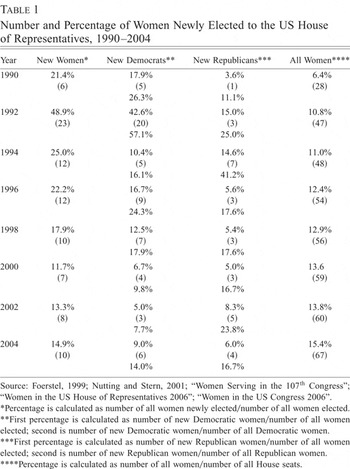
Newness of female representatives should affect both women and men in parliaments. As the number of women in parliament shifts, with newness, from token to minority status, formerly token women will now find themselves part of an enhanced minority. Newness is likely to require adjustment by all parliamentary actors: by women newly elected, by women already serving in a national legislature, and by male legislators. If women are newly elected and there are many of them, they may be positioned as more numerous than incumbent women and as a sizeable minority of new legislators (including men). It is reasonable to expect that a large number of new female legislators will require accommodation by male legislators, and by incumbents, including incumbent women. (See Table 1 for the percentages of new women relative to incumbent women in their party delegations.)
Number and Percentage of Women Newly Elected to the US House of Representatives, 1990–2004

Newness as well as numbers of elected women varies across time in national parliaments. In the United States, for example, the opportunity for “newness” occurs biannually, and hence the potentially disruptive impact of newly elected female tokens or minorities is frequent. The actual occasions of newness, however, are moderated by the strong incumbency effects of the US Congress. In Britain, in contrast, parliamentary elections may be as infrequent as every five years, providing a longer period of adjustment, adaptation and incorporation of newly elected women into the Commons. Party discipline and party candidate selection rules, however, may have a strong impact on the practical newness of elected MPs. Any consideration of the impact of newness and numbers of elected women upon women's substantive representation will have to take into account the cross-time variation of these factors, the potentially cumulative continuing impact of newness within specific legislatures, the frequency opportunities of newness, and how those play out within political parties.20
Within political parties, this would include attentiveness to nomination and selection practices, as well as recruitment patterns (e.g., Norris and Lovenduski, 1995; 1993). The modest literature on women's turnover suggests that women have lower incumbency rates than men, raising additional questions about the potential impact of newness (Andersen and Thorson, 1984; Darcy and Choike, 1986; Palmer and Simon, 2005; Welch and Studlar, 1996).
Although the trajectory of elected women in many legislatures follows a pattern of incremental increase (this is the case in the US, see Table 2), the percentage of newly elected women may be more likely to demonstrate a pattern of spike and decline (see, for the US, Table 1). Dramatic increases in the number of women and of women newly elected are likely to have an impact on internal legislative behaviours and arrangements, which themselves are likely to affect the chances for women's substantive representation in parliaments.
Number and Percentage of Women Elected to the US House of Representatives, by Party, 1974 to 2004

Kanter suggests that the reaction from dominants (where women are tokens) and from majorities (where women constitute a substantial minority) toward women may be negative, punitive and divisive. Women's small numbers and status as new arrivals are likely to make it difficult for them to assume office and to undertake legislative work without attracting public notice. For example, the large numbers of women, overwhelmingly Labour Party candidates, elected to the House of Commons in 1997, about half of whom were new members, attracted extensive media attention. Categorized by the media by the disparaging moniker “Blair's Babes” (see Norris and Lovenduski, 2001: 2), the new Labour women were targets of substantial attention and criticism, including from other Labour MPs (Lovenduski, 2005). Cowley and Childs (2001: 1) report Brian Sedgemore's reference to new Labour women as “Stepford Wives” and Ann Widdecombe's protest that “the comparison was an insult to the Stepford Wives” (Cowley and Childs, 2001: 19 n3).
Kanter's work suggests that, for a token group, “newness” combined with “token status” provoke responses from dominants that shape distinctive behaviours among tokens. In regard to women's descriptive and substantive representation, both numbers and newness could therefore be expected to produce distinctive legislative behaviours among newly elected women. With specific regard to policy behaviour, newly elected women may be more likely to support party programmes, less likely to defy party whips (or vote against party leadership), and less likely to initiate and to support progressive or radical legislative proposals than are party incumbents, male or female.
Hypotheses Concerning Newness
Kanter's work suggests that, for a token group, newness combined with token status provokes responses from dominants that shape distinctive behaviours among tokens. In regard to women's descriptive and substantive representation, both numbers and newness could therefore be expected to intersect to produce distinctive legislative behaviours among newly elected women. Among testable hypotheses are the following:
- Where newly elected women constitute a minority of women in their party parliamentary group, they will be more likely to support party programmes than will their incumbent female counterparts. They will also be more likely to support party programmes than will party incumbents, male or female.
- Where newly elected women constitute a minority of women of their party parliamentary group, they will be less likely to defy party whips (or vote against party leadership) than their incumbent female counterparts. They will also be less likely to defy party whips than will party incumbents, male or female.
- Where newly elected women constitute a minority of women in their party parliamentary group, they will be less likely to initiate and to support progressive or radical legislative proposals than their incumbent female counterparts. They will also be less likely to support radical legislation than will party incumbents, male or female.
These hypotheses address newness in parliament by party. There is some evidence of support for some of these hypotheses. Debra Dodson (2006) found evidence of differences in the policy behaviours of women newly elected to the US House, although these behaviours also varied across Congresses.21
In the 103rd Congress, “Five of the [23] newly elected women in the House—all Democrats—had sponsored at least one WHEA provision in the Democratically controlled 103rd; yet not one component of the 104th's WHEA of 1996 was sponsored by a freshman or even sophomore Republican woman” (Dodson, 2006: 193, n8; see also 101-4).
For a more detailed discussion of the impact of newly elected women upon policy decisions in the US Congress and the UK House of Commons, see Beckwith, 2002.
In “doing politics differently,” however, the difference may not be attributable to a critical mass threshold or a shift in proportion of female to male legislators. I argue that the difference may be the product of the intersection of numbers and newness, in party and parliamentary context.
VI. Conclusion
What impact does the product of numbers and newness have upon possibilities for substantive representation? Kanter suggests that women's “rarity” requires adjustment by and learning from men in organizations where men are dominant and that as women become a fixity in an organization, men will learn to accommodate them. That is, Kanter sees rarity or newness as an aggregate characteristic of organizations. I suggest, instead, that newness be seen as both a feature of newly elected individual women, who must learn the institutional structures, norms and folkways of legislatures, and as a feature of the response of incumbents, both male and female, in socializing and adapting to numbers of newly elected women within their party and within the larger legislature. “Newness,” therefore, is characterized by a range of uncertainties and unpredictabilities: uncertainties among newly elected women about their capacity for legislative influence and uncertainties among incumbents about the (not yet) predictable (in party and parliamentary terms) behaviour of the newly elected.
Newness also occurs in a newly elected legislature and, hence, additional uncertainties and unpredictabilities may obtain. A governing party may have lost a parliamentary election and an opposition party may come to power in the new parliament; a governing party may have increased its electoral advantage and find itself more favourably positioned to advance its policies; an opposition party may have increased its parliamentary presence, strengthening its capacity to influence government policy. In each of these cases, within specific parliaments and within specific parties positioned as government or opposition, numbers of newly elected women will experience positive and negative opportunities for constructing cross-party alliances among women, for strengthening their own party ties, and for acting independently in policy making.
Studlar and McAllister (2002) suggest that, for political women to have a legislative impact, they need to be representatives of a conducive party and they need to be able to “work” the party; that is, to persuade party leadership and male colleagues of the virtues of supporting policies that provide substantive representation for women. Elected women's opportunities for such influence should be enhanced when the number of women is high.
Because major political loss for a governing party often means major political victories for women of the opposition, or a high number of newly elected women, substantial increases in numbers of women in parliaments will of necessity depend upon newness. In a study of women's election to lower chambers of 13 West European parliaments, R. Darcy and Karen Beckwith (1991) found that women were more likely to be elected in large numbers when a party previously in opposition became the governing party. They reasoned that a previous electoral defeat may create three potential opportunities for female candidates. First, major electoral losses for a party remove its incumbents from parliament, sometimes permanently, opening candidacy opportunities for women in the next election.23
An unsuccessful incumbent may decide to leave politics; his or her party may also fail to renominate or reselect a failed incumbent for subsequent campaigns.
Darcy and Beckwith's research implies that large numbers of elected women necessarily intersect with newness, or women's newly elected status—a status which may diminish the capacity of women to translate their increased numbers into women-friendly legislation. If substantial numbers of women are newly elected, in a party that has become the governing party, those women are more likely to lack the parliamentary experience necessary to mobilize quickly for women-friendly legislation. They are also more likely to lack the experience and party position necessary to resist any of their party's directives that might undermine women-friendly public policy (see Lovenduski, 2005 on Britain; for the US, Beckwith, 2006; Dodson, 2006; Mink, 2002; see also Katzenstein, 2003). The intersection of numbers and newness creates an irony: the moments in which parties elect large numbers of women are the same moments when parties enjoy new majority and governing status; hence positive opportunities for women's increased numerical representation may be paired with negative opportunities for women's policy successes. The very factors that enhance women's descriptive representation may be those that undermine women's ability to promote women's substantive representation. These possibilities suggest further that a focus on the intersection of numbers and newness, rather than on critical mass or a threshold proportion, offers the greater utility for understanding the relationship between women's descriptive and substantive representation.
A final conclusion concerns the ultimately gendered nature of the intersection of numbers and newness. Newness, a substantial increase in the numbers and proportions of women elected for the first time, may have its least positive policy impacts, in terms of women-friendly legislation and women's substantive representation, when newly elected women lack necessary experience and supportive party, movement and institutional context. Newly elected women, however, can become incumbents, with re-election, and they can have an impact upon their male colleagues and, potentially, upon institutional norms and practices. The interactions and iterations of newly elected women and incumbency imply cross-time analysis of women's institutional integration and their positioning for women's substantive representation. Where parties and parliaments experience a substantial increase in the numbers and proportions of elected women, women's newness functions to underscore interaction between elected women and men, revealing their actual and potential institutional influence and power, and foregrounding the gendered nature of legislative politics and the possibilities for women's substantive representation.
Acknowledgments
Readers who provided critiques of an earlier version of this article include Lee Ann Banaszak, Sarah Childs, Phillip Cowley, Debra Dodson, Richard E. Matland, Pippa Norris and Donley Studlar. They share all my gratitude and none of the responsibility.