INTRODUCTION
Covering a considerable area of the world's coastlines (284,300 km2 of the oceans' surface, UNEP, 2001), coral reefs form a vital component harbouring some of the most diverse faunal and floral marine ecosystems (Rachello-Dolmen & Cleary, Reference Rachello-Dolmen and Cleary2007; Wu & Zhang, Reference Wu and Zhang2012) and supporting many habitat-specific and restricted-range species (Beger & Possingham, Reference Beger and Possingham2008). However, coral reefs are increasingly being exposed to a range of (often interacting) physico-chemical and biological disturbances globally (Maina et al., Reference Maina, McClanahan, Venus, Ateweberhan and Madin2011) and are suffering from severe degradation processes of both natural (Cróquer et al., Reference Cróquer, Villamizar and Noriega2002; Maina et al., Reference Maina, McClanahan, Venus, Ateweberhan and Madin2011) and anthropogenic (Beger & Possingham, Reference Beger and Possingham2008; Cuevas et al., Reference Cuevas, Sherman, Ramírez and Hubbard2008) origins. It is estimated that a substantial proportion of the world's coral reefs will have disappeared in the next few decades because of such phenomena as acidification in marine environments (Ridd, Reference Ridd2007). Despite this significant change in coral reefs of the world, there is still little understanding of the diversity and status of coral reefs in many parts of the globe, especially within the Persian Gulf region (Kavousi et al., Reference Kavousi, Seyfabadi, Rezai and Fenne2011).
Being a semi-enclosed body of water, the Persian Gulf has some of the harshest environmental conditions for coral reef development (Coles Reference Coles1988; Sheppard, Reference Sheppard and Sheppard1991). It is located in one of the hottest areas in the world; air temperatures may reach 50°C in summer and this can raise the temperature of the Gulf water well above 40°C (Coles, Reference Coles2003). In general, the Gulf experiences notable seasonal fluctuations in both surface water temperature (ranging from 14 to 34°C) and salinity (ranging from 35 up to 45 ppt) (Coles & Fadlallah, Reference Coles and Fadlallah1991). Despite these harsh environmental conditions, relatively diverse and abundant coral reef communities are found within both the southern and northern Gulf (Coles, Reference Coles2003; Coles & Fadlallah, Reference Coles and Fadlallah1991; Sheppard & Sheppard, Reference Sheppard and Sheppard1991; Shokri et al., Reference Shokri, Haeri-Ardakani, Sharifi, Abdoullahi and Nazarian2000). Approximately 60 species of scleractinian corals have been described for the Persian Gulf, representing approximately one-tenth of the corals known for the Indo-Pacific and 15% of those of the Indian Ocean (Sale et al., Reference Sale, Feary, Burt, Bauman, Cavalcante, Drouillard, Kjerfve, Marquis, Trick, Usseglio and Lavieren2011). Coral reefs reportedly cover an area of about 7050 ha in the northern Persian Gulf (IRODC, 2004). These coral communities predominantly form as fringing reefs and patchy coral bommies throughout 17 Iranian islands (Shokri et al., Reference Shokri, Haeri-Ardakani, Sharifi, Abdoullahi and Nazarian2000), with the highest coral coverage being reported at Khark, Kharku and Larak Islands (Shokri et al., Reference Shokri, Haeri-Ardakani, Sharifi, Abdoullahi and Nazarian2000; Wilkinson, Reference Wilkinson2008).
There is a wealth of research that has illustrated the importance of environmental variables in structuring coral reef biodiversity (Sheppard & Sheppard, Reference Sheppard and Sheppard1991; Coles, Reference Coles2003; Guinotte et al., Reference Guinotte, Buddemeier and Kleypas2003; Bellwood et al., Reference Bellwood, Hughes, Connolly and Tanner2005; Wilkinson, Reference Wilkinson2008). Globally, coral reefs have been shown to thrive up to threshold environmental values, with temperatures between 25°C and 28°C (Wu & Zhang, Reference Wu and Zhang2012), salinities of 34–36 ppt (Kinsman, Reference Kinsman1964) and water clarity of 15–50 m (USDC, 1984) vital for coral reef development. However, environmental extremes well in excess of the threshold values for coral reef development are found within the northern Persian Gulf (Coles, Reference Coles2003). Water temperature fluctuates from 13°C in winter to 38°C in summer (Wells & Hanna, Reference Wells and Hanna1992), low flushing rates, shallow depths, high evaporation and limited freshwater inflow result in salinities of over 70 ppt in sections of the northern Persian Gulf (IRODC, 2004; Sheppard et al., Reference Sheppard, Al-Husiani, Al-Jamali, Al-Yamani, Baldwin, Bishop, Benzoni, Dutrieux, Nicholas, Subba, Jones, Loughland, Medio, Nithyanandan, Pilling, Polikarpov, Price, Purkis, Riegl, Saburova, Samimi-Namin, Taylor, Wilson and Zainal2010), while low water clarity (i.e. high turbidity) associated with high winds and currents, eutrophication and excessive anthropogenic land development are found throughout the Gulf region (Coles, Reference Coles2003). These extreme conditions have resulted in a naturally low-diversity and potentially adaptable coral community developing within northern Persian Gulf waters (Kinsman, Reference Kinsman1964; Coles, Reference Coles2003). Furthermore, anthropogenic stressors such as intensive oil exploitation and transport activities, and coastal pollution by extended urbanization in the last decades have had a significantly negative impact on the coral diversity of the northern Gulf region (Coles, Reference Coles2003; Burt et al., Reference Burt, Bartholomew and Usseglio2008; Sheppard et al., Reference Sheppard, Al-Husiani, Al-Jamali, Al-Yamani, Baldwin, Bishop, Benzoni, Dutrieux, Nicholas, Subba, Jones, Loughland, Medio, Nithyanandan, Pilling, Polikarpov, Price, Purkis, Riegl, Saburova, Samimi-Namin, Taylor, Wilson and Zainal2010).
Despite the increasing changes in northern Persian Gulf coral communities (Shokri et al., Reference Shokri, Fatemi and Crosby2005; Samimi-Namin et al., Reference Samimi-Namin, Rezai and Kabiri2009; Kavousi et al., Reference Kavousi, Seyfabadi, Rezai and Fenne2011), there are still few works examining coral reefs in this region, with little known about their diversity and abundance. Therefore, the aim of this paper is to assess the diversity and distribution of scleractinian corals on the coastlines of two Iranian islands in the Persian Gulf (Qeshm and Larak Islands), and to examine the role of environmental variables in structuring the coral communities.
MATERIALS AND METHODS
Study sites
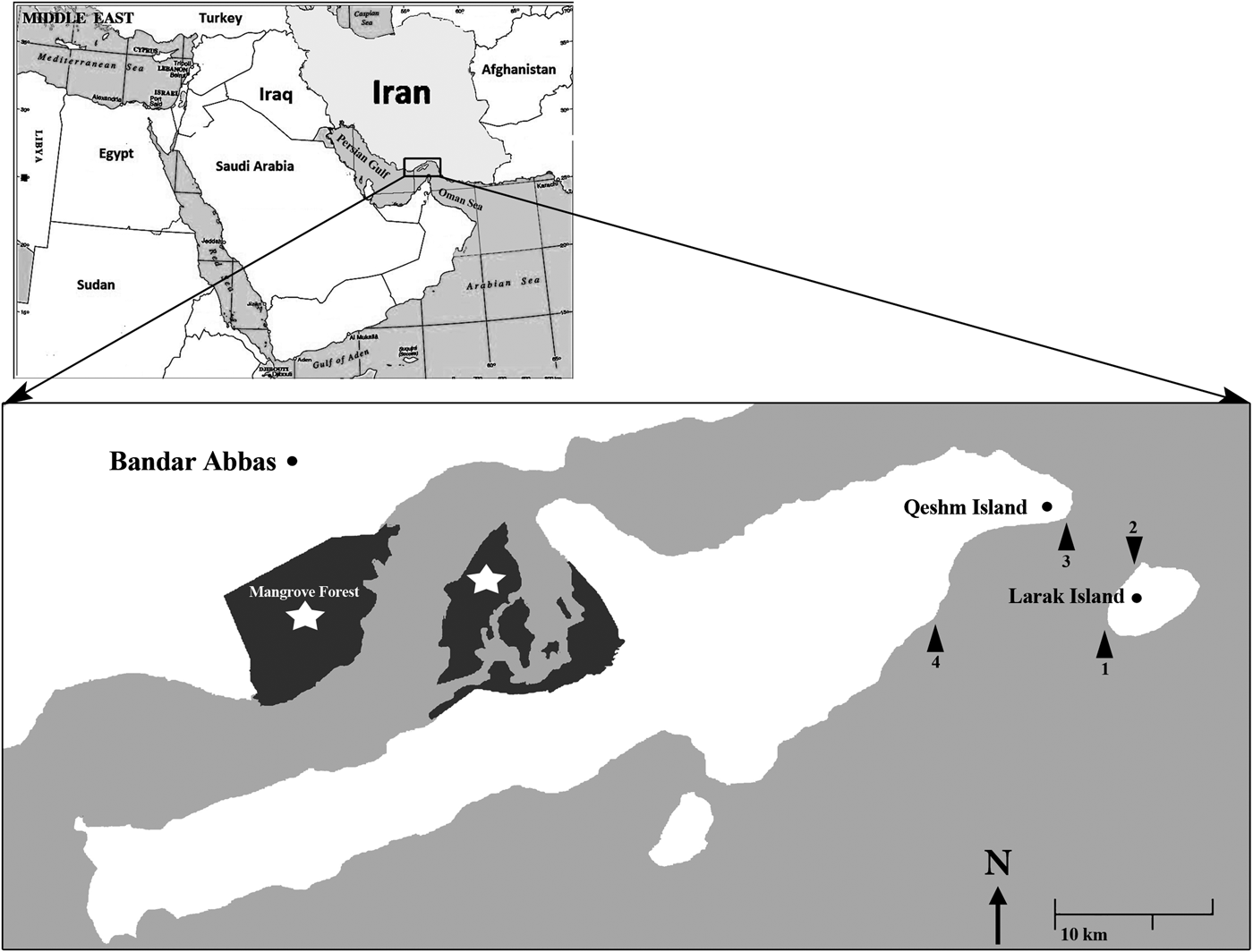
Qeshm and Larak Islands are two major coastal islands within the northern Persian Gulf (Figure 1). Encompassing an area of 1491 km2 (~122 km long, 18 km wide), Qeshm is the largest island in the Gulf (Moradi et al., Reference Moradi, Kamrani, Shokri, Ranjbar and Askari2010), while Larak Island has an area of approximately 48.7 km2 (~10.5 km long, 1.5 km wide) (Iranian Islands Geography, 2002). These two islands were chosen for this study because of their different hydrological and environmental conditions. Compared to Qeshm Island, Larak is closer to the Strait of Hormuz where the sea currents bring in fresh and less salty water from the Indian Ocean into the Persian Gulf (Pous et al., Reference Pous, Carton and Lazure2004; Shokri et al., Reference Shokri, Fatemi and Crosby2005). Larak Island has a sandy and rocky seafloor and its coral communities occur at the depths from as little as 10 cm up to 13 m, but corals cannot usually be seen as reefs at depths over 6–8 m. Qeshm Island has a diverse coastline and seabed, but compared to Larak Island the seabed is mainly muddy. In Zeyton Park, coral reefs can be observed at depths of 2–4 m, while in Naz Island the coral zone is located at depths of 10–12 m, where the seafloor changes to a rocky and muddy bed. Qeshm is a resort and a relatively-densely populated island, thus its coral reefs are subject to considerable stress from human activities, e.g. desalination, waste inflow and marine transportation. Larak Island, on the other hand, is less impacted by urbanization and the environmental stresses caused by human activities.
Map of Iran and position of the study sites: (1) west Larak Island; (2) north-east Larak Island; (3) Zeyton Park; (4) Naz Island.

Coral sampling and analysis
This study was carried out in June 2008 and February 2009, representing actual seasons, summer and spring, in the Persian Gulf. On each occasion, sampling was performed at four sites: Zeyton Park (26°55′47.17″N 56°16′18.22″E) and Naz Island (26°49′20.61″N 56°7′8.72″E) located on Qeshm Island, and the west (26°49′35.31″N 56°19′19.67″E) and north-east (26°53′26.64″N 56°21′0.32″E) parts of Larak Island (Figure 1). At each site, corals were photographed and sampled during several dives over a period of a week. All samplings were undertaken between 9 am and 1 am (Hill & Wilkinson, Reference Hill and Wilkinson2004) at depths of 2–12 m and an approximate distance of 200–250 m from the shore. Pieces of coral of 10–15 cm in diameter were removed from the colonies using a hammer, and labelled in situ (Hueerkamp et al., Reference Hueerkamp, Glynn, D'Croz, Maeté and Colley2001). The coral specimens were carried to the boat and preserved in 70% ethanol. In the laboratory, the specimens were bleached using hydroperoxide and photographs were taken of all parts of their bodies, such as the corallite structures. The coral species identification was performed by using standard reference keys (e.g. Carpenter et al., Reference Carpenter, Harrison, Hodgson, Alsaffar and Alhazzeem1997; Wallace, Reference Wallace1999; Veron, Reference Veron2000). The type specimens are kept at the Faculty of Marine Biology, University of Hormozgan, Iran. Percentage coral cover of each site was estimated across a 100 m transect comprising four 20 m long transects with 5 m between each transect (Hill & Wilkinson, Reference Hill and Wilkinson2004). Numbers of collected corals in the studied sites were as follow: Zeyton Park, 173; Naz Island, 111; west Larak, 212; north-east Larak, 183.
During the coral sampling in each of the time periods (June or February), water salinity, temperature, pH and clarity at all sites were measured daily and almost at the same time (9–10 am) and the average measures during a week were used for the analysis. The three former parameters were estimated by using a digital multimeter (Delta Ohm, Italy), while water clarity was determined by using a Secchi disc.
The measures of the environmental variables had a normal distribution according to the Kolmogorov–Smirnov test. A paired-samples t-test was performed to compare the values of the variables between two seasons (June and February). Analysis of variance (ANOVA) followed by a post hoc Tukey's test was used to compare the measures of environmental variables between the study sites (significance level P < 0.05). A multivariate approach, the canonical correspondence analysis (CCA), was applied to discover the relationship between the occurrence of coral species and gradients of the environmental factors. For an ecological interpretation of the ordination results, the scores of the species on the first three CCA axes were correlated with corresponding measures of the environmental variables using Spearman rank correlation coefficients (Jongman et al., Reference Jongman, Ter Braak and Van Tongeren1995). Prior to the analysis, the data were mean-centred and autoscaled to variance 1, aimed at assuring that all variables contributed equally to the model, independent of the scale with which they were measured. The computer program PC-ORD for Windows v.3.0 (McCune & Mefford, Reference McCune and Mefford1999) and SPSS, v.11.5 were used for the analyses.
RESULTS
Environmental parameters
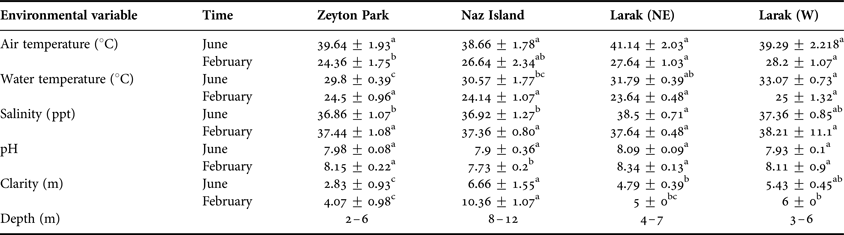
Values (mean ± standard deviation) of the measured environmental parameters are shown in Table 1. Maximum air temperature (41.14 ± 2.03°C) was recorded in north-east Larak in June, while minimum air temperature (24.36 ± 1.75°C) was recorded for Zeyton Park in February. Zeyton Park had a significantly different air temperature from Larak Island in February. In all sites air temperature was significantly different between the two seasons (P < 0.05, Table 2). Maximum (33.07 ± 0.73°C) and minimum (23.64 ± 0.48°C) values of water temperature were recorded in west and north-east Larak, respectively. In June, water temperature differed significantly between Zeyton Park and Larak Island and between west Larak and Naz Island, while in February the differences in water temperature between the study sites were not significant. In all sites, water temperature differed significantly between the two seasons. Maximum (38.5 ± 0.71 ppt) and minimum (36.86 ± 1.07 ppt) salinity levels were recorded in June at north-east Larak and Zeyton Park, respectively. While all sites had almost similar water salinities in February, salinity was significantly different between north-east Larak and Qeshm Island in June. Maximum pH (8.34 ± 0.13) was at north-east Larak, while Naz Island had a significantly lower pH level (7.73 ± 0.2) than the other sites in February. Two sites at Larak Island had significantly different water salinity and pH in the two seasons. Maximum water clarity (10.36 ± 1.07 m) was at Naz Island in February, while minimum clarity (2.83 ± 0.93 m) was at Zeyton Park in June. Two sites at Qeshm Island had significantly different water clarity in both seasons, and except for north-east Larak, at all sites clarity was significantly different in the two seasons.
Values (average ± standard deviation) of the environmental parameters in the study sites (June 2008 and February 2009).
In each row, data with different letters are significantly different (P < 0.05). NE, north-east Larak Island; W, west Larak Island.
Results of paired-samples t test showing the significance levels for comparisons of the environmental variables between two sampling times (June and February).
NE, north-east Larak Island; W, west Larak Island.
Coral diversity and coverage rate
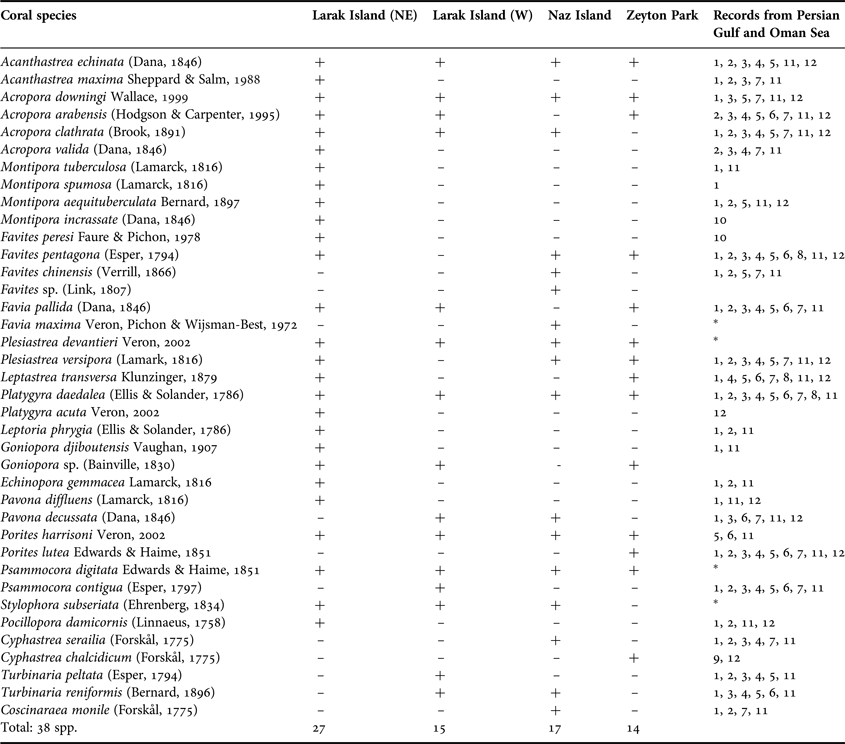
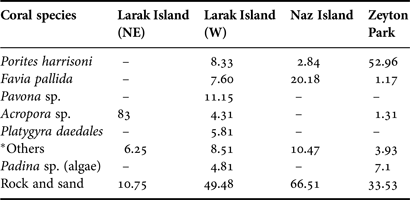
Coral reefs were distributed as restricted patches in the study sites. The coral reefs covered areas of about 25 ha and 2.5 ha at Zeyton Park and Naz Island, respectively. At west Larak Island the coral zone area was 8.5 ha, while at north-east Larak the corals had a linear array extending up to 2 km in length and 20–100 m in width. Thirty-eight species of hard corals belonging to 20 genera and nine families were identified in this study. The number of corals found at Larak and Qeshm Islands were 31 and 23 species, respectively (Table 3). Maximum species diversity (27 species) was recorded at north-east Larak, while the minimum number of coral species (14 species) was at Zeyton Park. The dominant coral families at Zeyton Park, Naz Island, west Larak and north-east Larak were Poritidae, Faviidae, Faviidae and Acroporidae, respectively. Estimation of coral cover showed that the dominant coral groups at Larak Island were the genera Acropora (83%) and Pavona (11.15%), whereas Qeshm Island was dominated by Porites (52.96%) and Favia (20.18%) (Table 4).
Reef-building coral species found in each of the studied sites and their record (s) history from Persian Gulf and Oman Sea. + and − show presence or absence of each species, respectively.
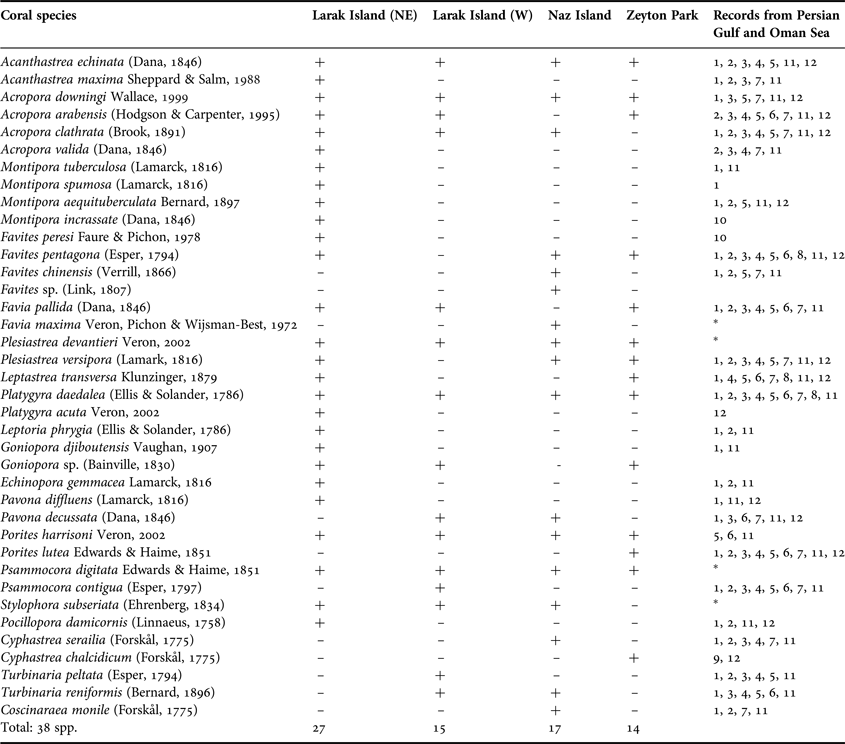
1. Saudi Arabia (Sheppard & Sheppard, Reference Sheppard and Sheppard1991); 2. Oman Sea (Coles, Reference Coles1996); 3. Kuwait (Carpenter et al., Reference Carpenter, Harrison, Hodgson, Alsaffar and Alhazzeem1997); 4. Dubai, United Arab Emirates (Riegl, Reference Riegl1999); 5. Kish and Farur Islands, and Nayband Bay, Iran (Fatemi & Shokri, Reference Fatemi and Shokri2001); 6. Kuwait (Benzoni et al., Reference Benzoni, Pichon, Al Hazeem and Galli2006); 7. Larak and Kish Islands, and Nayban Bay, Iran (Maghsoudlou, Reference Maghsoudlou2008); 8. Hengam Island, Iran (Nejatkhah et al., Reference Nejatkhah, Rezai and Dehgani2010); 9. Qeshm Island, Iran (Moradi et al., Reference Moradi, Kamrani, Shokri, Ranjbar and Askari2010); 10. Larak Island, Iran (Shojai et al., Reference Shojae, Kamrani, Shokri, Ranjbar, Moradi and Hesni2010); 11. Persian Gulf and Oman Sea (Riegl & Purkis, Reference Riegl and Purkis2012); 12. North Larak Island, Iran (Vajed-Samiei, Reference Vajed-Samiei, Koosha, Ghezellou and Shirvani2013).
*New, new record. NE, north-east Larak Island; W, west Larak Island.
Percentage cover of the dominant corals in the study sites.
*, cumulative cover rate of the corals with percentage covers of less than 0.2% each. NE, north-east Larak Island; W, west Larak Island.
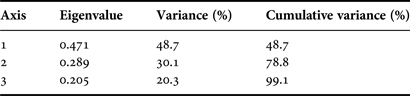
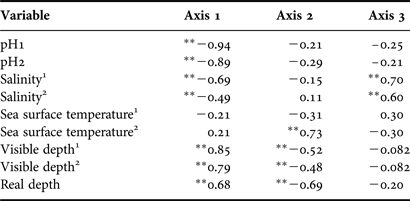
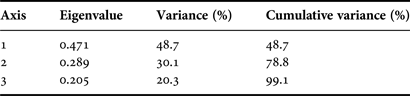
The CCA plotting of Figure 2 clearly discriminated the study sites based on their environmental conditions. It also shows the relevance of environmental variables and coral diversity at each site. Six species: Acanthastrea echinata, Porites harrisoni, Plesiastra devantieri, Platygyra daedalea, Psammocora digitata and Acropora downingi located in the centre of the CCA scatter plot, were found at all sites with diverse environmental conditions (Figure 2; Table 3). Conversely, P. contigua, Turbinaria peltata and Cyphastrea serailia were recorded at only one site each. The number of singletons, i.e. the species occurring only in a certain site, at north-east Larak, Naz Island, Zeyton Park and west Larak were 13, 5, 2 and 2, respectively. The first two CCA axes accounted for ~80% of the total variance (Table 5), and thus were considered as the main determinants of correlations. However, axis 3 also showed a high variance (20.3%). Axis 1 displayed significantly negative correlations with the values of water pH and salinity at both sampling times (June and February) (Table 6). The diversity of corals in north-east Larak was positively correlated with high pH and salinity levels. Axis 2 had positive and negative correlations with water temperature and clarity, respectively. Temperature affected the diversity of the corals in Zeyton Park and west Larak, while the coral diversity in Naz Island was mainly related to water depth and clarity (Figure 2).
Triplot diagram of canonical correspondence analysis ordination of 38 coral species in four study sites (Zeyton Park, Naz Island, west (W) and north-east (NE) Larak Island) in relation to the environmental variables. Refer to Table 6 for species abbreviations. Variables in June 2008 and February 2009 are shown by numbers 1 and 2, respectively. ○ and ▴ represent the sampling sites and the coral species, respectively. The overlapped species are slightly displaced for clarity.
Characteristics of the axes in canonical correspondence analysis.
Spearman rank correlation between environmental parameters and ordination scores for the first three canonical correspondence analysis axes.
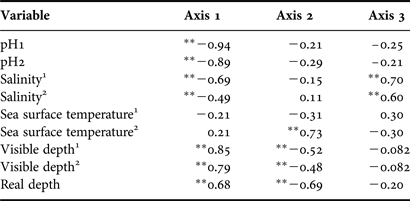
**, correlation significant at P < 0.01. Variables in June 2008 and February 2009 are shown by superscripts 1 and 2, respectively.
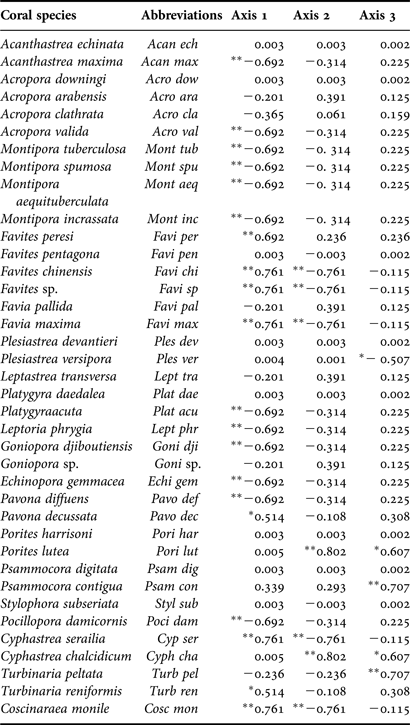
Correlations between ordination axes and the coral species in the study sites are shown in Table 7. Several coral species had positive correlations with salinity and pH, while negatively correlated with water temperature (P < 0.01). These species were Pocillopora damicornis, P. acuta, A. maxima, A. valida, Montipora tuberculosa, M. spumosa, M. aequituberculata, M. incrassate, Goniopora djiboutiensis, Echinopora gemmacea, Pavona diffuens, Platygyra acuta and Leptoria Phrygia, which were mainly present at north-east Larak. Several other species which were the indicators for Naz Island, comprising C. serailia, Coscinaraea monile, Favite chinensis and Favia maxima, had significantly positive correlation with water clarity. On the other hand, A. arabensis, F. pallid and Leptastrea transversa were observed in water of low clarity. Porites lutea and C. chalcidicum were the dominant species at Zyton Park, where their occurrence was positively correlated with water temperature.
Spearman rank correlation between the coral species and ordination scores of the first three canonical correspondence analysis axes.
**, correlation significant at P < 0.01.
DISCUSSION
In order to protect coral biodiversity it is essential to identify and characterize corals from various natural habitats, especially those in less investigated areas, and examine their relevance to the alteration in environmental conditions. This is particularly important for the diverse, but threatened, reefs in marine biodiversity hotspots (Rachello-Dolmen & Cleary, Reference Rachello-Dolmen and Cleary2007). Many older coral records for the Persian Gulf are becoming increasingly invalid following recent coral mortality events resulting from both anthropogenic and natural disturbances (Sale et al., Reference Sale, Van Lavieren, Ablan Lagman, Atema, Butler, Fauvelot, Hogan, Jones, Lindeman, Paris, Steneck and Stewart2010; Sheppard et al., Reference Sheppard, Al-Husiani, Al-Jamali, Al-Yamani, Baldwin, Bishop, Benzoni, Dutrieux, Nicholas, Subba, Jones, Loughland, Medio, Nithyanandan, Pilling, Polikarpov, Price, Purkis, Riegl, Saburova, Samimi-Namin, Taylor, Wilson and Zainal2010; Riegl et al., Reference Riegl, Purkis, Al-Cibahy, Abdel-Moati and Hoegh-Guldberg2011). In comparison with the earlier studies, we herein report the highest number of coral species (38 species) ever recorded from Iranian waters in the Persian Gulf. Of these, three species, P. digitata, F. maxima and Stylophora subseriata, are reported for the first time from the Persian Gulf and Sea of Oman. Several coral species have been recorded from Iranian islands and coastlines. Fatemi & Shokri (Reference Fatemi and Shokri2001) and Maghsoodlu (Reference Maghsoudlou2008) found 27 and 31 coral species, respectively, from Kish, Larak and Farur Islands, and Nayband Bay. Nejatkhah et al. (Reference Nejatkhah, Rezai and Dehgani2010) reported eight corals from Hengam Island. Moradi et al. (Reference Moradi, Kamrani, Shokri, Ranjbar and Askari2010) and Shojai et al. (Reference Shojae, Kamrani, Shokri, Ranjbar, Moradi and Hesni2010) reported two and three new coral species from Qeshm and Larak Islands, respectively. Recently, Vajed-Samiei et al. (Reference Vajed-Samiei, Koosha, Ghezellou and Shirvani2013) reported 37 coral taxa from north Larak Island. Various coral species have also been identified from the southern Persian Gulf. The number of species reported from Saudi Arabia is between 41 (Burchard, Reference Burchard1979) and more than 50 (Basson et al., Reference Basson, Burchard, Hardy and Price1977), while Sheppard (Reference Sheppard1988) recorded 40 species from Bahrain (Table 3). The present paper is vital in understanding the diversity of hard corals within the Gulf, as it has been hypothesized that propagules of corals from the Indian Ocean reach the Iranian shoreline first, and then circulate towards the Arabian States (Sheppard et al., Reference Sheppard, Al-Husiani, Al-Jamali, Al-Yamani, Baldwin, Bishop, Benzoni, Dutrieux, Nicholas, Subba, Jones, Loughland, Medio, Nithyanandan, Pilling, Polikarpov, Price, Purkis, Riegl, Saburova, Samimi-Namin, Taylor, Wilson and Zainal2010).
Species composition of the Persian Gulf coral communities is typically Indo-Pacific (Riegl, Reference Riegl1999) and it is no surprise that coral diversity is lower in the Persian Gulf compared to the Indian Ocean due to the Gulf's extreme environmental conditions and limited connection with the Indian Ocean (Price, Reference Price1993; Tavakoli, Reference Tavakoli1998). Coles (Reference Coles1996) identified 68 coral species from the Sea of Oman, which is more closely connected to the Indian Ocean than the Persian Gulf. Relatively lower coral diversity in the Persian Gulf has also been attributed to several biotic and abiotic factors, including microalgal competition, extreme seasonal variance in water salinity and temperature, powerful winds and a tidal surge and oil pollution, which may have eliminated many species and perhaps favour a number of other species that are adapted to the uniquely harsh conditions of the Gulf (Coles, Reference Coles2003). Harmful algal blooms during the years 2008–2009 had a destructive impact on the Gulf coral communities (Samimi-Namin et al., Reference Samimi-Namin, Risk and Hoeksema2010). Sedimentation by dominant storms and water currents has also been considered an important factor affecting coral diversity in the Gulf (Downing & Roberts, Reference Downing and Roberts1993; Riegl, Reference Riegl1999).
The identified corals in this study were observed as two reef forms: non-reef settings and reef patches. However, there are no actual coral reefs in the Persian Gulf, but rather ‘reefs’ refers to extended rows of coral beds. Acroporidae and Faviidae, which had the highest diversity in the present study, were also found to be the most diversified coral families in previous studies (Fatemi & Shokri, Reference Fatemi and Shokri2001; Maghsoudloo, Reference Maghsoudlou2008). Acroporidae had low diversity at Qeshm Island, while its diversity was high at north-east Larak Island. Acropora clathrata, which has been reported from different parts of the Gulf (Riegl, Reference Riegl1999), was observed in all but one of the sampling sites. Similarly, A. arabensis, which is an endemic species to the Persian Gulf (Riegl, Reference Riegl1999), was sampled from all sites except Naz Island. Furthermore, high percentage cover of Porites in Qeshm Island was in accordance with the results of an earlier study by Kavousi et al. (Reference Kavousi, Seyfabadi, Rezai and Fenne2011), in which P. harrisoni was a dominant coral with a percentage cover of 52.96%.
Different coral species vary in their environmental preferences for maximal development (Riegl, Reference Riegl1999). As is illustrated by the CCA plotting, all sampling sites could be discriminated based on their environmental conditions, while there were significant differences in the values of some water parameters, mainly temperature, between the two seasons. Thus, it was predictable that the physico-chemical parameters of water influence the diversity and distribution of the coral species. This can be acknowledged by considering that only six species were observed at all the studied sites, and that even the corals which are tolerant of a broad range of environmental conditions, such as A. clathrata and P. lutea (Riegl, Reference Riegl1999), were absent in some locations. An important reason for the relatively higher coral diversity in Larak Island may be that the island is directly exposed to the oceanic currents entering through the Strait of Hormuz. The currents affect the Gulf ecosystem by the influx of cooler, less saline, clearer and more nutrient rich waters (Pous et al., Reference Pous, Carton and Lazure2004; Sale et al., Reference Sale, Feary, Burt, Bauman, Cavalcante, Drouillard, Kjerfve, Marquis, Trick, Usseglio and Lavieren2011) which consequently can provide favourable conditions for the prevalence of different coral species.
Temperature has been found to be a major environmental factor affecting coral diversity and distribution (Coles, Reference Coles2003; Schleyer & Celliers, Reference Schleyer and Celliers2004). Lowered and elevated seawater temperatures were suggested to be the cause of coral reef mass mortalities in the southern and northern parts of the Persian Gulf (Coles & Fadlallah, Reference Coles and Fadlallah1991; Fattemi & Shokri, Reference Fatemi and Shokri2001). Sheppard (Reference Sheppard2003) predicted that corals on Iranian shores will suffer from more severe and frequent warming periods in the future, resulting in declining diversity. Goreau & Hayes (Reference Goreau and Hayes1994) reported that the majority of bleaching events in corals can occur at water temperatures of 28–34°C. In most parts of the Persian Gulf temperatures may rise to more than this range during the summer. However, large coral colonies such as those found in the genus Porites are able to withstand extreme temperature shocks (Baird & Marshall, Reference Baird and Marshall2002). In this study the distribution of P. lutea was positively correlated with high temperature, while C. serailia, which is known to be resistant to high temperatures (Sheppard, Reference Sheppard1988) had negative correlation with water temperature. Such conflicting results may be because not one single environmental element is responsible for the distribution of a coral species. In addition, geographically-distinct populations of a species can have different environmental preferences.
Given the comparable water salinity levels at different sites, Spearman rank correlation analysis revealed a notable correlation between salinity and distribution of some coral species. While salinity is generally high in the Persian Gulf, the influx of less saline oceanic water through the Strait of Hormuz lowers the salinity of surrounding waters such as those near Qeshm and Larak Islands (Shokri et al., Reference Shokri, Fatemi and Crosby2005). However, coral communities at these islands still suffer from high salinity levels. Coral reefs can experience extreme changes in salinity of varying duration (Porter et al., Reference Porter, Lewis and Porter1999). The results of this study challenge previous findings on salinity preferences of some coral species. For instance, Sheppard (Reference Sheppard1988) reported that F. chinensis, F. pentagona and C. monile may have an upper salinity limit of about 45 ppt, while these corals occurred at lower salinities in this study and the CCA plotting showed their negative correlations with water salinity. Another example is Porites spp. which are known to be highly tolerant to salinity conditions, but displayed negative correlation with salinity. Salinity preference in coral species can be population-specific (RPS, 2009).
The acidic or alkaline nature of water affects calcification and growth of corals, so that lower water pH hampers coral calcification (Marubini & Atkinson, Reference Marubini and Atkinson1999). While waters in the study sites had a relatively similar pH range, being slightly alkaline, Spearman rank correlation analysis and the CCA revealed remarkable correlation between the occurrence of several coral species and water pH. It can, therefore, be concluded that the distribution of corals is highly pH-dependent. On the other hand, there are controversial results on the effect of pH on coral diversity. For instance, contrary to the findings of Marubini & Atkinson (Reference Marubini and Atkinson1999), we did not observe a significant correlation between water pH and the abundance of P. lutea.
The vertical distribution of living corals is restricted by the depth of light penetration, which is a function of water clarity/turbidity (Barnes, Reference Barnes1987). Though all our study sites had relatively shallow depths in comparison with most coral reef areas, there were significant differences in water clarity at the study sites. Furthermore, the distribution of several coral species was significantly correlated with water clarity. The higher coral diversity in Larak Island may be associated with to its relatively shallower depth, which allows more light penetration and nutrient influx (Shokri, Reference Shokri, Fatemi and Crosby2005). On the other hand, decreased water clarity at Zeyton Park due to the anthropogenic eutrophication and run-off from human land use (Maina et al., Reference Maina, McClanahan, Venus, Ateweberhan and Madin2011) was reflected in its lower coral diversity. It seems that corals cannot be observed as large colonies at the depths greater than 15 m in Persian Gulf, and their maximum depth limits are lower than those of most open-sea corals, mainly due to the lower water clarity in the Gulf. A. clathrata and F. peresi, which are reported to be found at depths up to 20–25 m (IUCN, 2011) were observed at depths less than 6 m in this study. Nicolas et al. (Reference Nicolas, Simon, Shaker, Shokri and Wilkinson2000) reported that the suitable depth for coral growth and diversification varies in different parts of the Persian Gulf. In our study, maximum hard coral coverage rates were observed in the depths of 3–7 m at Larak Island and 2–12 m at Qeshm Island.
The higher diversity of Acroporidae and Faviidae at Qeshm and Larak Islands, respectively, can also be attributed to the nature of the sea stratum at the islands. Faviid corals are sediment-resistant and, therefore, have an advantage in areas of high re-suspension and resettlement, while acroporids are less tolerant to sediment and only dominate in areas with less permanent sandy deposits and lower re-suspension (Riegl, Reference Riegl1999). The coral P. damicornis, which is tolerant of sedimentation (Hodgson, Reference Hodgson1999), was only observed at north-east Larak Island, whereas the higher diversity of branching corals such as Acropora sp. at west Larak explains lower sedimentation effects. The latter site does not face intense sedimentation as a function of oceanic currents (Shokri et al., Reference Shokri, Fatemi and Crosby2005), while relatively stagnant water allows sedimentation at north-east Larak. Furthermore, species with very large corallites and calices, such as Favia sp. and Porites sp., which have very active rejection for all sediment sizes (Rachello-Dolmen & Cleary, Reference Rachello-Dolmen and Cleary2007), were more frequently observed in Qeshm Island, where sedimentation is a common phenomenon (data not shown).
Although we did not intend to assess anthropogenic impacts on the coral diversity, pollution mainly due to human activities can have considerable effects on coral reef cover and diversity (Riegl, Reference Riegl1999; Nicolas et al., Reference Nicolas, Simon, Shaker, Shokri and Wilkinson2000; Sabine & Thomas, Reference Sabine and Thomas2008; Wiedenmann et al., Reference Wiedenmann, D'Angelo, Smith, Hunt, Legiret, Postle and Achterberg2013). Lower coral diversity at Qeshm Island compared to Larak Island could be attributed to the extended urbanization and resulting environmental changes on this island. Nevertheless, while this was a reason for the reduced total coral diversity, it increased the abundance of a few species, such as P. lutea, at Zeyton Park. On the other hand, the corals absent in more populated areas can be considered to be vulnerable or less-tolerant species. For example, A. clathrata, whose presence was positively correlated with water clarity, was absent at Zeyton Park, most likely due to the high water turbidity. However, firm conclusions on the effect of anthropogenic activities on coral diversity and distribution should only be made after extensive experimental and field studies.
We have attempted to present a new scheme of coral diversity at two main Iranian islands in the Persian Gulf. While the dependence of several coral species on environmental variables has been discovered, for a more accurate evaluation of the environmental impact it is necessary to extend the sampling effort, considering a higher number of locations and potential factors.
ACKNOWLEDGEMENTS
The authors are grateful to Dr M.S. Ranjbar of Hormozgan University for his invaluable support of this study. We thank Professor M. Pichon of James Cook University, Dr M.R. Shokri of Shahid Beheshti University and Dr D. Feary of Sydney University of Technology for their useful comments on the corals identification, and special thanks to Elenaz Janfaza, PhD candidate in translation studies of Isfahan University for her help in writing and editing this paper.