Introduction
One in four vulnerable older people report being abused when asked in surveys (Cooper et al., Reference Cooper, Selwood and Livingston2008) and much of this abuse remains undetected (Cooper et al., Reference Cooper, Selwood and Livingston2009). The UK Department of Health (Department of Health, 2000) defines abuse as: “a single act or repeated acts. It may be physical, verbal or psychological, it may be an act of neglect or an omission to act, or it may occur when a vulnerable person is persuaded to enter into a financial or sexual transaction to which he or she has not consented, or cannot consent.” Professionals tend to underestimate the prevalence of elder abuse and only a minority ask their older patients about it routinely. They report that lack of confidence and knowledge regarding defining, diagnosing, and reporting abuse are important barriers to managing abuse effectively (Cooper et al., Reference Cooper, Selwood and Livingston2009).
Only one randomized controlled trial (RCT) has sought to improve professionals’ management of elder abuse (Richardson et al., Reference Richardson, Kitchen and Livingston2002). In this study it was found that educational seminars were more effective than printed material in improving knowledge about how to manage elder abuse among nursing and social care staff in a UK old age psychiatry service. Two US studies without comparison groups or validated outcome measures have also evaluated interventions to improve knowledge or management of elder abuse. In the first, 292 health and social care professionals watched a video demonstrating approaches to managing abuse of older and younger people (McCauley et al., Reference McCauley, Jenckes and McNutt2003). Sugita and Garrett (Reference Sugita and Garrett2012) interviewed 130 dentists, hygienists, and assistants attending a four-hour training symposium. In both studies, knowledge and awareness of elder abuse increased when pre- and immediate post-test results were compared.
In the current study, we tested our hypothesis that a brief educational seminar would improve knowledge about the detection and management of suspected elder abuse by UK psychiatric trainees. For the first time, we measured the professionals’ actual practice in asking about and detecting abuse as an outcome, and interviewed participants again about three months after the intervention.
Methods
The study received Research Ethics Committee approval. Participants gave written informed consent. Participants were doctors on psychiatry or general practice training programs, currently working in psychiatry in two National Health Service (NHS) trusts covering inner city London and suburban areas of outer London, Middlesex, and Essex in the UK. The trusts provide all NHS hospital and community secondary psychiatric care to those living in their catchment areas.
Procedures
The intervention was scheduled within mandatory academic teaching for junior trainees which senior trainees were encouraged to attend. Trainees were emailed a few weeks prior to the session to explain about the study and advise that they could attend the educational session with or without participating. Participants completed questionnaires during the session immediately before and after the training and completed the three-month follow-up by email.
Intervention
One of the authors (LH) gave a 20-minute didactic standardized slide presentation, tailored to trainee doctors. It included information about:
1. the definition, prevalence, and risk factors of elder abuse;
2. detecting early signs of abuse to prevent situations becoming more serious;
3. the Mental Capacity Act (2005);
4. how to ask about abuse in a sensitive and non-judgmental manner and advice to screen for abuse during routine consultations with patients and their carers;
5. keeping timely and clear documentation (especially of suspected signs of abuse);
6. the limits of confidentiality; and
7. local procedures for reporting possible elder abuse.
LH also showed the trainees an eight-minute DVD produced by Action on Elder Abuse promoting awareness of abuse, targeted at the general population as well as professionals.
Assessment
At baseline, participants were asked their age, ethnicity, sex, years of work experience, and details of any previous elder abuse training. At baseline and three months, they were asked whether they had been involved in managing an elder abuse case in the previous three months (and, at baseline, if they ever had) and to indicate on Likert scales how often they were asking older people and their carers about abuse, whether they considered elder abuse during assessments of older people, and how confident they would feel detecting and managing a case of elder abuse (see Figure 2 for Likert categories). If they did not routinely ask about or consider elder abuse they were asked to write down in a free text response question what stopped them from doing so.
They completed parallel forms of the KAMA (Knowledge and Management of Abuse questionnaire) and CSQ (Caregiver Scenario Questionnaire). Pre-intervention, versions A and B, were handed out alternately to participants so that those sitting next to one another had different versions, and half of the participants completed each version. After the intervention they completed the version not completed at baseline. This was to prevent recall bias from participants knowing the questions for up to an hour before completing the instruments for the second time and thus having more time to think of answers and being able to listen specifically for the correct responses during the training.
The KAMA measures staff-applied knowledge and practice regarding identification and management of potentially abusive situations. Both versions A and B are valid and reliable; parallel form reliability was 0.82 (Richardson et al., Reference Richardson, Kitchen and Livingston2003). Wording was altered slightly for this study to make the scenarios more applicable to trainee doctors. Trainees were asked to describe how they would manage each of six scenarios and their responses were marked using a structured marking scheme. Higher scores indicate that respondents gave more correct answers, demonstrating more knowledge. In the current study, LH and CC independently rated the replies to 20 KAMA questionnaires, 10 each of version A and B. The intraclass correlation coefficient for a comparison of their ratings was 0.98.
The CSQ asked what strategies for managing challenging behavior in a person with dementia were abusive (Selwood et al., Reference Selwood, Cooper and Livingston2007; Thompson-McCormick et al., Reference Thompson-McCormick, Jones, Cooper and Livingston2009; Caciula et al., Reference Caciula, Livingston, Caciula and Cooper2010; Hempton et al., Reference Hempton2011). A vignette was followed by a list of 14 management strategies and participants were asked to rate each strategy on a 6-point Likert scale. Possible responses were: “Good idea and helpful; possibly useful; not sure; unlikely to help; bad idea but not abusive; abusive.” Four of the strategies were abusive as defined by the World Health Organization Centre for Interdisciplinary Gerontology and judged by an expert panel (Selwood et al., Reference Selwood, Cooper and Livingston2007), five were judged to be possibly abusive, and five not abusive. Version B of the CSQ was created for this study with a very similar structure and marking scheme. Table 1 lists all the strategies and where relevant what type of abuse they involve.
Strategies listed in the Caregiver Scenario Questionnaire and for abusive or possibly abusive strategies, the type of abuse they involve (version A; version B very similar)

In version A and B of the CSQ, there were two restrictions of liberty items and one neglect item. In version A there was one physically abusive item, and in version B there were two physically abusive items. We calculated the total number of abusive items correctly identified. We gave two points for the physically abusive item in version A of the CSQ and one point for identifying all the other abusive items so that the total scores for either A or B ranged between 0 and 5. Version A contained five strategies classified as possibly abusive and version B contained three strategies that were classified as possibly abusive. We therefore awarded three points for each possibly abusive strategy identified as abusive in version A and five points for each possibly abusive strategy identified as abusive in version B. Thus the total possible scores for the number of possibly abusive strategies identified as abusive ranged from 0 to 15 in both versions. Version A had 5 non-abusive items and version B had 6.
When we calculated participants’ total scores for identifying definite or possible abuse at either time point, these did not vary between participants completing version A or version B first (independent t = 0.7, p = 0.5), indicating adequate parallel form reliability.
Analysis
We used SPSS version 17.0 and two-tailed tests throughout. We compared the KAMA and CSQ scores, and participants’ confidence in managing abuse and the frequency with which they asked about and considered abuse, pre- and post–test. We determined whether or not these outcomes were significantly skewed (defined as a value <–1 or >1). If they were, we used a Wilcoxon signed rank test, otherwise we used a paired t-test. We reported the proportion of participants who had managed or detected a case in the three months before and after the intervention and calculated 95% confidence intervals for these percentages. We calculated that 36 participants would be sufficient to detect a similar difference to that reported by Richardson et al. (Reference Richardson, Kitchen and Livingston2002) at a power of 80% and a significance level of 1%. Participants’ answers regarding why they did not consider or ask about abuse routinely were read repeatedly and summarized into main themes by LH, and these were then discussed with CC.
Results
All 40 participants completed assessments at baseline and immediately after the intervention, of whom 24 (60%) responded to the three-month follow up email. At three months, responses were received from 13 (68%) men and 11 (52%) women (χ2 1.1, p = 0.3), 6 (46%) of whom were more experienced compared with 18 (67%) less experienced trainees (χ2 1.5, p = 0.22). Eight (47%) were aged 35 or over and 16 (70%) were younger trainees (χ2 2.1, 0.15). Mean pre-intervention KAMA scores were 13.3 (SD 4.8) for those who responded to the follow-up and 12.8 (3.2) for those who did not respond (t = 0.9, p = 0.4). Response rates were significantly different in the two NHS trusts (19 (76%) vs 5 (33%); 7.1, p = 0.008).
Sample characteristics
Nineteen (47.5%) of the participants were male. The most common ethnicity was Asian or Asian British (57.5%, n = 23), 7 (17.5%) were White British, 5 (12.5%) were from other white, and 5 (12.5%) from other or mixed ethnic groups. Twenty-three (57.5%) participants were aged between 24 and 34, 15 (37.5%) aged between 35 and 44, and 2 (5%) aged between 45 and 54. Twenty-one (52.5%) participants were in the first three years of specialist psychiatric training, 13 (32.5%) were more experienced trainees, 4 (10%) were General Practice trainees and 2 (5%) were pre-registration doctors working in their first psychiatry post. Tweny-six (65%) participants had previously undertaken a six-month post in Old Age Psychiatry. Six (15%) participants recalled prior elder abuse training; their baseline KAMA scores were not significantly different to those who did not report earlier training (mean 14.0 (SD 3.7) vs 12.9 (4.3), t = 0.57, df = 38, p = 0.57).
Effect of the intervention on knowledge and detection of abuse
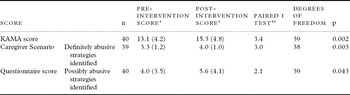
Participants scored significantly higher on the KAMA questionnaire and, on average, identified more definitely and possibly abusive items correctly after the training (Table 2). Figure 1 shows the number of participants identifying each type of definitely abusive strategy; more participants identified each type of abuse post-intervention compared with baseline. Three (7.5%) participants misidentified a non-abusive item as abuse at T1 compared with 5 (12.5%) at T2. The strategy most commonly misidentified as abuse was camouflaging the front door with a curtain.
Pre- and post-test scores on the KAMA and the caregiver scenario questionnaire

* Mean (standard deviation) except for identifying definite abusive strategies where values are median and interquartile range as data not approximating normal distribution.
** Except for identifying definitely abusive strategies where result shows Wilcoxon signed rank test result (as non-parametric data).
The number of participants correctly identifying each definitely abusive strategy and misclassifying non-abusive strategies as abuse at T1 and T2. *On version A there was one physical abuse item and on version B there were two.

Experience and confidence in managing abuse
At baseline, 10 (25%) participants reported that they had previously been involved in managing a case of possible elder abuse, and 1 (3%; 95% CI 0–13) participant said this was in the last three months. Five (13; 95% CI 9–40) of those completing the follow-up interview had been involved in a case of elder abuse in the three months since the intervention. At baseline, 13 (32.5%) participants said that they had ever detected a case of elder abuse and 2 (5%, 95% CI 2–17) said that this was in the last three months. This compared with 2 (8%, 95% CI 2–26) who reported detecting a case in the three months after the intervention, neither of whom reported detecting a case previously.
Figure 2 illustrates the responses of participants to questions about their practice and confidence in detecting and managing abuse before the intervention (T1) and three months later (T2). Those completing the follow-up were more frequently considering abuse when assessing older people (Wilcoxon signed rank test, z = 2.8, p = 0.006) and felt more confident in managing it (z = 3.7, p < 0.001) than they had before the training, but there was no significant change in the frequency with which they reported asking older people and their carers about abuse (z = 1.2, p = 0.24). Eight of the 12 participants who did not routinely ask about or consider elder abuse when assessing older people gave their reasons. These included a reluctance to ask about abuse without evidence to suspect it might be happening (n = 4), fear of people being offended or reacting badly (n = 3), concerns about a negative effect on the doctor's relationship with the patient/carer (n = 2), their own lack of knowledge about elder abuse (n = 2), and not feeling able to ask people with dementia due to difficulties in communicating with them (n = 1).
Percentage of participants considering and asking about abuse at T1 and T2 and how confident they felt managing abuse.

Discussion
Knowledge about elder abuse was low, despite most participants having completed a six-month Old Age Psychiatry Speciality post. Those who recalled receiving specific elder abuse training scored no higher on baseline knowledge tests than those who did not, suggesting that their current training is inadequate.
A third of trainees reported that they had ever detected a case of elder abuse, and this is in agreement with previous studies (Cooper et al., Reference Cooper, Selwood and Livingston2009). A quarter of vulnerable adults report abuse when asked (Cooper et al., Reference Cooper, Selwood and Livingston2008), suggesting that the trainees were failing to detect most of the abusive situations they encountered. Over half of the participants did not feel confident in managing a case of elder abuse before the intervention, and most were not enquiring about elder abuse routinely.
Knowledge of both how to manage and detect elder abuse significantly improved after the educational intervention and vigilance for and confidence in managing abuse were also higher three months after the intervention than before it. However, despite this greater confidence and vigilance, the trainees were not asking older people and their carers about abuse more frequently. Those reluctant to do so reported a range of reasons in addition to lack of knowledge, such as fear of a breakdown in their therapeutic relationship or causing offence, a reluctance to ask without evidence and concerns about how to ask people with dementia about abuse. Our intervention was brief and didactic, and these preliminary results suggest it changed knowledge and awareness but not behavior. We postulate that incorporating a more interactive component into the intervention, with role play, communication skills training, and discussions to elicit and challenge concerns that screening for abuse might cause harm, could help to change doctors’ behavior so that they screen for abuse more frequently. Most elder abuse does not leave objective signs, so until professionals are willing to ask about abuse, most cases will remain undetected (Cooper et al., Reference Cooper, Selwood and Livingston2009).
The proportion of trainees misreporting non-abusive strategies as abuse remained low, suggesting that our results were not due to participants tactically ticking more “abuse” boxes after the intervention. More people felt the camouflaging the door item would be abusive after the educational intervention. Perhaps discussion about the Mental Capacity Act (2005), highlighting the issue of restriction of liberty, sensitized participants to this type of abuse. Camouflaging the door is not necessarily restriction of liberty but could potentially be used in this way.
Limitations
This was a preliminary study, using a test-retest design, so the lack of a comparison group is a limitation. We only recruited trainees from two London NHS trusts, who may not have been representative of all UK trainees. All trainees at each site were invited to take part but only a proportion attended. The response rate was not measured and the characteristics of the non-attendees were not recorded, so we do not know if there was a systematic bias. All participants were aware of the research project at least one week before the intervention, and those who came to the training session may have differed systematically from those who did not. Perhaps those with less knowledge of, interest in, and concern about elder abuse were more reluctant to attend. All those attending the sessions took part in the research. The training was conducted by one researcher, so although it is standardized we cannot comment on whether it is equally effective if delivered by other trainers. The effect on detection and knowledge was measured using vignettes and case scenario questionnaires. Assessment of performance using vignettes has demonstrated acceptable validity when compared to performance in real consultations (Almquist et al., Reference Almquist, Stein, Weiner and Linn1981). The CSQ has been widely used and content validity has been demonstrated through professional consensus, but other psychometric properties have not been reported. Correct responses regarding what is abusive in the CSQ are those that have been categorized as meeting the World Health Organization Centre definition of abuse by an expert panel (Selwood et al., Reference Selwood, Cooper and Livingston2007). Despite these agreed definitions, there are different views about what constitutes abuse; for example, an Australian study reclassified the item of allowing someone with dementia not to be clean as not abusive in line with local guidelines (Hempton et al., Reference Hempton2011). This study was designed to have adequate power to detect an effect on knowledge of management of abuse, but lacked power to investigate the impact on trainees’ detection of abuse over three months as detection rates were low.
Conclusions
Currently there is no specific training available on elder abuse for doctors despite its high prevalence. This brief educational intervention increased trainee psychiatrists’ knowledge and vigilance for abuse. They remained reluctant to ask about it, for reasons including fear of causing offence or harming the therapeutic relationship and being unsure how to ask people with dementia. We postulate that changing doctors’ behavior may require a more complex intervention, focusing on communication skills, and plan further development of the intervention.
Conflict of interest
None.
Description of authors’ roles
All the authors designed the study; LH conducted the training and interviews; CC and LH analyzed the data and CC prepared the first draft; all authors revised the content critically for important intellectual content and approved the final version.
Acknowledgements
We thank Action on Elder Abuse whose DVD we included in the training, and the clinical tutors who facilitated the educational sessions.