




No CrossRef data available.
Article contents
ILLUSTRATIVE ESTIMATES OF COSTS AND EFFECTS OF THE USE OF DOPPLER ULTRASONOGRAPHY IN HIGH-RISK PREGNANCIES
Published online by Cambridge University Press: 21 April 2004
Abstract
Objectives: To examine the cost-effectiveness of Doppler ultrasonography in high-risk pregnancies.
Methods: An analysis was made of the cost-effectiveness of Doppler ultrasonography in high-risk pregnancies in relation to different organizational models. National costs of Doppler ultrasonography for singleton pregnancies with intrauterine growth retardation were estimated for three models. The cost-effectiveness analysis was based on results from a meta-analysis on clinical effects, patient costs, immediate health care costs, and costs per “saved” perinatal death.
Results: In the decentralized model (the current situation in Denmark), incremental health care costs were estimated to be 13.5 million DKK, with patient costs set at zero. In the regional and centralized models, the estimated costs were 9.3 million/0.9 million DKK and 3.4 million/2.6 million DKK, respectively. The incremental costs were more than outweighed by the savings made from significant reductions in obstetric interventions. The centralized model dominated the other two models in the cost-effective analysis. In the decentralized model, the costs of avoiding one perinatal death were estimated to be 1 million DKK. The sensitivity analysis suggested that the cost-effectiveness ratio differed considerably, depending on the assumptions used, although the rank order of the three models did not change.
Conclusions: The cost-effectiveness analysis showed that a centralized model with five obstetric centers offering Doppler ultrasonography dominates the regional and decentralized models. However, even with the decentralized model (which reflects the current situation in Denmark), the costs of avoiding one perinatal death would seem to be reasonable. In view of the paucity of available cost and effects data and the sensitivity of the results to changes in the assumptions made, more reliable information is needed before a decision can be made regarding the organization of Doppler ultrasonography for high-risk pregnancies.
Information
- Type
- GENERAL ESSAYS
- Information
- International Journal of Technology Assessment in Health Care , Volume 19 , Issue 4 , December 2003 , pp. 624 - 631
- Copyright
- © 2004 Cambridge University Press
The cost-effectiveness of Doppler ultrasonography in high-risk pregnancies is unknown. Searches in the Cochrane Library, MEDLINE, and CRD NHS-HEED databases using keywords such as Doppler ultrasonography, pregnancy, and cost-effectiveness did not identify any studies on the subject. Nevertheless, Doppler ultrasonography is frequently applied in obstetrics, and considerable health care resources have already been allocated to diagnostic testing by this technology.
Meta-analyses have suggested that the application of Doppler ultrasonography reduces perinatal mortality and, at the same time, reduces the application of unnecessary interventions such as induction of labor and cesarean section (CS) (7;13). Some studies have also suggested that the number of prenatal admissions and unnecessary examinations by cardiotocography can be reduced (2;5).
In view of the uncertainty of the benefits of Doppler ultrasonography, a health technology assessment (HTA) of the use of Doppler ultrasonography in obstetric care was undertaken (10;11). An analysis was made of (i) the evidence for the use obstetric Doppler ultrasonography (13), (ii) the current use of Doppler ultrasonography in Denmark, (iii) pregnant women's views on the application of Doppler ultrasonography in high-risk pregnancies, and (iv) the costs of providing obstetric Doppler ultrasonography (10;11). In the present article, an assessment is made of the cost-effectiveness of different organizational models for the use of Doppler ultrasonography in high-risk pregnancies.
METHODS
The principles of cost-effectiveness analyses were applied. The analytical perspectives taken were those of the health care service and of the patients as being most relevant for health care managers who are responsible for the organization of Doppler ultrasonography services. The cost-effectiveness analysis compared the cost and consequences of different organizational scenarios. The effect parameters included process indicators, such as antenatal admissions and obstetric interventions, and outcome indicators, such as perinatal mortality and admissions to a neonatal intensive care unit (NICU). These data were retrieved from a recent meta-analysis (13). The cost of resources used for obstetric interventions were retrieved from Copenhagen University Hospital (CUH). Cost-effectiveness was expressed as the costs of antenatal testing and obstetric interventions in relation to selected effect indicators.
The relative effectiveness of Doppler ultrasonography in comparison with no Doppler ultrasonography was modeled by using odds ratios for antenatal admission, induction of labor, elective and acute CS, and perinatal mortality. Where 95% confidence intervals were available, these two values were applied in the sensitivity analysis.
DATA
Effects of Doppler Ultrasound
The most recent meta-analysis identified thirteen randomized controlled trials (RCTs) of Doppler ultrasonography in high-risk pregnancies (13). Six of these studies (with 2,159 high-risk pregnancies) satisfied a narrowly defined inclusion criterion: singleton pregnancies that were assessed to be at high risk of fetal intrauterine growth retardation (IUGR). The remaining seven studies used a broader definition of high-risk pregnancy. In this analysis, only the data from the six narrowly defined studies (control and intervention groups) were used to derive the effect parameters described by the odds ratios (ORs). These ORs and their 95% confidence intervals are presented in Table 1.

Danish Estimates of Pregnancies at Risk of Fetal IUGR
Estimates of the number of pregnancies in Denmark that are at risk of fetal IUGR and subsequently would need assessment by Doppler ultrasonography were derived through an analysis of 1996 data from the Medical Birth Registry and of local data from case notes on fetuses that were small for gestational age (SGA) at delivery (weight <2 SD for gestation) (12). Local data from medical records at CUH included (i) the number of pregnancies that were assessed by fetal biometry and Doppler ultrasonography due to the risk of SGA or a diagnosis of SGA, and (ii) the number of infants that were SGA at delivery.
This analysis suggested that an estimated 3.1% of all pregnancies are at high risk of IUGR. Applying this estimated rate to the number of births in one year (65,000 births in 1996) suggested that there are 1,500 Danish pregnancies at risk of IUGR (10–12). Based on these data, it was estimated that these 1,500 pregnant women would need a total of 5,000 Doppler examinations (an average of 3.3 examinations per pregnancy) (12). An analysis of perinatal mortality data for 1996 indicated that there were twenty-nine perinatal deaths in pregnancies where an antenatal diagnosis of suspected IUGR or preeclampsia was made (4;10;11).
Organizational and Cost Analyses of the Use of Doppler Ultrasonography in High-Risk Pregnancies in the Obstetric Departments in Denmark
Information on the current organization of Doppler ultrasonography was collected through questionnaires that were sent to all the obstetric departments in Denmark. In 2002, there were thirty-two departments who had the necessary equipment and used Doppler ultrasonography in obstetric care (10;11). Based on this information, three possible scenarios for the use of obstetric Doppler ultrasonography were envisaged: a decentralized scenario that involved thirty-two obstetric units (i.e., the current situation in Denmark), a county scenario that involved twenty obstetric units, and a centralized scenario that involved five obstetric units. For the sake of simplicity, it was assumed that the annual number of required Doppler examinations was evenly distributed among all the units in each scenario.
The cost per Doppler ultrasound was estimated from information obtained from the financial department at CUH and from the hospital's tariffs for reimbursement of patients from other regions. The cost estimates shown in Table 2 are in DKK (100 DKK=$13.28, 13.46€, October 2002) and are based on year 2000 prices. The fixed costs included the annual cost of one Doppler device (depreciated over ten years at an interest rate of 5%), as well as the costs for service and maintenance, the use of a room, and staff education. The variable costs included staff salaries and the costs of utensils (10;11). Due to the assumption that there were 5,000 Doppler ultrasounds performed annually, which were equally distributed across all units, the cost per SGA pregnancy was lower in the centralized scenario in comparison to the decentralized model, as the fixed costs were allocated to a higher number of pregnancies (better utilization of capacity). In the county and centralized scenarios, the greater costs to patients were due to the additional transportation time and time/wages lost by the one third of husbands who accompanied their wives to Doppler ultrasonography (Table 2) (10;11).

The costs of antenatal admissions, as well as admissions to NICU and to a maternal care unit were based on an assumed length of stay and a daily charge. The cost of an antenatal admission was assumed to be 6,075 DKK, whereas a spontaneous vaginal delivery was estimated to cost 4,076 DKK, an induced vaginal delivery cost 8,517 DKK, an elective CS cost 9,093 DKK, an emergency CS cost 13,543 DKK, and a NICU admission cost 92,900 DKK (10;11).
RESULTS
Table 3 shows the estimated reduction from the use of Doppler ultrasonography in the number of perinatal deaths, obstetric interventions, and admissions to NICU based on the ORs from the meta-analyses of pregnancies with suspected fetal IUGR (13).

Total incremental health care costs were calculated to be 13.5 million DKK for the decentralized model (of thirty-two units), 9.3 million DKK for the county model (twenty units), and 3.4 million DKK for the centralized model (five units) (Table 4). Incremental transport costs to patients amounted to 920,000 DKK in the county model and 2.6 million DKK in the centralized model. The overall costs for a pregnancy with suspected IUGR that was assessed by Doppler ultrasonography were estimated to be 9,028 DKK in the decentralized model, 6,810 DKK in the county model, and 3,978 DKK in the centralized model.

Table 4 also shows the calculated savings and the resulting net costs for the three organizational models. The centralized model resulted in a saving of 347,000 DKK as the additional costs of Doppler ultrasonography were more than offset by the savings from fewer antenatal admissions and intrapartum interventions. The decentralized model and the county model resulted in net costs of 7.2 million DKK and 3.9 million DKK, respectively.
The cost of avoiding one perinatal death was estimated to be 1 million DKK in the decentralized model and 563,000 DKK in the county model (Table 5). The centralized model resulted in a net saving and, therefore, dominated the other two models. A sensitivity analysis was conducted on the costs per avoided perinatal death by applying the lower and upper bounds of the 95% confidence intervals of the ORs. The cost-effectiveness ratio varied considerably, depending on the assumptions made in the model. The rank order of the three models did not change, however.

DISCUSSION
The cost-effectiveness of Doppler ultrasonography in singleton high-risk pregnancies is highly dependent on the assumptions made in terms of cost and clinical effectiveness and on the economic model used. First, fetal death is rare, which means that the effect in terms of absolute risk reduction of fetal death is low and can only be estimated with wide confidence intervals. Second, the cost of providing Doppler ultrasonography is fairly high if the Doppler equipment is not used to full capacity. Third, as Doppler examination has to be provided to a large number of pregnant women to avoid one perinatal death, a small change in the unit cost of Doppler ultrasound can have a large impact on the total cost.
The economic model that was used in the present study has some limitations. It included only immediate health care costs and not costs related to the consequences of obstetric interventions. For example, a reduced cesarean section rate may influence the course and costs of future pregnancies and deliveries. In addition, patients' costs were considered only in relation to the Doppler ultrasound examination and not to other obstetric interventions or admittance of the infant to NICU. If these calculations had been included in the model, the incremental costs of saving an infant life would have been reduced.
In the cost calculations, the cost of the Doppler ultrasound device was calculated as the annual equivalent cost under the assumptions of a ten-year lifetime, an annual interest rate of 5%, and the need to buy a new Doppler device at each obstetric department. The use of alternative assumptions would alter the cost estimates. For example, if the Doppler equipment were also used as a diagnostic tool for other health problems, the cost per test would be lower (because the fixed cost would be shared across a greater number of tests). It would be too optimistic to assume, however, that the marginal cost of the equipment was zero.
In a Dutch study from 1995, Nienhuis showed that the implementation of Doppler ultrasonography in pregnancies with suspected IUGR could result in net savings of 15 million Dutch guilders merely through a reduction in antenatal admissions (8). However, the study did not assess total health care costs or the savings introduced by the Doppler program, nor did it assess cost-effectiveness.
Recommendations for issues to consider in evaluations of ultrasound were published in 1994 (1) and, since then, many studies have reported on the use of ultrasound during pregnancy, both as a screening program and for medical indications. However, a recent HTA showed that there are very few good quality economic evaluations and primary cost studies of the use of ultrasound in pregnancy (3). While routine scanning in the second trimester was found to be relatively cost-effective, the costs to the women who were attending for ultrasound examination were significant in comparison to the costs to the National Health Service (3). Others have discussed the considerable uncertainty about the relative economic efficiency of alternative programs for ultrasound screening in pregnancy and the weakness of the available evidence (9).
In the present study, the baseline data (the decentralized model) suggested that a program that offered Doppler ultrasonography to pregnant women with fetal IUGR would cost 1 million DKK per avoided fetal death. If a county model was used instead, the incremental cost per avoided perinatal death could be reduced to 563,000 DKK, whereas if Doppler ultrasonography was organized in a centralized model, the result would be a net saving. In the sensitivity analysis, the use of lower confidence intervals (i.e., more optimistic assumptions about the effects of Doppler examination) suggested that both the centralized model and the county model would give net savings. The implication of a net saving is that the additional cost of Doppler ultrasonography is offset by the savings from fewer interventions and more appropriate antenatal care.
The calculations illustrate, not surprisingly, that a decentralized service organization is more costly than a centralized organization, and thus highlight the tradeoffs that decision makers have to consider between the costs of providing services and the proximity and specialization of services. It is noted that, in the decentralized model, only a few Doppler examinations were performed per device, thereby making the program more expensive. However, the information gathered through the questionnaires that were sent to obstetric departments showed that all the thirty-two obstetric departments in Denmark used their Doppler equipment, and in fact there were seventy-eight Doppler devices in total (10;11). Furthermore, in the centralized model, there were also more Doppler devices than needed, as the calculations showed that 5,000 Doppler examinations could be done with two devices if all obstetric Doppler examinations were centralized to one or two departments.
The cost-effectiveness calculations were based on simplified assumptions that require validation before the results can be used for decision making. In the cost calculations, no adjustments were made to take account of productivity gains that would arise from economics of scale, nor have the benefits of clinical specialization been considered explicitly. In the event of a large expansion of the service, however, it is unlikely that the costs and effects would remain unchanged from the baseline.
It should also be noted that the effect data from the meta-analyses date back to the early 1990s (13). Clinical practice may have changed since then and may result in different effects than those suggested by the meta-analysis. For example, as a result of the use of Doppler ultrasonography, there are now practically no hospital admissions for pregnant women with fetal IUGR. Furthermore, the introduction of strict guidelines for the handling of IUGR pregnancies may result in even greater reductions in obstetric interventions (6). The increased use of Doppler technology has also resulted in the assessment of other high risk conditions such as twin pregnancies and gestational diabetes, as well as the examination of other blood vessels than the umbilical artery (such as the uterine arteries and other fetal vessels). The costs of obstetric Doppler ultrasonography, therefore, may increase even further without a proven benefit.
As long as the Doppler ultrasonography program dominates the no-Doppler alternative, then implementation is recommended. However, if the incremental cost of the Doppler program exceeds that of the alternative, the decision to implement or not should depend on the preferences of the decision makers and their willingness to pay for health improvement. It is likely that a cost-effectiveness rate of, say, 1 million DKK per avoided death would be acceptable, but if the figure is instead around 12 million DKK per avoided death, then some decision makers may think that the opportunity cost is too high and, thus, may be unwilling to support the program.
POLICY IMPLICATIONS
With the current Danish decentralized organization of Doppler ultrasonography with regard to high-risk pregnancies, the cost of 1 million DKK for the avoidance of one perinatal death would appear to be acceptable. In view of the paucity of cost and effects data available and the sensitivity of the results to changes in the assumptions made, however, more reliable information is needed before a decision can be made to change the use of Doppler ultrasonography for high-risk pregnancies. This knowledge could be achieved through careful monitoring of the use of Doppler ultrasonography, appropriate evaluations of the current use of the technology, and wider debate of the advantages and disadvantages of different organizational models.
This study emphasizes the wide range of economic aspects that should be included in a health technology assessment. It is, for example, important to estimate incremental costs of additional interventions and to include estimates of patient costs and not simply the cost of the Doppler test. The confidence intervals of the medical effects data were found to be quite wide; thus, it was not possible to give precise estimates of the cost-effectiveness ratios. Furthermore, sensitivity analysis showed that the use of different assumptions affected the cost-effectiveness ratios.
This PhD project was financed by the Danish Institute of Health Technology Assessment (grant 262-147/1998).
References
1994
Report of the subgroup for the rational use of ultrasound.
J Perinat Med.
22:
455-
462.
Almström H,
Axelsson O,
Cnattinguis S et al.
1992
Comparison of umbilical-artery velocimetry and cardiotocography for surveillance of small-for-gestational-age fetuses.
Lancet.
340:
936-
940.Google Scholar
Bricker L,
Garcia J,
Henderson J et al.
2000
Ultrasound screening in pregnancy: A systematic review of the clinical effectiveness, cost-effectiveness and women's views.
Health Technol Assess.
4:
i-
iv.Google Scholar
Dirksen A,
Mosbech J,
Bay-Nielsen H,
Frimodt-Møller B,
Reinländer B.
1992
International classification of diseases.
2nd ed.
Copenhagen:
Munksgaard
Haley J,
Tuffnell DJ,
Johnson N.
1997
Randomised controlled trial of cardiotocography versus umbilical artery Doppler in the management of small for gestational age fetuses.
Br J Obstet Gynaecol.
104:
431-
435.Google Scholar
Laurin J,
Lingman G,
Marsal K,
Persson P-H.
1987
Fetal blood flow in pregnancies complicated by intrauterine growth retardation.
Obstet Gynecol.
69:
895-
902.Google Scholar
Neilson JP,
Alfirevic Z.
2001
Doppler ultrasound for fetal assessment in high risk pregnancies (Cochrane Review).
In: The Cochrane Library.
Oxford:
Update Software.
Issue 2.
Nienhuis SJ.
1995
Costs and effect of Doppler ultrasound measurements in suspected intrauterine growth retardation.
Thesis.
University of Maastricht
Roberts T,
Mugford M,
Piercy J.
1998
Choosing options for ultrasound screening in pregnancy and comparing cost effectiveness: A decision analysis approach.
Br J Obstet Gynaecol.
105:
960-
970.Google Scholar
Westergaard HB.
2001
[Doppler ultrasound in high risk pregnancies - A Health Technology Assessment].
Westergaard HB,
Langhoff-Roos J, eds.
Copenhagen,
Danish Institute of Health Technology Assessment.
Available at: http://www.cemtv.dk/projekter/56_uk.asp.
Westergaard HB.
2002
Umbilical artery Doppler ultrasonography in high risk pregnancies: A health technology assessment.
Thesis.
University of Copenhagen
Westergaard HB,
Langhoff-Roos J.
2001
Doppler ultrasonography in singleton pregnancies at risk of intrauterine growth retardation: A national estimate.
Acta Obstet Gynecol Scand.
81:
534-
539.Google Scholar
Westergaard HB,
Langhoff-Roos J,
Lingman G,
Marsal K.
2000
A critical appraisal of the use of umbilical artery Doppler ultrasound in high risk pregnancies: Use of meta-analyses in evidence-based obstetrics.
Ultrasound Obstet Gynecol.
17:
466-
476.Google Scholar

Calculated Odds Ratios for Perinatal Deaths, Obstetric, Interventions, and NICU Admissions Resulting from the Application of Doppler Ultrasonography in Pregnancies with Suspected IUGR

Estimated Costs per Obstetric Unit and per Pregnancy with Suspected Fetal IUGR (Small for Gestational Age SGA) in Different Organizational Models for the Use of Obstetric Doppler Ultrasonography

Estimated Reductions in the Number of Perinatal Deaths, Obstetric Interventions, and Admissions to NICU Using the Mean Odds Ratios and Their 95% Confidence Intervals
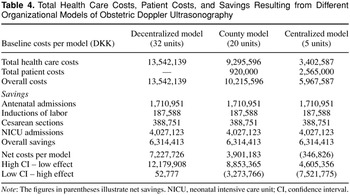
Total Health Care Costs, Patient Costs, and Savings Resulting from Different Organizational Models of Obstetric Doppler Ultrasonography
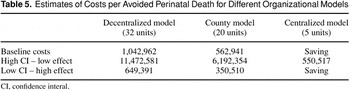
Estimates of Costs per Avoided Perinatal Death for Different Organizational Models
 You have
Access
- 2
- Cited by