Hereditary non-polyposis colorectal cancer (HNPCC) is an autosomal dominantly inherited disease. Surveillance by colonoscopy with removal of adenomas and colectomy/proctocolectomy in case of colorectal cancer (CRC) effectively reduces cancer risk and mortality (11;12). The Danish recommendations for colorectal surveillance in\break HNPCC families are colonoscopy and removal of adenomas every second year from the age of 25 in high risk families and every second year from the age of 45 in most of the moderate risk families, for example late onset. More than one third of all families referred to counseling in Denmark have a moderate risk of CRC. There are no systematic population-based CRC screening programs in Denmark.
Cost-effectiveness studies of HNPCC have tended to focus upon detection of mutation carriers (5;6;13;16– 18) . The outcomes in these studies have largely been the cost per detected mutation carrier or the incremental cost-effectiveness of alternative strategies to detect mutation carriers. Kievit et al. (2005) estimate cost-effectiveness of a new strategy (microsatellite instability analysis) for detecting HNPCC among the population of colorectal cancer patients compared with current practice. The only study that evaluates the cost-effectiveness of HNPCC surveillance versus no surveillance finds the surveillance strategy dominant (i.e., both lower costs and better effect) (23). Both Kievit et al. (2005) and Vasen et al. (1998) evaluate cost-effectiveness of high risk families only. On the one hand, this tends to overestimate cost-effectiveness of surveillance programs because it fails to include surveillance costs connected to families at moderate risk. On the other hand, failing to take advantage of the effectiveness of surveillance for families with moderate risk of CRC could result in cost-effectiveness being underestimated.
The present study evaluates the cost-effectiveness of HNPCC surveillance versus no surveillance with the Danish surveillance program as base case. The model allows for assessing the isolated cost-effectiveness of high and moderate risk programs as well as various scenarios for genetic testing and genetic counseling. The research question posed is whether surveillance of both high risk and moderate risk families is cost-effective compared with a no surveillance strategy.
METHODS
Study Design/Interventions
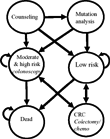
We developed a Markov model to evaluate cost-effectiveness (Figure 1). For simplicity, we assume that all individuals enter at age 25 (even though surveillance is first offered to moderate risk families at age 45). We use a Markov cycle length of 1 year. Individuals enter the model when referred for genetic counseling and either enter the different surveillance programs or are excluded from this if they have no increased risk of CRC.

Simplified Markov state diagram of the surveillance andthe no-surveillance strategies.
The two-headed arrows from the risk stages to the CRC stage indicate the risk of metachronous colorectal cancer. The no-surveillance strategy omits the counseling and mutation analysis stages and merges the two risk stages.
The surveillance program is modeled in three steps: (i) genetic counseling and mutation testing, (ii) colonoscopic surveillance of individuals at increased risk, (iii) colectomy with ileorectal anastomosis or proctocolectomy at onset of CRC (and chemotherapy at onset for late stage CRC [Dukes C and D]). The costs of these steps are accumulated in the surveillance strategy. In the no-surveillance strategy, only costs of segmentary colon resection (and chemotherapy at late stage CRC) are accumulated. After genetic counseling and testing, the individuals are categorized into one of four risk-groups: (i) high risk with identified mutation, (ii) high risk with unidentified mutation, (iii) moderate risk, or (iv) low risk.
High risk is defined as families that fulfill the Amsterdam I or II criteria with or without an identified mutation. The Amsterdam I criteria are: (i) at least three family members with CRC, one of them being a first-degree relative, (ii) at least two successive generations are affected, (iii) one with CRC before age 50, and (iv) familial adenomatous polyposis is excluded. In Amsterdam II criteria, CRC may be exchanged with endometrial, small bowel, or upper urinary tract cancer. Moderate risk refers to families suspected of HNPCC although not fulfilling the criteria, for example, late-onset HNPCC where none of the affected family members are under 50 years of age. Low risk refers to sporadic CRC.
Mutation screening was performed by sequencing the exons and the exon–intron junctions of the MLH1 and MSH2 genes.
Surveillance is offered for both high risk groups and for the moderate risk group, but not for the low risk group. Cost-effectiveness is defined as the incremental costs per life year gained for an average individual of the population referred to genetic counseling. The decision analysis program Treeage Pro (TreeAge Software, Inc., Williamstown, MA) is used to evaluate the model.
Data
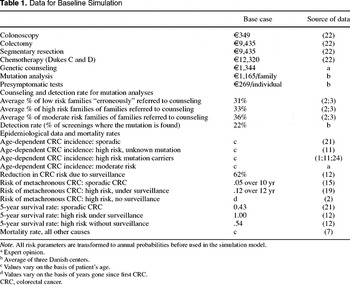
Costs for colonoscopy, colectomy with ileorectal anastomosis, proctocolectomy, segmentary colon resection, and chemotherapy are based on the Danish Diagnosis Related Group rates from 2004 (22), whereas costs for genetic counseling and mutation testing is based on expert opinion and calculations from the screening centers, respectively (Table 1). All cost parameters are converted from Danish Kroner (DKK) to Euro (€) using an average exchange rate for 2004 (1 € = 7.44 DKK). Genetic counseling is assessed at a cost of €1,344 per family (Table 1).

Since 1991, The national Danish HNPCC Register has registered epidemiological and molecular–genetic information on all Danish HNPCC families and suspected HNPCC families in a PARADOX database system and a corresponding pedigree program. The Register identifies HNPCC families and recommended screening programs, as do the other genetic departments in Denmark, and all the data are collected in the database, including the results of screening.
The annual number of Danish families referred to genetic counseling averaged around 110 families in the period 1999–2001 inclusive. After genetic risk assessment, 31 percent of the families were defined as low risk, 33 percent were defined as having a moderate risk, and the remaining 36 percent were considered high risk families. The mutation analysis resulted in identification of a mutation in 22 percent of the high risk families. In families with identified mutation, the mutation carriers (50 percent) belong to the high risk with identified mutation, and 50 percent did not carry the mutation and were consequently in the low risk group.
Epidemiologic Data and Mortality Rates
Incidence of colorectal cancer is modeled in 10-year age intervals based on Järvinen et al. (1995) (11). The cancer incidence for the moderate risk group is not known but is assumed to be three times the cancer incidence of the low risk group in each age interval. The lifetime risks of colorectal cancer are 3.3 percent, 10.8 percent, 46 percent, and 80–90 percent for the low risk, moderate risk, high risk with unknown mutation, and high risk with identified mutation, respectively (11;21). The stage distribution of CRC under surveillance (77 percent detected at an early stage—Dukes A or B) and without surveillance (48 percent detected at an early stage—Dukes A or B) is modeled using Danish data (4).
Rodriguez-Bigas et al. (1997) estimate of the risk of rectal cancer after colectomy is used to model the risk of metachronous cancer after colectomy (19). Estimates from the Danish HNPCC registry are used to model the risk of metachronous colorectal cancer after segmentary colon resection for the high risk group under surveillance (2). Estimates of metachronous colorectal cancer for the low risk group are taken from Myrhøj et al. (15). It is assumed that the moderate risk group has the same risk of metachronous colorectal cancer as the low risk group. Mortality rates are taken from Järvinen et al. (2000) (12), whereas the risk of death of other causes is estimated from mortality and population statistics from Statistics Denmark (7). We use the estimate by Järvinen et al. (2000) of a 62 percent reduction in incidence as a result of surveillance for the high risk as well as for the moderate risk group (12).
Sensitivity Analysis and Discounting
The available data provide little information about parameter variation and uncertainty. It is increasingly being recommended that sensitivity analysis is performed using stochastic modeling and cost-effectiveness acceptability curves. However because of the limited information on parameter uncertainty and because we are particularly interested in changes in specific very uncertain parameters (as, e.g., the risk of CRC for the moderate risk group), we have chosen to use traditional univariate sensitivity analysis.
It is recommended that costs and life years be discounted at 3 percent and to perform sensitivity analysis at 0 percent and 5 percent discounting (20). Because cost is expected up front and gains in life years occur in the future, discounting heavily devaluates the cost-effectiveness of prophylactic interventions (9). To obtain the most conservative estimate of cost-effectiveness, we use 5 percent discounting in the base case simulations. Sensitivity analysis is done to assess the effect of parameter uncertainty in cost estimates, cancer incidence and effectiveness of surveillance. Finally simulations are performed to assess various scenarios for genetic testing and genetic counseling.
RESULTS
Three sets of simulation results are provided: (i) price per gained life year under base case assumptions, (ii) price per gained life year under variation in pivotal base case assumptions (sensitivity analysis), and (iii) price per gained life year under alternative surveillance program setups (scenario analysis).
Base Case Results
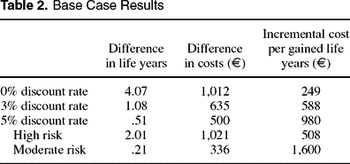
Simulation with base case assumptions results in incremental cost per life year gained on €249, €588 and €980 with 0 percent, 3 percent, and 5 percent discounting, respectively (Table 2). Disaggregated to high and moderate risk groups, the incremental costs per life year are estimated to €508 and €1,600, respectively (at 5 percent discounting).

Sensitivity Analysis
Sensitivity analysis is performed for parameters based on expert opinion, on costs related to surveillance (colonoscopy, counseling, genetic testing), and on the reduction in CRC incidence due to surveillance. The impact of changes in other parameters is covered in the scenario analysis.
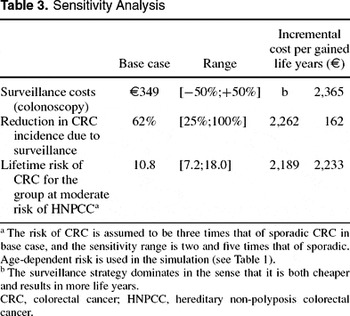
Colonoscopy costs have the largest influence on the results. If costs of colonoscopy were reduced with 50 percent, then surveillance becomes the dominant strategy, that is, surveillance is both cheaper and results in more life years than a case without surveillance. Variation in costs on genetic counseling and testing has less influence on the results (Table 3).

The risk of colorectal cancer for the moderate risk group is in base case assumed to be three times that of sporadic CRC incidence. This finding turns out to be a very important parameter. Sensitivity analysis reveals that cost-effectiveness has an inflection point in connection to this parameter: both higher (five times sporadic CRC) and lower incidence (two times sporadic CRC) increases the incremental costs per life year gained (€2,189 and €2,283 compared with €980).
Järvinen's result of a 62 percent reduction in CRC risk due to surveillance is used in base case. If this parameter were reduced to 25 percent, then cost-effectiveness would fall by 130 percent (€2,262 compared with €980). If it increases to 100 percent, cost-effectiveness would increase by 84 percent (€162 compared with €980).
Scenario Analysis
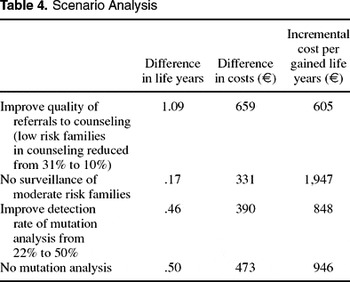
If surveillance were not offered to families at moderate risk then the incremental costs for a gained life year is estimated at €1,947. Cost-effectiveness would fall by around 40 percent (€605 compared with €980) if the number of low risk families referred to counseling could be reduced from 31 percent to 10 percent (Table 4). Increasing the detection rate of mutation analysis from the current 22 percent to 50 percent can improve cost-effectiveness by almost 15 percent (€848 compared with €980). Omitting mutation analysis hardly affects the incremental cost per gained life year (€946 compared with €980).

DISCUSSION
The strength of the present study is the use of data from the Danish HNPCC database to build a simulation model that explicitly models the consequence on cost-effectiveness of: (i) no criteria for referral to genetic counseling, which means that also low risk families would be referred; (ii) families with unknown mutation referred to surveillance; and (iii) surveillance strategies for families at moderate risk of CRC. The focus is on cost-effectiveness of surveillance versus no surveillance, while most studies analyze cost-effectives when comparing various screening strategies.
The estimated cost per gained life year when surveillance of the moderate risk group was omitted was €1,947. Of interest, including the moderate risk group in a surveillance program suggested a huge reduction on the cost per gained life year; €980 vs. €1,947. This finding is probably because the costs of counseling of the moderate risk group had already been effected, but failing to pursue the potential gain in life years from colonoscopic surveillance would result in poor cost-effectiveness. Sensitivity analysis revealed another interesting result—namely that cost-effectiveness has an inflection point in connection to the risk of CRC for the moderate risk group. At first this might seem somewhat odd, but a plausible explanation could be that, if the risk of CRC is very low, then the benefits of surveillance are reduced and cost-effectiveness falls. If on the other hand the risk is high and tends toward that of the high risk group, then the surveillance strategy starting at age 45 is too late to take full advantage of the surveillance benefits, which then reduces cost-effectiveness. It should be noticed however that even though cost-effectiveness is reduced with changes in the risk parameter of the moderate risk group the change is only marginal and does not alter the conclusion about cost-effectiveness.
Even with the most conservative assumptions, our results show that the price for a gained life year never exceeds €2,500. Compared with other healthcare interventions, this finding makes HNPCC surveillance extremely cost-effective. Devlin and Parkin (2004) evaluated the correlation between interventions accepted by the British National Institute for Clinical Excellence and cost-effectiveness rates. Of thirty-three accepted interventions, only three had incremental cost-effectiveness rates less than €2,500 (smoking cessation and nicotine replacement, use of cytology in cervical cancer, and topecetan treatment of ovarian carcinoma) (8).
Our findings of cost-effectiveness of the surveillance program were less favorable than those of Vasen et al. (23) but were in the same range as Kievit et al. (13). Vasen et al. found that a similar surveillance strategy dominated the no surveillance strategy (23), but this study only modeled mutation carriers. By omitting the costs of genetic counseling and risk assessment for hereditary CRC (HNPCC and moderate risk families) and the costs of surveillance for individuals with unknown mutation status, the cost estimates tended to be too low. Furthermore, the estimated cost-effectiveness tends to be too favorable because the study failed to discount life years. Vasen et al. found an undiscounted gain in life years of 7 years for mutation carriers. The estimated gain in life years for the high risk group in our study was estimated to 2 years at 5 percent discounting (Table 2), which amount to 9 years when life years were left undiscounted (not reported). Our estimated gain in life years was thus, compared with Vasen's result, more favorable probably because our model included the gained life years due to a reduction in metachronous cancer, not directly modeled in Vasen's study. In comparison, Kievit et al. (2005) estimated the gain in life years to 2.5 years under 4 percent discounting, almost identical to the 2 years found here with 5 percent discounting.
The results in this study did not consider the effect of possible improvements in detection of mutation carriers by using analysis of microsatellite instability and/or immunohistochemistry. Recent studies analyzed the effectiveness of these methods in various settings.
Kievit et al. evaluated the cost-effectiveness of using microsatellite instability analysis of selected families compared with current practice without microsatellite instability analysis: 2.2 times more mutation carriers were detected when using microsatellite instability analysis and an incremental cost per life year gained on €2,184 compared with current practice. In a population of 1,066 patients with newly diagnosed CRC, Hampel et al. (2005) found that no great loss in sensitivity would occur if microsatellite instability analysis was replaced by immunohistochemical analysis. They also found that identification of HNPCC families improved by using these methods on all CRC compared with using Amsterdam or Bethesda criteria (10;14). Pigatto et al. (2004) analyzed 138 families referred to genetic service and found that the strategy in achieving the highest sensitivity for the lowest cost in identification of germline mutation in MLH1 and MSH2 was to use sensitive clinical criteria followed by immunohistochemistry and, if this was normal, then microsatellite analysis (16). The results of these three studies indicate that cost-effectiveness of surveillance versus no surveillance could be even more favorable than estimated in the present study if microsatellite instability analysis and/or immunohistochemical analysis were introduced before carrying out expensive mutation analysis.
POLICY IMPLICATIONS
The results of the present study show that cost-effectiveness of surveillance programs for HNPCC families tends to be underestimated in cases where the decision model does not consider surveillance for families at moderate risk of CRC. More restrictive criteria for referrals to genetic counseling and improvements in the detection rate of mutation analysis have a potential to improve cost-effectiveness even further. More effective mutation screening has already been implemented in the form of including the MSH6 gene (and in rare cases the PMS2 gene also) and deletion analysis of the MLH1, MSH2, and MSH6 genes. This will strengthen the results of this cost-effectiveness analysis even more. The policy implications of the results is that surveillance ought to be offered to high as well as moderate risk groups.
CONTACT INFORMATION
Kim R. Olsen, MSc (Econ) (kro@dsi.dk), Project Manager, DSI Danish, Institute for Health Services Research, Dampfaergevej 27-29, 2100 Copenhagen, Denmark
Stig E. Bojesen, MD, PhD (stig.bojesen@dadlnet.dk), Senior Registrar, Department of Clinical Biochemistry, Copenhagen University Hospital, Bispebjerg, Bispebjerg Bakke 23, DK-2400 Copenhagen, Denmark
Anne-Marie Gerdes, MD, PhD (anne-marie.gerdes@ouh.fyns-amt.dk), Consultant Clinical Geneticist, Department of Biochemistry, Pharmacology and Genetics, Odense University Hospital, Sdr. Boulevard, DK-5000 Odense C, Denmark
Karen Lindorff-Larsen, MD (lindorff@dadlnet.dk), Associate Professor, Centre Postgraduate Medical Education, Aarhus University 8000 Aarhus, Denmark; Consultant Surgeon, Department of Surgical Gastroenterology, Aalborg Hospital, Aarhus University, Hobrovej, 9000 Aalborg, Denmark
Inge T. Bernstein, MD, PhD (inge.bernstein@hh.hosp.dk), Consultant, HNPCC Register, Department of Surgical Gastroenterology, Hvidovre Hospital, Kettegaard Alle, 2650 Hvidovre, Denmark
The study was funded by DSI Institute for Health Services Research. There are no competing interests. This study was carried out in connection with a National Health Technology Assessment and comments and motivation from colleagues in this study group are acknowledged. We thank Sarah Wordsworth for helpful comments on the manuscript.