Introduction
To thrive, organizations may need their workforce to engage in idea championing, such that their employees go out of their way to promote innovative ideas that ensure and advance organizational well-being (Howell, Reference Howell2005; Perry-Smith & Mannucci, Reference Perry-Smith and Mannucci2017). When employees present and seek support for their innovative ideas, they can contribute to the success of their employer while also generating benefits for themselves. For example, they might enjoy a sense of personal satisfaction from this process (Kim, Hon, & Crant, Reference Kim, Hon and Crant2009) and enhance their reputation among organizational leaders who appreciate their efforts (Kissi, Dainty, & Tuuli, Reference Kissi, Dainty and Tuuli2013). Yet discretionary work behaviors, including idea championing, also create some important challenges. For example, they require substantial energy, may be distracting, and could compromise employees' abilities to meet their regular job requirements (Bergeron, Reference Bergeron2007; Quinn, Spreitzer, & Lam, Reference Quinn, Spreitzer and Lam2012). Moreover, championing efforts may be perceived as intrusive by other organizational members, particularly if the proposed ideas are disruptive or threaten existing privileges (Hon, Bloom, & Crant, Reference Hon, Bloom and Crant2014; Walter, Parboteeah, Riesenhuber, & Hoegl, Reference Walter, Parboteeah, Riesenhuber and Hoegl2011). In light of these challenges, it is critical to understand when employees might hesitate to engage in idea championing, such as when they already suffer from various workplace adversities, as well as how personal factors could influence this process (Fugate & Soenen, Reference Fugate and Soenen2018).
Extant research primarily focuses on the roles of favorable work conditions in spurring employees' championing efforts, such as network centrality (Wichmann, Carter, & Kaufmann, Reference Wichmann, Carter and Kaufmann2015), job control (De Clercq, Sun, & Belausteguigoitia, Reference De Clercq, Sun and Belausteguigoitia2018), or technology involvement (Lin, Ku, & Huang, Reference Lin, Ku and Huang2014). We instead focus on a possible inhibitor of idea championing – the extent to which employees suffer from workplace incivility (Cortina, Magley, Williams, & Langhout, Reference Cortina, Magley, Williams and Langhout2001; Liu, Zhou, & Che, Reference Liu, Zhou and Che2019). Workplace incivility is a resource-depleting work condition that can manifest in various ways, including when coworkers make demeaning or derogatory remarks, ignore or exclude peers from professional exchanges, or put them down in front of others (Loh & Loi, Reference Loh and Loi2018; Taylor, Bedeian, & Kluemper, Reference Taylor, Bedeian and Kluemper2012). This persistent phenomenon permeates many organizations (Jiang, Chai, Li, & Feng, Reference Jiang, Chai, Li and Feng2019; Porath & Pearson, Reference Porath and Pearson2013), though limited attention has been devoted to its potentially harmful effects on employees' efforts to promote innovative organizational improvement ideas. The primary goal of this research then is to investigate why and when employees' exposure to workplace incivility may steer them away from idea championing.
First, we postulate that an important conduit through which this adverse work condition might decrease idea championing is that employees ruminate about the possibility of quitting their jobs (Haar, de Fluiter, & Brougham, Reference Haar, de Fluiter and Brougham2016; Mai, Ellis, Christian, & Porter, Reference Mai, Ellis, Christian and Porter2016). According to COR theory, employees who suffer from resource-draining work circumstances tend to respond in ways that help them protect their existing resource reservoirs by releasing their frustrations (Hobfoll, Reference Hobfoll2001; Hobfoll, Halbesleben, Neveu, & Westman, Reference Hobfoll, Halbesleben, Neveu and Westman2018). In line with this argument, we conceive of employees' quitting plans as coping mechanisms through which they unleash their irritations with workplace incivility on the employing organization (Sguera, Bagozzi, Huy, Boss, & Boss, Reference Sguera, Bagozzi, Huy, Boss and Boss2016); ultimately, it may culminate in diminished idea championing (Janssen, Reference Janssen2000). That is, suffering from workplace incivility, once it reaches a substantial enough level, may decrease employees' propensity to promote innovative ideas, because they seek to conserve their energy to protect and advance their own career rather than ‘waste’ it on their employer.
Second, we also draw from COR theory to argue that employees' motivation to express their frustration with incivility may be mitigated if they also have access to personal resources that help them cope with the experienced hardships (Hobfoll & Shirom, Reference Hobfoll, Shirom and Golembiewski2000). In particular, motivations to express frustration through active plans to quit and diminished idea championing among victims of workplace incivility might be lower if those victims also are equipped with high levels of dispositional self-control (Maloney, Grawitch, & Barber, Reference Maloney, Grawitch and Barber2012). This personal resource is a stable trait that reflects an individual capacity to exert self-control and resist temptation in difficult situations (Tangney, Baumeister, & Boone, Reference Tangney, Baumeister and Boone2004). It also may function as a sort of protective shield against the threats that stem from rude coworker behaviors (Meier & Gross, Reference Meier and Gross2015), limiting the need to escape the current employment situation and keeping them motivated to promote innovative ideas that can support their organization.
With this approach, we seek to contribute to extant research in multiple ways. First, we apply the COR framework to theorize and empirically demonstrate how the hardships associated with resource-draining workplace treatment may hinder employees' persistent efforts to push their innovative ideas (Hobfoll & Shirom, Reference Hobfoll, Shirom and Golembiewski2000). In doing so, we investigate a hitherto overlooked outcome of workplace incivility and an ignored determinant of idea championing, by addressing a critical factor that connects the two: Employees feel fed up with their employment situation and want to leave (Joo, Hahn, & Peterson, Reference Joo, Hahn and Peterson2015). By considering a mediating role of quitting intentions, we advance insights into how and why employees might blame the disrespectful treatment they receive from coworkers on the employing organization (Chen & Wang, Reference Chen and Wang2019; Mackey, Bishoff, Daniels, Hochwarter, & Ferris, Reference Mackey, Bishoff, Daniels, Hochwarter and Ferris2019) and the resulting detrimental consequences. Notably, such plans can initiate a negative spiral that features even more hardships for victims of workplace incivility: Not only do they feel frustrated with an employer that seemingly endorses rude coworker behaviors (Porath & Pearson, Reference Porath and Pearson2013), but their reluctance to engage in idea championing might prevent them, and the organization, from identifying innovative solutions to the problem (Perry-Smith & Mannucci, Reference Perry-Smith and Mannucci2017; Van de Ven, Reference Van de Ven1986).
Second, we address calls for research that adopts contingency approaches to study how employees react to workplace incivility (Fida, Spence-Laschinger, & Leiter, Reference Fida, Spence-Laschinger and Leiter2018; Liu, Zhou, & Che, Reference Liu, Zhou and Che2019). Employees might respond less negatively to experienced incivility to the extent that they can draw from valuable organizational resources such as team building or personal management interventions (Sguera et al., Reference Sguera, Bagozzi, Huy, Boss and Boss2016), as well as personal resources such as resilience (Al-Hawari, Bani-Melhem, & Samina, Reference Al-Hawari, Bani-Melhem and Samina2020) or grit (Kabat-Farr, Walsh, & McGonagle, Reference Kabat-Farr, Walsh and McGonagle2019). We add to this research stream by specifying a buffering role of dispositional self-control resources (Maloney, Grawitch, & Barber, Reference Maloney, Grawitch and Barber2012). This view also complements previous studies that indicate the instrumental role of dispositional self-control in helping employees deal with other sources of hardship, such as high pressure work environments (Landman, Nieuwenhuys, & Oudejans, Reference Landman, Nieuwenhuys and Oudejans2016), abusive supervision (Yuan, Xu, & Li, Reference Yuan, Xu and Li2020), or surface acting (Yam, Fehr, Keng-Highberger, Klotz, & Reynolds, Reference Yam, Fehr, Keng-Highberger, Klotz and Reynolds2016). With this specific focus on dispositional self-control, we provide novel information for organizations, regarding their recruitment and retention efforts. If they seek out and maintain self-disciplined employees who can resist overreacting to challenging situations, it may break the aforementioned negative spiral. These employees appear more likely to remain loyal to their employer and work to keep advancing its success, even if they have to deal with others' rude behaviors at work.
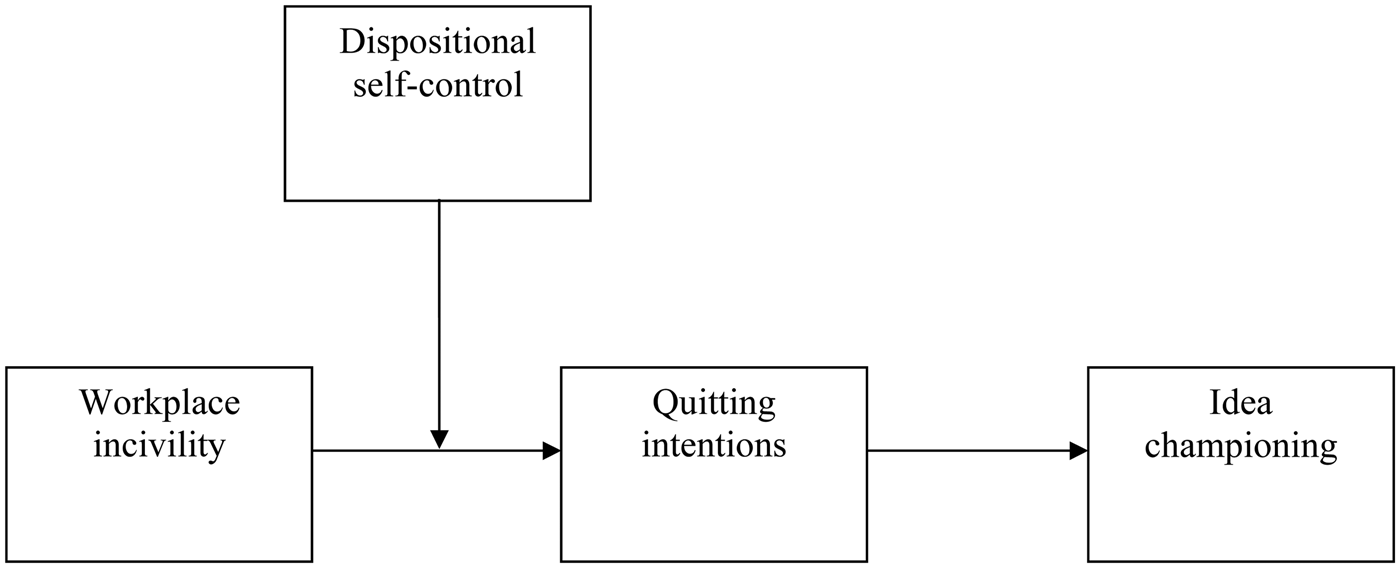
The theorized model, with its grounding in COR theory, is summarized in Figure 1. Employees who suffer from rude workplace treatment are more likely to develop plans to leave their organization, which decreases their propensity to go out of their way to mobilize support for innovative ideas. Their quitting intentions thus serve as critical paths through which workplace incivility escalates into diminished idea championing. Dispositional self-control in turn functions as a buffer; the translation of workplace incivility into reduced idea championing is less prominent among employees who are able to contain themselves due to their self-discipline.
Conceptual model.

Hypotheses
Mediating role of quitting intentions
We expect a positive link between employees' suffering from workplace incivility and their plans to quit their jobs. Consistent with COR theory (Hobfoll, Reference Hobfoll2001), the disappointments that employees experience when they are the victims of rude workplace treatment may drain their positive emotional resources to such an extent that they have no interest in staying employed (Sguera et al., Reference Sguera, Bagozzi, Huy, Boss and Boss2016; Sliter, Sliter, & Jex, Reference Sliter, Sliter and Jex2012). That is, their quitting plans offer a means to cope with their disillusions and release their frustrations, in ways that make them feel better about themselves (Ghosh, Reio, & Bang, Reference Ghosh, Reio and Bang2013; Mackey et al., Reference Mackey, Bishoff, Daniels, Hochwarter and Ferris2019). Employees exposed to rude treatment at work likely interpret the negative treatment as evidence that organizational leaders do not care for their personal well-being (Gabriel, Butts, Yuan, Rosen, & Sliter, Reference Gabriel, Butts, Yuan, Rosen and Sliter2018; Lim, Cortina, & Magley, Reference Lim, Cortina and Magley2008). Further, employees who blame their employer for not being able to limit their exposure to others' incivility during the execution of their job tasks may consider this situation a signal that their dedicated work efforts are not appreciated (Schilpzand, De Pater, & Erez, Reference Schilpzand, De Pater and Erez2016; Welbourne, Gangadharan, & Esparza, Reference Welbourne, Gangadharan and Esparza2016). They accordingly take revenge by making concrete plans to leave, which they consider highly justified.
Ruminations about the possibility of leaving, in turn, may diminish the likelihood that employees go out of their way to promote innovative ideas. Such ruminations might be so energy consuming and distracting that employees simply lack the stamina to mobilize support for the ideas (Guo, Plummer, Lam, Wang, Cross, & Zhang, Reference Guo, Plummer, Lam, Wang, Cross and Zhang2019; Quinn, Spreitzer, & Lam, Reference Quinn, Spreitzer and Lam2012). In line with COR theory, employees' quitting intentions thus might decrease their ability to find the energy resources that are needed to share and sell their ideas to others (Hobfoll & Shirom, Reference Hobfoll, Shirom and Golembiewski2000). Moreover, employees who have lost an interest in staying employed likely are less concerned about whether their organization is successful (Nuhn, Heidenreich, & Wald, Reference Nuhn, Heidenreich and Wald2019). They accordingly should be less motivated to stretch themselves to add to organizational effectiveness with dedicated championing activities (Walter et al., Reference Walter, Parboteeah, Riesenhuber and Hoegl2011). These employees, while looking for better employment opportunities, have little desire to help their organization and thus are reluctant to support it with effortful, discretionary championing activities (Mai et al., Reference Mai, Ellis, Christian and Porter2016). Their ruminations about the advantages of quitting reaffirm their sense that their organization does not deserve their diligent efforts, which motivates them to limit any idea championing.
The combination of these arguments suggests a pertinent mediating role of quitting intentions, as mechanisms that underpin the link between workplace incivility and idea championing. When employees blame the employing organization for failing to protect them from coworkers' rude treatment, they likely refuse to function as constructive idea champions to help an organization in which they do not see a future for themselves (Chen & Wang, Reference Chen and Wang2019; Sguera et al., Reference Sguera, Bagozzi, Huy, Boss and Boss2016). Prior research similarly reveals mediating roles of other relevant factors in the link between incivility and negative work outcomes, such as job insecurity (Shin & Hur, Reference Shin and Hur2020), burnout (Liu, Zhou, & Che, Reference Liu, Zhou and Che2019), or job-related anxiety (De Clercq, Haq, & Azeem, Reference De Clercq, Haq and Azeem2020). As an extension, we propose that employees' quitting plans mediate the translation of their suffering from workplace incivility into diminished idea championing.
Hypothesis 1: Employees' quitting intentions mediate the relationship between their exposure to workplace incivility and idea championing.
Moderating role of dispositional self-control
We predict a buffering effect of dispositional self-control on the indirect negative relationship between workplace incivility and idea championing through quitting intentions, as critically informed by the reduced likelihood that self-disciplined employees respond to negative workplace treatment with a desire to leave. According to COR theory, the resource-depleting effect of unfavorable work conditions is subdued to the extent that employees can counter the resource losses with valuable personal resources (Hobfoll, Reference Hobfoll2001). Employees with strong self-control are better placed to deal with the challenges of rude coworker treatment, because they are able to suppress the negative feelings that result from this source of workplace adversity (Landman, Nieuwenhuys, & Oudejans, Reference Landman, Nieuwenhuys and Oudejans2016; Meier & Gross, Reference Meier and Gross2015). This enhanced coping ability in turn reduces their need to vent their irritations with limited organizational protections against such rudeness (Mackey et al., Reference Mackey, Bishoff, Daniels, Hochwarter and Ferris2019). In addition, employees equipped with high levels of self-control may experience adverse work situations as attractive, to the extent that their ability to deal effectively with others in these situations generates a sense of personal achievement (Balliet, Li, & Joireman, Reference Balliet, Li and Joireman2011; Tangney, Baumeister, & Boone, Reference Tangney, Baumeister and Boone2004). That is, dispositional self-control may boost employees' ability to cope with the difficulties of workplace incivility while also producing a sense of satisfaction, because they prove themselves able to remain loyal to an organization, even though it condones negative work behaviors (Ryan & Deci, Reference Ryan and Deci2000).
These arguments for a mitigating role of dispositional self-control, in tandem with the mediating role of quitting intentions, suggest a moderated mediation dynamic (Preacher, Rucker, & Hayes, Reference Preacher, Rucker and Hayes2007). In this prediction, the personal resource is a critical contingency of the indirect relationship between workplace incivility and idea championing, through the desire to leave. For self-disciplined employees (Maloney, Grawitch, & Barber, Reference Maloney, Grawitch and Barber2012), the role of a desire to find better employment opportunities, as a mechanism that explains the translation of rude workplace treatment into a reluctance to promote innovative ideas, becomes subdued. In contrast, a belief that ‘the grass might be greener elsewhere’ is a likely reaction to resource-draining workplace incivility among employees who lack self-control (Meier & Gross, Reference Meier and Gross2015; Yuan, Xu, & Li, Reference Yuan, Xu and Li2020), in which case their irritations with the resource-depleting work conditions are more likely to escalate into diminished championing efforts (Hobfoll et al., Reference Hobfoll, Halbesleben, Neveu and Westman2018). When employees cannot count on their own strong self-discipline (Tangney, Baumeister, & Boone, Reference Tangney, Baumeister and Boone2004), their quitting plans become more important for explaining how exposures to workplace incivility undermine their idea championing.
Hypothesis 2: The indirect negative relationship between employees' exposure to workplace incivility and idea championing, through enhanced quitting intentions, is moderated by their dispositional self-control, such that this indirect relationship is weaker among employees with stronger dispositional self-control.
Research method
Sample and data collection
To test the hypotheses, we collected survey data from a large organization in Mexico that operates in the retail sector and sells a variety of home-related products, such as kitchen appliances, bathroom fixtures, flooring, and furniture.Footnote 1 Our focus on a retail organization is purposeful and informed by the high levels of stress and intra-organizational competition that mark Mexico's retail sector (Sanchez-Bayardo, Gonzalez, & Iacovone, Reference Sanchez-Bayardo, Gonzalez and Iacovone2018), in which dysfunctional coworker behaviors, including incivility, likely are not uncommon (Xu et al., Reference Xu, Huang, Jia, Xu, Liu, Graham and Snape2020). This organization also maintains an internal, integrated system that coordinates employee activities across different areas (e.g., sales, logistics, administration) and generates substantial interdependence among coworkers, which in turn may increase the probability that interpersonal tensions arise in their daily interactions (Cortina et al., Reference Cortina, Magley, Williams and Langhout2001; Porath & Pearson, Reference Porath and Pearson2013). Finally, the retail sector in Mexico is marked by high turnover rates and intensive competitive rivalry, such that retailers experience strong pressures to keep their best employees and find innovative ways to improve their internal functioning, relative to competitors' (Merino & Ramirez-Nafarrate, Reference Merino and Ramirez-Nafarrate2016). Our examination of how employees may respond to disrespectful coworker treatment with plans to quit and reluctance to champion ideas for organizational improvement – as well as how pertinent personal resources can mitigate this detrimental process – accordingly is highly relevant for this study context. The focus on one industry also avoids a key issue with multi-industry studies, namely, that they must account for unobserved industry-related differences that likely inform the innovative behaviors employees display (Bodlaj & Cater, Reference Bodlaj and Cater2019; Jansen, Vera, & Crossan, Reference Jansen, Vera and Crossan2009).
Setting our study in the national context of Mexico also responds to broader calls to investigate the negative consequences of adverse work conditions in Latin American settings (Pooja, De Clercq, & Belausteguigoitia, Reference Pooja, De Clercq and Belausteguigoitia2016; Valadez-Torres, Maldonado-Macías, Garcia-Alcaraz, Camacho-Alamilla, Avelar-Sosa, & Balderrama-Armendariz, Reference Valadez-Torres, Maldonado-Macías, Garcia-Alcaraz, Camacho-Alamilla, Avelar-Sosa and Balderrama-Armendariz2017) and is particularly interesting because of how two cultural factors may influence the proposed conceptual model in opposite ways. On the one hand, the high levels of uncertainty avoidance in Mexican culture imply that employees may suffer greatly from others' uncertainty-invoking rude behaviors (Hofstede, Hofstede, & Minkov, Reference Hofstede, Hofstede and Minkov2010). Negative reactions, quitting intentions, and subsequent reductions in idea championing then would be more likely. On the other hand, its high levels of collectivism may prompt a need to exhibit loyalty to the employing organization (Baeza & Wang, Reference Baeza and Wang2016), such that the victims of workplace incivility might be less inclined to punish the employing organization with negative responses. In light of these contrasting dynamics, Mexico offers an interesting study setting, with additional practical value for any company that competes in country settings that share similar cultural characteristics.
For the survey development, we used a translation–back-translation process (Brislin, Lonner, & Thorndike, Reference Brislin, Lonner and Thorndike1973), in which the original English version was translated into Spanish by bilingual translator, then back-translated into English by another translator. After a correction of minor discrepancies, the final survey was presented in Spanish. By leveraging the professional contacts of one of the authors, we contacted the organization's senior management and received approval for the study. The sample frame was the entire roster of the organization's employees, which its human resource department provided to us. From this roster, we randomly selected 250 employees for possible participation, using a random digit generator to avoid selection bias. Various efforts helped protect the rights of the participating employees. For example, we promised all participants full confidentiality and emphasized that their individual responses would never appear in any research output, by explaining that our research interest was solely in the average patterns across aggregate data. We also assured them that their employer would have no information about who decided to participate and that they could withdraw from the study at any point in time. Finally, the survey instructions included the reassurances that there were no good or bad answers, but that it was important for everyone to complete the survey as honestly as possible, to ensure the validity of the results. Among the 250 contacted employees, 162 completed the survey. Of these participants, 51% were women, 28% had a university degree, 57% had worked for the organization for more than five years, 38% had supervisory responsibilities, and they represented different functional areas (62% in sales, 21% in logistics, and 17% in administration).
Measures
The four central constructs were assessed with previously validated measurement scales, applying seven-point Likert anchors that ranged from ‘strongly disagree’ (1) to ‘strongly agree’’ (7).
Workplace incivility
We measured employees' exposure to rude coworker behaviors with a seven-item scale of workplace incivility (Cortina et al., Reference Cortina, Magley, Williams and Langhout2001). For example, participants rated whether ‘My coworkers put me down or are condescending to me’ and ‘My coworkers make demeaning or derogatory remarks about me’ (Cronbach's alpha = .90).
Quitting intentions
To measure employees' plans to leave their organization, we applied a five-item scale of turnover intentions (Bozeman & Perrewé, Reference Bozeman and Perrewé2001). It included measures of respondents' agreement with the following items: ‘At the present time, I am actively searching for another job in a different organization’ and ‘I intend to quit my job soon’ (Cronbach's alpha = .85).
Idea championing
We measured employees' efforts to promote innovative ideas with a three-item scale of idea championing (Janssen, Reference Janssen2000), including ‘I often mobilize support for innovative ideas’ and ‘I often make important organizational members enthusiastic about innovative ideas’ (Cronbach's alpha = .87). Our reliance on a self-rated measure of idea championing is consistent with previous studies (Lin, Ku, & Huang, Reference Lin, Ku and Huang2014; Wichmann, Carter, & Kaufmann, Reference Wichmann, Carter and Kaufmann2015) and with the argument that other raters, such as supervisors or colleagues, might not have an adequate understanding of the complete set of championing activities that employees engage in, because such activities can target various members of the organization (Howell & Boies, Reference Howell and Boies2004; Kissi, Dainty, & Tuuli, Reference Kissi, Dainty and Tuuli2013; Markham, Reference Markham1998)
Dispositional self-control
We assessed employees' dispositional self-control with a four-item scale that captures their ability to exercise restraint and resist temptation (Maloney, Grawitch, & Barber, Reference Maloney, Grawitch and Barber2012). Two sample items were, ‘People would say that I have iron self-discipline’ and ‘I am good at resisting temptation’ (Cronbach's alpha = .79).
Control variables
The analyses included five control variables: gender (1 = female), education (1 = university degree), organizational tenure (1 = less than 6 years, 2 = between 6 and 10 years, 3 = between 11 and 15 years, 4 = between 16 and 20 years, 5 = between 21 and 25 years, 6 = between 26 and 30 years, 7 = more than 30 years), job level (1 = supervisory responsibilities), and job function (sales, logistics, or administration, with the last category serving as the base category). Female employees tend to have lower propensities to fight for their ideas and seek to sell them to others, compared with their male counterparts (Detert & Burris, Reference Detert and Burris2007); highly educated, longer tenured, and higher ranked employees instead may feel more confident about their ability to develop and promote new ideas (De Clercq, Sun, & Belausteguigoitia, Reference De Clercq, Sun and Belausteguigoitia2018; Gong, Kim, Lee, & Zhu, Reference Gong, Kim, Lee and Zhu2013).
Construct validity
To assess the convergent validity of the focal constructs, we performed a confirmatory factor analysis of a four-factor measurement model. The fit of the model was good: χ2(146) = 268.17, confirmatory fit index (CFI) = .93, incremental fit index (IFI) = .93, Tucker−Lewis index (TLI) = .90, and root mean-squared error of approximation (RMSEA) = .07. In addition, each measurement item had strongly significant factor loadings (significant at p < .001) on its corresponding constructs (Gerbing & Anderson, Reference Gerbing and Anderson1988), and the average variance extracted (AVE) values all were higher than the benchmark of .50 (Bagozzi & Yi, Reference Bagozzi and Yi1988). Evidence of the presence of discriminant validity also emerged: The AVE values for each construct were greater than the squared correlations of each of the construct pairs that they constituted (Fornell & Larcker, Reference Fornell and Larcker1981), and the fit of the unconstrained models in which the correlation between two constructs was free to vary was significantly better (Δχ2(1) >3.84, p < .05) than the fit of their constrained counterparts in which the correlations between constructs were forced to equal 1 (Lattin, Carroll, & Green, Reference Lattin, Carroll and Green2003).
Statistical analysis
The research hypotheses were tested with the Process macro (Hayes, Montoya, & Rockwood, Reference Hayes, Montoya and Rockwood2017). This approach estimates the significance of the individual paths between constructs; it also offers an encompassing assessment of the presence of mediation and moderated mediation effects, leading to its growing application in studies that theorize about and test such effects (e.g., Bayraktar & Jiménez, Reference Bayraktar and Jiménez2020; Skiba & Wildman, Reference Skiba and Wildman2019). A notable advantage of this approach is that it is based on a bootstrapping procedure and does not make assumptions about the normality of indirect or conditionally indirect effects (MacKinnon, Lockwood, & Williams, Reference MacKinnon, Lockwood and Williams2004).
To check for the presence of mediation, we assessed the indirect relationship between workplace incivility and idea championing through quitting intentions, and particularly the corresponding confidence interval (CI), as detailed in Model 4 of the Process macro. In this first stage, we observed the signs and significance levels of the direct paths between workplace incivility and quitting intentions and then between quitting intentions and idea championing. To assess the presence of moderated mediation, we estimated the CIs for the conditional indirect effects of workplace incivility at different values of dispositional self-control. As explicated in the Process macro, these CIs correspond with three distinct levels of the moderator (one standard deviation [SD] below the mean, at the mean, and one SD above the mean). Consistent with our conceptual framework, we used Model 7 in the Process macro to test for a moderating effect of dispositional self-control on the relationship between workplace incivility and quitting intentions, though not between quitting intentions and idea championing. A post hoc analysis affirmed that dispositional self-control did not significantly moderate this second relationship.
Results
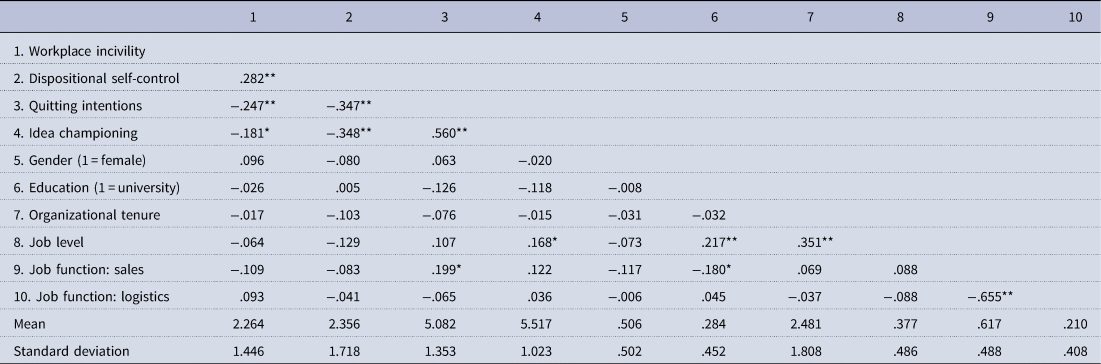
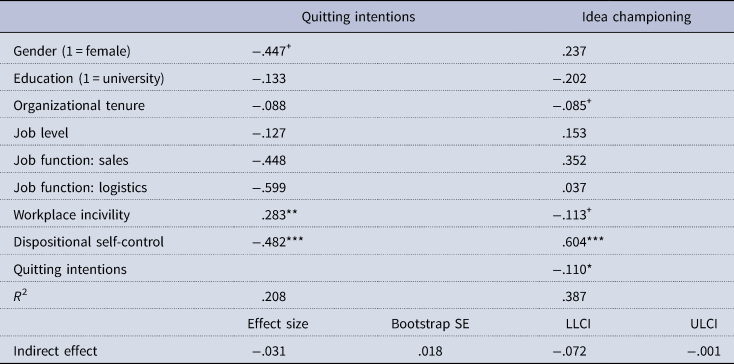
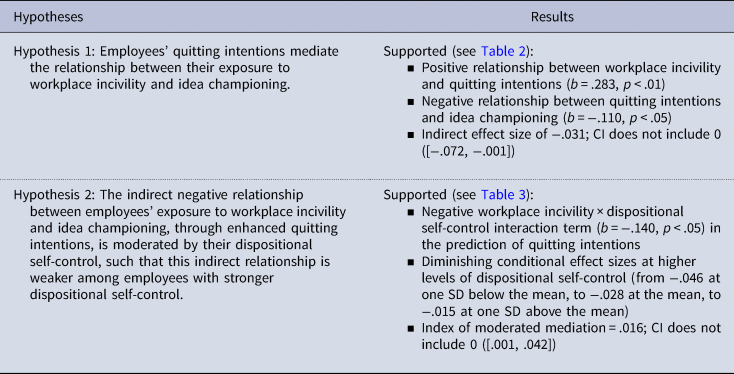
Table 1 summarizes the zero-order correlations and the descriptive statistics, and Table 2 shows the mediation results generated from the Process macro. The experience of workplace incivility spurs quitting intentions (b = .283, p < .01), which diminish idea championing (b = −.110, p < .05). The results with respect to the presence of mediation indicate an effect size of −.031 for the indirect relationship between workplace incivility and idea championing through quitting intentions; its CI does not include 0 [−.072, −.001], which confirms a mediating role of quitting intentions (Hypothesis 1).
Correlation table and descriptive statistics

Note: N = 162.
*p < .05; **p < .01.
Mediation results (Process macro)

n = 162; SE, standard error; LLCI, lower limit confidence interval; UCLI, upper limit confidence interval.
+p < .10; * p < .05; ** p < .01; *** p < .001.
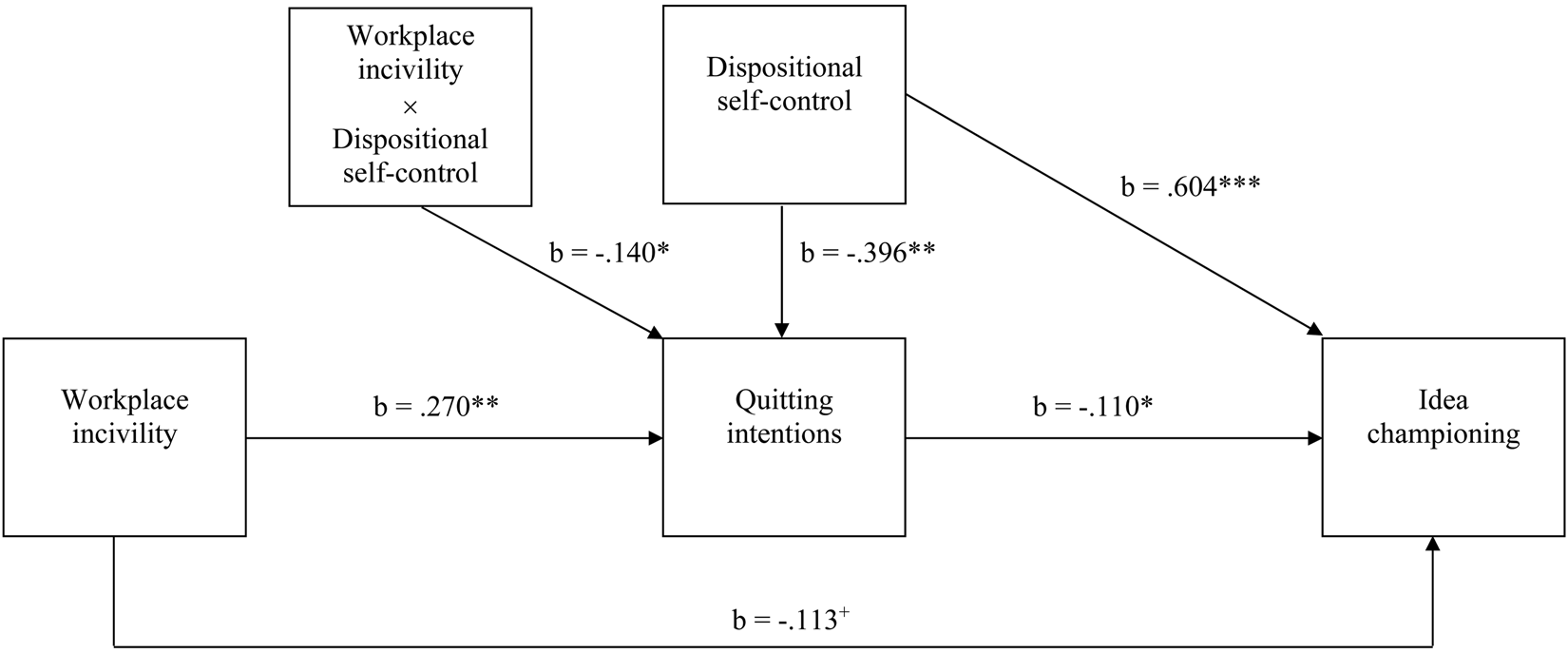
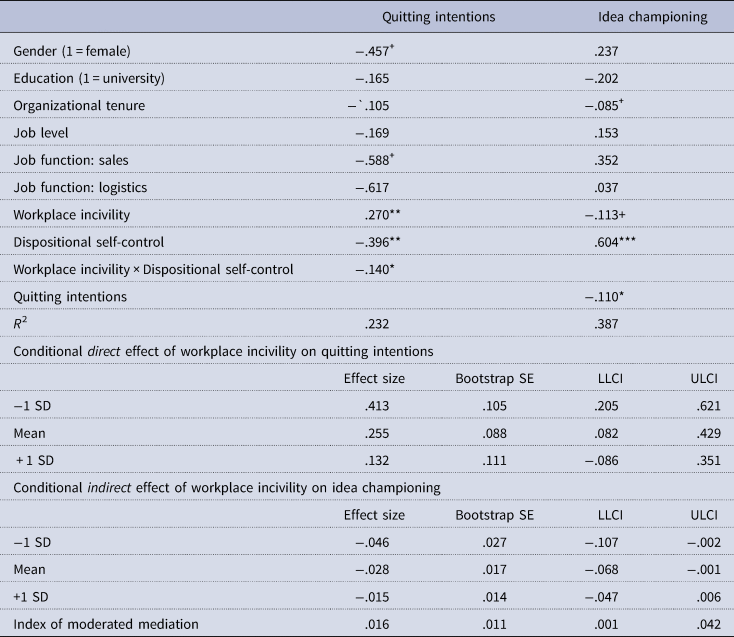
The results of the comprehensive moderation mediation model are in Table 3; we also depict them graphically in Figure 2. We find a negative, significant effect of the workplace incivility × dispositional self-control interaction term (b = −.140, p < .05) in the prediction of quitting intentions. The Process macro results indicate that the relationship between workplace incivility and quitting intentions weakens at higher levels of dispositional self-control (.413 at one SD below the mean, .255 at the mean, .132 at one SD above the mean). The associated CIs do not include 0 at the two lower levels of dispositional self-control ([.205; .621] and [.082; .429], respectively), but the CI does include 0 when this personal resource is high ([−.086; .351]). The direct test for the presence of moderated mediation similarly indicates diminishing effect sizes of the indirect relationship between workplace incivility and idea championing through quitting intentions (Table 3). In particular, these effect sizes decrease from −.046 at one SD below the mean, to −.028 at the mean, to −.015 at one SD above the mean. Again, the CIs do not include 0 at the two lower levels of the moderator ([−.107; −.002] and [−.068; −.001], respectively), but it does at its high level ([−.047; .006]). The presence of moderated mediation is further evidenced in the index of moderated mediation (Hayes, Reference Hayes2015), which equals .016, with a CI that does not include 0 ([.001; .042]). In other words, dispositional self-control mitigates the negative indirect link between workplace incivility and idea championing, in support of Hypothesis 2 and the study's overall theoretical framework. Table 4 summarizes each of the hypotheses and the corresponding statistical results.

Moderated mediation results (Process macro)

n = 162; SD, standard deviation; SE, standard error; LLCI, lower limit confidence interval; UCLI, upper limit confidence interval.
+p < .10; *p < .05; **p < .01; ***p < .001.
Hypotheses and empirical results

Discussion
With this study, we extend previous research by investigating the likelihood that employees' beliefs about workplace incivility escalate into diminished efforts to champion innovative ideas, and we clarify which factors might explain or influence this connection. Prior research has established that exposure to rude behaviors may steer employees away from productive behaviors, such as creativity (Zhan, Li, & Luo, Reference Zhan, Li and Luo2019) or organizational citizenship behavior (Mackey et al., Reference Mackey, Bishoff, Daniels, Hochwarter and Ferris2019), but it has not investigated the specific and relevant outcome of idea championing, let alone why and when this harmful translation may take place. Our focus on championing behavior reflects the argument that organizations benefit less from the creation of new ideas by employees than from employees' propensities to promote their ideas actively (De Clercq, Castañer, & Belausteguigoitia, Reference De Clercq, Castañer and Belausteguigoitia2011; Perry-Smith & Mannucci, Reference Perry-Smith and Mannucci2017). Among our contributions to extant research, we rely on COR theory (Hobfoll & Shirom, Reference Hobfoll, Shirom and Golembiewski2000) to propose that (1) employees avoid idea championing in the presence of rude workplace treatment because they desire to quit their jobs and (2) their dispositional self-control buffers this process. The empirical findings confirm these conceptual predictions.
A first key theoretical insight therefore is that the victims of resource-draining workplace incivility are less likely to undertake dedicated championing efforts for their innovative ideas, because they look for alternative employment opportunities. Consistent with the logic of COR theory, employees who undergo resource-draining, demeaning treatments at work interpret this precarious work situation as a sign that their employer exhibits little care for their individual and professional happiness (Loh & Loi, Reference Loh and Loi2018; Park and Haun, Reference Park and Haun2018); they release their associated irritations by making plans to leave (Rahim & Cosby, Reference Rahim and Cosby2016). These plans appear justified in this scenario. As we mentioned in the Introduction, such developments create a significant danger for organizations and their constituents: When intra-organizational exchanges already are marked by rudeness and disrespect, the ability to reverse or improve this negative situation may be compromised to the extent that employees, distracted by their quitting plans, are unable or unwilling to promote novel solutions to the problems (Walter et al., Reference Walter, Parboteeah, Riesenhuber and Hoegl2011).
As another theoretical insight, we show that this downward spiral (i.e., perceptions of rude coworker treatment lead to a sort of complacency) can be disrupted to the extent that employees possess high levels of self-control (Maloney, Grawitch, & Barber, Reference Maloney, Grawitch and Barber2012). Consistent with COR theory, the detrimental effect of resource-draining workplace incivility is subdued if employees can draw from personal resources that help them cope (Hobfoll & Shirom, Reference Hobfoll, Shirom and Golembiewski2000). The likelihood that victims of workplace incivility want to leave their organization is lower when they have high levels of self-control; they feel less threatened by workplace incivility because they are better equipped to deal with the associated negative emotions (Tangney, Baumeister, & Boone, Reference Tangney, Baumeister and Boone2004) and thus have less need to express their frustrations in the form of quitting intentions. They also may experience a sense of personal accomplishment if they can maintain a positive mindset toward the employing organization, despite the adversity that they experience at work (Balliet, Li, & Joireman, Reference Balliet, Li and Joireman2011), which further reduces their desire to vent and quit. This finding complements research that shows how dispositional self-control mitigates retaliation, in response to supervisor incivility, in the form of incivility toward that supervisor (Meier & Gross, Reference Meier and Gross2015). This buffering role of dispositional self-control also is especially insightful in combination with the intermediate role of quitting intentions. In particular, the irritations that result from derogatory coworker treatment are less likely to translate into diminished effort to promote innovative ideas – which could offer valuable solutions in terms of how to undo or counter this treatment (Perry-Smith & Mannucci, Reference Perry-Smith and Mannucci2017) – through a diminished desire among self-disciplined employees to abandon their organization.
Taken together, these findings explicate two pertinent and unexplored factors that underpin or affect the connection between workplace incivility and idea championing: quitting intentions and dispositional self-control. Previous studies indicate that the harmful effect of workplace incivility is not universal but is informed by employees' ability to diminish the associated hardships, by leveraging their grit or resilience for example (Al-Hawari, Bani-Melhem, & Samina, Reference Al-Hawari, Bani-Melhem and Samina2020; Kabat-Farr, Walsh, & McGonagle, Reference Kabat-Farr, Walsh and McGonagle2019). We offer a meaningful extension of these insights: Employees' dispositional self-control mitigates the mediating role of their plans to leave in the connection between workplace incivility and less productive work behaviors (i.e., idea championing). We accordingly establish an important means through which organizations can avoid the dual harms of disrespectful workplace treatment and diminished championing efforts, namely, by finding and counting on employees who exercise restraint even in adverse workplace situations (Landman, Nieuwenhuys, & Oudejans, Reference Landman, Nieuwenhuys and Oudejans2016).
Limitations and future research
This study admittedly has some limitations, which suggest avenues for additional research. First, some relationships may be subject to reverse causality. The positive energy that may arise with employees' ability to promote innovative ideas may spill over into beneficial perceptions about their employment situation in general, such that they exhibit lower quitting intentions and perceive less workplace incivility. The causal direction of the hypothesized relationships is anchored in the well-established COR framework – according to which resource-depleting workplace treatments spur a desire to vent frustration and hold back on energy-consuming behaviors that add to organizational effectiveness (Hobfoll et al., Reference Hobfoll, Halbesleben, Neveu and Westman2018) – but future research could measure the focal constructs at different points in time too and thus formally establish causality. Nor did we explicitly measure the underpinning mechanisms (i.e., motivations to unleash frustration on the organization and conserve energy resources). Future research with a longitudinal design could help address this issue.
Second, our investigation of the buffering role of dispositional self-control complements previous studies that pinpoint how this specific personal resource helps employees cope with adversity stemming from leadership (Yuan, Xu, & Li, Reference Yuan, Xu and Li2020) or goal progress (Rosen, Simon, Gajendran, Johnson, Lee, & Lin, Reference Rosen, Simon, Gajendran, Johnson, Lee and Lin2019) factors. Further research could examine the buffering effects of other personal factors too, such as employees' proactive personality (Jiang & Gu, Reference Jiang and Gu2015) or optimism (Cheng, Mauno, & Lee, Reference Cheng, Mauno and Lee2014). Moreover, favorable organizational circumstances could protect employees against the hardships of workplace incivility, such as trustworthy management (Holland, Cooper, Pyman, & Teicher, Reference Holland, Cooper, Pyman and Teicher2012) or an organizational climate that promotes change (Scott & Bruce, Reference Scott and Bruce1994). It would be useful to compare the relative potency of each of these alternative factors in offering a shield against rude workplace treatment, as well as how the mitigating role of dispositional self-control measures up against that of these factors.
Third, another limitation pertains to the empirical scope of this study, with its focus on one industry (retail) and country (Mexico). The industry-neutral character of the study's hypotheses implies that the signs of the hypothesized relationships should apply to most industries, yet their strength might vary with relevant industry characteristics. For example, in industries marked by limited employment opportunities, the lack of better options may leave victims of workplace incivility more reluctant to make plans to leave (Gardner, Huang, Niu, Pierce, & Lee, Reference Gardner, Huang, Niu, Pierce and Lee2015); instead, they might search for internal solutions to the experienced incivility, including developing their own innovative ideas. With respect to the national context, we noted two potentially opposing forces in Mexico: Risk aversion may generate strong negative reactions to uncertainty-inducing workplace incivility, but collectivism and the need to protect the organizational collective likely diminish employees' propensity to leave or stop promoting innovative ideas. The support we find for the hypotheses seems to suggest that the first force is stronger than the second, yet this interpretation is speculative. Further studies could undertake cross-country comparisons and explicitly examine how the strength of the hypothesized relationships varies with specific levels of different cultural characteristics (Hofstede, Hofstede, & Minkov, Reference Hofstede, Hofstede and Minkov2010).
Practical implications
This investigation of the interplay between workplace incivility and dispositional self-control, as it relates to the prediction of employees' quitting intentions and idea championing, is relevant for management practitioners. Organizations should be cognizant of the danger that deeply felt frustrations about demeaning workplace treatment will steer employees toward plans to consider alternative employment and away from efforts to promote innovative ideas that could address the negative situation. Employees who see themselves as victims of incivility may regard their suffering as evidence that organizational authorities do not care for their personal or professional well-being, to which they respond with plans to quit – plans that they likely keep to themselves. If they do not voice their disappointment with their employer's apparent embrace of incivility, it becomes more difficult for the firm to address the problem or retain employees (Schilpzand, De Pater, & Erez, Reference Schilpzand, De Pater and Erez2016). Thus, it is up to the organizations to create open forums to allow employees to express concerns, such as about rude workplace situations, and suggest pertinent solutions (Wang & Noe, Reference Wang and Noe2010). Alternatively, private communication channels, featuring formally appointed ombudsmen or ombudswomen, could give employees a means to share their struggles with unfavorable coworker treatments (Harrison, Hopeck, Desrayaud, & Imboden, Reference Harrison, Hopeck, Desrayaud and Imboden2013).
In addition to recommending efforts to address and eradicate demeaning workplace behaviors, this research provides valuable insights for organizational decision makers who are not able to accomplish this outcome, such as due to excessive work pressures or a persistently negative organizational culture (Porath & Pearson, Reference Porath and Pearson2013). To the extent that organizations can hire and retain employees who exhibit high levels of self-control in the presence of challenging work circumstances, they might diminish the risk that the grass seems greener elsewhere and that employees consider it useless to engage in energy-consuming championing efforts. In particular, organizations would benefit from identifying employees who enjoy a sense of personal accomplishment when they can exercise self-control and formulate positive instead of negative responses to experienced incivility (Ryan & Deci, Reference Ryan and Deci2000). These employees likely remain loyal to their employing organization and keep promoting innovative ideas for its improvement, even in the face of workplace incivility. They also could serve as role models, such that pertinent examples of how their ideas have helped resolve workplace incivility would inspire other employees who might have less self-control. Ultimately, these role models can contribute to a positive work environment in which employees develop a collective norm that limits negative coworker treatment, to the benefit of everyone.
Conclusion
This research adds to extant research by detailing the detrimental role of employees' perceptions of workplace incivility in spurring their quitting intentions and subsequent reluctance to promote innovative ideas, as well as a beneficial role of their dispositional self-control. The desire to find better employment opportunities is an important channel through which irritations about rude workplace treatments turn employees away from diligent championing efforts. The power of this underling mechanism depends, however, on the level of protection that employees enjoy due to their abilities to exercise self-control. The findings of this study might be used as a platform for additional research into how organizations can reduce the risk that one negative work situation (e.g., incivility) begets another (e.g., complacency in idea promotion) by considering a wider set of pertinent antecedents and outcomes.