Introduction
Sodium lactate infusions and CO2 inhalation regularly produce panic attacks in patients with panic disorder (PD) (Gorman et al. Reference Gorman, Askanazi, Liebowitz, Fyer, Stein, Kinney and Klein1984; Liebowitz et al. Reference Liebowitz, Fyer, Gorman, Dillon, Appleby, Levy, Anderson, Levitt, Palij, Davies and Klein1984a; Papp et al. Reference Papp, Klein and Gorman1993; Keck & Strohle, Reference Keck and Strohle2005). Distinctively, in most panic patients, both spontaneous and lactate-induced panic attacks produce subjective dyspnea (air hunger) and marked objective increases in tidal volume (TV) and respiratory frequency (Goetz et al. Reference Goetz, Klein, Gully, Kahn, Liebowitz, Fyer and Gorman1993; Martinez et al. Reference Martinez, Papp, Coplan, Anderson, Mueller, Klein and Gorman1996). Healthy control subjects usually respond to a sodium lactate infusion with minor, but definite, hyperventilation (Liebowitz et al. Reference Liebowitz, Gorman, Fyer, Levitt, Dillon, Levy, Appleby, Anderson, Palij, Davies and Klein1985). This has been replicated in a rat model (Olsson et al. Reference Olsson, Ho, Annerbrink, Thylefors and Eriksson2002).
Sodium lactate infusion causes a metabolic alkalosis. Therefore, a ventilatory decrease, producing increased CO2 retention, would be expected to maintain normal blood pH homeostatically. However, the opposite occurs, indicating a stimulatory respiratory effect of lactate, despite metabolic alkalosis.
Because an increase in the partial pressure of carbon dioxide (pCO2), in addition to increasing blood and brain lactate levels, signals impending asphyxiation, Klein (Reference Klein1993) advanced the integrative suffocation false alarm theory (SFA) of PD. The SFA posits that many seemingly spontaneous panic attacks are due to a dysfunctional, hypersensitive monitor for indications of impending suffocation. Enclosed still air, perceiving labored breathing and sighing inspirations, and also rising pCO2 levels, such as occur in deepening sleep, premenstrual and post-partum periods, may trigger this specific alarm system. The alarm instigates a flight to help (Preter & Klein, Reference Preter, Klein, Bellodi and Perna1998, Reference Preter and Klein2008).
This modular view of multiple adaptive brain systems evolved to deal with specific dangers is supported by Corfield et al. (Reference Corfield, Fink, Ramsay, Murphy, Harty, Watson, Adams, Frackowiak and Guz1995). In a positron emission tomography (PET) study of CO2-stimulated breathing in normal subjects, activation of limbic and specific cerebellar structures was demonstrated. Similarly, neuroimaging data from PET and functional magnetic resonance imaging (fMRI) implicate the cerebellum in the hypercapnic production of air hunger (Brannan et al. Reference Brannan, Liotti, Egan, Shade, Madden, Robillard, Abplanalp, Stofer, Denton and Fox2001; Parsons et al. Reference Parsons, Egan, Liotti, Brannan, Denton, Shade, Robillard, Madden, Abplanalp and Fox2001; Evans et al. Reference Evans, Banzett, Adams, McKay, Frackowiak and Corfield2002), a ‘compelling primal emotion like severe thirst’ (Liotti et al. Reference Liotti, Brannan, Egan, Shade, Madden, Abplanalp, Robillard, Lancaster, Zamarripa, Fox and Denton2001).
Pathological childhood separation anxiety frequently antecedes PD (Klein, Reference Klein1964; Gittelman & Klein, Reference Gittelman and Klein1984; Lipsitz et al. Reference Lipsitz, Martin, Mannuzza, Chapman, Liebowitz, Klein and Fyer1994; Biederman et al. Reference Biederman, Petty, Faraone, Hirshfeld-Becker, Henin, Brauer, Kaufman and Rosenbaum2006). It was noted that opioids decrease respiratory drive by blocking CO2 sensitivity. Opioids also decrease separation anxiety whereas the opioid antagonist naloxone was reported to exacerbated separation anxiety (Kalin et al. Reference Kalin, Shelton and Barksdale1988). Therefore, fluctuating opioidergic deficiency might underlie both separation anxiety and a hypersensitive suffocation monitor (Preter & Klein, Reference Preter, Klein, Bellodi and Perna1998, Reference Preter and Klein2008).
To explore opioidergic relevance, Liebowitz et al. (Reference Liebowitz, Gorman, Fyer, Dillon and Klein1984b) infused lactate, and subsequently naloxone preceding lactate, in panic patients with previous lactate sensitivity. However, the low naloxone pretreatment dose chosen (maximum 37.5 mg) did not intensify the lactate infusion response. It was then hypothesized that if clinically symptomatic patients were in a state of opioidergic deficiency, naloxone receptor blockade would have little effect. Conversely, in normal subjects, naloxone, by impairing opioidergic protection, should intensify lactate effects. An open pilot study (Sinha et al. Reference Sinha, Goetz and Klein2007) found that, in eight of 12 normal subjects, naloxone infusion (ranging from an initial 0.5 mg/kg to a maximum of 2 mg/kg), followed by intravenous (i.v.) lactate, caused significant TV increments, resembling clinical and lactate-induced panics. This seemed to be dose dependent. The four subjects receiving the maximum dose all manifested marked TV increments. Furthermore, four recalled subjects had no respiratory effect from naloxone alone. However, subjective panic reports were rare.
To extend these pilot findings, we conducted the present controlled, randomized experimental study. We also explored whether life events might influence our findings. Many animal data link endogenous opioid systems to separation and loss (Panksepp, Reference Panksepp2003; Preter & Klein, Reference Preter and Klein2008), and specifically to human panic (as opposed to fear). We investigated whether childhood parental loss (CPL) might cause a subclinical impairment of the opioidergic system. If so, a decrease in the anticipated robust respiratory response to the naloxone+lactate challenge would occur. Whether this opioidergic downregulation might induce a change in pain perception was also explored.
Previous work (Goetz et al. Reference Goetz, Klein, Gully, Kahn, Liebowitz, Fyer and Gorman1993; Martinez et al. Reference Martinez, Papp, Coplan, Anderson, Mueller, Klein and Gorman1996) in panic patients indicated that the major respiratory effect of apparently spontaneous panic was an increase in TV. Respiratory rate (RR) effects were relatively minor but might reinforce a minute volume (MV) increment (because MV is the multiple of TV and RR). Our primary hypothesis was that, in normal subjects given lactate infusions, randomized pretreatment with naloxone would cause larger increases in TV, RR and MV than pretreatment with saline. Our secondary hypotheses were that (1) pretreatment with naloxone, compared to saline, would increase subjective respiratory symptomatology (such as air hunger) during i.v. lactate, and (2) a history of CPL would interact with the respiratory measures, so that the amplifying effect of naloxone on the lactate infusion would be decreased. Finally, we explored pretreatment with naloxone with regard to reports of pain.
Method
Sample
Healthy volunteers were recruited by advertisement. The age range for female subjects was 18–40 years, to exclude menopausal women; the male age range was 18–50 years. Women were only tested immediately post-menses, after a negative pregnancy test. Subjects underwent a physical examination, routine blood and urine tests, and an electrocardiogram (ECG). The study was approved by the Institutional Review Board (IRB) of the New York State Psychiatric Institute and all participants provided written informed consent.
Exclusion criteria were current or past DSM-IV-defined psychiatric illness; clinically significant heart, lung or neurological condition; clinically significant irritable bowel syndrome, fibromyalgia, thyroid disease, premenstrual syndrome (PMS); menopause; application pending for medical disability; smoking; any sleep disturbance; a positive pregnancy test.
A trained telephone interviewer performed the initial screening, using a modified SCID (Spitzer et al. Reference Spitzer, Williams, Gibbon and First1992). Suitable volunteers were diagnostically interviewed by the research psychiatrist (M.P.). Eligible volunteers were further interviewed about potentially significant individual and family antecedents and frequent co-morbidities of panic, such as near-suffocation, pulmonary disease and migraine. Recent and childhood loss and separation events (parental divorce or death, childhood abuse) were reviewed specifically.
Protocol
We initially used a three-arm parallel groups design with 30 subjects randomized to naloxone+lactate (NL), 30 to naloxone+saline (NS), and 10 to saline+lactate (SL), with an interim analysis after 50% (n=35 subjects) of the target sample of 70 [reduced from 90 due to National Institute of Mental Health (NIMH) budget cuts]. This interim analysis was performed by both Columbia University (E.P.) and independent statisticians (M.V., S.H.L., S.K.). The project researchers remained blind.
The interim results showed that the concern that naloxone by itself might cause a significant ventilatory increment was unfounded (details on request). This was entirely consonant with the pilot trial by Sinha et al. (Reference Sinha, Goetz and Klein2007). Therefore, the NS condition was terminated. However, the NL v. SL contrast was non-significant because the SL sequence had a much greater magnitude and between-subject TV variability than previous experience suggested. Therefore, the protocol was changed, and IRB approved, to a randomized cross-over of NL and SL, administered on two different days.
Randomization
Given subject recruitment difficulties, seven subjects already tested under NL or SL agreed to be recalled, gave consent and were tested under the alternative condition. Six subjects previously NS tested and 14 new volunteers were randomized to the NL and SL sequences. However, two of the 14 randomized to (NL, SL) did not return after the first infusion, restricting this data analysis to 25 subjects with complete data. Although this procedure enabled only single observer blinding for recalled subjects, the data were generated by objective LifeShirt measures (Grossman, Reference Grossman2004), or self-reports.
Procedures
Subjects reported to the Biological Studies Unit at 0800 or 1200 h after overnight abstinence from food, liquids, caffeine and other stimulants. The LifeShirt apparatus was fitted. This non-invasive ambulatory, Food and Drug Administration (FDA)-approved monitor uses inductive plethysmography (IP) sensors to record respiratory and cardiac function (Grossman, Reference Grossman2004). Sensors include an accelerometer to record postural shifts. A continuous, spirometrically calibrated measurement of TV was recorded, in addition to RR and an ECG.
After negative urine toxicology, and a negative pregnancy test for females, an intravenous cannula was inserted into each arm's antecubital vein; one for infusions, the other for drawing blood.
Testing consisted of four phases. During phase 1, baseline measurements were recorded for 30 min. In phase 2 (first infusion), subjects received naloxone (2 mg/kg) or saline for 3 min based on the randomization assignment, followed by a 17-min rest period. In phase 3 (second infusion), subjects were switched to 0.5 m sodium lactate, 10 ml/kg, administered i.v. over 20 min. This replicates past lactate administrations exactly. Phase 4 (120 min) was the recovery/washout stage, with continued physiological and symptomatic safety monitoring of subjects, but too irregular to provide research data.
The research psychiatrist (M.P.) was present during the entire procedure to monitor physiological output parameters (blood pressure, pulse, respiration) and, as indicated, to confirm abnormal measures manually. The procedure was audio-visually recorded for quality control and further exploration.
Measures
Objective respiratory measurements (digitized 50 times per second) were used to compute the median TV, RR (breaths/min) and MV (product of TV and RR). The two treatment conditions (NL v. SL) were compared during the last 17 min of the lactate infusion. Subjective sensitivity was measured by the modified 17-item Acute Panic Inventory (API; Dillon et al. Reference Dillon, Gorman, Liebowitz, Fyer and Klein1987; Papp et al. Reference Papp, Martinez, Klein, Coplan, Norman, Cole, de Jesus, Ross, Goetz and Gorman1997), through non-verbal symptom reports. The Borg Breathlessness Scale (Borg, Reference Borg1982) is the standard dyspnea measure used by pulmonologists. Subjective scales were administered at baseline, and before and after each infusion period. The ‘Panic’ measure was the sum of eight API items (each scored from 0 to 3: API2/Fear of Dying; API3/Impending Doom; API5/Air Hunger; API6/Difficulty in Breathing; API9/Dizziness; API10/Confusion; API12/Feeling Detached from All or Part of Your Body; and API13/Sweating). ‘Pain’ (self-report) was a dichotomous measure indicating whole-body or head pain.
Statistical analysis
The enormous amount of functional data collected required preprocessing (trace artifact correction, baseline adjustment, thinning and noise removal by wavelet decomposition) before statistical comparisons could be made between NL and SL with respect to the respiratory response curves over time. A special analytic method was developed (Lee et al. Reference Lee, Lim, Vannucci, Petkova, Preter and Klein2008) to test the dominance of one mean curve over another, incorporating the correlation between repeated observations. The results, presented in Biometrics (Lee et al. Reference Lee, Lim, Vannucci, Petkova, Preter and Klein2008), a technical statistical journal, were in keeping with our respiratory hypotheses. However, the requirements of a largely non-statistical readership led us to this simpler analysis and exposition.
The repeated measurements of median TV, RR and MV were plotted for each subject against time, assessing the shape of the trajectories under NL and under SL during the 17 min before the end of the lactate infusion. The repeated measures were modeled as functions of time (with linear and quadratic terms), experimental condition (NL or SL) and its interaction with time, while controlling for the baseline value of each measure. To account for the correlation between repeated observations on the same subjects, mixed-effect models were used with random intercepts, slopes and curvature for each subject-by-condition, in addition to random subject effects. Non-significant interaction terms were removed one by one, preserving the hierarchical principle that, if a higher-order term is significant, the lower-order terms that comprise it remain in the model. NL v. SL contrasts are based on these final models. The effect of CPL on NL v. SL contrasts was assessed, by adding terms for CPL plus CPL interactions and using the model selection procedure outlined above.
The effect of pretreatment with naloxone on the ‘Panic’ and ‘Pain’ measures was similarly assessed by generalized linear models (GLMs). ‘Pain’, a dichotomous measure, was modeled with logit link; ‘Panic’ (a sum of eight API measures, scored 0–3) was modeled with a gamma link. The distribution of the sum did not deviate from gamma distribution. To account for the potential correlation between the values of the same subject's outcomes under NL and SL conditions, mixed-effect GLMs were used. The effect of CPL on the difference between NL and SL with respect to subjective measures was assessed, similar to the effects on respiratory measures.
NL and SL challenges were randomly administered on two different days. The effect of order (NL first v. SL first) was not significant and is not reported here.
Although our hypotheses were directional, two-tailed tests were performed using α=0.05. All analyses were performed using SAS 9.1.3 (SAS Institute Inc., USA); the mixed-effects models were fit using Proc mixed, glimmix and genmod.
Results
NL/SL effect on respiratory measures
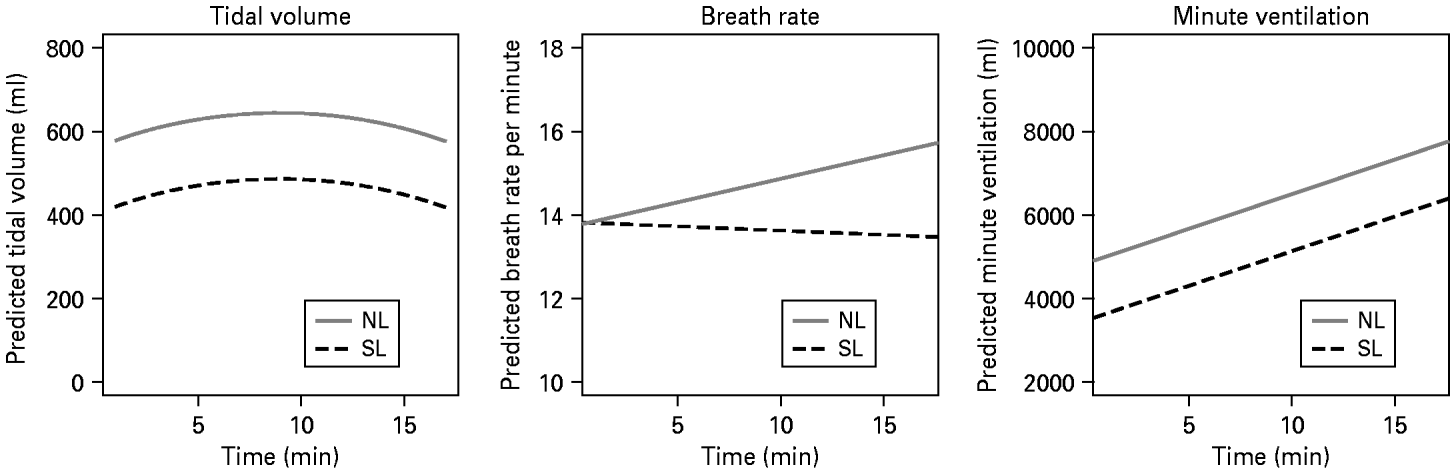
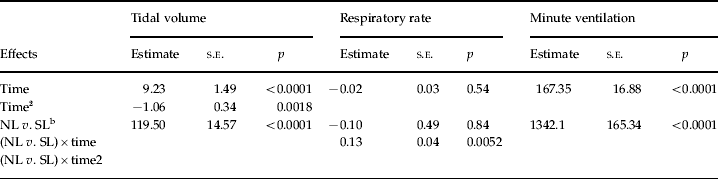
The final models for TV, RR and MV measures are reported in Table 1. Fig. 1 represents model-based mean trajectories for TV, RR and MV over the last 17 min of the lactate infusion. As predicted, TV during lactate infusion is higher during NL than during SL, and this effect starts almost immediately. The quadratic effects indicate that the initial increments plateau for both SL and NL groups. RR during lactate is also higher for NL than SL, but this appears in the interaction of treatment by time; that means that the NL effect on RR is initially negligible but steadily increases over time. Note that simply analyzing for a mean effect over the entire infusion would have missed this effect. Finally, MV during lactate under both NL and SL increases steadily during the infusion and at all times is uniformly larger for NL than SL.
Tidal volume, respiratory rate, and minute ventilation responses in normal subjects to intravenous (i.v.) lactate preceded by naloxone (NL) versus i.v. lactate preceded by saline (SL): all subjects.

Effect of condition (NL v. SL) over the 17 min before the end of the lactate infusionFootnote a

NL, Naloxone+lactate; SL, saline+lactate; s.e., standard error.
a Only effects that are present in the final model are reported. The modeling begins with all effects included. Non-significant effects (α=0.05) are eliminated one by one following the hierarchical principle: higher-order terms are eliminated first and lower-order terms are retained in the model regardless of their significance if a higher-order effect that contains them is significant.
b (NL v. SL) denotes an indicator for NL: NL=1, SL=0.
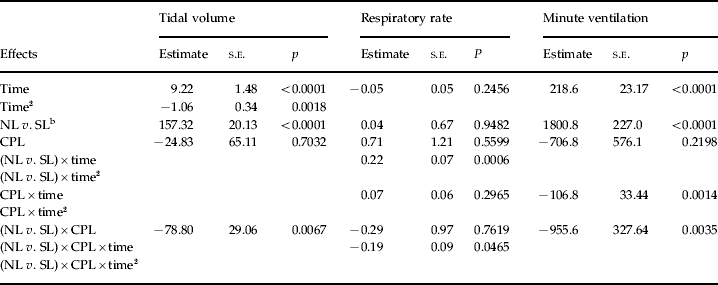
The initial clinical interview prospectively identified those exposed to CPL. In keeping with prior work (Brown & Harris, Reference Brown and Harris1978; Agid et al. Reference Agid, Shapira, Zislin, Ritsner, Hanin, Murad, Troudart, Bloch, Heresco-Levy and Lerer1999), we defined CPL as marked separations and disruptions (parental death or divorce) occurring prior to age 10. Thirteen probands (six females, seven males) had no history of CPL. Twelve (five females, seven males) had such antecedents. Eleven of the 12 CPL subjects (92%) had experienced parental separation or divorce in early childhood, one subject had lost his mother at age 4. The effects of CPL are summarized in Table 2.
Effect of CPL and condition (NL v. SL) over the 17 min before the end of the lactate infusionFootnote a

CPL, Childhood parental loss; NL, naloxone+lactate; SL, saline+lactate; s.e., standard error.
a Only effects that are present in the final model are reported.
b (NL v. SL) denotes an indicator for NL: NL=1, SL=0; CPL is an indicator for the presence of CPL.
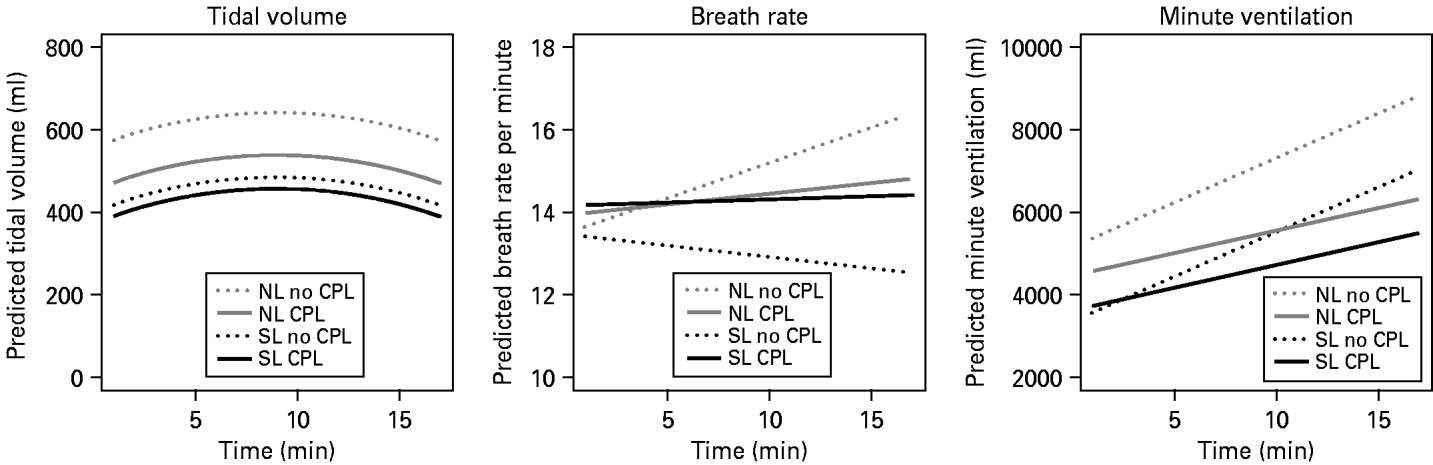
As Table 2 shows, there is no simple CPL effect: CPL only becomes significant by its interaction with condition (NL v. SL). Fig. 2 shows the final models for TV, RR and MV. Within each CPL group, NL is greater than SL. This difference is larger within the non-CPL group. In fact, there was no difference between NL and SL in the CPL group with respect to RR. As visual inspection suggests, for TV during NL exposure, the group without CPL was well above the other three conditions: a post-hoc analysis was performed contrasting the non-CPL group on NL against all other conditions showing very significant effects (p<0.0001).
Tidal volume, respiratory rate, and minute ventilation responses in normal subjects to intravenous (i.v.) lactate preceded by naloxone (NL) versus i.v. lactate preceded by saline (SL): interaction with childhood parental loss (CPL).

Secondary hypotheses: NL v. SL effect on subjective reports
Across all groups, there were no significant differences in subjective measures (API, Borg, physical pain) under NL v. SL. Taking CPL status into account did not affect these analyses.
Discussion
Normal subjects, usually relatively insensitive to the TV effects of lactate infusion, in this study, given opioid antagonist pretreatment, developed TV and RR increments resembling those occurring in both spontaneous clinical panic attacks and in panic patients who panic during lactate infusions (Gorman et al. Reference Gorman, Askanazi, Liebowitz, Fyer, Stein, Kinney and Klein1984; Liebowitz et al. Reference Liebowitz, Fyer, Gorman, Dillon, Appleby, Levy, Anderson, Levitt, Palij, Davies and Klein1984a; Papp et al. Reference Papp, Klein and Gorman1993). The hypothesis that a functioning endogenous opioid system buffers normal subjects from the behavioral and physiological effects of lactate is consonant with these results.
In this controlled, randomized study, we confirm the findings of the open pilot trial by Sinha et al. (Reference Sinha, Goetz and Klein2007), the only other naloxone-preceding-lactate study in normal subjects. As in Sinha's study, subjective reports of panic-like symptoms were insignificant. The absence of major measurable subjective responses to the naloxone–lactate challenge previously reported by Sinha et al. clearly limits inferences concerning affective reactivity. Subject-endorsed APIs were fairly low, under both NL and SL, and there was little correlation between respiratory API indices and TV increment. Perhaps even higher naloxone doses would have been required for a subjective panic attack to occur. Infusion speed might have played a role. We administered lactate as a slow drip over 20 min. In Sinha et al. (Reference Sinha, Goetz and Klein2007), the one subject receiving a high-speed lactate infusion, because of an inadvertently wide-open spigot, had a full-blown panic attack.
Earlier explorations of the endogenous opioid system using naloxone showed inconsistent results. Weinberger et al. (Reference Weinberger, Steinbrook, Carr, von Gal, Fisher, Leith, Fencl and Rosenblatt1985) did not find any effect of naloxone pretreatment on ventilatory responsiveness to 7% CO2 rebreathing, but the naloxone dose was only 10 mg. Subjective responses were not reported. By contrast, Pickar et al. (Reference Pickar, Cohen, Naber and Cohen1982), using 3–6 mg/kg naloxone in normal subjects, found ‘(t)he behavioral effects of high-dose naloxone comprised a rather distinct clinical syndrome characterized by irritability, anxiety, sadness, and confusion.’ This was accompanied by significant dose-dependent increments in RR.
To our knowledge, this is the first time that the prolonged physiological effects of actual separations and losses during childhood (i.e. parental death, parental separation or divorce) on the endogenous opioid system of healthy adults have been objectively shown in an experimental setting. The presence or absence of CPL antecedents determined the response to the naloxone–lactate probe. A history of CPL decreased the NL effect. The import of these findings is that analyses attempting to relate CPL to other baseline variables may well fail because CPL impact may be specific to challenges to the endogenous opioid system. Furthermore, based on our analysis of CPL v. non-CPL, the NL v. SL contrast across groups was largely a function of non-CPL reactivity to lactate if preceded by naloxone. The NL non-CPL group was most sensitive to the respiratory stimulation effect of lactate when preceded by opioid blockade.
It should be emphasized that these CPL effects were apparent in ‘normal’ subjects. In a society where divorce rates approach 50%, the results raise the question whether current psychiatric classification and diagnostic scales are sensitive enough to detect CPL effects. This also applies to developing societies such as China, where the massive migration of mostly young individuals from the countryside to urban areas has left behind approximately 30 million small children (Liu et al. Reference Liu, Li and Ge2009).
CPL is a risk factor for adult anxious and depressive psychopathology (Kendler et al. Reference Kendler, Neale, Kessler, Heath and Eaves1992; Bandelow et al. Reference Bandelow, Spath, Tichauer, Broocks, Hajak and Ruther2002). However, its detrimental long-term effect is not limited to psychiatric illness (Shonkoff et al. Reference Shonkoff, Boyce and McEwen2009). Using criteria similar to ours, the Adverse Childhood Experiences (ACE) Study, a Centers for Disease Control and Prevention (CDC)-supported prospective cohort study of 16 908 adults, found a significant relationship between CPL and premature death in adulthood (Brown et al. Reference Brown, Anda, Tiemeier, Felitti, Edwards, Croft and Giles2009). Retrospective (e.g. Juang et al. Reference Juang, Wang, Fuh, Lu and Chen2004; Kopec & Sayre, Reference Kopec and Sayre2005) and prospective longitudinal data (Fearon & Hotopf, Reference Fearon and Hotopf2001; Harter et al. Reference Harter, Conway and Merikangas2003; Katerndahl, Reference Katerndahl2008; Jones et al. Reference Jones, Power and Macfarlane2009) link family disruption, physical abuse, separation and maternal loss in early life to chronic physical pain in adulthood. Whether the NL v. SL probe has a differential effect on pain perception and physiological pain measures, and whether CPL status modifies this interaction, should be explored. Unfortunately, our exploratory pain measure was limited to a single item and, in retrospect, was clearly inadequate.
CPL as related to childhood separation anxiety, adult PD and suffocation hypersensitivity was studied by Battaglia et al. (Reference Battaglia, Pesenti-Gritti, Medland, Ogliari, Tambs and Spatola2009). In a large sample of twins from Norway, CPL accounted in no small part for ‘the covariation between separation anxiety in childhood, hypersensitivity to CO2 (as indexed by the anxiety response to a 35% CO2/65% O2 mixture), and panic disorder in adulthood’. Note that in Battaglia's study, CPL increased reactivity to the 35% CO2 probe.
The inclusion of a subgroup of single-blind, recalled subjects is methodologically suspect because recalled subjects have different expectancies from newly recruited subjects. Furthermore, the unblinded experimenter may have subtly changed the environment, although this is somewhat mitigated by our objective measurements. However, given the exigencies of funding and timing, such response bias could not be ascertained.
Our normal, NL-treated controls resemble non-fearful panic patients, an apparent contradiction. The DSM-IV (APA, 1994) criteria for a panic attack require the experience of intense anxiety or discomfort. The absence of anxiety or fear does not preclude panic. Kushner & Beitman (Reference Kushner and Beitman1990) extensively documented the non-fearful panic phenomenon. Epidemiological studies (Katon, Reference Katon1986) demonstrated that patients with PD often seek non-psychiatric treatment because the clinical presentation often comprises only somatic symptoms. The effect of CPL antecedents on this phenomenon requires further attention.
Testing the specificity of the naloxone–lactate model of clinical panic requires double-blind investigation whether specific anti-panic drugs, but not panic-irrelevant drugs, block this effect. If found, this has practical and heuristic implications. First, there is currently no specific, screening method for testing putative anti-panic drugs except by the experimental treatment of PD patients. The naloxone+lactate effect in normal humans may afford such a screening method, and may be extended to preclinical studies. Second, these data offer heuristic support for the theory that an opioidergic dysfunction is the pathophysiological mechanism underlying PD. If so, the appropriateness of opioidergic therapeutic agents comes into question. The use of morphine or other simple agonists would probably be rejected for fear of inducing addiction, although the evidence for addiction during indicated medical treatment is sparse. However, recent work with opioidergic mixed agonist-antagonists (Gerra et al. Reference Gerra, Leonardi, D'Amore, Strepparola, Fagetti, Assi, Zaimovic and Lucchini2006; Wallen et al. Reference Wallen, Lorman and Gosciniak2006), such as buprenorphine, may be relevant. The concern about addiction would be mitigated by the fact that higher doses become receptor blockers rather than agonists. Positive results would foster investigations into basic molecular mechanisms. For instance, we note that the dose of naloxone used in our study (2 mg/kg) substantially exceeds that needed for μ opioid receptor (MOR) blockade (Sluka et al. Reference Sluka, Deacon, Stibal, Strissel and Terpstra1999), suggesting a role for the δ opioid receptor (DOR). This could spark interest in the development of specific DOR agonists suitable for human use. Currently, such agents have not been developed, although agents suitable for animal use are available.
Acknowledgments
We thank our subjects, and M. De La Nuez and A. Karyat for their assistance with this study. Dr Vannucci is supported by NSF (DMS-0605001) and by NIH (R01 HG003319-01); Dr Klein by NIMH (MH-30906 and MH-067749).
Declaration of Interest
D. Klein is an unpaid member of the Scientific Advisory Board of Vivometrics, Inc.