INTRODUCTION
Parasites are ubiquitous components of all ecosystems, yet for a long time it was doubted that they have a significant impact on host fitness and population dynamics (Lack, Reference Lack1954). However, the last three decades have revealed an abundance of theoretical, experimental and field evidence that parasites and pathogens can be important factors for host population dynamics (e.g. Irvine et al. Reference Irvine, Corbishley, Pilkington and Albon2006). Host fitness revolves around a number of life-history traits: growth, reproduction and survival. These are closely connected, since available resources are limited and should be allocated in a way that optimizes fitness (Agnew et al. Reference Agnew, Koella and Michalakis2000). Parasites can have a direct or indirect influence on these factors by consuming energy resources, or redirecting them towards defence mechanisms or regenerative activities (Dobson, Reference Dobson1988; Sheldon and Verhulst, Reference Sheldon and Verhulst1996).
The European shore crab, Carcinus maenas, is one of the most commonly encountered large crustaceans along the coasts of north and west Europe. It is host to a number of parasites (reviewed by Torchin et al. Reference Torchin, Lafferty and Kuris2001) occurring in varying intensities and prevalences (e.g. Thieltges et al. Reference Thieltges, Hussel, Herrmann, Jensen, Krakau, Taraschewski and Reise2008). For decades, the main interest of parasitologists was focused on the cirriped Sacculina carcini, which forms conspicuous external brood sacks and castrates the crab host (Høeg, Reference Høeg1995). Other parasites, mainly helminths with sea bird final hosts, are extremely common as well. Microphallid trematodes (Maritrema subdolum, Microphallus claviformis, Microphallus similis) and an acanthocephalan (Profilicollis botulus) utilize C. maenas as intermediate host. However, reports on their influence on host fitness are scarce and mainly limited to grey literature (Lauckner, Reference Lauckner1986; Lauckner and Söhl, Reference Lauckner and Söhl1990).
Recently, interest has focussed on the role of parasite load in determining the success of this species as a marine and estuarine invader. An increase in crab size in invasive populations was linked with the loss or reduction of parasite richness and prevalence (Torchin et al. Reference Torchin, Lafferty and Kuris2001; Grosholz and Ruiz, Reference Grosholz and Ruiz2003), suggesting that parasites have a significant impact on host fitness in the native range (Torchin et al. Reference Torchin, Lafferty and Kuris2001). Support for this hypothesis was found for parasitic castrators like S. carcini, which reduces spermatogenesis and inhibits moulting and therefore growth (Rubiliani, Reference Rubiliani1983; Høeg, Reference Høeg1995), resulting in smaller crab mean size and biomass in populations with high prevalences of this parasite (Torchin et al. Reference Torchin, Lafferty and Kuris2001). However, very little is known about the role of helminth parasites, which are much more common than S. carcini in many areas (Thieltges et al. Reference Thieltges, Hussel, Herrmann, Jensen, Krakau, Taraschewski and Reise2008). It is the aim of this study to investigate a possible effect of helminth parasites on crab fitness. We examined native populations from Europe with varying parasite prevalences as well as invasive populations in South Africa and Australia in which, respectively, no and only non-European parasites were present. Data from the invasive populations provide a broader spectrum of parasite infestation than is available in native populations alone.
By focusing on resource allocation into reproductive effort, we were able to monitor 2 possible outcomes of reduced fitness caused by parasites. Firstly, a reduction in reproductive effort is possible by direct or indirect nutrient competition and resource allocation (Hurd, Reference Hurd2001). Secondly, parasite-induced mortality may lead to increased, or earlier, investment into reproduction to offset the shorter life-span (Agnew et al. Reference Agnew, Koella and Michalakis2000).
We used male testes weight as an indicator for resource allocation in reproductive effort. This is possible because male testes weight in C. maenas is linked to reproductive success: Styrishave et al. (Reference Styrishave, Rewitz and Andersen2004) showed that the 2 colour morphs encountered in this crab actually represent 2 life-history strategies. Red crabs are stronger, more successful in mating competitions and also have comparatively larger gonads (see Styrishave et al. Reference Styrishave, Rewitz and Andersen2004). For this benefit over green colour morph crabs they trade off growth and have an increased susceptibility towards hypoxic and salinity stress (Reid and Aldrich, Reference Reid and Aldrich1989; Reid et al. Reference Reid, Abelló, McGaw, Naylor and Aldrich1989). These and other studies (Schärer et al. Reference Schärer, Ladurner and Rieger2004) indicate that gonad weight and allocation to reproductive effort are linked, providing us with an easily measured indicator for field samples. In order to determine the potential effect of parasites on predation rate, we examined the crabs for autotomy. The loss of limbs as a method of predator avoidance is a common phenomenon in C. maenas and provides a measure of predation pressure (Smith and Hines, Reference Smith and Hines1991).
MATERIALS AND METHODS
Sampling methods
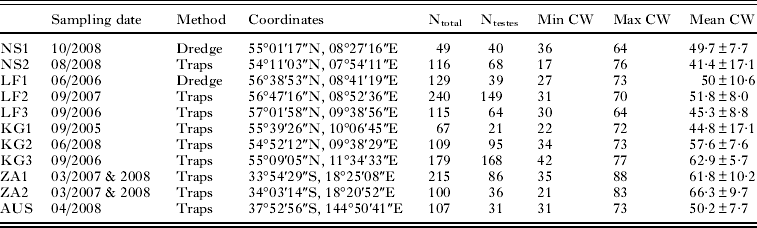
European C. maenas were collected between 2005 and 2008 from 3 populations in the eastern and western range of the Limfjord (LF1-3) and 3 areas in the Kattegat in the western part of the Baltic Sea (KG1-3). In addition, crabs from Helgoland and Sylt in the North Sea were caught in 2008 (NS1-2). Populations from South Africa were sampled in Cape Town and Hout Bay in 2007 and 2008 (ZA1-2). In Australia, crabs were caught in Port Phillip Bay in 2008 (AUS) (see Table 1). The crabs were caught in traps (mesh size max. 10 mm, opening min. 40 mm) and, in 2 cases, by dredge (see Table 1). In the laboratory they were transferred to tanks with filtered sea water in an overflow system and provided with crushed mussels or fish ad libitum twice a week. Excess food was removed after 3 h. The animals were kept in the laboratory for no more than 3 weeks. In the case of the North Sea samples, as well as 1 Kattegat sample and the crabs from Australia, no such facilities were available and the crabs were kept in aerated sea water or artificial sea water with the same feeding schedule.
Sampling dates, coordinates and methods for different locations

Dissection of crabs
Male crabs were killed prior to dissection by cooling in a freezer (−20°C) for 15–30 min, depending on size of the individual. We took care not to freeze the tissue, which would have complicated the dissection. During the dissection we removed the testes and carefully examined the visceral cavity, as well as the gills and abdomen, for parasites. The hepatopancreas of the crabs was digested overnight in approx. 0·6 g pepsin (Carl Roth GmbH, Karlsruhe, Germany) dissolved in 25 ml of filtered seawater and acidified with 6 drops of hydrochloric acid (32%, Carl Roth GmbH, Karlsruhe, Germany). The digested hepatopancreas tissue was filtered through a 200 μm sieve to retain metacercariae and cystacanths, and the residue examined for the presence and quantity of these parasitic stages. This allowed us to detect even small numbers of metacercariae, which are otherwise easy to miss. S. carcini infections are typically single infections. However, we distinguished between 3 intensity stages, ranging from few and translucent internal roots over a medium stage to a fully-grown dense internal root system.
The prepared testes were dried at 60°C to constant weight. To determine the size of the crab the carapace width (CW) was measured at its widest point. We also recorded the number of missing limbs lost due to autotomy. The incidence of autotomy is considered to be an indicator for predation pressure and can be indicative of higher susceptibility to predation in certain crab populations (Torchin et al. Reference Torchin, Lafferty and Kuris2001). Colour morph was determined visually following the method of McKnight et al. (Reference McKnight, Mathews, Avery and Lee2000). Individuals displaying green, white or yellow colouration of the ventral carapace were categorized as ‘green’, crabs with a red or orange ventral surface were considered ‘red’.
Statistical analysis
The two species of microphallid trematodes found, Microphallus claviformis and Maritrema subdolum, are difficult to distinguish at the metacercarial stage and were pooled.
Log-testes weight is a log-linear function of crab size. Expected testes weight can then be determined from the linear regression equation of log-testes weight on log-carapace width. We then calculated a reproduction index (RI) as the ratio of observed testes weight to expected testes weight. Styrishave et al. (Reference Styrishave, Rewitz and Andersen2004) found that testes weight is higher in red coloured morph crabs, and our own preliminary tests showed that sampling site influences testes weight significantly (ANCOVA, F=32·459, P<0·001). Both factors were eliminated for statistical analysis of parasite effects by calculating RI separately for sample sites and colour morphs. Subgroups with insufficient sample size for this procedure were not included in the statistical analysis. Statistical and graphical analyses of data were conducted with SPSS 17 and MS Excel XP.
RESULTS
Parasite prevalence
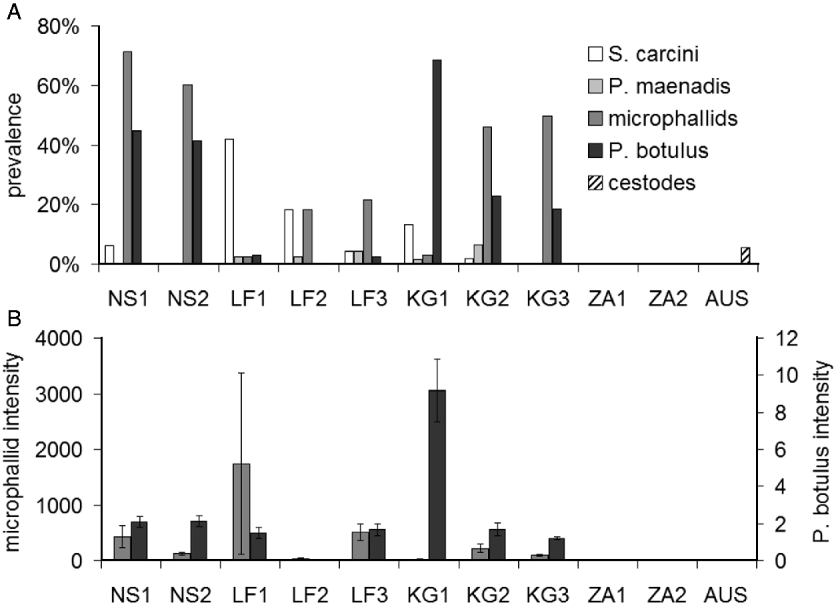
In Europe, we found 5 endoparasites: 2 species of microphallid trematodes, Microphallus claviformis and Maritrema subdolum, cystacanths of the acanthocephalan Profilicollis botulus, and 2 species of parasitic castrators, the cirriped Sacculina carcini and the isopod Portunion maenadis. Parasite prevalence, as well as intensity, varied greatly between sites (Fig. 1). However, trophically transmitted microphallids were typically most prevalent in open sea areas, while showing a lower prevalence within the Limfjord. P. botulus showed a similar distribution, but was mostly absent in the Limfjord. Parasitic castrators were found with variable prevalences in several European populations (Fig. 1), although in almost all cases they were less abundant than helminths.
(A) Prevalence of parasites in Europe, South Africa and Australia. (B) Mean intensity of microphallid and acanthocephalan parasites. All other parasites occurred in intensities of 1 only. Error bars indicate standard error. See Table 1 for sample sizes. Sampling location abbreviations: KG, Kattegat (Denmark); LF, Limfjord (Denmark); NS, North Sea (Germany); ZA, South Africa; AUS, Australia.

Both parasitic castrators occur as single infections only (Høeg, 1995). The intensities of microphallids could range as high as several thousand metacercariae in a single crab, whereas the larger cystacanths of P. botulus were only once found in intensities of over 50. High helminth intensities were not consistently connected with high prevalences (Fig. 1).
Invasive crab populations in South Africa, where we could sample 200 individuals, appeared to be completely parasite free. More than 100 crabs examined in Australia revealed low prevalences (under 5%) of 2 parasites that were previously described for the area (Gurney et al. Reference Gurney, Nowak, Dykova and Kuris2004; Gurney, Reference Gurney2006): the trypanorhynch Trimacracanthus aetobatidis and a nematode of the genus Proleptus. Both were found in intensities of only 1 parasite per crab.
Autotomy
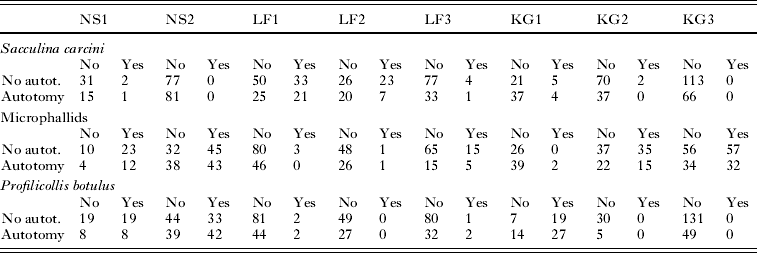
We found that autotomy is highly variable between populations, ranging from under 5% to 38% (see Table 2). In Europe there were significant differences between the 8 examined populations (Chi-square test: χ 27=12·391, P=0·006). There was no significant difference between the 2 South African populations, but a trend was present as well (Chi-square test: χ 2=5·546, P=0·062). Due to these differences, the role of parasites for autotomy was analysed for individual populations. Neither helminth parasites nor the castrator S. carcini had any significant influence on the frequency of autotomy in their host (see Table 2).
Number of crabs with missing limbs (autotomy) in different populations of Europe

Analysis of testes dry weight
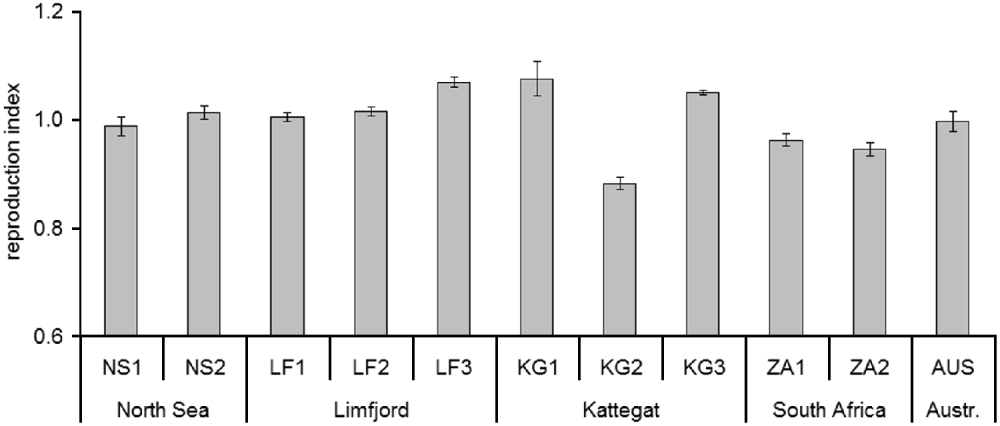
The reproduction index (RI) over all sampled crabs confirmed that both sampling site and parasite infection have a significant effect on testes weight (Kruskal-Wallis test: χ 2=229·157, P<0·001). A ranking of the different locations shows that the invasive sites are situated at the lower end of the testes weight spectrum, with only one North Sea and one Kattegat population on a similar or lower level (see Fig. 2).
Reproduction index in different populations of Carcinus maenas. Error bars indicate standard error. See Table 1 for sample sizes. Sampling location abbreviations: KG, Kattegat (Denmark); LF, Limfjord (Denmark); NS, North Sea (Germany); ZA, South Africa; AUS, Australia.

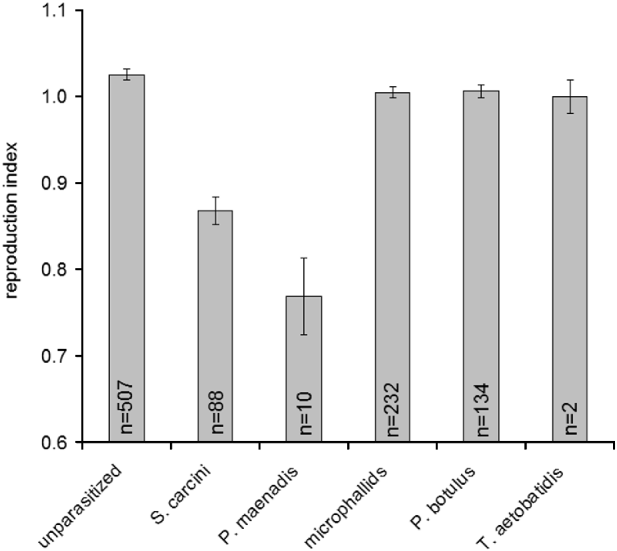
When testing unparasitized crabs and crabs with varying parasite infections, we found a significant difference (Kruskal-Wallis-test: χ 2=74·341, P<0·001). Pair-wise comparisons showed that both S. carcini (Mann-Whitney test: Z=−9·389, P<0·001) and P. maenadis (Mann-Whitney test: Z=−4·854, P<0·001) infected crabs had considerably smaller testes than uninfected crabs (see Fig. 3). There was no difference between crabs with and without either helminth infection (Fig. 3).
Reproduction index in crabs infected by different parasites. Sample size is given in individual columns. Error bars indicate standard error.

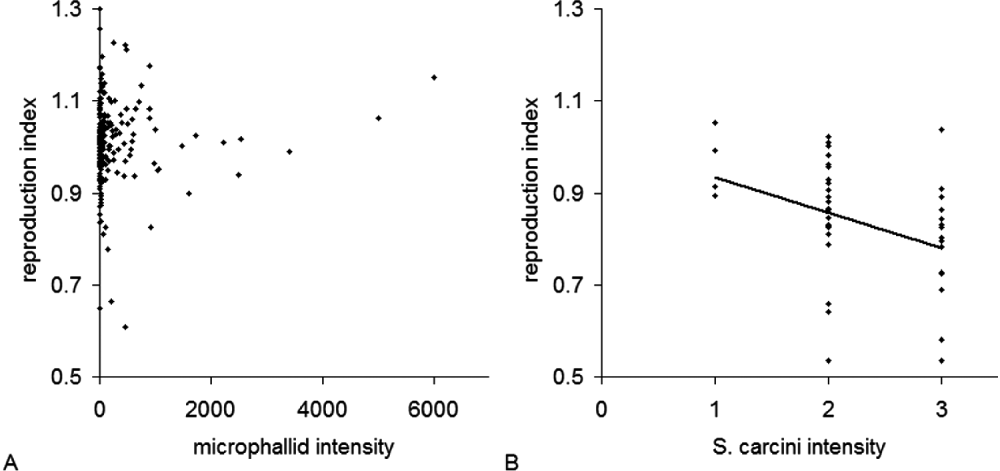
When investigating the effect of different parasite intensities on testes dry weight we found no correlation between cystacanth intensity and RI. However, there was a significant positive correlation between microphallid intensity and RI (Fig. 4), although at an extremely low level (Pearson: R=0·097, P=0·006), explaining less than 1% of the variance (R2=0·009). If the single extreme value is removed, the correlation is not significant. However, we examined metacercarial intensity more closely and found a highly significant correlation at intensities over a threshold of 1000 metacercariae per crab (Pearson: R=0·945, P<0·001). At such high intensities, number of metacercariae explained almost 90% of the variance in testes weight, but the sample size was considerably smaller than for other groups (R2=0·89, N=9). Although the castrator S. carcini only occurs as single infections, we distinguished between 3 different stages of internal infection from weak to strong. Crabs with stronger and older infections had significantly smaller testes (Pearson: R=−0·371, P=0·009) (Fig. 4).
(A) Influence of metacercarial intensity on the reproduction index. (B) Influence of the ‘intensity’ of a Saccolina carcini infection (stages 1 to 3) on reproduction index.

DISCUSSION
Our study shows that the distribution and abundance of parasites differed highly between the sampled populations of C. maenas in Europe. P. botulus was mainly found in the North and Baltic Sea where the final host, the eider duck Somateria molissima, is common (Petersen et al. Reference Petersen, Pihl, Hounisen, Holm, Clausen, Therkildsen and Christensen2006). Microphallid trematodes were more patchily distributed. Their abundance appeared to be connected to occurrence of their final hosts (a number of seabirds) and also the first intermediate host, the mud snail Hydrobia ulvae (Mouritsen et al. Reference Mouritsen, Jensen and Jensen1997). H. ulvae is known to have a scattered distribution, depending partly on the floating migration of juveniles (Armonies and Hartke, Reference Armonies and Hartke1995), as well as habitat characteristics and competition (Fenchel, Reference Fenchel1975). Parasitic castrators, despite being attributed an important role in parasite release (Torchin et al. Reference Torchin, Lafferty and Kuris2001), were not highly prevalent in the populations we investigated, and completely absent in 2 of them. The more common S. carcini is monecious with planktonic larvae, allowing for possibly high distribution rates, however, larval development may be limited by salinity and other environmental factors leading to a patchy distribution between host populations (Kashenko and Korn, Reference Kashenko and Korn2002; Tolley et al. Reference Tolley, Winstead, Haynes and Volety2006).
In the South African and Australian populations investigated, none of the European parasites were present, but very low prevalences of 2 native parasites were found in Australia. The lack of parasites in these invasive areas can easily lead to the conclusion that parasite release may play an important role for invasion success. However, the highly variable prevalences and intensities of parasites even within Europe indicates that the origin of the invading crab populations has to be taken into account to confirm that they were indeed released from parasites in a relevant way.
The significant effect of sampling area on testes weight indicates that environmental factors do have an impact on the testes weight of C. maenas. However, our findings show that neither parasite prevalence nor intensity is one of these factors. There were no indicators for population level effects of parasite pressure on testes weight that might be caused indirectly by resource allocation towards defence mechanisms. On the individual level, parasite infection was indeed connected to altered testes weight. However, reduced weight was only caused in crabs infected with the parasitic castrators S. carcini and P. maenadis.
The effect of S. carcini on testes weight has not previously been studied. It is known that this parasitic castrator causes degeneration of the androgenic gland, as well as inhibition of spermatogenesis (Rubiliani-Durozoi et al. Reference Rubiliani-Durozoi, Rubiliani and Payen1980; Rubiliani, Reference Rubiliani1983) and general feminization of male crabs (Høeg, Reference Høeg1995). It is often assumed that S. carcini infections lead to smaller or even completely reduced testes; however, this has never been quantified before. Our results show that testes weight is only reduced by an average of 12% in infested crabs, demonstrating that ‘parasitic sterilization’ is a more appropriate term than the more commonly used ‘parasitic castration’ (Høeg, Reference Høeg1995). P. maenadis showed a similar effect on C. maenas to that of S. carcini. These findings show that parasite influence on host spermatogenesis, and therefore invested energy resources, is indeed reflected in male gonad weight.
Generally, microphallid and acanthocephalan larvae using the crab as an intermediate host did not significantly influence testes weight. However, microphallid infestation appears to lead to increased testes weight when it reached extreme intensities of over 1000 metacercariae per crab. Although the sample size for such highly infested crabs is low and additional samples should be made to check this result, this is a potentially interesting finding and suggests that the crabs might compensate for a potentially shorter life span by increased resource allocation towards reproduction. While this can indicate mortality, intensities of over 1000 metacercariae only occurred in less than 5% of all crabs infected with microphallids, making it unlikely that this potential effect has a serious impact on the population dynamics of C. maenas.
Parasite-induced fitness losses can also be caused by behavioural modifications of the host, making them more vulnerable or visible to predators (Thomas et al. Reference Thomas, Adamo and Moore2005). So far, there is some evidence that this is also caused by helminth larvae in large decapod crabs (Haye and Ojeda, Reference Haye and Ojeda1998; Latham and Poulin, Reference Latham and Poulin2002b). But our results on the frequency of autotomy in parasitized crabs suggest that behavioural modification is not an issue for C. maenas. If this occurred, we would predict that the proportion of crabs showing autotomy would increase with the level of infestation. This is not the case. We cannot conclude, however, that parasites are a trivial problem for the shore crab in its natural range or elsewhere.
It is possible that negative effects on fitness may not be reflected in such an easily accessible feature as testes weight. For example, they could be more apparent in female reproduction, as is the case in Gammarus (Plaistow et al. Reference Plaistow, Troussard and Cézilly2001). Female shore crabs care for the eggs until the larvae hatch, so they have a higher reproductive energy expenditure than males. This may make them more vulnerable to parasites if there is a trade-off in energy partitioning between brood care and immune defence (Zuk and Stoehr, Reference Zuk and Stoehr2002). Unfortunately, in our study, the sample size of parasitized female crabs with the correct ovarial stage for dissection was too small for statistical analysis.
Lauckner (Reference Lauckner1986) considered how juvenile C. maenas in the Wadden Sea seem to have a higher mortality and grow more slowly when they are highly infected with microphallids and P. botulus. Yet, reliable data are sadly lacking and it is unclear if these effects extend to adult crabs and more common parasite loads. Other crab species do show an increased mortality of individuals infected with acanthocephalans (Latham and Poulin, Reference Latham and Poulin2002a).
Our findings are in contrast with the general experience that intermediate hosts of trophically transmitted parasites suffer negative effects on fitness (Ewald, Reference Ewald1995). A number of studies on crustaceans have confirmed this for various host traits. They are often found to increase the general metabolic rate or decrease growth, but relatively little is known about their consequences for reproductive fitness (Vivarès and Cuq, 1981; Haye and Ojeda, Reference Haye and Ojeda1998). In Gammarus pulex, gravid females are known to suffer from reduced lipid reserves under the influence of the acanthocephalan Pomphorhynchus laevis (Plaistow et al. Reference Plaistow, Troussard and Cézilly2001). Also, an investigation on different lines of the snail Biomphalaria glabrata found an association between increased parasite resistance and decreased fertility (Webster and Woolhouse, Reference Webster and Woolhouse1999). In C. maenas, however, no such mechanism is evident.
Overall, the results of our study do not hint at a relevant effect of helminth parasites on the reproductive fitness of the European shore crab, either at the population level, or for individual crabs. However, our study mostly focused on a single aspect of fitness. It is entirely possible that helminths influence C. maenas in other ways not covered by this study. In any case we found that parasite prevalence is highly diverse between different locations. Parasitic castrators – the lack of which is a suggested cause for invasion success of the host – are not at all omnipresent. We should therefore be careful when making generalizations about the effect of parasites in both native and invasive populations of the shore crab. Additionally, there are few empirical data on the density of C. maenas in its native and invasive habitats, and none relating parasite prevalence to crab density. A careful survey of green crab populations in relation to parasite pressure in their home range would help our understanding of their population dynamics and might also be crucial for the development of control measures in invaded areas.
ACKNOWLEDGEMENTS
The authors would like to thank the team of the Dansk Scaldyrcenter, Nykøbing for their help with the collection of crabs and for the provisioning of laboratory space. Our thanks also go to the members of the Parasitology Department of the University of Melbourne and the laboratory of Professor Robin Gasser, who provided space and invaluable support for the collection of crabs. We would also like to thank the graduate students of the Griffiths laboratory for their help with the sampling process. Also, B. Hussel's knowledge about the work with the crabs and the parasites was invaluable. This work was financially supported by the German Federal Environmental Foundation (DBU) and the German Academic Exchange Service (DAAD).