Surgical site infections (SSIs) have a devastating impact on patient outcome. Reference Petrosyan, Thavorn and Maclure1 In trauma surgery and orthopedics, SSIs may result in additional surgeries, limited mobility, fracture non-union, and death. Reference Jenks, Laurent, McQuarry and Watkins2-Reference Owens and Stoessel4 Furthermore, SSIs add a burden on healthcare systems by increasing direct and opportunity costs. In Germany, direct costs resulting from SSIs have been estimated at 2 billion euros (∼US$2.4 billion) each year. Reference Nachtigall and Bonsignore5
Thus, various campaigns have been initiated, and infection prevention bundles have been proposed to decrease SSI rates. In most cases, the aim was to improve hand hygiene. Reference Khodyakov, Ridgely, Huang, DeBartolo, Sorbero and Schneider6-Reference Berríos-Torres, Umscheid and Bratzler9 Additionally, numerous guidelines have been developed in recent years. Reference Berríos-Torres, Umscheid and Bratzler9-11 The Five Moments of Hand Hygiene published by the World Health Organization (WHO) offer a mental framework for correct hand hygiene and defined the indications for hand disinfection. Reference Allegranzi, Sax and Pittet12 The hand hygiene indications before clean or aseptic procedures, such as an aseptic dressing change (ADC), play key roles in infection prevention. However, the indications before clean or aseptic procedures have the lowest adherence among the Five Moments of Hand Hygiene. 8
Additionally, since the 1960s, worldwide rates of SSI have not substantially dropped. Reference Willy, Rieger and Stichling13 The proportion of SSIs of all nosocomial infections has increased since the 1990s in Germany, Reference Behnke, Hansen and Leistner14,Reference Rüden, Gastmeier, Daschner and Schumacher15 but no conclusive reasons have been recognized. However, it has been proposed that ineffective implementation of hygiene measures and guidelines may have played a role. Reference Damschroder, Aron, Keith, Kirsh, Alexander and Lowery16,Reference von Lengerke, Lutze, Krauth, Lange, Stahmeyer and Freya Chaberny17
The structure of infection prevention teams in German hospitals is defined by the German Commission for Hospital Hygiene and Infection Prevention (KRINKO). Every hospital has to be supervised by a hospital hygienists who is supported by infection prevention nurses. Additionally, KRINKO recommends nominating 1 authorized medical specialist in every medical department as the infection prevention link physician (PLP) to facilitate implementation. That physician serves as an intermediary between the respective medical department and the infection prevention and control team and acquires the necessary skills and knowledge during a 40-hour course.
The present study is part of the prospective cohort study “Hygarzt,” which examines whether a PLP can introduce new hygiene measures and reduce infection rates in a trauma surgery and orthopedic department. To the best of our knowledge, no published research data are available regarding this topic.
In this study, we investigated whether the PLP can introduce a standardized ADC concept (ADCC) adopted to the local situation in everyday medical practice, thus increasing adherence to hand hygiene and other process steps during ADC to protect surgical wounds from bacterial contamination.
Methods
Study design
We compared the initial situation (preintervention phase) before any intervention was made with results after interventions (postintervention phase) on 3 orthopedic and trauma surgery general wards of a single hospital (level 1 trauma center). The preintervention phase and postintervention phase each lasted 6 months, separated a 4-month intervention phase. Hand hygiene adherence according to the WHO and decisive ADC process steps were considered in the preintervention and postintervention phases, and a standardized ADCC was implemented as the intervention.
Study population
During the study period, all patients admitted to the study department’s general wards who underwent surgery were included. Only ADCs conducted from Monday to Friday during the morning shift (6:00 a.m. to 2:00 p.m.) were considered. For organizational reasons, these observation periods were chosen because most ADCs were performed during these periods on included wards.
Intervention
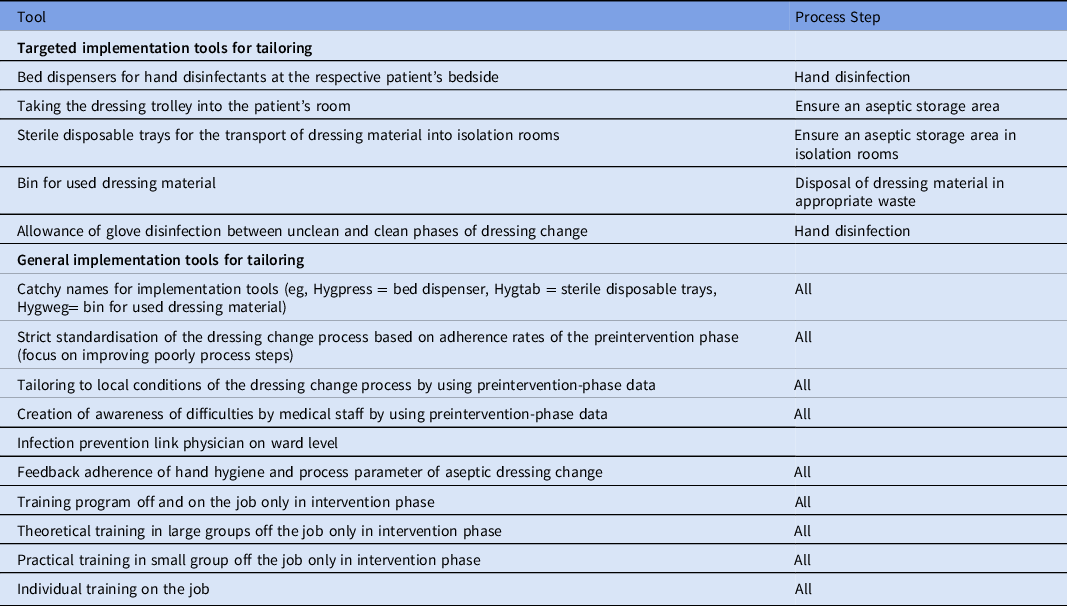
In the study institution, ADCs were conducted by physicians and were partly supported by medical students or nurses. At the end of the preintervention phase, in which an analysis of the ADC processes was conducted, the PLP and infection prevention team worked out a standardized best-practice ADC procedure on the basis of international guidelines and preintervention phase results. The procedure was tailored to local conditions and was supported by members of the trauma surgery and orthopedics team including the head of the department (Table 1).
Implementation Tools for Tailoring Hygiene Measures for Local Conditions and Increasing Adherence to Process Steps during ADC a

a The targeted implementation tools serve to support concrete process steps, and general implementation tools improve the overall process.
The weaknesses in the ADC process identified in the preintervention phase were directly addressed during the intervention phase by specific and unspecific implementation tools (Table 1) to achieve behavioral changes.
After the first half of the postintervention phase, feedback was provided to the entire trauma surgery and orthopedics team.
Data collection
For the standardized recording of hand hygiene and process parameters of ADCs in the preintervention and postintervention phases, a modified step-by-step procedure checklist was created during the trial preparation, partly based on existing literature (Supplementary Material 1 online). 8,11,Reference Alefelder18
With this checklist, adherence was recorded for 4 hand disinfections and 10 process steps of the ADC (observation steps according to KRINKO 10 ) several times per week (Supplementary Material 1 online). Reference Alefelder18 We considered 4 required hand disinfection indications: (1) before preparation of the ADC equipment, (2) immediately before the ADC, (3) before the clean phase, and (4) after the ADC. Additionally, the frequency of ADCs, during which all “before” indications were performed, was considered (ie, overall before indications for ADCs). Glove disinfection was permitted between the unclean and clean phases of ADCs.
Hand disinfection before the clean phase was only demanded for the first ADC after surgery and for wounds with discharge. Additionally, we recorded the following data: number of present medical staff and persons performing the ADC, the professional groups performing ADCs (physicians or nurses), wards, duration of the ADC, and interruption of the ADC process by the person(s) performing it.
Adherence to hand hygiene and process steps of the ADCC was calculated as the number of “yes” responses divided by the sum of “yes” and “no” responses on the checklist. If an activity was incorrectly conducted, it was considered a “no” response. Also, 4 persons, all of whom were previously trained in the use of the documentation checklist to ensure interobserver reliability, performed the ADCC observations. They were exclusively specialists with experience conducting compliance observations.
In the preintervention phase, the persons performing the ADC were informed that the ADC process would be observed and were asked to ignore the observers and to continue their daily routines. Additional instructions on how to correctly perform the ADC were not given. In the intervention phase after off-the-job training had occurred, the ADC was attended by members of the infection prevention team to aid the ADC process at the patient’s bedside. In the postintervention phase, no assistance was given during the ADC process. Occasionally, possible errors were discussed after the ADC with the infection prevention team observer, if demanded by a performer. If this was the case, observations of the whole team were not continued for the day.
Statistical analysis
A χ2 test was performed to calculate the statistical differences in ADCC adherence between the preintervention and postintervention phases. For the analysis of the duration of ADC in the before-and-after comparison, a 2-sided t test was performed for independent samples. A β regression with logit-link was used to investigate the influence of the intervention, the number of persons performing the ADC, mixed gender, and mixed professional groups performing the ADC on the ADCC adherence during the whole ADC, including all necessary hygiene steps. Reference Ferrari and Cribari-Neto19 ADCC adherence was determined as the proportion of correctly executed necessary hygiene steps during an ADC. Hence, the ADCC adherence ranged between 0 (all hygiene steps were not or wrong executed) and 1 (all hygiene steps were executed correctly). In the β regression with logit link, the odds ratio is used as a measure of association between exposure (ie, intervention) and ADCC adherence. An odds ratio >1 indicates an increased occurrence of an ADCC adherence of exposed ADCs compared to nonexposed ADCs. An odds ratio <1 indicates decreased ADCC adherence during exposed ADCs compared to nonexposed ADCs. The significance level was set at P <.05. Cohen d and the ϕ values were calculated as measures of the effects.
Results
To facilitate the implementation and the performance of the defined ADCC, the sequence of process steps was standardized, and various tailoring measures were accomplished (Table 2). Process interruptions did not occur throughout the study phases. The ADCC was introduced and iteratively adopted during the intervention phase. The implementation was organized by theoretical and practical ADCC training for physicians off and on the job during the intervention phase. The theoretical and off-the-job training was performed by the PLP and was supported by the infection prevention team, which was also responsible for the on-the-job training of the routine. After one-half of the postintervention phase, an additional off-the-job training session was held to discuss the results and to once again point out existing difficulties.
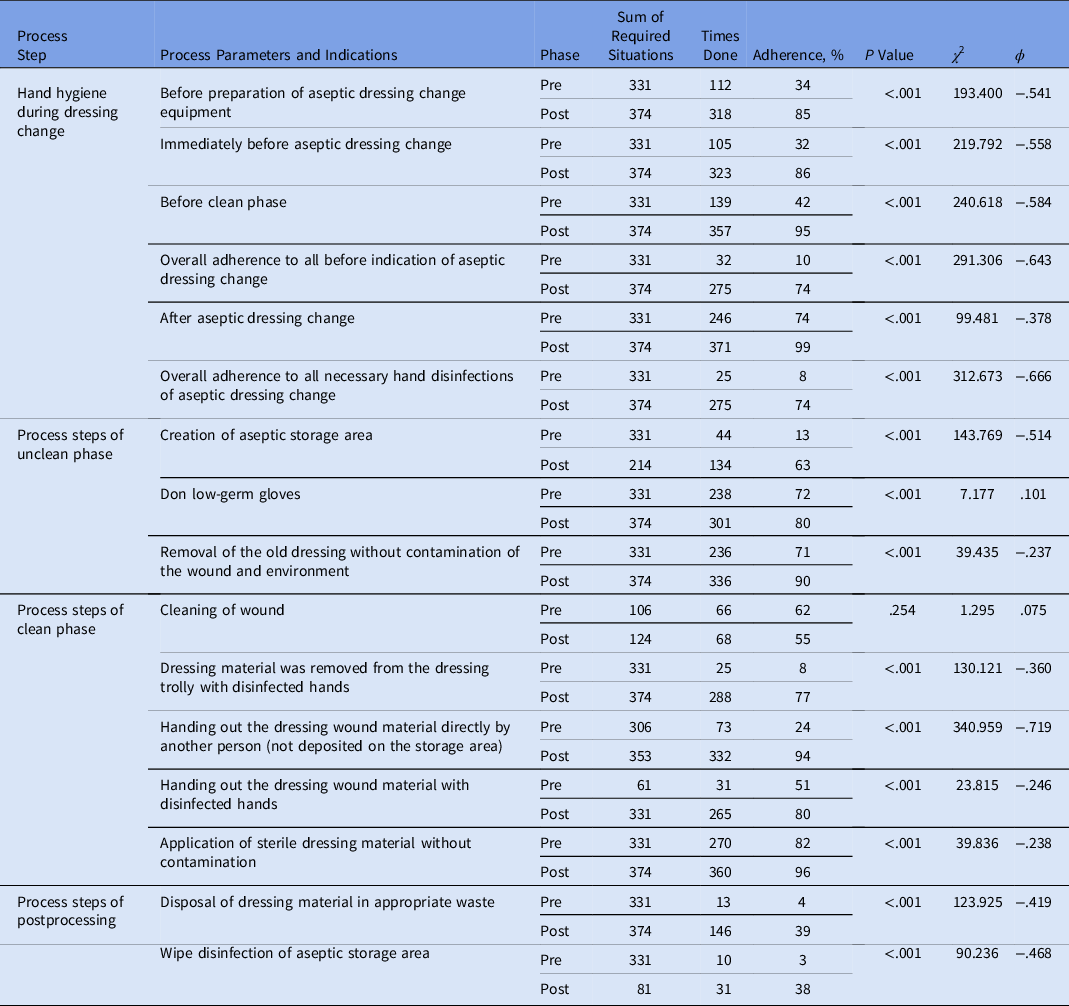
Preintervention Versus Postintervention Phase Comparison of Adherence to Hand Hygiene and Process Steps of an ADC a
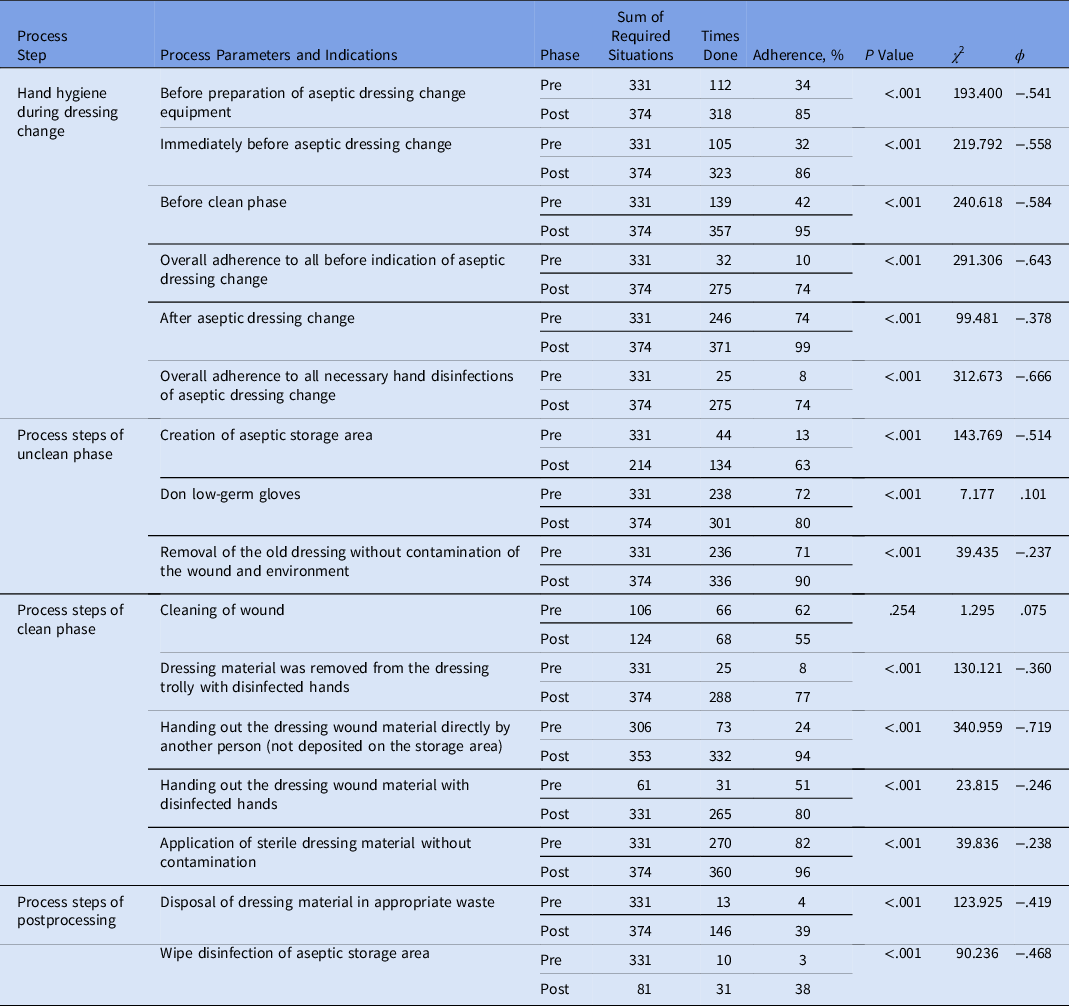
Note. Pre, preintervention; Post, postintervention.
a Adherence is measured for each step. The process steps are divided into necessary hand disinfections during dressing changes and steps of the unclean and clean phases.
During the preintervention phase (March–August 2018), 331 ADCs with 1,655 hand hygiene indications and 3,310 process steps were observed; during the intervention phase (September–December 2018), 60 ADCs with 300 hand hygiene indications and 600 process steps were observed. During the postintervention phase (January–June 2019), 374 ADCs with 1,870 hand hygiene indications and 3,370 process steps were observed.
Preintervention-phase observations revealed the lowest hand hygiene adherence rates for the indications before the preparation of the ADC equipment (34%) and directly before the ADC (32%). The introduction of the ADCC significantly increased the hand hygiene adherence of all indications (Table 2). Similarly, the overall hand hygiene adherence of “all before indications” increased significantly from 10% before the intervention to 74% after the intervention (P < .001). The overall adherence of all necessary hand disinfections increased from 8% before the intervention to 74% after the intervention (P < .001) (Table 2). If all 3 “before” hand disinfections were conducted, hand disinfection was always conducted after an ADC.
Most process steps of ADC were improved by the standardized ADCC. Adherence significantly increased for dressing material was removed from the dressing trolley with disinfected hands, creating an aseptic storage area for filling of sterile dressing material, and handing out the wound dressing material directly by another person (Table 2).
The analysis of the ADCC adherence with the β regression shows that the odds of ADCC adherence during the ADC were 5.497 times greater during the intervention than before the intervention started (P < .001). After the intervention, the odds of ADCC adherence were 6.146 times greater than before the intervention (P < .001). The increase of the dressing team by 1 additional person results in 1.223 times greater odds of ADCC adherence (P < .001). We detected neither a significant effect of mixed-gender teams (P = .387) nor an effect of mixed professional groups (nursing with physician compared to physician alone) (P = .368), on the odds of the ADCC adherence (Supplementary Material 2 online).
The time needed to complete 1 ADC in the defined manner was measured during 24 preintervention-phase and 83 postintervention-phase ADC procedures, respectively. With the standardized ADCC, the duration in minutes of an ADC in the postintervention phase (mean [M]minutes, 2.07 (2 minutes 4 seconds); 95% CI, 1.89–2.25; standard deviation [SD], 0.855) compared with that in the preintervention phase (Mminutes, 2.21 (2 minutes 13 seconds); 95% CI, 1.51–2.91; SD, 1.76) did not change significantly [t(107) =.548; P = .585; Cohen d = −.101].
Descriptive but not significant temporal training effects were identified in the postintervention phase for the duration of an ADC between the first 3 months (Mminutes, 2.41; SD, 0.63) and last 3 months (Mminutes, 2.01; SD, 0.87; [t(82) =1.488; P = .070]). The number of people involved in ADCs in the postintervention phase (mean [M]people, 2.12; 95% CI, 2.05–2.19; SD, 0.625) compared with that in the preintervention phase (M people, 1.50; 95 % CI, 1.44–1.56; SD, 0.586) significantly increased [t(677) = −13.245; P < .001; Cohen d =1.03].
Discussion
In this intervention, we aimed to increase adherence to hand hygiene indications and performance of the ADC process, as well as the correct execution of the individual process steps through a new aseptic ADCC tailored to an orthopedic and trauma surgery department. The ADCC was implemented by a PLP. As a result of introducing the standardized ADCC, hand hygiene adherence in all 4 indications significantly increased compared to the preintervention phase and exceeded 80% in the postintervention phase. Again, the hand hygiene adherence for the overall before indications for an ADC significantly increased from 10% in the preintervention phase to 74% in the postintervention phase, thus exceeding the German average of 66% before clean or aseptic procedure on general wards. 8
The increase in adherence was achieved by implementing an ADCC developed by an interdisciplinary team from the departments of trauma surgery and infection prevention and control. The concept was tailored to the local setting to structure, simplify, and standardize the difficult and complex ADC process. Implementation was managed by an interdisciplinary team led by the PLP and included on- and off-the-job training and regular feedback to physicians in the trauma surgery and orthopedics department by the infection prevention team. Our findings were consistent with previous studies reporting that monitoring, feedback, and off-the-job training could increase hand hygiene adherence. Reference Benton20-Reference Pittet23 Furthermore, the tailoring and facilitating efforts may have increased hand hygiene adherence. Additionally, patient beds were equipped with hand disinfectant dispensers in the intervention phase, which have been proven to promote hand hygiene adherence by increasing disinfectant availability and indirectly reminding staff to perform hand hygiene. Reference Chan, Homa and Kirkland24,Reference Giannitsioti, Athanasia and Antoniadou25
Process observations during the preintervention phase showed that several employees were not aware of the incorrect implementation of hygiene measures or the omission of hand disinfection in the hygienic process. Reference Akca, Strybos and Otchwemah26 The targeted training with theoretical and practical components efficiently addressed knowledge gaps and integrated the standardized ADCC in the daily working routine.
The process steps that showed a significant increase in adherence were (1) creating an aseptic storage area, (2) removal of dressing material from dressing trolleys with disinfected hands, (3) handing of dressing material by another person, and (4) applying the dressing materials with disinfected hands. In the preintervention phase, creating an aseptic storage area was mostly neglected. Therefore, creating an aseptic storage area became an important part of the standardized ADCC and was intensively discussed during training and process support. The medical staff was given several options to generate this storage area: bringing the dressing trolley into the patient’s room and cleaning it with a surface disinfectant, covering it with a sterile cloth before use, or using a disposable tray for isolation rooms and being given the dressing material by another person with disinfected hands. The procedure of being given the dressing material directly from the dressing trolley by another person was used more frequently in the postintervention phase than the creation of a sterile storage area (Table 2). One reason for this could be that it saved wipe disinfection of a storage area at the beginning and end of the ADC process, allowing the process to be more quickly completed. Moreover, this procedure required a brief coordination of the division of tasks before the start of the ADC and probably increased team building. In the postintervention phase, more persons were actively involved in the ADC process than in the preintervention phase. The involvement of several individuals in the ADC process may have facilitated the provision of sterile dressing material. Additionally, the unclean and clean work steps could be divided between persons performing the ADC, leading to a seamless transition between those phases. While one person performed the unclean phase of the ADC, the second person had already disinfected their hands and awaited the end of the disinfectant’s reaction time to continue with the clean phase without any process interruptions.
During the presentation of the standardized ADCC, the medical staff was concerned that adopting the new concept would require additional process time. Required time for individual ADCs was measured in the preintervention and postintervention phases. No significant differences in ADC performance time were observed, although up to 2 additional hand disinfections were conducted in the postintervention phase, which could be due to the high level of standardization and the involvement of more persons in the ADC process. Time measurements in the postintervention phase were randomly documented throughout postintervention phase. No significant differences in the duration of ADCs were identified between the preintervention phase and the postintervention phase or within the postintervention phase. This could be due to the fact that the number of process steps remained the same and the duration of the individual process steps was so short that there was no significant time savings due to a training effect.
Our results show that the implementation of infection prevention measures by a PLP is a promising strategy to significantly increase adherence to hand disinfection and process parameters. Along with the basic conditions, personnel conditions such as abilities and attitudes, leadership support, commitment to change, and the initiator of the aspired changes play important roles. Local champions who propose and organize the implementation are important for the introduction of new measures. Reference Aaltonen and Ikävalko27-Reference Schon30 Our results also show that the use of a surgeon as PLP, primary stakeholder, and local champion for the implementation of infection prevention measures is beneficial and can potentially be transferred to any setting worldwide. Reference Mar, che, Neuwirth, Kugler, Bouillon, Mattner and Otchwemah31
Our study has several limitations. The ADCs were only observed on weekdays during the early shift. More mistakes may have been made in the postintervention phase during weekend and late shifts. On weekends, there is usually only 1 physician on duty, so that person is responsible for the ADC, and clean versus unclean steps cannot be divided among several people. However, on-the-job dressing change training by the PLP also includes training on how to perform an ADC alone. Fewer ADCs are performed on weekends and late shifts than during the week because fewer patients are admitted as inpatients and no elective operations are performed. Thus, the proportion of ADCs may not have had a large impact on the study results. Another limitation is that the staff may have been influenced by the presence of the observer and may have unintentionally improved hand hygiene adherence (Hawthorne effect). Reference Eckmanns, Bessert, Behnke, Gastmeier and Ruden32,Reference Hagel, Reischke and Kesselmeier33 To reduce this effect as much as possible, observers remained in the background. The observed study participants were also asked to ignore the observers and continue their normal routine. Additionally, 15-month duration of the study may have weakened this effect as being observed became routine. ADC is an extraordinarily complex activity, which is difficult to perform by nature, and it tends to be unstructured and ambiguous. Reference Campbell34,Reference Liu, Li and Rau35 This high level of complexity was challenging and may have led to some mistakes. For this reason, observations in the preintervention and postintervention phase were conducted by the same, trained persons to ensure accuracy and interrater reliability. This was a single-center study, and it is unclear whether the adopted ADCC can be transferred to other surgical departments or to other medical procedures.
After the introduction of the standardized ADCC, significant increases in hand hygiene adherence in all indications of the ADC were achieved. The ADCC was based on continuous process observations and was successfully introduced and customized during the intervention phase through theoretical and practical training by the PLP.
Acknowledgments
We thank Regine Galante, Ina-Kathrin Dombrowski, and Selda Akca for supporting the execution of ADC observations. Furthermore, we thank all the staff members who agreed to the observation.
Financial support
This work is supported by the Federal Ministry of Health Germany (grant no. ZMVI1-2516FSB111).
Conflicts of interest
All authors report no conflicts of interest relevant to this article.
Supplementary material
To view supplementary material for this article, please visit https://doi.org/10.1017/ice.2021.200