Introduction
Biological invasions have considerable combined ecological and economic impacts (Mack et al., Reference Mack, Simberloff, Lonsdale, Evans, Clout and Bazzaz2000; Pimentel et al., Reference Pimentel, Lach, Zuniga and Morrison2000; Perrings et al., Reference Perrings, Williamson, Barbier, Delfino, Dalmazzone, Shogren, Simmons and Watkinson2002; Sax et al., Reference Sax, Gaines and Stachowicz2005). It is often argued that one of the key factors affecting the establishment likelihood of species and their subsequent capacity to invade is propagule pressure (Lockwood et al., Reference Lockwood, Hoopes and Marchetti2007) and the low levels of genetic diversity associated with introductions of small numbers of individuals. Despite this, many introduced species that have experienced bottlenecks and founder effects during initial introduction have become invasive (e.g. Goodisman et al., Reference Goodisman, Matthews and Crozier2001; Meunier et al., Reference Meunier, Tirard, Hurtrez-Bousses, Durand, Bargues, Mas-Coma, Pointier, Jourdane and Renaud2001; Charbonnel et al., Reference Charbonnel, Angers, Rasatavonjizay, Bremond and Jarne2002; Downie, Reference Downie2002; Golani et al., Reference Golani, Azzurro, Corsini-Foka, Falautano, Andaloro and Bernardi2007). These suggest that the loss of genetic diversity may not limit the capacity for some species to become invasive (Sakai et al., Reference Sakai, Allendorf, Holt, Lodge, Molofsky, With, Baughman, Cabin, Cohen, Ellstrand, McCauley, Neil, Parker, Thompson and Weller2001; Golani et al., Reference Golani, Azzurro, Corsini-Foka, Falautano, Andaloro and Bernardi2007; Miura, Reference Miura2007; Gammon & Kesseli, Reference Gammon and Kesseli2010).
Molecular genetic approaches are useful in order to explore the ecological and evolutionary aspects of biological invasions and their associated influences on the genetic structure and variation of an invasive species (Miura, Reference Miura2007). However, in most cases, only one type of marker, such as mitochondrial cytochrome oxidase I (mtCOI) (Bucciarelli et al., Reference Bucciarelli, Golani and Bernardi2002; Downie, Reference Downie2002; Facon et al., Reference Facon, Pointier, Glaubrecht, Poux, Jarne and David2003; Kolbe et al., Reference Kolbe, Glor, Schettino, Lara, Larson and Losos2004; Golani et al., Reference Golani, Azzurro, Corsini-Foka, Falautano, Andaloro and Bernardi2007) or nuclear (microsatellite) DNA (Tsutsui et al., Reference Tsutsui, Suarez, Holway and Case2000; Meunier et al., Reference Meunier, Tirard, Hurtrez-Bousses, Durand, Bargues, Mas-Coma, Pointier, Jourdane and Renaud2001; Charbonnel et al., Reference Charbonnel, Angers, Rasatavonjizay, Bremond and Jarne2002; Giraud et al., Reference Giraud, Pedersen and Keller2002; Johnson & Starks, Reference Johnson and Starks2004), has been used. This limits our capacity to more fully explore the consequences of genetic variation on invasion potential.
Bemisia tabaci (Gennadius) (Hemiptera: Aleyrodidae) is a cryptic species complex which may contain at least 24 morphologically indistinguishable species (Dinsdale et al., Reference Dinsdale, Cook, Riginos, Buckley and De Barro2010). Two members of this complex, referred to by Dinsdale et al. (Reference Dinsdale, Cook, Riginos, Buckley and De Barro2010) as Middle East - Asia Minor 1 (herein referred to as B-type) and Mediterranean (herein referred to as Q-type) have now invaded well beyond their home ranges as a consequence of trade in ornamental plant species (Cheek & MacDonald, Reference Cheek and MacDonald1994; Dalton, Reference Dalton2006). In the 1980s, the B-type form of B. tabaci became a severe outbreak pest in the southwestern USA and is now regarded as one of the most globally damaging pests in open field or protected cropping production (Brown, Reference Brown, Stansly and Naranjo2010). The Q-type was originally thought to be restricted to the Iberian Peninsula (Guirao et al., Reference Guirao, Beitia and Cenis1997). However, later studies have shown that its native range covers the countries bordering the Mediterranean Basin and possibly extending into some Sub-Saharan African countries (Frohlich et al., Reference Frohlich, Torres-Jerez, Bedford, Markham and Brown1999; De Barro et al., Reference De Barro, Driver, Trueman and Curran2000; Boykin et al., Reference Boykin, Shatters, Rosell, McKenzie, Bagnall, De Barro and Frohlich2007; Dinsdale et al., Reference Dinsdale, Cook, Riginos, Buckley and De Barro2010).
In China, B. tabaci Q-type was first detected in Yunnan Province in 2003 (Chu et al., Reference Chu, Zhang, Cong, Xu, Wu and Zhu2005). In the following years, it has been reported in Anhui, Fujian, Guangdong, Guangxi, Guizhou, Hainan, Henan, Hubei, Hunan, Jiangsu, Jiangxi, Shandong, Shanxi, Tianjin, Xinjiang and Zhejiang provinces (Chu et al., Reference Chu, Zhang, Brown, Cong, Xu, Wu and Zhu2006 and Genbank records). In 2005, Q-type was first reported from Shandong Province, one of China's most important agricultural provinces where the B-type had established ten years earlier (Chu et al., Reference Chu, Jiang, Liu, Jiang, Tao, Fan, Zhou and Bi2007). Since then, Q has become the predominant whitefly (Chu et al., Reference Chu, Wan, Zhang and Brown2010a,Reference Chu, Zhang and Wanb). The recent invasion by Q provides an ideal opportunity to study the changes in genetic variation of the invader during the invasion process.
The aim of this study was, thus, to compare the genetic variation of Q in China and the Mediterranean Basin using both mtCOI and nuclear (microsatellite) DNA markers. In doing so, we were interested in identifying the Mediterranean origin of Q in China and the consequences of invasion on genetic diversity.
Materials and methods
DNA methods
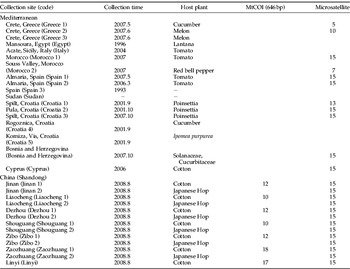
Adult Q-type B. tabaci were collected from different host plants from seven representative locations (Dezhou, Liaocheng, Jinan, Shouguang, Zibo, Zaozhuang and Linyi) throughout Shandong Province, China between 2005 and 2008 (Chu et al., Reference Chu, Wan, Zhang and Brown2010a,Reference Chu, Zhang and Wanb). Each collection involved sampling whitefly from every second available plant until at least 100 adults had been collected (table 1). These were collected live and placed into tubes containing 95% ethanol and then stored at –20°C. The collections of Q-type from the Mediterranean region were made from a number of different countries (table 1). They were likewise collected and stored as above.
Data of Bemisia tabaci samples used.

DNA was extracted from individual whitefly as described in De Barro & Driver (Reference De Barro and Driver1997). A total of 91 Q individuals collected in 2008 from the seven aforementioned locations throughout Shandong Province were amplified using the primers C1-J-2195 and L2-N-3014 and then sequenced (Frohlich et al., Reference Frohlich, Torres-Jerez, Bedford, Markham and Brown1999). The sequencing of the mtCOI from the 5′ end yielded a 646-bp fragment.
Because the amplification efficiencies using C1-J-2195 and L2-N-3014 have since been shown to be low and often result in a less than optimal quantity of product (Shatters et al., Reference Shatters, Powell, Boykin, He and Mckenzie2009), we also used the designed primers R-BQ-2195 (5′-CTGGTTYTTTGGTCATCCRGARGT-3′) and F-BQ-2819 (5′-CTGAATATCGRCGAGGCATTCC-3′) to obtain additional mtCOI sequences (Chu et al., Reference Chu, Zhang and Wan2010b). A total of 520 mtCOI fragments of Q individuals from Shandong, China (2005–2008) and Mediterranean countries were amplified using these primers to give a 623-bp fragment, which was then sequenced (Chu et al., Reference Chu, Wan, Zhang and Brown2010a). Of these sequences, 95 were from the Mediterranean region and 425 were from Shandong Province, China (insect samples collected in 2005–2008) (table 1). These sequences were aligned with Clustal W (Thompson et al., Reference Thompson, Higgins and Gibson1994); sequences were then checked for indels and numts. The unknown sequences were compared against the consensus sequences for each of the 24 putative species identified by Dinsdale et al. (Reference Dinsdale, Cook, Riginos, Buckley and De Barro2010). Each unknown sequence is associated with the consensus sequence with which it has the lowest divergence difference, i.e. the match which is closest to 100%. Assignment also requires that divergence from the consensus sequence is <3.5%. These various sequences, produced using the two primer pairs, thereby were used to determine the evolutionary origin of the Q collections in Shandong Province, China.
In addition, a suite of six microsatellites (BEM6, BEM11, BEM18, BEM25, BEM31 and BEM37) was also used to amplify loci from 335 individuals collected in 2008 from the Mediterranean region and Shandong as described by De Barro et al. (Reference De Barro, Scott, Graham, Lange and Schutze2003). The PCR reaction was mixed with 6× loading buffer, denatured for 3 min at 96°C, loaded on a 7% SDS (sodium dodecyl sulfate) polyacrylamide gel and analysed electrophoretically.
Data analysis
As of 3 Feb 2010, we have retrieved 1490 mtCOI sequences in Genbank. Of these, 96 were found to be unique haplotypes that fall within the Mediterranean putative species group (Q) based on the 3.5% pairwise genetic divergence bounds identified by Dinsdale et al. (Reference Dinsdale, Cook, Riginos, Buckley and De Barro2010) as being the boundary separating different species. This boundary is supported by evidence for either complete or partial mating isolation between a number of the putative B. tabaci ‘species’ (Xu et al., Reference Xu, De Barro and Liu2010). The work of Dinsdale et al. (Reference Dinsdale, Cook, Riginos, Buckley and De Barro2010) suggests that the home range of the Mediterranean putative species group extends from East and West Africa, through Sudan to the countries bordering the Mediterranean Basin. We, therefore, compared the four haplotypes found in Shandong Province with those from the presumed home range.
In order to compare the genetic structure using mtCOI and microsatellite markers, only Q-type individuals collected in 2008 from Shandong Province and the Mediterranean (Bosnia and Herzegovina, Croatia, Cyprus, Egypt, Greece, Italy, Morocco, Spain and Sudan) were used. A series of genetic parameters for mtCOI were estimated for 91 individuals from Shandong Province and 95 from the Mediterranean countries using DnaSP 5.0 (Librado & Rozas, Reference Librado and Rozas2009). We computed the number of polymorphic (segregating) sites (S), the total number of mutations (η) (Watterson, Reference Watterson1975), the average number of nucleotide differences (K) (Tajima, Reference Tajima1983), the number of haplotypes (H), the haplotype diversity (Hd) (Nei, Reference Nei1987) and the nucleotide diversity (π), defined as the average number of pairwise nucleotide differences per site (Nei, Reference Nei1987), the nucleotide diversity with Jukes and Cantor correction [π(JC)] (Lynch & Crease, Reference Lynch and Crease1990) within each population and region. To assess the possibility of population change or selection, we also calculated Tajima's D Fu's F from the sequences within each sampling site and region. All analyses were performed for all collections with the exception of Egypt, Italy, Sudan and Croatia 3, Croatia 4 and Croatia 5 where the number is less than five.
For microsatellites, the alleles for each locus among collections (from China, Greece, Egypt, Italy, Morocco, Spain, Sudan, Croatia, Bosnia and Herzegovina, and Cyprus) were calculated and the allele-sharing among populations estimated. Genetic diversity for the 13 collections from Shandong Province (Dezhou, Liaocheng, Jinan, Shouguang, Zibo, Zaozhuang and Linyi) and the two collections from both Morocco and Spain were calculated using POPGENE version 1.31 (Yeh et al., Reference Yeh, Yang, Boyle, Ye and Mao1997). The average number of alleles per locus (N a), the effective number of alleles (N e), the observed heterozygosity (H o), the expected heterozygosity (H e) and Nei's expected heterozygosity (Nei, Reference Nei1973) were calculated.
Results
The evolutionary origin of Q-type B. tabaci in Shandong, China based on mitochondrial haplotype analysis
Of the 425 Shandong individuals sequenced from the 2005–2008 collections, we recovered only four different haplotypes (GU472435, GU472434, GU472429, GU472426). When compared against 96 unique haplotypes, haplotype 1 accounted for 86.3% (367 individuals) of individuals, haplotype 2 for 11.8% (50 individuals), haplotype 3 for 1.2% (five individuals) and haplotype 4 for 0.7% (three individuals). Haplotype 1 was found in all collection locations within Shandong (Dezhou, Jinan, Liaocheng, Linyi, Shouguang, Zaozhuang and Zibo), haplotype 2 in all except Linyi while haplotype 3 was recovered from only Liaocheng and Shouguang and haplotype 4 from Shouguang only. None matched any of the haplotypes from West and East Africa, Algeria, Croatia, Egypt, Greece (mainland), Israel, Italy, Sudan, Syria or Turkey. Haplotypes 1–3 (99.3%) matched those from Morocco, Spain, Portugal, France and Crete. In the case of haplotype 4 (0.7%), no match could be found with any location within the presumed home range of Q. The haplotype data supports the conclusion that Q-type B. tabaci in Shandong originated in the western Mediterranean.
Studies by Guirao et al. (Reference Guirao, Beitia and Cenis1997) and Dalmon et al. (Reference Dalmon, Halkett, Granier, Delatte and Peterschmitt2008) suggest that B. tabaci is a relatively new invader to France. Similarly, of the four haplotypes in Shandong, only Haplotype1 was detected in Crete in 2008 but was present in only 1/28 locations in 2002–2004 (Tsagkarakou et al., Reference Tsagkarakou, Tsigenopoulos, Gorman, Lagnel and Bedford2007) and is genetically more related to those from the western Mediterranean than to those in Crete. This haplotype is one of the most commonly encountered globally and is known to be invasive, having been detected in Guatemala, South Korea, Taiwan and USA (P. De Barro, unpublished data). It, therefore, was concluded that the western Mediterranean region encompassed by Morocco, Portugal and Spain was the likely evolutionary origin of the four Shandong haplotypes. As a consequence, a comparison of mtCOI diversity between Shandong Province, and Morocco and Spain was then undertaken.
Comparison of mtCOI diversity between Shandong Province and Morocco and Spain
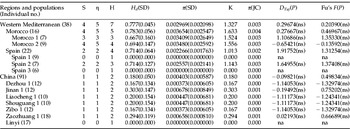
The comparison of mtCOI haplotype diversity between Shandong Province, Morocco and Spain showed that diversity was generally lower in China (table 2) with diversity values from Shandong 63.3–74.8% lower than those from Morocco and Spain (fig. 1a). The difference of the H d value between Chinese populations and Morocco and Spain was significant using independent-samples t-test (P<0.05), which suggested that the mtDNA of Q in Shandong had experienced either severe bottleneck effects or founder effects.
Changes in genetic diversity associated with introduction. (a) A plot of haplotype diversity (H d) of mtCOI sequences across populations and that calculated for each region as a whole. (b) Plot of expected heterozygosity (H e) of microsatellite across populations and that calculated for each region as a whole (—●—, Average of populations; —□—, Regional level).

Statistics of variation in mtCOI sequences from the presumed origin in Morocco and Spain and those from different locations in Shandong, China.

S, number of polymorphic (segregating) sites; η, total number of mutations; H, number of haplotypes; H d, haplotype diversity; π, nucleotide diversity; K, average number of nucleotide differences; π (JC), nucleotide diversity with Jukes and Cantor correction; D Taj, Tajima's D statistic; Fu's F, Fu and Li's F test statistic.
Neither Tajima's D nor Fu's F were significantly different from zero, suggesting neither recent population expansion or purifying selection in these populations. Non-significant, positive Tajima's D and Fu's F for Morocco, Spain and China suggests no change in population size or selection in those regions (table 2).
Microsatellite gene diversity
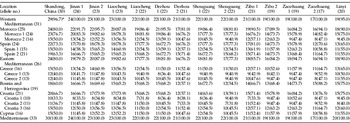
Analysis of the six microsatellite loci revealed the presence of 33 alleles across the Mediterranean region, 31 in the western and 26 in the eastern Mediterranean. In Shandong, there were 30 alleles of which 29 could be found in the western Mediterranean (Morocco and Spain) while only 24 occurred in the eastern Mediterranean. The greatest number of the alleles shared between Shandong and Mediterranean populations was with Morocco (24 alleles) followed by Spain (22 alleles) (table 3). The populations in Shandong shared 80.0% and 73.3% alleles with Moroccan and Spanish populations, respectively. In addition, there were two private alleles in the Shandong collections, one found in the Spanish populations and both in the Moroccan populations. These data are consistent with the conclusion drawn from the mtCOI data that Shandong Q was most related to those from the western Mediterranean.
The allele-sharing among populations.

* The percentage (%) of the sharing alleles is in parenthesis.
The percentage of the shared alleles between collections from Shandong and Morocco ranged from 81.0% to 95.7% and between Shandong and Spain ranged from 65.0% to 81.0%. In total, the number of alleles in Shandong (30) is higher than these in Morocco (25) and Spain (24). The number of alleles in Shandong (30) was similar to the number in the either the western Mediterranean (31) or the Mediterranean as a whole (33). The data above suggest that the Q-type populations in Shandong might have multiple origins, which has resulted in a greater number of alleles being present in Shandong than in individual countries in the presumed origin, but a very similar number when compared with the region as a whole. Multiple origins of Shandong Q might be a consequence of multiple introductions or perhaps the secondary introduction from an invaded region.
The comparison of genetic diversity values (table 4) for the introduced populations across Shandong did not show any marked decrease, suggesting that the bottleneck and founder effects had no severe impact on genetic diversity of the nuclear DNA markers. For example, the expected heterozygosity (H e) in western Mediterranean populations ranged from 0.3594 to 0.6124 and 0.3897 to 0.5886 for the Shandong collections. H e values for the western Mediterranean and Shandong, at the regional level, was 0.5658 and 0.5527, respectively, and were not significantly different (P>0.05) using independent-samples t-test (fig. 1b).
Estimates of diversity in Q populations based on six microsatellite loci.

N a, the average number of alleles per locus; N e, the effective number of alleles; H o, the observed heterozygosity; H e, the expected heterozygosity; Nei, Nei's (Reference Nei1973) expected heterozygosity.
Discussion
Study of population diversity using molecular markers can be very informative in providing clues to the likely origin of invading organisms. For example, in order to investigate whether there were repeated introductions of Fallopia spp. (knotweeds) introduced into the USA from Asia, Gammon & Kesseli (Reference Gammon and Kesseli2010) compared 21 Japanese haplotypes with 46 USA samples from 11 States, two Canadian samples, and six European samples using 800 bp of the non-coding chloroplast marker accD–rbcL. Their results supported the hypothesis of multiple introductions into the USA. Thus, comparison of the haplotypes between invasion populations and native populations can help determine the origin of the invasive species.
Based on the work of Chu et al. (Reference Chu, Zhang, Brown, Cong, Xu, Wu and Zhu2006), we speculated that Q-type individuals from Yunnan Province, China may have originated in Spain or other nearby locations. In order to determine where Q in Shandong evolved exactly, we compared the mtCOI haplotypes found in Shandong Province, China with those in its home range. We concluded that the western Mediterranean and, more precisely, the region encompassed by Morocco, Portugal and Spain was the evolutionary origin of this form of B. tabaci. While the haplotypes found in China were also found in France and Greece (Crete), these did not form part of the ‘evolutionary home range’. In the case of France, surveys in 1995 showed Q was not present (Guirao et al., Reference Guirao, Beitia and Cenis1997) and the first records of Q in France date back to 2003 (Dalmon et al., Reference Dalmon, Halkett, Granier, Delatte and Peterschmitt2008). Similarly for Crete, only one haplotype of presumed western Mediterranean origin was found in Crete as part of this study. A previous study (Tsagkarakou et al., Reference Tsagkarakou, Tsigenopoulos, Gorman, Lagnel and Bedford2007) showed that none of the four Shandong haplotypes were present in mainland Greece and only one was present in only one of the 14 sites surveyed in Crete between 2002 and 2004. The earliest record of B. tabaci in Crete is from 1992 (Kirk et al., Reference Kirk, Lacey, Roditakis and Brown1993), although records from the mainland date back to the 1880s (Mound & Halsey, Reference Mound and Hasley1978). In Genbank as of 11 Feb 2010, there were 95 unique haplotypes belonging to the Mediterranean putative species; of these, four are known to have invaded countries outside of the presumed home range of this species (P. De Barro, unpublished data). One of these is the haplotype found in Crete and Shandong, as well as Morocco and Spain, which has also invaded China, France, Guatemala, South Korea and Taiwan. We argue that it is more likely that this haplotype has recently invaded Crete from the Western Mediterranean.
The microsatellite data also supported a western Mediterranean origin of Q in Shandong, as 96.7% of the alleles found in Q from Shandong can also be found in western Mediterranean populations, whereas only 80.0% are common with the eastern Mediterranean populations. These data strongly support the conclusion that Q in Shandong originated in the western Mediterranean.
Changes of genetic diversity in mitochondrial and nuclear (microsatellite) DNA
Many studies have been performed to compare the genetic diversity between the home range populations and invading populations of invasive species (Tsutsui et al., Reference Tsutsui, Suarez, Holway and Case2000; Meunier et al., Reference Meunier, Tirard, Hurtrez-Bousses, Durand, Bargues, Mas-Coma, Pointier, Jourdane and Renaud2001; Bucciarelli et al., Reference Bucciarelli, Golani and Bernardi2002; Charbonnel et al., Reference Charbonnel, Angers, Rasatavonjizay, Bremond and Jarne2002; Downie, Reference Downie2002; Giraud et al., Reference Giraud, Pedersen and Keller2002; Facon et al., Reference Facon, Pointier, Glaubrecht, Poux, Jarne and David2003; Johnson & Starks, Reference Johnson and Starks2004; Kolbe et al., Reference Kolbe, Glor, Schettino, Lara, Larson and Losos2004; Golani et al., Reference Golani, Azzurro, Corsini-Foka, Falautano, Andaloro and Bernardi2007; Miura, Reference Miura2007). Some studies (e.g. Bucciarelli et al., Reference Bucciarelli, Golani and Bernardi2002; Giraud et al., Reference Giraud, Pedersen and Keller2002; Facon et al., Reference Facon, Pointier, Glaubrecht, Poux, Jarne and David2003; Stepien et al., Reference Stepien, Taylor and Dabrowska2002; Johnson & Starks, Reference Johnson and Starks2004; Kolbe et al., Reference Kolbe, Glor, Schettino, Lara, Larson and Losos2004) have shown that invasive species do not always experience severe population bottlenecks and the founder events. Rather, they imply that the number of individuals, the number of invasion events, multiple origins of introduction, subsequent introductions from multiply introduced populations, invasion pathways or timings of invasions may overcome the loss of genetic diversity (Kolbe et al., Reference Kolbe, Glor, Schettino, Lara, Larson and Losos2004; Frankham, Reference Frankham2005; Miura, Reference Miura2007). Other studies have concluded that the loss of genetic variation can have a positive effect on the subsequent population growth of an invasive species (Tsutsui et al., Reference Tsutsui, Suarez, Holway and Case2000).
Our study considered the question of genetic diversity through the combined use of both mitochondrial and nuclear DNA markers and, so, differs from many previous studies, which have considered this question through the application of only a single molecular marker. We found that the haplotype diversity of Q in Shandong was low compared with its presumed origin, whereas microsatellite allele diversity showed no such decline. A key factor in invasions is the establishment of females; and, so, bottleneck and founder events can lead to a very rapid and considerable loss of mitochondrial diversity. The lack of haplotype diversity in Shandong supports the view that at one or more points between the western Mediterranean and China, the invading Q-type insects lost haplotype diversity, most probably through the serial process of establishment and redistribution through trade in ornamental plants. However, the loss in haplotype diversity does not necessarily mean that nuclear allelic diversity should also decline. Provided females can mate freely with all available males, allelic diversity can be maintained or even increased relative to the origin of the invader. An example is seen in studies of the population genetics of a polygynous ant species where males come from a much wider geographic range than the female reproductives, which do not disperse long distances (Berghoff et al., Reference Berghoff, Kronauer, Edwards and Franks2008). In such situations, the mtDNA signature shows a low level of diversity, whereas the nuclear DNA shows considerably greater diversity.
Multiple invasion events by a species has been proposed as a means through which the loss of genetic diversity is overcome (Frankham, Reference Frankham2005; Miura, Reference Miura2007). Our results support the contention that the level of diversity in mitochondrial DNA may be no guide to the level of diversity in the nuclear DNA (Shao et al., Reference Shao, Mao, Fu, Ono, Wang, Bonizzoni and Zhang2004; DeHeer & Vargo, Reference DeHeer and Vargo2008). As such, our findings offer some explanation to the apparent paradox between the concept of reduced genetic variation limiting adaptation to new environments and the observed low diversity in successful invaders.
Acknowledgements
We thank all the researchers concerned for kindly collecting whitefly from different Mediterranean countries on our behalf, and Dr Wee Tek Tay (CSIRO in Canberra) and Dr Anastasia Tsagkarakou (Plant Protection Institute of Heraklion, National Agricultural Research Foundation, Heraklion, Greece) for help in data analysis. This work was funded by the Outstanding Youth Science Foundation of Shandong Province (JQ200811), the National Basic Research and Development Program (2009CB119200) and the National Natural Science Foundation of China (30771410; 31071747).