

The general population of many western countries is rapidly aging and companies therefore increasingly need to rely on older workers (Kunze, Boehm, & Bruch, Reference Kunze, Boehm and Bruch2013). Retaining and integrating these older workers requires continued training. Unfortunately, older workers are less likely to receive training than younger workers (Simpson, Greller, & Stroh, Reference Simpson, Greller and Stroh2002; Stamov-Roßnagel & Lloyd, Reference Stamov-Roßnagel and Lloyd2012). The older workers’ subjective reasons for this lack of training are unclear and represent a research gap that we seek to fill.
An Aged and Shrinking Workforce
Recent forecasts for Germany (Statistisches-Bundesamt, 2015) predict that the working population, aged 20 to 64, will decrease by 15% by 2030 and by 33% by 2060, in comparison to the working population in the year 2000. Along with this overall decline of the workforce, the proportion of older workers has increased from 30% in 2000 to 36% in 2015, and this proportion is predicted to remain at this level throughout the next decades. Employers are thus confronted with a rapidly shrinking and already aged workforce. Older workers are innovative and perform well (Ng & Feldman, Reference Ng and Feldman2013), and they are willing to embrace organisational change (Kunze et al., Reference Kunze, Boehm and Bruch2013); nevertheless, common hiring practices favour young employees (Gringart, Helmes, & Speelman, Reference Gringart, Helmes and Speelman2005). The demographic change therefore demands a paradigm shift, realising that capitalising on and developing the skills and knowledge of older workers is key to success.
Despite increased efforts, companies frequently fail to master this challenge. Heywood and Jirjahn (Reference Heywood and Jirjahn2015) argue that, while employment of older German workers has improved due to changes in government policy, the labor market for older workers remains characterised by far less mobility and opportunity. Successful cooperation at work requires workers to form shared goals and to trust each other; successful cooperation also requires companies to establish a positive company climate, to design jobs adequately, and to put effective diversity management into place (Spieß, Reference Spieß, Merten and Kaegi2015). Demographic change can impede these processes as a more diverse age structure may lead to a stronger age discrimination climate, which in turn reduces performance (Kunze, Boehm, & Bruch, Reference Kunze, Boehm and Bruch2011). This leads to a climate where older workers are less integrated in cooperative processes, are less valued, and disengage from work-related goals (Burke, Cooper, & Field, Reference Burke, Cooper, Field, Field, Burke and Cooper2013; Lehr & Kruse, Reference Lehr and Kruse2006). Currently, most companies thus fail to capitalise on older workers’ potential for innovation, knowledge, and experience (Bergmann, Reference Bergmann2001).
The Role of Continued Training
Continued training is key to integrating older workers (Stamov-Roßnagel & Lloyd, Reference Stamov-Roßnagel and Lloyd2012). Changing technological environments and new production processes require training workers constantly. Besides these task-related factors, training older workers increases their job satisfaction (Leppel, Brucker, & Cochran, Reference Leppel, Brucker and Cochran2012), which is key to retaining them. Despite these positive training outcomes and older workers’ willingness to adapt (Kunze et al., Reference Kunze, Boehm and Bruch2013), older workers receive less on-the-job training than their younger colleagues (Simpson et al., Reference Simpson, Greller and Stroh2002), which impedes their continued integration in the work process. Zwick (Reference Zwick2015) finds that the main reason for the differences in training effectiveness during the life cycle is that firms do not take differences in training motivation into account. Older employees get higher returns from informal and directly relevant training, and from training contents that can be mainly tackled by crystallised abilities (Zwick, Reference Zwick2015). Moreover, van Dalen, Henkens, and Wang (Reference van Dalen, Henkens and Wang2015) found that European employers clearly use exit policies more intensively than they use development measures such as training. Despite the aging population, European employers are thus not yet promoting active aging, and mostly still take the easy way out — exit strategies.
Besides a potential lack of qualified workers, companies moreover lose the knowledge and skill sets of older workers who leave the company (Argote & Ingram, Reference Argote and Ingram2000). Knowledge transfer is crucial for retaining these assets and creates the potential for companies to engage older workers as instructors in (informal) training sessions (Frerichs, Lindley, Aleksandrowicz, Baldauf, & Galloway, Reference Frerichs, Lindley, Aleksandrowicz, Baldauf and Galloway2012; Harvey, Reference Harvey2012). It is therefore also crucial for companies to motivate and include older workers in knowledge transfer.
It remains unclear how older workers perceive their training situation. This is unfortunate since training measures that fail to account for the subjective needs of older workers are likely to fail (Salas, Tannenbaum, Kraiger, & Smith-Jentsch, Reference Salas, Tannenbaum, Kraiger and Smith-Jentsch2012). In this mixed-methods study, we thus sought to identify subjective barriers to formal and informal training that older workers report.
Overview of the Present Research
The present research uses a mixed-methods approach to identify barriers to continued employee training. We conducted an explanatory sequential mixed-methods study (Creswell & Clark, Reference Creswell and Clark2011) in a production plant comprised of a quantitative survey and a qualitative interview study. This methodology uses qualitative as well as quantitative instruments to allow for the triangulation of methods and gives voice to the participants (Creswell & Clark, Reference Creswell and Clark2011). First, we conducted the quantitative survey to investigate whether older workers in the organisation perceive that they have reduced training opportunities. In a second step, we explored individual reasons for the lack of training through in-depth, qualitative interviews with older workers. We thus put an emphasis on the second, qualitative phase of the study.
Study 1: Do Older Workers Report Fewer Training Opportunities? A Quantitative Survey
We first sought to confirm that older workers in the production plant under investigation actually lack training opportunities. To this end, we analysed data from a yearly company questionnaire aimed at identifying work hazards. In particular, we focused on the vocational training scale (von Rosenstiel, Reference von Rosenstiel1992) included in the questionnaire.
Method
Company, Sample, and Response Rate
The data analysed in this study was collected as part of an organisational questionnaire at a medium-sized production plant in the automobile sector in southern Germany. The survey was sent to all workers employed at this point in time (N = 510) via mail; 251 questionnaires were completed and returned, reflecting a response rate of 49.2%. Forty-one respondents identified themselves as temporary employees and 34 indicated having a leadership position. We excluded these participants from our analysis and focused on permanently employed workers without leadership roles (n = 176) because this group most likely lacks training. The company mostly employs men (94.4%); gender therefore was not assessed to ensure confidentiality. Also due to confidentiality concerns, the company questionnaire assessed age in three brackets: (a) younger than 35 years (n = 51, 29.0%); (b) 36 to 50 years (n = 80, 45.5%); and (c) older than 50 years (n = 45, 25.5%). One-hundred-and-eleven (63.1%) were blue-collar workers and 65 (36.9%) were white-collar workers. Sixty-five workers (36.9%) indicated working without shifts, whereas all other workers indicated working in a two-shift scheme (25; 14.2%) or a three-shift scheme (86; 48.9%). Participation was voluntarily and confidentiality was ensured.
Measures
The company questionnaire contained the short questionnaire for work analysis (Kurzfragebogen zur Arbeitsanalyse [KFZA]; Prümper, Hartmannsgruber, & Frese, Reference Prümper, Hartmannsgruber and Frese1995) as well as additional items developed by the company. In this analysis, we focus on the vocational training scale (von Rosenstiel, Reference von Rosenstiel1992) consisting of two items: ‘Your company provides good vocational training opportunities’ and ‘You have many career opportunities’, which participants responded to on a five-point Likert scale (1 = not at all to 5 = very much). Although this scale is short, it reliably measures perceived training opportunities (Prümper et al., Reference Prümper, Hartmannsgruber and Frese1995) and has been used successfully in applied settings (von Rosenstiel, Reference von Rosenstiel1992), which suggests that it is also externally valid. Importantly, this scale assesses the perceived opportunities and not whether participants use these opportunities. Given the small number of items, the observed reliability of α = .73 is satisfactory. We use the categorial age measure as a predictor.
Results
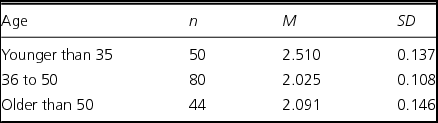
Two participants failed to respond to both items on training, leaving n = 174 participants for analyses (see Table 1). An ANOVA with age group as predictor and the vocational training scale as dependent variables showed that training differed between the age groups, F(2; 171) = 4.102, p = .018. As expected, workers older than 50 years reported fewer training opportunities than workers younger than 35 years, p = .038. Somewhat unexpectedly, there was no difference between workers older than 50 years and workers between 36 years and 50 years, p = .718. Workers between 36 years and 50 years also reported fewer training opportunities than workers younger than 35 years, p = .006.
Means and Standard Deviations of Self-Reported Training by Age Group (Study 1)

Discussion
A common assumption concerning demographic change is that ‘young workers’ differ from their colleagues who are 50 years and older (Kite, Stockdale, Whitley, & Johnson, Reference Kite, Stockdale, Whitley and Johnson2005; Voelpel, Leibold, & Früchtenicht, Reference Voelpel, Leibold and Früchtenicht2007). In our sample, workers between 36 and 50 years already report significantly reduced opportunities for training in comparison to their colleagues younger than 35 years, and the 36 to 50 years group does not differ from those 50 years and older. The lack of training among older employees may therefore be a larger problem than previously assumed.
A possible alternative explanation is that our cross-sectional sample included workers from different generations (i.e., a cohort effect). The motivation to participate in and seek training may differ between these generations (Macky et al., Reference Macky, Gardner, Forsyth, Macky, Gardner and Forsyth2008). Future research should therefore confirm our finding that even relatively young workers lack training (see also Stamov-Roßnagel, Reference Stamov-Roßnagel2008).
Consistent with our main hypothesis, we find that older workers report having fewer training opportunities than younger workers. At least three reasons may lead to this difference (see also Maurer, Weiss, & Barbeite, Reference Maurer, Weiss and Barbeite2003). First, our findings may reflect the actual training opportunities that the company offers its workers. Second, workers may perceive their opportunities differently, for instance, because older workers may stick to their work routines and may not notice opportunities as readily as younger workers (but see Kunze et al., Reference Kunze, Boehm and Bruch2013) or because they feel that they do not need further training. Lastly, older workers may simply not be motivated to advance any further (Maurer et al., Reference Maurer, Weiss and Barbeite2003) and therefore fail to recognise training opportunities. To gain insights into these individual reasons for the lack of training, we conducted problem-centered interviews with a sample of workers from this population.
Study 2: What Are the Subjective Reasons for Reduced Employee Training Opportunities? A Qualitative Interview Study
After establishing the decline of self-reported training opportunities among older workers in Study 1, we sought to investigate the underlying, subjective reasons perceived by workers. We focused on three potential factors: (a) feeling old, (b) particular tasks at work, and (c) the company climate. We moreover asked whether and in which fields older workers would like to have more training opportunities. Lastly, we extended our investigation to more informal knowledge transfer between older and younger workers.
Method
Qualitative Approach: The Problem-Centered Interview
We chose to conduct problem-centered interviews to gain access to older workers’ subjective reasons for reduced training opportunities. In this approach, each participant is considered an expert of their situation, and interviews help access participants’ knowledge to uncover relevant influences and connections (Mayring, Reference Mayring2010; Witzel & Reiter, Reference Witzel and Reiter2012). Thereby, the qualitative analysis enables researchers to gain access to social processes and soft data that cannot be observed with quantitative methods (Fine & Elsbach, Reference Fine and Elsbach2000).
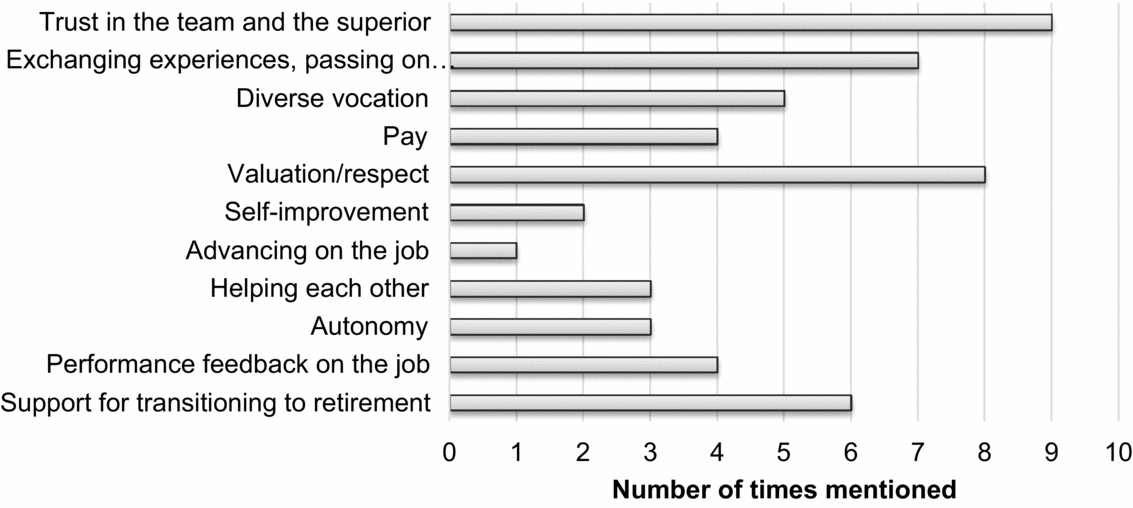
In line with the problem-centered interview methodology (Witzel & Reiter, Reference Witzel and Reiter2012), we used an interview guideline that served as a memory aid and defined the thought-space. Moreover, we used a fully structured list of items to ask participants to indicate the characteristics of their vocation (see Figure 1). Along this structure, we engaged in free conversation to establish a trusting relationship with the participant to gain access to their knowledge. In this way, we sought to balance our concern for systematic investigation with our aim to gain a deep understanding. We refined our theoretical constructs in line with our knowledge from the interviews, using a hermeneutic circle of induction and deduction (Lamnek & Krell, Reference Lamnek and Krell2015).
Job characteristics that are important to interviewed subjects (multiple answers possible).

Sample
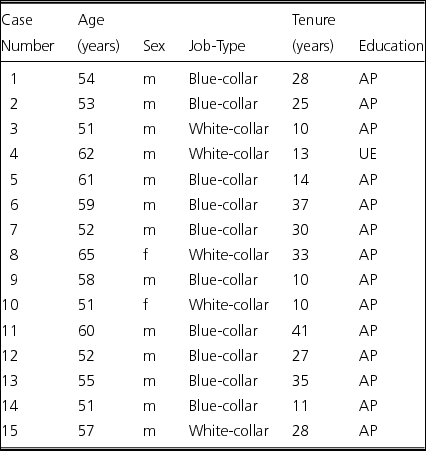
We conducted selective sampling (Schirmer, Reference Schirmer2009) based on previous research and on our quantitative study. We chose permanent workers from the same production company who were older than 50 years at the time of the interview and who did not occupy a leadership position. To gain insights into the different reasons for the lack of training in this group of employees, we selected workers from different jobs within the company. To ensure workers’ motivation to participate (Gläser & Laudel, Reference Gläser and Laudel2006), we asked division managers to suggest eligible participants. We then contacted 20 potential participants via email or in person, and made appointments in line with their working hours. Fifteen workers between 51 and 61 years old (M = 56.07, SD = 4.57) and with 10 to 41 years tenure (M = 23.47, SD = 11.06) agreed to participate. Ten were blue-collar workers and five were white-collar workers (see Table 2).
Sample Description Qualitative Investigation

Note: m = male, f = female, AP = apprenticeship, UE = university education
Interviews
We identified relevant topics on continued training and aging in the literature (Mayring, Reference Mayring2010). As the question order may influence participants’ responses (Gläser & Laudel, Reference Gläser and Laudel2006), we began with general questions concerning age and job tasks before asking about formal training and informal knowledge transfer. We developed the guideline and the company's human resource department provided feedback. The workers’ union council approved the final interview guideline. The interview guideline was structured as follows (see Appendix A for the complete interview guidelines):
-
1. Introduction and background:
-
a. Questionnaire to assess demographics
-
b. Age and aging
-
c. Job and vocation
-
-
2. Employee training
-
3. Knowledge transfer.
The interviews were conducted between January 21, 2015 and January 30, 2015. The interviews took 46 minutes on average (25–64 minutes) and were all conducted in the same room at the production plant to standardise interviews and to be close to the day-to-day work setting. We refined our interview guidelines after the first interview (Mayring, Reference Mayring2010; Mey & Mruck, Reference Mey and Mruck2010).
The first part of the interview served to establish a trusting conversation (Gläser & Laudel, Reference Gläser and Laudel2006). We explained the aim of the study and ensured confidentiality, and participants gave their informed consent. Confidentiality was crucial to the participants, as repeated questions show. Participants then provided demographic data, which enabled us to personalise the interview (Lamnek, Reference Lamnek1995). The interviewer took notes during and after the interview, and made audio recordings. Post-scriptum notes were taken after the interview (Flick, Reference Flick2007) to serve as an aid for interpreting the interview content.
Interview Preparation: Transcripts and Analysis
The interviews were fully transcribed, with exception of the standardised introduction, sections far off-topic, and names. Names were replaced with nonidentifying titles (e.g., Participant 1) to protect the individual's privacy. Dialect was replaced with standard German to enhance readability. Lastly, the transcripts were rechecked against the audio recordings. We conducted a qualitative content analysis with the transcripts (Mayring, Reference Mayring2010) to identify typical patterns across single cases (Lamnek & Krell, Reference Lamnek and Krell2015). The interview guideline was used as a starting point to deduct coding categories; further categories were developed inductively from the data (Kuckartz, Reference Kuckartz2010). During this process, the interviews were summarised and ordered according to common themes, yielding 429 coding units. Four common thematic categories emerged: (a) Age and aging; (b) Vocation; (c) Training; and (d) Knowledge transfer (see Appendix B). We discussed these categories with a second rater, and both raters matched central quotes to categories. The raters disagreed in 12 cases, leading to a highly satisfactory interrater-reliability, α = .94 (Krippendorff, Reference Krippendorff2004).
Results and Discussion
Our interviews began with two background sections, one on age and aging, and one on vocation. We briefly summarise these interview sections before we present and discuss the in-depth results on training and knowledge transfer. We illustrate our findings with representative quotes from the interviews (translated; original quotes provided in Appendix C).
Background: Age, Aging, and Vocation
All participants reported feeling younger than their chronological age (M = -14.3 years, range: -3 – -24 years), mostly because of their physical well being. Only one participant differentiated between mental and physical age, and reported feeling mentally young but physically old. Participants reported positive as well as negative consequences of aging. The most prominent negative aspect was physical decline due to life-long physical labour. Their decline became most obvious when participants compared themselves to younger coworkers or colleagues with different vocations.
A further, ambivalent aspect was the change of cognitive preferences and abilities, such as being less open to change and the subjective decline in the ability to learn. On the one hand, participants reported that their ability to learn had declined, especially regarding new media or using personal computers and other new technologies. On the other hand, many participants emphasised that interested workers can learn at any age. One third of the participants believed that the motivation and ability to learn is more related to personality than age.
On the positive side, most participants reported gaining more experience and knowledge with old age. They were proud of this asset and they felt valuable to their company because of it. They perceived that their experience is their key advantage over younger workers and that this makes up for other physical or cognitive deficits.
Quote 1. Young people have to prove themselves. As it is, I have seen everything; and if something changes, only one thing is new and not the entire machine. That is an advantage. And I grew up with the job from the beginning; and with this kind of experience you know many names and almost everybody by sight. And a lot of colleagues know me, too. That makes life easier. (Participant 1, 54 years)
Participants emphasised the importance of being valued as a worker. Nevertheless, most participants, especially blue-collar workers, reported feeling undervalued. They are aware how important their knowledge is for the company but feel that their contributions are not recognised. Some even reported that the company wants to ‘get rid of them’.
Quote 2. You do feel that you are not worth as much anymore. That has declined a lot in the last years. Now, everything is about performance . . . When you can't perform fully anymore, you are out of favor immediately. You should keep up with a 25-year-old. In the past, 10 to 15 years ago, old humans were still worth something; he was in demand. (Participant 13, 55 years)
Most interviewed workers generally claimed that their vocation is varied, due to changing work processes and working on different machines. However, workers see the monotonous tasks and the preclusion of decision making as problems.
Quote 3. We do not have any autonomy at all. (Participant 9, 58 years)
Quote 4. We don't need to think, we need to work. Other people get paid for thinking. I must deliver my lot sizes. (Participant 2, 52 years)
Participants further indicated characteristics of their vocation that were important to them on a fully structured list (see Figure 1). Participants mostly selected intrinsic factors including trust, being valued, and passing on knowledge. Experiencing variety in one's vocation was also important to participants. Important extrinsic factors included the company's retirement fund and, to a lesser degree, wages. Advancing one's career and self-improvement were not important to the participants.
Participants voiced different opinions about the potential to learn in their vocation. Two thirds were skeptical about their learning opportunities. The most frequently reported barriers to training were monotonous tasks and the work environment: rigid shifts and long tenure on a simple job. One third believed that they could acquire new knowledge or skills, such as understanding a product in greater detail, improving the production process, or working with a new machine. However, most of these participants later negated their statements.
Quote 5. In principle, you can learn and learn. But asking for one training or the other, you can't really do that here. But there are always things that you can't do perfectly and that you could learn to do better, no matter how long you have been working. (Participant 9, 58 years)
Furthermore, hard physical labor reduces the potential and the readiness to learn. Some participants also talked about their younger colleagues, who, according to their view, also have limited opportunities to grow. Increasing pressure to perform and the physical strain of the job reduce work motivation and satisfaction, even at a young age.
Quote 6. To some extent, it is inhumane [. . .]. But when the young guys are moaning already, it is certainly not normal. These poor guys need to work another 40 years. Thinking about that, I do pity them. (Participant 13, 55 years)
Summary and Discussion
The interviewed older workers felt younger than they are but are aware of their cognitive and physical decline. Participants complained that they are not held in high esteem. Older workers were mostly intrinsically motivated, would like to participate more in decision processes, and would like to have more autonomy. Most workers were under the impression that they cannot learn more than they already know or that learning is not relevant due to the low variety of products they work on. In sum, these qualitative findings support our quantitative observation that older workers lack training opportunities.
Formal Training
Preferred and Actual Training Opportunities
We first sought to assess how many training opportunities participants perceive having and would like to have. Only few participants indicated that they perceive having received many training opportunities, and all of these few participants were white-collar workers. The majority of the participants reported having received little training. Most of the training they did receive was comprised of seminars on specific topics such as safety and hazardous materials, health, or how to operate a specific type of machine.
Quote 7. But there is no time for that. The client is waiting for the product. The lot size must be right. And then we are understaffed at times. I have not received an offer for training. (Participant 13, 55 years)
Some participants criticised that current training opportunities were not geared towards older workers and suggested that informal training are more important for their work than formal training. Workers reported that they want to exchange their knowledge and their experience with coworkers and other companies to learn from each other. Few wished for job rotation, and most experienced changes in their workplace as stressful.
Training Motivation
Most participants did not want to receive training and would only participate in training if ‘it is absolutely necessary’ (Quote 8. Participant 2, 53 years) or ‘if I really have to’ (Quote 9. Participant 5, 61 years). The reasons for lacking training motivation were manifold. Some participants assumed that training is not necessary for older workers, either because they were satisfied with their work place as it is or because they did not have any experience with training. Many participants wanted to retire as soon as possible, further decreasing their interest in developing their work-related knowledge and skills.
However, some participants reported the intention to seek training or at least the willingness to participate in training necessary for their job. More than half of the participants wanted to retire early and are looking forward to this opportunity. Participants reported that their goals had been towards furthering their careers but that their interest has shifted toward leisure activities and family. Participants reported that, in retrospect, they could have advanced but that they now focus on ‘life after work’ (Quote 10. Participant 13, 55 years).
Quote 11. As you grow older, you realise all the things that you still want to do in your life. And then, during a shift, your time vanishes. It is hard to make up for lost time. I travel a lot. There are still a few things that I can do outside of work . . . When you are young, you have to be ambitious to advance in your job and your family. At my age, things change. I still work well. The young think ahead, about what they want to do with their qualifications, and I think about all the nice things that I can do once I don't have to work anymore. (Participant 9, 58 years)
Barriers to Training and Recommendations for Change
Participants generally reported few opportunities for training and the few participants who mentioned concrete vocational interests also claimed that their employer ignores these requests. At the level of the company, participants reported that formal training for older employees has little value because of the limited working time left before retirement. Therefore, younger workers get preferred treatment. Participants perceived that younger workers are ‘the future of the company’ (Quote 12. Participant 15, 57 years), and that it is worth investing in them because they are better educated, healthier, readier to learn, and more motivated. Participants agreed with this line of reasoning and perceived it as fair, thus attributing their lack of training to their lack of motivation due their old age and not to their company's policy. Participants thus seemed to be highly identified with their age group, which in turn lead them to adhere to common age stereotypes (self-stereotyping; Hogg & Turner, Reference Hogg and Turner1987; Levy, Reference Levy1996; Spears, Doosje, & Ellemers, Reference Spears, Doosje and Ellemers1997).
Quote 13. The company is not to blame, age is to blame. (Participant 2, 53 years)
Quote 14. Because workers are so expensive, it makes more sense to support a young one. It does not make sense to employ 67-year old, also because of his health . . . In this sense, he [the older worker] would take the job away from a younger one. (Participant 11, 60 years)
Participants moreover reported that training often does not meet their needs or is perceived as inappropriate for their age.
Quote 15. But the seminar must also cater to the needs of the participant. For instance, when a production worker gets presentation training. That does not make any sense, except if he is expecting a promotion! So, again, it is like an alibi due to the matrix. He would benefit more from project training and would participate more, too. In the other, he would just sit there. (Participant 1, 54 years)
More than half of the participants reported that the core motivator for training was the immediate relevance to their individual job. Participants further would prefer longer trainings in smaller groups. One participant suggested including workers in the design phase of the training. In general, the company should advertise available training opportunities more.
In fact, participants reported that even offering training to older workers would be ‘a sign of valuation’ (Quote 16. Participant 13, 55 years) that would be highly motivating. Further intrinsic motivators include the training climate and observing coworkers participating in training. Only a minority of workers mentioned financial incentives related to promotion opportunities as a motivation for training. Most participants agreed that training participation must be voluntary and that the company can only help motivate workers.
Summary and Discussion
Older workers in our sample consistently reported a lack of training motivation, which is in line with a general shift of focus from work to family and retirement. Older workers also reported receiving few training opportunities from their company. A main perceived barrier to training is age — the few remaining work years make training for older workers uneconomical. Older workers’ perceptions of themselves are thus a major impediment to training. This is unsettling since technological change requires training for their continued integration in the workforce. Potential motivators for training include feeling valued, learning something for one's job in an age-appropriate setting, and, to a lesser degree, attaining a better paying job. Companies thus need to change their age climate and actively engage older workers. Moreover, companies could explicitly set work-related goals and plans with their older workers, which would further engage them in work processes, keep them motivated, and help them to enact their intentions (e.g., Thürmer, Wieber, & Gollwitzer, Reference Thürmer, Wieber, Gollwitzer, Mumford and Frese2015).
Informal Training and Knowledge Transfer
Motivation and Incentives
Participants reported that their knowledge and their experience is valuable to the company, and that colleagues’ and superiors’ acknowledgement of this is a core motivator. More than half of the participants reported being asked for their knowledge, and most felt that this was a sign of valuation. Superiors also praise older workers for their knowledge and for being reliable. However, one participant reported feeling used by colleagues who prefer to leave the work to older, experienced workers, and another participant reported younger colleagues’ resentment because they are envious of the lighter work assigned to older workers. Most participants reported taking initiative to pass on their knowledge to the younger generation. However, many participants reported that some of their colleagues refuse to pass on knowledge, either because of a lack of motivation or because nobody asks them. This may point to a bias in our sample, as workers who agreed to participate may also be generally more likely to engage in knowledge transfer.
Passing on knowledge has two main benefits for older workers: First, young workers receiving advice can then take on more work, and lighten the load for older workers. Second, older workers derive a sense of meaning and a feeling of being needed from passing on their knowledge and experience. For many of the participants, passing on knowledge was also key to a positive company climate.
Quote 17. One should put a young worker next to an old worker so he can learn. And when he can do the job, the older worker can leave early, if he wants to . . . If an older worker has to stop working from one day to the next, he falls into a sort of limbo, when he is not needed anymore. (Participant 11, 60 years)
Barriers to Knowledge Transfer and Recommendations for Change
Successful knowledge transfer requires the recipient's readiness to learn. Participants acknowledged this and viewed themselves as sender as well as receiver. Despite their reported readiness to learn, many participants complained about their colleagues lacking readiness to take advice. To advance knowledge transfer, participants suggested improving company climate to build trust and to facilitate communication. To achieve this, participants suggested communication trainings and team events. Superiors also could encourage knowledge transfer, while still keeping it voluntary. A few participants moreover suggested appointing predecessors early to be able to pass on their knowledge on the job.
Summary and Discussion
Informal training and knowledge transfer does take place and is important to participants for many different reasons. Participants manage to pass on some of their knowledge, which they perceive to be important for the company. This transfer mainly concerns daily work processes and colleagueship. Equally, participants feel valued when they can pass on their experience, which may further motivate them to contribute to work processes and to remain in the company.
Participants seemed far more familiar and comfortable with this informal knowledge transfer than they are with formal training opportunities. Moreover, workers can contribute significantly by passing on their knowledge. Focusing on this type of training could therefore be a promising and cost-effective alternative to workshops and seminars. Team building exercises, encouragement from superiors, on-the-job training, and early successor assignment could further enhance knowledge transfer. Moreover, knowledge transfer is a great source of valuation and therefore may help keep older workers engaged in the work process.
General Discussion
Our mixed-methods approach consistently shows that older workers are not as motivated, do not feel as entitled to, and do not participate as much in training as younger workers. We moreover quantitatively observed that even middle-aged workers (30–50 years old) already report a decline in vocational training opportunities. This may suggest that workers in this production plant become disillusioned and demotivated at a relatively young age. Companies thus fail to use the potential of older workers.
Recommendations for Continued Training
Three themes emerged during the interviews that have implications for how to increase training participation for older workers. First, throughout the interviews, participants emphasised how important feeling valued is to them. The acknowledgement of past achievements, knowledge, or helping others appeared as a key motivator. This suggests that relatively low-cost, informal training formats may increase work satisfaction and knowledge transfer by sending a sign of valuation.
A second theme was the change in work motivation. Participants reported looking forward to retirement and focusing more on their personal life. This is in line with existing research on work motivation (Kanfer & Ackerman, Reference Kanfer and Ackerman2004) that shows work disengagement close to retirement, although moderators exist (Kooij, De Lange, Jansen, Kanfer, & Dikkers, Reference Kooij, De Lange, Jansen, Kanfer and Dikkers2011). Setting specific goals and plans during training may help maintain higher work motivation (e.g., Locke & Latham, Reference Locke and Latham2002; Thürmer et al., Reference Thürmer, Wieber, Gollwitzer, Mumford and Frese2015; Wieber, Thürmer, & Gollwitzer, Reference Wieber, Thürmer, Gollwitzer, Seebaß, Schmitz and Gollwitzer2013), for instance, when encouraging knowledge transfer.
A third theme was the changing need for training at an older age. Participants mentioned physical, cognitive, and technological impediments to training and work participation. Moreover, an important prerequisite for training participation is the immediate relevance for the participants’ jobs (see also Simpson et al., Reference Simpson, Greller and Stroh2002). Companies therefore need to adapt their training to the needs of older workers (Wolfson, Cavanagh, & Kraiger, Reference Wolfson, Cavanagh and Kraiger2014), and also take context and content into account (Williams van Rooij, Reference Williams van Rooij2012). Not only did company stereotypes emerge as an impediment (Stamov-Roßnagel, Reference Stamov-Roßnagel, Brauer and Clemens2009), but also the self-stereotypes of the workers. Comprehensive programs for life-long learning are therefore needed.
Strengths and Limitations
Our mixed-methods study has several methodological strengths. First, this design enabled us to shed light on the training situation of older workers from a quantitative and a qualitative perspective. This may be especially important when investigating aging, as recent research shows that older participants may differ systematically in the way that they respond to self-report questionnaires (Knäuper et al., Reference Knäuper, Carrière, Chamandy, Xu, Schwarz and Rosen2016). Thus, it was crucial to go beyond our questionnaire results with qualitative interviews. Second, our qualitative interviews allowed us to give voice to the subjective needs of the older workers as well as uncover relations and possible causes easily overlooked in a fully structured, quantitative study.
Despite these methodological strengths, our approach inevitably has limitations. First, our quantitative findings are cross-sectional; therefore, it remains unclear whether age actually caused the decline in training opportunities. Similarly, our qualitative observations have a high ecological validity but do not allow assessing which percentage of workers agrees with this view. Future quantitative research should therefore investigate whether our observations generalise.
Further, we focused on seeking training and advancement. An older workforce may also pose a challenge during training and training implementation, as age diversity reduces trust and reduced trust decreases training outcomes (Gerpott, Wenzel, Lehmann-Willenbrock, & Voelpel, Reference Gerpott, Wenzel, Lehmann-Willenbrock and Voelpel2015). Companies therefore need to take workers’ ages into account when designing and conducting training.
Lastly, companies will ultimately need to attract and retain older workers (Bal, De Jong, Jansen, & Bakker, Reference Bal, De Jong, Jansen and Bakker2012). Improved training and advancement opportunities are key to mastering this challenge. Other measures may include more flexible work arrangements and reducing the age discrimination climate. Beyond the existing workforce, companies may also need to adjust their recruiting processes. Unemployed older workers are less likely to find a new job, and this is partially due to their perceived lack of efficacy (Wanberg, Kanfer, Hamann, & Zhang, Reference Wanberg, Kanfer, Hamann and Zhang2016). As attracting qualified workers becomes increasingly competitive, companies may need to adjust their hiring campaigns to directly target older workers, thereby increasing older workers’ efficacy.
Conclusion
Older workers lack training, which puts them at risk for dropping out of the work process early. By giving voice to older workers in a production plant, we identified lacking valuation, changing needs, and decreased motivation as key subjective reasons for this lack of training. Informal knowledge transfer motivates older workers and helps retain their experience and knowledge within the company. These are key steps in enabling companies to master the challenge of integrating and retaining an aged and shrinking workforce.
Acknowledgements
This article is based on Aleksandra Yedyenyova's master's thesis and was presented at the 4th Conference on Disability Management: Decent Work! International Perspectives on Workplace Integration and Disability Management in Olten, Switzerland and the 50th Congress of the German Psychological Association (DGPS) in Leipzig, Germany. We thank Angela Whale for language editing.
Supplementary material
To view supplementary material for this article, please visit https://doi.org/10.1017/idm.2017.4