1. Introduction
1.1. spatial demonstratives as deictic expressions
Demonstratives (this/that in English) are cross-linguistically widespread deictic expressions. They are crucial for conveying information about space, time, person, and discourse in exophoric and endophoric contexts (Diessel, Reference Diessel1999, Reference Diessel, Haspelmath, Dryer, Gil and Comrie2005; Diessel & Coventry, Reference Diessel and Coventry2020), as well as for manipulating the interlocutor’s focus of attention during interaction (Kita, Reference Kita2003; Rocca, Wallentin, Vesper, & Tylén, Reference Rocca, Wallentin, Vesper and Tylén2019b; Todisco, Guijarro-Fuentes, Collier, & Coventry, Reference Todisco, Guijarro-Fuentes, Collier and Coventry2020).
Demonstratives are among the most frequent and flexible words in the lexicon (Diessel, Reference Diessel2013, Reference Diessel2014; Leech, Rayson, & Wilson, Reference Leech, Rayson and Wilson2014). In different situations, expressions such as ‘This one’ may refer to an object, a person, an event, or a thought. The advantage of such flexibility is that demonstratives can be used in a variety of linguistic and pragmatic contexts. The disadvantage that follows is that uttering a demonstrative will not always ensure identifiability of the intended referent, as the following examples show. In the sentence ‘This is what I think about you: you are a lovely person’, the cataphoric use of the pronoun this is disambiguated and easily identifiable by the sentence that immediately follows (i.e., you are a lovely person). Nevertheless, in the sentence ‘Give me that thing’, the adjectival use of that is not easily identifiable without additional cues. These cues are usually provided by nonverbal components of the context of utterance, including pointing gestures and eye-gaze trajectories (Kita, Reference Kita2003; Talmy, Reference Talmy2018; Todisco et al., Reference Todisco, Guijarro-Fuentes, Collier and Coventry2020).
Combining verbal and nonverbal referencing strategies, that is, pointing and gazing at a specific referent while using a demonstrative, facilitates the task of disambiguating the referent, compared to contexts where the speaker only uses one modality, either verbal or nonverbal (Cooperrider, Reference Cooperrider2016; Fricke, Reference Fricke, Müller, Cienki, Fricke, Ladewig, McNeill and Bressem2014; Iverson, Tencer, Lany, & Goldin-Meadow, Reference Iverson, Tencer, Lany and Goldin-Meadow2000; Kita, Reference Kita2003; Todisco et al., Reference Todisco, Guijarro-Fuentes, Collier and Coventry2020). Talmy (Reference Talmy and Pick1983, Reference Talmy and Rudska-Ostyn1988) and Kemmerer (Reference Kemmerer2006, p. 1608) highlighted that demonstratives alone do not encode precise degrees of remoteness from the speaker (or deictic centre). Sentences like ‘Here in this room’ and ‘Here in this galaxy’ are both perfectly grammatical, despite the huge differences in scale, because the semantic space demonstratives carve is pragmatically modulated by the combination of nonverbal cues, communicative intention of the speaker, physical position, and salience of referents in the contextual communicative scenario (see Diessel & Coventry, Reference Diessel and Coventry2020; Kemmerer, Reference Kemmerer2006, p. 1608). Moreover, the choice of one specific demonstrative rather than another also conveys some disambiguating information about the intended referent. In the utterance, ‘I know that guy’, for example, the use of that – rather than the perfectly grammatical alternative this – hints at the referent being located at some physical or social distance from the speaker (Peeters, Krahmer, & Maes, Reference Peeters, Krahmer and Maes2021; Rocca, Tylén, & Wallentin, Reference Rocca, Tylén and Wallentin2019a; Rocca & Wallentin, Reference Rocca and Wallentin2020).
In the present study, we aim at clarifying the role of the semantics of referents in the choice of demonstrative forms used to indicate them, using a simple and versatile experimental paradigm called the Demonstrative Choice Task (henceforth DCT). Previous studies have used this paradigm to investigate semantic factors driving demonstrative choice in English (a two-term demonstrative system with this/these as proximal forms and that/those as distal forms; Rocca & Wallentin, Reference Rocca and Wallentin2020) and other two-term European languages (Danish and Italian, though only a small number of semantic dimensions were investigated for these languages; Rocca & Wallentin, Reference Rocca, Tylén and Wallentin2019a In this study, we use the DCT to delve into the semantics of demonstrative choice in Spanish, a language with three demonstrative forms (este ‘this’ / ese ‘this–that’ / aquel ‘that’). Comparing patterns of demonstrative use in the DCT for Spanish with findings for a two-term language, such as English (this/that) will contribute to shedding light on whether similar clusters of semantic dimensions drive demonstrative choices across languages, even when languages differ in the number of terms available in their demonstrative systems. Furthermore, results from this study will allow us to gather insights on whether the use of medial demonstrative forms (i.e., ese) versus distal ones (i.e., aquel) can be explained by specific semantic dimensions of the referent, or whether the two are entirely redundant from a semantic perspective.
1.2. perceptual vs. psychological factors influencing demonstrative choice
The speaker’s choice of a specific demonstrative form results from a complex process of resolving the mappings between a number of multimodal perceptual, attentional, and pragmatic cues in the minds of both the speaker and the hearer and their relations to the intended referent. Cues functional to identifying the referent can largely be categorized as perceptual or psychological factors. perceptual cues are those pieces of information contributed, for example, by the physical circumstances of the utterance. Distance between the referent and the speaker is perhaps the most intuitive one, and the most widely studied and debated. Distance modulates the choice of demonstrative based on a near/far dichotomy (Di Pellegrino & Làdavas, Reference Di Pellegrino and Làdavas2015), such that the chosen form encodes information on whether the referent is proximal or distal from the speaker (or deictic centre). Many studies have pointed to space and distance between speaker and referent as being the most prominent parameter determining speakers’ choice of a specific demonstrative form (Caldano & Coventry, Reference Caldano and Coventry2019; Coventry, Valdés, Castillo, & Guijarro-Fuentes, Reference Coventry, Valdés, Castillo and Guijarro-Fuentes2008; Diessel, Reference Diessel1999, Reference Diessel, Haspelmath, Dryer, Gil and Comrie2005; Hunley & Lourenco, Reference Hunley and Lourenco2018).
In the context of these studies, distance is often understood as a physical space separating the speaker and the referent. However, recent work by Bocale and Cologna (Reference Bocale and Cologna2020) has pointed out that distance in communication should be better understood as incorporating a variety of subjective factors. An adequate notion of distance does not merely resolve in an indicator of physical space, but is a complex notion which incorporates both absolute and perceptional/perspectival distance relationships between interlocutors. absolute distance in this terminology is the space between two discourse elements, such as the speaker and the intended referent. perceptional/perspectival distance includes a displaced reference point, such as the perspective of the hearer involved in the communicative interaction (see Rocca et al., Reference Rocca, Wallentin, Vesper and Tylén2019b).
Distance is thus a prominent but not the only perceptual factor affecting the choice of demonstratives. It has been pointed out, for example, that visibility of the referent may also systematically influence demonstrative choice, as shown by Coventry and colleagues in a study using an adapted version of the psycholinguistic elicitation paradigm known as the Memory Game for Object Location (Coventry, Griffiths, & Hamilton, Reference Coventry, Griffiths and Hamilton2014). In this study, adult English monolingual speakers were asked to point to and verbally describe the position of discs placed at varying distances, with the visibility of discs being manipulated by covering them with either an opaque or a clear container. Results showed that the proximal demonstrative form this was used less often when the objects were covered with the opaque container, meaning that whether the object is visible or not also affects demonstratives choice and usage.
Alongside perceptual cues provided by the context of the utterance, the mapping between demonstratives and referents is also mediated by psychological factors, which depend on more abstract, cognitive processes, such as memory and emotions, rather than on perceptual ones. Social proximity between speaker and hearer, and the perspective of the hearer (Küntay & Özyürek, Reference Küntay and Özyürek2002; Peeters, Hagoort, & Özyürek, Reference Peeters, Hagoort and Özyürek2015; Peeters et al., Reference Peeters, Krahmer and Maes2021), for example, can determine whether the speaker chooses a proximal, medial, or a distal demonstrative form. Knowledge of the functional status of the referent (i.e., its affordance for manual grasp, see Coventry et al., Reference Coventry, Valdés, Castillo and Guijarro-Fuentes2008; Coventry et al., Reference Coventry, Griffiths and Hamilton2014; Rocca et al., Reference Rocca, Tylén and Wallentin2019a), as well as whether or not the referent is within or outside attentional focus (Strauss, Reference Strauss2002), are other psychological factors explored in the literature.
Evidence for the role of a variety of perceptual and psychological factors in speakers’ choices of demonstrative forms (and, therefore, in reference resolution on the addressee’s side) does not necessarily entail that all of these parameters do always (or always equally) play a role in speakers’ demonstrative choices or in the identification of the intended referent. A strict one-to-one correspondence, e.g., one specific parameter fully describing demonstrative choice in a specific language, is reductive and may lead to a misinterpretation of how the identification of the intended referent works. Parameters are not mutually exclusive; a range of potentially relevant parameters is available to the speaker and hearer, from which they select the most salient ones in accordance with the information they want to convey or with communicative needs/constraints (Peeters et al., Reference Peeters, Krahmer and Maes2021; Todisco, Guijarro-Fuentes, Gudde, & Coventry, unpublished observations). This combination of systematicity and flexibility is what makes demonstratives such an efficient, pervasive, and cross-linguistically widespread communication tool: all languages have some demonstrative forms, although the number of demonstrative terms and parameters affecting demonstrative choice can vary (Diessel, Reference Diessel, Haspelmath, Dryer, Gil and Comrie2005, Reference Diessel2013; Diessel & Coventry, Reference Diessel and Coventry2020; Levinson, Reference Levinson, Levinson, Cutfield, Dunn, Enfield and Meira2018). Providing a full description of which factors drive demonstrative choice and use, how their importance is modulated by context, and the extent to which these dynamics generalize across languages thus provides a key contribution to unpacking the pivotal mechanisms underlying the complex functioning of linguistic reference in interaction (Peeters et al., Reference Peeters, Krahmer and Maes2021).
In this study, we delved into a fundamental conceptual and psychological factor of demonstratives: their semantics. The relationship between semantics and deixis has been extensively discussed in the previous literature, but, as highlighted by Dufter (Reference Dufter, Jungbluth and Da Milano2015), a great part of these studies focuses on the interface between semantics and pragmatics in discourse (e.g., the function of deictic expressions in discourse, or the role of a speaker’s intentions in producing a deictic reference), and they mostly use qualitative tools. However, semantics and demonstrative reference are interwoven at a more fundamental level. The choice of demonstrative forms may in fact be constrained by which entities they are meant to refer to, especially when no other additional contextual cues, such as addressee position or physical distance, are provided. The semantics of such entities (and, thus, of the nouns denoting them) influence which demonstrative form are used, and, in turn, the use of specific demonstrative forms and/or their position provides information about the referring noun and/or the intended object (Jungbluth & Da Milano, Reference Jungbluth and Da Milano2015).
Previous studies on the semantics of demonstratives have mostly focused on a few selected, hypothesis-driven semantic factors at a time, or as embedded in interaction and physical space. Paradigms like the David Wilkins Demonstrative Questionnaire (DWDQ, Reference Wilkins and Wilkins1999), the Memory Game for Object Location (Coventry et al., Reference Coventry, Griffiths and Hamilton2014), and conversation data collection (Küntay & Özyürek, Reference Küntay and Özyürek2002) are example of elicitation methods used to investigate factors driving demonstrative choice (see also Levinson, Cutfield, Dunn, Enfield, & Meira, Reference Levinson, Levinson, Cutfield, Dunn, Enfield and Meira2018, for a cross-linguistic detailed review). The DWDQ manipulates 25 parameters – among which are: distance, interlocutors’ focus of attention, visibility, possession, and mention of the referent during conversation – while assessing one factor at a time (Lin, Reference Lin2013; Wilkins, Reference Wilkins and Wilkins1999). Coventry and collaborators (Reference Coventry, Griffiths and Hamilton2014) assessed that ownership, during the Memory Game paradigm, was affecting demonstrative choice and resulting in a larger use of this.
Thus, while perceptual factors and single psychological factors have been widely explored and debated, and differences in their role across languages extensively discussed (Levinson et al., Reference Levinson, Cutfield, Dunn, Enfield and Meira2018), the role of semantics in demonstratives choice has only recently started to receive attention in the experimental literature (Rocca et al., Reference Rocca, Wallentin, Vesper and Tylén2018, Reference Rocca, Tylén and Wallentin2019a, Reference Rocca, Wallentin, Vesper and Tylén2019b; Rocca & Wallentin, Reference Rocca and Wallentin2020). The first attempt to provide a comprehensive overview of the semantic dimensions on demonstrative choice which both isolates the contribution of semantics from perceptual and pragmatic factors and probes the role of a large set of psychologically relevant dimensions was provided by the online questionnaire paradigm DCT (Rocca et al., Reference Rocca, Wallentin, Vesper and Tylén2018, Reference Rocca, Tylén and Wallentin2019a, Reference Rocca, Wallentin, Vesper and Tylén2019b; Rocca & Wallentin, Reference Rocca and Wallentin2020).
1.3. the Demonstrative Choice Task: mapping the role of semantics
Rocca and collaborators (Rocca et al., Reference Rocca, Wallentin, Vesper and Tylén2018, Reference Rocca, Tylén and Wallentin2019a, Reference Rocca, Wallentin, Vesper and Tylén2019b; Rocca & Wallentin, Reference Rocca and Wallentin2020) studied the effect of semantic features of concrete referents/nouns in demonstrative choice for two-term demonstrative systems. By asking participants to match nouns and demonstrative forms without priming them with any contextual cues, they showed that speakers of different European languages (English, Danish, and Italian) converge on using proximal demonstratives when referring to words denoting harmless, familiar objects (like apples), and distal demonstratives for harmful, threatening objects (such as tigers). Moreover, Rocca and collaborators (Reference Rocca, Tylén and Wallentin2019a) found that manipulability of the intended referent, a semantic dimension combining both perceptual (size), psychological (harmfulness), and ontological (animacy) dimensions of the intended referent, influences the choice of a proximal demonstrative (i.e., this) over a distal form (i.e., that) in two-term demonstrative systems, such as English, Italian, and Danish. In a subsequent study including a larger number of both words, semantic dimensions, and participants (Rocca & Wallentin, Reference Rocca and Wallentin2020), it was found that demonstrative choice of the English proximal form (i.e., this) over a distal form (i.e., that) was related to a set of additional semantic factors, including valence, arousal, loudness, motion, time, and more generally the self as a multidimensional perceptual and psychological construct.
The results reported by Rocca and collaborators suggest that demonstrative choice depends on the interaction of a number of semantic features of a referent relative both to the speaker’s physical and psychological spaces. More specifically, objects can be closer or further away in space, but also in time (e.g., this time), or phenomenologically and emotionally (e.g., Don’t be that guy) (Peeters et al., Reference Peeters, Krahmer and Maes2021; Rocca & Wallentin, Reference Rocca and Wallentin2020). Distance is evaluated not only relative to the physical anchoring of the speaker in the immediate perceptual space, but also, in what Bühler (Reference Bühler1934/2011) and Stukenbrock (Reference Stukenbrock2014, Reference Stukenbrock2015) define as Deixis am Phantasma, relative to the position of the speaker in an imagined space. The dynamic deictic displacements have been described by Stukenbrock (Reference Stukenbrock2014) as a continuous shifting of origos among physical and psychological reference spaces and dimensions. When no physical distance information can be or needs to be conveyed, the reference space becomes an imaginary one, organized around dimensions such as familiarity and affection (e.g., sociocentric parameter in demonstrative choice, Peeters et al., Reference Peeters, Hagoort and Özyürek2015, Reference Peeters, Krahmer and Maes2021). In line with this, the DCT results suggest that the imagined space is organized around the self and its needs and motivations. The notion of self conflates the function of physical, bodily, and psychological reference spaces into one multidimensional hyperspace, and the referent’s location within this space is what determines the choice of one demonstrative over another.
While the results from large-scale DCT studies in English (Rocca et al., Reference Rocca, Tylén and Wallentin2019a; Rocca & Wallentin, Reference Rocca and Wallentin2020) are reliably consistent across participants, no evidence exists yet that these patterns generalize to the dynamics of demonstrative use across languages which differ in their demonstrative inventory. One of the strengths of the DCT paradigm, however, lies in the possibility of seamlessly adapting it to different languages, regardless of the number of demonstratives a specific system has. Showing that semantic patterns replicate not only in languages with two-term demonstrative systems, but also across languages with more than two demonstrative terms, would provide a strong argument supporting the hypothesis that these mechanisms capture a fundamental aspect of the relation between human cognition, semantics, and linguistic reference. This is the rationale behind the present study, where we extended the DCT study by Rocca and Wallentin (Reference Rocca and Wallentin2020) to Spanish, in order to both probe the replicability of the results obtained so far, and to characterize the role of additional demonstrative forms, such as medial forms in the Spanish three-term system, in the interplay between demonstrative reference and the self.
1.4. demonstrative terms in Spanish
Spanish has a three-term demonstrative system which consists of a proximal form, este/a ‘this’, a medial form, ese/a ‘this/that’, and a distal term, aquel/la ‘that’. The three terms present masculine and feminine, as well as singular and plural, forms which convey gender and number information in accordance with the noun they accompany (adnominal demonstratives: e.g., esta luna ‘this moon’) or substitute (e.g., estos ‘these’, referring to the plural referents ‘books’). The proximal–medial–distal distinction has been suggested to designate increasingly remote concentric circles around the speaker (Hottenroth, Reference Hottenroth1982, p. 133). Traditionally, the adnominal/pronominal proximal form este/a ‘this’ has been said to identify a portion of space close to the speaker; the medial form ese/a ‘this/that’ identifies a medial distance from the speaker (or hearer), and aquel/la ‘that’ is used for portions of space located far away from the speaker (and hearer). This division is partly supported by experimental evidence (Coventry et al., Reference Coventry, Valdés, Castillo and Guijarro-Fuentes2008). Using the Memory Game for Object Location (Gudde, Griffiths, & Coventry, Reference Gudde, Griffiths and Coventry2018), Coventry and collaborators (Reference Coventry, Valdés, Castillo and Guijarro-Fuentes2008) found that speakers of Spanish also tend to carve up space along a peri-personal (within reach) versus extra-personal (outside reach) distinction. Participants used more instances of the proximal demonstrative este/a ‘this’ in the peri-personal space compared to extra-personal space. Interestingly, however, Coventry and colleagues did not look at the distinction between usage patterns of the medial (ese/a) and the distal (aquel/la) demonstrative in the extra-personal space, which therefore remains largely unexplored. Moreover, in the majority of the above-mentioned studies, semantic distinctions between referents are ‘controlled for’ or neutralized rather than thematized as a factor of interest (Coventry et al., Reference Coventry, Valdés, Castillo and Guijarro-Fuentes2008; Jungbluth, Reference Jungbluth and Lenz2003). To our knowledge, there is no empirical study systematically and comprehensively describing the use of Spanish demonstrative forms as a function of semantic features of the referent when no contextual cue is provided and without the interaction with an addressee.
1.5. the present study
In the present study, we used the DCT to investigate the relationship between semantics and demonstrative choices in Spanish. The aims of this study were twofold. First, we aimed at investigating whether and how semantic features influence demonstrative choices in a language with a three-term demonstrative system. We expected to replicate results from the English two-term system, with semantic features related to referent manipulability, valence, and to a psychological notion of self driving preference for proximal vs. other forms (cf. Rocca & Wallentin, Reference Rocca and Wallentin2020). To this end, Spanish data were collected for the same set of words used in this study. These words comprised a set of words, previously given comprehensive semantic annotations by Binder and collaborators (Reference Binder, Conant, Humphries, Fernandino, Simons, Aguilar and Desai2016). Second, we aimed at exploring usage patterns and potential semantic specificities of medial and distal forms (i.e., ese/a and aquel/la in Spanish) in contexts where fine-grained spatial distinctions are not needed. With respect to the latter, two possible scenarios could be expected. In contexts where conveying precise information on the referent’s physical location is not necessary, the distinction between medial and distal forms could:
-
(a) disappear, leading to a collapse onto a binary near/far opposition. If this were the case, we would expect to see either a random distribution of the two non-proximal demonstratives, or a diminished use of one of the two non-proximal demonstratives, most probably the distal form aquel/la ‘that’ in favour of the medial form ese/a ‘this-that’, in line with a trend of reduction already identified in Argentinian Spanish (Pérez-Saldanya, Reference Pérez-Saldanya2015) and the Majorcan Catalan (Todisco, Guijarro-Fuentes, & Coventry, Reference Todisco, Guijarro-Fuentes and Coventry2021). The Argentinian Spanish three-term system (este ‘this’ / ese ‘this-that’ / aquel ‘that’) is in fact characterized by the co-existence of the two forms ese/a and aquel/la for the same dimension (the medial/distal space), where the distal demonstrative aquel/la is considered more formal than the medial demonstrative ese/a (Pérez-Saldanya, Reference Pérez-Saldanya2015, p. 116), but semantically equivalent. Majorcan Catalan demonstratives system (aquest/aqueix/aquell) presents a reduction to two-terms (aquest/aquell) when information about physical distance is conveyed (Todisco et al., Reference Todisco, Guijarro-Fuentes and Coventry2021).
-
(b) adapt to specific semantic factors and dimensions. The choice of the medial ese/a versus the distal term aquel/la could be made on the basis of semantic factors. In other words, speakers may use a multidimensional mapping between demonstratives and semantics, such that particular semantic dimensions map onto the medial/distal gradient of ese/a-aquel/la, while other dimensions may map onto a proximal/non-proximal gradient of este/non-este.
2. Materials and methods
2.1. participants
Similar to Rocca and Wallentin (Reference Rocca and Wallentin2020), we conducted a DCT experiment using Qualtrics (http://qualtrics.com) with participants recruited through the website Prolific (http://prolific.ac; see Appendix B for an example of the experiment). 1639 native Spanish speakers participated (gender: 871 female, 746 male, 22 other; age information was collected in bins: 1013 were 18–30 years, 401 were 30–40 years, 161 were 40–50 years, 56 were 50–60 years, and 8 were 60+ years). The study was approved by the Institutional Review Board at Aarhus University.
2.2. procedure
The study took on average 719 (std: 479) seconds to complete, and participants were rewarded with 0.9 GBP for participation. Each participant was presented with 60 Spanish words, sampled and translated from a database of 535 English words rated on 65 different semantic dimensions comprising sensory, motor, spatial, temporal, affective, social, and cognitive experiences (Binder et al., Reference Binder, Conant, Humphries, Fernandino, Simons, Aguilar and Desai2016). 480 of the 535 words were divided into 8 subsets, and participants were presented with one such subset of words in a pseudo-randomized manner. Translation of the full list of words from English to Spanish is presented in Appendix C. To allow for comparison with English, we used the same words (translated in Spanish). We provided both masculine and feminine forms for both the noun and the demonstrative options (i.e., noun: professor/a ‘teacher’; demonstrative options: este/a ‘this’; ese/a ‘this-that’; aquel/la ‘that’), or only for the demonstratives when the noun had the same form for both feminine and masculine form (i.e., common gender noun: paciente ‘patient’; demonstrative options: este/a ‘this’; ese/a ‘this-that’; aquel/la ‘that’). In total, we had 57 occurrences of masculine/feminine words, 26 occurrences of common gender nouns; 188 occurrences of exclusively feminine nouns, and 209 of exclusively masculine nouns. Grammatical features of the nouns were in accordance with the linguistic regulation of the Real Spanish Academy (Real Academia Española: https://www.rae.es). Similar to previous experiments (Rocca et al., Reference Rocca, Tylén and Wallentin2019a; Rocca & Wallentin, Reference Rocca and Wallentin2020), participants were asked to couple each word with a proximal, medial, or distal spatial demonstrative, such as este/a, ese/a, or aquel/la without further context. Demonstrative gender was congruent with the individual words. Participants were instructed to simply follow their intuition and choose the combination of demonstrative and word they thought fitted best. Subsequently, participants were subjected to a short personality test, and two tests of mood. Analysis of these data falls within the scope of a separate study (ongoing) and will not be reported here.
2.3. materials
The 65 semantic dimensions that words are rated along in the Binder dataset are: Vision, Bright, Dark, Colour, Pattern, Large, Small, Motion, Biomotion, Fast, Slow, Shape, Complexity, Face, Body, Touch, Temperature, Texture, Weight, Pain, Audition, Loud, Low, High, Sound, Music, Speech, Taste, Smell, Head, UpperLimb, LowerLimb, Practice, Landmark, Path, Scene, Near, Toward, Away, Number, Time, Duration, Long, Short, Caused, Consequential, Social, Human, Communication, Self, Cognition, Benefit, Harm, Pleasant, Unpleasant, Happy, Sad, Angry, Disgusted, Fearful, Surprised, Drive, Needs, Attention, and Arousal. The database is publicly available here <http://www.neuro.mcw.edu/representations/index.html>, and the rationale for the choice of these exact features is that they represent “experiential phenomena for which there are likely to be corresponding distinguishable neural processors” (Binder et al., Reference Binder, Conant, Humphries, Fernandino, Simons, Aguilar and Desai2016, pp. 133–134). The notion that these features should have clearly defined neural underpinnings suggests that they are somehow important and representative for human cognition (see Binder et al., Reference Binder, Conant, Humphries, Fernandino, Simons, Aguilar and Desai2016, for further details).
Similar to Rocca and Wallentin (Reference Rocca and Wallentin2020), we also included the Lancaster Sensorimotor Norms (available here <https://osf.io/7emr6/>) to our feature set to improve the semantic profile on manipulability. This dataset provides ratings along 11 sensorimotor features for a large body of words (Lynott, Connell, Brysbaert, Brand, & Carney, Reference Lynott, Connell, Brysbaert, Brand and Carney2020). The 11 dimensions are the following (the affix Lan is appended to differentiate from features from the Binder dataset): Auditory_Lan, Gustatory_Lan, Haptic_Lan, Interoceptive_Lan, Olfactory_Lan, Visual_Lan, Torso_Lan, Foot_leg_Lan, Hand_arm_Lan, Head_Lan, and Mouth_Lan (see Rocca and Wallentin, Reference Rocca and Wallentin2020, for illustrations of the features ordered according to semantic factors, obtained by factor analysis).
The overlap between the stimulus words and the two databases included 472 out of the original 480 words. All feature ratings were standardized to make them comparable. Two Binder features contained missing ratings for particular words. These were imputed using the mean of all other words along that feature.
2.4. statistical analyses
Analyses were conducted in RStudio version 1.1.383 (RStudio Team, 2016) running R version 4.0.2 (R Core Team, 2020). Additional packages used were: tidyverse 1.3.0 (Wickham et al., Reference Wickham, Averick, Bryan, Chang, McGowan, François and Yutani2019), xlsx 0.6.3 (Dragulescu & Arendt, Reference Dragulescu and Arendt2020), psych 2.0.7 (Revelle, Reference Revelle2017), ggsci 2.9 (Xiao & Li, Reference Xiao and Li2018), cowplot 1.0.0 (Wilke, Reference Wilke2020), reshape2 1.4.4 (Wickham, Reference Wickham2020), scales 1.1.1 (Wickham, Seidel, & RStudio, Reference Wickham and Seidel2020), and MBA 0.0.9 (Finley, Banerjee, Hjelle, & Bivand, Reference Finley, Banerjee, Hjelle and Bivand2017).
The analysis involved the following steps made in order to replicate the analyses conducted by Rocca and Wallentin (Reference Rocca and Wallentin2020) while also adapting the procedure to a three-demonstrative language:
-
1. Exploratory factor analysis on independent variables (semantic features) to lower dimensionality and create independent semantic dimensions (identical to Rocca & Wallentin, Reference Rocca and Wallentin2020).
-
2. Aggregating demonstrative choices, i.e., determining proportion of the choice of este/a, ese/a, and aquel/la for each word. Conducting principal component analysis on the proportions. This turns the three options into two dimensions (i.e., two principal components (PCs)), which correspond to the effective degrees of freedom in a three-choice experiment. This adapts the analyses conducted by Rocca and Wallentin (Reference Rocca and Wallentin2020) to the Spanish case.
-
3. Conducting two regression analyses, one for each PC, using semantic factors to predict the PC scores for each word.
Each of the steps is described in detail below. Data and analysis scripts are available at the Open Science Framework (https://osf.io/hjgfb/).
2.5. exploratory factor analysis of semantic features
We used the same dimensionality reduction approach to the semantic space (i.e., the 76 semantic features) as that used by Rocca and Wallentin (Reference Rocca and Wallentin2020). This was aimed at lowering the number of correlated regressors to be used in statistical analyses while preserving structural factors of the semantic space. To determine the number of latent factors, we used Horn’s parallel method (Horn, Reference Horn1965), implemented in the psych package (Revelle, Reference Revelle2019) in R. This method compares the scree plot from the observed data with one made from random samples (randomized across rows) of the original data, and subtracts out the components that explain less variance than a comparable factor based on non-informative data. The estimated number of non-random factors in the semantic features using this procedure was 12. Factor analysis was conducted using Ordinary Least Squares (OLS) to find the minimum residual (minres) solution. Orthogonal rotation (varimax) was applied to maintain orthogonality among factors (important for use in regression analyses). The cumulative proportion of variance of the semantic features explained by the 12 factors was 0.75.
The same factor labels as those used by Rocca and Wallentin (Reference Rocca and Wallentin2020) were applied (see Figures 1–3). The 12 factors and the proportion of the variance they explained in the original semantic space were: Vision (0.14), Valence (0.11), Loudness (0.09), Human (0.06), Taste/Smell (0.06), Motion (0.06), Manipulability (0.06), Scene (0.05), Time (0.03), Torso/Legs (0.03), Arousal (0.03), Self (0.03). It is important to note that these factors and the relative variance they explain do not necessarily reflect the general distribution in language or semantics, but only in the underlying sample of words and features present in the combined Binder and Lancaster databases. The structure and ordering of the factors are therefore also partly specific to those words. The factors may nevertheless serve to investigate whether semantics plays a role in demonstrative choices, and given that the same factors and words were previously used in an analysis of English demonstratives, a comparison may show similarities and differences between the languages. The 12 factors were therefore used as predictors in two regression analyses, where they were used to predict demonstrative choices.
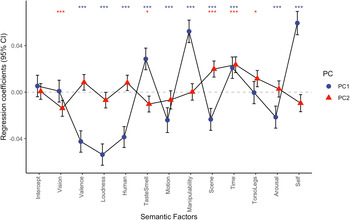
Regression coefficients (with 95% confidence intervals) for the two regression analyses using semantic factors to predict percentage demonstrative choices for words. Factor analysis on a combination of 76 Binder and Lancaster semantic features resulted in 12 factors, depicted on the x-axis. Factors are labelled according to Rocca and Wallentin (Reference Rocca and Wallentin2020). Demonstrative choice of este/a ‘this’, ese/a ‘this/that’, and aquel/la ‘that’ were condensed to two principal components, PC1 (blue circle) corresponds to the choice of este/a ‘this’ vs. the two non-proximal demonstratives; PC2 (red triangles) corresponds to ese/a ‘this/that’ vs. aquel/la ‘that’. A significant positive coefficient for PC1 means that words with a high score on a sematic factor are more likely to elicit the proximal este/a, whereas a negative coefficient means that a factor tends to elicit one of the two non-proximal demonstratives more often indiscriminately. A positive coefficient for PC2 means that a word with a high score on a semantic factor is more likely to elicit the distal aquel/la, whereas a negative coefficient on PC2 means that a factor is more likely to elicit the medial ese/a. * p < .05, ** p < .01, *** p < .001, Bonferroni corrected.

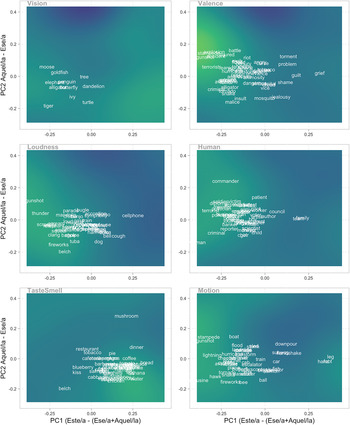
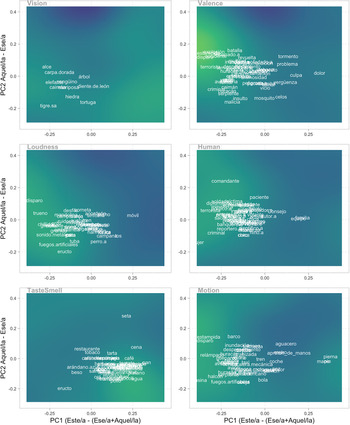
Each plot shows how demonstrative choices are distributed for semantic factors 1–6 (based on 76 Binder and Lancaster features): Vision, Valence, Loudness, Human, Taste/Smell, Motion. The x-axis represents principal component 1 for demonstrative choices: a positive number means that participants more often use este/a ‘this’ than any of the other two demonstratives for words that score high on a particular semantic factor. The y-axis displays principal component 2: the difference between aquel/la ‘that’ and ese/a ‘this/that’. A positive number means that aquel/la ‘that’ is chosen more often for words related to this factor. We used multilevel B-splines (Lee, Wolberg, & Shin, Reference Lee, Wolberg and Shin1997) to interpolate the distribution of each semantic factor in 2D demonstrative space (surface plot). Yellow colours indicate a higher frequency of use for the semantic factor. The plots also include high-scoring words on each semantic factor (cut-off 1.66 standard deviations above the mean) for illustration (Spanish version in Appendix A).

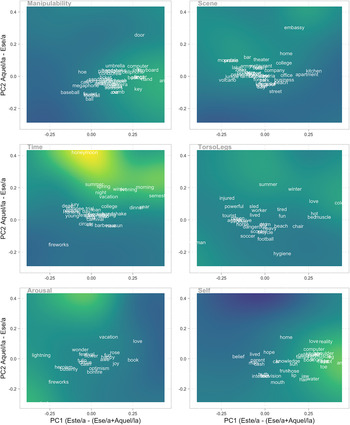
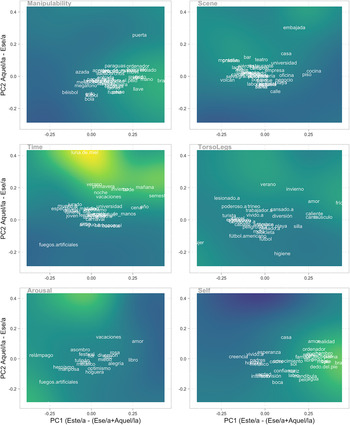
Each plot shows how demonstrative choices are distributed for semantic factors 7–12 (based on 76 Binder and Lancaster features): Manipulability, Scene, Time, Torso/Legs, Arousal, Self. Yellow colours indicate a higher frequency of use for the semantic factor. The x-axis represents principal component 1 for the demonstrative choices: a positive number means that participants more often use este/a ‘this’ than any of the other two demonstratives for words that score high on a particular semantic factor. The y-axis represents principal component 2: the difference between aquel/la ‘that’ and ese/a ‘this/that’. A positive number means that aquel/la ‘that’ is chosen more often for words related to this factor. We used multilevel B-splines (Lee et al., Reference Lee, Wolberg and Shin1997) to interpolate the distribution of each semantic factor in 2D demonstrative space (surface plot). The plots also include high-scoring words on each semantic factor (cut-off 1.66 standard deviations above the mean) for illustration (Spanish version in Appendix A).

2.6. aggregate components of demonstrative choices and principal component analyses
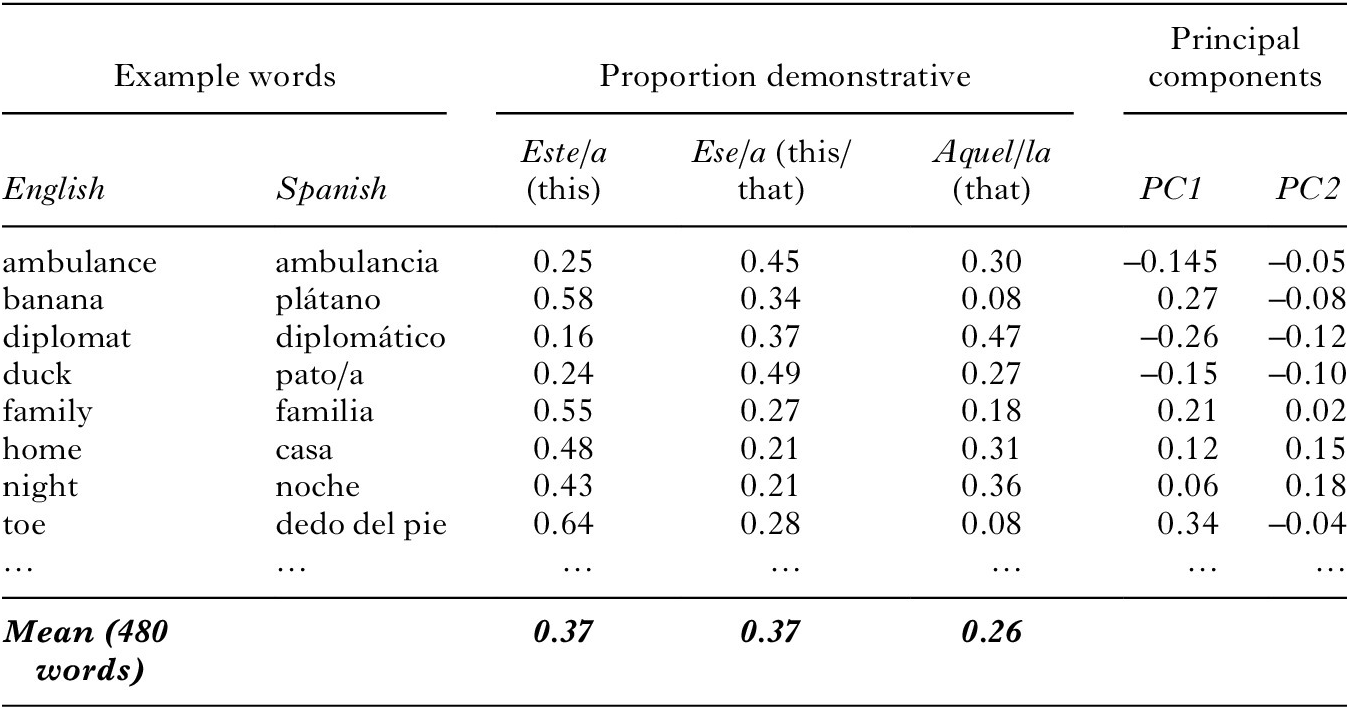
Individual choices of demonstrative for words were aggregated across participants to yield a proportion of este/a ‘this’, ese/a ‘this/that’, and aquel/la ‘that’ chosen for each word (see Table 1 for examples and overall proportions). Given that the proportions always sum to 100%, the distribution across the three demonstratives has only two degrees of freedom. Using principal component analysis (PCA), we therefore projected the three different demonstrative options onto the two dimensions (PC1 and PC2) on which choices were distributed. The loadings for these two components across the three demonstratives were for PC1: [0.81, –0.34, –0.47], i.e., roughly corresponding to the proximal demonstrative este/a relative to the two other demonstratives combined. For PC2 it was: [0.08, –0.74, 0.66], i.e., roughly corresponding to the distal demonstrative aquel/a relative to the medial demonstrative ese/a, disregarding the proximal demonstrative este/a.
Example words from the study

note. Example words from the study. Participants had to choose one of the three spatial demonstratives that they thought was best for that word without context. A proportion of choices were condensed into two principal components which were used as dependent variables in regression analyses. The mean value reported in the table refers to the total number of words in the experiment.
2.7. regression analyses
We conducted a linear regression analysis for each of the two principal components (PC1 and PC2) with PC scores for each word as dependent variable and estimated factor scores for the 12 factors as independent variables. This allowed us to determine which (if any) semantic factors could be used to predict the distribution of demonstrative choices across the two PC dimensions. Results were corrected for multiple comparisons using a Bonferroni correction.
3. Results
The overall proportion of the three demonstratives can be seen from Table 1, along with distributions for example words.
3.1. Principal Component 1
The first linear regression model with semantic factors as independent variables and PC1 as dependent variable was highly significant (Adjusted R-squared: 0.584), indicating that the semantic factors explained variability in the choice between the proximal demonstrative este/a and the two other demonstratives (i.e., medial ese/a and distal aquel/la).
Out of the 12 semantic factors, 10 significantly contributed to the model (p < .05, Bonferroni corrected, see Figure 1): Valence (t(459) = –9.1, p < .0001), Loudness (t(459) = –11.5, p < .0001), Human (t(459) = –8.4, p < .0001), Taste/Smell (t(459) = 6.0, p < .001), Motion (t(459) = –4.4, p < .0002), Manipulability (t(459) = 10.6, p < .0001), Scene (t(459) = –4.9, p < .0001), Time (t(459) = 4.5, p < .0001), Arousal (t(459) = –4.4, p < .0002), and Self (t(459) = 11.6, p < .0001). The factors Vision and Torso/Legs were non-significant (p > .05). Positive t-values indicate that the factor contributes positively to PC1 (i.e., elicits the proximal demonstrative este/a more often), whereas negative coefficients and t-values indicate a negative contribution to PC1 (i.e., elicits the medial ese/a or distal demonstrative aquel/la more often).
3.2. Principal Component 2
The second linear regression model with semantic factors as independent variables and PC2 as dependent variable was also highly significant (Adjusted R-squared: 0.22), indicating that the semantic factors explained variability in the choice between the distal demonstrative aquel/la and the medial demonstrative ese/a. Out of the 12 semantic factors, 5 significantly contributed to the model (p < .05, Bonferroni corrected, see Figure 1): Vision (t(459) = –3.9, p < .0001), Taste/Smell (t(459) = –2.9, p < .05), Scene (t(459) = 5.6, p < .0001), Time (t(459) = 6.8, p < .0001), Torso/Legs (t(459) = 3.2, p < .05). The remaining factors were non-significant (p > .05) when correcting for multiple comparisons. Positive t-values indicate that the factor contributes positively to PC2 (i.e., elicits the distal demonstrative aquel/la more often), whereas negative coefficients and t-values indicate a negative contribution to PC2 (i.e., elicits the medial demonstrative ese/a more often).
4. Discussion
In the present study, we adapted the DCT to Spanish to assess the influence of semantic features of the referent on speakers’ choices for demonstrative forms in a three-term demonstrative system (este/ese/aquel ‘this/this-that/that’ in English), when no contextual cue is provided. Our aim was twofold. First, we aimed at ascertaining whether results obtained with a two-terms demonstrative system replicate in a three-term demonstrative system, that is, whether the same semantic dimensions influence speakers’ preferences for proximal vs. non-proximal demonstrative forms when a language does not present a dyadic demonstrative system. Second, we aimed to assess whether the contrast between non-proximal (i.e., medial and distal) forms can also be used for semantic distinctions, that is, to assess whether particular semantic features of the referent explain speakers’ choices of medial vs. distal forms, or whether the distinction between medial and distal forms is only relevant in pragmatic contexts.
Concerning the first question, our results replicate the findings from a previous DCT study with English, showing that a range of semantic factors consistently influences demonstrative choice when no context is provided (Rocca & Wallentin, Reference Rocca and Wallentin2020). The same 10 semantic factors (including Manipulability, Valence, and Self) that predicted the distribution of proximal and distal demonstrative choices in English also predicted the choice of proximal (este/a) vs. non-proximal (ese/a – aquel/la) demonstratives in Spanish (PC1; see Figure 1).
Concerning the second question, we outlined two potential hypotheses. Hypothesis A stated that, in the absence of any context, the three-system demonstrative system might collapse into a two-term (proximal/non-proximal) demonstrative system organized along a self/non-self dichotomy, where medial forms do not have functional/semantic specificity. Hypothesis B, on the other hand, stated that medial and distal forms retain some semantic specificity with respect to each other, and consequently that some semantic factor would explain speakers’ choice for one form rather than the other.
Our results speak against hypothesis A. If the three-term system was reduced to a two-term system, one could either expect the use of a medial or distal form to be drastically reduced (which was not the case, as it can be seen from Table 1) or that speakers would use the medial and the distal term more or less interchangeably, and therefore randomly. In this scenario, semantic factors should not be consistently related to participants’ choices for medial (ese/a) versus distal (aquel/la) forms. However, we do detect a relationship between particular semantic dimensions of the referent and the speakers’ tendency to choose medial versus distal forms. In fact, PC2, which modelled the difference in use between the medial ese/a and the distal aquel/la, was significantly correlated with five different semantic factors (see Figure 1). This lends support to hypothesis B, which stated that, in the absence of spatial information, the dichotomy between the two non-proximal forms can be used to encode specific semantic distinctions.
An especially prominent example of such a semantic factor is Time (see Figures 1 and 3). As can be seen from Figure 3 (row 2, column 1), words related to Time caused a significant increase in the frequency of the distal form aquel/la compared to the medial form ese/a. Participants tended to choose aquella luna de miel instead of esa luna de miel ‘that honeymoon’ and aquel verano instead of ese verano ‘that summer’. Similar results have been found for other languages, such as Estonian, a two-term system with the forms see ‘this-that’ and too ‘that’, where the distal term too ‘that’ has been found to be especially used for fixed expressions related to the same semantic dimension of Time (Pajusalu, Reference Pajusalu2006). Conversely, a high score on the factor Vision increased participants’ likelihood to use the medial demonstrative ese/a relative to the distal demonstrative aquel/la. As can be seen from Figure 2, high scorers on this factor include animate beings, such as animals and plants. Participants tended to use ese tigre instead of aquel tigre ‘that tiger’, and esa tortuga was more frequent than aquella tortuga ‘that turtle’. Animacy has previously been found to influence choice of demonstratives (Rocca et al., Reference Rocca, Tylén and Wallentin2019a), especially in interaction with harmfulness. Isolating the individual contribution of Animacy (for which no explicit factor exists in this analysis) vs. Vision requires more fine-grained analyses. Overall, our results thus suggest that, while in Spanish the proximal/non-proximal distinction is explained by the same semantic factors detected for the proximal/distal contrast in English (with the same 10 semantic factors contributing to demonstrative choice), in Spanish the medial factor also retains semantic specificity.
Our observations that ese/a ‘this-that’ and aquel/la ‘that’ may be used to code for semantic distinctions are in line with observations from Argentinian Spanish, where patterns of usage of medial vs. distal terms are also consistently driven by non-spatial dimensions (here, aquel/la is used only in formal contexts). Another parallel is Majorcan Catalan, where the medial term aqueix/a has dropped out of the system when conveying physical distance, but can be used to mark social distance (Pérez-Saldanya, Reference Pérez-Saldanya2015; Todisco et al., Reference Todisco, Guijarro-Fuentes and Coventry2021). A general description of the relationship between expressiveness and complexity (i.e., number of forms) of demonstrative systems goes beyond the scope of the present studies, but it is an extremely interesting research avenue. On the one hand, the examples of Spanish and Argentinian Spanish may indeed suggest that maintaining a three-term (more complex) system may allow more refined referencing in relevant situations, also outside physical space. On the other hand, in languages with ‘simpler’ two-term demonstrative referencing systems, modulations of the dyadic system (e.g., by combining demonstrative particles and adverbs) may be used to carve more fine-grained distinctions and therefore retain high expressivity. Italian, for instance, presents a two-term demonstrative system (questo/quello), but speakers often use these combinations of a demonstrative and a locative adverb for more fine-grained referencing (e.g., questo qui ‘this here’; Jungbluth & Da Milano, Reference Jungbluth and Da Milano2015). Studies on the relationships and trade-offs between lexical complexity of demonstrative systems, affordances for pragmatic modulations, and expressivity would, in our opinion, be a highly valuable contribution to the literature.
To conclude, showing that semantic patterns psychologically or quantitatively replicate not only in languages with two-term demonstrative systems (i.e., Italian, Danish in Rocca et al., Reference Rocca, Tylén and Wallentin2019a; English in Rocca & Wallentin, Reference Rocca and Wallentin2020), but also in languages with more than two demonstrative terms provides a strong argument in favour of these mechanisms capturing some fundamental aspect of the relation between human cognition, semantics, and linguistic forms. Overall, these results are in line with the idea suggested by Rocca and Wallentin (Reference Rocca and Wallentin2020), that the frame of reference for demonstrative use – at least in absence of an explicit interlocutor – instantiates the speaker as deictic centre, and projects away from this centre in both physical and psychological dimensions. When non-spatial semantic entities are referred to, the coordinate system is structured along psychological (e.g., familiarity, affect), semantic, and imaginative dimensions, rather than spatial ones (Coventry et al., Reference Coventry, Griffiths and Hamilton2014; Stukenbrock, Reference Stukenbrock2014; Rocca & Wallentin, Reference Rocca and Wallentin2020).
A number of points remain open to investigation. First, our results lend support to the hypothesis that semantics systematically influences the choice of specific demonstrative forms when no context is provided. So far, however, effects of semantic dimensions on demonstrative choice have been described for a few languages, and some that are arguably not so dissimilar from a cultural and typological standpoint. A more extensive overview of the extent to which the detected dynamics generalize across languages is warranted. Conducting the DCT on a wider range of languages (using comparable words and feature sets), ideally covering a broader typological and cultural spectrum, would pave the way towards a deeper understanding of the cognitive mechanisms underlying the complex functioning of deictic reference and its relationship with cultural differences, given that the semantic dimensions will be the same for each language under analysis, independently of the context of utterance.
Investigating how this semantic space interacts with physical and conversational space is also a crucial avenue for future research, together with a more in-depth analysis of collocation patterns found in corpora of spoken and written language. This may shed light on whether the same semantic distinctions observed through the DCT can be observed in ‘naturalistic’ contexts. The analysis of corpora may replicate the effects found in our studies, but also enrich the picture with knowledge of usage patterns which are more conventional (e.g., common colocations) than purely driven by semantics.
Finally, our understanding of the topology of demonstrative systems with more than two terms and their relation to a dyadic system could be significantly improved by expanding the DCT to languages, such as Catalan, which present a reduction from three to two terms.
5. Conclusions
In the present study, we used the Demonstrative Choice Task (DCT) to investigate the relationship between demonstrative use and semantics in Spanish, a language with three demonstrative terms. We have provided evidence that demonstrative choice is influenced by a number of semantic dimensions (spatial, bodily, and emotional features). The contrast between proximal and distal forms is driven by the same dimensions which have been previously found to influence demonstrative choice in English. Semantic effects are thus replicable across languages, which hints at some degree of invariance in cognitive mechanisms underlying demonstrative reference. Additional semantic factors consistently influenced speakers’ preferences for medial and distal forms, which suggests that the medial/distal distinction can be recruited to express finer-grained semantic contrasts.
Appendix A
Demonstrative choice distribution (factor 1-6_Spanish version).

Demonstrative choice distribution (factor 7-12_Spanish version).

Appendix B
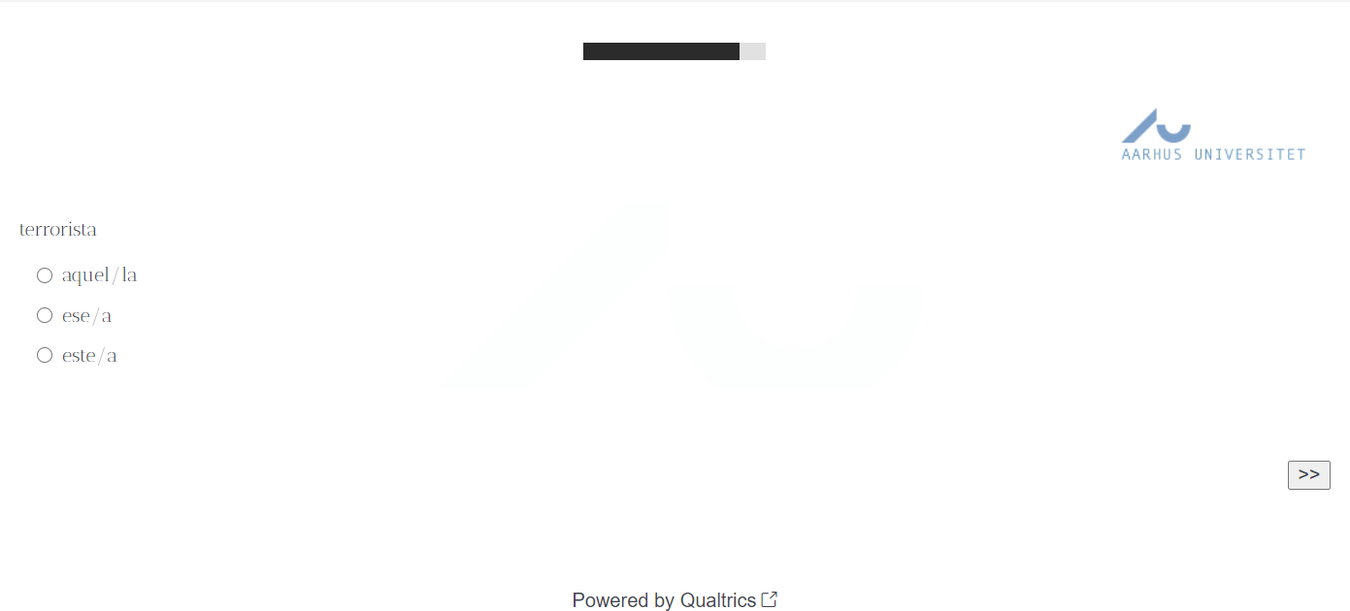
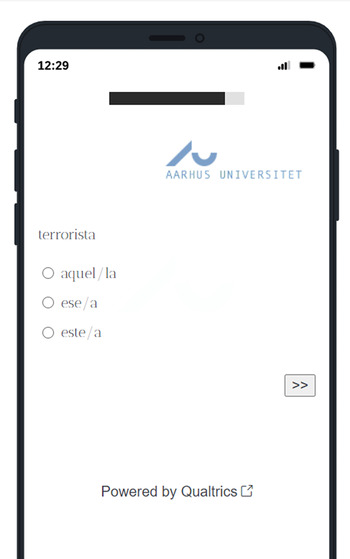
The figures represent the experimental setting in both laptop and mobile versions.
Laptop version.

Mobile version.

Appendix C
Here we report the words used in the DCT both in English and Spanish.