
Introduction
In the long history of research on oxides in the distorted-perovskite (henceforth simply called “perovskite”) structure with corner-sharing BO6 octahedra, cation alloying, and substitution has been a primary means of controlling material properties.[ Reference Nechache, Harnagea, Li, Cardenas, Huang, Chakrabartty and Rosei 1 – Reference Xu, Ihlefeld, Lee, Ezekoye, Vlahos, Ramesh, Gopalan, Pan, Schlom and Musfeldt 6 ] By contrast, anion alloying and substitution has been little studied. The smaller electronegativity of chalcogen elements such as sulfur or selenium relative to oxygen suggests that substituting chalcogens for oxygen in the perovskite structure may lower the band gap. This expectation is supported by recent results. For example, experiments show that the band gap for BaZrCh 3 in the perovskite structure decreases from 3.55 eV for Ch = O, to 1.83 eV for Ch = S.[ Reference Parida, Satapathy, Sinha, Bisen and Rout 7 , Reference Niu, Huyan, Liu, Yeung, Ye, Blankemeier, Orvis, Sarkar, Singh, Kapadia and Ravichandran 8 ] Theory predicts that the band gap of ferroelectric PbTiO3−x S x decreases rapidly from 4.1 eV for x = 0, to 2.6 eV for x = 1.[ Reference Brehm, Takenaka, Lee, Grinberg, Bennett, Schoenberg and Rappe 9 ] With increasing chalcogen content, many AB(O,S,Se)3 materials in the corner-sharing, perovskite structure become unstable relative to the edge- and face-sharing structures with lower symmetry.[ Reference Perera, Hui, Zhao, Xue, Sun, Deng, Gross, Milleville, Xu, Watson, Weinstein, Sun, Zhang and Zeng 10 – Reference Lee, Kleinke and Kleinke 13 ] Nevertheless, bulk powder samples of chalcogenide perovskites have been synthesized and studied since the early 1950s.[ Reference Meetsma, Wiegers and de Boer 11 , Reference Clearfield 12 , Reference Hahn and Mutschke 14 – Reference Lelieveld and IJdo 16 ] Recently there has been renewed interest in these materials as semiconductors, stimulated by theoretical predictions of ferroelectricity and promising photovoltaic properties.[ Reference Brehm, Takenaka, Lee, Grinberg, Bennett, Schoenberg and Rappe 9 , Reference Bennett, Grinberg and Rappe 17 – Reference Ju, Dai, Ma and Zeng 22 ] An important next step in evaluating chalcogenide perovskites for their usefulness in electronics and energy conversion is to grow single crystal or large-grained thin films.
Molecular beam epitaxy (MBE) offers a high degree of control over phase, morphology, and defects, and for decades has been an indispensable technique for the study of perovskite and other complex-structured oxides. MBE (and its antecedent, the “three-temperature” technique) was originally developed to make films of III–V materials, taking advantage of the existence of thermodynamic equilibrium at high temperature and high vacuum between the desired solid film and the vapor phase.[ Reference Tsao 23 ] This thermodynamic growth window enables so-called adsorption-limited growth, wherein the growth chamber is supplied with an overpressure of one constituent (e.g. As), and the film grows at a rate determined by the supply of the other constituent (e.g. Ga). There are two primary conditions for adsorption-limited growth: that one constituent has high vapor pressure, and that the desired phase is a line compound. When these conditions are met, then single-phase films can be reliably grown over a range of source rates, greatly simplifying the growth procedure.
Adsorption-limited growth is not possible for most oxide perovskites due to the low vapor pressure of the constituent binary oxides: the thermodynamic growth window is usually located at very high temperature, and at a pressure much lower than is achievable by even the best vacuum deposition chambers. As a result, extremely fine source rate control is required to avoid the formation of secondary phases. Stability of atomic fluxes is difficult to control, even with sophisticated monitoring and feedback control loops. Fluctuations in the molecular fluxes lead to off-stoichiometric films, the formation of unwanted secondary phases, and spatial non-uniformity. This challenge stimulated the development of metal–organic oxide MBE, in which one constituent is supplied using a molecular precursor with high vapor pressure.[ Reference Henini 24 – Reference Haislmaier, Stone, Alem and Engel-Herbert 26 ] In analyzing the growth of ternary oxides, it is common to use pseudo-binary phase diagrams, as we do here for ternary chalcogenides. This assumes that all metals will spontaneously oxidize, which is a good assumption under conditions of MBE oxide growth.
Here we consider the possibility of adsorption-limited growth of select chalcogenide perovskites by MBE. The thermodynamic growth windows are largely determined by the vapor pressure of binary chalcogenide constituents, and by the thermodynamics of the desired perovskite phase. The vapor pressure of most binary chalcogenide materials is available in thermodynamic databases. Almost no thermodynamic data exist for the chalcogenide perovskites, so we rely on theoretical calculations and assumptions (described below). We find that adsorption-limited growth of chalcogenide perovskites ABCh 3 with A = Ba and Sr and B = Hf, Zr, and Ti may be possible with very high-performing MBE systems. The situation is more favorable for phases including main-group elements that form binary chalcogenides with high vapor pressure. To demonstrate this, we also calculate the growth window for ZnSnS3 in the LiNbO3 structure, which is unstable in the bulk but may be stabilized by epitaxy.[ Reference Kolb and Kolpak 19 ] We find favorable conditions for adsorption-limited growth on both the Zn- and Sn-rich sides of the quasi-binary phase diagram.
Methods
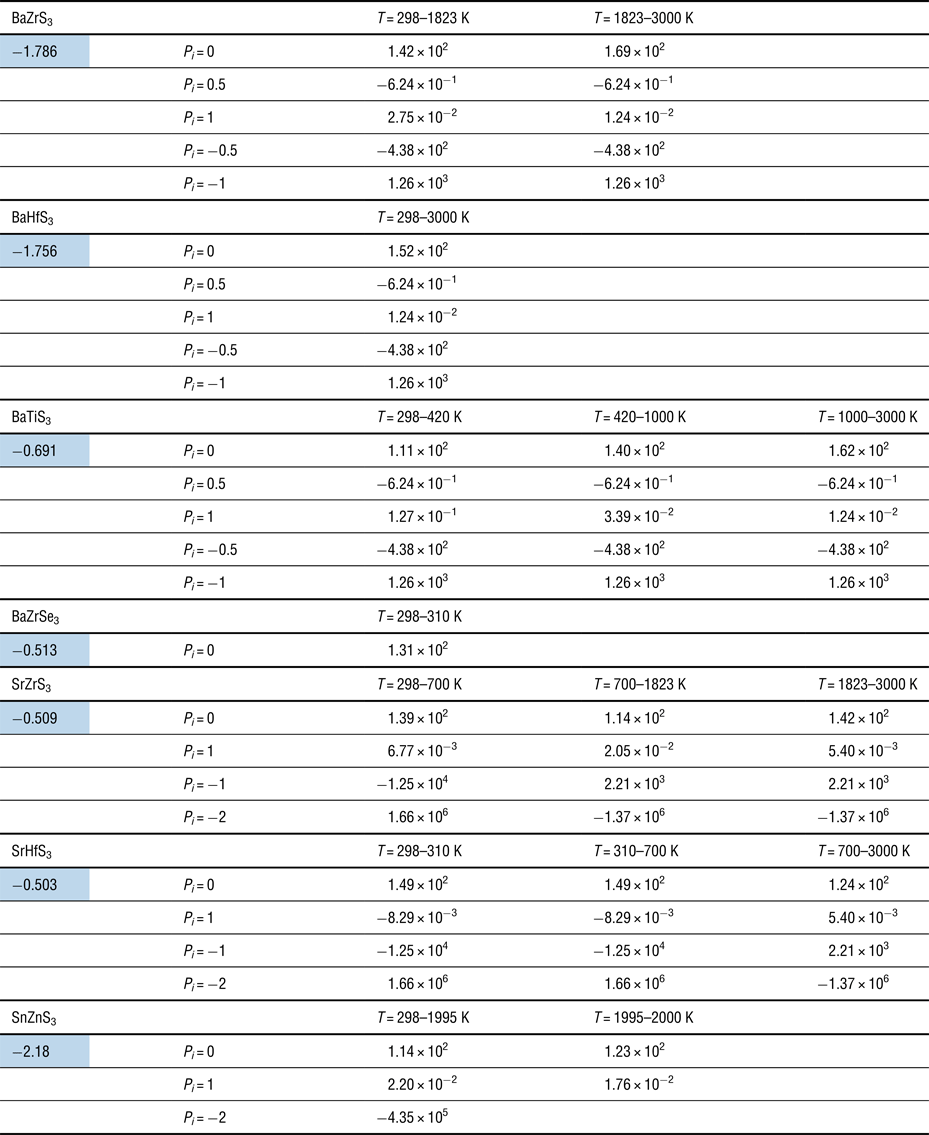
We used the computational thermodynamics software package FactSage[ Reference Bale, Bélisle, Chartrand, Decterov, Eriksson, Gheribi, Hack, Jung, Kang, Melançon, Pelton, Petersen, Robelin, Sangster and Van Ende 27 ] to compute phase diagrams. Thermodynamic data for most binary chalcogenides are available in the databases, but no such information exists for chalcogenide perovskites. To model these compounds, the heat capacity, and the formation energy must be given. We estimated the heat capacity using the Neumann–Kopp rule, implemented using the compound module and the mixer function in FactSage. The Neumann–Kopp rule is an empirical method for estimating the heat capacity of a compound,[ Reference Kopp 28 ] and has been successfully applied to mixed oxides.[ Reference Leitner, Voňka, Sedmidubský and Svoboda 29 ] The general form is shown in Eq. (1):
 $$C_{\,pm}(A_{x_A}B_{x_B}O_z{\rm )} = x_AC_{\,pm}{\rm (A}O_a{\rm )} + x_BC_{\,pm}{\rm (B}O_b{\rm )} + \Delta C_{dil}$$
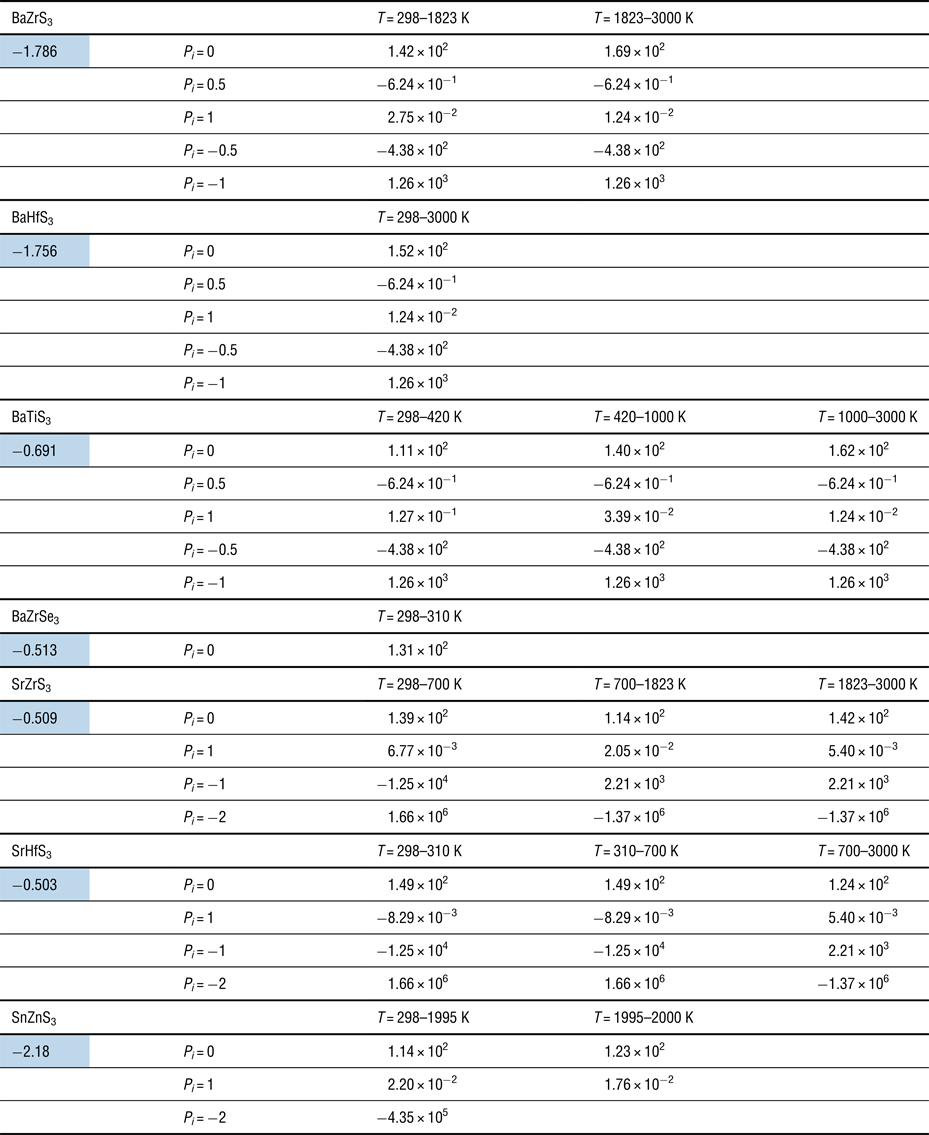
C pm is the molar heat capacity of the compound. When applied to chalcogenide perovskites of the form ABCh 3, the heat capacity is the sum of the heat capacity for the binary compounds: ACh and BCh 2. ΔC dil is a high-temperature correction that we set to zero. The functional form of the heat capacity for each compound is shown in Table I and generally follows the form in Eq. (2):
 $$C_p = \mathop \sum \limits_i C_i(T/K)^{P_i}.$$
The coefficients C i are in units of J/(mol K), and the variables (T/K) are unitless. The formation energy of the ABCh 3 chalcogenide perovskites relative to decomposition into the binary chalcogenides ACh and BCh 2 were calculated by density functional theory (DFT), and are listed in Table I. Of the 18 compounds studied by Sun et al., BaZrS3, BaHfS3, BaTiS3, BaZrSe3, SrZrS3, SrHfS3, and BaHfSe3 are predicted to be stable relative to decomposition.[ Reference Sun, Agiorgousis, Zhang and Zhang 18 ] Below we present the growth window for these compounds with the exception of BaHfSe3, which we cannot calculate because thermodynamic data are not available for HfSe2.
Heat capacity [J/(mol K)] and formation energy for each chalcogenide perovskite material. The heat capacity values are presented using the functional form in Eq. (2), and the table entries are the coefficients C i . The formation energy from the binary chalcogenides in units of eV/formula unit is listed below each compound formula (blue fields).
Results and discussion
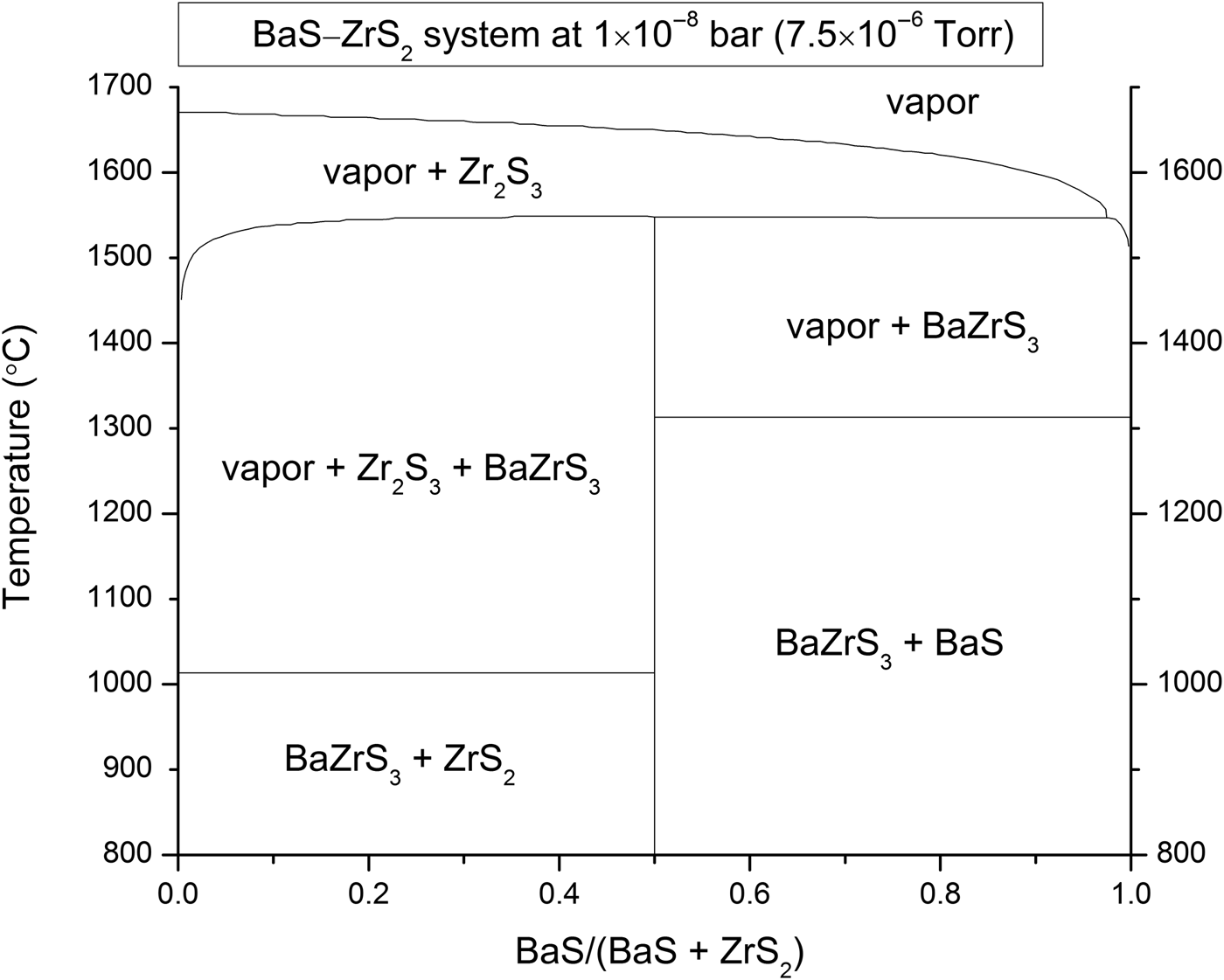
Figure 1 shows the calculated equilibrium phase diagram for the pseudo-binary BaS–ZrS2 system as a function of temperature and overall composition at a fixed pressure of 7.5 × 10⁻⁶ torr. The BaZrS3 line compound lies at a composition of 50:50 BaS:ZrS2. There is a region of two-phase equilibrium between solid BaZrS3 and a Ba-rich vapor on the Ba-rich side of the phase diagram and in the approximate temperature range 1300–1500 °C: this is the thermodynamic growth window. This window is bounded at the bottom by a region of coexistence between BaZrS3 and BaS solid phases. This is because at a lower temperature, solid BaS condenses from the vapor phase, and therefore excess Ba will tend to condense into BaS. The growth window is bounded on the top by a region of coexistence between solid Zr2S3 and a Ba-rich vapor.
Composition–temperature equilibrium phase diagram for the pseudo-binary BaS–ZrS2 system at a pressure of 7.5 × 10⁻⁶ torr. The thermodynamic growth window for BaZrS3 is on the Ba-rich side of the phase diagram.

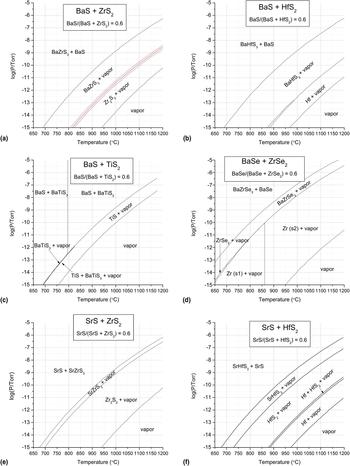
Although quasi-binary phase diagrams may better illustrate the materials science, a pressure–temperature phase diagram is often more useful to guide experiment. In Fig. 2, we show the pressure–temperature equilibrium phase diagrams for those chalcogenide perovskites that are predicted to be stable with respect to decomposition into binary chalcogenides (with the exception of BaHfSe3 as described above).
Temperature–pressure phase diagrams for six of chalcogenide perovskites that are calculated to be thermodynamically stable relative to decomposition into binary chalcogenides. The fixed composition in each case is a mole fraction of 0.6 of the ACh component. In each case, the thermodynamic growth window is labeled “ABCh 3 + vapor”, for variable elements A, B, and Ch. Plots are ordered by the formation energy of the ternary phase from the binaries, from most to least stable. (a) BaS–ZrS2, (b) BaS–HfS2, (c) BaS–TiS2, (d) BaSe–ZrSe2, (e) SrS–HfS2, (f) SrS–ZrS2. The additional red lines in (a) show how the lower limit of the growth window would be changed by a ±5% error in the formation energy of BaZrS3.

From this, we can determine which compounds have usable growth windows. To start, we look at the maximum pressure required to be just inside the growth window at a particular temperature. This upper-pressure limit is determined by the vapor pressure of the more volatile binary compound, which is ACh for the ABCh 3 materials described here. Using for example 1000 °C, BaZrS3, BaHfS3, SrHfH3, and ZrSrS3 require a maximum pressure of about 10−9 torr for adsorption-limited growth. For BaZrSe3, the maximum pressure in the growth window is 10−7 torr. BaTiS3 does not form until about 10−12 torr at approximately 800 °C. The case of BaTiS3 can be explained by the existence of a more stable solid phase, TiS. The takeaway from Fig. 2 is that, for these materials, adsorption-limited growth may be possible in certain cases, but would require an extraordinary growth chamber with a very high-temperature sample stage and an excellent vacuum.
The size of the growth window is another concern. It is difficult to maintain an adsorption-limited process if the window is too small in the pressure or the temperature dimension. The BaZrS3, BaHfS3, BaZrSe3, and SrHfS3 have growth windows that span at least one order of magnitude in pressure. SrZrS3 is more challenging, with a growth window that spans approximately a factor of three in pressure. BaTiS3 has a vanishingly narrow growth window that spans ±3% of the pressure range at about 10−14 torr.
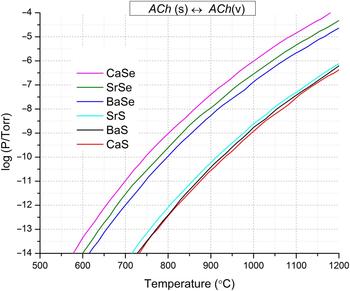
A number of ABCh 3 materials are predicted to be thermodynamically unstable with respect to decomposition into binaries. Materials with positive formation energy will not appear in an equilibrium phase diagram. However, it is still interesting to consider adsorption-limited growth for these materials, because it may be possible to make films using kinetic control or epitaxial stabilization. The high-pressure side of the growth window is determined by the binary compound with the higher vapor pressure. Therefore, by plotting the vapor pressure of ACh materials, we anticipate the growth window for ABCh 3 materials that are unstable in the bulk. In Fig. 3, we plot these binary vapor pressure curves for CaS, BaS, SrS, BaSe, SrSe, and CaSe. The selenides have higher vapor pressure than the sulfides, which means that adsorption-limited growth windows will be easier to achieve for ABSe3 than for ABS3. Figure 3 is also a guide to the growth window for BaHfSe3. This material is predicted to be thermodynamically stable, with a formation energy of −0.447 eV/f.u. Standard thermodynamic data for HfSe2 is not available, so we do not present an equilibrium phase diagram as in Fig. 2. However, the high-pressure side of the BaHfSe3 growth window is predicted by the vapor pressure of binary BaSe.
Vapor pressure of the ACh binaries associated with ABCh 3 compounds of interest. These curves can be used to estimate the upper bound of the growth window for compounds which are not thermodynamically stable.

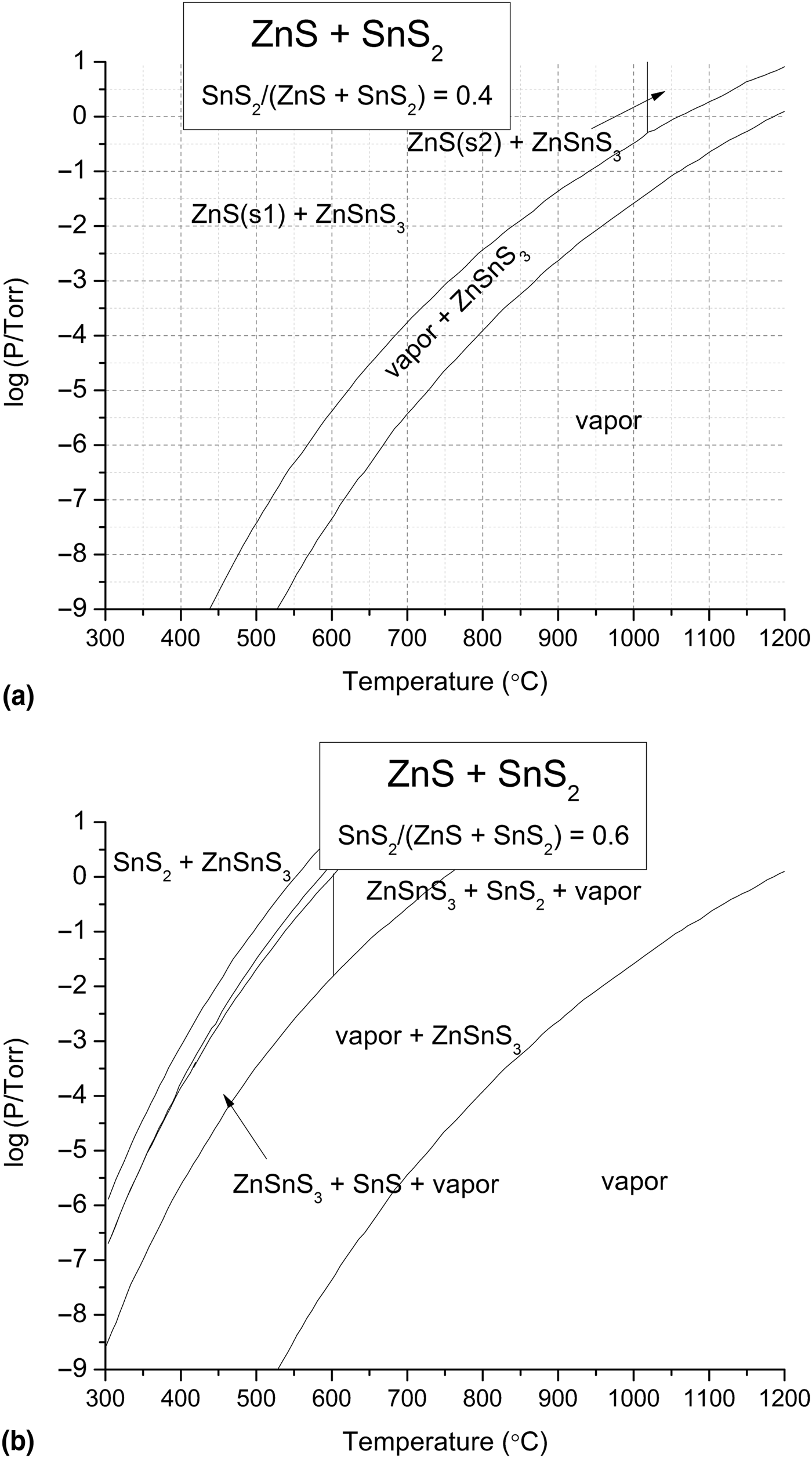
From the above, it is clear the ABCh 3 materials with A = alkaline earth and B = refractory transition metal will be challenging to grow in an adsorption-limited mode with the capabilities of typical MBE chambers. The situation becomes more favorable when we consider different regions of the periodic table. We take for example ZnSnS3 in the LiNbO3-type structure, which is predicted to be unstable in the bulk, but stable if grown epitaxially on GaN (0001).[ Reference Kolb and Kolpak 19 ] Due to the relatively high vapor pressures of both ZnS and SnS2, adsorption-limited growth is possible on both the Zn- and Sn-rich side of the quasi-binary phase diagram. In Fig. 4, we show the growth windows for Zn-rich conditions [Fig. 4(a)] and Sn-rich conditions [Fig. 4(b)]. We conclude that growth in Sn-rich conditions is preferable to Zn-rich conditions due to the larger size of its growth window, which results from the fact that the vapor pressure of SnS2 is higher than that of ZnS. In both cases, the pressures and temperatures required for adsorption-limited growth are accessible for typical MBE chambers.
Pressure–temperature equilibrium phase diagrams for the ZnS–SnS2 system. Growth windows are available on both Zn- and Sn-rich sides of the phase diagram. (a) Zn-rich side of the phase diagram with SnS2 mole fraction of 0.4. (b) Sn-rich side of the phase diagram with SnS2 mole fraction of 0.6.

The accuracy of the phase diagrams presented is limited by the available thermodynamic data. We note that the errors introduced by estimating the formation energies and heat capacities of ABCh 3 compounds only affect the lower bound of the growth window. While it is important that the lower bound is sufficiently below the upper bound to create an experimentally accessible growth window, its exact position is less important. In general, errors in the formation energies (those that we calculate and those that are contained in the FactSage databases) have an impact on the resulting phase diagrams that is faster than linear, due to the exponential dependence of vapor pressure on formation enthalpy. We estimate that our DFT-calculated formation energies are accurate to within ±5%, based on prior comparisons between PBEsol calculations and experimental data.[ Reference Csonka, Perdew, Ruzsinszky, Philipsen, Lebègue, Paier, Vydrov and Ángyán 30 ] In Fig. 2(a), we show the effect of a ±5% error in the formation energy on the BaZrS3 phase diagram; see the red lines. The effect on the predicted growth window is negligible, especially for materials such as BaZrS3 which have large growth windows.
The high-temperature deviations of heat capacity from the Neumann–Kopp rule are given by ΔC dil . For the oxides BaZrO3 and SrZrO3, ΔC dil /T is 1.05 × 10⁻⁴ and 6.81 × 10⁻³, respectively.[ Reference Leitner, Voňka, Sedmidubský and Svoboda 29 ] Table I shows that the linear heat capacity terms range from approximately 5 × 10⁻³ to 2 × 10⁻². Assuming that ΔC dil is similar for oxide and chalcogenide perovskites allow us to estimate the effect of neglecting ΔC dil on our calculated phase diagrams. Using ΔC dil for SrZrO3 as an upper bound, the max possible error in the linear heat capacity term for materials we investigated is 80% for SrHfS3. However, because of the way this error propagates, its effect on the formation enthalpy is much smaller than the ±5% uncertainty of our DFT calculations even in the case of SrHfS3, for which the error is the greatest. Therefore, conclude that using the Neumann–Kopp rule and neglecting ΔC dil has a negligible effect on our calculated phase diagrams.
Conclusion
We calculate the growth windows for the adsorption-limited growth of ternary sulfides and selenides in the distorted-perovskite structure. In many cases, the window for thermodynamic growth of pure-phase ABCh 3 solid films lies at high temperature and low pressure (e.g. T > 1000 °C and P < 10−9 torr) that are challenging for most MBE chambers. The growth window for selenides is more accessible than that for sulfides, and our results suggest that adsorption-limited growth may be achieved for ABSe3 with A = Ca, Sr, and Ba. The growth window becomes much more accessible for materials for which the quasi-binary phase diagram includes a compound (e.g. ACh or BCh 2 ) with high vapor pressure. We illustrate this case for ZnSnS3 in the LiNbO3-structure.[ Reference Kolb and Kolpak 19 ] Other examples may include chalcogenide perovskites with Sn, Ge, or Te on the B-site.[ Reference Ju, Dai, Ma and Zeng 22 ]
Acknowledgments
S. A. F. acknowledges support from the National Science Foundation Graduate Research Fellowship under Grant No. 1122374. Any opinion, findings, and conclusions or recommendations expressed in this material are those of the authors(s) and do not necessarily reflect the views of the National Science Foundation. Y.-Y. S. acknowledges support from the National Natural Science Foundation of China under Grant No. 11774365. This project was funded in part by the MIT Skoltech Seed Fund, as part of the MIT Skoltech Program.