1. Introduction
Recent studies have shown pronounced changes in lithospheric thickness, thermal state and petrological and geochemical compositions of the lithospheric mantle from an old, thick and refractory lithosphere during Palaeozoic time to a juvenile, thin and fertile lithosphere during Cenozoic time beneath the eastern North China Craton (e.g. Ma, Reference Ma1987; Lu et al. Reference Lu, Han, Zheng and Ren1991; Griffin, O'Reilly & Ryan, Reference Griffin, O'Reilly and Ryan1992; Menzies, Fan & Zhang, Reference Menzies, Fan, Zhang, Prichard, Alabaster, Harris and Neary1993; Griffin et al. Reference Griffin, Zhang, O'Reilly, Ryan, Flower, Chung and Lo1998; Menzies & Xu, Reference Menzies, Xu, Flower and Chung1998; Xu et al. Reference Xu, O'Reilly, Griffin, Zhou, Flower, Chung, Lo and Lee1998; Zheng & Lu, Reference Zheng and Lu1999; Liu et al. Reference Liu, Rudnick, Walker, Xu, Gao and Wu2015). However, the timing and mechanism of this replacement or removal of lithosphere still remains controversial (e.g. Xu, Reference Xu2001; Gao et al. Reference Gao, Rudnick, Carlson, McDonough and Liu2002; Zhang et al. Reference Zhang, Sum, Zhou, Fan, Zhai and Yin2002; Chen, Jahn & Zhai, Reference Chen, Jahn and Zhai2003; Liu et al. Reference Liu, Gao, Yuan, Zhou, Liu, Wang, Hu and Wang2004, Reference Liu, Rudnick, Walker, Gao, Wu, Piccoli, Yuan, Xu and Xu2011; Niu, Reference Niu2005; Xu et al. Reference Xu, Wang, Wang, Guo and Pei2006b, Reference Xu, Li, Pang and He2009; Zhang et al. Reference Zhang, Zhao, Liu, Liu, Chen, Xie and Chen2009a; Fu et al. Reference Fu, Wei, Kusky, Chen, Tan, Li, Kong and Jiang2012a; Xia et al. Reference Xia, Liu, Liu, Kovács, Feng and Dang2013). The debate on the beginning of replacement or removal of lithosphere is mainly focused on whether it was a rapid or a more protracted transformation process, with opinion divided between the late Carboniferous – Late Triassic, the Late Triassic and Jurassic – Early Cretaceous (Zhang et al. Reference Zhang, Sum, Zhou, Fan, Zhai and Yin2002; Chen, Jahn & Zhai, Reference Chen, Jahn and Zhai2003; Liu et al. Reference Liu, Gao, Yuan, Zhou, Liu, Wang, Hu and Wang2004; Xu et al. Reference Xu, Li, Pang and He2009; Zhang et al. Reference Zhang, Zhao, Liu, Liu, Chen, Xie and Chen2009a; Fu et al. Reference Fu, Wei, Kusky, Chen, Tan, Li, Kong and Jiang2012a).
Mesozoic magmatism may be used as a ‘window’ to help resolve the above questions of timing and mechanism of lithospheric thinning (Ma et al. Reference Ma, Jiang, Hofmann, Dai, Hou, Zhao, Chen, Li and Jiang2014a). Following the assembly of the Mongolian composite terranes with the NCC during middle–late Permian time (Xiao et al. Reference Xiao, Windley, Hao and Zhai2003; Li, Reference Li2006; Windley et al. Reference Windley, Alexeiev, Xiao, Kröner and Badarch2007), a number of Triassic magmatic rocks (alkaline, mafic-ultramafic, felsic magmas and mafic dykes) intruded into supercrustal rocks in the northern NCC. Formation of these magmas was considered to involve at least five components, including asthenospheric mantle, enriched or juvenile lithospheric mantle, and juvenile or ancient lower continental crust (LCC) materials (e.g. Wu, Jahn & Lin, Reference Wu, Jahn and Lin1997; Shao et al. Reference Shao, Han, Zhang and Mou1999; Liu et al. Reference Liu, Sun, Liu and Zhai2002; Tian et al. Reference Tian, Chen, Liu and Zhang2007; Peng et al. Reference Peng, Zhai, Guo, Zhang and Zhang2008; Fu et al. Reference Fu, Wei, Kusky, Chen, Tan, Li, Kong and Jiang2012a; Yang et al. Reference Yang, Sun, Zhang, Wu and Wilde2012; Wu et al. Reference Wu, Zhao, Gao and Wang2014; Ye et al. Reference Ye, Zhang, Zhao and Wu2014). It is believed that the above enriched lithospheric mantle beneath the NCC was formed during Archean time and replaced or metasomatized during late Palaeoproterozoic time (Wu, Jahn & Lin, Reference Wu, Jahn and Lin1997; Gao et al. Reference Gao, Rudnick, Carlson, McDonough and Liu2002; Wu et al. Reference Wu, Walker, Yang, Yuan and Yang2006a; Li et al. Reference Li, Wu, Li, Qiu, Liu, Yang and Tang2011; Liu et al. Reference Liu, Rudnick, Walker, Gao, Wu, Piccoli, Yuan, Xu and Xu2011, Reference Liu, Carlson, Rudnick, Walker, Gao and Wu2012, Reference Liu, Rudnick, Walker, Xu, Gao and Wu2015); nevertheless, whether it was fertile or refractory remains under debate. This is vital for our understanding of the Phanerozoic lithospheric evolution beneath the NCC. Since Jurassic time another pronounced tectono-thermal event featured in the eastern NCC, accompanied by the emplacement of vast intrusive rocks and widespread volcanic rocks. Only a few studies have been carried out on mafic rocks formed at this time, however. Because igneous rocks often have deep crustal or mantle derivations, studies of such rocks can be a sufficient approach to understanding the nature of subcontinental lithosphere.
There are widespread Mesozoic mafic dykes distributed along the northern margin of the NCC (Shao & Zhang, Reference Shao and Zhang2002; Fu et al. Reference Fu, Wei, Wei, Tan, Li, Li, Wang and Jiang2010, Reference Fu, Wei, Kusky, Chen, Tan, Li, Kong and Jiang2012a; Zhang et al. Reference Zhang, Zhao, Liu, Hu, Song and Wu2010a; Zhang, Yuan & Wilde, Reference Zhang, Yuan and Wilde2014). They may provide efficient probes into the nature of the lower crust and lithospheric mantle given their instantaneous emplacement processes and minor resultant modifications. As important country rocks of the mafic dykes, only zircon U–Pb age and major- and trace-element data were reported for the granodiorites of the Dashizhuzi (DSZZ) complex that consists of granodiorites and granites (Ye et al. Reference Ye, Zhang, Zhao and Wu2014). In this paper, we present zircon U–Pb ages, major- and trace-element data, and Sr–Nd isotope compositions for the lamprophyre dykes and the DSZZ granites exposed in the eastern Hebei – western Liaoning, and use these data to discuss their petrogenesis and implications for understanding their magma sources and the nature of the lithosphere beneath the NCC.
2. Geological setting
Containing continental rocks of age 3.85–3.2 Ga, the NCC was thought to be one of the oldest cratons in the world (Liu et al. Reference Liu, Nutman, Compston, Wu and Shen1992; Song et al. Reference Song, Nutman, Liu and Wu1996; Zhai & Santosh, Reference Zhai and Santosh2011). The NCC is composed of an Archean–Palaeoproterozoic metamorphosed basement overlain by Mesoproterozoic–Cenozoic cover. According to the lithological assemblages and geochemical, geochronological, structural and pressure–temperature (P–T) data, the basement of the NCC can be divided into the Eastern and Western blocks, separated by the Trans-North China Orogen (Fig. 1a; Zhao et al. Reference Zhao, Wilde, Cawood and Sun2001). Collision between the Eastern and Western blocks along the Trans-North China Orogen during late Palaeoproterozoic time led to the amalgamation of the NCC (Wu & Zhong, Reference Wu and Zhong1998; Zhao et al. Reference Zhao, Wilde, Cawood and Sun2001). The Eastern Block underwent Palaeoproterozoic rifting (Jiao-Liao-Ji continental rift) along its eastern margin before the collision of the Western and Eastern blocks (e.g. Li et al. Reference Li, Zhao, Sun, Han, Luo, Hao and Xia2005; Zhao et al. Reference Zhao, Sun, Wilde and Zhong2005). The craton was magmatically and tectonically quiescent until the occurrence of a tectono-thermal event at 0.98–0.60 Ga, recorded by some exposed Neoproterozoic mafic magmas and zircons in xenoliths derived from the lower crust (e.g. Shao, Zhang & Li, Reference Shao, Zhang and Li2002; Zheng et al. Reference Zheng, Griffin, Ma, O'Reilly, Xiong, Tang, Zhao, Yu and Su2012, Reference Zheng, Ping, Xia and Yu2013).
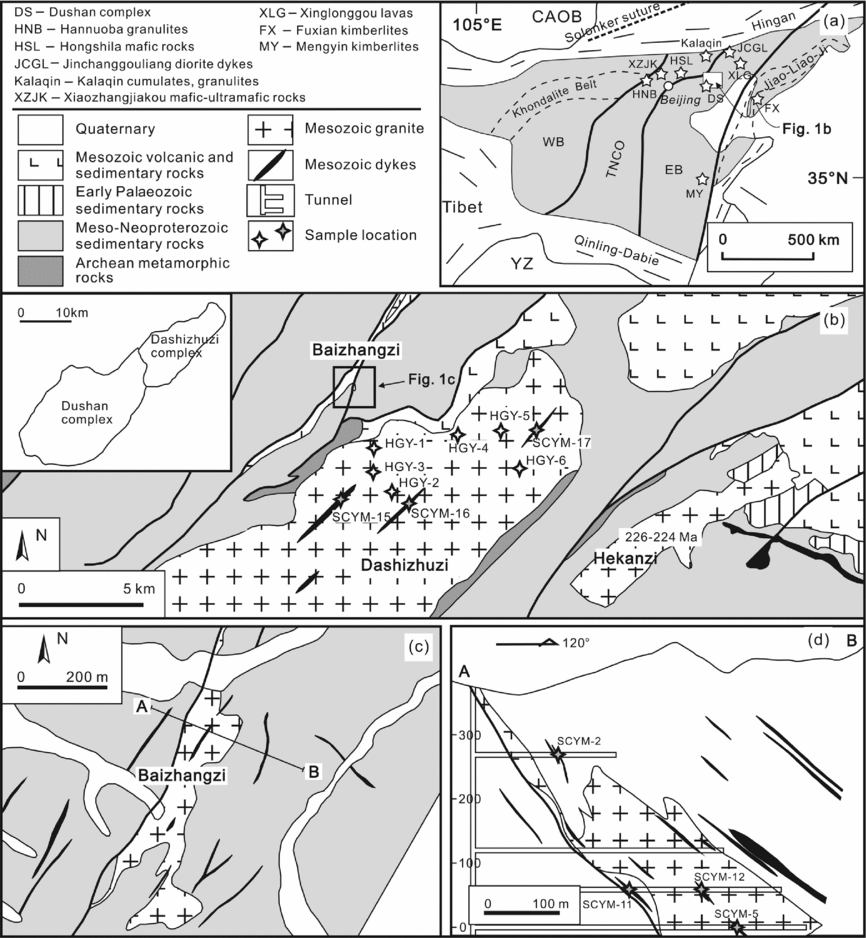
(a) Tectonic setting, modified after Gao et al. (Reference Gao, Rudnick, Yuan, Liu, Liu, Xu, Ling, Ayers, Wang and Wang2004) and Zhao et al. (Reference Zhao, Sun, Wilde and Zhong2005), showing the location of (b). YZ – Yangtze craton; SC – South China Orogen; WB – Western Block of the North China Craton; EB – Eastern Block of the North China Craton; TNCO – Trans-North China Orogen; CAOB – Central Asian Oregenic Belt; Jiao-Liao-Ji – Jiao-Liao-Ji continental rift. (b) Simplified geological map of the eastern Hebei – western Liaoning area, showing the location of (c). The inset shows spatial correlations between the Dushan and the Dashizhuzi complexes. (c) Geological sketch map of the Baizhangzi area (modified after Team 109 of Metallurgy and Geology Exploration Company, Liaoning, 1990, unpub.), showing the location of cross-section A–B. (d) Profile of the Baizhangzi granites and lamprophyre dykes.

During Palaeozoic – early Mesozoic time, voluminous igneous rocks intruded into supercrustal rocks in the NCC. The eruption of Middle Ordovician kimberlites in Fuxian and Mengyin was followed by the uplift of the NCC, which resulted in the absence of Upper Ordovician – middle Carboniferous sedimentary rocks (Zheng et al. Reference Zheng, Griffin, O'Reilly, Lu, Yu, Zhang and Li2004a). During middle Carboniferous – Permian time, emplacement of voluminous granitic magmas in the northern part of the NCC was related to the complicated tectono-thermal processes of the Central Asian Oregenic Belt (CAOB; e.g. Xiao et al. Reference Xiao, Windley, Hao and Zhai2003; Windley et al. Reference Windley, Alexeiev, Xiao, Kröner and Badarch2007; Zhu, Yang & Wu, Reference Zhu, Yang and Wu2012). The Solonker suture in the CAOB marks the location of the final closure of the Palaeo-Asian Ocean and the collision between the NCC and the Mongolian composite terranes (Xiao et al. Reference Xiao, Windley, Hao and Zhai2003) which led to significantly N–S-directed tectonic shortening of the continental crust in the northern NCC during middle–late Permian time (Zhang et al. Reference Zhang, Li, Deng, Liu, Liu, Wei, Li and Liu2011; Lin et al. Reference Lin, Zhu, Yan, Song and Liu2013). From early Mesozoic time a number of Triassic-aged igneous rocks, including alkaline rocks and some magma mafic to felsic in composition, have occurred in the northern NCC (Zhang et al. Reference Zhang, Zhao, Ye, Hou and Li2012). Following this, massive intrusive rocks and widespread volcanic rocks of late Mesozoic age have been identified within the entire Eastern Block.
The eastern Hebei – western Liaoning area is located on the northern part of the NCC. Widespread intermediate-mafic dykes and several granitic intrusions, including the Baizhangzi (BZZ) granites, Dashizhuzi and Dushan complex, intruded into the Archean amphibolites and Mesoproterozoic littoral-neritic sediments (Fig. 1b, c). The exposed DSZZ complex is elliptical, approximately 20×7 km, and comprises granites and granodiorites as well as localized mafic enclaves including hornblende pyroxenites and diorites. Zircon U–Pb dating of the DSZZ granodiorites yields a weighted mean age of 224 Ma (Ye et al. Reference Ye, Zhang, Zhao and Wu2014). The Dushan complex is located to the SW of the DSZZ complex, and was dated at 221–223 Ma (zircon U–Pb age; Luo et al. Reference Luo, Miao, Guan, Qiu and Qiu2003; Ye et al. Reference Ye, Zhang, Zhao and Wu2014). The BZZ granites, with a scale of approximately 600×200 m, crop out to the north of the DSZZ complex and were dated at 222 Ma (Luo et al. Reference Luo, Li, Guan, Qiu, Qiu, Mcnaughton and Groves2004). The large amount of exposed lamprophyre and granite dykes within the DSZZ complex and the BZZ granites range over 0.5–3 m in width and are hundreds of metres in length. Individual dykes mostly strike 28–58° NE and dip 37–67° towards the SE.
3. Samples
The granite samples of the DSZZ complex were collected for chemical and isotopic analyses. A composite (HGY-1) that consists of granite samples HGY-1, HGY-4 and HGY-5 was used for zircon U–Pb dating. Sampling locations are shown in Figure 1b. Some lamprophyre dyke samples were collected from underground, and the remainders were collected in the interior of the DSZZ complex (Fig. 1b–d). Both lamprophyre dyke samples in the interior of the DSZZ complex and the BZZ granites were collected for chemical and isotopic analyses. Two (SCYM-2 and SCYM-12) of them were chosen for zircon U–Pb dating.
The granites are coarse–medium grained with a mineral assemblage of K-feldspar (30–35 %) + quartz (20–30 %) + plagioclase (25–35 %) + hornblende ± biotite and typical granular texture. Sphene, zircon and magnetite are common accessory minerals. K-feldspar and plagioclase are partly altered to kaolinite.
All rock types of lamprophyres are mainly minette and kersantite with porphyritic texture. The phenocrysts are commonly biotite (or phlogopite, 30–40 %) ± minor plagioclase. These dykes contain various amounts of plagioclase, minor Fe–Ti oxide and quartz as groundmass phases. The biotite and phlogopite are partly altered to sericite and chlorite.
4. Analytical techniques
4.a. Zircon U–Pb isotope dating by LA-ICP-MS
Hand-picked zircon grains were mounted in epoxy blocks and polished until approximately two-thirds of grains were remained. U–Pb dating analyses were conducted by laser ablation inductively coupled plasma mass spectrometer (LA-ICP-MS; laser-ablation system GeoLas 2005 connected with an Agilent 7500a ICP-MS instrument) at the State Key Laboratory of Geological Processes and Mineral Resources (GPMR), China University of Geosciences, Wuhan. All data were acquired in single spot mode at a spot size of 32 μm. Detailed operating conditions for the laser-ablation system and the ICP-MS instrument were described by Liu et al. (Reference Liu, Hu, Gao, Günther, Xu, Gao and Chen2008, Reference Liu, Hu, Zong, Gao, Gao, Xu and Chen2010b). Off-line data reduction was performed by ICPMS DataCal 9.0 (Liu et al. Reference Liu, Hu, Gao, Günther, Xu, Gao and Chen2008). Concordia diagrams and weighted mean age calculations were made using IsoPlot 3.0 (Ludwig, Reference Ludwig2003).
4.b. In situ Hf isotope analyses of zircon by LA-MC-ICP-MS
Hafnium isotopic analyses were conducted using a multi-collector ICP-MS (MC-ICP-MS, Neptune Plus) in combination with a laser ablation system (GeoLas 2005) at the GPMR. All data were acquired at a spot size of 44 μm. Detailed operating conditions can be found in Hu et al. (Reference Hu, Liu, Gao, Liu, Zhang, Tong, Lin, Zong, Li, Chen, Zhou and Yang2012). Isobaric interference of 176Yb on 176Hf was corrected by measuring 173Yb isotope and using 176Yb/173Yb = 0.7876 (McCulloch, Rosman & De Laeter, Reference McCulloch, Rosman and De Laeter1977). The relatively minor interference of 176Lu on 176Hf was corrected by measuring the intensity of 175Lu isotope and using the recommended 176Lu/175Lu = 0.02656 (Blichert-Toft, Chauvel & Albarède, Reference Blichert-Toft, Chauvel and Albarède1997). Off-line data reduction was performed by ICPMS DataCal 9.0 (Liu et al. Reference Liu, Gao, Hu, Gao, Zong and Wang2010a).
4.c. Major- and trace-element measurements
Whole-rock samples were crushed and powdered in an agate ring mill to greater than 200 meshes. Major-element concentrations were determined by ME-XRF06 with analytical errors less than 3 % at the ALS Minerals in Guangzhou, China. Trace-element concentrations were measured by an inductively coupled plasma time-of-flight mass spectrometer (ICP-TOF-MS; OptiMass 9500) at the State Key Laboratory of Biogeology and Environmental Geology, China University of Geosciences, Wuhan. The samples were completely dissolved in Teflon bombs using a mixture of HF + HNO3. Analyses of BCR-2 and GSR-3 indicate analytical accuracy is mostly better than 8 % in relative error.
4.d. Sr–Nd isotope analyses
Whole-rock powders were digested by bomb dissolution with a mixture of HF + HNO3. Sr and Nd compositions were determined by a Finnigan MAT 261 thermal ionization mass spectrometer (TIMS) at the GPMR. Detailed analytical techniques are similar to those of Ling et al. (Reference Ling, Duan, Xie, Zhang, Zhang, Cheng, Liu and Yang2009). Procedural blanks were about 2.0 ng and 0.12 ng for Sr and Nd, respectively. The measured values for the GBW04411 (K-feldspar) and La Jolla standards were 87Sr/86Sr = 0.75992 ± 0.00010 (2σ), 143Nd/144Nd = 0.511845 ± 0.000012 (2σ). 87Sr/86Sr ratios were normalized to 86Sr/88Sr = 0.1194 and 143Nd/144Nd ratios were normalized to 146Nd/144Nd = 0.7219. The 87Rb/86Sr and 147Sm/144Nd ratios were calculated using the Rb, Sr, Sm and Nd concentrations obtained by the ICP-TOF-MS.
5. Results
5.a. Zircon U–Pb geochronology
5.a.1. DSZZ granites
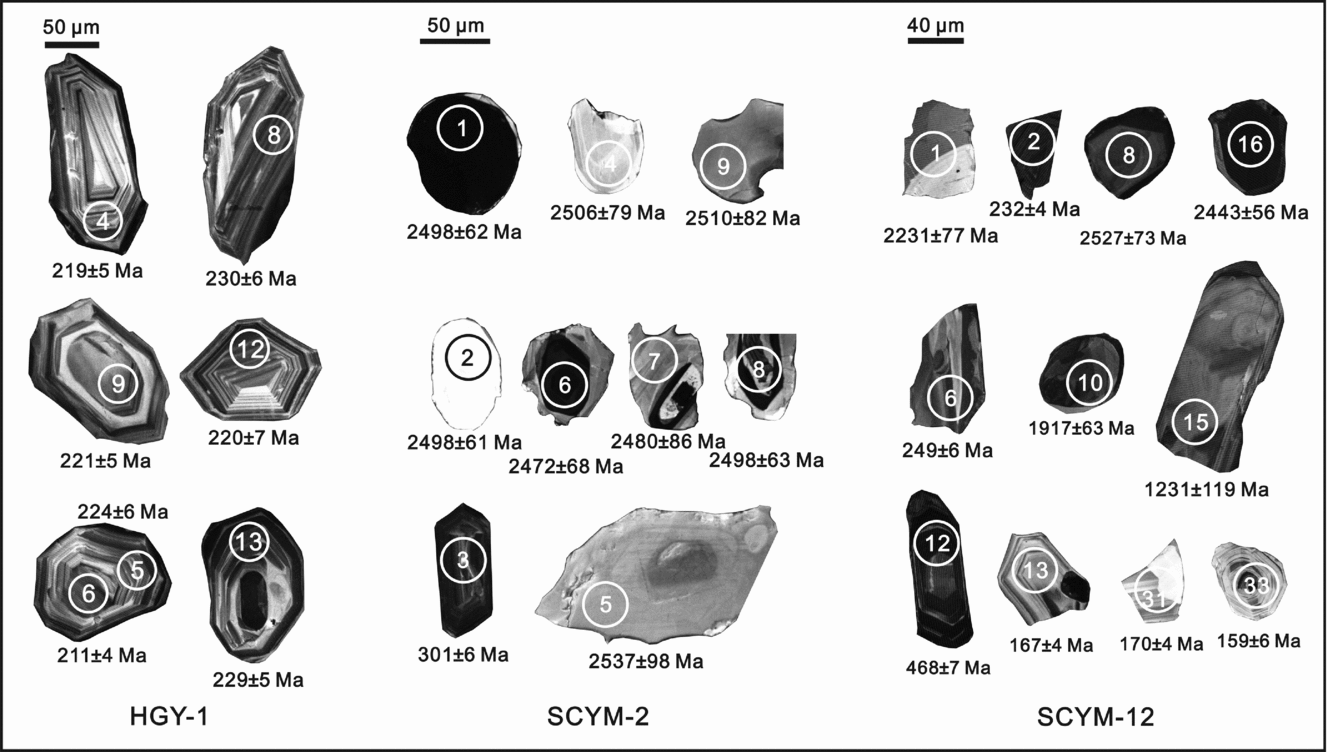
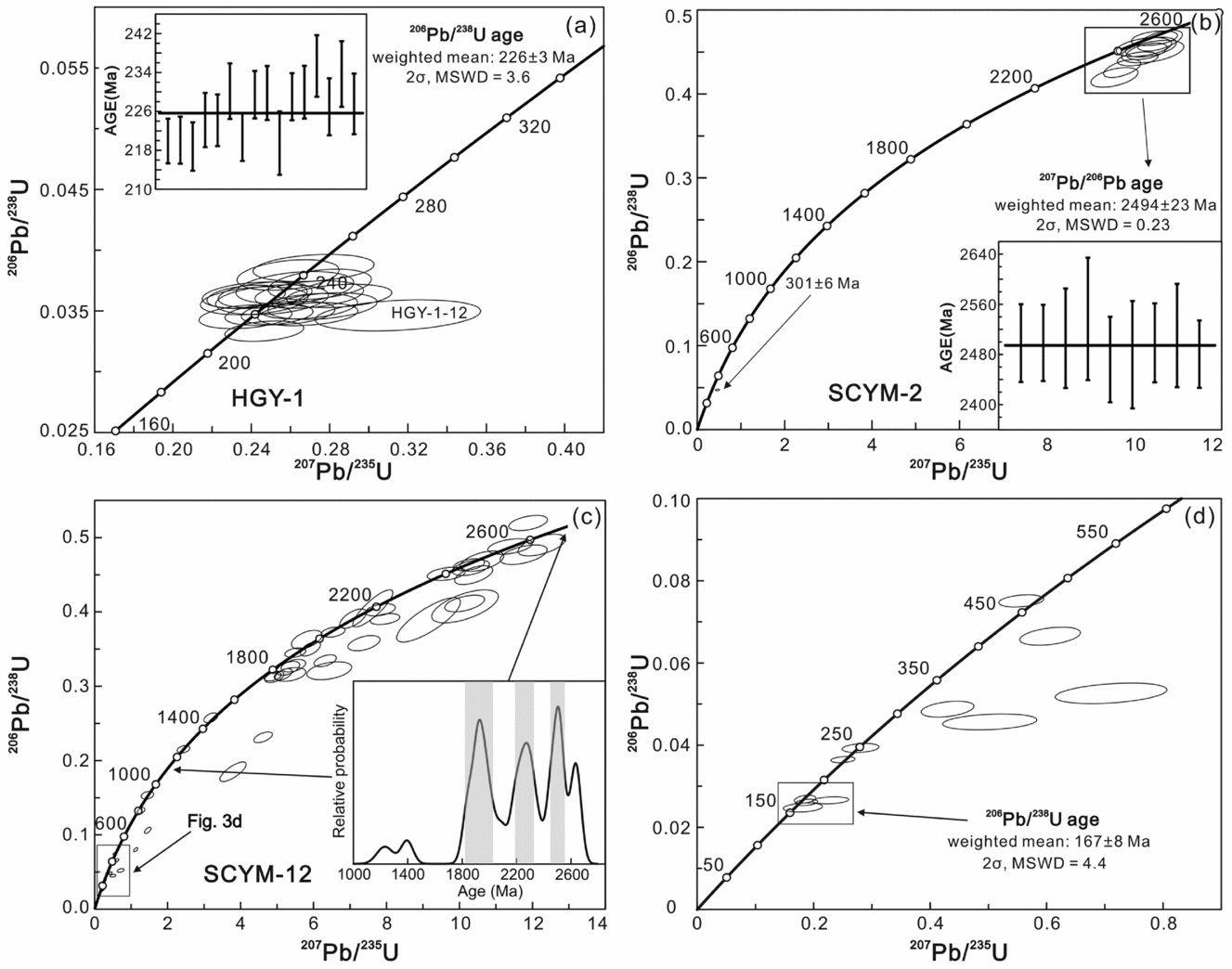
Results are shown in online Supplementary Table S1 (available at http://journals.cambridge.org/geo) and Figures 2 and 3a. Zircons from granite HGY-1 are light brown, transparent and euhedral to subhedral, with length/width ratios varying from 1 to 3 and lengths generally ranging from 70 to 180 μm. The cathodoluminescence (CL) images show that zircons contain typical magmatic oscillatory zoning. A total of 18 zircons were analysed at 19 points. With the exception of one point (HGY-1-12), the U–Pb data fall in a concentrated area and are all near-concordant in the concordant diagram. The core (HGY-1-6) is younger than the rim (HGY-1-5) in one grain, which may imply Pb loss. Two points yield an Early Triassic age (206Pb/238U age) of 242 ± 6 Ma and 244 ± 6 Ma. The remaining 16 analyses yield a weighted mean 206Pb/238U age of 226 ± 3 Ma (2σ, MSWD = 3.6, n = 16).
Cathodoluminescence images of zircons. White and black circles are LA-ICP-MS analysis spots.

Zircon U–Pb age of (a) the Dashizhuzi granites (HGY-1) and (b–d) lamprophyre dykes (SCYM-2 and SCYM-12).

5.a.2. Lamprophyre dykes
Zircons from dyke SCYM-2 are light green to transparent and rounded, irregular in external form, and of length ranging from 50 to 140 μm. The CL images show that some grains have both dark cores and bright rims, and some grains are structureless (Fig. 3b). A total of 10 zircons were analysed at 10 points; 9 of these are near-concordant to moderately concordant, and yield a weighted mean 207Pb/206Pb age of 2494 ± 23 Ma (2σ, MSWD = 0.23, n = 9). The remaining analysis (SCYM-2-3) yields a late Carboniferous age of 301 ± 6 Ma. Although the zircon grain is dark in the CL image, magmatic oscillatory zoning still occurs within the grain; this indicates that it was probably captured from igneous rocks of upper Palaeozoic age.
Lamprophyre dyke SCYM-12 has complex zircon populations (Fig. 3c, d), and 48 zircons were analysed at 48 points. Thirty-one of them demonstrate an Archean-Palaeoproterozoic age, and they can be divided into four groups with 207Pb/206Pb age ranges of 2660–2610 Ma, 2530–2440 Ma, 2330–2200 Ma and 1980–1830 Ma. All these grains are rounded in external form and have no obvious oscillatory zoning in CL images. A Mesoproterozoic age (207Pb/235U ages of 1453–1254 Ma) was demonstrated by two near-concordant zircon grains, and two near-concordant zircon grains record a Neoproterozoic age (206Pb/238U ages of 923–805 Ma). Except for two less-concordant points, six zircon grains have significant oscillatory zoning and show widely scattered near-concordant 206Pb/238U ages of Middle Ordovician – Middle Triassic. The remaining four zircon grains, with significant oscillatory zoning, yield a weighted mean 206Pb/238U age of 167 ± 8 Ma (2σ, MSWD = 4.4, n = 4).
5.b. Major and trace elements
5.b.1. DSZZ granites
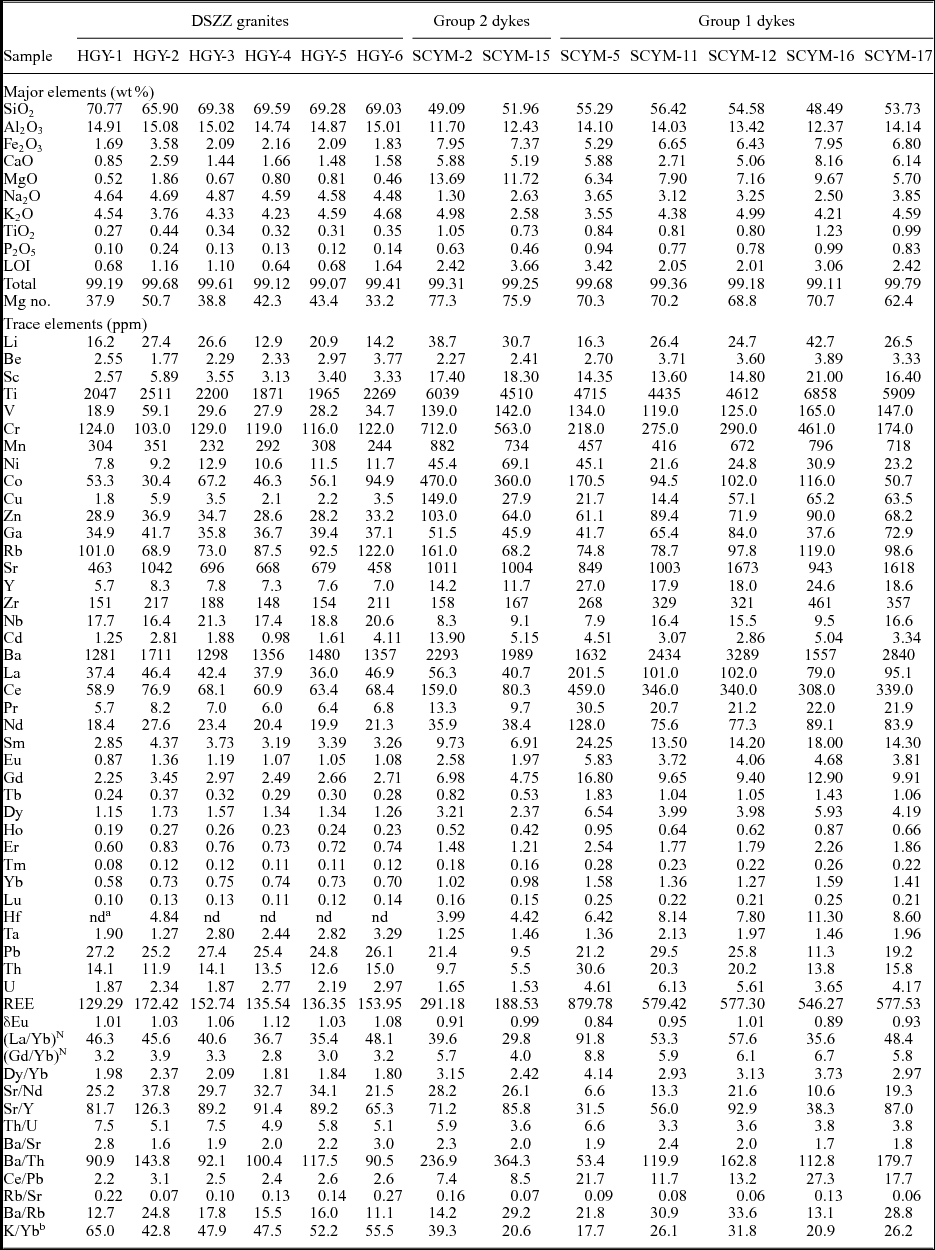
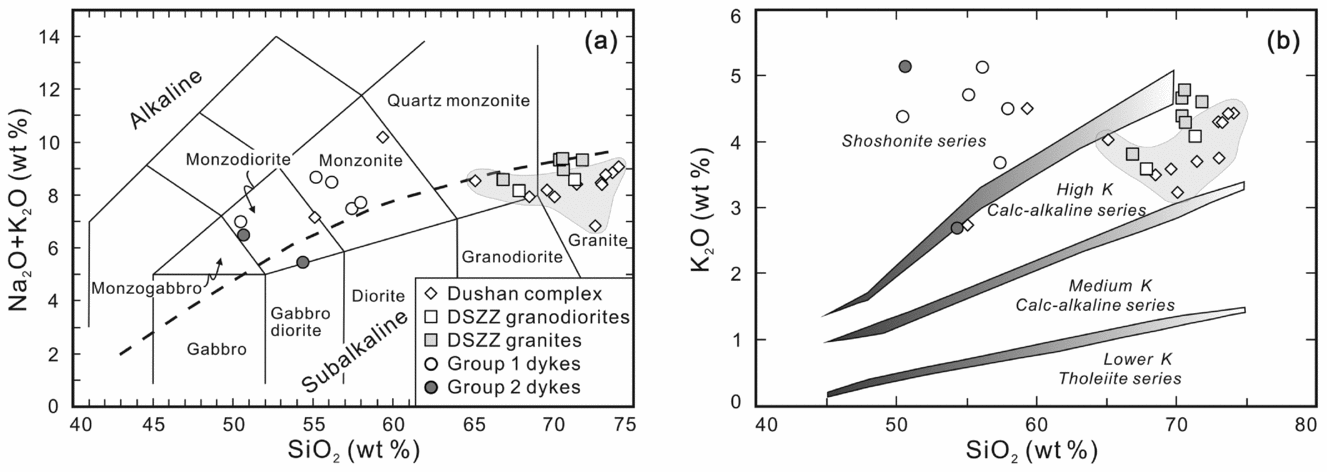
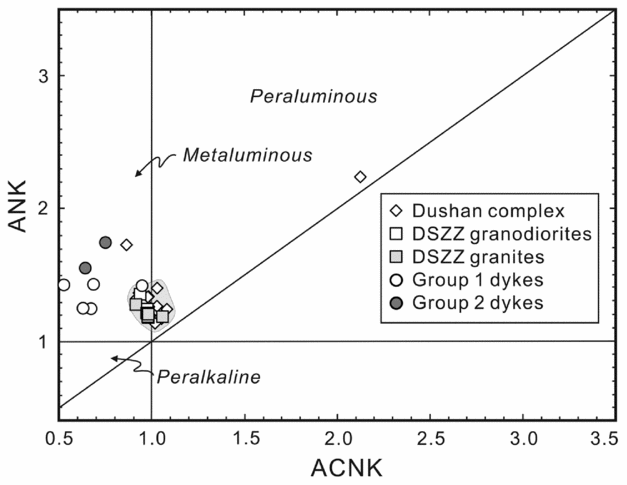
The major- and trace-element data are reported in Table 1. The DSZZ granites have SiO2 contents ranging from 65.9 to 70.8 wt %. All samples are relatively high in Al2O3 (14.7–15.1 wt %), Na2O (4.5–4.9 wt %) and total alkalis (K2O + Na2O ranging over 8.5–9.2 wt %), with Na2O/K2O ratios of 0.96–1.25. By contrast, they are low in P2O5 (0.10–0.24 wt %) and TiO2 (0.27–0.44 wt %) abundances, and have Mg no. of 33–51 (Mg no. = 100 × molar Mg/(Mg + Fe)). The DSZZ granites have SiO2 contents comparable to those of the DSZZ granodiorites and the Dushan complex (Ye et al. Reference Ye, Zhang, Zhao and Wu2014), but with relatively higher total alkali contents. In the total alkali versus silica diagram (Fig. 4a), all samples plot in granite and quartz monzonite fields. These granite rocks are metaluminous (Fig. 5) and can be categorized to high-K calc-alkaline series rocks (Fig. 4b).
Major- and trace-element concentrations of the Dashizhuzi granites and the lamprophyre dykes

a nd: data not detected; bK/Yb = weight (K/Yb)/1000
(a) SiO2 v. Na2O + K2O and (b) SiO2 v. K2O for the Dashizhuzi granites and lamprophyre dykes. The data for Dushan complex and Dashizhuzi granodiorites are from Ye et al. (Reference Ye, Zhang, Zhao and Wu2014).

Plot of A/CNK v. ANK for the Dashizhuzi granites and lamprophyre dykes. The data for Dushan complex and Dashizhuzi granodiorites are from Ye et al. (Reference Ye, Zhang, Zhao and Wu2014).

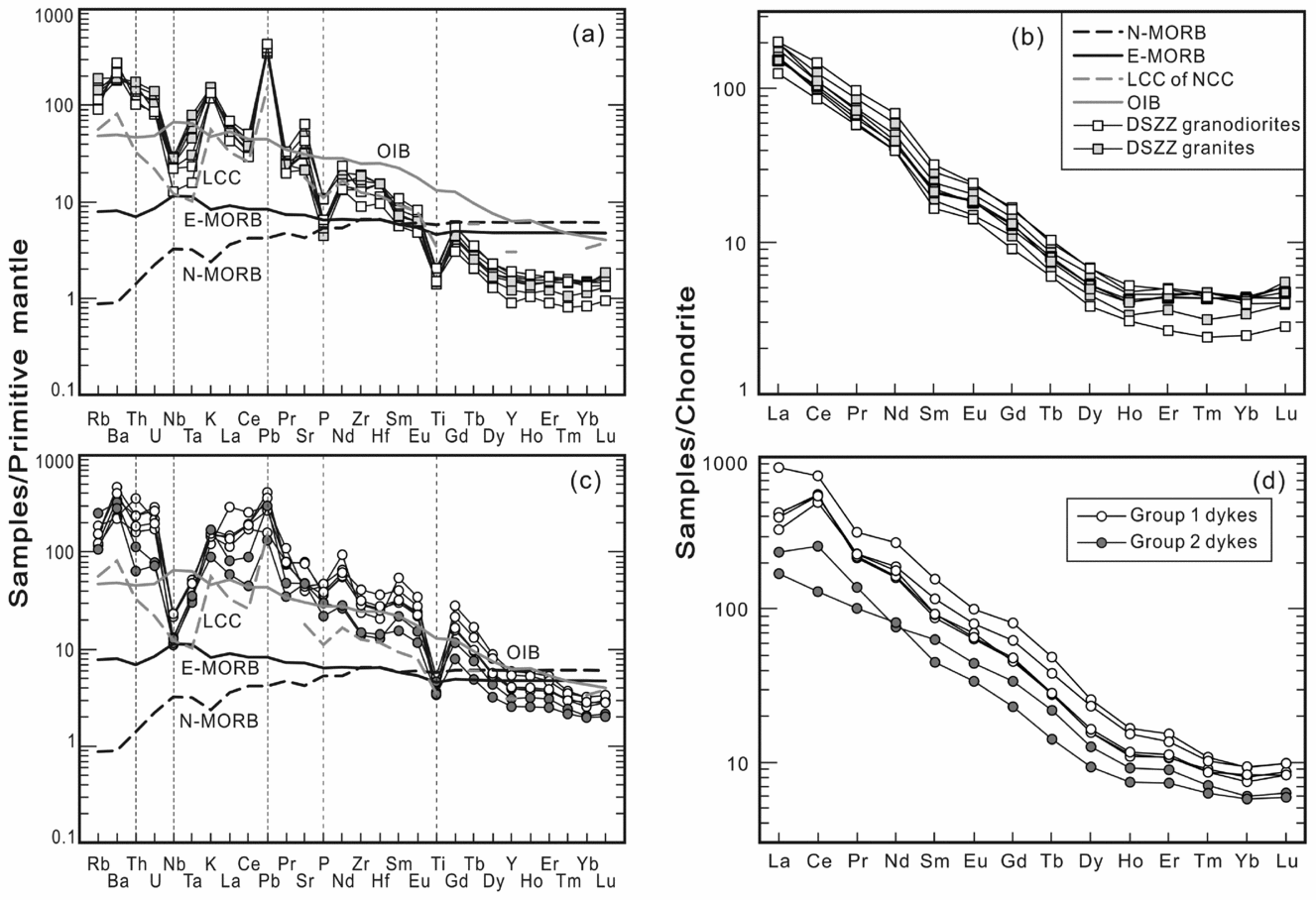
The DSZZ granites have total rare Earth element contents (ΣREE) varying over 129–172 ppm, and display right-dipping chondrite-normalized REE patterns (Fig. 6b) with (La/Yb)N and (Gd/Yb)N ratios of 35–48 and 2.8–3.9, respectively. All samples are distinctive for their extremely low heavy REE (HREE) abundances when compared to typical ocean island basalt (OIB; Sun & McDonough, Reference Sun, McDonough, Saunders and Norry1989) and LCC of the NCC (Gao et al. Reference Gao, Luo, Zhang, Zhang, Han, Zhao and Hu1998). The patterns have slightly positive Eu anomalies (1.01–1.12; δEu = (Eu)N/(0.5×[(Sm)N + (Gd)N]), where the subscript N denotes chondrite-normalized value). The primitive mantle-normalized trace-element patterns are similar to those of the DSZZ granodiorites (Ye et al. Reference Ye, Zhang, Zhao and Wu2014) and LCC of the NCC (Fig. 6a). All samples are enriched by large-ion lithophile elements (LILE; e.g. K, Rb, Sr, Ba, U) and depleted in high-field-strength elements (HFSE; e.g. Nb, Ta, Ti, P), and display a strong positive Pb anomaly and moderate to strong negative Nb, Ta, Ti and P anomalies. They also have some other striking geochemical features, including high Sr/Y (65–126) and elevated Cr (103.0–129.0 ppm) abundances.
(a, c) Trace-element and (b, d) rare Earth element concentrations of the Dashizhuzi granites and lamprophyre dykes. Concentrations were normalized to primitive mantle and chondrite that were recommended by Sun & McDonough (Reference Sun, McDonough, Saunders and Norry1989). Data for OIB, N-MORB and E-MORB (Sun & McDonough, Reference Sun, McDonough, Saunders and Norry1989) and LCC of the NNC (Gao et al. Reference Gao, Luo, Zhang, Zhang, Han, Zhao and Hu1998) are presented for comparison. The data for the Dashizhuzi granodiorites are from Ye et al. (Reference Ye, Zhang, Zhao and Wu2014).

5.b.2. Lamprophyre dykes
The lamprophyre dykes display a wide range of SiO2 abundances (48.5–56.4 wt %). They are all characterized by moderate to low Na2O (1.3–3.9 wt %) and high abundances of total alkalis (K2O + Na2O = 5.2–8.4 wt %). Two groups of dykes can be recognized based on their elemental features, especially MgO and Al2O3 contents. The Group 2 dykes include SCYM-2 and SCYM-15, and the remainder of the dykes belong to Group 1. The Group 1 dykes have moderate to high Al2O3 (12.4–14.1 wt %) contents and relatively low total Fe2O3 (Fe2O3T, 5.3–8.0 wt %) and MgO (5.7–9.7 wt %) contents, with Mg no. of 62–71; the Group 2 dykes have relatively low Al2O3 (11.7–12.4 wt %) contents and relatively high Fe2O3T (7.4–8.0 wt %) and MgO (11.7–13.7 wt %) contents, with Mg no. of 76–77. All samples plot in the fields of monzodiorite and monzonite, and belong to shoshonite series rocks (Fig. 4a, b).
The Group 1 dykes are characterized by low Ni (21.6–45.1 ppm) and Sc (13.6–21.0 ppm) and moderate Co (51–171 ppm) and Cr (174–461 ppm) abundances, and significantly high ΣREE abundances (546–880 ppm). In contrast, the Group 2 dykes contain moderate Ni (45.4–69.1 ppm) and very high Co (360–470 ppm) and Cr (563–712 ppm) abundances, and low Sc (17.4–18.3 ppm) and ΣREE abundances (189–291 ppm). All these samples exhibit a wide range of ΣREE abundances, and display similar right-dipping chondrite-normalized REE patterns (Fig. 6d) with (La/Yb)N and (Gd/Yb)N ratios of 30–92 and 4.0–8.8, respectively. The patterns have slightly negative Eu anomalies with δEu ranging from 0.84 to 1.01. All these lamprophyre dykes show subparallel primitive-normalized trace-element patterns (Fig. 6c). They are enriched in LILE (e.g. K, Rb, Sr, Ba, U), depleted in HFSE (e.g. Nb, Ta, Ti, P) and display a strong positive Pb anomaly, moderate to strong negative Nb, Ta and Ti anomalies and slightly negative P, Zr and Hf anomalies. The primitive mantle-normalized trace-element patterns are similar to those of LCC of the NCC to some extent, and abundances of most trace elements of the Group 2 dykes are comparable with those of OIB. The Group 1 dykes have Th/U (3.3–3.8, except SCYM-5), Ba/Th (53–180) and Ce/Pb (11.7–27.3) ratios similar to those of MORB (Salters & Stracke, Reference Salters and Stracke2004), whereas the Group 2 dykes have relatively higher Ba/Th (237–364) and lower Ce/Pb (7.4–8.5) ratios.
5.c. Whole-rock Sr–Nd isotopes
5.c.1. DSZZ granites
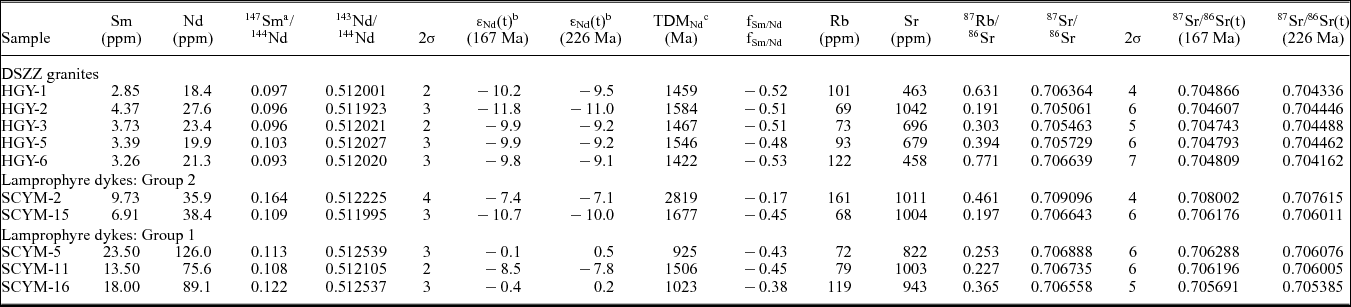
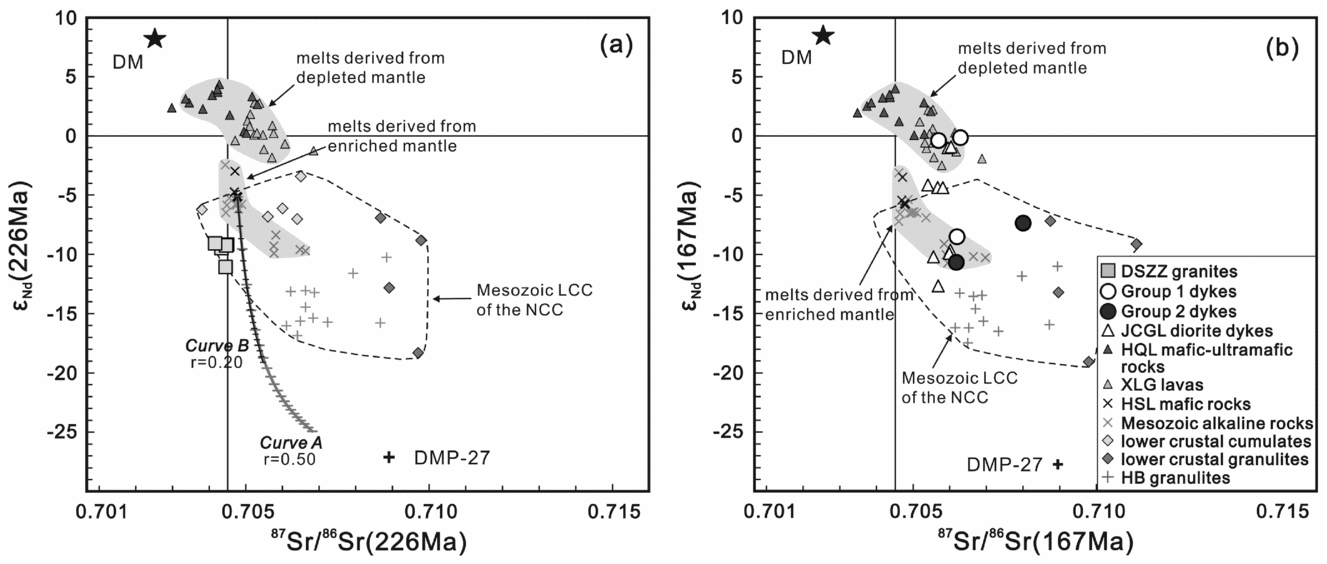
Sr and Nd isotope compositions are listed in Table 2. The DSZZ granites have Sr–Nd isotopic compositions plotting in the field of the Mesozoic lower crustal granulite xenoliths (Fig. 7a; Liu et al. Reference Liu, Gao, Yuan, Zhou, Liu, Wang, Hu and Wang2004; She et al. Reference She, Wang, Li, Zhang, Feng and Li2006) and cumulates (Shao et al. Reference Shao, Chen, Lu and Zhou2006). The initial 87Sr/86Sr ratios (0.70416–0.70449) of the DSZZ granites are almost identical to those of coeval Hekanzi pyroxene-biotite syenite (Yang et al. Reference Yang, Sun, Zhang, Wu and Wilde2012) and the Devonian Hongshila pyroxenite-hornblendite complex (Zhang et al. Reference Zhang, Zhao, Liu, Liu, Chen, Xie and Chen2009a). They display a narrow range in Nd isotopes (εNd (226 Ma) of –11.0 to –9.1), and have Nd model (TDMNd) ages of 1.42–1.58 Ga.
Sr and Nd isotopic compositions of the Dashizhuzi granites and the lamprophyre dykes

a 147Sm decay constant is 6.54×10⁻¹² a−1; bεNd (t) is calculated with 143Nd/144Nd = 0.512638 and 147Sm/144Nd = 0.1966 for present-day CHUR (Hamilton et al. Reference Hamilton, O'Nions, Bridgwater and Nutman1983); c Nd model age (TDMNd) is calculated with 143Nd/144Nd = 0.51315 and 147Sm/144Nd = 0.2135 for present-day depleted mantle (Goldstein, O'Nions & Hamilton, Reference Goldstein, O'Nions and Hamilton1984; Peucat et al. Reference Peucat, Vidal, Bernard-Griffiths and Condie1989)
Nd and Sr isotopic compositions of (a) the Dashizhuzi granites and (b) lamprophyre dykes. The black and grey curves A and B in (a) with horizontal tick marks are AFC (assimilation and fractional crystallization) trends showing 5 % increments in F (magma remaining) for melts of enriched mantle (Hongshila pyroxenite; Zhang et al. Reference Zhang, Zhao, Liu, Liu, Chen, Xie and Chen2009a) that assimilate lower crust (DMP-27; Liu et al. Reference Liu, Gao, Yuan, Zhou, Liu, Wang, Hu and Wang2004). Fields for melts derived from depleted mantle are the Triassic Hongqiling-Piaohechuan (HQL) mafic-ultramafic rocks (Wu et al. Reference Wu, Wilde, Zhang and Sun2004) and the Jurassic Xinglonggou (XLG) lavas (Gao et al. Reference Gao, Rudnick, Yuan, Liu, Liu, Xu, Ling, Ayers, Wang and Wang2004); for melts derived from enriched mantle the Triassic alkaline magma rocks (Yang et al. Reference Yang, Sun, Zhang, Wu and Wilde2012; Zhang et al. Reference Zhang, Zhao, Ye, Hou and Li2012) and the Devonian Hongshila (HSL) pyroxenite-hornblendite complex (Zhang et al. Reference Zhang, Zhao, Liu, Liu, Chen, Xie and Chen2009a); and for Mesozoic LCC of the NCC the Hannuoba (HB) deep-seated mafic-intermediate xenoliths (Liu et al. Reference Liu, Gao, Yuan, Zhou, Liu, Wang, Hu and Wang2004) and early Mesozoic lower crustal cumulates (Shao et al. Reference Shao, Chen, Lu and Zhou2006) and granulites (Shao et al. Reference Shao, Chen, Lu and Zhou2006; She et al. Reference She, Wang, Li, Zhang, Feng and Li2006). Data for Jingchanggouliang (JCGL) diorite dykes (Fu et al. Reference Fu, Wei, Kusky, Chen, Tan, Li, Kong and Jiang2012a) are present for comparison. All data are calculated at 226 Ma in (a) and 167 Ma in (b).

5.c.2. Lamprophyre dykes
The Group 1 dykes have initial 87Sr/86Sr ratios of 0.70569 to 0.70629 and have εNd (167 Ma) values varying from –8.5 to –0.1. With the exception of SCYM-11, their Sr–Nd isotopic compositions overlap those of the Xinglonggou lavas (Gao et al. Reference Gao, Rudnick, Yuan, Liu, Liu, Xu, Ling, Ayers, Wang and Wang2004). TDMNd ages of the Group 1 dykes range over 0.93–1.51 Ga. The Group 2 dykes have initial 87Sr/86Sr ratios of 0.70618–0.70800 and εNd (167 Ma) values of –10.7 to –7.4. The significantly high 87Sr/86Sr ratio of SCYM-2 is possibly due to hydrothermal alterations, which is also supported by relatively high Rb, Cu and Zn contents. Their Sr–Nd isotopic compositions plot in the field of the Mesozoic alkaline rocks (Fig. 7b). TDMNd ages of the Group 2 dykes range over 1.68–2.82 Ga, which is significantly older than the Group 1 dykes.
5.d. Zircon Hf isotopes
5.d.1. DSZZ granites
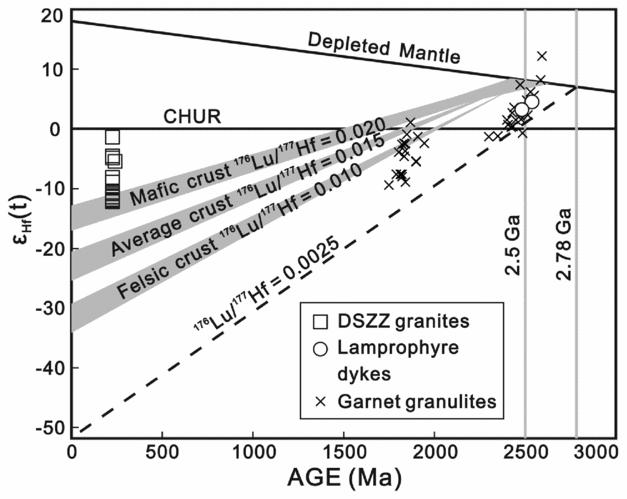
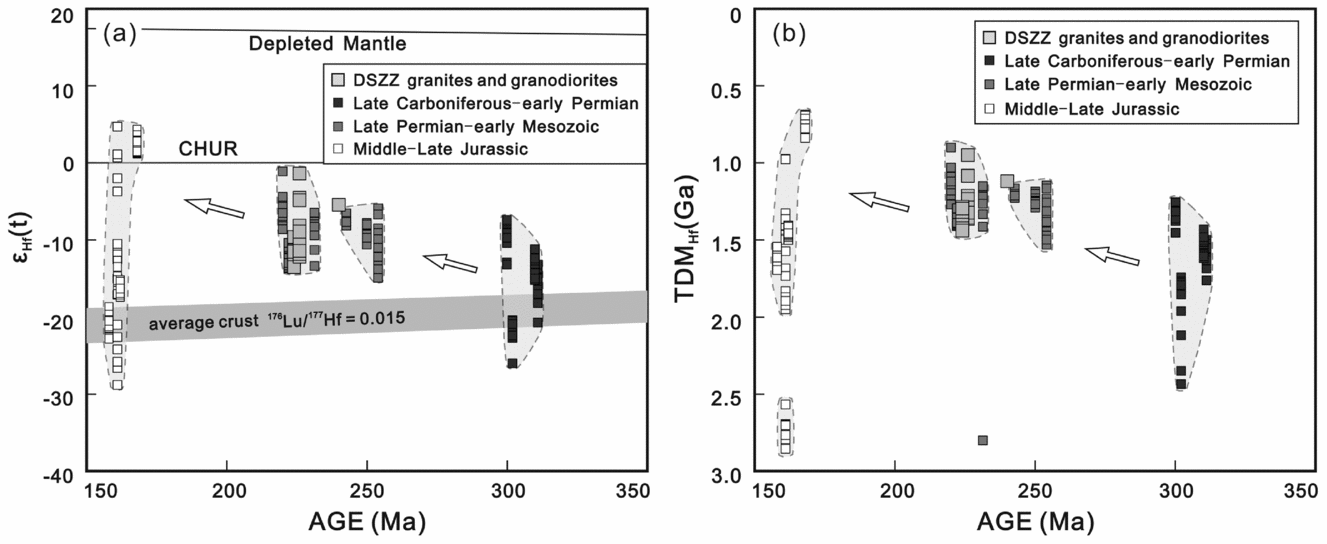
Results for in situ Hf isotope analyses of zircons are shown in online Supplementary Table S2 (available at http://journals.cambridge.org/geo) and Figure 8. Zircons from the DSZZ granites have model ages (TDMHf) of 0.95–1.36 Ga and a wide range of εHf(t) values varying from –12.2 to –1.4 with a trend towards the CHUR line recommended by Bouvier, Vervoort & Patchett (Reference Bouvier, Vervoort and Patchett2008).
Plots of εHf(t) against U–Pb age for the Dashizhuzi granites and lamprophyre dykes. The dashed line with (176Lu/177Hf = 0.0025), representing trend of zircons in the Fuxian garnet granulite xenoliths (Zheng et al. Reference Zheng, Griffin, O'Reilly, Lu, Yu, Zhang and Li2004a), is shown for comparison. The mafic crust, felsic crust and average crust evolution line with assumed 176Lu/177Hf ratios of 0.020, 0.010 and 0.015, respectively, are presented for comparison.

5.d.2. Lamprophyre dykes
The ancient zircons of the lamprophyre dyke SCYM-2 have TDMHf ages of 2.67 Ga and εHf(t) values varying over 3.2–4.5, which lie close to the depleted mantle and mafic-granulite-xenoliths-hosted ancient zircons evolution line (Zheng et al. Reference Zheng, Griffin, O'Reilly, Lu, Yu, Zhang and Li2004a) at this time beneath the NCC (Fig. 8).
6. Discussion
6.a. Emplacement age
Previous studies have shown that zircons are used to track complicated thermal histories. Similarly, most tectono-thermal histories of the NCC are recorded by zircon U–Pb geochronology of the DSZZ granites and the lamprophyre dykes. Four Precambrian age groups of 2.66–2.61 Ga, 2.53–2.44 Ga, 2.33–2.20 Ga and 1.98–1.83 Ga are recognized from zircons within the lamprophyre dykes SCYM-2 and SCYM-12 (online Supplementary Table S1, available at http://journals.cambridge.org/geo, and Fig. 3b, c). The Archean age group of 2.66–2.61 Ga is identical to their in situ hafnium model ages (2.67 Ga). These zircons also have high εHf (2.67 Ga) values from +3.2 to +4.5, which probably reflects a depleted-mantle-derived Precambrian continental crust growth event. The age group of 2.53–2.44 Ga coincides with a widespread metamorphism and deformation event during late Archean time (c. 2.5 Ga) in the NCC (e.g. Pidgeon, Reference Pidgeon1980; Jahn & Zhang, Reference Jahn and Zhang1984; Jin, Li & Liu, Reference Jin, Li and Liu1991; Wu et al. Reference Wu, Geng, Shen, Liu, Li and Zhao1991; Kröner et al. Reference Kröner, Cui, Wang, Wang and Nemchin1998). The Palaeoproterozoic age group of 2.33–2.20 Ga is roughly coeval with the development and closure of the Jiao-Liao-Ji continental rift in the Palaeoproterozoic (2.2–1.9 Ga; e.g. Li et al. Reference Li, Zhao, Sun, Han, Luo, Hao and Xia2005; Zhao et al. Reference Zhao, Sun, Wilde and Zhong2005), and the younger age group of 1.98–1.83 Ga probably marks the final collision of the Western and Eastern blocks of the NCC during late Palaeoproterozoic time (c. 1.85 Ga; Zhao et al. Reference Zhao, Wilde, Cawood and Sun2001, Reference Zhao, Sun, Wilde and Zhong2005). Further, two Palaeozoic age groups of 468–416 Ma and 331–289 Ma obtained from the lamprophyre dykes, SCYM-2 and SCYM-12, coincide well with the complicated evolution histories of the Palaeo-Asian Ocean (e.g. Windley et al. Reference Windley, Alexeiev, Xiao, Kröner and Badarch2007) and the Carboniferous–Permian (330–265 Ma) collision of the NCC and the Mongolia composite terranes (e.g. Windley et al. Reference Windley, Alexeiev, Xiao, Kröner and Badarch2007; Zhang et al. Reference Zhang, Zhao, Liu, Hu, Song and Wu2010a). Another considerable Phanerozoic period (249–240 Ma) is also recorded by zircons from the granite HGY-1 and lamprophyre dykes SCYM-12, and may be related to post-collisional extension or the granulite metamorphism induced by basaltic underplating (Shao, Han & Li, Reference Shao, Han and Li2000).
The youngest group from the granite HGY-1 yields a weighted mean 206Pb/238U age of 226 ± 3 Ma (Fig. 3a), which is consistent with the reported zircon U–Pb age (224 ± 2 Ma) of the DSZZ granodiorites by Ye et al. (Reference Ye, Zhang, Zhao and Wu2014). This age probably represents the best estimate of the crystallization age of the DSZZ granites. The DSZZ complex therefore emplaced during Middle Triassic time. This period is also implied by many exposed Triassic alkaline, mafic-ultramafic and felsic magma rocks along the northern margin of the NCC (online Supplementary Table S3 and Supplementary Figure S1; e.g. Yan et al. Reference Yan, Mou, Xu, He, Tan, Zhao, He, Zhang and Qiao2000; Luo et al. Reference Luo, Miao, Guan, Qiu and Qiu2003; Wu, Yang & Liu, Reference Wu, Yang and Liu2005; Pei et al. Reference Pei, Xu, Yu, Zhao and Yang2008; Fu et al. Reference Fu, Wei, Kusky, Chen, Tan, Li, Kong and Jiang2012a; Ye et al. Reference Ye, Zhang, Zhao and Wu2014).
Zircon grains from the lamprophyre dykes SCYM-2 and SCYM-12 are mainly inherited from early igneous and metamorphic rocks. The Middle Jurassic age of 167 ± 8 Ma is recorded by four zircon grains that are euhedral to subhedral in external form (Figs 2, 3d). This is consistent with the field relationships demonstrating that these dykes are hosted in the interior of the Middle Triassic DSZZ complex. Furthermore, the occurrence of voluminous intermediate to felsic granitoids and volcanic rocks in the NE segment of the NCC (e.g. Miao et al. Reference Miao, Luo, Guan and Huang1998; Gao et al. Reference Gao, Rudnick, Yuan, Liu, Liu, Xu, Ling, Ayers, Wang and Wang2004; Wu et al. Reference Wu, Walker, Yang, Yuan and Yang2006a; Du et al. Reference Du, Ma, Zhao and Wang2007) suggests a Middle–Late Jurassic pronounced magmatism period. The Middle Jurassic age of 167 ± 8 Ma is therefore the best estimate for emplacement age of these lamprophyre dykes.
6.b. Source of the DSZZ granites
The distinctive features of high Na2O (≥4.4 wt %) and Sr (≥458 ppm), enrichment in LREE and extreme depletion in HREE, Nb–Ta and Y (≤ 8.3 ppm), with high Sr/Y (65–126) and (La/Yb)N ratios (35–48) of the DSZZ granites, are similar to those of adakitic magmas from island arcs and Archean TTG suites (Kay, Reference Kay1978; Martin, Reference Martin1999). As recognition of magma rocks with analogous characters has increased, several petrogenetic hypotheses have been proposed including: melts from subducted young oceanic crust followed by interaction with the overlying mantle wedge peridotite (e.g. Kay, Reference Kay1978; Drummond & Defant, Reference Drummond and Defant1990; Schiano et al. Reference Schiano, Clocchiatti, Shimizu, Maury, Jochum and Hofmann1995), melting of thickened mafic LCC (e.g. Atherton & Petford, Reference Atherton and Petford1993) or melting of foundered LCC (e.g. Xu et al. Reference Xu, Shinjo, Defant, Wang and Rapp2002, Reference Xu, Wang, Wang, Guo and Pei2006a; Gao et al. Reference Gao, Rudnick, Yuan, Liu, Liu, Xu, Ling, Ayers, Wang and Wang2004); melting of hydrated mantle peridotite (Stern & Hanson, Reference Stern and Hanson1991; MacPherson, Dreher & Thirlwall, Reference MacPherson, Dreher and Thirlwall2006) or AFC (assimilation and fractional crystallization and/or crustal contamination) processes in basaltic magmas (e.g. Richards & Kerrich, Reference Richards and Kerrich2007; Fu et al. Reference Fu, Wei, Kusky, Chen, Tan, Li, Shi, Chen and Zhao2012b); mixing of mafic and felsic magmas (Guo et al. Reference Guo, Nakamuru, Fan, Kobayoshi and Li2007; Streck, Leeman & Chesley, Reference Streck, Leeman and Chesley2007); and source inheritance (Ma et al. Reference Ma, Zheng, Griffin, Zhang, Tang, Su and Ping2012, Reference Ma, Zheng, Xu, Griffin and Zhang2015). In the following discussion, we test these potential petrogenetic hypotheses in order to explain the petrologic and geochemical characteristics of the DSZZ granites.
Slab-melt–peridotite interaction has been proposed to account for the origin of rocks with adakitic characters (e.g. Kay, Reference Kay1978; Schiano et al. Reference Schiano, Clocchiatti, Shimizu, Maury, Jochum and Hofmann1995). This petrogenetic model requires a subduction setting in the northern margin of the NCC, yet the initial subduction of the Palaeo-Pacific Plate beneath the Eurasian continent took place during Early–Middle Jurassic time (Xu et al. Reference Xu, Pei, Wang, Meng, Ji, Yang and Wang2013) and the original calc-alkaline volcanic rocks related to the subduction of Mongol-Okhotsk Ocean Plate occurred during Early Jurassic time in the Erguna Massif (Wu et al. Reference Wu, Sun, Ge, Zhang, Grant, Wilde and Jahn2011; Xu et al. Reference Xu, Pei, Wang, Meng, Ji, Yang and Wang2013). These subduction events took place later than the emplacement of the DSZZ granites (226 Ma) and only the closure of the Palaeo-Asian Ocean, taking place during late Permian – Early Triassic time (Xiao et al. Reference Xiao, Windley, Huang, Han, Yuan, Chen, Sun, Sun and Li2009), can match this. Nevertheless, the DSZZ granites have significantly lower Na2O/K2O ratios (0.96–1.25) than typical ocean slab-derived adakites (with Na2O/K2O ratios >2.3; Martin, Reference Martin1999). Further, the evolved Sr (87Sr/86Sr (226 Ma) ≥0.7042) and Nd (143Nd/144Nd (226 Ma) ≤0.5119) isotopic compositions of the DSZZ granites contrast with MORB-like Sr–Nd isotopic compositions of slab melts interacted or not with overlying mantle wedge peridotite. The DSZZ granites were therefore not likely to originate from slab-melt–peridotite interaction.
Some studies have proposed that adakitic rocks can be generated by melting of hydrated mantle peridotite (Stern & Hanson, Reference Stern and Hanson1991; MacPherson, Dreher & Thirlwall, Reference MacPherson, Dreher and Thirlwall2006) or AFC processes in basaltic magmas (e.g. Richards & Kerrich, Reference Richards and Kerrich2007; Fu et al. Reference Fu, Wei, Kusky, Chen, Tan, Li, Shi, Chen and Zhao2012b). However, the SiO2 (65.9–70.8 wt %), MgO (0.46–1.86 wt %) and Sr (458–1042 ppm) contents of the DSZZ granites are inconsistent with those of the low-SiO2 adakites (<60 wt %, such as the sanukitoids described by Stern & Hanson, Reference Stern and Hanson1991), which have been suggested as a result of melting of peridotite source metasomatized by slab melts (Martin et al. Reference Martin, Smithies, Rapp, Moyen and Champion2005), but similar to those of the high-SiO2 adakites. Derivation of hydrated mantle peridotite for the DSZZ granites is therefore impossible here. The EM1-like Sr–Nd isotopic features (Fig. 7a) of the DSZZ granites are similar to those of the coeval-enriched mantle-derived alkaline magma rocks (Yang et al. Reference Yang, Sun, Zhang, Wu and Wilde2012; Zhang et al. Reference Zhang, Zhao, Ye, Hou and Li2012) and the Devonian Hongshila pyroxenite-hornblendite complex (Zhang et al. Reference Zhang, Zhao, Liu, Liu, Chen, Xie and Chen2009a), and may be an indication that AFC processes play an important role in magma petrogenesis. Indeed, their Sr–Nd compositions could be modelled by EM1-derived melts with assimilation of 18 % crustal materials (represented by the intermediate granulite sample DMP-27; Liu et al. Reference Liu, Gao, Yuan, Zhou, Liu, Wang, Hu and Wang2004) and a rate ratio of assimilation and fractional crystallization (r) close to 0.2. However, extremely low Sr/Nd ratios (Sr/Nd = 2.0; Table 3) are required in this model for the crustal contamination end-member. The required Sr/Nd ratios are obviously lower than the average Sr/Nd ratios of the continental crust (16.0) and LCC (31.6) recommended by Rudnick & Gao (Reference Rudnick, Gao, Heinrich and Turekian2014), which makes the modelled results infeasible. Furthermore, the presence of mafic enclaves locally entrained by the DSZZ granites and granodiorites in field investigations contrasts with crustal assimilation because mafic enclaves are normally regarded as proof of basaltic injection into felsic melts (Xu et al. Reference Xu, Huang, Ma, Wang, Iizuka, Xu, Wang and Wu2004; Yang et al. Reference Yang, Wu, Wilde and Liu2007) rather than crustal contamination. AFC processes in basaltic magmas can therefore also be ruled out.
Elemental ratios and isotopic data used for the AFC modelling for curves A and B (EM – enriched lithospheric mantle; LCC – lower continental crust)

Mixing of mafic and felsic magmas also have been proposed to account for some adakitic rocks (e.g. Guo et al. Reference Guo, Nakamuru, Fan, Kobayoshi and Li2007; Streck, Leeman & Chesley, Reference Streck, Leeman and Chesley2007). The local presence of pyroxenite and diorite enclaves in the DSZZ complex and adjacent Dushan complex implies basaltic injection into these magmas. This process probably resulted in the slightly elevated Magnesium number (such as sample HGY-2 with Mg no. of 51) and Cr contents. However, no reversely zoned plagioclase is observed in the petrographic study. Moreover, there is no obvious positive correlation between initial Nd isotopes and MgO and Cr contents. Such petrologic and geochemical characteristcis and the local occurrence of mafic enclaves possibly indicate that the addition of basaltic components does not play a significant role in magma petrogenesis. Although we cannot completely rule out this scenario, we do not favour it.
Preclusion of a mantle origin leads us to favour a crustal origin for the Triassic DSZZ granites. The adakitic characteristics of the DSZZ granites may have been generated by melting of thickened LCC that was delaminated or not (e.g. Atherton & Petford, Reference Atherton and Petford1993; Xu et al. Reference Xu, Shinjo, Defant, Wang and Rapp2002, Reference Xu, Wang, Wang, Guo and Pei2006a; Gao et al. Reference Gao, Rudnick, Yuan, Liu, Liu, Xu, Ling, Ayers, Wang and Wang2004), or just inherited from the crustal origin (Ma et al. Reference Ma, Zheng, Griffin, Zhang, Tang, Su and Ping2012, Reference Ma, Zheng, Xu, Griffin and Zhang2015). In the former petrogenetic hypothesis, depletion in HREE and high Sr/Y without Eu anomalies are normally explained by deep melting (at depths >45 km) with the presence of garnet, amphibole, clinopyroxene and little or no plagioclase as stable and residual minerals (Atherton & Petford, Reference Atherton and Petford1993). The equilibrium P–T conditions estimates of the Palaeozoic kimberlites-hosted lower-crustal xenoliths in Fuxian County revealed that the depth of the lower boundary of the crust exceeded 30 km during early Palaeozoic time (Zheng et al. Reference Zheng, Griffin, O'Reilly, Lu, Yu, Zhang and Li2004a, b). The crust was then significantly thickened in the northern NCC by generally N–S-directed tectonic shortening during middle–late Permian time related to the assembly of the Mongolian composite terranes with the NCC (Zhang et al. Reference Zhang, Li, Deng, Liu, Liu, Wei, Li and Liu2011; Lin et al. Reference Lin, Zhu, Yan, Song and Liu2013). Nevertheless, whether a Triassic-thickened LCC existed or not remains unknown.
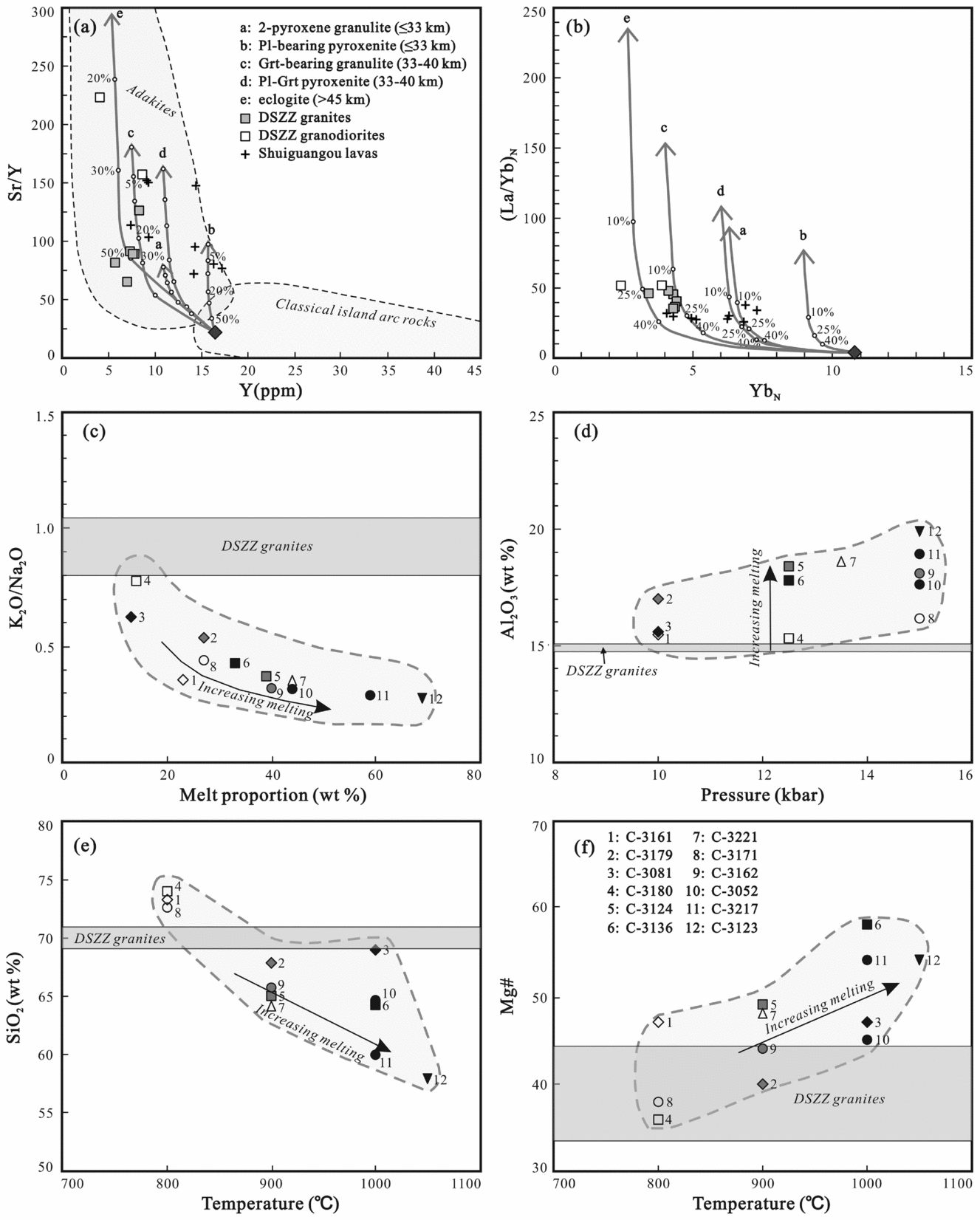
Regardless of the thickness of the Mesozoic continental crust of the NCC, Ma et al. (Reference Ma, Zheng, Xu, Griffin and Zhang2015) carried out trace-element modelling (with the depth ranging from ≤33 to >45 km) on the Mesozoic adakitic rocks from the northern part of the NCC, where the DSZZ granites are also located. We compared trace-element data with these modelled results. Most of the DSZZ granites samples can be generated either by 15–28 % melting of the mafic LCC of the NCC with residues of garnet-bearing granulite (33–40 km) or by approximately 50 % melting with residues of eclogite (>45 km) as indicated in the Sr/Y–Y diagram (Fig. 9a), and can be generated by 10–25 % melting with residues of garnet-bearing granulite as indicated in the (La/Yb)N–YbN diagram (Fig. 9b). Hence, on the basis of trace-element features, the DSZZ granites can be produced either by low melt fractions with residues of garnet-bearing granulite (Cpx:Opx:Am:Grt:Pl:Ilm:Rt = 40:20:24:10:5:0.5:0.5) or by large melt fractions with residues of eclogite (Cpx:Grt:Rt = 70:29:1; Ma et al. Reference Ma, Zheng, Xu, Griffin and Zhang2015). However, according to the melting experiments on compounds with major elements analogous to mafic LCC estimated by Rudnick & Gao (Reference Rudnick, Gao and Rudnick2003) and Condie & Selverstone (Reference Condie and Selverstone1999), conducted by Qian & Hermann (Reference Qian and Hermann2013), their major-element contents (such as SiO2, MgO, Mg no., Al2O3, K2O/Na2O) are consistent with the experimental results of 15–22 % melting of mafic LCC at 800–950 °C and 10–12.5 kbar (corresponding to a depth of 30–40 km; experimental run C-3180; Fig. 9c–f). Increasing melting (such as 50 % melt proportions) will produce elevated CaO, MgO, Mg no. and Al2O3 and depressed SiO2 and K2O/Na2O values (Winther, Reference Winther1996; Qian & Hermann, Reference Qian and Hermann2013), which are inconsistent with the major elemental characteristics of the DSZZ granites. Although low melt proportions products at higher pressures (15 kbar; corresponding to a depth of >45 km) and low temperatures (800 °C; experimental run C-3171) would also display similar major element contents, it cannot produce appropriate Sr/Y, Y, (La/Yb)N and Yb values (Fig. 9a, b). Furthermore, (Gd/Yb)N values will be strongly elevated in melts coexisting with high proportions of amphibole and especially garnet (Wang et al. Reference Wang, Wyman, Xu, Jian, Zhao, Li, Xu, Ma and He2007; Qian & Hermann, Reference Qian and Hermann2013). As calculated by Ma et al. (Reference Ma, Zheng, Xu, Griffin and Zhang2015), melts generated by 15–25 % melting with residues of eclogite will have (Gd/Yb)N values of 4.1–4.3. These values are obviously higher than those ((Gd/Yb)N = 2.8–3.9) of the DSZZ granites. Additionally, the EM1-like Sr–Nd isotopic compositions of the DSZZ granites are very different when compared to those of melts produced by foundered lower crust followed by interaction with mantle peridotites (Fig. 7a; Xu et al. Reference Xu, Shinjo, Defant, Wang and Rapp2002; Gao et al. Reference Gao, Rudnick, Yuan, Liu, Liu, Xu, Ling, Ayers, Wang and Wang2004). We therefore conclude that melting of thickened or foundered LCC cannot be used to explain the petrogenesis of the DSZZ granites. Their adakitic characteristics may simply be inherited from the mafic LCC of the NCC (with residues of garnet-bearing granulite at depths of 33–40 km).
Plot of (a) Sr/Y v. Y, (b) (La/Yb)N v. YbN, (c) K2O/Na2O v. melt proportion, (d) Al2O3 v. pressure, and (e) SiO2 and (f) Mg no. v. melt temperature. Data for the DSZZ granodiorites (Ye et al. Reference Ye, Zhang, Zhao and Wu2014) and the Shuiquangou lavas (Ma et al. Reference Ma, Zheng, Griffin, Zhang, Tang, Su and Ping2012) are also shown. Partial melting curves for batch melting of the mafic lower crust of the NCC in (a) and (b) are from Ma et al. (Reference Ma, Zheng, Xu, Griffin and Zhang2015), and the fields of adakites and classical island-arc rocks (andesite-dacite-rhyolite) are modified from Defant & Drummond (Reference Defant and Drummond1990). In the partial melting model, the assumed starting material is represented by the weighted average of Archean mafic-granulite terrains and mafic lower-crustal xenoliths in Phanerozoic basalts and kimberlites. For more details see Ma et al. (Reference Ma, Zheng, Xu, Griffin and Zhang2015). Experimental melting data and its trends for major element values in (c–f) are from Qian & Hermann (Reference Qian and Hermann2013). Numbers labelled adjacent to each symbol correspond to different experiment runs.

As discussed above, the DSZZ granites have Sr/Y and Y values and major-element contents similar to melts coexisting with garnet-bearing granulite/or mafic LCC by approximately 15–28 % melting proportions (Fig. 9a, b). Moreover, their Zr (148–217 ppm) and Hf (4.8 ppm) are also consistent with those (Zr = 185–232 ppm and Hf = 4.3–5.1 ppm; Ma et al. Reference Ma, Zheng, Xu, Griffin and Zhang2015) of melts coexisting with garnet-bearing granulite. Depletion in Nb–Ta and Ti was considered to be inherited from the intrinsic characteristics of the LCC of the NCC (Rudnick & Gao, Reference Rudnick, Gao and Rudnick2003, Reference Rudnick, Gao, Heinrich and Turekian2014; Ma et al. Reference Ma, Zheng, Xu, Griffin and Zhang2015), and does not necessarily indicate high-pressure melting conditions. However, some previous studies have argued that garnet is not a common mineral in the lower crustal xenoliths (e.g. Ma et al. Reference Ma, Zheng, Griffin, Zhang, Tang, Su and Ping2012). Here, we argue that this cannot be used to exclude the possibility that small proportions of garnet (≤10 %) could have existed in the mafic LCC, because garnet is present in the deep-seated crustal xenoliths from Fuxian and Hannuoba (Liu et al. Reference Liu, Gao, Yuan, Zhou, Liu, Wang, Hu and Wang2004; Zheng et al. Reference Zheng, Griffin, O'Reilly, Lu, Yu, Zhang and Li2004a). Distinctive high-K2O (3.8–4.7 wt %) features also can be observed. This may be related to incorporation of some enriched subcontinental lithospheric mantle-derived materials into the LCC prior to melting (Roberts & Clemens, Reference Roberts and Clemens1993). We therefore suggest the pre-existing ancient mafic LCC of the NCC as the main source for the DSZZ granites.
The EM1-like Sr–Nd isotopic features of the DSZZ granites (Fig. 7a) could be produced by either enriched lithospheric mantle or LCC. As mentioned above, pure mantle derivation can be ruled out, and the addition of basaltic components plays a limited role in magma petrogenesis. Moreover, the DSZZ granites have Sr–Nd isotopic compositions plotting in the field of the Mesozoic lower crustal granulite xenoliths (Liu et al. Reference Liu, Gao, Yuan, Zhou, Liu, Wang, Hu and Wang2004; She et al. Reference She, Wang, Li, Zhang, Feng and Li2006) and cumulates (Shao et al. Reference Shao, Chen, Lu and Zhou2006). Old Nd model ages (TDMNd (226 Ma) = 1.42–1.58 Ga) also indicate ancient crustal materials were involved in the magma source, which is consistent with the interpretation indicated by their major- and trace-element characteristics.
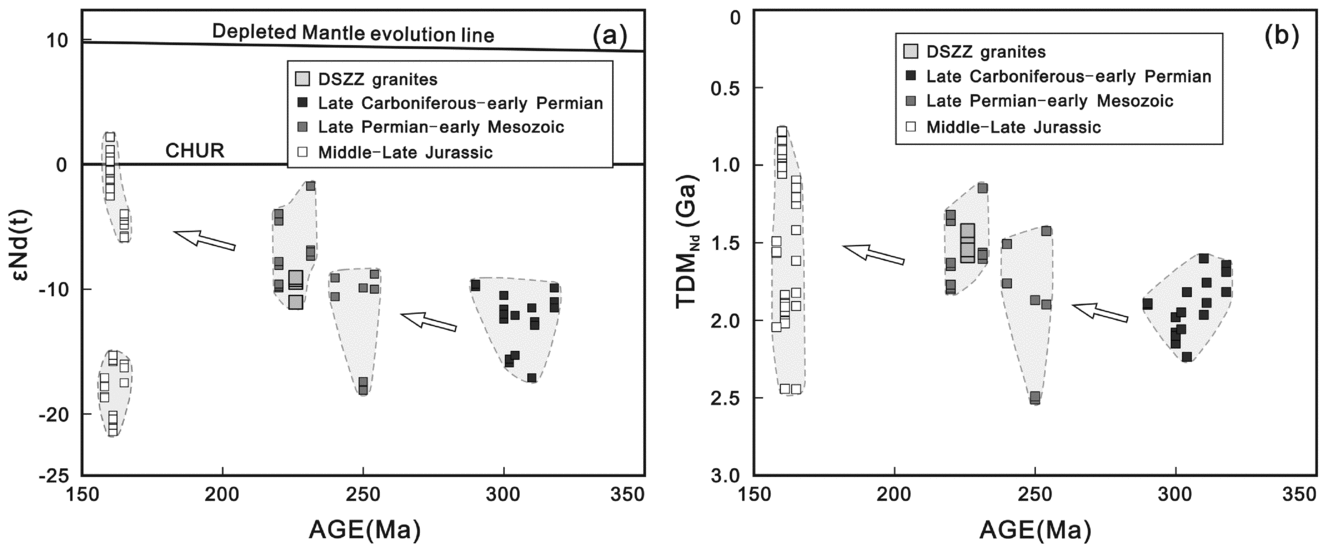
In addition, variable in situ Hf isotopic compositions (with εHf (226 Ma) up to –1.4) and young Hf (TDMHf (226 Ma) = 0.95–1.36 Ga) model ages suggest that a primitive component was involved in the magma source. The incorporation of mantle component is also indicated by the systematic changes in Nd and Hf isotopic compositions of the late Palaeozoic – Jurassic intermediate-felsic magma rocks in the northern NCC. The early Mesozoic intermediate-felsic magma rocks have higher εNd(t), εHf(t) values and younger Nd, Hf model ages than their late Palaeozoic counterparts (Figs 10, 11). This primitive component was probably derived from the subcontinental lithospheric mantle in an extensional environment, as there are widespread contemporaneous lithospheric mantle-derived alkaline magma rocks (e.g. Yan et al. Reference Yan, Mou, Xu, He, Tan, Zhao, He, Zhang and Qiao2000; Mu et al. Reference Mu, Shao, Chu, Yan and Qiao2001; Han, Kagami & Li, Reference Han, Kagami and Li2004; Yang et al. Reference Yang, Sun, Zhang, Wu and Wilde2012; Zhang et al. Reference Zhang, Zhao, Ye, Hou and Li2012) along the northern margin of the NCC. Incorporation of subcontinental lithospheric mantle-derived materials into the LCC therefore led to the formation of a juvenile lower-crust component during early Mesozoic time, and melting of the mixture of ancient and juvenile lower-crustal materials resulted in the relatively high Nd and Hf isotopic compositions of the DSZZ granites.
Plots of (a) εNd(t) and (b) TDMNd v. U–Pb age for the Dashizhuzi granites. Data for the late Carboniferous – early Permian intermediate-felsic magma rock are from Wang et al. (Reference Wang, Chen, Hou, Peng and Zhai2009) and Zhang et al. (Reference Zhang, Zhao, Song, Hu, Liu, Yang, Chen, Liu and Liu2009b). Data for the late Permian – early Mesozoic intermediate-felsic magma rocks are from Wang et al. (Reference Wang, Chen, Hou, Peng and Zhai2009), Zhang et al. Reference Zhang, Zhao, Song, Hu, Liu, Yang, Chen, Liu and Liu(2009b), Ma et al. (Reference Ma, Zheng, Griffin, Zhang, Tang, Su and Ping2012), Xiong et al. Reference Xiong, Shi, Li, Tian, Chen, Zhou, Zhao and Li2017; and this study. Data for the Middle–Late Jurassic intermediate-felsic magma rocks are from Gao et al. (Reference Gao, Rudnick, Yuan, Liu, Liu, Xu, Ling, Ayers, Wang and Wang2004) and Zhang, Yuan & Wilde (Reference Zhang, Yuan and Wilde2014).

Plots of (a) εHf(t) and (b) TDMHf v. U–Pb age for the Dashizhuzi granites. Data sources as for Figure 10.

Depletion in P may result from apatite separation. Depletion in Ti is mainly related to the intrinsic characteristics of the LCC of the NCC, and may be partly related to fractionation of titanite (a common accessory mineral in the DSZZ granites). However, no clear negative correlation is observed in the plot of Ba/Sr v. δEu (online Supplementary Figure S2, available at http://journals.cambridge.org/geo), which indicates that no significant plagioclase separation occurred. In summary, the petrography, geochemistry and isotope compositions suggest that the DSZZ granites were derived directly from melting of mixed lower-crust sources, which consisted of pre-existing ancient crustal and juvenile crustal materials, followed by fractionation of apatite and titanite.
6.c. Source of lamprophyre dykes
6.c.1. Crustal contamination
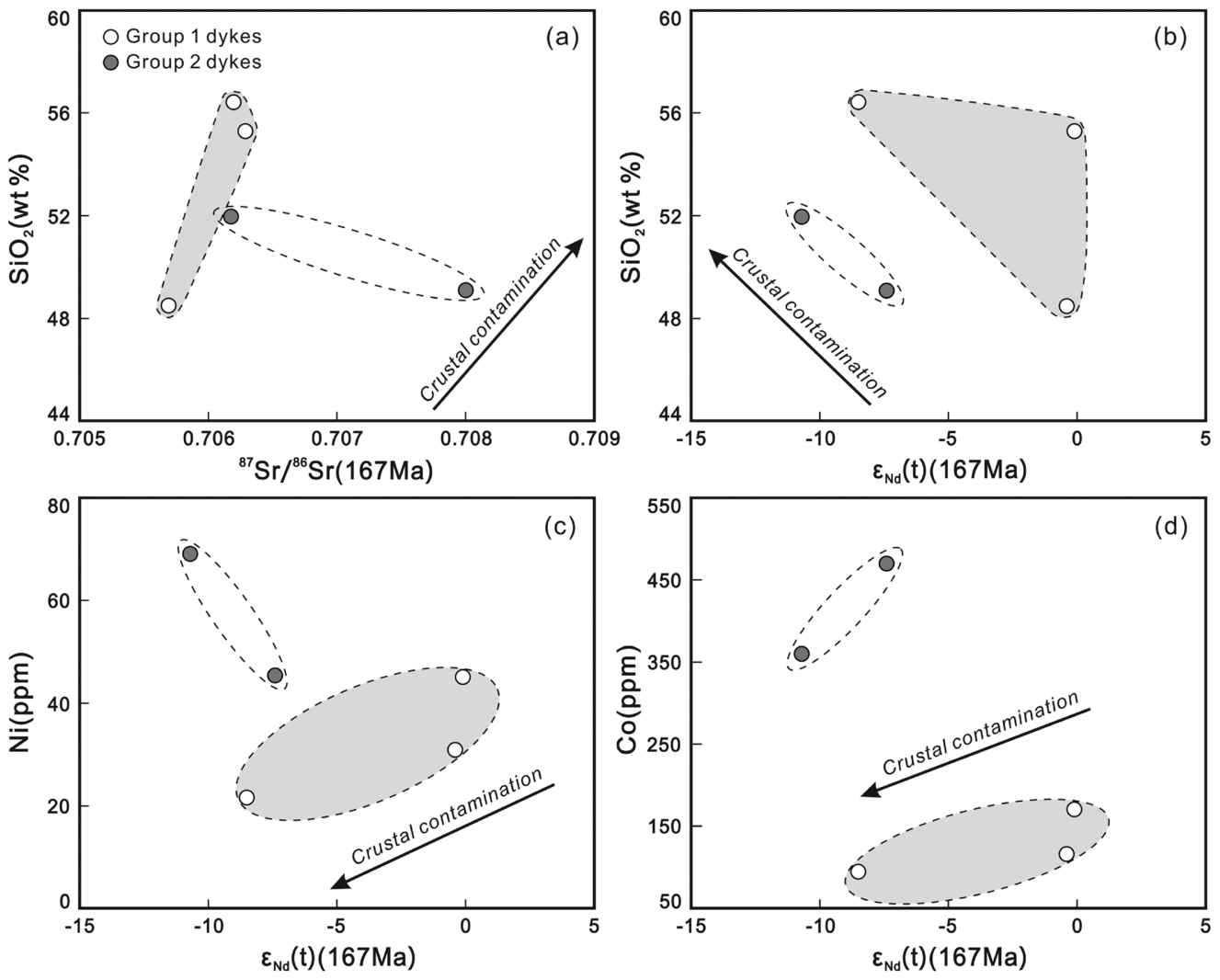
It is important to evaluate whether these lamprophyre dykes have undergone significant crustal contamination and magmatic differentiation before trying to explore their mantle sources. They seem to have experienced significant crustal contamination as indicated by their ‘crustal-like’ geochemical features (e.g. depletion in HFSE and enrichment in Pb; Fig. 6c). However, the Group 2 dykes have primitive Mg no. (76–77; Table 1), Cr (563–712 ppm), Co (360–470 ppm) and Al2O3 (11.7–12.4 wt %) values, which could be regarded as the mantle-derived primary or near-primary melts. Their Ba (1989–2293 ppm) and Sr (1004–1011 ppm) contents are apparently different from those of the average continental crust (456 ppm Ba; 320 ppm Sr; Rudnick & Gao, Reference Rudnick, Gao, Heinrich and Turekian2014), suggesting that trace elements were not obviously contaminated by crustal materials. Moreover, 87Sr/86Sr and εNd(t) values decrease with increasing SiO2 contents (Fig. 12a, b); such characteristics are also inconsistent with crustal contamination and may simply reflect a heterogeneous mantle source. Although there are some inherited Archean–Palaeoproterozoic zircons present in the sample SCYM-2, given the fact that less than 70 zircon grains were picked out from c. 9 kg of rocks, crustal contamination played a limited role in the magma petrogenesis. Crustal contamination is therefore negligible.
Plots of (a) 87Sr/86Sr v. SiO2 and (b–d) εNd(t) versus SiO2, Ni and Co for the lamprophyre dykes.

Similarly, high Mg no. (62–71), Cr (174–461 ppm) and Co (51–171 ppm) and low SiO2 (48.5–56.4 wt %) values of the Group 1 dykes also suggest that they are dominantly mantle derived. Slightly positive correlations between εNd(t) and compatible elements (e.g. Ni, Co and Cr; Fig. 12c, d) are observed, which indicates that some extent of crustal contamination was involved in the magma evolution processes. Incorporation of some crustal materials is also suggested by the occurrence of a large range of zircon populations (Fig. 3c). Bulk crustal contamination is impossible however, given the fact that only about 120 zircon grains were picked out from c. 11 kg of rocks. In addition, their Ba (1557–3289 ppm) and Sr (849–1673 ppm) contents are much higher than those of the average continental crust (Rudnick & Gao, Reference Rudnick, Gao, Heinrich and Turekian2014). Nb/U (1.7–4.0) and Ce/Pb (11.7–27.3) ratios are also different from those of the average continental crust (6.2 Nb/U; 3.9 Ce/Pb; Rudnick & Gao, Reference Rudnick, Gao, Heinrich and Turekian2014). The Group 1 dykes have therefore experienced low extent rather than bulk crustal contamination.
6.c.2. Fractional crystallization
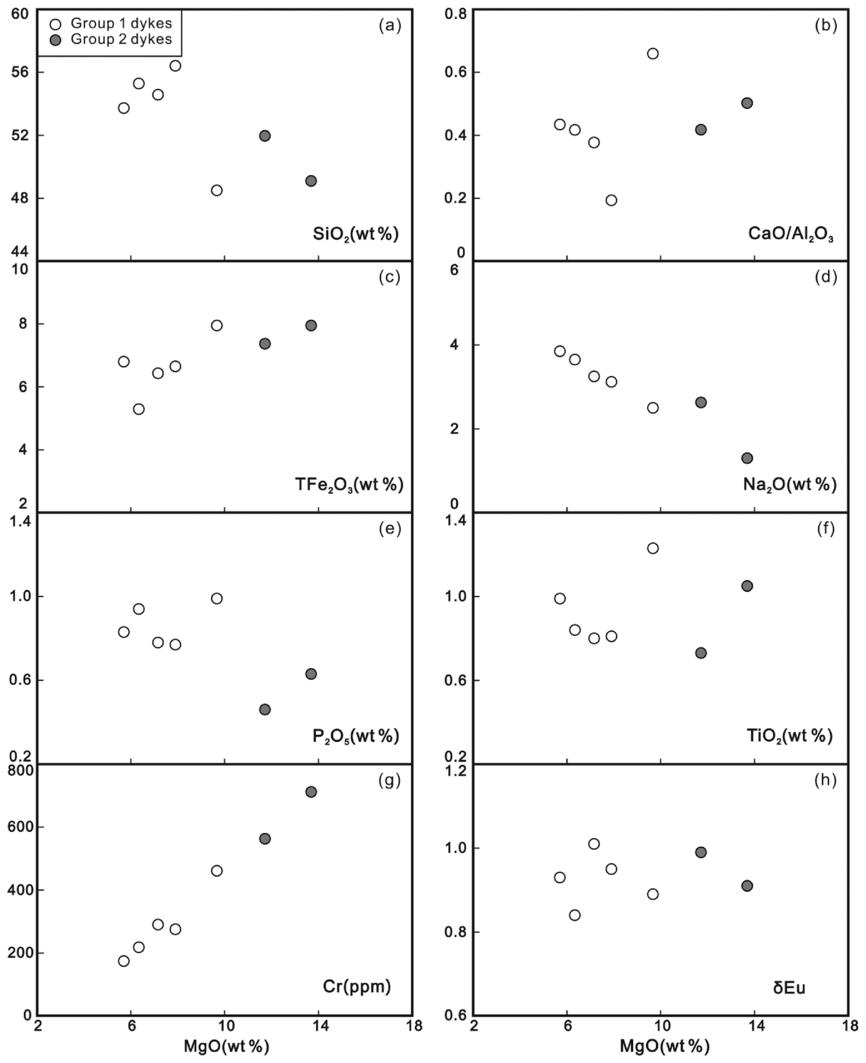
The Group 2 dykes have linear correlations between MgO and major and trace elements, although we do not have many samples (Fig. 13). TFe2O3, CaO/Al2O3 and Cr increase and SiO2 decreases with increasing MgO contents; such characteristics indicate that the Group 2 dykes may have experienced some fractionation of olivine and clinopyroxene. Similarly, positive correlations between P2O5, TiO2 and MgO indicate that some fractionation of accessory minerals (e.g. apatite and Fe–Ti oxides) may have occurred. In addition, the absence of Eu and Sr anomalies suggest that fractionation of plagioclase is insignificant.
Plots of MgO v. selected major and trace elements for the lamprophyre dykes.

The Group 1 dykes do not have clear linear correlations between MgO and major and trace elements (Fig. 13). The parental magma may not have experienced extensive fractional crystallization. Likewise, the absence of Eu and Sr anomalies indicates that plagioclase was not a significant fractionating phase.
6.c.3. Source of Group 2 dykes
The Group 2 dykes have primitive Mg no. (76–77), Cr (563–712 ppm), Co (360–470 ppm) and Al2O3 (11.7–12.4 wt %) values, which are similar to the features of mantle-derived primary or near-primary melts. These lamprophyre dykes could therefore originate from either the convective asthenospheric mantle or the subcontinental lithospheric mantle. The high Ba/Th (237–364) and low Ce/Pb (7.4–8.5) and Nb/U (5.0–6.0) ratios are obviously different from those of the MORB (Ba/Th = 86; Ce/Pb = 22.4; Nb/U = 45.7; Salters & Stracke, Reference Salters and Stracke2004). Moreover, their enriched Sr–Nd isotopic compositions and ancient TDMNd age (1.68–2.82 Ga) also argue against an asthenospheric mantle derivation. Due to the limited role of crustal contamination as discussed above, negative Nb–Ta and positive Pb anomalies further demonstrate that the Group 2 dykes cannot be generated from melting of asthenospheric mantle. Asthenospheric mantle derivation can therefore be ruled out, and the subcontinental lithospheric mantle may account for the petrogenesis of the Group 2 dykes.
Distinct geochemical features, such as strong fractionation between LREE and HREE, LILE enrichment and HFSE depletion, are similar to those of some Mesozoic mafic dykes in the northern NCC (Jiang et al. Reference Jiang, Jiang, Ling and Ni2010; Fu et al. Reference Fu, Wei, Kusky, Chen, Tan, Li, Kong and Jiang2012a; Duan et al. Reference Duan, Zeng, Yang, Liu, Wang and Zhou2014) and in the Jiaodong Peninsula (Ma et al. Reference Ma, Jiang, Hofmann, Dai, Hou, Zhao, Chen, Li and Jiang2014a, b), interpreted to have been derived from an enriched lithospheric mantle. The enriched Sr–Nd isotopic compositions of the Group 2 dykes are also similar to those of the early Mesozoic enriched lithospheric mantle-derived alkaline magma rocks (Fig. 7b; e.g. Yan et al. Reference Yan, Mou, Xu, He, Tan, Zhao, He, Zhang and Qiao2000; Yang et al. Reference Yang, Sun, Zhang, Wu and Wilde2012; Zhang et al. Reference Zhang, Zhao, Ye, Hou and Li2012). Mantle enrichment was probably produced by subduction processes as indicated by the depletion of HFSE (e.g. Nb, Ta, Zr and Hf) relative to neighbouring elements in the primitive mantle-normalized pattern (e.g. Duggen et al. Reference Duggen, Hoernle, Bogaard and Garbe-Schönberg2005; Ma et al. Reference Ma, Jiang, Hofmann, Dai, Hou, Zhao, Chen, Li and Jiang2014a). Moreover, the enrichment of the mantle source probably occurred during ancient time, which is suggested by the ancient whole-rock TDMNd ages (1.68–2.82 Ga) of the Group 2 dykes. The TDMNd ages are roughly consistent with the original formation (Archean; e.g. Wu et al. Reference Wu, Walker, Yang, Yuan and Yang2006b; Zhang et al. Reference Zhang, Goldstein, Zhou, Sun, Zheng and Cai2008; Liu et al. Reference Liu, Rudnick, Walker, Xu, Gao and Wu2015) and replacement (late Palaeoproterozoic; Gao et al. Reference Gao, Rudnick, Carlson, McDonough and Liu2002; Liu et al. Reference Liu, Rudnick, Walker, Gao, Wu, Piccoli, Yuan, Xu and Xu2011, Reference Liu, Carlson, Rudnick, Walker, Gao and Wu2012, Reference Ma, Zheng, Xu, Griffin and Zhang2015) age of the subcontinental lithospheric mantle beneath the NCC. The Group 2 dykes were therefore derived from an ancient subcontinental lithospheric mantle.
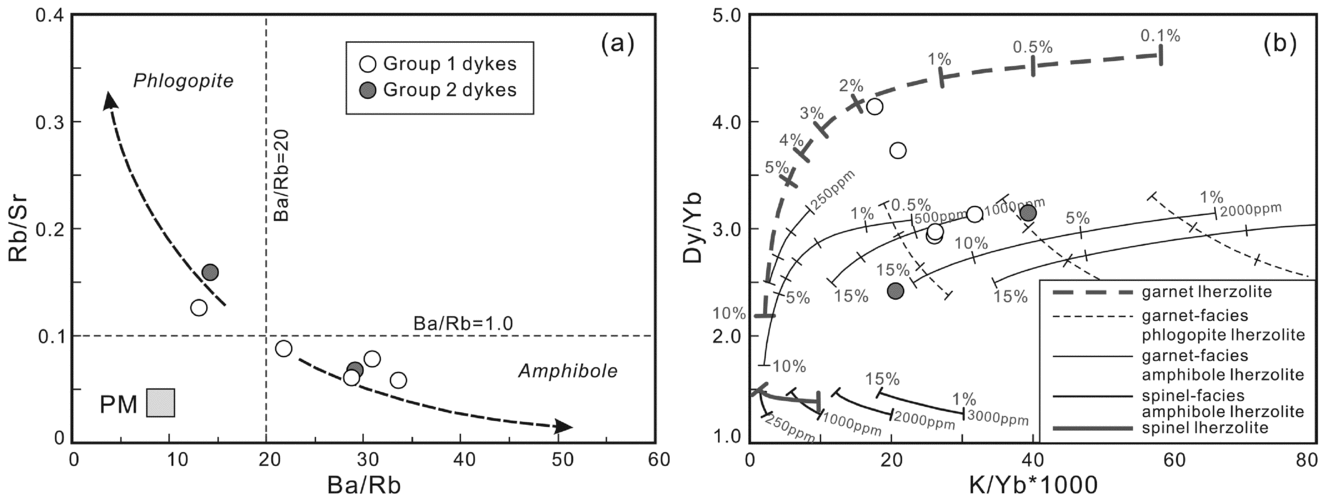
The high K2O content and enrichment of LILE suggest that K and volatile-bearing minerals such as phlogopite or amphibole were present in the mantle source of the Group 2 dykes. Their moderate Ba/Rb (14–29) and Rb/Sr (0.07–0.16) ratios indicate that the potassic phase in the magma source may be either phlogopite or amphibole (Fig. 14a). The identification of phlogopite and/or amphibole in the source region of the Group 2 dykes implies that mantle metasomatism by fluids or volatile-rich melts occurred prior to melting (Jiang et al. Reference Jiang, Jiang, Ling and Ni2010). In addition, the K/Yb and Dy/Yb ratios have been proposed to provide constraint on the composition of the mantle source and melt proportion (Duggen et al. Reference Duggen, Hoernle, Bogaard and Garbe-Schönberg2005). The Group 2 dykes have Dy/Yb ratios of 2.37–3.21 and plot in the field of garnet-facies lherzolite (Fig. 14b), which suggests that some proportions of garnet are present in the source of the Group 2 dykes. The occurrence of garnet in the magma source is also consistent with their high (La/Yb)N and (Gd/Yb)N values (30–40 and 4.0–5.7). The Group 2 dykes were therefore probably derived from a garnet-facies phlogopite and/or amphibole-bearing lherzolite lithospheric mantle.
(a) Plots of Ba/Rb v. Rb/Sr (modified after Furman & Graham, Reference Furman and Graham1999; Ma et al. Reference Ma, Jiang, Hofmann, Dai, Hou, Zhao, Chen, Li and Jiang2014a) and (b) K/Yb v. Dy/Yb for the lamprophyre dykes. Melting curves of garnet lherzolite, garnet-facies phlogopite lherzolite, garnet-facies amphibole lherzolite, spineal-facies amphibole lherzolite and spinel lherzolite are from Duggen et al. (Reference Duggen, Hoernle, Bogaard and Garbe-Schönberg2005).

6.c.4. Source of Group 1 dykes
High Mg no. (62–71), Cr (174–461 ppm) and Co (51–171 ppm) and low SiO2 (48.5–56.4 wt %) values of the Group 1 dykes also suggest a dominantly mantle derivation. Although the Group 1 dykes have experienced a low extent of crustal contamination, the LILE enrichment and HFSE depletion observed in the most basic dyke sample (SCYM-16) indicates a dominantly subduction-related metasomatized lithospheric mantle derivation. Their relatively lower MgO and compatible trace-element (such as Cr, Co and Ni) contents than the Group 2 dykes probably call for a relatively fertile mantle source. Dyke samples SCYM-5 and SCYM-16 have nearly primitive Nd isotopes (Fig. 7b), suggesting that a depleted component (e.g. asthenospheric mantle) was incorporated in the magma origin. This is supported by their identical Sr–Nd isotopic characteristics with those of the Triassic Hongqiling-Piaohechuan mafic-ultramafic rocks (Wu et al. Reference Wu, Wilde, Zhang and Sun2004) and the Late Jurassic Xinglonggou lavas (Gao et al. Reference Gao, Rudnick, Yuan, Liu, Liu, Xu, Ling, Ayers, Wang and Wang2004), which were thought to be derived from asthenospheric mantle or to have an asthenospheric mantle component. The relatively young TDMNd ages (0.93–1.51 Ga) is also consistent with the involvement of depleted component in the magma source. Moreover, the Group 1 dykes have Th/U (3.3–3.8, except SCYM–5), Ba/Th (53–180) and Ce/Pb (11.7–27.3; Table 1) ratios similar to those (Th/U = 3.3; Ba/Th = 86; Ce/Pb = 22.4; Salters & Stracke, Reference Salters and Stracke2004) of the MORB. Furthermore, the significantly higher REE contents of the Group 1 dykes (Fig. 6c, d) compared to the Group 2 dykes probably suggests that the incorporated depleted mantle materials are probably asthenospheric mantle-derived, volatile-rich, low-density melts. The Group 1 dykes were therefore derived from an ancient subcontinental lithospheric mantle with incorporation of asthenospheric mantle-derived melts.
As discussed above, the Group 1 dykes have experienced a low extent of crustal contamination. However, their variable εNd (167 Ma) values (–8.5 to –0.1) cannot be produced through crustal contamination, because the Group 1 dykes have significantly higher Sr (849–1673 ppm) and Nd (76–128 ppm) contents than the average continental crust (320 ppm Sr; 20 ppm Nd; Rudnick & Gao, Reference Rudnick, Gao, Heinrich and Turekian2014). Their Sr–Nd compositions are therefore insensitive to crustal contamination, and lowering the εNd values by 7.5 units requires bulk crustal contamination. The variation in εNd (167 Ma) values therefore cannot be caused by assimilation of crustal materials; such characteristics may reflect heterogeneity in the magma source, which was probably produced by variable degrees of mixing between the ancient subcontinental lithospheric mantle and asthenospheric mantle-derived component.
In addition, the high K2O and Ba/Rb (13–34, most >21) and low Rb/Sr (0.06–0.13, most <0.10) values indicate that amphibole is the dominantly potassic phase in the mantle source (Fig. 14a). Such characteristics imply mantle metasomatism prior to melting. Additionally, the Group 1 dykes have Dy/Yb ratios ranging over 2.93–4.14, and plot in the field of garnet-facies amphibole lherzolite (Fig. 14b). Significantly high (La/Yb)N and (Gd/Yb)N values (36–92 and 5.8–8.8) further support the existence of garnet as a residual phase in the magma source. The Group 1 dykes were therefore probably derived from a garnet-facies amphibole-bearing lherzolite lithospheric mantle with incorporation of asthenospheric mantle-derived melts prior to melting.
6.d. Evolution of the lithosphere
Continental adakitic rocks are normally considered as a geodynamic indicator of crustal thickening, orogenic collapse and lithospheric delamination (e.g. Kay, Reference Kay1978; Atherton & Petford, Reference Atherton and Petford1993; Xu et al. Reference Xu, Shinjo, Defant, Wang and Rapp2002; Ma et al. Reference Ma, Zheng, Xu, Griffin and Zhang2015). Interpretation of the Mesozoic adakitic rocks as resultants of crustal thickening have inferred the Late Mesozoic lithospheric delamination and destruction of the NCC (Xu et al. Reference Xu, Shinjo, Defant, Wang and Rapp2002; Gao et al. Reference Gao, Rudnick, Yuan, Liu, Liu, Xu, Ling, Ayers, Wang and Wang2004). Ma et al. (Reference Ma, Zheng, Xu, Griffin and Zhang2015) pointed out the flaw of this interpretation, and ascribed it to ignoring the effect of source composition on the generation of continental adakitic rocks. As discussed above, the Triassic DSZZ granites were produced from melting of mafic LCC, with residues of garnet-bearing granulite, at a normal continental crustal depth of 33–40 km. The adakitic characteristics were dominantly inherited from the protolith sources. Trace-element modelling also suggested that the melting depth required to produce the Jurassic adakitic rocks in the Yanshan belt is from <33 to 40 km (Ma et al. Reference Ma, Zheng, Xu, Griffin and Zhang2015). These lines of evidence therefore do not support the existence of a thickened mafic LCC during early Mesozoic time. The occurrence of these early Mesozoic adakitic rocks cannot be regarded as crucial evidence for later lower-crust foundering as an important mechanism for destruction of the NCC.
Mantle xenoliths entrained by Cenozoic volcanic rocks have distinct chemical compositions and ages compared to those entrained by Ordovician kimberlites, which suggested significant thinning and replacement of the lithospheric mantle beneath the eastern NCC during Mesozoic time (e.g. Griffin et al. Reference Griffin, Zhang, O'Reilly, Ryan, Flower, Chung and Lo1998; Gao et al. Reference Gao, Rudnick, Carlson, McDonough and Liu2002; Wu et al. Reference Wu, Walker, Yang, Yuan and Yang2006b; Chu et al. Reference Chu, Wu, Walker, Rudnick, Pitcher, Puchtel, Yang and Wilde2009; Liu et al. Reference Liu, Rudnick, Walker, Xu, Gao and Wu2015). More than 100 km of ancient refractory lithospheric mantle beneath the NCC have been removed and replaced by young and fertile mantle materials (e.g. Menzies et al. Reference Menzies, Xu, Zhang and Fan2007). However, when and how the replacement occurred has been debated for a long time (e.g. Xu, Reference Xu2001; Gao et al. Reference Gao, Rudnick, Carlson, McDonough and Liu2002; Zhang et al. Reference Zhang, Sum, Zhou, Fan, Zhai and Yin2002; Chen, Jahn & Zhai, Reference Chen, Jahn and Zhai2003; Xu et al. Reference Xu, Wang, Wang, Guo and Pei2006b, Reference Xu, Li, Pang and He2009; Liu et al. Reference Liu, Rudnick, Walker, Gao, Wu, Piccoli, Yuan, Xu and Xu2011, Reference Liu, Rudnick, Walker, Xu, Gao and Wu2015; Fu et al. Reference Fu, Wei, Kusky, Chen, Tan, Li, Kong and Jiang2012a).
As discussed above, the Group 2 lamprophyre dykes were generated by a garnet-facies metasomatized lherzolite lithospheric mantle. Previous studies have proposed that the depth of garnet-facies zone in the upper mantle is greater than 75–85 km (e.g. McKenzie & O'Nions, Reference McKenzie and O'Nions1991; Robinson & Wood, Reference Robinson and Wood1998; Klemme & O'Neill, Reference Klemme and O'Neill2000). The thickness of the Middle Jurassic (167 Ma) lithosphere beneath the Yanshan belt is therefore ≥75–85 km. The ancient Nd model ages of the Group 2 lamprophyre dykes suggest that the original Archean and Proterozoic lithospheric mantle has been preserved, and their chemical composition has not been changed at that time.
However, a petrogenetic study of the Group 1 lamprophyre dykes indicates a relatively fertile lithospheric mantle source that has experienced variable degrees of asthenospheric mantle-derived melt–peridotite interaction. Their significantly higher (La/Yb)N and (Gd/Yb)N values indicate a higher content of garnet in the source. It may therefore reflect an even greater melting depth than the Group 2 lamprophyre dykes. Previous studies have suggested that a change in magma source from lithospheric mantle to asthenospheric mantle and the occurrence of asthenosphere-derived magmas can be considered as an indicator of lithospheric thinning (e.g. Xu, Reference Xu2006; Wu et al. Reference Wu, Xu, Gao and Zheng2008; Xu et al. Reference Xu, Li, Pang and He2009; Ma et al. Reference Ma, Jiang, Hofmann, Dai, Hou, Zhao, Chen, Li and Jiang2014a).
The widespread early Mesozoic (240–220 Ma) alkaline magmas were considered to have enriched subcontinental mantle sources beneath the northern NCC (e.g. Yan et al. Reference Yan, Mou, Xu, He, Tan, Zhao, He, Zhang and Qiao2000; Mu et al. Reference Mu, Shao, Chu, Yan and Qiao2001; Han, Kagami & Li, Reference Han, Kagami and Li2004; Yang et al. Reference Yang, Sun, Zhang, Wu and Wilde2012; Zhang et al. Reference Zhang, Zhao, Ye, Hou and Li2012). Studies of Triassic granitic igneous rocks also have suggested incorporation of variable amounts of subcontinental lithospheric mantle-derived materials in their origin (Figs 10, 11; e.g. Ma et al. Reference Ma, Zheng, Griffin, Zhang, Tang, Su and Ping2012; Xiong et al. Reference Xiong, Shi, Li, Tian, Chen, Zhou, Zhao and Li2017; this study). Although some asthenospheric mantle components were considered to have been invoked in certain Triassic ultramafic-mafic igneous rocks (Tian et al. Reference Tian, Chen, Liu and Zhang2007; Fu et al. Reference Fu, Wei, Kusky, Chen, Tan, Li, Kong and Jiang2012a), this scenario is not common at that time. Asthenospheric mantle therefore does not have a significant role in the petrogenetic processes of the early Mesozoic magma rocks.
During Middle–Late Jurassic time large amounts of mafic to felsic magmas were emplaced in the northern NCC, including the Yanshan belt and Liaodong peninsula (e.g. Gao et al. Reference Gao, Rudnick, Yuan, Liu, Liu, Xu, Ling, Ayers, Wang and Wang2004; Zhang et al. Reference Zhang, Zhang, Jiang and Wilde2010b; Zhu, Yang & Wu, Reference Zhu, Yang and Wu2012; Zhang, Yuan & Wilde, Reference Zhang, Yuan and Wilde2014; this study). Geochemical data reveal significant involvement of asthenospheric mantle materials in these magmas, and their trace-element signatures are intermediate between clearly defined lithospheric and asthenospheric characteristics. Such characteristics probably suggest some extent of lithospheric thinning during Middle–Late Jurassic time, which was possibly induced by the subduction of the Palaeo-Pacific Plate beneath the Eurasian continent (e.g. Xu et al. Reference Xu, Pei, Wang, Meng, Ji, Yang and Wang2013). Based on the petrogenetic processes of the Group 1 lamprophyre dykes in this study, melt–peridotite interaction processes probably played an important role in the change of chemical compositions of the lithospheric mantle beneath the northern part of the NCC. It has been demonstrated that melt–peridotite interaction can change rheology and modal composition of mantle rocks (Kelemen, Dick & Quick, Reference Kelemen, Dick and Quick1992; Xu, Reference Xu2001). Repeated invasion of a small amount of asthenosphere-derived volatile-rich melts would accumulate at the lithosphere–asthenosphere interface, and provide heat to cause melting of this zone and its gradual upwards movement (McKenzie, Reference McKenzie1989). Meanwhile, upwelling of asthenosphere would lead to thermal weakening on the base of the lithospheric mantle. The melt–peridotite interaction and thermo-mechanical erosion may be jointly associated, rather than mutually exclusive (Xu, Reference Xu2001). The mechanism of lithospheric thinning is therefore mainly by coupled melt–peridotite interaction and thermo-mechanical erosion during Middle Jurassic time. Although the Late Jurassic Xinglonggou lavas were considered to have been produced as a result of lower crustal foundering (Gao et al. Reference Gao, Rudnick, Yuan, Liu, Liu, Xu, Ling, Ayers, Wang and Wang2004), the influence of lower crustal foundering may be local and limited. One reason is that the Jurassic adakitic rocks in the Yanshan belt were produced at a depth from <33 to 40 km (Ma et al. Reference Ma, Zheng, Xu, Griffin and Zhang2015); such an interpretation does not support the existence of thickened mafic LCC during Jurassic time. Another reason is that the original Archean and Proterozoic lithospheric mantle has been preserved, according to the petrogenetic study of Group 2 lamprophyre dykes. If lower crustal foundering has occurred, the original Archean and Proterozoic lithospheric mantle would have detached into the asthenosphere, accompanied by formation of juvenile lithosphere.
In summary, thinning of the early Mesozoic lithospheric mantle beneath the northern part of the NCC was dominantly though coupled melt–peridotite interaction and thermo-mechanical erosion prior to Middle Jurassic time. The chemical compositions were modified at the bottom of the lithospheric mantle through melt–peridotite interaction processes. However, whether a rapid removal process occurred at some point after Middle Jurassic time remains the topic for further studies.
7. Conclusions
Integrated U–Pb geochronology, elemental and Sr–Nd–Pb isotope studies of the DSZZ granites and lamprophyre dykes in the northern NCC allow us to make the following conclusions.
(1) The DSZZ granites are dated at 226 ± 3 Ma. The occurrence of voluminous Triassic alkaline, mafic-ultramafic and felsic magma rocks along the northern margin of the NCC suggests a pronounced magmatism period during Middle Triassic time.
(2) The Triassic DSZZ granites were produced from melting of mafic LCC of the NCC with residues of garnet-bearing granulite at normal continental crustal depths of 33–40 km, followed by fractionation of apatite and titanite. Their protolith source consists of pre-existing ancient crustal and lithospheric mantle-derived juvenile crustal materials.
(3) The Group 2 lamprophyre dykes were derived from an ancient garnet-facies phlogopite and/or amphibole-bearing lherzolite lithospheric mantle at depths greater than 75–85 km. However, the Group 1 lamprophyre dykes have a relatively fertile lithospheric mantle source (garnet-facies amphibole-bearing lherzolite) that has experienced variable degrees of asthenospheric mantle-derived melt–peridotite interaction prior to melting. The melting depth of the Group 1 lamprophyre dykes is even greater than the Group 2 lamprophyre dykes.
(4) Thinning of late Mesozoic lithospheric mantle beneath the northern part of the NCC is dominantly thought to have occurred via coupled melt–peridotite interaction and thermo-mechanical erosion prior to Middle Jurassic time. The chemical compositions were modified at the bottom of the lithospheric mantle through melt–peridotite interaction processes.
Acknowledgements
This study was financially supported by the Science and Technology Programme of Fujian, China (Grant DK2015001). J. P. Lu is thanked for his help with the petrographic study. Y. Y. Zhang and Y. L. Zhai are acknowledged for their help with the LA-ICP-MS dating. We are also grateful to C. Chen and the Rixing Mining Co. Ltd., Lingyuan for the assistance with fieldwork. Finally, we thank the reviewer Jingao Liu and two anonymous reviewers for their constructive comments on this manuscript.
Supplementary material
To view supplementary material for this article, please visit https://doi.org/10.1017/S0016756817000437