Introduction
There were both convergence and divergence among most Development Assistance Committee (DAC) members in the Organization for Economic Co-Operation and Development (OECD) regarding foreign aid policy for Human Immunodeficiency Virus/Acquired Immunodeficiency Syndrome (HIV/AIDS). They converged in the decision to commence global AIDS funding approximately ten years after the United States (US) had begun funding international efforts against HIV/AIDS in 1986. At the same time, however, they varied in the patterns of funding development: some countries, like the US and Sweden, showed dramatic increases in foreign aid for AIDS while others, like Japan, showed unwillingness to commit financially. Still, others, like France and Germany, placed themselves in the middle with an incremental augmentation of funding.
It is argued that they converged in commencing funding due to the pressure from international organizations such as the World Health Organization (WHO) whose role was to develop and establish normative frameworks (or norms) that reflected the global response to AIDS (Kim, Reference Kim2015a).Footnote 1 Foreign policies are likely to be established when certain issues are perceived threatening or problematic (Page, Reference Page2006: 38). In the case of HIV/AIDS pandemic, the perception was constructed under the overarching social structure of the WHO, which developed and disseminated the requirement of urgent and obligatory international cooperation in combating the pandemic; that is, the problem could be mitigated through the adoption of norms as a global response to AIDS. In other words, the WHO taught major donors the international norms by reminding them of the identity of DAC membership and the responsibilities associated with it. The related normative framework shaped the motivations for initiating foreign aid for a global health agenda amongst the main donors (Mann, Reference Mann1987; Mann and Kay, Reference Mann and Kay1991; Merson, Reference Merson2006; Slutkin, Reference Slutkin2000; Will, Reference Will1991; Kim, Reference Kim2015a).
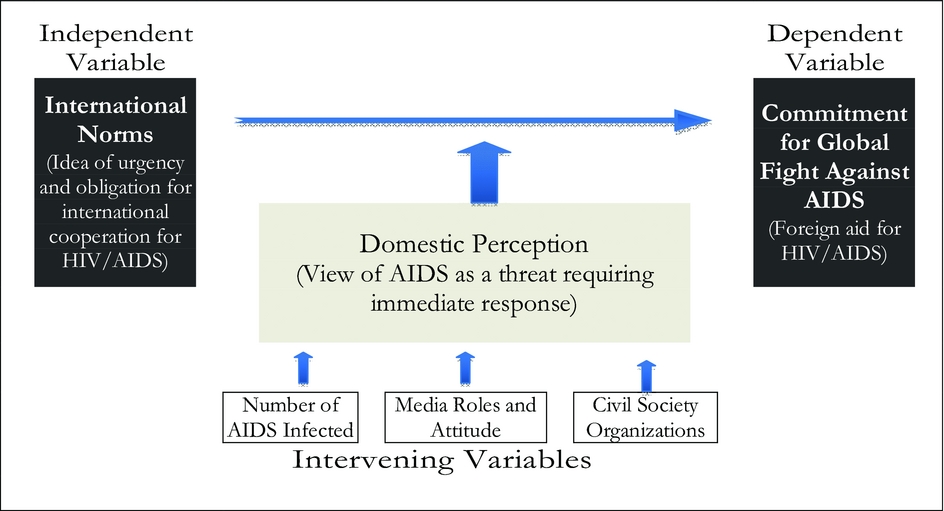
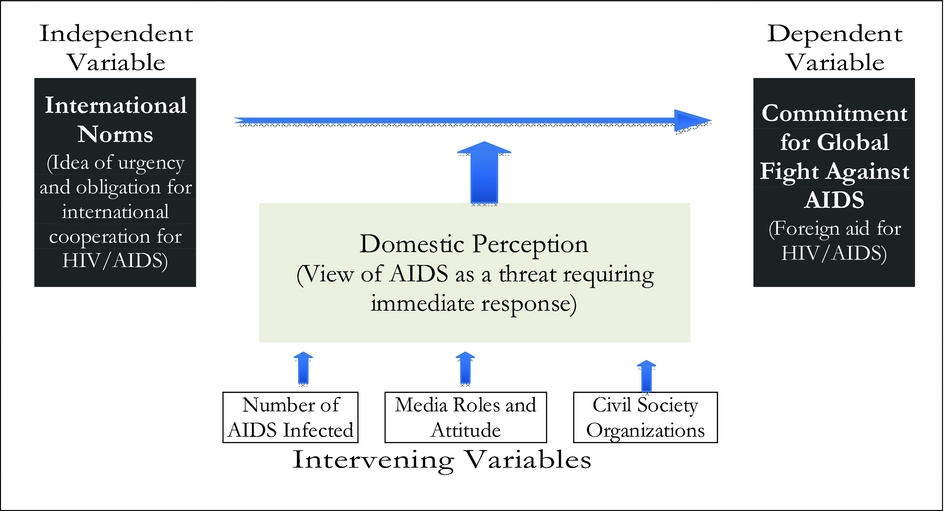
What, then, caused the divergence or variance in foreign policy development for HIV/AIDS? I claim that the distinctive patterns depended on how the pandemic was domestically framed and understood. Policy commitment is more likely when an internationally shared idea is domestically accepted and internalized. That happens when the international norms are congruent with the domestic understanding of any given agenda. In other words, the domestic resonance of international norms is contingent upon the ‘match’ between the norms and domestic perception.Footnote 2 The perception, thus, matters as an intervening variable that conditions domestic diffusion of international norms.
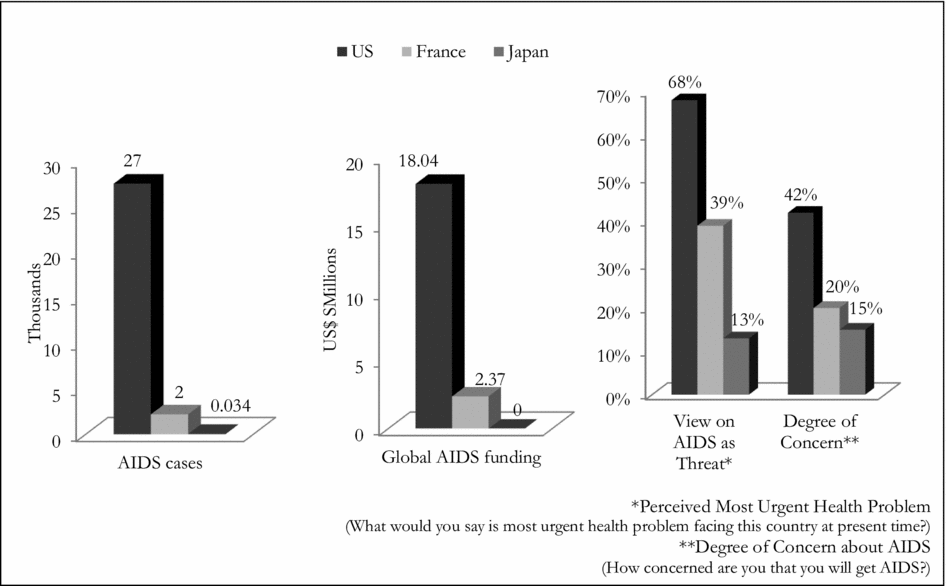
When it comes to HIV/AIDS, the perception of threats requiring immediate international cooperation tends to determine the level of global AIDS funding of respective donors. I contend that the aid increased when the issues regarding the epidemic became salient among the public and policymakers as a problem requiring immediate responses. Figure 1 shows the varying perception of AIDS and the level of funding for AIDS in the US, France, and Japan. The second chart illustrates the hierarchy of funding (in amounts) of the three countries. The third chart shows the public's view of AIDS. When asked ‘what would you say is the most urgent health problem facing this country at present time?’, the results for the three countries were respectively 68%, 39%, and 13%. There is a positive correlation between the size of funding and the public's view of whether AIDS is an urgent health problem. In other words, the higher the threat perception, the more foreign aid was committed.
Global AIDS funding, AIDS cases, view on AIDS and degree of concern in 1987

A critical question exists here: under what conditions do the international norms and domestic understandings match? Some countries easily adopt internationally shared views while others find it difficult to accept them. I contend that the ‘match’ was contingent upon the social and cultural conditions, which determined how AIDS was viewed. An epidemic of a sexually transmitted disease has the likelihood of being misunderstood due to sui generis sexual connotations of homosexuality and promiscuity, scientific misunderstandings, or the character of foreignness in its origin. The misperceptions were particularly problematic as the flawed ideas were intertwined with the socially marginalized groups with disparate life styles or allegedly exotic (or foreign) origins, such as gays/lesbians, intravenous drug users, sex workers, and people with African ancestries. In this case, the government was reluctant to actively execute relevant policy interventions to obviate it with relevant policy interventions. Only when the disease was perceived, based upon rigorous scientific research, as a legitimate target that deserved extra attention and resources would policy responses be undertaken.
The study, therefore, sheds light on the process that social and cultural conditions (domestic determinants) constituted the perception of AIDS. The determinants include the number of individuals infected with HIV, the attitude and role of the media, and civil society organizations dealing with HIV/AIDS. As seen in Figure 2, those determinants played significant roles as intervening variables that filtered the diffusion or internalization of the international norms of response to the pandemic for aid policy development. Figure 2 captures a casual mechanism of the domestic resonance of international norms.
Causal mechanism of foreign aid policy choices for HIV/AIDS
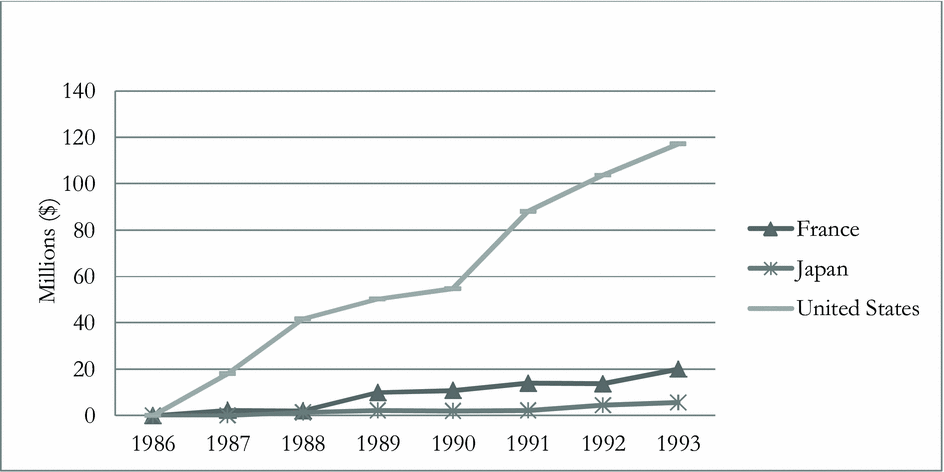
In accounting for the distinctive perception and the pattern of aid, the study compares the case of the US and of Japan, whose financial commitments were markedly idiosyncratic from the 1980s to the mid 1990s. Both have been the most significant contributors to the general international development assistance. In total amount of foreign aid, Japan ranked as the second largest donor following the US in most years and even exceeded the US from 1992 to 2000 (Umenai et al., Reference Umenai, Narula, Onuki, Yamamoto and Igari1997: 58). In terms of global AIDS funding, the two countries were virtually comparable during the initial commencement of their programs in the mid-1980s. The US instituted the incipient funding in 1986, immediately followed by Japan in 1988. However, they soon varied extraordinarily in terms of the trajectory of funding increase. The US's contribution dramatically increased in comparison with other DAC members and currently accounts for the majority of global AIDS funding. In contrast, Japan augmented its funding only incrementally until the early 1990s (see Figure 3). Given the common reputation of the two as the most generous donors, the contemporaneous funding pattern particularly stands out.
Total US, French, and Japanese global AIDS funding, 1986–93

The research is divided into three further sections. The next section is a brief description of the early responses of the US and Japan. Neither country perceived AIDS as threatening, and their responses can be characterized as either inaction or late action. The third section, which is the crux of this research, explores the construction of the distinctive domestic perceptions of AIDS since the mid 1980s in the US and the early 1990s in Japan. This section pinpoints the domestic factors that determined the varying perceptions in order to show how the idiosyncratic social and cultural contexts accounted for the divergence in aid. The final section concludes, summarizing the research and addressing future research questions.
Convergent beginning but divergent development in foreign aid for HIV/AIDS
Most DAC countries, including the US and Japan, began global AIDS funding since the mid-1980s thanks to the WHO, which, as a norms entrepreneur, exhorted the donors to initiate aid. Despite the convergent policy choices, however, there was remarkable variance in the pattern of funding development. This section addresses the cases of the US and Japan with respect to their brief history of early inaction and distinctive development of aid for the disease.
The period during the early 1980s (1981–5) is characterized as inaction in the US under the Reagan administration (Behrmnan, Reference Behrman2004; Brier, Reference Brier2009; Stockdill, Reference Stockdill2003). Since the first HIV-infected cases were reported in 1981, the US was thought to account for the largest portion of the global total number of the HIV-infected until the 1990s, when the African continent turned out to be the hardest hit by the pandemic. Despite the large number of HIV-infected individuals within its borders, the US was not actively engaged in the fight against AIDS domestically or internationally until the mid-1980s. The Reagan administration was rather indifferent and uninterested in the newly emerged medical issue.
The government inaction was attributed to the administration's conservative nature and the sexual and ethical connotations of the epidemic, (e.g. homosexuality or promiscuity). HIV/AIDS was especially perceived as a gay disease due to the high proportion of gays among the HIV-infected or AIDS patients. From the conservative perspective, homosexuality was considered as a deviant behavior. The homophobic trope was echoed in government perception so that the sexually transmitted disease was not properly determined to be an important issue that required an agenda for policy responses. The conservative administration did not have any incentive to actively tackle the issues that its constituencies were not favorably disposed to due to the ethical implications attached to it (Altman, Reference Altman1986: 21; Epstein, Reference Epstein1996: 45–53; Kistenberg, Reference Kistenberg and Fuller2003: 13–18; Smith and Siplon, Reference Smith and Siplon2006: 13).
Scientific misinformation, as well as social prejudice, resulted in not only ‘negligent’ but also ‘punitive’ institutional responses during the early 1980s (Stockdill, Reference Stockdill2003: 3). There was widespread misunderstanding about the contraction of HIV through casual person-to-person contacts, instead of sexual intercourse, and exchanges of contaminated blood through needles or transfusion. The misperception within government is captured in the begrudging remark of President Reagan regarding the school attendance of AIDS victim students. When asked a hypothetical question about whether he would send his children to a school that included a child who had AIDS, he expressed relief that he was ‘not faced with that problem today’. He went on to note that some medical sources say that AIDS cannot be transmitted in ways that involve children in school, but admitted that the medical community had not reached a clear conclusion, ‘unequivocally’, on the matter (Boffey, Reference Boffey1985). The President acquiesced the medical findings but he left room for distinctive misperception of the then mysterious medical symptom.
The suspicion and distrust about the scientific research generated collective fear and stigma among the public. As a result, the collective hysteria about venereal diseases was resurrected in the form of such proposed measures as expulsion, quarantines, mandatory testing, and the removal of people living with AIDS (PLWA) from schools, jobs, and housing. Due to the ignorance and fear about HIV/AIDS, homophobic violence and discrimination targeted all gay men, lesbians, bisexuals, and transgendered people regardless of their AIDS status (Stockdill, Reference Stockdill2003: 5).Footnote 3
The inaction ceased when the epidemic became perceived as one of the issues that deserved a high priority for the US national interests in the blueprint for the fiscal year 1987 (Reagan, Reference Reagan1986a). President Reagan declared that AIDS ‘remains the highest public health priority of the Department of Health and Human Services’ in the State of the Union Address on 4 February 1986, in which he referred to the word ‘AIDS’ five times (Reagan, Reference Reagan1986b). This was the first time that President Reagan officially mentioned the disease, particularly in the context of national interests and as a major threat to public health. It was a huge change in the policy priority, scaling up the funds for vaccine development through the Center for Disease Control (CDC) and the Health and Human Services Department (HHS).
The response, however, was concentrated on the domestic realm, excluding the global dimension of the epidemic. The domestic-centrism was ascribed to the relatively large number of AIDS cases. The already high and still increasing number of patients and deathsFootnote 4 alarmed, not only the public, but also policymakers to whom ‘the domestic epidemic became a political firestorm’ (Behrman, Reference Behrman2004: 25). Behrman (Reference Behrman2004) spells out the domestic-centrism: ‘[t]he battle lines seemed to be firmly entrenched within US territory … There was no groundswell, no impetus, from American society at large to address the global dimension of the catastrophe percolating’ (25–6).
The global dimension of AIDS reached the radar of US foreign policy in the latter part of the Reagan administration. The administration set up the Presidential Advisory Council on AIDS in 1987, which touched upon the issue along with a warning that early engagement would be critical at the international level (Behrman, Reference Behrman2004: 28–9). As seen in Figure 3, the US inaugurated $2 million for the foreign aid in 1986 and increased the funding dramatically to $120 million in 1993.Footnote 5 The shift from inaction and indifference to commitment was predicated by the perception of several Congressional figures who invigorated the idea that the US needed to more actively work on the global health crisis, such as Congressman Jim McDermott, then Speaker of the House Tom Foley, Senator Pat Leahy, Congresswoman Nancy Pelosi, Congressman David Obey, and a handful of others. Some public agents like Jeffery Harris or Peter McPherson, in the United States Agency for International Development (USAID) also galvanized the US's efforts to mobilize resources and allocate funding for the humanitarian health crisis (Behrman, Reference Behrman2004: 31–9).
HIV/AIDS was not a popular social issue in Japan, either, throughout the 1980s. In Japanese society, sexuality is usually regarded as one of the popular topics for gossip, but not as a significant or debatable agenda for social discourse, medical research, or policymaking (Yonemoto, Reference Yonemoto1997: 18). The epidemic thus failed to be recognized as an urgent health issue requiring immediate responses. According to the Opinion Poll with regard to AIDS in 1987, only 13.1% of respondents viewed AIDS as a threat (The Cabinet Office of Japan, 1987). As a result, there were no major AIDS policies internationally or domestically in the 1980s.
Japan changed its stance since the early 1990s. First, the Japanese government officially initiated and gradually developed a domestic response to AIDS through the Ministry of Health and Welfare (MHW) (Ikegami, Reference Ikegami1997: 52–3; Sawazaki, Reference Sawazaki1997: 50). The Ministry was allocated 10 million yen for AIDS related activities and established the ‘Stop AIDS Strategy Headquarters’ in 1993. The Headquarters developed a special strategy called the ‘Stop-AIDS 7-Year Plan’ set to be implemented from 1994 to 2000. It addressed such policy goals as public education, testing and counseling, improving medical care for the infected and promoting research (Yonemoto, Reference Yonemoto1997: 18).
Second, international level responses were also undertaken in the form of government policies in the mid-1990s. The Stop-AIDS 7-Year Plan mentioned its goals of halting the spread of AIDS and ‘promoting international cooperation’ (Brown et al., Reference Brown, Gayle, Morita and Brenden1997: 69). The global dimension was also embraced by the Japanese Foundation for AIDS Prevention (JFAP). The JFAP was a semi-governmental body created by the fund of the MHW for the purpose of the policy implementation. The policy goals included not only disseminating the knowledge on AIDS prevention to the public, providing counseling to PLWA, and training counselors, but also implementing international policies, such as training programs with neighboring Asian countries (JCIE, 2004: 27). For example, the JFAP undertook international projects, inviting 80 foreign researchers from 17 countries. It also launched 41 research projects in 11 countries. As a result, the JFAP supported 132 scientists in 13 countries and hosted 96 researchers at nine institutions in 1993 (Umenai et al., Reference Umenai, Narula, Onuki, Yamamoto and Igari1997: 61–2). In addition, Japan established a cooperative measure called the Global Issues Initiative (GII) on population and AIDS in February 1994. According to the GII, Japan dedicated US$3 billion to the issue of population and AIDS; 2% of which was shared for global HIV/AIDS projects such as blood supply, research and improvement of technology (JCIE, 2004: 33–4).
Construction of distinctive perception for foreign aid policy development
This section delineates the perception of AIDS in these two countries in order to understand how the distinctive aid policies were constituted. I argue that the variance in aid policy responses was dependent on how the newly introduced health crisis was perceived and understood among the public and policymakers. The views were disparately constructed by varying domestic conditions of the respective countries. Attention is given to three domestic determinants that shaped the views of AIDS as an impending threat and problem requiring immediate response: the population of HIV-infected individuals, the role of media, and the activities of civil society.
Number of the HIV/AIDS-infected
The number of HIV/AIDS-infected is a significant determinant for the salience or awareness of the issue, influencing the views or attitudes of the public. The larger the population of HIV/AIDS-infected persons, the more likely it was that the issue reached the radar of the public and the elites through various ways. Figure 1 shows the correlation between the number of AIDS-infected and the view of AIDS as a threat in the US, France, and Japan. The hierarchy in the number of cases is compatible with the threat perception of the public. It can be inferred from the figure that there is a correlation between the number of AIDS cases and the likelihood of the disease being viewed as an urgent health problem. In other words, the stark variation in the AIDS cases was related to the varying perceptions of AIDS.
According to a Newsweek poll in the US in June 1983, 91% of respondents over 18 answered that they had heard of AIDS (Kaiser Family Foundation, 1996). Given that the first cases had been reported in 1981, the level of awareness had heightened extraordinarily in only two years. This was possibly due to the large size of the HIV-infected population, whose stories spread rapidly. According to a WHO report, the US was reported to have the largest number of cases until the mid-1980s (Mann and Tarantola, Reference Mann and Tarantola1996: 479–86). In contrast, the number of cases in Japan was relatively small. Since the first official cases had been reported in 1985, the number had increased gradually up to around 100 by the late 1980s (Brown et al., Reference Brown, Gayle, Morita and Brenden1997: 69). The relatively fewer cases and lower awareness likely created a sterile condition for policy development, both domestically and internationally.
However, it should be noted that the alleged causal relation between the number of cases and the perception of the disease does not necessarily mean that the number directly affected the perception. Rather, it is more reasonable to say that the number mattered as a necessary condition. There must be certain causal factors that more directly influenced public views; theses include specific understandings or misunderstandings that provoked public anxiety or concern. This is where the role of the media needs to be highlighted. The public relied on the media for the information of the newly emerged medical mystery. The public view was, therefore, contingent upon the way in which the media coverage attached certain meanings or implications to the pandemic. What follows is a discussion of how the media played parts in constructing the shared views on AIDS in the US and Japan.
Roles and attitude of mass media
The role of the media was critical in creating the varying perceptions of AIDS by establishing social discourses and enhancing awareness of AIDS among the public and policymakers. The media introduced to the public new briefs on focusing events related to the epidemic as well as scientific discoveries of the medical and scientific communities.Footnote 6
It is rarely the case that the media directly determines certain foreign policies by providing a common frame of reference. The media rather gets indirectly involved in the process of ‘structuring what people think’ on an issue in the stage of agenda setting (Van Belle et al., Reference Van Belle, Rioux and Potter2004: 92).Footnote 7 The perception was distinctively constructed depending on how the unfamiliar medical agenda was framed in the coverage, in which specific images or meanings were perpetuated by the media who screened, sorted, and delivered the knowledge.
The research scrutinizes the newspaper articles that cover AIDS-related focusing events in major dailies through LexisNexis database. Perusing the articles gives us an idea of how media attitude shaped the way the views of the epidemic was depicted among the public and policymakers.
Misperception and dramatization of the media in the US and Japan
In the very early 1980s, the US media was reluctant to cover the topic of HIV/AIDS. Even The New York Times, the leading newspaper dealing with AIDS, seldom covered the issue. It was in 1983 that the US media began to report on more frequently on the ‘deadly and mysterious new health problem’ (Kaiser Family Foundation, 1996).Footnote 8 The coverage, however, contributed to creating a flawed impression among the public. The earliest media attitude toward HIV/AIDS was characterized as stigmatization. It magnified the aspect of homosexuality by distinguishing the normal behavior of the majority mainstream or ‘us’ from the ‘abnormal’ one or a ‘fringe’ society of ‘others’.Footnote 9 The media also highlighted the ‘dramatic aspects of the disease, e.g., its progressive nature, the death toll among higher-risk groups, and its potential to spread to the public at large’ rather than scientific studies for objective views for appropriate responses (Kaiser Family Foundation, 1996).
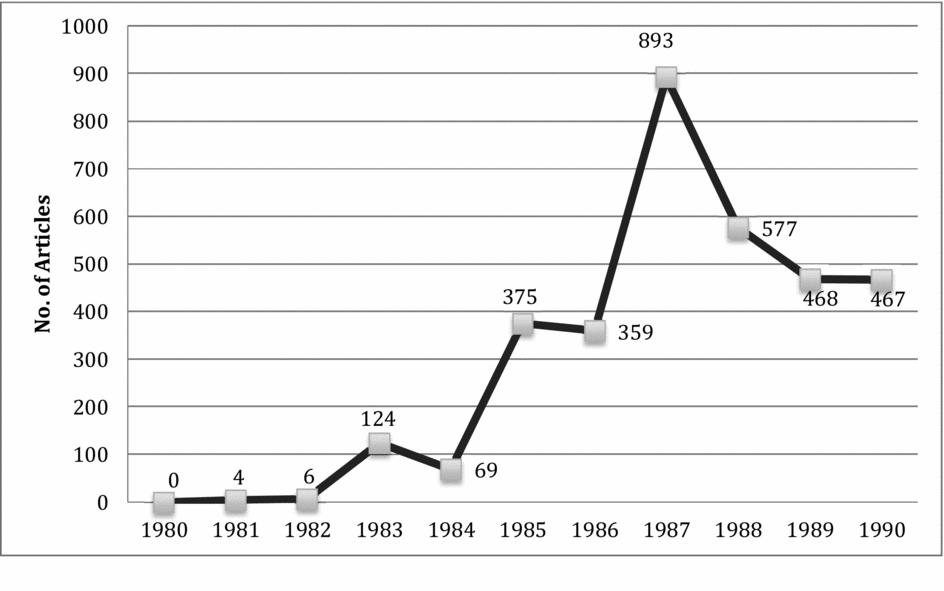
Misperception was intensified, for example, due to the media coverage of so-called ‘casual contact’ thesis. Many scholarly articles published in 1983, including the one by Anthony S. Fauci (Reference Fauci1983) in the Journal of the American Medical Association, announced that routine close contact, like household contact, could cause AIDS infection (see the increase in the number of articles in Figure 4). The media attitude covering the incorrect medical information traumatized the US public, which had previously thought of AIDS as a disease exclusive to those with a peculiar sexual penchant. This flawed view was captured in several public opinion polls: a Newsweek poll in June 1983 shows that 25% of Americans believed that the disease could be contracted through casual contact and 16% were uncertain of the way of transmission (Kaiser Family Foundation, 1996); according to a ABC News Polls (1985–90), many respondents in 1985 incorrectly believed that HIV/AIDS could be transmitted by ‘sharing a drinking glass’ (44%) or by ‘touching a toilet seat’ (31%) (Kaiser Family Foundation, 2006). The false notions of the mode of transmission misled and distressed the public.
Number of New York Times articles on AIDS by year

Another trope that the media fervently used in covering the epidemic was de-Americanization in conjunction with Africanization of AIDS. The US government traced the route of transmission of the virus to the US territory in order to distract the notorious accusation of the largest cases. In the end, the US placed an official blame on Haiti, by magnifying massive proliferating scale of AIDS in Africa and its close tie with Haiti (Moore and LeBron, Reference Moore and LeBron1986).Footnote 10 Dr. Bruce Chabner from the National Cancer Institute announced, ‘We suspect that this may be an epidemic Haitian virus that was brought back to the homosexual population in the United States’ (Farmer, Reference Farmer1996: 265).Footnote 11 Will (Reference Will1991) points out the rationale of the US behavior:
[a]s the country with by far the largest concentration of AIDS cases, the US faced the prospect of itself being the main target of health sanctions or restrictive measures . . . the US … then encouraged research and press reports that over-dramatized and exaggerated the incidence of AIDS in Africa. Moreover, if it could be shown at the same time that US was not ‘responsible’ for causing AIDS, then so much the better. (p. 89)
Major daily newspapers in the US such as The New York Times or The Washington Post joined the rally of burgeoning the scapegoat rationale.Footnote 12 As a result, people with African origins were victimized through discriminating measures such as ruthless blood sampling of African American patients. Such a politicized image of AIDS misguided the public and stopped the government from developing appropriate policy responses.
The Japanese media also created a public misperception of HIV/AIDS as a gay and foreign disease in the early stage of publications on AIDS. Japan's first official case of AIDS was reported in 1985 when the AIDS Surveillance Committee in the MHW publicized that a gay male had become infected with HIV. This man, who lived in the US, was diagnosed with the disease during a short visit to Japan. The report, with an extra emphasis on the flow of transmission, made people believe that it was a ‘foreign’ or ‘American’ disease. The media reports created an atmosphere where foreigners were ascribed as responsible for the new sexually transmitted disease.Footnote 13
AIDS was also regarded as a disease of gay people (Feldman and Yonemoto, Reference Feldman, Yonemoto, Kirp and Bayer1992: 339). Having tracked the epidemiology of HIV/AIDS, six Japanese males had been diagnosed with AIDS during the only one year of 1985 and all of them were gay. In 1986, infection through homosexual contact accounted for 18 cases out of 26 and only six cases through heterosexual contact (Kihara et al., Reference Kihara, Ichikawa, Kihara and Yamasaki1997: 3). The media exclusively focused on this particular aspect of the reports, which traumatized the public and intensified the existing antagonism and prejudice against gays who had been already marginalized.
The misperception of AIDS as a foreign disease was particularly exacerbated by the way the media covered several focusing events. The first such event was a story of a HIV-infected Filipino female working in the Nagano Prefecture as a nightclub prostitute. She was diagnosed as HIV-positive in November 1986. Her visa was immediately terminated and she was deported back to the Philippines (Dearing, Reference Dearing, Elizabeth and Daniel1992: 328–9). The media underlined her foreign nationality in the coverage yet totally bypassed such essential information as the number of her possible clients and their test results.Footnote 14
There was another AIDS-related focusing event like the death of a single woman in Kobe in January 1987 (Dearing, Reference Dearing, Elizabeth and Daniel1992: 329–30; Feldman and Yonemoto, Reference Feldman, Yonemoto, Kirp and Bayer1992: 344). The woman died two days after the media announcement of her AIDS contraction from the report of the AIDS Surveillance Committee on 20 January 1987. She was the first female to die of AIDS among the eighteen deaths up till this point. The first female AIDS death was dramatized in the media coverage where the woman was described as a ‘habitual prostitute’ having sexual relations with more than 100 people, including ‘non-Japanese’ sailors.Footnote 15 The media harshly vilified the female by revealing her identity and private information. For example, two weekly tabloids, each having a circulation of more than a million, uncovered the location of the funeral and published a photograph of her corpse in the coffin (Feldman and Yonemoto, Reference Feldman, Yonemoto, Kirp and Bayer1992: 344). The media introduced the nickname of AIDS as kurobune, translated as a ‘black ship’, with which the US invaded Japan in 1853 (Kim, Reference Kim2015b: 495). The foreign perception was intensified when the already denigrating historical legacy of the US was linked to the newly emerging health threat (Treat, Reference Treat1999). Japanese people were even more traumatized as the media highlighted that the disease was not confined to males, especially male homosexuals. The dismay was intensified because the heterosexual mode of transmission was markedly different from how AIDS had been understood as a disease only for the male sexual minorities (Dearing, Reference Dearing, Elizabeth and Daniel1992: 330).Footnote 16
The mistaken foreign perception was further exaggerated by the so-called ‘HIV-tainted blood scandal’, which is also known in Japanese as Yakugai eizu jiken. At the very early stage of AIDS infections, even before homosexual infection was first reported in 1985, the majority of HIV-infected people were hemophiliacs. It was estimated that approximately 40% of hemophiliac patients were infected with HIV between 1982 and 1985 through treatment with contaminated blood products primarily imported from the US even though the MHW did not acknowledge the route of infection (Feldman, Reference Feldman, Feldman and Bayer1999: 64–9; Satoko, Reference Satoko, Yamamoto and Satoko2006: 126; Sawazaki, Reference Sawazaki1997: 47; Ikegami, Reference Ikegami1997: 52). The first lawsuits by the HIV-infected hemophiliacs were filed in the Osaka and Tokyo district courts in 1989 against the MHW and five pharmaceutical companies. Plaintiffs accused the Ministry and the companies of importing untreated blood plasma from the US and producing blood products without heating treatment despite the risk of HIV infection. The media paid significant attention to the ‘US origin’ of the contaminated blood products and its attitude reinforced the existing misperception.Footnote 17
This misperception led to discrimination against foreigners. Many foreigners lost their jobs and were denied the use of public facilities regardless of their HIV status. They were expelled from their rental apartments and/or even denied treatment in medical institutes. Some females from Southeast Asian countries were regarded as members of a ‘high-risk group’ despite their clean record of non-infection of HIV, and they were subjected to harsh ostracism merely because of their foreign nationality (Yonemoto, Reference Yonemoto1997: 17–18; Satoko, Reference Satoko, Yamamoto and Satoko2006: 128–9).
Pervasive misperception and strong prejudice against foreigners misled Japanese gays to believe that they were safe if they were not exposed to sexual contacts with non-Japanese people. They, thus, did not change risky sexual habits that would increase the likelihood of infection. For example, the number of clients of gay bath houses had plunged in the late 1980s as AIDS was understood as gay disease and the perception scared gays of being infected with HIV. However, the number rose again in the 1990s, sometimes surpassing the level prior to the decrease as foreign image superseded the gay perception. Gays were misinformed that it would be fine to have sexual relations with ‘Japanese gay,’ but unsafe with foreigners.
In front of commercial sexual facilities such as ‘soap lands’ or massage parlors, discriminative signs that stated ‘Japanese Only’ were placed, leading to a false sense of security amongst Japanese gays (Sawazaki, Reference Sawazaki1997: 49; Feldman and Yonemoto, Reference Feldman, Yonemoto, Kirp and Bayer1992: 355). The rate of homosexual transmission of HIV increased again among Japanese males. This epidemiological trend is partly attributed to Japanese gay men who continued their sexual practices, and did not adopt the recommended HIV-prevention measures (Sawazaki, Reference Sawazaki1997: 50). The media's approach resulted in the flawed view of AIDS amongst the Japanese public as a disease for ‘anyone other than a “normal” Japanese – meaning foreigners, Japanese hemophiliacs, Japanese homosexuals, and Japanese IV drug users’ (Dearing, Reference Dearing, Elizabeth and Daniel1992: 340). The pattern of dramatization by the media continued to the late 1980s and the early 1990s in Japan.
US media since the mid-1980s: correcting and constructing perception of AIDS
In contrast to the negative influences of the media in the early 1980s, the US media contributed to constructing a new perspective of AIDS since the mid-1980s onward. The number of articles dealing with HIV/AIDS in the New York Times surged during 1983, 1985, and 1987 (see Figure 4). The number skyrocketed when new scientific announcements were made or certain focusing events with political or societal implications took place.Footnote 18 Not only did the distinctive two upsurges in 1985 and 1987 enhance the salience of the agenda but also shaped a new public perception.
The dramatic increase in 1985 was associated with the AIDS infection of a celebrity, Rock Hudson. He was diagnosed in July 1985 and died within three months. The event triggered the surge of media coverage, going from fifty-two newspaper articles between January and June 1985 up to 323 articles only between July and December 1985 (McAllister and Kitron, Reference McAllister, Dan Kitron and Fuller2003: 50). The increase in 1987 was related to the prospect of AIDS proliferation by the Secretary of HHS, Dr. Otis R. Brown. He warned, in the National Press Club on 30 January, that AIDS might be a threat to the entire population domestically and internationally.Footnote 19 Subsequently, Stephen Jay Gould's similar extrapolation was announced in The New York Times Magazine on 17 April (Gould, Reference Gould1987: 33) and the media was eager to cover the upcoming threat of the potential pandemic.
The media played a key role in providing objective information and knowledge based upon professional references since the mid-1980s onwards. A study released from the Institute for Health Policy Analysis found that ‘media coverage has been careful, [and] and informative’ (Konick, Reference Konick and Linda2003: 27). A Kaiser Family Foundation survey also pointed out that ‘the mainstream media confronted the challenge of reporting on a deadly and mysterious new health problem in a responsible manner – to inform but not inflame, to educate but not alarm’ (Kaiser Family Foundation, 1996).
As a result of the educational role of the media, the public misunderstanding of the mode of transmission of the virus was corrected. According to ABC News Polls, the percentage of Americans who did not know that HIV/AIDS could not be transmitted by ‘sharing a drinking glass’ dropped from 44% in 1985 to 26% in 1987 and then to 24% in 1990. In addition, the percentage of respondents who believed that HIV/AIDS could be transmitted by ‘touching a toilet seat’ also declined from 31% in 1985 to 19% in 1987 and 16% in 1990 (Kaiser Family Foundation, 2006). The decrease in misconceptions about the mode of contraction can be interpreted as a correction of the public views of AIDS in the late 1980s.
Roles that civil society groups played in the US and Japan
AIDS policy development ran parallel to the emergence of civil society organizations. In the US, new organizations consisting of a variety of minority groups vulnerable to the epidemic, such as gays, hemophiliacs, and drug users, became active in the mid-1980s. Their activities were mainly directed toward breaking the wall of social prejudice and discrimination against the PLWA. Such changes in perception were also made in Japan as new civil society organizations emerged in the early 1990s.
Active US civil society organizations since the mid 1980s
The first bona fide AIDS activism in the US was triggered as a reaction to the early homophobic atmosphere. Gay and lesbian communities instigated the first generation of AIDS activism through their social networks, such as gay newspapers and magazines or AIDS agencies in the mid-1980s (Freedman and D'Emilio, Reference Freedman and D'Emilio1988; Padgug, Reference Padgug, Peiss and Simmons1989). The AIDS agencies, like AIDS Project Los Angeles (APLA) and the Gay Men's Health Crisis (GMHC) in New York, were established for educating and caring for the PLWA and lesbian, gay, bisexual and transgendered (LGBT) community. The agencies developed extensive prevention programs with medical, psychological, and social services for the PLWA (Arno and Feiden, Reference Arno and Feiden1992; Stoller, Reference Stoller1998). Those programs were designed to provide emotional support to the PLWA suffering from ‘psychological trauma’ associated with isolation and discrimination (Patton, Reference Patton1990; Carter, Reference Carter1992). The agencies also launched research programs and requested governmental funding for AIDS victims. Stockdill (Reference Stockdill2003) points out that ‘[A]ctivists had to convince those in power and the general heterosexual population that gay lives were worth saving and/or force them to take action against the growing tide of AIDS’ (p. 5).
In order to organize the movements more effectively, the LGBT communities formed the confrontational AIDS Coalition to Unleash Power (ACT UP) in New York City in 1987 (Stockdill, Reference Stockdill2003: 5–6). ACT UP was ‘[A] diverse, nonpartisan group of individuals united in anger and committed to direct action to end the AIDS crisis’ (Carter, Reference Carter1992: 1). The nation's first and most vital modern activist movement specializing in HIV/AIDS had two ultimate goals: ‘to prevent the spread of HIV transmission and to provide treatment, support, and social services to people living with HIV and AIDS’ (Bull, Reference Bull2003: xx–xxi; Stockdill, Reference Stockdill2003: 58).
ACT UP tried to disquiet the LGBT population whose interests were at stake due to the current system of oppression (Stockdill, Reference Stockdill2003: 6). The organization devised such tools to ‘support groups, educational workshops, and one-on-one interactions’ for educating and promoting self-worth and dignity of the PLWA (Stockdill, Reference Stockdill2003: 61). It also empowered the people in the affected communities by improving AIDS programs and services sponsored by pharmaceutical companies and related government bodies. The multi-faceted efforts succeeded in awakening and mobilizing the LGBT communities along with such policy changes as the governmental budget increase and more access to treatment of the PLWA (Carter, Reference Carter1992; Corea, Reference Corea1992; Arno and Feiden, Reference Arno and Feiden1992; Cohen, Reference Cohen1998).Footnote 20
The role of ACT UP was significant in changing public attitude and governmental policy. It challenged the status-quo of homophobia and heterosexualism, in which people looked down upon the ‘queer’ life style, and where government responses lacked funding for research and prevention programs as well as accessible clinical trials (Carter, Reference Carter1992; Cohen, Reference Cohen1998; Arno and Feiden, Reference Arno and Feiden1992; Gould, Reference Gould2000; Gamson, Reference Gamson1989). It fought against the widely spread misleading and (sexually) discriminatory images by launching education programs and social protests as well as by traditional ‘politicking’. ACT UP met with government officials in order to request more research funding and the most up-to-date medical information. It also adopted direct tactics like marches, sit-ins, die-ins, and phone and fax zaps.
Civil society organizations in Japan emerging in the 1990s
Unlike in the US, civil society groups in Japan were not actively engaged in AIDS activism in the 1980s. Japanese politics has been traditionally characterized by a strong bureaucracy in which civil society was controlled by a government-led system. Rix (Reference Rix1993) comments that ‘their [civil society organizations] role in enhancing the public debate on aid is still undeveloped’ due to ‘a limited history and narrow exposure in Japan’ (p. 64). AIDS community-based organizations (CBOs) or HIV/AIDS related NGOs in Japanese civil society organizations were not only scarce in number but were also weak in influence. The initial ignorance and indifference was partly attributed to the absence of any actors who could have redressed the flawed view of AIDS. PLWA were reluctant to organize and unwilling to officially publicly identify their sexual orientation. In the absence of the leadership of civic society groups, it was almost impossible to create a public atmosphere through which resources could be mobilized for enkindling active government responses (Ikegami, Reference Ikegami1997: 52).
It was not until the late 1980s and the early 1990s that any civil society organizations became visible in Japan. In 1989, several small gay rights advocacy groups were united under the overarching gay community organization named ‘AIDS Action’. AIDS Action represented the voices of gay communities whose interests were at stake owing to the epidemic. It built hotline services within the gay community and distributed cards containing information on safe sex for the general public (Ikegami, Reference Ikegami1997: 52). The Japan Association for the Lesbian and Gay Movement (OCCUR), one of the major gay and lesbian organizations, also attempted to enhance the human rights of gays and lesbians against discrimination. OCCUR won a case in which they accused the Tokyo metropolitan government of discriminating against them by allowing city hotels to refuse to accept gay groups (Feldman and Yonemoto, Reference Feldman, Yonemoto, Kirp and Bayer1992: 356–8).
There were several civil activities that contributed to enhancing awareness and transforming existing preconceived notions of AIDS among the public. One of the most significant events was the ‘NAMES Project AIDS Memorial Quilt Japan’. The NAMES project was originally created in the US in 1987 aimed at creating a memorial of those who had died of AIDS and reminding others of the tragic impact of the pandemic. They put a quilt of the names of the AIDS victims on a wall and displayed it to the public.Footnote 21 One Japanese dye artist who had witnessed the event organized a project ‘Memorial Quilt Japan.’ Many volunteers got involved in creating a quilt and displayed it in nine major cities in April and May 1991, which over 15,000 people visited to appreciate.
Feldman and Yonemoto (Reference Feldman, Yonemoto, Kirp and Bayer1992: 357) echoed in the editorial of Asahi Evening News the remarkable impact of the project for public education: ‘the Japanese have begun to gain in only six months (up to 15 May 1991) a more immediate awareness of the worldwide AIDS disaster than they had acquired in all of the last six years’ (Furst, Reference Furst1991). Ikegami (Reference Ikegami1997) also reverberated the consequence of the event with respect to the creation of civil associations: ‘[T]his tour did not end with the display, but inspired the creation of CBOs in each locale and stimulated public participation, especially that of women, in AIDS-related activities’ (p. 53). Following the projects, many other civil society organizations convened various symposia and seminars on AIDS, which not only enhanced the awareness of AIDS per se but also advanced an accurate perception about the disease in the early 1990s (Potter, Reference Potter, Heal and Clausen1999).
Citizens also became involved in movements for AIDS policy changes in various ways like petition, lobbying, quilt, and protests. There was a citizens’ movement that received signatures from around 20,000 people appealing to the government to establish a ‘more humane and effective AIDS policy’. The appeal was signed not only by HIV carriers, AIDS patients, gays, and hemophiliacs, but also by the average citizen uninfected with AIDS – all of whom desired government AIDS policy changes. Five representatives of the movement visited Diet members and MHW officials to submit the appeal on 17 October 1990 (Feldman and Yonemoto, Reference Feldman, Yonemoto, Kirp and Bayer1992: 356–8).
The emergence of civil society organizations in the 1990s ran parallel with the altered understanding of AIDS as a threat to a problem requiring immediate global response including foreign policy development. Ikegami (Reference Ikegami1997: 53) points out that the global AIDS policy transformation was feasible as the activities of civil society groups enhanced awareness of AIDS and put pressure on the government apparatus through civic participation. Umenai et al. (Reference Umenai, Narula, Onuki, Yamamoto and Igari1997) also argue that the Japanese government undertook the global financial commitment based on the recognition of the ‘global threat of AIDS’ (p. 60). Yonemoto (Reference Yonemoto1997) contends that the change was a reflection of the understanding of AIDS as ‘an emergency’ (p. 18).
The perception shift is found in the MOFA's Annual Reports in the early 1990s. The 1992 MOFA Reports first mentioned AIDS as a ‘new threat’ or a ‘new danger’ equivalent to global environmental problems and other diseases similar to cancer or chronic circulatory disease that threatened certain African and Southern Asian countries (Japanese ODA, Reference Japanese1992: 127–8). The concern of the global health challenge was intensified in the 1993 Report, which allocated a separate section pertaining to the global issue of AIDS. The Report (Japanese ODA, 1993) recognizes the issue as a serious ‘concern … that presents the most urgent need for international cooperation’ and underscores that ‘Japan must come to grip with AIDS as one of the serious tasks in the health and medical services sector and as a problem of global scale’ (157–8). The Report also emphasizes the potential threat of AIDS: ‘unless we take proper measures in the near future, AIDS will cause even more grave and extensive damage’ (Japanese ODA, 1993: 157). The 1994 MOFA Report adds AIDS to the list of most urgent global ‘problems’ or ‘concerns’ that should be a priority of Japanese ODA for developing countries (Japanese ODA, 1994: 171). Even further, the Report clearly stipulates that AIDS is a ‘common challenge for mankind’ and calls for the urgent global efforts of developed countries and international organizations (Japanese ODA, 1994: 211).
In sum, civil society in the US and Japan shaped the view which imported a sense of urgency for policy responses at the domestic and international level in the mid-1980s and the early 1990s, respectively. In other words, the domestic shift in the view of AIDS by civil society organizations was related to foreign policy development. However, it should be noted that the domestic factors cannot be said to have triggered the international response to HIV/AIDS. The gradually constructed and shared view on AIDS was a necessary condition for developing governmental commitment against global AIDS.
Conclusion
The variance in the development of global AIDS-funding of the US and Japan depended on how the pandemic was perceived by their respective public and policymakers. The perception of threats requiring immediate international cooperation played a key role as an intervening variable that conditioned the domestic diffusion of international norms of the global response to AIDS. In the case of the US, the view was constructed relatively earlier than in other countries due to its unique domestic conditions. The conditions included the relatively high number of HIV-infected individuals, the role of an engaged media, and active civil society organizations. In contrast, any immediate and remarkable policy development in the 1980s was not feasible in Japan due to ignorance and misperception during that time. HIV/AIDS failed to be perceived as an international threat or problem under the domestic condition with a relatively meager number of cases reported, a dramatizing media attitude, and lack of AIDS activism until the early 1990s. The funding began to accrue in the mid 1990s and increased dramatically from the late 1990s onwards as awareness developed in the public and government.
This research contributes to the studies of international norms and domestic determinants for foreign policy choices. The findings of this study show how domestic factors that shaped perceptions conditioned foreign aid policy development. The study can be extended toward examining domestic resonance of international norms and foreign policy establishment in other policy areas. This type of approach can examine the dynamics and process of norm diffusion by highlighting under what domestic conditions international norms proliferate or are hampered. In addition, the research paves the way for examining issues with scientific uncertainty or ethical (sexual) implication. The lessons about the process of framing, in which certain meanings were attached to the perception of AIDS, will be suggestive to the study of other medical or scientific agenda with equivalent features.
About the authors
Dr. Young Soo Kim is an Assistant Professor of Political Science at Loyola University New Orleans. He holds a Ph.D. degree in Political Science from Purdue University at West Lafayette. His research interests surround international relations theories, international norms, mechanism of foreign aid policy choice, politics of global HIV/AIDS and International Relations of East Asia. His work has appeared in several peer-reviewed journals such as Asian Perspective, Comparative European Politics, International Politics, Journal of International and Area Studies, and International Area Studies Review.
Dr. Joongbum Shin is a Senior Research Associate in the Center for the Study of Grand Strategy at Chung-Ang University, Seoul, Republic of Korea. He holds a Ph.D. degree in International Studies from Chung-Ang University. His research interests lie in regional integration, international norms, and international development and cooperation (more specifically the Official Development Assistance).