Philosophers who would do history of philosophy (which they must do in order not to impoverish themselves and the discipline they serve) must also occasionally do some philology. The meaning of the text interacts with the language in which it is spoken, and it is informed by it. One need not be a Whorfean to appreciate that there is no text without contexts, and one of the most important of these contexts is the language itself. To what extent the philologist must also become a palaeographer is a question seldom raised even among those who call themselves philologists. Taking our texts not only in written form, but in printed regularity, we tend to focus on the type of expression rather than the token, treating the latter as incidental, irrelevant and uninteresting. I want here to tell a tale of a text with attention to some palaeographic dimensions, hoping to open questions about their philological and philosophical worth. The palaeography may itself be superficial or amateurish, but if the point is well taken at this level, someone more expert may be able to unfold a richer tale.
My tale about a text must begin with worries about what counts as a text. The text with which I wish to deal is Aristotle's Physics, Book 7. It is by content and by tradition a piece of a broader text called The Physics, and that too is a part of a broader body of work called the Aristotelian treatises, and that of the Aristotelian corpus (this last taken either as the texts to which we now have access and which we attribute to the authorship of Aristotle, or as those texts and also the other texts that we suppose that he wrote). At each level of partition, the text both contributes to and derives its meaning from the significance of the broader whole. But it is also a text unto itself, having a structure, a content and a purpose readable in abstraction from the broader context, even though its fuller significance may be informed by its role in that broader text. The philosophical aim of telling this tale is to explore how our altered knowledge of the history of Physics 7 as a text might alter our understanding of its role in the broader contexts of Aristotle's works, and with that, the significance of the broader texts themselves.
THE SHUTE/ROSS THESIS VS THE WARDY THESIS
In ancient times, the place of Physics 7 was already in question. Andronicus of Rhodes had given it its current place of honour among the other books of the Physics before the beginning of the Common Era. Yet Simplicius in his commentary six centuries later tells of its dubious pedigree and finds it necessary to defend the right of the book to belong. He points out that it was evidently not acknowledged by the early followers of Aristotle as a part of the corpus, though he judged it worthy of the master in both style and content. In addition to the version of this book that he himself preferred, Simplicius refers to ἕτερον ἕβδομον βιβλίον (‘the other seventh book’, 1051.5; 1054.31; 1086.23; 1093.10), which he found generally inferior, but still of enough influence to be worthy of note. Subsequent scholars before the Renaissance give no explicit evidence of attention either to the issue of the place of the book in the corpus or to the problem of two versions of the text, and it has only been in more recent times that sustained attention has been given to these two problems.
In Ross's 1936 account of the structure of the text,Footnote 1 using the ancient lists and commentaries of Aristotle's works, together with philosophical and philological arguments about the compositional relations of the several books, he concluded that Books 1, 2, 7 and 8 were each originally separate treatises, that the first four books came to be those traditionally referred to as the books on nature, that Books 5, 6 and 8 were those traditionally referred to as the three books on motion, and that Book 7 was in ancient times a separate treatise, perhaps never integrated by the Peripatetics themselves into the unified treatise. It was apparently only later, certainly after the death of Aristotle, and probably not until Andronicus’ collation of the texts, that Book 7 finally found a place in the treatise.
The other peculiarity of the text of Book 7 is the dual tradition of manuscripts to which Simplicius alluded. These differences involved greater textual discrepancies than those between the two great manuscript families that are the source of our current text of the Physics, of which Parisinus 1853 (E) and Vindobonensis 100 (J) are important early exemplars (indeed, the manuscript families of E and J had only the second of these versions of our Book 7 between them). Ross takes the difference to be of two versions of the same subject matter, close enough to be regarded in some sense as the same text, but different enough to imply no common written source. He relates these different versions to the different versions cited by Simplicius (he designates what he takes as Simplicius’ preferred version as the ‘α’ version and the ‘other seventh book’ as the ‘β’) and to different independent books in the ancient lists. This complexity adds to the bastard status already implied by the questions of the place of this book in the treatise.
Although the ancient commentators seemed aware of the differences and preferred the α version, the commentators and copyists of the medieval period showed no awareness of the difference and almost universally followed the β version. It was Erasmus’ rediscovery of the difference that led to various ways of handling the problem until Ross followed C. Prantl in preferring the α version, relegating the β version to an appendix. In pursuit of this resolution, Ross gave appropriate credit to Richard Shute's recension of the text based on four MSS which Shute maintained preserved the α version throughout. Ross accepted Shute's contentions about the first three chapters, but maintained that the last two were of too mixed a character to maintain the difference. While Ross does not note Shute's conclusions on the matter, the latter also maintained that Book 7 in ancient times must have been seen as a separate treatise, but that it must have been written later than the other books of The Physics, and that the authorship and relationship of the two versions are open to question.Footnote 2 Together, the Shute account and the Ross account leave us with a questionable place and status for Book 7 in the Aristotelian corpus. It is this bastard status to which I will refer generally as the Shute/Ross thesis, though a number of other scholars have taken up similar positions in recent times.
In contrast to this position, Robert Wardy has sought to reassert proper status and parentage for Book 7 by treating both versions with respect and claiming the book is placed in the text where it belongs. He has published what are for the most part Ross's recensions of the two versions, but side by side, for easy comparison, and he has followed these in similar parallel pages with his own translations. He has argued for an interpretation of authorship that leaves open how they were related to Aristotle, but speculates that both versions might be by the master's own hand as he worked through the same problem on more than one occasion. Wardy has argued that the book exhibits not only a coherent unity within itself, but that it is bound by supporting argument as the immediate antecedent to Book 8, requiring the place where we now find it in the treatise. So, on all points, he opposes the bastard status implied by the Shute/Ross thesis.Footnote 3
What immediately turns on the difference between the Wardy thesis and the Shute/Ross thesis is the interpretation of the import of the argument in 7.1. Wardy has made a good case for the remainder of the book carrying out in coherent fashion the concerns of the first chapter, but this need not imply his points about the place of the book in the corpus, or in the investigations and aims of its author.Footnote 4 The opening line in both versions is: Ἅπαν τὸ κινούμενον ἀνάγκη ὑπό τινος κινεῖσθαι (‘It is necessary for everything that is moved to be moved by something’, 241b34; 241b24), but that chapter in β ends (242b33): φανερὸν οὖν ὅτι στήσεταί ποτε καὶ οὐκ εἰς ἄ πειρον πρόεισιν τὸ ἀεὶ ὑφ’ ἑτέρου, ἀλλ’ ἔσται τι ὅ πρῶτον κινηθήσεται (‘So it appears that there will be a stop, and that it will not go on indefinitely, but that there will be something that is the first moved’). Compare the corresponding α version (242b71): ὥστε ἀνάγκη ἵστασθαι καὶ εἶναί τι πρῶτον κινοῦν καὶ κινούμενον (‘So it is necessary that there be a stop, and that there be something that is the first mover and moved’). Portions of the β version give such interpretive phrasing as αὐτὸ ὑφ’ ἑτέρου κινεῖσθαι (242a3), where the α version gives only ἀνάγκη ὑπό τινος αὐτὸ κινεῖσθαι (242a37). Where the α version claims simply that ‘it is necessary that there be a first agent of change’ (242a53), the β version claims that ‘it is also necessary that everything which is changed is moved in place by something other than itself” (242a16). Such accents in β lead the way to our interpreting the opening line as ‘… moved by something else’. This was indeed the traditional reading of it. On the basis of this reading, Thomas Aquinas in On the Nature of Things argued from what he took as Aristotelian grounds to the very un-Aristotelian conclusion that the efficient cause in natural motion must be different and distinct from the formal (against what Aristotle says to the contrary in Physics 2.7 and 3.3), and from that base he argued for the necessity of a creator God as a first efficient cause.
In a similar way, these interpretive lines in the β version lend support to the links that Robert Wardy makes of the arguments in 7 to those in 8. After acknowledging that the β version in 7.1 requires a thesis too strong for the second argument (p. 99), he offers an outline of the argument based on the α version alone (p. 100). But his last two steps rely on extrapolation from the opening sentence of 7: ‘Everything moved is moved by another’. Here, the interpretation based on the β version has seeped back in. This enables him by an extension of this argument to draw conclusions about an unmoved mover that he then can relate to arguments in 8.5. In this claim, however, he has again relied on the β version interpretation alone. With it, he has made an assumption as apparently modest as that of Thomas, but one with a comparably great implication. This not only lays a crucial foundation for Wardy's thesis about the link of 7 to 8, but it opens the way to tying both interpretively to Metaphysics Λ. So it is that philological questions about the text and its place in the corpus may make crucial differences about the philosophical message of the text and its place in Aristotle's conceptual development.
In telling the tale of the place of Physics 7 in Aristotle's philosophical development, we must have some account of its place in the development of the text, and with that an account of how that place has been viewed in the history of the transmission of the text to us. The telling of a tale must have a beginning, a middle and an end, but this order need not be chronologically dictated. Moreover, my earlier questions about parts of texts must also apply to tales: What serves as a unit of storytelling? I am not sure what a complete story about Physics 7 might entail. Nor is it clear whether any of the sub-tales might be better told as a story unto itself. A part of my task as storyteller will be to knit the subplots as well as the sub-periods into a sufficiently coherent whole. While the seams may still be apparent, the garment at the end must appear a whole piece, well knitted together. In the end, we may have to ask not only aesthetic questions (was it told well, this story, and how might it be told better?) but also practical ones (was it a true story, and how may its infelicities be corrected?). Such questions as these may open the way to the conclusion that the story itself is worth telling, whatever the worth of this telling of it. I will begin with an examination of some of the earliest and most reliable of our available MSS, because this part of the story is told only partially by Ross and Shute, and is generally ignored by others. After this I will retell in outline the stories of the commentators and the editions, and from all of these resources, again re-evaluate the status of the bastard book of the Physics.
MEDIEVAL MANUSCRIPTS
In setting forth the base for his rendering of the text, Ross lists as his chief sources (with initials for ready reference):
(E) Parisinus 1853 (10th century)
(F) Laurentianus 87.7 (14th century)
(G) Laurentianus 87.6 (12th century, Book 4 only)
(H) Vaticanus 1027 (13th century, ‘old hand begins at Book 6: 215a8’)
(I) Vaticanus 241 (13th century)
(J) Vindobonensis 100 (10th century)Footnote 5
(K) Laurentianus 87.24 (13th century, Books 6–8 only)
(Μ) Parallels to the text of The Physics in Aristotle's Metaphysics.
(V) Arabo-Latin version of Books 1–4.
(T) Themistius’ paraphrase (4th century)
(P) Philoponus’ commentary (6th century, Books 1–4 complete, 5–8 fragmentary)
(S) Simplicius’ commentary (6th century)
(A) Alexander's commentary (3rd century, as quoted by Simplicius)
For our purposes, MSS G, V and the parallels in the Metaphysics (only to Books 2, 3 and 5) prove irrelevant, and we must postpone reference to the commentators until a later part of our story. Of the remaining six MSS, the oldest and most venerated are MSS E and J. This is true not only for The Physics, but indeed for a number of major works of Aristotle, including The Metaphysics. They have even come to be generally regarded as the fountainheads of two distinct MSS traditions.Footnote 6 The remaining sources receive some attention from Ross because they exhibit some independence from both MSS E and J. Of these, MSS F, H and I belong to the one MSS family along with MS J (the so-called Lambda tradition), and MS K belongs with MS E in the other tradition.
As I noted earlier, both of these traditions seem to have had only the ‘other seventh book’, which Ross labels the β version. In his discussion of Shute's thesis (p. 116), Ross lists those MSS that Shute had used for his recension of 7:
(b) Parisinus 1859 (14th century)
(c) Parisinus 1861 (15th century)
(j) Parisinus 2033 (15th century)
(y) Bodleianus Misc. 238 (16th century)
These Ross took into account along with his chief sources for his recension of 7.
Ross lists some seventy-five other MSS of the Physics that he had ‘traced the existence of’ in correspondence with various libraries, but regarded those that he listed, together with Shute's four for Book 7, as the most relevant for an adequate recension. It is not clear how many of the MSS which he used that he actually consulted physically. He had seen MS E, because he makes reference to the physical irregularities that I will note, but he explicitly states that he had not seen the actual manuscript J. From his selection, I have consulted all of the relevant MSS for 7 (the six of Ross's chief sources that contain 7, plus Shute's MSS for the α version). I have viewed the originals of all of these MSS in the libraries where they are now housed, and have studied those along with the others in microfilm reproduction at the Aristotelesarchiv in Berlin.Footnote 7 In the great majority of these MSS, I found irregularities about titles and numbers of books that suggested doubts about the place of the seventh book among the last books of the Physics.
Let us begin with those irregularities in MS E, some of which Ross notes, but we need to give some embellishment to them. Ross notes that, in MS E, Books 6, 7 and 8 are treated as παρὶ κινήσεως τῶν εἰς γ τὸ β, τὸ α, τὸ γ, noting this excludes Book 5, which is traditionally included, and he takes the reverse numbering between 6 and 7 (the first as Book β, the second as α) to be an ‘unsuccessful attempt to make a well-ordered unity of the three books which Simplicius identifies with τὰ περὶ κινήσεως τρία.Footnote 8 Ross had already contended, on the basis of links of grammar, style and content, that 6 cannot be separated from 5, which is part of his own argument of why our last three books cannot be the three concerning motion.
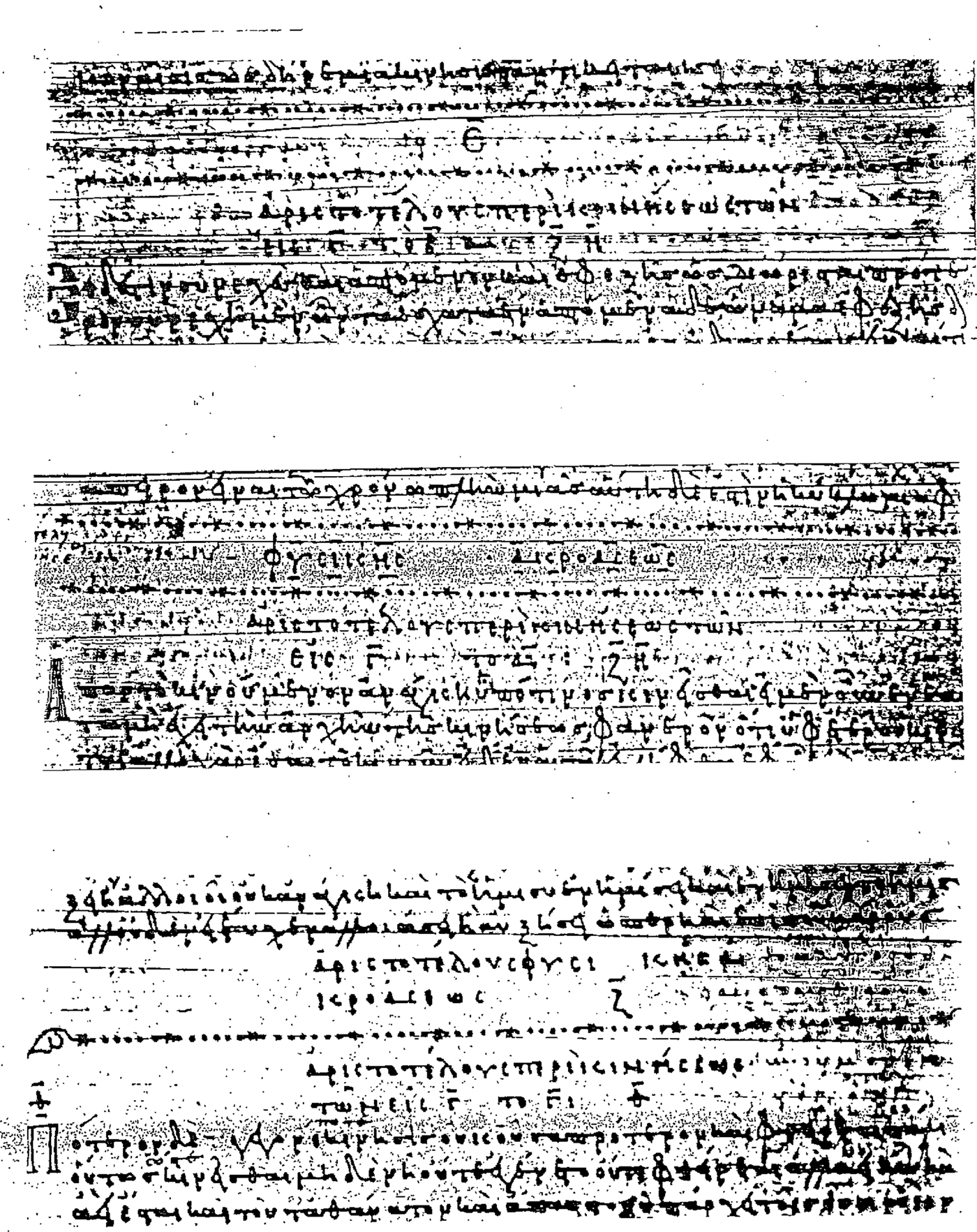
Ross was a bit too terse in his report of MS E, or a bit too superficial in his examination. MS E exhibits more intriguing irregularities than just this one (see Plate 1). The last book opens as one would expect with the designation that it is Book θ of the whole and Book γ of those books on motion, but immediately preceding it is the designation that our Book 7 is Book ζ. Book 7 opens with the supertitle φυσικής ἀκροασεῶς that does not introduce either of the other two books, and only after this on a separate line does it have the subtitle, Ἀριστοτέλου περὶ κινησεως εἰς Γ. Book 7 is not only introduced as ‘τὸ Α’ of these three books, but also it is characterized as ‘ΖΗ’, presumably of the whole text. Even though Book 6 opens as Book β of the three books on motion, it too is characterized as ‘ΖΗ’ of the whole. The book preceding that one concludes with the designation that it is Book ε, as Book 7 concludes that it is Book ζ, but there is no concluding designation for Book 6.
MS E

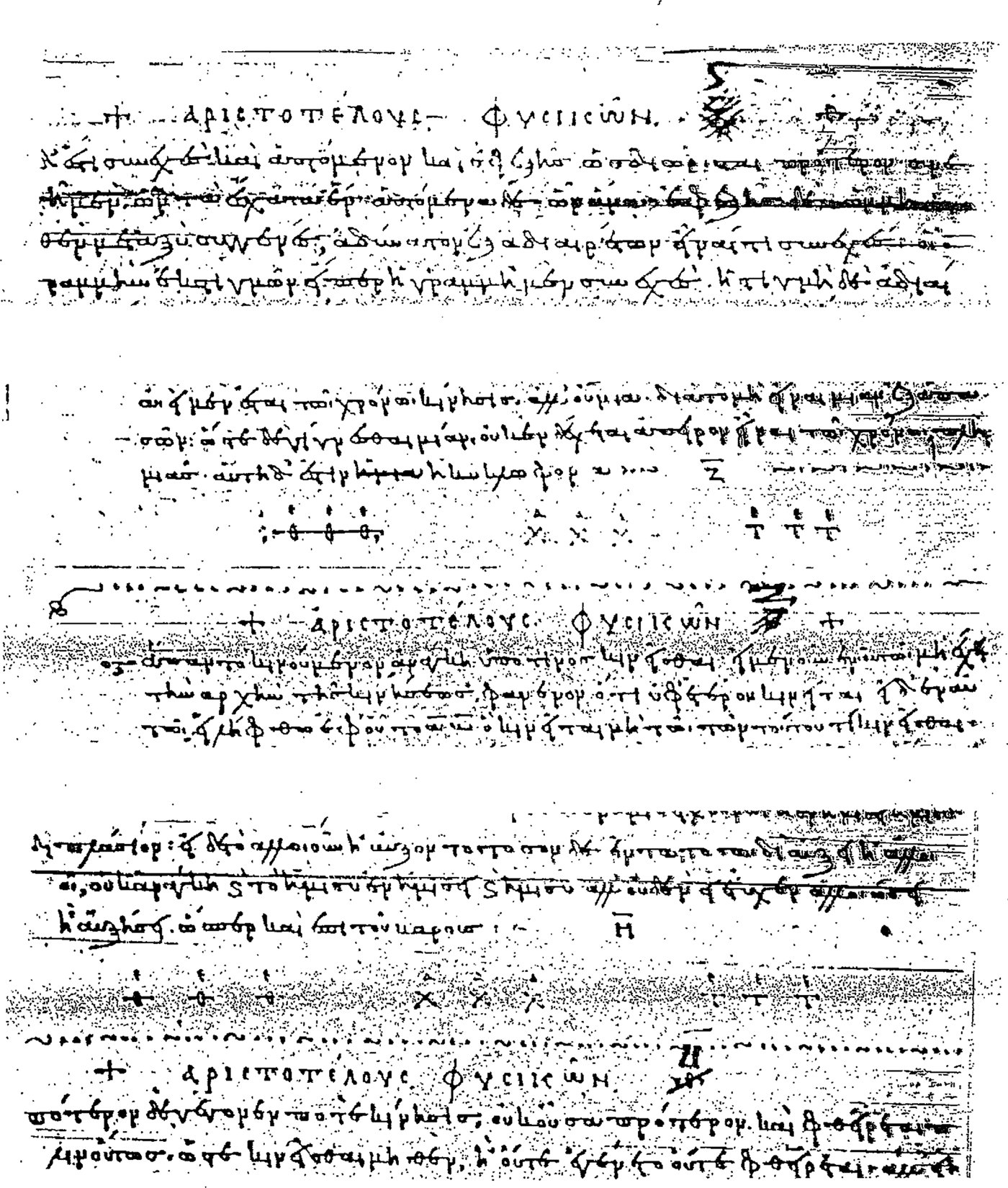
MS J exhibits some similar peculiarities to those of MS E, even though their link historically is only by age and venerability (palaeographers debate whether their lineage goes back through separate traditions to ancient times, or in what way there might be some Urtext from which they both drew in Byzantine times). The opening of 6 has its numbering crossed out twice (see Plate 2). It first apparently had ζ replacing a numbering that is too difficult to read, even in the original of the manuscript, and then the ζ was crossed out, and replaced by a ϛ (‘stigma’, a Byzantine carry-over from the ancient digamma, but still used in countingFootnote 10). In a similar manner, the ζ at the beginning of 7 replaces what appears to be a crossed-out η, even though the concluding designation of the preceding book remains ζ. Likewise, the θ at the beginning of 8 is replaced by an η, even though the η at the conclusion of the preceding book remains unaltered. The closing of 8 remains θ, but in a brief summary of the number of books at the end, the final designation (a θ) is crossed out, and no letter (stigma or otherwise) is added in its place.
MS J
The manuscript history that led to these conditions in MS E was perhaps a complex one. There may have been a time when Book 7 was regarded as the first of the three books on motion, not only by its number, but by following the supertitle that apparently opened the new section. Whoever changed the ordering kept these features of the older order. In spite of these changes, there seems to be an attempt to join 6 and 7 together as some sort of single unit within the designated three books. This is reflected not only by the joint ΖΗ designation for both, but by the absence of a terminus designation at the end of Book 6. Speculation invites two scenarios for ordering these two irregularities. One is that once the books were ordered in their present form, they needed an account of the reverse numbering of the first two of the three books on motion, so that the absence of the terminus designation for 6, along with the joining of the two as a single joint designation in the count of the whole treatise, was to gloss over the apparent anomaly of the reverse numbering. The other scenario is that in the original ordering of 7 before 6, 6 was regarded as so closely linked to 8 in subject matter that there was no terminus designation between them, and that it was only after the order switch that the joint designation of 6 and 7 became necessary. Both scenarios are of course grossly underdetermined, but whatever the actual history, its story seems to require an unsettled locus for 7 in the whole, not only in MS E, but in several MSS generations before it.Footnote 9
It does not seem plausible that a fairly clumsy editor altered these designations after the copyist was finished. An editor in the scriptorium would have been concerned to correct the MS against the standard of the exemplar, and such alterations would only have been done if the exemplar MS itself already showed these irregularities. If the editor was a scholar/owner, he might be undertaking the changes on grounds of some knowledge of other MSS, or based on something that he knew of the tradition of the text. In either case, the basis for change would most likely be a prior MS or MSS, or a known tradition. That the editor was a hand different from the copyist, and from whoever provided the titles, is evident from the difference in ink strokes, but that he was from the same location and period is made plausible by the similarity of lettering.Footnote 11
What his purpose was is less obvious. The use of the stigma in numbering the books of Plato and other ancient authors may have been a common practice among medieval and Byzantine copyists, but we have no evidence that it was ever used to number the books of Aristotle's treatises, nor that it was even used to correct altered numbering in other treatises. ‘Little alpha’ in the Metaphysics (the second book in our received treatise; no tampering by MS J with the numbering in this treatise) is an example of an ancient insertion where the numbering was not altered for the remaining books. Nothing in the treatment of the Metaphysics text in MS J suggests any Byzantine tampering to introduce a stigma, or to bring the numbering into some line of correction.
What may make the renumbering of the last books of the Physics in MS J more intelligible is the proximity of the stigma (ϛ) in the numbering order to the problem books in the treatise. Suppose the editor began with crossing off the θ at the end of the list of books at the end of the treatise. Then he had to change the number at the beginning of the last book (8) to an η, but that required that he change the number at the beginning of 7 to a ζ. By the time he came to Book 6, he recognized his regressive futility, and substituted the ϛ for the ζ. Such an account is diminished somewhat in credibility when we recall that the ζ had already been substituted for another numeral, now illegible. In any case, the list of numerals at the end was shortened to seven, without the insertion of the ϛ, and the ϛ may have been introduced at the opening of 6 to reconcile the numbering of the books with that list. As with MS E, the focus seems to be on the seventh book, and with no comparable alterations prior to the sixth book.
But why shorten the list? The most obvious answer is that there must have been something in the manuscript tradition as late as the ninth century that led to expecting only seven books in the treatise. Such a hypothesis would give some credence to the strange complexities of linking two of the last three books as we found them in MS E. Whether such a shortening of the number of books rests upon so slight a motivation as reconciling the two ancient traditions about the books on motion (Porphyry counted four, Simplicius argued for three), or would require a more complex motivation, seems impossible to determine from this distance without additional evidence.
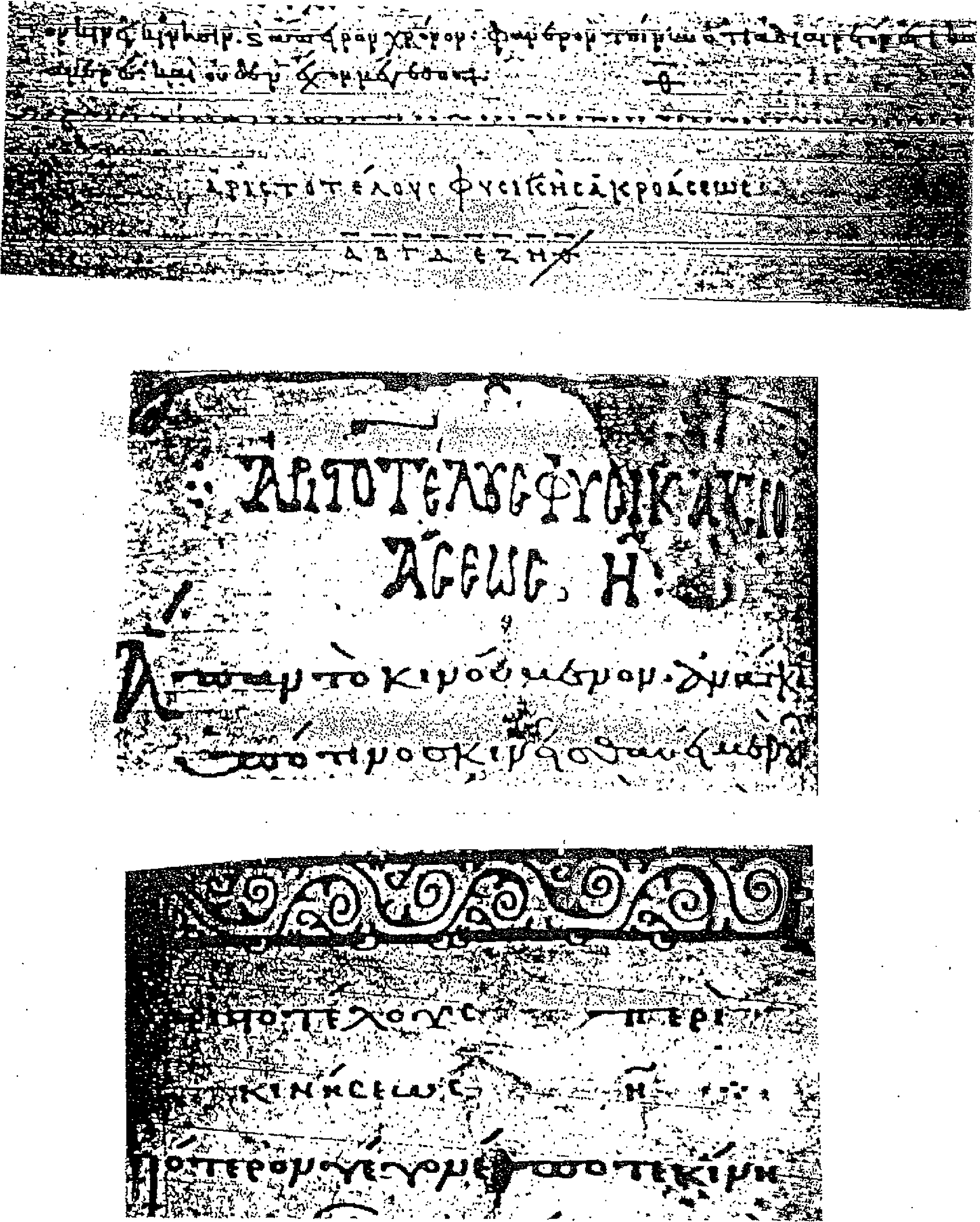
The irregularities of some of the other MSS might lend support to the hypothesis that the number is being shortened. MS K contains only the final three books, but without consistent titles (see Plate 3). Book 7 is designated as Ἀριστοτέλουϲ φυσικῆ ἀκροάσεωϲ Η and Book 8 as Ἀριστοτέλουϲ περὶ κινήσεωϲ Η. They may have been copied at different times, or even from different sources, but they are by the same hand. Whatever prompted the evident mistake of speaking of seven books on motion, what catches the eye in relation to the peculiarities of MSS E and J already noted is the apparent effort to come to a list that ends with the numeral η. Parisinus 2033 (the MS of Shute's study that Ross lists as j) also gives the last book the numeral η by introducing a ϛ for 6. Any of these irregularities by itself could plausibly be discounted on other rationales, but taken together with those of MSS E and J they reflect a pattern that suggests an expectation of a treatise with seven books.
MS J (continued); MS K
Similar conclusions seem plausible for yet two more MSS. MS I (Vaticanus 241), a 13th-century MS, writes out the names of the numbers for the first seven books. For Book 6 it has Ἀριστοτέλουϲ φυσικῶν ἕκτον, but with a ϛ in the margin. In a similar fashion, Book 7 has Ἀριστοτέλουϲ φυσικῶν ἕβδομον, with a ζ in the margin. At the beginning of Book 8, however, even though clearly in the same hand, with the same decoration as the earlier books, we get the title ἀριστότελυ φυσικῆς ἀκροάσεως, with no numerical designation at all, and no sign for a number in the margin. This gives us yet another MS edited to show seven books. The pattern in Bodleianus Misc. 238 (Ross's ‘y’) has some similarity of effect, but is more complicated in its execution. The first book is designated Ἀριστοτέλουϲ φυσικῆϲ ἀκροάσεωϲ ἀλφαί. While it is odd here to write out the ‘alpha’, the subsequent books appear with this same title, but with the usual letter numeration: β’, γ’, δ’, ε’, until we get to Book 6. There we get, Ἀριστοτέλουϲ φυσικῆϲ ἀκροάσεωϲ βιβλίον ἕκτον, and the following books (our seventh and eighth) as ‘… βιβλίον Ζ’ and ‘… βιβλίον Η’. Thus, the numbering here by the same editor's hand is irregular, and ends with the designation of a Book η.
The evidence runs across family lines. Ross's account of the families is this: ‘E represents one line of tradition, FGHIJ another. K does not belong to either line, but in book 6 leans to L, in books 7 and 8 to E’ (p. 115). Gercke gives the same group for the Lambda tradition, and neither he nor Ross suppose that MS J, even though much earlier, served as a direct exemplar for any of the rest. Indeed, the numbering in MS I departs from numeralization completely, and the other MS that uses a ϛ, besides J, is Parisinus 2033, which seems to have no place in either tradition. MS K, supposedly similar to E in the last two books, reflects in its irregularities of title nothing of E's resolution (MS E is the only one we have yet considered that does use a designation of a θ for the final book). Were one to come upon any one of these irregularities by itself, it might be passed over without remark. Were one to compare any two, the dissimilarities would not likely suggest a common source, either from a family stem or from scholiastic editing. Taken all together, however, they converge upon the commonality of suggesting in one way or another a shorter treatise in terms of one less book, and some perplexities about the arrangements of the last three books of the eight.
With this background, more minor or only apparent irregularities, which might not be noticed on their own, take on at least some suspicion. Parisinus 1859 (the preferred of Shute's MSS) has full scholia filling every page except those of Book 7, where two of the pages only show small diagrams, and there are no other comments except two or three lines of notes on two other pages. The 13th-century Vaticanus 1027 (MS H) was written in two hands, Book 7 being in the older of the two. It is both damaged and difficult to read. It is hard to tell from the microfilm copy whether Book 7 is numbered as ζ or as η, and the numbers of Books 6 and 8 are illegible. Still, even without this incidental and doubtful evidence, the majority of the preferred MSS seem to cast the place of Book 7 in dubious light. Of the remaining eight that Ross considers for his recension of Physics 7, six show significant suggestion of its questionable place in the corpus.
ANCIENT LISTS AND COMMENTATORS
Ross himself supposed ‘Book 7, then, was included in the Physics sometime in the third century b.c.’ (p. 18). But this supposition itself already takes for granted a tradition of stability that my examination of the MSS suggests may not have been there even as late as the tenth to the thirteenth centuries. These irregularities in the MSS may well find their basis in the ancient lists and commentators. Ross rightly notes that the relevant evidence from the lists is the following:
From Diogenes Laertius’ list:
#41 περὶ ἀρχῆς α
#45 περὶ κινήσεως α
#90 περὶ φύσεως αβγ
#91 περὶ κινήσεως α
#115 περὶ κινήσεως α
From Hesychius’ list:
#21 περὶ ἀρχῶν ἢ φύσεως α
#40 περὶ κινήσεως α
#81 περὶ φύσεως α
#82 περὶ φυσικῶν α
#102 περὶ κινήσεως α
#148 φυσικῆς ἀκροάσεως ιη
#170 περὶ χρόνου
From Ptolemy's list:
#17 περὶ κινήσεων η
#34 περὶ ἀκροάσεως φυσικῆς η
#57 θέσεις φυσικαί α
#85 περὶ χρόνου α
Ross acknowledges that any interpretation of the lists is highly conjectural (Ross, p. 5). He notes that the authority for the lists of Diogenes and Hesychius depends upon Hermippus (c. 200 b.c.) and for that of Ptolemy upon Andronicus (85 b.c.). Ross speculates (p. 18) that the entry of φυσικῆς ἀκροάσεως ιη in Hesychius’ list means that there were 18 books of the physics (in the broad sense) in all, and that this probably included our Physics 1–8, De caelo 1–4, De generatione et corruptione 1–2 and Meteorologica 1–4. This all could be true, of course, but still not imply that the books were in the arrangement that we now have. It is because Ross extrapolates from the number to the arrangement that he concludes that Book 7 was in place by the third century b.c.
If we look afresh at the lists, we find a much more likely account awaiting us closer to the surface. Neither Diogenes’ nor Hesychius’ list gives us any entry that suggests a single treatise comparable to our Physics. The former lists a single group of three books on physics, but the remaining items in the list are single books; likewise, the latter lists only single books except for the one collection of eighteen already noted. By contrast, Ptolemy gives us two entries of collections, περὶ κινήσεων η and περὶ ἀκροάσεως φυσικῆς η. Ross's speculation is probably right that Diogenes’ set of three books is our Physics 2–4, following the entry of a single book on principles. Hesychius’ set indicates only a number, not an arrangement, and the likelihood of which books they are again makes Ross’ speculation plausible. But what seems more plausible in terms of arrangement is that there never was an eight-book arrangement of the Physics until Andronicus of Rhodes made his edition of the treatises. This would account for why there is no set of eight books in lists before that of Ptolemy, which is dependent upon Andronicus. So even if Ross were right in his interpretation of the significance of the individual entries, his conclusion that our arrangement existed as early as the third century b.c. in no way follows. Far more likely, our arrangement came into being at the hands of Andronicus, and nothing in the remarks of earlier editors or later commentators would speak strongly for a different thesis.
In the cross references within Aristotle's treatises themselves, the various references to τὰ φυσικά and τά περὶ φύσεως suggest no set list of books comprising a single treatise, and occasionally these were used in clear reference to De caelo and to other physical works (Ross, p. 2). This lends plausibility to Ross's conjecture that Hesychius’ large set included all of the major physical works, since those were just the works to which Aristotle's own cross references refer. In these cross references, there is no indication that Books 1, 4, 5 or 7 were among the books on nature or the books on motion. Ross argues on both philological and conceptual grounds for linking 4 to 3 and 5 to 6. If we take our clue from Diogenes that Book 1 is on principles, this would give us the next three books on nature and 5, 6 and 8 on motion, leaving 7 out of consideration. There are no references within the treatises themselves by any name or in any manner to the material in Book 7.
We know that Eudemus, one of the immediate followers and successors to Aristotle, wrote a Physics in seven books, following the topics and issues of the Aristotelian treatise except for Book 7, which he left entirely out of consideration or mention. Simplicius quotes Damas, the biographer of Eudemus, as the authority for dividing the treatise into the last three on motion, and – by implication – the first five on nature; but as Ross points out, this presupposes the model of an eight-book treatise which apparently was not Eudemus’ model.Footnote 12 Simplicius also notes another tradition followed by Porphyry in which the last four books are counted as those on motion. The difference makes ready sense if we see the one tradition following Eudemus in counting seven books in the treatise, and the other including Book 7 which Eudemus left out. The one tradition stands before the editing by Andronicus and the other after it. The tension between these two traditions may well partially inform the irregularities we have already noted in the medieval MSS, and reinforce the thesis that Book 7 was not incorporated into the treatise until Andronicus’ editing.
The issues of the two versions overlap and interact with those of the place of the book in the treatise. The two problematics exacerbate one another. If there were two versions of the book, then its place in the treatise seems more questionable; if there were no established place for this book in the treatise, then the relative value and the absolute authenticity of the two versions come into question. Here again, the lists need to be read with care. In both Diogenes’ version and that of Hesychius, we find double entries of exactly the same name, and the same name in each list, ‘περὶ κινήσεως α’ (Diogenes #45, #115; Hesychius #40, #102). These are the lists, remember, that are based on sources before Andronicus’ edition. Here, it seems plausible to suppose with Ross that these double entries are the two versions of our Book 7, not at that time incorporated into any larger collection. It is precisely because no comparable entries of such single books appear in Ptolemy's list that it seems reasonable to suppose that they had been incorporated in a single version into the larger treatise that we now call the Physics between the times of the earlier lists and of his, presumably by Andronicus.
Simplicius is interestingly mixed on these matters. Clearly he has a treatise of eight books before him in declaring that the first five were those on nature, and the last three those on motion. This suggests that he never considered the tradition before Andronicus in which Book 7 was left out, even though his own speculation was that it was inserted into the body of the Physics by some of Aristotle's successors (see Ross, p. 16). On the other hand, he is clearly aware that there are two versions of 7 (1036.4), presumably had both versions at hand, and favoured the α version by making reference to the β version as ἕτερον ἕβδομον in several places. He regarded the arguments of the book as μαλθακώτεραι (1036.12), but worthy of Aristotle and appropriate to the Physics, and meriting serious consideration. Simplicius shares with the other early commentators the presumption of the relative insignificance of the book because they supposed its arguments to be doing in a less adequate fashion much the same job as Physics 8. The result was to treat 7 as a bastard book in value, while by that very act requiring its interpretation in relation to 8 for its significance. This has the force of at once binding it into its current place in the treatise, and at the same time depreciating its significance there. Simplicius quotes Alexander as calling it verbose, Themistius’ paraphrase pays it little heed, and Philoponus gives it only sketchy commentary. Yet they all give some evidence of knowing the two versions and preferring the α version.
How could both versions survive even after Andronicus gave his definitive edition of the treatises? Presumably by the production of rival copies for other libraries, some copied from another version that had ‘the other book seven’. Here, Shute's ‘rival school’ hypothesis makes some sense, if not for the generation of the two versions, then at least for their preservation. Perhaps this ‘other book seven’ even became the preferred version because of its apparent affinities to Book 8 and because it suggested accounts both of self-motion and of an unmoved mover that seemed more congenial with the rising predominance of Christianity. Whatever the reason, by the tenth century, the β version predominated, the two versions tradition went unnoticed, and the apparent difficulties with the bastard book seemed to focus, as we have seen, on making some adjustment for its place and arrangement within the last books of the treatise.
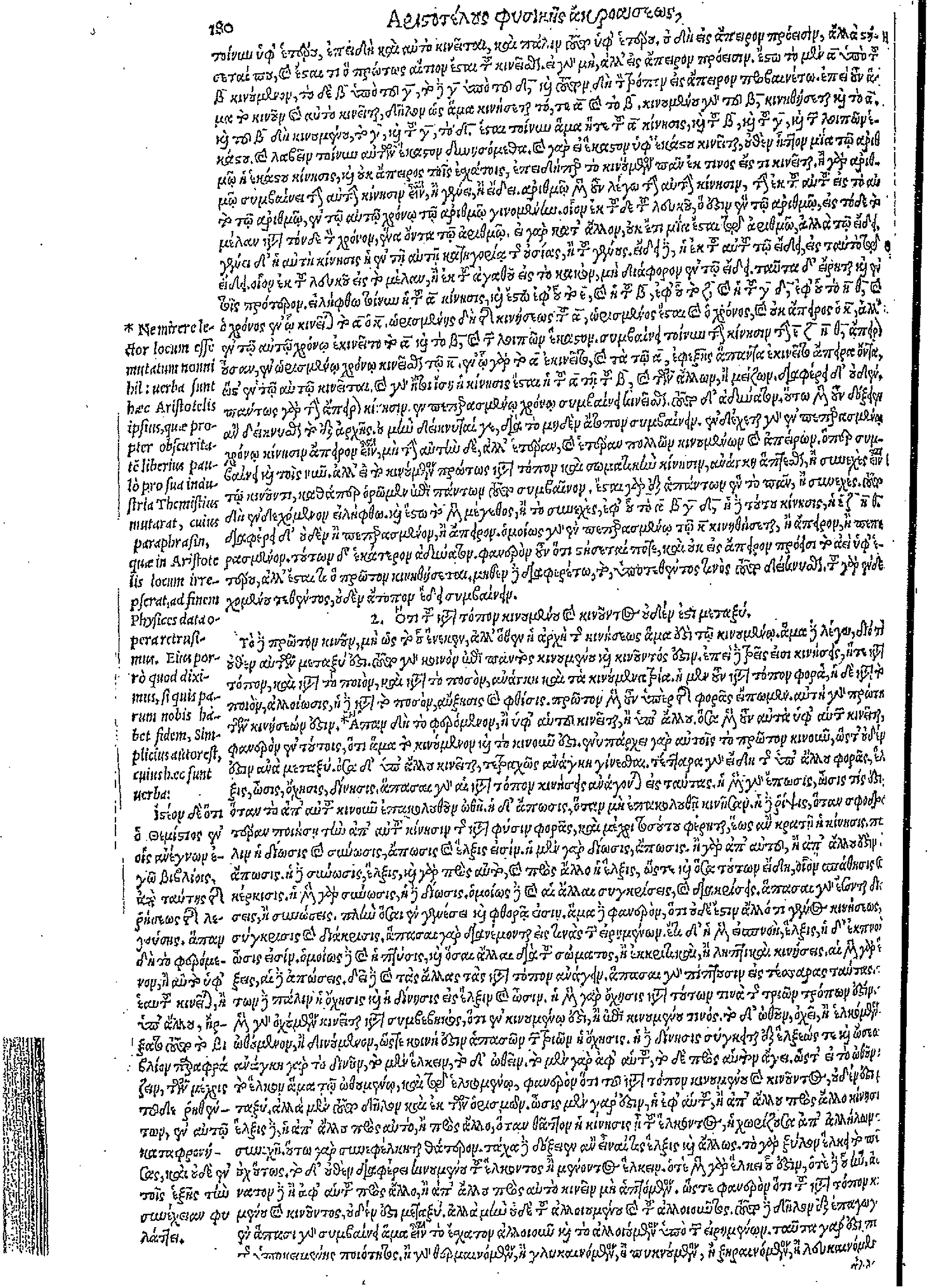
It was only after the Aldine printing of Simplicius’ commentary that the two versions gained Erasmus’ attention for his Basel editions. Erasmus introduces an asterisk at 343a11 (see Plate 4), with a marginal apology in Latin that says, in effect, ‘Don't be amazed, reader, that the passage is somewhat altered. The words are those of Aristotle which, because of their obscurity, Themistius changed a little too freely, whose paraphrase, which had crept into the text of Aristotle, we have put back to the end of the Physics, Simplicius is my source’.Footnote 13 This remark he follows with a quote from Simplicius 1036.15–17 in which, as Ross rightly notes, Erasmus misunderstands the interpretation. Erasmus was able to use Simplicius as his resource for following part of the α version without any apparent acknowledgement of the two-version issues, even though Simplicius makes explicit reference to them but ten lines before. He is thus able to correct the glaring misaccount of the ways that something can be moved by others, which the β version gives in a jumbled fashion and that in the α version is a well-ordered one (243a17 ff., α version; 243a24 ff., β version).
Erasmus' notation
This does not yet speak to the differences between the two versions for chapter l, of which the first printed α version appears as an appendix to the Physics in the Morel edition of 1561 in Paris, apparently using Parisinus 1853 as a MS source. It was not until the nineteenth century, as Ross's recounting of the printing history notes (p. 12 ff.), that the α version was printed as the preferred text, and perhaps not until Ross's own edition that it became accepted as the standard one. Only then was the authority of Simplicius fully acknowledged in the editions.
CONCLUSIONS AND IMPLICATIONS
My aim has been not so much to cast doubt on the parentage of Physics 7 as upon its family status. The ancient commentators indeed regarded it as Aristotle's bastard, but we have no indication that the apparent parent himself ever claimed it. Indeed, there is no evidence from the Peripatetic tradition that immediately followed, from Theophrastus or from Eudemus, that it was then recognized even as a part of the corpus. It is only after the editing by Andronicus, and perhaps because of it, that we have any evidence from ancient times of treating it as a part of the treatise we know as the Physics. The commentators seemed to know something of its chequered history: that there were two versions, one evidently preferred, but neither explicitly authorized; and that (at least on Simplicius’ account) it was inserted into the treatise after the other books were brought together as a single whole, and most certainly after the death of the author. The medievals show no sign of any knowledge of two versions, but from the very earliest MSS we possess, they seem to have struggled with how the final books of the treatise were supposed to fit together, an apparent by-product of the differences between the seven-book tradition before Andronicus and the eight-book tradition afterwards. The moderns apparently never questioned the eight-book tradition, but from beginnings in Erasmus’ renaissance of classical scholarship to Ross's critical edition, they evolved a reconstruction of the two versions, with a clear preference in the end for the α version. That, in sum, has been the burden of my tale.
If that indeed is the tale, what then is the moral? There is an interpretive tradition going all the way back to the ancient commentators that treats Physics 7 in relation to Book 8. This tradition reads the former book in the light of the latter, treating it as an earlier version of the same issues, or as a prolegomenon to them. This interpretation was perhaps the basic reason for the placing of Book 7 in its present position in the treatise in the first place, and was certainly a reason for solidifying its place there. Once in that position, the β version offered more reinforcement for interpretations of the arguments in terms of self-movers and unmoved movers, and this also contributed to the interpretive ties to Book 8. Once seen as separate from the rest of the treatise, the way is open to other interpretations, and if, as Simplicius and Ross concluded, that opens the way to seeing it as earlier that all of the rest of the treatise, that in turn opens the way to different interpretations yet.
Ross notes the references to virtues of the body (mentioned elsewhere only in the Topics) and the entertainment of treating essence in terms of number as indicators of the likelihood of the book's early dating. These indicators seem superficial compared to others that can now come into focus: the absence of any hylomorphic conception of motion, the suggestion of a struggle with conceiving motion in terms of alteration (in the fashion that Plato treated individuals as composites of properties in the Timaeus), the questioning of whether there are any such things as elements, just to name a few. These are all issues clearly present in Physics 7, but they must remain closed to critical scrutiny so long as we insist upon supposing that this book comes after 6 and before 8, either in Aristotle's own inquiry, or in his history of authorship, or in his programme of instruction, or in his conceptual scheme. These are issues that place Book 7 in an order of Aristotle's own conceptual development before the introduction of hylomorphism in the early books of the Physics, and they give some clues about how and why he came to such a conception. That, however, must be another tale, or at least another part of a broader one. Here I have only been concerned to clear the way by exposing more fully the bastard status of Book 7 of the Physics.