




No CrossRef data available.
Trajectories of depressive symptoms and stressful life events among male and female adolescents in divorced and nondivorced families
Published online by Cambridge University Press: 10 February 2006
Abstract
This 11-year longitudinal study models the trajectories of depressive symptoms among approximately 550 females and males raised in divorced and nondivorced families in the rural Midwest. Using multilevel analyses, we demonstrate that, first, depressive symptoms changed according to a curvilinear pattern, especially for females; they increased during early to midadolescence and then declined in late adolescence to young adulthood. Second, compared with males, females experienced a greater number of depressive symptoms in adolescence and early adulthood. Third, children who experienced parental divorce by age 15 manifested a sharper increase in depressive symptoms compared to those from nondivorced families. Fourth, stressful life events children experienced shortly after parental divorce mediated the effect of parental divorce on depressive symptoms. Fifth and finally, time-varying stressful life events, particularly those related to relationship and personal loss, were significantly associated with the trajectories of depressive symptoms.
During the past several years, support for this research has come from multiple sources including the National Institute of Mental Health (MH00567, MH19734, MH43270, MH48165, MH51361), the National Institute on Drug Abuse (DA05347), the Bureau of Maternal and Child Health (MCJ-109572), the MacArthur Foundation Research Network on Successful Adolescent Development among Youth in High-Risk Settings, the Iowa Agriculture and Home Economics Experiment Station (Project No. 3320), and the California Agriculture Experiment Station (CA-D*-HCD-6092-H).
Information
- Type
- Research Article
- Information
- Copyright
- © 2006 Cambridge University Press
Although there is now solid evidence that the emotional effect of parental divorce on children continues well into adulthood (Amato & Keith, 1991; Chase-Lansdale, Cherlin, & Kiernan, 1995; Cherlin, Chase-Lansdale, & McRae, 1998; Cherlin et al., 1991), especially for females (McLeod, 1991), most studies have not examined what actually occurs to the emotional lives of children of divorce in the intervening period. Cross-sectional studies cannot answer this question; even when longitudinal data are available, they tend to be based on infrequent follow-up contacts during the intervening period. Questions remain as to whether and how trajectories of emotional life among boys and girls from divorced and nondivorced families differ during the years of adolescence and young adulthood. The first objective of the present study was to chart developmental changes in depressive symptoms using a longitudinal data from children of nondivorced and divorced families who were interviewed on multiple occasions during this period of time.
Of particular interest in the present study was identification of factors that may differentiate the emotional trajectories of children of divorced families from those of nondivorced families. Many researchers have argued that parental divorce often triggers a series of negative life changes, such as a sudden decline in family income (McLanahan & Booth, 1989; McLanahan & Sandefur, 1994; Simons & Associates, 1996), tumultuous life transitions (Aseltine, 1996; Cherlin & Furstenberg, 1994; McLanahan & Booth, 1989), or protracted parental conflict (Buchanan, Maccoby, & Dornbusch, 1996; Simons & Associates, 1996). In theory, these secondary stressors may become a source of stress for many years after parents have separated or divorced (Aseltine, 1996; Aseltine & Kessler, 1993; O'Connor, Thorpe, Dunn, & Golding, 1999; Pearlin & Johnson, 1977). From this perspective, parental divorce is viewed as a life-course disruption that initiates a chain of stressful circumstances that exacts a toll on children's well-being (Aseltine & Kessler, 1993; Hetherington, Bridges, & Insabella, 1998; Ross & Mirowsky, 1999). The second objective of this study, therefore, was to test the life-course disruption hypothesis by investigating the mediating role of the secondary stressors that accompany parental divorce.
It is also of importance that several studies have noted that certain types of stressful life events appear to be particularly detrimental to mental health (Cicchetti & Walker, 2001; Hammen & Mayol, 1982; Rudolph et al., 2000). Despite this fact, only a limited number of researchers (e.g., Kessler & McLeod, 1984; Gore & Aseltine, 1995; Hammen & Mayol, 1982) have directly investigated the differential effects of various types of life events on changes in depressive symptoms over time. Moreover, the occurrence of such life events fluctuates across time. Although some evidence suggests that trajectories of life events are associated with changes in depressive symptoms in early adolescence (e.g., Ge, Lorenz, Conger, Elder, & Simons, 1994), it is unclear whether the ebb and flow of these stressful life events are also associated with emotional ups and downs over time in late adolescence and young adulthood. The third objective of this study, therefore, was to examine which particular facets of life events are especially disruptive and whether fluctuation in life events over time is associated with changes in depressive symptoms. In the sections that follow, we discuss each of these issues in turn.
Age, Gender, Parental Divorce, and Depressive Symptoms
Age and depressive symptoms
Using five waves of longitudinal data on children from divorced and nondivorced families in Great Britain, Cherlin et al. (1998) modeled trajectories of emotional distress from ages 7 to 33 as a linear curve. Evidence from other studies, however, suggests that the trajectory of depressive symptoms may be curvilinear rather than linear when assessed at more frequent intervals. These studies suggest that, on average, depressive symptoms increase in early adolescence and then either plateau or decline somewhat in late adolescence, a pattern that is particularly evident among girls (Ge et al., 1994; Hankin et al., 1998; Mirowsky, 1996). For example, using a longitudinal data from 1,035 children who participated in the Dunedin Multidisciplinary Heath and Development Study, Hankin et al. (1998) showed that girls' rates of clinical depression rose from ages 11 to 13, became steady between ages 13 and 15, increased again from ages 15 to 18, then leveled between ages 18 and 21. Similarly, Ge et al. (1994) showed that trajectories of depressive symptoms among female adolescents increased steadily from ages 13 to 16, then declined.
These curvilinear findings fit well with current theory. Early adolescence is known to be a period when the widening array of social stressors, coupled with the pubertal transition, often places individuals at heightened risk for emotional distress (Ge, Conger, & Elder, 1996, 2001; Ge et al., 1994). The recognition of greater maturity (e.g., driving privileges, voting status) in late adolescence and further progression of social status (e.g., marriage, employment, and economic well-being) in young adulthood, on the other hand, are expected to reduce emotional distress (Mirowsky, 1996; Pearlin & Johnson, 1977). Based on these theoretical reasons and the aforementioned empirical findings, we hypothesized that depressive symptoms would take a nonlinear shape with higher prevalence in early and midadolescence.
Gender differences in depressive symptoms
Studies have consistently shown that significant gender differences in depressive symptoms emerge in early adolescence (Garber, Keiley, & Martin, 2002; Ge et al., 1994; Hankin et al., 1998; Nolen-Hoeksema & Girgus, 1994; Wichstrom, 1999), with females being significantly more likely to be depressed than males. Similarly, studies conducted among adults reported females' heightened vulnerability to depression (Kessler & Magee, 1994; Kessler & McLeod, 1984; Mirowsky, 1996). It is unclear, however, whether gender differences observed in adulthood are actually a continuation of differences that emerged in early adolescence. An answer to this question requires long-term longitudinal data that track respondents into young adulthood. We are aware of only one study that used this research strategy to study depressive symptoms (Hankin et al., 1998). These authors reported that gender differences in depression emerged around age 13. This difference became noticeable and statistically significant at age 15 and thereafter. On the basis of this finding, we hypothesized that (a) females would manifest higher depressive symptoms than males during adolescent years, and (b) these gender differences would continue into young adulthood.
Parental divorce and depressive symptoms
Most studies of depression among children of divorce involve retrospective, cross-sectional data. In these studies, participants were typically asked to recall whether they had experienced parental divorce in childhood and to describe their mood state at the time of assessment. Using a five-wave longitudinal study, Cherlin et al. (1998) were the first to prospectively model the longitudinal trajectories of depression among children of divorced and nondivorced parents. Their results demonstrated parental divorce continued to have a negative effect on children's emotional well-being in their early 20s and 30s (also see Amato, Loomis, & Booth, 1995). The effect was particularly pronounced for those whose parents divorced when they were children or adolescents. In an earlier study based on the same data, Chase-Lansdale et al. (1995) similarly showed that experiencing parental divorce during adolescence increased the likelihood of being scored above the clinical cutoff for emotional disorders in adulthood. The present investigation extends their research by using a longitudinal data with more frequent assessments during adolescence and early adulthood. The prospective design with multiple and more closely spaced follow-ups represents a distinctive advantage: whereas Cherlin et al. (1998) modeled trajectories of emotional distress as a linear curve, we were able to model changes in depressive trajectories in a nonlinear fashion. Based on these earlier findings, we expected that children of divorced parents would exhibit higher depressive symptoms throughout adolescence and young adulthood than children from nondivorced families.
Stressful Life Events and Depressive Symptoms
Life course disruption hypothesis: Stressful life events as a mediator
Although parental divorce may have a direct, long-lasting effect on children's mental health, there is reason to believe that the stressors that exist immediately after parental separation may play a mediating role in the link between parental divorce and subsequent emotional well-being of children. First, according to the life course disruption hypothesis (Aseltine & Kessler, 1993; Pearlin & Johnson, 1977; Ross & Mirowsky, 1999), one would expect parental divorce to trigger a series of secondary stressors, events that are not limited to the immediate aftermath but that continue to occur for several years. For example, most children live with their mothers after divorce; households headed by mothers generally experience a decline in their standard of living (McLanahan & Booth, 1989). Such decline in income may increase the risk for other undesirable life events such as having to move to a poor and stress-laden neighborhood where crime rates are likely to be high and educational opportunities more limited (McLanahan & Booth, 1989; Ross & Mirowsky, 1999).
Second, experiencing parental divorce may reset the tolerance level for other stressors at a lower threshold, making it more difficult for children to cope with stress later in life (Hammen, Henry, & Daley, 2000; Hammen, Mayol, deMayo, & Marks, 1986). According to Post (1992), for example, once an onset of depression has been triggered by a primary stressor (e.g., parental divorce), a person becomes sensitized to future stressors. In such instances, even a moderate amount of stress could bring about another episode of depression. Thus, the effects of initial stressors surrounding parental divorce on depressive symptoms may well be different from those of subsequent recurrent events (Monroe & Depue, 1991). Drawing upon these lines of reasoning, we hypothesized that initial stressors, that is, stressful live events occurring immediately after divorce, should have a significant effect on depressive symptom trajectories. We also expected these initial stressors to mediate the effect of parents' divorce on depressive symptoms.
Disaggregating stressful life events and their time-varying effects
There are additional reasons for a more concentrated examination of the interlocking trajectories of stressful life events and depressive symptoms. Most of the existing stress research has examined the negative effects of an accumulation of stressful events. This approach is based on the assumption that, regardless of the characteristics of given events, it is the cumulative nature of multiple stressors that overwhelms individuals and adversely influences their emotional well-being (Tausig, 1982). In their classic study, Rutter and Quinton (1977) examined six dimensions of family adversity in two independent populations. These authors discovered that individuals experiencing two or more of family difficulties were far more likely to display psychiatric disorders than those who only experienced one adversity. Similarly, Turner and Lloyd (1995) found that cumulative adversity was significantly associated with major depression and other psychiatric disorders. In this line of research, the number of events is usually aggregated into a single measure of life stress. The problem with this approach, however, is that it may obscure which facets of events are particularly closely intertwined with changes in emotional distress (Kessler & Magee, 1994).
An alternative approach disaggregates stressful life events and emphasizes the differential effects of life events with distinctive characteristics (Paykel, 1979). With this method, life events are grouped into different dimensions such as those related to health or interpersonal problems. Indeed, several studies have reported that qualitatively different events may affect depression differentially (Kessler & McLeod, 1984; Maciejewski, Prigenrson, & Mazure, 2001; Nazroo, Edwards, & Brown, 1997). In their study of 1,036 adolescents in the Boston area, for example, Gore and Aseltine (1995) showed that differentiating domains of stressful events had an added benefit because stressors in different domains appeared to be moderated by distinctive domains of social support. These authors found that interpersonal resources mitigated the negative effects of friendship problems on youths' emotional well-being, but friends' support did not ameliorate the adverse effect of family turmoil. Similarly, by disaggregating life stress into interpersonal, noninterpersonal, and chronic stress, Rudolph et al. (2000) were able to demonstrate that depression was especially associated with interpersonal and chronic stress. These findings underscore the importance of examining the differential effects of different types of life events.
There is also evidence to suggest that disaggregating life events is especially useful for investigating gender differences in reactions to the same stressful events. Evidence from several longitudinal studies suggests that female proneness to depressive symptoms in adolescence and adulthood is probably due to their heightened vulnerability to certain types of life events. For instance, Kessler and McLeod (1984) found that women were more vulnerable than men to negative life events that occurred to significant others because females, these authors argued, have greater emotional involvement in the lives of those around them. Conger, Lorenz, Elder, Simons, and Ge (1993) demonstrated that husbands were more likely distressed by work and financial events while wives were more strongly affected by exposure to negative events within family. Only when stressful events in such domains are differentiated from events occurring in other domains, can gender differences in vulnerability to stressful events be clearly determined. In the current study, therefore, we examined depressive symptoms of males and females separately and focused on the differential effects of stressful life events in three domains including health, relationship events, and life events occurred to respondents themselves.
Moreover, disaggregating life events may provide additional insights into their timing and influence, as life events in certain domains may be particularly likely to occur at particular time during the life course. This approach is especially consistent with developmental psychopathology perspective that acknowledges changes in risk and protective processes over time, as type, incidence, and prevalence of stressors vary during different developmental periods (Cicchetti & Rogosch, 2002). For example, Monroe, Rohde, Seeley, and Lewinsohn (1999) demonstrated that a recent romantic breakup predicted the first onset of major depression among adolescents. The time-varying nature of stressful life events has rarely been investigated, however. In this study, we explored how fluctuations in the three domains of stressful life events (i.e., health, relationship, and personal events) were associated with trajectories of depressive symptoms across the years of adolescence and young adulthood. We hypothesized that changes in stressful life events would be associated with changes in depressive symptoms. In keeping with Kessler and McLeod (1984), we expected that the strength of the association between stressful life events and changes in depressive symptoms would vary depending on gender and life event domains.
We begin the study by first presenting some descriptive statistics on mean scores of depressive symptoms and stressful life events across the years of adolescence and early adulthood. These analyses also consider mean differences by gender and family structure. Second, we formally model the developmental trajectories of depressive symptoms and test the gender and family structure differences in these trajectories using multilevel modeling procedures. Third, we demonstrate the importance of initial levels of stressful life events in mediating the effect of divorce on adolescents' depressive symptoms and examine their longitudinal significance. Fourth, we examine the interlocking nature of stressful life events and depressive symptoms by introducing stressful life events occurring at various ages as time-varying covariates.
Methods
Sample and procedures
This study is based on the data from approximately 550 rural adolescents in Iowa, who were followed longitudinally at various time points for 11 years (1989–1999). These youths came from a combination of three research projects: the Iowa Youth and Families Project (IYFP), a four-wave study of 451 rural seventh graders living in nondivorced families when the project was initiated in 1989 in central Iowa (yearly interviews in 1989, 1990, 1991, and 1992); the Iowa Single-Parent Project (ISPP), a three-wave study of 207 rural 8th–9th graders from families headed by single mothers whose parents had divorced within the past 2 years when the project was initiated in 1991 also in Iowa (yearly interviews in 1991, 1992, and 1993); and the Family Transitions Project (FTP), initiated in 1994, that combined the two above-mentioned projects by matching the adolescents who were the same age and were in the ninth grade in 1991 (N = 559, interviewed in 1994, 1995, 1997, and 1999).
The IYFP participants were recruited in 1989 through the seventh grade classes of 34 public and private schools in eight counties in Central Iowa. A family was eligible for the study if a seventh grader was living with both biological parents and had a sibling within 4 years of his or her age. About 78% of the eligible families agreed to participate in the initial wave of data collection in 1989. Of the original 451 families, 406 (90.0%) remained in the IYFP in 1992. Additional details regarding the sample are presented in Conger and Elder (1994). The ISPP participants were identified through lists of students provided by schools in rural areas of Iowa (excluding urban areas and university communities). Telephone calls were made to mothers who were household heads. To match the family characteristics of the IYFP participants, a family was eligible to participate if (a) there was a target child in eighth or ninth grades in 1991, (b) the biological parents had divorced within the past 2 years, and (c) the target child had a sibling within 4 years of his or her age. Fifteen percent of women who were telephoned met all the requirements due to these stringent criteria. Of those who met the study criteria, 99% agreed to participate. All adolescent participants from the ISPP lived in households headed by mothers. All but one mother (98%) considered the mother's home as the primary residence of children. The majority (94%) of fathers kept in contact with their children. In 1991, the legal custody arrangement of the target child was joint custody (58%) or sole maternal custody (33%). Nine percent of them reported that they did not have legal arrangement. Additional details about the sample are presented in Simons and Associates (1996).
The IYFP and ISPP families shared comparable demographic characteristics, including mother's age (M = 39.8, IYFP; M = 38.3, ISPP), level of mothers' education (M = 13.4, IYFP; M = 13.4, ISPP), number of children (M = 3.1, IYFP; M = 3.1, ISPP), age of the target children (M = 14.6, IYFP; M = 14.3, ISPP), percentage of target children who were female (52.8%, IYFP; 52.6%, ISPP), percentage of mothers employed (82.6%, IYFP; 80.3%, ISPP), and the number of hours per week spent working outside the home (M = 31.5 hr, IYFP; M = 32.5 hr, ISPP). Several differences, however, exist between these two samples. First, as expected, households headed by single mothers had lower income in the ISPP ($24,281) than the nondivorced families in the IYFP ($39,116) in 1991. In the present study, we included household income in 1991 as a covariate to examine its possible confounding effect. Second, divorced families (ISPP) lived in slightly larger communities than married families (IYFP). Because previous studies using the combined data of the IYFP and ISPP have shown that size of community did not influence the magnitude of the associations between study variables (Simons & Associates, 1996), we did not include community size as a covariate. Nine target participants of the IYFP whose parents divorced before 1991 were combined with the participants from the ISPP to form the divorced group. There were 38 target participants in the IYFP whose parents divorced after 1991. These individuals were not classified in the divorced group in this study because their parental divorce occurred after early adolescence; instead they were assigned to the nondivorced group. To ensure that this classification did not significantly alter the results, we compared the results using two alternative classification schemes, one in which these individuals were assigned to the nondivorced group and the other in which they were excluded. We found that the study results did not differ. Thus, we decided to keep these participants as the nondivorced group in the following analyses.
Both the IYFP and ISPP participants followed similar procedures. At each wave of data collection, the interviewers visited each family at home for approximately 2 hr on each of two occasions. During the first visit, each of the family members completed a set of questionnaires focusing upon individual characteristics and emotions, family processes, and economic circumstances. During the second visit, the family was videotaped while engaging in several different structured interaction tasks. Only data collected from the first home visit at each wave were used in the present study.
Age as the unit of analysis
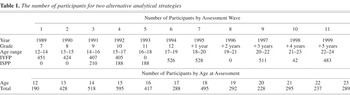
An important challenge facing the present study involves the classic methodological issue of cohort-sequential design: that is, whether to analyze data by data collection wave or by age at assessment (see Nesselroade & Baltes, 1979; Schaie, 1965, for detailed discussion). We chose to analyze the data by age at assessment for both substantive and methodological reasons. Substantively, analyzing the data by age at assessment is consistent with the goal of this study to map age trajectories of depressive symptoms, whereas analyzing the data by wave would ignore potentially important individual age variation within each wave. Methodologically, analyzing the data by age at assessment would help circumvent, at least in part, the limitation of skipping certain years in data collection. As shown in Table 1, nine waves of data were collected from the IYFP families, whereas eight waves of data were collected from the ISPP families over 11 years for budgetary and logistics reasons. The years that were skipped yielded no data for analysis (i.e., 1989 and 1990 for the ISPP; 1993 for the IYFP; 1996 for the FTP, see Table 1). In 1998, only a very small number of the participants (n = 42) were contacted, which made analysis by wave very difficult. Thus, there were only eight and seven waves of data, for IYFP and ISPP, respectively, collected fully in the 11-year study period. Analyzing the data by age at assessment takes advantage of the age variation within waves and helps bridge the data gap in years without assessment. In this study, we analyzed the data using hierarchical linear model (HLM) framework where the invariance of number of participants and the timing of assessment (i.e., everyone has to be assessed at the same time) are not required (Raudenbush & Bryk, 2002). Although not shown in the present paper due to space limitation, we compared the two alternative methods and found that modeling depressive symptoms by age at assessment provided more reliable parameter estimates than modeling them by wave.
The number of participants for two alternative analytical strategies

Attrition and missing data
As shown in Table 1, 483 of the original 661 participants (73%) continued their participation in the panel by 1999. To examine possible impact of attrition, we have conducted a series of attrition analyses comparing those who dropped out and who remained in the study. Our analyses indicated that individuals who dropped out in the later waves did not differ significantly from those who remained in this study in our dependent variable, depressive symptoms. This result is important because it suggests that the observed decline in depressive symptoms in later adolescence and early adulthood is not due to selective attrition. As found in many longitudinal studies, however, they differed in two independent variables: parental divorce and stressful life events. That is, those who continued participation were more likely from nondivorced families and reported experiencing less stressful life events than those who dropped out. We decided not to perform multiple imputation for missing data because, as shown in Table 1, data were not collected in certain years for certain projects. Such a massive imputation appears to be less justified, especially when data collection was skipped for entire waves. Moreover, the use of the HLM procedures helps partially circumvent the missing data problems because a distinguishing advantage of the HLM technique involves its allowance for varying number, timing, and spacing of measurement occasions across participants (Raudenbush & Bryk, 2002).
Measures
Parental divorce
In this study, parental divorce was represented by a dummy variable (1 = divorced, 0 = nondivorced). We focused on parental divorce that occurred before the participants became age 15. Individuals whose parents divorced included all adolescents (N = 207) from the ISPP and nine adolescents of the IYFP whose parents divorced before they reached age 15. Those participants whose parents divorced before age 15 received a score of 1 and the others a score of 0.
Depressive symptoms
Adolescents completed the depression subscale from the Symptom Checklist-90—Revised (SCL-90-R). This subscale has demonstrated reliability and validity (Derogatis, 1983), and has been successfully used in many previous studies with adolescents (e.g., Compas, Slavin, Wagner, & Vannatta, 1986; Ge et al., 1994; Kandel & Davies, 1986). The subscale includes 12 symptoms that assess depressive affect experienced during the past week. Due to our concern about parental objection, we omitted the item about “loss of sexual interest” during the first several waves when our target subjects were teenagers. Although this item was assessed in the later waves of data collection, it was not used in this analysis to maintain the consistency. On a 5-point scale ranging from not at all (0) to extremely (4), adolescents were asked to indicate to what extent they were bothered by each of the 12 symptoms (e.g., “feeling blue,” “crying easily”) during the past week (statistical range = 0–48). The subscale was internally consistent across all waves of data collection (α = .89, Wave 1; α = .88, Wave 2; α = .89, Wave 3; α = .92, Wave 4; α = .91, Wave 6; α = .92, Wave 7; α = .92, Wave 9; α = .91, Wave 10; α = .89, Wave 11). The prevalence rate for these participants is fairly low when diagnoses were conducted in 1999, indicating that this was a relatively normative sample (Rueter, Scaramella, Wallace, & Conger, 1999).
Stressful life events at the inception of the studies
Stressful life events were assessed using the Junior High Life Experiences Survey (JHLES) developed by Swearingen and Cohen (1985a). The JHLES has demonstrated validity and has been used in several other studies (e.g., Swearingen & Cohen, 1985b). Because of the importance of peers to adolescents, we added several items about close friends to the JHLES list. Given previous research indicating that undesirable life events are more likely to be related to psychological and physical problems than desirable ones (Compas, 1987), items that were reported to be desirable (e.g., received academic honors) in Swearingen and Cohen's (1985a) measure were eliminated from the list. Items pertaining to parental divorce was dropped to avoid any confound. Adolescents were asked to indicate whether any of the remaining 39 events (e.g., a close friend moved away) occurred to him/her during the past 12 months. Affirmative responses were then summed to form the life events scale with a statistical range of 0–39.
Time-varying stressful life events
For consideration of age appropriateness, we did not measure the exact same list of life events across all theses years: some events were not included in subsequent assessment waves (e.g., school events) while other events were added. Twenty events, however, were consistently assessed for every wave of the data collection for both IYFP and ISPP. The participants were asked at each wave to indicate if any of 20 negative events had occurred to them in the past 12 months (i.e., a friend died, a pet died, a sibling died, a relative died, parent was ill/injured, a friend was ill/injured, a sibling was ill/injured, a relative was ill/injured, a close friend moved away, broke up with a friend, broke up with boy/girl friend, argue with boy/girl friend, parents divorced/separated, suspended from school, not accepted by classmates/coworkers, got fired or laid off from work, was ill or injured, had trouble with the law, argued with parents, became a crime victim). We thus included these 20 events in the subsequent analyses to maintain the comparability and consistency across waves.
These 20 events were grouped into three major categories:
- death, illness, or injuries that have occurred to a person who is significant to the respondent, including a friend, parents, brothers/sisters, or a relative (range = 0–8);
- relationship events ranging from events such as having an argument with a boy/girlfriend, having an argument with a parent, breaking up with a boy/girlfriend and/or a friend, having a friend who moved away, or parental separation or divorce during the past 12 months (range = 0–7); and
- events of a stressful nature that have occurred to the respondent him/herself (range = 0–5), including being suspended from school, getting into trouble with the law, becoming a victim of a violent crime, getting seriously ill or injured, and getting fired or laid off.
The average number of health-related events experienced by the participating adolescents per year was 0.91 (SD = 1.00) for males and 1.01 (SD = 0.95) for females. The participants reported experiencing an average of 1.02 (SD = 1.01) and 1.29 (SD = 1.21) relationship-related events per year, for males and females, respectively. The average number of stressful personal events per year was 0.36 (SD = 0.57) for males and 0.25 (SD = 0.43) for females. As expected, the three categories of events were modestly correlated, with an average magnitude of correlations of 0.15, suggesting that multicolinearity was not a significant analytical concern.
Results
Depressive symptoms and stressful life events by gender and parental divorce
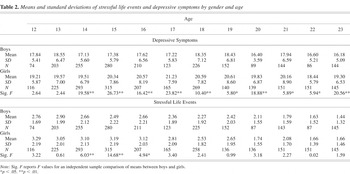
Table 2 provides means and standard deviations of depressive symptoms and stressful life events for males and females at each age. As shown in the table, depressive symptoms among females appeared to increase throughout middle adolescence. These symptoms peaked at age 17, plateaued until age 19, and declined thereafter. This pattern of increase during adolescence is quite similar to the findings reported by Hankin et al.'s (1998) study using clinical diagnostic criteria. The decrease in depressive symptoms around 20 years of age is also consistent with the results reported by Mirowsky (1996), who found that depression decreases in young adulthood. For males, there was no clearly discernable pattern of increase in depressive symptoms, except a small spike at ages 18 and 19, perhaps due to the school transition around these ages.
Means and standard deviations of stressful life events and depressive symptoms by gender and age

An analysis of variance (ANOVA) test indicated that, overall, there were significant gender, F (1, 4300) = 31.82, p < .01, and age differences, F (12, 4376) = 2.53, p < .01, in depressive symptoms. However, the Gender × Age interaction was not statistically significant (F = 1.25, p = 0.24), indicating that similar to the female pattern, males' depressive symptoms appeared to also decline when they entered young adulthood. As shown in Table 2, significant gender difference emerged at age 14 (F = 19.58, p < .01) when females started reporting significantly more depressive symptoms than did males. This significant gender difference continued through age 23 (F = 20.56, p < .01), consistent with results reported by Ge et al. (1994).
An ANOVA test indicated that, overall, there were statistically significant differences for gender, F (1, 4282) = 8.08, p < .01, and for age, F (1, 4257) = 20.97, p < .01, in reported stressful life events, although the average number of the initial stressful life events was not statistically different between girls (M = 6.95, SD = 4.32) and boys (M = 6.86, SD = 4.29). Specifically, females experienced significantly more stressful life events than did their male counterparts at ages 14 (F = 6.03, p < .01), 15 (F = 14.68, p < .01), and 16 (F = 4.94, p < .05), as shown in Table 2. These gender differences attest to the tumultuous nature of adolescence for girls. However, there was no significant Gender × Age interaction, F (12, 4257) = 1.42, p = .15, suggesting that the general pattern of change reported by both genders was quite similar: the number of stressful life events declined steadily from early adolescence to young adulthood for both males and females.
Youths whose parents divorced in early adolescence reported, overall, significantly more depressive symptoms than their peers from nondivorced families at ages 14 to 21, F (1, 4300) = 8.63, p < .01. This was particularly the case when they were 14 (F = 11.09, p < .01), 15 (F = 7.87, p < .01), and 16 (F = 4.95, p < .05) of age. Youths whose parents divorced, overall, also reported experiencing significantly more stressful life events, F (1, 4281) = 25.00, p < .01. Further investigation indicated that this difference was especially pronounced at ages 14 (F = 64.82, p < .01), 15 (F = 49.69, p < .01), 16 (F = 21.09, p < .01), and 17 (F = 10.77, p < .01), and then again at age 23 (F = 4.88, p < .05). Although the differences in depressive symptoms and life events were apparent at ages 12–13, they were not statistically significant, probably because of the extremely small number of divorced cases. The effects of gender and parental divorce were tested without controlling the autocorrelated multivariate nature of the longitudinal data, however. We thus view these comparisons as preliminary results. To more accurately estimate the gender and divorce effects, we used multilevel analytical techniques and examined the coefficients separately by gender. The results are reported in the following sections.
Intraindividual changes in depressive symptoms
To model the age trajectories, we first estimated a fixed effect model for the age curve for depressive symptoms in the following form:

where the coefficients β0, β1, and β2 represent the intercept, linear, and quadratic slopes, respectively, that together describe the age curve for depressive symptoms. Because of gender and divorce effects noted earlier in depressive symptoms and stressful life events, we estimated above age-curve model for males and females in divorced and nondivorced families separately. Four estimated equations describe the age curves for males and females in divorced and nondivorced families:
males in divorced families,

males in nondivorced families,

females in divorced families,

and females in nondivorced families,

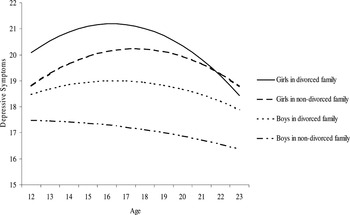
Using the parameters estimated in these equations, we graphed the age trajectories of depressive symptoms for each of these four groups (Figure 1). As shown in this figure, there were several observable gender and family structural differences in age trajectories of depressive symptoms. First, overall levels of depressive symptoms are significantly higher for females than for males (t = 3.52, p < .01 for linear age), as apparent within both divorced and nondivorced groups. Second, adolescent males and females whose parents divorced during early adolescence had a higher overall level of depressive symptoms than that of males in nondivorced families (t = 2.42, p < .05 for linear age). However, their overall symptom levels were not significantly different from those of females in nondivorced families. Third, the shapes of the age trajectories differ systematically between those from divorced and those from nondivorced families, with adolescents in divorced families manifesting a sharper increase in depressive symptoms until age 17, compared to their peers from nondivorced families.

The trajectories of depressive symptoms by gender and parental divorce status.
Interindividual differences in intraindividual changes in depressive symptoms
The fixed effect model for age trajectories of depressive symptoms can be easily expanded to a multilevel model that allows the effects of age to vary by individual. Using the terminology of HLM (Raudenbush & Bryk, 2002), the Level 1 model for depressive symptoms at age t for person i, controlling for household income is (Model 1)

Note that now β0i, β1i, β2i, and β3i are indexed by i, in addition to time t. This allows these effects to vary by individual. We allowed β0i (the intercept in the Level 1 model) to vary by individual so that the overall level of depressive symptoms is now a function of the individual. We allowed β1i (the linear slope) and β2i (the quadratic slope of depressive symptoms) to vary by individual so that the change rates may differ according to characteristics of each individual, such as parents' marital status (divorce) for person I. Thus, the Level 2 equations are
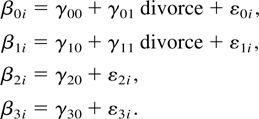
The ε0i, ε1i, ε2i and ε3i are unobserved error terms or random effects. We assumed that the ε0i, ε1i, and ε2i are multivariate normal with means of zero and autoregressive lag = 1 variance–covariance matrix. In this model, β0i represents the overall level of depressive symptoms for person i, which was expected to vary by the parents' divorce status (DIVORCE). Thus, β1i represents the linear slope for depressive symptoms of an individual, which was also expected to vary by parents' divorce status. In contrast, β2i represents the quadratic slope for depressive symptoms, which models the curvilinear shape of the trajectories, and β3i represents the main effect of the controlled variable, household income.
Note that although this model is expressed at each level, it is actually only one model; to see this, we may substitute the Level 2 equations for the βs in the Level 1 equation for Model 2:

This presentation of the model is likely to be more intuitive to those most familiar with single-level analysis. To examine the mediating role of stressful life events occurring immediately after divorce, we added initial stressors and a statistical interaction between initial stressors and age. Thus, coefficient γ02 indicates the main effect for initial stressors and coefficient γ12 indicates the interaction of initial stressors with age for Model 3:

To extend this model further, we may add time-varying covariates such as stressful life events experienced at different points in time to test the interlocking nature of life events and depressive symptoms over time for Model 4:

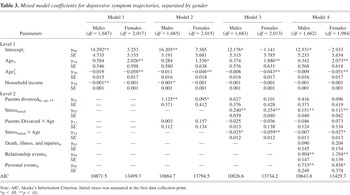
To evaluate our hypotheses, we tested the abovementioned four models: Model 1 is simply a fixed-effect model for age, which includes an intercept, a linear, and a nonlinear parameter for age. Model 2 adds a main effect of parents' divorce status and its interaction with age to those estimated in Model 1, while allowing random effects, to see if parental divorce increased overall level of depressive symptoms among adolescents. An interaction between parental divorce and age at assessment was included to examine if the effect of parental divorce increased or decreased as individuals aged. Model 3 examines whether initial level of stressful life events mediated the divorce effect and whether the divorce or stress effects change with age. Model 4 adds three time-varying stressful life events assessed at each age. The purpose of this model was to examine whether time-varying stressful life events had any additional negative effects on trajectories of depressive symptoms after initial level of stressful events and parental divorce were statistically controlled. To make sure that differences in family income did not confound the effects of divorce and stressful life events, we included household income as a covariate in all four models. Table 3 presents the estimated parameters for the four models, separately by gender of the respondents. The parameter estimates are analogous to unstandardized coefficients typically reported in multiple regression, which indicate increase or decrease in depressive symptoms with a unit increase of the independent variables. For instance, the coefficient for parental divorce among males in Model 3 are 1.125 (p < .01), suggesting that among males, those whose parents had divorced during early adolescence had, on average, 1.125 more depressive symptoms than those from nondivorced families.
Mixed model coefficients for depressive symptom trajectories, separated by gender

As shown in Table 3, the coefficients for Model 1 are the parameters of age curves for males and females separately, that can be used to reconstruct the males' and females' trajectories of depressive symptoms across age. The significant coefficients for the quadratic term among females suggest that the nonlinear pattern fits females' trajectories of depressive symptoms quite well. Model 2 shows that, compared to their same-gender peers from nondivorced families, males and females whose parents divorced by age 15 had a significantly higher overall level of depressive symptoms (γ01 = 1.125, p < .01, males; γ01 = 0.965, p <.05, females). This divorce effect, however, disappeared when their accompanied stressful events (stressinitial) and their statistical interaction with age were included in Model 3. Interestingly, the significant coefficients for initial stressful events (γ02 = 0.240, p < .01, males; γ02 = 0.254, p < .01, females) suggested that those stressful life events experienced at the same time as, or short after, their parents divorced mediated the relationship between parental divorce and children's depressive symptoms. In addition, the significant but negative coefficients for Initial Stress × Age interaction suggest that the effect of initial stressful life events diminished as the adolescents aged (γ12 = −0.025, p < .05, males; γ12 = −0.059, p < .01, females). Testing of statistical interaction reveals that the coefficients for initial stress did not differ significantly between males and females, t (1) = 0.67, p > .05, suggesting that the initial stressful events significantly affected both gender.
Finally, the inclusion of the three dimensions of time-varying stressful life events in Model 4 suggests that relationship events (γ04 = 0.904, p < .01, males; γ04 = 1.294, p < .01, females) and events that occurred to the respondents themselves (γ05 = 0.733, p < .01, males; γ05 = 0.858, p < .05, females) were significantly related to increase in depressive symptoms. Contrary to our expectation, however, no significant effect was obtained for health- and death-related events for males and females, perhaps due to their low occurrence. Although the magnitude of the unstandardized coefficients was generally larger for girls than for males, statistical tests indicated that they were not statistically significant, suggesting that these events had similar effects on both gender.
Discussion
Although there is now a consistently documented negative effect of early parental divorce on adolescent and young adulthood emotional well-being, surprisingly little empirical effort has been made to chart the trajectories of life stressors and consequent emotional ups and down over time. The present investigation was undertaken to examine the trajectories of depressive symptoms over 11 years from adolescence to early adulthood and several risk factors that were hypothesized to influence these trajectories. Using hierarchical linear modeling techniques, we analyzed changes in depressive symptoms by paying special attention to the roles of age at assessment, parental divorce, gender, and initial and time-varying stressful life events. It was our expectation that depressive symptoms would be disproportionately distributed across age, gender, and parental marital status. We expected that these differences be explained, at least in part, by the unequal distribution of stressful life events, particularly life stressors that occurred around the time of parental divorce. The following findings emerged from our results.
First, trajectories of depressive symptoms during adolescence and young adulthood appear to take a curvilinear pattern with a higher prevalence in mid- to late adolescence. This curvilinear pattern is more consistent with age trajectory of depressive symptoms among females than males. Although this finding seems so beguilingly self-evident that there is little need to spell it out, what we have learned serves to bridge the knowledge gap between the existing literature on age trajectories of depressive symptoms in adolescence (Ge et al., 1994; Hankin et al., 1998; Wichstrom, 1999) and adulthood (Mirowsky, 1996). It also underscores the importance of studying the depressive phenomenon during adolescence when this phenomenon becomes prevalent. The decrease in depressive symptoms during the transition out of adolescence is especially interesting. Indeed, several studies with adults have shown that a number of changes in early adulthood are associated with decline in depressive symptoms in adulthood, such as entering the work force, establishing stable relationship, achieving independence, and increasing sense of control (Mirowsky & Ross, 1992; Schieman, Van Gundy, & Taylor, 2001). The attainment of greater recognition as an adult, along with greater rights and prerogatives consistent to that status, may also help to explain this decrease.
Second, this study found that gender difference in depressive symptoms is not limited to adolescence, but it persists into young adulthood. Similar to the findings reported by Garber et al. (2002) and Hankin et al. (1998), females manifested more depressive symptoms throughout the study period. This finding is particularly consistent with the suggestion by Nolen-Hoeksema and Girgus (1994) in that the origin for the preponderance of depression among female adults can be, at least in part, traced back to the period of adolescence when this difference first emerges. With data spanning across adolescence and young adulthood, the present results provide support for their argument (also see Ge et al., 1994; Hankin et al., 1998; Wichstrom, 1999). A substantial number of studies on gender differences in adult depression simply ignored such a preexisting difference and presumed that these gender differences arose exclusively from adult life circumstances. In keeping with Nolen-Hoeksema and Girgus (1994), our findings serve as a powerful reminder of the need to consider such preexisting differences in the study of gender differences in adult depression.
Although more research efforts are needed to clarify the mechanisms underlying the emergence of gender difference in depressive symptoms in early adolescence, we speculate that pubertal maturation may play a role. According to Nolen-Hoeksema and Girgus (1994), girls become more vulnerable to depression than boys when their existing susceptibilities are combined with new risks during the biological and social transitions in early adolescence. As an important transition, puberty presents social, psychological, and biological challenges to early adolescents that may amplify girls' preexisting proneness to depression. Consistent with Nolen-Hoeksema and Girgus (1994), several studies have reported that early maturing girls are at heightened risk of developing depressive symptoms (Ge et al., 1996, 2003) and that pubertal timing plays a role in explaining the emergence of gender differences in depressive symptoms (Ge et al., 2001). Future research will need to clarify whether the effects of pubertal transition on depressive symptoms vary among boys and girls in divorced and nondivorced families.
Third, individuals experiencing parental divorce in early adolescence are at a significantly higher risk than those from nondivorced families for the development of depressive symptoms. The results show that those who had experienced parental divorce by age 15 manifested significantly higher levels of depressive symptoms than their peers from nondivorced families. This finding is consistent with the reports by Chase-Lansdale et al. (1995) and Cherlin et al. (1998). Furthermore, we found that girls whose parents divorced reported a sharper increase in depressive symptoms compared to their peers from nondivorced families. Although differences in depressive symptoms between females from divorced and nondivorced families appear to be diminishing as they enter young adulthood, males who experienced parental divorce in early adolescence continue to show a significantly higher level of depressive symptoms than their male peers who did not experience the parental breakup. This result extends the findings reported by Cherlin et al. (1998) and by Chase-Lansdale et al. (1995) that showed a significant long-term effect for the early experience of parental divorce.
Fourth, this study found that the initial level of stressful life events during the time of divorce appears to be an important predictor of the trajectories of depressive symptoms (Petersen et al., 1993). More importantly, the association between parental divorce and adolescents' depressive symptoms was mediated by stressors experienced around the time when their parents divorced. The finding is consistent with the life disruption hypothesis that stressful life events occurring concurrently with, or shortly after, parental divorce are more directly detrimental to a child's mental health than divorce per se. In other words, parental divorce may trigger a series of stressors, such as moving to a poorer neighborhood, which could further affect a child's mental health. Stressful life events and circumstances, as Pearlin (1989) has argued, are deeply rooted in the structured contexts of people's lives. Our findings are consistent with Pearlin's (1989) argument in that stressful encounters were disproportionately high among children of divorced parents in the years after divorce, and that these stressful occurrences and circumstances appeared to mediate the effect of parental divorce.
Another important implication yielded by these findings involves the specification of time. Most of the previous studies testing the life disruption hypothesis were cross-sectional, and thus unable to clearly specify the timing of stressful life events that accompany parental divorce. We found that the effect of parental divorce on depressive symptoms was largely explained by stressful life events that happened within 2 years of parental divorce. In other words, stressful life events that occurred shortly after divorce appeared to significantly increase vulnerability to depressive symptoms among children of divorced parents.
Fifth, most previous studies only examined the effect of stressors at a fixed point in time and as an undifferentiated cluster of life events. This study examined interlocking trajectories of depressive symptoms and stressful life events using life events experienced between ages of 12 and 23 as time-varying covariates in multilevel modeling. The results indicated that variations in stressful life events over time were significantly related to the pattern of changes in depressive symptoms, particularly for events that directly involved interpersonal relationships and personal domains. These findings are not only consistent with the existing literature suggesting the interlocking nature of life events and depressive symptoms (Garber et al., 2002; Ge et al., 1994), but also shed new light on this issue in that the distinct dimensions of stressful life events intertwine differentially with the trajectory of depressive symptoms (see Rudolph et al., 2000). Unexpectedly, the effect of life events related to death and illness did not reach statistical significance as a predictor of the trajectory of depressive symptoms. This unexpected finding may be due to their infrequent occurrence. After all, life events involving romantic upheavals are much more common than death of a family member in adolescence (Kendler et al. 1995).
Limitations and future directions
Caution should be exercised in interpreting and generalizing the present results. First, the current study used measures of the SCL-90-R depression subscale throughout the study period to measure depressive symptoms. Although the consistent use of the same scale over time is required in the analysis of longitudinal data using the multilevel modeling, Avenevoli and Steinberg (2001) cautioned that depressive symptoms may be manifested differentially across developmental periods. Future studies examining continuity and changes in the course of depressive symptoms should investigate the possibility of heterotypic continuity (Cicchetti & Toth, 1998). Because the SCL-90-R is a measure of current psychological distress that measures depressive symptoms exhibited within the past week, the intervening period between the assessments may have been overlooked. Moreover, there is limited validity of specificity in the Depression subscale of the SCL-90-R, as Compas, Ey, and Grant (1993) suggested that symptoms of anxiety are often exhibited in adolescents who report depressive symptoms. Although the SCL-90-R can be used for adolescents at 13 years of age or older, it was mainly designed for adults rather than adolescents. It is also important to note that the current findings should not be generalized to clinical populations because the SCL-90-R depression subscale was likely to have measured generalized negative mood rather than clinical depression.
Second, it should be acknowledged that our categorization of life events by the dimensions only represents a preliminary attempt. Although we are confident that distinct dimensions of life events are differentially interlocked with the trajectory of depressive symptoms, we are less certain about how various life events should best be categorized. More efforts are needed to unravel the nature of stressful life events in future research. Some stressful life events, such as problems in close relationships, may be indicative of psychopathological state. Individuals with higher levels of depressive symptoms also may select themselves into stressful situations that further exacerbate their psychopathology. Although the fact that participants reported stressful life events that occurred during past 12 months and their depressive symptoms in the past week may imply a temporal sequence, extreme caution should be exercised when we attempt to make any causal inference. Third, the variables used in this study were based on adolescents' self-report. Caution about possible method variance should be exercised when interpreting the results.
It should be noted that marital conflict leading up to divorce and parent–adolescent relation after divorce have been indicated as an important contributor to children's problems (Amato & Keith, 1991; Amato, Loomis, & Booth, 1995; Hetherington et al., 1998). Although this study was not able to examine the predivorce marital conflict due to the lack of such information, our findings of interlocking association between relationship domain of the stressful life events and depressive symptoms suggest an important direction. The next step of this research should involve a more fine-tuned investigation of how family processes such as ongoing conflict, multiple divorce, remarriage, and parent–adolescent relations mediate or moderate the adverse effect of divorce on individuals' developmental outcomes.
It is important to emphasize that generalization of the present findings is limited due to the sample characteristics. Our participants were from a rural European American population with relatively low levels of depressive symptomatology and most of them made their transition to early adulthood successfully (e.g., entering college or the work force and forming satisfying relationship). Generalization of the current findings to clinical depression or to urban population, therefore, is limited. Comparative or replication research is warranted to investigate whether patterns observed in this study also can be obtained in African, Hispanic, and Asian American samples. Moreover, the current analyses were based on the data contributed from two matched samples at various points in time. Although, as we mentioned previously, these samples were designed to be comparable, it would have been ideal if data were collected every year over the 11 years for both samples. Because only eight waves of the IYFP and seven waves of the ISPP data were collected, we used age at assessment to partially circumvent the problem with missing data at certain years. Future research with data from all participants collected at each of the assessment waves would provide better estimation.
Despite these limitations, the present findings contribute to our understanding of the depressive phenomenon over 11 years during adolescence and early adulthood. The results emerging from the current study suggest that, consistent with Cherlin et al. (1998) and Chase-Lansdale et al. (1995), the pattern of change in depressive symptoms during adolescence and young adulthood is significantly affected by parental divorce experienced during early adolescence. Consistent with the life course disruption hypothesis, this detrimental effect of parental divorce, however, was mediated by the stressful events occurring around the time of divorce, suggesting that it is these secondary stressors triggered by parental divorce, not parental divorce per se, that put individuals at heightened risk of developing depressive symptoms over time. Empirical support for the mediating role of secondary stressor after divorce has been primarily reported in cross-sectional data (Aseltine, 1996; McLanahan & Booth, 1989; Simons & Associates, 1996). A distinguishing feature of the present study is its ability to demonstrate such a mediation using long-term prospective data with frequent assessments.
By using such long-term prospective data, this study allows identification of a curvilinear pattern of change in depressive symptoms, a pattern that fits especially well for females. The current findings help bridge the study results from adolescence to young adulthood. A unique contribution of this study involves its differentiated examination of stressful life events and its attention to change in these events over time. Unlike previous studies that viewed stressful life events as a static variable at a fixed point in time, this study recognized stressful life events as a change phenomenon and examined them as time-varying covariates. We found changes in depressive symptoms to be significantly associated with fluctuations in stressful life events involving interpersonal relationship and personal events during these 11 years of important lives of our participants. The finding of a significant effect of relationship events on changes in depressive symptoms also provides further support for Rudolph et al. (2000) on the importance of interpersonal processes in the emergence, perpetuation, and recurrence of depression. Consistent with the developmental psychopathology perspective (Cicchetti & Rogosch, 2002), the study results suggest that individual trajectories of depressive symptoms can be more fruitfully examined in the context of individual characteristics (e.g., gender), family (e.g., parental divorce), and life circumstances that individuals encounter in their everyday life.
References
REFERENCES
Amato, P. R., &
Keith, B.
(1991).
Parental divorce and the well-being of children: A
meta-analysis.
Psychological Bulletin,
110,
26–46.Google Scholar
Amato, P. R.,
Loomis, L. S., &
Booth, A.
(1995).
Parental divorce, marital conflict, and offspring well-being during
early adulthood.
Social Forces,
73,
895–915.Google Scholar
Aseltine, R. H., Jr.
(1996).
Pathways linking parental divorce with adolescent depression.
Journal of Health and Social Behavior,
37,
133–148.Google Scholar
Aseltine, R. H., Jr., &
Kessler, R. C.
(1993).
Marital disruption and depression in a community sample.
Journal of Health and Social Behavior,
34,
237–251.Google Scholar
Avenevoli, S., &
Steinberg, L.
(2001).
The continuity of depression across the adolescent
transition. In
H. Reese &
R. Kail (Eds.),
Advances in child development and behavior
(Vol. 28, pp.
139–173).
New York:
Academic Press.
Buchanan, C. M.,
Maccoby, E. E., &
Dornbusch, S. M.
(1996).
Adolescents after divorce.
Cambridge, MA:
Harvard University Press.
Chase-Lansdale, P. L.,
Cherlin, A. J., &
Kiernan, K. E.
(1995).
The long-term effects of parental divorce on the mental health of
young adults: A developmental perspective.
Child Development,
66,
1614–1634.Google Scholar
Cherlin, A. J.,
Chase-Lansdale, P. L., &
McRae, C.
(1998).
Effects of parental divorce on mental health throughout the life
course.
American Sociological Review,
63,
239–249.Google Scholar
Cherlin, A. J., &
Furstenberg, F. F., Jr.
(1994).
Stepfamilies in the United States: A reconsideration.
Annual Review of Sociology,
120,
359–381.Google Scholar
Cherlin, A. J.,
Furstenberg, F. F., Jr.,
Chase-Lansdale, P. L.,
Kiernan, K. F.,
Robins, P. K.,
Morrison, D. R.,
et al.
(1991).
Longitudinal studies of effects of divorce on children in Great
Britain and the United States.
Science,
252,
1386–1389.Google Scholar
Cicchetti, D., &
Rogosch, F. A.
(2002).
A developmental psychopathology perspective on adolescence.
Journal of Consulting and Clinical Psychology,
70,
6–20.Google Scholar
Cicchetti, D., &
Toth, S. L.
(1998).
The development of depression in children and adolescents.
American Psychologist,
53,
221–241.Google Scholar
Cicchetti, D., &
Walker, E. F.
(2001).
Stress and development: Biological and psychological
consequences.
Development and Psychopathology,
13,
413–418.Google Scholar
Compas, B. E.
(1987).
Stress and life events during childhood and adolescence.
Clinical Psychology Review,
7,
275–302.Google Scholar
Compas, B. E.,
Ey, S., &
Grant, K. E.
(1993).
Taxonomy, assessment, and diagnosis of depression during
adolescence.
Psychological Bulletin,
114,
323–344.Google Scholar
Compas, B. E.,
Slavin, L. A.,
Wagner, B. M., &
Vannatta, K.
(1986).
Relationship of life events and social support with psychological
dysfunction among adolescents.
Journal of Youth and Adolescence,
15,
205–221.Google Scholar
Conger, R. D., &
Elder, G. H., Jr. (Eds.).
(1994).
Families in troubled times: Adapting to change in rural
America.
New York:
Aldine de Gruyter.
Conger, R. D.,
Lorenz, F. O.,
Elder, G. H., Jr.,
Simons, R. L., &
Ge, X.
(1993).
Husband and wife differences in response to undesirable life
events.
Journal of Health and Social Behavior,
34,
71–88.Google Scholar
Derogatis, L. R.
(1983).
SCL-90-R administration, scoring, and procedure
manual—II.
Towson, MD:
Clinical Psychometric Research.
Garber, J.,
Keiley, M. K., &
Martin, N. C.
(2002).
Developmental trajectories of adolescents' depressive symptoms:
Predictors of change.
Journal of Consulting and Clinical Psychology,
70,
79–95.Google Scholar
Ge, X.,
Conger, R. D., &
Elder, G. H., Jr.
(1996).
Coming of age too early: Pubertal influences on girls'
vulnerability to psychological distress.
Child Development,
67,
3386–3400.Google Scholar
Ge, X.,
Conger, R. D., &
Elder, G. H., Jr.
(2001).
Pubertal transitions, stressful life events, and the emergence of
gender differences in depression during adolescence.
Developmental Psychology,
37,
404–417.Google Scholar
Ge, X.,
Kim, I. J.,
Brody, G. H.,
Conger, R. D.,
Simons, R. L.,
Gibbons, F. X.,
et al.
(2003).
It's about timing and change: Pubertal transition effects on
symptoms of major depression among African American youth.
Developmental Psychology,
39,
430–439.Google Scholar
Ge, X.,
Lorenz, F. O.,
Conger, R. D.,
Elder, G. H., Jr., &
Simons, R. L.
(1994).
Trajectories of stressful life events and depressive symptoms during
adolescence.
Developmental Psychology,
30,
467–483.Google Scholar
Gore, S., &
Aseltine, R. H., Jr.
(1995).
Protective processes in adolescence: matching stressors with social
resources.
American Journal of Community Psychology,
23,
301–325.Google Scholar
Hammen, C.,
Henry, R., &
Daley, S. E.
(2000).
Depression and sensitization to stressors among young women as a
function of childhood adversity.
Journal of Consulting and Clinical Psychology,
8,
782–787.Google Scholar
Hammen, C., &
Mayol, A.
(1982).
Depression and cognitive characteristics of stressful life-event
types.
Journal of Abnormal Psychology,
91,
165–174.Google Scholar
Hammen, C.,
Mayol, A.,
deMayo, R., &
Marks, T.
(1986).
Initial symptom levels and the life even–depression
relationship.
Journal of Abnormal Psychology,
95,
114–122.Google Scholar
Hankin, B. L.,
Abramson, L. Y.,
Moffitt, T. E.,
Silva, P. A.,
McGee, R., &
Angell, K. E.
(1998).
Development of depression from preadolescence to young adulthood:
Emerging gender differences in a 10-year longitudinal study.
Journal of Abnormal Psychology,
107,
128–140.Google Scholar
Hetherington, E. M.,
Bridges, M.,
Insabella, G. M.
(1998).
What matters? What does not? Five perspectives on the association
between marital transitions and children's adjustment.
American Psychologist,
53,
167–184.Google Scholar
Kandel, D. B., &
Davies, M.
(1986).
Adult sequelae of adolescent depressive symptoms.
Archives of General Psychiatry,
43,
255–262.Google Scholar
Kendler, K. S.,
Kessler, R. C.,
Walters, E. E.,
MacLean, C. J.,
Sham, P. C.,
Neale, M. C.,
et al.
(1995).
Stressful life events, genetic liability and onset of an episode of
major depression in women.
American Journal of Psychiatry,
152,
833–842.Google Scholar
Kessler, R. C., &
Magee, W. J.
(1994).
The disaggregation of vulnerability to depression as a function of
the determinants of onset and recurrence. In
W. R. Avison &
I. H. Gotlib (Eds.),
Stress and mental health: Contemporary issues and prospects for the
future (pp.
239–258).
New York:
Plenum Press.
Kessler, R. C., &
McLeod, J. D.
(1984).
Gender differences in vulnerability to undesirable life
events.
American Sociological Review,
49,
620–631.Google Scholar
Maciejewski, P. K.,
Prigenrson, H. G., &
Mazure, C. M.
(2001).
Gender differences in event-related risk for major
depression.
Psychological Medicine,
31,
593–604.Google Scholar
McLanahan, S., &
Booth, K.
(1989).
Mother-only families: Problems, prospects, and politics.
Journal of Marriage and the Families,
51,
557–580.Google Scholar
McLanahan, S., &
Sandefur, G.
(1994).
Growing up with a single parents: What hurts, what helps.
Cambridge, MA:
Harvard University Press.
McLeod, J. D.
(1991).
Childhood parental loss and adult depression.
Journal of Health and Social Behavior,
32,
205–220.Google Scholar
Mirowsky, J.
(1996).
Age and the gender gap in depression.
Journal of Health and Social Behavior,
37,
362–380.Google Scholar
Mirowsky, J., &
Ross, C. E.
(1992).
Age and depression.
Journal of Health and Social Behavior,
33,
187–205.Google Scholar
Monroe, S. M., &
Depue, R. A.
(1991).
Life stress and depression. In
J. Becker &
A. Kleiman (Eds.),
Psychosocial aspects of depression (pp.
1011–130).
New York:
Erlbaum.
Monroe, S. M.,
Rohde, P.,
Seeley, J. R., &
Lewinsohn, P. M.
(1999).
Relationship loss as a prospective risk factor for first onset of
major depressive disorder.
Journal of Abnormal Psychology,
108,
606–614.Google Scholar
Nazroo, J. Y.,
Edwards, A. C., &
Brown, G. W.
(1997).
Gender differences in the onset of depression following a shared
life event: A study of couples.
Psychological Medicine,
27,
9–19.Google Scholar
Nesselroade, J. R., &
Baltes, P. B.
(1979).
Longitudinal research in the study of behavior and
development.
New York:
Academic Press.
Nolen-Hoeksema, S., &
Girgus, J.
(1994).
The emergence of gender differences in depression during
adolescence.
Psychological Bulletin,
115,
424–443.Google Scholar
O'Connor, T. G.,
Thorpe, K.,
Dunn, J., &
Golding, J.
(1999).
Parental divorce and adjustment in adulthood: Findings from a
community sample.
Journal of Child Psychology and Psychiatry,
40,
777–789.Google Scholar
Paykel, E. S.
(1979).
Recent life events in the development of the depressive
disorders. In
R. A. Depue (Ed.),
The psychobiology of the depressive disorders: Implications for the
effects of stress.
New York:
Academic Press.
Pearlin, L. I.
(1989).
The sociological study of stress.
Journal of Health and Social Behavior,
30,
241–256.Google Scholar
Pearlin, L. I., &
Johnson, J. S.
(1977).
Marital status, life-strain and depression.
American Sociological Review,
42,
704–715.Google Scholar
Petersen, A. C.,
Compas, B. E.,
Brooks-Gunn, J.,
Stemmler, M.,
Ey, S., &
Grant, K. E.
(1993).
Depression during adolescence.
American Psychologist,
48,
155–168.Google Scholar
Post, R. M.
(1992).
Transduction of psychosocial stress into neurobiology of recurrent
affective disorder.
American Journal of Psychiatry,
149,
999–1010.Google Scholar
Raudenbush, S. W., &
Bryk, A. S.
(2002).
Hierarchical linear models: Applications and data analysis
methods
(2nd ed.).
Thousand Oaks, CA:
Sage.
Ross, C. E., &
Mirowsky, J.
(1999).
Parental divorce, life disruption, and adult depression.
Journal of Marriage and the Family,
61,
1034–1045.Google Scholar
Rudolph, K. D.,
Hammen, C.,
Burge, D.,
Lindberg, N.,
Herzberg, D., &
Daley, S. E.
(2000).
Toward an interpersonal life-stress model of depression: The
developmental context of stress generation.
Development and Psychopathology,
12,
215–234.Google Scholar
Rueter, M. A.,
Scaramella, L.,
Wallace, L. E., &
Conger, R. D.
(1999).
First onset of depressive or anxiety disorders predicted by the
longitudinal course of internalizing symptoms and parent–adolescent
disagreement.
Archives of General Psychiatry,
56,
726–732.Google Scholar
Rutter, M., &
Quinton, D.
(1977).
Psychiatric disorder: Ecological factors and concepts of
causation. In
H. McGurk (Ed.),
Ecological factors in human development (pp.
173–187).
Amsterdam:
North Holland.
Schaie, K. W.
(1965).
A general model for the study of developmental problems.
Psychological Bulletin,
64,
91–107.Google Scholar
Schieman, S.,
Van Gundy, K, &
Taylor, J.
(2001).
Status, role, and resource explanations for age patterns in
psychological distress.
Journal of Health and Social Behavior,
42,
80–96.Google Scholar
Simons, R. L. & Associates
(1996).
Understanding differences between divorced and intact families:
Stress, interaction, and child outcome.
Thousand Oaks, CA:
Sage.
Swearingen, E. M., &
Cohen, L.H.
(1985a).
Life events and psychological distress: A prospective study of young
adolescents.
Developmental Psychology,
21,
1045–1054.Google Scholar
Swearingen, E. M., &
Cohen, L.H.
(1985b).
Measurement of adolescents' life events: The Junior High Life
Experiences Survey.
American Journal of Community Psychology,
13,
69–85.Google Scholar
Tausig, M.
(1982).
Measuring life events.
Journal of Health and Social Behavior,
23,
52–64.Google Scholar
Turner, R. J., &
Lloyd, D. A.
(1995).
Lifetime traumas and mental health: The significance of cumulative
adversity.
Journal of Health and Social Behavior,
36,
360–376.Google Scholar
Wichstrom, L.
(1999).
The emergence of gender difference in depressed mood during
adolescence: The role of intensified gender socialization.
Developmental Psychology,
35,
232–245.Google Scholar
The number of participants for two alternative analytical strategies
Means and standard deviations of stressful life events and depressive symptoms by gender and age
The trajectories of depressive symptoms by gender and parental divorce status.
Mixed model coefficients for depressive symptom trajectories, separated by gender
 You have
Access
- 133
- Cited by