Hypertrophic cardiomyopathy is an inherited cardiac disease with an estimated prevalence in the adult population of 1:500.Reference Hada, Sakamoto and Amano1–Reference Richard, Charron and Carrier4 Hypertrophic cardiomyopathy is characterised by left ventricular hypertrophy and is a common medical cause of sudden cardiac death during exercise in childhood and adolescence. The progress of the disease is accelerating during puberty and the risk of sudden unexpected death reaches the highest level between 9 and 16 years of age.Reference Östman-Smith, Wettrell and Keeton5 Previous studies have suggested that lifestyle modifications resulted in decreased mortality rates.Reference Bjornstad, Corrado and Pelliccia6–Reference Maron, Chaitman and Ackerman9 Similarly, medical therapy with high-dose beta-blockers has been shown to reduce mortality in childhood hypertrophic cardiomyopathy,Reference Östman-Smith, Wetrell and Riesenfeld10, Reference Östman-Smith, Wettrell and Keeton11 and thus screening to identify symptom-free individuals is justified.
Published guidelines from the European Society of Cardiology and the American Heart AssociationReference Corrado, Pelliccia and Bjornstad8, Reference Maron, Chaitman and Ackerman9 recommend family screening in families with inherited cardiac disease, and this has become a policy recommended by the Swedish National Board of Health and Welfare.12 However, screening for asymptomatic individuals in families with hypertrophic cardiomyopathy will lead to increased numbers of asymptomatic children and adolescents who will receive a diagnosis of a chronic disease with consequences for their future lifestyle. Studies on the psychosocial impact of the diagnosis of hypertrophic cardiomyopathy in the family are, however, sparse. A diagnosis of hypertrophic cardiomyopathy involves a transition from the experience of feeling healthy to having a potentially life-threatening chronic cardiac condition. The impact will not only affect the individual child, it will concern the whole family. Changes in health and onset of illness in individuals create a process of transition. Individuals in transition tend to be more vulnerable to risks that may, in turn, affect their health. Uncovering these risks may be enhanced by understanding the transition process.Reference Meleis, Sawyer, Im, Hilfinger Messias and Schumacher13 The aim of this study is to describe the experiences of the parents of screening-positive children in relation to how the diagnosis of hypertrophic cardiomyopathy in their child affects daily family life.
Method and sample
In this study, a descriptive qualitative research design with individual interviews was used. Qualitative research is a broad approach to the study of social phenomena; the approach is pragmatic, interpretive, and grounded in the lived experiences of people. The qualitative researcher studies phenomena taking place in the normal surroundings of the individual and focus on the context.Reference Marshall and Rossman14 Reality is based on perceptions and differs over time and it is different for each individual and the result only has meaning in certain situations or contexts.Reference Burns and Grove15, Reference Clark16
Families with an asymptomatic child between the age of 5 and 18 years diagnosed with hypertrophic cardiomyopathy through family screening were consecutively recruited and asked to participate in the study between January, 2007 and June, 2008. The parents had to understand, speak, and read the Swedish language. The participants were recruited from a research outpatient clinic that specialised in hypertrophic cardiomyopathy. After a period of between 1 and 2 years from the date of the diagnosis having been confirmed in a child, a letter was sent to those parents who fulfilled the inclusion criteria with information about the study. Two weeks after the letter was sent the parents were contacted and asked if they wanted to participate.
Data collection – interviews
Interviews were conducted between July, 2007 and June, 2008. The first author, trained in the qualitative interview technique, conducted all interviews. The interviewer had met the participants in the role as health-care professional at the outpatient clinic.
To emphasise the fact that the interviewer was in the role of researcher, the interviewer wore private clothes instead of the hospital uniform. Ten interviews were conducted at the hospital, one of two paediatric cardiac centres in Sweden. They were conducted in a private room, which was familiar to the parents since they had been there many times before in relation to their child’s outpatient visits. Two parents, according to their wishes, were interviewed in their homes. The average timing of the interviews was around 21 months with a range from 15 to 28 months after diagnosis. All participants were invited to talk freely about their experiences and thoughts when the child received the diagnosis. The interviews were guided by two open-ended main questions and a set of sub-questions. The two main questions were asked of all parents participating in the study. “Can you describe your reactions, experiences, and thoughts regarding how the diagnosis affected your child’s and the family’s daily life during the immediate time period after the diagnosis?”. The second main question asked was “How do you experience your family’s daily life at present?”. Supportive questions – “what do you think?” “what do you mean?” “could you explain?” – were added during the interview and focused on the fields of interests of the study raised by the main question areas. All interviews were audio-taped and transcribed verbatim by the first author. The mean interview duration was 39 minutes with a range from 17 to 79 minutes.
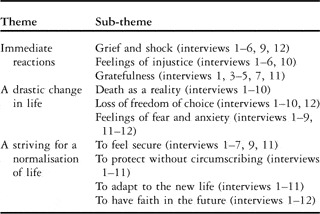
Qualitative content analysis was performed, which is a technique for analysing the content of a text in various steps.Reference Krippendorff17 The content analysis used in this study was influenced by Graneheim and Lundman.Reference Graneheim and Lundman18 The 12 interviews were combined into one text and were read repeatedly for overall impression to determine prominent themes and patterns. Meaning units were identified, coded, and named on the basis of shared concepts. The codes were grouped into sub-themes based on the content through ongoing discussion by the authors. During the analysis, when identifying and describing the content, efforts were made to stay close to the interview text. By going back and forth among the whole interview text, the meaning units, and codes, 10 sub-themes and three themes were identified. The authors reviewed the transcribed interviews and coding scheme to enhance conformability and to increase validity and trustworthiness. If agreement could not be achieved, further analysis was performed until consensus among the authors was reached.
Ethical considerations
According to rules applied by the local ethics committee at the commencement of the study, research ethics committee approval was not required for studies involving questionnaires or interviews. Written and verbal information about the study was given, stressing that participation was entirely voluntary, and informed consent was obtained. Confidentiality was guaranteed. Families were recruited among participants in a research committee-approved treatment study (study code ÖS 257-02). The study was undertaken according to the Declaration of Helsinki.19
Results
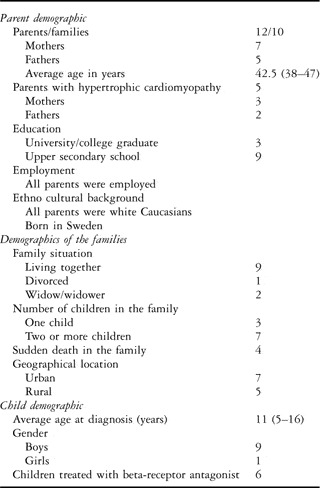
Twelve families were invited to participate in the study. Seven mothers and five fathers from ten different families accepted the invitation. Two families declined; their sociodemographic and medical characteristics did not differ from the participating families except regarding their children’s gender, both families had girls.
The sociodemographic and medical characteristics are presented in Table 1. Five of the participating parents had been diagnosed earlier with hypertrophic cardiomyopathy and four of the 10 families had experiences of sudden death in a close relative. The mean age of the children was 11 years with a range from 5 to 16 years, and nine were boys. After risk-factor assessment, six of the children were treated with beta-receptor antagonists, and four were untreated (Table 1). Text analysis resulted in three themes and 10 sub-themes (Table 2). Quotes will be referred to F as for father or to M as for mother and number of interview.
Sociodemographic and medical characteristics of parents, family, and children.

Themes and sub-themes.

Immediate reactions
The first reactions immediately after diagnosis were characterised by shock, grief, and feelings of injustice. However, some of the parents also felt grateful because the child was still asymptomatic and that no serious complications had occurred.
Grief and shock
The diagnosis caused feelings of grief because they mourned their child’s changed life situation and it came as a shock for most of the parents, even if they were aware of the inheritance of the disease. “We were prepared but still it was a shock (M2)”.
The parents felt that they needed to support their child and abandon their own reactions during the initial phase, which sometimes became hard to handle. “I was prepared … but I had to abandon my own feelings … I had to talk to him and support him … I had to put my own grief away (M2)”.
Feelings of injustice
Some parents described the diagnosis as unfair and expressed feelings as if it was the wrong child who got the diagnosis. “We would have preferred of course that none of our children had the disease but if someone had to have it … I felt that this was the wrong child (F1)”.
These thoughts were often connected with the individual child’s degree of involvement in sports. If there was another sibling in the family with no interest in sports or physical exercise, the immediate reaction was that the wrong sibling had got diagnosed. “It was strange … we felt that X would have it and not his brothers or his sister. His brother is not as competitive, although his brother also likes handball, but he also likes many other things (M9)”. Other parents described feelings of injustice as the child already suffered from other diseases. “I think I thought … not one more … he has so many other problems for example with the kidneys (M2)”. In some cases, the parent described that it was hard to handle the child’s own reactions when he or she very clearly expressed feelings of injustice. “ … why me, wish it would have been somebody else, for example somebody who cannot run or somebody who always sits reading books … he said (M3)”.
Gratefulness
Even though the initial period after diagnosis was characterised by chaos, feelings of gratefulness were present. “Now when we know he has the diagnosis we are grateful that we know and that he is taken care of but at first I thought it would have been better not knowing (M3)”. They were grateful that the child was diagnosed in time, before any fatal events occurred and thoughts of what could have happened if the child had not been diagnosed were acknowledged. “I feel that if that letter had not arrived … then maybe he had been one of those dying from the disease, that’s how I think (M5)”.
A drastic change of life
The diagnosis and its impact on everyday life changed their attitude towards life, sometimes drastically. Some parents did not experience any large changes in daily life because the child already had little interest in sports and physical activities. However, almost all parents felt that death became a close, realistic, and existential threat that led to feelings of vulnerability and weakness.
Death as a reality
Death suddenly became something that could strike the family in a very realistic way. “Yes, it was this thing that you can die from this diagnosis … and for him not only that he could die but that mummy could die too (M5)”. The adolescent asked questions about death and sometimes used it as an argument during quarrels with parents. “I say to him he should not do that and that, you have to be careful … he says that in 10 years from now it doesn’t matter, maybe I am not alive then … then it comes. I am not going to be that old he says sometimes or he says he is going to die (M4)”. Fear of death was strongly connected to physical exercise. “If I’m afraid of something? Yes of course … I’m afraid he will not have the chance to get a new heart or that he is going to be very ill or the worst of all … die on the football field, that′s the absolutely worst thing that could happen (M2)”. Some parents also stated that sudden death could have been a possible scenario if the child had not been diagnosed. “If we had not done these investigations, then we wouldn’t have known and he would have continued exercising, got worse and exposing himself to great risks of even dying suddenly on a sports field (M6)”.
Loss of the freedom of choice
Most parents expressed that they felt that the child had lost their freedom of choice, they were no longer able to choose whatever activities they wanted to participate in during their spare time or in their future profession. “Yes that’s the worst part … when he is not allowed to do what he want … (M2)”. “We always thought he could chose whatever he wanted for school etc, but that’s not possible any more … (M3)”. For the adolescent, future plans had to be reconsidered.“I think he is disappointed about for example military service, that he will not be accepted, that he will be omitted from any consideration of doing military service already from the beginning (M9)”.
Feelings of fear and anxiety
When the parents received the information about the diagnosis they usually experienced the disease as a threat. They could lose their child and, as a consequence, they became anxious and felt fear. “That he could suddenly just disappear … or that something could happen when he plays handball … that I wanted to be with him everywhere, if anything should happen to him; that fear was really great especially in the beginning (M9)”. Fear and anxiety became very obvious every time the child participated in any kind of physical activity, especially if the parent could not be present as during school sports or during children’s play. “I am thinking about it every time he is physically active, that’s the way it is. You think about what he is doing (F1)”. They worried when the child participated in very intense children’s games and showed signs that they were physically exhausted. “I am thinking about it when he comes home totally wet from sweat with a red face … then I am worried (F1)”. Most parents described anxiety in connection to physical activity experiences as the absolute worst fear and the most difficult to handle. However, some parents did not describe this high level of fear and anxiety and it was related to the child’s personality, if the child was quiet and preferred peaceful games the parents felt calmer. “He has the same interests as before the diagnosis … life didn’t change so much … It would be much worse if he had been interested in sports and soccer as many of the others are … that would have been a real disaster but this hasn’t really affected him (F7)”. “Yes, in a way I am very much afraid, but at the same time, because he is such a calm boy, I am also calm. It would have been worse if it was his brother … then I would not have been able to manage the situation … to stop him all the time (M5)”.
A striving for the normalisation of life
Parents found that their usual frame of reference to life was no longer valid. They felt that it was important to return to normal life, striving for control to reduce the feelings of chaos. In achieving this normalisation process they strived to adapt to the new life, to find a balance, and to feel secure. To feel secure, to protect without circumscribing, to adapt to a new life, and to have faith in future were four categories that became obvious and important for parents in their process to create a new life with new references.
To feel secure
Having the child diagnosed and under frequent medical check-ups gave the parents a sense of security. “It is good with the medical checkups. It is a form of pain relief, mental pain relief, to know they are so frequent (M3)”. To have close contact and easy access to the liaison nurse helped them to gain control in everyday life. To learn about the disease and its risk also contributed to feel secure. “After all I have the direct telephone number of the liaison nurse, that is also sort of security to know I can call directly and not have to call around to find somebody (M4)”.
To protect without circumscribing
Parents wanted to support and protect their child and they tried to find a balance between protection and restriction. “I want to protect him from everything that can make him worse … but it is a difficult balance between protection and making his life boring (M3)”.
They wanted to give positive support, to give the child freedom to act responsibly. “After all he is 17 now. He has to take some responsibility himself, it′s his life and I cannot force him not to do things (M4)”. Some parents didn’t rely on their child’s capacity to know their physical limitations. “He says he does not exercise too much, but I don′t trust him … he always want to perform to his best ability … I am afraid of that (F7)”. Some parents wanted to protect with control. This control sometimes included regular visits to school to control what the child participated in during the school breaks or through reminding them frequently that they must be aware and take it easy with physical activities. “So when I see him do something in the schoolyard or run or hunt or something … no, now you have to take it easy … I usually approach him in these situations and ask him to slow down (F8)”. Parents experienced that they became a part of circumscribing the child’s life in order to stop them doing inappropriate physical exercise, sports participation, and even to participate in children’s play that might lead to physical overwork. Some parents stated very clearly their awareness of the risk of circumscribing the child’s life. “When I see him doing heavy things I try to stop him, but not otherwise. But I think I protect him more than the other two, but he is the youngest of them so I don’t know what is the real reason (M4)”.
To adapt to the new life
Some families had to change life completely, especially if the family were involved in a high level of sports activities. This sometimes affected the whole family life with friends, physical activities, and plans for the future. “The difference is sports. That’s the big difference. The whole family was engaged in sports (F1)”. “To take away sports from him is as if you cut one of his legs off (M2)”.“And now instead … always having to ask: can I do this? (F8)”. Other families with no or very little interests in sports and physical activities felt that life didn’t have to change at all. “No I don′t think he has had to make any large changes (M12)”. “It's no difference, he is not a physically active child … he has some motor activity problems compared to other children … so he is more interested in reading and playing games on the computer (M5)”. These parents stated that the child was diagnosed in time, before any fatal events, which they were grateful for, and in those cases when the child was commenced on treatment the main goal in adaptation was to remind the child about the medications and be aware of any symptoms. “The largest difference in everyday life is to remember the medicine (F11)”.
To have faith in the future
Parents expressed faith in the future in different ways. Some parents described the frequent medical check-ups and pharmacological treatment as a reason for their optimistic view of the future while others described it as due to the fact that the child was diagnosed before any symptoms had come up. “ … but I think it is OK … you really can't see he is ill … there is nothing (M12)”.“He has been diagnosed and he has received the best care possible, so even if he has been informed he has a disease the situation is the best possible since he receives medical treatment. The alternative, not knowing about it and the risk that something could happen … So I think it is better as it is (M6)”. They also had an optimistic attitude to beta-blocker treatment. “They think that the medicine will slow the progress of the disease … and then he has all possibilities, then it is no handicap (F1)”.
Discussion
The initial phase was characterised by shock even if the parents were aware of the inheritance of the disease and the potential risk for their child to have the disease. Suddenly their child was transferred from being healthy and with no restraints in life to a child diagnosed with a life threatening chronic disease with restrictions and limitations. Health-care providers need to evaluate how these children and parents handle changes in order to develop appropriate care policies. Transitions are both a result of change and a cause of change in life, health, relationships, and environment.Reference Meleis, Sawyer, Im, Hilfinger Messias and Schumacher13 Transition experiences are not identical and each transition is characterised by its own individuality and complexity. It is crucial to reflect over the complexities of the transition experiences and to try to identify and clarify the needs.Reference Meleis, Sawyer, Im, Hilfinger Messias and Schumacher13
When the child was diagnosed, the parents experienced that they entered a life with new references. Inline with other studies the diagnosis of a heart condition was followed by a dramatic change in the life situation of the family, inducing severe distress in most parents.Reference Hendriks, Grosfeld and Van Tintelen20, Reference Farnsworth, Fosyth, Haglund and Ackerman21 In this study, the parents describe feelings of fear and anxiety, especially in connection to physical exercise. Every time they were aware of any kind of participation in physical exercise, whether it was during school gymnastics, school breaks, or in children’s play, it worried them. This is similar to what has been shown in studies of parents to children affected by long QT syndrome.Reference Farnsworth, Fosyth, Haglund and Ackerman21, Reference Meulenkamp, Tibben and Mollema22 One theme, which was identified in this study, was to protect without circumscribing. This phenomenon has been described in parents with children diagnosed with long QT syndrome too. Parents described how they tried to manage the situation by eliminating all situations that could cause serious complications, to adjust to their fears.Reference Farnsworth, Fosyth, Haglund and Ackerman21
The parents felt grateful that the child was diagnosed before any serious complications occurred. Thoughts about what could have happened if the child had not been diagnosed in time were common. They knew that their child could have been one of those who died on the football ground or in connection with other sports activities. The identification of hypertrophic cardiomyopathy in their child caused fear and anxiety, not only because of the risk of serious complications such as arrhythmias and sudden death, but also because of the crucial lifestyle modificationsReference Corrado, Pelliccia and Bjornstad8, Reference Maron, Chaitman and Ackerman9 that the child was advised to follow. These life style modifications may bring severe changes to the child’s life and have an impact on the whole family. Parents were concerned about how the child would handle the fact that their child being forced to give up leisure activities with friends and interests that in many cases engaged the whole family. These situations can cause a traumatic experience for the child and especially during adolescence, which is a vulnerable time in life. This was a particular trauma for families with a prominent interest in the participation in team sports. Nevertheless, there were parents who did not experience anxiety connected to physical exercise. Those were parents with children who were considered as calm and preferred peaceful play-activities, having no interest in sports. These parents did not experience that the diagnosis and the following lifestyle modifications had caused any dramatic changes in life.
When the parents in this study became aware of the child’s illness and risk of serious complications, death became a realistic threat, and this in turn meant that their sense of security in life was weakened, which is similar to what has been found in earlier studies of parents to children affected by the long QT syndrome.Reference Hendriks, Grosfeld and Van Tintelen20, Reference Farnsworth, Fosyth, Haglund and Ackerman21 During the process in which the parents strived for normalisation in the daily life, they highlighted the importance of feeling secure and safe in daily living. Close and frequent contact with the specialised health-care team supported this process, the frequent contacts were described as a lifeline that made them feel secure, and acted as “mental pain relief”. Even though hypertrophic cardiomyopathy is an inherited cardiac disease, no parent with the diagnosis expressed feelings of guilt in causing the disease.
Present results raise thoughts about parents’ needs and the responsibility to minimise the risk of unnecessary suffering and the need of detailed and repeated information regarding the disease and the lifestyle recommendations. Questions about lifestyle adjustments cause anxiety, and such worries cause an unnecessary burden in a chaotic and stressful time in life. To provide relief, a close contact with health-care professionals seems crucial. Follow-up guidelines should include well-structured, clearly expressed written information addressed to parents, school, leisure-time activity leaders, and age-related information for children and adolescents, as well as a parallel ongoing communication between health-care providers and parents, school, and leisure-time activity leaders.
Needs are different at different time points and the health-care providers need to establish a facility for parent-initiated contact that may need to be frequent initially. Together with the scheduled visits for outpatient appointments this increases the possibilities to create individual support through answering questions that arises when parents are facing the fact of having to create a new pattern for everyday life. Screening for inherited cardiac diseases is accompanied by the responsibility of taking care of the identified families and individuals to minimise the risk of unnecessary suffering and to encourage psycho-social as well as physical well-being. Support can be offered in different ways and considering today’s massive development in interactive and web-based communities, health-care system should consider to adapt and provide multi-faceted communicating channels which also facilitate the frequent need of support that this study have highlighted.
The retrospective design is a limitation. Data was collected from the participants’ memories of their experiences of the diagnosis within a 2-year time period. It could be that some individuals may not recall their experiences accurately,Reference Canli, Zhao, Brewer, Gabrieli and Cahill23 which could affect the findings of the study. All participants were Swedish-born, had there been a more diverse ethnic group other themes may have been found. Another important issue is that the participants were in a larger proportion parents of boys; this also might affect the outcome of the study. This however reflects the gender balance in childhood hypertrophic cardiomyopathy which shows male preponderance.Reference Östman-Smith, Wettrell and Keeton5, Reference Olivotto, Maron and Adabag24 Even though there were a limited number of participants in this study it is important to remember that in qualitative research intention is not to generalise.Reference Marshall and Rossman14, Reference Burns and Grove15, Reference Graneheim and Lundman18 However, patterns of experiences of parents are likely transferable to other individuals within the same situation. In quantitative traditions the quality criterions; validity, reliability, and generalisability are used to describe trustworthiness of the study, however in qualitative research traditions the concepts credibility, dependability, and transferability are used to describe various aspects of trustworthiness.Reference Graneheim and Lundman18 To increase trustworthiness in this study, the interview analysis was constantly checked and discussed until agreement about possible interpretation was reached.
Conclusions
Parents were grateful that their child was diagnosed before anything serious had happened. Furthermore, as a result of an early diagnosis parents can be given better possibilities to encourage the child to start with activities which are acceptable and within the lifestyle recommendations for hypertrophic cardiomyopathy patients, and thus gain a social network of peers among suitable leisure activities. The main changes perceived were ascribed to lifestyle modifications and parents described an increased, and sometimes severe, anxiety related to the child performing physical exercise. Parents with physically active children were more affected by the lifestyle modifications necessary. Regular outpatient review and the availability of an identified health-care professional who could be contacted for telephone advice were perceived as an important lifeline which provided “mental pain relief”.
Acknowledgements
The authors thank the parents who participated in this study. This study was made possible by funding and support from the Swedish Heart-Lung Foundation, the Swedish Heart-Children’s Association, the Märtha and Gustaf Ågren Foundation and the Petter Silverskiölds Foundation and LUA-ALF grant from Gothenburg University.