Introduction
Annual bluegrass can be controlled by a variety of preemergence and postemergence herbicides (Askew and McNulty Reference Askew and McNulty2014; McCarty and Miller Reference McCarty and Miller2002; McCurdy et al. Reference McCurdy, Bowling, de Castro, Patton, Kowalewski, Mattox, Brosnan, Ervin, Askew, Goncalves, Elmore, McElroy, McNally, Pritchard, Kaminski and Bagavathiannan2023; McElroy and Bhowmik Reference McElroy, Bhowmik, Stier, Horgan and Bonos2013). Pronamide, a unique mitotic-inhibiting herbicide (Akashi et al. Reference Akashi, Izumi, Nagano, Enomoto, Mizuno and Shibaoka1988), controls annual bluegrass preemergence and postemergence (Burt and Gerhold Reference Burt and Gerhold1970) but has limited efficacy when applied postemergence due to foliar interception that reduces availability for root uptake (Carlson et al. Reference Carlson, Lignowski and Hopen1975). Other herbicides, including flazasulfuron for example, which inhibit acetolactate synthase (ALS), are sometimes added to pronamide in mixture to increase efficacy and decrease selection pressure for resistance to a single site of action (Singh et al. Reference Singh, Dos Reis, Reynolds, Elmore and Bagavathiannan2021). With the advent of new application technology, opportunities to improve pronamide performance exist, but these options may reduce the performance of other products, such as flazasulfuron, that are included for resistance management and improved efficacy.
McCullough et al. (Reference McCullough, Yu and Czarnota2017) first reported pronamide-resistant annual bluegrass on a golf course in Georgia, in the United States. The population was controlled when pronamide was applied preemergence but exhibited resistance to postemergence -applied pronamide. Differential control among resistant and susceptible populations was attributed to varying absorption and translocation. More recently, Ignes et al. (Reference Ignes, McCurdy, McElroy, De Castro, Ferguson, Meredith, Rutland, Stewart and Tseng2023) reported three pronamide-resistant annual bluegrass populations from golf courses in Mississippi, with resistance attributed to target-site–based (Thr239-Ile mutation of the α-tubulin gene in three populations) and translocation-based mechanisms (reduced translocation of soil-applied pronamide in one population).
Foliar-applied herbicides are dependent upon leaf absorption for effective weed control (Knoche Reference Knoche1994). Thus, adequate spray droplet coverage is necessary to achieve full herbicidal activity. A greater amount of herbicide deposited uniformly on the surface of leaves may result in more effective weed control (Shaw et al. Reference Shaw, Morris, Webster and Smith2000). Leaf surface features such as epicuticular wax structures, trichomes, glands, and cell topography may affect droplet retention across the leaf surface, leading to reduced herbicide absorption (Hess and Falk Reference Hess and Falk1990; Sanyal et al. Reference Sanyal, Bhowmik and Reddy2006; Smith et al. Reference Smith, Askew, Morris, Shaw and Boyette2000). Sprays tend to bounce off the leaves of grass species (Cudney Reference Cudney1996). Ferguson et al. (Reference Ferguson, Chechetto, Adkins, Hewitt, Chauhan, Kruger and O’Donnell2018) also suggested that the small, narrow leaves of many winter annual grasses make their control difficult. Alternatively, soil-applied herbicides such as pronamide rely on soil deposition for root uptake (Carlson et al. Reference Carlson, Lignowski and Hopen1975), raising the possibility that droplet spectra may affect canopy penetration and subsequent herbicide root absorption.
Results of previous studies relating droplet spectrum and herbicide efficacy are inconsistent (Ennis and Williamson Reference Ennis and Williamson1963; Ferreira et al. Reference Ferreira, Ferguson, Reynolds, Kruger and Irby2020; Ferguson et al. Reference Ferguson, Calhoun, Broster, Merritt, Treadway, Wesley and Fleitz2022; Lake Reference Lake1977; McKinlay et al. Reference McKinlay, Brandt, Morse and Ashford1972). Similarly, previous reports have demonstrated an inconsistent relationship between spray volume and herbicide performance (Etheridge et al. Reference Etheridge, Hart, Hayes and Mueller2001; Meyer et al. Reference Meyer, Norsworthy, Kruger and Barber2016; Ramsdale et al. Reference Ramsdale and Messersmith2001), although herbicide performance generally decreases as spray volume decreases (Knoche Reference Knoche1994). Therefore, droplet spectrum and spray volume should be tailored to specific herbicides and the targeted weed species to maximize application efficiency (Butts et al. Reference Butts, Samples, Franca, Dodds, Reynolds, Adams, Zollinger, Howatt, Fritz, Hoffmann and Kruger2018; Clayton and Lyons Reference Clayton and Lyons2019; Creech et al. Reference Creech, Moraes, Henry, Luck and Kruger2016).
Spray deposition of agrochemical applications can be tracked with fluorescent tracer dyes (Hoffmann et al. Reference Hoffmann, Fritz and Ledebuhr2014; McWhorter and Wooten Reference McWhorter and Wooten1961; Staniland Reference Staniland1960), which are safe and allow rapid and economical quantification, and do not significantly alter the physical properties of the spray solution and droplet spectrum (Hayden et al. Reference Hayden, Ayers, Grafius and Hayden1990; Schleier et al. Reference Schleier, Preftakes and Peterson2010). The 1,3,6,8-pyrenetetrasulfonic acid tetrasodium salt (PTSA) tracer dye is a highly soluble, stable, and recoverable water-based spray solution with low degradation in sunlight (less than 15% to 20% degradation after 1 h) (Hoffmann et al. Reference Hoffmann, Fritz and Ledebuhr2014).
Few studies have evaluated the effects of droplet spectrum on pesticide efficacy in turfgrass systems (Fidanza et al. Reference Fidanza, Kaminski, Agnew and Shepard2009; Nangle et al. Reference Nangle, Raudenbush, Morris and Fidanza2021; Patton et al. Reference Patton, Weisenberger, Schortgen, Fausey and Breuninger2019). Information about the effects of spray droplet spectrum on pronamide efficacy in controlling annual bluegrass is lacking. Thus, we conducted greenhouse experiments to quantify the effects of spray droplet spectrum on pronamide deposition on annual bluegrass and to determine whether the application of pronamide as a mixture with flazasulfuron affects deposition. The hypothesis we tested was that pronamide deposition on annual bluegrass would vary with spray droplet spectra. In prior studies, a droplet spectrum of 100 µm was used to increase foliar deposition (McKinlay et al. Reference McKinlay, Brandt, Morse and Ashford1972). In this study, additional efficacy experiments were conducted using pronamide, flazasulfuron, and pronamide plus flazasulfuron to assess the effect of spray droplet spectrum on pronamide susceptible (S) and resistant (R) populations.
Materials and Methods
Experiment 1: Effects of Spray Droplet Spectrum on Foliar Deposition
Greenhouse research (21/10 C, day/night temperature) was conducted at the Mississippi State University R.R. Foil Plant Science Research Center near Starkville, MS (33.469382°N, 88.783679°W). The experiment was designed as a 4 (herbicide treatments) × 5 (droplet spectra) factorial treatment arrangement in a completely randomized design with six replications, and was conducted twice between February and July 2021. A pronamide-S annual bluegrass population was collected from Battle Sod Farm in Tunica, MS (34.668448°N, 90.374708°W). A single tiller was transplanted per cone-tainer (3.8 cm diam) containing 116 cm3 of a commercial potting mix (Promix BX general purpose; Premier Tech Horticulture, Quakertown, PA). Plants were fertilized weekly with a water-soluble fertilizer (Miracle-Gro® Water-Soluble All-Purpose Plant Food; Scotts Miracle-Gro Products, Inc., Marysville, OH; 24-8-16) at a rate of 24.4 kg N ha−1 and watered as needed to maintain adequate moisture and prevent drought stress. Seed heads were removed weekly with scissors or by hand. Plants were trimmed weekly with scissors to a height of 3.5 cm above soil level.
Treatments were applied to plants at the two-to-three tiller stage of growth. Cone-tainer foliar coverage was approximately 75%, with exposed growth media accounting for the remaining surface area. Fluorescent PTSA tracer dye (Spectra Colors Corporation, Kearny, NJ) was added to each treatment solution to quantify the effects of herbicide and spray droplet spectra on herbicide foliar deposition. Dye (10.31 g) was added to a tank (22.71 L) of distilled water to achieve a concentration of 0.454 g L −1. The solution was thoroughly mixed and then distributed equally into four containers for mixing to the rate equivalent of 1.160 kg pronamide ha−1 (Kerb 3.3SC; Corteva Agriscience, Indianapolis, IN), 0.044 kg flazasulfuron ha−1 (Katana 0.25WG; PBI Gordon Corporation, Shawnee, KS), or pronamide plus flazasulfuron at the aforementioned rates. A fourth container was considered nontreated and contained no herbicides—only the dissolved PTSA dye and water, as described above. Spray droplet spectra were chosen to cover the American Society of Agricultural and Biological Engineers spray droplet spectrum categories (ASABE 2009) and were analyzed using a particle/droplet image analysis system (VisiSize P15; Oxford Lasers Ltd., Didcot, Oxfordshire, UK). Treatments were applied using an enclosed spray chamber (Generation III track sprayer; DeVries Manufacturing, Inc., Hollandale, MN) equipped with two nozzles, 50 cm apart, placed at the height of 50 cm from the plants, delivering 374 L ha−1. Nozzles selected for the study are listed in Table 1, along with the volumetric median droplet (VMD) size and the pressure and speed of delivery. Further details about this droplet analysis technique are detailed by Ferguson et al. (Reference Ferguson, Calhoun, Broster, Merritt, Treadway, Wesley and Fleitz2022).
Nozzles and conditions selected for evaluation of droplet spectra effects on pronamide deposition. a

a Pronamide alone, flazasulfuron alone, or the herbicide mixture were applied to two-to-three tiller-stage annual bluegrass plants. Fluorescent tracer dye, 1,3,6,8-pyrenetetrasulfonic acid tetrasodium salt (PTSA), was added to each treatment solution to quantify the effects of herbicide and spray droplet spectra on herbicide foliar deposition.
b Volume median diameters were measured using a particle measurement system with an enclosed spray chamber equipped with two nozzles, 50 cm apart and placed at a height of 50 cm from the plants, delivering 374 L ha−1. The coefficient of variation of droplet size was 3%.
c Pressure and speed were manipulated to deliver the desired droplet spectrum for the respective nozzle.
Immediately after herbicide application, plant foliage was collected using tweezers and scissors before being washed twice for 30 s with 10 mL of distilled water and shaken in plastic bags (Whirl Pak Write-On-Bags; Nasco, Fort Atkinson, WI). The resulting 20 mL wash solution was transferred to 20-mL vials (Fisher Scientific, Pittsburgh, PA), resulting in a composite sample for each experimental unit (i.e., each cone-tainer) that was stored at 3 C until its quantification using a spectrofluorometer (RF-6000; Shimadzu Scientific Instruments, Columbia, MD) according to methods described by Fritz et al. (Reference Fritz, Hoffmann and Jank2011), at the excitation and emission wavelengths of 290 and 406 nm, respectively. Dye concentration was quantified based on a standard curve that consists of seven serial dilutions. Leaf surface area was determined using a leaf area meter (LI–3100C; LI-COR Environmental, Lincoln, NE). Deposition data were considered as micrograms per liter of mixture per centimeter of foliage (i.e., µg L−1 of mixture cm−2 foliage) (Castro et al. Reference Castro, Carbonari, Velini, Gomes and Belapart2018; Negrisoli et al. Reference Negrisoli, Tofoli, Velini, Martins and Palladini2002).
Data were subjected to ANOVA (α = 0.05). Data were modeled using linear regression in GraphPad Prism software (version 9.0; GraphPad Software, San Diego, CA) via Equation 1:
 $y = mx + b $
where b is the y-intersect of the calibration curve, and m is the slope of the predicted line. Regression models were compared using pairwise F-tests at α = 0.05 to determine whether droplet spectrum or the addition of flazasulfuron to pronamide affected herbicide deposition.
Experiment 2: Effects of Spray Droplet Spectrum on Herbicide Efficacy
Greenhouse experiments were conducted between January and March 2022 to evaluate the effects of droplet spectra (400 and 1,000 µm) on pronamide efficacy on pronamide-S and pronamide-R annual bluegrass populations. Annual bluegrass plants (1 tiller pot−1) were transplanted in pots (10 cm diam) filled with 410 cm3 of native Marietta silt loam soil (fine-loamy, siliceous, active, and Fluvaquentic Eutrudepts), pH 6.4, and with 0.4% organic matter. Plant material was grown in greenhouse conditions similar to those previously described in Experiment 1. Solar noon photosynthetic photon flux density (400 to 700 nm) was approximately 150 μmol m−2 s−1 in January and 300 μmol m−2 s−1 in March experimental runs, respectively. Day lengths were 10 h and 12 h, respectively. Plants were mown (3.5 cm) weekly, and seed heads were removed by mowing with hand sheers and/or electric trimmers. Plants of similar size/maturity (five tillers) were selected for the experiment. Pot foliar coverage was approximately 50%, with exposed soil accounting for the remaining surface area.
The experiment was arranged as a completely randomized factorial design with herbicide and droplet spectrum by application rate treatment factors. Each treatment combination was replicated five times, and the experiment was conducted twice in time. Herbicide treatments included pronamide, flazasulfuron, and a pronamide plus flazasulfuron mixture, and these were applied with spray droplet spectrum of 400 or 1,000 µm VMD. Three application rates were used for each herbicide treatment: 0.580, 1.160, and 2.320 kg ai ha−1 for pronamide; 0.022, 0.044, and 0.088 kg ai ha−1 for flazasulfuron; and 0.580 plus 0.022, 1.160 plus 0.044, and 2.320 plus 0.088 kg ai ha−1 for pronamide plus flazasulfuron, respectively. Application rates represented 0.5×, 1×, and 2× (fold) doses for annual bluegrass suggested on the product label (1.160 kg ai ha−1 for pronamide and 0.044 kg ai ha−1 for flazasulfuron). Treatments were tested on plants from four annual bluegrass populations: two known pronamide-S populations from Battle Sod Farm (BS-S) in Tunica, MS and Humphreys High School (HH-S) in Belzoni, MS (33.186879°N, 90.483539°W); and two populations resistant to POST pronamide applications from Lion Hills Golf Club (LH-R) in Columbus, MS (33.522983°N, 88.404055°W) and Shell Landing Golf Club (SL-R) in Gautier, MS (30.388181°N, 88.676874°W), both of which have previously been characterized for resistance by Ignes et al. (Reference Ignes, McCurdy, McElroy, De Castro, Ferguson, Meredith, Rutland, Stewart and Tseng2023).
Treatments were applied within an enclosed spray chamber and were allowed to dry for 30 min before being returned to the greenhouse. Irrigation was withheld for 24 h after herbicide application. Annual bluegrass control was visually evaluated 42 d after treatment (DAT) on a scale from 0% to 100% (0% = no control, 100% = complete control) relative to the untreated control of respective populations. At 42 DAT, plants were harvested at soil level, placed in paper bags, and dried (80 C) until a constant weight was achieved. Foliar dry-mass data were analyzed as a percentage reduction relative to the untreated control of respective populations.
Data were modeled using a nonlinear regression model (one-phase association) with GraphPad Prism software (Equation 2):
 $Y = Y_0+ a(1-e^{-k*x}) $
where Y represents the visual percentage control or percentage dry-mass reduction, a and K are constants generated from the analysis, Y 0 is the y intercept, and X is the herbicide application rate.
Visual control and dry-mass reduction were compared using pairwise F-tests (α = 0.05) to determine whether herbicide application rate affected efficacy and whether populations differed in response to various treatments. Pearson’s correlation coefficient (r) was used to assess the strength of association between visual control and dry-mass reduction with the CORR procedure with SAS software (version 9.4).
Results and Discussion
Experiment 1: Effects of Spray Droplet Spectrum on Foliar Deposition
Herbicide deposition results were statistically similar between runs, thus data were pooled. Spray droplet spectrum affected foliar deposition of pronamide and flazasulfuron on annual bluegrass, whether applied alone or in combination (P < 0.0001; Figures 1 and 2). The addition of flazasulfuron to pronamide in mixture did not affect pronamide foliar deposition (P = 0.3947), thus data of pronamide and pronamide plus flazasulfuron treatments were pooled. Herbicide foliar deposition was generally greatest when applied within the smallest droplet spectra. Regression estimates suggest that foliar deposition of pronamide decreases 14.8 µg cm−2 for every 100 µm increase in VMD. Likewise, foliar deposition of flazasulfuron decreases 0.3 µg cm−2 for every 100 µm increase in VMD.
Effect of droplet spectra on pronamide deposition on annual bluegrass plants. Data were pooled across two study runs and analyzed using a simple linear regression model. The addition of flazasulfuron to pronamide in the mixture did not affect pronamide foliar deposition (P = 0.3947); therefore, data of pronamide and pronamide plus flazasulfuron treatments (pronamide-containing treatments) were considered similar and pooled.

Effect of droplet spectra on flazasulfuron deposition on annual bluegrass plants. Data were pooled across two study runs and analyzed using a simple linear regression model.

These results align with those of previous studies. McKinlay et al. (Reference McKinlay, Ashford and Ford1974) demonstrated that paraquat applied in a discreet droplet size of 100 µm was more phytotoxic to sunflower than when droplets were larger (350 µm)—a result attributed to greater coverage. Lake (Reference Lake1977) studied the relationship between droplet spectra (100, 200, 300, and 600 µm), leaf angle (0, 30, 45, 60, and 75 degrees from horizontal), and retention of two spray solutions on wild oat (Avena fatua L.) and barley (Hordeum vulgare L.). The authors concluded that deposition on leaves was higher when the droplet spectrum was 100 µm than when it was 200 µm and that leaf angle did not affect retention. Since grasses have delicate and narrow leaf blades, the lower mass and density of the smaller droplets adhered better to the oat surfaces than the larger droplets, with less propensity for the droplet to bounce or run off (Dorr et al. Reference Dorr, Kempthorne, Mayo, Forster, Zabkiewicz, McCue, Belward, Turner and Hanan2014).
Despite these similarities, it is unknown how field-level control with pronamide, and pronamide herbicide combinations, might differ in the presence of a dense and competitive turfgrass sward, which might change the deposition of various droplet spectra. For instance, herbicides with soil activity rely on soil deposition to maximize their effectiveness. However, a previous study found little influence of spray droplet spectrum on soil-applied residual herbicides and weed control (Ferreira et al. Reference Ferreira, Ferguson, Reynolds, Kruger and Irby2020). Ferreira et al. (Reference Ferreira, Ferguson, Reynolds, Kruger and Irby2020) further concluded that larger droplet spectrum sprays resulted in weed control similar to smaller droplet spectrum sprays across soil-applied residual herbicides and physicochemical properties. Carlson et al. (Reference Carlson, Lignowski and Hopen1975) reported that root uptake is necessary to increase pronamide efficacy when applied postemergence. Results indicate that large droplet spectra sprays (800 and 1,000 µm) resulted in low foliar deposition of pronamide and thus suggest that the range of 800 to 1,000 µm (or larger) may be optimal for soil deposition of pronamide.
Experiment 2: Effects of Spray Droplet Spectrum on Herbicide Efficacy
Visual control and dry-mass reduction did not statistically differ between runs, thus data were pooled. Annual bluegrass control and dry-mass reduction were moderately correlated (r = 0.61). Results were analyzed at the population level (each population separately) and then at the group level (R vs. S groups).
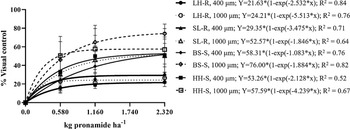
Based on visual control of annual bluegrass, pronamide efficacy increased with larger droplet size spectrum (Tables 2 and 3; Figure 3). The influence of VMD on control of susceptible and resistant annual bluegrass biotypes was dependent on pronamide rate, with no clear distinction between resistant and susceptible biotypes. For example, control of LH-R was significantly influenced by the spray spectrum at 0.5× and 2.0× the labeled pronamide rate, BS-S was similarly influenced at any rate, while HH-S responded variably due to spray spectrum only when treated at 0.5× the labeled rate.
Pronamide efficacy comparison of annual bluegrass populations and droplet spectra with pairwise F-tests of visual control (α = 0.05). a, b

a Treatments were applied in an enclosed spray chamber on five tiller-stage annual bluegrass plants. Efficacy was visually evaluated 42 d after treatment.
b Data were pooled across the two runs of the experiment.
c Abbreviations: BS-S, Battle Sod Farm (pronamide-susceptible); HH-S, Humphreys High School (pronamide-susceptible); LH-R, Lion Hills Golf Club (pronamide-resistant); SL-R, Shell Landing Golf Club (pronamide-resistant); VMD, volume mean diameter.
Percentage visual control and foliar dry-mass reduction of plants from different annual bluegrass populations, relative to those of untreated plants, 42 d after treatment. a, b

a Data were pooled across the two runs of the experiment. Pairwise means comparisons were performed with the Fisher’s protected LSD test at the α = 0.05 significance level. Different letters in the same column separated by a line indicate significant differences between droplet spectra.
b Abbreviations: BS-S, Battle Sod Farm (pronamide-susceptible); HH-S, Humphreys High School (pronamide-susceptible); LH-R, Lion Hills Golf Club (pronamide-resistant); SL-R, Shell Landing Golf Club (pronamide-resistant); VMD, volume mean diameter.
Percentage visual control of four annual bluegrass populations by pronamide alone treatments applied as sprays with droplet spectra of 400 or 1,000 µm, 42 d after treatment. Error bars indicate the standard error of the mean. Abbreviations: BS-S, Battle Sod Farm (pronamide-susceptible); HH-S, Humphreys High School (pronamide-susceptible); LH-R, Lion Hills Golf Club (pronamide-resistant); SL-R, Shell Landing Golf Club (pronamide-resistant).

Pronamide alone was relatively ineffective at controlling annual bluegrass populations, regardless of application rate and droplet spectrum. Pronamide control of the R populations at all application rates was ≤50%, with a range of 16% to 31%, and 21% to 50% when droplet spectrum was 400 µm and 1,000 µm, respectively (Table 3). However, R populations differed in response to pronamide treatments. Pronamide control across application rates and droplet spectrum was poor in the LH-R population (16% to 26%) and only slightly better in the SL-R population (25% to 50%). The highest pronamide control (50%) in the R populations was observed with 1,000 µm droplets at the 2× application rate in SL-R, followed by 46% achieved with the 1,000 µm droplets at the 1× application rate, also in SL-R. Even S populations were not completely controlled by pronamide, presumably due to favorable greenhouse conditions.
Dry-mass reduction by pronamide was generally unaffected by droplet spectrum. The only instance in which droplet spectrum affected dry mass reduction occurred in the SL-R population in response to the 0.5× application rate, with larger droplets resulting in a greater dry-mass reduction (Table 3). Lack of measured difference may be due to the reoccurring clipping/mowing throughout the evaluation period, and because efficacy was assessed visually, color and chlorosis may have biased resulting visual control data. However, in prior experience, greenhouse-grown annual bluegrass persists without degradation of injured foliage, degradation that is common in field experiments.
Shifting droplet spectrum VMD had a limited effect on flazasulfuron efficacy (Table 3). The only exception was at the 1,000 µm VMD applied at the 0.5× rate, which resulted in greater control than the 400 µm VMD in the LH-R and HH-S populations. Effects of droplet spectrum and flazasulfuron rate on SL-R may have been tempered due to the population being resistant to ALS-inhibiting herbicides [target-site mutation Trp-574-Leu characterized in Ignes et al. (Reference Ignes, McCurdy, McElroy, De Castro, Ferguson, Meredith, Rutland, Stewart and Tseng2023)]. This result was also observed with the ALS-inhibiting herbicide imazethapyr, whose droplet spectrum did not affect weed control (Ferreira et al. Reference Ferreira, Ferguson, Reynolds, Kruger and Irby2020). Flazasulfuron treatments, regardless of application rate, effectively controlled S populations (81% to 95%) except one, HH-S treated at the 0.5× application rate with 1,000 µm droplets resulted in only 69% control. Flazasulfuron reduced the dry-mass of LH-R greatest when applied at 1× and 2× rates with a droplet spectrum of 400 µm, but flazasulfuron reduced the dry-mass of BS-S greatest when applied at the 2× rate with a droplet spectrum of 1,000 µm.
Droplet spectra had limited effect on pronamide plus flazasulfuron efficacy according to visual control ratings and dry-mass reduction (Table 3). Only the BS-S population differed in control, with the 0.5× rate applied at the smallest droplet spectrum improving control. Pronamide plus flazasulfuron treatments with 0.5× to 2× application rates controlled R populations by 35% to 79%, regardless of droplet spectrum, but populations differed in the amount of control. Pronamide plus flazasulfuron treatments controlled LH-R by 35% to 59%, SL-R by 61% to 79%, and in both S populations by 81% to 95%, except in the case of BS-S treated at the 0.5× rate with 1,000 µm droplets, which resulted in only 73% control. The highest rate of control achieved was that of BS-S treated with a 2× rate of pronamide plus flazasulfuron in either droplet spectrum of 400 or 1,000 µm.
Flazasulfuron alone and in combination with pronamide generally controlled annual bluegrass more effectively than pronamide-alone treatments, regardless of droplet spectra (Table 4). Previous studies have demonstrated the effectiveness of flazasulfuron in mixtures for annual bluegrass control. Reed et al. (Reference Reed, McCullough, Grey, Czarnota, Vencill and Waltz2015) evaluated the efficacy of flumioxazin applied alone and in combination with other herbicides in Georgia. Flumioxazin mixed with flazasulfuron improved annual bluegrass control compared to flumioxazin alone in two of three years, and control was greater than when only flazasulfuron was applied. Johnston and McCullough (Reference Johnston and McCullough2014) reported that 26 g flazasulfuron ha−1 in combination with 196 g amicarbazone ha−1 improved annual bluegrass control compared to flazasulfuron alone, 3 and 6 wk after treatment in 2 of 3 yr.
Percentage visual control and foliar dry-mass reduction of plants from different annual bluegrass populations, relative to those of untreated plants, 42 d after treatment. a, b

a Data were pooled across the two runs of the experiment. Pairwise means comparisons were performed with the Fisher’s protected LSD test at the α = 0.05 significance level. Different letters in the same column separated by a line indicate significant differences between herbicide treatments.
b Abbreviations: BS-S, Battle Sod Farm (pronamide-susceptible); HH-S, Humphreys High School (pronamide-susceptible); LH-R, Lion Hills Golf Club (pronamide-resistant); SL-R, Shell Landing Golf Club (pronamide-resistant); VMD, volume mean diameter.
Population effect was significant for the R group (P < 0.0001) but not for the S group (P = 0.5415) according to visual control. However, data from the R populations were pooled to show trends and compare results between the R and S groups. Droplet spectra affected pronamide efficacy, indicating that applications with a 1,000 µm droplet spectrum spray were more effective than those with a 400 µm droplet spectrum spray (data not shown). Only the R group treated with pronamide at the 0.5× rate failed to show a difference in control due to droplet spectra. Control of S and R groups with flazasulfuron and pronamide plus flazasulfuron treatments did not differ due to droplet spectra, regardless of application rate. Irrespective of herbicide treatment, control of the S populations was greater than that of R populations, suggesting that pronamide resistance may be difficult to overcome, even with the addition of flazasulfuron or with optimized droplet spectra.
The efficacy of flazasulfuron applied alone or in mixture with pronamide failed to differ due to droplet spectra. Prior literature evaluating the effects of droplet spectra on postemergence herbicide control have observed that a range of droplet spectra are suitable for many postemergence herbicides (Ferguson et al. Reference Ferguson, Chechetto, Adkins, Hewitt, Chauhan, Kruger and O’Donnell2018; Nangle et al. Reference Nangle, Raudenbush, Morris and Fidanza2021; Patton et al. Reference Patton, Weisenberger, Schortgen, Fausey and Breuninger2019). This lack of difference may be due to pronamide’s apparent reliance upon root absorption. However, information on flazasulfuron absorption and translocation is limited but suggests that flazasulfuron efficacy may be enhanced by root uptake (Willis Reference Willis2008). Likewise, pronamide efficacy increases when it is applied to the soil (Carlson et al. Reference Carlson, Lignowski and Hopen1975; Smith et al. Reference Smith, Peterson and Horton1971). Results of the present study suggest that relatively large droplets could optimize pronamide delivery to the soil; however, this research, nor prior literature, addresses the effects of dense, contiguous turfgrass grown in companion with the target weed.
Future research should investigate postapplication irrigation and effects of thatch and canopy composition on pronamide efficacy. Furthermore, application technology such as granular formulations may aid in penetrating plant residues more easily than broadcast-applied liquids (Monaco et al. Reference Monaco, Weller and Ashton2002). Little is known regarding deposition aids, which are known to affect droplet spectra (Farris Reference Farris1991; Samples et al. Reference Samples, Butts, Vieira, Irby, Reynolds, Catchot, Kruger and Dodds2021) and are touted to enhance soil-deposition, though research on combinations with herbicides in turfgrass is scant. The effect of pronamide applied in combination or sequential applications with nutrients—granular-applied and liquid-applied—is also a potential area of future research. Previous studies reported that soil applications of nitrogen enhanced the efficacy of herbicides for POST control of weeds (Brosnan et al. Reference Brosnan, Thoms, McCullough, Armel, Breeden, Sorochan and Mueller2010; Elmore et al. Reference Elmore, Brosnan, Kopsell and Breeden2012), yet effects upon pronamide efficacy have not been evaluated. Future research should also evaluate the combination of pronamide with herbicides other than flazasulfuron, the effect of carrier volume and spray droplet spectra on pronamide efficacy, and the effects of postapplication irrigation-timing and quantity/quality of water added.
Practical Implications
Application of pronamide with large droplet sprays rather than small droplet sprays may improve annual bluegrass control, presumably due to greater soil deposition. Droplet spectra did not affect flazasulfuron or pronamide plus flazasulfuron efficacy, suggesting that irrespective of droplet spectra, annual bluegrass control is improved by application of a mixture of pronamide and flazasulfuron. However, applications in this greenhouse, controlled-growth pot study may not mimic those used in the field where the thatch layer and a healthy turfgrass canopy may prevent direct contact of herbicides with soil, nor can this limited range of R and S populations mimic the diverse range of herbicide resistance profiles reported for annual bluegrass elsewhere.
Acknowledgments
This research was partially funded by the U.S. Department of Agriculture–National Institute of Food and Agriculture Specialty Crops Research Initiative program (award 2018-51181-28436), “Research and Extension to Address Herbicide Resistance Epidemic in Poa annua in Managed Turf Systems.” No competing interests have been declared.
An abbreviated, non–peer-reviewed technical paper similar to this submission was published as part of the proceedings of the 2022 International Turfgrass Society annual meeting in Copenhagen, Denmark. Reference Ignes et al. (Reference Ignes, Tseng, de Castro, Wilber and McCurdy2022).