


INTRODUCTION
Representative democracy rests on the idea that elected officials understand and act on their citizens’ opinions. Yet research has struggled to demonstrate the link between representatives and their constituents, especially in the United States. Instead, there is growing evidence that elected officials are more responsive to interest groups and wealthier individuals than to average citizens (Bartels Reference Bartels2008; Druckman and Jacobs Reference Druckman and Jacobs2015; Gilens Reference Gilens2012; Gilens and Page Reference Gilens and Page2014) and that state politicians from both parties systematically overestimate the conservatism of their constituents (Broockman and Skovron Reference Broockman and Skovron2018).Footnote 1 Still, political scientists do not have a clear picture of why legislators misperceive constituent preferences and respond so unequally to the mass public. In this article, we examine one important and previously underappreciated mechanism propagating inequalities in legislative responsiveness: senior legislative staffers’ perceptions, attitudes, and behaviors. Legislative staff act as a bridge between elected officials, the public, and interest groups. As we will document, despite their best efforts to estimate the preferences of their Members’ constituents, senior legislative staff have very skewed perceptions of public attitudes. We also find that egocentric bias and interest group contact, especially with conservative groups and businesses, may drive some of the mismatch between staffer perceptions and actual public opinion.
We reach these conclusions using an original survey of senior legislative staffers in Congress merged with mass public opinion data on five policies: gun control, carbon pollution restrictions, repeal of the Affordable Care Act (ACA), infrastructure spending, and raising the minimum wage. This approach allows us to examine how well senior Congressional aides can characterize the public’s policy preferences. Across all five issues, we find that staffers do not accurately identify their district or state’s preferences and often overestimate their constituents’ conservatism. We examine four explanations for the mismatch in staffers’ perceptions: electoral competitiveness; staffers’ personal policy preferences; staffers’ experience in Congress; and staffers’ interactions with interest groups. We find that staffers’ personal policy preferences and their interest group contact correlate most strongly with the opinion-representation gap. Staffers whose personal opinions deviated from their constituents’ opinions were less accurate in their estimates of district and state preferences. In addition, staffers who reported greater contact with corporate and ideologically conservative interest groups over liberal and mass-based citizen groups—whether measured through staffers’ own reports or campaign contributions to that staffer’s Member—were less likely to get their constituents’ preferences right.
We present results from two survey experiments embedded in the legislative staffer survey that provide credible causal evidence for interest groups’ role in explaining the opinion-representation gap. Using a list experiment, we find that about 45% of senior legislative staffers report having changed their opinion about legislation after a group gave their Member a campaign contribution. In a second experiment, we show that staffers are more likely to interpret correspondence from businesses as being more representative of their constituents’ preferences than correspondence from ordinary constituents. These findings provide evidence that donor and interest group contact can shape how staffers perceive policies, leading to constituent opinion mis-estimates.
These results contribute to our understanding of Congress, legislative responsiveness, and political inequality. Despite the fact that 80% of senior legislative aides reported that constituent opinion was “extremely” or “very” important in their recommendations to their bosses, most had only a limited ability to characterize what their constituents actually preferred. Moreover, the prospect of more competitive elections—long thought to be an incentive for democratic representation—does not appear to spur greater congruence between senior staffers and their constituents. Instead, our observational and experimental evidence points to interest group contact and egocentric bias as sources of the staffer-constituent representation gap. One reason why Congress may seem so unresponsive to ordinary citizens is that interest group lobbying and campaign contributions skew staffers’ perceptions of their constituents. Since Congress, including staffers, hears much more frequently from businesses, donors, and organized interest groups than individual citizens (Schlozman, Verba, and Brady Reference Schlozman, Verba and Brady2012), staff may substitute interest groups’ and donors’ positions for constituent preferences. Our results highlight the need for scholars of legislatures, lobbying, and public policy to focus greater attention on legislative aides as key actors in the policymaking process, both in the United States and other advanced democracies.
LEGISLATIVE STAFF AND POLITICAL REPRESENTATION
Why focus on Congressional staff? Even as observers of Congress note Members’ growing dependence on their aides, few studies have explicitly examined staffers’ role in the policymaking process. Yet, scholarly accounts of Congress give us good reason to think that staffers are an essential part of the legislative process (Kingdon Reference Kingdon1984; Hall Reference Hall1996; DeGregorio Reference DeGregorio1988; Hammond Reference Hammond1996; Malbin Reference Malbin1980; Montgomery and Nyhan Reference Montgomery and Nyhan2017; Romzek and Utter Reference Romzek and Utter1997; Fenno Jr. Reference Fenno1978). As Hall (Reference Hall1996, 28) described it, “faced with the press of excessive obligations and the frequent prospect of needing to be two places at once, members have responded by relying increasingly on staff.” This power has led some Congressional scholars to worry about staff serving as “unelected representatives,” acting on their own to shape policy unmoored from electoral accountability (Malbin Reference Malbin1980).
The presence of staff in Congress has changed dramatically over time. Congressional staffing grew rapidly from the 1950s through the late 1970s, reaching a peak in the 1980s and followed later by a modest decline.Footnote 2 Even with these reductions, however, Members of Congress still act as the heads of large “legislative enterprises,” with up to 18 full-time staff in US House offices and potentially dozens more in US Senate offices and Congressional committees (cf. Salisbury and Shepsle Reference Salisbury and Shepsle1981).Footnote 3
While some authors have argued that Congressional staff ought to merely reflect Members’ preferences given staffers’ career incentives for loyalty (DeGregorio Reference DeGregorio1988; Kingdon Reference Kingdon1984, Reference Kingdon1989), other research suggests that staff exert a strong, independent effect on Member behavior. After conducting extensive fieldwork in the 1970s, Malbin (Reference Malbin1980) concluded that while some Congressional staffers acted as effective surrogates for their Members and constituents, in many other cases they were entrepreneurial, shaping legislation on their own in meaningful ways. More recent analysis backs up this conclusion. Using a longitudinal dataset of staffers, Montgomery and Nyhan (Reference Montgomery and Nyhan2017) show that Members who exchange more senior staff behave more similarly than would otherwise be expected, even after taking into account Member characteristics.
Given this evidence on staffers’ importance, this article poses three questions: To what extent do staffers rely on their constituents’ preferences when crafting recommendations about policy for their Members? Are staffers able to accurately assess those constituents’ preferences? And, if not, why? These are similar questions to those long asked about Members of Congress (Erikson, Luttberg, and Holloway Reference Erikson, Luttbeg and Holloway1975; Hedlund and Friesema Reference Hedlund and Friesema1972; Miller and Stokes Reference Miller and Stokes1963); we instead place the focus on staffers (see also Broockman and Skovron Reference Broockman and Skovron2018 for a similar approach to ours).
Of course, staff may not possess the same incentives as politicians, and so it is worth reflecting on their relationships to politicians and constituents.Footnote 4 Our theoretical framework assumes that, as with lawmakers in general, staffers consider both career incentives and personal policy preferences in their job. To advance on Capitol Hill, we assume that staff face incentives to develop a reputation as competent and loyal aides to their Members. This entails helping Members to pass legislation, service constituents, and engage in public activities that permit Members to position themselves as effective representatives. We assume that developing such a reputation is essential, even for staff who plan to leave government. For instance, connections with Members are very valuable for aspiring lobbyists (Bertrand, Bombardini, and Trebbi Reference Bertrand, Bombardini and Trebbi2014; McCrain Reference McCrain2018).
For any given policy issue, staffers must gather and synthesize information about the implications of various alternatives, as well as the stances of different interests, including their Member’s constituents. Typically, the senior-most policy staff in a Congressional office—Chiefs of Staff or Legislative Directors—will take these various considerations and incorporate them into a recommendation for their Member: for instance, whether to vote for a bill, oppose a proposal, or release a statement. Senior staffers have incentives to consider district or state opinion when making recommendations to their Member to help their bosses appear responsive to their constituents (Hall Reference Hall1996; Kingdon Reference Kingdon1989). Gathering constituent opinion, however, is not a costless endeavor for staffers. As a result, not all staffers may be equally able to judge the opinion of the citizens in their states and districts across all policy issues. Staffers (especially in the House) cannot regularly field representative polls of their constituents to figure out what those constituents think. Instead, we assume that staffers primarily rely on alternative methods to gauge public opinion in their district: managing and aggregating constituent correspondence; holding constituent meetings; hosting townhalls; keeping in touch with community leaders; following local media; and using interest group public opinion polls.
Constituent preferences are not the only interests that staffers rely upon when making recommendations to their Members, however. Staffers may also turn to Congressional support agencies, think-tanks, mass-based membership groups, or trade associations. Especially if staffers do not have a good sense of what their constituents want, staff may rely on interest groups that claim to speak for other constituents, like businesses that claim to represent the economic interests of a Member’s district or state. And staffers may also substitute their own preferences and opinions when making recommendations to their Members, or at least use their own preferences as a filter for understanding what their constituents want.
Gaps between constituents’ opinions and staffers’ perceptions could thus emerge in a variety of ways. First, senior legislative staff might have idiosyncratic biases in their preferences for public policy that run against constituent attitudes. These biases might emerge from staffers’ ideologies, racial or ethnic identities, personal finances, occupational experiences, or gender (e.g., Carnes Reference Carnes2013; Swers Reference Swers2002). If staffers communicate their own preferences to their bosses, rather than the public’s preferences, this could introduce a mismatch in representation. Second, staffers could have a different picture of what their constituents want based on the contact staffers have with a subset of their constituents, like organized interest groups, donors, or activists, perhaps because of their Member’s electoral pressures or their experience on the job. If a staffer only has contact with an especially vocal subset of their Member’s constituency, they might well develop a distorted perception of their district or state (Stokes Reference Stokes2016). Indeed, this is often an explicit strategy organized interest groups use when lobbying Members (Arnold Reference Arnold1990; Kingdon Reference Kingdon1984; Kollman Reference Kollman1998). Consistent with this strategy, Miler (Reference Miler2010) has shown that Members of Congress and their staffs are more likely to mention resource-rich constituencies, like businesses or interest groups, when recounting the actors who were important to them in past policy debates. A final possibility is that staff accurately represent their constituents’ preferences, but that representation gaps are created elsewhere in the legislative process.
To gauge the extent to which Congressional staffers are, or are not, representing their constituents’ preferences, we follow a long tradition in political science and examine the difference between the perceptions that legislative staffers hold of their constituents’ opinions and their constituents’ actual preferences (Broockman and Skovron Reference Broockman and Skovron2018; Erikson, Luttbeg, and Holloway Reference Erikson, Luttbeg and Holloway1975; Hedlund and Friesema Reference Hedlund and Friesema1972; Miller and Stokes Reference Miller and Stokes1963). As in earlier studies, we operationalize political representation as the degree of congruence between what constituents say they want on surveys and what staffers think their constituents want on those same policy issues. Our empirical strategy thus relies on merging an original survey of senior Congressional staffers with survey data on Congressional constituencies’ opinions.
It is worth acknowledging here that we are not examining legislative staffers’ effect on specific policy choices or outcomes. Our evidence speaks to staffers’ abilities to correctly perceive their constituents’ preferences, not their ability to shape legislation. And, identifying a congruence between constituent opinion and legislative staffers’ perceptions of that opinion does not necessarily imply that constituent preferences are causally informing legislative staffers’ actions (indeed, see Jacobs and Shapiro Reference Jacobs and Shapiro2000 for evidence to the contrary in a related context). While recognizing these limitations, we note that staffers’ correct estimation of public opinion is a necessary though insufficient condition for citizens’ representation in Congress. If staffers are not getting their constituents’ preferences right, then it is unlikely that staffers’ inputs into the legislative process will reflect the majority preferences of the citizens in their districts and states.Footnote 5
THE 2016 LEGISLATIVE STAFFER SURVEY
In August 2016, we fielded a survey instrument targeting senior legislative staff in each Congressional office. Typically, the target staffers’ job titles were either ‘Chief of Staff’ or ‘Legislative Director’. We chose to survey these aides because these are the individuals within each Congressional office responsible for developing the legislative and political agenda for their Member of Congress and for reporting directly to that Member (CMF 2011).Footnote 6 Chiefs of Staff and Legislative Directors are thus the individuals ultimately in charge of reviewing the information an office receives from ordinary constituents, interest groups, and other sources, and then incorporating that information into recommendations for their Member. Thus, our survey targeted the population that plays a crucial role in the policymaking process, connecting the preferences of constituents with Members of Congress. It may well be the case that other staffers within a Congressional office—like district directors—could more accurately judge their constituents’ opinions. However, we view Chiefs of Staff and Legislative Directors as the critical sample for our study’s research question because they are central in shaping Members’ policy decisions. District staff’s perceptions of public opinion mean little if they cannot be accurately conveyed through more senior staff to shape Member decision-making.
The survey asked staffers a range of questions about policy preferences, including staffers’ own preferences and their beliefs about their constituents’ attitudes. It also asked staffers about where their policy information comes from, including their reliance on organized interest groups. In addition, the survey included several experiments. One list experiment measured staffers’ willingness to change their beliefs on public policy as a result of campaign contributions from an organized interest group. Another experiment gauged how staffers would respond to communications from different constituents, including business and advocacy groups.
To construct the senior Congressional staff population, we used the Leadership Directories database to identify Chiefs of Staff and Legislative Directors in every US House and US Senate office as of July 2016. In cases where staffers did not have those exact titles, we identified other individuals who would serve as the top policy staffers in an office. We sent an initial email invitation to these staffers to participate in our survey on August 18, 2016. Two follow-up emails were sent to staffers on August 24 and August 31.Footnote 7 Our final survey sample includes 101 respondents from 91 offices, for a total response rate of 9.6%, in line with other studies of Congressional staff.Footnote 8
A number of Congressional offices have policies against participating in surveys, and we received emails indicating that many staff would not be able to participate in our study as a result of those policies. In other cases, however, staffers reported making an exception for our survey because of its confidential and academic nature—two facts that we heavily emphasized in our correspondence. These policies would be concerning if certain types of Congressional offices were more likely to implement them, or certain types of staffers were more likely to follow these policies more strictly, causing our survey results to represent a biased sample of staffers and offices. Reassuringly, however, our sample of respondents is quite close to the overall population of senior legislative staffers and Congressional offices on a range of observable characteristics. This provides evidence that certain types of offices or staffers did not systematically answer our survey.
Figure 1 compares our survey respondents to the overall population of senior legislative staffers in Congress, contrasting differences in means for a variety of characteristics with 95% confidence intervals.Footnote 9 Full balance tables are provided in Appendix C. In general, our sample closely resembles the overall population. Still, there are some differences. The largest gap between our survey sample and the overall population of staffers was in partisanship: slightly over half of our sample (54%) came from Democratic offices, while in Congress as a whole only 43% of senior staffers work in Democratic offices. Nevertheless, we still have a sufficient number of Republican respondents to disaggregate our analyses by party. Within both Democratic and Republican respondents, moreover, the responding offices’ ideological orientations are quite similar to the overall distribution of Congressional ideology, as measured by standard first-dimension DW-NOMINATE ideal points (Carroll et al. Reference Carroll, Lewis, Lo, McCarty, Poole and Rosenthal2015).
Balance Between Survey Respondents and Overall Population of Staffers (with 95% Confidence Intervals)

POLICY CONSIDERATIONS FOR LEGISLATIVE STAFFERS
Before assessing the relationship between staffer perceptions of their constituents and constituent opinion, we first consider the information sources that staffers report relying on. This allows us to compare, in staffers’ own minds, the importance of constituent opinion against other potential considerations. We asked staffers: “Think about the policy proposals you have worked on during your time on the Hill. What shaped your thinking on whether your Member should support or oppose these policies? Indicate how important each of the following considerations was in shaping your advice to your Member on various policy proposals.”
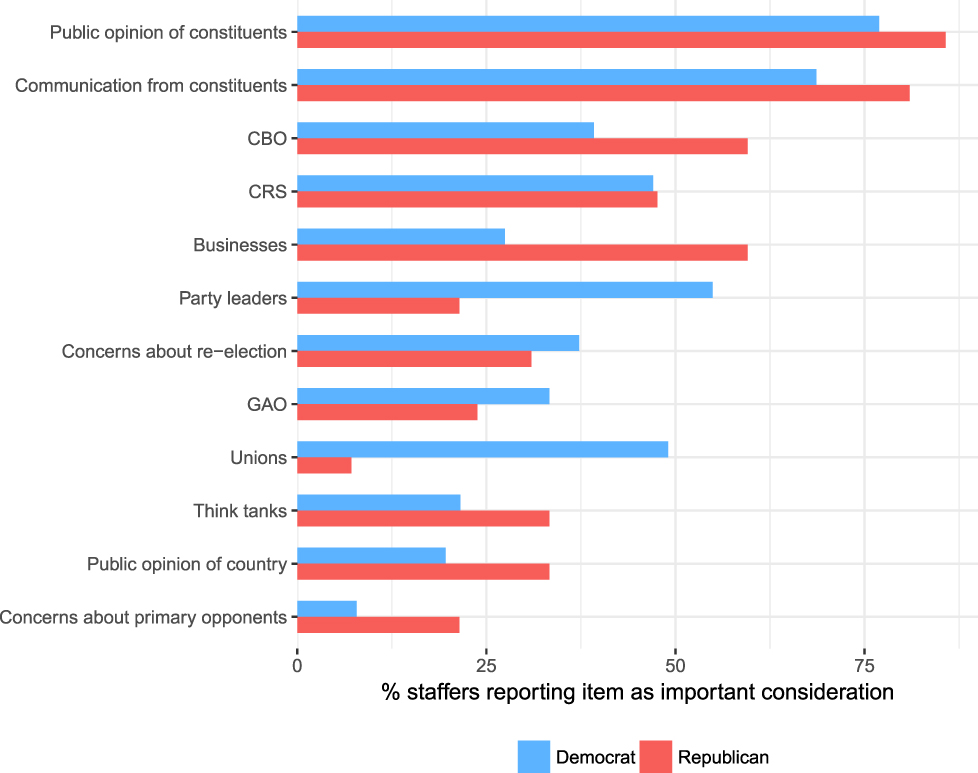
Figure 2 reports this item’s results by party. On average, staffers reported constituent communication and attitudes were most important, and concerns about primary opponents were least important. Over 80% of staffers view either constituent opinion or communication as extremely or very important in shaping their advice to Members. These results fit well with past polling of Congressional staffers by the Congressional Management Foundation, which has found that over 90% of surveyed staffers say that constituent contact would be important in deciding an office’s stance on an issue.Footnote 10 In fact, Congressional offices appear to prioritize collecting and responding to constituent opinions so much that the CMF has found that nearly half of surveyed staffers said that their office had shifted resources away from other activities toward managing constituent communications.Footnote 11 This is understandable, given that the internet makes it easier for constituents to communicate with their elected officials’ offices. Of course, these estimates are based on staffer self-reports. We might be concerned that, even in the context of a confidential survey, staffers downplay their reliance on certain information sources that are viewed as politically unpopular. To evaluate this potential bias, we also asked staffers what considerations other offices used for persuasion during past policy debates. This question partially taps into revealed behavior, rather than simply staffers’ own judgments. If another office was trying hard to persuade a staffer and their Member about an issue, they would likely pick considerations they knew would be taken more seriously by the target office. We provide full details on this question and results from this survey item in Appendix D. In general, there was a strong relationship between the types of considerations and information sources described as personally important by staffers and as frequently used by other offices for the purposes of persuasion.
Considerations Staffers Reported as Extremely or Very Important in Shaping Advice to Their Members, by Staffer Party

In follow-up, semi-structured interviews with some of our survey respondents, we also probed staffers about their efforts to process constituent communications and opinions.Footnote 12 Our interviews indicated that to track constituent opinion offices generally log every phone call, email, letter, and fax they receive into a database. These databases can be used to sort pieces of correspondence into batches relating to particular issue areas, such as health care or trade, and to report the number of contacts the office has received on each issue as well as the stances conveyed in the messages. When the American Health Care Act (the GOP bill to repeal the Affordable Care Act) was introduced in the House in 2017, for instance, staffers used this information to track how many contacts their office received in favor of the bill, and how many opposed it.
While this process is remarkably consistent across offices, interviewees varied in the extent to which they reported that their office engages in additional methods of assessing constituents’ views. The other methods they cited include face-to-face meetings with constituents in their offices, polling, monitoring constituents’ comments on social media, and even door-to-door canvassing by Members themselves. Several interviewees also mentioned town halls and other public events in the district or state, such as civic association meetings, as a useful means of keeping abreast of the issues that are most salient to constituents.
Staffers in our interviews consistently indicated correspondence tallies on a given bill (e.g., how many people asked a Member to vote for or against it) are often incorporated into recommendations about whether to vote for the bill. Similarly, interviewees reported that the information about which issues they are hearing about from their constituents plays a role in their office’s decisions about which issues to focus on. For instance, at weekly meetings with the Member where the office decides its priorities, staffers review which issues they have been hearing about most from constituents during the past week. We will evaluate the extent to which staffers actually perceive their constituents’ preferences and take correspondence from constituents as seriously as they indicate on this question in the sections that follow.
Returning to Figure 2, there were large differences by party in the considerations staffers reported were relevant for their policy advice, aside from constituent opinion. The largest divide was on information from unions: nearly half (49%) of Democratic staff reported that union information was extremely or very important to their deliberations, while only 7% of Republican staff said the same. Another striking difference was the importance of information from party leaders (Curry Reference Curry2015). Over half (55%) of Democratic staffers reported that they found information from their party’s leadership to be extremely or very important to them, while only one in five Republican staffers reported the same (21%). This divide may reflect the ongoing struggles within the Congressional Republican caucus as GOP leaders like Speaker Paul Ryan and Senate Majority Leader Mitch McConnell attempted to bring together more traditional, business-friendly Members with newer and more ideological Freedom Caucus and Tea Party members (Mann and Ornstein Reference Mann and Ornstein2016).
LEGISLATIVE STAFFERS’ PERCEPTIONS OF THEIR CONSTITUENTS
Over three-quarters of both Democratic and Republican staffers reported in our survey that their top consideration when thinking about legislation was their constituents’ opinion. But do staffers know what their constituents want? To answer this question, we compare staffers’ estimates of public opinion in their district or state to the actual opinion in that district or state. Specifically, we ask respondents “Now, consider only the people living in your Member of Congress’s constituency. To the best of your knowledge, what percentage of the people living in your Member’s constituency would agree with the following policy statements? The slider below goes from 0% (no one) to 100% (everyone). Just give your best guess.” Respondents moved a slider bar to answer the question.
As part of our follow-up interviews with survey respondents, we validated our interpretation of this question as representing estimates of state or district-level public opinion. In particular, these interviews foreclosed the unlikely interpretation of our question as querying the narrow preferences of their Member’s political supporters. All our interviewees unanimously interpreted our question wording as referring to the residents of their Member’s district or state. No staffer interpreted it as referring to political supporters.Footnote 13
We selected the five policy domains included on the survey for several reasons: public opinion data availability, issue salience, partisan polarization, and interest group involvement. With the exception of the climate change item, the items came from the Cooperative Congressional Election Study (CCES), which offers sufficiently large sample sizes to estimate downscaled public opinion for states and Congressional districts. The CCES uses respondents sampled from YouGov, a well-respected online polling firm. The sample aims to be representative of the national adult population and is very large with around 50,000 respondents during election years. We use data from the 2016 CCES to estimate district- and state-specific attitudes using multilevel regression and post-stratification (MRP), detailed in Appendix F. Our climate question uses data previously down-scaled by Howe et al. (Reference Howe, Mildenberger, Marlon and Leiserowitz2015). In the analyses that follow, we compare Senate staffer perceptions with state-level opinion estimates, and House staffers with district-level opinion estimates. For all five policy areas, we used essentially the same question wording in our survey as in these other surveys.Footnote 14
All five policy domains are highly salient, and therefore are issues on which staffers have received at least some constituent and interest group contact. This is especially true because Congress considered bills that would address all five proposals within the prior year to the survey.Footnote 15 The fact that Congress had recently voted on measures related to these policies means that top legislative staffers ought to have considered, relatively recently, the positions of their constituents on these issues. The five issues also exhibit varying degrees of partisan polarization. In two cases—ACA repeal and the minimum wage—the issue is highly polarized between the two parties. There is essentially no Congressional Democratic support in favor of repeal and virtually all Congressional Republicans were supportive of ending the health reform law, at least in principle before the Trump administration; while the reverse is true for boosting the minimum wage. By contrast, both parties have tended to be more divided internally toward climate change and gun control: even though Democrats have tended to be much more favorable toward measures to address climate change and gun control than Republicans, there are more divisions on these issues within the parties. Some conservative Democrats, for instance, have stymied Congressional climate proposals and new gun control measures. Some more moderate Republicans have occasionally supported legislation in these domains as well. And infrastructure spending is generally viewed as a bipartisan issue historically supported by both parties as a necessary investment in the economy. Indeed, an infrastructure spending bill was one of the few bipartisan accomplishments of the otherwise gridlocked 114th Congress.
The five issues also implicate different constellations of interest group involvement, which we anticipate may help explain Congressional representation. On climate change, fossil fuel and other extractive industries intensely oppose tighter regulations. These businesses have invested a considerable sum of money in campaign contributions, lobbying, and other political activities to prevent government action to curb greenhouse gas emissions (Mildenberger Reference Mildenberger2015; Stokes Reference Stokes2015). We might characterize this policy as engendering the opposition of a concentrated set of corporate interests. Tighter gun regulations represent a similar issue where there is intense corporate opposition from a concentrated set of interests, in this case, the firearm and ammunition industry and its advocacy groups, especially the National Rifle Association (Cook and Goss Reference Cook and Goss2014). Raising the minimum wage is also an issue that business interests have opposed; but in this case, opposition is less concentrated in particular industries and more widespread across the business community (Hacker and Pierson Reference Hacker and Pierson2010). Health reform, on the other hand, features a mixed set of corporate interests. Although health insurers and some medical providers strongly opposed health reform legislation, including the ACA (Jacobs and Skocpol Reference Jacobs and Skocpol2015), these sectors face a different set of incentives now that the ACA is law. Repealing some or all of the ACA would undermine these companies’ current business model, which now depends on enrolling Americans into new regulated marketplaces and an expanded Medicaid system. At the same time, these industries would support rolling back many individual provisions within the ACA. Lastly, infrastructure spending is an issue supported by many segments of the business community. The very conservative US Chamber of Commerce, typically opposed to most government intervention, backed the infrastructure spending bill considered by the 114th Congress.Footnote 16
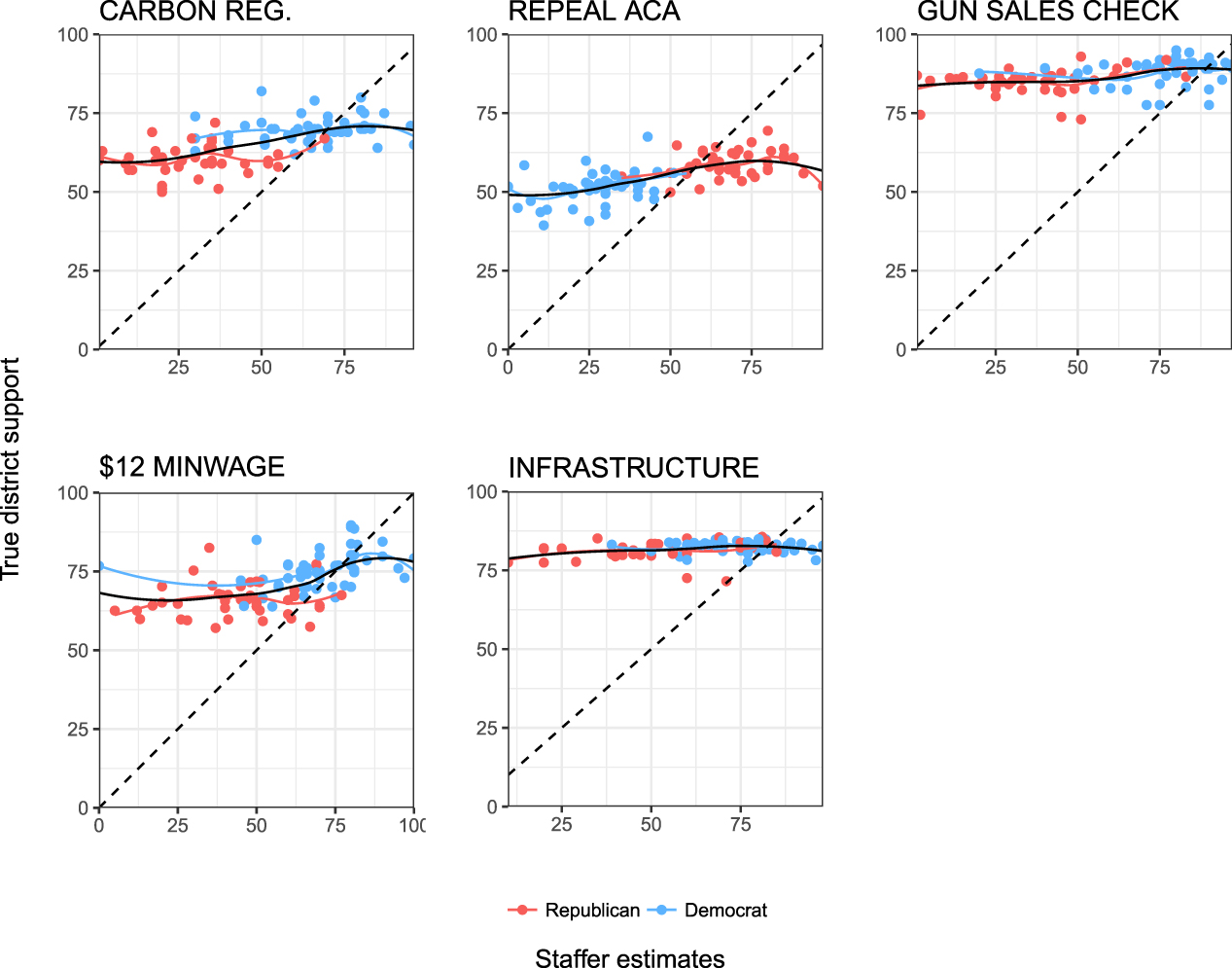
Figure 3 compares the relationship between Congressional staffers’ perceptions of their constituents’ opinions and their constituents’ actual opinions in each policy area.Footnote 17 If staffers were able to accurately perceive public opinion, the data should fall on the dashed 45 degree line; when staffers are underestimating support, the dots fall to the left-hand side of the line, when they are overestimating support, they fall to the right. The locally weighted (lowess) regression line shows that staffers estimate public opinion across the full range, from 0% to 100% support. By contrast, public support in each domain falls within a narrower range across districts: from 50% to 82% for carbon regulation; 39% to 69% for repealing the ACA; 73% to 95% for gun sale regulations; 72% to 86% for infrastructure spending; and 57% to 90% for boosting the minimum wage. While there are modestly positive slopes across all five issues when pooling across Democratic and Republican staffers, these correlations generally disappear once we consider within-party staffer misperceptions.Footnote 18 Overall, then, in none of the five areas are staffers estimating their constituents’ preferences with any degree of relative or absolute accuracy.Footnote 19 Staffer perceptions are far more extreme than the public’s actual policy preferences. Still, the strength of the relationship between staffer estimates and constituent preferences varied across the five domains: the correlation between staffer estimates and constituent preferences was strongest for attitudes about raising the minimum wage, followed by CO2 limits, repealing the ACA, gun sale checks, and then infrastructure spending.Footnote 20
Comparing Staffer Perceptions of Constituent Preferences to True District-Level Preferences, by Issue Area

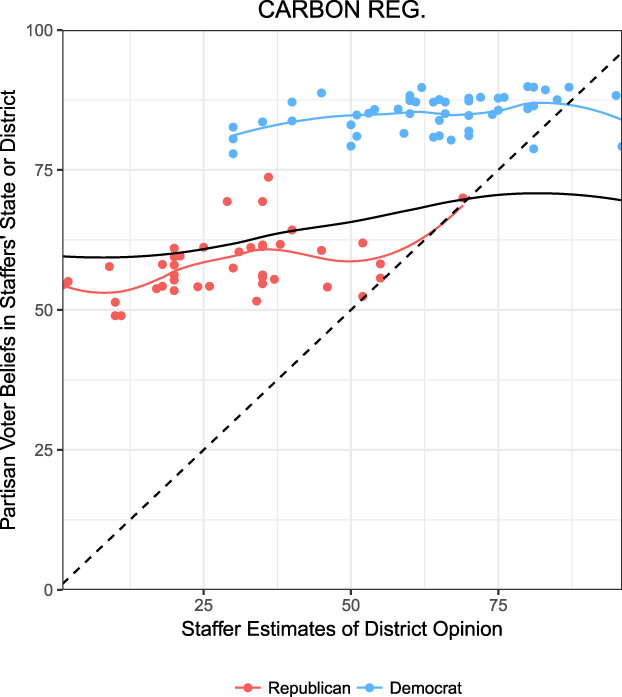
If staffers do not have accurate perceptions of publics in their districts or states, do these perceptions instead reflect the distribution of public attitudes among co-partisans? We can evaluate this possibility in the climate change issue area by leveraging data from a partisan MRP model of climate and energy attitudes (Mildenberger et al. Reference Mildenberger, Marlon, Howe and Leiserowitz2017). In Figure 4, we compare staffers’ perceptions of their constituents’ preferences for carbon regulation with the fraction of the Democratic or Republican publics in their elected official’s district supporting this position. We again find little relationship. Democratic and Republican staffers’ estimates of the general publics’ preferences do not seem driven by the distribution of their co-partisan publics’ beliefs. If staffers’ perceptions of public opinion were structured by primary or general election partisan voters, we would have expected to see a stronger relationship in this figure.
Staffer Perceptions of Constituent Preferences Against Distribution of Co-Partisan Constituent Preferences

Our data also allow us to evaluate whether staffers are systematically over- or underestimating public attitudes. Previous research finds that both liberal and conservative state politicians systematically over-estimate their constituents’ conservatism (Broockman and Skovron Reference Broockman and Skovron2018). We similarly find a conservative bias for four of our five issues. The vast majority of surveyed staffers (91%) underestimated their constituents’ support for background checks on gun sales. There was a similar, though less pronounced, bias toward staffers underestimating support for regulating carbon dioxide emissions—78% of staffers underestimated constituent support for CO2 limits in their districts and states. There was less of a clear pattern for staffers when estimating support for repealing the ACA: 65% underestimated and 35% overestimated mass support. However, there were clear partisan divisions in staffer misperceptions. Every Democratic staffer underestimated support for repeal and nearly every Republican staffer over-estimated support for repeal. On both the minimum wage and infrastructure spending, nearly all GOP staffers underestimated their constituents’ support. Democratic staffers tended to underestimate support, on average, though the bias was less pronounced than with their Republican counterparts. Thus, overall, we find a conservative bias in staffers’ estimations.
EXPLAINING LEGISLATIVE STAFFERS’ GAPS IN REPRESENTATION
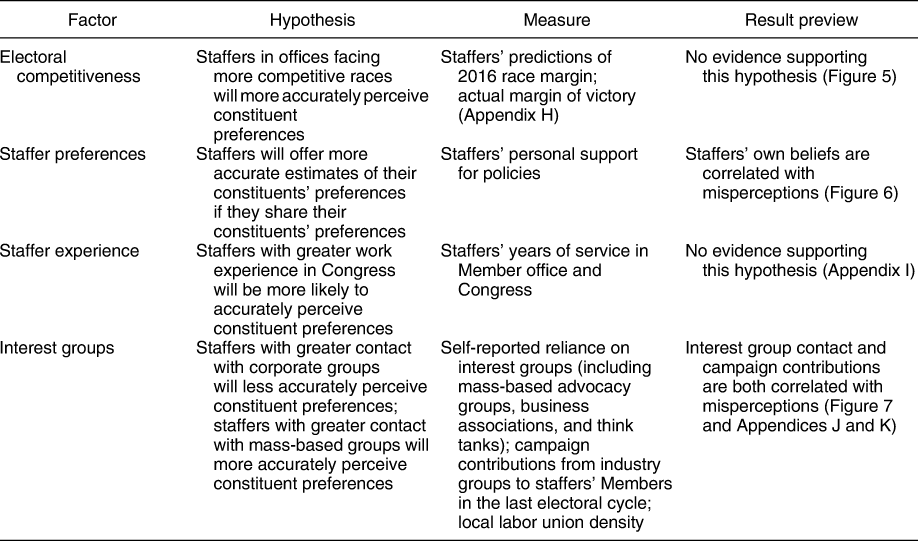
What could explain these strikingly large mismatches between staffer perceptions and constituent opinion? We examine four potential correlates for the representation gap: elections; staffers’ own preferences; staffer experience; and interest group contact. We summarize these hypotheses in Table 1.Footnote 21
Correlates of the Staffer Representation Gap

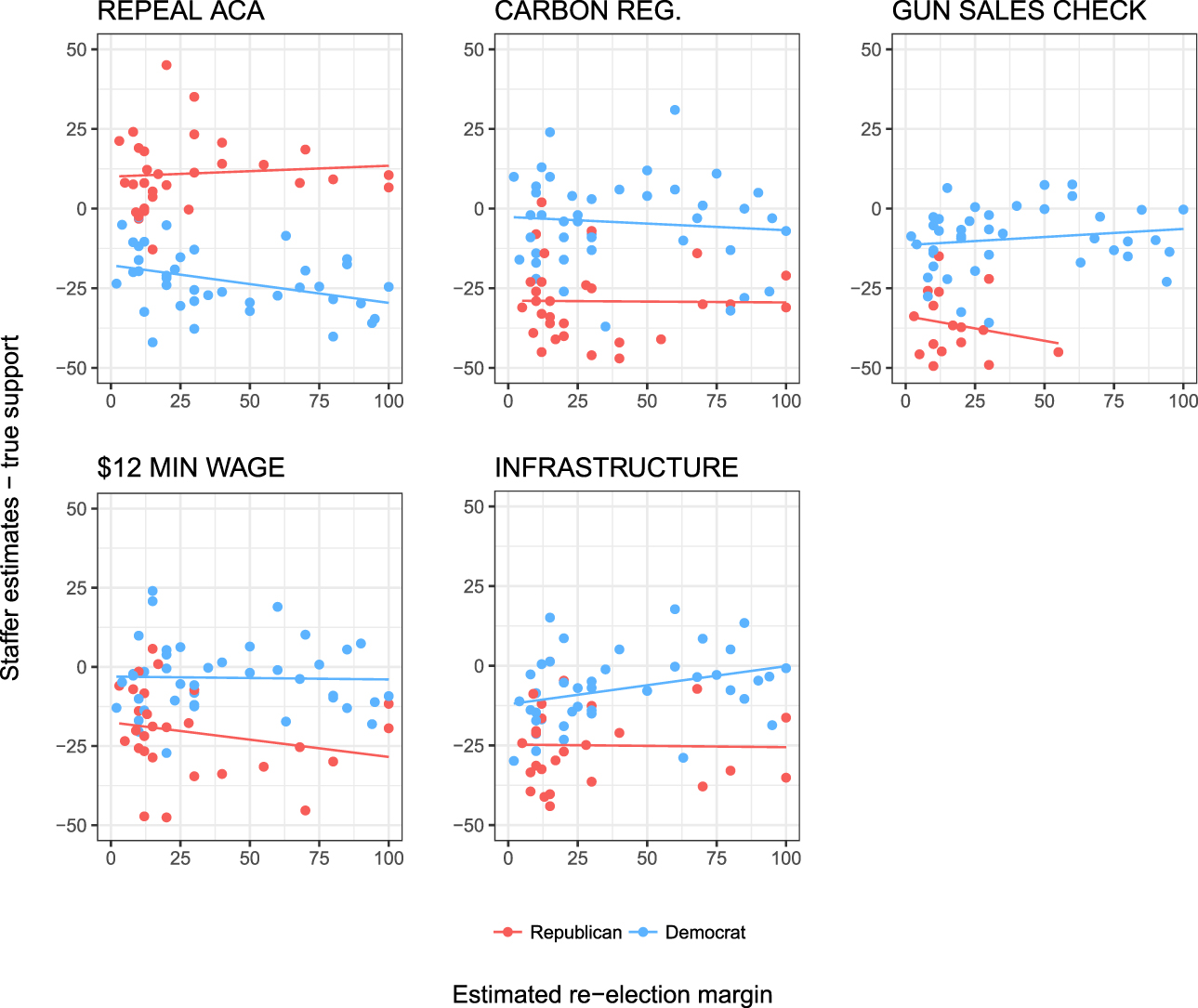
Standard models of representation predict that elections should drive responsiveness for politicians who want to win and hold office (Arnold Reference Arnold1990; Gilens Reference Gilens2012; Mayhew Reference Mayhew2004). Therefore, we might expect that staffers whose Members were in tighter races at the time of the survey would be more likely to correctly assess constituent opinions because they want their Members to win reelection to retain their jobs. We assessed this hypothesis using a question on the survey that asked staffers to predict their Members’ reelection margin, if their Member was up for reelection in 2016. We received 75 valid responses, ranging from a predicted two- to 100-percentage point victory, with a mean of 35 and a median of 23-percentage points. Notably, no staffer predicted a loss.
Figure 5 plots the relationship between the staffer-constituent opinion mismatch and staffers’ election predictions. Looking across all policy domains, we see little consistent relationship between estimated race competitiveness and the accuracy of staffers’ perceptions. Staffers for Members in tighter races were generally no more likely to get their constituents’ preferences right compared to staffers working for Members in relatively uncontested races. The strongest exception was for Republican staffers on gun policy. Here, we see the expected relationship: GOP staffers from safer districts and states were more likely to underestimate their constituents’ support for background checks. Yet, even for staffers in highly competitive races there was a large mismatch: staffers who thought that their bosses would only win by two-percentage points were estimated to be off of their constituents’ preferences by about 43-percentage points. Electoral competitiveness thus does not seem to offer much leverage in explaining the staffer-constituent mismatch (see Appendix H for evidence that actual race competitiveness does not predict representation, either).
Staffer Misperceptions of Constituent Preferences and Estimated Margin of Victory in Next Election, by Issue Area

Next, we examined the role of staffers’ personal opinions (Figure 6). For this hypothesis, we were interested in understanding whether egocentric bias could explain mismatches. Egocentric bias is a consistent finding in psychology that suggests individuals use their own beliefs as a heuristic for estimating the beliefs and opinions of others (Epley et al. Reference Epley, Keysar, Van Boven and Gilovich2004; Nickerson Reference Nickerson1999). We found the clearest case for egocentric bias in health policy. On average, staffers who supported the ACA repeal overestimated constituent support for repeal while staffers who opposed repeal underestimated constituent support for repeal. All staffers underestimated their constituents’ support for climate regulations, infrastructure spending, boosting the minimum wage, and gun background checks, though this dynamic was significantly moderated by staffers’ own beliefs. This finding indicates a potential role for staffers’ own perceptions and attitudes in accounting for the representation gap between Congressional aides and the public. Our evidence suggests that, despite any political incentives that may exist to reward unbiased estimation of constituent beliefs, staffers do not transcend common egocentric bias. Divergence in staffer misperceptions among individuals who agree and those who disagree with each policy statement are statistically significant in all five policy domains; substantively, the differences range from 17-percentage points (infrastructure) to 36-percentage points (gun regulations).
Staffer Misperceptions of Constituent Preferences and Staffer Personal Opinions, by Issue Area. Lines Indicate 95% Confidence Intervals

The third factor we considered was staffer work experience. There was broad variation in the length of time that senior staffers in our survey had worked for their particular Member, and for Congress in general. On average, staffers reported working for their Member for about five years, and in Congress for nine. It could be the case that staffers with more work experience are more knowledgeable about their constituents’ preferences, either because they have had more time to learn the public’s attitudes, or because they gained skills in estimating constituent opinion. To assess this explanation, we compare staffer tenure against staffer-constituent preference mismatches. We find no relationship. In none of the policy domains we examined was staffer experience, either in a Member’s office or in Congress in general, related to the accuracy with which staffers could discern their constituents’ attitudes. Staffers who have served in Congress for longer are not more likely to get their constituents’ preferences right compared to newer staffers (see Appendix I for full results).
Finally, we examined whether interest group contact could account for the representation gap. In the absence of strong signals from ordinary citizens, staffers might rely on interest groups that claim to represent constituents within a staffer’s state or district. Staffers might even simply substitute interest group preferences for those of their constituents. Building on the interest group literature (Schlozman, Verba, and Brady Reference Schlozman, Verba and Brady2012; Walker Reference Walker1991), we distinguish between mass-based interest groups and corporate-based interest groups. Business-oriented groups represent the interests of for-profit companies. Mass-based groups represent individuals from the mass public. We expect that greater relative staffer contact with mass-based groups will help staffers assemble a more accurate perception of their constituents’ preferences given that mass-based groups have closer interactions with the public. By contrast, we hypothesize that greater relative staffer contact with business-based groups will result in less accurate perceptions of public opinion because business-based groups are less likely to represent the preferences of the general public—and may be opposed to them (Gilens and Page Reference Gilens and Page2014; Hacker and Pierson Reference Hacker and Pierson2010). Consistent with the more general rightward movement of the organized business community in recent decades (Hacker and Pierson Reference Hacker and Pierson2016), most business interests in our survey are also aligned with ideologically conservative positions, while our mass-based groups are supportive of liberal stands. Regardless of the cause of this division, this complicates efforts to separate the ideological orientation of groups from the business versus mass group dimension in our survey. In the discussion that follows, we therefore refer to groups by both characteristics.
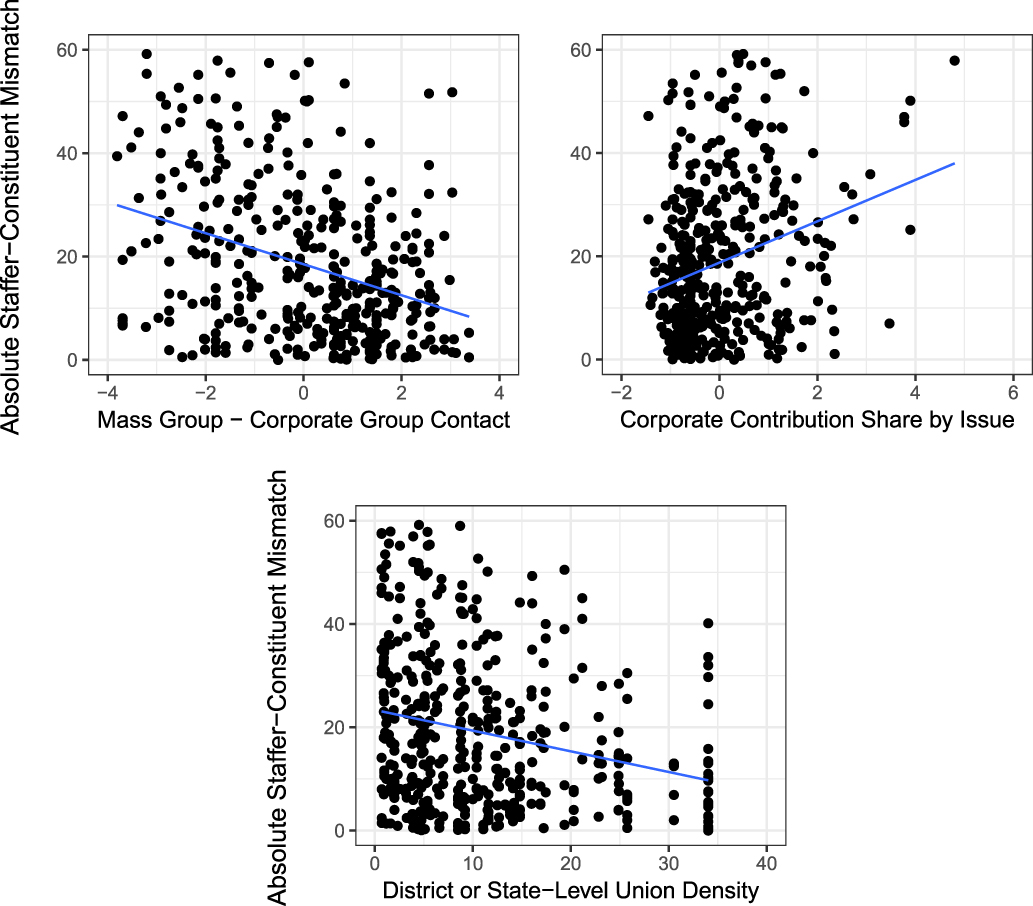
We measure interest group contact in three ways: staffers’ self-reported reliance on interest groups relevant to the policy issues we study, data on campaign contributions from the major corporate sectors related to these policy domains, and an objective measure of one mass group’s strength (labor unions). The self-reported measure comes from a survey item in which staffers could rate their reliance on various interest groups on a one through six scale, where six indicated the greatest importance.Footnote 22 We average and sum standardized versions of these measures across multiple interest groups involved in each of the five policy domains.Footnote 23
Our second measure involves the share of a Member’s campaign contributions in their last election cycle that came from businesses in specific industries that related to our policy domains: health providers and insurers for the ACA; gun and ammunition manufacturers for background checks; construction and contractors for infrastructure; business associations for the minimum wage; and extractive industries, including conventional energy power plants, oil, gas, and coal extraction, for carbon dioxide emission limits.Footnote 24 For now, we interpret the correlation between campaign contributions and staffer perceptions not as signifying the weight of the contributions themselves, but rather as the strength of the relationship between a Member’s office and a particular set of corporate interests. A greater reliance on contributions from an industrial sector signifies a stronger relationship between an office and businesses in that sector.
The final measure involves the density of labor unions in a staffer’s district or state, which we interpret as a measure of union strength. We rely on estimates of labor union membership by House district reported in Becher, Stegmueller, and Käppner (Reference Becher, Stegmueller and Käppner2018) and state union density from the Bureau of Labor Statistics (see Appendix J for more information). Unions represent an especially important mass-based group and check on corporate influence. As Kay Schlozman, Sidney Verba, and Henry Brady explain in The Unheavenly Chorus, unions are essentially the only way that nonprofessional, nonmanagerial workers receive representation in the organized interest community (see especially chapter 14; Schlozman, Verba, and Brady Reference Schlozman, Verba and Brady2012). In a similar vein, Martin Gilens finds in his analysis of the congruence between public opinion and policy change that “unions emerged as the interest groups with the most consistent and widespread tendency to share the preferences of low- and middle-income Americans” (Gilens Reference Gilens2012, 161). And in their analysis of the contribution of economic policy to rising top-end inequality, Jacob Hacker and Paul Pierson argue that unions are the “vigorous champion” of “pocketbook issues” for “middle- and working-class Americans”—not just their immediate members (Hacker and Pierson Reference Hacker and Pierson2010, 143). In light of this research, we feel comfortable characterizing unions as an especially important mass-based group representing public preferences.
The top left panel of Figure 7 summarizes, across policy domains, the contact that staffers reported with both liberal/mass groups and conservative/corporate groups. The horizontal axis is a standardized index of the frequency with which staffers relied on mass groups minus corporate groups. Greater values indicate a greater relative reliance on liberal/mass groups over conservative/corporate groups. The strong negative relationship indicates that staffers who reported relying on liberal/mass over conservative/corporate interest groups—at the right end of the x-axis—tended to more accurately perceive their constituents’ preferences. By contrast, staffers more reliant on conservative/corporate groups over liberal/mass-based groups—at the left end of the x-axis—were more likely to get their constituents’ opinions wrong. The top right panel reports the campaign contribution measure. We observe a similar relationship as in the left panel, indicating that a greater reliance on corporate contributions is correlated with larger constituent mismatches.Footnote 25
Staffer Misperceptions of Constituent Preferences and Interest Group Contact (Self-Reported Reliance on Mass Versus Corporate Groups in Top Left Plot; Corporate Campaign Contributions to Staffer’s Member in Top Right Plot; Labor Union Membership in Bottom Plot)

The bottom left panel of Figure 7 shows consistent results with the other two interest group panels: greater mass group-based pressure on a Member’s office (in this case measured with local union strength) is related to more accurate perceptions of constituent preferences. Staffers representing districts and states with stronger unions were more accurate in their predictions of constituent preferences along all five dimensions.
In summary, we find little support for a relationship between electoral pressures or staff tenure and staffers’ accuracy in estimating public opinion. We do find a relationship between accurate predictions and interest group interactions with and donations to offices, as well as staffers’ own opinions. Greater contact with liberal, mass-based groups is related to more accurate perceptions of constituent opinion while greater contact with conservative, corporate-based groups is related to less accurate perceptions. Staffer contact with these organizations may skew their perceptions of the public because the groups are more ideologically conservative than the public along the range of issues we study. That mechanism would be very consistent with the analysis in Broockman and Skovron (Reference Broockman and Skovron2018), which shows that state politicians’ over-estimation of their constituents’ conservatism can be attributed in part to conservatives’ greater likelihood of contacting elected officials.
Still, these correlations are at best suggestive. And importantly, these results cannot explain why it is that contact with conservative and corporate groups skews staffer perceptions of the public. To more rigorously test whether interest group interactions can shape staffer perceptions and positions, we turn to evidence from two experiments embedded in the survey. These experiments provide more credible causal evidence about the role of interest group and donor contact in shaping staffer perceptions and preferences.
EXPERIMENTAL EVIDENCE SUPPORTING INTEREST GROUPS’ INFLUENCE ON THE REPRESENTATION GAP
We use two experiments embedded within the staffer survey to test whether contact with organized interest groups changes senior legislative staffers’ perceptions of their constituents’ preferences. In a list experiment, we uncover the proportion of top Congressional aides revealing they changed their opinion on a policy issue after receiving a campaign contribution from an organized interest group. We used a separate experiment to examine how communications from ordinary constituents, citizens’ associations, or employees of a large business influence staffers’ opinions about pending policy debates and their perceptions of constituent attitudes.
Contribution List Experiment
Recent experimental research by Kalla and Broockman (Reference Kalla and Broockman2016) gives reason to think that interest group electoral contributions increase the likelihood that high-level staffers meet with interest groups. That study and related literature, however, is limited in its ability to gauge whether contributions also shape staffers’ policy opinions. While contributions facilitate access, those meetings may not necessarily result in staffers changing their minds about legislation. For instance, if interest groups generally make campaign contributions to allies who already agree with them, then contributions should not change staffers’ minds (Hall and Deardorff Reference Hall and Deardorff2006; Hall and Wayman Reference Hall and Wayman1990). Examining whether staffers change their minds on legislation after their Representative or Senator receives campaign contributions from an interest group is no easy task, however. It is a mechanism that is difficult to observe without asking staffers directly. Yet staffers likely face strong incentives against responding truthfully to such a question on a survey. Accordingly, we use a list experiment to elicit more accurate responses from senior legislative staffers about whether electoral contributions from interest groups shaped their policy preferences. If interest groups do shape staffers’ policy preferences, this could help explain why corporate contributions are correlated with a greater staffer-constituent opinion mismatch.
In a list experiment, respondents are shown a list of several statements, and then indicate how many items they agree with. Not all respondents see the same list, however. Half of respondents are shown a short list without the sensitive item the researcher is interested in studying, while the other half sees a list with the sensitive item included. The proportion of respondents agreeing with the sensitive statement can be calculated by subtracting the average number of items selected among respondents who saw the full list from the average number of items selected by respondents who saw the short list. List experiments have been successfully used in many other contexts to study similar taboo or sensitive behaviors (Glynn Reference Glynn2013).
In our list experiment, staffers read the following prompt: “Below, you will find a list of [4/5] statements. Please tell us HOW MANY of them you agree with. We don’t want to know which ones you agree with, just HOW MANY. Over the last year, I’ve developed a new perspective about a policy under consideration in Congress after speaking with…” Half the staffers were assigned to the control group, where they saw four items: “a representative from a business”; “a legislative staffer from the opposing party”; “a legislative staffer from my own party”; and “a representative from a union.” The other half of staffers were assigned to the treated group, where they saw those same four items plus an additional fifth item: “a group that provided campaign contributions to my Member.” This is the sensitive item whose prevalence we were attempting to estimate.Footnote 26
Staffers in the control condition agreed with an average of 2.84 items (SE = 0.18), while staffers in the treatment condition agreed with an average of 3.30 items (SE = 0.19). The difference in means between the conditions is 0.454 (SE = 0.27). This indicates that 45% of staffers agreed they had developed a new perspective about a policy after speaking with a group that provided campaign contributions to their Member.Footnote 27 This result suggests that a potentially large share of senior Congressional staffers have had their thinking about policy shaped by interest groups that provided their Member campaign contributions. Some of these staffers might develop new policy perspectives from campaign contributors because they share broad policy objectives. Others may engage these contributors to secure continued campaign financing. Critically, however, this experiment offers evidence that campaign contributors not only shape access to Congressional offices in the first place (Hall and Deardorff Reference Hall and Deardorff2006; Hall and Wayman Reference Hall and Wayman1990; Kalla and Broockman Reference Kalla and Broockman2016), but that contact with these contributors shapes staffer policy perspectives. In this sense, the list experiment suggests a potential mechanism for the correlations between corporate interactions and staffer-constituent preference mismatches we uncovered in the observational survey evidence above.
Communications Survey Experiment
Our second survey experiment focused on another strategy that interest groups use to shape Congressional policymaking: having their members write to Congress on pending policy proposals. These tactics are well-documented in past work on interest group behavior (e.g., Kollman Reference Kollman1998; Schlozman, Verba, and Brady Reference Schlozman, Verba and Brady2012; Walker Reference Walker2014). In particular, large companies increasingly use employee correspondence to shape legislative behavior on bills relevant to their firms and industries (Hertel-Fernandez Reference Hertel-Fernandez2018; Walker Reference Walker2014).Footnote 28 Legislative staffers’ role in mediating communications to Members is less well understood, however. This oversight is important because we know staffers play a central role in the information chain connecting outside communications to Members’ actions.
Existing literature on Congressional constituent correspondence is similarly unclear on whether these communications provide an opportunity for all interests to be represented in the policymaking process, or whether they advantage certain voices over others. In a series of correspondence experiments, Butler (Reference Butler2014) shows that municipal politicians discount constituent communications from individuals who appear to be of low socioeconomic status because elected officials perceive those individuals to be less knowledgeable about the issues described in those communications. This research suggests important ways that politicians might discount public attitudes of certain groups. We aim to extend this research, examining how political officials evaluate messages from individual citizens alongside interest groups, and especially business. We are thus interested in knowing whether interest group-initiated communications carry especially important weight in the minds of Congressional staff compared with individuals’ communications. Can interest groups, and particularly businesses, use Congressional communications as a way of disproportionately representing their interests in the policymaking process, thus skewing staffer perceptions of constituents?
To evaluate these questions, we designed an experiment wherein senior Congressional staffers were instructed to imagine that they had received constituent communications on a pending policy issue. Staffers were randomly assigned to receive different descriptions of the constituent communications, with the variations indicated in brackets as follows: “Imagine your office is considering a bill that is under debate in Congress. Your office receives [2; 20; 200] letters from constituents [supporting; opposing] this bill. The letters have very [similar; different] wording to one another. The letter writers identify themselves as [employees of a large company based in your constituency; constituents; members of a nonprofit citizens group].”
We then asked staffers three questions about the effect of those letters on their deliberations over the legislation in question: “How likely are you to mention these letters to your Member?”; “How significant would these letters be in your advice to your Member about their position on the bill?”; and “How representative do you think these letters are of your constituents’ opinions?” Responses to the three questions were all provided on a one through four scale (“very,” “somewhat,” “not very,” and “not at all”), with higher values indicating greater agreement with the question. Each of these three questions taps into a potential mechanism for how interest group-initiated communications with Congress could change how staffers—and ultimately, Members of Congress—perceive their constituents’ opinions and use those perceptions to inform policy decisions. By randomly assigning staffers to different hypothetical letters, we can estimate the effect of a staffer receiving messages that were coordinated in letter-writing drives from large businesses or citizen advocacy groups, or simply written by individual citizens.Footnote 29 As with any survey experiment, the treatment and related questions are stripped of much of the rich political context that surrounds the actual legislative process. Yet the virtue of this stripped-down experiment is that any differences we observe in how staffers report evaluating these constituent communications can be attributed to variation in the treatment conditions—and not other characteristics of the staffers themselves. Given our interest in understanding the effect of organized interest groups on staffers’ perceptions of constituent opinion, we focus our attention on evaluating the effects of these treatments, rather than the other conditions in the experiment. It is important to note that given three conditions, there are small sample sizes (N = 17–36) in each treatment group (moreover, we did not pre-register our hypotheses).
With these caveats in mind, staffers reported that they would be more likely to mention employee-authored letters to their bosses, but the differences with the constituent or citizens’ group conditions were not significant at this sample size. Staffers were also more likely to indicate that employee letters would shape their thinking and recommendations about legislation, but the difference between employee letters and letters from ordinary constituents was not significant. When comparing employee letters against both citizens group letters and ordinary constituents taken together, which improves the sample size, there is a larger effect (0.32 units on the one to four scale, p = 0.089; 16-percentage points on the “very” or “somewhat” important scale, p = 0.17).
The picture is more striking when looking at the final question we posed to staffers: how representative they believed the letters were of their constituents’ opinions as a whole. Employee messages are substantially more relevant as staffers form perceptions of their constituents’ opinions than either messages from individual citizens or members of nonprofit advocacy groups. A full 62% of staffers who saw messages purportedly from employees of the same large business reported that the messages were “very” or “somewhat” representative of their constituents’ opinions, compared to just 34% of staffers who saw letters from ordinary constituents and 29% of staffers who saw letters from nonprofit advocacy group members. More dramatically, over a third of staffers with letters from nonprofit advocacy groups and around 10% of staffers with letters from individual constituents reported that those letters were “not at all representative” of their constituents’ real opinions. The difference between the employee letter condition and the ordinary constituent condition was quite large, representing 0.39 units on the one to four scale (p = 0.019), as was the difference between the employee letter condition and the citizens group condition (0.68 units, p < 0.01).Footnote 30
Taken together, these results provide further evidence for a mechanism that businesses can use to shape Congressional policymaking (Hertel-Fernandez Reference Hertel-Fernandez2018; Walker Reference Walker2014). They also illuminate a potential mechanism by which staffers’ perceptions of their constituents’ preferences can be skewed away from the attitudes held by most citizens. If a slew of employee letters arrive supporting a particular bill, staffers may be more likely to think that their district or state as a whole supports that bill, even if those employee letters are not representative of public opinion. The results from the staffer communications survey, then, complement our observational analysis of staffer perceptions of district and state opinion, showing one potential mechanism by which organized interest groups—and especially businesses—can distort the representation of constituents’ opinions in the eyes of Congressional staff.
LEGISLATIVE STAFFERS, ORGANIZED INTEREST GROUPS, AND AMERICAN DEMOCRACY
As economic inequalities expand in the United States, many scholars and citizens have expressed concern that those at the top of the income distribution are advantaged in the political process. A growing body of research suggests that these fears may be well-founded. Wealthy individuals and business interests are more involved in the political process than groups representing the economically disadvantaged or workers (Drutman Reference Drutman2015; Schlozman, Verba, and Brady Reference Schlozman, Verba and Brady2012). Moreover, when researchers compare policy changes to public preferences, results show business’ and economic elites’ preferences are much more predictive of policy change than are the preferences of lower- and middle-income citizens (Gilens Reference Gilens2012; Gilens and Page Reference Gilens and Page2014). Overall, these results suggest a significant representation gap for average American citizens.
We contribute to this research, examining a potentially new mechanism for the breakdown in responsiveness: the staffers serving Members of Congress and their contact with organized interest groups, particularly businesses and ideologically conservative groups. Through our observational analysis and survey experiment on constituent communications, we have presented evidence consistent with the argument that when senior Congressional staff come into contact with corporate or conservative interests, they are less likely to have an accurate picture of what their constituents want.
Our results cast a rather pessimistic light on democratic representation in Congress. Although senior staffers responsible for advising Representatives and Senators overwhelmingly report they would like to base their decisions and recommendations on constituent opinion, in practice these staffers have only a limited understanding of constituent preferences across important policy issues. Our results also suggest that far from being a tool for democratizing access to lawmakers, in practice Congressional correspondence can be a mechanism through which organized business disproportionately influences the policymaking process at the expense of other interests (cf. Yackee and Yackee Reference Yackee and Yackee2006).
The staffer survey we used to reach these conclusions afforded us a number of advantages. It allowed us to study the top aides responsible for advising Members of Congress on legislative and policy decisions. We were also able to combine both observational and experimental evidence, finding support for interest groups and egocentric bias in driving the mismatch. Yet our findings also have several important limitations. We can only speak to staffer representation on the issues that we included on the survey. It may be that there are issues on which staffers are much better positioned to evaluate their constituents’ preferences. Still, given the paucity of representation on these five issues, which span very different types of highly salient policies during an election year, we think that this is unlikely to be true.
Our findings about representation are also subject to broader concerns about the measurement of mass opinion. Does it matter if legislative staffers do not correctly perceive their constituents’ opinions if constituent opinions simply represent ill-informed “nonattitudes” (Converse Reference Converse and Apter1964)? We are agnostic in this analysis about the quality of constituent attitudes themselves, simply noting that we have chosen salient policy issues that Congress has recently considered. These are the kinds of issues where we should expect citizens to have developed relatively clearer attitudes. Moreover, even giving staffers a generous benefit of the doubt in their precision, the magnitude of the mismatch between staffer perceptions and constituent preferences is quite striking.
A third limitation is that our results are necessarily bounded to the contemporary Congress. Recent increases in Congressional contact under the Trump Administration may change some of these findings. It is also an open question whether these results would hold in other times or across different legislative bodies. Future work assessing legislative staffers’ role in mediating mass responsiveness in the states, or in other countries, would be very useful.
Additional research could also examine the mechanisms underpinning our findings in greater detail. In particular, future work ought to disentangle conservative and business-group contact with staffers. Do both types of groups skew staffer perceptions of the public? Our findings in the communications experiment offer some suggestive evidence that business groups may independently shape staffer perceptions of their constituents. But additional work might examine the reasons behind this bias in more detail. For example, staffers may be more deferential to business representatives because they view employees as more knowledgeable about policy issues than ordinary citizens, especially on issues that affect their firms.
Ultimately, our analysis should not be seen as an indictment of staffers. If the public does not consistently communicate its preferences to Congress—and interest groups do—then it is hard to expect staffers to accurately perceive what the public wants. In addition, some citizens may be more likely to contact their representatives than others, whether these disparities occur by issue, socioeconomic background, or geography. Such asymmetric mobilization can lead to distorted signaling, making it harder for staff to understand the preferences of the whole public they seek to serve (Stokes Reference Stokes2016). Though efforts to increase mass participation in the policymaking process are likely to be challenging, they could help to close the staffer-constituent opinion gap and ensure better representation in Congress. Regardless of how future scholars and activists choose to pursue the research questions and normative issues raised in this article, the bottom line is that legislative staffers—and their resources, perceptions, and interactions—merit far more attention in political science.
SUPPLEMENTARY MATERIAL
To view supplementary material for this article, please visit https://doi.org/10.1017/S0003055418000606.
Replication materials can be found on Dataverse at: https://doi.org/10.7910/DVN/OWQNVF.






Comments
No Comments have been published for this article.