Introduction
For many gerontologists and health-care and social-services staff, vulnerability and disadvantage among older people are primarily associated with physical or mental health problems and social isolation, particularly so in northwest European countries where the prevalence of old-age poverty has been greatly reduced (Schröder-Butterfill and Marianti Reference Schröder-Butterfill and Marianti2006). Recent work has substantiated that the connections between living alone, social isolation (i.e. having few contacts) and senses of loneliness, alienation and disaffiliation are subtle and not deterministic (Cattan et al. Reference Cattan, White, Bond and Learmouth2005; Victor et al. Reference Victor, Scambler, Bond and Bowling2000, Reference Victor, Scambler, Bowing and Bond2005). Homelessness is an extreme manifestation of social isolation and generally seen as rare among older people, but in the United Kingdom, Canada, Australia, Japan and North America, many experience this unusually disadvantaged and excluded state. This paper reports the findings of a longitudinal study of the progress of 64 older homeless people who were rehoused from hostels in England, and examines the factors that associated with whether the tenancy was sustained and whether the person had ‘settled’.
The first section of the paper reviews what is known about older homeless people, including the causes of their homelessness, their exceptional problems, and the effectiveness of different types of help. To place the study sample members and their new housing in context, the following section summarises developments since around 1990 in services for homeless people in the United Kingdom. The design and methodology of the study are then described, the analyses reported, and the final section discusses the practice implications of the findings.
Older homeless people
Studies of the problems and needs of older homeless people began in the United States during the 1980s, spread to Britain and Australia during the 1990s, and have recently been evident in Canada (e.g. Cohen and Sokolvsky Reference Cohen and Sokolovsky1989; Crane Reference Crane1993; Hightower et al. Reference Hightower, Hightower and Smith2003; Kavanagh Reference Kavanagh1997; Keigher and Greenblatt Reference Keigher and Greenblatt1992; Kutza Reference Kutza1987; McDonald et al. Reference McDonald, Dergal and Cleghorn2004; Stergiopoulos and Herrmann Reference Stergiopoulos and Herrmann2003). An incipient interest is also evident in Japan, for the country's recent protracted recession has resulted in many middle-aged and older workers becoming homeless (Aoki Reference Aoki2003; Hasegawa Reference Hasegawa2005).
Older homeless people are a substantial minority of single homeless people in many western countries, and there are many reports of increasing numbers. Although there are no aggregate point-in-time or period statistics for all older homeless people in England, some components of the population are monitored. From 1997 to 2003, around 4,000 households were accepted each year by local authority housing departments in England as homeless and in ‘priority need’ of rehousing on the grounds of ‘old age’ (generally 60 years for women, and 65 years for men). Provisional figures indicate a subsequent decrease, to 2,530 in 2005 (Department for Communities and Local Government (DCLG) 2006a).Footnote 1 In addition, many older homeless people sleep on the streets or stay in hostels and night-shelters. In London, a survey in 2000 of the residents of homeless people's hostels found that 700 (21%) were aged 50 or more years. More than 500 in this age group have slept on London's streets each year since 2001 (Broadway 2002, 2005, 2006; Crane and Warnes Reference Crane and Warnes2001).
A national survey in the United States in 1996 of nearly 3,000 homeless people found that 35 per cent were aged 45 or more years (Burt et al. Reference Burt, Aron, Lee and Valente2001). In Greater Boston, Massachusetts, a census in 2000 enumerated 610 homeless people aged 50 or more years, a 39 per cent increase on 1993 (Boston Partnership for Older Adults 2003). The age structure of those admitted to emergency shelters in Massachusetts is unusually ‘old’ and becoming more so: in 2003, 43 per cent of the 15,609 were aged 45 or more years, compared to 37 per cent of the total in 2001, and 28 per cent in 1999 (Meschede et al. Reference Meschede, Sokol, Raymond, Friedman, Sullivan, Kahan, Ma, Faris and Silvestri2004). In Australia, among 99,900 homeless people enumerated by the 2001 Census, 24 per cent were aged 45 or more years (Chamberlain and MacKenzie Reference Chamberlain and Mackenzie2003), and in Canada, similar counts in 2006 found that 18 per cent of 1,826 homeless people in Toronto were aged 51 or more years, and 32 per cent of 3,315 homeless people in Calgary, Alberta, were aged at least 45 years (Community and Neighbourhood Services 2006; Shelter, Support and Housing Administration 2006). In Calgary, the number in this age group increased by 16 per cent between 2004 and 2006 (Stroick Reference Stroick2004). In New York City, there is a vigorous debate between some charitable organisations, which argue that there are ‘more and more older adults experiencing homelessness for the first time … because housing costs are just eclipsing the fixed incomes of seniors in the city’, and the city's Department of Homeless Services, which maintains that the rise ‘is due to the general aging of the population’ (Lefkowitz Reference Lefkowitz2006). The number aged 65 or more years that entered the city's shelters rose from 645 in 2002 to 760 in 2005, but they are a very small percentage (2.6) of the total. Most homeless shelters in the United States are however deeply unappealing to older people and few are used to working with them.
From the 1960s to the early 1990s, there was great concern about homelessness among very young people, not least because of its association with brazen, visible sleeping-out in shop-fronts, transport terminals, city parks and other public places. Dubbed by many the ‘new homelessness’, the association with young adults persists in the perception of both the public and politicians. During 2004/05, however, among those sleeping rough in London, 567 people aged 50 or more years were contacted by street outreach workers compared to only 276 people aged 25 years or less (Broadway 2005). Moreover, the 700 older residents of London's hostels (mentioned above) exceeded the number aged less than 25 years by 65, and 278 of them were aged 60 or more years (Crane and Warnes Reference Crane and Warnes2001: Tables 2.1 and 3.1).
Many older homeless people have multiple and deep-seated problems. Some have been homeless and on the streets or in hostels for years and entered old age as homeless, while others became homeless for the first time in late life following widowhood, marital breakdown, illness or retirement and financial problems. Physical illnesses and disabilities are common, particularly mental health problems among women. Around two-fifths of older homeless men have alcohol problems, some with the physical illnesses and memory problems caused by years of heavy drinking. Whereas many older homeless men never married, a high proportion of older homeless women are divorced or separated. Many have few or no family contacts and some shun all human interaction.Footnote 2 A minority of older homeless people in London entered the country as labour migrants; among them, those who never establish family or friendship networks or connect with mainstream welfare services are at high risk of homelessness when older and no longer employable, particularly if they have lived in accommodation provided with the job. Former merchant seamen, itinerant construction labourers, racehorse ‘stable lads’ and hotel maids are among London's older homeless people (Crane and Warnes Reference Crane and Warnes2001). Similar pathways have been described among Mexican agricultural workers in California (Ragan Reference Ragan2006).
Since the late 1980s, awareness of the unmet needs of older homeless people has grown. Even the comparatively sociable are reluctant to use hostels and day centres for homeless people, through fear of violence, intimidation and disturbance from younger clients. Many older homeless people are unassertive, and the staff are often fully occupied with meeting the needs of the younger and middle-aged majority. The response in a few cities in Britain, the United States and Australia has been to set up services exclusively for older homeless people. Little is known, however, about older people's movements into, through and out of homelessness (Warnes and Crane Reference Warnes and Crane2000a). A two-year prospective study of 210 older homeless women in New York City found that those who had been homeless for less than one year were more likely to be rehoused than those with longer histories (Cohen et al. Reference Cohen, Ramirez, Teresi, Gallagher and Sokolvsky1997).
A few local studies in England, Germany, the United States (Seattle), and Australia (Melbourne) have identified the benefits to older homeless people of being rehoused: increased confidence and independence; improvements in self-care; increased motivation, engagement in activities and family contacts; reduced alcohol consumption; and an increased willingness to access health-care (Crane and Warnes Reference Crane and Warnes1997; Elias and Innui Reference Elias and Inui1993; Hallebone Reference Hallebone, Huth and Wrighta1997). Among the small German sample (N=12), a few of those rehoused experienced crises linked to substance abuse problems or mounting rent arrears, and required intensive interventions by social workers and support at home for more than one year (Busch-Geertsema Reference Busch-Geertsema2002). A recent survey (2005–06) in Calgary and Toronto of 237 formerly homeless older people who were rehoused in supported or independent housing with community support found that many reported feeling ‘disconnected and isolated’ and relied heavily on service-providers for support (McDonald et al. Reference McDonald, Donahue, Janes and Cleghorn2006).
Homelessness and responsive services in the United Kingdom
A thorough discussion of the reasons for the continuation and even spread of homelessness in affluent countries is beyond the scope of this paper, even with particular reference to older people. As has timelessly characterised debates about the causes of vagrancy and indigent poverty, commentators tend to favour either ‘structural’ or ‘behavioural’ explanations (and strongly disagree). The most astute and detached analyses show, however, that homelessness is present in all societies, and that its forms reflect the particular society, the opportunities and constraints that individuals face, and their behaviour.Footnote 3 In the richest countries of the world today, the most commonly advanced explanations for homelessness are shortages of ‘affordable housing’, particularly in the largest cities, rising inequalities in income and ‘life chances’, more fluid sexual partnering (or, more specifically, the rise of divorce and of children being raised by a single-parent), and the spread of drug use and addiction.
Understanding why older people become homeless and the ways in which they are enabled to return to conventional living requires knowledge of the welfare and housing services in specific social contexts. In the United Kingdom since 1977, any person of state pensionable age who unintentionally becomes homeless and has a local connection may apply to a local authority for priority re-housing and must be found secure accommodation; in execution, however, this is far from a ‘universal’ entitlement. Both by intention and in practice, the arrangements are principally for applicants with dependent children. No local authority has a statutory responsibility to house any person (or household) that enters their territory and makes an application (which absolves the central London Boroughs from accommodating the many homeless people from elsewhere). The ‘intentionality’ and ‘local connection’ criteria leave room for local discretion but are effective filters and dissuade many single homeless people from making applications.
The net result is that an administrative distinction has arisen in the United Kingdom between ‘official’ homeless (families) and ‘single homeless’ people, for whom there is a separate structure of specialist hostels and services. These have been developed vigorously by successive British governments since the early 1990s, principally by providing funding and prescriptive advice to the non-profit organisations that run most hostels, shelters and out-reach teams (Warnes et al. Reference Warnes, Crane, Whitehead and Fu2003). Since the Homelessness Act 2002, however, the UK government has sought to break down the separation of the service and support arrangements for ‘family’ and ‘single’ homeless people.Footnote 4 The responsibility for commissioning services for single homeless people has been transferred from the housing ministry to the local authorities, and they are required to produce ‘local homelessness strategies’ that overview local needs and the adequacy of service provision. Another important cross-over is that in order to re-house a single homeless person, the non-profit homelessness service providers generally have to find a housing vacancy in either mainstream social housing or the privately-rented sector.Footnote 5 For the majority (certainly of older people), the rent is covered by social security funds through Housing Benefit, but non-profit housing associations, private landlords and residential care providers discriminate against formerly homeless people, and in many parts of the country vacancies are presently scarce. Given this housing-cost ‘safety net’, the effect of rising house prices and rents upon older people is less to prevent them finding accommodation than to drive a group on the margins of impoverishment into welfare dependency and a narrower range of social housing options.
The last few years have also seen strenuous attempts to develop more holistic housing and personal support policies for the most socially and economically disadvantaged older people, within a policy framework that lauds ‘independent living’ (i.e. averting moves into residential care), social inclusion and participation. One manifestation has been the proliferation of ‘tenancy and home-support’ schemes, some funded by ‘homelessness prevention’ grants, and some led by housing welfare staff with broader ‘inclusion’ aims. National Health Service primary-care trusts have also received funds to be more pro-active in delivering health-care to ‘under-served’ groups. Another manifestation is the pooling of many housing-related support schemes administered by local authorities in Supporting People grants. In England, the housing needs of older people have received a great deal of attention since the Green Paper, Quality and Choice: A Decent Home For All, of April 2000. In March 2005, the Government published its ageing strategy document, Opportunity Age: Meeting the Challenges of Ageing in the 21st Century, and announced in January 2006 its intention to develop a national housing strategy for older people by 2006/07 (ODPM 2006: 13).Footnote 6
Rehousing homeless people: the rationale and procedures
Resettlement programmes for single homeless people in Britain originated in the late 1970s in association with the closure of many large, obsolescent hostels and the Resettlement Units (the former Reception Centres that were the descendants of the poor-law union workhouse ‘casual wards’) (Timms Reference Timms and Bhugra1996). Until the early 1990s, however, planned resettlement was slow to spread among charitable homelessness organisations (Garside et al. Reference Garside, Grimshaw and Ward1990). Since then, British government policy has encouraged the rehousing of homeless people by funding resettlement preparation and skills programmes that help them rebuild their lives and disconnect from the homelessness ‘circuit’. The rationale stems partly from the objective of ‘homelessness prevention’, but also echoes the general case for the ‘deinstutionalisation’ of special-needs groups. The current ethos is that people should not be allowed to become accustomed to the regimented, supported and subsidised lifestyle of homeless people's hostels.
Some older people have been resident in homeless people's hostels for years (and a few for decades). Among the 700 older hostel residents in London (mentioned above), 15 per cent had been residents for more than 10 years (Crane and Warnes Reference Crane and Warnes2001). Some stay long-term in hostels because they have high-support needs and there is no suitable alternative housing, but the majority remain through inertia. After working lives characterised by casual work and frequent changes of generally rudimentary accommodation, some become accustomed to and generally content with congregate living (in which meals, laundry and cleaning services are provided). Until recently such arrangements were tolerated, but policy has changed. A £70 million Hostels Capital Improvement Programme is in progress that aims to convert hostels into short-term emergency accommodation, assessment and rehabilitation projects, from which residents will be expected to move on (Homelessness and Housing Support Directorate 2005). The understandable focus of the policy is to prevent young adults becoming entrenched in homelessness and welfare dependency, but an unintended consequence is that a few hundred older people who have become accustomed to living in homeless hostels in Britain's largest cities will be moved on.
The approach to rehousing single homeless people has become more sophisticated over the years. The long-established custom was to do no more than provide housing advice and, at most, find an accommodation vacancy, but individualised rehousing (or ‘resettlement’) is a more extended and intricate process. It requires a ‘resettlement plan’ that is informed by assessments of the client's housing and support needs, and that specifies the preparation and training that equips them with the means and skills to manage in the accommodation. It also involves identifying suitable housing, checking that it is fit for occupation, and providing support after the move until the person has adjusted to the new home or is receiving adequate support from formal or informal sources. There are disparate views about the optimal ‘timing’ of rehousing. Some service-providers believe that substance abuse problems should first be treated or controlled, but in contrast the United States' Housing First programme arranges housing without first requiring sobriety or participation in long-term treatment programmes, on the grounds that being housed encourages compliance with treatment (Meschede Reference Meschede2006).
Rehabilitation, resettlement and tenancy-support services for single homeless people have developed rapidly in Britain since the mid-1990s, although the form of these services and the availability and skills of the responsible staff vary. Some clients are rehoused from hostels directly into independent housing, while others first attend life-skills training or stay in transitional accommodation. After being rehoused, some receive support from a housing-support worker, but others receive little or no formal help. There have been few systematic evaluations of this work, although qualitative case studies have found that many rehoused homeless people find it difficult to adjust to settled living and have problems with managing bills, rent payments, loneliness and boredom, and that some are placed in accommodation that is in poor condition or inadequately furnished (Dane Reference Dane1998; Pleace Reference Pleace1995; Randall and Brown Reference Randall and Brown1994; Rosengard et al. Reference Rosengard, Laing, Jackson and Jones2002). Up to one-quarter of resettled homeless people are evicted or abandon their accommodation, many during the first six months (Craig Reference Craig1995; Dane Reference Dane1998; Edwards et al. Reference Edwards, Woodward and Fearn2001). Among men who were rehoused from Alvaston Resettlement Unit in Derby, for example, it was found that success ‘depended less on the acquisition of household skills than on the development of social mechanisms to minimise the twin problems of boredom and loneliness’ (Vincent et al. Reference Vincent, Deacon and Walker1995: 185).
Several studies have been conducted (most of them in the United States) of rehousing homeless people and the factors that predict stability and reintegration. The rigorous, quantitative US studies of rehoused homeless families and single people with mental illness or substance abuse problems have identified several predictors of positive housing outcomes, including receiving social security benefits, rent subsidies and access to subsidised housing (Shinn et al. Reference Shinn, Weitzman, Stojanovic, Knickman, Jiminez, Duchon, James and Krantz1998; Zlotnick, Robertson and Lahif Reference Zlotnick, Robertson and Lahif1999); the use of a resettlement plan (or ‘case management’), enhanced tenancy support, substance-abuse treatment, and involvement in employment and training schemes (Pollio et al. Reference Pollio, Spitznagel, North, Thompson and Foster2000; Shern et al. Reference Shern, Felton, Hough, Lehman, Goldfinger, Valencia, Dennis, Straw and Wood1997; Susser et al. Reference Susser, Valencia, Conover, Felix, Tsai and Wyatt1997); having a choice of housing; moving to independent rather than congregate housing (Srebnik et al. Reference Srebnik, Livingston, Gordon and King1995; Tsemberis, Gulcur and Nakae Reference Tsemberis, Gulcur and Nakae2004; Wolf et al. Reference Wolf, Burnam, Koegel, Sullivan and Morton2001); and improved relationships with ‘significant others’ (Thompson et al. Reference Thompson, Pollio, Eyrich, Bradbury and North2004). Predictors of housing instability include alcohol and drug problems, particularly among people not engaged in treatment programmes, and prolonged histories of homelessness (Bebout et al. Reference Bebout, Drake, Xie, McHugo and Harris1997; Goldfinger et al. Reference Goldfinger, Schutt, Tolomiczenko, Seidman, Penk, Turner and Caplan1999; Hurlburt, Hough and Wood Reference Hurlburt, Hough and Wood1996). There is little information, however, about the factors that predict successful and unsuccessful resettlement for older homeless people.
The longitudinal study
Aims, design and data collection
The aims of the longitudinal study were to evaluate the rehousing of older homeless people, to identify the factors that contributed to tenancy sustainment and failure, and to make recommendations about ways in which planned resettlement might be improved. The underpinning model was that rehousing outcomes are associated with four sets of variables:
Personal factors: Housing history, duration of homelessness, mental health and alcohol problems, contacts with relatives, housed friends and homeless people before and after being resettled, worries about being resettled, and engagement in activities.
Resettlement preparation: How long the person was known to the resettlement organisation, help received, daily-living skills training, treatment for mental health and alcohol problems, and housing choice.
Characteristics of the new home: Single-tenant or congregate housing, independent or supported housing, condition and readiness for occupation at the time of the move, and satisfaction with the accommodation.
Post-resettlement formal support: The intensity and duration of help from housing-support staff and other support agencies.
The population of interest was homeless people aged 50 or more years who were rehoused into independent or supported housing. The sample was drawn from the clients of three homelessness organisations: St Mungo's and St Martin-in-the-Fields Social Care Unit in London, and St Anne's Community Services in Leeds and Sheffield, Yorkshire. The St Mungo's clients were residents at an experimental hostel and drop-in centre for older homeless people, the Lancefield Street Centre (Warnes and Crane 2000b).Footnote 7 All those who were rehoused by the organisations over two years and who gave consent were invited to participate, and 59 men and five women agreed.
Three questionnaires with structured and open-ended questions were administered through face-to-face, in-depth interviews. The first collected information about the circumstances that contributed to becoming homeless and was administered when the client was referred for rehousing; the second covered the preparation for moving and the respondent's expectations, attitudes and concerns; and the third gathered information about the respondent's activities and progress after being rehoused, the support received from formal services and informal contacts, the problems experienced, and how these were overcome. The last was administered at each post-housing wave. All the respondents were interviewed in their new homes after three and six months.Footnote 8 Those who had ‘settled’ were then interviewed every six months until month 24, and those who were experiencing problems or were ‘unsettled’ were interviewed every three months. ‘Having settled’ was defined as feeling settled, being satisfied with the accommodation, not experiencing problems, and having had no thoughts during the previous three months of giving up the tenancy and returning to a hostel or the streets. Contact was maintained with 62 subjects (97%) for 24 months or until their tenancy ended through eviction, abandonment or death. One respondent refused participation after six months, and contact was discontinued with another after 15 months for safety reasons. Because several subjects remained ‘unsettled’, 22 were interviewed every three months for the first 18 months, and 12 for 24 months. Ten of the 17 whose tenancies failed were subsequently traced and interviewed. Further details of the methodology are available in Crane and Warnes (Reference Crane and Warnes2002).
Data analyses
The reported analyses focus on two outcomes: whether the respondents were housed at 24 months or their tenancy had ended through eviction or abandonment, and whether the respondents were housed and ‘settled’ at three, six and 24 months. The bivariate and multivariate associations of these outcomes with the independent variables have been examined using chi-squared tests and maximum-likelihood logistic regression.Footnote 9
Results
Socio-demographic profiles of the sample
When they were rehoused, 33 per cent of the 64 participants were aged 50–59 years, 48 per cent aged 60–69, and 19 per cent were 70 or over. Forty-two per cent had been homeless for less than a year, and 22 per cent for more than 10 years. Health and alcohol problems were common: 70 per cent had physical illnesses, 22 per cent had mental health problems (including a few diagnosed with dementia), and 50 per cent had alcohol problems (22 per cent had both mental health and alcohol problems). Only 27 per cent had seen a relative during the 12 months prior to being rehoused, and many had had no family contacts for years and no social contacts except with other homeless people.
Housing destinations and formal support
Thirteen respondents were rehoused in independent social housing, and 13 in ‘sheltered’ housing (where a warden either lived-in or visited a few times a week). All 26 units were provided by local authorities or non-profit housing associations. Most of these respondents received support from their rehousing worker or a housing-support worker for three to six months, although a few reported no such contact. Sixteen respondents moved to residential-care homes that were staffed 24/7 and provided meals and personal-care services (12 moved to homes for formerly homeless people that were managed by specialist homeless organisations, and four to homes that were managed by local authority social services or social housing associations, and where most tenants had not been homeless). The remaining 22 moved to shared houses, in which they had their own furnished bedroom but shared other facilities; some schemes had more than 10 tenants, while others were flats for two. A housing-support worker was either on the premises most days or visited several times each week. Their contacts with the participants varied, for some went out very early, returned late, and rarely saw the support worker. Most of the shared houses were managed by specialist homeless organisations and were for formerly homeless people.
Among those aged in the fifties, 57 per cent moved to shared houses designated for formerly homeless people, and 24 per cent to independent or sheltered accommodation. Among those aged 60–69 years, however, just 29 per cent moved to shared houses and 55 per cent to independent and sheltered housing. One reason for the inversion was that mainstream housing providers more readily accepted responsibility for the statutorily recognised ‘elderly’ (aged at least 60 years) than for those aged in the fifties, which reflects the conditions set by public funding. Almost three-fifths of those aged 70 years or over moved to registered care-homes.
Reactions to and outcomes of rehousing
The respondents' reactions to being rehoused varied. Some settled quickly, made their accommodation comfortable, and developed hobbies and interests. During the first six months, almost one-half personalised their accommodation and made it homely. Some visited second-hand shops or searched rubbish skips and acquired rugs, chairs, pictures, crockery and ornaments. A few men decorated their rooms and built shelves, book-cases and coffee-tables from discarded wood. Two men who had become homeless after being widowed bought recipe books and learned to cook for the first time in their lives. A few enrolled on courses while two men returned to work full-time and three acquired part-time jobs. Some in sheltered accommodation developed a supportive social network and exchanged help with neighbours. During the first six months after being resettled, 10 renewed family contacts, including a few who had been homeless for years. Some joined clubs and made friends. One man, for example, formed a relationship with a woman whom he met at a local club for elderly people – their friendship had lasted more than one year when the study ended.
Other respondents found it hard to adjust and reported being lonely, bored and unsettled. They had no friends or contact with relatives, and spent the day sleeping, watching television, drinking, and socialising with homeless people on the streets and at day centres. Seven respondents were moved to independent flats that were very dirty or needed repair and decoration. The housing providers expected the tenant to decorate the accommodation, and either gave money for paint or allowed several weeks' occupation without rent. Most of the seven had long histories of homelessness and mental health, physical health and alcohol problems, were unable to carry out the repairs or decoration, and the tenancies soon failed. During the 24 months, nine people moved to other accommodation: four had coped well in shared houses and were transferred to independent flats, and five did not cope in independent and sheltered accommodation and were moved to supported housing. After 24 months, 38 respondents (59%) were still housed, 11 had abandoned their accommodation, six had been evicted, seven had died, and (as explained) contact had ceased with two. Excluding those who died or ceased participation, 31 per cent of the tenancies ended through eviction or abandonment. Tenancy failures were most frequent during the first three months and also peaked during months 16–18. Eight of the 17 tenancy failures occurred without prior warning, and the others after protracted and declared difficulties and unsettledness.
Factors in tenancy sustainment
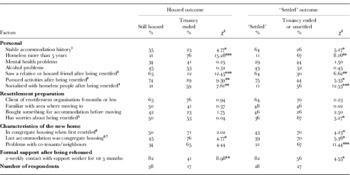
Too few of the respondents had abandoned or been evicted from their accommodation at three and six months to enable informative analyses of the covariates. On the other hand, several variables significantly associated with whether or not a respondent was still housed at 24 months, namely: previous stable accommodation histories, regular contacts with relatives or housed friends after being rehoused, engagement in activities, and regular help from housing-support or care-workers during the early months (Table 1). Tenancy failure by 24 months associated with prolonged homelessness and continuing contacts with homeless people. Tenancy sustainment did not significantly associate with how long the person was known to the service organisation before they were rehoused, the person's familiarity with the area of residence, or whether they had mental health and alcohol problems. Respondents with the latter problems were more likely to receive regular help from housing-support or care-workers during the early months; the above-average support may have counteracted their higher vulnerability.Footnote 10
Bivariate associations between personal, service-delivery and housing attributes and rehousing outcomes at 24 months

Notes: 1. Held a tenancy alone or with a marital partner for at least 15 years before becoming homeless. 2. At least weekly. 3. Pursued hobbies or interests, attended clubs or social centres, or did voluntary or paid work. 4. On the streets, at day centres or in hostels. 5. Concerns about the accommodation, other tenants, coping with household tasks or managing finances, or settling and overcoming loneliness. 6. Shared houses or residential care-homes. 7. At 24 months or when tenancy ended.
Significance levels: Chi-squared tests of 2×2 frequency tables (df=1) * p<0.05
** p<0.01
*** p<0.001.
Those resettled in congregate accommodation were less likely to be housed at 24 months than those who went to self-contained accommodation (independent or sheltered housing). All six evictions and seven of the 11 who abandoned were from shared houses and residential care-homes. Among those in shared houses, many reported that younger co-tenants drank heavily or used drugs, were noisy, had visitors at night, did not keep the kitchen or lounge clean, and pestered for money. Several requested a transfer to independent accommodation but there were delays and, as time passed, they became more distressed and intolerant of the other tenants' behaviour. Three eventually abandoned the accommodation and three were evicted, one following an assault on a co-tenant who had been drinking and was argumentative, and two after being taken into police custody for previously undisclosed misdemeanours. Among those in residential care-homes, some complained about the behaviour of other residents and many were unhappy with the financial arrangements. Their disposable income had been greatly reduced, because accommodation and service charges were deducted from their (benefit) income. Two abandoned within one month. Three with both mental health and alcohol problems were evicted for being aggressive; the staff had tried to negotiate with social services' care-managers for transfers to specialist homes for people with dementia, but the situation deteriorated before this was arranged.
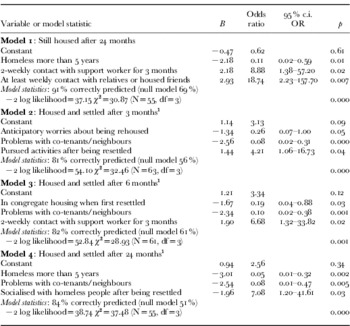
As there was no significant co-linearity, all the independent variables that significantly associated (p<0.05) with the outcome variables were entered into stepwise logistic regression models. Model 1 is of the factors associated with remaining housed after 24 months (Table 2). Only three variables made significant independent contributions: having been homeless for five years or less, weekly contact with relatives or housed friends after rehousing, and regular help from a support worker in the early months of resettlement (at least twice-weekly for the first three months). The model correctly classified 91 per cent of the cases, a 32 per cent improvement on the null model.Footnote 11
Logistic regressions of tenancy sustainment and settledness

Notes: 1. As opposed to either no longer being housed or being housed but unsettled.
Factors associated with settledness
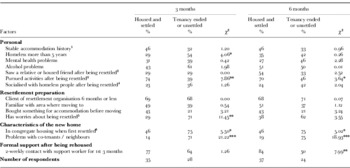
Information was collected from the respondents about whether they were ‘settled’ (as defined earlier): 17 were settled throughout, eight unsettled throughout, and the rest alternately settled and unsettled. At three months, 35 respondents were housed and settled, 23 housed but unsettled, five had abandoned their accommodation or been evicted, and one person had died. At six months, 37 were housed and settled while another had abandoned. Several factors significantly associated with whether or not the respondents were housed and settled (Table 3). Unsettledness at three months was most strongly associated with prior worries about being resettled, living alone, managing money, and problems with co-tenants in congregate housing. Unsettledness at six months was most strongly associated with problems with co-tenants or neighbours, and settledness was significantly associated with regular help from housing-support workers.
Bivariate associations between personal, service-delivery and housing attributes and rehousing outcomes after 3 and 6 months

Notes: 1. Held a tenancy alone or with a marital partner for at least 15 years before becoming homeless. 2. At least weekly. 3. Pursued hobbies or interests, attended clubs or social centres, or did voluntary or paid work. 4. On the streets, at day centres or in hostels. 5. Concerns about the accommodation, other tenants, coping with household tasks or managing finances, or settling and overcoming loneliness. 6. Shared houses or residential care-homes.
Significance levels: Chi-squared tests of 2×2 frequency tables (df=1) * p<0.05
** p<0.01
*** p<0.001.
Stepwise logistic regressions of settledness at three and six months produced significant models (Table 2). Model 2 is of the contrast between feeling settled at three months and all other outcomes except deaths. Three independent variables had significant associations – anticipatory worries about being rehoused (negative), problems with co-tenants or neighbours (negative), and being engaged in activities (positive). The model correctly predicted 81 per cent of the cases, a 47 per cent improvement on the null model. Model 3 is of the contrast between feeling settled in the accommodation at six months and all other outcomes except deaths. Once again, problems with co-tenants or neighbours significantly associated with the outcome, as did living in congregate housing, and receiving regular help from housing-support workers. The model correctly predicted 82 per cent of the cases, a 35 per cent improvement on the null model.
At 24 months, 28 (64%) respondents were housed and ‘settled’ (Table 1). Another 10 were housed but dissatisfied with their housing and contemplating abandonment. Several factors significantly associated with being housed and settled at 24 months: previous stable accommodation histories, regular contacts with relatives or housed friends after being rehoused, having activities and interests, and regular help from housing-support or care-workers during the early months (Table 1). There was a strong association between settledness at months three and 24 (χ2=9.09, df=1, p<0.003). Unsettledness (including tenancy failure) at 24 months was strongly linked to a long history of homelessness, continuing contacts with homeless people, and problems with co-tenants or neighbours. There was no link between settledness and mental health and alcohol problems. Model 4, of whether or not the respondents were housed and settled at 24 months, correctly classified 84 per cent of the cases, a 66 per cent improvement on the null model (Table 2). Once again, three variables were significant predictors – less than five years of homelessness, no problems with co-tenants or neighbours, and not socialising with homeless people.
Associations between the tenancy sustainment and settledness outcomes
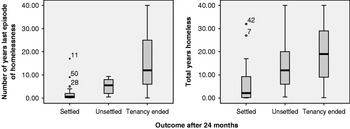
The strongest influences on settledness during the early months were worries about being resettled and problems with co-tenants in congregate housing (the effect of anticipatory worries was negligible by Month 6). There was no association at this time with the duration of homelessness, but at Month 24, a prolonged history of homelessness was a significant influence (or more likely, the personal factors that led to the chronic homelessness). Duration of previous homelessness was significant in the models of both tenancy sustainment and settledness, and socialising with homeless people was a significant variable in the latter. The strong influence of duration of previous homelessness on the rehousing outcomes is evident in Figure 1. Those who were housed and settled at 24 months had the shortest average duration of homelessness, those whose tenancies failed the longest, and those who were housed but unsettled an intermediate duration.
Distributions of resettlement outcomes by duration of homelessness.

The respondents who had regular help from a support worker in the early months after resettlement were more likely to be housed at Month 24, but such help did not predict settledness. Unsettledness was related to problems with co-tenants or neighbours that apparently were not counteracted by formal support. Although family contacts had a positive influence on remaining housed, they did not predict settledness. Some respondents who renewed contact with children or siblings had positive responses, but others were rebuffed. Four tried to make contact with siblings or children but were unsuccessful or turned away, and in four cases the children had personal and marital problems which spoilt the relationship. Two others refused to tell their family that they had been homeless and would not explain why they had not been in touch for years. The study of 237 rehoused older homeless people in Toronto and Calgary also found that some had tried to reconnect with their family but were rebuffed, while some described longstanding estranged family relationships (McDonald et al. Reference McDonald, Donahue, Janes and Cleghorn2006).
Discussion, conclusions and recommendations
Strengths and limitations of the study
The prerequisites, reliability and generalisability of this study's findings merit consideration. The design, an ethnographic longitudinal or panel study, and its in-depth, repeat interviews enabled a large number of descriptor and outcome variables to be collected. In addition, the principal field investigator (MC) conducted all the interviews and thereby gained a deep understanding of the subjects' experiences of being resettled and of the attendant problems. From this combination of quantitative and qualitative evidence, concerted and diverse analyses led to pertinent hypotheses about the factors that influenced the outcomes at different intervals after the resettlement, which could then be ‘objectively’ tested. Moreover, the in-depth interviews with the resettlement staff equipped the authors with sufficient knowledge of the conduct of resettlement to enable the evaluation findings to be converted into realistic practice recommendations.
If an in-depth longitudinal study is in some respects an exceptionally powerful social research method, its weaknesses are also clear. Given the labour intensiveness of the data collection, the investigation was restricted to a small sample and had attributes of a ‘case study’. The sample, the observed resettlement practices, the available housing options and the contextual welfare regime (available social security benefits) were specific to the time and place. Five years earlier or later, different criteria would govern who is selected for resettlement and housing opportunities would have changed. Only the broadest findings about the factors that influence the outcomes of rehousing are likely to apply in other countries. Clearly, however, the more evaluation studies there are, the stronger the evidence base, and the greater the chance that vulnerable and socially disadvantaged older people will be housed and effectively supported.
Summary findings
This study has shown that some older homeless people are able to move out of hostels and shelters, settle in conventional accommodation, and rebuild active and purposeful lives. Some renew interests and family contacts, and some develop new activities and friendships. A very clear finding is that it is much easier for those with stable backgrounds to remain housed, and more difficult for those with long histories of homelessness to settle. The clear implication is that the problems and vulnerabilities that lead to chronic homelessness persist. Moreover, a few respondents had been homeless intermittently or continuously for more than 30 years (since early adulthood), had longstanding estranged family relationships, and for years their social contacts had revolved around homeless people and homeless services. The Canadian study of rehoused older homeless people also found that several struggled to settle and that some ‘felt more “connected” to the homeless community than to their current communities' (McDonald et al. Reference McDonald, Donahue, Janes and Cleghorn2006: 118).
Less expectedly, there was no link between resettlement outcomes and mental health or alcohol problems. This may be because the particular vulnerability was recognised and prompted above-average support from housing-welfare workers, but there may have been a selection effect. Programmes to rehouse homeless people in independent-living accommodation do not generally include those whose behaviour is chaotic, who therefore remain in hostels. It has previously been shown that alcohol problems significantly reduced the probability of older homeless people being rehoused (Warnes and Crane Reference Warnes and Crane2000b). The findings also provide evidence of the effectiveness of low intensity tenancy-support in helping vulnerable people sustain independent living.
The policy context and practice recommendations
Older homeless people are a neglected and excluded group of disadvantaged elderly people. Many interventions to assist vulnerable older people focus on health-care needs, functional limitations, and supporting those who live alone. There is keen interest in developing more effective ways of caring for and supporting those with a cognitive deficit, but much less awareness of and sensitivity towards those who are disaffiliated, alienated or have alcohol or affective mental health problems. The policy and practice thinking about these groups of vulnerable people has been centred more on the ‘social exclusion’ debate than that on ‘elderly care’, and has therefore been dominated by the poor life chances and employability of disadvantaged young adults. The UK government established a Social Exclusion Unit in 1997. Initially very active in advancing policies to combat homelessness and to break the ‘cycle’ of disadvantage from childhood to early adulthood, its work has deepened the understanding of social exclusion. The focus has stimulated other bodies to fund work on the extension of the exclusion framework to older people, and recently the Unit has commissioned its own analyses (Phillipson and Scharf Reference Phillipson and Scharf2004; Scharf et al. Reference Scharf, Phillipson, Smith and Kingston2002; Social Exclusion Unit 2004, 2005; Walker et al. Reference Walker, Barnes, Cox and Lessof2006). The promotion of social inclusion lies behind a new thrust in homelessness policy, to minimise the duration of homeless episodes, and to accelerate people's return to conventional and productive lives. One result has been to encourage the planned and individualised resettlement of homeless people in independent accommodation. To date, the few projects that have given particular attention to the resettlement of older homeless people have shown that some tenancies are sustained and improve the quality of life of the older person, but the success rate is not yet high.
With homelessness prevention and amelioration in view, several practice recommendations were derived from the findings. Given the baneful influence of protracted or ‘entrenched’ homelessness, the importance is clear of helping people quickly when they first become homeless. To raise the success rate of resettlement, further improvements in recruitment, assessment, placement and support practices should be sought. Individual assessments of older homeless people's housing and support needs and ‘resettlement plans’ are required. As unsettledness during the early months was predicted by anticipatory worries, it is important to ensure that the prospective mover is mentally prepared, their fears allayed, and that they settle quickly. Systematic monitoring of older homeless people's support needs after they are resettled is crucial. Tenancy support should be individualised and available for as long as the client experiences difficulties. The importance of building social networks and engaging in meaningful activities away from the homelessness circuit has been demonstrated and should be encouraged by housing-support workers (Willcock Reference Willcock2004, Reference Willcock2006a, Reference Willcock2006b).
The component of resettlement that is most difficult to improve is the range of housing options. Some older homeless people are able to manage in independent accommodation with input from a tenancy-support worker, while others when rehoused require on-site support. Several study respondents who were placed in shared houses had problems with the other tenants, however, and the difficult behaviour of a few in care homes was unmanageable by staff untrained to meet their special needs. Other studies have also found that shared housing is unpopular and breeds conflict among the tenants because they have different interests, attitudes and problems (Cooper et al. Reference Cooper, Watson and Allan1994; Edwards et al. Reference Edwards, Woodward and Fearn2001; Randall and Brown Reference Randall and Brown1999). The manifest need is for new forms of supported housing and care homes for some formerly homeless older people, particularly those with problematic behaviour, an expensive requirement. Finding the optimum balance of relatively intensive support in an accommodation regime that develops and sustains independence will be very difficult, and only likely if the experience and outcomes of different projects are systematically compared.
The UK Coalition on Older Homelessness, the Department of Health and Help the Aged have recommended adapting sheltered housing schemes to provide ‘extra care’ housing for older homeless people with support needs (Blood Reference Blood2002; Pannell Reference Pannell2005). Advocates argue that ‘extra care’ combines the maintenance of independence with on-site support (including the provision of meals), communal facilities and companionship. One such scheme in Birmingham, St Eugene's, was opened in 2003 by Focus Futures, and provides 44 apartments to older Irish men who are excluded from mainstream social housing and who have unsettled housing histories, long-term alcohol use, and physical and mental health problems. Each tenant has their own studio flat, 24-hour staff provide intensive support if needed, and meals are provided if the tenants so wish. A ‘drop-in centre’ attached to the project provides meals, washing facilities and an advice service (Focus Futures 2006).
The term ‘extra care’ housing is, however, being applied to new housing-plus schemes that range from upmarket retirement communities, through ‘new generation’ residential care and nursing facilities for low-income (i.e. social services funded) frail older people, to special-needs housing. As one of the first evaluations of a low-income variant has shown, the rhetoric tends to simplify, to neglect the immense diversity and range of people's needs, and to reduce the level of care that the more needful receive (Bernard et al. Reference Bernard, Bartlam, Sim and Biggs2007). The requirement is to be reactive to people's competencies and needs, as exemplified by the schemes developed for older homeless people by St Mungo's in London, the Committee to End Elder Homelessness in Boston, Massachusetts, and by Wintringham in Victoria, Australia (Rota-Bartelink Reference Rota-Bartelink2006; Warnes and Crane Reference Warnes and Crane2000a; see also Judd et al. Reference Judd, Kavanagh, Morris and Naidoo2003).Footnote 12 If we rush to spread a single model, as if a panacea, the focus on the diversity of older people's support needs will be lost, and it will be shown once again that the residential juxtaposition of very different groups does not work and can be harmful.
Acknowledgements
The authors thank the older homeless clients and staff of St Mungo's and St Martin-in-the-Fields Social Care Unit in London, and of St Anne's Community Services in Leeds and Sheffield, who participated in and enabled the study. It was supported through grants from The Sir Halley Stewart Trust and The Leverhulme Trust. The preparation of the paper was carried out during a Research Fellowship awarded to Maureen Crane by the UK Economic and Social Research Council (grant RES-000-27-0095).