Second language (L2) vocabulary development through reading involves associating new forms with their functions or referents. This begins when learners encounter unfamiliar words during reading and consider them relevant enough to warrant further processing. This process is known as lexical bootstrapping (e.g., Clark, Reference Clark1993; De Bot, Paribakht, & Wesche, Reference De Bot, Paribakht and Wesche1997; Nassaji, Reference Nassaji2003; Sternberg, Reference Sternberg, McKeown and Curtis1987). Lexical bootstrapping occurs against the backdrop of other reading processes, such as letter identification, lexical access, syntactic analysis, propositional encoding, sentence comprehension, intersentence integration, activation of prior knowledge, and comprehension monitoring (e.g., Bernhardt, Reference Bernhardt1991; Grabe & Stoller, Reference Grabe and Stoller2002; Koda, Reference Koda2005). During reading, the syntactic, semantic, and pragmatic knowledge that becomes activated through these processes is held in working memory and is used online to constrain subsequent textual and lexical interpretations. Not all learners are equally successful in lexical bootstrapping during reading because of differential reliance on various linguistic and extralinguistic skills and knowledge (e.g., Haynes, Reference Haynes, Huckin, Haynes and Coady1993; Haynes & Baker, Reference Haynes, Baker, Huckin, Haynes and Coady1993; Pulido, Hambrick, & Russell, Reference Pulido2007). Because there is individual variation in such skills and knowledge, there is widespread use of textual aids to facilitate comprehension (e.g., Nation, Reference Nation2001). Textual aids, such as glosses, hypertext, and dictionaries, may also facilitate the creation of form-meaning connections, especially if learners are assigned strategic tasks that require their use, such as confirming and correcting guesses.
TEXTUAL AIDS AND VOCABULARY DEVELOPMENT
Studies have demonstrated the benefits of textual aids illustrating translations and word meanings on vocabulary retention (e.g., Fraser, Reference Fraser1999; Hulstijn, Reference Hulstijn, Dechert and Raupach1989, Reference Hulstijn, Arnaud and Béjoint1992; Hulstijn, Hollander, & Greidanus, Reference Hulstijn, Hollander and Greidanus1996; Knight, Reference Knight1994; Rott, Reference Rott2005; Watanabe, Reference Watanabe1997) as well as the superiority of such aids over methods that only rely on inferring (see, e.g., Mondria, Reference Mondria2003). This is because inferencing methods are subject to error due to individual variation in completing the requisite text processing operations. Individual variation can result from a number of factors, such as variability in sight vocabulary (i.e., the words whose meanings the reader can accurately recognize while reading), background knowledge, and reading and metacognitive skills. When learners experience difficulty constructing a context, they are also more apt to encounter difficulty in assigning meanings to new words in that context. Glosses can be useful because they are a form of textual enhancement, with the capacity to draw learners’ attention to the connection between the target word (TW) forms and the gloss information and to promote elaborative processing—forming connections between the new lexical forms and meanings and associating these with previous knowledge via rehearsal (Baddeley, Reference Baddeley1998). Yet, the mere presence of glosses does not always guarantee retention of such information. If there are too many constraints on the individual’s processing capacity (Just & Carpenter, Reference Just and Carpenter1992; McLaughlin, Reference McLaughlin1987), if unfamiliar words are not deemed important enough to warrant deeper processing (Craik & Tulving, Reference Craik and Tulving1975), or if the general context is easily understood, then new words may be processed more superficially and may be less likely to be retrieved from memory (e.g., Ellis, Reference Ellis and Ellis1994, Reference Ellis and Robinson2001; Gass, Reference Gass1999; Hulstijn, Reference Hulstijn and Robinson2001, Reference Hulstijn, Doughty and Long2003; Laufer & Hulstijn, Reference Laufer and Hulstijn2001; Robinson, Reference Robinson, Doughty and Long2003; Schmidt, Reference Schmidt and Robinson2001).
REVIEW OF RESEARCH
Involvement Load Hypothesis and Related Research
An attempt to operationalize the construct of elaboration with reference to L2 incidental vocabulary acquisition is the involvement load hypothesis (Laufer & Hulstijn, Reference Laufer and Hulstijn2001).Footnote 1 This hypothesis proposed that retention of new words depends on levels of need, search, and evaluation imposed by a task. Need, a motivational aspect, concerns the need to comply with the task that has been assigned. This can be externally dictated by the researcher or internally dictated. An example of external direction is through an explicit lexical guessing task, whereas internal direction can be accomplished through a task that requires verification or correction of guesses. Whereas some learners may need to engage in additional processing to correct their initially incorrect guesses, others may not because their guesses were initially correct, in which case they would merely need to verify the guesses. The latter two components of the hypothesis refer to cognitive involvement. Search requires attempts to determine the meaning of an unknown word (e.g., by searching the context for clues to meaning). Evaluation involves decisions about “semantic and formal appropriateness (fit) of the word and its context” (Laufer & Hulstijn, p. 15) by comparing whether a form-meaning pair is appropriate for a given context. The involvement load hypothesis predicts that the greater the degree of involvement in the various components of need, search, and evaluation imposed by a task, the better the retention. Laufer and Hulstijn argued that “a crucial question in understanding vocabulary learning is whether retention depends on what one does with the word rather than how often one meets it” (p. 22). To better understand what one does with a word, it is necessary to also consider how involvement load, or processing needs and capacity, moderates the frequency effects in language learning (Ellis, Reference Ellis2002). Lexical tasks that require the need to notice new word forms and searching for and evaluating the meanings of those new words—all of which require attention—heighten salience and relevance of input when learners match the input with previously stored mental representations. These processes involve multiple encodings into memory and interaction with previously encoded and, perhaps, very predictable and familiar information.
In addition to externally imposed tasks, learner-based variables also affect lexical input processing. The degree of cognitive effort in searching for meaning during reading (e.g., through lexical inferencing) should depend on text processing efficiency as well as background knowledge. Less proficient readers have less available context in which to search for meaning than more proficient readers, due to deficiencies in linguistic knowledge and required processing skills (e.g., Grabe & Stoller, Reference Grabe and Stoller2002; Koda, Reference Koda2005; Laufer, Reference Laufer, Coady and Huckin1997). Because weaker readers use available cognitive resources for lower level linguistic processes, they should have fewer resources to engage in higher level comprehension processes (e.g., activating background knowledge, monitoring comprehension, and lexical inferencing).Footnote 2 Evaluation, too, can be affected by individual differences in processing. Weaker readers should have fewer resources to simultaneously retain the form-meaning pair when processing the text. Without the appropriate background knowledge, the requisite processing operations should be more difficult to complete.
Using high school Dutch intermediate learners of French, Mondria and Wit-de Boer (Reference Mondria and Wit-de Boer1991) investigated the involvement load hypothesis by studying the effects of semantic richness on lexical inferencing and retention. They also investigated the relationship between inferencing and retention in a task that provided participants with a study phase that allowed them to confirm or to correct guesses in light of the given meanings. The results revealed facilitative effects of rich semantic sentence contexts on inferencing. However, these effects were not maintained on measures of TW retention, measured by a L2-first language (L1) translation within a sentential context. Furthermore, Mondria and Wit-de Boer found a negative correlation between lexical inferencing and retention as well as negative correlations between inferencing and retention on the majority of the TWs.
More recently, Mondria (Reference Mondria2003) investigated the effects of various stages of the meaning-inferred method (e.g., inferring and verifying or correcting the meaning) on vocabulary retention. The participants were Dutch learners of L2 French with 2.5 years of classroom experience comparable to a North American high school. The verification task required participants to indicate whether their guesses were correct and to write down the meanings of the incorrect guesses. Mondria noted in minutes and seconds the time to complete the inferring and the verifying tasks by tracking how long it took for participants to return their materials to the envelope. The lexical retention test—administered 2 weeks later—measured receptive knowledge by means of a L2-to-L1 translation of the TWs in new, but semantically neutral, contexts. Results revealed that each stage of the meaning-inferred method contributed to retention but that for only one third of the students did inferring and verifying lead to retention. It is noteworthy that there were no differences in retention of correctly and incorrectly guessed words after the inferring and the verifying phases. There was a greater effect from correcting incorrectly inferred words than from confirming correctly inferred words. Additionally, there was no correlation between inferencing and retention, no effect of proficiency on retention (operationalized as a student’s course grade), and no relationship between proficiency and time on task.
Mondria and Wit-de Boer (Reference Mondria and Wit-de Boer1991) and Mondria (Reference Mondria2003) concluded that correct and easy guessing may have led learners to think that they already knew the words, leading to decreased attention to the form-meaning pairs on the verification task (for a similar argument, see De Bot et al., Reference De Bot, Paribakht and Wesche1997). This finding provides some evidence that tasks designed to promote deep word processing do not automatically guarantee receptive retention (see, e.g., Barcroft, Reference Barcroft2002, Reference Barcroft2004, for similar reports for productive retention). These studies have limitations however. First, there were no prior assessments of the learners’ reading or linguistic abilities. Second, there was no precise measure of time on task, attentional allocation, or strategy use. Third, neither study had immediate retention tests to minimize the possibility of look-up and further strategic processing. Fourth, the retention measures illustrated the TWs in sentences, which possibly provided syntactic or other cues to meaning. Finally, the TWs were initially situated in disconnected sentence contexts. Other reading contexts (e.g., paragraphs or passages) are also frequently accompanied by glosses. Addressing these limitations as well as individual differences in L2 reading is necessary for shedding new light on underlying factors that affect involvement in lexical input processing.
Reader-Based Factors Influencing Lexical Input Processing
L2 Reading Ability. Reading involves the simultaneous use of various knowledge sources and abilities. Readers with strong lower level processing skills have the requisite attentional resources to enable the construction and integration of ideas from context as well as the access and use of information from long-term memory: This should lead to more successful lexical inferencing. In contrast, weak readers are less successful in local and global comprehension, resulting in a short circuit of the inferencing and integration processes (e.g., Bernhardt, Reference Bernhardt1991; Grabe & Stoller, Reference Grabe and Stoller2002; Just & Carpenter, Reference Just and Carpenter1992; Koda, Reference Koda2005; Laufer, Reference Laufer, Coady and Huckin1997; Stanovich, Reference Stanovich2000).
A few single-focus studies are noteworthy in this regard. With advanced learners of English as a L2, Chern (Reference Chern, Huckin, Haynes and Coady1993) reported significant effects of reading ability—as measured by the TOEFL—on lexical inferencing during reading. In a separate, cross-sectional Spanish L2 study, Pulido (Reference Pulido2000, Reference Pulido2003) also revealed robust effects of L2 reading ability (via the adult basic learning exam [ABLE], Spanish version) on short-term and delayed vocabulary receptive retention of meaning through reading using an incidental learning research paradigm.
Nevertheless, some studies revealed no effects of L2 reading ability. In another cross-sectional study with L2 Spanish learners, Pulido (Reference Pulido2004b) found no effects of reading proficiency on TW episodic memory (assessed via a yes/no verification test with distracters). In other studies, L2 reading ability was found to have no effect on lexical inferencing and retention (Bengeleil & Paribakht, Reference Bengeleil and Paribakht2004) or on retention alone (Fraser, Reference Fraser1999). In Begeleil and Paribakht’s and Fraser’s studies, L2 reading proficiency was treated as a between-groups variable and measured by the Canadian Test of English for Scholars and Trainees and the TOEFL, respectively. The null findings might be due to small samples and a restriction in the range of reading ability or to instruction on lexical processing strategies (Fraser), mitigating any differences in reading ability.
Background Knowledge. Background knowledge contributes to the efficiency of attentional allocation to input, enabling richer textual interpretations and superior memory (e.g., Bernhardt, Reference Bernhardt1991; Grabe & Stoller, Reference Grabe and Stoller2002; Graesser, Singer, & Trabasso, Reference Graesser, Singer and Trabasso1994; Kintsch, Reference Kintsch1998; Koda, Reference Koda2005; Rumelhart, Reference Rumelhart, Spiro, Bruce and Brewer1980; Schank & Abelson, Reference Schank and Abelson1977). Connectionist accounts argue that background knowledge is activated through the textbase constructed during reading through bottom-up processing (e.g., Kintsch). The textbase contains the propositional meaning of the passage. Such information is stored in working memory and acts as a “signal in an associative manner to all the information stored in long-term memory” (Nassaji, Reference Nassaji2002, p. 455).Footnote 3 Thus, background knowledge becomes activated in response to this signaling mechanism and can then influence the formation of further constructions, including meanings for new words.
A great number of studies have widely demonstrated robust effects of background knowledge on L2 reading comprehension (e.g., Alderson & Urquhart, Reference Alderson and Urquhart1985; Barry & Lazarte, Reference Barry and Lazarte1998; Carrell, Reference Carrell1987; Chen & Donin, Reference Chen and Donin1997; Hudson, Reference Hudson1982; Lee, Reference Lee1986). Pertaining to the effects of background knowledge on L2 lexical input processing, there is less evidence available. Some studies that adopted a think-aloud paradigm observed widespread use of background knowledge to guess word meanings (Chern, Reference Chern, Huckin, Haynes and Coady1993; Haastrup, Reference Haastrup1989; Lee & Wolf, Reference Lee and Wolf1997; Nassaji, Reference Nassaji2003; Parry, Reference Parry, Coady and Huckin1997). Yet, in Lee and Wolf’s study, native Spanish speakers used background knowledge the most, followed by the advanced, intermediate, and beginning learners of Spanish. These results suggest a developmental pattern of interactions between proficiency and background knowledge during lexical inferencing. Other studies also reported positive effects of background knowledge on guessing (e.g., Adams, Reference Adams1982; Pulido, Reference Pulido2007) and on ease in guessing (Pulido). The latter result was obtained only in connection with the more proficient readers (based on passage sight vocabulary).
With regard to episodic memory for form and memory for meaning, the evidence is varied. In a cross-sectional study with L2 Spanish learners, Pulido (Reference Pulido2004b) reported better delayed TW episodic memory (measured by a yes/no verification task) by the more proficient readers for words in passages with less familiar topics. However, in a different study of intermediate-level L2 Spanish learners, Pulido (Reference Pulido2004a) reported superior episodic memory for TWs from a culturally more familiar passage that used an adapted version of the vocabulary knowledge scale (Paribakht & Wesche, Reference Paribakht and Wesche1993). Concerning receptive retention of meaning, in a cross-sectional L2 Spanish study, Pulido (Reference Pulido2000, Reference Pulido2003) observed short-term facilitative effects of reading for texts dealing with more familiar topics on a L2-L1 multiple-choice translation measure. In another cross-sectional study on the simultaneous effects of sight vocabulary and familiarity, Pulido (Reference Pulido2007) also obtained immediate facilitative effects of topic familiarity on meaning retention in connection with inferring and verifying tasks. These inconsistent findings might be due to the tasks, the type of processing under investigation, or learner proficiency.
RESEARCH QUESTIONS AND HYPOTHESES
Based on this research, the present study considered the effects of the reader-based factors of L2 reading ability and background knowledge on lexical input processing while learners engaged in strategic tasks to promote deeper processing of new words. The following questions guided the study:
1. What is the impact of reading proficiency and background knowledge on these aspects of lexical input processing and involvement load during strategic tasks: (a) search for meaning (lexical inferencing), (b) attentional allocation during evaluation (TW sentence processing time during a verification task), (c) episodic memory of TW form after a verification task, (d) receptive retention of meaning after a verification task, and (e) changes in lexical input processing (the difference between inferencing and retention) after a verification task.
Several hypotheses for the effects of L2 reading ability and of background knowledge are posited for each aspect of lexical input. Hypothesis 1 predicts that there will be a significant effect of L2 reading proficiency such that as L2 reading skills improve, guessing will as well because better readers have more available resources and contextual support. Moreover, it was predicted that there will be more correct guesses in the more familiar passage due to greater topic knowledge and contextual information. According to hypothesis 2, there will be a significant effect of L2 reading proficiency such that as reading skills improve, less time will be needed to complete the evaluation task due to more efficient processing resources, more correct guesses, and the lack of a need to engage in more effortful or controlled processing. Furthermore, there will be faster processing times for the more familiar passage sentences due to more easily and correctly guessed words in that condition. Hypothesis 3 predicts that there will be a significant effect of L2 reading proficiency such that as L2 reading ability improves, episodic memory will also improve due to superior processing skills and available resources to form connections between the story contexts and the TW forms. Moreover, there will be worse memory in the more familiar condition due to more correct TW guesses and the lack of a need to sufficiently reprocess those TWs during the verification task. According to hypothesis 4, there will be a significant effect of L2 reading proficiency such that as L2 reading ability improves, retention will also improve due to greater efficiency and success in the previous phases. Furthermore, there will be better retention in the more familiar condition due to more initially correct guesses, more contextual support, and richer schematic networks to support new form-meaning connections. Finally, hypothesis 5 predicts that there will be greater changes as L2 reading proficiency improves due to more forgetting of easily and correctly guessed words as well as ease in completing the TW verification task for the words that were guessed correctly. Moreover, there will be greater changes in lexical input processing (more forgetting) in the more familiar condition due to more initially correct guesses in this condition and a diminished need to engage in attentive processing on the subsequent tasks.
2. What is the relationship between lexical inferencing and retention?
It is hypothesized that there will be weaker correlations for the more familiar passage condition due to more forgetting of correctly guessed words from that condition.
3. Is there any evidence for lack of a need to engage in deep processing during the verification task that is connected with the factors of background knowledge or proficiency?
Analysis of the results from the various phrases of lexical input processing and self-reports of strategy use is expected to indicate the lack of a need to engage in effortful processing during the TW verification task. This is particularly the case for the more familiar condition and by the more proficient readers who would have experienced greater ease and success in guessing.
METHOD
Participants
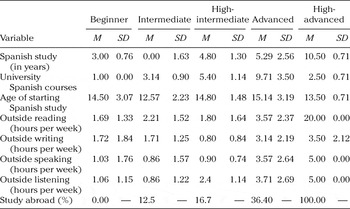
Thirty-five English-speaking adult learners of Spanish participated in this study. They were recruited from five university courses and divided as follows: 8 beginner (intensive course for false beginners), 8 intermediate (fourth-semester language course), 6 high-intermediate (fifth- and sixth-semester grammar and composition course), 11 advanced (seventh- and eighth-semester literature), and 2 high-advanced learners (MA graduate literature course). Table 1 summarizes additional participant characteristics. The participants had diverse Spanish language learning and language exposure backgrounds through formal instruction, exposure outside of the classroom, and study abroad.
Background characteristics of participants

Note:
Outside reading, writing, speaking, and listening correspond to out-of-class engagement.
Materials
Target Words. Sixteen lexical items representing concepts frequently associated with the topics of the scenarios were selected from the two stories (see Appendix A). They were then substituted with nonsense words to ensure that participants had no prior knowledge of them. The nonsense words maintained orthographic and morphological rules of Spanish. A ratio of nouns to verbs was held constant from one story condition to the next. Each TW was boldfaced and underlined and appeared only once in each story. Finally, there were no definitional context clues provided for any of them.
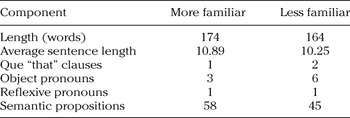
Reading Passages. The passages described a familiar and a less familiar scenario (see Appendix B). Whereas the more familiar passage, The trip to the supermarket, was based on a scenario considered to be very familiar to the participants, the less familiar passage, Publishing an article, was based on a less familiar scenario. Participant familiarity was later confirmed by their self-reported ratings of familiarity. Each passage conformed to a temporally ordered set of activities pertinent to the scenarios and was loosely centered around a script purported to be stored in long-term memory (Graesser et al., Reference Graesser, Singer and Trabasso1994; Schank & Abelson, Reference Schank and Abelson1977). Within each scenario there were roles and objects associated with the actions. The contents of each story were constructed via the script norm procedure (for more information, see Pulido, Reference Pulido2000). Both stories were of comparable length, but the grocery story had more semantic propositions than the publishing story (see Table 2). The publishing story was slightly more complex grammatically, with one more subordinate clause and more anaphoric references (i.e., object pronouns) than the grocery story. Furthermore, the grocery story contained vocabulary sequences that participants have on a daily basis, which was not the case of the publishing story.
Comparison of stories

Independent Variables
L2 Reading Proficiency. The L2 reading proficiency measure consisted of the Spanish version of the ABLE (Karlsen & Gardner, Reference Karlsen and Gardner1990), which is a 35-min timed test that contains readings of a functional (e.g., letters, signs, ads) and educational (e.g., expositions) nature. The 48-item multiple-choice measure contains 24 items that test literal comprehension ability (i.e., what is explicitly stated in the texts) and 24 items that test inferential ability (i.e., ability to make inferences and draw conclusions from what is not explicitly stated). Each item was worth one point. Thus, the two observed variables—literal comprehension ability (24 points) and inferential comprehension ability (24 points)—provided two processing dimensions of the construct: textbase extraction skills and situation-model integration skills, respectively.
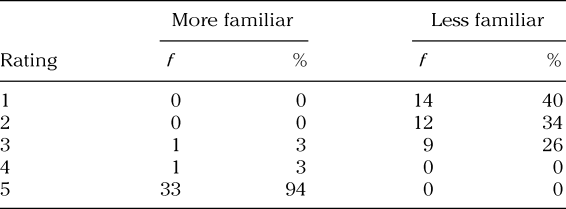
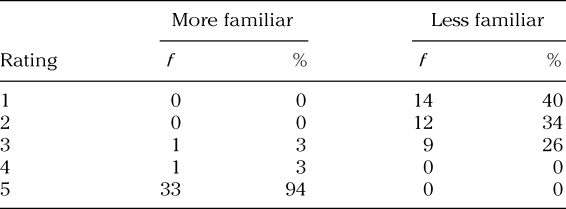
Topic Familiarity. Topic familiarity was assessed by a 10-item Likert-scale topic familiarity questionnaire. Participants rated on a 1–5 scale their familiarity with routine activities: the two portrayed in the passages and eight distracters (e.g., playing cribbage, filling a car with gas). Self-reports provided insight into participants’ knowledge of the activities involved in each scenario and their order of occurrence. This task furnished information about background knowledge and confirmed the prior categorization of the passages. The results indicated that, overall, the grocery scenario was more familiar than the publishing scenario (see Table 3).
Topic familiarity questionnaire: Overall response frequency for all participants (N = 35)
Note:
Ratings were made on a 5-point scale in which 1 corresponded to very unfamiliar with the activities involved in the situation and their order and 5 corresponded to very familiar with all of the steps generally involved in the situation and could give a detailed description of these and their ordering.
Dependent Variables
Search for Meaning. The lexical inferencing task required participants to write the meaning or translation of each TW in their L1. Participants were asked to read two very brief stories in Spanish, which contained eight boldface underlined words. Participants had to guess the translation of these eight words based on the context. Prior to reading and inferring, participants completed a practice exercise in guessing and writing the meaning of an unfamiliar word in a sentential context. Lexical inferencing ability was scored from a partial-precise continuum such that participants received 0 points for an incorrect guess, 0.5 point for a partially correct guess, and 1 point for a correct guess (either the correct L1 translation or a correct paraphrase or definition).Footnote 4
Attentional Allocation During Evaluation. The verifying task served to promote elaborative processing of the TWs in an error-free manner by allowing participants to make connections between the new word forms, their meanings, and the story contexts. Attentional allocation was operationalized as the milliseconds per word participants took to process each sentence. Because the sentences were of different lengths, a processing time index was created for each sentence by dividing the total processing time by the number of words in that sentence. This was an attempt to gain greater precision than in other studies (e.g., Mondria, Reference Mondria2003; Mondria & Wit-de Boer, Reference Mondria and Wit-de Boer1991). The participants’ time was measured from the moment they pressed the spacebar to view the TW sentence to the moment they pressed the spacebar to receive the next sentence. The order of presentation of the sentences was identical to that in the stories; however, the TWs were not enhanced in order to encourage processing of the entire sentence. The marginal gloss was the identical translation used in the retention-recognition measure. Participants were instructed to confirm or correct their TW guesses and to understand the sentence before continuing. They were forewarned about an upcoming sentence comprehension test but were not alerted to the vocabulary tests that followed. Unlike in previous studies (e.g., Mondria; Mondria & Wit-de Boer), this information was withheld so that participants would concentrate on the overall meaning of the sentences rather than on TW memorization. Participants were also not allowed to write down the TW meanings.
TW Episodic Memory. The ability to recognize new lexical forms is an initial step in their acquisition. Episodic memory was operationalized as a measure of accuracy in memory for the recently processed TW forms. This measure is a direct recognition measure of memory that serves as a rough estimate of how deeply textual information was processed because more correctly identified words indicates greater active memory for the input (e.g., Baddeley, Reference Baddeley1998; Craik & Lockhart, Reference Craik and Lockhart1972; Craik & Tulving, Reference Craik and Tulving1975). Immediately after completing the verification task for each story, all participants were introduced to the computerized TW episodic memory task. They were required to make decisions as to whether individual words had appeared in the verification task and to answer as accurately as possible. Responses were made by pressing a yes or no key. The words appeared one at a time in the middle of the screen and were randomized for each trial. A new word appeared immediately after a response was provided.
Stimuli consisted of 32 L2 words (without translations) broken down into the following categories: (a) eight TWs, (b) eight real words from relevant-to-the-story topic, and (c) 16 relevant topic words not in the story. In this task, a memory performance score improves to the extent that participants respond yes to presented items and no to those not presented. A hit rate was the probability of saying yes to the eight TW items, whereas a false alarm rate was the probability of saying yes to the 16 distracters. Equation 1, adapted for this study, calculates a d′ score based on a widely used formula to measure recognition memory and number of correct guesses in text processing (see Baddeley, Reference Baddeley1998; Graesser & Nakamura, Reference Graesser and Nakamura1982; Pulido, Reference Pulido2004a).
![$$d' = {{[phits(x/8) - [p\,false\,alarms(x/16)} \over {1 - [p\,flase\,alarms(x/16)}}$$](https://static.cambridge.org/binary/version/id/urn:cambridge.org:id:binary:20151023054934494-0933:S0272263109090020_eqn1.gif?pub-status=live)
An average of the d′ scores was calculated for each story. A negative score indicates some degree of forgetting, whereas a positive value indicates some degree of recognition memory.
Receptive Retention of Meaning. Two measures of retention were administered. Each measure contained all 16 nonsense TWs plus six additional nonsense distracters. The verbs were presented in their infinitival forms and the nouns were presented in their original text forms. The test items were randomized in order to diminish any effects of memory for presentation order or for a theme.
To measure the ability to produce L1 translation equivalents (translation production), participants were required to supply a translation, definition, or explanation of the nonsense words in their L1. Lexical retention was scored as: 0 points for an incorrect answer, 0.5 point for a partially correct answer, 1 point for a correct answer (either the correct L1 translation or a correct paraphrase or definition).Footnote 5
To measure the ability to recognize L1 translation equivalents (translation recognition), participants completed a multiple-choice test with options that emphasized semantic, not syntactic, differences. These options included the correct translation of the TW, three distracters, and I don’t know. Each distracter met at least one of the following criteria: (a) contextually proximate to the TW in the passage in which it was presented; (b) schematically appropriate for the given story situation; and (c) orthographically or phonologically close to another known L1 or L2 word. No option was completely implausible.
Changes in Lexical Input Processing. An index of change in lexical input processing was created in order to indirectly observe the effects of processing across the inferencing and verification phases and to relate such processing to reading proficiency and background knowledge. The score was created by first subtracting the inference score from the retention score for each TW. Then these change scores (i.e., change in processing) were aggregated to arrive at an average change score for each participant for each of the familiarity conditions and retention measures. The scores range from –1 to 1. Thus, a negative score indicates some degree of forgetting of partially correct or correct guesses, whereas a positive score indicates some degree of learning and revision after the guessing phase. The more negative the score, the more negative the change in processing and retention, or both, and, conversely, the more positive the score, the more positive the change in processing and retention, or both. A score of 0 indicates no change. Note that this simply indicates that no observable change occurred between the initial processing and later retention phases and could mean that nothing was learned, or that everything was remembered, and, consequently, that nothing was forgotten. These scores do not reflect quality in memory representation but rather the occurrence of improvement or forgetting between the initial guessing phase and later retention tests, changes that might have resulted from the verification task intended to promote deeper processing.
Processing Strategies During the Verification Task. A written questionnaire was administered immediately after the verification and episodic memory phases (see Appendix C). The questionnaire provided further evidence on the components of need, search, and evaluation. The questions tapped two issues: (a) perceived ease or difficulty in processing the stories and TW sentences and (b) strategy used during the TW sentence verification task.
Procedure
A repeated-measures design was used, whereby all participants were assigned to both readings (i.e., one more and one less familiar passage). There were two separate data-gathering phases. During session 1, participants completed the L2 reading proficiency test followed by the topic familiarity questionnaire, in small groups. Session 2, which lasted 45 min, was conducted on an individual basis in a laboratory approximately 1 week later. After a training phase, each participant read the first story and completed the accompanying lexical inferencing task for the boldfaced, underlined TWs before continuing to the second story. After reading both stories, participants completed the self-paced computerized TW verification task and episodic memory test for each story. The order of presentation of the passages and accompanying TW verification and episodic memory tasks were counterbalanced across all participants. This was followed by the strategy questionnaire. The final tasks administered were the lexical retention tests in the following order: L2-L1 translation production followed by the L2-L1 multiple-choice translation recognition. Session 2 concluded after a debriefing statement about the purpose of the experiment and the use of nonsense words.
RESULTS
Statistical Analyses
Correlations and one-way analyses of covariance (ANCOVAs) were conducted. L2 reading proficiency served as the continuous between-subjects variable represented by the total percentage obtained on the ABLE. Topic familiarity was the within-subjects categorical variable with two levels: more familiar and less familiar. The impact of the within- and between-subjects variables was tested with omnibus F-tests, observing Type III sum of squares. Because seven ANCOVAs were completed (hypotheses 1–5), a Bonferroni adjustment required an alpha level of .007 (i.e., .05/7) to be used for all multivariate statistical comparisons. For the hypothesis concerning the relationship between lexical inferencing and lexical retention, four correlations were computed, requiring a Bonferroni adjustment, which resulted in an alpha level of .0125 (i.e., .05/4).
L2 Reading Ability
The ABLE L2 reading proficiency scores are reported in percentages. There was a considerable range (.38–.96) in the percentage of correct answers (M = .75, SD = .17). There was also a range (.46–1.0) in literal (M = .85, SD = .16) and a range (.21–.92) in inferential (M = .64, SD = .19) ability. A paired-samples t test, t(34) = 11.49, p < .0001, revealed significant differences in these two abilities.
Lexical Inferencing
The descriptive statistics for lexical inferencing for the two familiarity conditions (with a maximum of 8 points for each condition) revealed better performance in the more familiar condition (M = 5.86, SD = 2.10) than for the less familiar condition (M = 3.26, SD = 1. 40).Footnote 6 A mixed-model repeated-measures ANCOVA was carried out with the independent variables of L2 reading proficiency and topic familiarity to determine their impact on lexical inferencing. There was a significant impact of reading proficiency, F(1, 33) = 93.56, p < .0001, η2 = .74, r = .86, and of topic familiarity, F(1, 33) = 77.58, p < .0001, η2 = .70. There was, however, no interaction effect between L2 reading proficiency and topic familiarity, F(1, 33) = 6.64, p = .015, η2 = .17.
Evaluation
For the dependent variable of TW sentence processing time on the verification task, there were faster processing times for the TW sentences in the more familiar condition (M = 636.33 ms/word, SD = 266.08) than for the less familiar condition (M = 715.12 ms/word, SD = 299.24). A mixed-model repeated-measures ANCOVA with the variables of L2 reading proficiency and topic familiarity revealed a significant impact of reading proficiency: The greater the reading ability, the faster the processing times, F(1, 33) = 35.26, p < .0001, η2 = .52, r = –.72. There was no significant effect of topic familiarity, F(1, 33) = 4.60, p = .039, η2 = .12, or a significant interaction effect between L2 reading proficiency and topic familiarity, F(1, 33) = 0.17, p = .69, η2 = .00.
TW Episodic Memory
There was slightly greater accuracy in terms of hits for the TWs (with a maximum of 8 points for each condition) in the less familiar condition (M = 6.66, SD = 1.33) than in the more familiar condition (M = 6.43, SD = 1.48). For the category of false alarms, there were slightly more errors in the less familiar condition (M = 2.60, SD = 2.24) than in the more familiar condition (M = 1.97, SD = 2.09). Overall, the scores on the d′ memory index were similar across the two conditions, both indicating a high degree of TW recognition memory (more familiar, M = .76, SD = .24; less familiar, M = .78, SD = .24). Results of the mixed-model ANCOVA revealed no significant impact of L2 reading proficiency, F(1, 33) = 1.21, p = .28, η2 = .04, r = .19, no effect of topic familiarity, F(1, 33) = 0.23, p = .63, η2 = .00, or no significant interaction effect, F(1, 33) = 0.44, p = .52, η2 = .02.
Receptive Retention of Meaning
Overall, performance was better on the recognition measure than on the production measure.
Translation Production. Descriptively speaking, slightly more TWs were retained from the more familiar condition after the inferring and verifying phases (M = 4.23, SD = 2.39) than from the less familiar condition (M = 3.43, SD = 2.29). Results of the ANCOVA revealed a significant effect only of L2 reading ability, F(1, 33) = 16.52, p < .0001, η2 = .33, r = .57. There was no effect of topic familiarity, F(1, 33) = 4.89, p = .034, η2 = .13, or any significant interaction effect between topic familiarity and L2 reading ability, F(1, 33) = 0.06, p = .81, η2 = .00.
Translation Recognition. There was better retention from the more familiar condition after the inferring and verifying phases (M = 6.66, SD = 1.47) than from the less familiar condition (M = 5.60, SD = 2.03). Results of the ANCOVA revealed a significant effect of the variable of L2 reading ability, F(1, 33) = 18.22, p < .0001, η2 = .36, r = .60, and of topic familiarity, F(1, 33) = 10.54, p = .003, η2 = .24. However, the interaction was not significant, F(1, 33) = 5.24, p = .029, η2 = .14.
Changes in Lexical Input Processing
Translation Production. There was more forgetting (i.e., worse performance) in the more familiar condition (M = .20, SD = .30) than in the less familiar condition (M = .01, SD = .24). A mixed-model ANCOVA revealed a significant main effect of topic familiarity, F (1, 33) = 15.68, p < .0001, η2 = .32. There was no significant effect of L2 reading proficiency, F(1, 33) = 0.17, p = .69, η2 = .00, r = .07, or any significant interaction effect, F(1, 33) = 3.97, p = .06; η2 = .12.
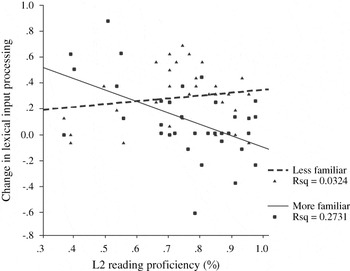
Translation Recognition. The change scores for the TW recognition variable revealed a similar pattern. There was worse performance for the more familiar condition, albeit positive (M = .11, SD = .29), than for the less familiar condition (M = .28, SD = .21). A mixed-model ANCOVA revealed a significant main effect of topic familiarity, F(1, 33) = 9.14, p = .005, η2 = .22, but not of L2 reading proficiency, F(1, 33) = 4.71, p = .037, η2 = .13, r = –.36. However, there was a significant interaction effect between topic familiarity and L2 reading proficiency, F(1, 33) = 10.14, p = .003, η2 = .24 (more familiar, B = –.91, t = –3.52, p = .001, η2 = .27, r = –.52; less familiar, B = .23, t = 1.05, p = .30, η2 = .03, r = .18).
The interaction revealed that the slopes of the two regression lines were significantly different, which suggests that the role of L2 reading ability in changes in lexical input processing depended on the degree of familiarity with the topic (see Figure 1). To interpret the interaction, it was necessary to identify regions where the two regression lines were significantly different for all possible points. The point of intersection of the lines was at .60 on the horizontal axis, which represents the range of L2 reading proficiency scores (see Figure 1). Potthoff’s extension of the Johnson-Neyman test was used to determine the value of L2 reading proficiency beyond .60, at which significantly different changes in input processing from the more familiar to the less familiar scenario were observed. This analysis allows one to obtain cutoff values of the predictor variable (L2 reading proficiency), above and below the point of intersection, where significant differences are predicted to occur.Footnote 7
Results for the translation recognition measure for each type of passage.

Results revealed that for the participants who scored at least 75% on the L2 reading proficiency measure (i.e., 36 of 48 on the ABLE exam), there were more positive changes in lexical input processing for the TWs in the less familiar passage, t(17) = –4.43, p = .0002, than in the more familiar passage. For this passage, scores were negative, which indicates forgetting. For learners of the group who scored below .75 on the ABLE, there were no differences in changes in lexical input processing between the different conditions, t(16) = –.38, p = .36.
Relationship Between Inferencing and Retention
Pearson correlations were computed to study the nature of the relationships between lexical inferencing and retention for the different measures and familiarity conditions. For the production measure, correlations were both positive and significant (more familiar, r = .45, p < .006; less familiar, r = .60, p < .0001). For the recognition measure, only the less familiar condition was significant (more familiar, r = .20, p = .26; less familiar, r = .58, p < .0001).
Lack of a Need to Engage in Deep Processing
The responses on the strategy questionnaire provided some information to address the components of need, search, and evaluation. First, 29 of the 35 participants rated the grocery story as easier to read (vs. 5 of 35, who rated the publishing story as easier). The majority (14/23) indicated previous experience and familiarity with the activity as the reasons. These comments provide some possible explanations for the significant effect of background knowledge on inferencing. In terms of completing the verification task, 29 of the 35 participants rated the TW sentences from the more familiar condition as moderately to very easy to process, compared to only 10 of 35 who made similar ratings for the less familiar story. Concerning strategies that were used when guesses were incorrect, 22 of the 35 participants listed beneficial strategies such as focus on the shape of the word, made a mental note of the correct translation and went back to fit it in and compare it with the overall context, and try to read it slowly. However, when guesses were correct, 11 of the 35 participants reported using less beneficial strategies such as if I was correct I didn’t think about it too long because I knew I had understood it, when they were the same I dismissed the sentence, I immediately looked to the right side of the screen to see what the definition of the word was and then I knew which sentence was displayed without having to read the sentence again, and I was trying to remember the events taking place in the story more than the vocab. Such responses were provided only by students at or beyond the intermediate course levels.
DISCUSSION
This study investigated involvement load in lexical input processing through reading by focusing on the effects of L2 reading proficiency and background knowledge. A cross-section of learners engaged in tasks to promote deeper processing of new words. Performance on a range of tests and questionnaires was observed before, during, and after the input processing tasks. Here, the discussion concerns the impact of individual differences on the involvement load.
The results provided strong support for both hypotheses and revealed independent significant contributions of L2 reading proficiency and background knowledge to lexical inferencing (i.e., search for meaning). First, there was a significant contribution of various reading skills to lexical inferencing ability. Reading ability was operationalized as literal and inferential comprehension skills were assessed through the Spanish version of the ABLE measure. Literal comprehension abilities included word-level decoding, sentence parsing, and text integration, whereas inferential comprehension skills involved generating conclusions or information not explicitly stated in the texts by bridging gaps in what was explicitly stated within the passages. Koda (Reference Koda2005) argued for the inclusion of an array of processing dimensions in measuring L2 reading competence. This study provides support for such a goal.
As both literal and inferential processing skills improved, so did lexical bootstrapping processes, which underscores the importance of efficient decoding skills and linguistic knowledge to comprehension monitoring and inferencing skills (e.g., Coady, Reference Coady, Coady and Huckin1997; Grabe & Stoller, Reference Grabe and Stoller2002; Koda, Reference Koda2005; Laufer, Reference Laufer, Coady and Huckin1997; Pulido, Reference Pulido2000, Reference Pulido2003, Reference Pulido2004b). The information generated during text processing and stored in working memory signaled information stored in long-term memory, which contributed to the creation of a situation model (i.e., the real-life situation being described) and ultimately helped to constrain inferences about new words. In sum, the greater the general reading skills, the greater the ability to transfer those skills to new reading and language learning activities, such as assigning meaning to new words.
With regard to background knowledge, the results also revealed that lexical inferencing was facilitated when learners were more familiar with a passage topic. Topic familiarity enabled deeper processing by allowing readers of all levels to draw upon the relevant background knowledge and predictable constructions in the process of searching for and assigning meanings to new words. The findings concerning both hypotheses expand results from previous research on text (Pulido, Reference Pulido2007) and sentence processing (Li, Reference Li1988; Mondria, Reference Mondria2003; Mondria & Wit-de Boer, Reference Mondria and Wit-de Boer1991).
Previous studies (e.g., Mondria, Reference Mondria2003; Mondria & Wit-de Boer, Reference Mondria and Wit-de Boer1991) concluded that correct inferencing may have given learners the impression that they already knew the words and, thus, might have led to decreased attentional allocation in the form-meaning connections on subsequent evaluation (i.e., verification) tasks. To address this possibility within the scope of reader-based factors, all participants completed a computerized task to confirm or correct their guesses in light of the given meanings, which were provided as marginal glosses. Processing times were measured. The results provided support for hypothesis 2 that concerns the effects of L2 reading ability. As expected, the better readers of the group, who were also more successful at inferencing, required less time to complete the task compared to the weaker readers of the group, regardless of the degree of familiarity with the passage contexts. This is due to a combination of more efficient processing resources and the need only to confirm rather than correct most guesses, especially in the more familiar condition. These results contrast with those of Mondria, who found no effect of proficiency on processing time.
The results did not support the second part of hypothesis 2 that concerns the role of topic familiarity. Although processing times were slightly faster for the more familiar condition, the differences were not statistically significant. In spite of greater success in inferencing within the more familiar condition (hypothesis 1 was confirmed), processing times for confirming or correcting guesses were not substantially faster for this condition. Some learners might have required additional time to reprocess the sentences, perhaps due to overall weaker language processing skills, regardless of whether they were confirming or correcting their guesses.
After the completion of the verification task, episodic memory was assessed to determine the extent of attentional allocation to the TWs during the verification phase and the effects of reading ability and topic familiarity. Neither hypothesis was supported: All participants, regardless of reading ability, were equally successful at assimilating the new TW forms and their respective story contexts into memory. These results suggest that, during the verification phase, learners allocated sufficient attention to building or strengthening episodic memory traces for new words by connecting the new TW forms with their semantic and story contexts, which is an initial step in vocabulary learning. That there were no effects of reading proficiency or topic familiarity on TW episodic memory as there were on the tasks leading up to the episodic memory test (i.e., lexical guessing and TW evaluation time) suggests that, at least within the scope of TW episodic memory, the verification task may have been helpful in eliminating any previous gaps in lexical input processing performance that were initially due to L2 reading proficiency or background knowledge.
The results also revealed independent effects of L2 reading ability and topic familiarity on receptive retention of meaning but not on productive retention of meaning. First, as predicted, the better readers of the group retained more new vocabulary compared to the weaker readers of the group. They were more efficient in retrieving meanings of new L2 words, confirming some previous research (e.g., Pulido, Reference Pulido2000, Reference Pulido2003; Pulido et al., Reference Pulido2007) yet contrasting with Mondria’s (Reference Mondria2003) findings. The better readers had more cognitive resources to process the TW form-meaning connections as they reconstructed the textbase and situation model for the different scenarios. Additionally, they had fewer words to learn, which freed up attentional resources during the verification task and thus enabled deeper processing of the incorrectly guessed words. The weaker readers of the group may have experienced more difficulty in correcting their guesses from the less familiar condition, whereas the stronger readers did not. At the same time, the stronger readers of the group may have forgotten some of the correctly guessed TWs from the more familiar condition.
There was also some evidence of an effect of topic familiarity on receptive retention. The means on the translation recognition multiple-choice measure were greater for the more familiar condition. This measure provided cues to meaning compared to the open-ended production measure (see also Pulido, Reference Pulido2007). This finding suggests the benefits of having rich schematic networks and more contextual support—as is the case when reading within a more familiar scenario—during lexical input processing tasks for later retrieval of receptive form-meaning connections.
To determine the effects of the reader-based variables on vocabulary retention after the input processing tasks, the changes in scores between the initial inferencing-search phase test and the final retention tests were considered. The results generally confirmed the hypothesis that memory would be worse for the TWs from the more familiar passage. Recall that more TWs were initially guessed correctly from the more familiar passage. There was a consistent effect of topic familiarity on changes in input processing on the more difficult translation production test, which was more sensitive to changes or difficulty in attentional allocation (see Pulido, Reference Pulido2000, Reference Pulido2003, Reference Pulido2004b, Reference Pulido2007, for similar test effects). These results also expand findings from previous research (Mondria, Reference Mondria2003; Mondria & Wit-de Boer, Reference Mondria and Wit-de Boer1991). Additionally, the better readers of the group demonstrated superior inferencing and faster verification times compared to the weaker readers. It was assumed that the faster processing times would be associated with more superficial attention to the connection between the TW forms and glosses.
A similar consistent effect was not obtained on the easier translation recognition measure, however. The significant interaction associated with the translation recognition measure helps to illustrate this phenomenon. As reading ability improved, there was more forgetting of the TWs from the more familiar passage, as illustrated by the negative correlation between L2 reading ability and the change in lexical input processing scores. However, as reading ability improved, there were more positive changes in lexical input processing and memory for the TWs from the less familiar passage, as illustrated by the positive correlation between reading ability and the change scores for the less familiar condition. These patterns occurred in spite of an error-free task to verify the initial guesses. Nonetheless, because the interaction effect was obtained on only one measure and L2 reading ability was not significant for either measure, these patterns of lexical input processing deserve further consideration in future studies.
The hypothesis concerning weaker correlations between inferencing and retention for the more familiar passage condition was confirmed. This can be linked to the forgetting of correctly guessed words in the familiar topic condition, which also illustrated the varied impact of reader-based factors on lexical input processing and memory decay across the different tasks.
The strategy questionnaire provided clues to understanding the connection between the reader-based factors and involvement load across the various tasks.Footnote 8 The majority of the learners rated the more familiar passage as easier to read due to their familiarity with the scenario. This provides a possible explanation for the effect of background knowledge on inferencing and for the processing that ensued on the verification task. Learners also reported using a wide range of strategies during the verification task. Some might have been beneficial, such as selectively attending to new words, retrieving new words and information about them from previous encounters, and creating semantic associations and networks by making conscious connections among previous knowledge, the TWs, and the reading contexts. Nonetheless, others might have been detrimental, possibly illustrating a low level of attention to the new TWs. These include dismissing the TW and sentence if the guess was correct, focusing only on the gloss and not its connection to the TW form and remembering the gist of the story instead of the form-meaning connection. Information of this nature helps to explain how involvement load or processing needs and capacity might moderate frequency effects in language learning as well as how tasks involving noticing, guessing, and verifying have the potential to heighten the salience and relevance of input through multiple encodings into memory.
SUMMARY
The present study illustrated a significant impact of the reader-based factors under investigation on the aspects of need, search, and evaluation during lexical input processing. Depth of processing during vocabulary learning activities fluctuated in response to the interaction between background knowledge and L2 reading ability. Searching for meaning was more successful and easier when there was available background knowledge and text processing resources to allocate to the task. Evaluation of the semantic fit between the new words and the contexts in which they were located was also influenced by the availability of text processing resources as well as by performance on previous tasks with the same words. The easier it was to guess word meanings, the less time learners spent to reprocess them and evaluate their fit with the context. Nevertheless, as background knowledge and reading ability improved, there was a decline in receptive retention of meaning after searching for and evaluating information about new words. These results help to illustrate a negative relationship between ease and success in lexical input processing and retention across a variety of tasks. By addressing individual differences in reader-based factors and manipulating the variable of context (e.g., more familiar vs. less familiar), this study sheds new light on theories of learner involvement in L2 lexical input processing during reading (e.g., Hulstijn & Laufer, Reference Hulstijn and Laufer2001; Laufer & Hulstijn, Reference Laufer and Hulstijn2001; Mondria, Reference Mondria2003; Mondria & Wit-de Boer, Reference Mondria and Wit-de Boer1991; Pulido, Reference Pulido2000, Reference Pulido2003, Reference Pulido2004a, Reference Pulido2004b, Reference Pulido2007; Rott, Reference Rott2005).
INSTRUCTIONAL IMPLICATIONS
In approaching lexical input processing activities, language teachers may wish to consider the reading abilities of their students and the background knowledge required by the reading activities in order to better gauge ease and difficulty in new word processing and learning. Because the relationship between guessing and retention is complicated by a number of factors, the more opportunities that can be provided for learners to engage in more qualitative and deeper processing of new words, the better. Activities to promote noticing, generating, and retrieving of information about new words should be encouraged as much as possible, especially in easy reading and guessing contexts (see, e.g., Nation, Reference Nation2001).
CONCLUSIONS AND FUTURE RESEARCH
This study demonstrated that reader-based factors contribute to learner-driven involvement in lexical input processing, sometimes in a negative manner. Future research may wish to study the effects of other variables related to L2 lexical input processing during reading (e.g., metacognitive ability, working memory, L1 literacy) as well as to consider in a systematic fashion the role of lexical-level factors (e.g., word class, salience, sentence position). Additionally, reader-based factors such as the ones in the present study could be included in future quantitative and qualitative studies to address whether these factors moderate the effects of different instructional methods on vocabulary learning (see, e.g., Rott, Reference Rott2005). This would expand the understanding of learner involvement in connection with the constructs of need, search, and evaluation in lexical input processing.
APPENDIX A TARGET WORDS INCLUDED IN THE READING PASSAGES

APPENDIX B READING PASSAGES
More Familiar Passage
En el supermercado
Hoy John se dio cuenta de que no había nada en la nevera, así que cogió su cartera y condujo al supermercado. Estacionó el coche y entró en el supermercado. Primero, cogió un resmo y sacó la lista de su cartera. Comenzó a dar una vuelta por las borrigas. Primero, fue a la sección de alimentos enlatados porque quería sopa. Había tantas marcas que decidió sapirar los precios. Luego, siguió hacia los puestos de frutas y verduras para comprar uvas. Allí, escogió un racimo. Después, fue a la pastelería para comprar pan. Saludó al pastelero y le pidió una barra. Luego, siguió por el supermercado par aver si le faltaba algo. Lo tenía todo, así caminó hacia la olneda. Había muchas personas esperando en cola, así que John comenzó a leer las pifantas. Por fin llegó su turno, así que colocó los alimentos en el lastredón y el dependiente comenzó a dacar los precios. Después John sacó la tarjeta de crédito y pagó su cuenta. Finalmente, cogió las afeltas y salió del supermercado.
Less Familiar Passage
La publicación de un artículo
Sue quería publicar los resultados de su investigación. Así que comenzó a arreglar el trabajo conforme a las dostas que requería el boletín. Betenó todos los agradecimientos y se quedó con cuatro copias anónimas. Después, escribió la segua. La adjuntó a las cuatro copias y le mandó todo al editor par aver si le pareceía interesante. Después de varios días, llegó el tídero de la casa editorial. A los dos meses, Sue recibió todos los comentarios de los toleneros. Ella estaba contenta porque la habían invitado a regamir el manuscrito, aunque tenía que hacer algunas revisions. Así que dilegentemente comenzó a revisarlo según las acriciones del editor. Terminó para la fecha de entrega. Dos meses antes de la publicación recibió las mascuas. Tuvo tres días para hacer cambios. También tuvo que firmar el contrato de propiedad. Después le entregó todo al editor. Por fin terminó con todo. Para ller su artículo tenía que esperar hasta la publicación de la próxima edición de Lengua Moderna.
Note: The TWs were boldfaced and underlined in the original materials.
APPENDIX C STRATEGY QUESTIONNAIRE
Answer the following questions to the best of your ability. If you need clarification of the questions ask your researcher for assistance.
1. What were you thinking about, or what strategies did you use when you read the sentences on the computer screen? Explain.
2. Were the translations that appeared in the margin on the computer sentence-reading task different from the guesses that you had made for those words when you read the stories on paper?
a. If so, what did you do or think about while reading the sentences on the computer?
b. If not, what did you do or think about while reading the sentences on the computer?
3. Rate the degree of ease/difficulty of understanding the sentences on the computer sentence-reading task.
1 = Very Difficult
2 = Difficult
3 = Moderately Difficult
4 = Moderately Easy
5 = Easy
6 = Very Easy
Sentences from the Grocery Store story:
Sentences from the Publishing an Article story:
4. Circle the letter of the statement that best applies to you, then briefly explain why.
a. The Grocery Store story was easier to read than the Publishing an Article story.
b. The Publishing an Article story was easier to read than the Grocery Store story.
Reasons: