INTRODUCTION
Taeniid tapeworms (Eucestoda: Cyclophyllidea: Taeniidae) are parasites of mammals, with carnivores as definitive and mostly herbivores as intermediate hosts. The family Taeniidae consists of 2 genera, Taenia and Echinococcus, which both have a global socioeconomic impact by causing morbidity in humans and domestic livestock (Eckert et al. Reference Eckert, Gemmell, Meslin and Pawlowski2001; Hoberg, Reference Hoberg2002). Because of their medical and veterinary significance, taeniids have been the focus of intensive epidemiological, ecological and taxonomic studies.
Traditionally, the specific identification of taeniids has been based on morphological criteria, usually taking into account also ecological and biological aspects like host specificity (e.g. Abuladze, Reference Abuladze and Skrjabin1964). The development of molecular genetic techniques has provided improved tools for the identification of taeniid species and for investigating relationships among them. In particular, mitochondrial DNA sequencing has been successfully used for the identification and genetic characterization of these parasites (e.g. Bowles et al. Reference Bowles, Blair and McManus1992; Bowles and McManus, Reference Bowles and McManus1994). To date, whole mitochondrial genomes of 8 Echinococcus spp. and 3 Taenia spp. have been published (Le et al. Reference Le, Blair, Agatsuma, Humair, Campbell, Iwagami, Littlewood, Peacock, Johnston, Bartley, Rollinson, Herniou, Zarlenga and McManus2000, Reference Le, Pearson, Blair, Dai, Zhang and McManus2002; Nakao et al. Reference Nakao, Yokoyama, Sako, Fukunaga and Ito2002, Reference Nakao, Sako and Ito2003, Reference Nakao, McManus, Schantz, Craig and Ito2007; Jeon et al. Reference Jeon, Lee, Kim, Hwang and Eom2005).
Sequence analyses have assisted in the revision of the taxonomy of the genus Echinococcus (Le et al. Reference Le, Pearson, Blair, Dai, Zhang and McManus2002; Nakao et al. Reference Nakao, McManus, Schantz, Craig and Ito2007; Hüttner et al. Reference Hüttner, Nakao, Wassermann, Siefert, Boomker, Dinkel, Sako, Mackenstedt, Romig and Ito2008). Recently reconstructed, robust molecular phylogenies supported strongly the validation of 9 Echinococcus spp. (Nakao et al. Reference Nakao, McManus, Schantz, Craig and Ito2007; Hüttner et al. Reference Hüttner, Nakao, Wassermann, Siefert, Boomker, Dinkel, Sako, Mackenstedt, Romig and Ito2008). Several molecular phylogenies of Taenia have also been published (e.g. Okamoto et al. Reference Okamoto, Bessho, Kamiya, Kurosawa and Horii1995a; de Queiroz and Alkire, Reference de Queiroz and Alkire1998; von Nickisch-Rosenegk et al. Reference von Nickisch-Rosenegk, Silva-Gonzalez and Lucius1999), but unfortunately they all suffer from an insufficient number of species to represent the diversity within this genus. The most comprehensive hypotheses regarding the phylogenetic relationships within Taenia were presented by Hoberg et al. (Reference Hoberg, Jones, Rausch, Eom and Gardner2000, Reference Hoberg, Alkire, de Queiroz and Jones2001) and Hoberg (Reference Hoberg2006) on the basis of morphological characteristics. Currently, the genus Taenia contains 42 valid species (Hoberg, Reference Hoberg2006), but most of them are still genetically uncharacterized. Moreover, to date, there has been no comprehensive phylogenetic analysis of members of the family Taeniidae using relatively large sample sizes for both genera in the same analysis. In the current study, we genetically characterized specimens of 9 Taenia spp. by sequencing 2 mitochondrial DNA regions, and investigated variation within the species. Furthermore, we inferred phylogenetic relationships within the family Taeniidae by combining sequence data from the present and previously published studies.
MATERIALS AND METHODS
Parasite specimens and DNA extraction
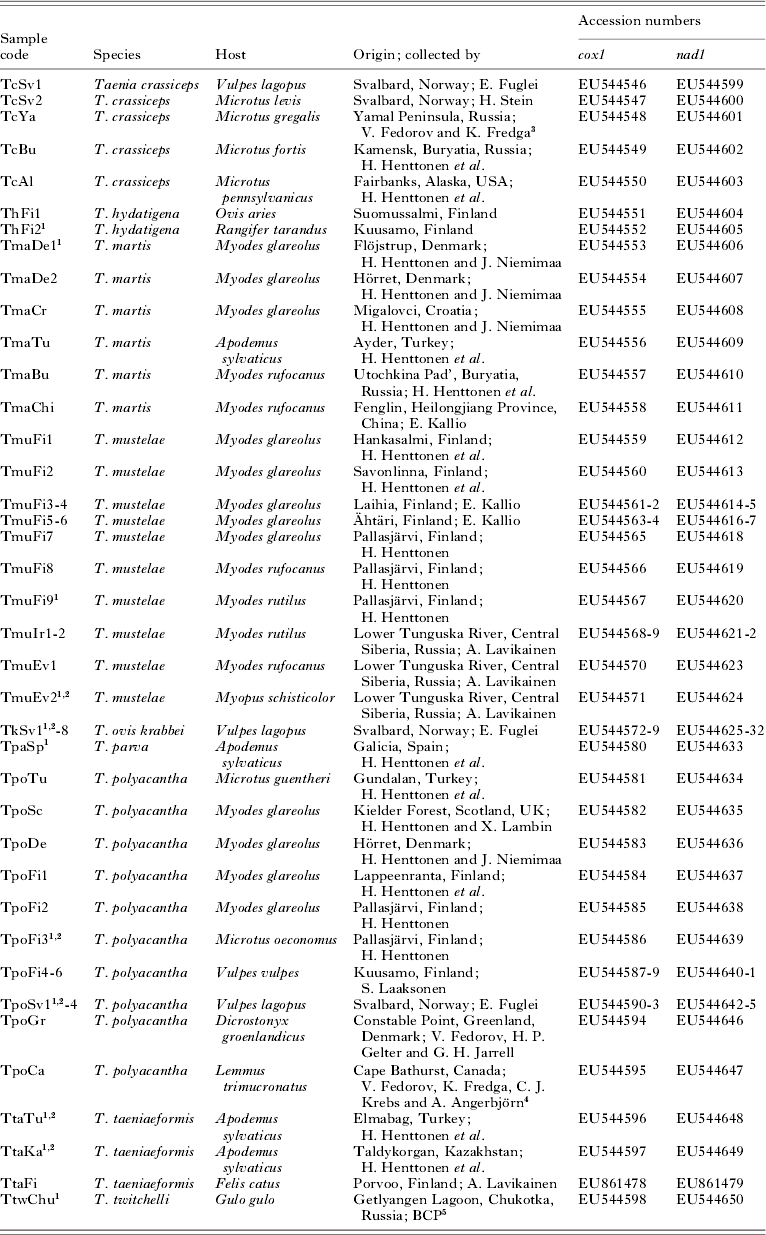
Fifty-four specimens of Taenia (larval and strobilate stages), representing 9 different taxa (T. crassiceps, n=5; T. hydatigena, 2; T. martis, 6; T. mustelae, 13; T. ovis krabbei, 8; T. parva, 1; T. polyacantha, 15; T. taeniaeformis, 3; T. twitchelli, 1), were collected from various intermediate and definitive hosts from different geographical regions (Table 1 and Fig. 1). Specimens of T. hydatigena were collected during routine meat inspection in slaughterhouses. The rest of the specimens were collected during several research projects (Table 1). The species were identified primarily based on the number, size and shape of the rostellar hooks, according to Verster (Reference Verster1969) and Loos-Frank (Reference Loos-Frank2000). All of the samples were fixed and stored in ethanol. Genomic DNA was extracted using the DNeasy™ Tissue Kit (Qiagen) and stored at −20°C.
Sampling locations of Taenia spp. in this study. (1) Alaska; (2) northern Canada; (3) Greenland; (4) Spain; (5) Scotland; (6) Svalbard; (7) Denmark; (8) Croatia; (9) Finland; (10) Turkey; (11) Yamal Peninsula; (12) Kazakhstan; (13) Central Siberia; (14) Buryatia; (15) northeastern China; (16) Chukotka. For the detailed locations of the single specimens, see Table 1.

Hosts and geographical origins of the Taenia specimens, and GenBank accession numbers for the partial cox1 and nad1 sequences

1 The cox1 and nad1 sequences of the isolate were included into the phylogenetic analysis.
2 Heterogeneity of amplified DNA examined by cloning.
3 Swedish-Russian Tundra Ecology Expedition (1994).
4 Tundra Northwest 1999 Expedition.
5 Beringian Coevolution Project.
DNA amplification and sequencing
Two mitochondrial DNA regions, including parts of the cytochrome c oxidase subunit 1 gene (cox1) and NADH dehydrogenase subunit 1 (nad1) genes, were amplified using previously published primers (Bowles et al. Reference Bowles, Blair and McManus1992; Bowles and McManus, Reference Bowles and McManus1993). PCR and sequencing were carried out as described previously (Lavikainen et al. Reference Lavikainen, Lehtinen, Laaksonen, Ågren, Oksanen and Meri2006). The sizes of the amplification products were assessed by electrophoresis in 1·5% (w/v) Tris-borate/EDTA agarose gels and ethidium bromide staining. Before sequencing, the amplicons were purified enzymatically with ExoSAP-IT® (USB, Cleveland, Ohio) treatment or excised from the agarose gels and purified using Qiaquick® Gel Extraction Kit (Qiagen). Both strands of DNA were sequenced with the same primers as used for the primary PCR. Because of difficulties in sequencing nad1 of T. parva in the reverse direction, 2 internal reverse sequencing primers, Tpa1 (5′-ACGGAGTACGATTAGTTTCACAGA-3′) and Tpa2 (5′-CCATTAAACAAGCCTCAAACCT-3′), were designed.
Investigation of pseudogene contamination
Because nuclear mitochondrial pseudogenes have been detected previously in Echinococcus (Obwaller et al. Reference Obwaller, Schneider, Walochnik, Gollackner, Deutz, Janitschke, Aspöck and Auer2004), we examined possible heterogeneity within PCR products from single isolates, which can indicate pseudogene ‘contamination’ (see Zhang and Hewitt, Reference Zhang and Hewitt1996). For this purpose, amplicons from selected isolates of T. mustelae, T. ovis krabbei, T. polyacantha and T. taeniaeformis (shown in Table 1) were excised from the agarose gels, purified (Qiaquick® Gel Extraction Kit, Qiagen) and then cloned using the TOPO TA Cloning® Kit (Invitrogen). Plasmid DNA was purified using QIAprep® Spin Miniprep Kit (Qiagen). The presence of plasmid inserts was confirmed by restriction analysis (EcoRI, New England BioLabs). Four clones from each amplicon were sequenced as described previously (Lavikainen et al. Reference Lavikainen, Lehtinen, Laaksonen, Ågren, Oksanen and Meri2006) using the plasmid-specific sequencing primers M13 forward and M13 reverse.
The cloned sequences were aligned with the directly sequenced PCR products by the MegalignTM module of the DNASTAR Lasergene® software. The theoretical Taq polymerase error rate (p) was calculated using the formula p=2f/n, where f is the observed error frequency and n is the number of the cycles (Eckert and Kunkel, Reference Eckert and Kunkel1991). This error rate was then compared with previously published Taq error rates (see e.g., Eckert and Kunkel, Reference Eckert and Kunkel1991). The cloned sequences were also examined for frameshift mutations and internal stop codons, which are anomalies of the type commonly associated with pseudogenes (Zhang and Hewitt, Reference Zhang and Hewitt1996).
Calculation of intraspecies variation
To evaluate intraspecific variation, the directly sequenced amplicons were aligned species by species using Megalign. Alignments were modified manually by removing all sites with ambiguous nucleotides. The levels of sequence difference (D), based on pair-wise comparisons, were calculated according to Chilton et al. (Reference Chilton, Gasser and Beveridge1997) using the formula D=1 – (M/L), where M is the number of alignment positions at which the 2 sequences have a base in common, and L is the total number of positions over which the sequences are compared. The sequences were also compared with previously published sequences of the same species, if such data of either of the gene regions were available. The level of sequence difference was expressed as percentage (100%×D).
Phylogenetic analysis
Eleven Taenia isolates of this study representing 8 species (directly sequenced amplicons, Table 1), and previously published sequences of 10 Taenia spp. and 9 Echinococcus spp./genotypes were included into the phylogenetic analysis, with Hymenolepis diminuta as an outgroup (Bowles et al. Reference Bowles, Blair and McManus1992; Bowles and McManus, Reference Bowles and McManus1993, Reference Bowles and McManus1994; Gasser et al. Reference Gasser, Zhu and McManus1999; Le et al. Reference Le, Blair, Agatsuma, Humair, Campbell, Iwagami, Littlewood, Peacock, Johnston, Bartley, Rollinson, Herniou, Zarlenga and McManus2000, Reference Le, Pearson, Blair, Dai, Zhang and McManus2002; von Nickisch-Rosenegk et al. Reference von Nickisch-Rosenegk, Brown and Boore2001; Nakao et al. Reference Nakao, Yokoyama, Sako, Fukunaga and Ito2002, Reference Nakao, Sako and Ito2003; Lavikainen et al. Reference Lavikainen, Lehtinen, Meri, Hirvelä-Koski and Meri2003; Jeon et al. Reference Jeon, Lee, Kim, Hwang and Eom2005; Xiao et al. Reference Xiao, Qiu, Nakao, Li, Yang, Chen, Schantz, Craig and Ito2005; Zhang et al. Reference Zhang, Hu, Jones, Alsopp, Beveridge, Schindler and Gasser2007; Hüttner et al. Reference Hüttner, Nakao, Wassermann, Siefert, Boomker, Dinkel, Sako, Mackenstedt, Romig and Ito2008). The genotype G10 of E. granulosus sensu lato was chosen to represent a cluster of closely related genotypes G6-G10. These genotypes have been proposed to form a single species based on mitochondrial DNA sequence data (see e.g., Nakao et al. Reference Nakao, McManus, Schantz, Craig and Ito2007; Moks et al. Reference Moks, Jõgisalu, Valdmann and Saarma2008; Hüttner et al. Reference Hüttner, Nakao, Wassermann, Siefert, Boomker, Dinkel, Sako, Mackenstedt, Romig and Ito2008). Sequences of 2 isolates from T. mustelae, T. polyacantha and T. taeniaeformis were selected because of the finding of the intraspecific variation. The partial sequences of cox1 and nad1 genes were first aligned using ClustalW and further manually adjusted (Thompson et al. Reference Thompson, Higgins and Gibson1994). Gaps and all codons with ambiguous sites were deleted from the alignments that were then concatenated. The final alignment contained 810 nucleotides.
An evolutionary model for the alignment was selected with Akaike Information Criterion implemented in the Modeltest v.3.06 program (Posada and Crandall, Reference Posanda and Crandall1998). Modeltest selected the model TVM+I+G to best describe the evolutionary information in the alignment. Transversional model (TVM) rate matrix parameters were a=1·7351, b=19·1170, c=1·5266, d=10·2675, e=19·1170, and f=1·0. The proportion of invariable sites (I) was estimated to be 0·3022 and the alpha parameter of gamma distribution (G) 0·5788. Phylogenies were constructed with PAUP* 4.0b10 (Sinauer Associates Inc., Sunderland, MA, USA) using minimum evolution (ME), maximum parsimony (MP) and maximum likelihood (ML) criteria. Heuristic Tree Bisection Reconnection algorithm was repeated 100 times with a random addition of sequences to construct an ML tree, which was assessed with 100 replicates of bootstrapping. For the ME approach, the neighbor-joining algorithm was used to construct a phylogenetic tree. Statistical support for the nodes in the ME and MP trees was assessed with 1000 replicates of bootstrapping.
RESULTS
Assessing the quality of amplicons
Single amplicons of the expected sizes for both cox1 and nad1 were detected on agarose gels for each examined Taenia isolate, except for a T. polyacantha isolate (TpoFi5) whose nad1 gene fragment was not amplified; cox1 and nad1 sequences of 396 bp and 488 bp, respectively, were obtained for each species, with the exception of T. parva, which had an nad1 sequence of 491 bp with ambiguous nucleotides between positions 441 and 446. All nucleotide sequences have been deposited in the GenBank database under the Accession numbers EU544546-EU544650, EU861478 and EU861479 (see Table 1).
To detect potential pseudogenes, sequence heterogeneity within amplicons from selected isolates (Table 1) was examined by cloning. In total, 16 cox1 clones (6336 bp) and 24 nad1 clones (11 712 bp) were sequenced. The number of cox1 clones was smaller, as the amplicons from the T. mustelae isolate TmuEv2 and from the T. polyacantha isolate TpoFi3 could not be cloned. When sequences of the clones were compared with directly sequenced PCR products, 60% of the cox1 clones and 50% of the nad1 clones exhibited no nucleotide differences. The obtained differences were single nucleotide substitutions, typically 1–2 per clone (the maximum was 4 nucleotide differences in a nad1 clone representing T. mustelae). Neither indels nor internal stop codons were detected. For both genes, the substitution frequency was 1·4×10−3. The error rate per nucleotide per cycle was estimated as 8×10⁻⁵, which is in accordance with the published Taq error rates which range from <1×10⁻⁵ to 2×10⁻⁴ (Eckert and Kunkel, Reference Eckert and Kunkel1991).
Intraspecific variation
Within-species variation in each cox1 and nad1 was examined by pair-wise comparison. Nucleotide differences between sequences can be interpreted reliably, because the errors introduced by Taq polymerase are not detectable by direct sequencing. A single nucleotide difference between sequences corresponded to differences of 0·3% in cox1 and 0·2% in nad1.
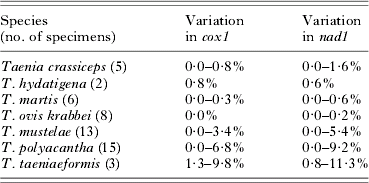
Low intraspecific sequence variation was detected within T. crassiceps, T. martis and T. ovis krabbei, and between the 2 T. hydatigena isolates (Table 2). Sequences of T. crassiceps, T. hydatigena and T. o. krabbei were also compared with the previously published sequences for these species. The Alaskan T. crassiceps isolate (TcAl) used on this study had identical sequences with that in the complete mitochondrial genome of T. crassiceps (see Le et al. Reference Le, Blair, Agatsuma, Humair, Campbell, Iwagami, Littlewood, Peacock, Johnston, Bartley, Rollinson, Herniou, Zarlenga and McManus2000). The previous T. hydatigena isolates differed in sequence from isolates studied herein by 0·3–1·0% in cox1 and 0·2–1·9% in nad1 (Okamoto et al. Reference Okamoto, Bessho, Kamiya, Kurosawa and Horii1995a; Gasser et al. Reference Gasser, Zhu and McManus1999; Nakao et al. Reference Nakao, Sako, Yokoyamo, Fukunaga and Ito2000; Zhang et al. Reference Zhang, Hu, Jones, Alsopp, Beveridge, Schindler and Gasser2007). Kedra et al. (Reference Kedra, Tkach, Swiderski and Pawlowski2001) reported up to 5·5% variation for nad1 among T. hydatigena isolates, but these sequences were not compared in the present study, because of their multiple ambiguous nucleotides and shorter lengths, which most likely exaggerated the variation. The differences between the T. o. krabbei and previously published T. ovis (presumably T. ovis ovis) sequences (Bowles and McManus, Reference Bowles and McManus1994; Gasser et al. Reference Gasser, Zhu and McManus1999) were as high as 13·4% in cox1 and 16·4–16·8% in nad1.
Intraspecific nucleotide sequence variations (%) in cox1 and nad1

On the basis of the nucleotide sequence differences (Table 2), the T. mustelae isolates were divided into 2 groups. This grouping was concordant with the geographical origins (Finland and Siberia) of the specimens. Sequence variations within the geographical groups were 0·0–0·8% in cox1 and 0·0–1·4% in nad1, whereas between the groups they were 2·3–3·4% and 4·5–5·4%, respectively. The Siberian isolates differed from a previously published cox1 sequence of T. mustelae from Japan by 0·5–0·8% (Okamoto et al. Reference Okamoto, Bessho, Kamiya, Kurosawa and Horii1995a), whilst differences between the Finnish and Japanese T. mustelae cox1 sequences were 3·1–3·4%.
The T. polyacantha isolates were also divided into 2 groups (Table 2). The geographically southernmost group contained specimens from Finland, Denmark, Scotland and Turkey, and the northern group from Svalbard, Canada and Greenland. Between the southern and northern groups, the sequence differences were 5·8–6·8% in cox1 and 9·0–9·2% in nad1. The sequence variations within the southern group were 0·0–0·3% in cox1 and 0·0–0·4% in nad1, and within the northern group 0·0–2·8% and 0·0–3·3%, respectively. Within the northern group, the Greenlandic isolate was the most divergent (differing by 2·3–2·8% in cox1 and 2·9–3·3% in nad1), whereas the isolates from Svalbard and Canada were closely related to each other exhibiting differences only up to 0·8% in cox1 and 1·0% in nad1.
Within the 3 T. taeniaeformis isolates, remarkable sequence differences were detected (Table 2). The cox1 sequence of the Kazakhstan isolate (TtaKa) resembled the majority of the previously published cox1 sequences of T. taeniaeformis, whereas the Turkish (TtaTu) and Finnish (TtaFi) isolates were close to a divergent isolate (TtACR) from Japan (Table 3; Okamoto et al. Reference Okamoto, Bessho, Kamiya, Kurosawa and Horii1995a).
Pairwise comparison of nucleotide sequence differences (%) in cox1 (362 bp) between the present and previously published Taenia taeniaeformis specimens
(In parenthesis, geographical origins of the previously published specimens.)

1 From Gasser et al. (Reference Gasser, Zhu and McManus1999).
2 From Okamoto et al. (Reference Okamoto, Bessho, Kamiya, Kurosawa and Horii1995a).
3 Specimens of this study. For details, see Table 1.
Phylogenetic relationships
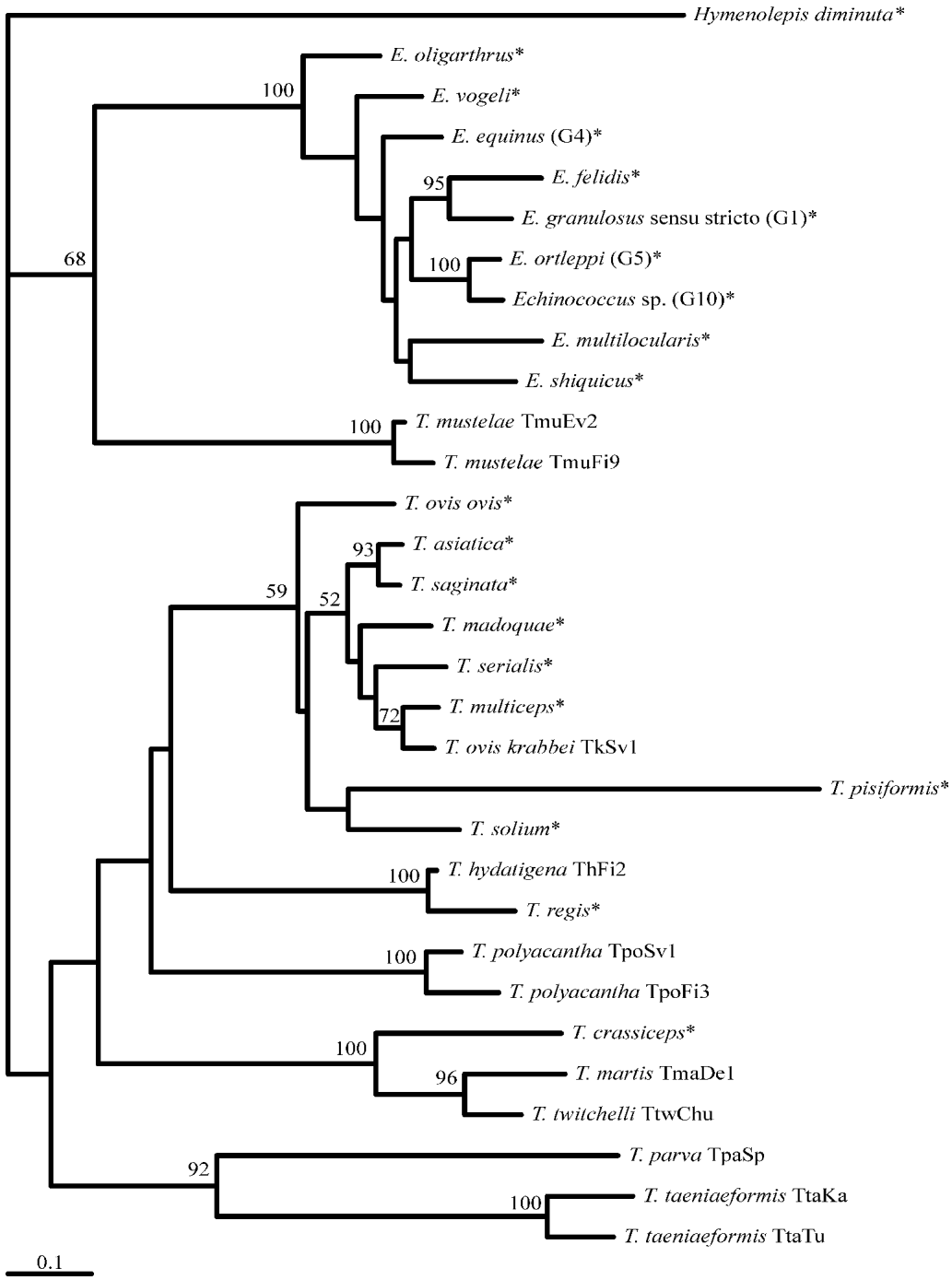
An heuristic search for the best maximum likelihood (ML) phylogeny resulted in 2 trees that had very similar likelihoods and topologies. The differences in the tree topologies were all in a monophyletic group formed by the genus Echinococcus. We addressed the Echinococcus group separately using ML criterion with branch and bound algorithm. The resultant topology was identical with that of the Echinococcus group in one of the 2 trees found in the heuristic search. This topology was also better supported by the previously published data on the phylogeny of Echinococcus (Bowles et al. Reference Bowles, Blair and McManus1995; Nakao et al. Reference Nakao, McManus, Schantz, Craig and Ito2007) and, therefore, only the tree with this topology was considered for further analyses.
Minimum evolution (ME) and maximum parsimony (MP) trees had minor differences to the ML tree presented in Fig. 2. The slight differences were detected within the monophyletic Echinococcus group and positions of T. solium, T. pisiformis and T. serialis. In all trees, T. taeniaeformis isolates clustered with T. parva, and T. crassiceps with T. martis and T. twitchelli (in well-supported clades). In addition, the position of T. regis and T. hydatigena as sister species was also strongly supported. The bootstrap supports for the node grouping T. mustelae with Echinococcus were 67% in MP, and 76% in ME trees. Furthermore, the sister species relationship between T. multiceps and T. ovis krabbei was supported with 91% and 69% (bootstrap proportions) in the MP and ME trees, respectively.
Maximum likelihood tree inferred from the concatenated sequences of cox1 and nad1 genes of Taeniidae and Hymenolepis diminuta (outgroup). Bootstrap values >50% are shown. The scale bar is proportional to 0·1 substitutions per site. Abbreviations: E – Echinococcus; T – Taenia; G1, G4, G5, G10 – genotypes of E. granulosus sensu lato; TmuEv2, TmuFi9, TkSv1, ThFi2, TpoSv1, TpoFi3, TtwChu, TpaSp, TtaKa, TtaTu – isolates of this study (for details, see Table 1). Marked with an asterisks (*) are the selected reference sequences from previous studies (Bowles et al. Reference Bowles, Blair and McManus1992; Bowles and McManus, Reference Bowles and McManus1993, Reference Bowles and McManus1994; Gasser et al. Reference Gasser, Zhu and McManus1999; Le et al. Reference Le, Blair, Agatsuma, Humair, Campbell, Iwagami, Littlewood, Peacock, Johnston, Bartley, Rollinson, Herniou, Zarlenga and McManus2000, Reference Le, Pearson, Blair, Dai, Zhang and McManus2002; von Nickisch-Rosenegk et al. Reference von Nickisch-Rosenegk, Brown and Boore2001; Nakao et al. Reference Nakao, Yokoyama, Sako, Fukunaga and Ito2002, Reference Nakao, Sako and Ito2003; Lavikainen et al. Reference Lavikainen, Lehtinen, Meri, Hirvelä-Koski and Meri2003; Jeon et al. Reference Jeon, Lee, Kim, Hwang and Eom2005; Xiao et al. Reference Xiao, Qiu, Nakao, Li, Yang, Chen, Schantz, Craig and Ito2005; Zhang et al. Reference Zhang, Hu, Jones, Alsopp, Beveridge, Schindler and Gasser2007; Hüttner et al. Reference Hüttner, Nakao, Wassermann, Siefert, Boomker, Dinkel, Sako, Mackenstedt, Romig and Ito2008).

DISCUSSION
The current analysis represents the most comprehensive molecular phylogeny to date for the family Taeniidae. Because the parasite material of the present study was limited and somewhat biased with an over-presentation of some isolates over others, the specification and phylogeography could not be viewed in detail. Despite these limitations, however, some fundamental conclusions could be drawn. The main new findings of this study were the paraphyly of the genus Taenia and of the species T. ovis, and the high intraspecific variation within T. polyacantha. In addition, the previously discovered high genetic variation within T. taeniaeformis (see Okamoto et al. Reference Okamoto, Bessho, Kamiya, Kurosawa and Horii1995a) was confirmed. These results suggest that a taxonomic revision of Taenia at the specific and possibly generic levels is warranted. Partial sequences of the cox1 and nad1 genes have been commonly used for genetic characterization of taeniids. Therefore, a relatively large amount of sequence data is available for phylogeny reconstruction. In addition, mitochondrial DNA has proved to be a useful molecular marker in evolutionary biology, in spite of some limitations associated with its use in phylogenetic studies (see e.g., Harrison Reference Harrison1989; Zhang and Hewitt, Reference Zhang and Hewitt1996). One of the problems is the occurrence of mitochondrial-like sequences in the nuclear genome, so-called pseudogenes, which have been discovered in a wide range of taxa, including Echinococcus (Obwaller et al. Reference Obwaller, Schneider, Walochnik, Gollackner, Deutz, Janitschke, Aspöck and Auer2004). Nuclear mitochondrial pseudogenes can confound phylogenetic studies, particularly if they occur in high copy numbers and universal primers are used. In this study, no evidence of pseudogene contamination was found.
Contrasting phylogenies
In the present analysis, the genus Echinococcus was found to be compact and monophyletic. The topology of the Echinococcus clade is consistent with the previous studies (e.g. Nakao et al. Reference Nakao, McManus, Schantz, Craig and Ito2007; Hüttner et al. Reference Hüttner, Nakao, Wassermann, Siefert, Boomker, Dinkel, Sako, Mackenstedt, Romig and Ito2008) placing E. oligarthrus and E. vogeli basally, and distinguishing 3 pairs of sister taxa: E. granulosus sensu stricto – E. felidis, E. ortleppi (the genotype G5 of E. granulosus sensu lato) – Echinococcus sp. (the genotype cluster G6-10 represented by G10 in the current analysis), and E. multilocularis – E. shiquicus. Molecular phylogenies for Taenia presented by Gasser et al. (Reference Gasser, Zhu and McManus1999) and Zhang et al. (Reference Zhang, Hu, Jones, Alsopp, Beveridge, Schindler and Gasser2007) are in essence similar to the current analysis, although these prior studies, based on the same gene regions, are more limited in the numbers of species investigated. Thorough morphological phylogenies by Hoberg et al. (Reference Hoberg, Jones, Rausch, Eom and Gardner2000) and Hoberg (Reference Hoberg2006) are consistent with the present study, particularly in the relatively basal placement of T. parva, T. taeniaeformis, T. twitchelli, T. martis and T. crassiceps, and in the relationships between them, whereas congruence regarding distal branches of the trees is more limited. In contrast to the current study, T. taeniaeformis is placed in the crown of the trees constructed by Okamoto et al. (Reference Okamoto, Bessho, Kamiya, Kurosawa and Horii1995a) and de Queiroz and Alkire (Reference de Queiroz and Alkire1998), based on cox1, and a combination of cox1 and a region of nuclear ribosomal DNA, respectively. This is the major difference also between our results and a morphological phylogeny by Moore and Brooks (Reference Moore and Brooks1987). A phylogenetic tree by von Nickisch-Rosenegk et al. (Reference von Nickisch-Rosenegk, Silva-Gonzalez and Lucius1999), based on mitochondrial 12S rDNA data, is quite different from the current phylogeny, except for some similarity in the basal species.
Revising taeniid taxonomy at the generic level
The genus Taenia is apparently much more diverse than Echinococcus. Some authors have even recognized a number of distinct genera within Taenia, based primarily on the morphology of the metacestode (e.g. Abuladze, Reference Abuladze and Skrjabin1964; Bessonov et al. Reference Bessonov, Movsessian and Abuladze1994). In agreement with several previous studies (Verster, Reference Verster1969; de Queiroz and Alkire, Reference de Queiroz and Alkire1998; Loos-Frank, Reference Loos-Frank2000; Hoberg et al. Reference Hoberg, Jones, Rausch, Eom and Gardner2000), our results do not support the recognition of the genera Taeniarhynchus, Multiceps or Fimbriotaenia. Taeniarhynchus consists of T. saginata (and T. asiatica). From the species of this study, T. multiceps, T. serialis and T. twitchelli are included in Multiceps (see e.g. Abuladze, Reference Abuladze and Skrjabin1964), and on the other hand, T. martis, T. mustelae and T. twitchelli into Fimbriotaenia (Korniushin and Sharpilo, Reference Korniushin and Sharpilo1986). According to the present results, these putative genera either are polyphyletic, or their recognition would make Taenia paraphyletic. Due to the partly low resolution of the current phylogeny, the status of Hydatigera (including T. taeniaeformis and T. parva) and Tetratirotaenia (T. polyacantha) remains unsolved. Furthermore, other related genera, such as Fossor, cannot be commented on here because of insufficient material.
Several previously proposed taeniid genera were ranked to synonymy with Taenia in a landmark taxonomic revision published by Verster (Reference Verster1969). In the same article, Taenia was divided into 2 groups on the basis of the relative positions of the genital and osmoregulatory ducts. One of these groups was postulated to be older and parasitize mainly mustelids and viverrids. Taenia parva, T. taeniaeformis, T. twitchelli and T. martis, which were included into this group, are basal also in the present phylogeny. However, the placement of T. crassiceps among the ‘older’ species differs from Verster's grouping. Furthermore, one member of this group, T. mustelae, is placed outside the genus Taenia in the current analysis.
Taenia mustelae is located in the echinococcal branch of the present phylogenetic tree. This is not surprising, because in all available phylogenies of Taenia, both morphological and genetic, in which T. mustelae has been included, it has been placed as the basal species (Moore and Brooks, Reference Moore and Brooks1987; Okamoto et al. Reference Okamoto, Bessho, Kamiya, Kurosawa and Horii1995a; de Queiroz and Alkire Reference de Queiroz and Alkire1998; Nickisch-Rosenegk et al. Reference von Nickisch-Rosenegk, Silva-Gonzalez and Lucius1999; Hoberg et al. Reference Hoberg, Jones, Rausch, Eom and Gardner2000). However, the current placement of T. mustelae renders Taenia paraphyletic, and consequently raises a need of a generic level revision of Taeniidae. Because of obvious morphological differences of the metacestode and adult parasite, T. mustelae cannot be included into Echinococcus, but judging by the phylogenetic position, it could form a genus of its own. Taenia mustelae differs from most of the other Taenia spp. by its numerous and very small rostellar hooks (Loos-Frank, Reference Loos-Frank2000), which, together with additional characteristics, might be used in the generic distinction of T. mustelae.
A common feature of T. mustelae and Echinococcus is the ability for asexual reproduction in the metacestode stage. The larvae of Echinococcus are proliferative, whereas 2 larval forms, uniscolex cysticercus and multiscolex coenurus, occur in T. mustelae. Coenuri of T. mustelae have been reported in various intermediate hosts from North America (Locker, Reference Locker1955; Freeman, Reference Freeman1956). Future studies may determine whether these different larval forms are associated with genetically distinct lineages. Asexual reproduction occurs also among some other species of Taenia (Loos-Frank, Reference Loos-Frank2000). Most of these species were located basally in the present phylogeny, and thus, the potential of scoleces to multiply in the intermediate host seems to be a very basic feature of the family Taeniidae.
Rehabilitating T. krabbei to an independent species
Taenia krabbei, described by Moniez in 1879, was lowered in rank to a subspecies of T. ovis by Verster (Reference Verster1969). These 2 species were considered to be biologically distinct but morphologically nearly indistinguishable. Recently, the subspecific ranking of T. o. krabbei has been defended (Loos-Frank, Reference Loos-Frank2000; Hoberg, Reference Hoberg2006), but also evidence supporting its specific status has been presented (Priemer et al. Reference Priemer, Krone and Schuster2002). In the current analysis, T. o. krabbei proved to be rather distant from T. ovis, and was placed as a sister taxon of T. multiceps. Judging by the host (sheep) and geographical origin (New Zealand), the former T. ovis sequences were from the subspecies ovis (see Gasser et al. Reference Gasser, Zhu and McManus1999). Thus, the present results strongly support the recognition of T. krabbei as a valid species. Taenia krabbei has not been implicated in human infections, whereas T. multiceps is known to be the causative agent of coenurosis in humans (Hoberg, Reference Hoberg2002). The close relationship between these species raises the question as to whether T. krabbei could also have zoonotic potential.
Cryptic species within T. taeniaeformis and T. polyacantha
Pairs of closely related sister taxa seem to occur commonly among taeniids. Some of these sisters were originally regarded as distinct species, for example, T. hydatigena versus T. regis, whereas the status of the others is controversial, for example, E. ortleppi versus the genotype group G6-G10 of E. granulosus sensu lato (Lavikainen et al. Reference Lavikainen, Lehtinen, Laaksonen, Ågren, Oksanen and Meri2006; Moks et al. Reference Moks, Jõgisalu, Valdmann and Saarma2008; Hüttner et al. Reference Hüttner, Nakao, Wassermann, Siefert, Boomker, Dinkel, Sako, Mackenstedt, Romig and Ito2008). Within the current T. polyacantha specimens, and within T. taeniaeformis isolates of this and previous studies, a relatively high level of intraspecific sequence variation was detected, in accordance to that demonstrated previously between different species (e.g. Gasser et al. Reference Gasser, Zhu and McManus1999; Zhang et al. Reference Zhang, Hu, Jones, Alsopp, Beveridge, Schindler and Gasser2007).
In previous studies, a very wide range in the numbers and measurements of rostellar hooks of T. taeniaeformis has been reported, which can indicate that more than one species are included (Loos-Frank, Reference Loos-Frank2000). In addition, it has been suggested that a divergent T. taeniaeformis isolate, found from the grey-sided vole (Myodes rufocanis bedfordiae, former Clethrionomys r. b.) from Japan, could be regarded as a distinct species (Iwaki et al. Reference Iwaki, Nonaka, Okamoto, Oku and Kamiya1994; Okamoto et al. Reference Okamoto, Bessho, Kamiya, Kurosawa and Horii1995a). This isolate differed from all other T. taeniaeformis isolates in various criteria, including morphology, infectivity, protein composition of metacestodes, isoenzyme profiles, DNA fingerprints and mitochondrial cox1 sequences (Iwaki et al. Reference Iwaki, Nonaka, Okamoto, Oku and Kamiya1994; Azuma et al. Reference Azuma, Okamoto, Oku and Kamiya1995; Okamoto et al. Reference Okamoto, Bessho, Kamiya, Kurosawa and Horii1995a, Reference Okamoto, Ito, Kurosawa, Oku, Kamiya and Agatsumab). It has been proposed that this isolate has adapted to voles as intermediate hosts, and that it is either European in origin, or alternatively indigenous to Hokkaido Island, where it was found (Iwaki et al. Reference Iwaki, Nonaka, Okamoto, Oku and Kamiya1994; Okamoto et al. Reference Okamoto, Ito, Kurosawa, Oku, Kamiya and Agatsuma1995b). Two of the T. taeniaeformis specimens, a metacestode from a wood mouse (Apodemus sylvaticus) from Turkey and a strobilate stage from a domestic cat from Finland, used herein, were genetically close to this isolate. The T. taeniaeformis specimen from Kazakhstan resembled closely the other former isolates. A genetic difference between these 2 lineages suggests that they are distinct species.
Two subspecies of T. polyacantha have been described based on differences in the numbers and sizes of rostellar hooks: T. p. polyacantha, distributed in Eurasia south of the tundra zone, and T. p. arctica, present throughout the holarctic tundra (Rausch and Fay, Reference Rausch and Fay1988). The present results support this division in that T. polyacantha specimens from the Arctic (Svalbard, Greenland and northern Canada) and western Eurasia were genetically clearly distinct. However, the morphological determination of the subspecies was partly inconsistent (data not shown). According to the numbers of the rostellar hooks of the larval stages, the specimens from Greenland and Canada belonged to T. p. arctica, but the Danish specimen was also T. p. arctica or intermediate, whereas the rest fell into T. p. polyacantha. Unfortunately, we did not have metacestodes from Svalbard, and the hook numbers cannot be counted reliably from adults because they fall off easily. The hook lengths of the specimens from Svalbard, however, matched those of T. p. arctica. Consequently, it seems that 2 genetically distinct allopatric species/subspecies (West-Eurasian and Arctic) occur, but their morphological characteristics vary more or in a different manner than has been previously described. Furthermore, the degree of genetic difference between these taxa supports their recognition as distinct species.
The current molecular phylogeny for Taeniidae is not complete. More than half of the recognized species of Taenia still remains to be genetically characterized. In addition, larger DNA fragments, preferably complete genes, should be sequenced to improve the resolution of analyses. Hence, further studies are required to resolve the phylogenetic relationships and taxonomy within this important cestode family.
We would like to thank all the persons who have collected samples for this study (see Table 1). This study was financed by the Research Foundation of the University of Helsinki, the Emil Aaltonen Foundation, Helsinki University Hospital Funds (EVO), the Sigrid Jusélius Foundation and the Academy of Finland. Many Taenia samples have been collected in the course of studies on systematics of anoplocephalid cestodes, funded primarily by the Research Council for Biosciences and Environment, Finnish Academy (grants 40813 and 50474 to H. Henttonen). Samples have also been collected during studies on rodent-borne viruses under various EU grants (QLK2-CT-2002-01 358, COCE-CT-2003-010284, ISTC PROJECT K-159).