Benjamin Britten, gravely ill at the time of its composition, was surely aware that Death in Venice would be his last opera. He obstinately delayed heart surgery until it was complete, since the risk of whether he would even survive, much less compose, after the operation was by no means clear. As a result, the opera was unusually important to him – as he put it later to Donald Mitchell, ‘Death in Venice is everything that Peter [Pears] and I have stood for’, and it is not hard to see why.Footnote 1 The struggle between self-discipline and submission to the senses for the opera's main protagonist, the writer Gustav von Aschenbach, was one that concerned Britten throughout his life. Venice as a place was second only to his Suffolk home of Aldeburgh in his affections, and the underlying theme of love of adolescent beauty was one with which Britten clearly could relate closely. Indeed, it would have been surprising if Aschenbach's infatuation with the Polish boy Tadzio did not remind Britten of his own obsession with the boy David Hemmings in the same city almost twenty years earlier, on the occasion of the first performance of The Turn of the Screw, in which Hemmings assumed the role of Miles. It would also have been surprising if Britten's partner Peter Pears was not uncomfortably aware of how close-to-the-bone this opera was; as he put it to the Australian artist Sidney Nolan at the time, ‘Ben is writing an evil opera, and it's killing him.’Footnote 2
Perhaps, however, it resonated most strongly with Britten in the way in which Aschenbach is not simply a foreigner in Venice, but also ‘famous as a master-writer, successful, honoured’, as he describes himself at the outset of the opera; as such, he remains distanced from everyone around him by constant flattery. Britten's status as the nation's pre-eminent composer put him in a somewhat similar position, and he was only too aware of the limitations this placed on him; as he himself had confessed to Nolan a couple of years earlier, ‘my destiny is to be in harness and to die in harness’.Footnote 3 To be sure, he was surrounded by friends, but also by sycophants, and in 1957 he had experienced the price of fame in being forced to move from his beloved seafront home to a much more isolated dwelling on the edge of Aldeburgh, in order to escape the increasing number of voyeurs who made life, and productivity, difficult (later, he would flee even this for the inland village of Horham, where he wrote much of Death in Venice). Moreover, the continuation of Aschenbach's opening self-description (‘self-discipline my strength, routine the order of my days’) could just as well describe Britten's lifelong working methods, his carefully scheduled studio time in the morning offset by walks in the Aldeburgh marshes in the afternoon – until his failing health no longer permitted these, of course. As with Aschenbach, creativity for Britten, by the time of Death in Venice, had become ‘taxing, tiring’ (to borrow again from the opera's opening lines). Nonetheless, the preceding comparisons show that Aschenbach's declining health is only the most obvious of a number of important correspondences between fictional writer and real-life composer.
In creating this fictional writer, Thomas Mann, the author of the novella which inspired the opera, was himself at least partly inspired by another real-life composer with the same first name – Gustav Mahler, who had recently died (Mann's physical description of Aschenbach was based on a photograph of the composer).Footnote 4 Indeed, the Italian film director Lucchino Visconti brought this element of inspiration to the surface, in a film version of the novel that preceded Britten's opera by only two years, by making his main protagonist a composer instead of a writer (moreover suggesting the identity of the composer by using Mahler's music exclusively as the soundtrack). Whether Britten was aware of this is not clear (he had been strongly advised to avoid seeing Visconti's film while writing the opera, in order to minimise the chance of plagiarism and the legal complications that would arise).Footnote 5 Be that as it may, part of the appeal of Mann's novella for Britten could conceivably have involved an awareness of at least the implicit presence of a composer who had always been one of his idols; he had known Mann's Death in Venice for some time, and might have known something of its background.Footnote 6 Certainly, the musical evidence of Britten's admiration is clear enough at multiple points in the opera – nowhere more so, perhaps, than at its conclusion, whose long, slowly ascending lyrical line could almost have come from one of the earlier composer's later symphonies (see Examples 14 and 15).
A valedictory work such as this naturally casts its references wide, both to other composers such as Mahler and to earlier music by Britten himself. A recent study of it alongside other final operas by figures as diverse as Strauss, Verdi and Messiaen observes this sort of summarising self-reference as a common phenomenon of what it describes as a Vollendungsoper (opera of completion), deliberately planned and created as a capstone on a lifetime's achievement, as a ‘musical autobiography’.Footnote 7 Among this quartet, Messiaen is something of an exception, as Saint François d'Assise was his only opera, whereas the other three composers had specialised in opera for the bulk of their careers. In the case of these three, the self-reference exists alongside the foregrounding of an insoluble binary opposition that could be said to have informed their operatic lives and concerns. Verdi's final two operas, Otello and Falstaff, together explore the opposition of tragedy and comedy through the lens of Shakespearean adaption. Strauss's Capriccio considers the competing primacy of words and music. Britten's Death in Venice, as already mentioned, concerns an ultimately irreconcilable conflict between Apollonian and Dionysian impulses, between ‘self-discipline and submission to the senses’. It was this element of insoluble opposition that Paul Kildea emphasised as a hallmark of Britten's late music in general (and Death in Venice in particular) in the final chapter of his biography of the composer. Kildea arranged his eight-chapter book into three main sections, ‘Early’, ‘Middle’ and ‘Late’, in line with the customary stylistic division accorded to Beethoven. Unlike the first two sections, the final ‘Late’ one is accorded just a single chapter which, also unlike its predecessors, is given a German title: Der Abschied (‘the farewell’), surely an allusion to the title of the enormous final song of Mahler's late masterpiece Das Lied von der Erde (‘the song of the earth’) and thus an implicit acknowledgement of not only its influence on Britten, but also its similar valedictory quality, written under a comparable awareness of impending mortality (Mahler too was beset with a heart condition in his final years). It is, however, to Beethoven that Kildea first turns in considering Britten's late music, by citing the views of the philosopher Theodor Adorno, who discerned in Beethoven's music a marked degree of unresolvable conflict between opposing forces, which characterises a heightened consciousness of (and protest against) the imminence of his own demise.Footnote 8 As Adorno himself memorably put it:
Objective is the fractured landscape, subjective the light in which – alone – it glows into life. He does not bring about their harmonious synthesis. As the power of dissociation, he tears them apart in time, in order perhaps to preserve them for the eternal. In the history of art, late works are the catastrophes.Footnote 9
The adjective ‘fractured’ is a powerful and evocative one, used more recently by Joseph Straus in a consideration of how ‘the aesthetic of modern art is distinguished by the way in which it represents and finds new sorts of beauty in the extraordinary, fractured, disfigured, disabled human body’.Footnote 10 The compelling notion that modernist music has the capability to enact, normalise and perhaps even celebrate disability certainly seems apposite in the case of Britten, who was himself very much disabled by the time he completed Death in Venice, an opera which in its remorseless study of Aschenbach's inexorable decline showcases both mental and physical disability like few others.
Nevertheless, it is not unreasonable to question the relevance of a theory of Beethoven's late music to that of Britten (who after all maintained an avowed discomfort with Beethoven's music for most of his life). However, Adorno was to use these very words again in his discussion of the late style of a twentieth-century modernist composer, Arnold Schoenberg, whose final works saw the uneasy juxtaposition of uncompromising twelve-tone techniques with a limited return to tonality.Footnote 11 Such a situation is perhaps closer to that of Britten, whose final opera features an often bewildering variety of styles (Mahler, serial techniques, Javanese Gamelan, popular song) coexisting in sometimes uneasy proximity. Sure enough, Edward Said, in a study of late style that in its way exemplifies the phenomenon (he died before finishing it, and his manuscripts were put together by another, resulting in something of the same dissociative quality that he himself describes), grounds his ideas in those of Adorno, and the book ends with an extended discussion of Death in Venice that concludes with this same paragraph once again.Footnote 12 Nonetheless, in a work whose discussion also includes another of the operas cited by the Hutcheons as an example of ‘musical autobiography’ (Strauss's Capriccio), Said's important contribution to Adorno's ideas lies in his recognition that the dissociated elements of the ‘fractured landscape’ are meaningful only because of the memory of how they were once unified in earlier works. As a result, the ‘summarising self-reference’ identified by the Hutcheons becomes an indispensable adjunct to such a landscape. For Said:
Britten's Death in Venice is a late work not only in its use of Venice as an allegory to convey a sense of recapitulation and return for a long artistic trajectory, but also in its representation of Venice as a site for this opera, as a place where – for the main character, at least – irreconcilable opposites are deliberately collapsed into each other, threatening complete senselessness.Footnote 13
Within its world of ‘irreconcilable opposites’, then, Death in Venice nonetheless glances retrospectively across its composer's operatic career, establishing its problematic identity within the context of music that had come before and led towards it.
It is, however, to the composer's first opera, Peter Grimes, that Death in Venice perhaps most significantly alludes, establishing its status as a capstone on his operatic achievements through significant references to a work of immense importance for both Britten and twentieth-century British music. If not quite his first staged work (Paul Bunyan is better described as a musical or operetta), Peter Grimes marked the composer's first major success and put him firmly on the international operatic map. Despite its global appeal, however, it was a work of distinctly local and personal meaning for Britten, and, like Death in Venice, had a distinct autobiographical relevance for the composer at the time. As a result, the manner in which features of Peter Grimes resurface in dissociated ways in Death in Venice not only serves to highlight the considerable and sometimes vexing stylistic disparity between the relatively integrated world of Britten's earlier music and the ‘fractured’, perhaps even disabled, nature of his later output, but also says something about his development as a person. Ultimately, however, both dramatic and musical connections between the two operas work towards a symbiotic relationship in which the full meaning of each piece comes to be dependent upon an awareness of the other. In this article, therefore, a discussion of some of the dramatic connections between the two works leads to an examination of the musical relationships that result, showing how Britten was effectively bookending his operatic career by forging important and meaningful connections between his first opera and his last, in turn showing, sometimes to devastating effect, just how far he had travelled both musically and personally in the space of twenty-eight years.
Many of the dramatic correspondences between the two works owe themselves to decisions made by both Britten and his librettist Myfanwy Piper. As Britten's librettist for Death in Venice, Piper engaged in the tricky task of transcribing Mann's markedly interior work into monologue and dialogue, and she may have been responsible for some of the allusions to Peter Grimes that are not specifically musical ones; as will be seen, Montagu Slater's words for that opera may have worked their way into more than one of Piper's libretti. Nevertheless, Britten worked particularly closely with her on the shaping of the words of Death in Venice, and plenty of the non-musical decisions may, in fact, have been his. Only some of these, however, were recorded in writing; others, such as those made in conversation, may never be fully known.Footnote 14
Set in the one place that was even more important to Britten than Venice (and a place that shares the city's intimate yet highly precarious relationship with the sea), Peter Grimes was inspired by the author George Crabbe's poem The Borough – a thinly disguised pseudonym for Aldeburgh. Britten's chance discovery of E.M. Forster's review of this poem precipitated his return to England from the United States halfway through the Second World War. Such a return was inspired in no small measure by homesickness: early in the opera, Grimes, speaking of his place on the Suffolk coast, claims to be ‘native, rooted here’, and this sentiment is applicable just as much to Britten himself. Nevertheless, this is certainly not the only way in which composer might relate to protagonist. Even more than Death in Venice, the opera concerns the role of the outsider in society, who does not fit in and in this case is ostracised and vilified as a result. Aschenbach, after all, is a foreigner in a city full of foreigners; Grimes, on the other hand, is a pariah within his own community. Nowhere is this crucial difference between the respective communities clearer than in the staged representation of music and liturgy that is so important to both operas. In Act II of Peter Grimes, Ellen and Peter are inextricably involved with the background liturgy: much of it seems to be a commentary on what they are saying (and vice versa), no more so than when Peter finally translates the church's concluding ‘Amen’ into his own angry ‘So be it! And God have mercy upon me.’ In Death in Venice, as Aschenbach pursues Tadzio and his family into St Mark's Cathedral, the opening prayer is the traditional Greek translation of the second part of Grimes's utterance (Kyrie eleison), but the point is that here it is translated, in a foreign language, unintelligible. Neither Aschenbach nor anyone else interacts with it; instead, he waits for communion with his own Gods – Apollo and Dionysus – later on in his dream, while the Travelling Players acknowledge the impenetrability of the liturgy in the immediately ensuing scene: ‘I knew the Creed, but now I can't get started, / Can't say the Gloria nor L'Ave Maria.’
Britten certainly recognised the relevance of this aspect of Peter Grimes for himself and Pears at the time. They found themselves within their own community, and yet apart from it:
A central feeling for us was that of the individual against the crowd, with ironic overtones for our own situation. As conscientious objectors we were out of it. We couldn't say we suffered physically, but naturally we experienced tremendous tension. I think it was partly this feeling which led us to make Grimes a character of vision and conflict, the tortured idealist he is, rather than the villain he was in Crabbe.Footnote 15
Of course, the other way in which they were ‘out of it’ lay in their homosexuality, but Britten could not mention this at the time, or even in 1963, almost twenty years later, when he made this statement – homosexuality would remain illegal for another four years.Footnote 16 Unlike Aschenbach, however, Grimes displays nothing in the way of homoerotic or paedophilic inclinations, yet like him he is an obsessive, fixated on work in a way that the highly prolific Britten was throughout his career. Just as Aschenbach describes himself in his scene 5 recitative as ‘dependent not upon human relationships, but upon work and again work’, so does Ellen Orford, in Act II of Peter Grimes, cite ‘this unrelenting work, this grey unresting industry’.
Finally, the identity and fate of both characters is similarly determined largely through the agency of a mysteriously silent boy. In both cases, it is just such a boy that both defines him and unwittingly causes his downfall. If Aschenbach becomes fixated with Tadzio, however, Grimes does not share such feelings for his boy apprentice – instead, he is obsessed with gaining the acceptance of the Borough through commercial success, and therefore drives the boy, resulting in ill-treatment. In Crabbe's original, the element of sadism is prominent:
Early versions of the libretto originally included suggestions of such sadism that perhaps even feature an element of sexual attraction on the part of Grimes towards the boy, as recognition of what, as an outsider, he was at least partly supposed to represent. Consider this idea for Act II scene 2, when Grimes drives the boy into his hut:
Ultimately, however, evidence of such cruelty arises only occasionally in the final version of the libretto (the boy's bruise revealed in the first scene of Act II, or Grimes's threat ‘I'll tear the collar off your neck!’ in the second) but never as an intentional source of delight, only as an unintended consequence of the protagonist's frustration. Moreover, any element of sexual attraction had now disappeared; as Pears explained in a letter to Britten at the time of composition, ‘The more I hear of it, the more I feel that the queerness is unimportant & doesn't really exist in the music (or at any rate obtrude) so it mustn't do so in the words. Peter Grimes is an introspective, an artist, a neurotic, his real problem is expression, self-expression.’Footnote 18 As both Pears and Britten suggest, their Grimes is an artist and a visionary, like Aschenbach.
Grimes is also beset with loneliness, longing for a family life with the widowed Ellen as wife, and boy apprentice as surrogate son (note the designation in Slater's original libretto earlier), a life that is never quite within reach, expressed most poignantly, perhaps, in his ‘In dreams I've built some kindlier home’, which he sings to his apprentice in Act II, thus implicitly including him in the dream. In Crabbe's The Borough, Grimes's brutal treatment of his various apprentices is set in the context of his own difficult relationship with his own father, who warns that this relationship will be repeated in the next generation, if and when he ever becomes a father himself:
Ultimately, Grimes's father continues to haunt him even from beyond the grave. Britten and Pears eventually excised this character from the opera, sometimes altering Slater's original ideas in order to do so – an excerpt from Slater's version of Grimes's ‘mad scene’ in Act III (which he published separately) is illustrative:
The implication of a father–son relationship between Grimes and his apprentice nevertheless lingers, and perhaps not only in the words. In an article exploring the importance to Britten of the idea of family, Donald Mitchell points out how the importance of the solo viola in the Act II Passacaglia, when Grimes drags his apprentice back to his hut, is later echoed in a dramatic work that even more explicitly concerns the father–son relationship – the third and final Church Parable, The Prodigal Son. As the son returns home, the solo viola again takes a leading role, as if to suggest that the instrument represents, in both works, the metaphorical voice of a son. It is perhaps significant in this respect that the viola (along with the piano) was one of Britten's instruments.Footnote 20
Aschenbach, too, longs for family life, although in this case it belongs in his past, for like Ellen Orford, he is widowed. In one of his recitatives, he describes how he has become ‘reserved, self-sufficient since the death of a wife and marriage of an only daughter’. Mann's novella puts it more overtly: ‘after a brief term of wedded happiness his wife had died. A daughter, already married, remained to him. A son he never had.’Footnote 21
As a result, Aschenbach experiences paternal feelings towards Tadzio as the son he never had, an important element of his infatuation with him. As he himself puts it, ‘I might have created him. Perhaps that is why I feel a father's pleasure, a father's warmth in the contemplation of him.’ It may be significant in this respect that Tadzio, although blessed with a multitude of siblings and a suitably protective mother, does not have a father present either in Mann's novella or on stage in the opera. A gap is thereby created for Aschenbach to fill, at least in his imagination. Piper seems deliberately to emphasise that Aschenbach's paternal feelings may perhaps spring from his experience of his own father. Whereas Mann has his hero ponder the passing of time by remembering the hourglass in his ‘parental home’, Piper makes the reference to fatherhood in particular more explicit by writing of the sand slipping ‘through my father's hourglass’.Footnote 22 Both Grimes and Aschenbach thus cast themselves in the role of father figures to sons they both, at some level, wish for – based, in turn, on the experience of being sons to their own fathers.
This interest in fatherhood is very much reflected in Britten's own life. Much has been written on his relationship with boys, particularly his physical attraction to them, but (aside from instances such as Donald Mitchell's ‘Happy Families’ article cited earlier) one aspect has been somewhat less emphasised: his wish to be a father figure, whether by briefly adopting a Basque refugee in the 1930s, seriously considering adoption again (and even asking his friend and erstwhile librettist Ronald Duncan to ‘share’ his son Roger) in the 1950s, or – at the time of Death in Venice – describing himself as a father figure to his current protégé Ronan Magill.Footnote 23 Indeed, the boys themselves sometimes explicitly considered him as such; Stephen Terry, who created the role of Puck in A Midsummer Night's Dream, described Britten as ‘the kind father/uncle figure’.Footnote 24 Britten was certainly very much aware of the sacrifice that needed to be made for his own art; as he put it in reference to John Newton, the boy in Curlew River, ‘he makes one feel rather what one has missed in not having a child’.Footnote 25 As with Grimes and Aschenbach, this interest in fatherhood may not be entirely unrelated to Britten's complicated relationship with his own father, who had died well before the composition of his first opera.Footnote 26
In addition to these important affinities between the two respective central roles, an equally important shared feature of these two operas lies, of course, in the presence of the sea. The author Neil Powell, in a recent biography of Britten, sees in Peter Grimes, Billy Budd and Death in Venice a ‘triptych’ of operas about the sea, but this is perhaps to miss an important distinction between Billy Budd, set at sea or surrounded by it, and the other two, which are set on the beach, the margin between land and sea, between two fundamentally different states of existence.Footnote 27 In such a setting, the sea serves as a threat to the land, in the form of the storm in Peter Grimes, or the sea-borne plague in Death in Venice, and in both cases the protagonist wilfully ignores that threat: Grimes drives his new apprentice home in the middle of the storm, while Aschenbach not only fails to warn the Polish family of the cholera infection, but seems almost to invite it upon himself by partaking of strawberries that are ‘soft, musty, over-ripe’, as he puts it – behaviour which, from our contemporary viewpoint, seems paradoxically both alarming and understandable. In both operas, such defiance leads, directly or indirectly, to the protagonist's demise, underscoring the long-held identity of the sea, stretching back to early Romanticism, as a metaphor for death or eternity.Footnote 28 Both protagonists meet their ends by going to sea, either literally or metaphorically – Grimes takes his boat out, Aschenbach is beckoned by Tadzio.
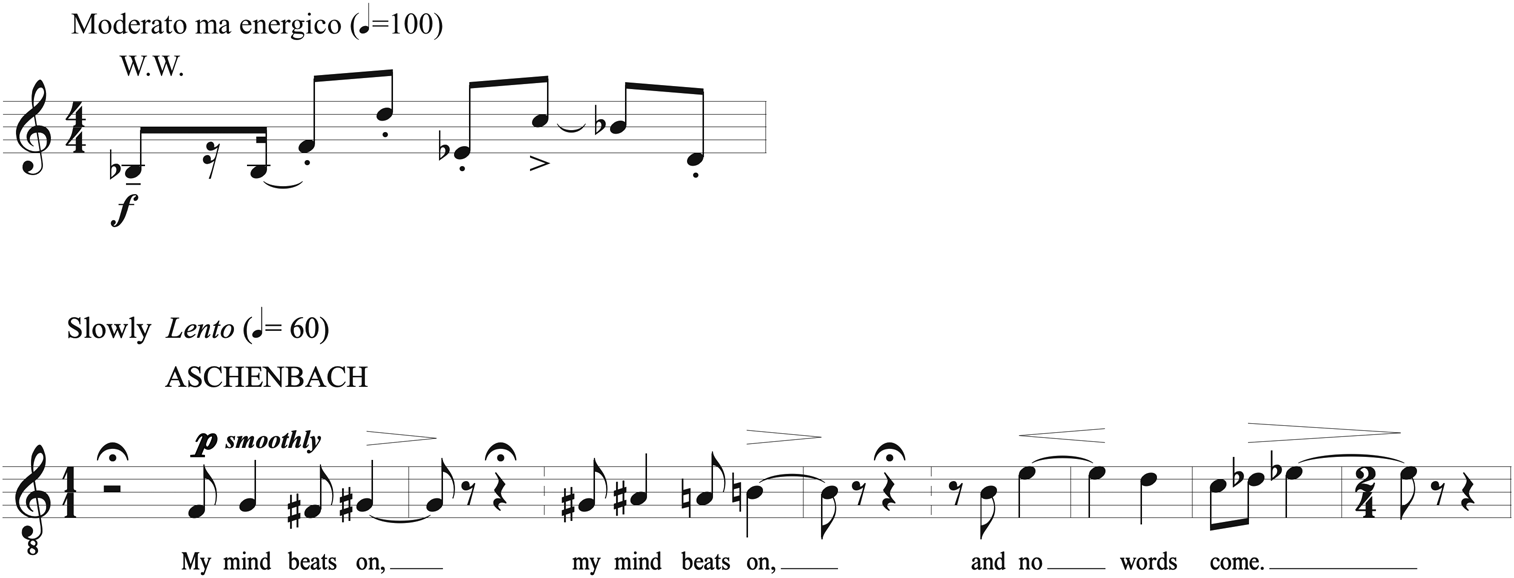
The considerable musical distance between Britten's first and last operas may immediately be perceived simply by comparing Grimes's opening triadic court summons with Aschenbach's initial twelve-tone theme (Examples 1a and 1b). Christopher Chowrimootoo has recently examined Britten's operas through the perspective of the critical reception of their ‘middlebrow modernism’, which treads a delicate line between a bourgeois need to partake of ‘highbrow’ culture and a simultaneous requirement for more ‘lowbrow’ pleasures on the other side of ‘the Great Divide’. For Chowrimootoo, the lowbrow sensationalist features of Death in Venice (in particular the voyeuristic appreciation of a young boy) are ‘sublimated’ within highbrow intellectual conceits.Footnote 29 Such conceits are clearly on display from the outset with this uncompromisingly modernist theme, so evocative of Aschenbach's dry and rarefied state of mind. Aschenbach's opening theme ‘draws attention to its own rigour’, as Philip Rupprecht puts it; a repeat of his initial words (‘my mind beats on’) brings forth a transposed repetition of the first tetrachord, in the best tradition of a row by Webern.Footnote 30
Openings of Peter Grimes and Death in Venice: a) Peter Grimes, opening; b) Death in Venice, opening vocal line.

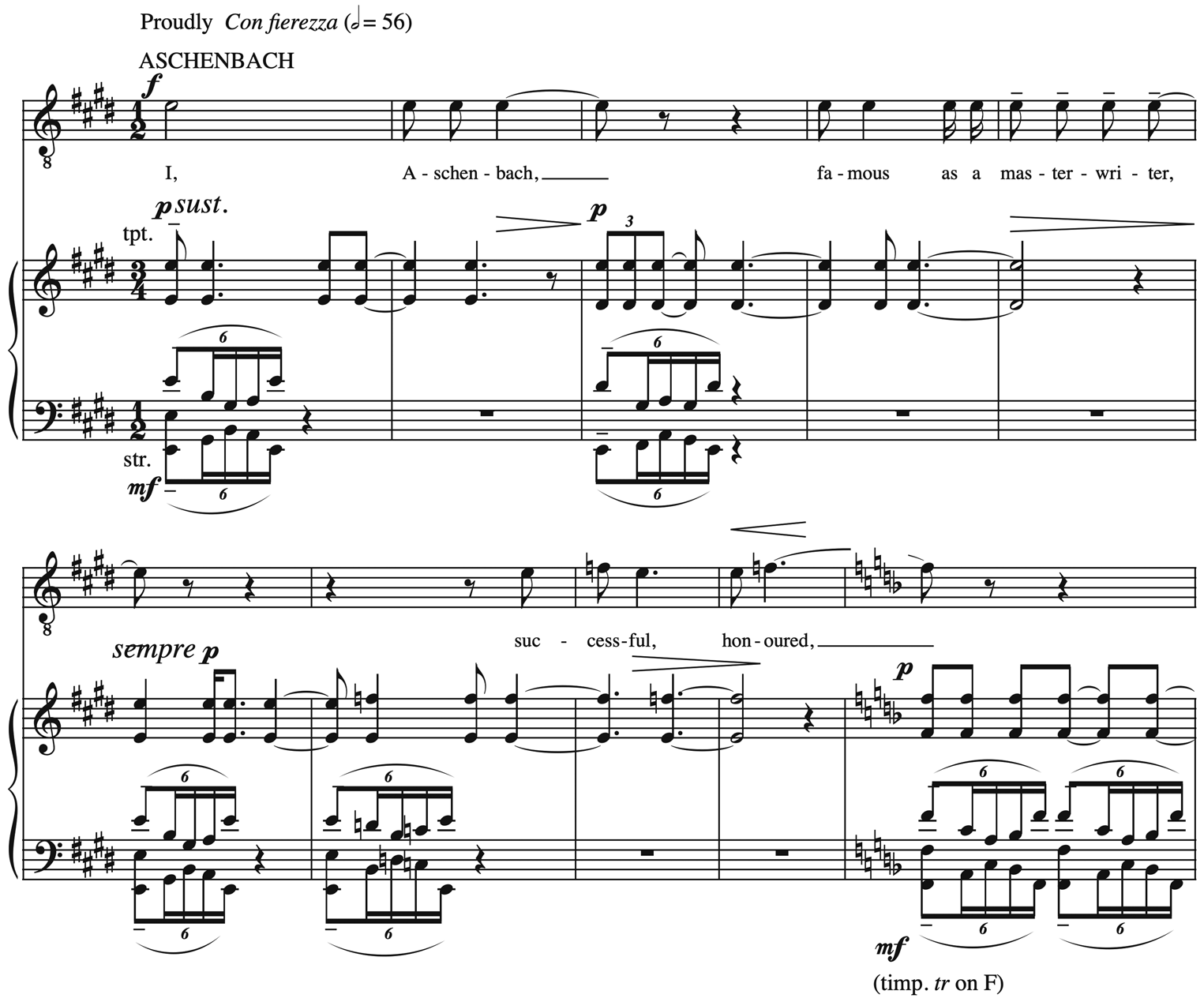
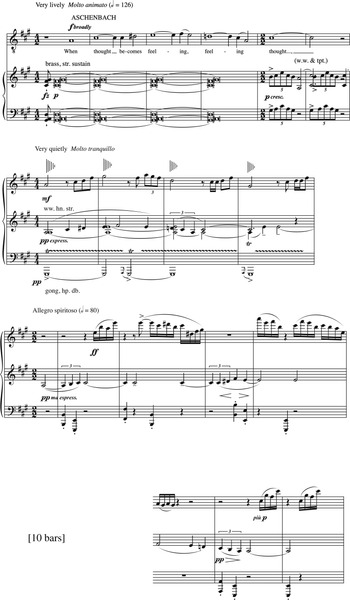
However, for J.P.E. Harper-Scott (who has had much to say about the extent of the influence of Japanese culture, and not simply music, on Death in Venice), this opening theme, along with its sparse heterophonic accompaniment, is in ‘Britten's typical post-Noh style’.Footnote 31 Nevertheless, within these opening notes, references to particular music abound; Rupprecht identifies the first real chord of the opera (at Aschenbach's last word, ‘come’) as a half-diminished seventh on F, similar in content (if not in precise voicing) to Wagner's famous Tristan chord, a powerful musical symbol for Aschenbach's longing if ever there was one.Footnote 32 Harper-Scott cites this identification as well, yet also points to the tonal allusion to E caused by the repetition of the note b1 followed by the upward-fourth leap to e2.Footnote 33 This prepares the first real instance of tonal music (and the first key signature) in the opera: Aschenbach's proclamation of himself as ‘famous as a master writer’. Comparison of this passage with an analogous one in Peter Grimes begins to suggest that in spite of the ostensibly very different styles of the two operas, meaningful musical correspondences nevertheless exist.
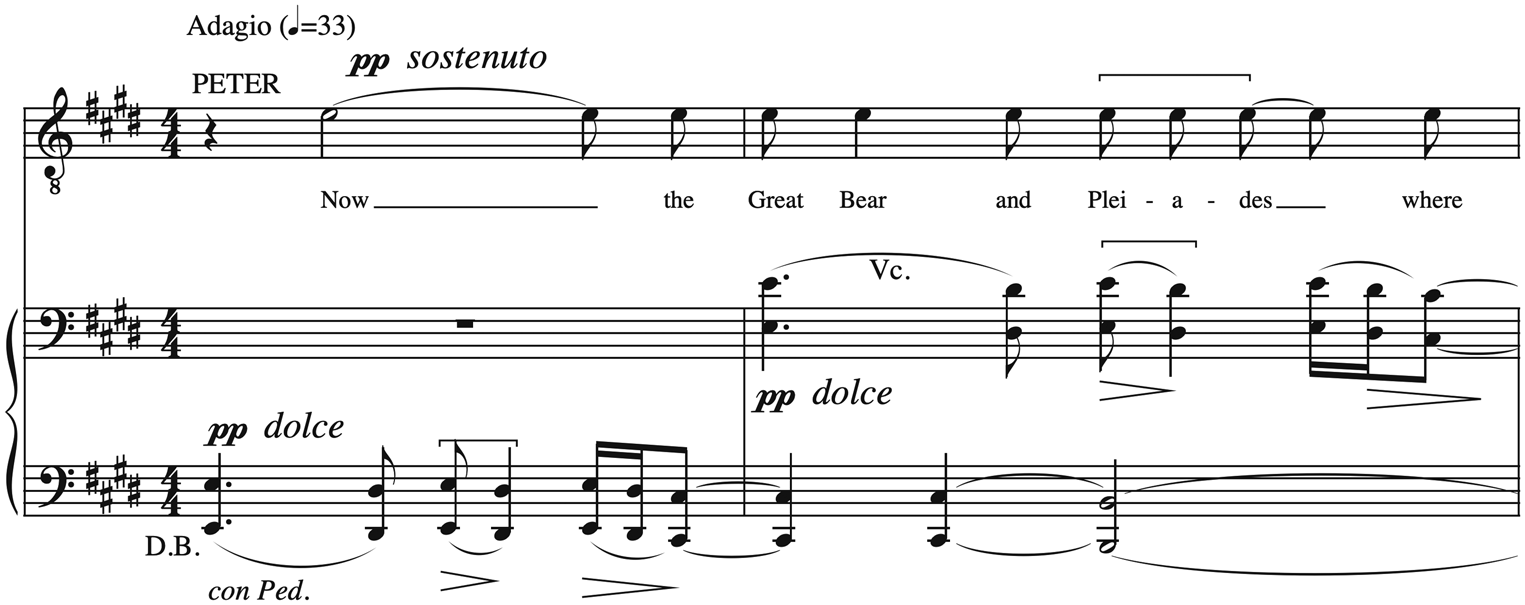
Governing these correspondences is the key of A that is central to both operas (both end in this key, and spend significant amounts of time in it elsewhere); Britten had already associated this key with the sun, and its divine manifestation, in his unpublished Young Apollo for piano and orchestra years earlier, and its extensive use in both Death in Venice (in which the god actually appears) and Peter Grimes (where the image of sunlight is sometimes as important as in the later opera) is a powerful means by which the two works palpably relate to one another. Almost as important is the fifth-related key of E, sometimes identified as Aschenbach's key in Death in Venice, but significant in Peter Grimes too. In the second scene of Act I, Grimes staggers into the pub during the storm, and immediately establishes his status as a visionary, fundamentally at odds with his prosaic community, with a hauntingly beautiful reflection on the passage of time, which seems to stand still as he recites on a monotone e2 seemingly forever, while the strings take it in turn to pull away gently downward in canonic fashion (Example 2). It is hard not to be reminded of this passage in the very early stages of Death in Venice. Once again, the protagonist recites on a monotone e2, and an octave is expanded to a ninth as a lower note moves downward to d1 sharp, but soft lyrical strings are now replaced by jagged brass and the d♯1 fails to move any further downward, instead being simply pulled back up again to e1 (Example 3).Footnote 34 Moreover, the entire passage is, according to Lloyd Whitesell, ‘compromised by internal disunity’ as each component of the texture operates on a different rhythmic and metrical plane; as Whitesell memorably puts it, ‘Aschenbach is having a problem with time’ in a manner characteristic of one fundamentally alienated from societal norms.Footnote 35 Heard in the context of Peter Grimes (and described by at least one author as ‘Grimes-like’), this comes across as music in which the lyrical fecundity of a younger artist has now become dry and perhaps even distanced in the hands of an older and more established one, and in which early style has fractured into late.Footnote 36
Peter Grimes, Act I scene 2, Rehearsal 76.

Death in Venice, scene 1, Rehearsal 3.

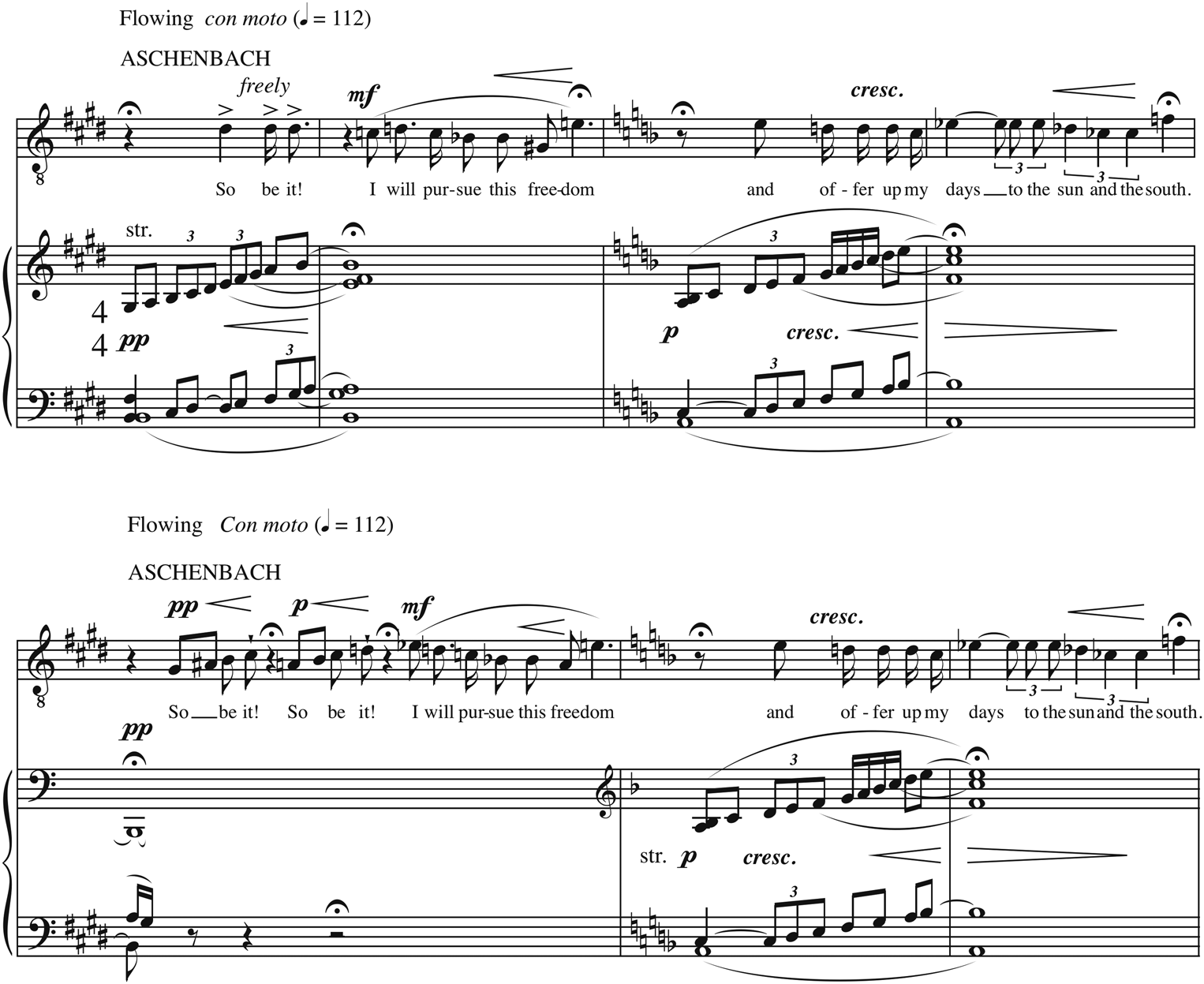
As can be seen by the end of this example, however, rhythmic disunity is matched by tonal ambivalence, as the first unsuccessful attempt to break away from the initial octave E through expansion to a ninth (the lower e1 descending to d♯1) is followed by a second attempt, this time by means of the upper e2 ascending a semitone to f2. Appropriately enough (given the word that this moment underlies), this second attempt could be said to be more ‘successful’ than the first; even though the interval again contracts back into an octave, this is now achieved through the similar semitonal ascent of the lower e1 to f1, resulting in a repeat of the opening music, but now in the key of F, as denoted by the new key signature. This is the first of a number of instances of conflict between these two key areas that comes to symbolise a fundamental tension within Aschenbach between the instincts towards self-discipline and submission to the senses. The next instance occurs shortly thereafter, at the end of the first scene, when Aschenbach takes the decision to travel to Venice. In both Britten's original version (preceded by the first piano-accompanied recitative) and the revised version (in which the recitative was deleted), the two keys are directly juxtaposed, as if to suggest ambivalence with regard to this decision (Examples 4a and 4b).
Death in Venice, alternative versions of scene 1 conclusion: a) Death in Venice, scene 1, Rehearsal 23, b. 24 (original version); b) Death in Venice, scene 1, Rehearsal 23 (revised version).

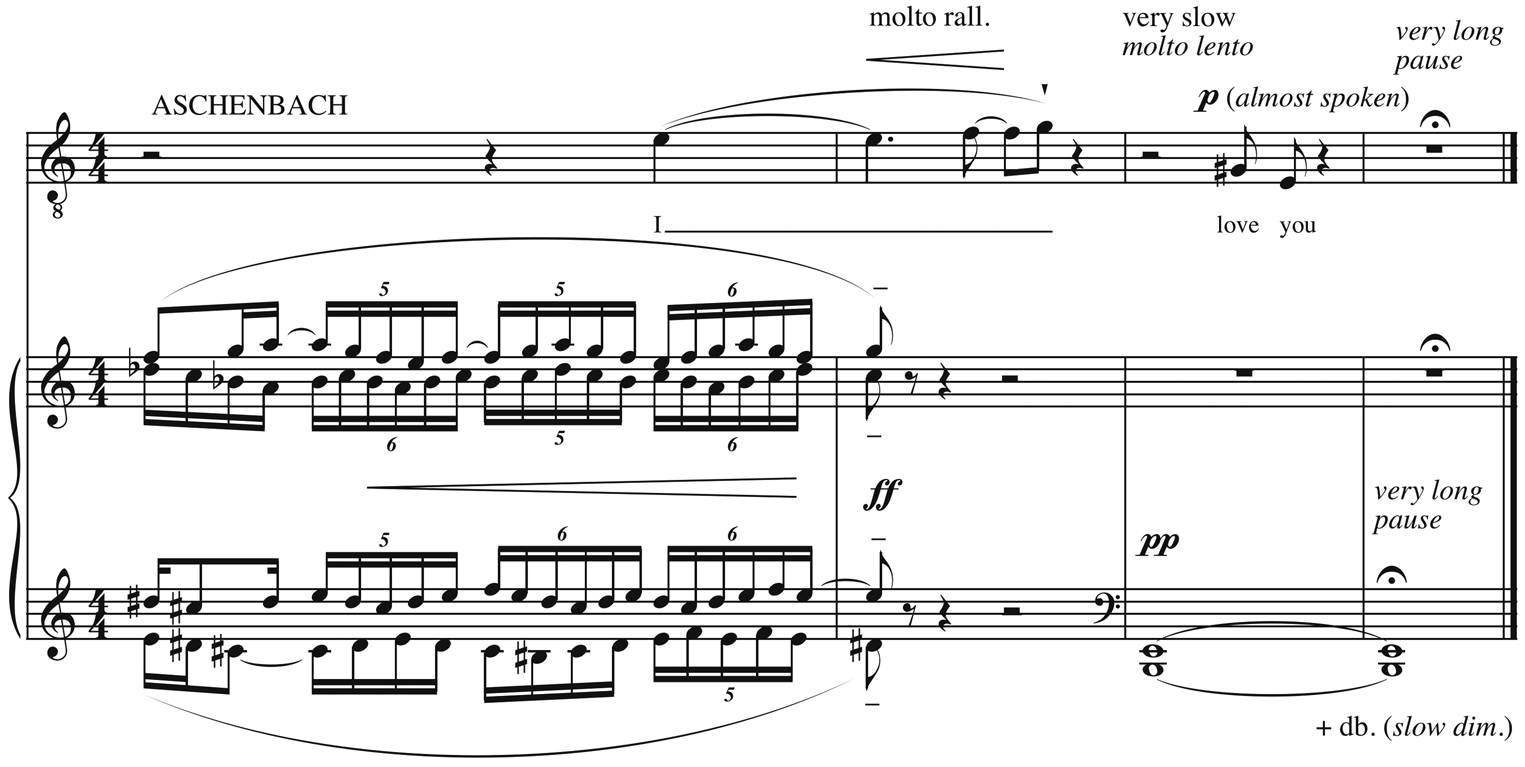
At the end of Act I, Aschenbach's even greater decision – his declaration of love for Tadzio – is inflected by the same sort of tension. As shown in the arrangement of the vocal score, the climactic orchestral buildup could basically be understood to exist both in F (upper stave) and E (lower stave) simultaneously (Example 5).Footnote 37 As for the protagonist's vocal line, it begins (‘I’) as if in F, yet concludes (‘love you’) in E, as if to suggest that he is still torn, even at this climactic point. The symbolism is perhaps most clear, however, in Aschenbach's dream sequence in scene 13, when the lure of Dionysus towards passion and pleasure (in E, set to the same ascending figure as the opening bar of Example 4a) is consistently set against the F major music of Apollo's injunctions towards purity and principle.
Death in Venice, scene 7, Rehearsal 188, b. 7.

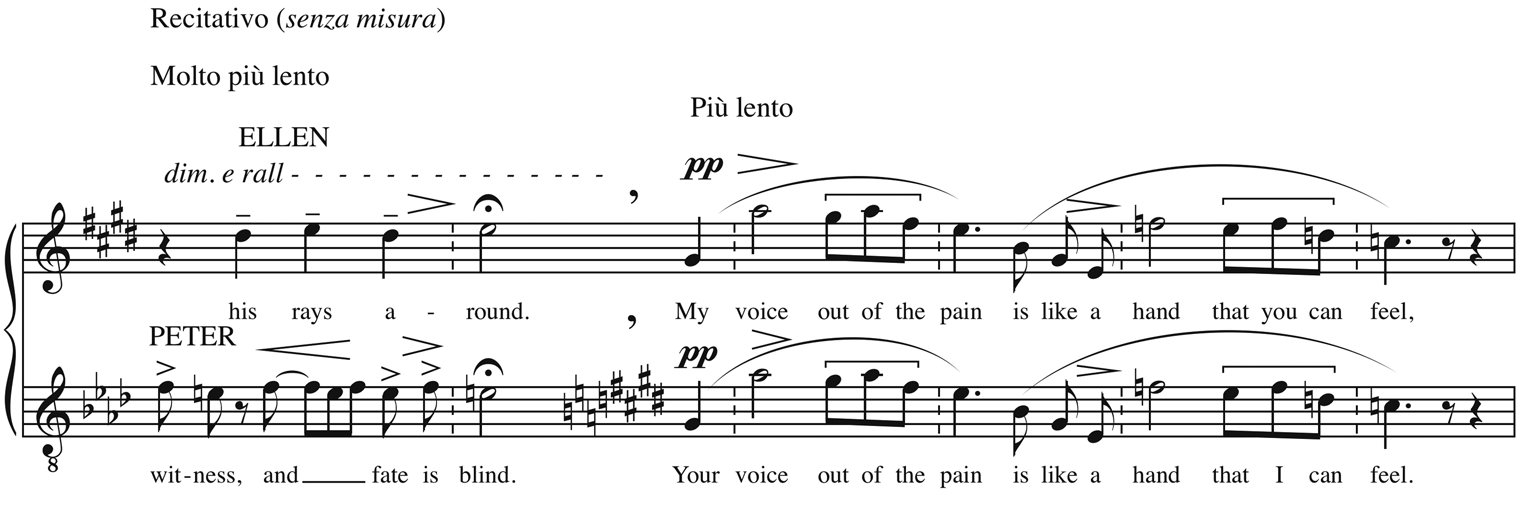
Significantly, perhaps, this E–F dichotomy has an important precedent in Peter Grimes, where it serves to underscore a similar conflict within the main protagonist, even if this conflict is in this case externalised through dialogue between him and Ellen Orford, the woman who tries to save him. At the end of the Prologue, Peter and Ellen sing simultaneously in different keys and with different words – in the key of E (major), Ellen attempts to reassure Peter about the future, while in the key of F (minor), Peter harbours his continual doubts and fears. Finally (in what, in retrospect, seems almost like an inversion of the process in Aschenbach's ‘famous as a master’ soliloquy), Ellen's d♯2/e2 alternation and Peter's e2/f2 alternation converge on the single note E, at which point the conflict is reconciled (for the time being, at least) in the key of E, even if the persistent F makes another appearance almost immediately (Example 6). Later, this conflict reappears in Act II when Ellen questions, in the key of E, Peter's ‘unrelenting work’ and Peter gives his reply (‘Buy us a home’) in the key of F. Such conflict also occurs when the carter Hobson's initial refusal to fetch the boy, in E, is met with Ellen's riposte, using the same music, but now in F. In the meantime, however, the duality at the end of the Prologue has given meaning to the famous orchestral interlude (‘Dawn’) which follows, for the grace-note f3 that inflects its opening e3 can now be understood as a small-scale expression of something already shown to be far deeper than a mere surface ornament (Example 7).
Peter Grimes, Prologue, Rehearsal 9, b. 16.

Peter Grimes Act I, first interlude, opening.

This first interlude effectively serves as the overture to the opera after an initial prologue, painting an unforgettable portrait of the harsh North Sea through the use of three distinctive ideas that sometimes coexist but never interact. The imagery is powerful and evocative, and has been interpreted many times, in similar yet varying ways. Certainly, the composer Colin Matthews, who worked closely with Britten on Death in Venice and later works, and who has about as much claim on insight into his intentions as any, had no need to draw upon any special knowledge when interpreting the above-mentioned surface ornament as suggestive of ‘the call of gulls’, the melody in general as ‘an open sky, early morning’, the clarinet cascade of thirds as ‘the gentle rise and fall of waves breaking on the shingle’ and the ominous brass chords, bass D♮ grating dissonantly against the D♯ of the implied V-of-V above it, as ‘the sea as elemental, a force of nature, perhaps’.Footnote 38 Matthews is careful to acknowledge the essential subjectivity of such observations, pointing out that without the given associations of the Suffolk coast (the subject, after all, of the opera) such music may as well be understood to evoke ‘Midday in Venice’. This seemingly random simile is fortuitous, however, for within the same paragraph he makes a considerably less disputable observation – that such imagery is actually rather rare in Britten's music, one notable exception being Death in Venice, in particular the ‘barcarolle-like music that evokes the rowing of the gondolier’.Footnote 39
In fact, the specific imagery of Death in Venice sometimes comes quite close to that of the ‘dawn’ interlude; the cascade of thirds (admittedly something of a Britten idiom) serves a very similar purpose (albeit at a significantly reduced tempo) in evoking the sunlit sea, first as the hotel manager shows Aschenbach the view from his room (described by several authors as ‘Grimes-like thirds’), and later as the chorus announces the beginning of the Games of Apollo near the end of Act I (Examples 8a and 8b).Footnote 40
Chains of thirds in Death in Venice, scenes 4 and 7: a) Death in Venice, scene 4, Rehearsal 59: b) Death in Venice, scene 7, Rehearsal 141.

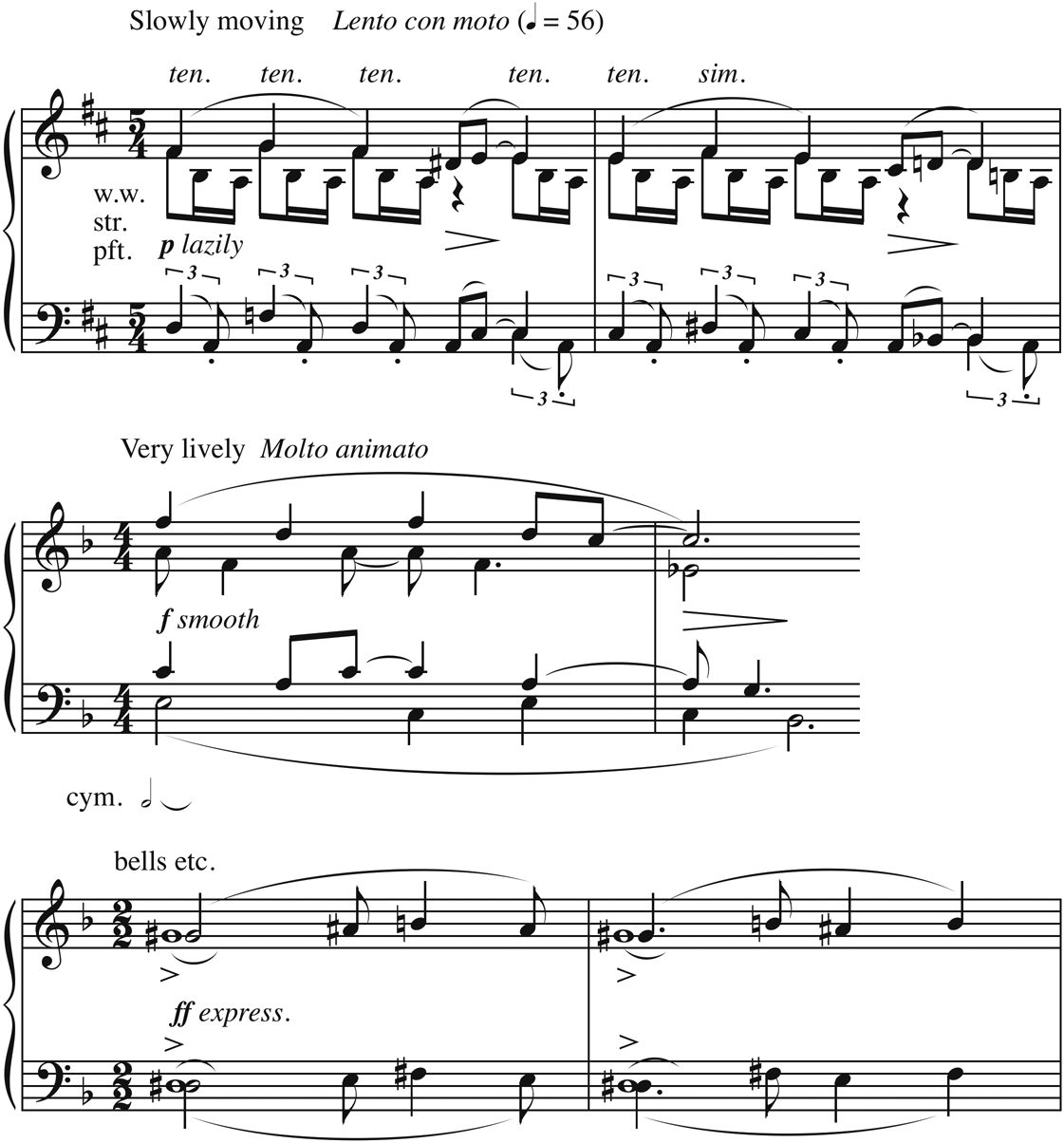
Yet the really meaningful connection derives not so much from musical content as from a shared formal procedure whereby an opening scene (or scenes) is made to function as a preliminary event, thanks to an extensive ensuing orchestral passage that serves to paint a particularly evocative picture of the central location and atmosphere of the drama, and thus functions as a prelude to the main part of the opera. In Death in Venice, after two introductory scenes (the Munich cemetery and the boat voyage) analogous in their way to the Grimes Prologue, Venice itself is revealed in an extended orchestral interlude which serves much the same function as the ‘dawn’ interlude, but which this time is explicitly labelled as an ‘overture’. Again, three distinct elements strongly evoke yet remain static, this time neither interacting nor coexisting (Examples 9a, 9b and 9c): the barcarolle-like gondola ride recognised by Colin Matthews, and then the polyphonic singing (or Gabrieli-inspired brass) within St Mark's and the cathedral bells themselves (both harbingers of the later importance of this place, as Aschenbach eventually pursues Tadzio and his family there).
Death in Venice, Act I, Overture: a) Rehearsal 41; b) Rehearsal 43; c) Rehearsal 43, b. 5.

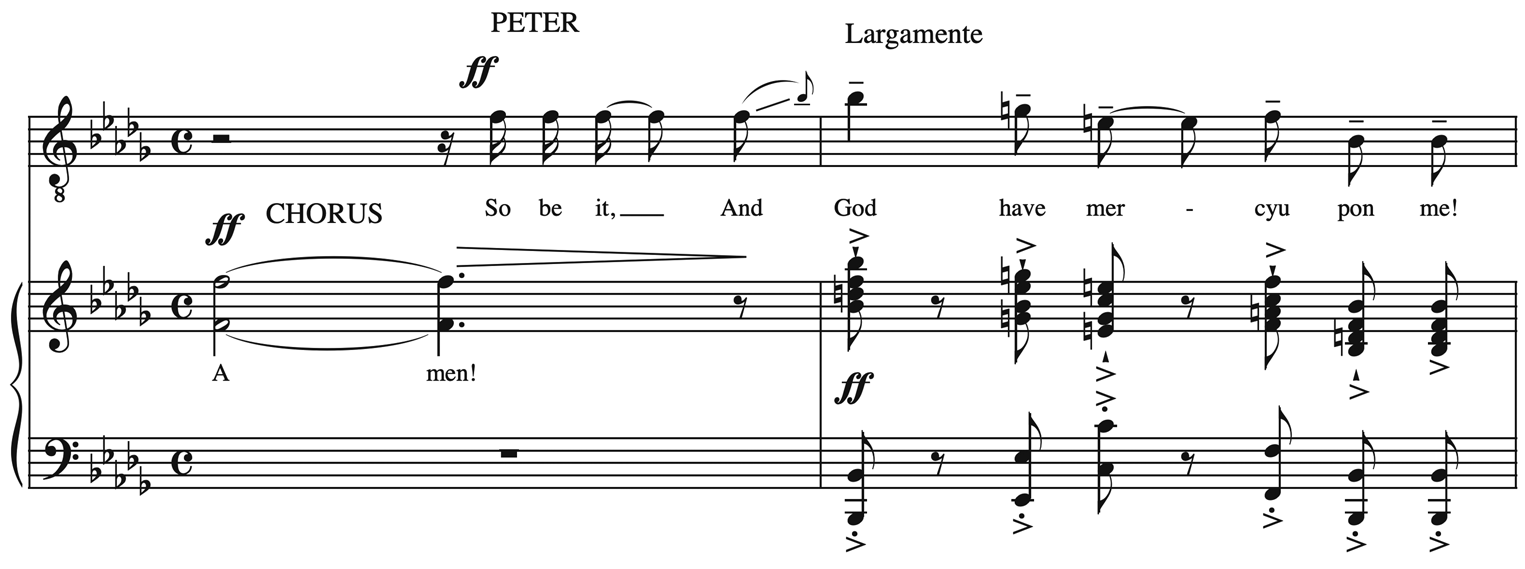
Nevertheless, the overall structures of Peter Grimes and Death in Venice are very different. In the former, extensive orchestral interludes clearly separate the Prologue and the six scenes (two in each of the three acts), serving the practical purpose of allowing the curtain to fall and the scenery to be changed. In the latter, much shorter scenes flow smoothly one into another, in a quasi-cinematic effect reminiscent of an earlier Britten/Piper collaboration, The Turn of the Screw, and in which the seventh of the seventeen scenes is even bisected by the (single) intermission. However, a number of authors have observed that a similar overall architecture is achieved by the way in which both protagonists experience a powerful moment of epiphany approximately halfway through the opera – Grimes's ‘So be it! And God have mercy upon me!’ (Example 10) occurs about halfway through the second of the three acts, and Aschenbach's ‘I love you!’ (Example 5) concludes the first of two acts.Footnote 41 Both of these dramatic moments are followed by an extended instrumental reflection upon it, in both cases delayed – in Peter Grimes, the chorus ‘Grimes is at his exercise’ precedes the instrumental Passacaglia interlude based upon the melodic motive of his outburst, and in Death in Venice the Mahlerian instrumental reflection on Aschenbach's pronouncement is separated from it by the opera's intermission.Footnote 42
Peter Grimes, Act II scene 1, Rehearsal 17, b. 3.

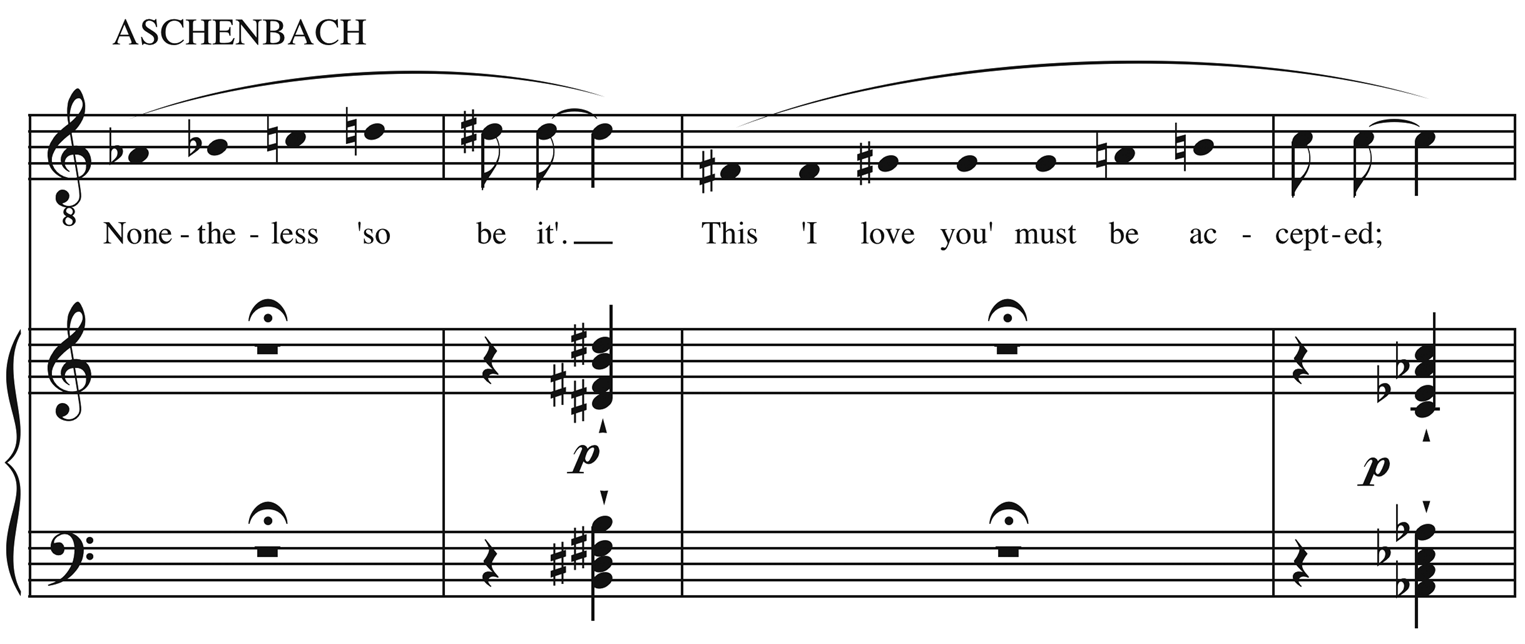
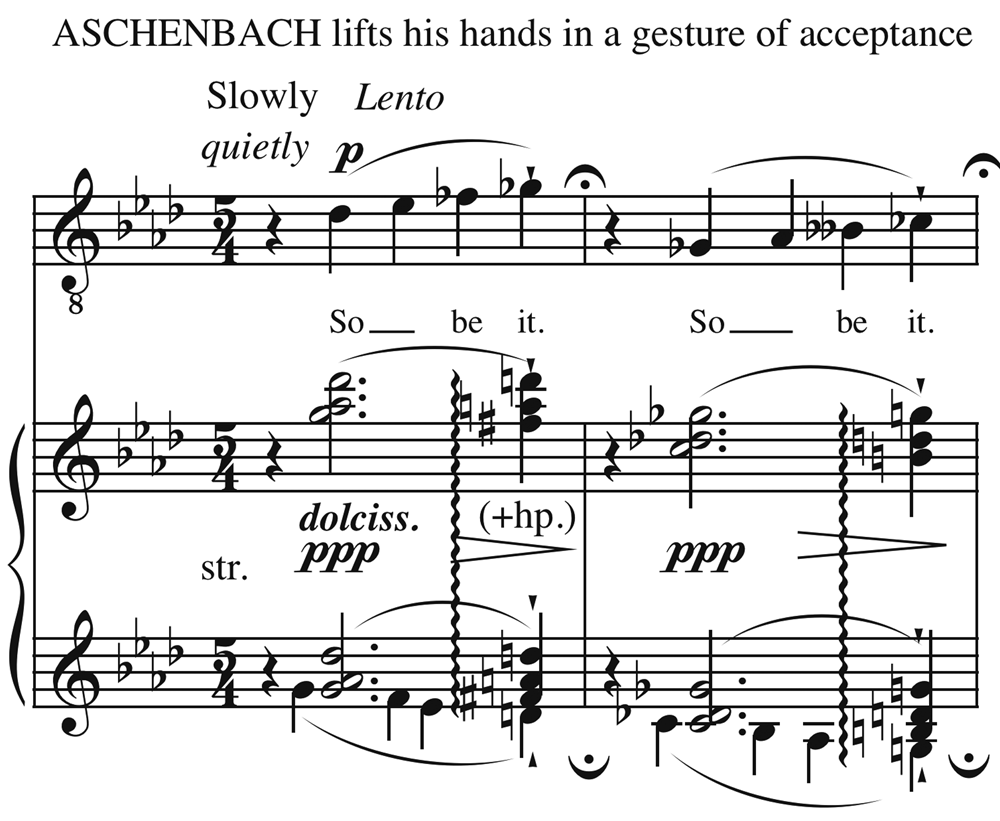
A no less important connection between the two operas, however, lies in those very words proclaimed by Grimes: ‘So be it!’, for Aschenbach utters them too, not long after his powerful confession, in the recitative that follows the orchestral reflection beginning Act II. The simple triads of the piano accompaniment, very rare for these recitatives, are perhaps distantly reminiscent of those that accompany Grimes's use of these words (Example 10). As can be seen in Example 11, Aschenbach quotes his words ‘I love you’ from the end of the previous act, but he also quotes the words ‘So be it’, in recognition of the fact that they have already occurred at no less than two previous moments of important decision-making: the decision to go to Venice in the first place (see Britten's two versions in Example 4), and the later decision to stay in Venice despite an initial attempt to leave (Example 12). As can be seen, the musical setting of the words is fundamentally different from the more declamatory style shown both in Britten's original version of the conclusion of the scene 1 recitative (Example 4a) and in that of scene 7 (Example 11). Instead, it is clearly more closely allied, in its smooth linear ascent and transposed repetition, to Britten's revision of the scene 1 conclusion (Example 4b). However, this element of transposed repetition (in each case ending with a pure triad) is echoed later in the scene 7 recitative (Example 11), which thus makes oblique reference, in its declamatory treatment of the words ‘so be it’ and its triadic conclusion of a twofold statement, to both of the two radically different approaches to these words. As a result, the decision as to which option to take at the end of scene 1 has important implications for the nature of the correspondences between Aschenbach's initial moment of decision (to go to Venice in the first place) and later ones in the opera (to return to Venice, and to accept his love for Tadzio). Clearly, Britten had thought carefully about the complicated network of relationships between the multiple instances of these words, for they are important and powerful ones, punctuating key moments of the drama.
Death in Venice, scene 7, Rehearsal 193, b. 5.

Death in Venice, scene 6, Rehearsal 137, b. 11.

This complicated network creates ambivalence and perhaps even dissociation relative to the clear and decisive single appearance of the words ‘so be it’ in Peter Grimes. Youthful certainty has been replaced by the doubts of age, late style fashioned from the destabilisation of elements from the past. The comparison is meaningful, for these are the only two of Britten's operas in which these words occur, the nearest equivalent being Claggart's pivotal ‘So may it be’ in Billy Budd (appropriately, the second of Powell's so-called ‘triptych’ of sea operas), uttered at the moment when he resolves to destroy Billy. This is perhaps no coincidence, for Piper, as well as Britten, may have had the catastrophic moment of Peter Grimes in mind. Ellen's words to Peter immediately prior to his outburst (‘We've failed’) are reprised as Quint's final words to Miles at the end of her first libretto for Britten, The Turn of the Screw. In the absence of any documented admission by Piper, it may nevertheless be reasonable, on the basis of these similarities, to speculate that this climactic juncture in Peter Grimes made something of an impression on her.
It is in their respective conclusions, however, that Britten's first and last operas show their most powerful affinity. In both cases, the main protagonist dies by going to sea – Grimes is persuaded to take his boat out and then sink it, while Aschenbach is beckoned (or imagines himself to be beckoned, as in Mann's novella) by Tadzio, and the effort in obeying this summons causes the already gravely ill man to collapse back into his beach chair, dead. Each of these events is preceded by a scene illustrating the protagonist's process of mental disintegration. In Grimes's mad scene, he quotes extensively words and music from earlier in the opera, as does Aschenbach in the final stages of his illness, having received his futile makeover at the hairdressers and having partaken of ‘soft, musty, over-ripe’ strawberries, surely a metaphor for his sad decline as well as a possible cause of his infection. Tellingly, both characters quote inaccurately, an indication, perhaps, of their mental instability. Grimes, in recalling the lawyer Swallow's verdict of ‘accidental circumstances’, quotes not the music originally associated with these words, but instead the opening figure of the scene and opera (Example 1a). Aschenbach, in repeating his initial proclamation of himself as ‘famous as a master writer’, can now only manage the words ‘famous as a master’, this last word slightly delayed as if the result of a slight memory lapse. In both cases, this act of misremembering is accentuated by its proximity to accurate musical reminiscences. One example in Grimes's mad scene is the conclusion of the ‘Great Bear and Pleiades’ aria – ‘who can turn back skies and begin again?’ – while Aschenbach has just finished a musically exact quotation of a line uttered earlier in the opera, ‘what if all were dead, and we two left alive?’
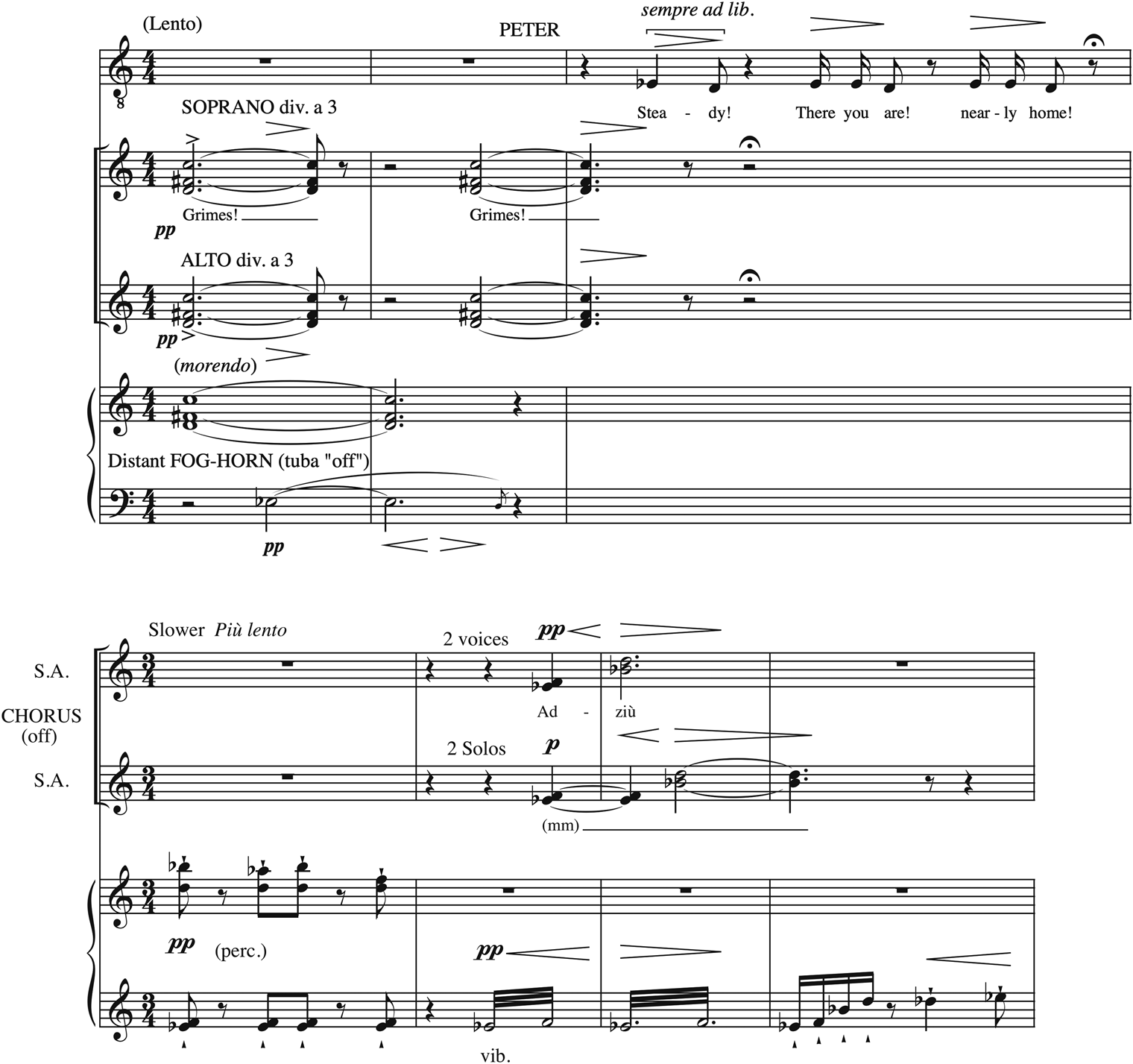
One further feature that contributes to the sense of hallucination or unreality for both characters is the presence of the offstage chorus calling a name. In Peter Grimes, this originates when the crowd, embarking on a manhunt, yells his name at the conclusion of the previous scene, and it persists during Grimes's delirium that follows, sometimes soft, as if heard from afar, and sometimes louder. In Death in Venice, ‘Adziù’ – the sound of Tadzio's friends calling him – occurs as early as scene 5, the first beach scene, and is the means by which Aschenbach first learns the boy's name. The calls resume in the final scene, once again on the beach (Examples 13a and 13b).
Offstage chorus calls in Peter Grimes and Death in Venice: a) Peter Grimes, Act III scene 2, Rehearsal 47; b) Death in Venice, scene 17, Rehearsal 324.

For Grimes, these cries are those of his persecutors, for Tadzio, those of his friends, but in both cases they come to seem more like siren-song, luring their respective protagonists to sea. Sure enough, both follow the call – Grimes instructed through the devastating breakdown of the opera's language in its only instance of speech, Tadzio walking out to sea and beckoning Aschenbach, similarly devastated through witnessing his idol being defeated in a fight. This act of beckoning brings to mind the writer's lines following his poignant reconstruction of Plato's dialogue between Socrates and Phaedrus on beauty in the previous scene:
During the course of the preceding dialogue, Aschenbach, in quoting Socrates, may naturally be understood to associate himself with the older teacher, while identifying Tadzio with Phaedrus, the younger pupil (earlier in the opera, he asks Tadzio – at least in his own mind – ‘do you look to me for guidance?’). At the end of the opera, however, as Tadzio leads Aschenbach out to sea, and to death, it becomes clear that in fact the roles have been reversed, such that it is Phaedrus who instead goes first. Moreover, the beautiful Polish boy, the effortless winner of games and the youngest sibling overshadowing his sisters, is strangely reminiscent of Britten as a child. One recent author has remarked on the close similarity between Mann's description of Tadzio and a photograph of Britten as a child, suggesting that the composer may have seen his younger self in Mann's creation, such that the closing scene could well be interpreted as ‘the old Britten bidding farewell to the young Britten’.Footnote 43 Indeed, Tadzio's beckoning could well be understood to suggest that it is he, as Britten's younger incarnation, who has really been the teacher all along, instructing his older self in some fundamental artistic truths.Footnote 44 He goes, and Aschenbach stays until his eyes no longer see him, then he goes too.
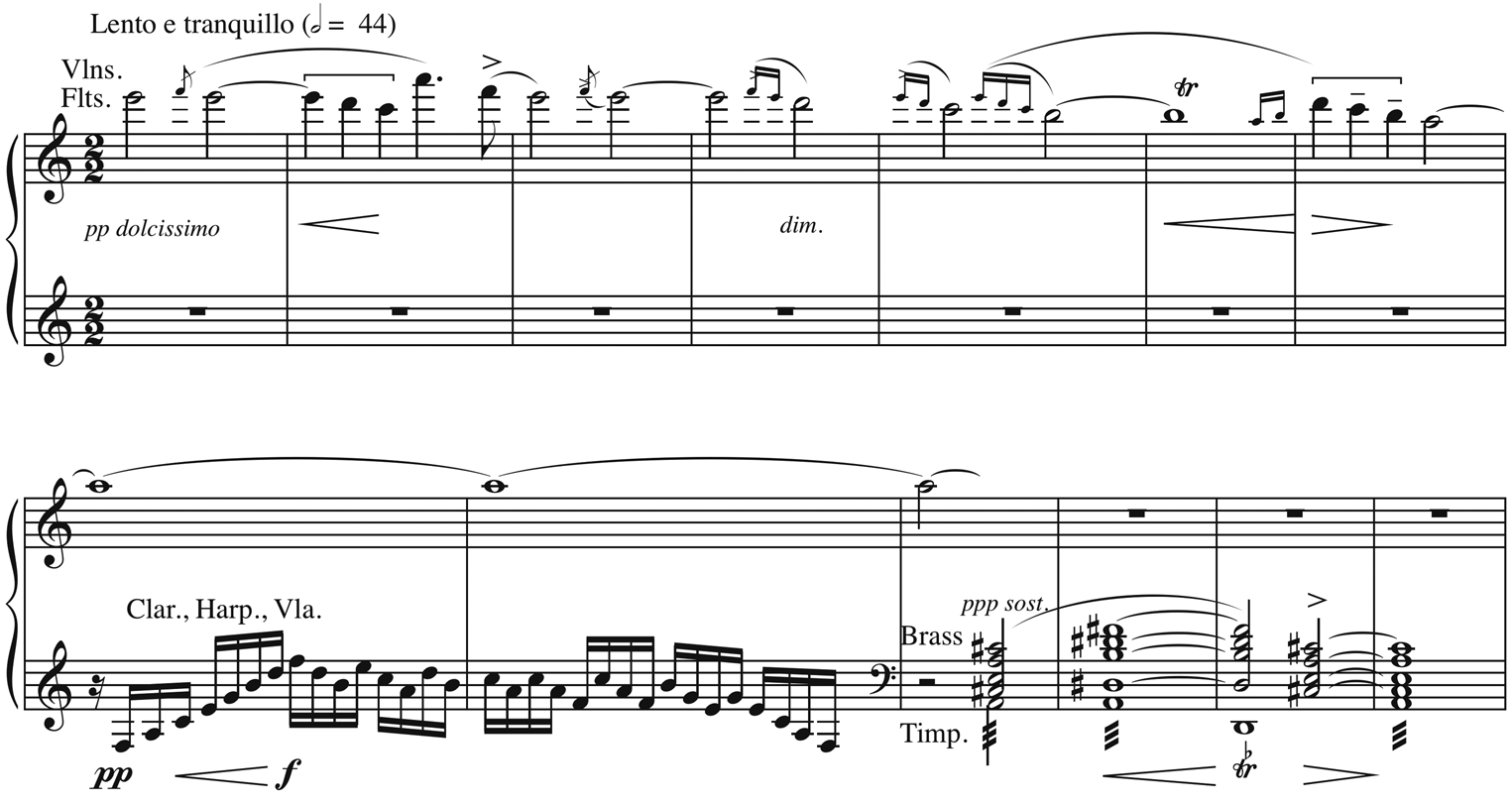
As both Grimes and Aschenbach go to sea, the music in both cases reverts to a recognisable and familiar manifestation from earlier in the opera, as if to stress the fundamentally cyclical nature of time in which an end is also a new beginning. In Peter Grimes, we hear the evocative music of the first interlude and the subsequent choral song that overlays it, sung by the Borough residents at the dawn of a new day, much the same as the one before. In Death in Venice, we hear Aschenbach's rapt hymn to Apollo that followed the beach games at the end of Act I (Example 14a), now in purely instrumental form (Example 14b). Both are in the key of A, yet there is perhaps more than simply shared key and self-reference at play here. This final page of Death in Venice is indeed, on the face of it, an allusion to Aschenbach's earlier effusions, yet both versions of this theme, with its Lydian melodic quality soon cancelled by the naturalisation of the fourth scale degree at its end, bear a distinct similarity to another A major evocation of sunlight-on-sea, the rather more extensive ‘glitter of waves’ theme at the start of Act II of Peter Grimes (Ellen Orford soon sings these words to this theme) (Example 14c). The relationship of the theme, as it appears at the conclusion of Death in Venice, to the Grimes theme is especially close, due to its newly adopted triplet rhythms and the counterpoint above it. If the ‘glitter of waves’ theme, with its melodic coexistence of raised and natural scale degree four (D♯ and D♮), could be understood to represent a sort of composing out of the harmonic coexistence of these notes in the very evocative second chord of the first interlude (Example 7), then this common feature might be interpreted as integral to the sense of beginning in Peter Grimes (dawn in Act I, Sunday morning in Act II). Thematic allusion to this feature in Aschenbach's hymn to Apollo seems therefore appropriate, given the powerful sense of a new start that he experiences (albeit mistakenly) at this moment. When it recurs in the final postlude, as he dies, his end becomes inextricably associated with this crucial moment of beginning, itself perhaps derived from no less crucial moments in Grimes.
Thematic similarities between the Hymn to Apollo (Death in Venice) and ‘Glitter of Waves’ (Peter Grimes): a) Death in Venice, scene 7, Rehearsal 178; b) Death in Venice, scene 17, Rehearsal 235, b. 2; c) Peter Grimes, Act II, third interlude, Rehearsal 2.

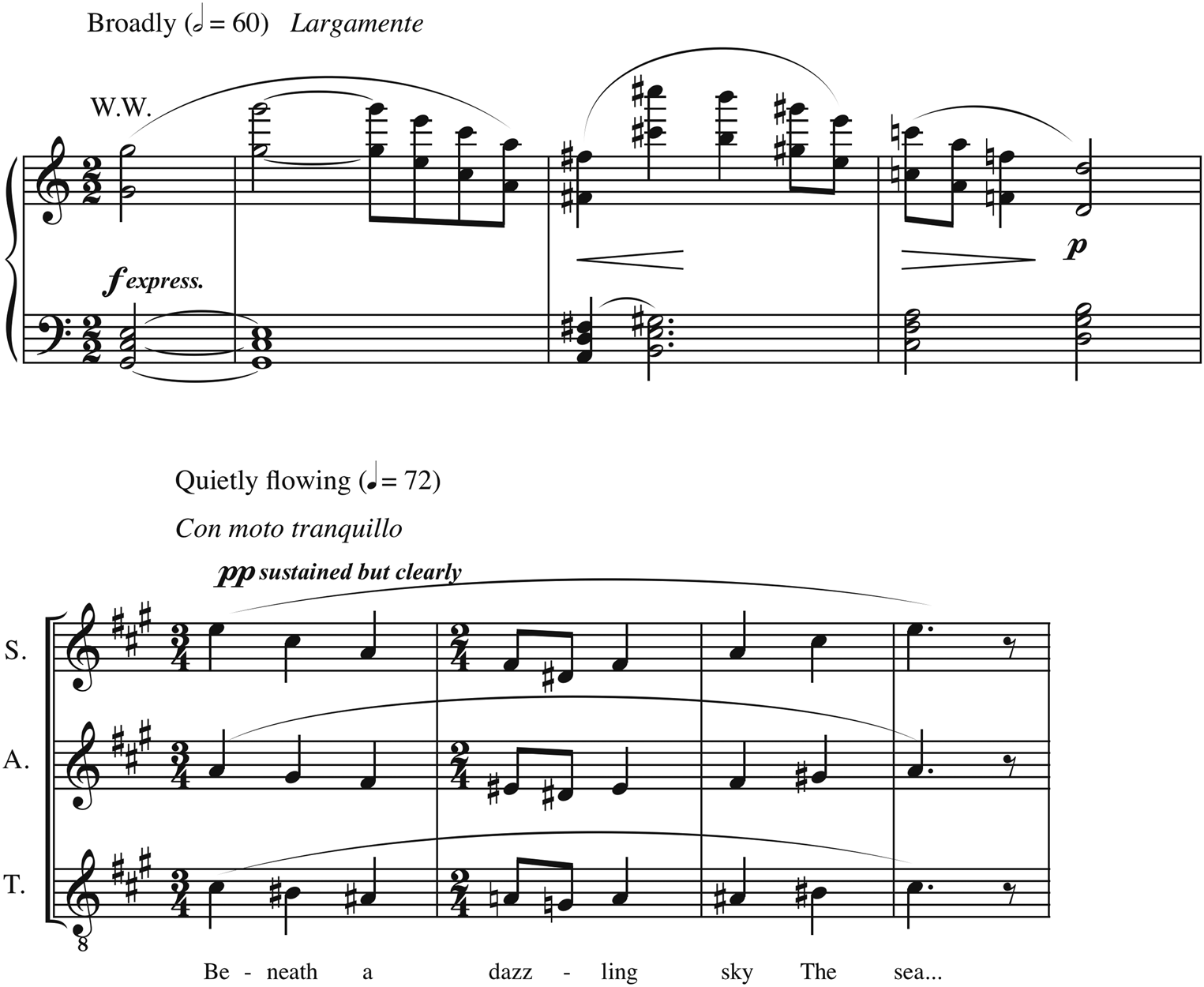
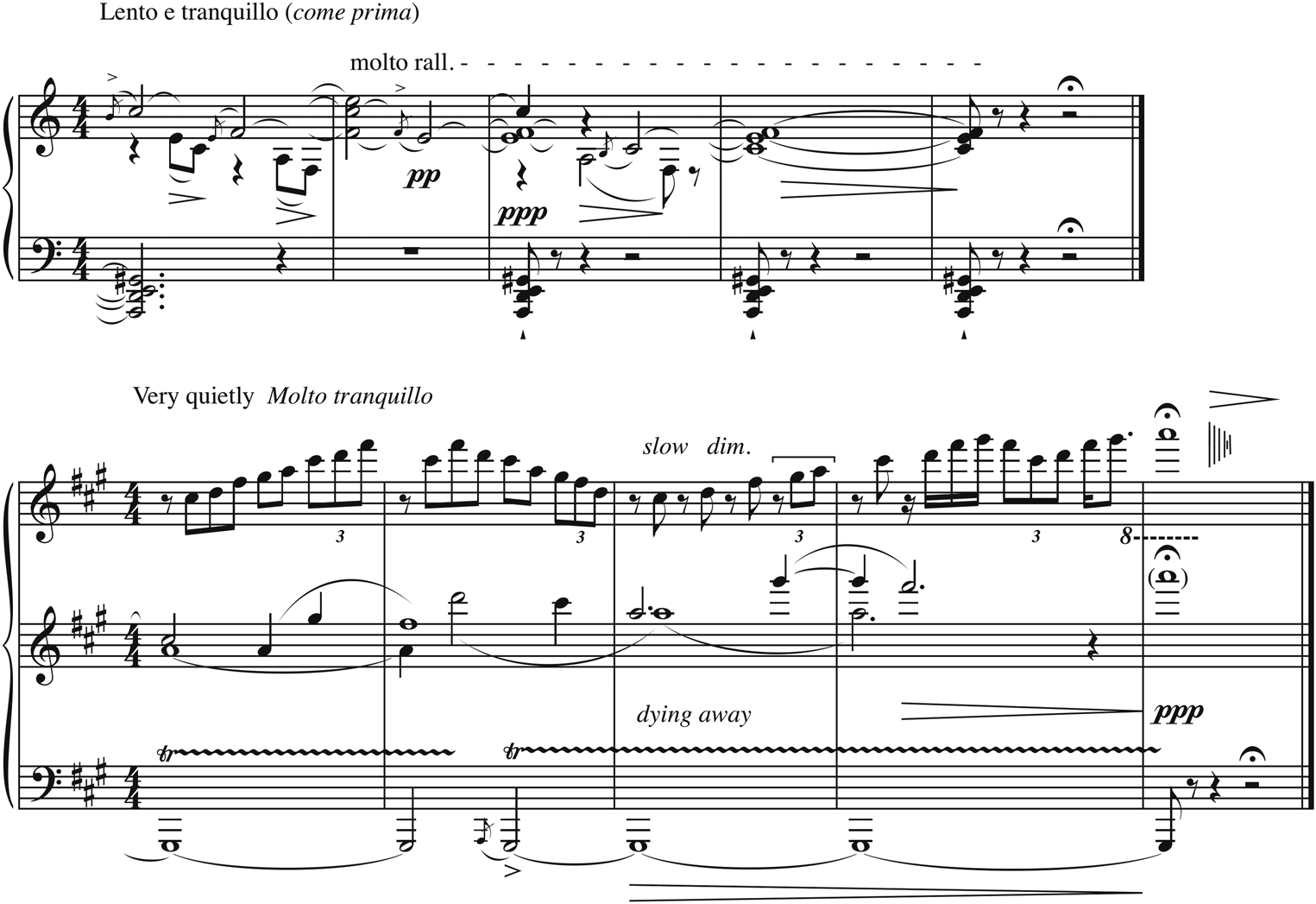
When the end finally comes, however, it takes place in a significantly similar way in each case (Examples 15a and 15b). Both dissolve to an extreme of register, in an image of death itself – Peter Grimes to the depths, Death in Venice to the heights. The extremes, however, are considerably greater in the later work – the G♯ that dissonantly decorates the tonic pedal at the end of the earlier opera now becomes the bass, displaced to a register so low as to be practically inaudible, or at least to render the pitch almost indiscernible. The high a3, too, is at such a registral extreme that its pitch identity also runs the risk of being compromised. Britten, at the very end of his final opera, adopts elements from the corresponding conclusion to his first, yet radicalises them in one final gesture of lateness. In choosing to walk far out to sea (a formulation, incidentally, present only in Piper's libretto, not in Mann's novella), Tadzio has something important in common with Grimes, even if apparently only in this one respect. Yet if the character of the outsider Peter Grimes to some extent reflects Britten the young man on the cusp of fame, the conscientious objector (and homosexual) who was ‘out of it’ in 1945, then perhaps Tadzio, the young, beautiful and impossibly talented boy doted upon by his mother and overshadowing his siblings, reflects a still younger version of his former self. If the character Aschenbach is to some extent a reflection of the older and more established Britten, then his pursuit of Tadzio can perhaps be understood as this older composer in pursuit of his younger incarnation, who ultimately leads him to his end. Certainly, the numerous correspondences between the two operas invite us to consider the degree to which Britten, in Death in Venice, is comparing his older and younger selves, examining the end of his career in relation to its beginning, evaluating the differences in the context of the similarities, considering the end of the journey from the perspective of its beginning. ‘Who can turn back skies and begin again?’ sings Peter Grimes at the end of his ‘Great Bear and Pleiades’ aria, yet somehow Britten, in Death in Venice, is at least attempting to do just that.
Respective conclusions of Peter Grimes and Death in Venice: a) Peter Grimes, Act III scene 2, Rehearsal 5, b. 11; b) Death in Venice, scene 17, Rehearsal 325, b. 16.

Both operas received something of an instrumental epilogue in the form of a string quartet, which Britten's friend Hans Keller viewed as a Mozartian trait, the ‘instrumental purification of opera’, as he put it.Footnote 45 The Second Quartet, first performed later in 1945 as part of a series of concerts commemorating Henry Purcell, concludes with a Purcellian chacony (the anglicisation of ‘chaconne’) whose final insistent and powerful twenty-three C major chords brings ‘Grimes at his exercise’ to mind for one author.Footnote 46 For another, the first movement's development section is reminiscent of ‘Now the Great Bear and Pleiades’.Footnote 47 These, though, are subjective observations prompted at least partly by the unassailable fact of the temporal proximity of opera and quartet. The Third Quartet, suggested by Keller himself and ultimately dedicated to him, was written in 1975, somewhat further after its preceding opera and just about the last work Britten wrote, yet its references are certainly more intentional on the composer's part. In particular, the last movement, written in Venice and subtitled ‘La Serenissima’, begins with a series of brief thematic reminiscences of Death in Venice, and proceeds as a passacaglia in Aschenbach's key of E. Passacaglia and chaconne are essentially interchangeable forms, based on a repeating pattern, and it is appropriate that such a procedure concludes both quartets, because it has a central role to play in both operas, as an emblem of fixation and pursuit. In Peter Grimes, the passacaglia built out of Grimes's ‘God have mercy upon me’ connects the two scenes of Act II, as the villagers make their way to his hut. In Death in Venice, another passacaglia emerges as Aschenbach pursues Tadzio through Venice.
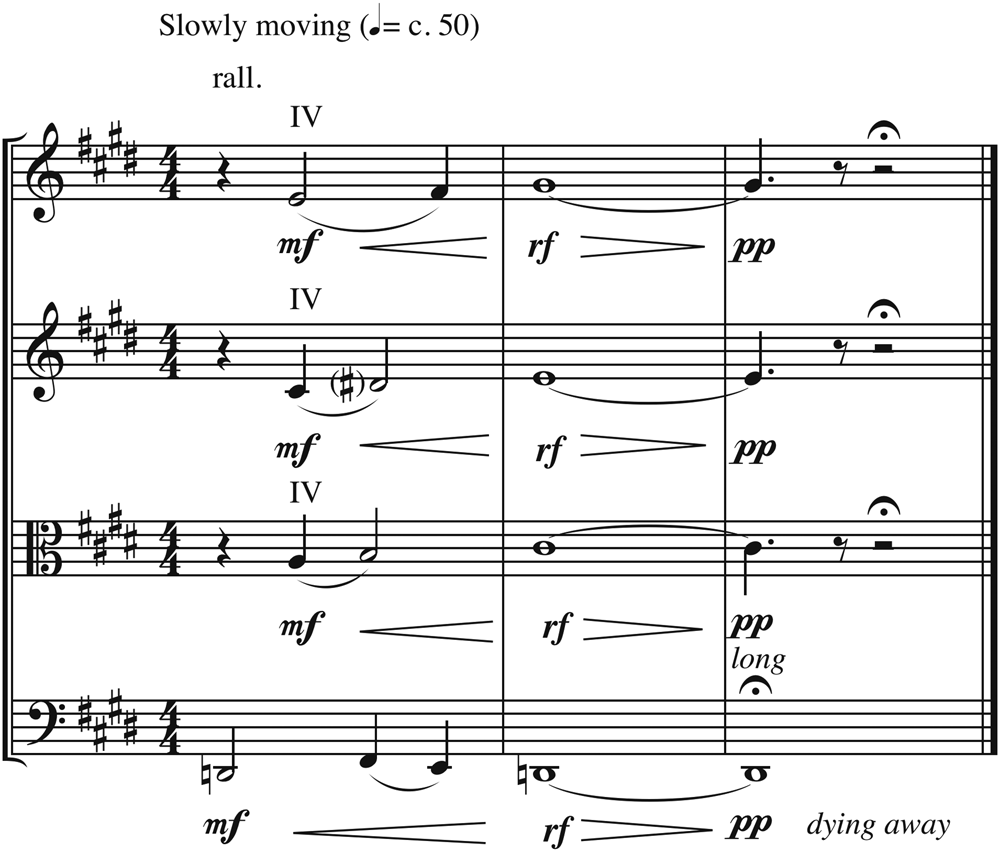
Perhaps, however, it is the conclusion of the Third Quartet that resonates most strongly with the spirit of its operatic precursor – a near-ending in the tonic E is avoided in favour of an ambiguous submediant C♯ minor chord with a gently dissonant D♮1 beneath (Example 16). For Michael Kennedy, whose book about Britten was one of the first to appear after his death, this haunting movement clearly reflects the composer's feelings about his impending demise, and ‘this last chord suggests no end, for who can say if death is end or beginning?’, having earlier observed that ‘this string quartet, like the end of Death in Venice, suggests a new beginning’.Footnote 48
String Quartet no. 3, V (Passacaglia ‘La Serenissima’), b. 126.

Such thoughts seem, intentionally or otherwise, to echo the words of the poet T.S. Eliot, who, at about the same time as Britten's composition of Peter Grimes, was writing his own Four Quartets, which in their title as well as their form and content seem to aspire to a condition of music (to paraphrase Walter Pater).Footnote 49 The second of these, ‘East Coker’, concludes with the words ‘In my end is my beginning’, which follow sea-imagery (‘The wave cry, the wind cry, the vast waters / Of the petrel and the porpoise’) that helps to convey the sense of eternity and timelessness evoked by the metaphysical final statement, and also seems highly appropriate in relation to Britten's marine-infused first and last operas. The memorable line was originally embroidered in French centuries earlier by Mary, Queen of Scots, shortly before her death, presumably as an expression of her belief that in the ‘end’ of her mortal life lay the ‘beginning’ of her immortal one. This, as Kennedy suggests, might also be an apt description of Britten's final opera, and the way in which it marked the ‘end’ of his dual career as composer and performer, and simultaneously the ‘beginning’ of his brief final post-surgery life as composer alone, no longer able to perform. Yet in Eliot's formulation, the phrase also represents a rumination on the fundamental circularity of time, wherein the end of one's life is in a sense a return to its beginning, and this might also be a useful way to understand Britten's final opera and its relationship to his first. Sure enough, with almost inevitable reciprocity, Eliot's poem begins with the logical inversion of the phrase: ‘in my beginning is my end’. In the final Quartet, ‘Little Gidding’, he expands upon this notion:
This idea, if applied to Britten's first and last operas, would seem to suggest that if the latter establishes its finality by revisiting the former, then perhaps a complete understanding of Peter Grimes is not entirely possible without consideration of what it would one day become. In this respect, these famous later lines from ‘Little Gidding’ seem especially apposite to Britten and his remarkable twenty-eight-year operatic journey.
Britten may well have been thinking of some of these lines as he worked on Death in Venice; after all, he was busy setting Eliot's Journey of the Magi as his Canticle IV immediately prior to starting work on the opera in early 1971. This poetry, too, examines the symbiosis of ends and beginnings, in the context of the birth of Christ, and the death that this inevitably leads to:
Perhaps this notion of a reciprocal relationship between birth and death remained a compelling one for Britten as he then studied Mann's novella and proceeded to set it to music. After all, this literary work, concerning a death that the composer had every reason to view metaphorically as his own, was not only written but set in very close temporal proximity to the time of his own birth (the novella was inspired by Mann's visit to Venice in 1911 and published in 1912 – the year before Britten's birth). Certainly, he revisited the idea in the first work that he would complete after finishing Death in Venice (and recovering from heart surgery) – another setting of an Eliot poem, The Death of Saint Narcissus, as his Canticle V in 1974. Coming as it did after the opera, Eliot's evocative yet mysterious imagery of the mythical youth obsessed with his own beauty, who ‘walked once between the sea and the high cliffs’ and who ‘danced on the hot sand’, must surely have put Britten in mind of Tadzio (whose role required no singing, but instead dancing). Yet the manner of Narcissus's death, in which he ‘became a dancer before God’ in the wake of multiple incarnations (a tree, a fish, a young girl) again merges the ideas of death and birth, an end simultaneously a beginning.
Whether Britten ever consciously thought of Death in Venice and its relationship to Peter Grimes in quite this way is by no means clear. In all likelihood his views were somewhat more down to earth, perhaps as hypothesised by Alan Bennett in his 2009 play The Habit of Art, in which he imagines an ageing Britten hard at work on Death in Venice, in one unguarded moment espousing his aims for the piece: ‘I've never wanted to shock. I just want an audience to think that this is music that they've heard before and that it's a kind of coming home – even when they're hearing it for the first time. I want it to seem inevitable.’Footnote 50 In a sense, Death in Venice did indeed ‘come home’ for its first performance. Suffolk's Snape Maltings may have seemed a long way in both time and place from London's Sadler's Wells (where Peter Grimes premiered almost exactly twenty-eight years earlier), but it should be remembered that it was precisely this complex of abandoned industrial buildings set in the marshes that Britten spent his time looking out upon as he worked on Peter Grimes in his home at the time, the Old Mill in Snape, unaware as yet of the importance they would play in his future life – and operas. It seems appropriate, therefore, that the first filmed performance of Peter Grimes (including the composer as conductor and Pears reprising the title role he created) should have taken place in 1969 at the Maltings, and it certainly seems possible that Britten had this association in mind when he started to prepare Death in Venice for its first performance there four years later. Forty years after that, for the Aldeburgh Festival's celebrations of the centenary of the composer's birth, it seemed no less appropriate that Peter Grimes was again performed, in a most distinctive way: staged and sung on Aldeburgh beach (the opera's setting) to the accompaniment of an orchestral soundtrack pre-recorded in the Maltings. Indeed, the fact that it was conducted by Steuart Bedford, who had conducted the first performance of Death in Venice forty years previously, seemed somehow fitting. Thus, this memorable and perhaps unique rendition of Peter Grimes could be said to have taken place both at its point of inspiration (Aldeburgh beach) and at the place to which it would ultimately lead (the site of the premiere of Death in Venice) – that is to say, both its end and its beginning.
Acknowledgements
I am grateful to the two anonymous readers for their helpful comments on the initial draft of this article. All musical examples from Peter Grimes are reproduced courtesy of Boosey and Hawkes, and all examples from Death in Venice and the Third String Quartet are reproduced courtesy of Faber Music.