“Uncertainty about the environment . . . increasingly appears as a very special form of politics.”
–Sheila Jasanoff, “The Songlines of Risk”
“The State of Palestine is ‘ahead of the game’!”
–Ziad Mimi (Birzeit University) and Richard Smithers (Ricardo)
“Israel's occupation of the West Bank and Gaza ended yesterday,” the Palestinian Authority's (PA) climate change policy central coordinator says with a smile in October 2016. So the first Palestinian National Communication to the United Nations Framework Convention on Climate (UNFCC) is about to propose. Nedal Katbeh-BaderFootnote 1 explains this is one of “two scenarios” organizing the PA's suggested climate change adaptation measures ahead of the Conference of the Parties to the Convention (COP) meeting in Marrakesh in November.Footnote 2 He and his colleagues modeled the future of Palestine through 2090. An exercise in planning the unplannable, the model forced them to answer impossible questions: Will Israeli rule over the occupied Palestinian territories end within seventy-five years?Footnote 3 Would its end entail an independent Palestinian state? If so what form of rule would govern the newly liberated territories? What would its economy look like? If millions of Palestinian refugees returned to their lands and homes, at what rate would they return? Would the establishment of a Palestinian state entail hundreds of thousands of Palestinian refugees reclaiming the homes in what is now Israel from which they were exiled? What would be the environmental impact of such population movements?
According to the scenario with which Katbeh-Bader begins, the occupation ended “yesterday,” before adaptation measures were put in place. This allows his team to select a vision of a future population and territory for which adaptation measures are necessary: refugees rehoused in a Palestinian state, 700,000 Israeli settlers gone, a Palestinian state in control of East Jerusalem, the West Bank, and Gaza. This vision, a version of what is often referred to as the “two-state solution,” is highly contested among Palestinians, partly because it “gives up” the parts of Palestine that became Israel along with the possibility that refugees could return to their homes and land there.Footnote 4 But it allows climate planners to recommend measures for Palestine as a state like any other. I meet Ziad Mimi, who specializes in water issues and has worked on climate change since the early 2000s, in his office at Birzeit University twenty minutes from Ramallah. He holds a doctorate from Loughborough University in the UK and chairs Birzeit's civil engineering department. Students knock on his door to ask about assignments for his course on climate change. Dr. Mimi came up with the two scenarios for the Palestinian National Communication. “You know,” it would be a country “with corruption, a lack of resources,” he says, detailing some of the features that would come with scenario number one, which he calls “Without Occupation,” meaning the occupation would have ended by the time the adaptation measures are put in place. Later, in a separate conversation in Ramallah, Katbeh-Bader's tone quiets. “But we're going to have to be realistic,” he says. “We plan as if the occupation is here to stay.” This second scenario assumes growing settlements, the Separation Wall making farmlands inaccessible, and Israeli control over water resources, 60 percent of West Bank lands, and Gaza's coastline.
This article investigates the way Palestinians and others involved in PA climate change adaptation view and organize their efforts. Climate planning is a small but growing field of Palestinian governance. Adaptation offers Palestinian bureaucrats, engineers, and researchers a means of laying claim to the future of Palestine, emboldening a new set of actors to participate in claims making in high-stakes fora. This article contributes to the study of the formation of elites in general and of Palestinian elites in particular by looking at those whose currency is performance of uncertainty management.Footnote 5 If adaptation is often about water, it is also about uncertainty because, while climate adaptation planners may have confidence in their techniques for planning for the long-term future under changed climatic conditions, they are always acutely aware that they are dealing with an inherently uncertain future.Footnote 6 This makes climate strategizing an imaginative process, which in turn makes worlds and ways of thinking possible.Footnote 7 Designers of adaptation strategies must imagine the shape, territorial boundaries, and economic life of a future polity, making future conditions available for intervention in the present.Footnote 8 This is especially challenging in places—including many in today's Middle East and North Africa—where additional causes for uncertainty such as war and economic crisis animate social and governmental imaginaries.Footnote 9 This article examines the relationship between climate temporalities and political possibility.Footnote 10
Palestinian climate change planning is plagued by uncertainties. The two most important are how precipitation will be affected by rising temperatures and whether occupation will end. The former is common for governments thinking about climate change; the latter much less so. Palestine is unusual compared to the countries across the world seeking international help to adapt to climate change because of its nonsovereign status. The UNFCC framework assumes a system of sovereign states with predictable population growth rates and economic systems based on the assumed stability of governmental rule over a defined territory.Footnote 11 For those trying to fit the nonsovereign, occupied Palestinian territories into this framework, there is added uncertainty around how and when that status will change.
This article's guiding question is: how do Palestine's climate planners represent the future of settler colonialism within climate planning? Palestine's is a settler colonial condition because across both sides of the Green Line “the control of land is a zero-sum contest fought against the indigenous population,” and Israel's “drive to control the maximum amount of land is at its centre.”Footnote 12 Palestinians working to obtain funds to help them adapt to climate change are in the strange position of having to represent the future of a structure that attempts to erase them. In writing texts like the Climate Change Adaptation Strategy and Programme of Action for the Palestinian Authority, which, over the past six years, has organized PA efforts to orient institutions and infrastructures toward global warming, Palestine's climate planners produce and draw upon environmental imaginaries. These are constellations of “ideas that groups of humans develop about a given landscape, usually local or regional, that commonly include assessments about that environment as well as how it came to be in its current state.”Footnote 13 Climate planners intertwine visions of environmental futures with narratives about political futures.Footnote 14
The timescales and funding imperatives of United Nations–led climate change adaptation compel planners to address uncertainties in ways new to PA planning practices. I argue that planners’ perceptions of uncertainty and the need to nevertheless predict the future lead them to objectify their lack of knowledge and Palestine's relative future stability. Processes of thinking through Palestine's future adaptation sometimes make occupation and climate change analogous terms by which planners frame the future. They are sometimes juxtaposed. And they are sometimes mutually contradictory. Climate planners evaluate the relative cost effectiveness of different adaptation measures. They assess uncertainties around how precipitation will change by comparing the likelihood of occupation ending with that of reduced rainfall. What political futures do these assessments encode within them? One answer lies in what is “blackboxed”—left uninterrogated—when certain phenomena are foregrounded and others are assumed to be stable.Footnote 15 In the rainfall-occupation comparison at long-term timescales, adaptation planners blackbox the PA. This “interim” government, whose formal dissolution date passed sixteen years ago, is projected to exist in the future-continuous tense.
Palestine's climate planners commensurate the two realms of uncertainty—rainfall and occupation—through the common metric of “vulnerability.”Footnote 16 Assessed for their relative exposure of segments of the Palestinian population to certain forms of damage, occupation and precipitation are reduced to a shared rubric.Footnote 17 Projecting future stability is important to making a credible case for the need for funding for long-term adaptation projects. The evaluative rubric of vulnerability allows disparate objects to appear similar or identical. Commensuration seeks more than equivalence: it allows one of the two uncertainties to be stabilized. That the PA's long-term existence is unquestioned in this evaluation offers planners enough of a sense that something is stable to allow for an analysis of comparative uncertainties. Blackboxing and commensuration work in a loop, serving as one another's preconditions.Footnote 18
One effect of this process is that the same practices of climate planning that allow PA bureaucrats to perform statehood, something I propose many are committed to doing, present the PA as accommodating of a nonsovereign Palestinian future.Footnote 19 The normative ideal of sovereignty both shapes PA climate planning and is put into question by it. In industrialized societies, risk—the likelihood of harm—is the “organizing concept that gives meaning and direction to environmental regulation.”Footnote 20 By examining the case of Palestine, this article argues that in politically volatile parts of the Global South, uncertainty—perceived inability to predict futures—may play a similar role.
This article brings ethnographic research among Palestine's climate planners to bear on emergent anthropologies of climate change in conjunction with social scientific studies on the practices of managing uncertainty.Footnote 21 Recent work on the significance of uncertain environmental futures in the Middle East looks at the scientists at the frontlines of climate modeling.Footnote 22 Here I highlight the work of intermediaries—bureaucrats and researchers tasked with turning uncertainties into narratives and plans for “infrastructural futures.”Footnote 23 Scholars of climate change highlight the coproduction of science, policy, and social order.Footnote 24 Nevertheless, scholars of climate change in the Middle East have paid more attention to the scientists who work on modeling than to the people whose job it is to “translate” models into scenarios legible to international climate funders, which can sometimes be completely different groups.
Important studies, in some cases by the very authors of the Climate Change Adaptation Strategy, analyze the politics of adaptation in Palestine as an exemplary, so-called “conflict zone.”Footnote 25 This article builds upon these scholarly efforts to understand how conflict differentially distributes vulnerability to climate change across populations. It contributes an analysis of how not only conflict but also the existential and political condition of nonsovereignty-pending-sovereignty becomes calculable for climate planners. It foregrounds the challenges climate adaptation temporalities pose to planners’ representations of the future, adding a dimension to growing scholarly work on the relationship between climate change and violence. Although scholars have shown increasing interest in climate change as a cause of conflict across the world in general and in the Middle East in particular, less attention has been paid to how people in conditions of extended conflict—whether military occupation, settler colonialism, or civil war—think about conflict as they attempt to adapt to climatic changes.Footnote 26 Ethnographies of contemporary Palestine, for their part, have tended to investigate neither the production of Palestinians’ scientific narratives in general nor Palestinian orientations toward issues deemed “environmental” (beyond the exhaustive literature on the politics of water and nationalist attachments to land).Footnote 27 While the PA's climate initiatives have not yet given rise to infrastructural changes, the plans are fertile terrain for analyzing how representations of uncertainty become key to governments’ ability to make claims to international assistance and recognition. Adaptation plans for occupied and war-ravaged places are important for understanding environmental politics in the Middle East and across the Global South.
RESEARCH
The Palestinian National Communication is the PA's first move to comply with the requirements of full accession to the UN Convention, which it attained in 2016. All parties to the convention submit communications. “Developing” countries, listed as “Non-Annex I Countries,” submit their first national communication within three years of entering the convention.Footnote 28 To understand the origins of the communication's logic, this article examines an earlier document on which the communication's approach is based: the PA's Climate Change Adaptation Strategy, published in 2010.
My analysis presupposes that texts and documents are “culturally produced, explicitly negotiated, often to the minutest detail, and encapsulating particular discursive logics.”Footnote 29 I draw on interviews and texts the people I interviewed wrote, edited, and work with closely. In the summer and fall of 2016, I interviewed and corresponded with about a dozen PA bureaucrats, NGO workers, aid agency representatives, and activists. They are not the only people working on Palestinian adaptation, but they are part of a core, if scattered, group. My goal was to understand how they deal with the uncertainties they face when planning for Palestine's long-term future. Interviews were as important to my research as were texts, each allowing these actors to express different ideas in different communicative modes.
My study benefited from earlier research I conducted in Palestine. I came to know several of the people with whom I spoke for my research on climate change adaptation during fieldwork for my first book (2007–16), on waste management in Palestine. My earlier fieldwork had examined how PA ministries, municipalities, and ordinary residents manage wastes in the West Bank. Upon turning my lens to climate change adaptation, I discovered some of them had also begun to work on adaptation themselves. The fact that I had known some of my interlocutors for years and that our interests had shifted in the same direction provided the opportunity for particularly candid conversations around climate change and the questions it poses.Footnote 30
Following a brief history of the PA's climate turn and an explanation of who works in climate planning, I offer an overview and analysis of the Climate Change Adaptation Strategy. I continue by discussing how people whose livelihoods are already affected by climatic changes perceive those changes, comparing that to how climate modelers view the potential for more changes in the future. I then take up the question of how uncertainty and adaptation are linked by laying out some of the uncertainties PA climate planners encountered as a result of working within UN-imposed climate change planning timescales. After exploring climate planners’ need to render some uncertainties stable, I go on to analyze a diagram from the Climate Change Adaptation Strategy to explore how planners commensurate rain and occupation. Commensuration represents occupation as part of Palestine's natural boundaries. Introducing a discussion of the politics of “flexibility” within UN-led adaptation planning, I close by suggesting that we ask what climate planning does—that is, how it becomes a political practice—in this case in the context of state building.
THE CLIMATE TURN: WHOSE TURN, WHEN?
I call the group that the Climate Change Adaptation Strategy assembled “climate planners” not because they refer to themselves that way but because involvement in climate adaptation unites them. Their institutional locations, professional work, and educational backgrounds vary. Some are faculty at Palestinian universities in departments such as civil engineering and environmental management. Katbeh-Bader is a civil engineer trained in Jordan, for example. Some are UNDP (United Nations Development Programme) representatives based in Ramallah and Jerusalem. As in climate planning contexts elsewhere, the PA's struggle to produce accurate measurements and projections and the need to produce a certain kind of writing have led the PA to seek the aid of foreign scientists and consultants to “model plausible and credible” climate futures for Palestine.Footnote 31 Palestine's climate planners include experts from British climate consulting firms, British universities, and the Belgian government.
Several of the people I interview turned to climate change adaptation planning at the encouragement of the UNDP. The UNDP offered the PA funding to prepare the Climate Change Adaptation Strategy in 2007, and selected three authors to write it: Michael Mason and Mark Zeitoun, two UK-based geographers, and Ziad Mimi, a West Bank–based professor of civil engineering. Katbeh-Bader worked as part of a small project team that included Rima abu Middein and Mercedes San Roman, both UNDP employees specializing in environmental project coordination and management. Funded (and edited) by an international aid agency and written by university-based scholars, the Climate Change Adaptation Strategy was, strictly speaking, created outside the PA.
Palestinians have long been entangled in relationships with foreigners seeking to protect the Palestinian environment, variously defined as the land of the Bible, untamed nature, and a neglected desert landscape laying in wait for its bloom.Footnote 32 That foreign experts are involved in designing Palestine's climate adaptation scheme and in determining whether it meets funding criteria is in this sense nothing new. The dynamics of which people such as Mimi and Katbeh-Bader are a part echo a manifestation of a longer colonial rationale and legacy.
Yet Mimi and Katbeh-Bader encountered a historically unprecedented opportunity to perform and help Palestine work to obtain sovereign statehood through engagement with environmental imaginaries. During the first half of the 20th century, British Mandate nature protection officers and Zionist hydrologists attempted to curtail Palestinian practices that they deemed damaging to nature claiming that Palestine was a vulnerable, degraded landscape. Lacking representatives legible to their colonizers, Palestinians' responses had difficulty reaching international audiences. Today the extent to which the PA represents the Palestinian population remains contested. However, for the people involved in its daily operation, the political possibilities opened up in the international arena by its engagement with pressing environmental issues offers cause for tempered optimism. Their experience underlines the historic intensification of the significance of environmental management to the PA's outward-looking nationalist politics.
Within Palestine, the preparation and propagation of the Climate Change Adaptation Strategy have involved a broader network of people, including bureaucrats in the Ministries of Water, Agriculture, Health, Transportation, Planning, and others. The authors of this document did fieldwork of their own, interviewing PA ministry employees, and PA officials approved the final draft. Since its publication, PA ministry officials have used it as a guide for new adaptation projects and for representing Palestine in international climate fora such as annual COP meetings. The authors feel there is some room in which to be creative in thinking about how to represent climate change in Palestine. One example is a diagram they invented, to which I will return shortly.
The Palestinians who contributed to the making of the Climate Change Adaptation Strategy live, raise families, and work in Palestine under conditions their colleagues based in Europe would find difficult to imagine. They have learned to “get by” amid the occupation's many forms of violence.Footnote 33 They value perseverance and patience and keep things moving despite the obstacles occupation routinely places in their path. In 2003 and 2005, as the intifada persisted across the West Bank and Gaza and PA ministry buildings were bombed, PA and British experts partnered to publish a report on rainfall variability and regional climate change models. The PA began sending a representative to Conference of Parties meetings. In 2007, as US-backed Fatah members pushed Hamas employees out of West Bank ministries after Hamas's 2006 election victory, an organization then called Friends of the Earth Middle East, a joint Palestinian, Israeli, and Jordanian environmental NGO, presented a report titled “Climate Change: A New Threat to the Middle East” at the Bali COP.Footnote 34 In 2008 and 2009, as nine-year sieges on West Bank cities were lifted while Israel bombed Gaza, Palestinian scientists published two reports considering future climate change scenarios.
WHAT IS THE CLIMATE CHANGE ADAPTATION STRATEGY AND PROGRAMME OF ACTION?
The culmination of these efforts was the Climate Change Adaptation Strategy. Most countries that are or seek to be parties to the UNFCC, along with some regional and subnational administrative entities, have produced similar strategies, which are guidelines for determining funding priorities. As the PA's first UN-oriented document assessing the climate risks to the occupied population, the Strategy’s stated purpose is to summarize the results of a vulnerability assessment, describe its consultation process, identify key adaptation measures, and provide recommendations for “mainstreaming” adaptation.Footnote 35 Together these offer the foundation upon which the PA can request funding. The text's tone and language (English) suggest an audience unfamiliar with Palestine, performing a kind of introduction to climate change in Palestine as much for the PA ministries it addresses as for potential international donors.Footnote 36 Parts of the one hundred-page document read like a wedding registry. The PA asks for support for fifteen measures, each of which could require millions of dollars. The PA's main concern throughout the text is water, so it recommends desalination facilities, water-harvesting infrastructures such as cisterns and dams, water-efficient irrigation techniques, and increased use of treated wastewater.
In addition to interviewing and holding “stakeholder meetings” with employees in the Palestinian Authority, the authors of the Climate Change Adaptation Strategy interviewed and conducted questionnaires with experts at Al Quds University and at the Arab Research Institute-Jerusalem, the House of Water and Environment, the Land Research Centre, and the Palestinian Hydrology Group, all NGOs. To the extent that the answers of these various “stakeholders,” as the Strategy calls them, were included in the analysis and proposals the Strategy put forward, authorship was actually distributed among a variety of actors. And those actors did not all agree on the success of the outcome.
Nevertheless, contrary to what might be expected, the Strategy’s foreign-based authors have been its biggest critics, highlighting the politics that constrained what they could write. So much did they disagree with the final product that they published critiques of the process of writing it and two of them refused to continue working on later PA climate change initiatives.Footnote 37 The Palestine-based bureaucrats and researchers who had been involved in its production and with whom I spoke, by contrast, expressed a sense of identification with the way it framed the PA's proposed climate adaptation projects. NGO employees who were arguably the most mechanically plugged into the process as mere “stakeholders” rather than as authors similarly surprised me by expressing a sense of ownership over the Strategy. Something about the document spoke to certain Palestinians’ sensibilities around the future of Palestine and its climate.
CLIMATE OBSERVATIONS FROM THE WEST BANK
“It was about ten years ago that we started to notice changes,” Fadi Sarhan tells me in his office in Ramallah. He has worked for a Palestinian agricultural NGO for seventeen years. I am surprised to hear him use the word “we” when discussing who designed the Climate Change Adaptation Strategy and the Palestinian National Communication to the United Nations Framework Convention on Climate. I know that only a fraction of his organization's opinions made it into the final text. In interviewing Sarhan and others in grassroots NGOs, I attempt to diverge from the trend in social scientific research on climate change. Much of the existing work focuses on scientific experts, often reconstituting the very knowledge hegemonies critiqued by science and technology studies. Sarhan works among farmers, not climate modelers or donors.Footnote 38 His organization rejects funding from donors who make funds conditional on political concessions. Many including Fadi would consider his organization far to the left of the PA. His organization has been calling for the liberation of Palestine on behalf of vulnerable farmers since long before the PA was established. Many of its employees have socialist commitments that fly in the face of neoliberal policies promoted by the Fatah-led PA.
Sarhan tells me that 95 percent of Palestinian agriculture is rain fed, partly because Israeli restrictions on Palestinians’ use of water make irrigation difficult. Changes in weather add challenges to farmers’ already grueling efforts to make ends meet. Fewer rains damage farmers’ livelihoods. Seasons shorten. “We're wearing summer clothes in October where we used to wear winter clothes.” He pinches his button-down shirt at his chest. Less rain means a decrease in the number of animals people raise as livestock. In response to changes such as these, several NGOs incorporated the term “climate change” (taghayyur al-manākh) into their work and twelve NGOs formed a climate change coalition.
Days before speaking with Sarhan I also meet with Samia Jabareen, a Palestinian researcher and social activist. I invite her to give a presentation on climate change to al-Quds University students based on her work promoting farmers’ water and land rights. Samia shows slides to emphasize the damaging effects of drought on Palestinian agriculture. Droughts in Hebron between 2005 and 2009 triggered emergency food distribution from international humanitarian organizations. She stands in front of a class of twenty students. Gesturing toward the slide behind her, she says: “Everyone knows the cows are dying in Hebron from the snow.” The students nod. One clears his throat, raising his hand. “My father is a farmer in Jericho,” he says. “In the last few years we've needed more water for the crops because it's hot. The water evaporates more quickly. We buy more water from Israel.” Samia thanks him and holds up her palm: “Farmers know all this much better than we do,” she adds with a sad smile. While farmers make a living producing water-intensive cucumbers on thirsty land, officials make a living writing documents in Ramallah offices. In many ways farmers are more in touch with the impacts of climate change than are PA officials, though the former do not always use the language of climate change to describe their challenges. For these Palestinian farmers climate change is not uncertain, it is a fact.
CLIMATE RISK UNCERTAINTIES
Palestine's climate planners have a “high degree of confidence” that temperatures will increase in the 21st century. The Climate Change Adaptation Strategy calls drought and desertification already detectable impacts.Footnote 39 It expresses certainty about which sectors rising temperatures will negatively affect, including “agriculture and food security, water resources, coastal zones, public health, climate-related disaster risk management and natural resources management.”Footnote 40 Yet the basis of the Strategy’s proposals is that climate risk is questionable.Footnote 41 Climate planners refer to this as a problem of “uncertainty” or “low scientific confidence.” Arguably the most important information—the extent of climate risk—is known with only “medium” and “low” degrees of confidence. The authors of the Strategy make the argument that two uncertainties in particular need to be reduced: “rainfall variability”Footnote 42 and “long-term climate change.”Footnote 43
Uncertainties about climate change's effects are due to the timescales of climate planning and difficulties in obtaining predictable data on climate change in Palestine. There is no high resolution modeling data for Palestine.Footnote 44 The fact that accurate climate modeling requires larger geographical territories comes up in several of my interviews. Accurate modeling would require analyzing the Eastern Mediterranean region as a whole. However, Palestine's climate planners are concerned that the major weather patterns of the Mediterranean Sea are too influential over the countries of the eastern Mediterranean for them to be able to distinguish between climate change- and Mediterranean-induced patterns.Footnote 45 A company offered to downscale data from a weather station north of Cairo for $70,000, but the PA refused. Historic trends have been difficult to ascertain, though the 2016 Palestinian National Communication offers an unprecedentedly comprehensive analysis of regional weather patterns over the last one hundred years.
Sheila Jasanoff argues that uncertainty about the environment can be “an affirmation that we have the means and the will to find out more about those things that we label ‘uncertain.’”Footnote 46 The word “uncertainty” objectifies absences in knowledge, and objectification makes action possible. It makes it possible to assimilate those absences into planning for preparedness.Footnote 47 Climate planning allows the PA to seek funds that would help execute measures to reduce some of these uncertainties. In that process the PA poses questions about new uncertainties, which must also be absorbed into planning.Footnote 48
Political possibilities emerge in the production and comparison of different uncertainties. The remainder of this article centers on the political possibility of statehood. By this I mean both performances of statehood in the present and aspirations for the actual realization of a state in the future. Other political possibilities are also cleaved open: for instance, the possibility for the PA and other actors who enter the adaptation “game” to accumulate capital and, with it, the power to transform the economy and infrastructural layout of the occupied landscape. Another is the political possibility of empowering organizations such as EcoPeace Middle East (formerly Friends of the Earth Middle East). As Palestine's climate modeling challenges suggest, adaptation planning extends geographical and temporal scales. It favors regional thinking. EcoPeace is at the forefront of environmental cooperation initiatives combining scientists in Israel, the occupied Palestinian territories, and Jordan. EcoPeace uses the language of “environmental peace building” to promote work across political borders.Footnote 49 But, as this article shows, climate change adaptation entails an interesting ethnographic moment for Palestine. It reflects a dual movement, both opening a new temporal horizon and restraining it once again—at once offering a possibility and its collapse.
CLIMATE CHANGE TIMESCALES: CLIMATE RISK IN UNCERTAIN POLITICAL TIMES
A key uncertainty in dealing with the climate in Palestine is the political status of Palestine's future. That uncertainty opens up because of the novel timescales demanded by adaptation planning. UN-oriented climate planning requires the extension and specification of multiple temporal scales. The authors of the Climate Change Adaptation Strategy think in terms of “short-term” issues such as obtaining weather data for flood warnings for zero to ten days and about “medium-term” information on climate variability for six to nine months.Footnote 50 In units of measurable time both echo “emergency” projects that donors have been supporting in Palestinian development work since the 1990s. These have tended to be limited to six-month to four-year plans because of the difficulty of planning for longer timescales. As Sarhan puts it, a four-year strategy seems long in Palestine. But it is manageable. “With a four-year strategy you can plan. You know there won't be a state in that amount of time,” he says. “A state will take much longer. In the meantime you work on the medium-term.”
Some of the temporal scales at which Palestinian climate planning functions are much further into the future than Palestinian government agencies, NGOs, and even individuals are often able to think. Palestine's is a social reality where people experience present circumstances such as land confiscation, imprisonment, and the fear of arbitrary violence from soldiers and settlers, as infinitely more anxiety provoking than the “future imperfect” of climate change.Footnote 51 (Notable exceptions include investments in and regulation of real estate projects, including Rawabi, the first planned Palestinian city. Such projects encode longer, even infinite timescales.)Footnote 52 The Climate Change Adaptation Strategy requests climate change information over the next forty to fifty years.Footnote 53 The Palestinian National Communication requests a budget for projects that would span ten years with a view to preparing for rising temperatures in increments spanning the years 2025, 2055, and 2090.
The extended timescales of UN climate planning diminish the already low confidence of climate planners about climate impacts.Footnote 54 The longer term the temporal lens, the more the “calculability of harms is compromised,” as in Ulrich Beck's risk society.Footnote 55 Yet unlike Beck's depiction, calculability is compromised not because the future temporality of risks is seen as unlimited but because of the specification of definite but long-term timescales. Timescales reverberate as uncertainties about political futures. It could be argued that expanded timeframes inherently intensify the uncertainties associated with plans. They do so in Palestine because occupation creates a sense of things being constantly pending and of people and institutions having to wait. Palestinian experiences of occupation-induced waiting take many forms, including waiting to return from exile, for a state, for representative government, at checkpoints, for permits, for merchandise to cross Israeli customs checks, for curfews to end, and for relatives to be released from prison. Waiting for clarification through “the final status negotiations between the Israelis and the Palestinians”—for the status of the PA's jurisdiction over the territories to be “finalized” either as a state or as something else—structures PA bureaucrats’ everyday work.Footnote 56
The PA was established in 1995 as an interim self-government. The PLO and Israel had agreed on a five-year timeframe after which further negotiations were meant to take place to determine its final status. Since the mid-1990s the international community has relayed the message to this interim body that appearing to be ready to handle the responsibility of governing a state could help contribute to the state's establishment. This message puts a premium on orienting PA infrastructures, institutions, and policies toward international audiences. But the negotiations meant to determine the interim government's final status have yet to take place and the PA's governing timeframe continues to expand indefinitely. With the PA's budget almost entirely donor-dependent, PA officials are constantly wondering if, when, and from where next year's means to keep going will arrive. The political uncertainties that arise as a result of expanding planning to seventy-five years compel some whom I interview to critique it. One local UNDP staffer calls it “impossible to plan for more than twenty years into the future.” “It makes no sense,” she says. “In that time everything changes. Technology, industry. How can you know what will happen?”
In a presentation to a group of ministry bureaucrats, international donors, and local NGO representatives in Ramallah in April 2016, two of the authors of the Palestinian National Communication include a Powerpoint slide stating: “We have to embrace uncertainty.” They frame embracing uncertainty as a decision—an orientation to insist upon. When we meet in October, I tell Sarhan that I wonder if expanded timescales indicate Palestinians feel that some aspects of life have become more predictable. Sarhan shakes his head. “Actually, everything is up in the air,” he says. In 2015 and 2016 violence increases again in Israel and the territories. Friends speak of a new intifada. Some think of emigrating. In December 2015, a month that sees nearly 1,500 more dunums of West Bank Palestinian land confiscated, 250 more olive trees uprooted, twenty houses and other structures demolished, and fifty-five new instances of settler violence recorded, the PA's climate delegation flies to the climate summit in Paris.Footnote 57 The PA's climate team submits its instrument of accession to the UNFCCC. “It's paradoxical that at the exact time we feel nothing is stable we plan for the far future,” Sarhan adds.
In calling long-term planning paradoxical, Sarhan articulates a version of what a UNDP representative says to me one afternoon. In response to my comment that it seems hard to make plans so far ahead for adaptation when the question of statehood remains unresolved, she asserts: “Something has to be stable!” Like the presenters of the slideshow on the Palestinian National Communication in April, she implies that the choice to acknowledge and to manage uncertainty is uncomfortable but necessary. Even if you can know nothing, she says, you need to act like there's something you do know. The sections that follow explore how Palestine's climate planners engage adaptation's necessary guesswork.Footnote 58
COMMENSURATION: HOW OCCUPATION BECAME LIKE THE RAIN
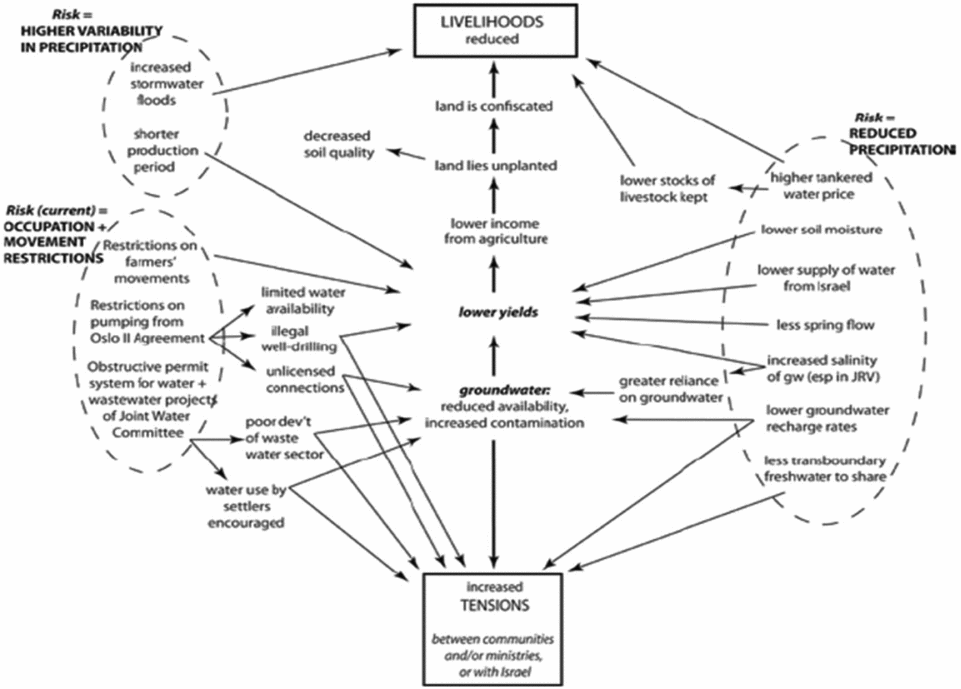
The authors of the Strategy visualized the relationship between the two main uncertainties facing the occupied Palestinian territories in the form of two diagrams they called “Climate Vulnerability Pathways,” one for the West Bank and one for Gaza (Figure 1).Footnote 59 It was invented by one of the three authors. He describes “conceiving of it in a flash and then scribbling it out and then adjusting it forever.” Adjustments were in part “a reflection of many discussions,” including among the authors, with their interviewees and with water experts they consulted for comments on earlier drafts. The diagram condenses many actors’ concerns, though it continues to circulate as an emblematic depiction of PA climate change planning.Footnote 60
Climate Vulnerability Pathways.

In the West Bank version of the diagram (Figure 1), the two boxes at the top and bottom contain the negative outcomes to which communities in Palestine were found to be most vulnerable: “reduced livelihoods” and “tensions between communities, [tensions] with ministries and with Israel.” On the sides in oblong bubbles three “risks” expose populations to the possibility of two outcomes. Risks are “higher variability in precipitation,” “occupation and movement restrictions,” and “reduced precipitation.” Each risk emits arrows that tell us about a series of domino effects that it brings about. At the center of the diagram two phrases are bolded: “lower yields” and “groundwater: reduced availability, increased contamination.” From the arrows all three risks lead to the two problems. These set in motion their own set of domino effects leading to the two negative outcomes at the top and bottom.
The diagram shows how climate planners “embrace uncertainty” through commensuration. Vulnerability is the common metric that allows them to do so. Beck argues that in the risk society a new sense of vulnerability emerges.Footnote 61 This is true also for so-called “developing” countries where the framework of vulnerability dominates how future threats and present conditions are thought together.Footnote 62 States participating in the UNFCC must identify their sites of greatest vulnerability and target sites in requesting funds. This demonstrates how generating knowledge about vulnerabilities in relation to capacities is key to techniques of climate preparedness.Footnote 63 But rather than bringing future events “into the present,” as national security preparedness does in the US, Palestinian climate vulnerability assessment brings present events into the future. By highlighting this move and the significance of the future in this emergent domain of Palestinian experiences, I bolster discussions in Palestine studies that seek, on the one hand, to analyze how Palestinians remember the past and, on the other, how the past continues to be present.Footnote 64 In climate planning, current vulnerabilities point to interventions for the future.
The rubric of vulnerability allows different-seeming events such as military sieges and floods to be brought into a single remit. In rendering occupation and rain interchangeable, the diagram presents the telos of occupation as reduction of “livelihoods” and intensification of “tensions.” Occupation and rain are both threats to Palestinian water use. I return to this below.
But commensuration does more than render different phenomena fungible. It allows climate planners to handle “uncertain and elusive qualities” by “making the world more predictable.”Footnote 65 Commensuration brings two uncertainties into an orbit. It allows one of them to become what one of my interlocutors calls “stable.” The need to perform stability arises from the fact that documents like the Strategy are funding applications. Palestine's climate planners also experience the globally growing trend whereby “agencies are increasingly asked to justify their actions on the basis of risk assessment.”Footnote 66 Planners must appeal to donors who ask: if the future is up in the air, what are credible arguments for billions in investments? The Climate Change Adaptation Strategy deals with risk at two levels: at the level of managing its own “cost effectiveness” and at the level of planning for potential harm to humans and the environment. The process has a boomerang effect. Uncertainty about hazards and how they may affect humans and the environment loops around to make the practice of writing a strategy risky business.
The authors of the Climate Change Adaptation Strategy manage this risk by thinking “realistically.” In the long-term, they say, occupation is expected to endure whether or not the climate changes. “Were the Israeli partial blockade (on the West Bank) and total blockade (on the Gaza Strip) lifted completely, the Palestinian economy could be expected to flourish as it did in the late 1990s,” the authors write. “However, the current political climate obliges all analysts to be realistic about the opportunities for significant improvement in the near- or even medium-term future. The ‘worst case’ scenario in the oPt is usually also considered the ‘most likely’ scenario.”Footnote 67 References to “realism” here connote a type of thinking with a more intimate relationship to present conditions. They are a version of the kind of thinking Hebron farmers do when they see drought hit their orchards three years in a row. “Realistic” thinking connotes empirical reasoning that steps outside the “game” of climate planning and the applications for billions of dollars that planning entails. To say one is realistic is also to perform having sense. It is to perform thinking in a measured way and to attempt to be convincing by comparison with utopian, idealistic, or alarmist thinking.Footnote 68
Palestine's climate planners assert that thinking realistically means treating occupation as a constant. The occupation becomes precondition and premise, a risk almost more natural, and certainly more predictable, than rainfall. A UNDP representative describes this to me as Palestinians’ treatment of “occupation as part of our natural boundaries.” In this sense thinking realistically is also interpreting the natural, even if that which is natural is also political. It is understanding what is out of one's control. In this way Palestine's climate planners do not underplay the Palestinian territories’ volatility, as is often the case in premature representations of states as “postconflict” countries in efforts to project stability for foreign investors. Instead, Palestine's climate planners represent volatility as a stable phenomenon.
The consequences of stabilizing occupation for the Strategy’s proposed measures are significant. They have incited fiery debates among people concerned about justice in Palestine. The aquifers under the West Bank are Palestinians’ only source of freshwater. Israel controls 95 percent of the water in the West Bank. The 2.5 million Palestinians who live there consume about 10 percent of it, and Israelis consume the rest. If Israel were to allocate an equitable share of the West Bank's water sources to Palestinians, even if average rainfall were to decrease by 50 percent over the next fifty years, Palestinians would have access to 331 percent more water than they do today. This was the 2012 calculation of one of the most vocal critics of donor-led climate planning in Palestine, the Palestine-based hydrogeologist Clemens Messerschmid.Footnote 69
Despite the droughts, floods, and unseasonable frost, climate change, Messerschmid tells me, is not Palestine's main water problem. Water scarcity in Palestine is not natural; it is political.Footnote 70 Yet the Strategy proposes desalination, cisterns, and wastewater reuse, among other measures, rather than prioritizing the demand that Israel recognize Palestinians’ water rights. It is in this context that Samia Jabareen, a Palestinian activist and researcher, calls the Strategy adaptation not to climate change but to occupation.Footnote 71 Messerschmid and Jarrar highlight a wider critique of climate change talk in Palestine. Numerous researchers and activists have shown how Palestine confirms the necessity of analyzing issues of water and scarcity together with political and economic conditions. This necessity reaches beyond Palestine. Climate change adaptation planning cannot be understood as practices of work around the environmental problem of watersheds. They must instead be considered practices targeting what scholars call a “problemshed.”Footnote 72
The scientific uncertainties about climate change along with the finitude of climate funds create the need to make credible arguments of several kinds. One is the argument that “something is stable.” Another is the argument for what some call “dual-use” measures.Footnote 73 Assuming that occupation is more stable than climate change, proposed investments must be necessary even if climate change does not turn out to have a significant impact on Palestine during the period over which the plans extend. In one of my interviewers’ words: “we have to play it safe.” Funding imperatives encourage parties to the UNFCC to perform stability. Paradoxically, they also demand that climate planners be “flexible,” displaying an “agile response capability” before they even begin responding to climatic changes with infrastructures and policies.Footnote 74
The Strategy and my conversations are shot through with the language of flexibility. The diagram is helpful again for visualizing what that means. It presents the two negative outcomes of “reduced livelihoods” and “increased tensions” as likely to occur even if one or two of the risks in the oblong bubbles are removed. Without the current risk of “occupation and movement restrictions,” with eleven arrows pointing toward “lower yields” and “groundwater contamination,” fourteen arrows still point to them and therefore lead to the (eventual) reduction of livelihoods and increased tensions. If we remove the risk of reduced precipitation, which has its own eleven arrows pointed at the problems of yields and groundwater contamination, the risks of “higher variability in precipitation” and “occupation and movement restrictions” will do the same. The diagram has no starting point. Everything happens at the same time. Our eyes begin at any point and follow the arrows—or not. We start at the two boxes and move outward, or vice versa. Or we jump around. The diagram does not tell us which risks should or can be removed first or if there is an order to navigating them.
In an article published with a graduate student as an outgrowth of his research on climate planning, Ziad Mimi calls “effective adaptation practices” those that “are responsive to a wide variety of economic, social, political, geographic and environmental conditions.”Footnote 75 In our conversation about the Palestinian National Communication in October, he explains: “We can't go to donors and say ‘We have occupation, it's complicated, but please also help us on this other problem!’” He pushes himself from his desk with two hands and leans back. “We have to be clear.” For him, clarity means parsing out the causes of the problems that adaptation measures could solve, carving out scenarios and thinking flexibly about infrastructures.Footnote 76 He and the other authors recommend what they call “no regrets” and “low regrets” measures, or measures with what they call “co-benefits.” The language of no and low regrets is common to adaptation strategies, action plans, and national communication reports that states write for the UNFCCC. In the case of Palestine, no and low regrets measures include wastewater reuse and more efficient irrigation that would be beneficial to Palestinians even with occupation and without climate change. Paradoxically, a Strategy for Climate Change Adaptation imagines its usefulness without climate change.
WHAT DOES CLIMATE PLANNING DO? CLIMATE PREPAREDNESS AS STATE READINESS
Longterm timescales are one of many analytical “impositions” placed on Palestinian climate planners. They are determined by the scenarios issued by the Intergovernmental Panel on Climate Change on the degrees and rates of rising temperatures over the 21st century. The commensuration work the diagram puts on display represents a kind of forced analytical acrobatics required of Palestinians in contexts where the dominant frame does not “see” the settler colonialism that structures their lives. But commensuration can also be tactically attractive to PA bureaucrats who use it.
Climate planning brings a “new twilight of opportunities . . . into existence.”Footnote 77 It coincides with ongoing PA performances of what I call state readiness—one effect of waiting for a finalized status. By the time I was conducting fieldwork for my first book thirteen years after the PA was meant to have been transformed into something ostensibly permanent or to have dissolved, bureaucrats were explaining their work in waste management as versions of what one water ministry lawyer calls “preparation for the day.” Designing sewers, national strategies, posting Facebook updates on Palestinian celebrations of Earth Day and obtaining funds for projects delayed by the Israeli military bureaucracy continue to be preparations for the day the international community recognizes their institutions as sovereign on the land.
Preparation has two meanings: creating conditions that would benefit the state when it becomes sovereign, and creating the conditions of a state in order for it to become sovereign. The temporality of these two distinct, seemingly incompatible versions of preparation overlaps. There is a sense that the future-as-state—and how soon that future will arrive—depends on one's work in the present. Work is valued for its capacity to leverage forms of capital that fast forward to the future's arrival. Preparation for the day shares features of what Andrew Lakoff calls “preparedness.” It is “an ethos and a set of techniques for reflecting about and intervening in an uncertain” future.Footnote 78 It reaches beyond the limits of rationality. It is, in this sense, unrealistic. The incalculability of statehood compounds and is compounded by the incalculability of the long-term effects of climate change on Palestine.
In practice, preparation involves a third meaning that seems to defy the temporalities of both other meanings: performances as if the PA were already a state.Footnote 79 Most abroad know this from the PA's diplomatic acts, as in attempts to gain membership in international bodies. The PA attained status as a “nonmember observer state” at the UN in 2012 and membership in UNESCO in 2011. Palestine's 2016 accession to the UNFCCC is the most recent of these efforts. Acting as if in a state also permeates the work of many mid-level bureaucrats whose names never reach the halls of Geneva and New York. By producing texts that frame the occupied Palestinian territories as a place for which seventy-five-year plans can be made, Palestine's climate planners self-consciously mimic other state practitioners. But the documents they produce are not “make believe.”Footnote 80 They are papers recognized as forms of legitimate participation in international fora despite ongoing refusals by Israel and Republican US Senators to “recognize” Palestinian participation.Footnote 81
Climate planning also makes experiences possible. Scholars writing about the meanings of documents have shown how, especially for marginalized populations, documents can be a source of anxiety, aspiration, fear, and uncertainty.Footnote 82 These effects are most often the case when people are forced to use or seek out identity documents or permits for movement across political boundaries.Footnote 83 The Strategy and the Palestinian National Communication are very different from identity documents or permits, of course, not least because they do not pertain to a single individual. At the same time, the documents do function in some ways like personal documents: they give their authors and proponents forms of mobility that extend beyond mobility at checkpoints. They afford bureaucratic mobility: their authors participate in faraway meetings, sitting at tables and standing at podia otherwise inaccessible to them.Footnote 84 They afford expanding professional opportunities, as they have done for the Strategy’s authors. Another piece of the long-term future puzzle is quietly stabilized, or blackboxed, in the process: the PA. Climate planners present the PA as both “ready” for the ultimate stability of statehood and “reliable” as a recipient of climate aid into the long-term future.Footnote 85 The PA harnesses the long-term temporal scales of climate change adaptation to extend the image of its own viability.
CONCLUSION
The political stakes of Palestinians’ entanglement with the imperatives of UN climate planning while performing state readiness are not straightforward. Commensuration of two uncertainties—occupation and rain—yields uncertain results. The diagram is again useful here. It depicts the PA's lack of sovereignty as a problem insofar as it allows occupation to lead to the two problematic ends of “reduced livelihoods” and “increased tensions.” It does not depict it as a problem of historical injustice or national self-determination. The diagram presents occupation as problematic not because it is unjust but because it exacerbates water contamination and poverty and because it harms agricultural production. This marks an epistemological shift from occupation as injustice to occupation as hazard.Footnote 86
From the perspective of someone concerned about climate change “denial,” it is noteworthy too that the diagram bypasses the question of who, or what, is causing climate change. Blame for anthropogenic changes is irrelevant. In this sense climate change appears as a natural force. Treating the occupation as part of planners’ “natural boundaries” depoliticizes it, implicitly accepting occupation as normal. It offers to build infrastructures that further entrench occupation's “facts on the ground.” Israel can argue against allocating more water to Palestinians if Palestinians have better water-harvesting technologies to capture rain. The diagram makes data about occupation “uncharismatic,” sanitizing its historical, bloody, and humiliating features.Footnote 87
But PA climate planning is better understood as a process that moves politics to a different domain rather than eradicating it. Scholars have highlighted the ways in which climate planners and other government officials create invisibilities, sometimes intentionally.Footnote 88 The Strategy’s “naturalizing” of occupation renders occupation hyper visible by calling attention to how adaptation cannot be thought without it.Footnote 89 Documents such as the Strategy offer the exercise of imagining and displaying Palestine—or at least a Palestinian polity—in the long term. Palestinians’ existence is not among the various uncertainties at play in long-term climate planning. Palestinians as a population become a fact to be planned for.
Commensurating occupation—a system that “manages” Palestinians, including many of the climate planners themselves—with rain also makes occupation manageable by those occupation manages. As Wendy Nelson Espeland and Mitchell E. Stevens argue, there are political stakes in calling something incommensurable.Footnote 90 The incommensurable is unruly, outside the remit of possible intervention. The Strategy presents occupation as a fixed feature of projected future life that does not exceed the PA's capacity to act upon it. This is counter to the tendency, which gained traction in the 1980s, for people to believe that technical risk management is separate from political risk management.Footnote 91 Palestinian climate planning attempts to combine them. Political risk management becomes a technical practice.
This results, as I have tried to show, in a contradiction. In one sense, it is paradoxical that Palestine's climate planners see themselves as helping the PA inch closer to statehood by assimilating the occupation into their future plans. The PA performs itself not as an all-knowing or all-seeing state but as one without sovereignty or certainty.Footnote 92 The PA performs statehood by performing its opposite, enacting its lack of sovereignty in the enactment of sovereign-similitude. The people who make and work with documents such as the Strategy represent occupation as “the most realistic scenario.” They are aware that the state they perform is in some sense “make believe.”Footnote 93 They know themselves to be performing as if they work in a state.Footnote 94 Perhaps the performance is meant to be partial in order to highlight communities’ “vulnerabilities” as well as the vulnerabilities of the PA. This may be a performance of a kind of statehood not based on sovereignty but on management of financial resources and credible claims to management of an uncertain future.