INTRODUCTION
Suctorians (class Suctorea) form a poorly known, distinctive taxon of carnivorous or parasitic ciliates, living as epibionts on a number of invertebrates including harpacticoid copepods, nematodes and kinorhynchs in the sediment interstices of a number of marine environments (e.g. Jankowski, Reference Jankowski1981; Dovgal, Reference Dovgal1996; Dovgal et al., Reference Dovgal, Chatterjee and Ingole2008). However, there is a paucity of information on suctorian ciliates in general, and as epibionts of marine nematodes inhabiting tropical continental shelf ecosystems in particular.
As part of an ongoing study on the meiofaunal diversity along the continental shelf of the north-western Bay of Bengal (e.g. Bhattacharjee et al., Reference Bhattacharjee, Choudhury, Sivakumar, Sharma, John, Behera, Behera and Bhadury2013), free living nematodes were collected and examined. Interestingly, two suctorian ciliates were observed as epibionts on the cuticles of one free living marine nematode, Chromaspirina sp. belonging to the family Desmodoridae. This study extends our knowledge about the association between suctorians and desmodorid nematodes, and is the first report of these suctorians from the shallow continental shelf of the tropical Bay of Bengal, northern Indian Ocean.
MATERIALS AND METHODS
The site (19°22′48.11″N 85°06′13.02″E) from where the parasitized nematodes were obtained is located at a depth of 6.1 m along the coastal belt of Rushikulya (Odisha State of India), north-western Bay of Bengal in the Indian Ocean. Samples were collected in spring of (March) 2012.
Environmental parameters such as salinity and temperature of the ambient water were measured using a hand held refractometer (Brix) and an ordinary hand held Celsius thermometer. Sediment sample was collected using a Van Veen grab (0.1 sq. m). The upper 3 cm of this collected sediment sample was then sub-sampled (in quadruplicate) following the method of Herb (Reference Herb1968), using a core sampler (10 cm3) and preserved in 4% buffered formaldehyde. Pre-weighed sediment samples (from a corresponding collection) were oven-dried at 60°C for 48 h and grain sizes of the sediment were determined following the standard sieve-and-pipette method developed by Folk (Reference Folk1968). Sand, silt and clay fractions were expressed in per cent.
Preserved sub-samples (10 cm3 each) were washed and sieved (separately) through 500 µm and 63 µm meshes, and mounted over ordinary glass slides in glycerol (98% purified) as media (refractive index, 1.47 at 20°C) for: (i) counting of total meiofauna present in the sediment sub-samples (two-sets); and (ii) identification of free living nematodes in the remaining (two-)sets of sub-samples, retained on the 63 µm sieve. Free living nematodes were identified to genus level using the pictorial keys of Platt & Warwick (Reference Platt, Warwick, Kermack and Barnes1983) and on-line recent literature (www.nemys.ugent.be). At the same time, nematodes with suctorian infestations were picked up under a stereomicroscope and images were taken using the computer program Scope Photo v. 2.0. Suctorians were identified to species level following the descriptions in Dovgal et al. (Reference Dovgal, Chatterjee and Ingole2009).
RESULTS AND DISCUSSION
The present report describes two suctorian ciliates (Thecacineta cothurnoides and Trematosoma rotunda), as epibionts on the nematode Chromaspirina sp. from the shallow continental shelf of the tropical Bay of Bengal, northern Indian Ocean. Biometric data were used to further confirm the identity of the suctorians in my samples. The mean length and width (±standard deviation, N = 10) of the lorica of T. cothurnioides were 32.5 ± 1.3 µm and 18.6 ± 1.3 µm, respectively, while the diameter of the spherical macronucleus was 7.3 ± 0.8 µm. Similarly, the specimens of T. rotunda (N = 14) had mean lorica length and width of 18.9 ± 1.4 µm and 15.1 ± 1.1 µm, respectively, and a mean macronucleus diameter of 7.3 ± 0.9 µm. Earlier, Collin (Reference Collin1909) documented T. cothurnioides with mean lorica length of 50 µm and width of 18–20 µm, while Dovgal et al. (Reference Dovgal, Chatterjee and Ingole2009) reported specimens of T. cothurnioides from Ratnagiri in the Arabian Sea with lorica length that ranged from 33–39 µm, width 17–21 µm and macronucleus diameter 7–10 µm. Likewise, measurements of T. rotunda reported by Allgén (Reference Allgén1955) ranged from 26.52–32.65 µm in lorica length and 15.3–28.56 µm in lorica width. Dovgal et al. (Reference Dovgal, Chatterjee and Ingole2009) also described specimens of T. rotunda from Ratnagiri (Arabian Sea) with lorica length that ranged from 7–14 µm, width 6–14 µm and macronucleus diameter 6–8 µm. Thus, the measurements of the suctorians collected in the present study are in the range of those of specimens reported from the Arabian Sea. These suctorians are commensals on nematodes (Dovgal, Reference Dovgal2002). Their free swimming larvae (swarmers) are known to settle on the nematode cuticle and undergo metamorphosis that results in the development of a stalk, lorica and tentacles (Bardele, Reference Bardele1970; Dovgal, Reference Dovgal2002). The fully grown suctorians feed on other ciliates and amoebae with the help of their tentacles (Dovgal, Reference Dovgal2002).
Sediment at the sampling site was predominantly sandy (98.6%). Remains of bivalves, gastropods, echinoderms, foraminifers and corals also contributed. The remaining 1.4% of the sediment was composed of silt (1.1%) and clay (0.3%). The granulometry of this sediment matches well with that of a site (consisting of 98% of sand) in the Arabian Sea (Ratnagiri) from where Thecacineta cothurnoides and Trematosoma rotunda have been reported previously by Dovgal et al. (Reference Dovgal, Chatterjee and Ingole2009). Mean (N = 3) ambient water salinity and temperature measured (mean value ± standard deviation) 29 ± 0.5 psu and 31 ± 0.5°C respectively.
Average meiofaunal abundance (mean value ± standard deviation) at the site was 226.5 ± 44.5 individuals/10 cm3 (N = 2). Benthic foraminifers constituted the bulk (70%) with a mean 159.5 ± 40.3 individuals/10 cm3, followed by the free living nematodes (mean 50.5 ± 4.9 individuals/10 cm3 or 22% of the meiofaunal community). The remaining 8% of the meiobenthic community was composed of taxa like harpacticoid copepods, ostracods and polychaetes. These findings on the abundance and assemblage patterns of meiofauna are in agreement with previous studies in the area of Rushikulya (e.g. Bhattacharjee et al., Reference Bhattacharjee, Choudhury, Sivakumar, Sharma, John, Behera, Behera and Bhadury2013).
Among the free living nematodes at the study site, Chromaspirina sp., belonging to the family Desmodoridae, was by far the most abundant species (mean ± standard deviation, 24.5 ± 3.5 individuals/10 cm3 or 49%), followed by genera like Sabatieria sp. (Comesomatidae) and Camacolaimus sp. (Leptolaimidae) with ~24% and 9%, respectively. The remaining 18% was composed of genera like Chromadora, Daptonema, Desmodora, Desmoscolex, Epsilonema and Theristus.
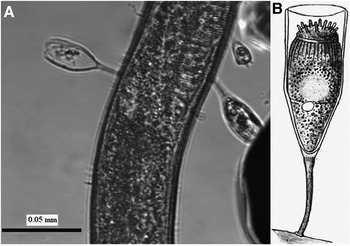
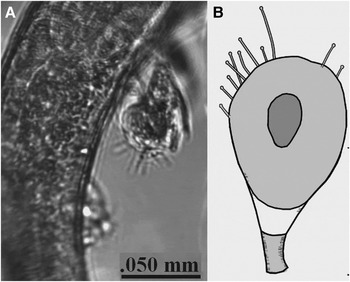
Overall, around 98% of the population of Chromaspirina sp. at this site was infested with suctorian ciliates (either or both)—Thecacineta cothurnoides (order Spelaeophryida, family Thecacinetidae) and Trematosoma rotunda (order Acinetida, family Acinetidae) (Figures 1 and 2, respectively). Again, 32% (mean, 8 ± 2.8 individuals/10 cm3) of the population of Chromaspirina sp. was found infested only with T. cothurnioides, while 51% (mean, 12.5 ± 2.1 individuals/10 cm3) only infested with T. rotunda. Notably, about 15% (mean, 8 ± 2.8 individuals/10 cm3) of the population of Chromaspirina sp. was heavily infested (10 suctorians were recorded on a nematode specimen) with both species of suctorians. The sample size in the present study was not big enough to reliably test if these suctorians prefer a particular age group and/or gender. However, it is noteworthy that in this study no other species of nematode was found infested with these suctorians. Previously, Collin (Reference Collin1912) reported T. cothurnoides from a harpacticoid copepod Cletodes longicaudatus from Banyuls-sur-Mer (France), while, Allgén (Reference Allgén1952, Reference Allgén1955) documented the occurrence of T. rotunda on the free living nematodes (Desmodora tenuispiculum and D. stateni) from Graham Land and the Falkland Islands. Recently, Dovgal et al. (Reference Dovgal, Chatterjee and Ingole2009) reported the emergence of T. cothurnoides and T. rotunda in the Arabian Sea (Ratnagiri, central-west coast of India) on free living marine nematodes of the families Desmoscolecidae (Tricoma sp.) and Desmodoridae (Pseudochromadora sp.), respectively.
(A) Thecacineta cothurnioides on the nematode Chromaspirina sp. collected from S1; (B) Thecacineta cothurnioides from a harpacticoid copepode, Cletodes longicaudatus, after Collin (Reference Collin1912).

(A) Trematosoma rotunda on the nematode Chromaspirina sp. collected from S1; (B) Trematosoma rotunda (frontal view) from India, after Dovgal et al. (Reference Dovgal, Chatterjee and Ingole2009).

Despite the paucity of available data, these suctorians (T. cothurnoides and T. rotunda) appear to preferentially or specifically associate with free living marine nematodes that are characterized by a thick annulated cuticle (e.g. Fisher, Reference Fisher2003; Dovgal et al., Reference Dovgal, Chatterjee and Ingole2009), more specifically from the families Desmodoridae and Desmoscolecidae. Chromaspirina sp. is also characterized by a thick annulated cuticle (e.g. Cavalkanti et al., Reference Cavalcanti, Da Silva and Da Fonsêca-Genevois2009). Nevertheless, there is no information available on the selection criteria and biochemical processes of settlement of the suctorians (epibionts) on marine nematodes, and it is therefore unclear what processes underlie the specificity of this association. In addition, whilst suctorians have often been considered parasitic, it is worth mentioning that there is currently no data on how they affect their nematode hosts. No elaborate system to carry out respiration, circulation or excretion exists in nematodes, and these vital processes therefore largely depend on diffusion of gases and molecules across the cuticle (Barnes, Reference Barnes1980). Heavy infestation by suctorians may consequently decrease the surface area for diffusion in nematodes and/or disrupt the normal water flow patterns over their body surface, thereby potentially interfering with the usual processes of diffusion across the cuticle. On the other hand, our data show that even the dominant nematode species in an assemblage may be consistently infested, suggesting that the suctorians have no substantial negative effects, or may perhaps even have beneficial effects, on their hosts. Much more detailed investigation is warranted to understand the dynamics and impacts of these host–epibiont interactions. This in turn requires a more complete view on the prevalence and specificity of the associations in different marine habitats.
ACKNOWLEDGEMENT
I thank Dr Igor Dovgal, Schmalhausen Institute of Zoology, Ukraine, for helping me identify the suctorians reported in this study.