INTRODUCTION
Racial disparities have been documented at virtually every stage of criminal justice processing, from investigation to sentencing. Researchers find racial disparities in police stops (Gelman, Fagan, and Kiss Reference Gelman, Fagan and Kiss2007), police coercion (Paoline, Gau, and Terrill Reference Paoline, Gau and Terrill2016), police uses of force (Payne Reference Payne2006; Kahn et al. Reference Kahn, Steele, McMahon and Stewart2016), arrests (Golub, Johnson, and Dunlap Reference Golub, Johnson and Dunlap2007; Kochel, Wilson, and Mastrofski Reference Kochel, Wilson and Mastrofski2011), charging decisions and plea negotiations (Edkins Reference Edkins2011; Smith and Levinson Reference Smith and Levinson2012; Wu Reference Wu2016), sentencing severity (Demuth and Steffensmeier Reference Demuth and Steffensmeier2004; Abrams, Bertrand, and Mullainathan Reference Abrams, Bertrand and Mullainathan2012), and wrongful convictions (Parker, Dewees, and Radelet Reference Parker, Dewees, Radelet, Saundra and John2001; Gross et al. Reference Gross, Jacoby, Matheson and Nicholas2005). We know comparatively less about how, and whether, racial disparities manifest once the prison door is closed. Parole decisions, in particular, have been “long neglected by academic, research, and policy communities” (Rhine, Petersilia, and Reitz Reference Rhine, Petersilia, Reitz and Tonry2017). As a result, we know surprisingly little about whether and how postsentencing mechanisms contribute to overarching racial disparities in criminal justice processing.
A majority of states use indeterminate sentencing, in which a judge imposes a range of punishment (e.g., five to ten years; twenty years to life) rather than a set period of time.Footnote 1 Of the half million people released from prison each year, more than 40 percent are released via discretionary parole, which is used in forty-six states (Maruschak and Bonczar Reference Maruschak and Bonczar2015, 8; Rhine Petersilia, and Reitz Reference Rhine, Petersilia and Reitz2015). One in fifty-eight US adults is on parole, probation, or a combination of the two (Kaeble and Alper Reference Kaeble and Alper2020). Although the adult probation rate fell 25 percent from 2008 to 2018, the adult parole rate scarcely budged in the same period, falling only 4 percent (Kaeble and Alper Reference Kaeble and Alper2020). Releasing decisions have enormous impacts on parole candidates themselves, as well as on their’ families and communities (Petersilia Reference Petersilia2003). No scholarly consensus exists about the social mechanisms that underlie parole outcomes (see Wacquant Reference Wacquant2002; Rhine et al. Reference Rhine, Petersilia, Reitz and Tonry2017; Vîlcică Reference Vîlcică2018), and extant literature is divided about whether racial disparities exist in parole decision-making at all. Another likely reason for the lack of scholarly attention to parole is a lack of available data. This stands in contrast to the US Sentencing Commission’s data, which is released annually and is used in the bulk of sentencing scholarship (Lynch Reference Lynch2019, 1160). No corollary exists in the parole context, and parole is essentially nonexistent at the federal level (Berman Reference Berman2017). As Huebner and Bynum point out, “little quantitative research has been amassed on parole, and even less is known about the role that ethnic and racial bias may play in this aspect of the criminal justice system” (Reference Huebner and Bynum2008, 908).
In addition to their impact on public life, parole decisions offer a theoretically rich site for examining the complex role of race in criminal justice. Not only do parole hearings convey special communicative meanings about punishment and rehabilitation (Dagan and Segev 2015), but as legal processes, they are unusually chimeric: in some ways, parole hearings resemble other criminal justice procedures, but they also bear similarity to civil administrative proceedings. For one, due process protections are minimal. Unlike their rulings on sentencing or arrest, the US Supreme Court has never recognized a fundamental liberty interest in parole grants (Greenholtz v. Inmates of the Nebraska Penal and Correctional Complex 1979; Thomas and Reingold Reference Thomas and Reingold2017, 243–44).Footnote 2 This absence of due process protection makes parole hearings more akin to proceedings like administrative segregation. Evidentiarily, they are close to unrestricted (MacKay and the Prison Law Office Reference MacKay2019, 295). In California, as in many other states, substantive issues raised can include anything from a parole candidate’s mental health history to whom he chats with on the prison yard, as long as the information presented is “relevant and reliable” (California Code of Regulations Title 15 § 2281). Decision-makers are not shielded, as juries are, from relevant information that is constitutionally or statutorily inadmissible. This near-total absence of rules of evidence sets parole hearings apart from trials, which are governed by the California Rules of Evidence. Files comprise hundreds, even thousands, of pages, and may include victims’ impact statements and live testimony, letters from the friends or religious leaders, book reports written by the parole candidate, and more (Young Reference Young2016, 445; MacKay and the Prison Law Office Reference MacKay2019, 289–93).
The wealth of information available to parole commissioners is intended to allow person-centered, information-rich decision-making—an opportunity to overcome biases by allowing decision-makers to develop holistic understandings of parole candidates as individuals. Indeed, as we discuss below, most of the recent research on parole decisions aligns with this picture. But on the other hand, we might imagine that particular kinds of information might have racially disparate impacts, even indirectly. Indeed, with a notable exception (Huebner and Bynum Reference Huebner and Bynum2008), previous work has not contemplated the indirect effects of race on parole grants. This means that any racial disparities could reflect immediate bias on the part of parole commissioners, but might also operate via factors on which commissioners rely.
We use a data set derived from detailed coding of California lifer parole hearing transcripts. First, we estimate the relationship between race and the likelihood of receiving parole, comparing outcomes for Black, Latino, and white parole candidates. Second, we test a proposition that has largely borne out in the sentencing context: that racial disparities are reduced by the inclusion of education and job training. Third, we draw on a broad literature analyzing racial bias within professional assessments to investigate the possibility that racial biases manifest via other evaluations to which parole decision-makers have access.
BACKGROUND
How Parole Hearings Work
Hearings are the modal means of parole decision-making, but procedures and personnel vary by state. No national guidelines exist for parole board membership. Most boards are populated at least partly via gubernatorial appointment, with vague or nonexistent standards about education or experience (Rhine et al. Reference Rhine, Petersilia and Reitz2015, 5). Indeed, many states employ board members who have no formal legal training, and/or little or no criminal justice experience (Schwartzapfel Reference Schwartzapfel2015). Some states use administrative law judges, or a combination of administrative law judges and other government employees. Twenty states lack statutory criteria for parole board membership altogether (Ruhland et al. Reference Ruhland, Rhine, Robey and Lyn Mitchell2016). The informal norms and formal legal guidelines that govern parole hearings in general, and lifer hearings in particular, vary across the United States as well. In some states, including Washington, Oregon, Florida, and Alabama, hearings are open to the public. In others, including New Mexico, New Jersey, Pennsylvania, and Wisconsin, they are closed (Schwartzapfel Reference Schwartzapfel2015). In thirty-two states, people in prison are allowed full or limited access to their own parole files. In the remaining eighteen, they are allowed none (Schwartzapfel Reference Schwartzapfel2015). In some states, victims may give topically and temporally unrestricted testimony, but in others, a victim’s right to speak at parole hearings is limited (Young Reference Young2016). In some states, parole boards are not required to meet with parole candidates, and may send an investigator or other designee (Renaud Reference Renaud2019). Some states require parole candidates to attend in person, while others prohibit attendance and require statement submission by video, if at all (Renaud Reference Renaud2019). Some states use formal risk assessment tools, but others do not (Thomas and Reingold Reference Thomas and Reingold2017), and of the former, only about half allow parole candidates to review and contest risk assessments (Ruhland et al. Reference Ruhland, Rhine, Robey and Lyn Mitchell2016). Guidelines for granting parole tend to be broad, directing board members to consider vague criteria such as rehabilitative success, current dangerousness, or simply “public safety” or “the public good.” In short, parole boards’ discretion is tremendous, and may be highly subject to social and political pressures (Aviram Reference Aviram2020).
As mentioned above, evidentiary rules at parole hearings are different from trials. Though people’s commitment offenses are often discussed, the point of a parole hearing is not to retry the case, but to parse issues like dangerousness, rehabilitation, and likelihood of recidivism. Since few evidentiary restrictions apply, decision-makers have access to a wide breadth of information. At minimum, this typically includes demographic information, details of the commitment offense, criminal history, employment records, letters or statements from the victim or victim’s next of kin, letters from employers, family, or other close acquaintances, medical and psychological diagnoses, disciplinary records, and more (Young Reference Young2016; Aviram Reference Aviram2020). Formulaic risk assessments, which we will discuss in subsequent sections, are often used as supplements to the larger body of information. The point of giving parole board members such unbridled access to these kinds of details is to help them make holistic decisions tailored to people’s life circumstances.
Decision-makers’ access to such plentiful information is virtually unparalleled in other areas of criminal justice processing. Unlike police officers, parole board members are not forced to make snap judgments. Unlike prosecutors, they do not need to weigh the adequacy of evidence to support a criminal charge. Unlike jurors, they do not need to determine factual guilt or innocence. And unlike sentencing judges, who can only speculate about an offender’s capacity for rehabilitation, parole board members can assess indicia of it. Thus, compared to other stages of criminal justice processing, parole hearings seem to offer an ideal recipe for thorough assessments of individual offenders’ circumstances.
The Lifer Context
“Lifers,” or people serving life sentences with the possibility of parole, represent a growing portion of the US prison population. From the mid-1980s to 2016, the number of lifers rose from 34,000 in 1984 to 162,000 in 2016, and if people serving “virtual life” sentences (that is, sentences of fifty years or more) are included, the 2016 number is over 200,000 (Sentencing Project 2018, 1). To put this into context, one in seven people in prison is serving a life sentence (Nellis Reference Nellis2017), and the vast majority will be eligible for discretionary parole release.
In addition to the sizeable number of lifers, both in absolute terms and as a percentage of the candidate population, there are two reasons we focus on lifer parole. First, although the question of racial disparities in parole release is important in all prison populations, it is especially salient in the lifer population because the racial disparity in incarceration rates is even more pronounced among lifers, particularly for Black lifers. Nearly half (48.3 percent) of people serving life sentences with the possibility of parole are Black (Nellis Reference Nellis2017), compared to 38 percent in the general prison population (Nellis Reference Nellis2016; Nellis Reference Nellis2017). Thus, to the extent that racial disparities manifest, they will have particularly large consequences for the lifer segment. Second, we examine lifer hearings because in many states, these hearings offer greater procedural protections than in other types of parole hearings. For example, in Massachusetts, lifer parole candidates attend hearings in person, but nonlifer parole candidates are not permitted to be present for the majority of the hearing (Renaud Reference Renaud2019). In California, lifers are represented by counsel, are minimally restricted in their presentation of information, and are heard by a two-person panel, not a single commissioner (Young Reference Young2016). A parole denial requires the agreement of both members, and split decisions are sent to the full board. Thus, lifer hearings generally represent the most procedural protection parole candidates ever receive, and this factor means that lifer hearings probably offer a more modest test of racial disparity than other categories of parole hearings, where people’s fate may be decided by a single commissioner on the basis of more limited information. Of course, the extent to which findings from any examination of lifer parole generalize to all parole hearings is an empirical question, and one we do not take up herein. But racial disparities that manifest even where parole candidates are the most procedurally protected would suggest an especially urgent need for reform.
Lifer hearings in California are each conducted by two commissioners: one governor-appointed commissioner and one “deputy” commissioner. The fifteen to twenty commissioners in the former group have diverse backgrounds often related to legal practice or criminal justice; deputy commissioners, of whom there are at least a few dozen at any given time, are civil servants with backgrounds in corrections, criminal justice, and criminal law. Appointed commissioners’ primary job is lifer hearings, while deputy commissioners also conduct medical release hearings, review lengthy denials, and perform other functions (CDCR 2021a; 2021b). Together, these commissioners are tasked with reviewing key documents, including a summary of the crime, the parole candidate’s criminal record, psychological evaluations, the postconviction progress report, and prior parole decisions, and conducting the hearing (Young, Mukamal, and Favre-Bulle Reference Young, Mukamal and Favre-Bulle2016, 268). Approximately three lifer hearings are conducted each hearing day. Commissioners are not usually assigned to specific regions; they may stay at one prison for the entirety of a work week or two, but travel throughout the state conducting hearings at different facilities (Young Reference Young2020). The duration of appointed commissioners’ and deputy commissioners’ stints on the parole board varies. Among the former group, the longest-serving commissioner as of this writing has been on the board for thirteen years and has served under multiple governors, while the two most recent appointees were confirmed in 2020. Deputy commissioners do not require reappointment, and usually serve on the board longer than commissioners.
Empirical Research on Parole Decisions
A survey of the parole literature from the 1970s to the early 2000s concluded, “much of the scholarly research on parole release decision making is more than 20 years old and may be irrelevant to contemporary parole board policies and practices in U.S. states with discretionary parole release” (Caplan Reference Caplan2007). These older studies find that institutional behavior, crime severity, criminal history, incarceration length, mental illness, and victim input matter most to odds of release (Caplan Reference Caplan2007). Newer work casts doubt on some of these factors’ influence, particularly mental illness (Matejkowski, Caplan, and Cullen Reference Matejkowski, Caplan and Cullen2010; Matejkowski et al. Reference Matejkowski, Draine, Solomon and Salzer2011; Houser et al. Reference Houser, Vîlcică, Saum and Hiller2019; but cf. Hannah-Moffat Reference Hannah-Moffat2004). It supports the importance of others, particularly in-prison aggression or disciplinary infractions (Huebner and Bynum Reference Huebner and Bynum2008; Mooney and Daffern Reference Mooney and Daffern2011; Mooney and Daffern Reference Mooney and Daffern2014), and psychological risk assessments (Guy et al. Reference Guy, Kusaj, Packer and Douglas2015; Young, Mukamal, and Favre-Bulle Reference Young, Mukamal and Favre-Bulle2016).
Additionally, empirical examinations of parole decisions suggest that in a variety of contexts, certain factors tend to correlate with parole grants, including age at the time of release and the time of the hearing (Weisberg, Mukamal, and Segall Reference Weisberg, Mukamal and Segall2011; Young, Mukamal, and Favre-Bulle Reference Young, Mukamal and Favre-Bulle2016); whether it was a person’s first hearing for the offense (Weisberg Mukamal, and Segall Reference Weisberg, Mukamal and Segall2011; Vîlcică Reference Vîlcică2018); participation in prison programs (Goldkamp et al. Reference Goldkamp, Vîlcică, Harris and Weiland2009); the nature of the commitment offense (Goldkamp et al. Reference Goldkamp, Vîlcică, Harris and Weiland2009; Vîlcică Reference Vîlcică2018); recommendations of wardens and senior corrections officers, including perceptions of parole candidates’ adherence to disciplinary guidelines (Morgan and Smith Reference Morgan and Smith2005; Goldkamp et al. Reference Goldkamp, Vîlcică, Harris and Weiland2009); and security level designations (Glass Reference Glass2017).
The handful of scholars to examine the role of race in parole hearings have reached varied conclusions about the extent to which race is associated with outcomes. Importantly, Huebner and Bynum find direct effects of race on time to parole, with disadvantages for Black parole candidates compared to white parole candidates and no significant differences between Hispanic parole candidates and white parole candidates (2008). Huebner and Bynum’s sample was limited to relatively young people (seventeen to twenty-four years old) who had been incarcerated for less than eighteen months in only three institutions and had to opt into the study, which about half did. Nonetheless, this work represented a significant step forward in understanding parole decision-making, and Huebner and Bynum considered a wider variety of variables than had been included in previous work, including several variables related to community context. It also looks at both direct and indirect effects of race in the parole context. In related research, using a sample of sex offenders, Huebner and Bynum found that odds of receiving a parole grant were lower for nonwhite parole candidates than for white parole candidates (Reference Huebner and Bynum2006; see also Bynum and Paternoster Reference Bynum and Paternoster1985).
The remainder of the research on race and parole finds no significant association between race and parole grant rates. However, these analyses are limited in two key ways. First, some of them use as “control” variables factors that may, themselves, be influenced by race (Proctor Reference Proctor1999; Morgan and Smith Reference Morgan and Smith2008; Young, Mukamal, and Favre-Bulle Reference Young, Mukamal and Favre-Bulle2016). These studies are helpful in getting an overall picture of the factors that matter most to parole decision-makers net of all other factors, but do not incorporate the possibility that race exerted a strong influence via another variable. A related line of work discusses racial disparities in parole release, but does so without looking directly at releasing decisions. Using data from 1999 to 2003, Anwar and Fang (Reference Anwar and Hanming2015) use parolees’ recidivism rates after parole to estimate, in retrospect, whether parole decisions had been racially equitable. They conclude that the parole board is not racially prejudiced because all racial groups are released at the same “recidivism rate threshold.” Although their approach is innovative, it does not look directly at outcomes, and thus is analogous to concluding that, if Black and white students perform equally well in college, college admissions must be free of racial bias. That is, Anwar and Fang require us to assume that successful parole candidates are released into identical circumstances that exert identical levels of incentives and disincentives to recidivate. Given the wide variety of family structures, neighborhoods, postrelease programs, and differential levels of discrimination they may face in postrelease surveillance, this assumption may or may not hold. Using data from multiple states, Mechoulan and Sahuguet (Reference Mechoulan and Sahuguet2015) reach the same conclusion as Anwar and Fang (2015). However, their approach is similar and uses recidivism to draw conclusions about racial bias in release decisions. The main difference between those two studies, apart from the data they use, is that Mechoulan and Sahuguet compare probabilities of whether a parolee ever recidivates, and Anwar and Fang’s model takes into account when the recidivism occurs. While both studies provide an important context for understanding parole decisions and recidivism, neither actually uses parole grants as the outcome variable.
Given the limitations of prior research, we know relatively little about the role race plays in parole hearings and the indirect effects of race in this context. We now turn to a discussion of other literatures that have looked at the relationship between race and criminal justice processing outcomes. We give a brief overview of the relevant literature on sentencing and race, then turn to a broader discussion of some of the criminal justice literatures that have considered the importance of race and the relationship between multiple decision points.
Sentencing and Race: A Point of Comparison to Parole?
Several recent studies examine the relationship between race and sentencing, which provides a useful comparison to parole decisions, even though the two stages differ in a number of ways. While parole hearings determine whether an offender will return to society, sentencing hearings determine how long he will be removed. Parole boards also have access to more information than sentencing judges do. Yet, sentencing decisions are useful in thinking about parole decisions because of the stages’ similarities: both involve hearings by neutral decision-makers; both allow deliberative, rather than split-second, decision-making; both involve questions of dangerousness and rehabitability rather than guilt or innocence. These similarities make sentencing a useful reference point, especially since the literature about race and sentencing is much more developed than the literature about race and parole.
Several studies test direct effects of race on sentencing outcomes, and the bulk find at least moderate evidence of disparity. Various analyses have found that young Hispanic men have the highest odds of incarceration, while young Black men receive the longest sentences (Doerner and Demuth Reference Doerner and Demuth2010); that young Native American men receive the longest sentences (Franklin Reference Franklin2013); that Black and Hispanic offenders receive more severe punishments than white or Asian offenders (Johnson and Betsinger Reference Johnson and Betsinger2009; but cf. Light Reference Light2014); and that Black-white sentencing disparities are more pronounced in jurisdictions with larger Black populations (Wang and Mears Reference Wang and Mears2015).
In the sentencing literature, evidence of racially disparate outcomes is often interpreted as support for a criminological theory known as “focal concerns,” wherein sentencing judges make decisions based on concerns about community safety, offender blameworthiness, and practical constraints and consequences (Steffensmeier, Ulmer, and Kramer Reference Steffensmeier, Ulmer and Kramer1998; see also Hartley Reference Hartley and Mitchell Miller2014). Racial disparities emerge, the theory goes, because absent adequate time or information to mull exhaustively over each decision, judges use characteristics like race as shorthand for assessing criminality. As Lynch (Reference Lynch2019) and Ulmer (Reference Ulmer2019) argue, focal concerns literature is somewhat limited by its reliance on individual-level explanations of bias. It tends to draw social psychological conclusions from correlative inference, ignoring sentencing judges’ institutional embeddedness. In reality, “[d]iscriminatory action in organizational settings is produced by an amalgam of larger contextual and structural forces that interact with individual- or group-level discretion, rather than simply by singular, unconstrained actors who consciously or unconsciously discriminate against individuals of color” (Lynch Reference Lynch2019, 1156). Several scholars have lamented that most of the work on race and sentencing limits contemplation of racial disparities to a single outcome or decision-making point (Baumer Reference Baumer2013; Kutateladze et al. Reference Kutateladze, Andiloro, Johnson and Spohn2014). This limitation is problematic because, as Lynch observes, many justice processes are contingent on the outcomes of earlier processes (2019). Verdicts are partly a factor of charging, which is partly a factor of discretionary arrests, plea offers, and so on. These earlier decisions shape the structure within which later decisions are made.
Race and the Relationships between Multiple Decision Points
Increasingly, researchers have recognized the importance of examining multiple decision points and understanding the downstream effects of earlier decisions, attempting to operationalize legal decision-makers’ organizational and social embeddedness by looking at racial bias via multiple decision points. First, some scholars have measured the cumulative disadvantage (see Zatz Reference Zatz1987) wrought by racial disparities over multiple criminal justice stages for the same individuals, treating each outcome as an isolated event (Muñoz, Lopez, and Stewart Reference Muñoz, Lopez and Stewart1998; Stolzenberg, D’Alessio, and Eitle Reference Stolzenberg, D’Alessio and Eitle2013; Kutateladze et al. Reference Kutateladze, Andiloro, Johnson and Spohn2014; Chin Reference Chin2016; Kurlychek and Johnson Reference Kurlychek and Johnson2019). This research estimates separate models for each decision point to illustrate how small racial disparities aggregate and to see which decision points contribute most to cumulative racial disadvantage. For example, Stolzenberg, D’Alessio, and Eitle show that “although the influence of a defendant’s race on the severity of sanction is statistically discernible at just two of the eight criminal justice decision points, a substantive cumulative racial discriminatory effect is evident when all the individual decision points are considered in their totality” (2013, 275). Wooldredge et al. (Reference Wooldredge, Frank, Goulette and Travis2015) found greater cumulative disadvantages for Black defendants than for white defendants and discovered that defendant race affected bond amounts and pretrial detention. Sutton found that cumulative disadvantages experienced by Black and Latino defendants at early stages of criminal justice processing subjected them to a greater chance of imprisonment (2013).
A smaller body of research examines how personal history, earlier criminal justice outcomes, and other factors mediate racial disparities in an outcome of interest (Spohn Reference Spohn2000; Brennan Reference Brennan2006; Shermer and Johnson Reference Shermer and Johnson2010; Spohn, Brennan, and Kim Reference Spohn, Brennan, Kim, Jeffery and Mindy2017). In his discussions of the sentencing research, Baumer identifies a tendency to amalgamate different types of variables into single models, making it difficult to identify social mechanisms (2013).
More recently, some scholars have sharpened the examination of downstream effects by looking at the influence of earlier decision points on later decision points. In their work on the relationship between charge disparities and incarceration, Johnson and Larroulet (Reference Johnson and Larroulet2019) examine the extent to which a defendant’s odds of incarceration can be attributed to charging alterations made at two discrete, earlier points in prosecution. Their work demonstrates the importance of these early prosecutorial decisions to later stages of criminal justice processing, finding that they reduce the probability of incarceration for white defendants significantly more than for Black and Latino defendants (2019, 1249). Heaton, Mayson, and Stevenson (Reference Heaton, Mayson and Stevenson2017) look at downstream consequences of the decision to detain defendants charged with misdemeanors and find that detainees, who are more likely to live in ZIP codes with high levels of poverty, are more likely to plead guilty and serve time in jail. And Donnelly and MacDonald find that bail and pretrial detention decisions account for 43.5 percent of the Black-white disparity in conviction rates, as well as 29.6 percent of the Black-white disparity in being sentenced to incarceration (2019, 808). The approach we take here, in the parole decision-making context, is most closely analogous to this vein of scholarship. Understanding the indirect effects of race, and the relationship between race and multiple decision points, is key to developing a fuller picture of the parole landscape. We draw on previous work to identify two categories of potential indirect sources of bias and briefly describe each of these in the sections that follow.
Rehabilitative Efforts as a Potential Indirect Source of Bias
In California, as elsewhere, parole commissioners have access to several pieces of information about the rehabilitative efforts a person makes in prison. Some studies point to a connection between self-rehabilitation and chance of release, finding that rehabilitative programming increases the odds of receiving a grant, whether operationalized as program participation, the existence or quality of postrelease plans, work experience in prison, or attainment of educational degrees (Weisberg, Mukamal, and Segall Reference Weisberg, Mukamal and Segall2011; Young, Mukamal, and Favre-Bulle Reference Young, Mukamal and Favre-Bulle2016; see also Huebner and Bynum Reference Huebner and Bynum2008 regarding educational attainment and Goldkamp et al. Reference Goldkamp, Vîlcică, Harris and Weiland2009 regarding institutional program completion, as well as participation in violence reduction programming). Though none of this work suggests that people’s opportunity or inclination to engage in these activities differs by race, any racial difference in rehabilitative programming could operate as an indirect source of racial bias.
Work and education differences as possible indirect effects of racial bias have been investigated in the sentencing context. For example, Franklin tests the hypothesis that education “insulates” against racial bias in sentencing and finds that including educational attainment in sentencing outcome models significantly decreases racial disparity in the sentences imposed (Reference Franklin2017). In three federal district courts, LaFrentz and Spohn detected no direct effects of race on sentencing outcomes but found that the influence of employment status on outcomes was conditioned by race (Reference LaFrentz and Spohn2006). To our knowledge, no analogous examination of the indirect effects of race on factors related to employment or education has been done in the parole context.
Professional Evaluations as a Potential Indirect Source of Bias
As part of their decision-making processes, parole boards consider multiple types of prior professional evaluations. But a wide interdisciplinary social science literature on professional assessments, as well as the literature on race and the relationship between multiple decision-making points, raises the possibility that these evaluations may themselves be an indirect source of racial disparity. California parole commissioners have access to three evaluations made by other professionals in the criminal justice system: (1) psychologists’ assessment of parole candidates’ dangerousness; (2) disciplinary infractions recorded by corrections personnel; and (3) prosecutors’ opposition to parole. Criminological and sociological research documents racial inequalities in situations closely related to all of these contexts, offering theoretical support for the proposition that prior decisions may exert indirect racial effects in parole hearing outcomes. We discuss each in turn.
(1) Psychologists’ Assessments of Mental Health and Dangerousness
Medical professionals’ evaluations draw on personal menus of expertise, training, and experience. A broad social science literature finds that racial inequality pervades these assessments. Under time pressure, physicians and internists are more likely to underdiagnose Black and Hispanic patients suffering from chest pain and less likely to refer them to specialists (Stepanikova Reference Stepanikova2012). Physicians ask direct diagnostic questions to white children more often than to Black and Latino children (Stivers and Majid Reference Stivers and Majid2007). Similar patterns occur among mental health professionals. When white patients and Black patients present identical symptoms, Black patients are less likely to receive treatment for depression (Simpson et al. Reference Simpson, Krishnan, Kunik and Ruiz2007) and more likely to be diagnosed with psychotic and childhood disorders (Schwartz and Feisthamel Reference Schwartz and Feisthamel2009), schizophrenia (Blow et al. Reference Blow, Zeber, McCarthy, Valenstein, Gillon and Bingham2004; Barnes Reference Barnes2013; see also Neighbors et al. Reference Neighbors, Trierweiler, Ford and Muroff2003), and oppositional and conduct disorders (Baglivio et al. Reference Baglivio, Wolff, Piquero, Greenwald and Nathan2016; Grimmett et al. Reference Grimmett, Dunbar, Teshanee, Cory, Brittany and Miller2016). In the criminal justice context, psychological risk assessments have been the subject of a great deal of scrutiny, and several studies have found that in a wide variety of contexts, these assessments—which range a great deal in terms of how purely actuarial or algorithmic they are—advantage white defendants and parole candidates and disadvantage Black defendants and parole candidates (for example, Angwin and Larson Reference Angwin and Jeff2016; Isard Reference Isard2017; but cf. Skeem and Lowenkamp Reference Skeem and Lowenkamp2016).
(2) Disciplinary Infractions Recorded by Corrections Personnel
Behavioral assessments lead Black youth to be punished more than non-Black youth for identical behavior. In the classroom, Black students’ behavior tends to be judged as more deserving of punitive discipline and “zero tolerance” policies (Ferguson Reference Ferguson2000; Skiba et al. Reference Skiba, Michael, Nardo and Peterson2002; Nichols Reference Nichols2004; Gregory and Weinstein Reference Gregory and Weinstein2008; Welch and Payne 2010). The same patterns manifest in the juvenile delinquency context. Probation officers attribute criminal responsibility differently based on juvenile offenders’ race (Dannefur and Schutt Reference Dannefur and Schutt1982; Bridges and Steen Reference Bridges and Steen1998; Engen, Steen, and Bridges Reference Engen, Steen and Bridges2002). Racially disparate disciplinary actions have been documented in the adult carceral context as well.Footnote 3 Poole and Regoli examined corrections officials’ responses to imprisoned people’s rule-breaking and found that “while [B]lack and white inmates were equally likely to engage in rule-breaking activity, [B]lacks were more likely to be officially reported for rule infractions” (Reference Poole and Regoli1980). More recent scholars have commented on the dearth of attention given to race as a factor embedded in prison disciplinary decisions (Calavita and Jenness Reference Calavita and Valerie2014) and argued that implicit bias plays an important role in prison discipline (Armstrong Reference Armstrong2015). This is particularly important given that prisons are largely insulated from public scrutiny and that corrections officials regularly make disciplinary decisions that are essentially unreviewable and hold considerable power over the everyday lives of people in prison (Crewe Reference Crewe2011).
(3) Prosecutors’ Opposition to Parole
No scholarship has examined racial disparities in prosecutors’ willingness to recommend parole grants, but several studies document inequalities in prosecutors’ pretrial decision-making. In charging decisions, white defendants tend to be advantaged over nonwhite defendants and Black defendants tend to be disadvantaged compared to non-Black defendants (Wu Reference Wu2016; Kutateladze Reference Kutateladze2018). Plea bargaining follows a similar pattern, with Black defendants less likely to receive offers from prosecutors to reduce the seriousness of their charges (see Kutateladze, Andiloro, and Johnson Reference Kutateladze, Andiloro and Johnson2016; Berdejó Reference Berdejó2018; Metcalfe and Chiricos Reference Metcalfe and Chiricos2018; Johnson and Larroulet Reference Johnson and Larroulet2019).
Professional Assessments and Parole Decisions
Each of these three categories of professional assessment maps onto a type considered by California parole commissioners: psychological evaluations, disciplinary reports, and prosecutorial opposition or nonopposition to release. It is unknown whether and to what extent parole commissioners rely on these prior assessments. If they do, and if racial disparities exist in hearing outcomes, the extent to which the assessments contribute to these disparities is unknown.
Research Questions
-
Are Black parole candidates less likely than white parole candidates to receive parole grants, even when the nature of the crime, in-prison rehabilitation, and demographic characteristics are accounted for?
-
If racial disparities exist in parole outcomes, to what extent are these disparities accounted for by parole decision-makers’ reliance on evidence of rehabilitative progress?
-
If racial disparities exist in parole outcomes, to what extent are they accounted for by parole decision makers’ reliance on evaluations made by other criminal justice officials, such as psychological evaluations, disciplinary reports, and prosecutors’ recommendations?
DATA AND METHODS
Data
Our data set was generated via detailed manual coding of transcripts of lifer parole hearings that took place in California between October 23, 2007, and January 28, 2010, sampled randomly and obtained with the assistance of the California Department of Corrections and Rehabilitation (CDCR) and the Stanford Criminal Justice Center at Stanford Law School. This unique approach captured a wider variety of factors than are typically included in criminal justice data sets. At the same time, the approach had limitations. Most importantly, it restricted our variables to those that could be gleaned from hearing transcripts, plus racial data, which we obtained separately. As we will explain below, there were multiple instances where we were prevented from including a variable of interest because it did not arise regularly in the transcripts, or did not arise in enough detail to be useful.
Before coding began, a codebook was developed to capture variables of interest. These variables ranged widely, from personal characteristics to details of the life crime. The transcripts were generally between fifty and two hundred pages long, for a total of tens of thousands of pages. A small team of university undergraduates was hired to code the transcripts by reading the text and selecting the proper value on an electronic form. For example, for the variable “age at crime,” the undergraduate selected the age, in years, of the parole candidate when he committed the crime. Each student completed extensive training that familiarized them with parole transcripts and the parole hearings process, went over every component of the codebook in detail, and trained them on how to use the software program. Several dozen transcripts were selected at random and coded by all coders. The coders’ values were then compared to one another. Most of the values were easy to discern with a careful reading (exact values involving numbers, ages, dates, and so on) and quickly approached 99–100 percent agreement.Footnote 4 Few variables required impressionistic judgment.Footnote 5 Additional random spot checks were performed throughout the coding process to ensure that proper procedures were followed and that coding was thorough.
We restricted the sample to people in men’s prisons because prior research suggested that the factors that influence the likelihood of parole differ by sex (Butcher, Park, and Piehl Reference Butcher, Park and Piehl2017). The sample for people in women’s prisons during this time (N = 60) was too small for separate analyses. This is unsurprising, as 96 percent of lifers are men (Weisberg, Mukamal, and Segall Reference Weisberg, Mukamal and Segall2011). Our sample consisted of 680 hearings for 662 men. Of these men, 644 had one hearing between October 2007 and January 2010. The remaining eighteen had two hearings. The original sample was 685 hearings. We excluded five hearings because they were missing data on the outcome variable. We used multiple chained equation multiple imputation methods to impute values for hearings missing any of the independent variables. This type of multiple imputation makes no assumptions about the multivariate distribution among the variables (Allison Reference Allison2001).Footnote 6
Our outcome variable was whether the person was granted parole. Our key independent variable was racial/ethnic background: Black, Latino, white, or another racial or ethnic group, including Asian American/Pacific Islander and Native American. Racial/ethnic classifications were provided separately by the CDCR. In that classification system, Latino is defined as a racial/ethnic group; race and ethnicity are not measured separately.
We were interested in three categories of independent variables, each mapping onto one of our research questions.
Demographic and Legal Factors
We included several variables that the parole board is statutorily required to consider or that prior research found influenced the likelihood of a parole grant. These variables included the age at crime, age at hearing, number of prior adult convictions for violent crimes, and total number of adult convictions.Footnote 7 We also included an indication of whether this was the parole candidate’s initial hearing for the offense, though we did not include the total number of prior hearings, because this information was unavailable in the data.Footnote 8 We did not include a separate variable to indicate whether a victim or victim’s next of kin attended the parole hearing; victims and their kin are much more likely to attend initial hearings (Weisberg, Mukamal, and Segall Reference Weisberg, Mukamal and Segall2011; Young Reference Young2016), so it would have been redundant to include both this variable and a variable to indicate whether the hearing was the candidate’s first.
We also included variables to capture the characteristics of the commitment offense. Nearly 80 percent of the crimes were first- or second-degree murder. We separated these two categories from one another and put the remaining 20 percent into a third category that included a wide variety of offenses, such as attempted murder, conspiracy to commit murder, aggravated rape, kidnapping, and torture. This breakdown is representative for California prisoners serving life sentences with the possibility of parole (Weisberg, Mukamal, and Segall Reference Weisberg, Mukamal and Segall2011). In addition to including a variable to capture the commitment offense, our data allowed us to include two details to look at offense heinousness: whether there were multiple victims and whether any victims were defiled. Particularly gruesome crimes may be associated with a sense that it is difficult or impossible for a person to rehabilitate (see Seeds Reference Seeds2019; Aviram Reference Aviram2020). For example, someone who committed a single-gunshot murder and someone who committed a brutal series of violent stabbings might have each been convicted of first-degree murder, but we wanted to capture the differences between these two cases, especially because possible overreliance on heinousness had been a subject of litigation in California (In re Lawrence 2008).
We also included placement scores, which are assigned based on a number of factors the CDCR deems relevant to security level assignment. Most California prisons contain multiple security levels, from Level I (least security) to Level IV (most security). A Level II prisoner and a Level IV prisoner might be housed in the same prison, but the freedom they enjoy, the resources available to them, and other factors associated with security level differ. Placement scores, also referred to as classification scores, can go up or down. For example, a person housed in a Level IV prison who wishes to transfer to a lower security level might cease gang involvement or seek laudatory chronos (positive writeups) to lower his score, enabling him to transfer to a Level III unit. We used parole candidates’ scores at the time of their hearings. Inclusion of these scores was also important to account for the possibility that differences associated with security levels or commissioners’ perceptions of classification scores were associated with racial disparities.
The final variable in this category was a binary indicator of whether the hearing took place before or after the implementation of Marsy’s Law, a voter initiative that modified the California Penal Code and California Constitution. The law’s passage increased the minimum time between a person’s parole denial and next parole hearing (“denial length”). The previous minimum and maximum denial lengths were one year and five years; Marsy’s Law increased the minimum denial length to three years and increased the maximum denial length to fifteen years. It was important to account for the possibility that commissioners’ inclination to grant parole was shaped by the denial lengths they could impose. This is a somewhat conservative test of the impact of Marsy’s Law, since the intricacies of the law’s implementation meant that a small percentage of hearings that occurred after Marsy’s Law adhered to the prior guidelines.Footnote 9
Rehabilitation
We included two variables to measure a person’s efforts toward rehabilitation while incarcerated: first, whether he earned a degree in prison, such as a GED, vocational training certificate, or college degree; second, whether he secured a job, vocational training placement, or other formal program, such as a drug treatment program, to start after release.Footnote 10 Including a measure of program participation proved unfeasible. We considered using a binary variable to indicate whether a parole candidate’s had ever participated in rehabilitation, but this ended up being meaningless, since nearly every lifer participated in at least one program. Nor did it make sense to tally the number of programs. Some programs are ongoing, while others only require a few meetings; some have entry requirements or waiting lists; some do not apply to all candidates’ situations. One potentially useful approach would be percentage of time a candidate spent participating in at least one program. This measure would capture long-term commitment to in-prison programming—the difference between people who had participated in programs for many years versus those who simply enrolled in programs a year or two before their first parole hearing. Unfortunately, the transcripts lacked this information.
Thus, after careful consideration, we selected two indicators of rehabilitation that would be theoretically attainable for all parole candidates, be measurable within our data, and capture in-prison participation in rehabilitation (educational attainment), as well as postrelease planning (job or program placement after release). Ideally, we could have also looked at differences within various types of educational attainment and postrelease planning, such as the difference between a residential drug and alcohol treatment facility versus a vocational program. However, there was not sufficient detail in enough of the transcripts for a finer-grained analysis. This limitation underscores an argument to which we will return later: the need for better, more detailed, standardized record keeping of postadjudicatory criminal justice processes.
Professional Assessments
We used three variables to reflect key postincarceration assessments. These decisions encapsulated the perceptions and actions of three categories of professional actors: psychologists, corrections officers, and prosecutors. Each assessment or recommendation was made prior to the parole hearing and presented to the parole board.
The first variable was the prosecutor’s recommendation about whether a particular candidate should be paroled. This variable was dichotomous, indicating whether a prosecutor opposed release. We combined cases where the prosecutor actively supported parole and those in which the prosecutor simply did not oppose parole or provided no opinion, since active support of parole from prosecutors was rare (see Robbins Reference Robbins2019).
Second, we included the number of citations a candidate received for serious disciplinary infractions (“115s”).Footnote 11 These ranged in substance and their receipt hinged on corrections officers’ discretion. For example, a 115 could be given for attacking another person in prison, treating a guard disrespectfully, possessing an illegally obtained cell phone, or selling contraband. To be sure, disciplinary citations were partly a result of a person’s objective behavior, but we categorized this as a decisional variable because of the large amount of discretion involved.
Third, we included the assessment of psychologists and/or psychiatrists who examined the parole candidate during his incarceration. These evaluations are mandatory prior to an initial parole hearing, but the type and frequency of examinations was not uniform across parole candidates over time. Any psychological evaluation may be based on one or more of five types of assessments,Footnote 12 all of which are used to approximate “risk level”—the chance that a person will reoffend. Each test is scored on a different scale, but all are understood in terms of risk level, so the best way to ensure equivalency across tests (and thus across parole candidates) is by risk categories.
Previous work on parole has drawn an important delineation between the low-risk category and other risk categories. Guy et al. (Reference Guy, Kusaj, Packer and Douglas2015) specifically examined the California lifer context and found that the low-risk category was the most salient designation for parole decision-makers. Young, Mukamal, and Favre-Bulle (Reference Young, Mukamal and Favre-Bulle2016) followed this approach as well, pointing out that the most substantively similar risk category across the five different types of psychological risk assessments is the low-risk category, so the best way to compare risk levels across the diverse tests is with respect to this category. We followed the same approach, creating a binary measure to indicate whether someone had ever been assessed as presenting more than a “low risk.”Footnote 13
Because a psychological risk score may be based on a combination of multiple assessments, there is a possibility of unobserved heterogeneity due to differences among assessments. Still, the measure we created reflects the information available to parole commissioners. In other words, we do not claim to measure a person’s actual psychological state, but rather how professional assessments of this state affect parole hearing outcomes. It is also important to distinguish psychological risk assessments from more generalized algorithmic risk assessments, which were not used here. The psychological risk assessment regime used at the time of the sample has been critiqued for prejudicial consideration of demographic characteristics (Isard Reference Isard2017, 1241), unjust treatment of people with cognitive disabilities (Heron Reference Heron2018), and a lack of validation within the lifer population (Isard Reference Isard2017, 1239). Ideally, a psychological risk score would enable a finer-grained analysis, but anything more detailed would have sacrificed reliability in our analysis. Additionally, as we discuss later, the psychological evaluations have changed somewhat in the past few years. The operationalizations we use herein reflect the landscape of psychological evaluations as it existed during the hearings we analyze.
Analytic Strategy
We used logistic regression to model the log odds that parole was granted. We estimated a series of three models. Model 1 included the parole candidate’s race, age at the hearing, age when he committed the crime, number of prior adult convictions, number of prior adult convictions for violent crimes, whether this was his initial hearing for this crime, whether the crime was first-degree murder, second-degree murder, or another crime, whether any victims were defiled, whether there were multiple victims, whether the hearing occurred before or after Marsy’s Law took effect, and the candidate’s placement score. Model 2 includes the variables from the first model and adds variables to indicate the steps a person took toward rehabilitation: whether he earned a degree in prison and whether he had a postrelease placement arranged. Model 3 includes the aforementioned variables and adds the three variables that capture professional assessments: whether the prosecutor opposed parole, the number of disciplinary citations the candidate received from corrections officials, and whether mental health experts assessed him as presenting a low risk of recidivism.
To facilitate interpretation of the magnitude of the racial disparities in the likelihood of parole, we calculated a series of predicted probabilities of the likelihood of parole being granted, varying the race of the candidate. Using the coefficients from Models 1, 2, and 3, we estimated the predicted probability of a parole grant for each candidate, first coding all candidates as Black and then coding all candidates as white. Parole candidates retained their own values for each of the other covariates. The average (across individuals) of the each of the predicted probabilities was then calculated. This approach allowed us to compare the predicted probabilities of being granted parole for a Black candidate and a white candidate with identical values for the covariates included in the model.
To determine whether rehabilitative activities accounted for a statistically significant portion of racial differences in the likelihood of being granted parole, we used the following process: if our outcome was continuous, for each coefficient measuring the impact of being a member of a specific racial/ethnic group on the log odds of being granted parole, we evaluated the statistical significance of the difference between the value of that coefficient from Model 1 and the value of the respective coefficient from Model 2. Because coefficients from a logistic regression model are scaled by the variance of the residuals of the outcome, these coefficients cannot be directly compared across models (Wooldridge Reference Wooldridge2010). However, predicted probabilities calculated using the coefficients from logistic regression models are not affected by this scaling and hence can be directly compared across models (Wooldridge Reference Wooldridge2010).
Therefore, to determine whether rehabilitative activities account for a statistically significant portion of racial differences in the likelihood of parole, we use bootstrap techniquesFootnote 14 to estimate standard errors and confidence intervals for the difference between the race effect in Model 1 and the race effect in Model 2. “Race effect” refers to the difference in the predicted probability of being granted parole between a white parole candidate and a Black parole candidate with identical values for the covariates included in the model. The formula for this difference is {P(parole granted | candidate is Black, Model 2) - P(parole granted | candidate is white, Model 2) - P(parole granted | candidate is Black, Model 1) + P(parole granted | candidate is white, Model 1)}. To test the statistical significance of the combined mediating effects of the prosecutor’s recommendation, the number of disciplinary citations, and the psychiatric evaluation, we used the same technique to compare the race effect in Model 2 versus Model 3.
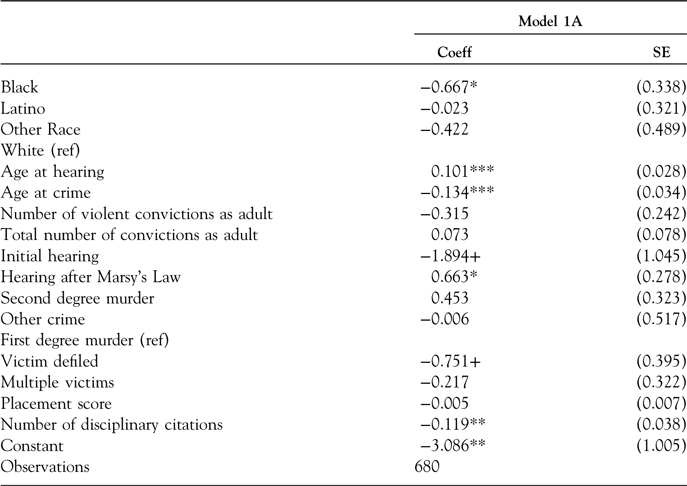
While we believe that the number of disciplinary citations is accurately represented as a mediating variable subject to racial bias on the part of prison wardens and other supervisory personnel, this variable also partly captures objective behavior. Therefore, we also estimated an additional Model, Model 1A, in which we included the number of disciplinary citations along with the demographic and legal variables in Model 1. In this model (shown in the Appendix, Table 1A), the racial disparity between Black parole candidates and white parole candidates remained statistically significant.
Supplemental Logit Model of Granting Parole

*** p<0.001, ** p<0.01, * p<0.05, + p<0.1
RESULTS
Descriptive Statistics
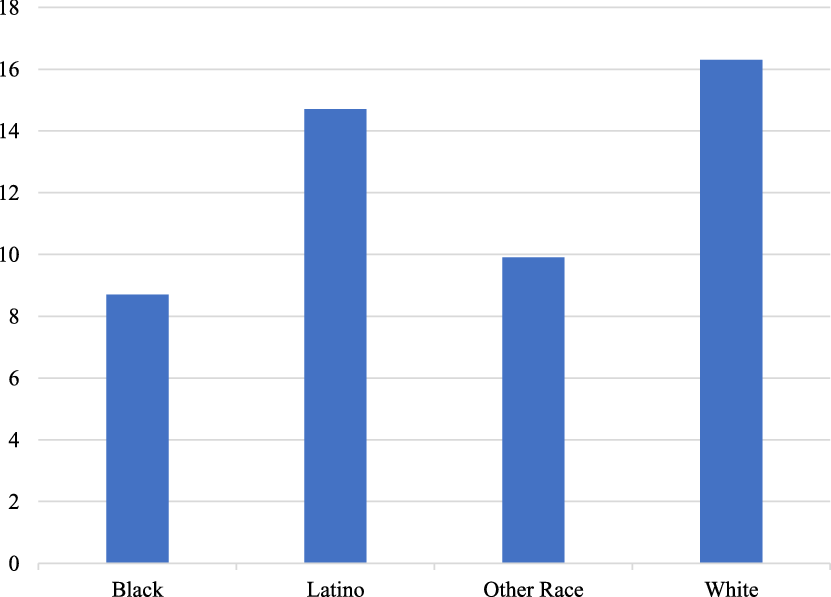
We begin by exploring raw differences in the likelihood of parole for different racial groups. Figure 1 illustrates the percentage of lifer parole candidates who were granted parole, by race. Overall, parole is not a common outcome regardless of race. However, white candidates are the most likely of the four racial groups to be granted parole (17 percent). Black candidates are the least likely to be granted parole (9 percent). The probability that Latino candidates are granted parole is higher than for Black candidates but lower than for white candidates (14 percent).
Percentage of Hearings in which Candidate was Granted Parole, by Race/Ethnicity.

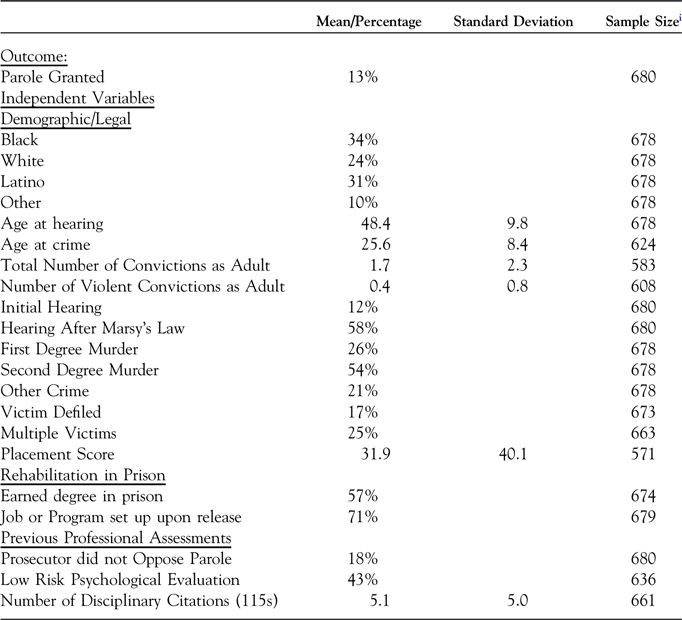
Table 1 shows descriptive statistics for the independent variables. Just over a third of lifer parole candidates are Black, nearly a quarter are white, and just under a third are Latino. The candidate’s average age at the crime was twenty-six years and his average age at the parole hearing was nearly fifty years. All commitment offenses were serious felonies, 26 percent of which were first-degree murder. The average number of prior adult convictions was 1.7, although the average number of prior violent convictions was only 0.4. Most lifer parole candidates engaged in rehabilitative activities in prison. More than half earned a degree (57 percent) and 71 percent had a job or postrelease program lined up before their parole hearing. In terms of prior assessments, prosecutors nearly always opposed parole (82 percent), the average number of serious disciplinary offenses in prison is 5.1, and 43 percent of lifer parole candidates received only “low-risk” assessments on their psychological evaluations.
Descriptive Statistics

i Sample size is the sample on which the means and percentages are calculated. This does not include cases for which the variable was imputed.
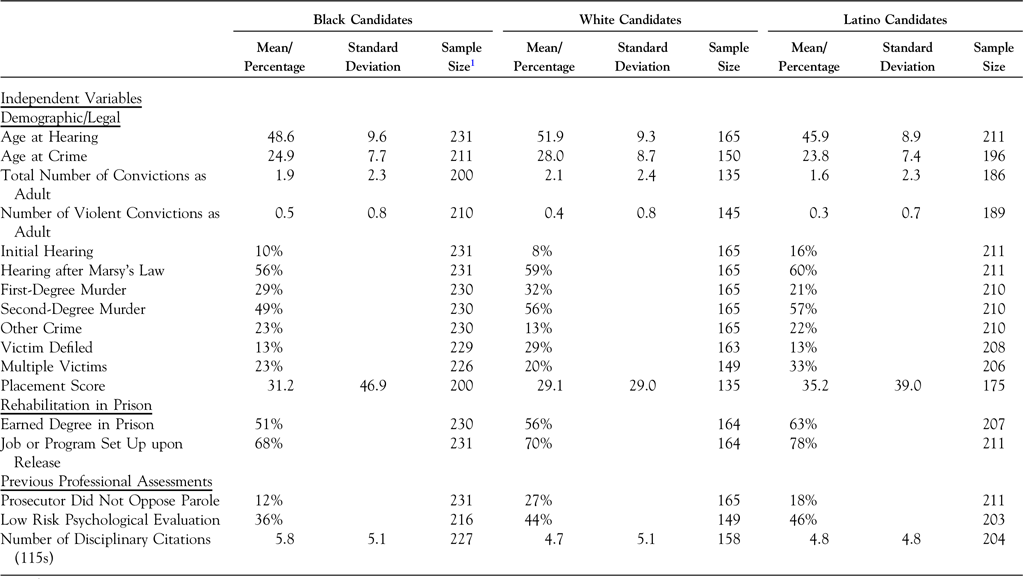
Table 2 presents descriptive statistics for Black, Latino, and white lifer parole candidates. Black, Latino, and white candidates share similar profiles on most of the demographic, legal, and rehabilitation characteristics. One notable difference is that Latino candidates are less likely (by 8–11 percentage points) to be serving life sentences for first-degree murder compared to Black or white candidates. However, Latino candidates are more likely to be serving life sentences for crimes that include multiple victims. They are also the most likely to earn a degree in prison and to have a job or program secured upon release.
Descriptive Statistics by Race

1 Sample size refers to the sample on which the means and percentages are calculated. This does not include cases for which the variable was imputed.
However, there are marked differences among the three racial/ethnic groups in terms of professional evaluations. Prosecutors opposed parole in 88 percent of hearings where the parole candidate was Black and 82 percent of hearings where the candidate was Latino, but only 73 percent of hearings where the candidate was white. Furthermore, only 35 percent of Black candidates but 44 percent of white candidates and 46 percent of Latino candidates were given a low-risk score based on their psychological evaluation. Finally, on average Black candidates received one more disciplinary citation than white or Latino candidates. Thus, in general, the professional assessments given to Latino candidates and white candidates appear to be fairly similar, while Black candidates fare differently in this regard.Footnote 15
Regression Models
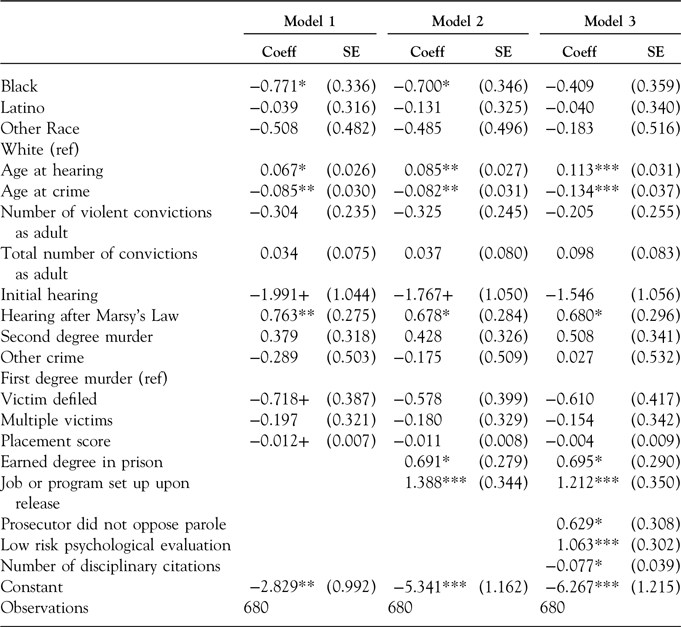
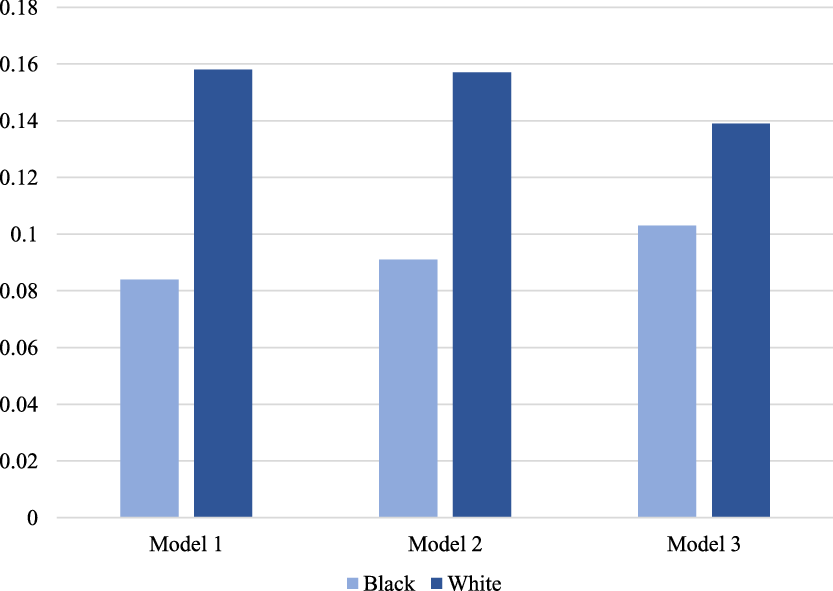
We first examine the impact of demographic characteristics and characteristics of the commitment offense. We see from Model 1 in Table 2 that lifer parole candidates who were older at the hearing and younger at the time of the crime have a higher likelihood of receiving a grant. However, neither the type or characteristics of the commitment offense nor a person’s prior criminal history appear to influence the parole board’s decisions. Additionally, hearings conducted after the implementation of Marsy’s Law are more likely to result in a grant. In Model 1, there is not a significant difference between Latino candidates and white candidates in the likelihood of being granted parole.Footnote 16 However, Black parole candidates have a significantly lower likelihood of receiving a grant than white parole candidates. As shown in Table 3 and Figure 1, using coefficients from Model 1, the predicted probability of a parole grant for white candidates is 15.8 percent. This is nearly twice the predicted probability for Black candidates (8.4 percent).
Logit Models of Granting Parole

*** p<0.001, ** p<0.01, * p<0.05, + p<0.1
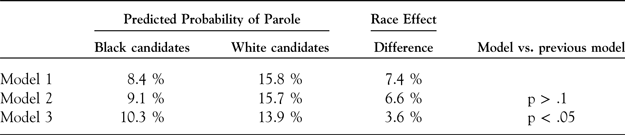
In Model 2, we explore the role of rehabilitative activities. Earning a degree in prison and arranging a postrelease job or program are both associated with an increase in the likelihood of a grant. Thus, it appears that commissioners are more influenced by a person’s rehabilitative efforts in prison than by the nature of the crime or by prior criminal history. The racial patterns evident in Model 1 remain even when rehabilitative activities are accounted for in Model 2. When using coefficients from Model 2, there is only a minimal and statistically insignificant change in these predicted probabilities: 15.7 percent for white parole candidates, compared to 9.1 percent for Black parole candidates. Again, white candidates have nearly twice the predicted probability of receiving a parole grant compared to Black candidates. In Model 2, as in Model 1, Black candidates are at a disadvantage, regardless of the education they obtain in prison or their security of a postrelease employment offer or program placement.
Finally, in Model 3, we examine the impact of prior decisions by criminal justice officials. Prosecutorial opposition to release and number of disciplinary citations are both associated with a decrease in the likelihood of a grant, while a low-risk psychiatric evaluation is associated with an increase in the likelihood of a grant. As Figure 2 and Table 3 show, when the professional assessment variables are accounted for, the difference between Black and white candidates’ likelihood of being granted parole becomes statistically insignificant, though the numbers do not converge; the predicted probabilities are 13.9 percent for white candidates and just over 10 percent for Black candidates.
Predicted Probabilities of Parole Being Granted.

Using the coefficients from Model 2, the difference between Black and white candidates’ predicted probability of receiving parole is 6.6 percentage points. However, when the coefficients from Model 3 are used, the difference between Black and white lifer parole candidates falls to 3.6 percentage points. Thus, the three intervening decisions included in Model 3 account for about 44 percent of the difference between Black candidates’ and white candidates’ likelihood of receiving parole grants. As shown in Table 4, the change between Model 2 and Model 3 in the magnitude of the difference between Black candidates and white candidates is statistically significant (p < .05).
Racial Differences in Predicted Probabilities of Parole Being Granted

DISCUSSION
We find a significant difference between the rate at which Black lifer parole candidates and white lifer parole candidates obtain grants, with Black candidates significantly less likely to be granted parole. As Model 2 shows, this disparity does not seem to be related to racial differences in self-rehabilitation. Indeed, the Black-white gap scarcely narrows between Models 1 and 2. However, in Model 3 the difference between Black candidates’ and white candidates’ chance of receiving a parole grant is cut by nearly 50 percent, suggesting that commissioners’ reliance on prior professional evaluations exerts indirect racial effects on people’s odds of receiving parole grants.
Apart from the significant disparity between outcomes for Black candidates and white candidates in our first two models, which we will discuss in detail below, we found no other racial disparity between white candidates and any other racial groups. This is particularly noteworthy given sentencing research that finds disparities between Hispanic and non-Hispanic white defendants and between white and Latino defendants, but it also echoes Huebner and Bynum’s (Reference Huebner and Bynum2008) work, which found no statistically significant parole decision outcome differences between Hispanic candidates and white candidates. The CDCR’s imprecise racial categorizations may play a role. It is also worth noting that compared to other states with large Hispanic populations, including New Mexico and Arizona, California has a smaller disparity in incarceration rates between its Hispanic population and its non-Hispanic white population (Sentencing Project 2019a). But compared to other states, it has a large Black-white incarceration disparity—nine times the size of its Hispanic-white disparity (Sentencing Project 2019b).
Prior research finds that racial disparities in sentencing are decreased by educational attainment, suggesting that education may insulate offenders from the effects of racial bias (Franklin Reference Franklin2017). Similarly, Freiburger and Hilinski (Reference Freiburger and Hilinski2011) found that race affected probation officers’ recommendations indirectly, partly via education levels. In our results, both rehabilitation variables were significant predictors for parole grants in the expected direction, which aligns with previous work on rehabilitation’s role in parole decisions (see, for example, Ruhland et al. Reference Ruhland, Rhine, Robey and Lyn Mitchell2016). These factors remained significant even when professional assessments were incorporated in Model 3. This suggests that the Black-white disparities we found are not due to differences in the rate at which lifers pursue rehabilitation, and correspondingly suggests that Black lifer parole candidates are less likely to receive parole than white lifer parole candidates who engage in equivalent rehabilitative activities. Of course, our analysis cannot encompass a person’s ability to “perform” rehabilitation, which qualitative work suggests may play an important role (Shammas Reference Shammas2019). Additionally, we were unable to code factors related to physical appearance, which play an important role in shaping perceptions of dangerousness (Johnson and King Reference Johnson and King2017).
Perceptions of Black criminality may contribute to the racial disparities we found. Research on implicit bias finds that Black men are more readily seen as culpable and judged less deserving of empathy than white men who commit the same crimes (Thompson Reference Thompson2010). Our findings suggest a possible flip side: in addition to being seen as more “truly” criminal, Black men may be seen as less “truly” rehabilitated than identically situated white men. If so, they may be held to a higher standard because decision-makers implicitly believe that they have a greater rehabilitative distance to travel. This accords with recent research that directly examines the association between race and perceptions of danger, finding that Black defendants are more likely than white defendants to be perceived as threatening (Johnson and King Reference Johnson and King2017).
Our most striking finding is that nearly half the observed racial inequality owes to parole commissioners’ reliance on prior professional assessments—a kind of decisional scaffolding that leads decision-makers to reach racially disparate conclusions about whom to release. This reliance on previous assessments is particularly noteworthy given national data suggesting that releasing authorities actually claim to find professional assessments less influential than other criteria (Ruhland et al. Reference Ruhland, Rhine, Robey and Lyn Mitchell2016). Parole decision-makers may be unaware of the degree to which professional evaluations actually sway them. Our findings align with other empirical work that has found that the recommendations of wardens and senior corrections officers are persuasive to parole decision-makers (for example, Morgan and Smith Reference Morgan and Smith2005; Goldkamp et al. Reference Goldkamp, Vîlcică, Harris and Weiland2009).
As Baumer (Reference Baumer2013) and Spohn, Brennan, and Kim (Reference Spohn, Brennan, Kim, Jeffery and Mindy2017) note, research on racial bias in the criminal justice system often neglects the ways bias directed toward an offender at certain stages in the criminal justice system influences subsequent decisions for that individual. Even in the research-rich sentencing context, theoretical accounts describe race as having indirect effects on sentencing outcomes but most quantitative models do not test indirect influence (Lynch Reference Lynch2019). Instead, “the pertinent mediators” are used “as controls that must be included to yield a meaningful estimate of the direct effect of defendant race” (Baumer Reference Baumer2013, 253). A similar approach may explain why recent studies of parole detect no significant racial disparity; the indirect effects of race may be masked by professional evaluations’ incorporation alongside other independent variables. For example, Morgan and Smith (Reference Morgan and Smith2008) found no significant racial bias, but found that the most influential variable was prison personnel recommendations. This approach can conceal the structural reality of racial bias—just as Model 3, viewed in isolation, could appear to tell a story in which Black lifers and white lifers have a statistically similar chance of obtaining parole.
The mechanism we identify advances the literature by proposing a set of mediating variables that attempt to operationalize a social mechanism in legal processing that, to our knowledge, has not been examined in the postsentencing context. Criminological research offers a few analogies. Within the sentencing research, Spohn’s 2000 meta-analysis identifies several “process-related” factors that indirectly affect sentence severity, such as bigger sentencing discounts for white defendants represented by private attorneys and for white defendants who provide “substantial assistance” to prosecutors; bigger sentencing penalties are imposed on nonwhite defendants detained pretrial and nonwhite defendants who elect trial over a guilty plea (Spohn Reference Spohn2000, citing Albonetti Reference Albonetti1997, Holmes et al. Reference Holmes, Hosch, Daudistel, Perez and Graves1996, Chiricos and Bales Reference Chiricos and Bales1991, Crew Reference Crew1991, Ulmer and Kramer Reference Ulmer and Kramer1996, and Zatz Reference Zatz1984). But although these factors all fall within the umbrella of “process-related,” they are substantively disparate; for example, “substantial assistance” is a subjective assessment by a prosecutor, while the decision whether to go to trial rests with a defendant. Although several process-related variables were found to contribute indirectly to outcome disparities, they do not necessarily present a theoretically cohesive story about the social mechanisms underlying these disparities. Spohn, Brennan, and Kim also suggest that “the effects of race and ethnicity will manifest themselves in less closely regulated, intermediate decision-making stages of court processing” (2017, 213). They found that two case processing stages had indirect racial effects for female drug offenders. Another approach has been taken by scholars looking at the downstream influence of early-stage prosecutorial decisions, such as charge reduction, which reduces white defendants’ odds of incarceration more than it reduces Black and Latino defendants’ (Johnson and Larroulet Reference Johnson and Larroulet2019; see also Donnelly and MacDonald Reference Donnelly and MacDonald2019 on the relationship between bail and pretrial detention decisions on Black-white disparities in conviction rates).
Our work builds on these findings in the new context of postsentencing criminal justice processes and suggests that racial disparity owes partly to the way legal decision-making is structured (see Lynch Reference Lynch2019; Ulmer Reference Ulmer2019). That is, racially disparate assessments are legitimized via decisional “scaffolding.” Highly subjective judgments, such as psychiatric reports and disciplinary infractions, become part of the official record, and later evaluations build on earlier ones. Every file contains exercises of discretion as “facts.” If a prison guard believes someone is disrespectful and gives him a citation, that parole candidate now “has” a 115. If a psychological evaluation results in a particular score, a parole candidate becomes someone who ‘is’ high-risk. The legitimacy of these determinations is rarely questioned and the psychologists’ decisions are essentially unreviewable. Then these racially disparate assessments are incorporated into the palette of factors on which parole commissioners rely in deciding whether to grant parole.
But reliance on professional evaluations is not a structural necessity. For one, although it makes sense to allow prosecutors to correct the case record, it is unclear why they should weigh in on suitability. Prosecutors possess no expertise about rehabilitation. Additionally, they often face significant political pressure to oppose release, particularly in high-notoriety cases, politically charged cases, or hearings attended by the victim or victim’s next of kin (see Aviram Reference Aviram2020).
The usefulness of the other two professional assessments, psychological evaluations and disciplinary records, is more obviously pertinent to key questions of dangerousness and rehabitability. Nonetheless, these assessments should be contextualized, and commissioners should be educated about the problems they present. For example, commissioners’ training could include education about racial bias and appearance bias in perceptions of discipline and culpability (see Johnson and King Reference Johnson and King2017), so that they better understand psychological evaluations and 115s as exercises of discretion, not facts, and can contextualize them within the larger social structure of prison (Crewe Reference Crewe2011). Although this type of training can seem pro forma, the Board of Parole Hearings has trained commissioners in the past to understand and incorporate complex legal information into their decision-making (Young Reference Young2016, 438). Training grounded in social science has the potential to be useful as well. For example, we might imagine narrowing the influence of 115s by only giving commissioners information about a parole candidate’s most recent infractions, most serious infractions, or certain categories of infractions. Currently, common “major” 115s in California prisons include attempts to maintain ties to friends and family, such as possessing prohibited cell phones (Ghandnoosh Reference Ghandnoosh2020). In recent years, the Board of Parole Hearings has expanded commissioners’ training to include more social science grounding. For example, their training now includes detailed discussions about the role that implicit bias, and particularly cognitive biases related to racial appearance, can play in decision-making. Analyses of more recent parole decisions would enable comparative examination and may provide insight as to whether this training is effective in combating the indirect racial effects we have discussed in this article.
The use of psychological risk assessments is particularly problematic. Although some scholars argue that risk assessments are superior to clinical assessments in terms of predictive accuracy (Goel et al. Reference Goel, Shroff, Skeem and Slobogin2018), they have also been the subject of scrutiny. In addition to shortcomings we have noted in previous sections, including risk assessments’ lack of validation for use with the California lifer population (Isard Reference Isard2017), risk assessments have been found to apply unequally to Black offenders and white offenders in multiple contexts (Harcourt Reference Harcourt2015; Campbell et al. Reference Campbell, Papp, Barnes, Onifade and Anderson2018). Reliably equitable risk assessment tools are in development (see Goel et al. Reference Goel, Shroff, Skeem and Slobogin2018), but existing tools are not always used in fair and equitable ways (Monahan and Skeem Reference Monahan and Skeem2016; Goel et al. Reference Goel, Shroff, Skeem and Slobogin2018; Viljoen, Cochrane, and Jonnson Reference Viljoen, Cochrane and Jonnson2018), nor interpreted accurately (Monahan and Skeem Reference Monahan and Skeem2016; Slobogin Reference Slobogin2018)—and categorical risk assessments, like those used in California, may present interpretive problems (Scurich Reference Scurich2018). California has recently introduced the Structured Decision Making Framework (SDMF) for use in lifer parole hearings. The SDMF is used in a handful of other states and will purportedly guide commissioners about which factors to consider without putting lifers into rigid categories (CDCR 2019). The racial neutrality of the SDMF’s implementation will be an important question for future parole researchers to examine. Updated analyses will be particularly important since, in recent years, the CDCR has more recently taken multiple steps to improve evaluations and to make them more regular and uniform. Additionally, the BPH has held multiple training sessions in 2020 and 2021 to more clearly contextualize these evaluations and explain their meaning to commissioners. Future research should compare the influence of evaluations to assess the impact of these improved measures and more extensive training sessions.
One surprising result is the lack of association between parole grants and prior adult criminal convictions, particularly violent offenses. Commissioners are statutorily tasked with considering a parole candidate’s criminal history, but violent priors were not significant in our results. One possible explanation is that since virtually all lifers’ commitment offenses are violent, this “cancels out” differential levels of violence prior to the commitment offense. Or commissioners may think of violence in binary terms: an person either was or was not violent, but the degree of violence did not matter. Relatedly, we found that the nature of the commitment offense did not influence the results. In all three models, neither the offense nor its heinousness (neither in terms of the number of victims harmed nor whether the victim experienced defilement, although the defilement variable approached significance in Model 1) were significantly associated with a candidate’s chance of receiving a grant. This finding is surprising in light of national survey data that found that parole releasing authority chairs believed that the nature and severity of the commitment offense were the two most important factors in making decisions (Ruhland et al. Reference Ruhland, Rhine, Robey and Lyn Mitchell2016)—as well as in light of a California Supreme Court decision intended to correct this perceived reliance.Footnote 17
Next, recall that our independent variables included Marsy’s Law, a “tough on crime” measure partly intended to keep lifers in prison longer (Appleby Reference Appleby2013; Richardson Reference Richardson2013; Friedman and Robinson 2014). Our results suggest that the law’s passage was correlated with less difficulty, not more difficulty, obtaining a grant, and this effect held across all models. Qualitative work could shed light on the reasons for this effect, but to the extent that it is driven by Marsy’s Law itself, we suspect that it is driven by “wobbler” or “borderline” cases. That is, before Marsy’s Law, if commissioners believed a person was nearly ready for release, they could give him a one-year denial. But under Marsy’s Law, minimum denial lengths were tripled, forcing commissioners to choose between a grant and a three-year denial. Commissioners may tend to resolve close cases in favor of grants. Another explanation is that Lawrence, discussed above, was handed down at approximately the same time and may have contributed to the effect as well.
On their face, California lifer parole hearings seem a well-designed, holistic decision-making process, with all the ideal ingredients for fair results. Commissioners come from different occupational backgrounds, are diverse along race and gender lines, and have varied criminal justice experience in prosecution, criminal defense, and corrections. They undergo regular training and have access to extensive information about each candidate, enabling them to tailor decisions to each person’s unique circumstances, rehabilitative needs, accomplishments, personal lives, and more. Indeed, most research on parole supports a fairly rosy picture, suggesting that commissioners rely on appropriate factors that they are statutorily directed to consider, resulting in no significant racial disparity. By and large, this may be so. But as our analyses reveal, parole decisions are not immune from the racial disparities that plague other areas of criminal justice processing.
Our results demonstrate that attention to racial equity in the parole context is crucial. Not only are there significant racial imbalances within the lifer population already (Nellis Reference Nellis2016, Reference Nellis2017), but as we discussed at the outset, prospective parolees lack many of the procedural and constitutional protections available to offenders at other stages of criminal justice processing. Including a broad palette of information about candidates enables access to substantively useful input, but it may also facilitate decisional scaffolding—which comes at a very steep cost.
CONCLUSION
As Crutchfield, Fernandes, and Martinez have observed, “Disparity may occur at many different points between a person’s first contact with law enforcement and the prison door” (2010). But a great deal less is known about how racial disparities manifest once the prison door is closed. Parole decisions represent a final barrier between a convicted offender’s time in prison and his release back into society. Parole hearings in general, and lifer hearings in particular, affect hundreds of thousands of Americans each year, shaping parole candidates’ lives, families, and home communities.
Our results illustrate how a facially neutral process can perpetuate and legitimize unequal outcomes. In this study, we used three models of decision-making to advance the empirical understanding of parole hearings and found evidence of significant Black-white racial disparities. Drawing on literature from criminology, sociology, and other subfields, we used novel mediating variables to test possible sources of indirect racial influence, and found that nearly half of the Black-white disparity in the odds of receiving a parole grant owed to commissioners’ reliance on professional evaluations by other criminal justice professionals. While our methodological approach does not allow us to draw conclusions about parole commissioners’ subjective goals, our results support the possibility that, like the state judges who engaged in what Clair and Winter called “situational decisionmaking,” parole commissioners “may unintentionally contribute to racial disparities” through a failure to “account for potential differential treatment by other actors” (2016, 354). These social processes form a decisional scaffolding on which law “enables particular forms of discretion, and authorizes racially discriminatory outcomes” (Ocen Reference Ocen, Dolovich and Natapoff2017). To understand these outcomes, we must understand the mechanisms that produce them (Van Cleve, and Mayes Reference Van Cleve and Mayes2015).
It is also important to acknowledge drawbacks to our approach. The degree to which our findings generalize from lifer hearings to all parole hearings, or from California to other states, is unknown, and more research is needed to answer these questions. Our operationalization of several variables was also necessarily blunter than we would have preferred. Specifically, we would have liked to be able to look in more detail at program participation and job placement variables; to know more about parole candidates’ social histories; to know which psychological evaluation was most recent; and to capture demographic differences such as developmental disabilities and language barriers. A larger sample and better information about people’s race would have also allowed a more detailed examination of the factors that predict hearings for lifer parole candidates who are not Black, Latino, or white. Researchers’ ability to empirically investigate parole hearings would be greatly improved by the kind of record keeping already done in many sentencing contexts. As it is, our imperfect approach took years of time and the devotion of considerable resources. Getting an empirical picture of a theoretically “public” process should, frankly, be easier. Additionally, more contemporary analyses can assess the effects of more recent changes to California law, such as Proposition 57, which enabled the CDCR to give sentencing credits to offenders for educational and other rehabilitative achievements (Meyers and Rossetta Reference Meyers and Rossetta2020, 2), and the development of new postrelease initiatives for long-term offenders.
The postsentencing stages of criminal justice processing constitute an important, growing, and largely invisible frontier in the research on mass incarceration. Though racial disparities may be more blatant at earlier stages of criminal justice contact, our findings shed light on how race can shape criminal justice decision-making in subtler ways at later stages—and with similarly devastating effects. Processes related to parole grants and parole release, as well as in-prison determinations such as administrative segregation, are cornerstones of the carceral landscape and deserve more empirical attention. While some justice decisions are made by lawyers and judges and take place in courtrooms and law offices, others are made by civil servants and take place in dusty meeting rooms. For the people whose lives are shaped by the processes therein, the latter are no less important.