Nuclear power plant accidents affect the long-term mental health of residents in neighboring communities. Reference Bromet, Havenaar and Guey1 , Reference Bromet2 One of the factors relating to their long-term mental health is radiation anxiety, that is, anxiety about radiation’s adverse health effects. Correlations of radiation anxiety and poor mental health have been repeatedly reported after nuclear power plant accidents previously occurred in Three Mile Island Reference Dew and Bromet3 , Reference Goldsteen, Schorr and Goldsteen4 and Chernobyl, Reference Adams, Guey and Gluzman5,Reference Bromet, Gluzman and Schwartz6,Reference Bromet, Litcher-Kelly, Havenaar, Cwikel and Bromet7 as well as after the Fukushima nuclear power plant accident. Reference Fukasawa, Kawakami and Umeda8-Reference Suzuki, Takebayashi and Yasumura14
Because of the invisibility of radiation and its adverse health effects, which might emerge several years later, people’s anxiety seems to have been greatly impacted by the information on radiation to which they have been exposed since the nuclear power plant accident. Reference Murakami, Nakatani and Oki15-Reference Yumiya, Murakami and Takebayashi19 Among the various media types used to acquire information, identifying which media was related to radiation anxiety is the first step in examining the effects of information on radiation anxiety. Furthermore, identifying specific media related to radiation anxiety might provide suggestions as to how to respond to radiation anxiety through the media.
A previous study, which was based on the same sample as this one, found that the use of websites was related to higher anxiety about one’s health, whereas the use of local TV news was related to lower anxiety. Reference Nakayama, Sato and Sugita16 However, this previous study focused on the use of individual media, without controlling for the parallel use of other types of media. Sugimoto et al. Reference Sugimoto, Nomura and Tsubokura18 examined the relationships between media frequently used to obtain information about the Fukushima nuclear disaster and radiation anxiety; the study revealed that different types of media were related to different aspects of radiation anxiety. They reported that the use of national newspapers was related to lower fears for the future (eg, concerns for effects on employment, income, and infertility), whereas the use of regional newspapers was related to higher fears for the future. In addition, the use of radio was related to fears about social disruption (eg, concerns for media information and future evacuation orders), and the use of rumors was related to fears about radiation and health (eg, concerns for food and water safety and danger of daily radiation exposure). Their study subjects, however, were limited to radiation-health seminar participants, who were probably highly interested in and eager to learn about these problems. Therefore, the generalizability of their findings is limited.
In addition to radiation anxiety regarding health, residents in Fukushima have reported anxiety about interpersonal conflicts, perceived stigma, prejudice, discrimination, and bullying among children after the nuclear power plant accident, which seem to stem from radiation anxiety regarding health. Reference Maeda and Oe20,Reference Ohto, Yasumura and Maeda21,Reference Sawano, Nishikawa and Ozaki22 These kinds of anxiety and experiences have been reported anecdotally and seem to be strongly affected by media reporting; however, their relationships regarding the use of media have not been examined.
In this study, we aimed to reveal frequently used media for obtaining information on radiation among community residents in Fukushima prefecture, 5.5 years after the nuclear power plant accident and, among them, to examine the relationships between the type of media used and radiation anxiety regarding health and regarding discrimination and prejudice. This study extends our earlier study on radiation anxiety for one’s health Reference Nakayama, Sato and Sugita16 by adjusting for the parallel use of several types of media and providing additional focus on radiation anxiety regarding discrimination and prejudice due to radiation exposure.
METHODS
Study Design and Population
We conducted a cross-sectional questionnaire survey from August to October 2016, about 5.5 years after the accident, among randomly sampled community residents in Fukushima prefecture. Its details have been reported elsewhere. Reference Kuroda, Iwasa and Orui23 Briefly, in the present study, we divided Fukushima prefecture into 4 areas: (1) the evacuation zone, the area near the nuclear power plant designated as such by the Japanese government; (2) the eastern coastal area (Hama-dori), excluding the evacuation zone; (3) the central area in the prefecture (Naka-dori), excluding the evacuation zone; and (4) the western mountainous area (Aizu). From each area, we randomly sampled 500 residents ages 20 to 79 years old and sent the questionnaire to 2000 residents in total.
Study Variables
Radiation Anxiety
We defined radiation anxiety as negative cognitions and perceptions, such as worry and anxiety about the possible adverse health effects of radiation exposure, and related psychosocial problems such as perceived stigma and discrimination due to radiation exposure. Reference Fukasawa, Kawakami and Umeda8 Current radiation anxiety was assessed using the 7-item Radiation Anxiety Scale developed and validated by Umeda et al. Reference Umeda, Sekiya and Kawakami24,Reference Kawakami25 The details of this scale have been reported previously. Reference Fukasawa, Kawakami and Umeda8 The scale was suggested to consist of 2 factors by a factor analysis; the first factor included 4 items measuring anxiety for adverse health effects, and the second factor included 3 items measuring anxiety regarding discrimination, prejudice, and interpersonal conflicts due to radiation exposure. Reference Umeda, Sekiya and Kawakami24 , Reference Kawakami25 This 2-factor structure was also confirmed in our study sample. Reference Maeda and Oe20 Therefore, in this study, we addressed these 2 dimensions of current radiation anxiety, using subscale scores corresponding to the 2 factors; we named these 2 dimensions, radiation anxiety regarding health and radiation anxiety regarding discrimination and prejudice. The subscale for radiation anxiety regarding health consisted of items such as “I am concerned about getting a serious illness in the future due to the effects of radiation” and “I am concerned that radiation effects can be inherited by the next generation, such as our children and grandchildren.” The subscale for radiation anxiety regarding discrimination and prejudice consisted of items such as “I have had the experience of being discriminated against (or unfairly treated) because I lived in the area that is reported to have high levels of radiation.” The items were rated on a 4-point Likert scale from 1 (strongly disagree) to 4 (strongly agree), and the item scores were summed to obtain a total score. The score for the subscale of radiation anxiety regarding health ranged from 4 to 16 and that for radiation anxiety regarding discrimination and prejudice ranged from 3 to 12; higher scores indicated higher levels of radiation anxiety.
Use of Media
We asked questions about the respondents’ current use of media for acquiring information about radiation. We listed 12 sources of information (local newspaper, national newspaper, non-commercial TV news by the Japan broadcasting corporation [Nippon Hoso Kyokai: NHK], local commercial TV news, national commercial TV news, radio, Internet news, websites, social networking sites [SNS], magazines or books, local government newsletters, and word of mouth via friends or relatives) and asked respondents to choose no more than 3 that they used most frequently to acquire information on radiation.
Sociodemographic Characteristics
The sociodemographic characteristics included in this study were age, sex, educational attainment, and residential area. We also asked whether respondents had a family member under 18 years old or who was pregnant at the time of the nuclear power plant accident.
Anxiety Immediately After the Accident
The degree of anxiety for the health effects of radiation felt immediately after the nuclear power plant accident was assessed using a single-item scale, with response options ranging from 1 (none) to 5 (extreme).
Statistical Analysis
First, we calculated descriptive statistics of our study subjects, including sociodemographic characteristics, use of media, degree of anxiety immediately after the nuclear power plant accident, and current radiation anxiety. Regarding the use of media, we added a calculation stratified by age.
Second, we examined bivariate correlations of sociodemographic characteristics, use of media, and degree of anxiety immediately after the accident with 2 dimensions of current radiation anxiety, using single regression analyses. Next, we examined correlations of the use of media with current radiation anxiety, controlling for sociodemographic characteristics and anxiety immediately after the accident, using multivariate linear regression analyses. We included all of the media (12 variables) simultaneously in the model to adjust for overlapping usage of several types of media.
All statistical analyses were performed using Stata 15 for Windows (StataCorp LP, College Station, TX). The statistical significance was set at 0.05, and all tests were 2-tailed.
Ethical Considerations
All procedures followed were in accordance with the Declaration of Helsinki and its later amendments. The study protocol was reviewed and approved by the Ethics Committee of Fukushima Medical University (approval number: 2699).
RESULTS
Among the initial 2000 subjects, 916 individuals responded; we used the 790 responses (39.5%) without missing information on the study variables.
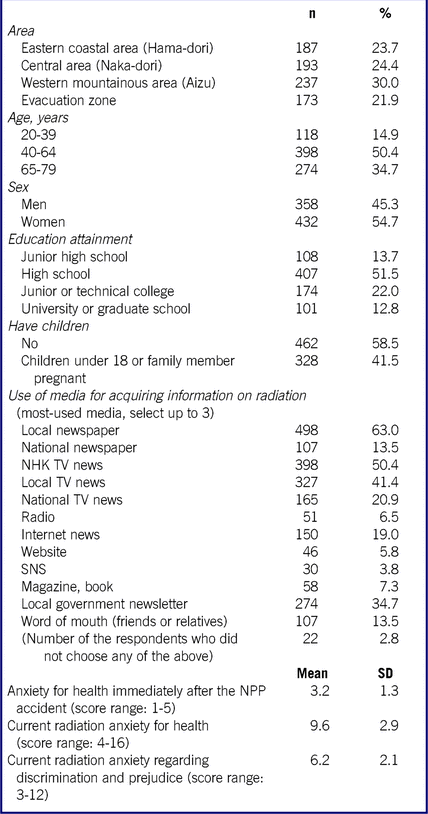
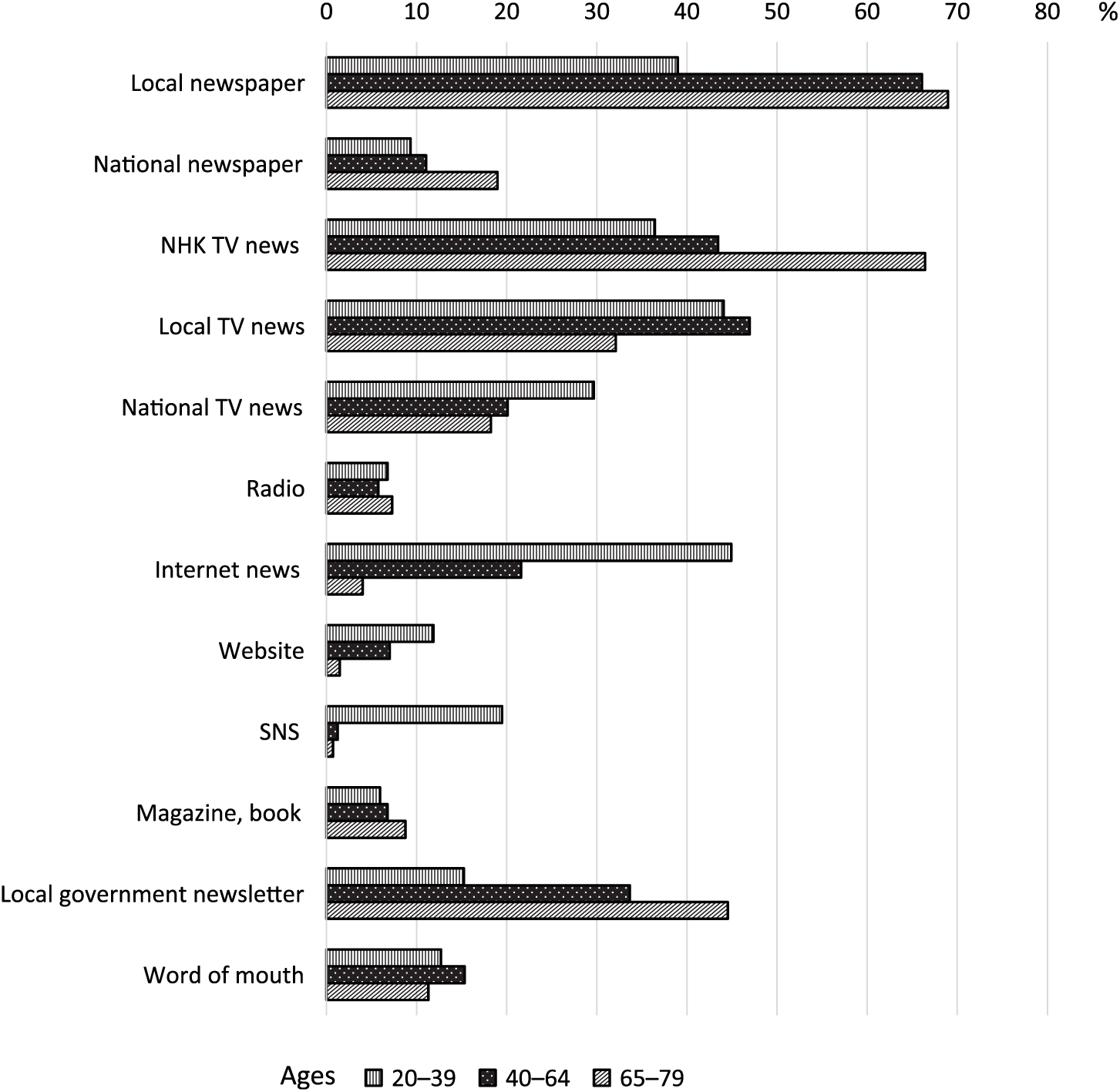
Table 1 reports the descriptive statistics of sociodemographic characteristics, use of media, the degree of anxiety immediately after the nuclear power plant accident, and the current radiation anxiety of our study subjects. Regarding the most-used media to acquire information on radiation, our study subjects frequently chose local newspapers, NHK TV news, local TV news, and local government newsletters. Figure 1 shows usage of these media stratified by age. It reveals that local newspapers, NHK TV news, and local government newsletters were chosen frequently by the older population, ages 65 and over, with more than 60% of them choosing local newspapers and NHK TV news. The middle-aged population tended to choose local newspapers and NHK or local TV news, with more than 60% choosing local newspapers. Conversely, the choices of the young population, less than 40 years old, were dispersed, with more than 40% choosing Internet news and local TV news. Local newspapers and NHK TV news were chosen by less than 40%.
Demographic Characteristics, Use of Media, and Radiation Anxiety of the Study Participants (n = 790)

NPP = nuclear power plant; SD = standard deviation; SNS = social networking sites.
Use of Media for Acquiring Information on Radiation by Age

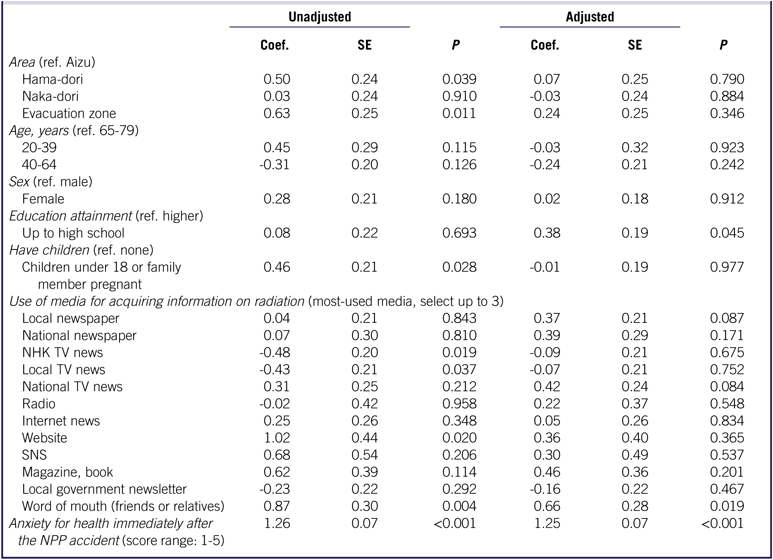
Table 2 reports the relationships of sociodemographic characteristics, use of media, and anxiety immediately after the accident with current radiation anxiety regarding health. Residents in Hama-dori and the evacuation zone had higher radiation anxiety regarding health, compared with the residents in Aizu. The respondents who had a child under 18 years old had higher radiation anxiety. Those who felt higher anxiety for health in the immediate aftermath of the accident also had higher current radiation anxiety. Concerning the use of media, those who acquired information on radiation through websites had higher radiation anxiety regarding health than those who did not choose it as their most-used media. Those who acquired information on radiation through word of mouth (friends or relatives) also had higher radiation anxiety regarding health than those who did not choose it. Those who chose NHK TV news and local TV news had lower radiation anxiety. After controlling for sociodemographic characteristics, anxiety immediately after the accident, and parallel use of other types of media, acquiring information on radiation mainly by word of mouth (friends or relatives) was related to higher radiation anxiety regarding health.
Relationships of the Use of Media With Radiation Anxiety for Health (n = 790)

Coef. = coefficient; NPP = nuclear power plant; ref. = reference; SE = standard error; SNS = social networking sites.
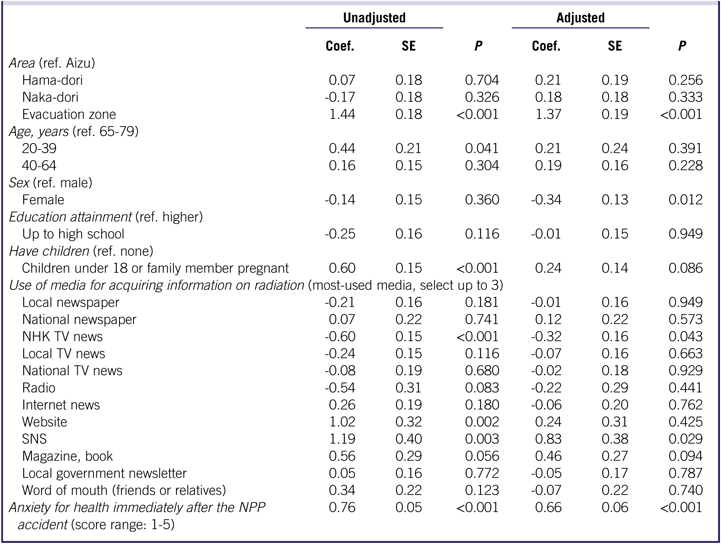
Table 3 reports the relationships of the corresponding variables with current radiation anxiety regarding discrimination and prejudice. Residents in the evacuation zone had higher radiation anxiety regarding discrimination and prejudice compared with the residents in Aizu. Young respondents and those who had a child under 18 years old had higher radiation anxiety. Those who felt higher anxiety for health immediately after the accident had higher current radiation anxiety regarding discrimination and prejudice. Concerning the use of media, those who acquired information on radiation through websites had higher radiation anxiety regarding discrimination and prejudice than those who did not choose it as their most-used media. Those who acquired information on radiation through SNS also had higher radiation anxiety regarding discrimination and prejudice than those who did not choose it as their most-used media. Those who chose NHK TV news had lower radiation anxiety than those who did not choose it. After controlling for sociodemographic characteristics, anxiety immediately after the accident, and the parallel use of other types of media, acquiring information on radiation mainly by SNS was related to higher radiation anxiety regarding discrimination and prejudice, and NHK TV news was related to lower radiation anxiety.
Relationships of the Use of Media With Radiation Anxiety Regarding Discrimination and Prejudice (n = 790)

Coef. = coefficient; NPP = nuclear power plant; ref. = reference; SE = standard error; SNS = social networking sites.
DISCUSSION
The elderly population frequently chose local newspapers, NHK TV news, and local government newsletters as the most-used media to acquire information on radiation. The middle-aged population chose local newspapers and NHK and local TV news, and the young population chose Internet news and local TV news. Concerning the relationships between the use of media and radiation anxiety, acquiring information on radiation by word of mouth (eg, from friends or relatives) was related to higher radiation anxiety regarding health. As for radiation anxiety regarding discrimination and prejudice, using SNS was related to higher anxiety, whereas acquiring information through NHK TV news was related to lower anxiety.
Our study revealed that higher radiation anxiety regarding health was related to acquiring information on radiation by word of mouth (friends or relatives), but not related to other types of media. This is consistent with the results of a previous study, which reported that obtaining information about a nuclear disaster through rumors was related to higher fears about radiation and health, whereas other types of media were not. Reference Sugimoto, Nomura and Tsubokura18 It is also consistent with the result of another study conducted after the 2011 Fukushima nuclear power plant accident by Murakami et al., Reference Murakami, Nakatani and Oki15 which suggested that those who trusted direct information from friends perceived a higher radiation risk for health. Among studies exploring the social amplification of risk perceptions conducted in other contexts, a study on residents’ wildfire risk perceptions indicates that receiving information from non-experts – neighbors, friends, or family members – and talking about the risks with neighbors were related to higher risk perceptions, whereas receiving information from the media was not. Reference Brenkert-Smith, Dickinson and Champ26 Another study on risk perception related to a biological research facility reports that people who engaged in more frequent discussions of it perceived higher risk. Reference Binder, Scheufele and Brossard27 Exchange of information concerning radiation risks with those around them might increase people’s perceived risk and amplify their radiation anxiety regarding health. However, these findings were inconsistent with those of our previous study reported by Nakayama et al. Reference Nakayama, Sato and Sugita16 In that study, whereas acquiring the information by word of mouth was not significantly associated with radiation anxiety regarding health, the use of websites was associated with higher anxiety regarding health, and the use of local TV news was associated with lower anxiety. In the present study, our results were partly consistent with these in an unadjusted model; that is, the use of websites was positively correlated, and the use of local TV news was negatively correlated, with the level of radiation anxiety regarding health. Therefore, one of the reasons for this inconsistency might stem from the confounding effects of the other types of media simultaneously used, which were not controlled for in our previous study. Reference Nakayama, Sato and Sugita16
Using SNS to acquire information on radiation was related to higher radiation anxiety regarding discrimination and prejudice. Using SNS could be an opportunity to see the individual responses of people outside of the Fukushima prefecture to radiation or the nuclear power plant accident, which might contain more discriminatory or prejudicial messages toward them. One study conducted after a natural disaster suggests that people who used social media to learn about the disaster had more posttraumatic stress symptoms, compared with those who used only traditional media such as newspapers, radio, and television. Reference Goodwin, Palgi and Hamama-Raz28 Use of SNS to acquire information about a disaster may have adverse effects on post-disaster mental health.
Acquiring information through NHK TV news was related to lower anxiety regarding discrimination and prejudice. NHK runs non-commercial public broadcasting, and its broadcast contents are considered to be neutral and carefully checked so as to not imply any kind of discrimination or prejudices. Therefore, watching NHK TV news might not increase radiation anxiety regarding discrimination or prejudice, compared with the other types of media.
Local newspapers, NHK TV news, and local TV news were used frequently to acquire information about radiation by all age groups. Local newspapers and local TV news were chosen more frequently than national newspapers and national TV news, which seems to represent the trust of residents in local media. A gap was reported between a topic reported in the national television networks and the general feeling among the people of Fukushima. Reference Ohmori29 In contrast to national media, individuals working for local media were, in most situations, the residents of Fukushima, whose lives had also been affected heavily by the nuclear power plant accident, and who seemed to be sharing the needs and concerns of the local community. In addition, the elderly population tended to use local government newsletters, which seems to represent their trust in the local government. The younger population tended to use Internet news, which seems to reflect the accessibility of their devices. These frequently used media, which mainly provide one-way information, were not related to radiation anxiety. Therefore, we could neither find suggestions for identifying possible information that had affected radiation anxiety nor for responding to radiation anxiety through the media by providing tailored contents for those using specific media.
This study has several limitations, requiring a careful interpretation of the results. First, it was a cross-sectional study and discussions on causal relationships were limited. We discovered a possibility that acquiring information on radiation by word of mouth and using SNS increased radiation anxiety; however, it was possible that people with higher radiation anxiety tended to use these information sources because of dissatisfaction with the other types of media providing authoritative or official information. Second, while we revealed the relationships between most-used media and radiation anxiety, we could not identify any contents relating to radiation anxiety. Especially regarding websites and SNS, these contain a wide variety of information provided by authoritative experts to lay people without any specialized knowledge. This mixture of information might affect our results. Third, we did not have information on the respondents’ length of exposure to each media. Longer exposure to media coverage on a disaster is suggested to relate with poorer psychological outcomes after a disaster, Reference Pfefferbaum, Newman and Nelson30 which might confound our results. Fourth, although we adjusted for the possible confounding effects of anxiety for health immediately after the nuclear power plant accident, the single-item scale used might not be able to fully capture it, and its confounding effects might still affect the associations between the use of media and current radiation anxiety even after being adjusted for them.
CONCLUSIONS
We conducted a cross-sectional questionnaire survey 5.5 years after the Fukushima nuclear power plant accident for a representative sample of community residents in the Fukushima prefecture. Acquiring information on radiation by word of mouth was related to higher radiation anxiety regarding health, whereas using SNS was related to higher radiation anxiety regarding discrimination and prejudice. Acquiring information mainly through NHK TV news was related to lower anxiety regarding discrimination and prejudice. Although the types of media primarily providing one-way information, such as newspapers, TV or Internet news, and governmental newsletters, were frequently used, they were not related to radiation anxiety. Interpersonal interactions within relatively restricted groups, such as friends or relatives or connections through SNS, might increase or maintain anxiety regarding radiation among residents of neighboring communities affected by the nuclear power plant accident.
Financial Support
This work was supported by the Japan Society for the Promotion of Science (JSPS) KAKENHI (Grant Number 15K08810), Research Center for Radiation Disaster Medical Science – Projects Responding to Fukushima Nuclear Power Plant Accident 4 (Research on Risk Communication Regarding Radiation Disasters), and Research on the Health Effects of Radiation, organized by the Ministry of the Environment, Japan.
Authors’ Contributions
MF analyzed and interpreted the data and drafted the manuscript. CN and SY planned and managed the survey. NK, CN, and SY revised the draft for important intellectual content. All authors read and approved the final manuscript.
Conflict of Interest Statement
The authors have no conflicts of interest to declare.