INTRODUCTION
Semantic memory (general knowledge about the world) is distinguished from episodic memory (memory for personally experienced events) (Tulving, Reference Tulving1972). Although these two systems were shown to be dissociable by a large body of neuropsychological studies, they are thought to interact (Fang, Rüther, Bellebaum, Wiskott, & Cheng, Reference Fang, Rüther, Bellebaum, Wiskott and Cheng2018; Greenberg & Verfaellie, Reference Greenberg and Verfaellie2010). Notably, healthy individuals’ episodic memory encoding and retrieval processes are enhanced when the to-be-remembered new information can be integrated within and is consistent with pre-existing knowledge about the world, schemas, which provides an organizational structure to support learning (Bartlett, Reference Bartlett1932; Bird, Davies, Ward, & Burgess, Reference Bird, Davies, Ward and Burgess2010; Greve, van Rossum, & Donaldson, Reference Greve, van Rossum and Donaldson2007; Hemmer & Steyvers, Reference Hemmer and Steyvers2009).
Intact semantic knowledge can also support declining episodic memory. For instance, in normal aging, semantic memory either improves or remains stable (Umanath & Marsh, Reference Umanath and Marsh2014), whereas episodic memory declines, partly due to difficulties in forming and retrieving associations between elements (Naveh-Benjamin, Reference Naveh-Benjamin2000). Critically, the age-related associative memory deficit can be diminished when the to-be-learnt associations are congruent with prior knowledge (semantically related word pairs, Naveh-Benjamin, Hussain, Guez, & Bar-On, Reference Naveh-Benjamin, Hussain, Guez and Bar-On2003; Patterson, Light, Van Ocker, & Olfman, Reference Patterson, Light, Van Ocker and Olfman2009; groceries-price associations, Castel, Reference Castel2005; age-face associations, McGillivray & Castel, Reference McGillivray and Castel2010; name-adjective associations, Smyth & Naveh-Benjamin, Reference Smyth and Naveh-Benjamin2018; objects in relational learning tasks, Ostreicher, Moses, Rosenbaum, & Ryan, Reference Ostreicher, Moses, Rosenbaum and Ryan2010; Ryan et al., Reference Ryan, D’Angelo, Kamino, Ostreicher, Moses and Rosenbaum2016). When semantic support can be used as a strong cue of past exposure, older individuals perform memory tasks as efficiently as younger individuals.
Older adults’ overreliance on their prior knowledge could be explained either by the strength of pre-existing knowledge relative to recent episodic memories, or by its greater accessibility in memory (Umanath & Marsh, Reference Umanath and Marsh2014). Similar results were put forward in medial temporal lobe amnesia. For instance, Kan, Alexander, and Verfaellie (Reference Kan, Alexander and Verfaellie2009) demonstrated that amnestic patients’ episodic memory was enhanced when the to-be-remembered information (objects and prices) could be anchored within pre-existing knowledge, provided that semantic memory was preserved (see also Moses et al., Reference Moses, Ryan, Bardouille, Kovacevic, Hanlon and McIntosh2009). Conversely, an impairment in semantic knowledge could impair the acquisition of new episodic memories (Fang et al., Reference Fang, Rüther, Bellebaum, Wiskott and Cheng2018; Greenberg & Verfaellie, Reference Greenberg and Verfaellie2010). Such findings thus have implications for rehabilitation strategies for individuals with memory disorders.
A predominant impairment of episodic memory is also observed early in the course of Alzheimer’s disease (AD) and includes an alteration of associative memory (Bastin et al., Reference Bastin, Bahri, Miévis, Lemaire, Collette, Genon and Salmon2014; Gallo, Sullivan, Daffner, Schacter, & Budson, Reference Gallo, Sullivan, Daffner, Schacter and Budson2004; Sperling et al., Reference Sperling, Bates, Chua, Cocchiarella, Rentz, Rosen and Albert2003; Wolk, Signoff, & DeKosky, Reference Wolk, Signoff and DeKosky2008). In autobiographical memory, AD is accompanied by a shift from episodic to semantic memories (El Haj, Antoine, Nandrino, & Kapogiannis, Reference El Haj, Antoine, Nandrino and Kapogiannis2015), suggesting that semantic memory could compensate for the deteriorated episodic memory. However, to our best knowledge, few studies have investigated whether AD patients could benefit from prior-knowledge in episodic memory (Backman & Herlitz, Reference Backman and Herlitz1990; Lipinska, Backman, & Herlitz, Reference Lipinska, Backman and Herlitz1992). These studies showed that AD patients benefitted from prior knowledge in memory only when they were encouraged to generate elaborative statements at encoding, such that it probably increased prior-knowledge activation. Nevertheless, these works assessed item rather than associative memory. No study has investigated whether AD patients could benefit from prior-knowledge to support their markedly impaired associative recognition.
One potential reason for this lack of investigation could be that AD patients actually do demonstrate a progressive deficit in semantic memory (Chertkow, Whatmough, Saumier, & Duong, Reference Chertkow, Whatmough, Saumier and Duong2008; Laisney, Desgranges, Eustache, & Giffard, Reference Laisney, Desgranges, Eustache and Giffard2010; Rogers, Ivanoiu, Patterson, & Hodges, Reference Rogers, Ivanoiu, Patterson and Hodges2006). Still, semantic memory is not uniformly affected in AD. A central debate concerning semantic memory decline in AD concerns the contribution of semantic memory access difficulties (i.e., semantic retrieval), semantic knowledge deterioration (i.e., semantic content) and/or semantic process dysfunction (i.e., semantic regulation) (Reilly, Peelle, Antonucci, & Grossman, Reference Reilly, Peelle, Antonucci and Grossman2011). Some authors proposed that semantic impairment in early AD is attributed to retrieval difficulties, followed by semantic storage alteration with the evolution of the disease (Cardebat, Aithamon, & Puel, Reference Cardebat, Aithamon and Puel1995). Those accounts are thus not mutually exclusive in explaining semantic deficits in AD (Rogers & Friedman, Reference Rogers and Friedman2008).
Among semantic knowledge deterioration theories, some researchers proposed that, as AD progresses, semantic memory follows a bottom-up degradation, with subordinate attributes (e.g., functional and perceptual features) declining before superordinate knowledge (e.g., categorical features) (Bottom-up Process Theory; Huff, Corkin, & Growdon, Reference Huff, Corkin and Growdon1986). Furthermore, there is a category effect whereby AD preferentially affects living things compared with manufactured objects (Chertkow et al., Reference Chertkow, Whatmough, Saumier and Duong2008), possibly due to the small semantic distance between living concepts (Zannino et al., Reference Zannino, Perri, Pasqualetti, Paola, Caltagirone and Carlesimo2006).
In this context, the present study assessed whether mild AD patients’ associative memory could be improved when the to-be-learnt associations could be anchored within preserved prior-knowledge (here, categorical relationship between words), similar to amnesia or healthy aging. We predicted that the benefit from prior-knowledge in associative memory in AD patients would vary as a function of the relative integrity of their semantic memory.
METHODS
Participants
Twenty-one participants with a diagnosis of probable mild AD (Mini Mental State Examination score>21; range: 22–28; M=24.57; SD=1.75) and 21 control participants took part in the experiment (see Table 1). All participants were native French speakers. AD patients were all at a mild dementia stage and suffered from memory impairments (amnestic subtype). They were recruited from the Memory Clinic (Liège) and voluntarily participated in the study. Clinical AD diagnosis was made according to the guidelines provided by the National Institute on Aging-Alzheimer’s Association workgroups (McKhann et al., Reference McKhann, Knopman, Chertkow, Hyman, Jack, Kawas and Phelps2011). No detailed and systematic neuropsychological information regarding AD patients was available from the Memory Clinic because cognitive assessment varied from one patient to another.
Mean demographics and group differences.

Exclusion criteria were additional neurological or psychiatric disorder, systemic disease as well as any medication that could negatively interfere with their cognitive functioning. Healthy older adults were recruited from the Liège area. None of them reported neurological or psychiatric history, nor did they show any sign of cognitive decline, as assessed with the Mattis Dementia Rating Scale, which indicated better performance in older adults compared with AD patients (scores were unavailable for two AD patients). The two groups were matched in terms of age and education. All participants gave a written informed consent and the study was approved by the Ethics Committee of the Faculty of Psychology of the University of Liège.
Materials
A total of 144 words were selected among the most frequently generated words in response to a category term (free association norms, Dubois & Poitou, Reference Dubois and Poitou2002). The words belonged to 10 different semantic categories representing either natural (n=5: animals, trees, vegetables, flowers, occupations) or manufactured (n=5: drinks, tools, toys, vehicles, clothes) elements. Thirty related word pairs were created by organizing 6 words from each category into three pairs (e.g., tomato-cucumber, turnip-celery, leek-spinach). The pairs were selected to form categorical associations only, and phonological resemblance between words of a same pair was controlled for by avoiding syllables repetition from one word to the other.
Thirty unrelated word pairs were created by combining words from different categories (e.g., willow-rattle, pea-horse, brain-tram). Each word was presented only once during encoding, either in a related or in an unrelated combination. Recombined pairs for the associative memory test were created by switching words across the studied pairs, within a same category for the related pairs or across categories for the unrelated pairs (e.g., tomato-celery for related pairs or mouse-harp for unrelated pairs). The remaining words served as stimuli for the practice session (24 words) and to test item memory in a separate “item test” (3 new words from a studied category and 3 new unrelated words in each list).
The 30 related and 30 unrelated word pairs were divided in two lists, each comprising 15 related and 15 unrelated word pairs, in such a way that five categories appeared in one list, but not in the other. The two lists were used to create two study-test cycles. The order of presentation of the lists, the status of the pairs as intact or recombined in the memory tests, as well as the order of item and associative memory tests (see Procedure below) were counterbalanced across participants. The order of pair presentation within each list was randomized.
To ensure that the pairs matched with their relatedness condition (semantically related or unrelated), we asked 10 other participants (age: M=28.72; SD=15.04) to rate the relatedness of each pair on a Likert scale from 1 (completely unrelated) to 10 (completely related). The pairs with a mean higher than 7 were classified as related, and those lower than 4 as unrelated pairs.
Procedure
Participants were tested individually. Stimuli were presented on a laptop computer using the E-Prime software. Two study-test cycles were completed with a short break (2 min) in-between. For each cycle, the encoding phase comprised 30 word pairs intermixing 15 related and 15 unrelated pairs. Each pair was presented for 6 s, with a 1-s inter-stimuli interval composed of a 500-ms blank screen followed by a 500-ms fixation cross. Study instructions were intentional and the participants knew that their memory would be assessed. During the retention interval, participants had to count backward during 1 min. Two yes–no recognition memory tests followed, one “item test” assessing memory for single items, thought to be better preserved in AD than associative memory, and one “associative test” assessing memory for the associations between items. Responses were self-paced. In the item test, participants viewed 18 words (6 old from related pairs, 6 old from unrelated pairs, 3 new related to a studied category, 3 new unrelated to any studied category). They had to decide whether each word had been previously presented.
In the associative recognition memory test, 24 word pairs were presented: 12 related (6 intact and 6 recombined) and 12 unrelated (6 intact and 6 recombined). For each pair, participants had to indicate whether they had seen the exact same pair at encoding (intact) or not (recombined). Before the task, there was a practice session to familiarize the participants with the procedure.
We also assessed the integrity of patients’ semantic knowledge using the French version of the Semantic Knowledge Questionnaire (SKQ, Simoes Loureiro & Lefebvre, Reference Simoes Loureiro and Lefebvre2015). This questionnaire was initially created by Laiacona, Barbarotto, Trivelli, and Capitani (Reference Laiacona, Barbarotto, Trivelli and Capitani1993) and assesses semantic memory according to the Bottom–up Process Theory (Huff et al., Reference Huff, Corkin and Growdon1986). The French version of the questionnaire consists of 30 items: 15 items are natural (5 fruits, 5 vegetables, 5 animals) and 15 are manufactured (5 tools, 5 vehicles, 5 furniture).
For each item (e.g., helicopter), four forced-choice questions requesting different kinds of semantic information are asked. They, respectively, evaluate superordinate general knowledge (Q1, “Is the helicopter a vegetable, an object, or an animal?”), superordinate intracategorical knowledge (Q2, “Is the helicopter a vehicle, utensil, or furniture?”), subordinate perceptual knowledge (Q3, “Does the helicopter have a propeller, wings, or wheels?”), and subordinate functional features (Q4, “Does the helicopter run on wind, electricity, or fuel?”). Participants selected the items in a self-defined order. When an item was selected, the first question appeared on the screen and was read aloud by a female voice. The experimenter pressed the response key corresponding to participants’ answer. This procedure was then repeated for the three next questions and for the 29 remaining items. Each error was counted. A global error score was obtained as well as specific error scores for the four question types and for both categories of objects (natural vs. manufactured objects).
Statistical Analyses
To obtain a measure of participants’ global memory performance and response bias, we computed the discrimination index d’ and criterion C using hits and false alarm (FA) rates (Macmillan & Creelman, Reference Macmillan and Creelman2005). Repeated measures analyses of variance (ANOVAs) were used to explore differences across groups and conditions and their interaction. We also implemented linear regression analyses to investigate the relationship between the measures from the two tasks (the SKQ and the associative memory task) for each group separately. The statistical threshold was set at p<.05.
RESULTS
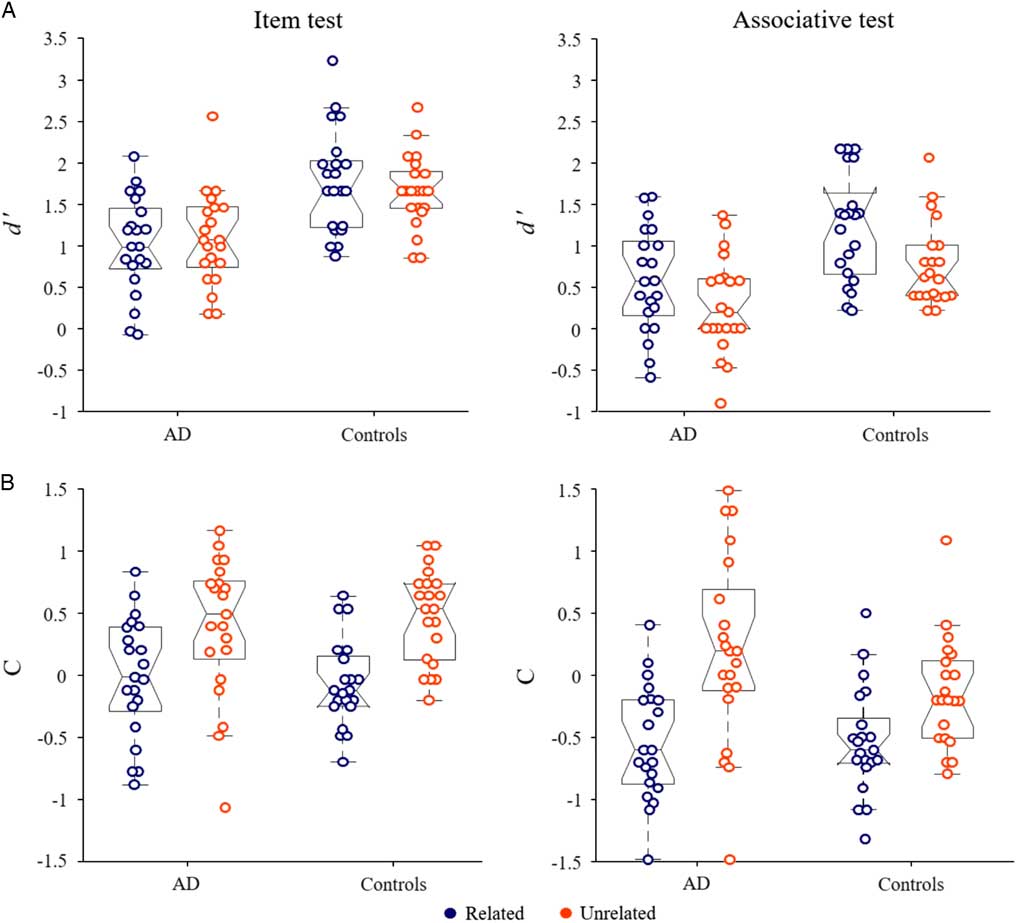
Because the effect of study-test cycle was not of primary interest, we collapsed the two study-tests cycles for the main analyses. The d’ scores were submitted to a 2 (group: control, AD) × 2 (test: item, associative) × 2 (relatedness: related, unrelated) repeated-measures ANOVA (see Figure 1). This revealed a main effect of group, F(1,40)=29.80, p<.001,  $$\eta _{p}^{2} $$=.43, reflecting better discrimination performance for controls (M=1.35; SD=0.68) compared with patients (M=0.73; SD=0.66); a main effect of test, F(1,40)=82.35, p<.001,
 $$\eta _{p}^{2} $$=.67, with higher d’ in the item (M=1.38; SD=0.64) than in the associative test (M=0.71; SD=0.67); but no test × group interaction, F(1,40)=0.49, p=.48,
 $$\eta _{p}^{2} $$=.01.
(A) Discrimination performance (d’) in the item and associative recognition memory tests for control and AD participants as a function of relatedness conditions. (B) Response bias (C) in the item and associative memory tests across groups and relatedness conditions. Each circle is a participant. Error bars represent the minimum and maximum points of the distribution, excluding outliers.

There was a main effect of relatedness, F(1,40)=6.76, p=.013,  $$\eta _{p}^{2} $$=.14, indicating higher performance for related (M=1.14; SD=0.75) compared with unrelated stimuli (M=0.94; SD=0.72). The two-way relatedness × group interaction was non-significant, F(1,40)=1.32, p=.26,
 $$\eta _{p}^{2} $$=.03, while the test × relatedness interaction was marginally significant, F(1,40)=3.91, p=.054,
 $$\eta _{p}^{2} $$=.09, with better performance for related (M=0.89; SD=0.71) compared with unrelated stimuli (M=0.52; SD=0.59) in the associative test (Tukey test, p=.003, Cohen’s d=0.57), but not in the item test (Mrelated=1.39, SD=0.58 vs. Munrelated=1.37, SD=0.42) (p=.99, Cohen’s d=0.05). Finally, the three-way test × relatedness × group interaction was not significant, F(1,40)=0.01, p=.93,
 $$\eta _{p}^{2} $$=.01.
To assess whether AD patients had an associative memory deficit beyond their memory impairment for items, we conducted a linear regression analysis in which memory performance (indexed by d’) for unrelated pairs in the associative test was entered as outcome variable while item memory performance (d’) for items encoded in unrelated pairs and group were entered as first and second predictor, respectively. This analysis controlled for age, sex, and education. Results revealed that memory performance for the item test did not significantly predict performance in the associative test, β=0.107, ΔR2=.07, F(1,37)=3.01, p=.091. When group was added in second step, it marginally predicted associative memory performance for unrelated pairs, β=0.324, ΔR2=.08, F(1,36)=3.70, p=.062, suggesting that healthy controls had greater associative memory performance than AD patients beyond their memory performance for the items forming these associations.
The 2 (group: control, AD) × 2 (test: item, associative) × 2 (relatedness: related, unrelated) repeated measures ANOVA on the response bias C revealed that the effect of group was not significant, F(1,40)=0.46, p=.50,  $$\eta _{p}^{2} $$=.01, while there was a main effect of test, F(1,40)=45.51, p<.001,
 $$\eta _{p}^{2} $$=.53, with a more liberal bias in the associative (M=−0.25; SD=0.61) than in the item test (M=0.20; SD=0.50). The two-way group × test interaction was not significant, F(1,40)=1.86, p=.18,
 $$\eta _{p}^{2} $$=.04. There was a main effect of relatedness, F(1,40)=78.46, p<.001,
 $$\eta _{p}^{2} $$=.66, with a more liberal bias for related (M=−0.29; SD=0.49) than unrelated stimuli (M=0.23; S=0.59). The two-way relatedness × group, F(1,40)=0.77, p=.38,
 $$\eta _{p}^{2} $$=.02, and test × relatedness interactions, F(1,40)=0.69, p=.41,
 $$\eta _{p}^{2} $$=.02, were not significant.
There was, however, a significant test × relatedness × group triple interaction, F(1,40)=5.67, p=.022,  $$\eta _{p}^{2} $$=.12 according to which, in the associative test, patients had a more liberal bias for related (M=−0.54; SD=0.46) compared with unrelated pairs (M=0.20; SD=0.75) (Tukey test, p<.001, Cohen’s d=1.19) while this difference was less important in controls (Mrelated=−0.53, SD=0.43 vs. Munrelated=−0.14, SD=0.44) (p=.006, Cohen’s d=0.89).
One particular interest in the current study was to evaluate whether the variability in the ability to benefit from semantic prior knowledge among AD patients was related to the integrity of their semantic memory, especially for categorical relationships. Mean number of errors on each question type of the SKQ in patients and in controls are presented in Table 2.
Mean number of errors on each question type of the SKQ in controls and in patients

First, number of errors on the SKQ was submitted to a 2 (group: control, AD) × 4 (question: Q1 (superordinate general), Q2 (superordinate intracategorical), Q3 (subordinate perceptual), Q4 (subordinate functional)) repeated-measure ANOVA. This revealed a main effect of group, F(1,40)=6.44, p=.015,  $$\eta _{p}^{2} $$=.14, with more errors in patients (M=4.52; SD=2.75) than controls (M=2.67; SD=1.68); a main effect of question type, F(3,120)=20.81, p<.001,
 $$\eta _{p}^{2} $$=.34, with more errors for Q2 (M=1.31; SD=1.05), Q3 (M=0.71; SD=0.83), and Q4 (M=1.48; SD=1.37) compared with Q1 (M=0.12; SD=0.4); and a non-significant group × question type interaction, F(3,120)=0.92, p=.43,
 $$\eta _{p}^{2} $$=.02.
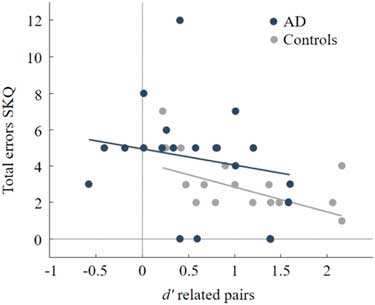
Second, to assess whether the degree of semantic memory alteration is related to participants’ memory for related pairs, we conducted linear regression analyses with the d’ for related and unrelated pairs as dependent variable and the total number of errors committed in the SKQ as predictor after controlling for the effects of age, sex, and education. Error rates in the SKQ was a significant predictor of the d’ for related pairs in controls (β=−0.498, ΔR2=.20, F(1,16)=6.00, p=.026) (Figure 2), while it was not the case for unrelated pairs (β=−0.309, ΔR2=.08, F(1,16)=1.55, p=.23). In patients, neither the regression between the number of errors in the SKQ and the d’ score for related pairs (β=−0.265, ΔR2=.05, F(1,16)=0.94, p=.35), nor the equivalent regression for unrelated pairs (β=0.02, ΔR2=.00, F(1,16)=0.00, p=.99), were significant. So, in controls, but not in patients, the lower the number of errors on the SKQ, the better the discrimination performance for semantically related pairs.
Linear regression analyses between the total number of errors committed in the SKQ and memory performance for related pairs (indexed by d’) in both groups. Each circle is a participant.

Then, we evaluated more specifically whether superordinate categorical knowledge integrity was a significant predictor of memory performance as the associative memory task comprised categorical relationships. In controls, the number of errors to the questions that assessed categorical knowledge was a significant predictor of the d’ for related pairs (β=−0.475; ΔR2=.20; F(1,16)=6.15; p=.025)Footnote 1, while it was not the case for unrelated pairs (β=−0.057; ΔR2=.01; F(1,16)=0.06; p=.82). In contrast, in AD patients, the regressions between the number of errors to superordinate categorical questions and d’ for related and unrelated pairs were non-significant (β=−0.239; ΔR2=.05; F(1,16)=0.98; p=.34, and β=−0.054; ΔR2=.01; F(1,16)=0.05; p=.82, respectively). To sum up, a higher number of errors to superordinate categorical questions was associated with a lower categorically related word pairs recognition in control participants, but not in AD patients.
Because knowledge about living things is more affected than knowledge about manufactured items in AD, we conducted finer analyses separating performance for living and non-living stimuli both in the SKQ and in the associative memory task. In the SKQ, the total number of errors was higher for living than non-living items in both patients (t(40)=−5.75; p<.001; Cohen’s d=−1.82; Mliving=3.86; SD=2.17; Mnon-living=0.66, SD=1.31) and controls (t(40)=−5.86; p<.001; Cohen’s d=−1.85; Mliving=2.52; SD=1.78; Mnon-living=0.19; SD=0.40). In the associative task, 2 (group: control, AD) × 3 (type of pair: unrelated, related living, related non-living) repeated-measure ANOVA on hits-FAsFootnote 2 rates yielded a main effect of group, F(1,40)=18.84, p<.001,  $$\eta _{p}^{2} $$=.32, reflecting better performance for controls (M=0.34; SD=0.27) compared with patients (M=0.14; SD=0.25). There was also a main effect of type of pair, F(2,80)=12.57, p<.001,
 $$\eta _{p}^{2} $$=.24, indicating better performance for related non-living pairs (M=0.39; SD=0.30) compared with related living (M=0.15; SD=0.27) (p<.001), and unrelated pairs (M=0.18; SD=0.20) (p<.001) that did not differ from each other (p=.84). The two-way group × relatedness interaction was not significant, F(2,80)=0.26, p=.77,
 $$\eta _{p}^{2} $$=.01.
Because the number of errors on the SKQ to non-living objects was close to floor, and because patients’ category deficit is thought to be specific to living things, further analyses were conducted on living concepts only. We conducted linear regression analyses with participants’ discrimination performance (hits-FAs) for living pairs as dependent variable and the total number of errors on the SKQ for living items as predictor. Errors on the SKQ for living items were associated to performance for living word pairs in controls (β=−0.499; ΔR2=.23; F(1,17)=5.81; p=.028) but not in patients (β=−0.023; ΔR2=.00; F(1,17)=0.08; p=.93).
DISCUSSION
This study assessed whether mild AD patients would benefit from semantic relatedness between words in associative memory, similar to healthy older adults. We further assessed whether this benefit was related to the integrity of semantic knowledge, with the hypothesis that AD patients should benefit from semantic relatedness to remember word pairs only when their semantic knowledge is preserved.
Associative Memory Benefit From Semantic Relatedness
AD patients, like healthy older adults, displayed greater associative memory performance when word pairs were pre-experimentally related compared with when they were unrelated. However, for older participants, this improvement was not as important as in previous studies (Naveh-Benjamin et al., Reference Naveh-Benjamin, Hussain, Guez and Bar-On2003; Patterson et al., Reference Patterson, Light, Van Ocker and Olfman2009) in which the presence of a semantic link between words brought associative memory performance to the same level as item memory performance. This might be explained by the need for using recollection, a controlled, attention-demanding process that declines in healthy aging (Koen & Yonelinas, Reference Koen and Yonelinas2014), to reject recombined related word pairs formed by switching words between studied related pairs.
The same pattern of performance was observed in AD patients, although their general memory level was significantly poorer, which echoes with the existing literature showing that AD is accompanied by a severe episodic memory deficit (Bastin et al. Reference Bastin, Bahri, Miévis, Lemaire, Collette, Genon and Salmon2014, Gallo et al. Reference Gallo, Sullivan, Daffner, Schacter and Budson2004). This deficit has notably been attributed to a decline in source monitoring processes (El Haj, Fasotti, & Allain, Reference El Haj, Fasotti and Allain2012), a process that plays a role in associative recognition (Mitchell & Johnson, Reference Mitchell and Johnson2010) and that has been identified as a major factor contributing to the decline in source and destination memory observed in AD patients (El Haj, Moroni, Luyat, Omigie, & Allain, Reference El Haj, Moroni, Luyat, Omigie and Allain2014; El Haj, Gely-Nargeot, & Raffard, Reference El Haj, Gely-Nargeot and Raffard2015).
Of interest, AD patients had a more liberal bias when discriminating related than unrelated word pairs, while the difference was less important in healthy controls. This suggests that AD patients adopted a completely different response criterion depending on the type of word pairs considered. Related to this finding is the study of Balota, Burgess, Cortese, and Adams (Reference Balota, Burgess, Cortese and Adams2002) that revealed that AD patients showed a more liberal bias for high frequency relative to low frequency words, perhaps because high frequency words are more familiar in an absolute way (Coane, Balota, Dolan, & Jacoby, Reference Coane, Balota, Dolan and Jacoby2011). AD may thus be more likely than controls to adapt their decision criterion according to whether the word pair bears an absolute sense of familiarity or not. Nevertheless, even if not spectacular, both groups improved their associative memory performance when words were related.
Of interest, when dividing the related pairs between living and non-living related pairs, the improvement in associative memory for related pairs actually appeared to be driven specifically by non-living related pairs, while living related pairs were not better recognized than unrelated pairs in both patients and healthy older adults. Living concepts are thought to be more similar to one another because they share a greater number of features with less distinctive features than non-living concepts (Clarke & Tyler, Reference Clarke and Tyler2015). It could, thus, be the case that relatedness within living pairs did not help improve the associative memory performance because recombined related living pairs were more similar to the target pair and, thus, required finer discrimination than related non-living pairs recombined with other non-living concepts.
Previous studies indeed showed AD patients to experience difficulties in discriminating between close living concepts in an episodic memory task (Kivisaari, Monsch, & Taylor, Reference Kivisaari, Monsch and Taylor2013) and in a naming task (Kivisaari, Tyler, Monsch, & Taylor, Reference Kivisaari, Tyler, Monsch and Taylor2012). Moreover, although only in the visual modality, some studies also showed fine discrimination impairments in healthy older adults (e.g., Ryan et al., Reference Ryan, Cardoza, Barense, Kawa, Wallentin-Flores, Arnold and Alexander2012). Altogether, our results bring support to the theories according to which distinguishing between living concepts would require finer discrimination abilities than distinguishing between non-living ones (Clarke & Tyler, Reference Clarke and Tyler2015).
Associative Memory Benefit From Semantic Relatedness and Semantic Knowledge Integrity in Healthy Aging
It is widely accepted that semantic memory accumulates knowledge across the life span and remains relatively spared in healthy aging (Brickman & Stern, Reference Brickman and Stern2009; Drag & Bieliauskas, Reference Drag and Bieliauskas2010) while it declines in AD (Chertkow et al., Reference Chertkow, Whatmough, Saumier and Duong2008; Laisney et al., Reference Laisney, Desgranges, Eustache and Giffard2010). The results of the SKQ fit with such a claim. Nevertheless, our results suggest that slight variations in semantic knowledge exist in healthy older adults. Moreover, the relation shown between these variations and performance in associative memory for related pairs suggests that older adults’ level of semantic knowledge could influence their performance in an episodic memory task where prior knowledge is manipulated.
We suggest that older individuals’ semantic knowledge might impact memory performance by determining, at least partially, the degree of elaboration at encoding (cf. Levels of Processing theory, Craik & Lockhart, Reference Craik and Lockhart1972), therefore leading to a more or less successful discrimination at retrieval. These findings support hypotheses according to which one’s capacity to efficiently use pre-existing semantic knowledge to support episodic learning is related to the integrity of one’s semantic knowledge (Greenberg & Verfaellie, Reference Greenberg and Verfaellie2010).
Consistent with this idea, Stevens-Adams, Goldsmith, and Butler (Reference Stevens-Adams, Goldsmith and Butler2012), using the DRM paradigm, showed that the probability of committing a FA for a given lure was directly related to the structure and the development of semantic knowledge. More critically, this relationship occurred at the individual level suggesting that each individual processed each item differently in the memory task according to how his/her semantic network has been built-in throughout his/her life.
Associative Memory Benefit From Semantic Relatedness and Semantic Knowledge Integrity in AD
Worthy of note is that our results in AD patients are discordant with a previous study that used the SKQ questionnaire in an AD population (Simoes Loureiro & Lefebvre, Reference Simoes Loureiro and Lefebvre2015). In that study, patients displayed worse performance for perceptual questions than intra-categorical ones while this was not the case in controls. In our study, patients displayed a similar pattern of performance as controls, although poorer, and did not display worse performance to perceptual than intra-categorical questions. This discrepancy in results might be explained by differences in age or education between the populations or the fact that our patients were at a mild stage of the disease, contrary to participants in Simoes-Loureiro and Lefebvre’s study who ranged from a mild to a severe stage.
The fact that recognition of related pairs was not predicted by semantic knowledge integrity in AD patients could mean that they did not use their semantic knowledge, at least as measured by the SKQ, to perform the episodic memory task, contrary to healthy older adults. However, the improvement in patients’ performance in the associative recognition task for related compared with unrelated pairs suggests that AD patients did use some residual semantic knowledge to support the encoding of related pairs. One possibility would be that the nature of the semantic information they used is different from the one assessed by the SKQ or the one used by control participants.
Alternatively, the lack of a relationship between the SKQ performance and memory for semantically related words may result from different modes of access to the information. Indeed, the SKQ may call on a controlled retrieval of semantic information within the semantic memory system, contrary to the associative memory task in which the access to the semantic content could be more automatically triggered by the presence of semantic relatedness. Consistently, controlled processes are typically more affected by mild AD than automatic processes (Bastin et al., Reference Bastin, Kerrouche, Lekeu, Adam, Guillaume, Lemaire and Salmon2010; Fabrigoule et al., Reference Fabrigoule, Rouch, Taberly, Letenneur, Commenges, Mazaux and Dartigues1998).
Along those lines, it could be that the cognitive mechanisms that are involved in the two tasks of the current study (associative memory and SKQ) could be differently impaired in AD. Support for this interpretation comes from the study of Aronoff et al. (Reference Aronoff, Gonnerman, Almor, Arunachalam, Kempler and Andersen2006) that showed, in a same cohort of patients, that AD patients were as able as controls to identify that two related items (e.g., dog and cat) were conceptually close, while they had difficulties accessing specific information about items taken individually. These findings suggest that whether AD patients demonstrate semantic memory deficits is determined by the way it is assessed. Thus, although the current associative memory task and the SKQ both involved categorical semantic information, one required to identify the categorical link between two words (associative memory), a capacity that was found preserved in AD, while the other necessitated to access semantic details relative to a single item (SKQ), an ability that is affected in AD (Aronoff et al., Reference Aronoff, Gonnerman, Almor, Arunachalam, Kempler and Andersen2006).
Limitations and Future Directions
One limitation of the current study was the inequity in the target-lure proportion in the item recognition memory task that could have biased the calculation of global discrimination scores for this task. Moreover, a more systematic evaluation of semantic memory and of each of its mechanisms (semantic retrieval, semantic content, semantic regulation) should be included in future studies to help determining their contribution to episodic memory tasks by relating their respective integrity to performance. Relatedly, more detailed cognitive and functional evaluations of AD patients should be included to determine more precisely their dementia profile and to relate memory performance to other functions like executive abilities. Also, the sample size was relatively small but current results can be taken as a basis for sample size estimation to ensure sufficient power in future studies.
Another limitation is that the SKQ focuses on encyclopedic knowledge, which may not be entirely representative of the integrity of semantic knowledge (i.e., one could understand the meaning of a word without mastering its encyclopedic properties). Relatedly, future work should further explore the impact of semantic memory alteration in AD on the influence of prior knowledge on associative memory by assessing the perception of the relation between concepts rather than the knowledge for the concepts themselves, since these two measures lead to different conclusions with regard to patients’ semantic alteration (Aronoff et al., Reference Aronoff, Gonnerman, Almor, Arunachalam, Kempler and Andersen2006).
Finally, in addition to investigating whether semantic memory could bring support to participants’ episodic memory, future research should assess whether these two memory systems could interact in a reverse manner, with episodic memory influencing performance in a semantic task by providing an organizational framework that could guide semantic retrieval (e.g., generating birthday gifts examplars in a semantic task by referring to one’s own experience of gifts received/offered, Greenberg, Keane, Ryan, & Verfaellie, Reference Greenberg, Keane, Ryan and Verfaellie2009). Future work should assess whether/how declining or impaired episodic memory influences how older adults and AD patients complete semantic knowledge evaluations.
ACKNOWLEDGMENTS
This work was supported by the University of Liege, the Léon Frédéricq Foundation, the Alzheimer Research Foundation (SAO-FRA; grant S#14003), the Wallonia Brussels Federation Special Funds for Research (grant #FSRC−14/11), the Fund for Research in Human Science and the National Fund for Scientific Research (FRESH/FRS-FNRS), and the Inter-University Attraction Pole P7/11. Disclosure of Interest: All authors declare having no actual nor potential conflict of interest including no financial, personal, nor other relationships with other people or organizations that could have inappropriately influenced the present work.