Over the past several centuries, financial crises have been frequent, widespread, and consequential. Charles Kindleberger counts over fifty international financial crises and panics since the seventeenth century. More recently, Reinhart and Rogoff have identified about 700 country-years of banking crises since 1800.Footnote 1 Financial crises are associated with adverse macroeconomic performance, most notoriously the depressions of the late nineteenth and early twentieth centuries and Japan's lost decade of the 1990s.Footnote 2 The US subprime crisis and the Euro crisis have underscored the salience of financial crises in the current era and also revealed important gaps in political science scholarship on the issue.Footnote 3
I argue that more democratic countries are more susceptible to financial crises. Democratic governance is characterized by constraints on executive authority, accountability through free and fair elections, protections for civil liberties, and large winning coalitions.Footnote 4 These characteristics bring important benefits, which are widely recognized. However, they may also have unintended consequences that increase the likelihood of financial instability and crisis onset. Veto players can make it difficult to take swift administrative or legislative action to forestall crises. Frequent executive turnover can make democratic leaders neglect the long-term costs of policies that encourage short-term speculative booms. Philosophical attachment to private liberty and freedom may be associated with excessive financial liberalization. Large winning coalitions tend to encourage democratic leaders to pursue economic openness, which exposes countries to international contagion.
Empirically, I show that more democratic countries are more prone to financial crises. This is a striking regularity that can be traced back to the early nineteenth century, and perhaps even earlier. The finding is robust to a variety of controls and model specifications. The association is also robust across time periods: the relationship exists in the nineteenth and twentieth century, before and after World War II, and before and after the collapse of the Bretton Woods System.
My analysis underscores the importance of examining the validity of theories using historical data over long time periods.Footnote 5 The relationship between democracy and crisis was weakest during the “Washington Consensus” period of the 1980s and 1990s, when diffusion of neoliberal ideas led both democratic and autocratic regimes alike to embrace aggressive financial sector liberalization. Most scholarship on banking crises, for understandable reasons, such as the availability of other variables of interest, has focused on data dominated by this anomalous time period.Footnote 6 This has likely led scholars to neglect the strong, historical association between democracy and crises.
Like other relationships involving democracy, such as the democratic peace,Footnote 7 democratic advantage in war,Footnote 8 and the greater propensity for democracies to engage in international trade,Footnote 9 it is not an easy task to pinpoint the precise mechanisms responsible for this empirical regularity. Democracy is multifaceted and embodies many characteristics. Financial crises are also complex phenomena that lend themselves to multiple explanations—for example, the official commission of the US government tasked with investigating the causes of the 2008 subprime crisis split sharply along partisan lines and ultimately failed to produce a consensus report.Footnote 10 In this article, I assess the observable implications of several mechanisms derived from the literature on democratic advantage. In particular, I examine four hypotheses related to constraints, time horizons, liberalization, and openness.
This article is not a critique of democratic governance. Surely, the many advantages of democracy outweigh the costs of occasional crises. However, financial crises are often associated with protracted output loss, high unemployment, and ballooning public sector debt. The vulnerability of democracies may also become a more serious concern as the frequency and magnitude of crises increase along with global capital flowsFootnote 11—the period between World War II and the 1970s, which saw the suppression of capital mobility, and the 1980s and 1990s, which saw the disparity between regime types temporarily diminish, may have masked some potential sources of democratic instability. Recent crises in major democracies such as Japan, the Nordic states, the United States, and the Euro Area represent a return to a pattern more consistent with the historical record. As such, the argument I outline here may necessitate a reassessment of empirical findings that rely heavily on post-World War II data on a range of topics such as democratization and differences in economic growth and stability by regime type.
Democracy and Financial Crisis: A Historical Overview
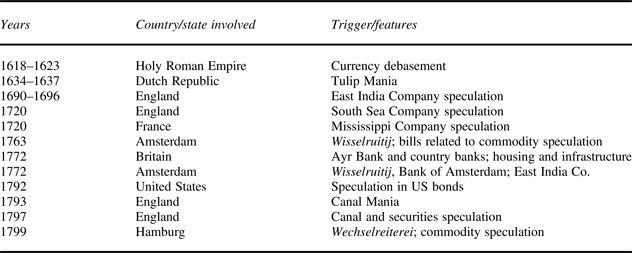
There is limited empirical data on financial crises prior to the nineteenth century. Most writing on the period is by economic historians and popular authors,Footnote 12 and to date, no comprehensive database of early crisis episodes exists. There is some crude evidence of financial speculation and ill consequences as early as the second century BCE in the Roman Republic, but records are scant.Footnote 13 Perhaps the most authoritative source on the matter is Kindleberger, who spent much of his career as an economic historian chronicling financial crises.Footnote 14 Table 1 reproduces his list of pre-nineteenth-century crises, with dates, countries, and a concise description. It is striking how many of these crises occurred in countries with the most liberal or limited governments of the era,Footnote 15 particularly given the paucity of such states in the international system at the time—nine out of twelve crises occurred in England/Britain, the Dutch Republic, or the United States. Of course, these regimes were hardly full democracies in the contemporary sense. Although they featured elections, relatively strong protections for civil liberties compared to peers, and nontrivial constraints on executive authority, these countries limited suffrage to a subset of the population, and the United Kingdom and United States allowed slavery well into the nineteenth century. However, Table 1 suggests that relatively more democratic countries were more prone to financial crises in years prior to the nineteenth century.
Notable pre-nineteenth-century financial crises

Source: Kindleberger Reference Kindleberger2000.
A brief inspection of the historical record also gives the impression that the most notable financial crises have afflicted or centered on relatively democratic regimes. Besides the Dutch Tulip Mania and South Sea Bubble, one may also point to the series of crises related to railroads in the United States and Great Britain in the nineteenth century and the Panic of 1907. The Great Depression of the 1930s severely affected the leading democracies of the era, while the relatively autocratic Soviet Union and Japan were largely unscathed.Footnote 16 The so-called “big five” financial crises of recent years have all struck democracies—Spain, Japan, and the Nordic trio of Finland, Norway, and Sweden.Footnote 17 The most recent wave of crises—the 2008 subprime debacle in the United States and the Euro crisis—are predominantly democratic affairs. The most prominent autocracy of the contemporary era, China, largely escaped the consequences of the 2008 crisis, reinforcing a narrative of the country's rise.Footnote 18
Transitions toward more democratic government are also often associated with an intensification in financial instability and crises. France's establishment of the Third Republic in 1871, which moved the country from political vacillation to relatively stable democracy, was followed by a sharp increase in the frequency of banking crises.Footnote 19 Japan's Taisho Democracy, a brief period of democratic experimentation after the end of World War I, was also a period of recurrent banking crises, while the military's consolidation of power in the 1930s coincided with financial stability despite the onset of the Great Depression and deteriorating conditions in the rest of the world.Footnote 20 Recent episodes of democratization and democratic consolidation in developing countries, such as those in Argentina, Ecuador, South Korea, Thailand, and Turkey, have also been associated with shifts from relative financial stability to fragility.
Of course, this is hardly systematic evidence. It may be that financial crises in more autocratic regimes are less likely to be recorded or are less salient. One can point to some famous counterexamples, such as the Mississippi Bubble, which occurred in France under the rule of Louis XV, and the financial instability associated with the Latin American debt crisis, which primarily afflicted autocratic countries. There are also several large-scale crises that afflicted autocracies and democracies alike, such as the “long depression” of 1873 and the Asian Financial Crisis of 1997–1998.
More systematic evidence is available from the nineteenth century onward. Reinhart and Rogoff have collected data on financial crises from 1800 to the present for sixty-eight countries, using a variety of international and country-specific sources.Footnote 21 I focus on their indicator for systemic banking crises because the measure is the clearest proxy for a crisis of the financial system.Footnote 22 In this data set, banking crises are coded as a dichotomous variable, taking on a value of 1 if a country is in crisis and 0 otherwise. The data systematically cover a wide range of countries, such as developing countries and autocracies, which might otherwise be neglected by historians focusing on episodes of perceived significance.Footnote 23
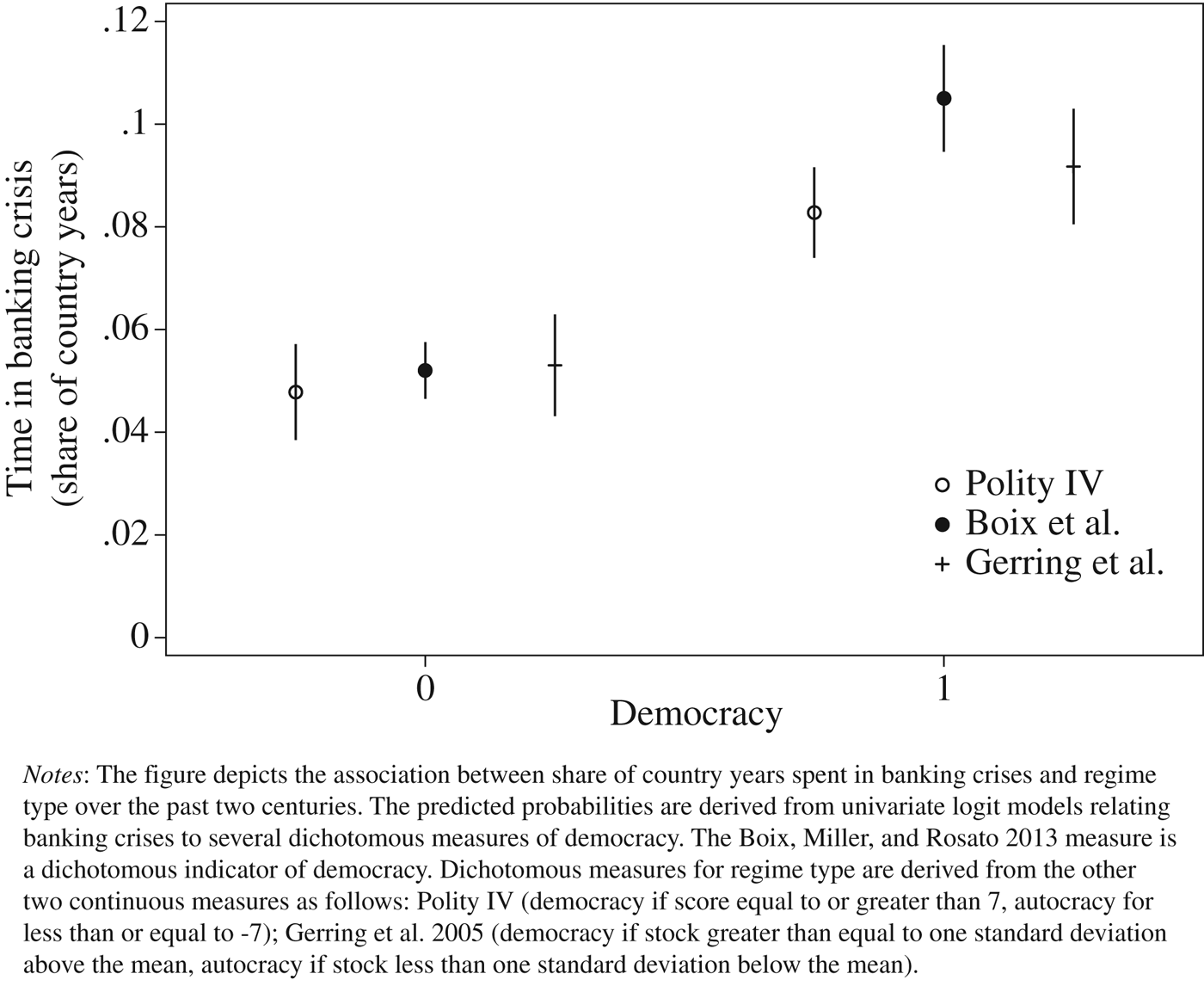
Figure 1 depicts the relationship between democracy and financial crisis in this raw data. The figure separates countries dichotomously into democracies and autocracies according to several common measures.Footnote 24 The Polity IV project provides a widely used measure of regime type based on institutional characteristics.Footnote 25 I follow convention by coding autocracies as countries with polity scores less than or equal to −7 and democracies as countries with polity scores greater than or equal to 7. The measure by Boix, Miller, and Rosato codes democracy dichotomously based on the presence of free and fair elections and a threshold value for suffrage.Footnote 26 Gerring, Bond, Barndt, and Moreno's measure codes democracy as a stock based on the premise that democratic experience accumulates over time.Footnote 27 Because this measure is continuous, I dichotomized it by setting thresholds at one standard deviation below and above mean. As the figure shows, regardless of the specific measure of democracy used, democratic countries have spent about twice as many country years on average in financial crises (about 7 to 11%) compared to autocratic countries (about 4 to 6%).
Time spent in banking crisis (1800–2009), various measures of democracy

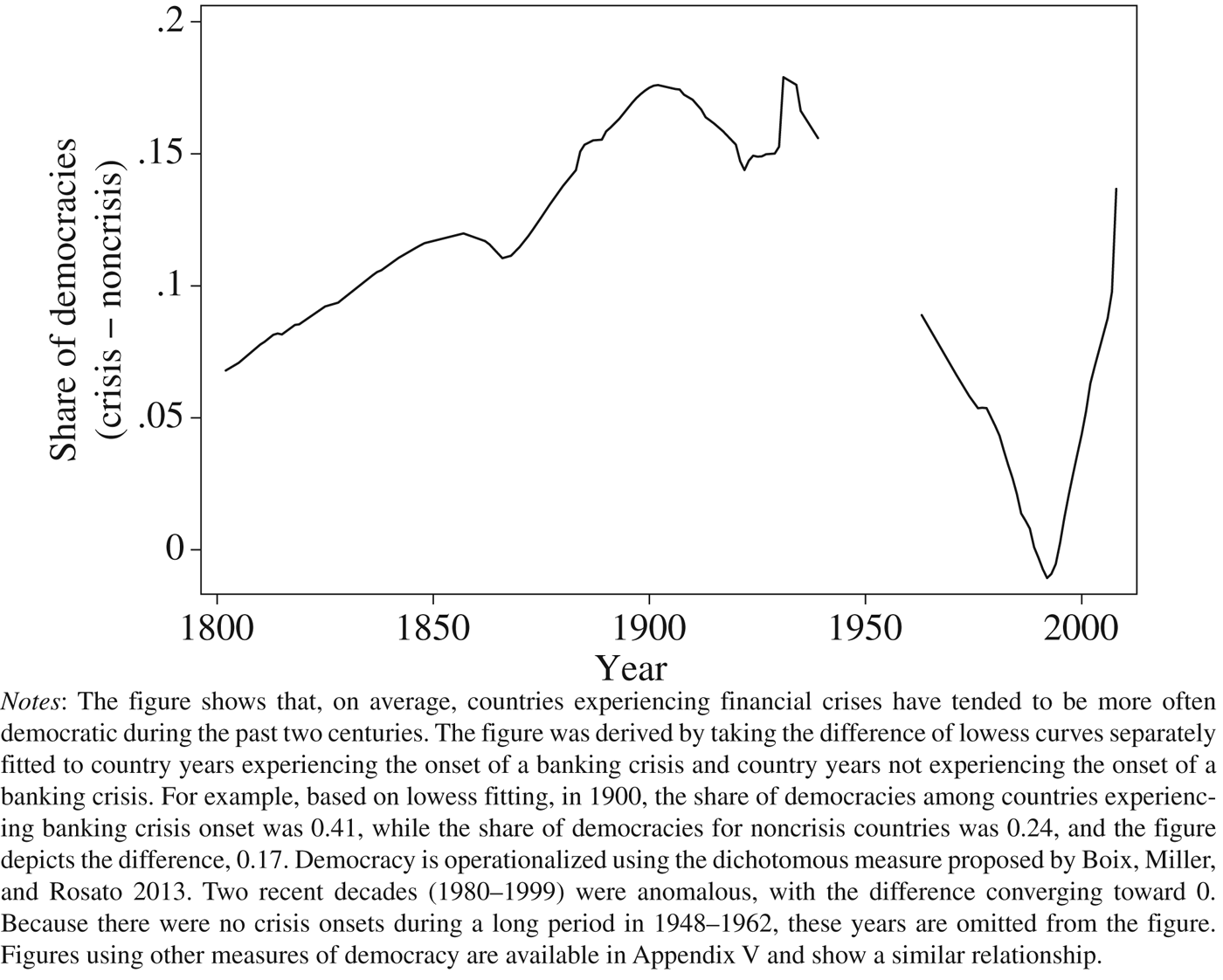
One reason that this association between democracy and financial crisis has gone unnoticed is the partially anomalous nature of the recent historical period. Figure 2 depicts the relationship between regime type and financial crises over time. Based on the dichotomous measure of democracy proposed by Boix, Miller, and Rosato,Footnote 28 the figure compares the difference in share of democracies among countries that experienced the onset of a financial crisis and those that did not. The figure was derived by taking the difference of lowess curves separately fitted to country years experiencing the onset of a banking crisis and country years not experiencing the onset of a banking crisis. For example, based on lowess fitting, in 1900, the share of democracies among countries experiencing banking crisis onset was 0.41, while the share of democracies among noncrisis countries was 0.24. The figure depicts the difference, 0.17.
Financial crisis and democracy over time

The figure shows that the democratic share of countries experiencing financial crisis onset has been higher for much of the past two centuries. For much of history, from 1800 through the Great Depression years, banking crises were disproportionately democratic affairs. The decades immediately after World War II were characterized by financial stability and very few crises—generally attributed to the suppression of global capital flows.Footnote 29 The 1980s and 1990s saw an unusually large share of crises among relatively autocratic states. The most recent decade from 2000 to 2009 has reverted to what is more historically typical.
Of course, these observations are only suggestive. There are several important potential confounders. The most obvious of these is that the accumulation of wealth and the development of a robust middle class, which is associated with the rise of limited government,Footnote 30 is also a source of financial excess that contributes to crises. In the following section, I more carefully establish the empirical association between democracy and crisis incidence to rule out such alternative explanations. I then turn to a discussion of mechanisms.
Empirical Evidence
To estimate the association between regime type and banking crises, I recoded a dichotomous variable for banking crisis onset.Footnote 31 This variable takes on a value of 1 for all country years in which a banking crisis started, and 0 otherwise.Footnote 32 The key independent variable is democracy, measured using polity scores.Footnote 33 Since this is a time series cross-sectional analysis with a binary dependent variable, I include cubic splines in all models to account for duration dependence, as well as a count variable for previous incidence of banking crises.Footnote 34
I generally keep the empirical models sparse. There is a limited set of control variables that are theoretically plausible and available for a suitably large number of countries over two centuries. In addition, controlling for an immediate temporal precursor to financial crises—such as a proxy for financial booms—is problematic since it is plausibly a consequence of the key explanatory variable.Footnote 35 I consider control variables that are plausible on theoretical grounds and evaluate the empirical models using the Bayesian Information Criterion (BIC) as suggested by Raftery.Footnote 36
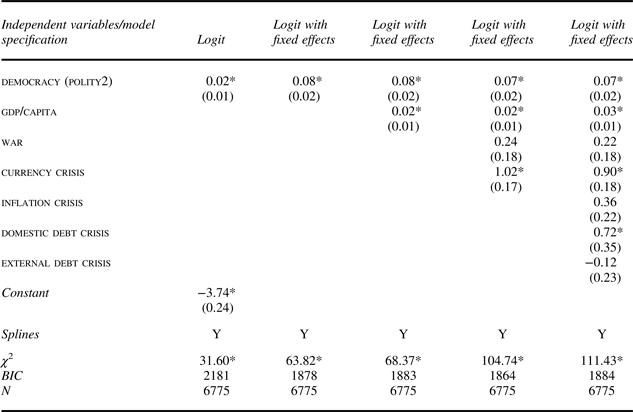
The first column in Table 2 presents the results from a basic logit specification including only democracy. Some unmeasured factors also likely affect the tendency for countries to experience crises. For example, countries that have served as important financial centers during the entirety of the past two centuries—for example, the United Kingdom and France—may be more prone to crisis for reasons unrelated to regime type. Time-invariant factors such as proximity to sea lanes or cultural attitudes toward risk taking may also affect the tendency for speculative excesses to develop. Countries located in geographic areas subject to extreme weather patterns may be prone to crises triggered by crop failures. To account for this type of unobserved heterogeneity, the second column of Table 2 includes country fixed effects.Footnote 37 In both specifications, there is a positive and statistically significant association between democracy and financial crisis incidence.
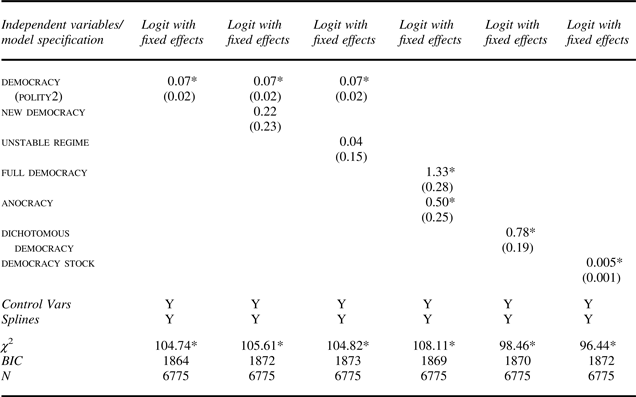
Financial crisis and democracy, 1800–2009

Notes: Dependent variable in all models is a dichotomous indicator of banking crisis onset. All models include cubic splines to account for duration dependence and a count variable for previous crisis episodes. Numbers in parenthesis are standard errors. Asterisk denotes a coefficient at least two standard errors removed from 0.
One obvious control variable is per capita GDP. It is well known that wealthy countries are more likely to be democratic.Footnote 38 Wealthy countries may also be more likely to experience financial crises for reasons orthogonal to democracy. For example, it is possible that wealthy countries have larger, more complex banking systems that are difficult to regulate effectively. Speculative mania may also take hold more frequently in wealthy countries where markets are reasonably well developed and citizens have accumulated assets to invest. Hence, the third column of Table 2 includes gdp per capita as a control variable.Footnote 39 The association between democracy and financial crisis incidence remains unaltered. The BIC for the second and third columns of Table 3 are similar, indicating that neither model is clearly preferred. I opt to retain gdp per capita as a control variable in subsequent models on theoretical grounds.
Financial crisis and alternative measures and relationships with democracy, 1800–2009

Notes: Dependent variable in all models is a dichotomous indicator of banking crisis onset. All models include the following control variables, which are omitted from the table for brevity: GDP/capita, currency crisis, war, cubic splines to account for duration dependence, and a count variable for previous crisis episodes. Numbers in parenthesis are standard errors. Asterisk denotes a coefficient at least two standard errors removed from 0.
In several historical episodes, such as 1914, military conflict has served as a trigger for banking crises. There is also a large body of work that associates regime type with the likelihood of militarized conflict.Footnote 40 I therefore include a dummy variable for war in the fourth column of Table 2.Footnote 41 It is also possible that democracy is correlated with other types of economic crises, which destabilize financial institutions. In particular, economists have noted the frequent association of currency and banking crises, which often occur as “twin crises.”Footnote 42 I therefore include a dummy variable for currency crises.Footnote 43 The inclusion of these variables does not alter the association between democracy and financial crisis incidence. Because there are plausible theoretical grounds to retain these variables, and their inclusion is associated with a lower BIC, they will be included in subsequent analyses. In the fifth column of Table 2, I include dummy variables for three other crisis types: inflation, domestic, and external debt crises. Although these crisis types are not as frequently associated in the literature with banking crises, they could also plausibly trigger financial instability. As results show, inclusion of these variables does not alter the association between democracy and crises, and the higher BIC suggests they should be excluded from the model.Footnote 44 In all subsequent analyses, I use the model from the fourth column of Table 2 as the baseline.
In Table 3, I consider alternative operationalizations of democracy. The first column replicates the fourth model from Table 2 to serve as a baseline. It is possible that unstable regimes, such as those transitioning to democracy, are particularly prone to crises as a result of political turmoil. Therefore in the second and third columns of Table 3 I control for new democracy and unstable regimes.Footnote 45 Neither variable is statistically significant, and the relationship between democracy and crisis incidence remains unchanged. Analogously, the relationship between democracy and crisis could be curvilinear, such that anocracies are most prone to crisis. In the fourth column of Table 3, I include dichotomous variables for full democracy and anocracy, where the reference category is full autocracy.Footnote 46 The results in the column do not support the notion of a curvilinear relationship: anocracies are more crisis prone than autocracies, and full democracies are more crisis prone than anocracies.Footnote 47
Finally, to avoid overreliance on a single measure of democracy, I reran the empirical specifications using several alternative measures of democracy. The fifth column substitutes a dichotomous democracy measure from Boix, Miller, and Rosato.Footnote 48 The sixth column substitutes a measure of democracy as a stock proposed by Gerring and colleagues.Footnote 49 These alternative measures also show a clear, positive association between democracy and crisis incidence. Comparison of BIC values for the models in Table 3 indicate that the baseline model entering polity2 as a single linear term is preferred.
I performed a range of additional robustness checks and confirmed that the substantive results remain unchanged.Footnote 50 To consider the possibility of reverse causation—that is, the occurrence of financial crises triggers democratization—I reran the statistical specifications using lagged democracy (one, five, and ten years) as the key independent variable. Because there might be some concern that financial crises are rare events, I reran the analysis using Rare Events Logistic Regression.Footnote 51 To confirm that the results are not unduly influenced by the United States, United Kingdom, and the Netherlands, which have long histories of both democratic government and financial crises, I excluded these countries from the analysis. I also recoded the dependent variable to include the onset of all crisis types included in the Reinhart and Rogoff data set, on the logic that “financial crisis” could be more broadly defined.Footnote 52 The positive association between democracy and financial crisis incidence remained positive and statistically significant under all of these alternative specifications.
One additional concern is that some autocracies, such as communist regimes, may experience few financial crises because there are no private banks. If so, regime type would be a determinant of financial crisis incidence, but for trivial reasons. A related, less trivial possibility is that limited government produces large banking systems by minimizing the threat of expropriation, and in turn, large banking systems are more prone to occasional crises.Footnote 53 To consider this possibility, I reran the analysis: (1) omitting all countries that adopted communism at any time; (2) omitting country years in which bank lending as a share of GDP was less than 5 percent; and (3) directly controlling for bank lending as a share of GDP.Footnote 54 In all models, the association between democracy and financial crisis onset remains positive and statistically significant.Footnote 55
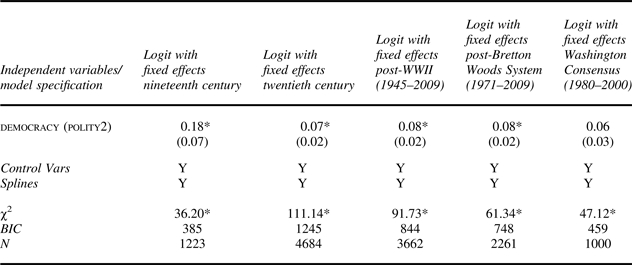
Finally, it is useful to consider whether the positive relationship between democracy and banking crisis onset is specific to any particular time period. Table 4 separates the data into several time periods of substantive interest—the nineteenth century, the twentieth century, the period after World War II, the period after the collapse of the Bretton Woods System, and the Washington Consensus years. The results illustrate that the positive association between democracy and banking crises is not driven by the inclusion of any specific time period. Other plausible temporal divisions of the data, such as pre- and post- World War I, produce substantively similar results.Footnote 56 As discussed earlier, the relationship between democracy and crisis incidence weakens during the Washington Consensus years, though it remains positive and just short of statistical significance in the specification presented.Footnote 57
Financial crisis and democracy, various time periods of interest

Notes: Dependent variable in all models is a dichotomous indicator of banking crisis onset. All models include the following control variables, which are omitted from the table for brevity: GDP/capita, currency crisis, war, cubic splines to account for duration dependence, and a count variable for previous crisis episodes. Numbers in parenthesis are standard errors. Asterisk denotes a coefficient at least two standard errors removed from 0.
Mechanisms
Economists, using cross-national data, have tied the incidence of financial crises to variables such as capital inflow bonanzas,Footnote 58 financial liberalization,Footnote 59 and macroeconomic mismanagement or shocks.Footnote 60 However, these accounts are largely apolitical. The considerable qualitative work on the sources of crises generally examines a handful of notable cases in Europe, Latin America, Japan, and the United States.Footnote 61 Quantitative work on political factors affecting financial crisis incidence has been relatively limited, but recent work has examined domestic factors such as partisanship and regulatory policies,Footnote 62 institutional constraints on financial crisis response,Footnote 63 and international distortions caused by the IMF.Footnote 64 These studies have generally focused on a limited time period since the 1970s, for understandable reasons—data on many variables of interest are unavailable for a longer time period. However, this may be problematic because of the anomalous nature of the 1980s and 1990s.
Drawing from this literature as well as other sources, in this section, I propose several mechanisms that may make more democratic countries more prone to financial crisis. In particular, I posit and evaluate hypotheses concerning constraints, turnover, liberalization, and openness. I draw each hypothesis from a distinct characteristic of democratic governance: constraints on executive authority, free and fair elections, protection for civil liberties, and large winning coalitions. After introducing the logic of the hypotheses and briefly considering their plausibility, I examine empirically whether proxies associated with each appear to account for the association between democracy and the incidence of financial crises presented earlier.
Constraints
A major feature of democratic government is the presence of constraints on political authority, which are also an important component of polity scores.Footnote 65 Compared to autocrats, the actions of democratic leaders tend to require some degree of support from other domestic actors such as legislatures, political parties, or the judiciary.Footnote 66 Executive constraints are widely cited as a major benefit of democracy, not only as a mechanism to prevent arbitrary violations of property rights and the rule of law, but also as a source of credible commitment that can produce economic and diplomatic advantages.Footnote 67
Financial crises are often preceded by credit-fueled speculation in assets such as real estate and equities—when mania gives way to bust, financial institutions are left with severely impaired assets, triggering instability.Footnote 68 Government intervention to preempt crises often requires the implementation of controversial policies, such as the use of public funds to recapitalize financial institutions or regulatory measures to curb risky lending and speculation—what former Federal Reserve Chairman William Martin described as “taking away the punchbowl” just as a party is getting started.Footnote 69 In democracies, the constraints on political action by multiple veto players may slow or prevent measures to curtail speculative excesses by private actors. In contrast, in autocracies, unconstrained leaders may be able to take sweeping, flexible actions to mitigate the risk of outright crises. Hence, we may posit:
Constraints Hypothesis
Democratic leaders are constrained by domestic veto players from taking actions to curb speculative excesses prior to the incidence of a crisis.
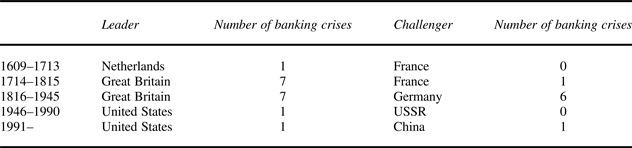
We can begin by considering the long-term historical data, which have often been referenced by scholars focusing on theories about limited government. Table 5 reproduces a list of “world leaders and challengers,” the most powerful countries during each historical time period as classified by long-cycle theorists.Footnote 70 I added China as a plausible challenger to the United States during the post-Cold War period. These are large, powerful countries chosen by Schultz and Weingast to demonstrate their core hypothesis about asymmetrical constraints. If constraints are related to financial crisis incidence, this is a plausible set of countries to examine based on findings in the existing literature.
Banking crises among “world leaders and challengers”

Notes: Identities of world leaders and challengers are from Schultz and Weingast Reference Schultz and Weingast2003, with China added for the post-Cold War period. Banking crises as identified by Reinhart and Rogoff Reference Reinhart and Rogoff2009 from 1800 to present and Kindleberger Reference Kindleberger2000 for years prior to 1800.
The table illustrates that more democratic “leader” countries have generally experienced more financial crises during each historical time period—cumulatively, the count is seventeen to eight, or about twice as many crises for the more constrained governments. However, the large disparity between Great Britain and France in the eighteenth century accounts for most of the difference. This is not inconsistent with the premises of the democratic constraints literature. In early liberal states, such as Britain in the eighteenth century, the franchise was limited to substantial holders of wealth—in such cases, the interests of parliamentary representatives overlapped heavily with those of private financial interests. It may be that constraints were particularly acute during this period: legislatures aligned closely with financial interests may impose particularly strong constraints against executive actions to rein in speculative financial activity.
Turning to a broader set of countries, Henisz has developed a measure of executive constraints, polconiii, which is available for the entire duration of my data set.Footnote 71 The variable proxies for the feasibility of policy change in a country based on both institutional factors (i.e., the independence of the executive, upper legislative, and lower legislative chambers) as well as the extent of alignment across branches of government based on partisan composition. Following the logic of Baron and Kenny,Footnote 72 if executive constraints are an important mediator for the relationship between democracy and crises, at a minimum, constraints should be positively associated with both democracy and crises, and the inclusion of the variable in the empirical models should weaken the direct association between democracy and crises. The evidence is consistent with constraints being a partial mediator. When constraints are included in the empirical models, the coefficient on polity2 remains positive, but it is attenuated considerably.Footnote 73
The constraints hypothesis is difficult to test directly because of the practical difficulties of identifying financial crises that were averted.Footnote 74 However, Laeven and Valencia have collected detailed information about government responses during recent crises, including the timing of extensive liquidity support provided to the financial sector.Footnote 75 Their data are collected based on observed crises, which may introduce bias, since countries that acted proactively to avert crises are not represented. However, the direction of the bias should generally stack the decks against findings consistent with the constraints hypothesis: unconstrained countries that select into crises will tend to be those that are slow or unable to take proactive steps for other reasons. According to these data, countries that score high on political constraints are relatively slower in initiating liquidity support for the financial sector.Footnote 76 This is a crude measure, but it provides some preliminary support for the intuition that political constraints may hinder policy measures to address crises.
We can also point to historical episodes that are consistent with the constraints hypothesis. For example, Japan, a country that scored high on the polconiii measure in the late 1980s and early 1990s,Footnote 77 was notoriously characterized by inaction and forbearance when major asset price bubbles inflated and then collapsed, destabilizing the financial system.Footnote 78 In 1922, Swedish authorities attempted to rein in speculative risk taking by prohibiting ownership of equity companies by banks, but by the time the legislation had passed in 1924, most of the equity companies had already declared bankruptcy.Footnote 79 Former US Treasury official Lee Sachs, reflecting on the crises in Japan and the United States, explained the difficulty of acting preemptively in a democratic context: “the sooner you act and the greater force with which you act, the better the outcome and the cheaper the cost to the taxpayer … It's very hard to execute in reality … because the pressure hasn't built to the point where there's overwhelming popular demand for you to do some of the difficult things you have to do.”Footnote 80 Contemporary China presents a stark contrast. In response to perceived asset price speculation, Chinese authorities have implemented a series of draconian measures unthinkable in Western democracies, such as rules limiting house ownership to one per family and mass arrests of market speculators.Footnote 81
Turnover
Relatively frequent executive turnover is another defining feature of democratic government. Most definitions of democracy include free and fair elections as a basic precondition.Footnote 82 In democracies, citizens can hold their leaders accountable through the electoral process. Democratic leaders often face meaningful political competition and frequent elections. Term limits are common. By comparison, executive turnover in autocratic governments is generally less institutionalized, costly, and unpredictable. For sure, some autocratic systems—such as China in recent years—feature predictable, orderly executive turnover. However, on average, democratic leaders tend to stay in office for shorter time periods and therefore probably face shorter time horizons compared to their autocratic counterparts. In the past 150 years, the average length in office for an autocratic leader was about twelve years, while for a democratic leader it was about five years.Footnote 83
Short time horizons can create incentives for democratic leaders to pursue policies that improve economic conditions during their time in office or before elections, even if such policies have negative long-term consequences. For example, democratic leaders may manufacture financial booms by strategically relaxing regulatory standards, holding interest rates low, or subsidizing speculative activities. In effect, frequent financial crises in democracies could be one manifestation of the political business cycle.Footnote 84
Time Horizon Hypothesis
Democratic leaders are more likely to create the preconditions for financial crisis because of short time horizons.
If this explanation is correct, one observable implication is that we should expect financial crisis incidence to track other proxies for time horizons aside from regime type. For example, autocratic leaders who do not expect to stay in office very long should face comparable incentives to underplay the long-term consequences of actions that stimulate financial booms. Similarly, it should be possible to observe variation among democratic leaders according to other variables that proxy for their time horizons.
Although the time horizons of political leaders are not directly observable, plausible proxies are available from the existing literature. If the short time horizons of democratic leaders are responsible for the frequency of democratic crises, other proxies for time horizons should also be related to crisis onset. I use the following measure proposed by Quan Li: the number of changes of the chief executive accumulated to date during the life of a particular political regime, divided by the cumulative years of life of the regime from the first observation.Footnote 85 The rationale is that leaders governing countries that have experienced frequent turnover of the chief executive are likely to believe their time will also be brief and have short time horizons. This turnover measure has two practical advantages: it is available for a long time period (about 150 years), and it is not specific to any regime type. As one would expect, turnover is moderately correlated with regime type (R = 0.31) and negatively correlated with actual time remaining in office (R = −0.25).
When included in the baseline statistical model, turnover is positively associated with crisis onset, and the coefficient on democracy is reduced slightly but remains positive and statistically significant.Footnote 86 Turnover may partially account for the observed relationship between regime type and crisis onset. However, several caveats are in order. The turnover measure may be picking up some latent instability or political dysfunction in the country. Underlying political and economic problems may be jointly responsible for frequent executive turnover and crisis onset. If so, the positive association between turnover and crises may be unrelated to time horizons. I also considered several other conventional proxies for time horizons—leader age and length of leader tenure—but these were not meaningfully related to crisis onset. I also substituted turnover of the executive party on the rationale that some parties remain in control for long periods in democracies despite turnover of specific leaders. This variable was not meaningfully associated with crises.Footnote 87
Liberalization
Democratic governance is generally predicated on the recognition of inherent rights and liberties of its citizens. Protections for civil liberties are often used to proxy for degree of democratization cross-nationally: for example, it is one of the two components in the “Freedom in the World” index compiled by Freedom House.Footnote 88 Some scholars argue that there is a philosophical and legal consistency between these basic principles of democracy and the notion that citizens should be able to engage freely in economic activity.Footnote 89 One facet of this is the freedom to invest freely and without restriction, that is, financial liberalization. To be clear, democracy does not always go hand in hand with unfettered economic liberalization in an absolute sense. Even among democratic states, the Great Depression led to a long period of strict regulation, capital controls, and Keynesian government intervention.Footnote 90 However, even during this period, government intervention in economic activity was often more severe among autocratic states, many of which adopted communism or distortionary policies such as import substitution industrialization.
Democratic leaders may also have a relative preference for financial liberalization because of their larger winning coalitions.Footnote 91 Financial institutions within autocracies are often tightly controlled and manipulated to support economic activities that benefit close supporters of the regime.Footnote 92 Financial liberalization breaks up these arrangements by introducing price competition and market entry by domestic and foreign firms, benefiting consumers.Footnote 93 Empirical studies have found a strong association between democracy and capital account liberalization.Footnote 94
In turn, financial liberalization has been widely noted as an important precursor of banking crises by a large economics literature.Footnote 95 This leads to the following hypothesis:
Liberalization Hypothesis
Democratic governments are more likely to have liberalized financial sectors, which leads to a higher likelihood of banking crisis onset.
One practical difficulty when testing this hypothesis is the availability of data on financial liberalization. Comprehensive data on liberalization are available only since the 1970s.Footnote 96 However, the 1980s and 1990s were a somewhat anomalous period when considering the relationship between regime type and financial liberalization. This is the height of the so-called “Washington Consensus.” During this period, through ideological diffusion and the leadership of international institutions such as the International Monetary Fund, “big bang” market-oriented reforms were adopted widely by democratic and autocratic regimes alike.Footnote 97 Both democratic and autocratic regimes pursued aggressive liberalization programs during these two decades. One point in favor of the liberalization hypothesis is the fact that the 1980s and 1990s were decades characterized by unusually high incidence of crises among autocratic regimes.
As Figure 2 illustrates, outside of this period, financial crises have more reliably struck more democratic countries. The first decade of the twenty-first century represents a break from this pattern, which is also consistent with the liberalization hypothesis. The Washington Consensus was weakened after the spotty record of big-bang reforms during postcommunist transitions and the 1997–1998 Asian Financial Crisis. The 1990s represented a high-water mark for the Washington Consensus, after which even IMF staff reassessed the effectiveness of rapid liberalization in favor of gradualism.Footnote 98 More recently, Western democracies have seen the explosion of shadow banking and various financial sector “innovations” unmatched in other parts of the world. The US subprime crisis and the Euro crisis mark a return to a pattern more consistent with the historical record.
Although a direct measure of financial liberalization is not available before 1970, the absence of capital controls, that is, liberalization of international capital transactions, may be a reasonable proxy—international liberalization is one component of the financial liberalization measure, and it is highly correlated with the broader index (R = 0.81). I use data on capital controls from Eichengreen and Leblang,Footnote 99 which are available going back to 1880. Based on this measure, it appears that the behavior of democracies and autocracies indeed diverged from the historical pattern during the Washington Consensus period. Prior to 1980, there is an association between democratization and the removal of capital controls, a pattern that held in both the pre- and post-World War II periods. In comparison, there is no such relationship from 1980 to 2000.Footnote 100
Openness
Democracies are characterized by large winning coalitions compared to autocratic regimes.Footnote 101 One seminal prediction that emerges from this insight is that governments with large winning coalitions tend to adopt relatively open trade policies.Footnote 102 Free trade policies have features of a public good, benefiting a large proportion of citizens in a country, whereas protectionism tends to advantage a narrow group of import-competing firms at the expense of the consumer. Empirically, democratic countries tend to adopt freer trade policies and engage in greater international trade compared to their autocratic counterparts.Footnote 103
Financial crises are often characterized by contagion.Footnote 104 Particularly during periods of heightened international capital mobility, the incidence of a crisis in one country can quickly spill over across borders. The Barings Crisis of 1890 began in Argentina but quickly spread to a host of other countries. The Asian Financial Crisis of 1997–1998 affected seemingly unrelated countries such as South Korea, Brazil, and Russia. The 2008 subprime crisis originated in the United States but quickly destabilized financial institutions in a much wider set of primarily European countries.
Democratic governments may be particularly susceptible to contagion because of their tendency toward economic openness. These economic linkages may make democracies more susceptible to adverse international shocks. In short:
Openness Hypothesis
Because they are more globally integrated, democratic countries are more susceptible to international contagion.
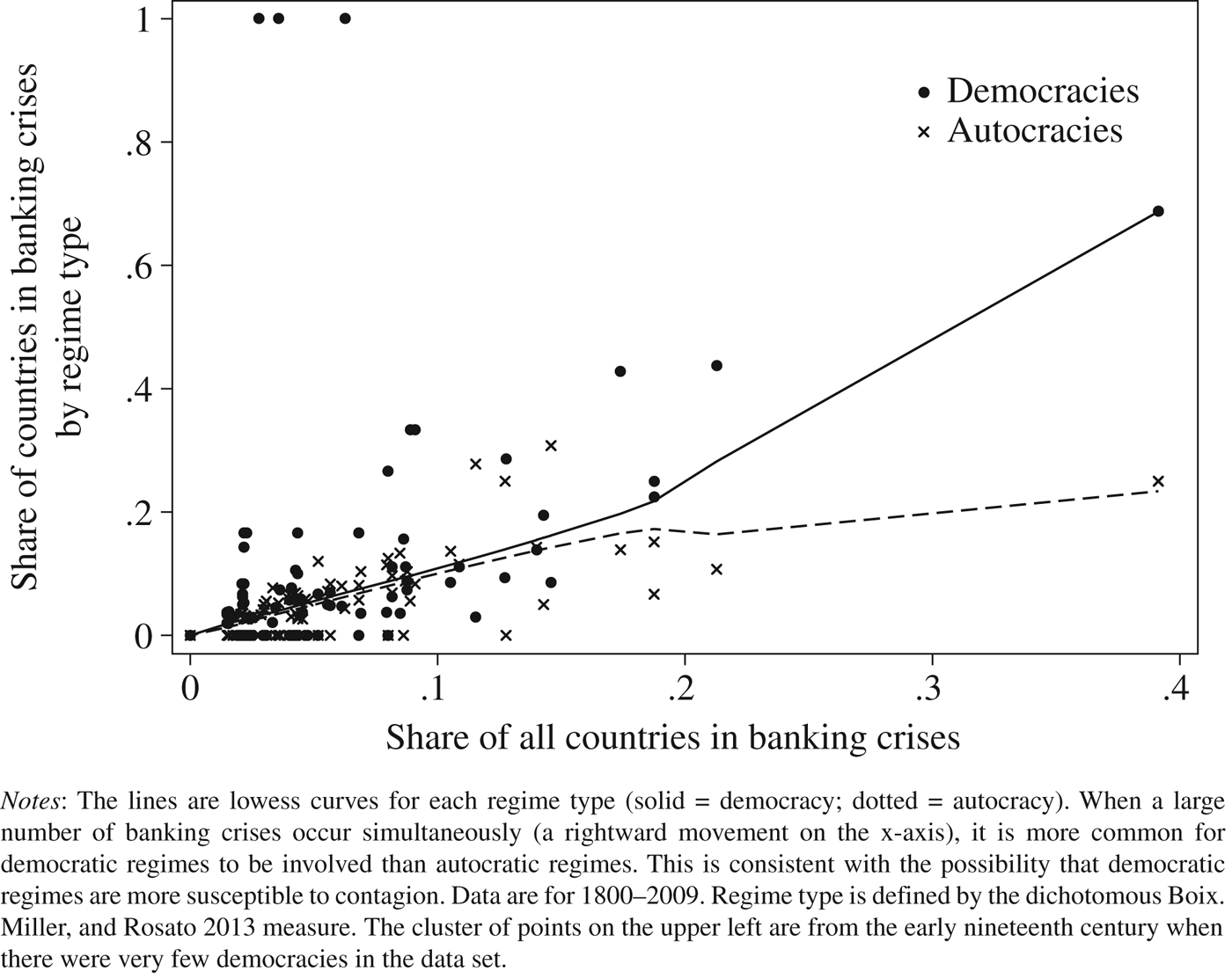
One observable implication of this hypothesis is that democratic crises should more frequently cluster together in time. If democratic crises are being set off by contagion, they should have a tendency to occur together in rapid succession. Conversely, if autocratic crises are less likely to be induced by contagion, they should more frequently occur as one-off events. Figure 3 plots crisis years according to the percentage of all countries experiencing banking crises on the x-axis, and the same percentage by regime type on the y-axis. Steep slopes indicate that a particular regime type is more susceptible to crisis during years when there are many ongoing crises. As the figure illustrates, during years when there are many episodes of banking crises, democratic countries are more likely to be affected than autocratic countries.Footnote 105 Consistent with the openness hypothesis, autocratic crises have often been singular events, while democratic crises have often clustered together.
Regime type and contagion

Is contagion the whole story? To consider this possibility, I reran the statistical models omitting years during which more than 10 percent of countries were experiencing banking crisis onsets.Footnote 106 Such years include widely recognized systemic financial crises such as the Panic of 1907, the onset of the Great Depression, and the 2008 subprime crisis. Even with these years omitted, democracy is strongly associated with crisis onset.Footnote 107 I also reran the models including decade dummies for crisis periods, as well as an indicator for the global average polity2 score during each year on the logic that crises may be especially prevalent with many democracies in the international system. These specifications also produced substantively similar results.Footnote 108 Hence, contagion is unlikely to be solely responsible for the association between democracy and financial crises.
Analysis
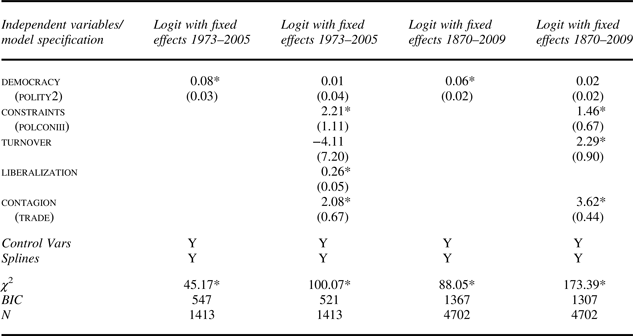
So far, I have considered the mechanisms in isolation. In Table 6, I examine proxies for the hypothesized relationships described earlier. For constraints, I use the polconiii variable from Henisz.Footnote 109 For time horizons, I use the Quan Li measure: the number of changes of the chief executive accumulated to date during the life of a particular political regime, divided by the cumulative years of life of the regime from the first observation.Footnote 110 To measure the possibility of contagion, I constructed a diffusion variable that represents the average occurrence of banking crises in all of a country's trading partners, weighted by trade share of GDP.Footnote 111 Unfortunately, the financial liberalization variable from Abiad, Detragiache, and Tressel is available for only recent years, severely limiting the time period for analysis.Footnote 112 I therefore separate the analysis into two time periods, 1973–2005, for which the liberalization variable is available, and 1870–2009, for which all other variables are available.
Considering the hypotheses

Notes: Only coefficients for variables of interest are shown for the sake of presentation. Time period of analysis is constrained by availability of data for the independent variables. Variables included in the model but omitted from the table are: GDP per capita, currency crisis, war, cubic splines, and an indicator for previous crises. Dependent variable in all models is a dichotomous indicator of banking crisis onset. Numbers in parenthesis are standard errors. Asterisk denotes a coefficient at least two standard errors removed from 0.
Table 6 presents the empirical results. The first two columns cover the time period between 1973 and 2005, when the financial liberalization variable is available. The first column runs the specification with polity2 and the control variables from the baseline model (Table 2, column 4) to confirm that democracy is meaningfully associated with crisis incidence for the available observations during this period. The second column adds the four proxies for mechanisms. As the results show, once the mechanism variables are included, the relationship between democracy and crisis onset weakens considerably, with the coefficient on polity2 becoming statistically indistinguishable from 0.Footnote 113 All the mechanism variables are signed in the correct direction, with the exception of turnover, which is statistically indistinguishable from 0. I reran the analysis for the same years while retaining time horizons but omitting the other mechanism variables, and turnover was consistently indistinguishable from 0: it appears that turnover and crisis incidence are not meaningfully associated during the recent period.
In the third and fourth columns of Table 6, I reran the analysis for the years 1870–2009 omitting the financial liberalization measure, which is available for only recent years. This shows analogous results, with the exception that all mechanism variables, including turnover, are associated with crisis onset in the expected direction.Footnote 114 The divergent result for turnover may reflect the declining ability of political leaders in recent years to manipulate economic outcomes according to their narrow political interests, for example, because of the advent of independent central banking.
How should these findings be interpreted? Although the empirical results suggest that constraints, turnover, liberalization, and openness are important in accounting for the relationship between democracy and financial crisis incidence, we should be cautious about dismissing alternative mechanisms. As is generally the case with observational studies covering long historical time periods, it is difficult to comprehensively rule out alternative mechanisms that could account for the association between democracy and financial crises.
Should the variables I analyzed be thought of as mechanisms associated with democracy or independent factors that account for the occurrence of crises? As I discussed earlier, each hypothesis is derived from a well-established literature that argues that a specific feature of democracy is closely related to the mechanism variable in question. The data are generally consistent with the proposition that the mechanism variables are closely intertwined with democracy. For example, in theory, we might expect an autocracy with strong executive constraints, frequent turnover, a liberalized financial system, and trade openness to experience frequent financial crises. However, this counterfactual autocracy does not exist: in the entire data set, there are no instances of autocracies that are above-mean levels for all four of these variables.Footnote 115
Nonetheless, there is nontrivial variation in the mechanism variables that is independent of regime type, and the models suggest that this variation is important in predicting the onset of financial crises. For example, there are some unconstrained democratic leaders in the data, such as the premiers of New Zealand in the late nineteenth century, and relatively autocratic states that pursue open economic policies, such as Singapore. The most reasonable interpretation of these findings is that more democratic countries are generally (but not uniformly) associated with greater constraints on executive authority, higher rates of turnover, financial liberalization, and openness to trade. In turn, when present, these factors are associated with a higher likelihood of financial crisis onset.
Conclusion
Although democratic governance has many advantages over the alternatives, it is associated with more frequent financial crises. I have argued that the propensity of more democratic countries to experience financial crises may be a result of features of democracy often cited as advantages. Existing work generally finds that democracies: (1) have leaders who are more constrained and therefore more capable of credible commitment; (2) have greater executive accountability because of free and fair elections; (3) tend to place fewer restrictions on the activities of private citizens; (4) are more economically open thanks to large winning coalitions.
I described how each of these purported advantages can also increase the likelihood of financial crises. First, executive constraints can make it difficult for leaders to implement effective policies to curb speculative excesses in the run up to a financial crisis. Second, short time horizons give democratic leaders incentives to orchestrate financial booms without sufficient consideration for the long-term consequences. Third, democracies tend to place great value on personal liberty and freedom of action, which may lead to excessive liberalization of the financial sector. Finally, because they are economically open, democracies may be particularly susceptible to international contagion.
The research presented here raises the possibility that democratic governance is less stable than conventionally recognized. The relationship between democracy and financial crises has been somewhat masked since World War II, first by the suppression of global capital flows and then by the Washington Consensus years. Existing research relying heavily on this period may overstate the economic and political stability of democratic regimes. In particular, serious financial crises among advanced industrialized democracies were extremely rare post-World War II until the 1990s, but they were a common occurrence in the nineteenth and early twentieth centuries. One may question, for example, whether democracy in these countries proved stable because of high incomes,Footnote 116 or because high-income countries have enjoyed a long period of unusual financial stability. Scholarship that associates democracy with stable or higher economic growth rates has also relied heavily on postwar data, which may overstate democratic stability.Footnote 117
The fact that democracies are more prone to financial crisis should not lead us to question the legitimacy or appropriateness of democratic governance. Democracy has myriad advantages that almost certainly outweigh the occasional brush with financial instability. However, crises will likely continue to increase in frequency in future years along with global capital flows.Footnote 118 If the macroeconomic consequences of crises continue to affect democracies asymmetrically, it could feed into incipient narratives lauding the purported advantages of authoritarianism, such as the “Beijing Consensus.”Footnote 119 To avoid a repeat of the democratic reversals of the early twentieth century, it will be important to better understand the mechanisms responsible for democratic financial crises.
Supplementary Material
Supplementary material for this article is available at <https://doi.org/10.1017/S0020818318000279>.