Introduction
Individuals with dementia are routinely dehumanized (Ryvicker, Reference Ryvicker2009; Doyle and Rubinstein, Reference Doyle and Rubinstein2013), as they are often perceived as having lost autonomy, dignity, and control (Illiffe et al., Reference Illiffe, Mathorpe and Eden2003), or as being “zombies” (Behuniak, Reference Behuniak2011). Additionally, attitudes toward older adults without dementia are sometimes characterized by beliefs that all older people have dementia, or will develop it (Kane, Reference Kane2003). Despite these negative perceptions, very little empirical work has examined perceptions of humanness of people with dementia and older adults and strategies to improve these perceptions. In this study, we investigated the role of contact and perspective taking in enhancing perceptions of humanness of these two groups.
Haslam (Reference Haslam2006) proposed that dehumanization of individuals occurs along two dimensions: human nature (NH) and human uniqueness (NU). HN characteristics include emotional responsiveness, interpersonal warmth, cognitive openness, agency or individuality, and depth. When HN is denied to people, they are seen as inert and cold (robot-like). HU characteristics include civility, refinement, moral sensibility, rationality or logic, and maturity. When HU characteristics are denied to others, individuals are perceived as being coarse, unintelligent, childlike, immature, and immoral (animal-like) (Haslam, Reference Haslam2006). These two sets of humanness traits have been validated by Haslam et al. (Reference Haslam, Bastian and Bissett2004, Reference Haslam, Bain, Douge, Lee and Bastian2005) as rating highly and distinctly on each dimension of humanness. Haslam et al. (2005, Study 1) found that aggregate ratings of the HU and HN trait items did not correlate across the 80 HU and HN characteristics (r = 0.07, ns), supporting the distinctness of the two senses of humanness. Support for the high construct validity of the HU and HN trait scales comes from multiple studies. Using Haslam et al. (2005)’s trait scales, Loughnan and Haslam (Reference Loughnan and Haslam2007) found that artists were rated higher on HN than with HU traits (seen more animal-like), whereas business people were rated higher on HU than on HN traits (seen more like automata). Loughnan et al. (Reference Loughnan, Haslam and Kashima2009) found that participants rated a novel group as animal-like when the group lacked HU traits than when it lacked HN traits. Support for the predictive validity of the HU and HN scales comes from experiments indicating that when people strip others of HN traits, they exclude others, whereas when people perceive others as lacking HU characteristics, they treat them as animals or children (Bastian and Haslam, Reference Bastian and Haslam2010; Andrighetto et al., Reference Andrighetto, Baldissari, Lattanzio, Loughnan and Volpato2014).
Our first research goal was to use Haslam's theoretical model and HU and HN traits (Haslam et al., Reference Haslam, Bain, Douge, Lee and Bastian2005) to develop a new concept of humanness standards, which we defined as the amount of evidence of impairments of HN and HU characteristics needed in order to conclude that an individual has lost personhood (i.e. is no longer a person). In prior work, an evidentiary standard was defined as the amount of evidence needed to conclude that a person or a group has a particular ability, characteristic, or attribute (e.g. Biernat et al., Reference Biernat, Collins, Katzarska-Miller and Thompson2009). Our application of evidentiary standards to researching humanness perceptions of people with dementia and older adults is novel and important, especially given calls by Kitwood (Reference Kitwood1997) and Sabat (Reference Sabat2001) for a focus on personhood of people with dementia.
Our second research goal was to test whether humanness standards and perceived humanness of older adults and of those with dementia are a function of the extent of contact and perspective taking. We define perspective-taking orientation as routinely taking the perspective of a friend or family member, who has dementia (or is older) and actively thinking of his or her situation and symptoms (Miron et al., 2015). Previous exposure and recent experience or employment with people with dementia are key factors in the development of positive responses to this population (Kane et al., Reference Kane, Hamlin and Hawkins2004). Extended contact with people with dementia decreases fear of them (Phillipson et al., Reference Phillipson, Magee, Jones and Skladzien2014), but humanizing a person's suffering positively predicted symptoms of burnout, especially for healthcare workers who had higher levels of direct contact with patients (Vaes and Muratore, Reference Vaes and Muratore2013). Thus, contact may decrease prejudice only when opportunities are present for actively taking the perspective of another person and thus considering the situation from their viewpoint (Aronson, Reference Aronson2000). Indeed, taking the perspective of an older individual decreases stereotyping of that person (Skorinko and Sinclair, Reference Skorinko and Sinclair2013). Perspective taking is also associated with increased satisfaction with caregiving and decreased perceived burden in caring for spouses with dementia (Shim et al., Reference Shim, Barroso and Davis2012).
In this study, we predicted that participants would require less evidence of HN and HU impairments in order to conclude that someone with dementia (vs. an older individual) has lost personhood (Hypothesis 1). Participants were expected to judge people with dementia as possessing HN and HU characteristics to a lesser extent compared to elderly individuals (Hypothesis 2). Because contact is beneficial when it is accompanied by a high degree of perspective taking, we predicted that the highest amount of evidence of humanness impairments required to conclude that an individual has lost personhood (humanness standards) and the strongest perceptions of humanness characteristics would be in the high contact/high perspective taking condition for both social groups (Hypotheses 3 and 4).
Methods
Design
In order to assess whether there are differences in humanness perceptions and standards set for older people and those with dementia, we used a cross-sectional survey design. Half the participants (n = 311) were randomly assigned to complete a survey measuring their evidentiary standards and perceived humanness characteristics of people with dementia, whereas the other half (n = 308) was randomly assigned to complete an identical questionnaire about older people. This also allowed us to test whether contact and perspective taking differentially predicted these outcomes within these two social groups.
Recruitment and participants
The study took place at a Midwest university in the USA. A total of 619 persons participated in this study: 290 Psychology students completed the questionnaire online; 84 Psychology students completed the questionnaire in the laboratory; 66 participants from the USA, who were recruited through Amazon Mturk completed the questionnaire online; and 179 community members were recruited by the student participants, research assistants, and the first author. One additional participant's data were excluded because he completed the same questionnaire twice. The missing data ranged from 0.48% (3 out of 619 participants) for HN trait ratings to 0.65% (4 out of 619) for HU standards and HU trait ratings, to 0.97% (6 out of 619) for HN standards. Given the small amount of missing data, no data imputation was performed. The average age was 27.47 years old (SD = 13.40; age ranged from 18 to 78 years old); 59.5% were women. There were no differences between the dementia and older adults groups in terms of gender, χ 2(1) = 0.10, p = 0.99, age, χ 2(51) = 49.25, p = 0.54, or level of education, χ 2(4) = 6.69, p = 0.15.
Measures
The questionnaire assessed the measures in the following order:
Standards of humanness
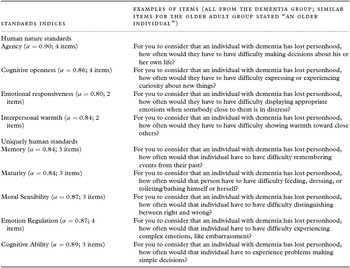
Twenty-nine questions assessed the amount of evidence of humanness impairment needed to conclude that an individual with dementia (or an older individual) has lost personhood. Following Haslam's conceptualization of humanness, two different sets of standards were measured: HN Standards (α = 0.96; 12 items) and HU Standards (α = 0.97; 16 items). Table 1 includes examples of standards items. The HN Standards tapped into the amount of evidence of impairments of HN characteristics (Emotional Responsiveness, Interpersonal Warmth, Cognitive Openness, and Agency) needed to conclude that an individual had lost personhood. The HU Standards measured the evidence of impairments of HU characteristics (Moral Sensibility, Use of Cognitive Ability, and Maturity) needed to reach the same conclusion. Two new standards indices measuring evidence of impairments of Memory and of Emotion Regulation were included in the HU Standards index. Standards were assessed on 11-point scales measuring the frequency with which the impairment must occur, ranging from 0% to 100% of the time, in 10% increments. The HU Standards and HN Standards scales are included in Supplemental Materials, which is attached to the electronic version of this paper at https://doi.org/10.1017/S1041610217000989.
Examples of human nature standards and uniquely human standards

Perceptions of HN and HU characteristics
Participants rated the group on each of Haslam et al.’s (Reference Haslam, Bain, Douge, Lee and Bastian2005) traits, on an 8-point scale (0 = Strongly disagree; 7 = Strongly agree): curious, friendly, fun loving, and active (positive HN, α = 0.74), impulsive, impatient, jealous, and shy (negative HN, α = 0.73), broadminded, humble, polite and thorough (positive HU, α = 0.76), and disorganized, ignorant, rude, and stingy (negative HU, α = 0.69).
contact
Contact was measured with two questions, “How much experience do you have interacting with people with dementia/elderly people?” (0 = None; 4 = A lot of experience); and “In the last three months, how often did you interact with people with dementia/elderly people?” (0 = Never; 7 = Very Often; 8-point scale) (α = 0.84).
Perspective-taking orientation
We modified Miron et al. (Reference Miron, Wicklund, Diestelmann, Moore and Schroeder2015)’s perspective-taking orientation measure to assess perspective taking in this study. Depending on condition, participants were asked either whether they had a close friend/relative diagnosed with dementia or an older close friend/relative. If they answered “Yes,” they were directed to answer three questions, all on an 8-point scale: “How often do/did you think of your friend or relative's situation and his/her life as he or she is/was experiencing symptoms of dementia/old age?” (0 = Never; 7 = Very Often); “How severe are/were that person's symptoms of dementia/old age?” (0 = Very mild; 7 = Very Severe); and “How often do/did you think of your friend or relative's need for assistance as he or she is/was experiencing symptoms of dementia/old age?” (0 = Never; 7 = Very Often) (α = 0.80).
Ethics
The study was approved by the authors’ Institutional Review Board. After completing the questionnaire, participants were given a debriefing sheet with information about the study goals and predictions and the first author's contact information.
Statistical analyses
A VARIMAX factor rotation that requested extraction of two factors was conducted to explore the presence of the two types of standards: HU Standards and HN Standards. To create two separate measures of perceived HN and HU characteristics, participants’ ratings of negative HN and negative HU characteristics were reversed-scored and averaged with the positive HN and positive HU ratings, respectively, to create Perceived Human Nature Characteristics and Perceived Human Uniqueness Characteristics indices. To explore the effects of type of group (people with dementia vs. older adults) on types of standards and types of perceived humanness characteristics, we conducted mixed ANOVAs. A hierarchical regression analysis was conducted to examine whether contact and perspective taking predicted standards. First, all predictors were centered/standardized. In the first step, group (dementia vs. older adults) and the main effects of contact and perspective taking were included. In the second step, the two-way interactions among three predictors (group×contact, group×perspective taking, and perspective taking×contact) were included. In the last step, the three-way interaction between group, contact, and perspective taking was included. Finally, two hierarchical regressions analyses were conducted to test whether contact and perspective taking predicted perceived humanness. The analyses were identical with the exception of the predicted outcome: HN characteristics for the first analysis and HU characteristics for the second analysis. In the first step, the main effects of contact, perspective taking, and group (all centered or standardized) were entered. In the second step, the two-way interactions of these variables were entered. In the third step, the three-way interaction was entered. In the last step, the corresponding standard was entered (HU standards for perceptions of HU characteristics and HN standards for perceptions of HN characteristics, respectively). Preacher et al. (Reference Preacher, Curran and Bauer2006) online calculator for computing simple slopes for a MLR 3-way interactions was used to compute the simple slopes. The slopes were computed at 1 standard deviation below the mean for the low-scoring group (e.g. low contact group; low perspective-taking group) and at 1 standard deviation above the mean for the high-scoring group (e.g. high contact group; high perspective-taking group). For all analyses, two-sided tests were applied and statistical significance was set at p ≤ 0.05.
Results
Humanness standards
A VARIMAX factor rotation that requested extraction of two factors was conducted with the nine standards displayed in Table 1. The first factor (HU Standards; 47.67% of variance accounted) includes Moral Sensibility, Maturity, Cognitive Ability, and Memory. Factor 2 (HN Standards; 35.36% of variance accounted) includes Interpersonal Warmth, Agency, and Cognitive Openness. Emotion Regulation loaded on both factors but based on other work where it clearly loaded on Uniquely Human Standards (Miron et al., Reference Miron, McFadden, Nazario and Buelow2017), it was included in the HU Standards index. Emotional Responsiveness loaded on both factors but, based on prior theorizing (Haslam, Reference Haslam2006), was included in the HN standards. These factors are consistent with work by Miron et al. (Reference Miron, McFadden, Nazario and Buelow2017, n = 107) that used the same Standards scales and found the same two factors with the same loading structure and internal consistency. In that study, Uniquely Human Standards accounted for 40.52% of variance in the data (α = 0.95), whereas the second factor (Human Nature Standards) accounted for 34.50 % of variance (α = 0.93).
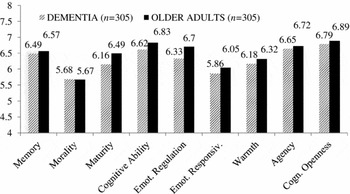
Figure 1 displays the effects of the group manipulation on HN Standards and HU Standards. A mixed ANOVA was conducted with type of standards as a within-subjects factor and group (people with dementia vs. elderly adults) as the between-subjects factor. The within-subjects effect was significant, F(1, 608) = 16.76, p < 0.001, ηp 2 = 0.03. Neither the interaction between standards type and group manipulation, F(1, 608) = 1.17, p = 0.28, ηp 2= 0.01, nor the group effect was significant, F(1, 608) = 0.85, p = 0.36, ηp 2 = 0.01. Regardless of the group, participants requested more evidence of impairment of HN (M = 6.54, SD = 2.23) than evidence of impairment of HU (M = 6.36, SD = 2.20) in order to conclude that personhood was lost.
Types of standards for the two groups. Emot. Regulation = Emotion Regulation; Emot. Responsiv. = Emotional Responsiveness; Cogn. Openness = Cognitive Openness. To explore which standard was most stringent and which standard was most lenient, we conducted a 2×9 mixed ANOVA, with the group manipulation (dementia vs. older adults) as a between-factor and type of standard as a within-subjects factor. The type of standard was significant, F(8, 4,864) = 57.79, p < 0.001, ηp 2 = 0.09. Neither the interaction of standards by group, nor the group effect was significant, F(8, 4,864) = 1.48, p = 0.16, ηp 2 = 0.01 and F(1, 608) = 0.89, p = 0.35, ηp 2 = 0.01, respectively. Given this, we collapsed across the two social groups and tested the differences in means between the various standards using a Bonferroni-type correction method. Based on the significance of tests of mean differences, the following rankings emerged. Participants asked for the least amount of evidence of impairments of Moral Sensibility, as all the other Standards means were significantly higher than the mean for this standard, all ps’ < 0.003. The second grouping was made of the Emotional Responsiveness standard, as participants asked more evidence of impairments of Emotional Responsiveness than of impairments of Morality, p = 0.002, but also asked for less evidence of impairments of Emotional Responsiveness than any of the other dimensions in order to conclude that the target group member was no longer a person, all ps’ < 0.002. The third grouping was made of Maturity and Interpersonal Warmth Standards, which not differ from each other (p = 1), but were lower from the rest of the standards (all ps’ < 0.05). The fourth grouping was made of Emotion Regulation impairments, which was different from all but Agency (all other ps < 0.05). Finally, participants asked for the most amount of evidence of impairments of Memory, Agency, Cognitive Ability, and Cognitive Openness, in order to conclude that the target individual is no longer a person as they all differed from the rest, all ps’ < 0.05, but did not differ from one another (all ps’ >0.11).

Univariate tests conducted on the nine individual standards indicated that participants asked for less evidence of Emotion Regulation impairments and somewhat less evidence of Maturity impairments in order to conclude that an individual with dementia (vs. older adult) had lost personhood, F(1, 608) = 3.72, p = 0.05, ηp 2 = 0.01 and F(1, 608) = 2.73, p < 0.10, ηp 2 = 0.01, respectively (see Figure 1). An analysis of the relative rankings of the nine standards is reported in the footnote of Figure 1.
Perceptions of HN and HU characteristics
A mixed ANOVA with group as a between-subjects factor and type of humanness characteristic as a within-subjects factor revealed a significant interaction, F(1, 612) = 10.24, p = 0.001, ηp 2 = 0.02, and a marginally significant main effect of characteristic type, F(1, 612) = 2.97, p = 0.085, ηp 2 = 0.01. The effect of group was significant for both types of characteristics. Participants perceived people with dementia as possessing HN and HU to a lesser extent than older adults, F(1, 612) = 175.20, p <0.001, ηp 2 = 0.22 for HN, and F(1, 612) = 179.97, p <0.001, ηp 2 = 0.23 for HU. Paired t-tests suggested that while people with dementia were seen as possessing HU characteristics (M = 3.21, SD = 0.82) to a lesser extent than HN characteristics (M = 3.35, SD = 0.69), t(307) = 3.48, p = 0.001, there was no corresponding effect for older adults, t(305) = 1.04, p = 0.30 (M = 4.15, SD = 0.89 vs. M = 4.10, SD = 0.72).
What predicts humanness standards?
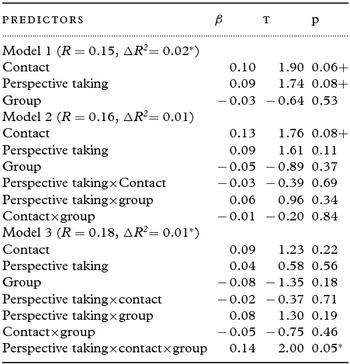
We used the combined Standards Index as the predicted variable because when we conducted two analyses with HN standards and HU standards, respectively, as the predicted variable, the results were the same: only the three-way interaction was marginally significant, β = 0.14, t = 1.94, p = 0.053 for HU standards and β = 0.13, t = 1.90, p = 0.058 for HN standards. As shown in Table 2, when using the combined Standards Index, the only significant predictor in the last step was the three-way interaction, β = 0.14, p = 0.046.
Predicting humanness standards (n = 473)

Note: n = 473 (n = 202 for the dementia group and n = 271 for the elderly group) because of occasional missing data and because the analyses were conducted with only participants who answered yes to the question of whether they had a relative or friend diagnosed with dementia or someone being an older adult. This question was the prescreening question for answering the questions used to create the perspective-taking variable. *p ≤ 0.05; +p ≤ 0.10. For the last model, F(7, 465) = 2.27, p = 0.03.
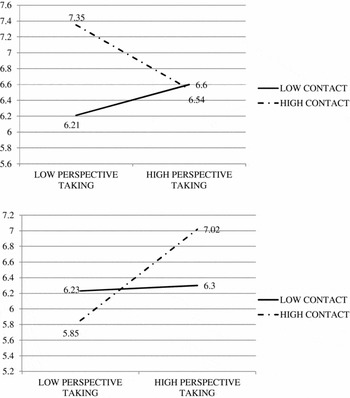
Under low perspective-taking conditions, participants asked for less evidence of humanness impairments for determining personhood loss for people with dementia when they had lower contact than when they had higher contact with people with dementia, B = 0.66, SE = 0.35, t = 1.88, p = 0.06 (M lowcontact = 6.21 vs. M highcontact = 7.35). No differences in standards were found as a function of contact in the high perspective taking condition for people with dementia, B = −0.04, SE = 0.37, t = 0.10, p = 0.91 (M lowcontact = 6.60 vs. M highcontact = 6.54). Similarly, no differences in standards were found as a function of perspective taking in the low and high contact conditions, respectively, both ps’ > 0.21 (Figure 2, top).
Humanness standards as a function of perspective taking, contact, and group (top graph: people with dementia; bottom graph: older adults). Higher numbers indicate more evidence of impairments needed to conclude personhood loss.

When the target was older adults (Figure 2, bottom), no differences in standards were found under low perspective-taking conditions as a function of contact, B = −0.22, SE = 0.41, t = 0.54, p = 0.59 (M lowcontact = 6.23 vs. M highcontact = 5.85). However, under high perspective-taking conditions, participants asked for more evidence of humanness impairments for older adults for determining personhood loss when they had higher contact versus lower contact with them, B = 0.42, SE = 0.21, t = 1.98, p = 0.05 (M lowcontact = 6.30 vs. M highcontact = 7.02). Moreover, under low contact conditions, no differences were found as a function of perspective taking, p > 0.91. As predicted, under high contact conditions, participants asked for more evidence of humanness impairments to determine personhood loss for older adults under higher perspective-taking conditions (vs. lower perspective-taking conditions), B = 0.72, SE = 0.33, t = 2.14, p = 0.03 (M lowperspective= 5.85 vs. M highperspective= 7.02).
What predicts perceptions of HN and HU characteristics?
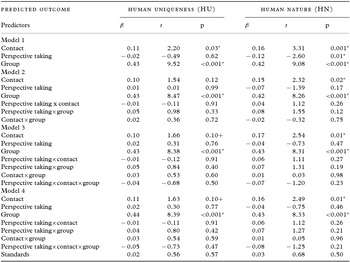
As seen in Table 3, in the last model, perceived HU characteristics were predicted by group, β = 0.44, t = 8.39, p < 0.001, and marginally by contact, β = 0.11, t = 1.63, p = 0.10. Perceived HN characteristics were predicted by group, β = 0.43, t = 8.33, p < 0.001 and contact, β = 0.16, t = 2.49, p = 0.01. All other predictors were not significant, all βs’ < 0.08, all ps’ > 0.20. People with dementia were perceived as possessing HN and HU characteristics to a lesser extent than were older adults. Regardless of group, participants who had more contact with members of the two groups perceived them as possessing HN traits and HU characteristics to a greater extent than those with less contact.
Predicting perceived human uniqueness and human nature (n = 476)

Note: n = 476 (n = 205 for the dementia group and n = 271 for the elderly group) because the analyses were conducted with only participants who answered yes to the question of whether they had a relative or friend diagnosed with dementia or someone being an older adult. This question was the prescreening question for answering the questions used to create the perspective-taking variable. In the last step, the corresponding standard was entered (HU standards for perceptions of HU characteristics and HN standards for perceptions of HN characteristics, respectively). *p ≤ 0.05, +p ≤ 0.10. For the last model, F(8, 467) = 18.21, p < 0.001 for predicting Human Uniqueness, and F(8, 463) = 18.89, p < 0.001 for predicting Human Nature.
Discussion
Summary of the findings
Partially confirming our first hypothesis, participants asked for less evidence of Emotion Regulation and Maturity impairments in order to conclude that an individual with dementia (vs. an older individual) had lost personhood. Confirming Hypothesis 2, people with dementia were perceived as possessing HU and HN characteristics to a lesser extent than were older adults. Although people with dementia were seen as possessing HU characteristics to a lesser extent than HN characteristics, there was no corresponding effect for older adults. As predicted (Hypothesis 3), participants asked for more evidence of humanness impairments for determining personhood loss for older adults in the high contact/high perspective-taking condition. However, when the target was people with dementia, higher contact predicted higher amount of evidence of impairments being asked for, but only under conditions of low perspective taking. We predicted that the highest perceptions of HN and HU characteristics would occur in the high contact/high perspective-taking condition (Hypothesis 4). We found that, for both groups, only contact predicted enhanced perceptions of HU and HN characteristics.
Humanness standards and perceived HN and HU characteristics
With the exception of Emotion Regulation and Maturity standards, no differences in humanness standards were found between the two groups. This may be due to the ambiguous relationship between aging and dementia (Scodellaro and Pin, Reference Scodellaro and Pin2013), and perceptions of memory problems as “an almost inevitable part of growing older, a natural and normal process accompanying aging” (Werner, Reference Werner2004, p. 22). Despite the similarities in humanness thresholds for these two groups, there were significant differences between the two groups in the perception of the two types of humanness: people with dementia were perceived as possessing HN characteristics and HU characteristics to a lesser extent than were older adults. Moreover, while people with dementia were seen as possessing HU characteristics to a lesser extent than HN characteristics, there was no such corresponding effect for older adults.
These findings suggest that HU (and not HN) may be a more relevant dimension of evaluation of personhood of people with dementia, who thus may experience HU dehumanization. This finding was conceptually replicated in an experiment by Miron et al. (Reference Miron, McFadden, Nazario and Buelow2017) in which perspective taking was manipulated. Using the same HU Standards and HN Standards scales, Miron et al. (Reference Miron, McFadden, Nazario and Buelow2017) found that taking the perspective of an older individual with dementia increased the amount of evidence of impairments of HU characteristics but not impairments of HN characteristics needed to determine personhood loss for that individual. In the current study, the most stringent standard for both groups was set for Morality (a HU standard), as participants needed the least amount of evidence of Morality impairments to conclude that personhood was lost (see footnote, Figure 1). Morality is an essential dimension of evaluation of others, particularly in judgments of personal identity of people with dementia made by their family members (Strohminger and Nichols, Reference Stohminger and Nichols2015). Future work should explore the consequences of perceptions of absence of HU characteristics and particularly perceived absence of morality in older adults and those with dementia, and acknowledge the importance of these perceptions in social and personal interactions.
The role of contact and perspective taking
For both groups, perceived HN and HU characteristics were predicted only by contact, suggesting that perceptions of these characteristics may operate differently than humanness standards (i.e. may be more strongly influenced by social desirability concerns). Humanness standards, in contrast, were predicted by an interaction between contact and perspective taking, for both target groups. As predicted, participants asked for more evidence of impairments for determining personhood loss for older adults in the high contact/high perspective-taking condition. However, when the target was people with dementia, higher contact with people with dementia predicted higher amount of evidence of impairments being asked for in order to determine personhood loss, but only under conditions of low perspective taking. Humanness impairment thresholds did not differ as a function of contact in the high-perspective condition, and, similarly, these thresholds did not differ as a function of perspective taking when contact was high.
This outcome is puzzling as it suggests that contact may enhance openness to perceiving those with dementia as persons only when people do not actively try to imagine the situation of a relative or close friend diagnosed with dementia. Why did perspective taking not increase humanness impairment standards more in the high contact condition than in the low contact condition for people with dementia? One explanation is that when individuals are not asked to focus on specific aspects of the close other's situation (e.g. the other's need for assistance), perspective taking under conditions of high contact with the person with dementia can lead to a focus on the relative or friend's humanness (increasing humanness impairment standards), but also to a focus on his or her deficits (decreasing standards). Shim et al. (Reference Shim, Barroso and Davis2012) found that dementia caregivers vary in attitudes toward people in their care, from positive to ambivalent to negative, and that caregivers in these three groups focus on different aspects of the other (e.g. on burden and their own needs in the negative affect group, or on the other and their relationship with the other in the positive affect group, or on both aspects for the ambivalent group). Rinaldi et al. (Reference Rinaldi2005) found that being a child or a spouse of a person with dementia increased the risk of experiencing burden-distress more than five and six times, respectively, compared to being a friend or other relative, presumably because of a focus on the close other's ability impairments. Overall, recent research has uncovered deeply ambivalent attitudes about those with dementia (pity, empathy, but also threat; Bousfield and Hutchinson, Reference Bousfield and Hutchison2010; O'Connor and McFadden, Reference O'Connor and McFadden2012). These opposing feelings are more likely to be amplified when perspective taking increases. Thus, in hindsight, it is not surprising that taking the perspective of close others with dementia under conditions of high contact with the person with dementia comes with positive and negative effects that cancel each other out.
No such ambivalence was found when the target group was older adults. In their case, and, as predicted, participants asked for the most amount of evidence of impairments for determining personhood loss in the high contact/high perspective-taking condition. Thus, although in the case of people with dementia, contact matters most particularly under conditions of low perspective taking, in the case of older adults, taking the perspective of an older adult without dementia brings additional benefits to the interaction. Indeed, various studies show that exposure via service learning courses can increase positive attitudes toward people with dementia, whereas increased psychological closeness does not necessarily increase positive attitudes (Rinaldi et al., Reference Rinaldi2005; Yamashita et al., Reference Yamashita, Kinney and Lokon2013). On the other hand, in the case of older adults, quality but not frequency of intergenerational contact (i.e. time spent with elderly people) was positively associated with young people's attitudes and behavioral intentions toward the elderly (Bousfield and Hutchison, Reference Bousfield and Hutchison2010). This suggests that while social programs such as Memory Cafés, which bring persons with dementia and other individuals in contact, could change humanness standards and perceptions of humanness characteristics of people with dementia, in the case of elderly adults, the contact must be supplemented by variables that facilitate taking the perspective of the person.
Another implication is that when individuals take another person's perspective (and particularly the perspective of a person with dementia), they should be given specific instructions to focus on “how that individual's situation is affecting his/her life” rather than to focus on his or her impairments. Prior work has found that such perspective-taking instructions reliably reduce standards for HU impairments for a person with dementia (Miron et al., Reference Miron, McFadden, Nazario and Buelow2017). In contrast, perspective taking can lead to more stereotyping of an older person when the focus of the perceiver is on that person's stereotype-consistent characteristics (Skorinko and Sinclair, Reference Skorinko and Sinclair2013). This recommendation fits well with the general call for a study of personhood of people with dementia that departs from the “standard paradigm” (Kitwood, Reference Kitwood1997) that focuses on the person's “defectology”—“things he or she cannot do, along with often unwarranted inferences about the incapacities of the afflicted” (Sabat, Reference Sabat2001, pp. 93–94). A study of personhood must focus on the person in the social context, and his or her social and personal connections to close others who engage with the person through repeated contact and through active perspective taking that focuses more on what is retained rather than what has been lost.
Limitations and strengths
One limitation of the study was that most of our participants were from the Midwestern part of the USA, although a subsample (Amazon Mechanical Turk participants) were recruited from across the USA. Future research should further validate the standards scales and our findings in different cultural contexts, to increase generalizability. Work is also needed to further validate the humanness standards measures we designed for this study by establishing criterion validity for these scales. Such work could test whether the setting of a high humanness impairment threshold for people with dementia and older adults’ leads to more willingness to help those individuals, as found in the Andrighetto et al. (Reference Andrighetto, Baldissari, Lattanzio, Loughnan and Volpato2014) study. Future research should also explore the relationship between objective ratings of dementia symptoms (Morris, Reference Morris1997) and subjective judgments of humanness of those with dementia, and how contact and perspective taking moderate this relationship.
While our findings regarding the role of contact and perspective taking on humanness perception are somewhat predictable, our work is the first to measure humanness standards and perceptions of humanness for people with dementia and older adults and to assess the roles of perspective taking and contact on these novel outcomes. Moreover, uncovering the differential importance of various dimensions of humanness for these social groups is an important contribution to the literature on social perceptions of people with dementia and older adults and is consistent with recent work (Strohminger and Nichols, Reference Stohminger and Nichols2015).
We are hopeful that our work can inform researchers and practitioners alike about the importance of contact and perspective taking in humanness perception, and can contribute to policies that would enhance their unique benefits in improving relationships with older adults and persons with dementia. This would include policies about training for those who care for elderly people and those with dementia.
Conflict of interests
None.
Description of authors’ roles
Anca Miron, Susan McFadden, and Katarena Seelman designed the study. Anca Miron conducted the data analyses and wrote the manuscript. Nathan Hermus, Jennifer Buelow, Amanda Nazario, and Katarena Seelman collected the data. Susan McFadden and Nathan Hermus provided feedback on the manuscript.
Acknowledgments
The first author received funding for this work from the University of Wisconsin Oshkosh Faculty Development Board, FDR 877.
Supplementary Material
To view supplementary material for this article, please visit https://doi.org/10.1017/S1041610217000989