Horizon scanning or early awareness and alert (EAA) activities to provide timely and useful information of emerging health technologies to health professionals, health policy decision makers, patients, and payers have been introduced in European countries since the late 1990s (Reference Gutierrez-Ibarluzea, Simpson and Benguria-Arrate1). The main contents of horizon scanning activities usually comprise emerging health technologies’ trends, clinical evidence, and impacts on society. Outcomes of horizon scanning activities have been widely used by: policy makers to establish, revise, and implement health policies; payers to develop payment criteria and set up listings; health professionals to be prepared for the new technology before it is fully introduced; and patients to obtain important information for emerging health technologies and accordingly choose appropriate technologies for their disease(s) (Reference Peter2).
The National Evidence-based Healthcare Collaborating Agency (NECA), the health technology assessment agency in South Korea, conducted preliminary studies in 2011 and 2012 aimed to adopt a horizon scanning system. Accordingly, Horizon Scanning Service of Innovative Global Health Technology (H-SIGHT) was established in August, 2013. As a first activity, H-SIGHT performed a pilot research of horizon scanning in the first half of 2014 and developed the H-SIGHT toolkit based on one from the EuroScan International Network, a leading collaborative network of horizon scanning agencies (3). The aim of the pilot research was to assess emerging medical procedures, drugs, and medical devices in advance and predict their potential impact to provide useful information of health technologies at the developmental stage, enhancing Research and Development (R&D) resources allocation and establishing healthcare policies.
The process of H-SIGHT horizon scanning activities consists of four stages, namely identification, filtration, prioritization, and assessment. We identify newly developed health technologies that could be possibly introduced to the Korean healthcare system; then, we filter them with respect to innovativeness and applicability to the Korean healthcare system in 1 to 5 years. Subsequently, we score each technology based on the prioritization criteria and the results from a survey of health professionals and select health technologies that are high ranked. The next stage includes assessment of the technologies. We assess safety, effectiveness, and potential impact of the selected health technologies based on literature reviews and experts’ opinions. Finally, we disseminate our horizon scanning reports on the new and emerging health technologies.
One technology selected from our pilot study was the implantation of polyurethane scaffold for partial meniscal lesions. The meniscus can be damaged during sports activities or traffic accidents or due to cartilage degeneration with aging. Failure to treat meniscal lesions can lead to damage of the articular cartilage, arthritis, and loss of knee joint function (Reference Cook, Tomlinson, Kreeger and Cook4;Reference Kim, Oh, Lee and Lee5). Meniscal lesions have an incidence of 60–70 per 100,000 individuals in the world (Reference Kim, Oh, Lee and Lee5). Current treatment options available in Korea for meniscal lesions include arthroscopic meniscal repair, meniscectomy, and allograft transplantation. In Korea, the frequency of meniscal transplantation performed to treat meniscal lesions has increased annually from 369 in 2010 to 390 in 2011 and to 516 in 2012. Medical expenses for meniscal allograft transplantations in 2012 totaled 273 thousand USD, representing a 41 percent increase from 2010 (6). It was reported that meniscectomy poses a risk of complications, such as increased pressure on the contact surface of the joint and damage to the articular cartilage after surgery. As an alternative measure, meniscal allograft transplantation is performed to restore meniscal function (Reference Choi and Choi7;Reference Lubowitz, Verdonk, Reid and Verdonk8). However, meniscal allograft transplantation is not suitable for partial resection, and it poses concerns related to availability, very long waiting times for a suitable transplant, the possibility of disease transmission, and nerve damage. There has thus been an increased demand for synthetic meniscal scaffolds (Reference Stollsteimer, Shelton, Dukes and Bomboy9;Reference Choi and Oh10). The U.S.-based ReGen Biologics developed a collagen scaffold (product name: Menaflex), which received Food and Drug Administration (FDA) approval (510[K] clearance) in 2008 and became widely used for meniscal implantation (Reference Myers, Sgaglione and Kurzweil11). However, the FDA rescinded the product's marketing clearance in 2010 due to the lack of evidence for efficacy after postmarket evaluation of the device (12).
The implantation of polyurethane meniscal scaffolds involves removing the ruptured or damaged area and implantation of a three-dimensional absorptive synthetic material to promote natural regeneration of the meniscus (13). During the procedure, the polyurethane scaffold is attached to the vascularized zone of the meniscus. Cellular infiltration and vascular ingrowth occur over time to facilitate tissue regeneration of the surrounding cells. Ultimately, the regenerated functional tissue begins to fulfill the role of the native meniscus.
The ACTIFIT from Orteq Limited. has been adopted in European countries since it was granted the CE marking in 2008 (14). This polyurethane scaffolds could replace the meniscal allograft transplantation which is the only approved form of treatment available in Korea (Reference Verdonk15). To enter the clinical market in Korea, every health technology is verified for its safety and effectiveness through new health technology assessment (nHTA) separate from the approval required for accompanying medical devices from the Korean Ministry of Food and Drug Safety (16). Polyurethane meniscal scaffold implantation had failed to get approved as a new technology by the nHTA in 2013, due to a lack of clinical evidence for safety and effectiveness in its use. In addition, there was no rigid or well-designed research that proved the mechanism of tissue ingrowth into the polyurethane scaffold, biocompatibility, and biodegradability of the polyurethane in human body.
The purpose of this study was to apply horizon scanning methods for predicting potential impacts of the implantation of polyurethane scaffold in Korean healthcare system and to assess the safety, effectiveness, and potential impacts of polyurethane scaffolds on patients or healthcare services in the near future.
METHODS
Horizon Scanning
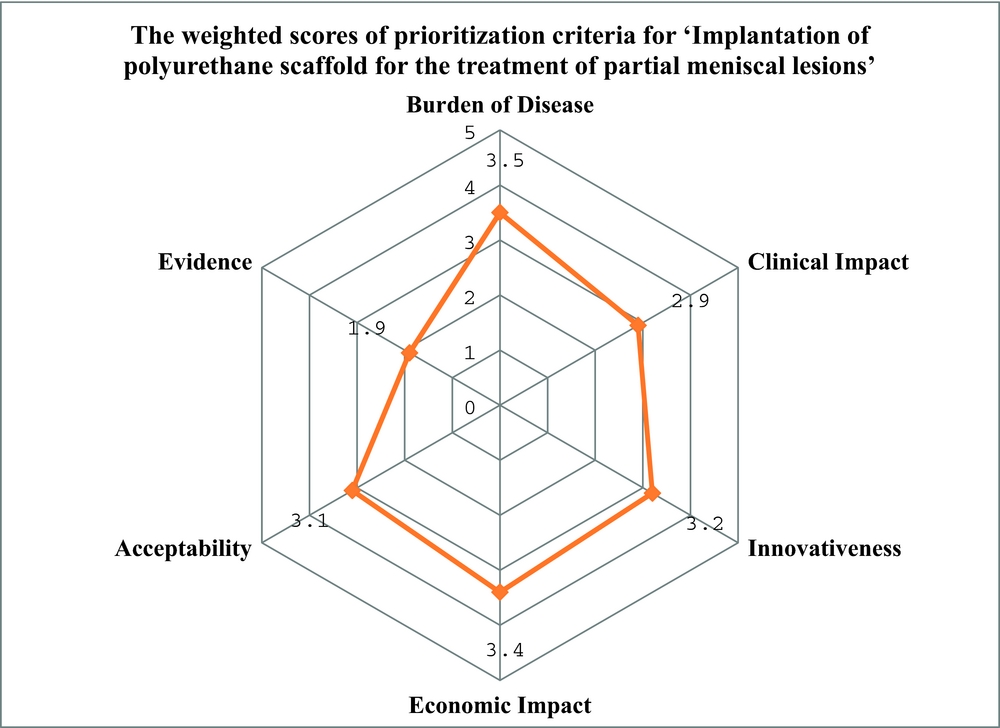
We identified 136 newly developed health technologies that had been applied for evaluation of New Health Technology Assessment (nHTA) in 2013 and were not being clinically used in the Korean healthcare system at the time of the study. Subsequently, we filtered the 136 health technologies by the following selection criteria: innovativeness, appropriateness of introduction to the Korean healthcare system, and the possibility of introduction to the Korean health insurance system within 1 to 5 years. Five authors participated in the filtration process, and the eight health technologies which all the five authors agreed with the three criteria were considered to be included. For the next stage, which is the prioritization process, we invited ten medical experts in various fields such as cardiology, internal medicine, and orthopedic surgery from a pool of 826 health technology assessment specialists at the NECA. They were asked to prioritize the eight technologies based on our prioritization criteria through a face-to-face interview: the criteria discussed included the burden of disease, clinical impact, innovativeness, economic impact, acceptability in the clinical field, social impact, and current clinical evidence. The priority was determined by the total weighted score. We had surveyed fifty-four Korean healthcare professionals including physicians, academics, private, and public sector researchers on the importance of each prioritization criterion with a five-point-scale to calculate its weight value which were later applied to determine the ranking of the eight technologies. The high-ranked four technologies were finally selected for the assessment process, and the implantation of polyurethane scaffold for partial meniscal lesions was included. Figure 1 shows weighted scores of prioritization criteria for the technology.
The weighted scores of prioritization criteria for “Implantation of polyurethane scaffold for the treatment of partial meniscal lesions.”

In the assessment stage, we sought counsel on potential impact of the technology from four medical professionals in orthopedics that were randomly selected from a pool of 826 health technology assessment specialists at NECA. The professionals rated the potential of the implantation of polyurethane scaffold for each of the following parameters: (i) the potential to fulfill unmet needs; (ii) the potential to improve patients’ health; (iii) the potential to affect health disparities; (iv) the potential to influence healthcare delivery system; (v) the potential for acceptance/adoption by patients and clinicians; (vi) the potential impact on healthcare costs; (vii) the potential impact on social, ethical, legal, political and cultural aspects; and (viii) the overall potential impact of the target technology. The experts were asked to score each area of potential impact assessment on a scale of one (least) to five (most) and give subjective opinions on expected impact of the technology in various aspects.
Literature Review
To examine the evidence related to the study purpose, a literature review was performed in Google Scholar, Ovid-MEDLINE (1946 to May 2, 2014), Ovid-Embase (1974 to May 2, 2014), and Korean databases, including KoreaMed and KMBase without any time limitation on May 6–9, 2014. The terms polyurethane, meniscus, meniscal implant, and combinations of these terms were used to identify relevant studies. Inclusion criteria were all human studies with English and Korean languages; furthermore, studies that reported patient outcomes, including randomized controlled trials, case-reports, case-series, or observational studies, were selected. Reviews, letters, and comments were excluded. Titles and abstracts of retrieved articles were screened to examine if they fulfilled the inclusion criteria. Then, the full texts of eligible studies were reviewed. In addition, for the confirmation of ongoing research, we searched Clinicaltrials.gov and Cochrane Library with same search terms mentioned above. The databases from horizon scanning agencies, HTA (health technology assessment) organizations, and the EuroScan were used to search for guidance, systematic reviews or early assessment reports regarding the implantation of polyurethane scaffold.
RESULTS
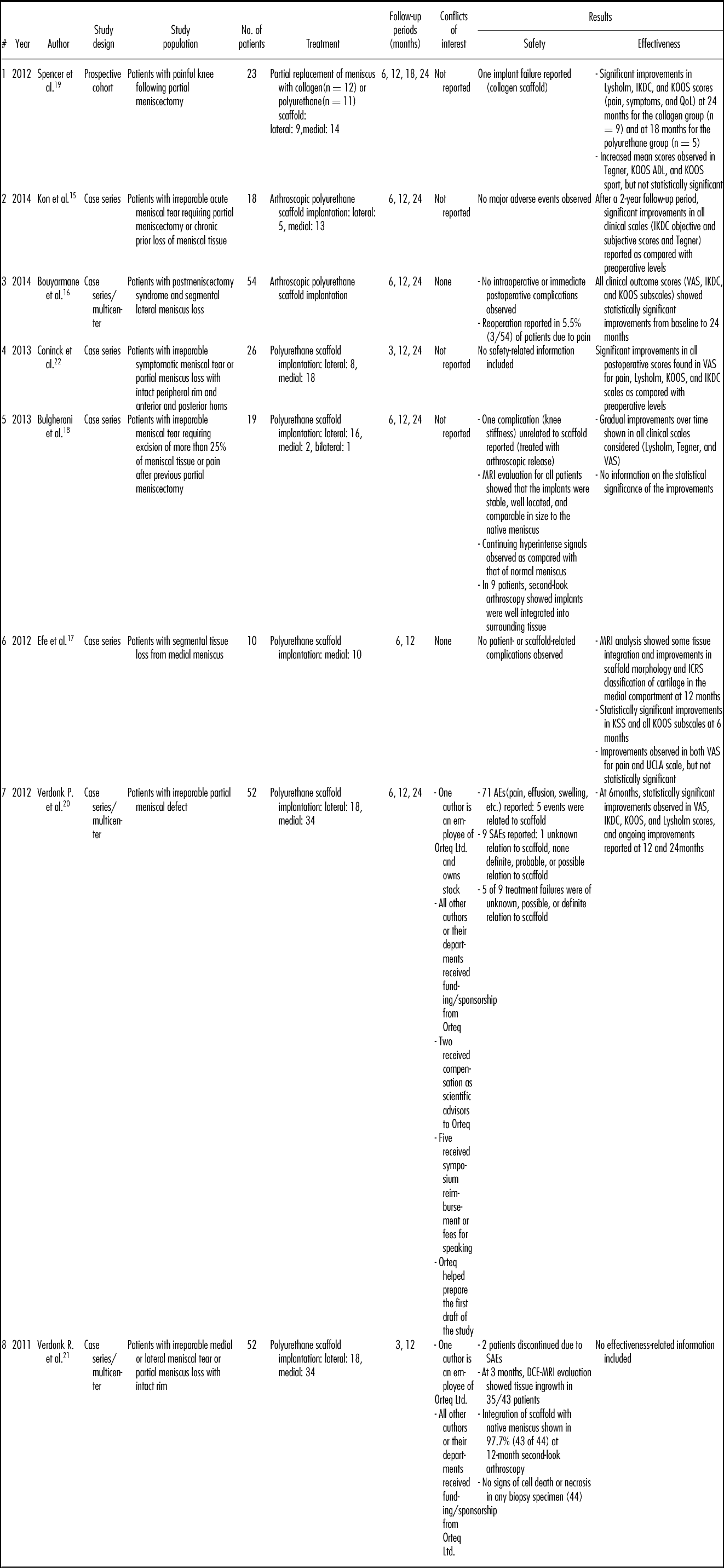
Overall, thirty-three English language articles on meniscal implantation using polyurethane scaffolds were identified, of which twenty-five were excluded because they did not meet the inclusion criteria. As of May 2014, there have been eight studies concerning the implantation of polyurethane meniscal scaffolds, of which only one was a prospective cohort study and seven were case-series. There were no randomized controlled clinical trials or systematic reviews which are currently being conducted for this technology. Table 1 shows the details of eight studies.
Summary of Studies on the Implantation of Polyurethane Scaffolds

ADL, activities of daily living; AE, adverse event; DCE-MRI, dynamic contrast-enhanced magnetic resonance imaging; ICRS, International Cartilage Repair Society; IKDC, International Knee Documentation Committee; KOOS, Knee Injury and Osteoarthritis Outcome Score; KSS, Knee Society Score; MRI, magnetic resonance imaging; QoL, quality of life; SAE, severe adverse event; UCLA, University of California Los Angeles; VAS, visual analog scale.
Safety of the Implantation of Polyurethane Meniscal Scaffolds for Partial Meniscal Lesions
Of the seven studies that assessed the safety of the implantation of polyurethane meniscal scaffold, six reported safety endpoints: Kon et al., Bouyarmane et al., Bulgheroni et al., Efe et al., Verdonk P. et al., and Verdonk R. et al. Four reported no major postoperative complications or adverse effects related to scaffold (Reference Kon, Filardo and Zaffagnini17–Reference Bulgheroni, Bulgheroni, Regazzola and Mazzola20). Verdonk P. et al. and Verdonk R. et al. reported adverse events and serious adverse events as well as loss to follow-up and treatment failures in their research (Reference Verdonk, Beaufils and Bellemans21;Reference Verdonk, Verdonk, Huysse, Forsyth and Heinrichs22). Verdonk P. et al. found five of seventy-one adverse events (AEs) that were considered as scaffold-related AEs, including pain, arthralgia, myalgia, joint swelling and etc. None were revealed to be related solely to the scaffold, among a total of nine serious adverse events (SAEs) reported. Improved International Cartilage Repair Society (ICRS) cartilage grade was shown in most of the patients (92.5 percent) during the 24-month follow-up period compared with their cartilage scores at baseline. Verdonk R. et al. reported two cases of treatment failures in fifty-two patients due to SAEs. In this study, Dynamic contrast-enhanced MRI (DCE-MRI) evaluation at 3 months demonstrated that no tears or loosening of sutures were reported, and 12-month second-look arthroscopy showed integration of scaffold to the surrounding tissue in forty-three of forty-four patients.
Effectiveness of the Implantation of Polyurethane Scaffolds for Partial Meniscal Lesions
Seven studies reported effectiveness endpoints: Kon et al., Bouyarmane et al., Bulgheroni et al., Efe et al., Verdonk P. et al., Spencer et al., and Coninck et al. Six described significant improvements in function and pain relief (Reference Kon, Filardo and Zaffagnini17–Reference Efe, Getgood and Schofer19;Reference Verdonk, Beaufils and Bellemans21;Reference Spencer, Saithna and Carmont23–Reference Coninck, Huysse and Willemot24). Bulgheroni et al. observed improved mean scores of clinical outcomes (visual analog scale) at 6 months but did not report their statistical significance (Reference Bulgheroni, Bulgheroni, Regazzola and Mazzola20). Kon et al. investigated the outcome of the International Knee Documentation Committee (IKDC) objective, IKDC subjective, and Tegner scores in eighteen subjects who underwent arthroscopic polyurethane scaffold implantation (Reference Kon, Filardo and Zaffagnini17). Clinically and statistically significant improvements (p = .01, p = .03 and p < .005) were reported in all of the three clinical outcome scores at 24 months compared with baseline scores. Bouyarmane et al. used several scoring systems in the study to assess effectiveness of polyurethane scaffold implantation: Visual Analog Scale (VAS) for pain, IKDC, and Knee injury and Osteoarthritis Outcome Score (KOOS) (Reference Bouyarmane, Beaufils and Pujol18).
All clinical outcome scores improved between baseline and 2-year follow-up period. In Coninck et al., significant improvements in all postoperative scores found in VAS for pain, Lysholm, KOOS, and IKDC scales at 2 years postoperatively, as compared with preoperative levels. Efe et al. assessed radiological outcome through MRI analysis at 6 and 12 month, and it revealed a stable presence of the polyurethane scaffold and tissue integration (Reference Efe, Getgood and Schofer19). Improvements in scaffold morphology and ICRS classification were revealed in the medial compartment at 12 months. The Knee Society Score (KSS) and all KOOS subscales were significantly improved at 6 months. Verdonk P. et al. investigated improvements in pain and function using VAS, IKDC, KOOS, Lysholm scores in fifty-two patients after they were treated with polyurethane scaffold implantation (Reference Verdonk, Beaufils and Bellemans21). Significantly improved outcome scores at 6 months and continuous improvements at 12 and 24 months were observed. Spencer et al. compared the clinical outcomes of Lysholm, KOOS, Tegner, and IKDC scores between patients treated with collagen scaffold (n = 9) and those with polyurethane scaffold (n = 5) (Reference Spencer, Saithna and Carmont23). All the outcome measures except KOOS function in daily living (ADL) and KOOS sport scales showed statistically significant improvements in two groups. No substantial differences between groups were observed. The analysis of second-look arthroscopy at a mean of 12.8 month showed variable amounts of regenerative tissue in those with polyurethane scaffold.
Potential Impact of the Implantation of Polyurethane Scaffolds for Partial Meniscal Lesions
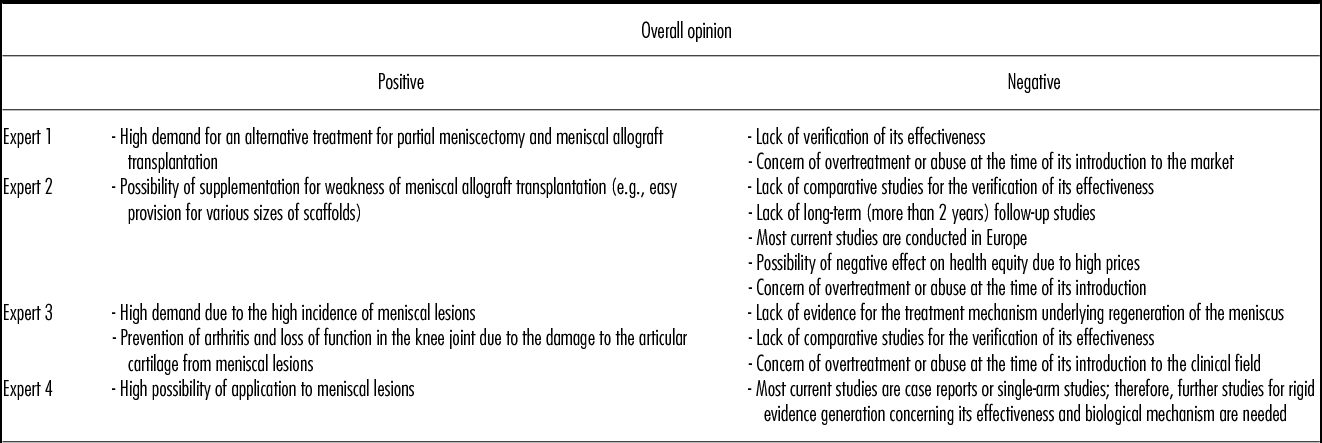
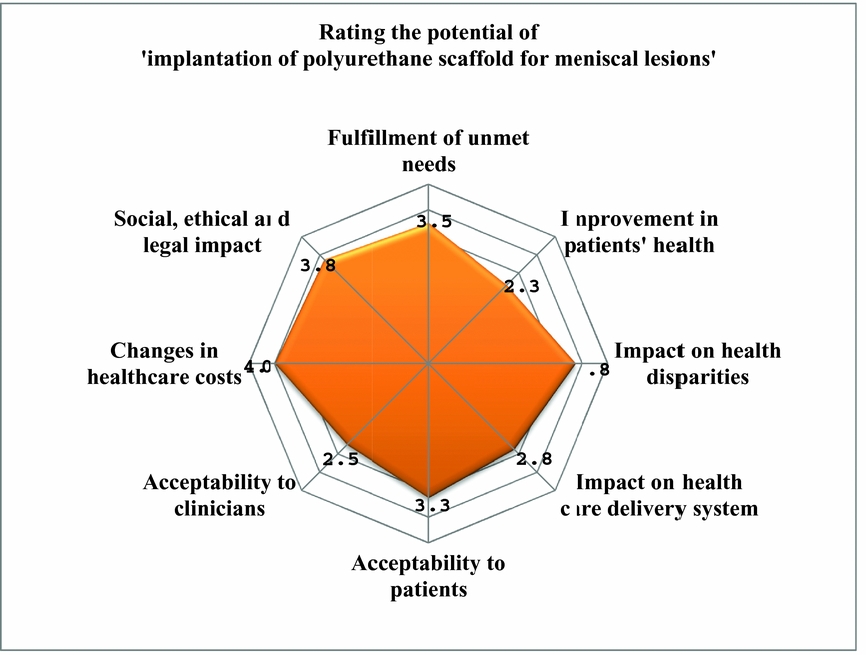
Based on the experts’ consultation, we presented the potential impacts of the implantation of polyurethane meniscal scaffold (Table 2). The experts all agreed that polyurethane meniscal scaffold has the potential to satisfy the diverse needs of patients and meet the high demand of surgeries. However, the high cost of polyurethane meniscal scaffold may make it available to only a certain group of the public, rendering the treatment inaccessible to some. As Figure 2 shows, the experts were mostly concerned about changes in healthcare costs and health disparities as potential impacts of the technology in Korean healthcare system.
Experts’ Opinion on the Social Impact of Implantation of Polyurethane Scaffold for Meniscal Lesions

The result of scoring potential impacts of implantation of polyurethane scaffold for meniscal lesions.

Moreover, the experts were concerned that there is insufficient evidence supporting the logic behind the indications and mechanisms of the technology (Table 2). In addition, the majority of related studies have been based on short-term follow-up observations lasting less than 2 years, without any validation process involving a long-term comparison between the intervention and control groups. To prevent indiscriminate use of the technology and ensure its safe application after its introduction into the medical market, additional evidence is required to clearly support its safety and effectiveness.
DISCUSSION
The aim of the present study was to predict potential impact of the implantation of polyurethane scaffolds in Korean healthcare system through horizon scanning activities. Our findings from horizon scanning and scoping activities suggested that there is growing population of meniscal defects around the world and the implantation of polyurethane scaffolds would be one of the promising alternative treatments to fulfill the unmet needs. Furthermore, most clinical outcomes from the eight existing studies on the technology suggested that it may be safe and effective to use, and many patients with polyurethane scaffold implantation were satisfied with the postoperative results. The potential harm of the technology can be high healthcare cost and health disparities. Although the benefits of the technology could outweigh the potential harms, the validity of the results is in question, for all study designs were case-series except one, noncontrolled cohort study. The short-term follow-up observations can hardly provide conclusive results. We, therefore, concluded that the technology should be supported by a high level of evidence to be passed the MFDS and nHTA approval and placed on the Korean healthcare market.
In a review of previous studies and existing health technologies for the treatment of meniscal tears, Scotti et al. reported that in comparison with collagen scaffolds, the polyurethane meniscal scaffold had superior mechanical strength, was easier to handle, and that degradation occurred more slowly (4 to 6 years on average) (Reference Scotti, Hirschmann, Antinolfi, Martin and Peretti25). Meanwhile, in 2012, the National Institute for Health and Care Excellence (NICE) in the United Kingdom presented an interventional procedure guideline concerning the safety and effectiveness of the partial replacement of the meniscus using a biodegradable scaffold based on a systematic literature review (26). Of the eight papers included in the review, two described the use of polyurethane scaffolds (Verdonk P. et al. and Spencer et al.) (Reference Verdonk, Beaufils and Bellemans21;Reference Spencer, Saithna and Carmont23). The guideline included three specialist advisors’ opinions on the partial replacement of the meniscus using biodegradable scaffolds, and they all agreed that the procedure is novel, but its safety and effectiveness are uncertain. This fact corresponds to our findings. The final information on the implantation of polyurethane scaffolds was reviewed by the experts and industries and disseminated to stakeholders of interest as a form of in-depth report, newsletter, or leaflet through H-SIGHT Web site and electronic mails.
This study is limited by the small number of articles included in the literature review. Although we searched and reviewed all the articles related to the selected health technology, due to the characteristics of newly developed health technologies that do not have adequate clinical evidence, only a few articles were available. Moreover, most of the selected articles regarding the implantation of polyurethane scaffold in partial meniscal lesions did not report the conflicts of interest; only two articles declared that the authors had conflicts of interest with the manufacturers of the devices used (Reference Verdonk, Beaufils and Bellemans21;Reference Verdonk, Verdonk, Huysse, Forsyth and Heinrichs22).
Although the selected articles tried to show the results objectively, manufacturers have a tendency to shield negative information from other parties. Therefore, there exists some possibility of unreported results or unknown information for this technology. In the future, it is necessary to identify and minutely examine the conflicts of interest of the quoted articles to specific health technologies, with constant consultation from external experts such as clinicians and researchers in relevant fields throughout the identification until the archiving process. Furthermore, there was no randomized trial in the eight included studies, and we did not assess the methodological quality of the studies. The lack of reporting risk of bias of each study is another major limitation.
Despite these limitations, this study provides the first new methodology of predicting potential impact of a newly developed health technology in Korea; this is particularly important given that there has been a need for a system to monitor the safety and effectiveness of emerging health technologies and help them be legally and stably placed on the market in shortened periods. As mentioned above, for the introduction of newly developed health technologies into the Korean healthcare system, the Ministry of Food and Drug Safety (MFDS) and nHTA approval have to be passed preferentially. Therefore, for accurately predicting the necessary period of introduction of newly developed health technologies to the clinical field, we have to use very conservative calculations as compared with other countries. If newly developed health technologies that pass the nHTA are not cost-effective and do not have adequate clinical validity, they will not be used in the clinical field. Thus, for the selection of promising health technologies, we need to consider these issues and inform the experts who prioritize, assess newly developed health technologies and predict their potential impact. This activity would ensure the effective selection of promising and feasible health technologies in a short period, with productive outcomes.
Our study design, horizon scanning review, allowed evidence-based investigations for the implantation of polyurethane meniscal scaffold and provision of useful information to stakeholders of interests regarding its potential impact on society, patients and health services in the near future. For future directions, all the process of our horizon scanning activity should be evaluated for the supplementation and improvement, and an expert evaluation system with rigid examination standards will be also essential. The following points should be examined for evaluation: (i) Did our activity identify innovative health technologies that have a significant impact on our healthcare system? (ii) Did we disseminate useful, relevant, and timely information effectively to the appropriate customers? (iii) What was the sensitivity, specificity, and prediction probability of our activity?
CONCLUSION
This is a pilot case of horizon scanning activities in Korea and the first study to assess current evidence and evaluate the social impact of the transplantation of polyurethane scaffold in meniscal lesions through horizon scanning tools. Through this study, we experienced the horizon scanning process in full-scale and acquired the methods necessary for scanning, filtering, prioritizing, analyzing, and disseminating information concerning the new health technology. As a result, we found that the implantation of polyurethane scaffold in partial meniscal lesions is a promising technology to resolve articular cartilage defects.
However, there is a lack of long-term evidence for evaluating the safety and effectiveness of the technology using comparison groups and tissue regeneration and ingrowth into the polyurethane. Therefore, well-designed long-term follow-up studies and randomized controlled or controlled trials to address these points will essential. The results of this study have been disseminated to decision makers, healthcare providers, patients, industries, and the public, and this would be used as a reference in developing further research and facilitating adoption of the implantation of polyurethane scaffolds in the Korean healthcare system.
CONFLICTS OF INTEREST
There are no conflicts of interest to declare.