Introduction
The diagnosis of Alzheimer's disease (AD) confers a poor prognosis, with a mean survival time of approximately 5–8 years from symptom onset (Schoenberg et al., Reference Schoenberg, Kokmen and Okazaki1987; van Dijk et al., Reference van Dijk, Dippel and Habbema1991; Jagger et al., Reference Jagger, Clarke and Stone1995; Heyman et al., Reference Heyman, Peterson, Fillenbaum and Pieper1996; Larson et al., Reference Larson2004). This may be a worse prognosis than seen with other neurological and neuroplastic disease (Ganguli et al., Reference Ganguli, Dodge, Shen, Pandav and DeKosky2005). Survival time is heterogeneous and many factors are postulated to influence mortality. Among these, increased age, male gender and worse disease severity have consistently been shown to decrease survival time (Walsh et al., Reference Walsh, Welch and Larson1990; Burns et al., Reference Burns, Lewis, Jacoby and Levy1991; Heyman et al., Reference Heyman, Peterson, Fillenbaum and Pieper1996; Moritz et al., Reference Moritz, Fox, Luscombe and Kraemer1997; Larson et al., Reference Larson2004).
People with more education have lower rates of AD (Fratiglioni et al., Reference Fratiglioni1991; Katzman, Reference Katzman1993). Several explanations for this have been suggested. The “cognitive or brain reserve” theory proposes that education provides a cognitive and neurological “reserve” through neuronal changes or increased efficiency of processing networks, which means that the clinical symptoms of neurodegeneration in AD occur later in the pathological process (Satz, Reference Satz1993; Fritsch et al., Reference Fritsch2001), so people with higher levels of education show symptoms later than those with less education. This is supported by some neuroimaging (Stern et al., Reference Stern, Alexander, Prohovnik and Mayeux1992) and post-mortem studies (Bennett et al., Reference Bennett2003; Roe et al., Reference Roe, Xiong, Miller and Morris2007) which demonstrate that those with more education show a greater degree of neuropathology at a given level of clinical disease severity and cognitive function. Other such studies have disputed this finding (Del Ser et al., Reference Del Ser, Hachinski, Merskey and Munoz1999).
If the cognitive reserve theory is valid, there should be an association between higher levels of educational attainment and reduced survival in epidemiological studies of people with dementia, as those who are more educated will have more severe disease at diagnosis. Stern et al. (Reference Stern, Tang, Denaro and Mayeux1995) found that more education is associated with shorter post-diagnosis survival and suggested this is due to cognitive reserve, and results from the greater level of neuropathology found in those with more education at diagnosis for any given level of cognitive impairment. This is in contrast with many common medical conditions such as cancer, heart disease and diabetes (Steenland et al., Reference Steenland, Henley and Thun2002; Hussain et al., Reference Hussain, Altieri, Sundquist and Hemminki2008), where increased education is associated with improved survival. Increased education is also associated with greater all-cause life expectancy (Guralnik et al., Reference Guralnik, Land, Blazer, Fillenbaum and Branch1993). We have conducted the first systematic review to test the hypothesis that higher educational level and achievement predicts decreased survival in people with AD. In addition to contributing to the debate regarding the cognitive reserve hypothesis, we aim to contribute to the knowledge about determinants of survival in AD which will enable clinicians to discuss prognosis with patients and their carers.
Method
Search strategy
A literature search was conducted using Medline (1966–January 2008) and EMBASE (1980–January 2008) electronic search engines. We used the search terms alzheimer and education combined with death, mortality or survival. We also searched the internet and reference lists in all papers included.
Inclusion criteria
We included observational cohort studies of people with possible or probable AD, however diagnosed, in which education level and mortality was reported. We excluded studies not published in English.
Data extraction and analysis
We extracted data from all studies. The validity of papers was assessed according to the Oxford Centre for Evidence Based Medicine (CEBM) Guidelines (http://www.cebm.net/levels_of_evidence.asp#levels) which rate levels of evidence from 1 to 5, with lower levels indicating higher quality papers. This system allocates cohort studies to one of two possible levels. Good quality prognostic cohort studies are rated as Level 1b. These are defined as studies with at least 80% follow-up, and which adequately control for confounding factors in analyses. We determined that the confounding factors that should be considered were (at least) sex, age and dementia severity as these have been consistently associated with survival in the literature. Cohort studies not meeting these criteria were rated Level 4 in line with CEBM criteria. Two authors (MP and CC), blind to each other's gradings, rated the papers. Any discrepancies were discussed and a consensus reached in discussion with the third author.
The CEBM criteria also provide an overall grade of recommendation based on the quality of included studies. This ranges from Grade A to D and indicates the confidence that can be had in the findings of the review. Grade A represents the best level of evidence and comprises consistent Level 1 studies. We presented the hazard ratios and 95% confidence intervals for Level 1b studies in a forest plot but did not undertake a meta-analysis due to heterogeneity of measures of education.
Results
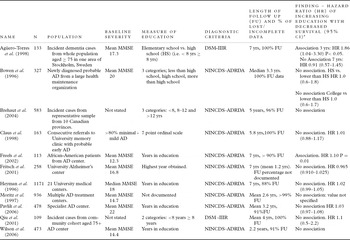
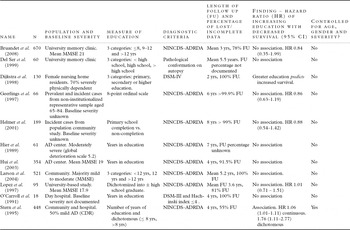
Of the 197 abstracts identified, 49 appeared to meet inclusion criteria: 22 of these were included in the review. Of the 27 not included, three examined dementia as a whole and not AD survival specifically, while the remaining 24 studies did not examine the association between education and survival. We identified 11 good quality (Level 1b) and 11 Level 4 studies. Study characteristics are shown in Tables 1 and 2.
Characteristics, findings and level of evidence of Level 1b studies
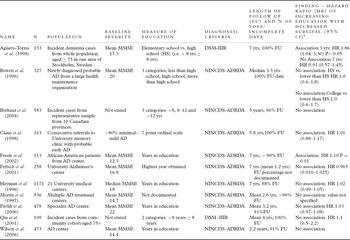
AD = Alzheimer's disease; DSM = Diagnostic and Statistical Manual of Mental Disorders; FU = follow up; HR = hazard ratio; MMSE = Mini-mental State Examination; NINCDS–ADRDA = National Institute of Neurological and Communicative Disorders and Stroke and Alzheimer's Disease and Related Disorders Association.
All HR corrected for age, gender and cognitive severity
Characteristics, findings and level of evidence of Level 4 studies
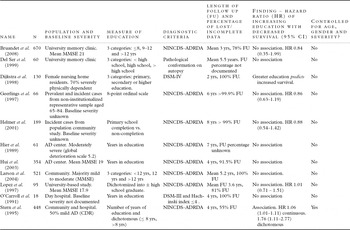
AD = Alzheimer's disease; CDR = Clinical Dementia Rating Scale; DSM = Diagnostic and Statistical Manual of Mental Disorders; FU = follow up; HR = hazard ratio; HS = high school; MMSE = Mini-mental State Examination; NINCDS–ADRDA = National Institute of Neurological and Communicative Disorders and Stroke and Alzheimer's Disease and Related Disorders Association.
Level 1b studies
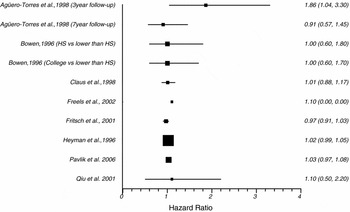
Of the studies rated 1b, 10/11 found no association between more education and reduced survival in AD after adjusting for age, sex and dementia severity at the end of the study. Eight of these studies reported Cox Proportional hazard ratios, and the adjusted hazard ratios from these studies are shown in a forest plot in Figure 1. These studies showed considerable measurement heterogeneity. Sample sizes ranged from 109 to 1171 and included cohorts of patients from specialist AD centers as well as community incident surveys (Table 1). Education was measured as a continuous variable (years) in five studies, while in the remainder educational level was categorized. Baseline severity of dementia ranged from mean MMSE scores of 22 (Pavlik et al., Reference Pavlik, Doody, Massman and Chan2006) to 12.3 (Freels et al., Reference Freels, Nyenhuis and Gorelick2002). All the larger studies found no association between education and survival.
Forest plot showing hazard ratios (and 95% confidence intervals) for the effect of education on survival in Level 1b studies where reported. Note: Summary effect not calculated due to heterogeneity in measures of education.
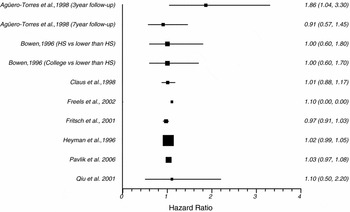
Only Freels et al. (Reference Freels, Nyenhuis and Gorelick2002), who analyzed the most severe group in the included studies found an association between more education and reduced survival (HR 1.10, p < 0.01) on multivariate analysis. Age and ADL score were the other significant predictors in the final model. This relationship was not significant on univariate analysis, and the authors postulated that this was due to the negative correlation between age and years of education (r = −0.38, P = <0.0001) in the sample, which masked the increased risk of death with education when age was not considered. This was also the only study we found in which all participants were African-American.
Agüero-Torres et al. (Reference Agüero-Torres, Fratiglioni, Guo, Viitanen and Winblad1998) showed mixed results from their community-based study, finding greater education predicted worse survival only at 3 years (HR 1.86 (1.04–3.30)) but not at 7 years (HR 0.91 (0.57–1.45)), possibly due to limited sample size, with only 133 in the original sample. In addition, education was dichotomized and this may mask its effect. The cohort comprised incident AD cases in one district of Stockholm (Kungsholmen) of people aged 75 and older. Of all participants with dementia 15% had attended higher education, but the details of education of the AD group who were analyzed separately were not reported.
As there is consistent level 1 evidence (10/11), we found Grade A evidence according to CEBM criteria that there is no association between educational level and survival in AD.
Level 4 studies
Of the studies rated Level 4, 10/11 also found no such association and were heterogeneous in their size and sampling. None accounted for the common confounders. The follow-up rates for several studies could not be determined and one study (Bruandet et al., Reference Bruandet2008) had a follow-up rate of <80%. Only Stern et al. (Reference Stern, Tang, Denaro and Mayeux1995) found an association between greater education and reduced survival. Follow-up data was only available on 246/448 (55%) of participants, the lowest rate of all studies included. Those lost to follow-up were significantly younger with less severe dementia than the group that was followed up. Dijkstra et al. (Reference Dijkstra, Sipsma and Dassen1998) found an association between greater education and increased survival. The cohort was not, however, representative of the general population with AD as it comprised mainly severely dependent female nursing home residents.
Discussion
We found Grade A evidence (i.e. the strongest) that higher levels of education were not associated with decreased survival post diagnosis in AD. The great majority of all included studies (19/22) showed no association between education and shortened survival, including the largest Level 1b studies by Heyman et al. (Reference Heyman, Peterson, Fillenbaum and Pieper1996) and Mortiz et al. (Reference Moritz, Fox, Luscombe and Kraemer1997), with around 1000 participants each, suggesting that this finding was not due to lack of power.
The one small high quality study which found a consistently different result was of African-Americans with, on average, more severe AD than the other studies. The study is relatively small and the result may be a chance finding. The authors suggest that African-American people with AD may differ in some respects from other ethnicities (Freels et al., Reference Freels, Nyenhuis and Gorelick2002). They are reported to have a higher prevalence of smoking and hypertension. There is limited data on ethnicity and dementia, but some studies have suggested there are different incidence and prevalence rates and presentation between races (Tang et al., Reference Tang2001; Froehlich et al., Reference Froehlich, Bogardus and Inouye2001: Livingston et al., Reference Livingston, Leavey, Kitchen, Manela, Sembhi and Katona2001). It may be that African-American participants had a higher prevalence of vascular pathology which may have accounted for the results. From studies included in this review, neither Heyman et al. (Reference Heyman, Peterson, Fillenbaum and Pieper1996) nor Fritsch et al. (Reference Fritsch2001) found an association between ethnicity and survival. Education is a widely used measure of the “cognitive reserve” construct, but it will not accurately approximate cognitive reserve in all people. It may have been a poor proxy of it in older African-Americans who probably had less access to education in their lifetime compared to the general population. Alternatively, this study may provide support for the cognitive reserve model of reduced survival holding true only in a subgroup. If we consider the model holds true only below a certain threshold of cognitive impairment, it only becomes apparent with a group of severely disabled people. This is consistent with the finding of Geerlings et al. (Reference Geerlings1999) that greater education only predicted reduced survival in people with dementia of any cause with an MMSE of less than 20, although many studies in our review did not find such an association in people with AD of similar degrees of severity.
While it has been suggested that reduced survival time in those with higher levels of education would support the cognitive reserve hypothesis, this would assume, as Stern et al. (Reference Stern, Tang, Denaro and Mayeux1995) has commented, that “there is a relationship between death and the severity of AD pathology, and that subjects die of AD.” In fact, few deaths are recorded as a direct result of AD and are more often due to secondary infections. Overall mortality is strongly associated with socioeconomic disadvantage and lesser education (Guralnik et al., Reference Guralnik, Land, Blazer, Fillenbaum and Branch1993), so including all-cause mortality is likely to reduce any apparent differences between the survival curves of more and less educated groups. Therefore, our findings do not necessarily contradict the putative explanation for the reduced incidence of AD in those higher levels of education (Fratiglioni et al., Reference Fratiglioni1991; Katzman, Reference Katzman1993), namely, that it is due to diagnosis later in the disease process.
Stern et al. (Reference Stern, Tang, Denaro and Mayeux1995) also found an association between education and reduced survival in a Level 4 study, with a follow up rate of 55%. Geerlings et al. (Reference Geerlings, Deeg, Schmand, Lindeboom and Jonker1997) question whether the results of Stern et al. are due to an inverse relationship between education and mortality generally, whereby those patients with lower education have been selected out because of their greater probability of dying at an early age. The sample that remains will therefore be the relatively healthy, lesser educated elderly.
Conclusions
Our systematic review does not support the postulated association between more education and shortened survival. We postulate from our findings that while higher levels of education may defer or prevent the clinical manifestations of AD and affect cognitive decline post-diagnosis, they do not appear to decrease survival. This suggests a similarity to vascular changes which affect susceptibility rather than the course of AD (Regan et al., Reference Regan, Katona, Walker, Hooper, Donovan and Livingston2006). However, as death is multi-factorial rather than only as a direct result of AD, survival might be more accurately associated with the person's overall function, a manifestation of not just neuropathology but also general physical health and compensatory mechanisms including education. Our findings suggest that a coherent model of the cognitive reserve hypothesis should include education as a factor that delays the onset of the dementia syndrome. Further research into those with more severe dementia and African-Americans may shed light on whether the same applies to those groups.
Conflict of interest
None.
Description of authors' roles
MP and GL designed the study. MP retrieved the papers and wrote the first draft. All three authors evaluated the papers, revised the article critically and approved the final version.
Acknowledgments
We thank Camden and Islington Foundation Trust for the use of their facilities and their time while writing this paper.