I. INTRODUCTION
During the past decade, high-entropy alloys (HEAs) have become of interest because they provide a potential “paradigm shift” in the way we design alloys. Unlike conventional alloys, which only have one or two principal elements, HEAs are composed of five or more principal elements with 5–35 at.% concentrations for each element.Reference Yeh, Chen, Lin, Gan, Chin, Shun, Tsau and Chang1,Reference Miracle and Senkov2 This unique compositional architecture can induce a high entropy of mixing, particularly at high temperatures, that can promote the formation of the HEAs defining feature, that is a multi-element random solid solution, in which each element has the same probability to occupy any given site in a simple crystal structure.Reference Miracle and Senkov2 Consequently, instead of intermetallic phases, solid-solution phases with simple crystal structures, that is, face-centered cubic (fcc), body-centered cubic (bcc), and hexagonal close-packed (hcp) structures, are generally formed in the HEAs.Reference Choudhuri, Gwalani, Gorsse, Mikler, Ramanujan, Gibson and Banerjee3–Reference Zou, Maiti, Steurer and Spolenak5 Several proposed phenomena, including severe lattice distortion, sluggish diffusion kinetics, and a high-entropy effect have been argued to play a role in the observed physical and mechanical attributes of HEAs. In particular, HEAs possess promising combinations of properties that are not attainable with conventional alloys, such as high strength and hardness, excellent resistance to high-temperature softening, superior corrosion, and high saturation magnetization,Reference Zou, Maiti, Steurer and Spolenak5–Reference Zhang, Zuo, Cheng and Liaw8 to name a few.
Recently, some studies have shown that some HEAs, such as FeCoNiAl0.2Si0.2, FeCoNiAl0.25Mn0.25, and FeCoNiCrCu HEAs, can exhibit excellent soft magnetic properties with high saturation magnetization (M sat) and low coercivity (H c < 1000 A/m), suggesting that HEAs could be potentially applied as soft magnets.Reference Zhang, Zuo, Cheng and Liaw8–Reference Zuo, Gao, Ouyang, Yang, Cheng, Feng, Chen, Liaw, Hawk and Zhang11 Along with the high saturation magnetization and low coercivity, other crucial properties including corrosion resistance and mechanical performance can be achieved through tailoring the chemical compositions of HEAs.Reference Zhang, Zuo, Cheng and Liaw8,Reference Li, Wang and Liu10–Reference Shang, Axinte, Ge, Zhang and Wang12 Unfortunately, most previous studies of HEAs are primarily focused on the microstructure and mechanical behavior, and their magnetic response is poorly understood. Although there are some reports on the soft magnetic properties of HEAs,Reference Zhang, Zuo, Cheng and Liaw8,Reference Li, Wang and Liu10–Reference Yu, Zhang, Cheng, Zhang, Ma, Li, Li, Liaw and Liu17 the fundamentals of the relationship between microstructure and soft magnetic properties in specific HEAs are still poorly understood.
Tailoring the chemical composition of an alloy can be used to manipulate phase composition, and thereby affect magnetic behavior. It has been reported that in the FeCoNi(AlSi)x, H c tends to increase as x increases when x < 0.3 (the alloys showing a single fcc structure); however, H c tends to decrease as x increases when 0.3 < x ≤ 0.8 (the alloys showing a single bcc structure). H c of the alloy reaches the highest value when the alloy exhibits combinations of fcc + bcc phases (x = 0.3). Interestingly, M sat decreases significantly with the increasing value of x.Reference Zhang, Zuo, Cheng and Liaw8 Similarly, the soft magnetic properties of AlxCrCuFeNi2 (0 < x < 1.5) and CoFeMnNiX (X = Al, Cr, Ga, and Sn) HEAs are influenced by the phase changes which result from the specific compositions used.Reference Zuo, Gao, Ouyang, Yang, Cheng, Feng, Chen, Liaw, Hawk and Zhang11,Reference Borkar, Gwalani, Choudhuri, Mikler, Yannetta, Chen, Ramanujan, Styles, Gibson and Banerjee13 Previous studies have shown that in addition to tailoring chemical compositions, the soft magnetic properties of particular HEAs can also be tailored by the specific heat treatment and processing route used.Reference Lin, Cheng, Yeh and Chin16,Reference Zuo, Yang, Liaw and Zhang18,Reference Singh, Wanderka, Kiefer, Siemensmeyer and Banhart19
It is widely believed that single-phase HEAs behave in a manner which is consistent with the assumption of stability derived from a high-entropy state. Thus, it is meaningful to investigate the relationship between the microstructure and soft magnetic properties of single-phase HEAs, with the aim to understand the underlying fundamentals of soft magnetic properties for HEAs. Interestingly, published data reveal that some FeCoNi-based fcc HEAs possess excellent soft magnetic properties.Reference Zhang, Zuo, Cheng and Liaw8–Reference Zuo, Gao, Ouyang, Yang, Cheng, Feng, Chen, Liaw, Hawk and Zhang11 Consequently, in the present work, we designed a Fe29Co28Ni29Cu7Ti7 (at.%) HEA based on the single-phase FeCoNi alloy, anticipating the formation of a single fcc solid-solution phase. This is because the parameters satisfy the requirements of forming single fcc solid-solution phase in HEAs; more specifically: Ω = 3.67 > 1.1, δ = 4.04 < 6.6%, and VEC = 8.79 > 8.0.Reference Guo and Liu20,Reference Yang and Zhang21 In addition, the available literature reveals that low contents of Cu and Ti would dissolve into the fcc-based FeCoNi matrix.Reference Fu, Chen, Wen, Zhang, Chen, Zheng, Zhou and Lavernia22,Reference Fu, MacDonald, Zhang, Wu, Chen, Ivanisenko, Hahn and Lavernia23
Thus, in view of the above findings, the objective of the present work was to investigate the influence of heat treatment on the microstructure of an fcc-based Fe29Co28Ni29Cu7Ti7 HEA, and the correlation between the microstructure and soft magnetic properties. The relationship between the microstructure and mechanical properties was also investigated in detail.
II. EXPERIMENTAL PROCEDURE
A. Casting and homogenization
The studied alloy, Fe29Co28Ni29Cu7Ti7 (at.%), was prepared by casting, using bulk Fe, Co, Ni, Cu, and Ti materials (purity >99.7 wt%) as the raw materials. The method used for casting was induction levitation melting under an Argon atmosphere to melt the raw materials which were then solidified in a Cu crucible. The melting process was repeated four times to assure uniformity of composition, and the ingot was flipped after each remelting step. The alloy was melted a fifth time and cast into a stainless steel die with a geometry of Ø 50 mm × 220 mm after solidification. The resulting ingot was machined down to remove any contamination from the die cast. It is important to note that the as-cast and homogenized samples were sectioned from the same position of the ingot using electrical discharge machining. To obtain the homogenized samples, the as-cast samples were homogenized at 1453 K for 2 h in an argon atmosphere, followed by water quenching.
B. Microstructure characterization and tensile testing
The crystal structure and phase composition of the as-cast and homogenized samples were measured by using a Rigaku SmartLab X-ray diffractometer (XRD) (Rigaku Corporation, Tokyo, Japan) using Cu Kα (λ = 0.1542 nm) radiation at a step size of 0.02° with a speed duration time of 2 s/step from 20 to 100°. Microstructural and chemical composition analyses were performed on an FEI Quanta 3D FEG (FEI Technologies Inc., Hillsboro, Oregon) scanning electron microscope (SEM) equipped with a back-scattered electron (BSE) detector and an energy dispersive X-ray spectrometer (EDS). The as-cast and homogenized samples for SEM observations were first prepared by polishing, followed by etching with a dilute aqua regia solution. The transmission electron microscopy (TEM) microstructural analysis of the as-cast and homogenized samples was carried out on a JEOL 2800 (200 kV) (JEOL Ltd., Tokyo, Japan) and a JEOL JEM-2100F (200 kV) (JEOL Ltd., Tokyo, Japan) equipped with a selected area electron diffractometer (SAED) and EDS. Thin foils for TEM studies were first mechanically polished using SiC grit papers, and subsequently ion-milled using a dual ion-beam Gatan PIPS. Tensile tests performed on the dog bone-shaped tensile specimens with a gauge length of 10 mm, a thickness of 1 mm, and a width of 2.5 mm. A Zwick universal material testing machine (Zwick GmbH & Co. KG, Ulm, Germany) with a maximum load of ∼ 100 kN was employed for tensile tests at ambient temperature with a nominal strain rate of 1 × 10³/s.
C. Magnetic testing
Magnetization measurements were collected using a Quantum Design MPMS-7 SQUID magnetometer (Quantum Design, San Diego, California). Cubic samples with the geometry of 4 × 4 × 4 mm were used. Magnetization curves were recorded from −4000 to +4000 kA/m at 293 K. Magnetic data were analyzed using Igor Pro from WaveMetrics (WaveMetrics, Inc., Portland, Oregon).
III. RESULTS AND DISCUSSION
A. Phase composition and microstructure
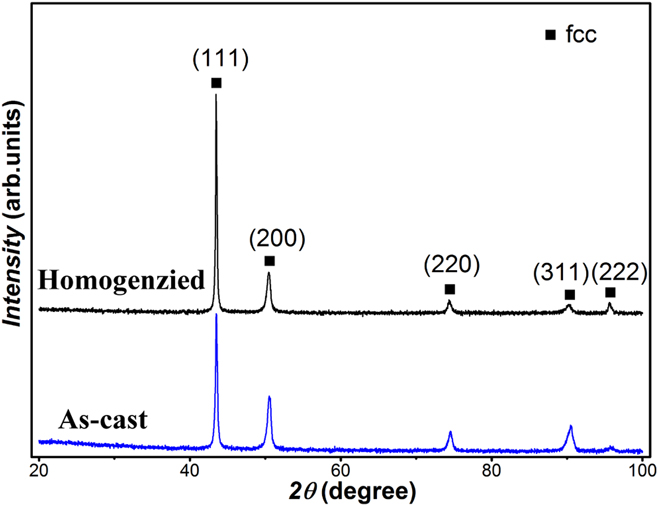
Figure 1 shows the XRD patterns of the as-cast and homogenized Fe29Ni29Co28Cu7Ti7 HEA. Both the as-cast and homogenized Fe29Ni29Co28Cu7Ti7 HEA exhibit a single fcc structure. Note that the slight texture in the (311) plane for the as-cast sample disappears after homogenization. The peaks of the homogenized Fe29Ni29Co28Cu7Ti7 HEA shift to the left slightly as compared to those of the as-cast Fe29Ni29Co28Cu7Ti7 HEA, suggesting that there is an increase in lattice constant. It can be inferred that some phases, which could not be completely distinguished by the XRD spectra in the as-cast state due to peak convolution, have been dissolved through homogenization. These secondary precipitates found in the as-cast state are described in detail in the following paragraphs.
XRD patterns of the as-cast and homogenized Fe29Ni29Co28Cu7Ti7 HEA.

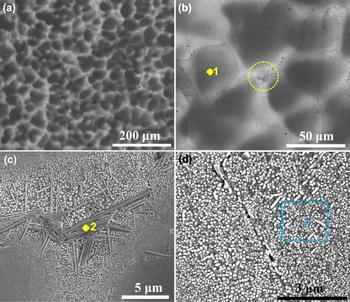
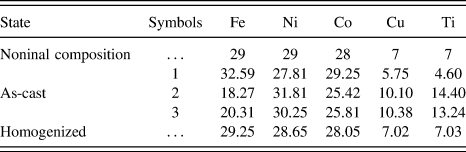
Secondary SEM images of the as-cast Fe29Ni29Co28Cu7Ti7 HEA are shown in Fig. 2. Clearly, near-equiaxed grains are observed in the low-magnification image [Fig. 2(a)]. The grains ranging from 15 to 50 μm exhibit an average grain size of ∼30 μm. High-magnification image in Fig. 2(b) clearly shows the presence of a phase located at grain boundaries. The magnified image of the circled region in Fig. 2(b) shows that needle-like phases and nanoprecipitates are present at the grain boundaries. Upon further inspection of the microstructure of some grain boundaries, as shown in Fig. 2(d), some of them possess a large amount of nanoprecipitates with none of the needle-like phases present. The semiquantitative EDS/SEM analysis was used to measure the chemical compositions of the needle-like phase and nanoprecipitates. Interestingly, both the needle-like phase [point 2 in Fig. 2(c)] and nanoprecipitates [region 3 in Fig. 2(b)] are rich in Ni–Ti and depleted in Fe. However, the primary phase [point 1 in Fig. 2(b)] is depleted in Cu–Ti and rich in Fe–Co. Note that the detailed chemical compositions analyzed by EDS/SEM are summarized in Table I.
SEM images of the as-cast Fe29Ni29Co28Cu7Ti7 HEA. (a) Low-magnification image, (b) high-magnification image, (c) magnified image of the circled region in (b), showing the presence of some needle-like phase, and (d) magnified image of grain boundaries without needle-like phase.

Chemical compositions (in at.%) of the as-cast and homogenized Fe29Ni29Co28Cu7Ti7 HEAs analyzed by EDS/SEM.

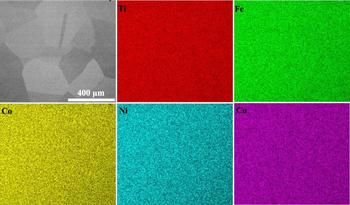
A BSE image and the corresponding EDS elemental maps of the homogenized Fe29Ni29Co28Cu7Ti7 HEA are shown in Fig. 3. The homogenized Fe29Ni29Co28Cu7Ti7 HEAs have a polycrystalline structure with grains ranging from 150 to 500 μm, which display an average grain size of ∼240 μm. Additionally, the constituent elements, Fe, Ni, Co, Cu, and Ti, are uniformly distributed in the microstructure, suggesting that the homogenization treatment of the Fe29Ni29Co28Cu7Ti7 HEA successfully formed resulted in the formation of a homogenous microstructure. The semiquantitative EDS/SEM analysis results listed in Table I reveal that the homogenized Fe29Ni29Co28Cu7Ti7 HEA has a chemical composition of 29.25 at.% (Fe), 28.65 at.% (Ni), 28.05 at.% (Co), 7.02 at.% (Cu), and 7.03 at.% (Ti), which is almost identical to the nominal composition. Thus, taking the XRD results into account, it suggests that the homogenized Fe29Ni29Co28Cu7Ti7 HEA possesses a single fcc solid-solution phase.
BSE image of the homogenized Fe29Ni29Co28Cu7Ti7 HEA with corresponding mapping, showing that the constituent elements are uniformly distributed.

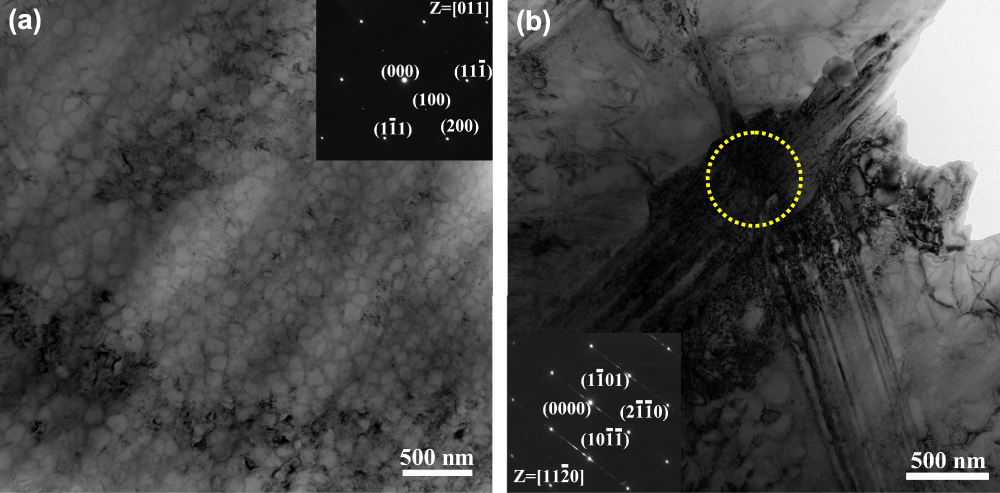
Figure 4 shows TEM images of the as-cast Fe29Ni29Co28Cu7Ti7 HEA. As shown in Fig. 4(a), there are numerous nanoprecipitates distributed in the microstructure. SAED pattern presented in the inset of Fig. 4(a) corresponds to an ordered fcc (L12) structure along [011] zone axis with a weak superlattice. It is obvious that the nanoprecipitates are coherent with the matrix, according to the SAED pattern in Fig. 4(a). Actually, high-resolution TEM results (not shown here) show that the matrix has a disordered fcc structure, whereas the nanoprecipitates exhibit an ordered fcc (L12) structure. In addition, EDS/TEM results show that the fcc matrix consists of 40.74 at.% (Fe), 15.25 at.% (Ni), 31.08 at.% (Co), 10.67 at.% (Cu), and 2.24 at.% (Ti), and the L12 nanoprecipitates are composed of 8.62 at.% (Fe), 39.62 at.% (Ni), 26.50 at.% (Co), 4.28 at.% (Cu), and 20.96 at.% (Ti). A small amount of a needle-like phase, showing a similar morphology to that of the η-Ni3Ti phase in Ni-based superalloys,Reference Kim, Choi, Hong, Do and Jo24,Reference Xu, Cui and Sun25 has also been determined using TEM as shown in Fig. 4(b). The EDS/TEM results reveal that the needle-like phase consists of 6.62 at.% (Fe), 41.08 at.% (Ni), 23.83 at.% (Co), 6.08 at.% (Cu), and 21.65 at.% (Ti), which is Ni–Ti-rich phase. Additionally, the SAED pattern of the needle-like phase presented in the inset of Fig. 4(b) also exhibits a D024 structure, which is identical to that of the η-Ni3Ti phase.
TEM images of the as-cast Fe29Ni29Co28Cu7Ti7 HEA. (a) Bright-field TEM image of the region with precipitations with corresponding SAED pattern showing an L12 structure presented axis in the inset. (b) Bright-field TEM image of the needle-like phase with corresponding SAED pattern showing a D024 structure presented in the inset.

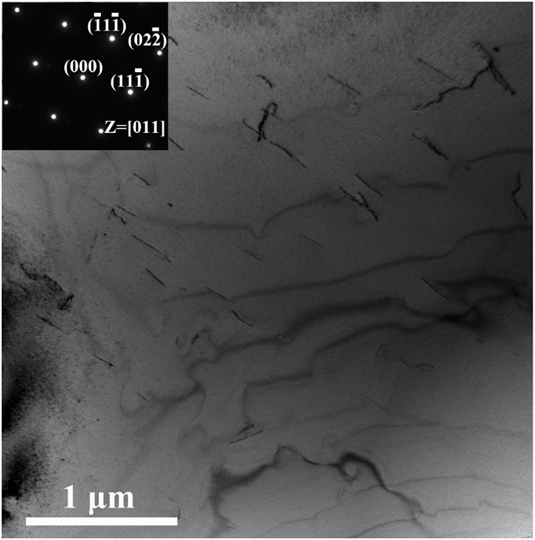
Figure 5 shows a bright-field TEM image of the homogenized Fe29Ni29Co28Cu7Ti7 HEA and the corresponding SAED pattern presented in the inset. Clearly, there are no nanoprecipitates present in the homogenized Fe29Ni29Co28Cu7Ti7 HEA. A few dislocations can also be observed in Fig. 5. The SAED pattern presented in the inset of Fig. 5 corresponds to a disordered fcc structure along the [011] zone axis without any superlattice spots. Hence, the homogenized Fe29Ni29Co28Cu7Ti7 HEA shows a single fcc solid-solution phase, which is consistent with the EDS and XRD results as presented above.
Bright-field TEM image of the homogenized Fe29Ni29Co28Cu7Ti7 HEA with corresponding SAED pattern showing an fcc structure presented in the inset.

Based on the microstructural analysis, the as-cast Fe29Ni29Co28Cu7Ti7 HEA primarily consists of an fcc matrix with coherent nanoprecipitates and trace amounts of a needle-like phase. Following homogenization, the Fe29Ni29Co28Cu7Ti7 HEA exhibits an fcc single-phase microstructure. Here, we discuss the phase formation in the homogenized state first. It is well known that the equiatomic FeNiCo alloy has an fcc single-phase microstructure. The Fe29Ni29Co28Cu7Ti7 HEA can be regarded as adding Cu and Ti into the equiatomic FeNiCo alloy system.Reference Zuo, Yang, Liaw and Zhang18,Reference Fu, Chen, Wen, Zhang, Chen, Zheng, Zhou and Lavernia22 The fcc Cu shows a lattice parameter approaching to that of the equiatomic fcc FeNiCo alloy; Cu and Ni have a complete mutual solubility; and accordingly a single fcc solid-solution phase tends to form in the (FeNiCo)–Cu alloy system.Reference Fu, Chen, Wen, Zhang, Chen, Zheng, Zhou and Lavernia22 It has been reported that the enthalpies of mixing for Ti–Ni, Ti–Co, Ti–Fe, and Ti–Cu atom pairs are −35, −28, −17, and −9 kJ/mol, respectively.Reference Takeuchi and Inoue26 It seems that Ti–Ni- and Ti–Co-based intermetallics are preferentially formed. Surprisingly, after homogenization at 1453 K for 2 h followed by water quenching, the reactive Ti can also dissolve into the (FeNiCo)–Cu alloy system. Evidently, the high-temperature (at 1453 K) microstructure is retained after water quenching. At high temperatures, based on the equation ΔG mix = ΔH mix − TΔS mix, the free energy of mixing (ΔG mix) can be notably reduced by a high entropy of mixing (ΔS mix), supporting that solid-solution phases would be formed instead of intermetallics, which is also referred as the famous “high-entropy effect”.Reference Yeh, Chen, Lin, Gan, Chin, Shun, Tsau and Chang1 It is expected that the so-called “high-entropy effect” can suppress the formation of Ti–Ni- and Ti–Co-based intermetallics and is active at 1453 K in the (FeNiCo)–Cu–Ti alloy system. This entropic stabilization during the homogenization of Fe29Ni29Co28Cu7Ti7 HEA leads to an fcc single-phase microstructure. It is not surprising that phase or element segregation can occur in the as-cast Fe29Ni29Co28Cu7Ti7 HEA due to the relatively slow rate of solidification. In the (FeNiCo)–Cu–Ti alloy system, it is anticipated that Ni–Ti-based intermetallics would form preferentially to other intermetallics, and therefore they would form first at grain boundaries and interdendritic regions.Reference Chuang, Tsai, Wang, Lin and Yeh6 This is a reasonable explanation for the formation of the needle-like phase enriched in Ni–Ti displaying an identical crystal structure to that of the η-Ni3Ti phase. Similarly, the competition between the formation of solid-solution phase and intermetallics is also responsible for the formation of nanoprecipitates. The formation of intermetallics could not be completely suppressed; as a result, nanoprecipitates appeared to nucleate from the matrix during solidification. In summary, the heat treatment (homogenization) significantly influenced the microstructure of the as-cast Fe29Ni29Co28Cu7Ti7 HEA.
B. Mechanical properties
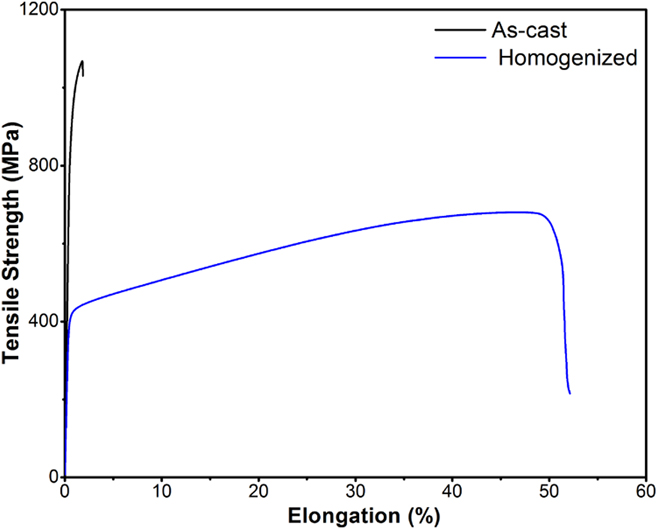
Engineering tensile stress–strain curves of the as-cast and homogenized Fe29Ni29Co28Cu7Ti7 alloys are depicted in Fig. 6. The yield strength (σ0.2), ultimate strength, and total elongation of the as-cast state are 917 MPa, 1060 MPa, and 1.8%, respectively. Following homogenization, the yield strength, ultimate strength, and total elongation of the homogenized state are 411 MPa, 681 MPa, and 52%, respectively.
Engineering tensile stress–strain curves of the as-cast and homogenized Fe29Ni29Co28Cu7Ti7 HEA.

Compared with the as-cast state, the homogenized state exhibits a decrease of ∼55% in yield strength and a decrease of ∼36% in ultimate strength; however, the total elongation is increased from 1.8 to 52%. In terms of the microstructure and phase composition discussed above, the high strength accompanied with low ductility for the as-cast state is principally attributed to precipitation strengthening derived from the presence of a dispersion of nanoprecipitates, as well as to the presence of the strong but brittle needle-like phase.Reference Liu, Lu, He, Luan, Wang, Liu, Liu, Chen and Liu27,Reference He, Liu, Wang, Wu, Liu, Nieh and Lu28 The dramatically improved ductility of the homogenized state is a direct result of the dissolution of the precipitates and needle-like phase to form the fcc single-phase microstructure.Reference Liu, Lu, He, Luan, Wang, Liu, Liu, Chen and Liu27,Reference He, Liu, Wang, Wu, Liu, Nieh and Lu28
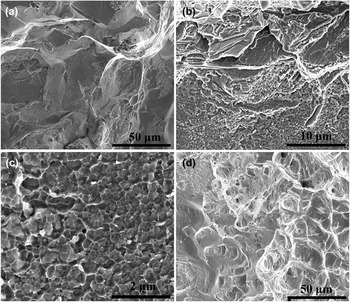
Figure 7 shows fracture morphologies of the Fe29Ni29Co28Cu7Ti7 HEA after tension testing. As shown in Fig. 7(a), the fracture mechanism of the as-cast Fe29Ni29Co28Cu7Ti7 HEA is intergranular fracture. Additionally, Fig. 7(b) (top part) shows the deformed regions related to the strong needle-like phase and Fig. 7(b) shows intergranular fracture of nanoprecipitates, confirming that both the needle-like phase and precipitates are known to contribute to the measured high strength and low ductility. In Fig. 7(d), many dimples can be observed distinctly in the fracture surface, confirming that the homogenized state possesses an excellent ductility.
Fracture morphology of the Fe29Ni29Co28Cu7Ti7 HEA after tension testing. (a)–(c) As-cast and (d) homogenized.

C. Soft magnetic properties
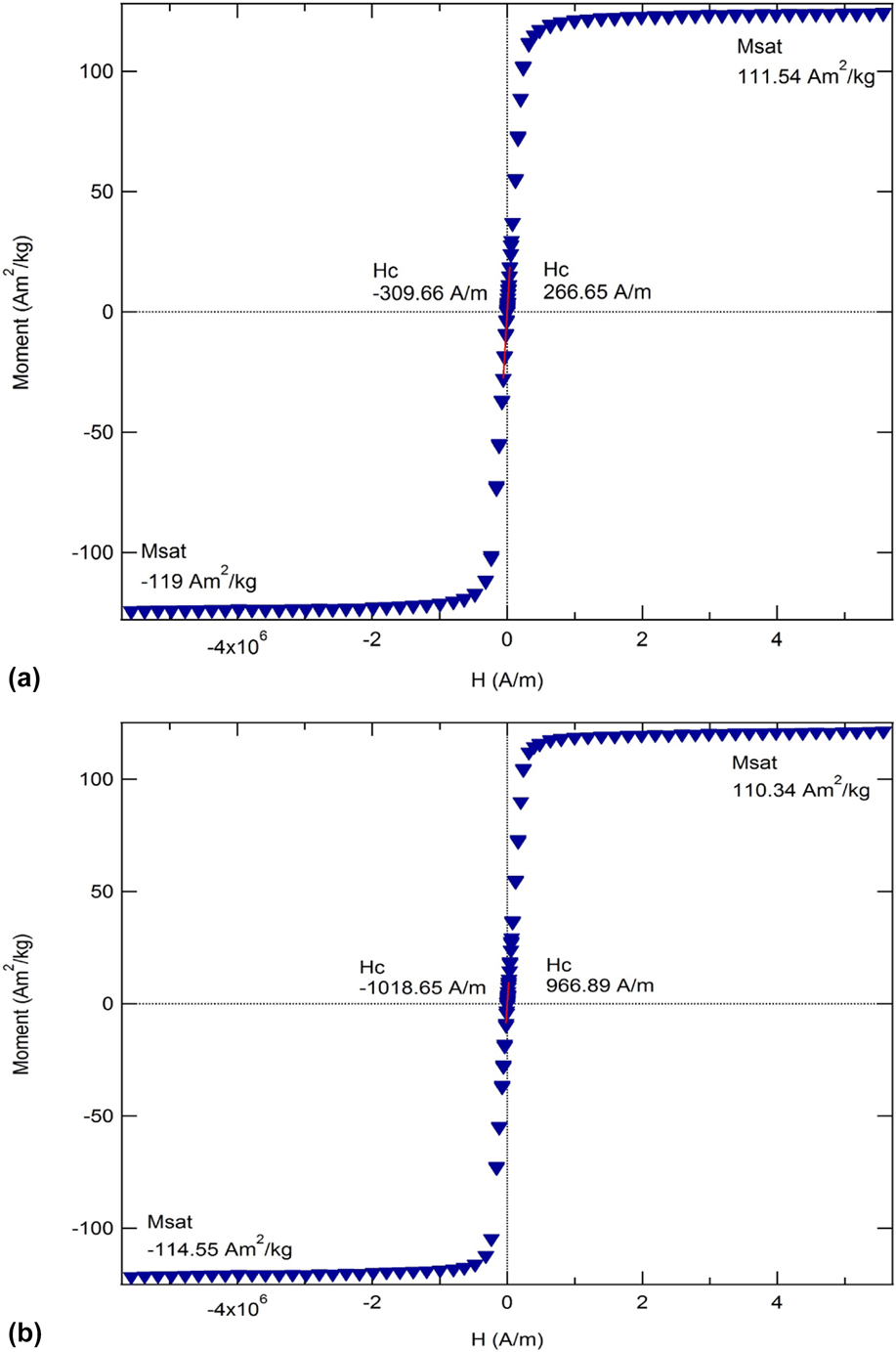
Figure 8 presents hysteresis loops of the as-cast and homogenized Fe29Ni29Co28Cu7Ti7 HEA. It can be seen that both of them display a soft magnetic characteristic. In addition, homogenization shows an insignificant influence on M sat, that is, 111.54 Am2/kg and 110.34 Am2/kg for the as-cast and homogenized state, respectively. By contrast, following homogenization, H c increases from 266.65 A/m (as-cast) to 966.89 A/m (homogenized), indicating that homogenization has a remarkable influence on H c. Therefore, homogenization can degrade soft magnetic properties of the as-cast Fe29Ni29Co28Cu7Ti7 HEA. It has been reported that M sat is dominated by the chemical composition and crystal structure, whereas coercivity can be significantly affected by grain size, precipitation, secondary phase, impurity, dislocations, etc.Reference Li, Wang and Liu10,Reference Zuo, Gao, Ouyang, Yang, Cheng, Feng, Chen, Liaw, Hawk and Zhang11,Reference Wei, Sun, Chen, Han and Li29–Reference Hou, Shan, Wu and Bi31 Certainly, the as-cast and homogenized Fe29Ni29Co28Cu7Ti7 HEAs have the fcc-based structure and identical chemical composition, resulting in a very slight difference in saturation magnetization. As described above, the homogenized state has a single fcc solid-solution phase; however, the as-cast state has a complex microstructure consisting of a primary fcc matrix containing a high density of nanoprecipitates and trace amounts of a needle-like phase. Previous studies show that in the typical FeCo-based soft magnetic alloys, precipitation can either increase or decrease coercivity, depending on the alloy system being studied.Reference Yu, Basu, Li, Zhang, Hadjipanayis, Lorenz and Xiao30,Reference Hou, Shan, Wu and Bi31 However, in terms of the measured H c in the present work, the presence of nanoprecipitates are likely to decrease coercivity. The available literature reveals that larger grain sizes can usually lead to higher coercivity in HEAs.Reference Zhang, Zuo, Cheng and Liaw8,Reference Wei, Sun, Chen, Han and Li29 The homogenized state (∼240 μm) has a noticeably larger grain size than that of the as-cast state (30 μm), and therefore the large grain size is responsible for the higher coercivity in the homogenized state.
Hysteresis loops of the Fe29Ni29Co28Cu7Ti7 HEA. (a) As-cast and (b) homogenized.

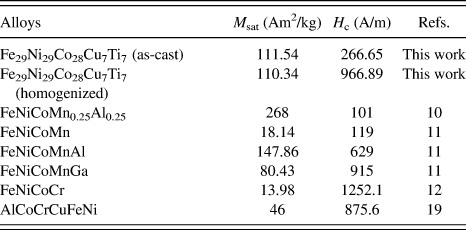
To evaluate the soft magnetic properties of currently investigated HEA, the soft magnetic properties of some promising HEAs are summarized in Table II. Apparently, among the listed HEAs, the as-cast Fe29Ni29Co28Cu7Ti7 HEA reveals a combination of high saturation magnetization and low coercivity and appears to be amongst the best soft magnetic properties reported with the exception of those for the FeNiCoMn0.25Al0.25 alloy.Reference Li, Wang and Liu10
Comparison of soft magnetic properties of HEAs.

IV. CONCLUSIONS
An fcc-based Fe29Co28Ni29Cu7Ti7 HEA was first prepared by casting, and homogenization was performed on the as-cast state. A primary fcc phase with L12 nanoprecipitates and trace amounts of a needle-like Ni–Ti-rich phase with D024 structure located at grain boundaries were observed in the as-cast state. Homogenization resulted in the dissolution of the precipitates and needle-like phase to form an fcc single-phase microstructure. The as-cast alloy exhibits a tensile yield strength of 917 MPa, an ultimate strength of 1060 MPa, and a total elongation of 1.8%. Following homogenization, the tensile yield strength decreases to 411 MPa and the ultimate strength decreases to 681 MPa; however, the total elongation increases to 52%, which is attributed to the dissolution of the numerous precipitates and the strong needle-like phase. Homogenization shows an insignificant influence on the saturation magnetization; specifically, the as-cast alloy has an M sat of 111.54 Am2/kg and the homogenized alloy shows an M sat of 110.34 Am2/kg. The H c is 266.65 A/m is significantly increased to 966.89 A/m through homogenization, thereby leading to the deterioration of the soft magnetic properties of the as-cast Fe29Co28Ni29Cu7Ti7 HEA.
ACKNOWLEDGMENTS
The authors acknowledge the financial support from the Opening Project of Guangdong Key Laboratory for Advanced Metallic Materials processing, South China University of Technology (GJ201601) and from the US Army Research Office (W911NF-16-1-0269), and Alexander von Humboldt Research Award for Senior Researchers. We would also like to thank Robert E. Delaney for his assistance with magnetic data analysis.