


Introduction
Individuals from ethnic minority backgrounds experience health inequalities and have poorer health outcomes compared to majority populations, including worse mental health (Nielsen and Krasnik Reference Nielsen and Krasnik2010; Patel and Hanif Reference Patel and Hanif2022; Vines et al. Reference Vines, Ward, Cordoba and Black2017). Discrimination, language barriers, and acculturation pressures, and reduced access to culturally safe services are among some of the structural and interpersonal factors that contribute to these disparities (Nielsen and Krasnik Reference Nielsen and Krasnik2010; Patel and Hanif Reference Patel and Hanif2022; Vines et al. Reference Vines, Ward, Cordoba and Black2017). From a cultural psychology perspective, the interpretation of distress and pathways to care are shaped by cultural norms, values, and social roles, meaning that mental health experiences cannot be separated from their cultural context. There is consistent international research which has shown that individuals from ethnic minority backgrounds are at greater risk for mental illness compared to the general population (Apers et al. Reference Apers, Van Praag, Nöstlinger and Agyemang2023). A systematic review examined suicide risk amongst individuals from ethnic minority backgrounds, and while there was no statistical evidence for increased suicide risk amongst ethnic minority groups, there was evidence of elevated risk of suicide amongst Indigenous populations when compared to majority populations globally (Troya et al. Reference Troya, Spittal, Pendrous, Crowley, Gorton, Russell, Byrne, Musgrove, Hannah-Swain, Kapur and Knipe2022).
Irish Travellers are a minority ethnic group, Indigenous to the island of Ireland, whose distinct ethnic status was officially recognised in Ireland in 2017, with evidence of their presence from the 5th century. Historically, nomadism is an important characteristic of Irish Travellers although this is less prominent in recent years. The 2022 Irish census presented that there are 32,949 Traveller people in Ireland [<1% of all Irish residents; (CSO 2023)], and that they have a lower average life expectancy compared to the overall population. Similar to other Indigenous communities (Kairuz et al. Reference Kairuz, Casanelia, Bennett-Brook, Coombes and Yadav2021), Travellers have experienced health disparities and inequalities compared to the settled community, due to discrimination and racism. These inequities are consistent with historical and intergenerational trauma theory which describes the cumulative emotional and psychological wounding experienced across generations following colonisation, cultural suppression, and structural marginalisation across generations. For Traveller people, historical loss of cultural autonomy, reduced mobility, and persistent social exclusion have been linked to higher incidence of physical or mental illness, infant mortality, chronic long-term illness, and overall poorer health outcomes (Hamid et al. Reference Hamid, Fitzpatrick, Rowan, McGorrian, Daly and Kelleher2013; McGorrian et al. Reference McGorrian, Daly, Fitzpatrick, Moore, Turner and Kelleher2012; Parry et al. Reference Parry, Van Cleemput, Peters, Walters, Thomas and Cooper2007).
An Irish study from 2010 presented a high risk of suicide mainly for Traveller men, while a recent mortality study for White Gypsies or Irish Travellers from England and Wales presented that Traveller women have the highest suicide risk compared to the White British women [(IRR: 2·26, CI: 1·42–3·58; (All Ireland Traveller Health Study 2010; Knipe et al. Reference Knipe, Moran, Howe, Karlsen, Kapur, Revie and John2024)]. Traveller women living in Ireland have found to have an increased emergency department (ED) presentation risk of suicide-related ideation (three times higher) and self-harm (four times higher) when compared to White Irish women (Kavalidou et al. Reference Kavalidou, Daly, McTernan and Corcoran2023). In a recent study, Traveller women were found to be less likely to accept next-of-kin involvement upon discharge from Irish EDs, while the protective role of human connection, across family, the Traveller community, and social services, was highlighted during suicidal crisis (Kavalidou et al. Reference Kavalidou, Tighe, Corcoran, Quinlivan and O’Mahony2025).
Within culturally safe mental health systems, lived experience perspectives are increasingly recognised as essential to informing service design and delivery for marginalised communities. Lived experience research provides insight into how individuals interpret and navigate mental health systems and has become central to recovery-oriented approaches that emphasise agency, identity, and empowerment rather than symptom reduction alone (Villani et al. Reference Villani, Kuosmanen, McDonagh and Barry2024a). Cultural safety similarly emphasises how healthcare interactions are shaped by power relations, trust, recognition of identity, and the extent to which care is experienced as respectful, collaborative, and free from discrimination (Papps and Ramsden Reference Papps and Ramsden1996).
Contemporary understandings of cultural safety extend beyond cultural competence by focusing not only on knowledge of cultural groups but also on how healthcare systems, institutional practices, and interpersonal interactions may reproduce power imbalances, marginalisation, or exclusion (Curtis et al. Reference Curtis, Jones, Tipene-Leach, Walker, Loring, Paine and Reid2019). Cultural safety therefore requires reflective awareness of power, empathy, autonomy, relational trust, and the broader structural conditions shaping healthcare encounters, particularly for Indigenous peoples and ethnic minority communities accessing mental health services (Curtis et al. Reference Curtis, Jones, Tipene-Leach, Walker, Loring, Paine and Reid2019; Truong et al. Reference Truong, Paradies and Priest2014) Within emergency mental healthcare settings, culturally safe approaches may be especially important in shaping how individuals experiencing suicidal crisis perceive relational safety, dignity, trust, and engagement with clinicians.
For Traveller communities, experiences of mental health care must also be understood within broader social and historical contexts characterised by discrimination, social exclusion, and structural inequalities that shape patterns of help-seeking and engagement with services (O’Callaghan et al. Reference O’Callaghan, Ryan, Harnett, Kearns, O’Brien, Cuskelly and Griffin2026) Evidence suggests that culturally responsive mental health services for Roma and Traveller populations require trust-building relationships, community involvement in service design, and recognition of lived experience as a source of knowledge for improving care (O’Callaghan et al. Reference O’Callaghan, Ryan, Harnett, Kearns, O’Brien, Cuskelly and Griffin2026; Villani et al. Reference Villani, Kuosmanen, McDonagh and Barry2024a). This emphasis on lived experience is also reflected in international and national mental health policy, including the World Health Organization’s roadmap for integrating lived and living experience into mental health systems (World Health Organization 2025) and Ireland’s national mental health policy, Sharing the Vision (Department of Health 2020). Accordingly, the present study is primarily informed by lived experience and cultural safety perspectives, with attention to how Traveller women experience suicidal crisis, emergency care, autonomy, relational interactions, and help-seeking within acute healthcare settings.
Minority Stress Theory (Frost and Meyer Reference Frost and Meyer2023; Meyer Reference Meyer2003) and the Interpersonal Theory of Suicide (Joiner and Van Orden Reference Joiner and Van Orden2008) provide additional contextual frameworks that help situate these experiences within broader structural and psychological processes. Minority Stress Theory proposes that marginalised populations experience chronic identity-related stressors associated with discrimination, stigma, and social exclusion, which may negatively affect mental wellbeing over time. Similarly, the Interpersonal Theory of Suicide highlights the role of thwarted belongingness and perceived burdensomeness in the development of suicidal distress. While these theories are not used as primary interpretative frameworks within this study, they provide useful contextual lenses for understanding how broader social inequities, relational disconnection, and emotional distress may shape suicidal experiences among marginalised populations.
Preventing suicide is a global priority, with people accessing healthcare services being the main focus of national policies and research, as people who self-harm or present with suicide-related ideation are at increased risk of subsequent suicide (Geulayov et al. Reference Geulayov, Casey, Bale, Brand, Clements, Farooq, Kapur, Ness, Waters, Tsiachristas and Hawton2019; Griffin et al. Reference Griffin, Arensman, Kavalidou, Perry and McMahon2023; Ross et al. Reference Ross, Murphy, O’hagan, Maguire and O’reilly2023). Research shows that individuals presenting to EDs with self-harm are up to 50 times more likely to die by suicide than those who do not present to EDs with self-harm (Griffin et al. Reference Griffin, Arensman, Kavalidou, Perry and McMahon2023; Hawton et al. Reference Hawton, Bergen, Cooper, Turnbull, Waters, Ness and Kapur2015, Reference Hawton, Bale, Brand, Townsend, Ness, Waters, Clements, Kapur and Geulayov2020; Lin et al. Reference Lin, Bickley, Clements, Webb, Gunnell and Hsu2019). Given that health care professionals have been placed as an intervention point for preventing deaths by suicide, EDs have been viewed as an important environment to stabilise suicidal crisis and initiate appropriate follow up care. In 2016 a national service for those presenting to acute hospitals in Ireland was introduced and is currently expanding to General Practitioner sites; the National Clinical Programme for Self-Harm and Suicide-related Ideation (NCPSHI) (HSE 2022). It established a clinical framework to ensure that any person who presents to the ED following self-harm or with suicide-related ideation receives a compassionate, empathic, validating response, and a therapeutic assessment and intervention from a suitably trained mental health professional. This approach aligns with principles of cultural safety (Papps and Ramsden Reference Papps and Ramsden1996), which emphasise that care must not only be clinically competent but also culturally responsive and free from discrimination.
It is within this national, cultural and clinical context that the present study aims to explore the lived experiences of Traveller women presenting to EDs with suicidal ideation. By applying an Interpretative Phenomenological Analysis (IPA) approach, this study seeks to understand how these women make sense of suicidal crisis, their interactions with clinicians, and their experiences of emergency mental healthcare within the context of cultural identity, relational experiences, and broader social inequalities. This lived experience-informed exploration may help guide the development of interventions that are not only clinically effective but also culturally safe, trauma-informed, and responsive to the needs of Traveller communities.
Methods
Design and sample
A qualitative design was employed to explore the lived experiences of Traveller women within their community who sought help for suicidal ideation at EDs across Ireland. Qualitative methods enabled a naturalistic portrayal and interpretation of these experiences by those who directly encountered them (Langdridge Reference Langdridge2007). It provided insights by exploring human experiences, motivations, perceptions, intentions, and behaviours. Specifically, the use of IPA allowed for an understanding of healthcare and illness from the individual’s perspective (Biggerstaff and Thompson Reference Biggerstaff and Thompson2008), offering a deep exploration of their thoughts and actions (Parahoo Reference Parahoo2014). Phenomenology is well-regarded for its emphasis on how individuals interpret their lived experiences and perceive the world around them (Langdridge Reference Langdridge2007). Given the study’s objective to explore the experiences of Traveller women in the community who attended an ED whilst experiencing suicidal ideation, IPA was particularly suited to the present study given its focus on exploring how individuals make sense of lived experience within specific relational, social, and cultural contexts.. This phase of the research involved recruiting women from the Traveller community who had attended an ED during an episode of suicidal ideation.
Recruitment
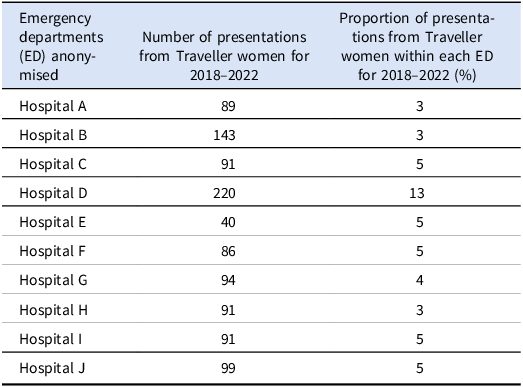
Recruitment is often challenging for marginalised groups and particularly in relation to hospital presentations following self-harm or suicidal ideation (MacDonald et al. Reference MacDonald, Sampson, Turley, Biddle, Ring, Begley and Evans2020). Recruitment was achieved through purposive sampling. Based on the database of the NCPSHI covering 24 adult EDs operating 24/7, services with a at least 3% of female Irish Travellers for years 2018–2022 were selected. The range of female Traveller presentations were between 40 to 220. Services with a proportion of 3% or more Traveller women presentations were chosen for recruiting participants for subsequent interviews (Table 1). When a Traveller woman presented to one of the participating EDs, the clinical nurse specialist (CNS) provided her with a study information leaflet and the researcher’s contact details. Women who were deemed eligible to participate by the CNS and received the study leaflet but chose not to participate, could not be identified by the researcher, as no information about them was provided by the nursing staff. Women who expressed interest asked the CNS to inform the researcher for a follow up call in order to understand the aim of this work. The researcher phoned the women that expressed interest in participating to the study and discussed the aim of the study and interview process and safety. Verbal informed consent was obtained during the phone call prior to providing the consent form documents and conducting the interview. Two participants were recruited for this study.
Emergency departments targeted for participant recruitment (Irish Traveller women)

Table 1. Long description
A table titled Emergency departments targeted for participant recruitment (Irish Traveller women) presents data on the number of presentations from Traveller women at various emergency departments and the proportion of these presentations within each department for the years 2018-2022. The table has three columns: Emergency departments (ED) anonymised, Number of presentations from Traveller women for 2018-2022, and Proportion of presentations from Traveller women within each ED for 2018-2022 (percent). There are ten rows, each representing a different hospital. Row 1: Hospital A, 89, 3 percent. Row 2: Hospital B, 143, 3 percent. Row 3: Hospital C, 91, 5 percent. Row 4: Hospital D, 220, 13 percent. Row 5: Hospital E, 40, 5 percent. Row 6: Hospital F, 86, 5 percent. Row 7: Hospital G, 94, 4 percent. Row 8: Hospital H, 91, 3 percent. Row 9: Hospital I, 91, 5 percent. Row 10: Hospital J, 99, 5 percent. The table shows the number of presentations from Traveller women and the proportion of these presentations within each emergency department for the specified years.
Participants and interview process
Two Traveller women who had sought help for suicidal ideation at EDs participated in the study. Both women had a history of mental health problems and previous self-harm behaviours, had experienced suicidal ideation, and had attended mental health services, which provided important experiential context for understanding their perspectives. In terms of situational factors, one participant reported having a supportive partner at the time of the ED visit, while the other did not, which influenced their help-seeking experiences and perceptions of care. These individual contexts and contrasting circumstances were taken into account during the analysis to highlight both shared and divergent aspects of their experiences.
Data were collected using in-depth semi-structured interviews guided by an interview schedule developed in consultation with mental health professionals within the research team. The schedule included open-ended prompts exploring: Reasons for self-harm and suicide related ideation; Barriers and facilitators for access to care; and Support from different groups (family, friends, statutory services, third sector).
Interviews were approximately between 50 to 60 minutes in duration and conducted in private rooms outside of hospital settings, to promote comfort and confidentiality. Participants were given the option to choose the interview location, and both opted for neutral community-based venues. Interviews took place within 2 months of the ED presentation to balance recall accuracy with allowing sufficient time for reflection.
To safeguard participant well-being, interviews were conducted by a researcher with over 17 years’ experience in suicide-related research and practice. At the start of each interview, participants were reminded they could pause or stop at any time and were encouraged to take breaks if needed. Supportive debriefing was provided after each interview, along with written information on local and national mental health support services. A pre-arranged distress protocol was in place to manage any signs of acute distress; however, no such signs were observed during or after the interviews.
Analysis
The interview data were analysed using Interpretative Phenomenological Analysis (IPA) and the rigorous analysis followed the steps outlined by Smith et al. (Smith and Nizza Reference Smith and Nizza2022). This method aimed to create a detailed and systematic record of the themes and topics discussed, linking them within a comprehensive category system (Smith et al. Reference Smith, Flowers and Osborn2013; Smith and Nizza Reference Smith and Nizza2022). This process was underpinned by IPA’s iterative and interpretative principles, involving a continual movement between the detail of individual accounts and the overarching thematic patterns, and engaging with the “double hermeneutic” central to the approach (Nizza et al. Reference Nizza, Farr and Smith2021). Initially, researchers thoroughly read and re-read the interview transcripts to immerse themselves in the data. They then performed initial noting, which involved making descriptive, linguistic, and conceptual comments on each transcript. Next, “Experiential Statements” were created, from which “Personal Experiential Themes” (PETs) were derived. After identifying PETs for each interview, they were collectively examined to identify patterns in participants’ experiences. Finally, a comprehensive framework of cross-case “GETs“ was developed. The final thematic structure and illustrative quotes were agreed through discussion among the research team (JOM, KK, LQ, JT).
Reflexivity
Co-authors came from multidisciplinary backgrounds in mental health nursing, psychotherapy, psychology, and public health. Interviews were conducted by the senior author (blinded for review), an academic psychologist with suicide and self-harm research expertise. A reflexive diary was kept, and regular meetings were held with co-authors during data collection to inform the process. Following reflexive practice, acknowledgement of the potential power imbalance between the interviewer and participants was noted. Furthermore, consistent with IPA’s epistemological stance (Nizza et al. Reference Nizza, Farr and Smith2021), the researcher’s interpretative role was acknowledged as an integral part of meaning-making, with reflexive engagement ensuring that emerging insights were grounded in the participants’ accounts while recognising the co-constructed nature of the analysis.
Patient and public involvement
A woman with lived experience from the Traveller community of Ireland was employed as a Patient and Public Involvement (PPI) contributor for this study and advised on the recruitment process and study documentation, participant recruitment and interpretation of findings. More specifically, our PPI contributor advised us on a suggested recruitment methodology. The research group initially designed the recruitment process to integrate a QR code on the recruitment flyer that would direct participants to a 1:30 minute video. In this video, the research group would be introduced, and the aim and process of the interview would be briefly described by the lead author of this work. However, as our PPI contributor advised, not all Traveller women may have access to a smartphone when presenting in an acute setting. Additionally, even if they did have access to one, they may not feel comfortable using it if they were presenting with a next-of-kin member. Therefore, the video was removed from the recruitment flyer. The recruitment methodology also included payment compensation for participants who agreed to be interviewed, in accordance with the university’s payment policy for study participants. Our PPI contributor acknowledged that many people from the Traveller community are often recruited to studies without any payment offered for the time they spend communicating their experiences. She considered the payment compensation included in our recruitment university-based practice to be sufficient but minimal, stating that no payment is enough when you talk about your trauma and mental health to a stranger. Finally, the IPA thematic findings were communicated to our PPI contributor after the initial analysis, as these results would later be discussed in a workshop conducted for the development of an animated video disseminating the study findings. For this workshop two further Traveller women were recruited from our PPI contributor of the study and this dissemination workshop process has been submitted as a publication, with the PPI contributor included as a co-author (currently under review).
Ethical approval
All interviews were recorded for accuracy. Ethical approval was sought and obtained in all six Hospital Ethics Committee where recruitment took place (REC CA 3046; REC 060/2023; REC 15/06/2023; RRECB0623ITB; REC 27/09/2023; REC ECM 3 (cc) 24/10/2023).
Results
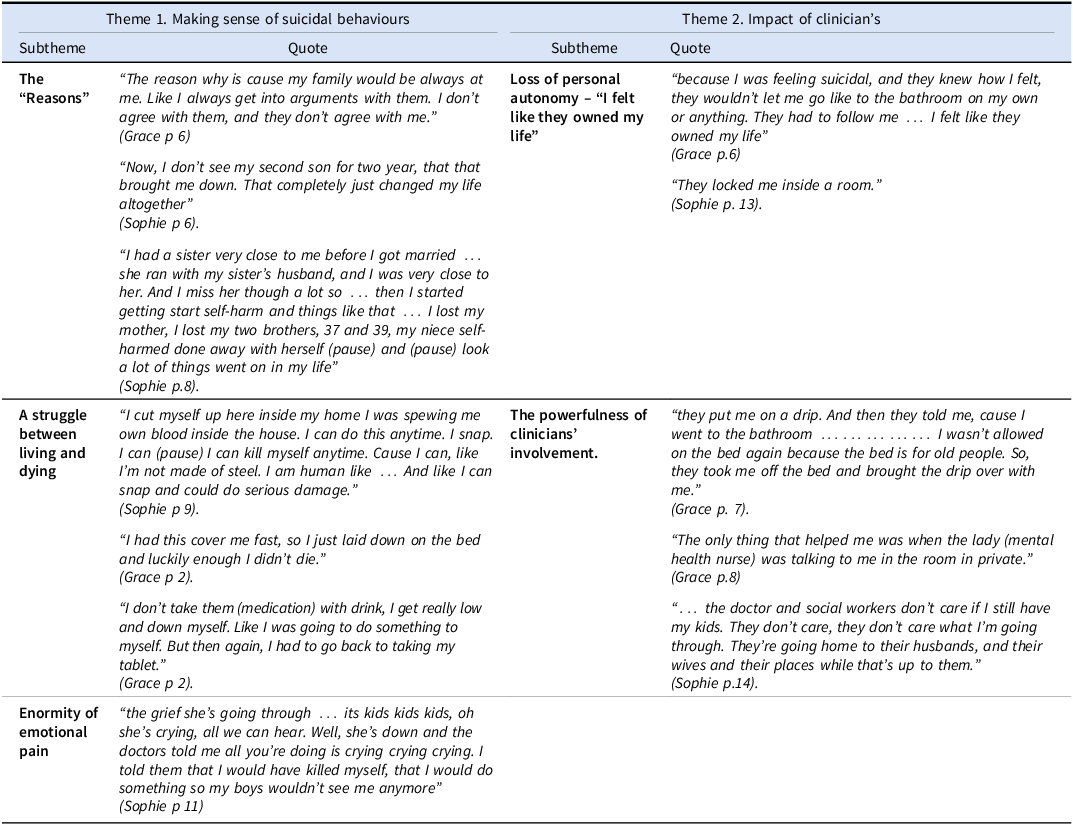
Inductively, GETs were developed from the Personal Experiential Theme maps. Two primary Group Experiential Themes (GETs) were developed through the analytic process, directly reflecting experiences of Traveller women who had sought help for suicidal ideation at EDs throughout Ireland. Quotations extracted from the interviews reflect these themes. The iterative process honoured both convergences and divergences among the two participants’ narratives regarding Traveller women presenting to EDs with a suicidal crisis. To ensure confidentiality, all identifying details have been either omitted or altered, and pseudonyms have been assigned to safeguard participant anonymity. Table 2 outlines a synopsis of the themes, along with quotations delineating and shedding light on the convergence and divergence across participants’ narratives.
Group experiential themes

Table 2. Long description
A table comparing themes and quotes related to suicidal behaviors and clinician impact. The table has two main themes: Theme 1, Making sense of suicidal behaviors, and Theme 2, Impact of clinician’s. Theme 1 is divided into three subthemes: The Reasons, A struggle between living and dying, and Enormity of emotional pain. Theme 2 is divided into two subthemes: Loss of personal autonomy and The powerfulness of clinicians’ involvement. Each subtheme contains quotes from participants Grace and Sophie. Theme 1, The Reasons, includes quotes about family arguments, loss of family members, and personal struggles. Theme 1, A struggle between living and dying, includes quotes about self-harm, medication, and emotional pain. Theme 1, Enormity of emotional pain, includes a quote about grief and crying. Theme 2, Loss of personal autonomy, includes quotes about feeling owned and locked inside a room. Theme 2, The powerfulness of clinicians’ involvement, includes quotes about being put on a drip and the lack of care from doctors and social workers.
Theme 1: making sense of suicidal behaviours
The first group experiential theme, “Making sense of Suicidal Behaviours” was developed from three subthemes. “The reasons” whereby the participants attempted to make sense of their experience of suicidal behaviours by identifying specific reasons both past and present as an explanation for their experience. Participants in another subtheme, “Enormity of Emotional Pain” resulted from the enormous emotional pain described in their experience of suicidal behaviours. This pain reflected the final subtheme which described their “struggle between living & dying.” This subtheme demonstrates the cognitive dissonance participants experienced in terms of continuing to exist with the emotional pain or considering escaping the emotional pain through suicide.
The subtheme “The Reasons” was evident across both participants’ accounts with relationships with others, including family members, as significant in participants understanding why they experienced suicidals behaviours. It was evident from their accounts the impact relationships had both in early childhood and in their present lives as significant in their sense making.
The reason why is cause my family would be always at me. Like I always get into arguments with them. I don’t agree with them, and they don’t agree with me.
(Grace p 6)
Now, I don’t see my second son for two year, that that brought me down. That completely just changed my life altogether
(Sophie p 6).
I had a sister very close to me before I got married … she ran with my sister’s husband, and I was very close to her. And I miss her though a lot so … then I started getting start self-harm and things like that … I lost my mother, I lost my two brothers, 37 and 39, my niece self-harmed done away with herself (pause) and (pause) look a lot of things went on in my life
(Sophie p.8).
The significance of human relationships and connectedness of those relationships is evident in participants understanding why they experienced suicidal behaviours. Human relationships are at the essence of both participants sense making. Within the context of Traveller community life, where family connections, family loyalty, and relational belonging are culturally significant, disruptions to these bonds may carry profound emotional and identity implications. While participants did not explicitly frame their distress in cultural terms, their narratives reflect how relational rupture, conflict, and loss were experienced not merely as interpersonal difficulties but as destabilising events that impacted their sense of self and place within their familial networks. The change in the human relations described by participants resulted in enormous emotional pain which emerged in the second subtheme “enormity of the emotional pain.”
the grief she’s going through … its kids kids kids, oh she’s crying, all we can hear. Well, she’s down and the doctors told me all you’re doing is crying crying crying. I told them that I would have killed myself, that I would do something so my boys wouldn’t see me anymore
(Sophie p 11).
The “enormity of the pain” participants described led to the third subtheme a struggle between living and dying with Grace describing wanting to die and taking an overdose in the past but describing feeling lucky that she did not die in her account below.
I had this cover me fast, so I just laid down on the bed and luckily enough I didn’t die.
(Grace p 2).
At a more interrogative analysis level, the cognitive dissonance between living and dying is evident. Grace experienced suicidal ideation due to the enormity of her pain, took an overdose to escape the pain in the past and felt lucky to be alive following the overdose. This reflects the complexity of human behaviour in terms of understanding and responding to human emotional pain. Within communities that have experienced longstanding marginalisation and social inequities, emotional suffering may be compounded by structural stressors, even when these are not explicitly named in individual accounts. The tension between despair and survival in Grace’s narrative reflects both acute psychological pain and an enduring struggle to maintain continuity in the face of adversity. Sophie’s account also reflected her sense making and how death could come if she “snap” with her understanding that she is human and not “made of steel.” There is a sense here from Sophie that it is out of her control.
I cut myself ……. I can do this anytime. I snap. I can (pause) I can kill myself anytime. Cause I can, like I’m not made of steel. I am human like … And like I can snap and could do serious damage.
(Sophie p 9).
In contrast, Grace describes how she attempts to mitigate the risk of acting on her suicidal ideation and describes that she does not take her medication if she drinks alcohol.
I don’t take them (medication) with drink, I get really low and down myself. Like I was going to do something to myself. But then again, I had to go back to taking my tablet.
(Grace p 2).
This theme reflects the importance of familial relationships in participants’ understanding of their experience with suicidal ideation. While these experiences are deeply personal and idiographic, they are also situated within a cultural context in which family, kinship, and community identity hold significant meaning. The narratives suggest that relational rupture and loss may carry particular weight in shaping emotional suffering. Interestingly, a similar emphasis on the significance and influence of relationships emerged in the subsequent theme concerning the impact of clinicians, specifically regarding the significance and influence of participants’ relationships with clinicians.
Theme 2: impact of clinicians
This group experiential theme “Impact of Clinicians” represented the process of participants experiencing the impact clinicians had in their treatment. Participants described a “loss of personal autonomy” in their decision making when accessing and engaging in treatment. This subtheme was expressed in powerful language reflecting the significance loss of personal autonomy had on their experience of clinicians and services. The second subthemes directly reflected “the powerfulness of clinicians’ involvement” and their impact on how participants experienced the clinicians delivering the service.
From participant accounts they described a loss of their personal autonomy, their personal power which Grace described using powerful language.
because I was feeling suicidal, and they knew how I felt, they wouldn’t let me go like to the bathroom on my own or anything. They had to follow me … I felt like they owned my life
(Grace p.6).
Participants were attempting to make sense of the clinicians behaviour of restricting their personal autonomy. The participant’s quote reflects a profound sense of loss of autonomy and agency. Grace’s understanding acknowledged that clinicians knew that she was experiencing suicidal ideation which led to their behaviour of not allowing her to be on her own. Even with this understanding, Grace still described this as clinicians “owning” her life. The language of ownership conveys more than temporary supervision; it suggests a deeper disruption of self-determination. The participant’s mention of feeling suicidal suggests a deeper existential struggle. The presence of suicidal thoughts indicates profound emotional distress and a questioning of one’s existence. The feeling of being owned by others intensifies this existential anguish, as it undermines the participant’s sense of self and agency. The participant’s interpretation of the situation “I felt like they owned my life” reflects an attempt to make sense of their experience within a broader existential framework. This interpretation not only captures the subjective reality of the participant but also hints at the profound impact of their experiences on their sense of self and identity. Within the historical context of Traveller communities, who have experienced longstanding social exclusion, surveillance, and limited institutional trust, encounters characterised by restriction and monitoring may carry additional symbolic weight. While Grace does not explicitly attribute her experience to her ethnic identity, her narrative can be situated within a broader socio-cultural backdrop in which institutional authority has not always been experienced as protective or culturally safe. The tension between safety and control thus becomes central to her meaning-making. Sophie described a similar experience in her account of her personal liberty been taken from her as described below:
They locked me inside a room.
(Sophie p. 13).
Sophie’s brief but powerful statement – “They locked me inside a room” – similarly conveys a loss of liberty and agency. Although such practices may reflect risk-management procedures within emergency care, her account foregrounds the experiential impact rather than the clinical rationale. The perception of being confined evokes themes of containment and control. For members of marginalised communities, institutional confinement may resonate beyond the immediate clinical encounter, particularly where healthcare systems intersect with other state systems such as social services. The participant’s experience is shaped significantly by their interactions with others, particularly those who were monitoring them. The fact that they “knew how I felt” suggests a certain level of understanding or concern, yet the participant perceives this as invasive and controlling. This highlights the complex interplay between individual experiences and interpersonal relationships. While Sophie does not explicitly frame this in cultural terms, her account can be interpreted within a broader context in which Traveller families have historically experienced scrutiny and intervention from statutory bodies. The participant’s descriptions offer valuable insights into their experiences, highlighting themes of autonomy, interpersonal relationships, existential anguish, and meaning making.
The second subtheme the “powerfulness of clinicians’ involvement” described the impact that clinicians such as specialist mental health nurses, physicians and social workers had on their experience which was mixed. Sophie believed that clinicians dd not care about her or her circumstance in her description:
… the doctor and social workers don’t care if I still have my kids. They don’t care, they don’t care what I’m going through. They’re going home to their husbands, and their wives and their places while that’s up to them.
(Sophie p.14).
Sophie’s account reflects her perception being misunderstood and uncared for by physicians and social workers. To Sophie their apparent indifference to her situation contributes to her sense of isolation and alienation. This highlights the importance of empathetic understanding in human interactions, especially in contexts where individuals are experiencing vulnerability or distress. Sophie’s reference to the doctor and social workers going home to their families while seemingly disregarding her struggles reflects the power dynamics inherent in the doctor patient and social worker patient relationships. This power imbalance can intensify feelings of helplessness and frustration on the part of the individual seeking assistance. This was also reflected in Graces description below:
they put me on a drip. And then they told me, cause I went to the bathroom …………… I wasn’t allowed on the bed again because the bed is for old people. So, they took me off the bed and brought the drip over with me.
(Grace p. 7).
Grace’s account further demonstrates issues of agency and autonomy, as she describes being taken off the bed without having a say in the matter. This lack of agency contributed to feelings of powerlessness and frustration, highlighting the importance of respecting individuals’ autonomy and involving them in decisions concerning their care and treatment. This interaction highlighted the influence of authority figures, such as clinicians, in shaping individuals’ experiences and perceptions within services. Finally, the participants accounts reflect feelings of isolation and powerlessness. It demonstrates the importance of empathetic understanding, social support, and addressing systemic inequalities in promoting holistic well-being and dignity for individuals from minority groups. Although Grace does not attribute this interaction to her Traveller identity, her account highlights the importance of culturally safe, person-centred care that actively affirms autonomy and respect, particularly for patients from minority ethnic backgrounds.
However, not all experiences were experienced negatively. Grace described the specialist mental health nurse she met as helpful.
The only thing that helped me was when the lady (mental health nurse) was talking to me in the room in private.
(Grace p.8).
Graces experience with the specialist mental health nurse demonstrates the importance of interpersonal relationships in providing support and comfort during times of distress. Grace’s interaction with the mental health nurse offered some form of relief allowing her to express her difficulties in private. Grace specifically stated that she took her to a private room which facilitated safety and trust, allowing Grace to open up and receive the help she needed. The confidentiality of the setting encouraged openness and honesty, enabling Grace to discuss her experiences and feelings more easily. The participant’s positive experience suggests that the mental health nurse’s communication style and ability to empathise were effective in providing validation and support. In contrast to Sophie’s experience of loss of autonomy the use of a private room with the mental health nurse highlights their agency and autonomy in seeking support in a manner that feels comfortable and effective. While Grace does not explicitly frame this interaction in cultural terms, the positive encounter illustrates how culturally attuned, person-centred communication can mitigate feelings of marginalisation and restore a sense of agency during crisis. Finally, it is evident of the participants accounts the impact of human relationships in relation to their experiences of suicidal ideation and accessing services.
In summary two GETs emerged, directly reflecting experiences of Traveller women within the Traveller community who had sought help for suicidal ideation at EDs throughout Ireland. The first theme explored how the participants’ attempted to make sense of suicidal behaviours, “the reasons” behind such actions, “the enormity of emotional pain” experienced, and the internal struggle between living and dying. Participants attributed their suicidal ideation to past traumas, strained relationships, and overwhelming emotional distress. The centrality of familial relationships, particularly conflicts and losses, emerged prominently in their narratives. Within the context of Traveller community life, where family connections and relational bonds hold significant cultural meaning, disruptions to these relationships appeared to carry profound emotional and identity implications. Despite feeling overwhelmed, some participants expressed a desire to live but grappled with the intensity of emotional pain. This narrative highlighted the complexity of human behaviour in response to emotional suffering within both personal and socio-cultural contexts, demonstrating the need for specific population informed interventions.
The second theme explored the impact of clinicians on participants’ experiences. It identified a “loss of personal autonomy” and power in decision-making within ED settings, as participants felt controlled and monitored, limiting their agency. While one participant expressed feeling understood and supported by clinicians, the other participant described a lack of empathy and meaningful engagement, contributing to feelings of isolation and frustration. These narratives reflect the intricate dynamics of therapeutic relationships and the importance of culturally safe, person-centred approaches in crisis care. For Traveller women, whose communities have historically experienced social exclusion and health inequities, interactions with institutional authority may carry particular significance. Overall, the themes reflect the multifaceted nature of suicidal experiences and suicidal ideation, emphasising the pivotal role of relational dynamics and contextual factors in shaping individuals’ journeys towards well-being.
Discussion
This study provides an in-depth, idiographic exploration of the experiences of two Traveller women who presented to EDs during episodes of suicidal ideation. Two key themes were identified. First, both women sought to make sense of their suicidal behaviours through reference to past traumas, losses, and ongoing relational conflicts, with both accounts highlighting the profound emotional pain underpinning their suicidal ideation. Both described an internal struggle between living and dying, with moments of acute risk alongside strategies to manage or avoid self-harm.
Second, participants reflected on the impact of clinicians on their ED experience. Both reported a perceived loss of autonomy and power in decision-making, describing close monitoring and restrictions that, while intended for safety, sometimes felt controlling or disempowering. Consistent with the study’s lived experience and cultural safety orientation, the findings primarily highlight how Traveller women interpreted suicidal crisis, autonomy, interpersonal relationships, and emergency healthcare interactions within broader contexts of marginalisation and relational distress. These accounts illustrate how participants’ experiences of restricted autonomy and limited empathic engagement may contribute to perceptions of culturally unsafe care environments. As highlighted in prior qualitative work (O’Mahony et al. Reference O’Mahony2024), feelings of diminished agency in healthcare encounters may intersect with internalised stigma, reinforcing perceptions of weakness or inadequacy. This may further erode trust and engagement, particularly for individuals already navigating cultural marginalisation. Experiences of empathy varied: one participant described a positive, private, and supportive encounter with a mental health nurse, while others involved feelings of being misunderstood or treated with indifference. This aligns with evidence that empathic, validating interactions can mitigate the impact of stigma and self-blame, encouraging greater openness to care (Lindgren et al. Reference Lindgren, Svedin and Werkö2018; MacDonald et al. Reference MacDonald, Sampson, Turley, Biddle, Ring, Begley and Evans2020; O’Mahony et al. Reference O’Mahony2024). While the small sample means the findings cannot be generalised, the accounts offer valuable insight into how ED processes and relational dynamics may be experienced by members of the Traveller community in crisis.
The findings are most meaningfully understood through the lenses of lived experience and cultural safety, which foreground how participants experienced autonomy, relational interactions, trust, and power within emergency healthcare settings. In this context, cultural safety provides a framework for understanding how issues of power, trust, autonomy, empathy, and relational engagement shaped participants’ interpretations of emergency mental healthcare encounters. Papps and Ramsden (Reference Papps and Ramsden1996) From this perspective, several of the experiences described by participants including perceived loss of autonomy, feelings of being controlled within clinical environments, and a lack of empathic engagement may be understood as forms of cultural unsafety. Lived experience accounts such as those presented in this study provide important insight into how healthcare systems are perceived by marginalised communities and highlight the need for culturally responsive mental health practices that prioritise dignity, trust, and collaborative engagement (O’Callaghan et al. Reference O’Callaghan, Ryan, Harnett, Kearns, O’Brien, Cuskelly and Griffin2026; Villani et al. Reference Villani, Kuosmanen, McDonagh and Barry2024b).
The novel findings identified a significant loss of personal autonomy and power in decision-making within ED settings, where participants felt controlled and monitored, limiting their sense of agency. This is consistent with literature on patient experiences in coercive or restrictive environments (Brophy et al. Reference Brophy, Roper, Hamilton, Tellez and Mcsherry2016) and with findings that ethnic minority groups may face additional barriers to equitable care (Patel and Hanif Reference Patel and Hanif2022). While one participant described feeling understood and supported by a clinician, the other recounted experiences characterised by a perceived lack of empathy and meaningful engagement, contributing to feelings of isolation and frustration. The differing experiences of empathy between the two women highlight the potential impact of individual clinician communication style and interpersonal approach, a finding supported in studies of person-centred care in crisis settings (Riess and Kraft-Todd Reference Riess and Kraft-Todd2014). Collectively, the findings reinforce the importance of culturally responsive and empathic approaches among ED staff supporting individuals from ethnic minority communities during suicidal crisis.
These narratives reflect the complex dynamics of therapeutic relationships and the importance of empathy and collaborative care approaches in building trust and ensuring well-being. Overall, the themes highlight the multifaceted nature of suicidal experiences and ideation, emphasising the crucial role of relational dynamics and contextual factors. Ethnic minority groups, such as Irish Travellers, often face discrimination and systemic barriers within healthcare settings, which may exacerbate the feelings of being controlled or powerless reported in the study. These findings echo wider research documenting how marginalised groups may experience power imbalances and diminished agency in healthcare encounters (Vines et al. Reference Vines, Ward, Cordoba and Black2017). For example, discrimination, language barriers, and cultural mismatches have been noted to reduce agency and engagement in healthcare contexts (Vines et al. Reference Vines, Ward, Cordoba and Black2017).
However, the present results should be understood as illustrative case examples rather than representative evidence of all Traveller women’s experiences in EDs. While both participants were members of the Traveller community, neither explicitly attributed their treatment in the ED to their cultural identity. It is therefore possible that some of the experiences described such as feelings of reduced autonomy, mixed perceptions of clinician empathy, and frustration with care processes may reflect challenges encountered by ED patients more generally in Ireland, rather than being unique to Traveller patients. However, existing literature indicates that minority ethnic groups, including Travellers, often experience additional barriers and discrimination within healthcare settings (Nielsen and Krasnik Reference Nielsen and Krasnik2010; Patel and Hanif Reference Patel and Hanif2022; Vines et al. Reference Vines, Ward, Cordoba and Black2017). In this context, the present findings should be understood as in-depth accounts from two Traveller women that may illuminate issues relevant both to culturally specific care and to ED practice more broadly.
Similar to one of the participants experiences of having her children under social care services reflecting a loss of personal autonomy and power, international evidence has presented a high risk of self-harm and suicide deaths among mothers whose children have been taken into care, particularly for mothers with pre-existing mental health conditions (Wall-Wieler et al. Reference Wall-Wieler, Roos, Brownell, Nickel, Chateau and Singal2018). While our study cannot establish prevalence or causality, this parallel suggests an area that warrants attention; clinicians in primary and secondary healthcare services could consider providing additional mental health support for mothers in this situation, including timely follow-up appointments and equipping social services to assess suicide risk, particularly when there is a history of suicidal ideation. Furthermore, enhancing empathic and compassionate skills for acute hospital clinicians should be provided (Riess and Kraft-Todd Reference Riess and Kraft-Todd2014). Traditional risk assessments should be replaced with empathic, person-centred safety planning and follow-up care. It would be helpful to directly address preferences for family and carer involvement, particularly for patients with complex home environments. Although the current findings come from two in-depth cases, they add to existing calls for healthcare services to work closely with the Traveller community to build trust and co-design approaches that address barriers to care and reduce health inequalities (O’Callaghan et al. Reference O’Callaghan, Ryan, Harnett, Kearns, O’Brien, Cuskelly and Griffin2026; Villani et al. Reference Villani, Kuosmanen, McDonagh and Barry2024b; Nielsen and Krasnik Reference Nielsen and Krasnik2010; Patel and Hanif Reference Patel and Hanif2022; Vines et al. Reference Vines, Ward, Cordoba and Black2017). These findings also align with international evidence demonstrating that trust, cultural awareness, and community partnership are central to improving engagement with mental health services among minority populations (O’Callaghan et al. Reference O’Callaghan, Ryan, Harnett, Kearns, O’Brien, Cuskelly and Griffin2026; Patel and Hanif Reference Patel and Hanif2022; Villani et al. Reference Villani, Kuosmanen, McDonagh and Barry2024b; Vines et al. Reference Vines, Ward, Cordoba and Black2017).
Despite environmental challenges, such as noise and demand, EDs are often the first intervention for patients experiencing suicidal crises. Mobile apps have been found to help reduce suicidal distress the help-seeking barrier of “shame,” in Aboriginal and Torres Strait Islander (Tighe et al. Reference Tighe, Shand, Ridani, MacKinnon, De La Mata and Christensen2017, Reference Tighe, Shand, McKay, McAlister, Mackinnon and Christensen2020). While our study cannot assess such interventions, there may be value in exploring whether a co-designed app for the Traveller community could support crisis care in EDs, with mental healthcare workers playing a pivotal role in implementation. This is especially relevant given the ongoing international interest in apps for racial minorities (Saad et al. Reference Saad, Eisenstadt, Liverpool, Carlsson and Vainieri2023) and the need to address patient isolation and the absence of significant others
Peer-led support workers within cultural connectedness for marginalised communities, such as the First Nations, may be effective in promoting wellness and reducing suicidal behaviours/thoughts (Gibson et al. Reference Gibson, Stuart, Leske, Ward and Vidyattama2021). To enhance culturally sensitive suicide interventions, healthcare staff assessing Traveller patients for mental or physical health conditions or suicidal behaviours should receive cultural competency training. Future work could examine whether incorporating Traveller peer-support members within acute care services offers culturally tailored benefits (Villani et al. Reference Villani, Kuosmanen, McDonagh and Barry2024b).
Constraints on generality/limitations
An important constraint is that recruitment was challenging, and the current study involved two participants due to the ethical sensitivity of the topic, the challenges of recruiting from a marginalised community, and the study’s focus on depth rather than breadth. It was not possible to recruit enough Traveller women to the study and therefore further research, and engagement is necessary to build trust over clinical research.. Although IPA studies often include at least three participants to facilitate broader pattern recognition across cases, IPA is fundamentally idiographic in orientation and is methodologically appropriate for very small samples, including single-case designs, where the aim is to conduct an in-depth and nuanced exploration of lived experience (Nizza et al. Reference Nizza, Farr and Smith2021). In the context of a marginalised and hard-to-reach population discussing highly sensitive experiences, depth of analysis was prioritised over breadth. Our small sample enabled a thorough, case-by-case exploration and the examination of both convergences and divergences in their accounts. With two participants, the analysis retained IPA’s idiographic commitment by providing a detailed, case-by-case exploration of each woman’s lived experience and provides novel in-depth insight into the experiences of Irish Traveller women when attending acute hospitals in a suicidal crisis. As our aim was not to generalise to a broader population but to provide qualitative contextual experiences, we believe that our results may help to support the development of appropriate suicide interventions for this minority group of women.
Conclusion
This study provides an in-depth, idiographic exploration of how two Traveller women experienced suicidal crisis and ED care. Their accounts highlight the central role of relational and contextual factors in shaping suicidal distress and help-seeking experiences. Participants described profound emotional pain connected to loss, family relationships, and social circumstances, alongside an internal struggle between living and dying. Their narratives also emphasised the importance of interpersonal interactions within emergency care settings, particularly how empathy, communication style, and perceived autonomy influenced their experiences of care.
Viewed through the lenses of cultural safety and lived experience, these findings highlight the importance of ensuring that emergency mental health responses are not only clinically competent but also culturally responsive and relationally supportive. Experiences of restricted autonomy and perceived lack of empathy may contribute to feelings of culturally unsafe care environments, particularly for individuals from marginalised communities. Strengthening culturally safe practice in EDs may therefore require targeted cultural awareness training, greater emphasis on empathic and person-centred care, and closer collaboration with Traveller communities to co-design services that build trust and improve engagement. While the findings arise from two in-depth cases, they offer important insights into how emergency mental health care may be experienced by members of the Traveller community and highlight opportunities for developing more culturally responsive suicide prevention practices within acute healthcare settings. Future research should continue to prioritise the voices of Traveller communities in suicide prevention research and explore how culturally safe, co-designed mental health services can improve engagement and outcomes for Traveller people experiencing suicidal crisis.
Data availability statement
No data are available. The data that support the findings of this study are not publicly available due to restrictions of the research (consent and information that could compromise the privacy of research participants).
Acknowledgements
Our sincere thank you to the Clinical Nurse Specialists working with the National Clinical Programme for Self-Harm and Suicide-related Ideation, HSE, who helped recruit Irish Traveller women as interview participants. We further acknowledge the emergency department consultants and non-consultant hospital doctors who also supported participant recruitment. Furthermore, we extend our sincere gratitude and dedicate this work to the Traveller women who shared their experiences. Sharing their lived experience of a deeply personal interaction with the mental health services has offered valuable context and depth to our findings, underscoring the importance of engaging with those who use the services to shape their ongoing development. Thank you to Ms Katerina Drakos who transcribed the interviews. KK is further acknowledging the National Office for Suicide Prevention (NOSP, HSE) that has seconded her to work with the National Clinical Programme for Self-Harm and Suicide-related Ideation, HSE, from 2019 until 2024. Further acknowledgments to Professor Vincent Russell, Ms Rhona Jennings and Ms Sally Lovejoy from the National Clinical Programme for Self-Harm and Suicide-related Ideation, HSE.
The views expressed in this paper are those of the authors and do not necessary represent those of the funders or the HSE. LQ is funded by the National Institute for Health and Care Research (NIHR) Greater Manchester Patient Safety Research Collaboration (Grant Reference Number NIHR204295).The views expressed in this article are those of the authors and not necessarily those of NICE, NIHR, NHS, or the UK Department of Health and Social Care.
Author contributions: CRediT taxonomy
-
• Conceptualisation : KK, JOM, LQ, JT, IT (Ideas; formulation or evolution of overarching research goals and aims).
-
• Data curation : JOM, KK – Management activities to annotate (produce metadata), scrub data and maintain research data (including software code, where it is necessary for interpreting the data itself) for initial use and later re-use.
-
• Formal analysis : JOM – Application of statistical, mathematical, computational, or other formal techniques to analyse or synthesise study data.
-
• Funding acquisition : KK, JOM – Acquisition of the financial support for the project leading to this publication.
-
• Investigation : KK, JOM Conducting a research and investigation process, specifically performing the experiments, or data/evidence collection.
-
• Methodology : JOM, KK Development or design of methodology; creation of models.
-
• Project administration : KK – Management and coordination responsibility for the research activity planning and execution.
-
• Resources : NA Provision of study materials, reagents, materials, patients, laboratory samples, animals, instrumentation, computing resources, or other analysis tools.
-
• Software : NA – Programming, software development; designing computer programmes; implementation of the computer code and supporting algorithms; testing of existing code components.
-
• Supervision : KK – Oversight and leadership responsibility for the research activity planning and execution, including mentorship external to the core team.
-
• Validation : KK, JOM, LQ, JT – Verification, whether as a part of the activity or separate, of the overall replication/reproducibility of results/experiments and other research outputs.
-
• Visualisation : JOM, KK – Preparation, creation and/or presentation of the published work, specifically visualisation/data presentation.
-
• Writing – original draft : JOM, KK, IT – Preparation, creation and/or presentation of the published work, specifically writing the initial draft (including substantive translation).
-
• Writing – review & editing : JOM, KK, LQ, JT, IT Preparation, creation and/or presentation of the published work by those from the original research group, specifically critical review, commentary or revision – including pre- or post-publication stages.
Funding statement
This work was supported by the Department of Health, Irish Government under the Women’s Health Fund Mental Health Initiatives (reference number of grant 13/10/2022).
Competing interests
The authors declare that they have no conflict of interest.
Data Availability
This study has been published as a pre-print: Mahony, J. O., Quinlivan, L., Tighe, J., Troya, M. I., & Kavalidou, K. (2025, April 15). Exploring the Experiences of Indigenous Traveller Women Attending Emergency Departments with Suicidal Ideation: An Interpretative Phenomenological Study. https://doi.org/10.17605/OSF.IO/NV2PK
Informed consent
As mentioned in the main manuscript both verbal and written informed consent were obtained from participants in order to conduct the interview and publication process.

 Open access

