Introduction
Psychotic experiences (PE) refer to sub-threshold hallucinations and delusions that occur in the absence of a psychotic disorder. PE are considered part of the extended psychosis spectrum and are reported in the general population (McGrath et al., Reference McGrath, Saha, Al-Hamzawi, Alonso, Bromet, Bruffaerts and Florescu2015). Estimates of the prevalence of PE vary considerably across cohorts and studies (Van Os, Linscott, Myin-Germeys, Delespaul, & Krabbendam, Reference Van Os, Linscott, Myin-Germeys, Delespaul and Krabbendam2009). However, the median prevalence rate is ~5.3%, highlighting that the occurrence of PE in the general population is much higher than that of non-affective psychotic disorders (Van Os et al., Reference Van Os, Linscott, Myin-Germeys, Delespaul and Krabbendam2009). Notably, PE are most prevalent in childhood and adolescence (Kelleher, Clarke, Rawdon, Murphy, & Cannon, Reference Kelleher, Clarke, Rawdon, Murphy and Cannon2012a, Kelleher et al., Reference Kelleher, Connor, Clarke, Devlin, Harley and Cannon2012b) and co-occur with psychopathology, including common mental health disorders (Kelleher et al., Reference Kelleher, Clarke, Rawdon, Murphy and Cannon2012a, Reference Kelleher, Connor, Clarke, Devlin, Harley and Cannon2012b, Reference Kelleher, Keeley, Corcoran, Lynch, Fitzpatrick, Devlin and Arseneault2012c) and suicidality (Yates et al., Reference Yates, Lång, Cederlöf, Boland, Taylor, Cannon and Kelleher2019). Research from population-based studies found that at least one non-psychotic psychiatric disorder was diagnosable in young adolescents who reported PE (Kelleher et al., Reference Kelleher, Keeley, Corcoran, Lynch, Fitzpatrick, Devlin and Arseneault2012c) and this association increased with age, with rates as high as 80% found in older adolescents. Depression has been shown to be highly co-morbid with PE (Kounali et al., Reference Kounali, Zammit, Wiles, Sullivan, Cannon, Stochl and Lewis2014). Armando et al. (Reference Armando, Nelson, Yung, Ross, Birchwood, Girardi and Nastro2010) observed that depressive symptoms in a community sample of older adolescents who reported PE increased in a dose-dependent manner, where the greater the number of PE reported predicted greater depressive symptomology. Thus far, there has been a lack of research extending such findings into early adulthood, a time of transition where mental health difficulties can become more prevalent (Suvisaari et al., Reference Suvisaari, Aalto-Setälä, Tuulio-Henriksson, Härkänen, Saarni, Perälä and Lähteenmäki2009).
PE have also been shown to have wider implications for an individual, including maladaptive coping strategies (Lin et al., Reference Lin, Wigman, Nelson, Vollebergh, Van Os, Baksheev and Yung2011) and reduced global functioning (Armando et al., Reference Armando, Nelson, Yung, Ross, Birchwood, Girardi and Nastro2010; Heinze et al., Reference Heinze, Lin, Nelson, Reniers, Upthegrove, Clarke and Wood2018; Kelleher et al., Reference Kelleher, Wigman, Harley, O'Hanlon, Coughlan, Rawdon and Cannon2015; Trotta et al., Reference Trotta, Arseneault, Caspi, Moffitt, Danese, Pariante and Fisher2020). Evidence of decreased global functioning throughout adolescence in those who report PE has been exhibited (Healy et al., Reference Healy, Campbell, Coughlan, Clarke, Kelleher and Cannon2018). Trotta et al. (Reference Trotta, Arseneault, Caspi, Moffitt, Danese, Pariante and Fisher2020) found that PE at age 12 increased the risk of life dissatisfaction, loneliness, social isolation, risky sexual behaviours and parenthood, as well as lower educational attainment at age 18 years. Many of those measures were however self-report, and to date functioning in young adults who have reported PE has not been assessed clinically. Whether functional deficits continue into early adulthood, and if so, which facets of functioning are most affected, is yet to be determined.
Impairments in cognition have been detected in individuals who are at clinical risk for psychosis, pre-dating the onset of overt positive symptoms (Bora & Murray, Reference Bora and Murray2013). Individuals who report PE also display a poorer cognitive performance in particular neurocognitive domains, detectable in childhood (Kelleher et al., Reference Kelleher, Clarke, Rawdon, Murphy and Cannon2012a, Reference Kelleher, Connor, Clarke, Devlin, Harley and Cannon2012b, Reference Kelleher, Keeley, Corcoran, Lynch, Fitzpatrick, Devlin and Arseneault2012c), adolescence (Lindgren et al., Reference Lindgren, Manninen, Laajasalo, Mustonen, Kalska, Suvisaari and Therman2010) and adulthood (Mollon et al., Reference Mollon, David, Morgan, Frissa, Glahn, Pilecka and Reichenberg2016). Although cognitive deficits do not present in all individuals who report PE, group differences indicate a lag in cognitive performance in those with PE (Gur et al., Reference Gur, Calkins, Satterthwaite, Ruparel, Bilker, Moore and Gur2014) particularly in the domains of working memory (Kelleher et al., Reference Kelleher, Clarke, Rawdon, Murphy and Cannon2012a), visual attention (Kim et al., Reference Kim, Lee, Jang, Lim, Cho and Cho2012), executive function (Martín-Santiago et al., Reference Martín-Santiago, Suazo, Rodríguez-Lorenzana, de Azúa, Valcárcel, Díez and Molina2016), processing speed (Niarchou et al., Reference Niarchou, Zammit, Walters, Lewis, Owen and van den Bree2013) and fine motor skill (Carey et al., Reference Carey, Dooley, Gillan, Healy, Coughlan, Clarke and Cannon2019). Such a lag has commonly been explained within a neurodevelopmental framework. Until now, few studies have focused on whether such a pattern extends into early adulthood. Mollon et al. (Reference Mollon, David, Morgan, Frissa, Glahn, Pilecka and Reichenberg2016) found that young adults who reported PE presented with a specific deficit in verbal knowledge. This was conceptualised by inferring that differences in neurocognitive profiles between PE and psychotic disorders exist, the latter of which is associated with more global neuropsychological impairments. However, those data were limited to cross-sectional comparison and therefore, only captured new onset PE in early adulthood, despite the prevalence being much higher in childhood and adolescence.
Therefore, the aim of the present research was to compare the mental health, functional and neuropsychological outcomes of a general population, non-help seeking sample of young adults with a lifetime report of PE to those of their age-equivalent peers, who had never reported PE. We also looked at these outcomes for individuals who only reported childhood PE, in order to investigate the utility of PE as a marker for outcomes in early adulthood.
Methods
Ethical approval for the study protocols, including interviews and assessments, was granted by the Beaumont Hospital Medical Ethics Committee.
Participants
A community-based sample of young adults was recruited as part of a longitudinal cohort study entitled the Adolescent Brain Development (ABD) study. Recruitment of participants has previously been outlined (Kelleher et al., Reference Kelleher, Clarke, Rawdon, Murphy and Cannon2012a). Briefly, 212 participants consented to take part in further testing from a larger sample of 1131 young people aged 11–13 years who had been screened in primary schools in Leinster, Ireland in 2007. One participant was not included due to an intellectual disability, therefore 211 participants formed a baseline sample of young adolescents and were followed up over 10 years. Participants completed clinical and neuropsychological assessments at baseline (mean age 11.7 years) and were later followed up in early adulthood (mean age 20.9 years). Of note, a sub-sample of participants completed 2 further waves of participation during adolescence (mean age 15.8 years and 18.8 years respectively, as part of a neuroimaging study). For the purposes of this analysis, all of the initial 211 participants were invited back for participation in early adulthood. A total of 103 participants took part.
Mental health assessment
Psychopathology was assessed at baseline in childhood, and in adolescence, using semi-structured clinical interviews. The Kiddie Schedule for Affective Disorders and Schizophrenia (K-SADS-PL) was administered by trained mental health clinicians.
PE was assessed using the psychosis subsection of the K-SADS-PL. At baseline during childhood, both the participant and caregiver were interviewed. Definite cases of PE in both childhood and adolescence were based on key components such as duration, type, level of distress and attribution of the event. Cases were decided upon following recruitment by consensus agreement with at least one psychiatrist. In early adulthood, participants were interviewed using the Structured Clinical Interview for DSM-5 (SCID-5), a semi-structured interview for making DSM-5 diagnoses. Only diagnoses from ‘core disorders’ of the SCID-5 were assessed. Two interviewers were present in all cases, and diagnoses were agreed upon by both of the interviewers following each assessment. The psychosis section of the SCID-5 was used to assess PE and was supplemented with additional questions from the SOCRATES instrument, a structured questionnaire developed by Kelleher and Cannon (Reference Kelleher and Cannon2014) to systematically assess for the presence of PE in youth populations. Interviewers were blind to information on whether the participants had previous PE. Rates of PE, as well as DSM-5 diagnoses, were consequently decided upon when recruitment had finished by consensus agreement with mental health clinicians and psychiatrists, in line with previous waves of the study. Multi-morbidity was considered meeting diagnostic criteria on more than one disorder in different categories (i.e. if two or more diagnoses were categorised as affective disorders, they were only counted as one). Both current (in the past month) and lifetime diagnoses were measured. Data on the demographic information of the participants was taken during the current wave of the study, in early adulthood, with the exception of childhood psychopathology and socio-economic status (SES), which was taken at baseline. Childhood psychopathology was considered as threshold presentation of symptoms of a disorder from the K-SADS-PL. SES was measured on a 7-point scale where a lower number indicated a higher SES, 1–2 were professional/managerial roles and 3–7 included non-manual skilled, skilled manual, semi-skilled manual, unskilled manual and unemployed respectively.
Social, role and global functioning assessment
The clinical interview included questions assessing participants' current levels of functioning. Social, role and global functioning was assessed using the Social Functioning (SF) and Role Functioning (RF) Scales (Cornblatt et al., Reference Cornblatt, Auther, Niendam, Smith, Zinberg, Bearden and Cannon2007) and the Global Assessment of Functioning (GAF) scales. The SF scale assesses peer relationships, peer conflict, age appropriate intimate relationships and involvement with family members. The RF scale assesses performance and amount of support needed in one's specific roles (i.e., school/work). Scores on the SF and RF scales ranged from 1 to 10 (1 = extreme dysfunction and 10 = superior functioning) and are interviewer-rated. The GAF is scored on a 100-point scale and is divided into 10 levels, with lower scores indicating more severe impairment, and is also interviewer-rated. A descriptive vignette of each category is attached to each 1 (SF, RF) and 10-point (GAF) score to aid the interviewer's accuracy. Current functioning encompassed levels of functioning over the past month.
Neuropsychological assessment
A comprehensive battery of neuropsychological assessments was completed by all participants. The tests encompassed measures of proxy IQ, processing speed, executive functions, working memory (verbal and non-verbal), verbal learning, visual learning and motor skills. A combination of subtests from the MATRICS Consensus Cognitive Battery (MCCB) plus additional measures wereadministered.
Statistical analyses
Analyses were conducted using SPSS software (ver. 25.0; SPSS Inc., USA). The PE group included those who had ever reported PE throughout the ABD study (n = 41). Those who had never reported PE (n = 62) were the comparison (control) group. Demographic information of the groups was compared using independent t tests and a χ2 test. An attrition analysis of baseline demographic characteristics was also performed to assess if the participants who returned for follow-up differed significantly from those who did not, using t tests and a χ2 test. Frequencies in rates of DSM-5 disorders were calculated and group differences were investigated using logistic regressions.
Analysis of group differences on functioning scales was conducted using multivariate analysis of covariance (MANCOVA), both unadjusted and adjusted for gender and current DSM-5 diagnoses. Cut-off scores of 7 on the SF and RF scales and 70 on the GAF (Polanczyk, Salum, Sugaya, Caye, & Rohde, Reference Polanczyk, Salum, Sugaya, Caye and Rohde2015) were set, and scores that fell below cut-off were categorised as impairments in functioning. Frequencies of scores below the cut-off were calculated for both PE and control groups, and χ2 tests were employed to investigate group differences.
Neuropsychological raw test scores were analysed also using MANCOVA, firstly unadjusted and then adjusted for gender and current DSM-5 diagnoses. Holm–Bonferroni sequential corrections were applied and a statistical significance value of p < 0.05 was set. Holm–Bonferroni sequential correction is a multiple test procedure that sequentially rejects hypotheses one at a time until no further rejections can be made on unadjusted scores. The test has a prescribed level of significance protection against Type 1 error (Holm, Reference Holm1979).
Secondary analyses on mental health, functional and neuropsychological outcomes were also conducted for participants who reported PE in childhood only (childhood PE group) (n = 31) and controls (n = 62), to see if a similar pattern of results emerged.
Results
Attrition analysis
No significant differences were found at baseline between those who returned for follow-up in early adulthood (n = 103) and those who did not (n = 108) in terms of age (t = 1.26, p = 0.21), gender (χ(1) = 0.01, p = 0.94), PE in childhood (χ(1) = 2.66, p = 0.10), childhood psychiatric diagnoses (χ(1) = 0.44, p = 0.51) or SES (t = −1.64, p = 0.10).
Demographic characteristics
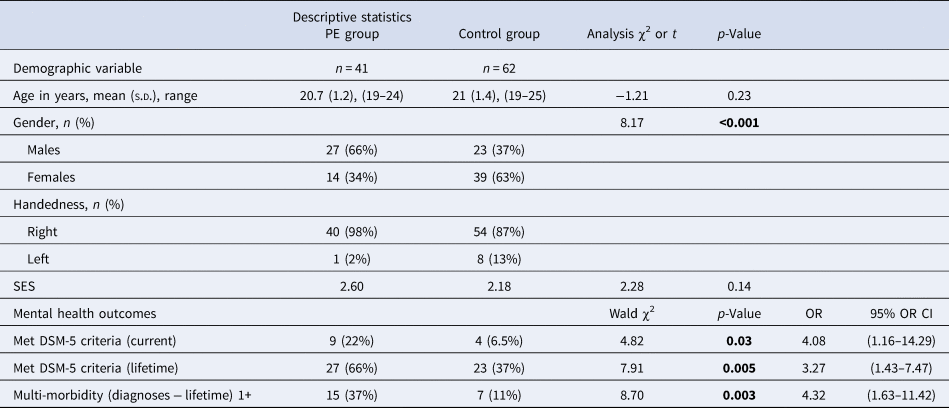
Participants' demographic information is presented in Table 1. No significant group differences were found between the PE and control groups in terms of age (t = −1.21, p = 0.23), SES (t = 1.51, p = 0.14) or proxy IQ (t = 0.78, p = 0.44) as calculated using the WASI-II Vocabulary and the WASI-II Matrix Reasoning subtests. However, there was a significant group difference for gender (χ(1) = 8.17, p = <0.001).
Participants' demographic information and rates of DSM-5 disorders in groups and associated risk

SD, standard deviation; OR, odds ratio; CI, confidence intervals; Results of unadjusted logistic regressions.
Statistically significant results (p < 0.05) are presented in bold text.
Mental health outcomes
A total of 48.5% of all participants met diagnostic criteria for at least one DSM-5 disorder in their lifetime. The most common diagnoses were major depressive episode (34%), which included diagnoses of major depressive disorder and persistent depressive disorder, social anxiety disorder (12.6%) and generalised anxiety disorder (8.7%). Group differences in frequencies are presented in Table 1, online Supplementary Materials.
The PE group was at a significantly higher risk of meeting criteria for both a single lifetime DSM-5 disorder (OR 3.27, CI 1.43–7.47, p = 0.005) and multi-morbid lifetime DSM-5disorders (OR 4.32, CI 1.63–11.42, p = 0.003). Two-thirds (66%) of those who reported PE met criteria for a DSM-5 disorder at some stage of their lives by age 21 (range 19–24 years). Although low rates in general, there was also a significant difference between the groups in terms of those currently meeting criteria for a DSM-5 disorder (OR 4.08, CI 1.16–14.29, p = 0.03) (see Table 1).
Functional outcomes
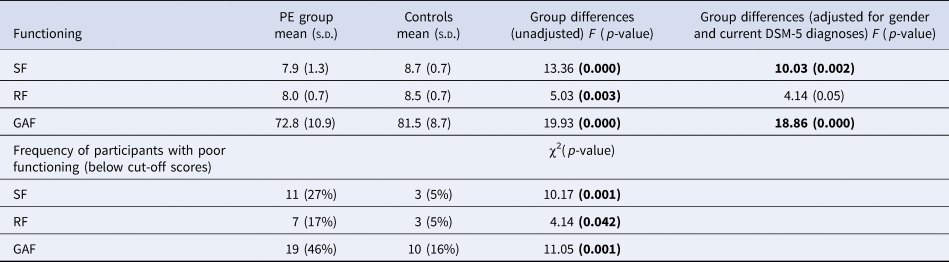
As presented in Table 2, the PE group had significantly lower scores on both the SF (F = 10.03, p = 0.002) and GAF (F = 18.86, p = <0.001) scales following adjustments. Mean GAF scores for the PE group fell within the category described as ‘more than slight impairment in social, occupational or school functioning’, while mean GAF scores for the control group fell within the category described as ‘good functioning in all areas, interested and involved in a wide range of activities and socially effective’.
Mean functioning scores with group differences (adjusting) on all functioning scales and percentage of participants below cut-off scores with group differences

s.d., standard deviation; SF, Social Functioning Scale; RF, Role Functioning Scale; GAF, Global Assessment of Functioning Scale.
Statistically significant results (p < 0.05) are presented in bold text.
The PE group also showed significantly higher rates of functional impairments as defined by cut-off scores. For the PE group, 27% were below cut-off scores for SF and 17% were below cut-off scores for RF, whereas only 5% of the control group were below cut-off scores on each scale respectively. A total of 46% of the PE group were below cut-off scores for global functioning in comparison with 16% of the control group. This corresponded to a significant difference in groups, where significantly more of the PE group were considered as poorly functioning on the SF, (χ(1) = 10.17, p = 0.001) RF, (χ(1) = 4.14, p = 0.042) and GAF (χ(1) = 11.05, p = 0.001) scales.
Neuropsychological outcomes
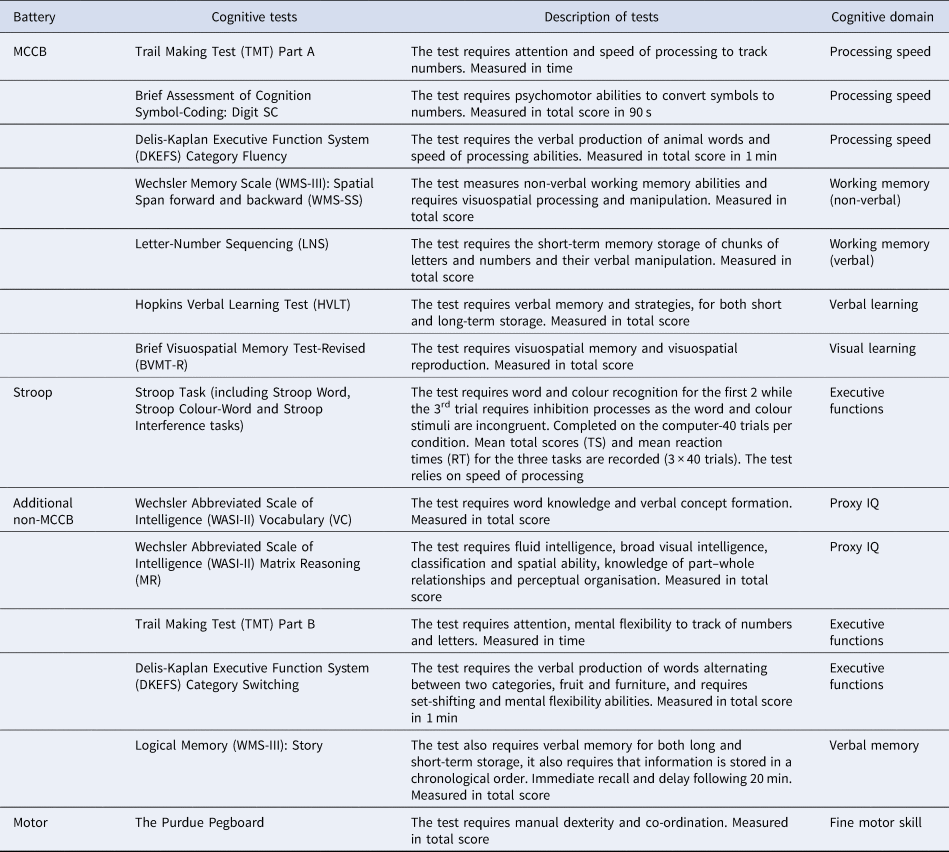
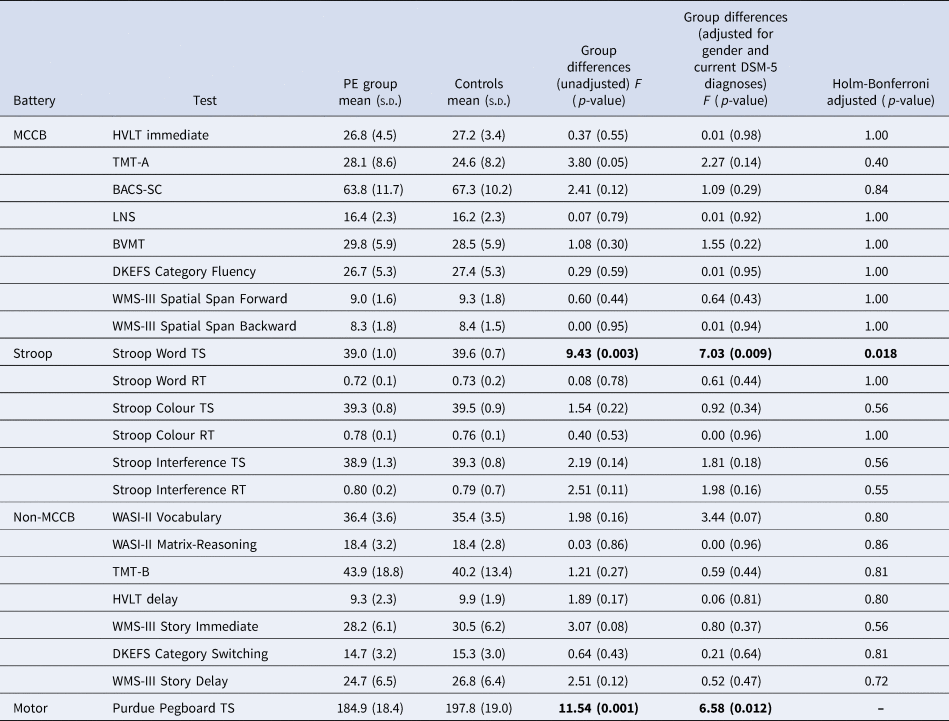
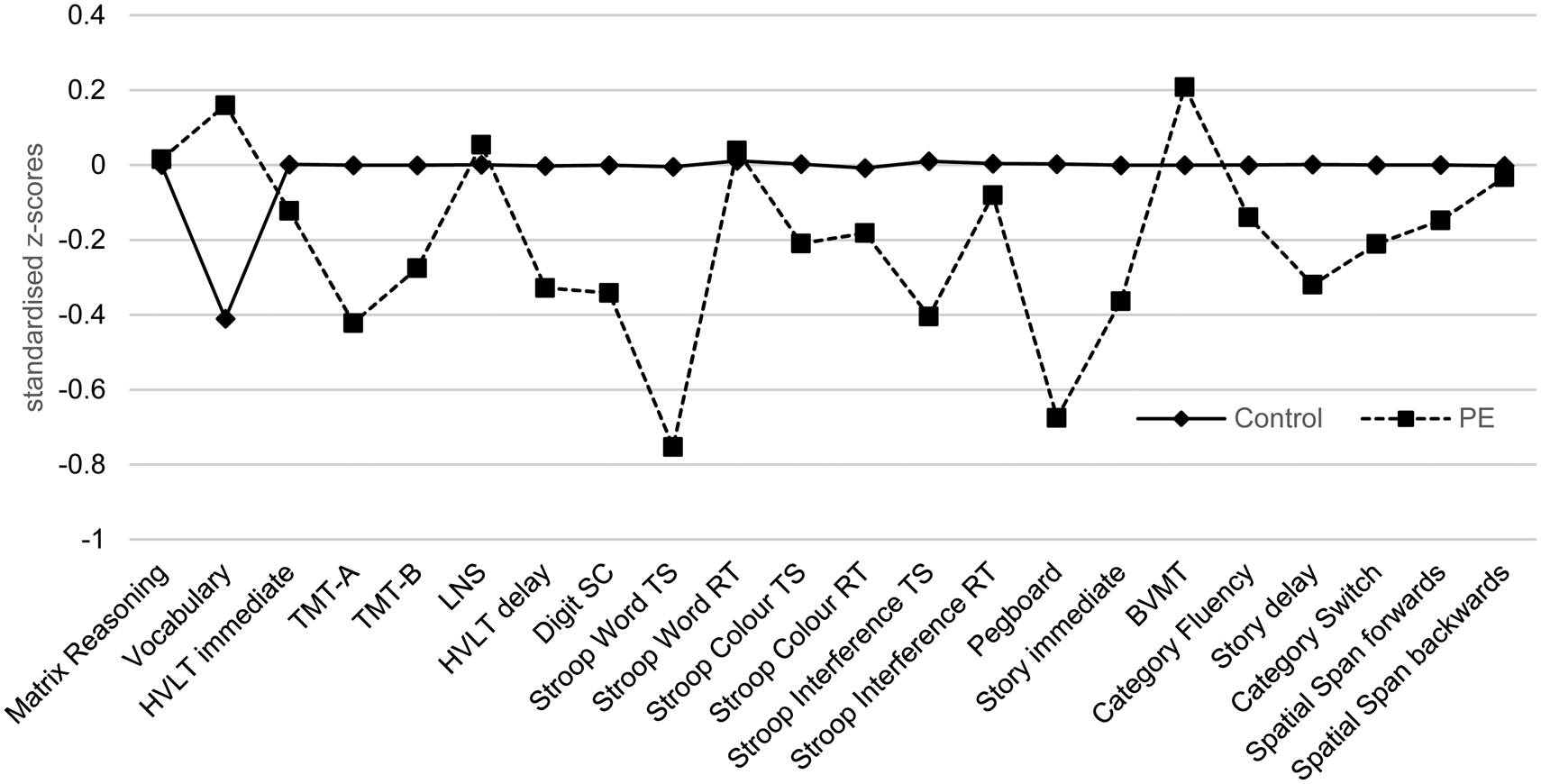
Descriptions of each task, including their cognitive domain and administration instructions, are presented in Table 3. Of the 19 subtests of the neuropsychological battery, adjusted analysis revealed significant group differences on the Stroop Word task (total score) (F = 7.03, p = 0.009) and the Purdue Pegboard (total score) (F = 6.58, p = 0.012), where the PE group had significantly lower mean scores than the controls. The finding on the Pegboard task remained significant for both the non-dominant (F = 6.95, p = 0.01) and dominant (F = 3.99, p = 0.048) hands. None of the tests of the MCCB battery revealed any significant differences after adjustment (see Table 4 and Fig. 1).
Neuropsychological assessment battery completed by all participants, cognitive domains, individual subtests and instructions for administration

Note: For all measures, with the exception of timed tasks, a higher score represents a better performance. For timed tasks, a lower score represents a better performance.
Mean raw scores of neuropsychological assessments for both groups respectively, along with unadjusted and adjusted group differences

s.d., standard deviation; WASI, Wechsler Abbreviated Test of Intelligence; HVLT, Hopkins Verbal Learning Test; TMT, Trail-Making Test (Part A and Part B); BACS, Brief Assessment of Cognition in Schizophrenia; LNS, Letter-Number Sequencing; WMS, Wechsler Memory Scale; BVMT, Brief Visuospatial Memory Test; D-KEFS, Delis-Kaplan Executive Function System; TS, Total Score; RT, Reaction Time.
Statistically significant results (p < 0.05) are presented in bold text.
Unadjusted mean z-scores of neuropsychological assessments for the PE and control groups.

Secondary analysis
The childhood PE group showed largely the same results. The childhood PE group was at a significantly higher risk of meeting criteria for a single lifetime DSM-5 disorder (OR 2.51, CI 1.04–6.08, p = 0.04). They also showed poorer functioning, with significantly lower scores on the SF (F = 4.67, p = 0.03) and GAF (F = 7.92, p = 0.006) functioning scales following adjustments. There was also a significantly greater proportion of individuals in the childhood PE group below-cut off scores (functional impairments) on the SF (χ(1) = 8.18, p = 0.004), RF (χ(1) = 4.65, p = 0.03) and GAF (χ(1) = 7.09, p = 0.008) scales compared to controls. Following adjustments, group differences on the neuropsychological task scores revealed significant differences on the Stroop Word task (total score) (F = 9.42, p = 0.003) and the Purdue Pegboard total score (F = 7.40, p = 0.008), where the childhood PE group had lower scores (see Tables 1–3 online Supplementary Materials).
Discussion
To our knowledge, the present research is the first to examine the mental health, functional and neuropsychological outcomes in early adulthood of young people who reported PE, the majority for which occurred in childhood and/or adolescence. Our findings suggest that young adults with a lifetime report of PE are not only at a significantly higher risk of a single DSM-5 disorder, but also of multi-morbid DSM-5 disorders. The most common diagnosis met by young people who reported PE was that of a lifetime major depressive episode. Furthermore, our analysis showed that PE is also associated with poorer SF and global functioning outcomes in early adulthood. Significantly lower scores were observed on both the SF and global functioning scales, with 46% of the PE group considered as globally poorly functioning at the time of assessment. In terms of neuropsychological performance, the PE group had significantly lower scores in the domains of visual attention and fine motor skill. When examining those who only reported PE in childhood, largely the same results were revealed when compared to controls, highlighting the utility of PE as an early risk marker for later outcomes into early adulthood.
Our research is in-line with a recent meta-analysis which suggests that PE in childhood and adolescence are associated with a 3-fold increased risk of developing any mental disorder (Healy et al., Reference Healy, Brannigan, Dooley, Coughlan, Clarke, Kelleher and Cannon2019). PE are considered as early transdiagnostic markers (McGorry, Hartmann, Spooner, & Nelson, Reference McGorry, Hartmann, Spooner and Nelson2018), with even transient symptoms associated with increased risk of subsequent depressive disorders (Calkins et al., Reference Calkins, Moore, Satterthwaite, Wolf, Turetsky, Roalf and Gur2017). Research carried out on the Dunedin cohort found that only 15% of individuals who reported PE at age 11 were not diagnosed with a psychiatric disorder at age 38 years (Fisher et al., Reference Fisher, Caspi, Poulton, Meier, Houts, Harrington and Moffitt2013). Results from the present research suggest that psychiatric morbidity, indeed psychiatric multi-morbidity, can be detected at an even earlier stage in early adulthood in young people who report PE. Our findings also show that PE in childhood alone is associated with adverse mental health and functional outcomes, replicating those of Trotta et al. (Reference Trotta, Arseneault, Caspi, Moffitt, Danese, Pariante and Fisher2019) who also showed that childhood PE was associated that range of mental health problems at age 18 years in the Avon Longitudinal Study of Parents and Children study. Our findings further emulate those of a large-scale systematic study of non-clinical US youths evaluating psychosis spectrum symptoms (Calkins et al., Reference Calkins, Moore, Merikangas, Burstein, Satterthwaite, Bilker and Qiu2014). In their study, in accordance with other population studies (Kelleher et al., Reference Kelleher, Connor, Clarke, Devlin, Harley and Cannon2012b), higher levels of PE were reported at younger ages. The majority of the participants of the present research who reported PE did so in childhood and adolescence, with the least being reported in early adulthood, in accordance with prevalence rates in the general population. Emerging research suggests however that another peak in prevalence occurs in late adolescence (Sullivan et al., Reference Sullivan, Kounali, Cannon, David, Fletcher, Holmans and Owen2020). Further to this, in agreement with our results, Calkins et al. (Reference Calkins, Moore, Merikangas, Burstein, Satterthwaite, Bilker and Qiu2014) also found that being male was significantly predictive of psychosis spectrum symptoms. However, other studies have shown PE are more common in females (Moriyama et al., Reference Moriyama, van Os, Gadelha, Pan, Salum, Manfro and McGuire2019; Scott et al., Reference Scott, Welham, Martin, Bor, Najman, O'Callaghan and McGrath2008).
Our findings relating to poorer functional outcomes into adulthood for those who reported PE extend recent findings which convey that adverse functional trajectories persist to age 18 years following childhood PE (Trotta et al., Reference Trotta, Arseneault, Caspi, Moffitt, Danese, Pariante and Fisher2019). A study by Brandizzi et al. (Reference Brandizzi, Schultze-Lutter, Masillo, Lanna, Curto, Lindau and Gebhardt2014) found that PE, particularly perceptual abnormalities, were related to poorer SF in a help-seeking sample of youths. The present research demonstrates that such deterioration in functioning is also present in non-help-seeking young people. This has been shown longitudinally throughout the ABD study both in childhood (Kelleher et al., Reference Kelleher, Wigman, Harley, O'Hanlon, Coughlan, Rawdon and Cannon2015) and adolescence (Healy et al., Reference Healy, Campbell, Coughlan, Clarke, Kelleher and Cannon2018), with persistent psychotic symptoms indicative of poorest global functional outcomes. Our analysis confirms that this trend has continued into early adulthood, where those with a lifetime report of PE are not functioning as well as their peers, particularly in aspects of social functioning. This in part may be attributable to social cognitive dysfunction, a characteristic of the psychosis spectrum. Unfortunately, impairments in overall functioning at this stage may have life-long consequences, as early adulthood is a critical period where pathways to long-term personal, interpersonal, educational and economic success are often formed (Shanahan et al., Reference Shanahan, Zucker, Copeland, Bondy, Egger and Costello2015).
Overall, minor neuropsychological differences were evident between groups, however a variable performance across domains for the PE group was noted. Following adjustments, two tasks revealed significantly lower scores for the PE group, the Stroop Word task which measures visual attention and response acuity, and the Purdue Pegboard Task, which measures fine motor skill and manual dexterity. Deficits in attention were identified in childhood during baseline assessments in the ABD study, where the PE group had significantly lower scores on the TMT-A task (Kelleher et al., Reference Kelleher, Clarke, Rawdon, Murphy and Cannon2012a). Our results show that dysfunction in attention and information processing are still evident in early adulthood. Interestingly, lower total scores were observed, however reaction time was unaffected. Trading performance accuracy for reaction time replicates previous findings in young people with PE using similar attention tasks (Calkins et al., Reference Calkins, Moore, Merikangas, Burstein, Satterthwaite, Bilker and Qiu2014), suggesting that impairments lie in disinhibition, sustained attention and salience monitoring. Deficits in performance on the Purdue Pegboard task in participants with PE have been found consistently throughout the ABD study, during childhood (Blanchard et al., Reference Blanchard, Jacobson, Clarke, Connor, Kelleher, Garavan and Cannon2010), adolescence (Carey et al., Reference Carey, Dooley, Gillan, Healy, Coughlan, Clarke and Cannon2019) and presently in early adulthood. Evidence that motor abnormalities are a stable trait marker in the psychosis spectrum is accumulating. Strik, Stegmayer, Walther, and Dierks (Reference Strik, Stegmayer, Walther and Dierks2017) identify three key brain circuits relevant to psychosis, one of which is motor circuitry. In one of the earliest studies, Cannon et al. (Reference Cannon, Jones, Huttunen, Tanskanen, Huttunen, Rabe-Hesketh and Murray1999) investigated 400 children in Finland who were later diagnosed with schizophrenia in adulthood and found that, although children who later developed psychosis had performed as well as their peers in academic subjects, they had significantly worse scores in sports and handicrafts abilities. Deficits particularly in fine motor functioning have been previously reported in individuals at risk for psychosis, predominantly pertaining to reduced dexterity, and velocity of hands and fingers (Gschwandtner et al., Reference Gschwandtner, Pflüger, Aston, Drewe, Stieglitz and Riecher–Rössler2006). Therefore, some motor abnormalities may prove unique to the psychosis spectrum and serve a role both as observable markers and targets for intervention (Mittal & Walther, Reference Mittal and Walther2019). Our study highlights the need to measure both cognitive and motor abilities in tandem, as both possess specific independent effects.
Strengths of our research include the enrolment and re-recruitment of a general population cohort of young people, a proportion of which had reported PE, and clinically assessing their outcomes 10 years later following baseline clinical assessments. Further to this, our study is also the first to employ such an extensive neuropsychological assessment battery, using standardised neuropsychological measures spanning all major cognitive domains, to investigate neuropsychological performance in young adults who have reported PE. However, the limitations of the present study should also be considered. Firstly, as part of the ABD study, all 211 participants who took part at baseline in childhood were invited to take part in early adulthood, of which 49% returned. This yielded a relatively small sample size for the present research, and may have raised issues with statistical power for analyses, as well as issues surrounding the prevalence of psychiatric disorders. That said, Saiepour et al. (Reference Saiepour, Najman, Ware, Baker, Clavarino and Williams2019) showed that differential loss to follow-up rarely affects estimates of associations. Our attrition analysis attempted to reconcile this, and showed that those who had returned were not demographically or clinically different from those who had not. Secondly, of those who had returned, 41 (40%) had a lifetime report of PE. This is over-representative based on global lifetime prevalence rates and we can only speculate that the high levels returning reflected potentially help-seeking related behaviour. Thirdly, in terms of the findings from the neuropsychological assessments, results on the Stroop Word task may have been driven by a ceiling effect. Scores on the task fell within a range of four for all participants, and we recommend that future research employs more trials on this task to see if our finding can be replicated. We would argue however that a significantly lower score on such a simple task remains insightful. Finally, to our knowledge, at the time of assessment all participants were naïve to anti-psychotic medication.
Suggestions for future research include delving further into understanding the reduction of functioning associated with PE, as extracting the principal influences on functional outcomes is crucial in designing effective interventions. Our results would indicate that although a variable neuropsychological performance is observed, many of the early cognitive deficits associated with PE have resolved by early adulthood. What remains to be seen however, is if differing outcomes emerge for those with transient or recurring symptoms.
Finally, the findings from our study endorse the importance of routine screening for PE in clinical practice, particularly in children and young adolescents. Evidence for PE as an early marker of later, ongoing mental distress and poorer functioning is mounting.
Supplementary material
The supplementary material for this article can be found at https://doi.org/10.1017/S0033291720000616.
Acknowledgements
The authors report no conflicts of interest in relation to this study. The authors also thank all participants who have taken part in this study and their families, and for their continued participation in the research.
Financial support
The research has been funded by a European Research Council Consolidator Award to M Cannon (724809 iHEAR) (EC, CH, DC,, AO'N, MC). HC was funded by a Health Professionals Fellowship from the Health Research Board. ND is funded by an RCSI StAR studentship. MC is funded by a HRB Health Research Award and Irish Research Council COALESCE Award. IK was funded by an RCSI StAR lectureship.
Conflicts of interest
None.
Ethical standards
The authors assert that all procedures contributing to this work comply with the ethical standards of the relevant national and institutional committees on human experimentation and with the Helsinki Declaration of 1975, as revised in 2008.