INTRODUCTION
History of the Lombards is somewhat complicated and yet to be fully understood. The Lombards originally came from Scandinavia in the 1st century and settled in the territory of the Lower Elbe for about 400 years. However, it is not sure whether the Lombards in the 1st century were the same as those in the 5th century. If we map all findings of the Lombards, we can reconstruct the Lombard migration from Lower Elbe in the 1st century to southern Italy in the 6th to 8th century (Stadler Reference Stadler2015). Thus, it is reasonable to assume that the Lombards have the origin in Northern Germany. By crossing the territory of the Thuringians, they reached the area of Czech Republic near Prague. At about 480 AD, they settled in Moravia and the Northern part of Lower Austria. In fact, they were the last of the migrating Germanic peoples to enter the western part of the old Roman Empire. As the focus of their settlements shifted, they reached the Danube region over the following centuries and finally crossed the river to settle in the “Tullnerfeld” in 505 AD. Due to strength of neighboring kingdoms (the Ostrogoths and Byzantines) and other migrating cultures (the Gepids and Avars), they stayed there for some fifty years until they left to invade Italy (Peters Reference Peters1974; Stadler et al. Reference Stadler, Friesinger, Kutschera, Priller, Steier and Wild2003, Reference Stadler, Friesinger, Kutschera, Lauermann, Rácz, Tejra, Wild and Zeman2008; Bystrický Reference Bystrický2008).
In the framework of the project “Absolute Chronology for Early Civilizations in Austria and Central Europe using 14C dating with Accelerator Mass Spectrometry,” numerous Lombard settlements (graveyards) located in the Pannonian Basin (north and south of the Danube) were radiocarbon dated, using collagen originated from human bone samples found in the different sites in Lower Austria, Moravia and Western Hungary (Stadler et al. Reference Stadler, Friesinger, Kutschera, Priller, Steier and Wild2003, Reference Stadler, Friesinger, Kutschera, Lauermann, Rácz, Tejra, Wild and Zeman2008). The primary aim of the study was to find out whether absolute age determinations for the 4th–6th centuries can improve the distinction between the ethnic groups which were active during the Migration Period. To answer this question, the authors exploited the method of Bayesian sequencing (Bronk Ramsey Reference Bronk Ramsey2009). The data obtained from 14C dating were in a reasonable agreement with the time frame based on the previous archaeological investigations in the aforementioned regions. Moreover, the project resulted in pushing the examined sites (Zlechov, Unterlanzendorf, Mödling) in the correct time period, placing an interesting custom of skull deformations in the frame of Attila’s regime, and clarification in the case of the Lombard tombs that had been incorrectly dated (e.g., a burial of Keszthely Fenekpuszta Ödenkirche; Stadler et al. Reference Stadler, Friesinger, Kutschera, Lauermann, Rácz, Tejra, Wild and Zeman2008).
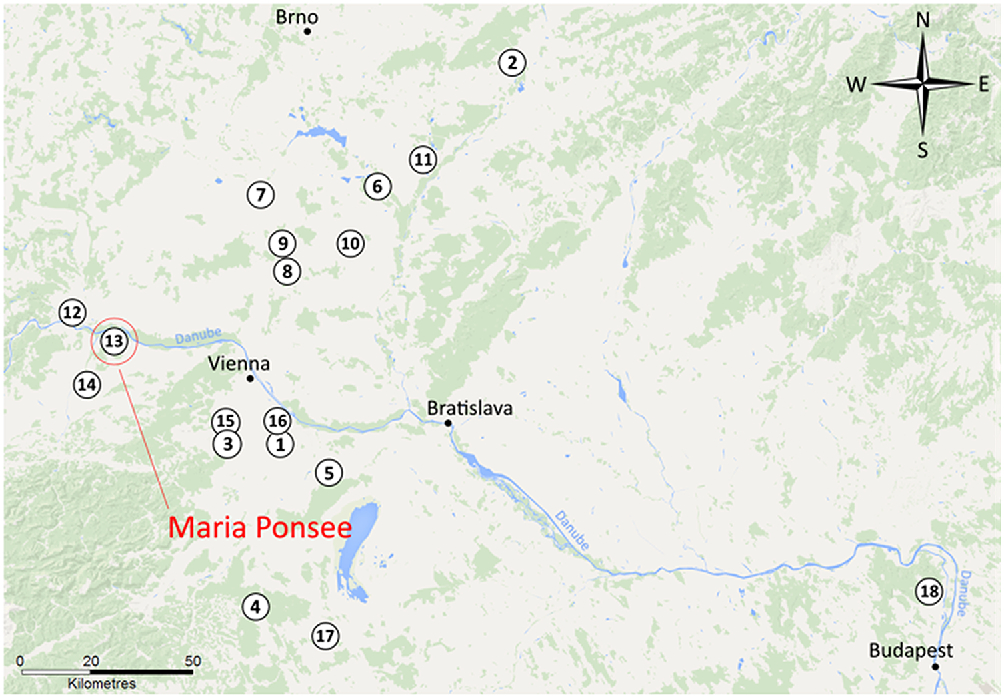
One of the investigated graveyards was located in Maria Ponsee (Lower Austria), close to the Danube and village of Oberbierbaum, approximately 50 km to the west from Vienna (Figure 1). In 1965–1972, 95 graves with skeletal remains of 100 individuals were excavated (Adler Reference Adler1966, Reference Adler1972) and handed over to the Natural History Museum of Vienna for further studies. Almost all graves showed disturbances of varying extent, either caused by construction work and/or reopening of the graves in the ancient time; grave goods were often missing. The graves were oriented in the W–E direction and the dead were buried in a stretched supine position, which is in concordance with the burial ritual of Germanic tribes in that time (Adler Reference Adler1966). Depth of the graves varied from 30 to 270 cm (Kováčová Reference Kováčová2014).
Map showing locations of the graveyards used in the sequence: 1 – Unterlanzendorf; 2 – Zlechov; 3 – Mödling; 4 – Schwarzenbach; 5 – Sommerein; 6 – Břeclav-Líbivá; 7 – Laa an der Thaya; 8 – Ladendorf; 9 – Asparn Schletz; 10 – Hauskirchen; 11 – Lužice; 12 – Rohrendorf; 13 – Maria Ponsee; 14 – Pottenbrunn; 15 – Brunn am Gebirge; 16 – Schwechat; 17 – Nikitsch; 18 – Szentendre.

According to archaeological findings, in particular the arrangement of the graves and the grave goods, the Maria Ponsee necropolis seemed to be tripartite; hence, three “migration waves” at different time were assumed (Friesinger and Adler Reference Friesinger and Adler1979; Lauermann and Adler Reference Lauermann, Adler, Bemmann and Schmauder2008). The first group, located in the northern sector of the site, contained grave goods of Thuringian character. Therefore, it was assumed that this group may represent migrants from the Middle Elbe region which eventually settled in Tullnerfeld at the beginning of the 6th century. Based on the typology of artifacts, a north Danubian (Bohemian) origin or, at least, influence was clearly noticeable for the group located in the southern sector of the graveyard. Interestingly, the burials located in the western area differ conspicuously in their artifacts character: the goods were simple, probably belonging to poor local Roman citizens, which coincided for a short period with the Lombards arriving at the region. However, other findings (i.e. graves in which human remains were found together with skeletal remains of horses and dogs) suggest that members of the ruling class were also buried at Maria Ponsee (Priester Reference Priester2004).
The Bayesian sequence of Stadler et al. (Reference Stadler, Friesinger, Kutschera, Lauermann, Rácz, Tejra, Wild and Zeman2008), which followed the chronological migration of recognized ethnic groups to and through Central Europe in the 4th–6th century, was divided into seven phases. The dated human bone samples were uncovered in 18 excavation sites, shown in Figure 1. While first three phases of the sequence dealt with the time before the Lombard arrival to the Danube region at the end of the 5th century (Marti Reference Marti2010; Sauer Reference Sauer2007), the second part involves North and South Pannonian periods of the Lombard occupation of the territory, which were split into four distinctive stages. The overall agreement level of the sequence (135.8%) suggests a positive correlation between the modeled and historical data.
Although the original project of Stadler et al. (Reference Stadler, Friesinger, Kutschera, Lauermann, Rácz, Tejra, Wild and Zeman2008) has shed light on important questions and brought up some fresh ideas, a few aspects are still pending and open for discussion. Here we present results of radiocarbon dating of a new sample set originating from the Maria Ponsee graveyard, located in a region of Lower Austria that was historically known as Tullnerfeld. This area was occupied by the Lombards after they crossed the Danube in ∼505 AD. The bulk of the samples for this study were taken from the skeletal remains of the individuals buried in the northern and southern subareas of the site to reveal and verify their purported chronological difference. Finally, the new dataset was used to update the sequence presented in Stadler et al. (Reference Stadler, Friesinger, Kutschera, Lauermann, Rácz, Tejra, Wild and Zeman2008), therewith to increase our knowledge about the validity of the modeled data in relation to the historical records.
MATERIAL AND METHODS
The samples for radiocarbon dating were taken from the skeletal remains of 20 humans and 3 animals (horses) that were recovered from 22 graves of Maria Ponsee. Nine of these graves were located in the northern area while 11 graves in the southern one. Further samples were taken from the western group (grave nr. 20) or unassigned (grave nr. 9). The morphologically estimated age of death (MA) of adults varies between 26 and 47.5 years. Three samples (VERA-6017, VERA-6018, VERA-6032) presumably belonged to infants while the age of death of one individual is undefined (Klement Reference Klement2014). The samples were taken from undamaged and uneroded, taphonomically non-altered parts of bones to minimize possible contamination.
The samples were processed and measured by accelerator mass spectrometry (AMS). The pretreatment of the samples followed the standard VERA protocol which is an adopted version of the modified Longin method (Longin Reference Longin1971). First, bone samples were crushed into small pieces which were then demineralized with HCl. After soaking the material in NaOH solution and fresh portion of HCl, the collagen was solubilized in the pH 3 solution at 90 °C. The samples were washed with double distilled water between these steps. The solution with the dissolved gelatin was passed through a silver filter and evaporated to dryness. The dried and weighed collagen was combusted in a sealed quartz tube at 900 °C. The emerged CO2 was reduced with hydrogen to the form of filamentous graphite, deposited on the iron catalyst (Vogel et al. Reference Vogel, Southon, Nelson and Brown1984). In the end, the graphite was pressed into a target holder and its radiocarbon content was measured. More detailed information on the sample pretreatment steps and AMS measurements are presented in Wild et al. (Reference Wild, Golser, Hille, Kutschera, Priller, Puchegger, Rom, Steier and Vycudilik1998, Reference Wild, Guillen, Kutschera, Seidler and Steier2007, Reference Wild, Neugebauer-Maresch, Einwögerer, Stadler, Steier and Brock2008) and Steier et al. (Reference Steier, Dellinger, Kutschera, Priller, Rom and Wild2004), respectively.
The calibration of the conventional radiocarbon ages and following sequencing were performed using the on-line version of the OxCal program (v4.3.2; Bronk Ramsey and Lee Reference Bronk Ramsey and Lee2013), with the implemented atmospheric calibration curve IntCal13 (Reimer et al. Reference Reimer, Bard, Bayliss, Beck, Blackwell, Bronk Ramsey, Grootes, Guilderson, Haflidason, Hajdas, Hatté, Heaton, Hoffmann, Hogg, Hughen, Kaiser, Kromer, Manning, Niu, Reimer, Richards, Scott, Southon, Staff, Turney and van der Plicht2013). The new Maria Ponsee data was incorporated into the sequence of Stadler et al. (Reference Stadler, Friesinger, Kutschera, Lauermann, Rácz, Tejra, Wild and Zeman2008), together with four terminus post quem dates which are connected to the historically documented events in Central Europe, i.e. the start of the Hunic invasion in 375 AD, the uprising of the Germanic tribes after the death of Attila in 453 AD, the arrival of the Lombards to Tullnerfeld in 505 AD, and the move of the Lombards to the Northern Pannonia in 526 AD. Instead of the simple boundary model, the start and end of the sequence was defined by trapezium priors (Karlsberg Reference Karlsberg2006; Lee and Bronk Ramsey Reference Lee and Bronk Ramsey2012).
RESULTS AND DISCUSSION
The radiocarbon ages of the individual samples and the respective calibrated calendar time ranges, together with the grave numbers, morphological age of death estimation, and the collagen yield values are given in supplemental Table S1. In the case of six bone samples (VERA-5991, VERA-5993, VERA-5995, VERA-5998, VERA-6000, and VERA-6033), the amount of sampled material was high enough to repeat the dating; the results from first and second dating are in good agreement. According to the literature (Piotrowska and Goslar Reference Piotrowska and Goslar2002), almost all bones could be classified at least as “well preserved”, having the collagen yield >1% which is generally advised as a minimum level for reliable radiocarbon dating (Hedges and van Klinken Reference Hedges and van Klinken1992). Two samples (VERA-6032, VERA-6033) were even close to values corresponding to modern bones (∼22%; van Klinken Reference van Klinken1999). As the sample VERA-5994, yielding not more than 0.9% of the collagen, showed a good compatibility with other samples (for χ2-test results, see next paragraph), it was added to the chronological sequence as well.
In order to check if the whole Maria Ponsee sample set is of the same age, a χ2-test was performed. We followed a general rule and chose a 5% significance level for the rejection of the hypothesis whether the dated samples are truly coeval. The critical value for our case with 22 degrees of freedom would be 33.9, which is higher than the actual value of 32.6 determined by the χ2-test. A calculation of the calibrated date for the combined radiocarbon age (1585 ± 5 BP) of the Maria Ponsee samples falls in the period of 485–535 AD (with the probability of 59.9% at the 95.4% level), which is in concordance with the historical period of 505–568 AD of the Lombard occupation of the region, where the graveyard is located. Despite that, we evaluated a possible chronological discrimination between the northern (9 samples) and southern group (11 samples) of the Maria Ponsee cemetery, suggested by archaeologists (Friesinger and Adler Reference Friesinger and Adler1979; Lauermann and Adler Reference Lauermann, Adler, Bemmann and Schmauder2008). For this purpose, we exploited the R_Combine function of the OxCal program. The radiocarbon age for the northern and southern group was determined to be 1595 ± 10 and 1570 ± 10, respectively. The values clearly overlap on the 2σ level which means that there is no significant difference between the dates. Therefore, the groups could not be separated in time, using only radiocarbon dating results.
The aforementioned good agreement of the calibrated and historical data can also be seen in Figure S1 in which all calibrated time ranges and the period of the Lombard occupation of the region, where the Maria Ponsee graveyard is located (a magenta-colored bar), are illustrated. It is obvious that three samples do not match the period very well: the corresponding probability at the 95.4% level for sample VERA-5990, VERA-5993 and VERA-6035 is 8.9%, 10.3% and 11.7%, respectively (Table S1). On top of that, these three older dates yielded very poor agreement indices in the very first run of the updated sequence. Thus, we considered them as outliers and omitted them from the final version of the sequence presented here. In general, the radiocarbon age of a sample can be shifted due to several reasons. Bone collagen turnover rates that vary with the biological age of the dated human can cause a time shift as great as 30 years (Wild et al. Reference Wild, Arlamovsky, Golser, Kutschera, Priller, Puchegger, Rom, Steier and Vycudilik2000), which might be crucial when constructing absolute chronology based on the high-precision dating. Barta and Štolc (Reference Barta and Štolc2007) suggested application of the human bone collagen offset (HBCO) corrections, which are based on the model proposed by Geyh (Reference Geyh2001). However, such HBCO corrections were not applied either because of the unknown MA value (as for VERA-5990) or they were well below the uncertainties of the radiocarbon determinations, i.e. the HBCO correction value for VERA-5993 and VERA-6035 was calculated to be 14 and 10 14C yr, respectively. Extracting such low numbers from the radiocarbon age values would have only negligible effect on the outcome of calibration and sequencing. Another explanation could be that radiocarbon ages were shifted due to the fresh water reservoir effect (Philippsen Reference Philippsen2013), as Maria Ponsee is situated in the vicinity of the Danube (4 km), and a fish-fork or harpoon was found in the grave 9. The age difference between the sample VERA-5993 (human) and VERA-6024 (herbivorous horse) of the grave 9 (95 ± 42 14C yr) suggests that the freshwater reservoir effect could play some role. The δ15N values could provide some insight in the paleodiet of the Lombards as well, though this would require more measurements of the samples, e.g. by elemental analyzer isotope ratio mass spectrometry (Rumpelmayr Reference Rumpelmayr2012). In conclusion, the “origin” of three outlying samples is yet to be understood.
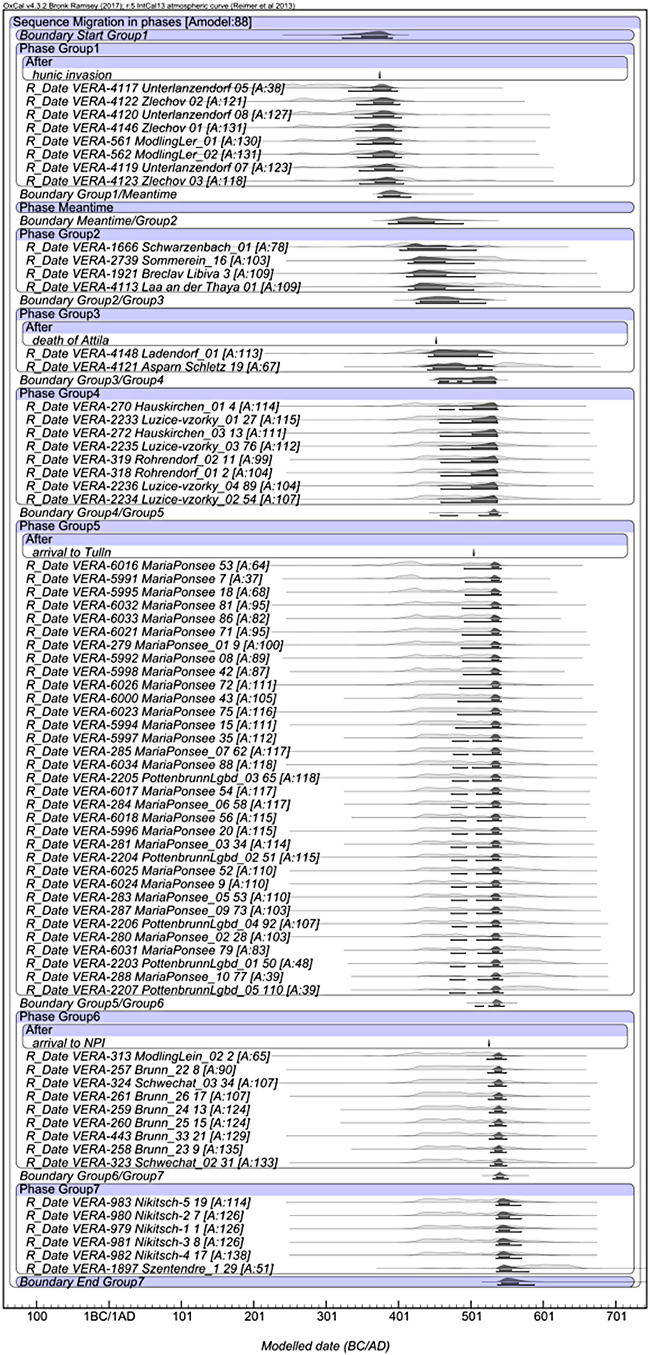
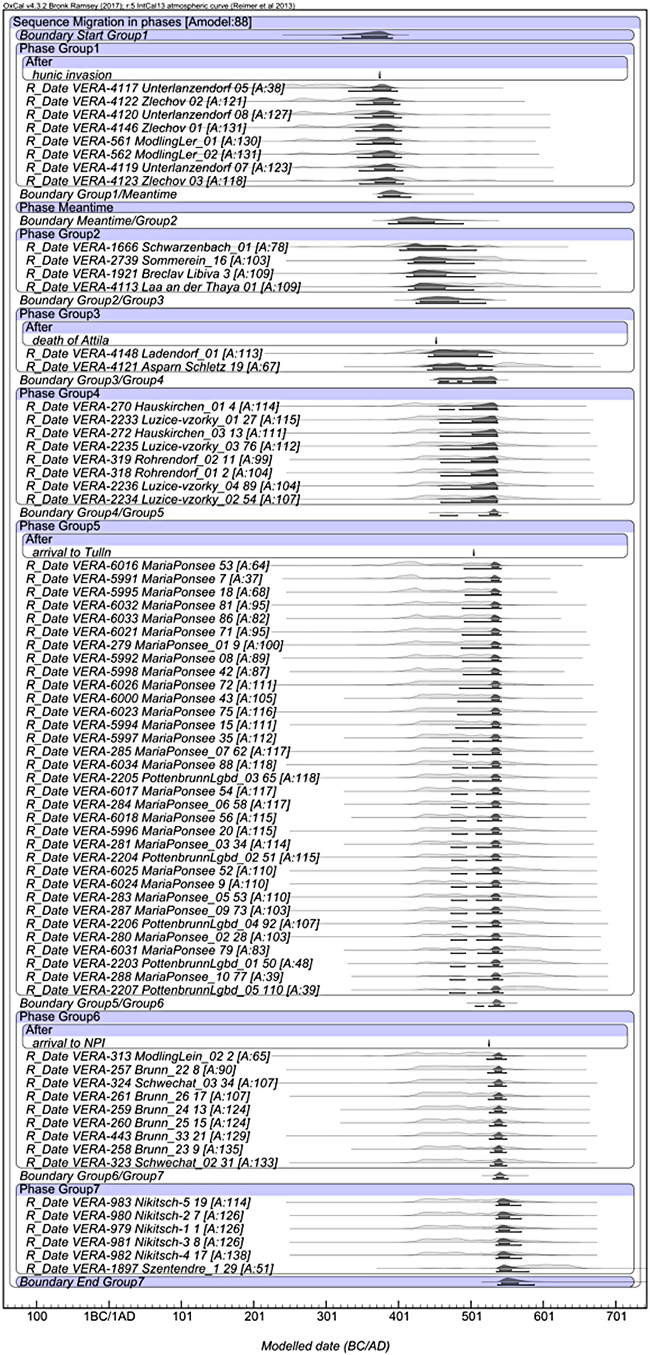
The updated Bayesian sequence of the Migration Period in the Central Europe region comprises altogether 70 radiocarbon dates, most of which (33) are allocated in the phase of the Lombard inhabitation of Tullnerfeld (Figure 2). An agreement index for the sequence (Amodel) was calculated to be 87.6% which is quite above the critical value of 60%. This implies that the chronology of the migration of different ethnic groups in Central Europe between 4th and 6th century AD is well outlined. Several samples yielded rather poor agreement levels, including dates from the source sequence (one from Unterlanzendorf, Maria Ponsee and Szentendre, and two from Pottenbrunn), as well as one bone from the new data set from Maria Ponsee (VERA-5991). Nevertheless, we decided not to remove them because doing so would not have any significant effect on the results of the sequencing. To further elaborate, sample VERA-5991 does not fit in the structure of the chronological order as good as other new samples probably due to the uncertainty of its radiocarbon age (±25 14C yr), which is a bit lower if compared e.g. to the sample VERA-6016 (±35 14C yr), having the very same radiocarbon age, and still yielding the acceptable agreement level (70.6%). Obviously, the lower uncertainty of the measured 14C age leads to narrower time interval, which in the end overlaps less with the model. Calibrated and modelled data for all samples used in the sequence are given in Table S2.
Plot of the Bayesian sequence of different recognized ethnic groups active in Central Europe during the Migration Period between 375 and 568 AD. The sequence comprises the data from this study and from Stadler et al. (Reference Stadler, Friesinger, Kutschera, Lauermann, Rácz, Tejra, Wild and Zeman2008). The beginning of the phase 2 (Huns) was pushed forward by an undefined interim (meantime).
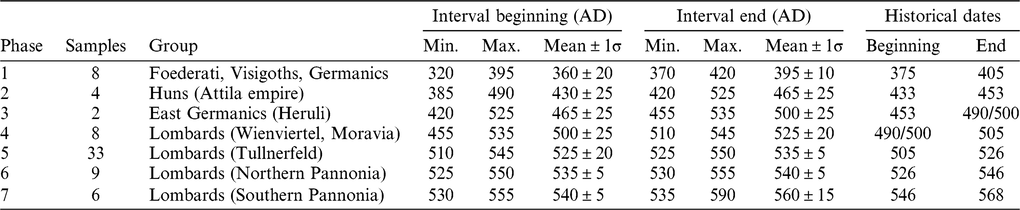
The results of the sequencing are summarized in Table 1 where modeled data are compared with the historical milestones. The minimal and maximum values represent rounded dates of the boundary intervals between the respective group phases at the 95.4% probability level. The mean values of the intervals with the 1σ uncertainties are also shown in the table. The minima and maxima of the beginnings and ends of the phases as well as the mean values of the modeled time intervals fit reasonably (within 1σ uncertainty) the historical periods. Interestingly, the phases of the Huns and East Germanics showed good agreement between the model and historical knowledge, though only small sample sets were used in their cases. Looking at the Lombards intervals, we can see that the phases seem relatively close to each other, i.e. their respective modeled periods overlap significantly. This would support the idea postulated by Stadler et al. (Reference Stadler, Friesinger, Kutschera, Lauermann, Rácz, Tejra, Wild and Zeman2008) that the Lombard settlements were not fully evacuated, while they were moving from the north to the south and opening new ones, rather the occupation area was expanded with old settlements abandoned later. An exception to this would be the last phase— colonization of the Southern Pannonia—which presumably began in 546 AD and was so extensive that it seems necessary for the Lombards to completely leave their habitants, situated north of the Danube. Therefore, it is not possible in reality to confine the Lombard phases in the strict time frames. It is also worth to note that the poorer time discrimination between the Lombard phases and consequently slightly lower Amodel value for the whole sequence might have been caused by broad ranges of the calibrated dates. For example, if we take sample VERA-5994 (Maria Ponsee), due to the unfavorable form of the calibration curve (plateau) in the region of the determined conventional radiocarbon age of the sample, its calibration resulted in the time interval of 415–560 AD at the 95.4% probability level, with only 17.7 of 68.2% distributed in the period of the Lombard occupation of Tullnerfeld, that is 505–526 AD (Figure S2). Another thing to point out is somewhat disproportional distribution of samples in the respective phases for sequencing when almost 50% of the whole set is in a single migration period. With increasing number of radiocarbon determinations in other phases, we expect that the model would yield even better results.
Results of the updated Bayesian sequence of the Migration Period in Central Europe (375–568 AD) compared with the historical data (at the 95.4% probability level).

SUMMARY
Following the project which has been dealing with the absolute chronology of the different ethnic groups active during the Migration Period in Central Europe, we successfully dated a set of 23 samples, excavated from the Maria Ponsee graveyard. The performed χ2-test confirmed that the samples are coeval and fit well in the time frame of the Lombard inhabitation of Tullnerfeld (Lower Austria) where the graveyard is located, though the expected time discrimination between different grave groups could not be confirmed. The obtained calibrated dates were used to update the Bayesian sequence mapping the chronology of the tribe migration in Central Europe from 375 to 568 AD. The modeled intervals were found to be in concordance with the historical milestones, which is supported by good agreement level of the model (Amodel = 87.6%). On top of that, the results showed that the phases of the Lombard colonization of the Pannonian Basin and Danube region should not be considered as the closed consecutive time frames, suggesting that before 546 AD the Lombards did not fully abandon old northern settlements as they were moving southward and opening new ones.
ACKNOWLEDGMENTS
Authors would like to thank Ronald Mühl of the NHM for the assistance with the sampling of the bones and Stefan Lehr of the VERA laboratory for the help with the graphitization. This work was supported by the OeAD program Aktion Austria-Slovakia (Ernst-Mach Stipendium).
SUPPLEMENTAL MATERIALS
New 14C data from Maria Ponsee and calibrated and modeled dates for all graveyards used in the sequence are given in online Table S1 and S2, respectively. Figure S1 shows a multiplot of calibrated dates of samples dated in this study. An unfavorable form of the calibration curve in the ∼1580 BP region is depicted in Figure S2. The OxCal code of the final sequence is a part of the supplemental materials as well.
To view supplementary material for this article, please visit https://doi.org/10.1017/RDC.2019.89.