Organophilic clays have the ability to increase the viscosity of drilling fluids. Organoclays are the most commonly used rheological agents in non-aqueous drilling fluids, such as organo-montmorillonite, organo-palygorskite and organo-sepiolite (Zhuang et al., Reference Zhuang, Gao, Peng and Zhang2019). Palygorskite (Plg) is a 2:1 clay mineral that possesses a moderately high structural charge due to the replacement of Al3+ by Mg2+ and Fe2+ in the octahedral sheet (Warr, Reference Warr2020). There are several types of active sites on the surface of Plg (Mu & Wang, Reference Mu and Wang2016), which play important roles in the adsorption of cationic surfactants. In this study, the cationic surfactant cetyltrimethyl ammonium bromide (CTAB) was used to organophilize Plg (Silva et al., Reference Silva, Gois, Ramme, Castro Dantas, Barillas and Santanna2021, Reference Silva, Castro Dantas, Barillas and Santanna2023).
The oil industry has employed nanotechnology for a number of years in the search of novel solutions to problems associated with its production networks. Researchers have identified feasible solutions to such problems, one of which being the use of nanofluids. Bayat et al. (Reference Bayat, Moghanloo, Piroozian and Rafati2018) studied the performance of a bentonite water-based mud (WBM) by adding to it the hydrophilic nanoparticles (NPs) Al2O3, TiO2, SiO2 and CuO. The results revealed that adding the NPs at concentrations below 0.5 wt.% to the bentonite-WBM had the potential to improve its rheological and filtration properties. Ahasan et al. (Reference Ahasan, Alvi, Ahmed and Alam2021) investigated the effects of ZnO NPs prepared in the laboratory on the rheological and filtration properties of a WBM without KCl at various temperatures and concentrations. The results revealed improved yield points (YPs), gel strengths and mud cake characteristics. The impact of SiO2 NPs on the rheological, filtration, antifriction and colloidal stability properties of oil-based drilling fluids was investigated by Mikhienkova et al. (Reference Mikhienkova, Lysakov, Neverov, Zhigarev and Minakov2022). They observed a change in all of these parameters at very low concentrations of NPs. These works show that NPs mainly improve the rheological and filtration properties of drilling fluids.
The incorporation of NPs into the composition of drilling fluids allows engineers to modify drilling fluid rheology, reduce filtration loss, improve the rate of heat transfer, reduce friction, improve shale and wellbore stability and mitigate hydrate formation because of the very ultrafine size (<100 nm) and high surface area to volume ratio of the NPs (Rafati et al., Reference Rafati, Smith, Haddad, Novara and Hamidi2018). Nanofluids can be classified into two main categories: single-material nanofluids and hybrid nanofluids (Ali et al., Reference Ali, Teixeira and Addali2018). Single-material nanofluids are considered to be the conventional form of nanofluids that are used, in which a single type of NP is used to produce the suspension. Hybrid nanofluids are made of a combination of more than one type of NP suspended in a base fluid.
One of the main problems encountered when using drilling fluids in deep waters is controlling the thermal stability and rheological properties. The rate of heat transfer of the drilling fluid is also critical to maintaining a stable fluid so as to prevent overheating of drill string components. Ideally, a drilling fluid should have a low deterioration rate, high stability, consistent rheology and filtration loss properties and a high rate of heat transfer (Fuhua et al., Reference Fuhua, Xuechao, Ruihe, Mingbo, Li and Jianghua2012; Zhao et al., Reference Zhao, Qiu, Huang and Wang2017; Paixão et al., Reference M.V.G, Fernandes, Souza and Balaban2021). Non-aqueous fluids are preferred for use in drilling in highly challenging high-pressure and high-temperature (HPHT) environments, as these provide improved thermal stability and contamination resistance and a faster drilling rate (Arain et al., Reference Arain, Ridha, Ilyas, Mohyaldinn and Suppiah2022). Organo-Plg fluids present excellent rheological properties due to their formation of a good network structure (Zhuang et al., Reference Zhuang, Wu, Zhang, Zhang, Zhang and Liao2017; Zhang et al., Reference Zhang, Xu, Christidis and Zhou2020).
Moraveji et al. (2020) examined the effects of amorphous silica NPs on the rheological and filtration properties of an aqueous drilling fluid and its influence on the stability of shale formations. The results indicated that the use of NPs improved these rheological properties, particularly because of the concentration and size of the NPs. The loss of fluid was also reduced and the thermal stability of the drilling fluid increased.
Farahbod (Reference Farahbod2021) studied the effects of carbon nanotubes and titanium dioxide NPs on the thermophysical properties of an aqueous drilling fluid. The experimental results showed that the ratio of convective heat transfer to conductive heat transfer for a drilling fluid containing carbon nanotubes was ∼30% greater than that for a drilling fluid containing titanium dioxide NPs.
Abbas (Reference Abbas2021) applied cellulose NPs to improve cleaning procedures in horizontal drilling operations. The drilling fluids were prepared by adding cellulose nanocrystals (CNCs) and cellulose nanofibers (CNFs) to drilling fluids. The drilling fluid samples with CNCs had comparatively lower cuttings transport ratios than those fluids with CNFs.
Paixão et al. (Reference M.V.G, Fernandes, Souza and Balaban2021) investigated the ability of Fe3O4@SiO2@Ag NPs to store thermal energy so as to minimize the cooling effects on the rheological properties of drilling fluids. Their results demonstrated reductions in viscosity, flow limit and gel force of the drilling fluids with the addition of NPs due to the strong electric repulsions promoted by the bentonite clay particles. They also observed that these NPs could be used as heat exchangers to improve rheological properties at low temperatures.
The objective of this work was to examine the effects of the hydrophilic–lipophilic balance of inorganic NPs composed of hydrophobic alumina (Al2O3) and amphiphilic strontium nickelate (SrNiO3) on the rheological and filtration properties and thermal stability of a non-aqueous drilling fluid with Plg. The vast majority of previous works in this area have focused on the effects of NPs in aqueous fluids in terms of fluid rheology and filtration capacity. This work broadens this type of investigation through the examination of the effects of the hydrophilic–lipophilic balance on fluid properties and proposes a mechanism for the action of NPs in non-aqueous fluids with organo-Plg.
Materials and methods
Preparation of nanoparticles
Al2O3 and SrNiO3 NPs were synthesized by following the gelatin method reported in Oliveira et al. (Reference Oliveira, Pimentel, Oliveira, Melo and Melo2010). Gelatin powder (GELITA®) and metallic nitrates (Ni(NO3)26H2O 99.9% (ACS Científica), Al(NO₃)₃9H₂O 99.9% (Êxodo) and Sr(NO3)2 99.9% (ACS Científica)) were used as starting materials. The precursor powders resulting from the synthesis process were calcined at 900°C for 4 h with a heating hate of 10°C min–1 to obtaining the NPs.
Characterization of the nanoparticles
The synthesized NPs were characterized using various techniques. The structure of the NPs was determined using X-ray diffraction (XRD) analysis. The XRD traces were recorded on an X-ray diffractometer (7000 Shimadzu) using Cu-Kα radiation with a wavelength of 1.5406 Å. The chemical composition of the NPs was confirmed using X-ray fluorescence (XRF) with an XRF-1800 spectrometer from Shimadzu. Crystallite sizes were obtained using Scherrer’s equation. This equation is used to estimate the average crystallite size from the broadening of XRD peaks (Klug & Alexander, Reference Klug and Alexander1974). The formula is as in Equation 1:
 \begin{equation}D = \left( {K\unicode{x1D706}} \right)/\left( {\unicode{x03B2} \mathrm{cos}\unicode{x03B8}} \right)\end{equation}
where D is the crystallite size (usually in nanometres), K is the shape factor (typically 0.9), λ is the wavelength of the X-ray radiation (e.g. 1.5406 Å for Cu-Kα), β is the full width at half-maximum (FWHM; in radians), corrected for instrumental broadening, and θ is the Bragg angle (in radians).
If β is given in degrees, it must be converted to radians using Equation 2:
 \begin{equation}\unicode{x03B2} \left( \text{rad} \right) = \unicode{x03B2} \left( \text{degrees} \right) \times \unicode{x03C0}/180\end{equation}
The β measure should be corrected for the extension of the instrument using Equation 3:
 \begin{equation}\unicode{x03B2} {\text{ }} = {\text{ }}\surd \left( {{\unicode{x03B2} _{\text{measured}}}^2- {\unicode{x03B2}_{\text{instrumental}}}^2} \right)\end{equation}
where βinstrumental is 0.008.
Morphological analysis of the powders was performed using a field emission gun scanning electron microscope (FEG-SEM; TM3000 Hitachi). The Brunauer–Emmett–Teller (BET) and Barrett–Joyner–Halenda (BJH) methods were used to determine the specific surface area and pore size, respectively. These measures were obtained using a NOVA2000 BET system.
Preparation of organo-palygorskite
In this work, 3.4 mass% of Plg was added to 6.5 g L–1 cetyltrimethyl ammonium bromide (CTAB) and stirred at 200 rpm on a shaking table for 1 h at 25°C (Silva et al., Reference Silva, Gois, Ramme, Castro Dantas, Barillas and Santanna2021). After a subsequent 24 h resting period, supernatants were removed and the Plg was dried in an oven at 60°C for 24 h. Mineralogical composition and the thermal curves of organo-Plg can be seen in the work of Silva et al. (Reference Silva, Gois, Ramme, Castro Dantas, Barillas and Santanna2021).
Drilling fluid preparation
The non-aqueous drilling fluids were prepared with 320 mL of mineral oil (composed of alkanes), 0.25% and 0.5% NPs, 12 g of emulsifier (fatty acid amides), 80 mL of brine (34 g L–1 NaCl) and 20 g of organo-Plg (Silva et al., Reference Silva, Castro Dantas, Barillas and Santanna2023). The oil phase and NPs were placed in a Hamilton Beach mixer at 1200 rpm for 5 min. The emulsifier was then added under agitation for 5 min. Organo-Plg was then added under agitation for 10 min. Finally, the brine was added and stirred for an additional 20 min. After preparation, the fluids were set to rest for 24 h. Following the resting period, the fluids were aged in a Roller Oven for 16 h at 69°C. After ageing, the fluids were stirred for 5 min in a Hamilton Beach mixer at 1200 rpm. After preparation, the fluids were characterized by carrying out analyses in duplicate.
Characterization of the drilling fluids
According to the American Petroleum Institute (API) and Recommended Practice API 13A 2010, the parameters of the prepared drilling fluid samples were measured following the specifications and standard procedures of API RP 13B-2 (American Petroleum Institute, 2014). The rheological parameters were measured using an Ofite rotational viscosimeter (model 800) at 49°C. The rheological analysis was performed by employing the Bingham and Power Fluids models. The parameters of plastic viscosity ( $\mu $P) and YP were obtained from the Bingham model according to Equation 4:
 \begin{equation}\tau = {\unicode{x03BC} _\mathrm{P}} \times \unicode{x03B3} + \mathrm{YP}\end{equation}
where  $\tau $ is the shear tension (lbf 100 ft–2),
 $\mu $P is the plastic viscosity,
 $\mu $ is the shear rate (s–1) and YP is the yield point (lbf 100 ft–2).
The parameters of ‘behaviour index’ (n) and ‘consistency index’ (K) were calculated using the Power Fluid model according to Equation 5:
 \begin{equation}\text{log}\tau = n\text{log}\unicode{x03B3} + \log K\end{equation}
where n is the behaviour index (dimensionless) and K is the consistency index ((lbf × sn)100 ft–2).
An Ofite HPHT press-filter was used to determine the fluid filtrate volume (FV), fluid loss coefficient (Cw) and spurt volume (VSP). A pressure of 500 psi was applied at 65.5°C, and the test period began at the time of pressure application. The volume of filtrate collected was measured at 1, 2, 3, 4, 5, 10, 15, 20, 25 and 30 min. Graphs of FV per filtering area unit were plotted as a function of the square root of time. Cw was estimated from the slope of the fitted straight line and VSP was determined from the linear coefficient of the equation of the straight line. The behaviour of the filtrate invasion curves was also examined in the presence and absence of NPs during the first 300 s of the filtration. Equation 6 was used for the construction of the curves:
 \begin{equation}q\left( t \right) = \left( {1/A} \right)\left({dV/dt}\right)\end{equation}
where q(t) is the filtration rate (cm s–1), A is the filtration area (cm2), V is the filtrate volume (cm3) and t is time (s).
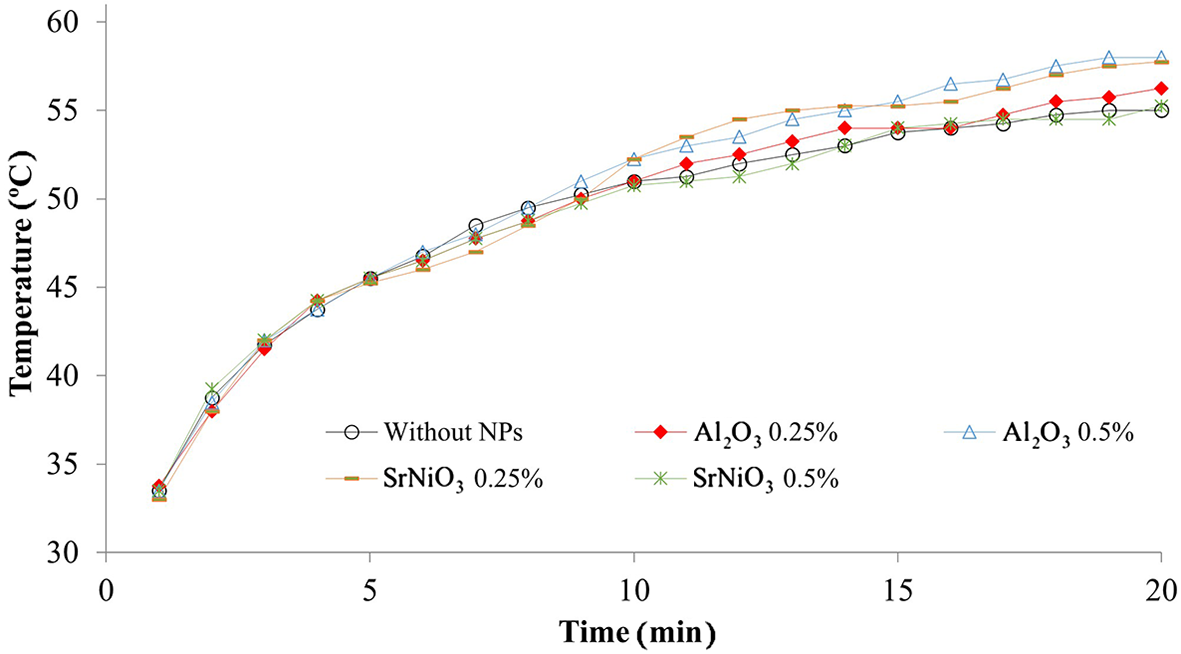
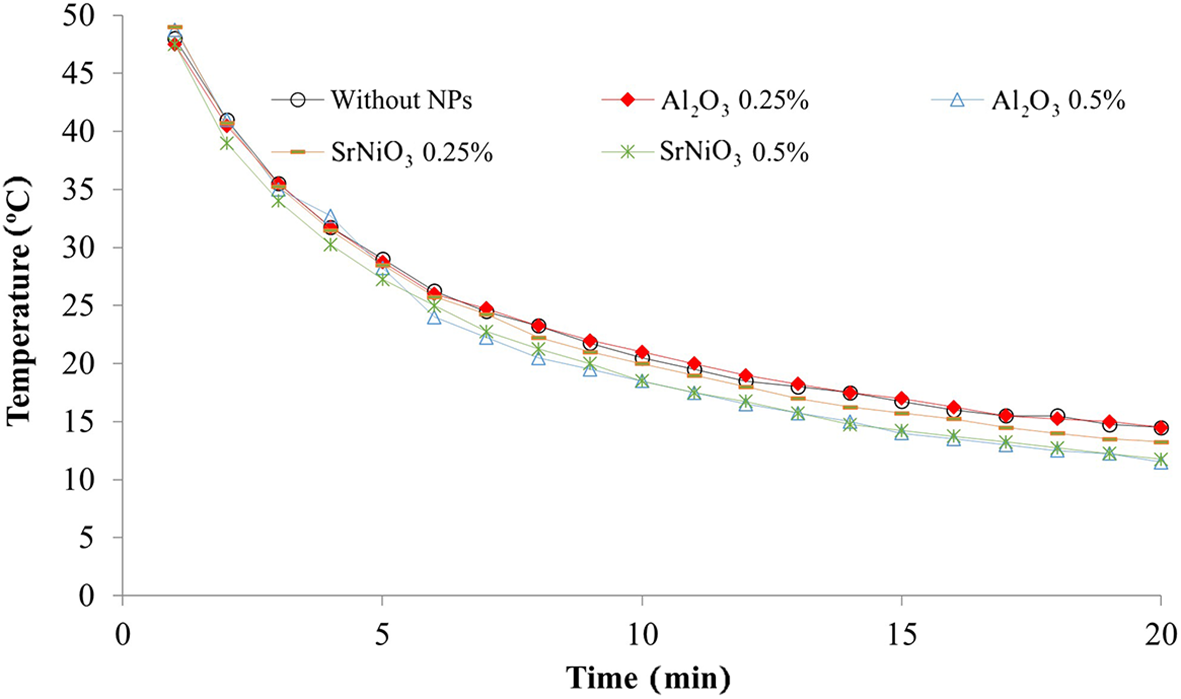
Analysis of the fluid thermal performance was carried out by initially placing 100 g of the fluid at 26°C in a Solab water bath at 60°C. The fluid was heated for 20 min and the temperature was monitored after every minute. The fluid was then transferred to an ultrathermostatic bath at 4°C to cool down for 20 min. Again, the temperature was monitored after every minute. A graph of temperature as a function of time was then plotted for each fluid.
To assess the affinity of NPs with the drilling fluids, 0.25 and 0.50 wt.% NPs were added to 25 mL of water and mineral oil in glass measuring cylinders.
Results and discussion
Characterization of the nanoparticles
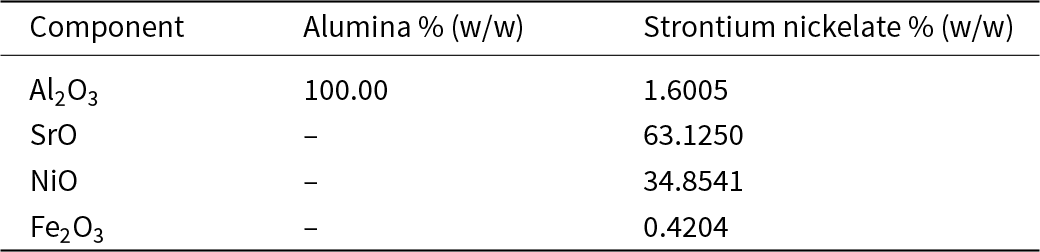
The chemical compositions of alumina (Al2O3) and strontium nickelate (SrNiO3) are shown in Table 1. As expected, the results indicate the presence of alumina in the Al2O3 NPs and the predominance of strontium oxides in the SrNiO3 NPs.
Chemical compositions of the alumina and strontium nickelate NPs.

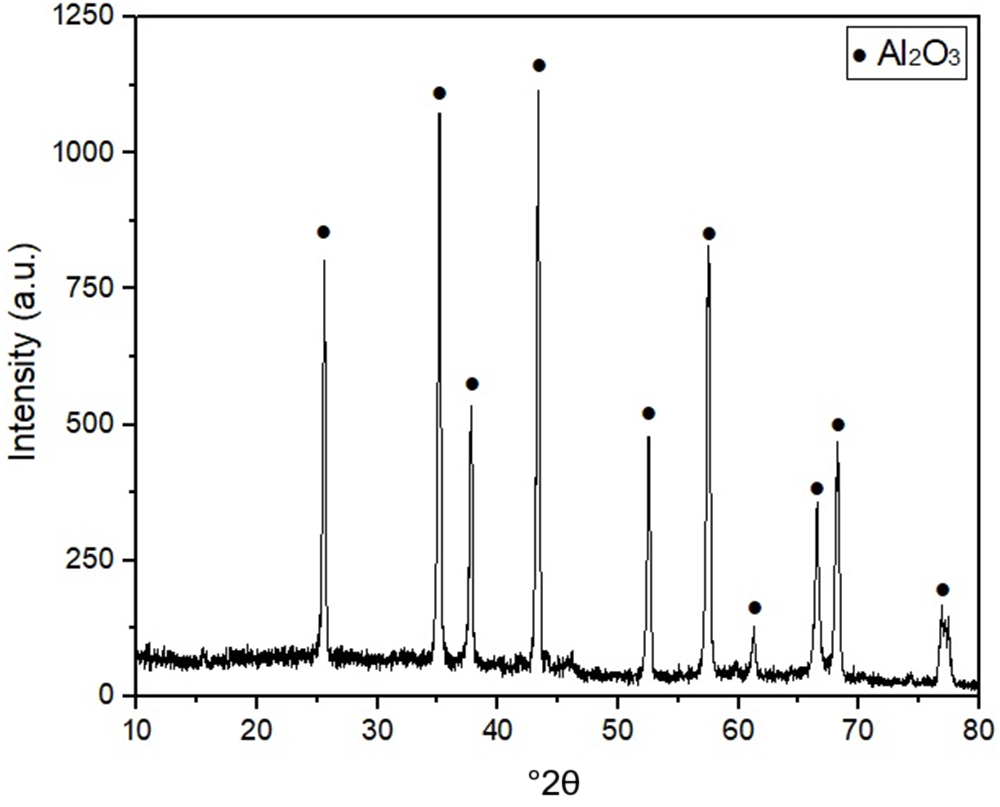
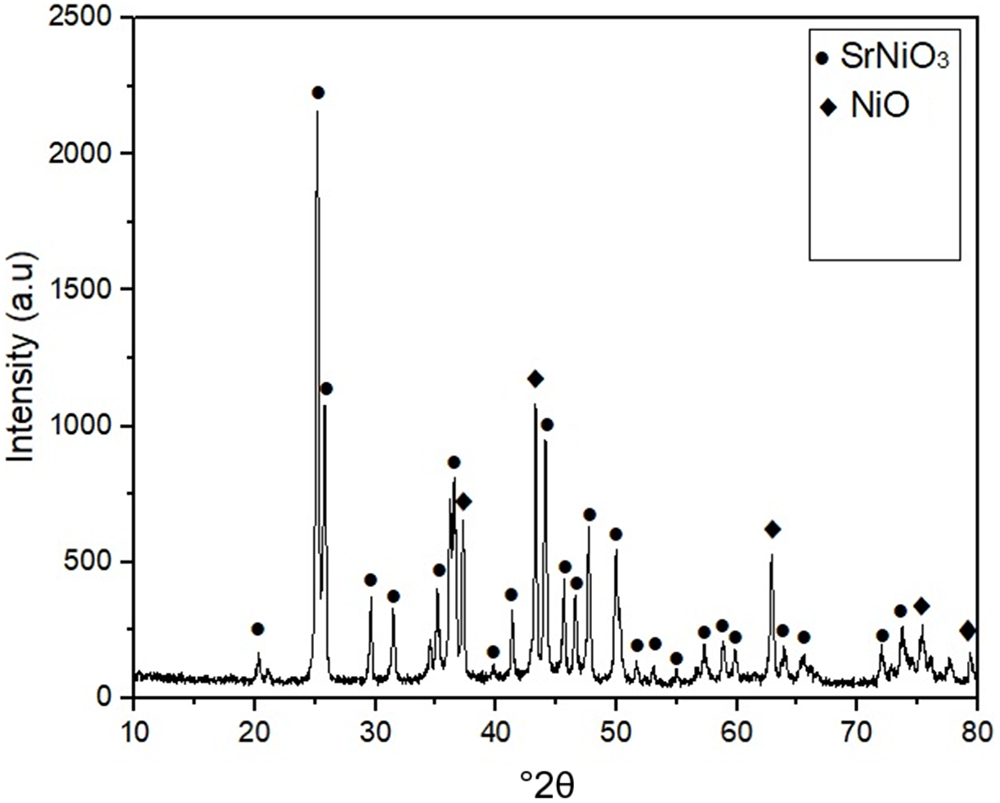
The XRD trace of the aluminium oxide (Fig. 1) revealed the presence of an α-Al2O3 phase, which is more common and stable than alumina itself. The XRD trace of the strontium nickelate (Fig. 2) confirmed the formation of the main SrNiO3 phase with a perovskite-like structure, as well as the presence of some peaks that have been ascribed to the secondary NiO phase. The synthesized samples showed high crystallinity, with well-defined and intense diffraction peaks.
XRD trace of alumina.

XRD trace of strontium nickelate.

From these diffractograms, it was possible to determine the average size of the NPs by estimating the average size of the crystallites. For this calculation, the widths at mid-height of the peaks relating to the crystalline planes of the Al2O3 and SrNiO3 phases were determined. The average sizes of the crystallites were ∼50.13 and 49.25 nm, respectively.
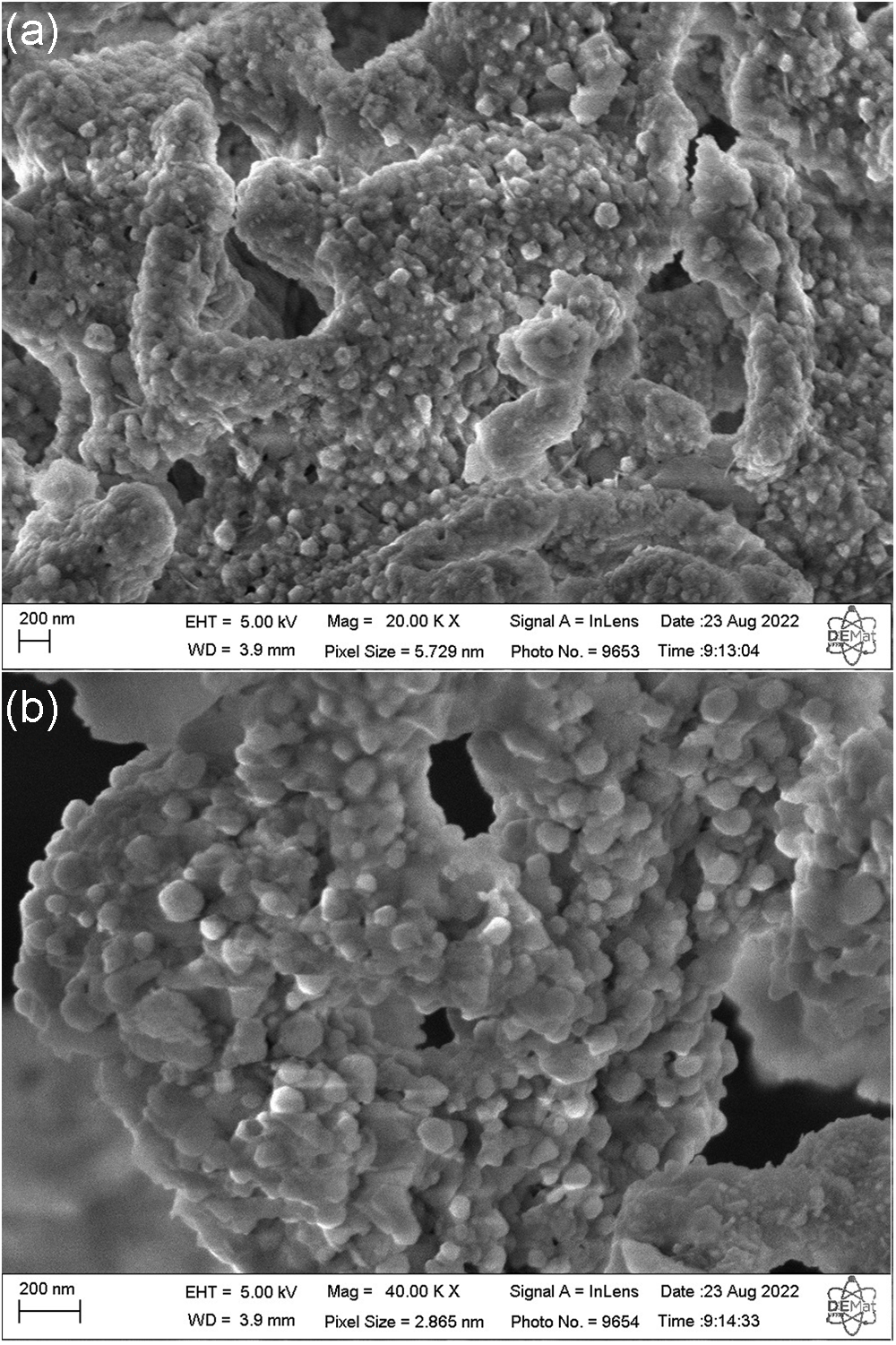
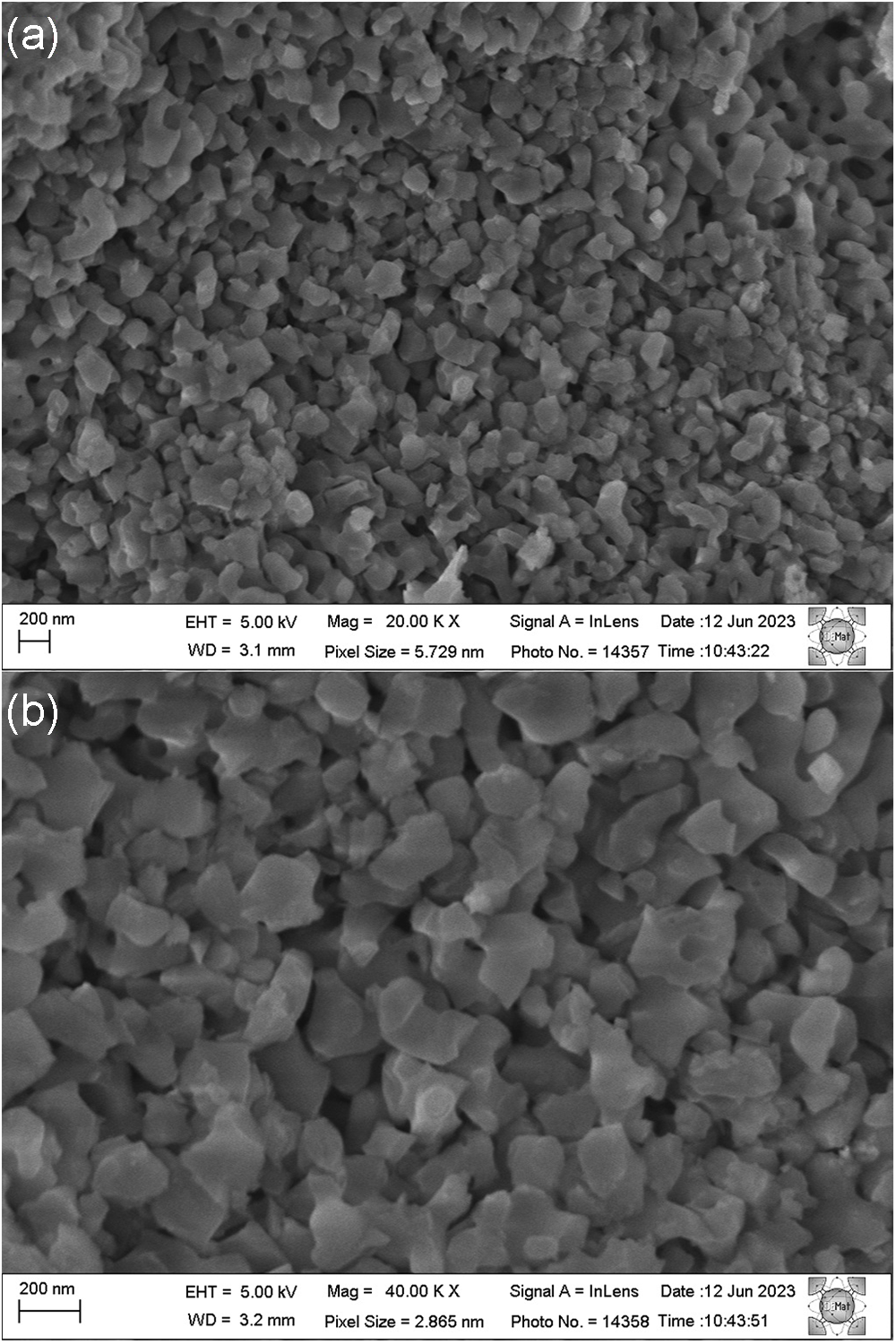
Figure 3 shows to scanning electron microscopy (SEM) images of strontium nickelate under 20 000× and 40 000× magnification. According to these images, it is not possible to determine the size of the particles with high precision, even under increased magnification, because the particles form clusters with dimensions less than 100 nm. Clustering of inorganic NPs is a ubiquitous problem in such investigations due to their high surface energy, which keeps them clustered together. Some pores can also be detected, which are derived from the decomposition of organic matter in the gelatin during the calcination process.
SEM images of strontium nickelate under (a) 20 000× and (b) 40 000× magnifications.

The SEM images for the aluminium system under 20 000× and 40 000× magnifications (Fig. 4) also revealed that it is not possible to quantitatively establish the particle sizes due to clustering, with the images showing what resembles a sintered material.
SEM images of the aluminium system under (a) 20 000× and (b) 40 000× magnifications.

The BET surface areas were 9.4243 m2 g–1 for alumina and 5.3970 m2 g–1 for strontium nickelate. The specific surface area of Plg (124.6060 m2 g–1) is very large due to its fibrous shape with large amounts of nanoscale and microporous tunnels and channels. However, the specific surface area decreases to 16.5008 m2 g–1 for organo-Plg. These findings suggest that surfactants coat the surface of Plg and make more of the organo-Plg fibres aggregate (Zhuang et al., Reference Zhuang, Wu, Zhang, Zhang, Zhang and Liao2017).
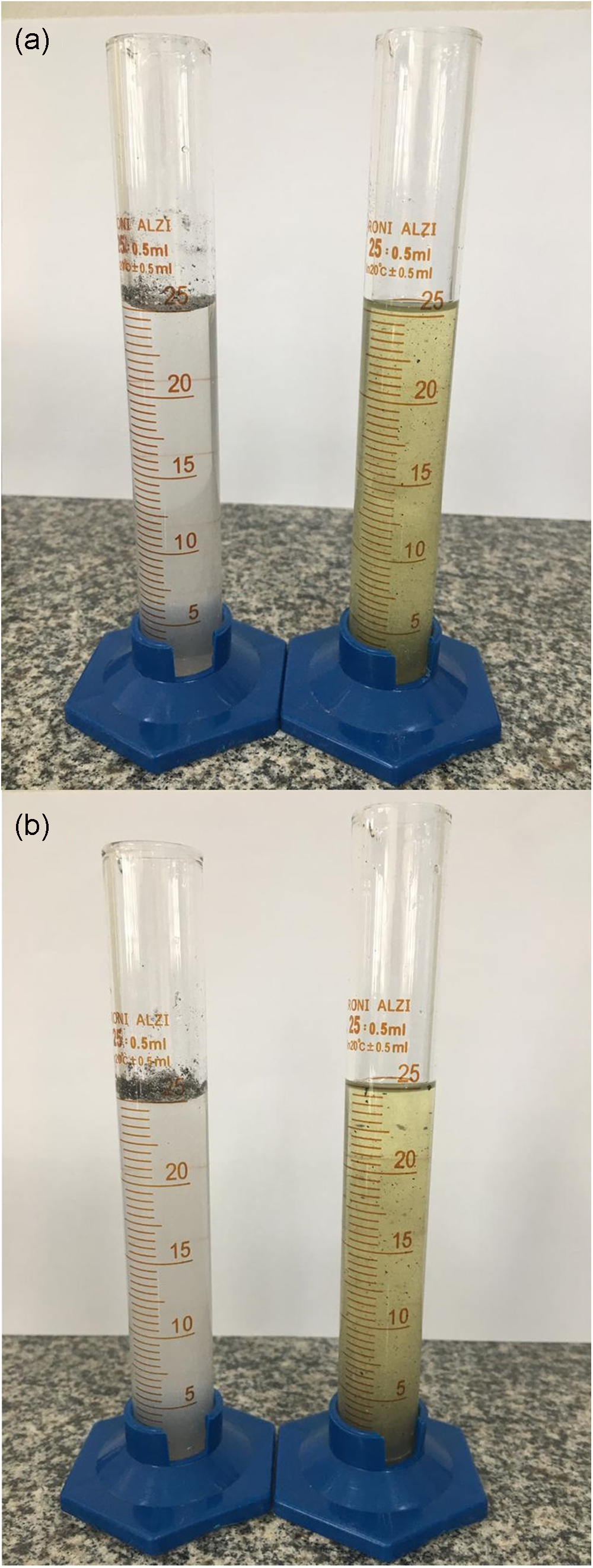
The affinity of NPs at concentrations of 0.25% and 0.50% (w/w) with the water and oil phases was also assessed. The Al2O3 NPs remain on the water surface (Fig. 5), reinforcing their hydrophobic nature, as shown in the cylindrical flasks on the left in Fig. 5. However, these NPs are dispersed in the oil phase (cylindrical flasks on the right in Fig. 5).
(a) Al2O3 0.25% (w/w) and (b) Al2O3 0.5% (w/w) in water (left) and in oil (right).

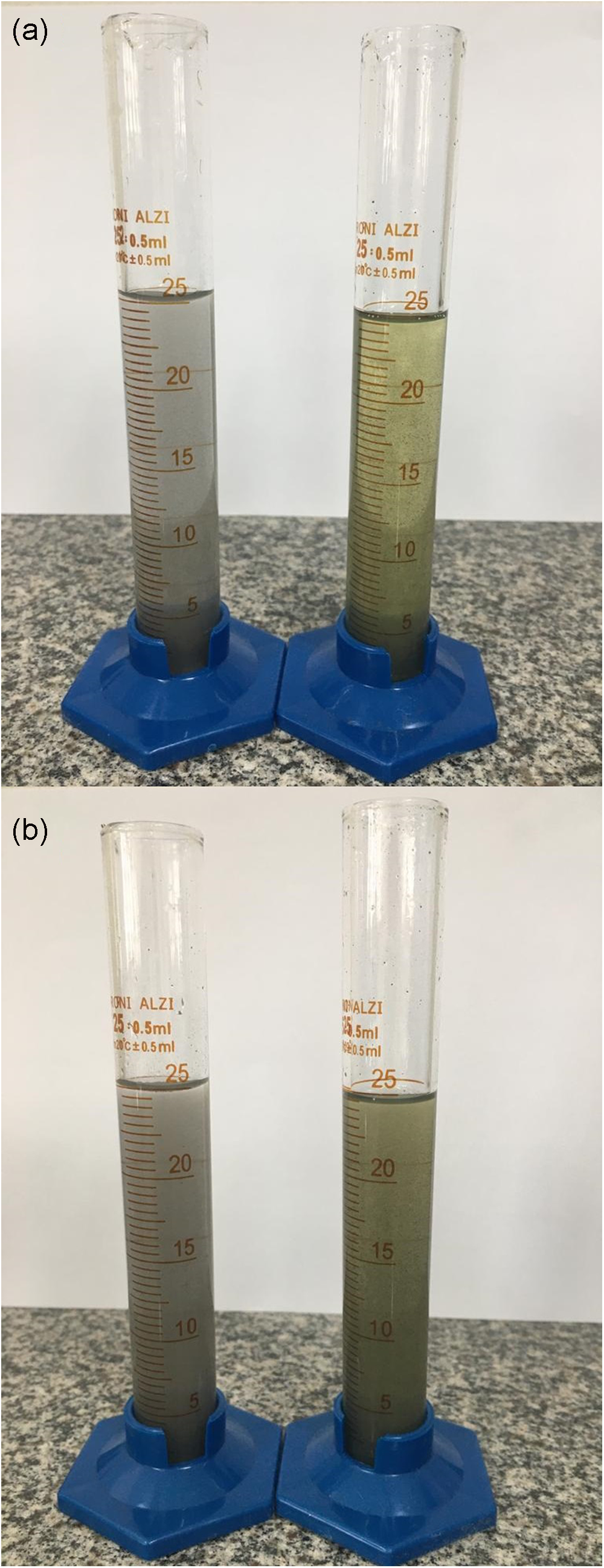
In contrast, the SrNiO3 NPs dispersed both in water and in oil (Fig. 6), thereby confirming their amphiphilic nature at the concentrations tested. These are very important observations that help us to elucidate the formation of the mud cake during the static filtration assays, as the drilling fluid is a reversed emulsion (i.e. water is the dispersed phase and oil is the dispersing phase).
(a) SrNiO3 0.25% (w/w) and (b) SrNiO3 0.5% (w/w) in water (left) and in oil (right).

Rheological analysis of the fluids
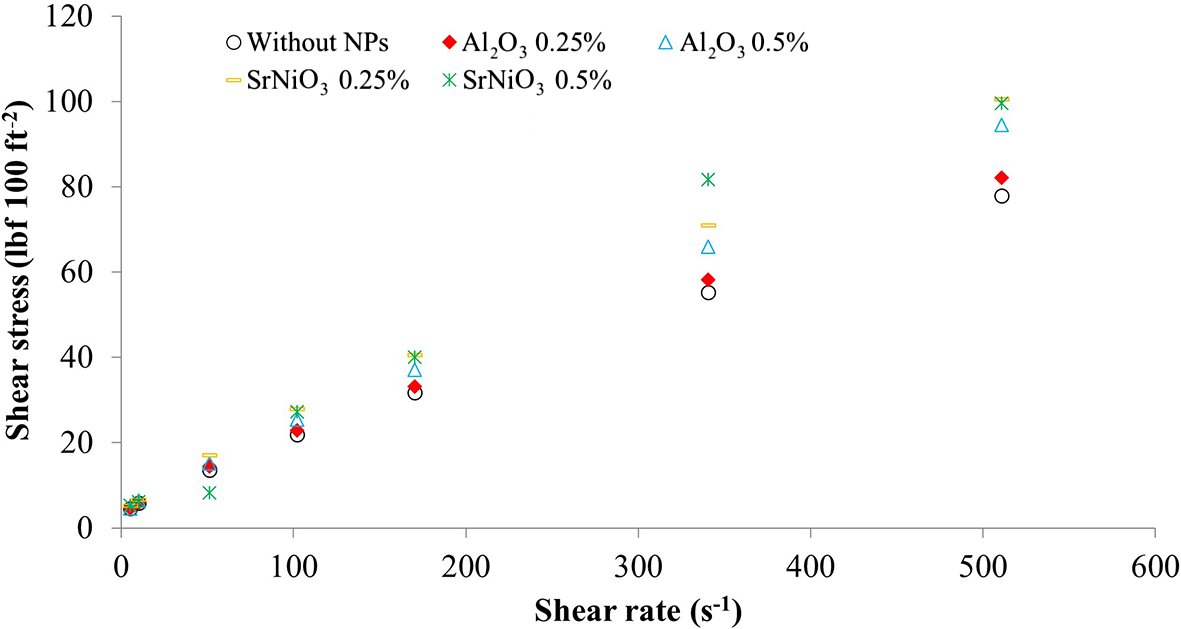
The rheological investigation of the fluids was carried out by employing the Bingham and Power Fluid models. Plots of shear tension vs shear rate were constructed (Fig. 7) to obtain the Bingham model parameters ( $\mu $P and YP). As is shown in Fig. 7, the fluids with NPs have greater viscosity than the fluids without NPs, as the shearing deformation destroyed the gel assemblages of the fluids without NPs.
Dynamic flow behaviour of non-aqueous drilling fluids with and without NPs.

The parameters n and K in the Power Fluid model were estimated from log–log plots of shear tension vs shear rate. The correlation coefficients (R 2) of the fitted straight lines ranged between 0.9313 and 0.9993. The rheological properties of the drilling fluids were determined from the equations of the fitted straight lines ( $\mu $P, YP, n and K), and the Gi (10 s gel) and Gf (10 m gel) values were obtained following the API RP 13B-2 standard (American Petroleum Institute, 2014). All of these values are shown in Table 2.
Rheological properties of the drilling fluids.

a 1 lbf 100 ft–2 = 0.4788 Pa.
It is clear from the data in Table 2 that the rheological properties of the fluids are affected upon the addition of NPs. Both the alumina and strontium nickelate systems show increased fluid viscosity as compared to fluids without NPs. This is due to the fact that plastic viscosity represents the flow resistivity produced by friction between solid particles in drilling fluids and fluid layers. Considering that NPs are distributed throughout the fluid, due to their high surface area additional liquid phases may be required to wet their surfaces. This results in significant increases in plastic viscosity and carrying capacity (Rafieefar et al., Reference Rafieefar, Sharif, Hashemi and Bazargan2021).
Regarding the interaction between NPs and organo-Plg, the addition of NPs increases the plastic viscosity to an even greater degree compared to fluids without NPs. The greater plastic viscosity results from the flocculation and aggregation of NPs, which may cause greater attraction, poorer distribution and a reduced distance between the solids. Silva et al. (Reference Silva, Gois, Ramme, Castro Dantas, Barillas and Santanna2021) suggested multilayer CTAB adsorption occurs on Plg, which renders the clay surface positively charged. As alumina has a neutral charge and strontium nickelate has a negative charge, attractive forces would be present between organo-Plg and SrNiO3 NPs. Alumina has pairs of electrons that mean it acts as a Lewis base, attracting positive charges as well. According to Mikhienkova et al. (Reference Mikhienkova, Lysakov, Neverov, Zhigarev and Minakov2022), increasing plastic viscosity or consistency index improves cuttings flow, but this can lead to increased pressure losses during drilling fluid pumping.
Regarding the flow limit, the highest value (6.0729 lbf 100 ft–2) was observed with the fluid with 0.25% SrNiO3. The YP is related to electrochemical forces, especially the attractive force in the drilling fluid system, and it represents the strength of the fluid structure while in flow (Zhang et al., Reference Zhang, Li, Liu, Li, Guo, Cui and Zhou2016). The greater YP of the 0.25% SrNiO3 fluid ensures better dynamic suspension of drill cuttings and efficient cleaning of the borehole while drilling (Wilson, Reference Wilson2012). In drilling applications, maintaining the YP at an appropriate level is critical to prevent the occurrence of a washing wall and to limit damage to the stability of the borehole (Zhang et al., Reference Zhang, Li, Liu, Li, Guo, Cui and Zhou2016).
The addition of NPs to the fluids decreased the value of K. This behaviour might be related to the dependence of the shear stress on the shear rate being reduced in nanofluids than in the fluids without NPs. The value of n increased in nanofluids, indicating that nanofluids experience less shear thinning (Rafieefar et al., Reference Rafieefar, Sharif, Hashemi and Bazargan2021).
Regarding the Gi and Gf values, it was confirmed that the fluids are non-thixotropic, which could affect the cleaning of the drilling well. In this case, it would be necessary to increase the concentration of the viscosity enhancer (organo-Plg) in the fluid. Zhang et al. (Reference Zhang, Li, Liu, Li, Guo, Cui and Zhou2016) obtained gel strengths of >0 in suspensions with 6.4% Plg. In this work, a concentration of 4.8% organo-Plg was used.
Static filtration
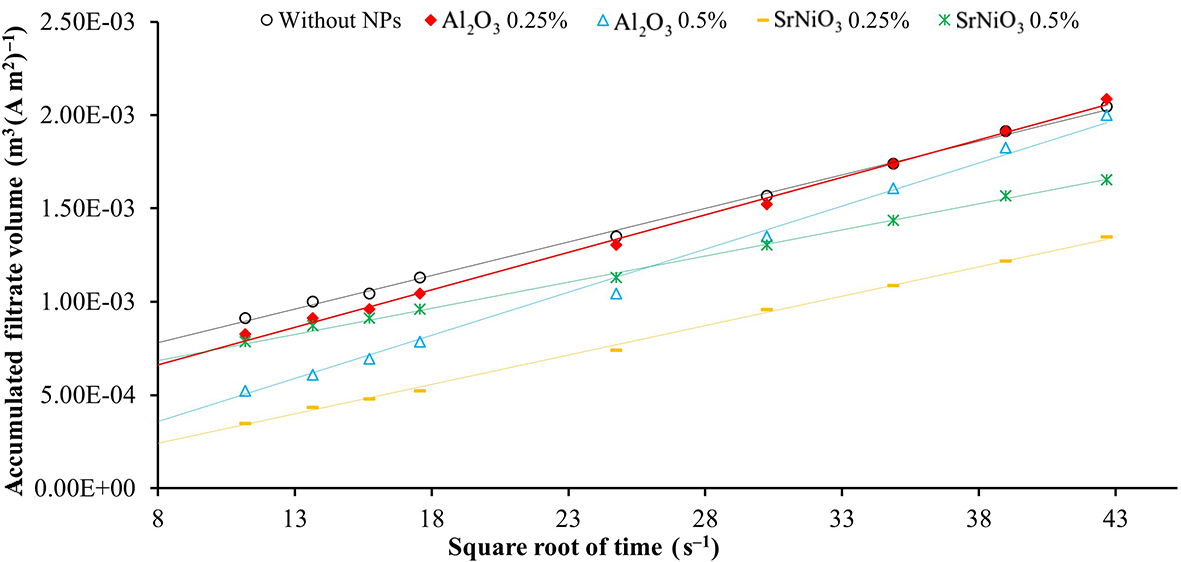
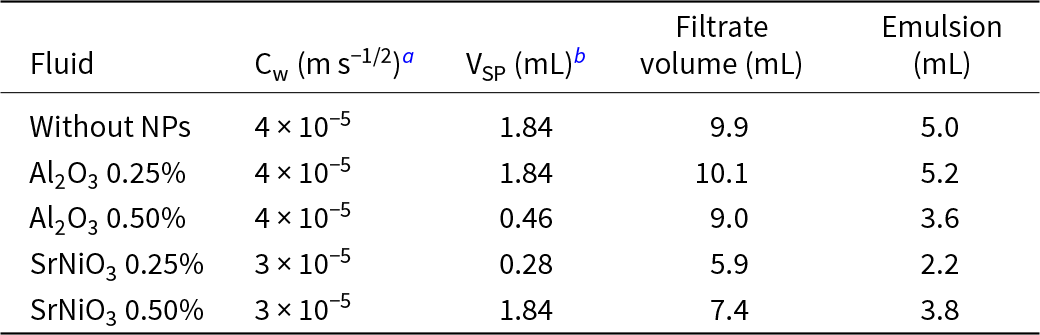
Figure 8 shows the results regarding accumulated filtrate volume as a function of the square root of time for all investigated fluids. From the equations of the fitted straight lines, the values of Cw (loss coefficient) and VSP (spurt volume) can be obtained from the slope and linear coefficient, respectively. These values are shown in Table 3, together with data regarding filtrate volumes and emulsion volumes in the filtrate. The R 2 values ranged between 0.9960 and 0.9995.
Accumulated filtrate volume as a function of the square root of time for all investigated drilling fluids.

Filtration parameters for the investigated drilling fluids.

a Cw measures the filtration resistance resulting from the formation and growth of the mud cake.
b VSP is the instantaneous loss of fluid resulting from the first contact between the fluid and the formation.
The data in Table 3 show that the filtrate volumes were only slightly altered in the presence of alumina, indicating that these NPs do not contribute to the formation of an impermeable mud cake. This behaviour is due to the poor interaction of alumina with the aqueous phase, thereby impairing the ability of NPs to disperse in this medium and not adsorb on the surface of the filter paper. As can be seen in Fig. 5, alumina is better dispersed in the oil phase, enabling its transport through the pores and preventing the formation of an impermeable mud cake. According to Shojaei & Ghazanfari (Reference Shojaei and Ghazanfari2022), the fluid filtrate volume increases when the NPs have the same affinity with the solvent.
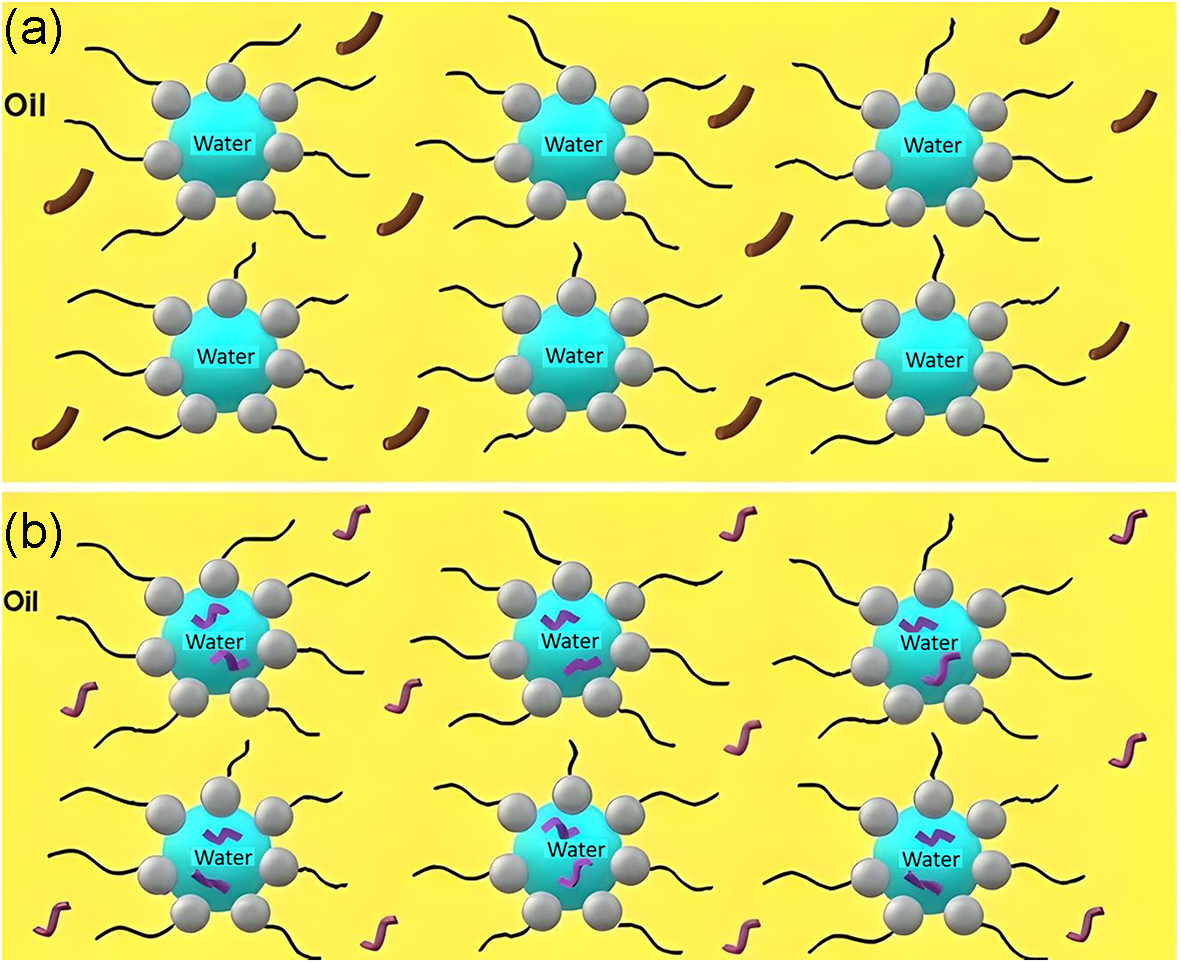
The low filtrate volume values in the presence of strontium nickelate demonstrate that the NPs contribute to the formation of a mud cake. This can be explained via the partial dispersion of nickelate in the aqueous and oil phases (Fig. 6). As a result, the NPs dispersed in the oil phase are transported through the pores of the filter paper, whereas those that are dispersed in the aqueous phase are retained on the surface of the membrane, thereby confirming the formation of an impermeable mud cake. Figure 9 illustrates the NPs in the liquid phases of the reversed micelles. It shows that alumina NPs can be dispersed in the oil phase only (Fig. 9a) and that strontium nickelate NPs can be dispersed in both phases (Fig. 9b). The presence of SrNiO3 within the micelle core contributes to the formation of a mud cake, as the continuous phase flows through the pores, whereas the NP-loaded aqueous phase adsorbs on the surface of the filter paper. This phenomenon renders the fluid less prone to damaging the formations. When the amount of SrNiO3 NPs was increased from 0.25% to 0.50% in the drilling fluid, the filtrate volume increased, indicating that a less consolidated mud cake was formed in the presence of greater concentrations of NPs. These results confirm that the formation of a fine solid layer, which is required for ideal impermeabilization during filtrate transportation, is more effective when smaller amounts of these NPs are used. Moreover, employment of greater concentrations of solids may contribute to clustering into much larger sizes than the pore size (Ahasan et al., Reference Ahasan, Alvi, Ahmed and Alam2021), generating a thin membrane that only impairs fluid flow to a small degree.
Illustration of the dispersions of alumina and strontium nickelate in the phases of the reversed emulsion. (a) Alumina nanoparticles (NPs) are dispersed in the oil phase. (b) Strontium nickelate NPs are dispersed in both the oil and water phases.

It could also be observed that systems with 0.25% SrNiO3 produced the lowest emulsion volume in the filtrate (2.2 mL), which suggests that they can be used as the most stable non-aqueous fluids among all of the investigated systems. It is important that filtrates from non-aqueous fluids are free of emulsions to minimize formation damage, particularly in clay formations.
With regard to the loss coefficient (Cw), which refers to the resistance to filtration effected by the formation and growth of a mud cake, the data in Table 3 show that fluids containing SrNiO3 NPs had slightly greater resistance to filtration.
In contrast, the spurt volume (VSP), also known as mud spurt, is caused by the tendency of finer NPs to cross the filter paper until they block the pores, after which point only the filtrate can be transported. Fluids with 0.25% SrNiO3 (Table 3) provided the lowest VSP value, followed by the 0.50% Al2O3 system. This is due to the fact that the average crystallite size of SrNiO3 NPs is ∼49.25 nm, which is slightly lower than that of Al2O3 NPs, at 50.13 nm. However, when using 0.50% SrNiO3, the VSP value equalled those observed for the systems without NPs and 0.25% Al2O3, probably due to clustering of the nickelate NPs, which would enlarge them and impair transportation through the filtering medium due to pore blocking. Similarly, the 0.50% Al2O3 fluid also had a low VSP value (0.46 mL), even with the greater concentration of NPs. However, there was no NP clustering of 0.50% Al2O3, possibly due to the lipophilic nature of the NPs, thereby enabling their dispersion in the non-aqueous fluid during filtration.
According to Minakov et al. (2019), adding NPs to a solution causes them to fill the pores between the bridging microparticles in the filter cake, which decreases its permeability. The main mechanism for reducing filtration losses when adding NPs to a drilling fluid is through the decrease in the permeability of the filter cake caused by filling the pores between clay microparticles with NPs. In this case, the positive effect of NPs on filtration losses largely depends on the concentration and size of the microparticles of the bridging agents (i.e. clays). This is probably what occurs between organo-Plg and SrNiO3 NPs to reduce the filtrate volume.
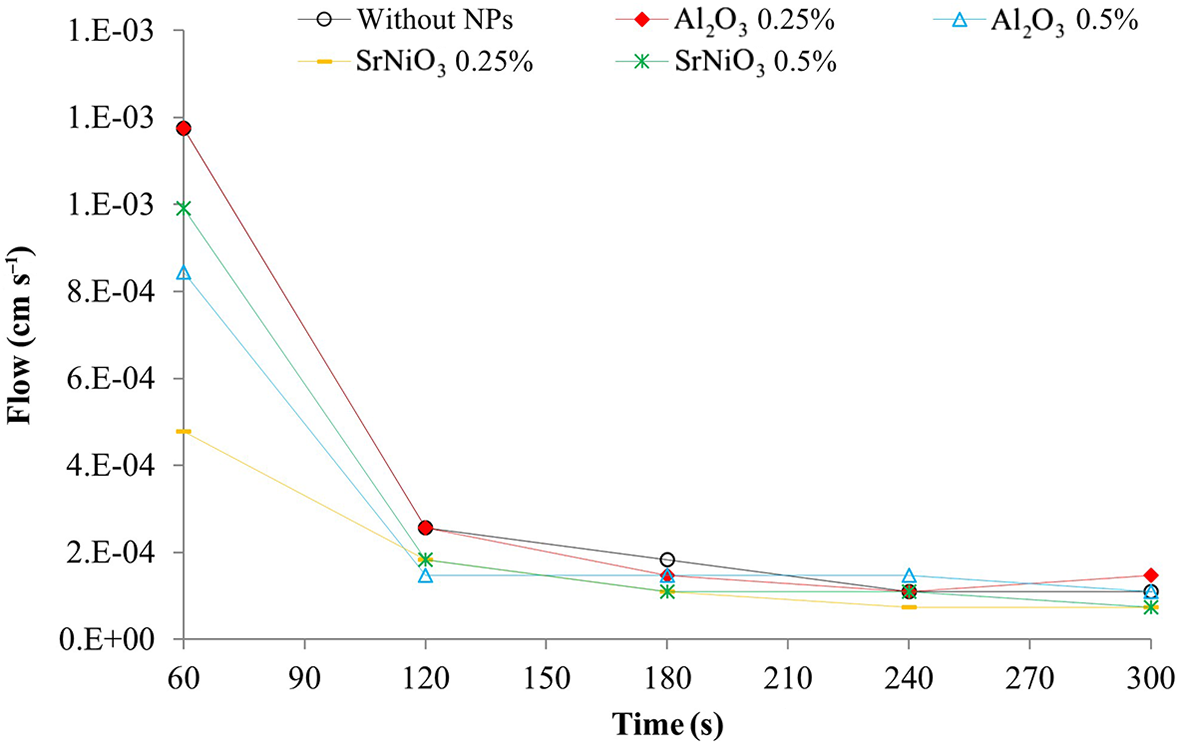
Figure 10 shows the behaviour of the filtrate invasion curves, or flow of the fluid filtrate, with and without NPs, during the first 300 s of filtration.
Filtrate invasion curves of fluids with and without NPs.

Resistance to flow promoted by the liquid phase of the systems can clearly be seen in Fig. 10. The fluid invasion process in the filtering medium is more pronounced at the beginning of the phenomenon. Solids were more rapidly deposited in most NPs systems, causing the packing effect of NPs on the filtration cake (i.e. mud cake) and inhibiting the flow of filtrate through the filtering medium. The behaviour indicated by the experimental results is compatible with the typical curve of this phenomenon, characterized by an exponential decrease in filtrate rate with time at the beginning of such a graph. The invasion effect is predominant in the first 120 s and determines the spurt volume. Although all such graphs have a similar aspect, the curve for the 0.25% SrNiO3 system suggests the more rapid achievement of a uniform deposition of NPs on the filter paper, which could explain the reduced extent of filtrate invasion for this fluid.
Thermal performance of the fluids
All of the fluids were subjected to heating and cooling procedures as described in the ‘Materials and methods’ section. Graphs of temperature as a function of time were plotted for each fluid. Figures 11 & 12 demonstrate the effects of Al2O3 and SrNiO3 NPs in these heat-exchange processes.
Heating of non-aqueous fluids with and without NPs.

Cooling of non-aqueous fluids with and without NPs.

The data in Figs 11 & 12 indicate that, when subjected to heating, the 0.50% Al2O3 system, followed by the 0.25% SrNiO3 system, absorbed a little more heat than the fluids without NPs. However, they dissipated more heat during cooling. Amanullah et al. (Reference Amanullah, Al-Arfaj and Al-Abdullatif2011) reported that the high surface area to volume ratio of NPs could improve the thermal conductivity of nanofluids. Consequently, this improved thermal conductivity of the drilling fluid would provide efficient cooling of the drill bit, leading to a significant increase in its operational life cycle. In addition, the high heat transfer coefficient of nanofluids contributes to the rapid cooling of drilling muds at their surface.
To observe the heat-exchange effect of the addition of NPs on the flow curve profile of the non-aqueous drilling fluids, another study was also performed after heating the fluid at 49°C. Figure 7 illustrates this impact. Increased apparent viscosity with electrostatic attraction between negatively charged NPs and positively charged organo-Plg clays can be observed (Fig. 7), and heating the drilling fluids loaded with NPs can optimize this process at 4°C (Fig. 12). The degree of dispersion of clay suspensions is generally decreased at low temperatures, resulting in high rheology. A similar behaviour between Fe3O4@SiO2@Ag NPs and montmorillonite particles was observed in a previous study by Paixão et al. (Reference M.V.G, Fernandes, Souza and Balaban2021).
Conclusions
In this work, the affinity of inorganic NPs with the solvent phase of drilling fluids was shown to affect their rheological properties. Greater concentrations of hydrophobic Al2O3 NPs (0.50%) in non-aqueous fluids increased the plastic viscosity (40.24%) of the final fluid as a result of enhanced gravel transport, along with improving thermal conductivity. However, there was no effect on the formation of an impermeable mud cake, with a greater filtrate volume (2.02%) being observed at a NP concentration of 0.25%.
On the other hand, the amphiphilic SrNiO3 NPs in non-aqueous fluids at lower concentrations (0.25%) reduced the filtrate volume to ∼40%. This system demonstrated improved thermal conductivity as compared to fluids without NPs.
It was verified in this work that the positive effect of the combination of organo-Plg and SrNiO3 NPs on filtration losses depends significantly on the concentration and size of the microparticles of the clay.
These observations reinforce the proposition of using NPs that have affinity with the phases that comprise emulsion-based drilling fluids, but under low concentrations to prevent NP clustering during filtration. By following this protocol, it will be possible to improve the properties of drilling fluids, thereby increasing their efficiency in real-world operations.
Acknowledgements
None.
Financial support
The authors acknowledge financial support from the Program of Human Resources of ANP – PRH-26.
Competing interests
There authors declare none.