Alexandra Ovchinnikova, leader of the Presidium of the Supreme Soviet of the Yakut Autonomous Soviet Socialist Republic (ASSR), was a testament to the positive changes that Soviet power had yielded in remote former Russian colonial possessions. (See Figure 1). A 1963 story that appeared in Soviet Woman presented her as the first woman among her Siberian people to acquire a technical education; she subsequently became an engineer and held various municipal and Party positions before rising to her current station. According to Ovchinnikova, “Before the Revolution, people here had no rights, were poverty-stricken and illiterate. Today we have excellent doctors, engineers and teachers. Our scientists are studying the cosmos and the permafrost….”Footnote 1 That the opportunities that emancipation had afforded her were part of a wider, ongoing modernization project was reinforced by the article crediting communism for transforming a region with “vast expanses of dense virgin forest where once only wild beasts roamed” into a place where new towns were emerging and education was markedly improving.Footnote 2
President Alexandra Ovchinnikova pointing out her republic, the Yakut ASSR, on a map (Soviet Woman, No. 6, 1963, 2).

This feature on Ovchinnikova was typical of established Soviet narratives about the positive changes that socialism had brought to non-European peoples of the Russian Empire.Footnote 3 Surprising, however, were the references it made to similarities between the Yakut ASSR and the Congo, for example, in comparing their respective natural resources.Footnote 4 The analogy was bolstered by details about the need for further investment in housing and infrastructure in the Soviet republic, which intimated that it too was a developing region.Footnote 5 At the same time, descriptions of its comprehensive transformation made Yakut territory appear more advanced, implying that the Soviet system was a model for progress in female liberation, economic development, and daily life—one applicable even to a place as different from the Siberian taiga as was central Africa.
Providing glimpses into the lives of accomplished women throughout the Soviet Union was a key feature of Soviet Woman, the chief publication of the Komitet Sovetskikh Zhenshchin (Committee of Soviet Women; KSZh), between 1956 and 1964. Although articles about non-European women like Ovchinnikova did not predominate during this period, they were chockfull of significance for readers in developing countries.Footnote 6 They showcased measures that the Soviet state had undertaken to eradicate economic and social backwardness and to foster gender equality, as well as the wide range of activities that Soviet women carried out in public life. In doing so, they signaled the scope of advances that socialist systems could generate, much in keeping with the Soviet policy of “peaceful coexistence,” which postulated that communism would expand not by force, but by confirming for people everywhere its superiority to capitalism.
That said, the Soviet Union had reason to bolster its image in the Cold-War contest for the non-aligned world. It had been excluded from the 1955 Afro-Asian Bandung Conference because its position as leader of the eastern bloc undercut its claims of neutrality, while its status as an Asian power was made suspect by the imperial Russian conquest of Central Asia. To overcome perceptions of the Soviet Union as neo-colonial, the leadership of Nikita Khrushchev made Central Asia the linchpin in relations between Moscow and developing countries, positing that places like Tashkent were more persuasive loci for outreach than was the Soviet capital.Footnote 7 Moreover, it estimated that drawing affinities between non-European Soviet regions and decolonizing countries, and avowing that socialism could flourish in the latter as in the former, would make the Soviet modernization model, when combined with assistance and friendship, competitive with the western one “from Ghana to India to Peru.”Footnote 8
Soviet Woman mirrored this approach to the Third World. Underscoring its international profile and gesturing toward its potential to resonate with women in decolonizing countries, KSZh chair Nina Popova asserted in 1957 that the magazine should convey the multi-national composition of the Soviet Union and include more information about its republics, especially the eastern ones.Footnote 9 This she added to its overarching aim, which was to display Soviet foreign policy and Soviet reality, foremost pertaining to the status of women and the welfare of children.Footnote 10
Given this general mandate, alongside the fact that the KSZh reported to the Communist Party of the Soviet Union, Soviet Woman might readily be dismissed as pokazukha (“putting on a show”).Footnote 11 Western assessments had long characterized the Committee as a mouthpiece of the Party that disregarded the “double burden” of Soviet women in its communications in order to persuade individuals abroad of the successes of socialist gender policy.Footnote 12 Current scholarship, however, has been reevaluating female activism and outreach under socialism, and complicating the role of the mobilization of women, gender equality policies, female aspirations, and international relations among women in Cold-War rivalry.Footnote 13 Some of this research has focused on interaction between women of the Second and Third Worlds.Footnote 14 Examining the Bulgarian equivalent of the KSZh and Zambian women, Kristin Ghodsee has revealed that the international relationships that state socialist organizations cultivated led individuals in developing countries to glimpse in socialism encouraging answers to the “woman question.”Footnote 15
This article argues that the main publication of the KSZh, Soviet Woman, did precisely that. Specifically, the ways in which it represented non-European Soviet women and their fortuitous circumstances cast the Soviet system as a template for economic transformation and female emancipation at a time when the Soviet leadership was just beginning to seek favor in the decolonizing world and recently liberated peoples throughout it were in the early stages of forging independence.Footnote 16 A study of Egyptian publications for women during this same period provides insight into the potential receptivity of the Soviet model. Focusing on the regime of Gamal Abdel-Nasser, Laura Bier argues that the peoples of newly independent countries did not restrict themselves to two options for the revision of gender roles—a return to traditional modes, which could engender the revival of restrictive patriarchal customs, or a shift to western ones.Footnote 17 Socialism offered a third way.Footnote 18
To be sure, socialist rhetoric could evoke a sense of superiority about modernization as much as its western counterpart.Footnote 19 At first glance, Soviet Woman might be read as positioning women in the “Soviet East” (Central Asia, the Caucasus, and Siberia) as the benchmark for gender equality for women in the “foreign East” (here, Africa and South Asia) in a way that implied that the Soviet trajectory of progress was the one to be emulated—from the resumption of independence to advancement through uplift thanks to a caring socialist state.Footnote 20 As this article will demonstrate, however, the motif of global sisterhood that undergirded the magazine obfuscated such Orientalist undertones by reinforcing a “sense of the kinship of women across national boundaries.”Footnote 21 The spirit of international cooperation and feminist organization that Soviet Woman embodied was rooted in the genesis of the KSZh in wartime struggle in 1941—from which point, until 1956, it was called the Anti-Fashistskii komitet sovetskikh zhenshchin (Anti-Fascist Committee of Soviet Women)—and in its contributions to founding the Women's International Democratic Federation (WIDF) in 1945.Footnote 22
The content of Soviet Woman also blurred the binary “self-other” by suggesting commonalities among non-European Soviet women and women in developing countries in terms of their experiences and aims. The magazine regularly featured the trials, activities, and triumphs of women from around the globe and provided them a venue to share with fellow readers their personal accounts, aspirations, and viewpoints. For women in the Third World, this, in combination with declarations of moral support for independence struggles, and encouragement and praise for various kinds of initiatives undertaken in their countries, made Soviet Woman an expression of solidarity with all peoples.
Together with affirmations of sisterhood and the socialist model of economic advancement and emancipation, the revival or preservation of ethnic distinction that Soviet Woman depicted also appealed to peoples resuming their national independence and may even have tempered anxiety about the nature of socialism amid the ideological crusades of the Cold War. As will be elaborated, the magazine not only projected international foreign relations strategies; it also embraced difference and reflected Soviet domestic nationalities policy. In this vein, Soviet Woman frequently proclaimed the role of the state in fostering both a harmonious “friendship of the peoples” and cultural distinction within the Union of Soviet Socialist Republics (USSR). As the introduction to an issue devoted to showcasing progress in Central Asia rhetorically asked: “Could the peoples of all these republics have achieved so much were not the Soviet Union one big friendly family of all the nationalities?”Footnote 23 The message was that adopting communism need not erode national identity, and that solidarity and respect for diversity were not incompatible.
Focusing on representations, this article broadly explores the “Second World's Third World” in two regards: Soviet projections of a Third World within the Second World (non-European regions of the Soviet Union) and the Third World in the Soviet imagination.Footnote 24 That said, producing and disseminating Soviet Woman was but one among a range of activities that the KSZh undertook to fulfill its goals of expanding and strengthening international relationships. The Committee also established links and fostered contacts with women's organizations worldwide; hosted foreign delegations; participated in international activism for causes like world peace; and sent aid to developing countries.Footnote 25 Thus, this study also engages with scholarship on socialist internationalism, a phenomenon that was marked by the surge in these kinds of exchanges beginning in the 1950s.Footnote 26
Soviet Woman for Every Woman
Soviet Woman was intended for women everywhere. By 1985, this colorful monthly was being exported to 148 countries and published in over a dozen languages, including in its native Russian (as Sovetskaia Zhenshchina), German, Hindi, Hungarian, Japanese, and Spanish.Footnote 27 The English issues examined in this study were consumed not only in Anglophone countries like the United Kingdom and United States, but also in former British colonies in Africa and Asia where English served as the lingua franca. This might explain preferences for the English-language version of the publication in diverse countries like India, such as that expressed by a woman from predominantly Telugu and Urdu Hyderabad. In one letter to the KSZh, she stated that although its members read Urdu editions of Soviet Woman “with great interest,” her organization was regularly receiving only the Hindi one, in which case, English would be “better.”Footnote 28 Speaking more broadly, a reader from Indonesia expressed her enthusiasm for Soviet Woman by stating that there was no publication like this in her country in English that might “be understood by everybody in the whole world.”Footnote 29
With regard to distribution, the magazine made its way to readers across the globe through a network that included the foreign language publisher Mezhdunarodnaya kniga (International book) and embassies abroad, together with the Moscow office of the KSZh, which both handed the magazine to visitors and mailed it to organizations and individuals, either by request or based on assumptions about their interest.Footnote 30 Recipients included public libraries, educational institutions, friendship societies, leisure clubs, labor and women's organizations, and individuals who had learned about it while hosting Soviet visitors, travelling in the Soviet Union, or through word of mouth. While publication data is sporadic and incomplete, anecdotal accounts indicate that this would, at any rate, be an inaccurate gauge of readership because the reach of Soviet Woman extended beyond its direct subscribers.Footnote 31 Telling of this, libraries abroad informed the Committee that they did not always have enough copies to meet demand, and individual women writing its members revealed that they talked about and shared the magazine with others.Footnote 32
Concerning its mission, the first page of each issue of Soviet Woman declared that it was “devoted to social and political problems, literature and art.” Editorial directives and decisions about specific articles have not been located in the institutional archives of the KSZh. However, an analysis of the publication verifies that Soviet Woman largely followed the course recommended by one member of its editorial staff—that it cover contemporary domestic and international policy in a way that would allow readers to take a stance of their own.Footnote 33 This is not to say that the magazine refrained from deliberating upon ideological issues; its column “Talks on Communism” was centered on the principles, aims, and practices of socialist systems.Footnote 34 At the same time, two of its chief themes—“peace” and “disarmament”—not only echoed Soviet mantras, but also reflected international humanist concerns. Meanwhile, the recurring “Get-Together Club” both addressed universal topics and advocated for socialism by enabling women from around the world to engage in dialogue about common interests like motherhood, and to learn about unique elements of Soviet society like collective farms. Conversational in tone, its subject matter was shaped by queries about Soviet politics, work, and life that had either been sent from readers or arose during gatherings held at the editorial offices of Soviet Woman.Footnote 35
As the format of the “Get-Together Club” suggests, the editors of the magazine were partly guided by input from ordinary women. Directly acknowledging their contributions, a Committee report stated that the staff of Soviet Woman “derived much of value” for discerning the interests of readers abroad and determining how to appeal to them from an expanding influx of letters.Footnote 36 As if responding to one summary of correspondence that revealed that some wanted the magazine to be “more feminine” and others preferred that it be “more political,” the publication offered something for everyone.Footnote 37 Concerning “feminine” interests, the magazine provided features on accomplished women, as well as recurring columns proffering parenting advice, recipes, and beauty tips. It also published reviews of books, live performances, and exhibitions. In such ways, Soviet Woman was typical of general interest magazines aimed at women in the Soviet Union and elsewhere.Footnote 38
A cursory survey of Sovetskaia Zhenshchina for the Khrushchev years reveals that the English iteration of the magazine under scrutiny here did not differ radically from the Russian one in terms of the types of topics covered; it even contained some of the same features and reports on the Soviet East and developing countries cited throughout the present article.Footnote 39 At the same time, the messages of understanding, encouragement, praise, and friendship that permeated the magazine would have had added significance abroad. These were conveyed in reports outlining the activities of national independence movements, as well as accounts about campaigns of support undertaken by the KSZh (such as “Hands Off Congo”) and events to recognize their achievements held in the Soviet Union (such as Indian Independence Day celebrations in Moscow). Covering such topics suggested that Soviet Woman was not merely an instrument of persuasion; its mode of socialist outreach encompassed extending moral support to peoples undergoing various stages of decolonization.
Amid the wide array of subjects it addressed, what did the magazine show readers about Soviet women? Features on those from the “European” parts of the Soviet Union detailed their work, family life, leisure pursuits, and contributions to their community through public activism or service in political office. The same was true of the portrayals of women from “non-European” regions, but with added material on struggles against traditions that had curtailed their participation in society and their successes in challenging them. For instance, Muslim Central Asian women were described as having overcome confinement to female quarters, restrictions on uncovering their face in front of strangers, and lack of choice in marriage. Women in the far northern, southern, and eastern reaches of the Soviet Union, meanwhile, were depicted as having battled prescriptions against attending school issued by shamans and “property owners” intent on maintaining their submission or exploiting them for labor.Footnote 40 Comments like these conveyed the impression that prior to the Revolution, non-European women throughout the Russian Empire had been ignorant, degraded, and enslaved, but now were fully liberated.
The schema that Soviet Woman followed to demarcate life before and after 1917 was already established in the Soviet press.Footnote 41 It was also grounded in a development model that stretched back to the 1920s and 1930s. During these decades, in regions lacking a proletariat to enlist in revolutionary construction (namely, in agrarian and nomadic societies), the Bolsheviks approached women as substitutes for the “uplift” that elsewhere in the Soviet Union was being offered to members of the working class.Footnote 42 So it was with the non-European women featured in Soviet Woman in the 1950s and 1960s—except in this case it was because of their changed realities that the “surrogate proletariat” held representational value for women in developing countries.Footnote 43
Women of the Soviet and the Foreign East
Narratives in Soviet Woman tracing the rising status of women under Soviet rule followed an arc from the imperial era through decades after the Revolution when opportunities for advancement proliferated thanks to the socialist state. Typical of such accounts was a feature on a meeting of Tajik women explaining that before 1917 “ancient” customs would have forbidden such a public gathering; forced to wear the paranja, these women had been literally and figuratively “doomed to ignorance, darkness and a total lack of rights.”Footnote 44 Their ability to meet freely in public was thus presented as proof positive that the Tajik woman was “no longer a slave” but rather, “mistress of her native land.” The professional composition of the delegates, which included government ministers, teachers, scientists, engineers, factory directors, and agronomists, further substantiated progress under socialism.Footnote 45
Soviet Woman also recognized female agency for expanding the visibility of women in all spheres of society, lauding those who had embraced the opportunities generated by regime change to shape their personal future and advance their society. At times, these model women provided their own accounts, as did Clara Mirza-Akhmedova, whose pride in achievement is indicated in the title of her article, “We are builders.” This Uzbek architect began by outlining how she had benefitted from transformations in housing, schools, and urban spaces, and from a new way of life that afforded her “freedom, the joy of creative work, recognition, faith in herself and in the future.” Recalling how Uzbek women had welcomed change with a “thirst for knowledge,” she proclaimed: “Like flowers that have been brought out from a dank cellar into the sunshine, they blossomed in glory” and came to realize their “own worth … strength and usefulness” over the course of a mere generation. As a member of this cohort, she now sought to serve as an example “to those who have just reached the first rung of the scaffolding and to those who dream to climb it.”Footnote 46
Soviet Woman suggested that the widespread applicability of Soviet development had been proven already within the Soviet Union beyond Central Asia. This was exhibited, for example, in its account of the life story of the Yakut Alexandra Ovchinnikova introduced at the beginning of this article. A piece on Tuva was similarly crafted to capture the promises that the Soviet system held, in this case involving a fairly recent addition to the USSR in southern Siberia.Footnote 47 At its center is Baikara Dolchanmaa, leader of the Presidium of the Supreme Soviet of the Tuvan ASSR, whose transformation “from shepherdess to president” corresponded with the advance of the entire Tuvan people from feudal, nomadic and dominated by religious superstition, to modern. In the words of the “president” herself: “With the fraternal aid of the Soviet Union … the Tuvan people overcame their backwardness and illiteracy and laid the foundations for a transition to collective … agriculture.”Footnote 48 The trajectory of her own life was also linked to the revolutionary regime, for Dolchanmaa was a product of the education it had extended to girls.
When combined with the repetition of certain words and phrases, this kind of juxtaposition of backwardness and advancement conjured up comparisons among non-European Soviet women and women in the Third World. For instance, one Russian visitor to Guinea reported that “colonialism doomed the African woman to be the slave of a slave” by placing her at the very bottom of the social hierarchy, beneath African men. But now, he declared, the Guinean woman has “thrown off the chains of colonialism” and “is rising to her stature.”Footnote 49 The author peppered his article with stories of ambition and triumph as he cited various Guinean women active in public life.Footnote 50
Explicitly anticipating that the experiences and gains of women in the Soviet East would resonate with those in the foreign East is a piece that Ene Ovezov submitted to Soviet Woman after attending an international trade union congress in the Soviet Union. Claiming that she had not had the chance here to share everything that she would have liked about the lives of women in her republic, this Turkmen weaver framed her article as a letter to two Togolese delegates she had befriended. Demonstrating the successes of her people in general and women in particular, she credited the Soviet regime with advancing her republic from a “backward tsarist colony” to a “flourishing industrial and agrarian republic,” in part thanks to its irrigation schemes in the Karakum Dessert. Ovezov recognized the state also for making it possible for women to contribute to progress by translating its laws “into action” with amenities like canteens, laundries, and childcare provisions that facilitated their participation in society “on a level with men.” In turn, she depicted the endurance and industriousness of women themselves, for example, in persevering against family opposition and stereotypes about female inferiority to take advantage of the opportunities that Soviet power had brought to boys and girls alike. The title of her piece accordingly intimated that national liberation and gender equality were interwoven: “There can be no freedom where women do not enjoy equality.”Footnote 51
Chronicles of “nation-building” drawing from Soviet nationalities policy were first adapted for export to developing countries in the interwar period when representations of Central Asia were used to showcase liberation from the Russian colonial past and serve as a counterpoint to western imperialism.Footnote 52 The “flowering garden” motif that Soviet Woman employed during the Khrushchev years in portrayals of women in the region advancing their republics also had antecedents; the image had attended early Soviet development in Central Asia, and after the war, had rendered its republics a model for overcoming the legacies of colonialism. Dissecting the rhetoric surrounding this metaphor in his study of Tashkent, Paul Stronski stated: “Just as they had moved from living in a ‘backward’ desert colony to possessing a ‘flowering’ industrial republic under Soviet power, all ‘with the help of the Russian people,’ the Uzbek people were ready and willing to assist their Asian, African, and Middle Eastern friends in making a similar jump to modernity.”Footnote 53 Basically, “the Uzbek ‘little brother’ in the Soviet family … was described as assuming the role of ‘elder sibling’ in Soviet relations with the rest of the postcolonial world.”Footnote 54 Integrating women into the narrative, Soviet Woman indicated that the “little sister” of the Soviet East could show women in newly-liberated countries that like their counterparts in the less developed regions of the Soviet Union, they too could turn “swamps” into “flowering gardens,” that is, advance their economies and societies.
The notion that testimonies about non-European parts of the Soviet Union were especially relevant to the Third World also surfaced in meetings of the KSZh. At a 1960 Plenum, for example, S.A. Azimdzhanova, director of the Institute of Oriental Studies of the Uzbek Academy of Sciences, claimed that contacts the Committee had thus far made with women in the foreign East had shown them the possibilities of raising their voices against injustice and poverty. She therefore recommended strengthening ties with women in “eastern” countries and presented her Uzbek compatriots as willing and ready to exchange delegations and maintain contacts with visitors to their republic, and to send them materials about Uzbek women.Footnote 55 She prefaced her assertion with an overview of their gains that closely resembled accounts of progress that appeared in Soviet Woman. It demonstrated both gratitude (“endless thanks to the CPSU”) and pride in the significant part that Central Asian women played in public life—from leading enterprises to working in government.Footnote 56
Observations by women who had visited the Soviet Union confirmed the benefits of socialist gender equality that Soviet Woman enumerated and the applicability of Soviet modernization methods to the circumstances of decolonizing countries. These appeared, for example, in the recurring column, “Our Visitors,” which relayed comments from women who had stopped in at the editorial offices of the magazine.Footnote 57 During one such reported encounter, the Ceylonese (Sri Lankan) poet K.M. Sirisena made the following remark about her experiences “in the Great Land of the Soviets”: “I have seen for myself that [Soviet women] take part in all spheres of endeavor. Their faces shine with the happiness they have won.”Footnote 58 Similarly, the wife of the Indonesian Ambassador to the Soviet Union suggested that Soviet women embodied the realization of Indonesian dreams and claimed to “rejoice” that they “were already enjoying … full equality in every sphere as a result of the triumph of the October Revolution.”Footnote 59
In addition to voicing admiration and common aspirations, women from developing countries affirmed the pertinence of Soviet experience by verifying the perceived affinities that Soviet Woman depicted between parts of the Soviet East and the foreign East. This is apparent in the impressions that Aoua Keita Camara, head of a Malian delegation to the Soviet Union, shared about her trip to the Turkmen republic. During a conversation with members of the KSZh she stated: “The people there live well…. The state digs canals through deserts and turns the land of the Turkmenian collective farms into blossoming oases. Nobody can better estimate what you have done in conquering the desert than we who live by the Sahara.”Footnote 60 Her high regard for the Soviet system was matched by that for Soviet women, whose struggles in development and defense during the Second World War she likened to that of Malian women fighting for national liberation. The following reinforced this sense of a bond: “The bright sun of Central Asia reminded me of the hot sun of Africa and the people with their warm hearts were as close to us as our own kin.”Footnote 61
Also demonstrating a feeling of commonality roused by a trip through Central Asia, Sophia Doku, a Ghanaian Member of Parliament, asserted in an interview with Soviet Woman,
Under the tsars, today's flourishing Uzbekistan was also a colony [like Ghana] and also suffered from ignorance and backwardness. When a Negro [as she referred to herself and fellow Africans] goes to America and England and sees how people live there [implicitly, badly] he is not surprised. But when he sees a free and educated people who were once slaves like himself, he is deeply impressed and very much encouraged.Footnote 62
While linking Ghana and Uzbekistan through an experience of imperial tyranny, Doku also conflated American racism, European colonialism, and Russian imperialism and indicated that only the legacy of the last of these oppressive regimes had been fully overcome. She thereby contrasted the success of the Soviet Union with the failure of western countries to ensure racial equality. The article that featured her, meanwhile, not only presented the Soviet system as a model for countries resuming their independence and seeking a path to advancement; it also cast the Soviet Union as a caring patron, with its title declaring that peoples who had been subjugated by colonialism welcomed its guidance: “African People Seek Knowledge.”Footnote 63
In contrast, one Indian reader expressed suspicion about the ease of Soviet progress that Soviet Woman delineated. Although this kind of response to the magazine was atypical among both published and unpublished sources, it prompted heated discussion about how the KSZh was fulfilling its mandate to display Soviet reality at the January 1957 meeting of its Presidium, which convened after the Committee's first year under its new name. One recommendation made for avoiding the inclination to “gloss over” reality was to present readers with “real, living people” in “concrete situations” so as to demonstrate that Soviet achievements were made “not in white gloves.”Footnote 64
To what extent did Soviet Woman heed this suggestion? What were the “realities” of female emancipation, the phenomenon that predominated in the magazine? When tracing the shift from oppression to gender equality, Soviet Woman tended to provide mere cursory mention of the attitudes and actions of previous generations, classes, or religious figures at odds with Soviet efforts, and to acknowledge only indirectly the strains of juggling work, household obligations, childrearing, and public life by showcasing state support for balancing these. In short, its portrayals of emancipation did not dwell on resistance or the “double burden.”
In fact, during the 1920s and 30s, central and indigenous state and Party officials intent on displacing native customs deemed hostile to communism through revisions to the gender order had encountered both violent opposition and accommodation, from women and men, across generational lines.Footnote 65 Yet while Soviet Woman provided only a perfunctory sense of how Soviet policy came to be realized—and certainly never questioned the means of its implementation—the legal rights and employment opportunities that women came to enjoy as a result of it were real, as were the negative traits of patriarchy that the Soviet regime had sought to dislodge.Footnote 66 Provisions for female education, in particular, a cornerstone of liberation accounts in Soviet Woman, came to be highly valued over generations and continues to be a resilient aspect of Soviet rule in Central Asia.Footnote 67 Although the intervening years demand more extensive study, there are indicators that official liberation efforts here had gained traction by the 1960s, with the Second World War having served as a turning point in integrating women of this diverse region into Soviet society.Footnote 68
As for the tendency to downplay hardship in Soviet life, what Yana Knopova has argued about the broader international relations of the KSZh is applicable also to its magazine: “The message about values could be delivered without reference to any deficiencies in the Soviet system.”Footnote 69 Ultimately, where gender equality was concerned, Soviet Woman offered affirmation that women were worthy and capable of assuming any occupation—collective farm chair, government official, shop floor worker, factory manager, teacher, scientist, and engineer. Moreover, while the burdens that this could entail escaped rigorous discussion, the magazine showed through remarkable individuals that women could hold multiple functions and identities. As a case in point, Ene Ovezov, who had so eagerly reached out to her new Togolese friends in Soviet Woman, was not “only” a weaver; she was also a decorated worker, a representative of the Supreme Soviet of her republic, and a mother of four.Footnote 70
Women, National Flowering, and Femininity
Alongside featuring individual women and the impact that socialist policies had had on various facets of their lives, Soviet Woman illuminated the diversity of the Soviet Union and presented the socialist state as a champion of tradition as much as of modernization and a new gender order. The abundant photographs it published alone would have imparted to readers a sense of the vastness of the country. At the same time, accounts of unfamiliar locales and customs—from a state fur farm in the Karelian ASSR to a lavish Georgian wedding—might have stirred readers to imagine life in the Soviet Union. Meanwhile, patterns and recipes afforded them means to immerse themselves in the traditions of the USSR by offering instructions, for example, for replicating Kazakh needlework or preparing Azerbaijani lyula-kebabs.
Through this virtual celebration of different cultures and traditions, Soviet Woman declared that many aspects of the national past could coexist with the “internationalism” of the socialist future. The same was true of modernization narratives featuring non-European republics, which were infused with national flavor. These also alluded to nationalities policies that had entailed the Soviet regime navigating through national customs, instituting affirmative action linked to ethnic identity, fostering ethnic particularities, and celebrating distinctions, in part to correct Russian “great power” chauvinism.Footnote 71 By highlighting how such programs had enabled diverse cultures to blossom, Soviet Woman further rendered the Soviet system a pertinent model for transitioning from colonialism, especially in countries that were similarly diverse.
Overall, while Soviet Woman habitually presented negative features of pre-revolutionary society, it also portrayed the Soviet state as nurturing positive traditions. This conveyed the message that certain customs were to be treasured and could be incorporated into a modernizing agenda aimed at eradicating “backward” practices of the past (namely, those that denigrated women). Moreover, women could actively participate in resurrecting the admirable and unique aspects of their culture.
This is evident in a piece on Reina Chokoyeva, a Kyrgyz dancer who had contributed to the national “rebirth” of her people by reviving their folk dances. Castigating Russian imperialism, the author explained that Kyrgyz traditions had been nearly extinguished before the Revolution because of disinterest in “the dances of a people who were contemptuously referred to as ‘…ignorant and savage …’”Footnote 72 This kind of characterization of the European colonial legacy that ethnic groups in the Soviet Union had overcome would have resonated with readers whose own customs had been eroded by colonial rule. In addition, by presenting Reina as an educated activist, Soviet Woman intimated that restoring the past and advancement were not incompatible.
That cultural distinction could remain intact or develop amid social transformation was vividly illustrated in a feature on Zoya Markelova, the “daughter of a Chuvash peasant” whom the magazine cast as representing the advance of one family and the chronicle of a distinct people unfolding amid the drama of Soviet history. Living in Sputnik, a town on the outskirts of Cheboksary, at age eighteen she was the youngest among four siblings in a family whose quality of life had progressed in tandem with the expansion of the Soviet system. Still studying, Zoya aspired to be a construction engineer—a dream that would come true, the author suggested, thanks to the Soviet regime with its increased educational institutions, urbanization, and infrastructure projects.Footnote 73
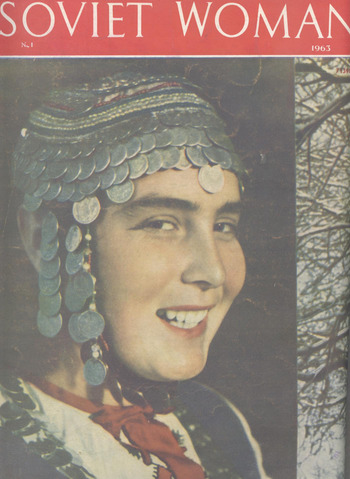
Even as it depicted Zoya as a modern young woman, Soviet Woman described her as “an ordinary Soviet girl” who had not lost an appreciation for tradition. This was underscored by her reverence for her national costume, integral to which was a cap made up of coins that had been passed down through generations, making it a material account of her family history and of the entire Chuvash people. A photograph of Zoya wearing this garment appeared both in the article and on the back cover of the issue of Soviet Woman that featured her. (See Figure 2).
Zoya Markelova – “Daughter of a Chuvash Peasant” (Soviet Woman, No. 1, 1963, outer back cover).

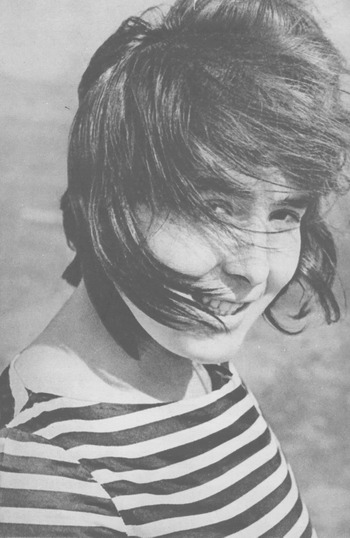
Consideration and respect for traditional dress might have assuaged concerns about the impact of adopting communism on societies resuming their national independence—perhaps all the more so in a place like the Chuvash ASSR, located within the Russian republic. At the same time, a photo essay of Zoya, which captured her in attire ranging from girlish dresses to androgynous work clothes as she participated in a wide array of activities, may have tempered anxieties about female emancipation. (See Figure 3). Soviet Woman frequently inserted references to feminine sensibilities into testimonials about gender equality. For instance, the author of the aforementioned feature on the Tuvan president emphasized that Baikara Dolchanmaa was not singularly devoted to tending to her constituents, but happily allotted time for “cooking tasty meals for her children.”Footnote 74
Zoya Markelova – “An Ordinary [Feminine] Soviet Girl” (Soviet Woman, No. 1, 1963, 9).

The magazine showed admiration for blending femininity and strength also in its commentary on women from developing countries. This is evident in a piece on a gathering at the Friendship House in Moscow celebrating Indonesian independence. Accentuating femininity amid public activism, its author remarked upon the “beauty of [the] dress, … grace, and charm” of the Indonesian women in attendance, adding that they also “take part in solving the most serious and difficult problems. The great achievements … of the Indonesian people would have been impossible without their aid.”Footnote 75 Soviet Woman similarly exhibited high regard for women who combined traditional roles with public life in a piece on Margaret Martei, Secretary of the National Council of Ghana Women, who headed a 1964 delegation to the Soviet Union. Drawing from an interview at its editorial offices, it revealed that Martei had raised three children, was a nurse by profession, had fought for female education, and participated in domestic politics and international conferences. What is more, for her exemplary service to her country, the Ghanaian press named her “Woman of the Year” in 1963.Footnote 76
Portraying women as both feminine and strong was typical of magazines aimed at domestic audiences during the Khrushchev era.Footnote 77 Emphasis on preserving culture alongside representations of women embracing new opportunities to fulfill all manner of functions at home and in the public realm held added meaning in a publication like Soviet Woman, which was, after all, intended for export. Essentially, to whatever extent it evoked friction between tradition and modernization, or roused anxieties about national integrity and changing gender roles, it also “textually provided a way for readers to reconcile those tensions and imagine new possibilities for their lives.”Footnote 78 Specifically, by casting the ideals for socialist femininity and Soviet womanhood as multidimensional and multifaceted, it assured readers that publicly active women need not abandon their customs or become masculine.
Soviet Woman as a “Herald of Friendship”—Signals from Readers
Responses from women abroad suggest that they were receptive to the possibilities that Soviet Woman presented. When Sirimavo Bandaranaike, the Prime Minister of Ceylon (Sri Lanka), wrote to the editors of the magazine, she conveyed a keen interest in the roles that Soviet women played, declaring that women in her own country could learn “a great deal” from Soviet experience.Footnote 79 How did ordinary readers perceive the magazine and relate to the messages about female emancipation, national development, and socialism that it projected?
Official reports of the KSZh indicate that readers generally enjoyed Soviet Woman and found it informative.Footnote 80 Correspondence between Committee members and women abroad offers more nuanced insight into popular reception of the magazine. While letters from women in developing countries occasionally included negative remarks, showing disinterest or dismissal of the magazine as propaganda, those containing comments of a positive nature dominated.Footnote 81 It may be that individuals who held a favorable view of Soviet Woman were more inclined to write to the KSZh. Among them was one in Madras stating that she “read it with great interest and pleasure every month,” and another in Calcutta who described it as “charming and educative.”Footnote 82
Alongside positive impressions, unpublished correspondence also demonstrates the effectiveness of Soviet Woman in undercutting negative preconceptions about the Soviet Union and rousing interest in facets of Soviet life, both critical objectives of the KSZh. For example, a woman from Nairobi divulged to the Committee that she had no idea how “great” the Soviet people were because some in her country alleged that they were “dangerous”; from reading the magazine, she learned what “wonderful friends” they really were and came to admire everything she learned about Soviet progress.Footnote 83 Besides changing her opinions about the Soviet Union, Soviet Woman sparked her interest in appearing in the magazine herself, and even in visiting the country.Footnote 84
Whether this reader ever ended up traveling to the Soviet Union is unknown. For women who were able to spend time there, however, the magazine reinforced the advantages of Soviet reality that they had encountered, as well as served as a periodical souvenir. Such was the case with a woman from Java to whom the KSZh began sending issues of Soviet Woman after she had visited the USSR. In a letter of thanks for the publication, she expressed high regard for Soviet economic policy and stated that she felt that circumstances were better for Soviet than Indonesian women because of greater access to household appliances, which mitigated the challenges of balancing work and home life. She thus seemed encouraged by the possibilities that the Soviet system presented for realizing gender equality.Footnote 85
Despite continual efforts to solicit feedback about Soviet Woman, there is a paucity of direct and detailed statements from recipients about the content of the magazine in the KSZh archives. As a case in point, the Committee member who corresponded with the aforementioned reader from Java assured her that she would continue to receive the magazine, but wondered, for example, if she thought it contained enough information on the conditions of Soviet women and children. While otherwise amicable, supportive, and lively in her letters, the recipient ignored these pointed questions about Soviet Woman.Footnote 86
The appeal of its substance to women in developing countries can nevertheless be gleaned indirectly from letters inquiring about Soviet daily life, education, healthcare, pension law, provisions for mothers and infants, and the participation of women in socialist construction, for these encompassed the very range of topics that Soviet Woman addressed.Footnote 87 That such subjects were of interest to women in Africa and South Asia can also be ascertained from the content of publications produced for or by women in those regions. To illustrate, informational literature about the 1960 Afro-Asian Women's Conference in Cairo acquired by the KSZh covered gender equality, female education, and marriage reform, while an overview of the meeting itself reported on exhibitions of handicrafts and women modelling their national dress.Footnote 88 An accompanying issue of The Afro-Asian Woman, produced by the Afro-Asian People's Solidarity Organization, afforded the same kind of attention to showcasing difference as did Soviet Woman; it featured articles about activities undertaken by Afghan women, Indian womanhood, and children in China.Footnote 89
Reader reactions to the messages of friendship and solidarity that permeated Soviet Woman are easier to gauge than those to specific topics that it covered. Letters to the KSZh were typically infused with a sense of amity. This was implicit in salutations addressing its members as “Dear Comrades” or “Friends.”Footnote 90 Among the more direct assertions of comradery that appeared in the correspondence of the KSZh was the declaration of an Indian woman writing to a Committee acquaintance that they were bound together, “two sisters and friends belonging to two distant parts of the globe.”Footnote 91 Over the course of her letter, she shared details about her personal life and enthusiastically voiced support for the Soviet stance on disarmament, like Soviet Woman, broaching matters that were both personal and political.
That the magazine could resonate with readers and create a sense of sisterhood among women sharing a preoccupation with daily life, issues of gender equality, and foreign affairs is reinforced by the context within which it emerged—that of early postwar international feminism, which cut across ethnic lines. As Fiona Paisley suggested of multicultural interaction, women could transcend “suspicions about difference” to focus on common interests and to unite in the struggle “with the central concerns of their day: diversity and progress, universalism and difference, globalization and cultural identity.”Footnote 92
The same can be said of the producer of Soviet Woman, the KSZh, which was grounded in transnational cooperation stretching back to the Second World War. The perception that the magazine represented women everywhere and spoke to causes they held in common was expressed by the future Prime Minister and then President of the Indian National Congress, Indira Gandhi. Effectively endorsing Soviet Woman during a visit to its editorial offices, she cast it as “a herald of friendship in all countries” that was helping “to spread the ideas of peace throughout the world.”Footnote 93 (See Figure 4).
Endorsement of Soviet Woman from Indira Gandhi (Soviet Woman, No. 10, 1963, 26).

“Communism is the life everyone would like to live.”Footnote 94 This was the title of a 1962 piece in Soviet Woman comprised of comments from women from around the globe praising the “just” rule and economic achievements of the Soviet state. The article was centered around the current program for building communism, which readers had purportedly proclaimed to be substantiation that socialism was leading and capitalism was retreating, a stance in accord with official Soviet convictions about “peaceful coexistence.” Yet, as demonstrated, Soviet Woman was not simply a vessel for projecting tenets of Soviet policy or a primer on the Soviet system. Moreover, it is quite conceivable, as the magazine stated, that the Nigerian who uttered the words that became the tagline for the piece was genuinely impressed with what she had learned about the Soviet Union and found in it attractive options—perhaps even a third way between national tradition and western modernization.Footnote 95
Critiquing their tendency to essentialize women in developing countries, Chandra Mohanty argued that western feminist representations produced a “singular ‘Third World woman’” and typically positioned her problems and successes in relation to “an imagined free white liberal democracy” in a way that made her ahistorical.Footnote 96 For Mohanty, “woman” indicates “a cultural and ideological composite other constructed through diverse representational discourses—scientific, literary, juridical, linguistic, cinematic, etc.,” whereas “women” conjures up “real, material subjects of their collective histories.”Footnote 97 The singular form used for the title of the publication under scrutiny here suggests that socialist discourse tended toward the same instrumentalization of women as its western counterpart. The feature cited at the beginning of this article might be read as presenting the Yakut woman as a variant of the quintessential Soviet woman that would presumably appeal to the typified Congolese woman.Footnote 98
Soviet Woman certainly appeared to be aligned with the official perception that employing the Soviet East to display a Soviet “self” would garner for the Soviet Union influence and legitimacy among developing countries. On the surface, the magazine seemed to “objectify” the non-European Soviet woman by emphasizing the role of the state and Party in freeing her from restrictive customs and illiteracy, providing her new roles in society, and nurturing what it deemed positive traditions. Upon closer analysis, however, it becomes evident that by depicting exemplary women of the Soviet East embracing the array of opportunities that the Revolution had brought, Soviet Woman rendered them agents of their own fate and builders of their country.
In detailing the successes of national progress and of real women, Soviet Woman also signaled that the advancement that socialism offered was accessible to all citizens, regardless of ethnicity.Footnote 99 This message was informed by Soviet nationalities policy, which had disallowed the wholesale replication of the division between “metropole” and “periphery” characteristic of western imperialism, despite Soviet inheritance or acquisition of territories of the former Russian Empire.Footnote 100 Especially significant in the era of decolonization, distinctions between the Soviet Union and “other” countries were also blurred. Basically, by publicizing official programs aimed at ongoing progress within the USSR, outreach to the foreign East presented “developed-developing” as a continuum rather than a dichotomy.
The divisions that emerged in Soviet Woman between “self” and “other” were also muted by Soviet emphasis on “international integration rather than on territorial imperialism”—much in the vein of “Cold War Orientalism” conceptualized by Christina Klein.Footnote 101 Besides, however mighty the discourse about socialist progress appeared in Soviet Woman, Soviet power in the international arena—or even the Third World—was far from hegemonic.Footnote 102 Furthermore, by equating them with social justice, Soviet Woman indicated that communist values, in contrast with the foreign nationalist or imperialist ones that underpinned European empires, were universal.
That said, although the magazine conveyed a potentially universalizing vision for mass participation in public life, by exhibiting respect for national difference within the Soviet Union it emphasized that the Soviet development model did not require newly liberated peoples to surrender ethnic tradition and markers of identity. In this regard, Soviet Woman was aligned with protocols of the KSZh that advocated taking into consideration both “the concrete historical and social conditions of separate countries” and the “international environment.”Footnote 103 These directives also asserted the necessity of recognizing women in developing countries as striving to attain full political independence for their peoples, advancing their national economies and culture, liquidating illiteracy, achieving gender equality in labor and in public and family life, eradicating customs and prejudices that denigrate women, and improving the standard of living.Footnote 104 In presenting women in the foreign East as agents of newly independent countries who were formidable in their own ways, and lauding their activities, Soviet Woman aptly fulfilled these protocols.
Alongside dampening essentialist characterizations of women and tenors of Orientalism that emerged in the magazine, this approach underscores a key contribution of the KSZh in the realm of socialist internationalism. Beyond broadening contacts and strengthening relations with women worldwide, the Committee aimed to provide moral support to the Third World.Footnote 105 This was manifested in Soviet Woman in declarations of friendship and solidarity, which denoted the cooperative nature of the Soviet Union. It was also evident in the encouragement for advancement that the magazine projected through its representations of socialist modernization and female participation in social, economic, and political progress.
The efficacy of, and even interest in appropriating the Soviet template for newly independent peoples was still being determined during the 1950s and 1960s. Yet given the international climate characterized by ideological rivalry, national liberation movements, and global feminism, readers would have found both compelling and empowering accounts of women overcoming various struggles and active in all areas of society, central to which was the message that women everywhere can effect change. Meanwhile, by portraying liberated Soviet women as navigating between national tradition and modernization to build their country, Soviet Woman presented socialist gender equality as critical to resolving the very kinds of challenges that decolonizing countries were grappling with.